Avery's Monster Manual
Still a mess and in progress
I like to give monsters uses to players, weird stat blocks, and battle tactics.
Monsters included:
Bottle Walrus (glass shooting walrus)
Depths Ghost (sea dwelling monster of seaweed and coral)
Drop Bear (tree dwelling beast)
Eyebats (big eyes with bat wings, undead scouts)
Fairy flitter (valuable fleeing/teleporting animal)
Hush (silent wolf, sometimes intelligent)
Game Master (trickster spirit, plays games)
Lugermosh (big stony frog creature which collects valuable for it's master)
Lum-Bhaal acolyte/killer/warlock/abomination + temple features (murder cult)
Nightmare blaster (flying skeletal demon)
Sandman (strange sleep inducing sand beast)
Smokebulb (fuel eating beast)
Spore Crawler (large mushroom turtle)
Trunkneck (huge hidden tree-creature)
Yuan-ti hydrakin (hydra-headed yuan-ti malison)
Guard robot (made for goofy sci-fi dungeon)
Triggers and unpleasantness
General D&D stuff. Fighting monsters, blood, skeletons, ect.
Starving and a disturbing dog (Hush)
Manipulation, abuse (nightmare blaster)
Gruesomeness in general, cults (Lum-Bhaal cult)
Cults, manipulation cannibalism mention (yuan-ti)
Clowns, kinda (Game Master)
Suffocation/Drowning (Sandman, Lugermosh, Depths ghost)
Eyebat
An eye the size of a dwarf's head attached to bat wings. These troublesome undead swarm forgotten forests and dark dungeons. They aid undead in battle, not differentiating between different undead, even those that attack them.
Masterless spies Countless amounts of these things were made in a bygone age. They patrol, watch, and assault the adventurous few who step into their territories.
Strange pests Though they are frightening to look at, they are fairly harmless alone and can easily be taken down by a peasant. As they frequently stray from ancient ruins, they're known to many common people, through stories or direct encounters.
Cheap scouts Eye bats are easy to make, for those who know the disgusting recipe. A human eye (preferably from a curious person), a bat, and one of a variety of slightly magical ingredients (eye of newt, toe of frog, tongue of dog, ect) are boiled in a cauldron. Any small amount of necromantic magic is mixed into the brew, and an eyebat spawns from the burning water.
Banks of knowledge If a necromancer holds the eyebat in their hands, they can see what it has seen.
Eye Bat
Tiny undead, neutral evil
- Armor Class 13
- Hit Points 5
- Speed flying 30ft
STR DEX CON INT WIS CHA 2 (-4) 16 (+3) 6 (-2) 2 (-4) 16 (+3) 1 (-5)
- Skills Perception +5
- Senses Darkvision 60ft, passive perception 15
- Damage immunities necrotic, poison
- Condition immunities poisoned
- Languages Obeys infernal, abyssal, and it's creator, can't speak
- Challenge 1/8 (25xp)
Sentry. An eyebat can focus on one creature within 60ft at a time, which gives undead within 30ft of it advantage on attacks against that creature.
Sensitive to light Any amount of radiant or fire damage instantly destroys an eyebat.
Actions
Charge. Melee Attack: +3 to hit, Reach 5 ft, one target. Hit 1 bludgeoning damage. 1 recoil damage.
Eye Bat
Large undead swarm, neutral evil
- Armor Class 10
- Hit Points 90
- Speed flying 30ft
STR DEX CON INT WIS CHA 10 (0) 18 (+4) 10 (0) 2 (-4) 20 (+5) 1 (-5)
- Skills Perception +10
- Senses Darkvision 60ft, passive perception 20
- Damage vulnerabilities radiant, fire
- Damage immunities necrotic, poison
- Condition immunities poisoned
- Languages Obeys infernal, abyssal, and their creator, can't speak
- Challenge 2 (450xp)
Sentry swarm. An eyebat swarm grants advantage to any undead within 60ft attacking any creature within 60ft. If many undead are about, this can be summarised as +4 to hit instead of advantage.
Swarm. The swarm can occupy another creature's space and vice versa. This grants disadvantage on attacking creatures other than the eyebat swarm and lightly obscures the area. The swarm can move through any space big enough for a regular eyebat, but it takes 30ft of movement. The swarm can't gain hit points or temporary hit points.
Actions
Charge. Melee Attack: +3 to hit, Reach 5 ft, one target. Hit 9 (1d12+4) bludgeoning damage. 1d10 recoil damage.
Bottle Walrus
Bottle Walruses look like regular walruses except they have clear tusks and white hide. They live on cold shores, and are terrors to the local halfling people. They can shoot hollow balls of glass from their mouth, through their tusks.
Bottle Walruses mostly ignore or fear creatures larger than themselves. White dragons sometimes make their lairs near hordes of bottle walruses (and occasionally feed on them). They target smaller creatures, and often knock aside or ignore obstacles to reach their target. Bottle walruses might try to attack medium human sized creatures, but not if they are outnumbered.
Bottle Walrus
Medium beast, Unaligned
- Armor Class 13
- Hit Points 80
- Speed 15ft, 30ft swim
STR DEX CON INT WIS CHA 16 (+3) 8 (-1) 18 (+4) 1 (-5) 6 (-2) 1 (-5)
- Skills Stealth +2
- Damage resistances cold
- Challenge 1 (200xp)
Bottle Gland. With a DC 12 medicine or nature check, the glass-ball creating gland can be removed, and can make 1d12 balls. With a DC 22 result, the firing organ is removed as well. It sells for 8gp on it's own, or 10gp with the firing organ.
Actions
Multiattack. The walrus makes a shove attack and a ball/stab attack.
Shove. The walrus makes a +3 roll contested by the target's Athletics or Acrobatics. If it succeeds, the target falls prone (or is pushed 5ft away).
Launch ball. Ranged/Melee Attack: +1 to hit, Reach 30/60 ft, one target. Hit 5 (1d8+1) bludgeoning damage + 3 (1d6) piercing damage.
Tusk stab. Melee Attack: +3 to hit, Reach 5 ft, one target. Hit 7 (1d12+3) piercing damage.
Fairy Flitter
Fairy Flitters are rare sights around forests and jungles. They leave a short trail of sparkles wherever they go. Villages near a fairy flitter have rumors that it's sparkles have miraculous effects on crops, and will pay as much as they can for it (sometimes hundreds of silver). Fairy flitter hide is used to make a Bag of Tricks, and it's fur is a key ingredient in a number of potions.
Fairy Flitter
Tiny beast, Unaligned
- Armor Class 14
- Hit Points 4
- Speed 30ft
STR DEX CON INT WIS CHA 4 (-3) 16 (+4) 18 (+4) 4 (-3) 12 (+1) 4 (-3)
- Challenge 2 (450xp)
- Senses Truesight 5ft
Grabbing the fairy flitter. When within 5ft, the fairy flitter may be grabbed (even as an opportunity attack). The pursuer makes an athletics check contested by the fairy flitter's dexterity check. The fairy flitter may attempt to escape once, at disadvantage.
Actions
Dash. The fairy flitter moves twice it's movement speed.
Teleport (Recharge 6). The fairy flitter teleports to a location 10ft away that it can see. It cannot do so if it is touching skin (including dead skin, such as leather).
 http://www.cadnav.com/3d-models/model-37860.html
Smokebulb
Smokebulbs are creatures with 3 strong legs, a large bulbous body, stony skin, a claw, and 3 ‘chimneys’ rising out of it’s head. It shovels fuel into it’s gaping, furnace-like maw for food. A smokebulb can spit coals and embers to attack, and the area around it is constantly filled with smoke and ash. A hungry Smokebulb is a dangerous thing as it seeks any nearby flammable objects with a life-risking desperation, including the hair, clothes, and spears of nearby creatures.
Some people try to 'tame' smokebulbs, but it has no concept of moderation and will eat anything it can.
Smokebulb eggs contain a spark of life, which is used to create many fire producing magic items.
Smokebulb
Medium beast, Unaligned
- Armor Class 13 (natural armor)
- Hit Points 80
- Speed 25ft
STR DEX CON INT WIS CHA 14 (+2) 12 (+1) 12 (+1) 1 (-5) 6 (-2) 1 (-5)
- Damage vulnerability cold
- Damage resistances fire
- Challenge 1 (200xp)
Bottle Gland. With a DC 12 medicine or nature check, the glass-ball creating gland can be removed, and can make 1d12 balls. With a DC 22 result, the firing organ is removed as well. It sells for 8gp on it's own, or 10gp with the firing organ.
Actions
Ash Puff. The smokebulb emits a puff of smoke and ash, heavily obscuring the area within 10ft for 1d4 rounds and blinding anyone within 5ft who fails a DC 13 CON save for the same amount of rounds.
Fire spit. Ranged/Melee Attack: +3 to hit, Reach 15/30 ft, one target. Hit 6 (1d10+1) fire damage.
Claw. Melee Weapon Attack: +4 to hit, Reach 5 ft, one target. Hit 6 (1d8+2) piercing damage.
Drop Bear
Dropbears live in forests with thick foliage or tall trees. They look like grey or brown bears that are about two and a half feet tall. Local people have many stories about scars they got from dropbears for outsiders to hear. They are fierce, bloodthirsty beasts who are not above attacking whole groups of people. They fear fire. Dropbear bounties can go for 1 or 2 silver a paw.
They sometimes will retreat as a group back up into the treetops and follow a group to ambush again if they were not very successful the first time.
Dropbear
Small beast, Unaligned
- Armor Class 12 (natural armor)
- Hit Points 10
- Speed 25ft, 25ft climbing
STR DEX CON INT WIS CHA 12 (+1) 14 (+2) 10 (0) 1 (-5) 10 (0) 2 (-4)
- Skills Acrobatics +5, Athletics +5
- Challenge 1/8 (25xp)
Pillowy A dropbear can fall up to 20ft without taking any damage.
Actions
Drop. The drop bear rolls an acrobatics check against a DC of 10. If it succeeds, then it automatically makes a claw attack. If it fails, it takes fall damage (taking into consideration it's Pillowy ability).
Claw. Melee Attack: +1 to hit, one target. Hit 3 (1d4+1) slashing damage.
Spore Crawler
These large turtles, if not provoked, are not particularly hostile. However, they terrorize small communities in the deep forests and deep caves where they live. Gnomes and wood elves often cannot live the easy life they wish if a spore crawler wonders around poisoning wildlife and eating crops.
Spore crawlers are often taken as pets by people and even creatures immune to poison, such as green dragons or yuan-ti. Some druids and dryads keep them on patrol as a deterrent to magical springs and mushroom groves.
Spore crawler's mushrooms and blood can be used as an anesthetic, a fact not lost on the communities that live near these exotic creatures. DC 5 nature to recognise, DC 10 to brew (with the proper tools). A failed brewing roll will make the target poisoned until they take a long rest and
In battle, the Spore Crawler is often just there as a passively supporting creature. If it is directly attacked though, it will burrow and approach through dirt then bite when it senses someone nearby. Unless it is cornered, it will flee at half health. The spore crawler retreats it's limbs into it's shell as necessary (this is taken into account by AC and Burrower)
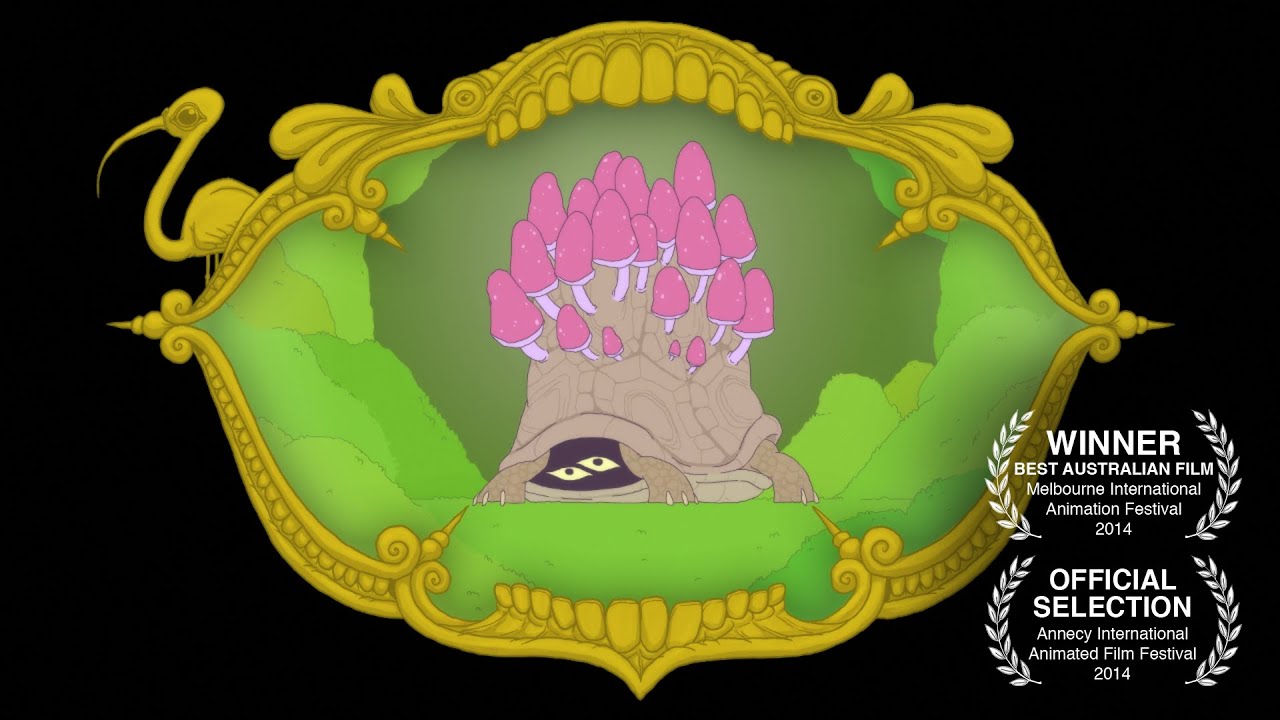 From Felix Colgrave's "The Elephant Garden"
Spore Crawler
Large beast, Unaligned
- Armor Class 15
- Hit Points 120
- Speed 10ft, burrow 10ft
STR DEX CON INT WIS CHA 18 (+4) 2 (-4) 18 (+4) 1 (-5) 6 (-2) 1 (-5)
- Damage Vulnerabilities Fire
- Damage Immunities Poison
- Senses Tremorsense 5ft
- Challenge 1 (200xp)
Burrower. While the spore crawler's bottom half is burrowing (only in dirt), it appears as a dirt mound of mushrroms and has an AC of 20, but cannot Bite.
Poison Cloud. The 10ft area around the Spore Crawler is lightly obscured.
Any creature that enters or starts it's turn within 10ft of the spore crawler must make a DC 14 CON saving throw. If the saving throw is failed, the creature is poisoned for 1d4 rounds. If the throw is failed by 5 or more, the creature is also blinded for that duration.
Closing eyes and/or holding breath is a valid strategy to deal with this.
Broken shell The Spore Crawler cannot regain more than half HP.
Explosive! If the spore crawler takes fire damage, it must succeed on a CON save of 10 + fire damage taken or explode (Alternatively, any fire damage can explode the Spore Crawler). Creatures within 20ft of the spore crawler must make a DC 14 DEX saving throw or take 1d20 piercing damage from shrapnel, taking half damage on a successful save. Creatures next to the Spore Crawler take 4d6 fire damage or half on a successful save.
Actions
Bite. Melee: +4 to hit. Hit: 9 (1d10 + 4) piercing damage
Trunkneck
Trunknecks are peaceful, but powerful, forest dwelling creatures. They bury their rooty bodies under the ground and leave their tree trunk like necks poking above the canopy throughout the day, and wander curiously during the night. Their heads have small, white, waxy eyes and a bare few green leaves on top. They fear fire, but are not particularly vulnerable to it because unless extremely old they are mostly composed of healthy bark. They are attracted to colorful bunches of objects, which can hold their attention for a few hours before they look for something else. Should anyone climb their neck, they are very inattentive but may thrash around if they are awake (or awoken).
Woe the Lumberjack who doesn't inspect a tree they're about to axe, or doesn't heed the local druid's threats.
The leaves on top of a trunkneck's head are used in the creation of a staff of the woodlands, as well as superior potions of healing.
Trunkneck
Huge plant, Unaligned
- Armor Class 15 (natural armor)
- Hit Points 180
- Speed 30ft, burrow 5ft
STR DEX CON INT WIS CHA 22 (+6) 8 (-1) 20 (+5) 1 (-5) 4 (-3) 1 (-5)
- Saving throws Strength +9
- Senses Passive perception 7
- Challenge 5 (1800xp)
Distraction. If there is a bunch of colorful objects in the trunkneck's vision, it has disadvantage on attacks and trash.
Climbing the trunkneck. DC 13 athletics to get onto the body, DC 22 athletics (or DC 16 if asleep) to climb the neck.
Actions
Stomp. Melee: +6 to hit. Hit: 42 (6d12 + 6) piercing damage
Charge. The Trunkneck moves twice it's normal movement speed. Any creatures in it's way that are large or smaller must make a
DC 9 DEX saving throw or take 30 (5d12) damage or a
DC 16 STR saving throw to sufficiently divert/slow down the charge or the trunkneck continues it's charge and take 30 (5d12) damage.
Trash. As a bonus action the trunkneck makes a strength roll contested with all creatures climbing it to throw them off. Those on the body fall off and take 1d10 damage, those one the neck are flung 3d10ft away and take 2d10 damage.
Hush
Hushes are always lead by an Alpha Hush, who is as smart as a man and has a haunting, whispering voice (Int 10 (+0), telepathy 10ft). Alpha hushes are cunning and cruel, directing the regular hushes. Alpha hushes arise whenever there is a lack of one in a hush pack, and create more hushes by infecting common wolves. Given a good deal, alpha hushes might work for/with a humanoid, most often bandits and other rural criminals. Hushes are said to be the ghosts of wildmen's starved dogs (or, if more knowledgeable, ghosts of wolves that die of infection)
Hush
Medium beast, Unaligned
- Armor Class 13
- Hit Points 5
- Speed 30ft
STR DEX CON INT WIS CHA 12 (+1) 15 (+2) 4 (-3) 3 (-4) 12 (+1) 6 (-2)
- Skills Stealth +6 (also completely silent)
- Damage Immunities cold
- Senses darkvision, blindsight 30ft
- Languages -
- Challenge 1/8 (25 XP)
Silent. A hush never makes any noise.
Sunlight Sensitivity. A hush has disadvantage on attack rolls in sunlight.
Actions
Bite. Melee Attack: +4 to hit, Reach 5 ft, one target. Hit 7 (2d4+2) piercing damage. The target must succeed on a DC 7 CON save or be stunned for 1 round.
 https://greeneyedmonster88.deviantart.com
Nightmare Blaster
The nightmare blaster can sow nightmares in sleeping people, and it is it's preferred way of causing distress and chaos. The personalised nightmares it sticks can last for weeks or months, more than long enough for the demon's victims to become emotionally vunerable and suspectible to it's psychic taunts and commands. As the demon targets more than one person in a community, the presence of a Nightmare Blaster causes rumors of a Nightmare Sickness.
Nightmare Blasters form when powerful draconic mortals end up in the chaotic hells, such as sorcerers and dragonborn. They torment fellow demons, even stronger ones, with nightmares that suggest the worst neverending pains should they disobey an order from the Nightmare Blaster. After many years, it swoops in and recruits it's new minion.
In battle, they rely on their flight and curse laser to stay out of range and drop anyone who approaches them to the floor, preferably where their minions reside.
Nightmare Blaster
Large Fiend, Chaotic Evil
- Armor Class 15
- Hit Points 190
- Speed 30ft, 40ft flying
STR DEX CON INT WIS CHA 16 (+3) 18 (+4) 12 (+1) 10 (0) 10 (0) 16 (+3)
- Saving Throws Charisma +7
- Damage Resistances Piercing, One Elemental Type
- Condition Immunities Fear
- Languages Telepathy 100ft, Draconic, Abyssal
- Challenge 10 (6000xp)
Actions
Multiattack. The Nightmare Blaster makes two claw attacks and one laser attack
Curse Laser. Ranged: +8, 150ft/300ft, one target. Hit: 24 (4d12) One Elemental Type. On a hit the target rolls a CHA saving throw (DC 15) or they Grovel (Prone)/Flee, Nightmare Blaster's choice.
Razor Claw. Melee: +8, Hit: 12 (3d8) slashing damage
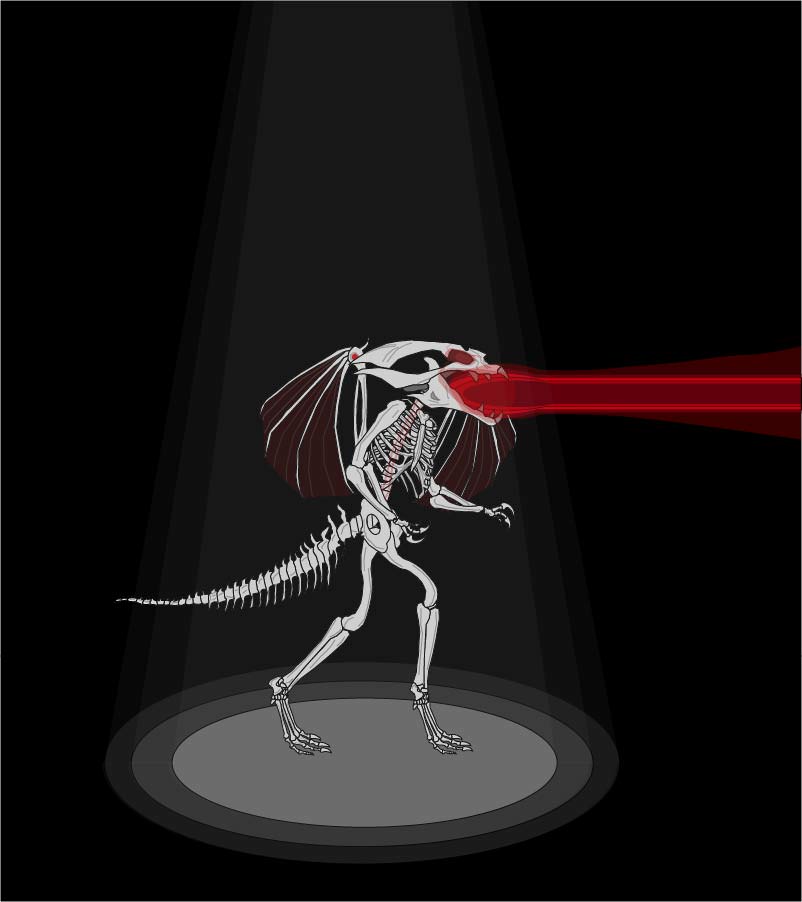 -A friend
Lum-Bhaal Cult
Lum-Bhaals are cultists that worship Bhaal, god of murder. They are often people who were brought in with the cult’s true purpose hidden, or murderers and outlaws that have turned to worshipping Bhaal to get away with their deeds.
The traditional Lum-Bhaal outfit is composed of hide armor, an executioner's hood with 13 drops of blood (or red droplet glass/gems) on it, and a battleaxe. This outfit brings the Lum-Bhaals luck when committing their crimes and the obvious benefit of obscuring one's identity if they live within regular society. The inner sanctums of their temples are decorated with the skulls of their victims, which hold the magic of their blood sacrifices steady.
Though Bhaal is not a powerful god, and the cultists are few, the great power of blood sacrifice and ancient occult techniques has provided the cult with much magical power that has otherwise been lost to the centuries. In particular, Lum-Bhaal temples are immune to divination magic (only the temples, members outside the temples have no protection) Bhaal also often appeals to murderers of a high class, even if they avoid doing the dirty work themself. For this reason many nobles, guild masters, and even royalty can be found with connections to Bhaal.
They are practised in travelling far from their hidden temples as not to be found out or pick too often from a particular village.
The Lum-Bhaal cult despises hydra-worshipping yuan-ti cults, as their texts claim it was made specifically to defeat the champion Lum-Bhaal Birel Siannodel who could not kill it no matter how many heads she cut off.
Their tactics in active combat outside of their lair are usually to run away to assassinate later. When running isn't an option, they try to block the exit and overwhelm their enemies with direct attacks and shoves.
Lum-Bhaal Acolyte
Medium Humanoid, Any Evil Alignment
- Armor Class 12
- Hit Points 10
- Speed 30ft
STR DEX CON INT WIS CHA 12 (+1) 12 (+1) 10 (0) 10 (0) 10 (0) 12 (+1)
- Saving Throws Charisma +3
- Languages Regional
- Challenge 1/8 (25xp)
Actions
Melee Handaxe. Melee: +3 to hit, Hit: 4 (1d6+1) slashing damage

A symbol of Bhaal
Lum-Bhaal Killer
Medium Humanoid, Any Evil Alignment
- Armor Class 14
- Hit Points 60
- Speed 30ft
STR DEX CON INT WIS CHA 16 (+3) 14 (+2) 12 (+1) 12 (+1) 8 (-1) 14 (+2)
- Saving Throws Charisma +4
- Languages Regional
- Challenge 2 (450xp)
Predator's Assurance. The Lum-Bhaal Killer has advantage on the next attack towards any creature it damaged on the previous round.
Magic Weapon. Lum-Bhaal Killers often carry cursed weapons bestowed upon them by their leader. These weapons, once they have tasted blood, compel the user to finish their foe (DC 16 wisdom save to resist).
Assassin's Blood The Lum-Bhaal carries a vial of the "assassin's blood" poison. It appears as a vial of blood and must be ingested to work. It deals 1d12 damage and poisons the target for 24 hours, unless a DC 10 CON save is made in which case it deals half damage and isn't poisoned. A Lum-Bhaal Killer typically sticks around incase the poison doesn't finish the job.
Actions
Battleaxe. Melee: +5 to hit, Hit: 8 (1d10+3) slashing damage
Lum-Bhaal Warlock
Medium Humanoid, Any Evil Alignment
- Armor Class 12
- Hit Points 30
- Speed 30ft
STR DEX CON INT WIS CHA 10 (0) 10 (0) 10 (0) 14 (+2) 14 (+2) 16 (+3)
- Saving Throws Charisma +5
- Skills Deception +5, Persuasion +5
- Languages Regional, Abyssal, Infernal
- Challenge 2 (450xp)
Spell Slots. 1st level (4), 2nd level (3)
Unholy book. The Lum-Bhaal Warlock's spellbook is warded against good aligned creatures, who take 1d12 necrotic damage if they open it. The spells contained inside are darkvision, thaumaturgy, unholy chill, inflict wounds, shield of faith, hold person, command
Actions
Handaxe. Melee: +2 to hit, Hit: 3 (1d6) slashing damage.
Unholy Chill. A black cloud flows along the floor towards a target within 60ft, who makes a DEX save of 13 or takes 1d8 necrotic damage. (VS) (cantrip, sacred flame)
Shield of Faith. As a bonus action, the Lum-Bhaal Warlock delivers blessings and grants +2 AC to a target for 10 minutes. (Concentration) (1st level) (VSM - a bit of holy text)
Thaumaturgy. The Lum-Bhaal Warlock makes a threat with supernatural backing such as floor rumbling.
Inflict Wounds. Melee: +4 to hit, 3d10 necrotic damage. The Lum-Bhaal warlock touches a target and dry wounds spring from their skin. At 2nd level or higher, this spell deals 1d10 additional damage for each spell slot level above the first. (1st level) (VS)
Command. The Lum-Bhaal Warlock delivers a single word command such as Drop, Flee, Halt, Approach or Grovel to a target within 60ft. The target must understand the language, and makes a DC 13 saving throw or follows the command and ends it's turn on it's next turn. (1st level) (V)
Hold Person. The Lum-Bhaal Warlock points an iron bar at a target within 60ft, who makes a DC 13 WIS saving throw or is Paralysed for 1 minute. At the end of each of it's turns the target may make another saving throw to end the effect. (Concentration) (VSM - A small straight piece of iron) (2nd level)
Lam-Bhaal Abomination
When 13 sacrifices are made to Bhaal simultaneously alongside dark rites, a loyal murderer may bath in the falling blood and be transformed into a monster. Lum-Bhaal Abominations feel no pain, and can keep fighting right up until their body literally cannot move. Their skin is dark like shadow and deep crimson bones glow underneath. They are mostly kept in Lum-Bhaal temples except in extraordinary circumstances.
The Lum-Bhaal Abominations do not eat, drink, or sleep.
Lum-Bhaal Abomination
Medium Monstrosity, Any Evil Alignment
- Armor Class 15 (natural armor)
- Hit Points 140
- Speed 30ft
STR DEX CON INT WIS CHA 16 (+3) 14 (+2) 18 (+4) 14 (+2) 6 (-1) 16 (+3)
- Saving Throws
- Senses Darkvision 60ft
- Languages Regional, Abyssal, Infernal
- Challenge 5 (1800xp)
Predator's Assurance. The Lum-Bhaal Killer has advantage on the next attack towards any creature it damaged on the previous round. It does not get two advantage attacks in a row against a single target, but does against separate targets.
Heart of Darkness. 20ft around the Lum-Bhaal Abomination's heart (and thus themself) is shrouded in dim light (disadvantage on perception checks). Torches dim, sunlight is weaker and magical light of 1st level or lower falters. This property is retained until the heart is shredded.
Magic Weapon. Lum-Bhaal Killers nearly always carry cursed greataxes which when drawn compel the user to kill (DC 17 to resist, can retry every minute).
Murderer's Blood When the Lum-Bhaal Abomination is damaged, the attacker must make a DEX saving throw or take 1d10 acid damage, or half on a successful save.
Actions
Multiattack. The Lum-Bhaal Abomination makes two greataxe attacks.
Greataxe. Melee: +6 to hit, Hit: 9 (1d12+3) slashing damage.
Lum-Bhaal Temples
Lum-Bhaal lairs, regardless of if they are ancient Bhaal temples or renovated areas, often have magical safeguards over them. Lum-Bhaal temples are designed for defence against mass amount of enemies and are filled with traps designed for many enemies. There are many secret corridors (with peepholes) while the open areas are largely linear and filled with traps, allowing the cultists to surround and ambush their enemies.
Pillar rooms (Open area)
Worship rooms that are large but filled with wide pillars every 10ft, effectively making the room a grid of 5ft corridors. They force organised groups to split up and Lum-Chaal cultists to surround individual people easily. They are shrouded in darkness, and can only be filled with dim light out to 5ft. Magical light of 1st level or lower are dimmed.
There are sometimes open cages on the sides of the rooms, for quick storing of recently aquired victims. These rooms are often near the entrance.
Acid Pit (Open Area)
Empty rooms that have peepholes and manually activated acid pits (activated from behind secret doors). There are also often portculli to make properly escaping the acid pit room difficult. While the acid isn't strong enough to take down a seasoned soldier, it can deal enough to drastically change the tide of a siege.
The acid is 1ft deep and does 1d10 damage per round. The rooms are typically 10ft-15ft wide as well as deep, there is enough places around the walls for two people to stand flat against the wall. There are also torch scones to possibly hang onto.
Secret doors at the side of the room may be opened to throw rocks or shoot arrows at people who survive.
Secret Doors
The secret doors are one way, with some going into the open rooms and one going out. They act like simple stone doors, but have no obvious way to open them on one side. They have peepholes.
Channeling room (Secret room)
This room is locked by a DC 15 lock. It contains several skulls, cursed idols, and a ritual circle drawn in blood. Destroying the skulls or consecrating the area weakens or disables a warlock's power. It may also disable the magic of a room.
Cursed Idols (Secret room)
Gold statuettes of Bhaal upon pillars. They deal 1d12 necrotic damage when touched by a non-evil aligned creature. Worth 10gp each, but caution to those who try to sell them (at least, without melting them down). Can be touched indirectly, such as with a stick, but not with a glove.
Acid Pot
A ceramic pot filled with acid, the bizarre remains of previous cultists. Splashing the acid or throwing the pot at someone counts as an improvised weapon attack and does 1d10 acid damage.
Ritual Room (Secret room)
Large room that contains a stage with an altar, 13 (vertical) sacrificial tables on pillars in the center, and chandeliers.
Living Area
A large area with a roof open to the sky. The roof may be wound closed, upon which it looks like a normal hillside/mountainside/ect from afar.
Game Master
Trickster spirits that challenge adventurous souls to games of chance. They appear as jesters wearing strange face paint and gaudy outfits. They exist for games, merriment, and mischief.
If attacked, they will run and cause as much mischeif for their pursuers as possible, even after they stop pursuing. They'll wet floors, loop around, warn enemies, trip them up and cover them in oil (then light them on fire).
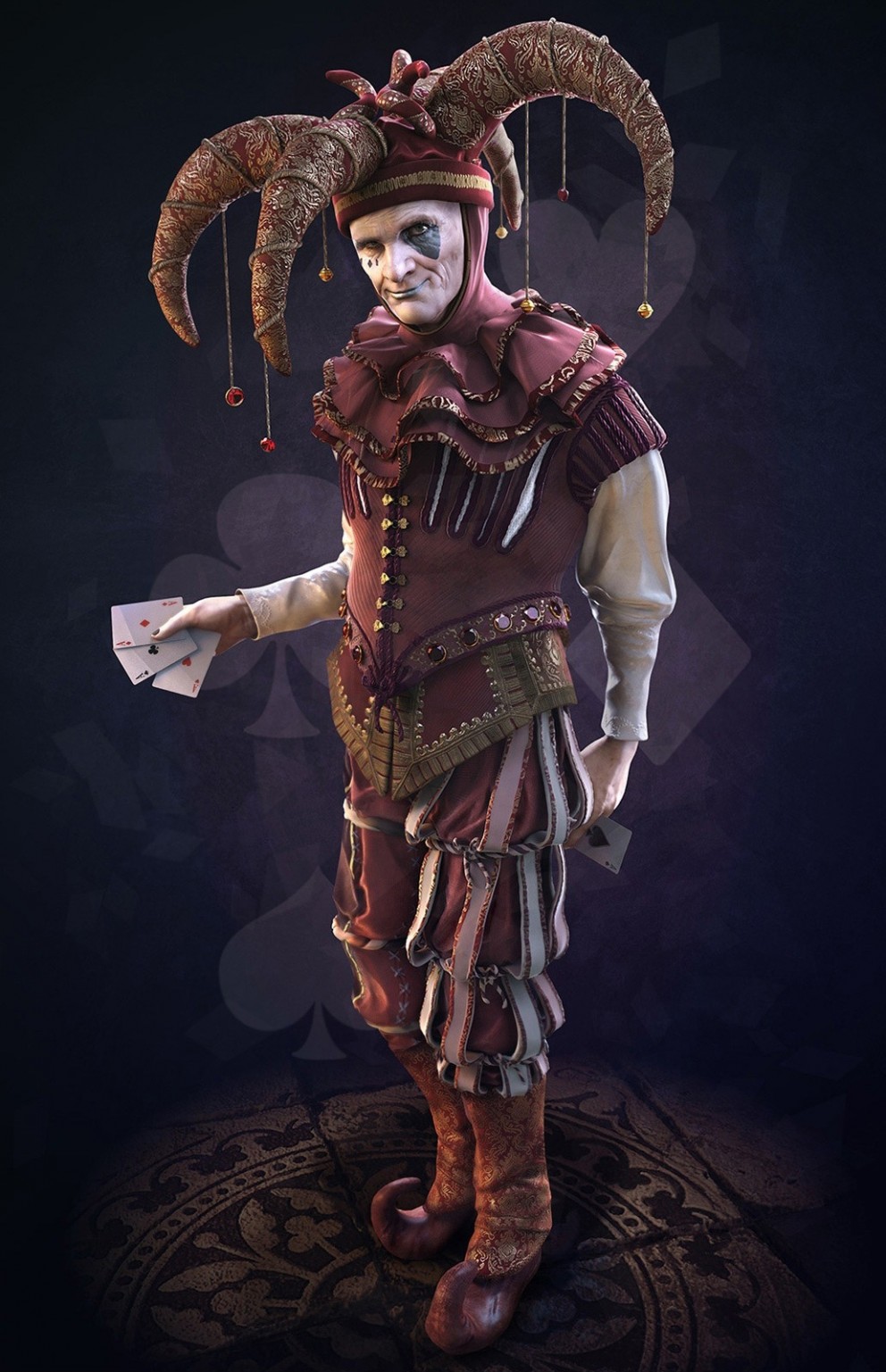 Raphael Boyon at http://www.bohemond.fr/
Game Master
Medium Fey, Chaotic Neutral
- Armor Class 14 (natural armor)
- Hit Points 50
- Speed 30ft, 15ft flying
STR DEX CON INT WIS CHA 8 (-1) 18 (+4) 10 (0) 14 (+2) 14 (+2) 16 (+3)
- Skills Sleight of Hand +8, Deception +7, All games +6
- Languages Gnomish, Halfling, Sylvan
- Challenge 3 (700xp)
First to Three. Place a bet. The game master will attempt charades even with those it can't speak to. Roll a contest between the participants, with the higher roll winning. This is using the player's proficiency in gaming sets and the appropriate modifier (INT or WIS). First person to 3 wins. The game master will up the stakes and maybe even offer up their own magic items. It is possible for the game master to bet souls if they are sure enough they can win.
Focused Gambler. Advantage on saving throws against being charmed.
Magic Item. The game master carries a bad of tricks, bag of holding, deck of illusions, medellion of thoughts, or a robe of useful items.
Trick up my sleeve The game master has extra cards and loaded dice hidden in their sleeves to cheat with. They also carry various games like dice, playing cards, Three-Dragon Ante and rarely dragon chess (it's harder to cheat at), as well as gold (2d100). The game master likely also carries a couple of other items such as a water canteen, a tablecloth, a bag of ball bearings, caltrops or throwing daggers.
Actions
Fast Hands. The Game Master uses a bonus action to make a sleight of hand check (such as steal) or use an object.
Cheat. The Game Master rolls sleight of hand against the passive perception (or active perception, if they are looking out for cheating) to produce a perfect win.
Steal. The game master rolls a sleight of hand check (even if the target is aware) to take an item from someone such as their weapon, belt, or up to 300 of one kind of coin.
Dancing Lights. The Game Master casts dancing lights.
Yuan-Ti
People who have kept or learnt the secrets of ancient empires, using strange and sometimes cannabalistic rituals to turn themselves into snake creatures. To non-yuan-ti they wish to recruit, they mask as a cult, bringing in the vulnerable and angry then gradually bringing them closer to the truth until they're either truly indoctrinated or in too deep.
Yuan-Ti philosophy states that emotions are pointless, and that reason is the way to true power. They take pride in thinking nothing of anyone that isn't a yuan-ti as meat (though in reality they rarely actually perform cannibalism). Ultimately, all it takes to survive or even 'believe' in groups is to want more power and control over others.
Yuan-Ti Hydrakin
A kind of Yuan-Ti Malison with many necks atleast a foot long upon which sit serpent heads. Exactly as it sounds.
Yuan-Ti Hydrakin
Medium Monstrosity, Neutral Evil
- Armor Class 11 (natural armor)
- Hit Points 66 (12d8 + 12)
- Speed 30ft, 30ft swimming
STR DEX CON INT WIS CHA 14 (+2) 16 (+3) 13 (+1) 14 (+2) 16 (+3) 16 (+3)
- Skills Deception +5, Stealth +5, perception +5
- Damage Immunities. Poison
- Condition Immunities. Poisoned
- Senses. Darkvision 60ft, passive perception 15
- Languages Common, Yuan-Ti
- Challenge 4 (1100xp)
Better than one. The hydrakin by default has 2 heads. While it has more than one head, the hydra has advantage against being blinded, charmed, deafened, frightened, and knocked unconscious. All heads share vaguely the same consciousness, but may manifest in different ways.
Better than two. Whenever the hydrakin takes 10 or more slashing damage in a single turn, one of it's heads is decapitated. If all it's heads die, the hydrakin dies. At the end of it's turn, it grows two heads for each one of it's heads that was decapitated, unless it has taken fire damage since it's last turn. The hydra regains 5 hit points for each head regrown in this way.
Shapechanger The yuan-ti can use it's action to transform into a multi-headed medium snake or back into it's true form. Any equipment it is wearing or carrying isn't transformed. It doesn't change if it dies.
Innate Spellcasting.
At will: animal friendship (snakes only)
3/day: suggestion (save 13)
Magic Resistance. The yuan-ti has advantage on saving throws against spells and other magical effects.
Watching Warrior. The hydrakin has advantage on opportunity and ranged attacks.
Actions
Multiattack. The hydrakin makes as many bite attacks as it has heads.
Bite. Melee attack: +5 to hit, reach 5ft., one creature. Hit: 5 (1d4+3) piercing damage + 7 (2d6) poison damage.
Longbow. +5 to hit, range 150/600ft, one target. Hit: 6 (1d8+2) piercing damage plus 7 (2d6) poison damage.
Lugermosh
Lugermoshes are huge, froglike, stoney skinned creatures that are the result of some twisted mage's experiments on regular frogs. Their bulky human-like tongues are incredibly sticky, and often contain the belongings (and corpse) of previous victims or plunders. Things put in their mouth are preserved. A lugermosh's purpose is to collect wealth (and sometimes other things) for it's master. Without a master, they often wonder the world hoarding what they can in their mouths before they can't fit any more.
A lugermosh may present the objects on it's tongue in an effort to lure other creatures to it. It will attempt to Lick opponents before Leaping onto them, as crashing them may damage valuables.
Lugermosh
Huge monstrosity, Unaligned
- Armor Class 16
- Hit Points 190
- Speed 20ft, 20ft swim
STR DEX CON INT WIS CHA 18 (+4) 12 (+1) 18 (+4) 6 (-2) 16 (+3) 1 (-5)
- Damage vulnerabilities cold, thunder, adamantine weapons, warpicks, pickaxes
- Challenge 8 (4000xp)
Actions
Multiattack. The walrus makes a shove attack and a ball/stab attack.
Lick. The Lugermosh targets a 5ft square adjacent to it DC 15 DEX save or are trapped on the Lugermosh's tongue in it's mouth. DC 20 to remove self or another creature from the tongue. If the Lugermosh dies or decides so, all objects on it's tongue are no longer stuck. A creature can breathe for 1d2+CON rounds before it drops to 0 hit points and is dying. This time resets any time the lugermosh opens i's mouth, such as to make another Lick attack.
Crush. The Lugermosh deals 5d10 damage to the objects and creatures in its mouth (only in desperation).
Leap. The Lugermosh leaps atleast 20ft up in the air and lands in a spot within 50ft. All creatures within the area it lands must make a DC 15 DEX saving throw or take 51 (8d10) bludgeoning damage, as well as be restrained under it's body (unless it moves). It can jump in a lower-roofed space but it only does 5d10 and takes 1d10 damage.
Sandman
Spawned from the sand of a lonely beach, the mysterious and disturbing sandman lumbers across the coast. A sandman chases and puts to sleep (and occasionally, kills) any creature it sees or hears. While not necessarily deadly, an encounter can leave someone vulnerable to wild animals and other hostile inhabitants of the wilderness.
In truth, a sandman is just a misunderstood being who's energies originate on the elemental plane of earth. In the material plane, the sandman is exposed to the noisy and fast moving waking world which never seems to stop or rest. Some sandmen may collect gold and other minerals from those it finds, as it passes for food for some denizens of it's home plane. Of course, a sandman not need be a good aligned being. They might also be bound by a mage's spell.
On the elemental plane of earth, Sandmen serve as pacifiers and law enforcers for the slaver Dao genies.
Sandman
Medium elemental, Neutral
- Armor Class 15 (natural armor)
- Hit Points 130
- Speed 20ft, 20ft burrow (sand only)
STR DEX CON INT WIS CHA 16 (+3) 10 (+0) 16 (+3) 8 (-1) 10 (0) 14 (+2)
- Skills Athletics +6
- Damage Vulnerabilities slashing, fire, force, thunder
- Damage Resistances poison
- Senses darkvision 120ft, tremorsense 30ft
- Languages Terran
- Challenge 5 (1800 XP)
Actions
Sleep dust. The sandman blows sparkling sand in a 15ft cone. Creatures within this cone must make a DC 15 CON save or fall asleep.
Smother. The sandman engages a creature within 5ft in a grappling contest (automatically wins if the creature is asleep, but wakes them up). The creature smothered (grappled) by the sandman immediately starts suffocating and falls to 0 hit points within 1 + CON rounds. They must engage the sandman in another grappling (athletics) contest to escape the smother.
Slam. Melee Attack: +6 to hit, reach 5 ft, one target. Hit 8 (1d10+3) bludgeoning damage.
Depths Ghost
A depths ghost is a nightmarish creature that appears as a bed of coral walking on seaweed legs. The torso of the creature is made out of coral and the seaweed intertwines within this, forming it's lengthy limbs. Two glowing yellow eyes and a gaping hole that resembles a mouth stare at its prey from the darkness. It's known to latch onto ships and drag sailors overboard into the sea. For this reason it's often rumoured that depths ghosts are the remains of drowned sailors.
Pseudo constructs. Depths Ghosts can be revived (once) with a magic ritual often performed by sea hags and druids.
Depths Ghost
Medium Plant, unaligned
- Armor Class 14 (natural armor)
- Hit Points 100
- Speed 20ft.
STR DEX CON INT WIS CHA 16 (+3) 14 (+2) 14 (+2) 6 (-2) 11 (+1) 4 (-3)
- Skills Stealth +4, Athletics +5
- Damage Vunerabilities Lightning
- Senses passive Perception 11
- Languages -
- Challenge 4 (1,100 XP)
Crocodile drag A grappled creature automatically moves where the depths ghost wishes it (within 15ft)
Rope chop If a critical hit in slashing damage is done to the depths ghost, an arm of the attacker's choice may be chopped off (for example, one suffocating a player). Thus, it loses its multiattack.
Actions
Multiattack. The Depths Ghost makes two attacks with Seaweed Whip or Constrict. If it is grappling a creature, it cannot use that arm for Seaweed Whip.
Seaweed Whip. Melee Weapon Attack: +5 to hit, reach 15ft., one target. Hit 15 (2d12 + 3) bludgeoning damage, and the target is grappled and restrained. A creature can take an action to make a Strength saving throw (DC 15) to escape the grapple.
Constrict. A creature that is in water (not nessecerily under water) and grappled by the depths ghost takes 2d12 + 3 damage on the depths ghost's turn and makes a Constitution saving throw. If they fail the saving throw, they are suffocating.
Suffocation. When a creature is suffocating, it can survive for a number of rounds equal to its Constitution modifier (minimum 1 round). At the start of its next turn, it drops to 0 hit points and is dying.
Useful Remains. On a DC 14 Nature Check, it can be determined that the coral from a depths ghost's torso may be used to make 3 waterbreathing potions, and which pieces of coral are needed. The process is rather simple and just requires finely grinding up the coral and mixing it with animal fats or oils in water.
Servant Ritual On a DC 20 Nature check or religion check, it is revealed that a druid may spend two months reanimating a depths ghost. The requirements are: A fresh crocodile brain and heart (at the start of the ritual), the ritual takes place by the seaside (the creature may be moved afterwards), and a large variety of burnt grasses and fish fats in bonfires. The druid may spend 1000GP to speed this up to only 2 weeks.
The new depths ghost follows the orders of its master (which are delivered through prayers to Umberlee, goddess of the sea) as a contruct would. The depths ghost may go weeks without food but requires a sizable pool of water to live past a few days.
Guard Robot
Medium Construct, Unaligned
- Armor Class 18 (natural armor)
- Hit Points 33 (6d8+6)
- Speed 30 ft
STR DEX CON INT WIS CHA 10 (+2) 10 (+0) 13 (+1) 4 (-3) 4 (-3) 1 (-5)
- Damage Vulnerabilities lightning
- Damage Immunities poison, psychic
- Condition Immunities charmed, exhaustion, frightened, petrified, poisoned
- Senses passive perception 7
- Languages Alien
- Challenge 1 (300 XP)
Antimagic Suspectibility. The Construct is incapacitated while in the area of an antimagic field. If targeted by dispel magic the construct falls unconscious for 1 minute.
Actions
Multiattack. The Construct makes two Phaser attacks
Phaser Arm Blast. Ranged Attack: +2 to hit, Reach 30 ft, one target. Hit 4 (1d8) force damage
Slam. Melle Attack: +0 to hit, reach 5 ft, one target. Hit 2 (1d4) bludgeoning damage.
Stun (1/hour). Ranged Attack: +2 to hit, Reach 30ft, one target. Hit The target must make a DC 15 CON saving throw or be stunned (cannot take actions, cannot move, attack rolls against have advantage). If a creature fails 3 of these saving throws in a minute they are paralysed for an hour.