

Destine
In an instant, the pristine silence that had once claimed the ornate throne room was subverted by the thunderous footsteps of its chief resident. His breaths were short and fleeting, much like the time remaining in his life. As he staggered past the rows of colossal portraits that depicted his ancestors who ruled before him, he could feel their acrylic eyes brand his soul with their judgment ― for in their hearts, they knew he was bound to this end.
His bloodshot eyes were kept fixed on the balcony windows, both in search of a viable escape route and of aid from an army that would never come. When he reached his throne, he felt mocked by its gold-encrusted arms and turned around, as there was nowhere left to run. As if written in the stars, his assailant was already there, standing stoically in the moonlight that bathed her. The tyrant had never felt more powerless, and fell to his knees not from fear, but from sheer bewilderment.
"I-It's not possible. I had you enslaved, tortured, and sentenced to death ― from that there is no return."
Stepping forward with purpose and sanctimony, the heroine raised her blade.
"My fate has changed... and so has yours."
Attuned to the Universe
In one way or another, you have a unique relationship with the universe and its inner workings. Whether it be through your dynamic state of mind, knack for magic manipulation, or strangely dependable reliance on luck, this relationship allows you to alter your life's course in the blink of an eye. Labels, social standing, and dire situations bear little meaning to a destine for this very reason.
Creating a Destine
When you create a destine, first consider how your character gained their ability to control fate. Did your character spend years meditating in an attempt to understand the underlying mechanics of the universe? Or was your character granted this ability by some entity unbeknownst to them? It is also important to consider how your character would plan on using said ability. Perhaps they intend on making a living out of it by reading fortunes. Or maybe your character wants to test the limits of their unique power - assuming such limits exist.
Quick Build
You can make a destine quickly by following these suggestions. First, put your highest ability score in Wisdom, followed by Dexterity. Second, choose the outlander background.
The Destine
| Level | Proficiency Bonus | Features | Fate Point Limit | 1st | 2nd | 3rd | 4th | 5th |
|---|---|---|---|---|---|---|---|---|
| 1st | +2 | Twist of Fate, Find Oneself | 2 | ― | ― | ― | ― | ― |
| 2nd | +2 | Spellcasting, Destine Cantrips, Arcane Flurry | 2 | 2 | ― | ― | ― | ― |
| 3rd | +2 | Profound Fortune, Air of Providence | 2 | 3 | ― | ― | ― | ― |
| 4th | +2 | Ability Score Improvement | 2 | 3 | ― | ― | ― | ― |
| 5th | +3 | Destinies Tied | 3 | 4 | 2 | ― | ― | ― |
| 6th | +3 | Possibility Window | 3 | 4 | 2 | ― | ― | ― |
| 7th | +3 | Profound Fortune feature | 3 | 4 | 3 | ― | ― | ― |
| 8th | +3 | Ability Score Improvement | 3 | 4 | 3 | ― | ― | ― |
| 9th | +4 | ― | 3 | 4 | 3 | 2 | ― | ― |
| 10th | +4 | Spontaneous Intuition | 4 | 4 | 3 | 2 | ― | ― |
| 11th | +4 | Improved Air of Providence | 4 | 4 | 3 | 3 | ― | ― |
| 12th | +4 | Ability Score Improvement | 4 | 4 | 3 | 3 | ― | ― |
| 13th | +5 | Profound Fortune feature | 4 | 4 | 3 | 3 | 1 | ― |
| 14th | +5 | Tempting Fate | 5 | 4 | 3 | 3 | 1 | ― |
| 15th | +5 | Profound Fortune feature | 5 | 4 | 3 | 3 | 2 | ― |
| 16th | +5 | Ability Score Improvement | 5 | 4 | 3 | 3 | 2 | ― |
| 17th | +6 | ― | 5 | 4 | 3 | 3 | 3 | 1 |
| 18th | +6 | Crossroads of Destiny | 5 | 4 | 3 | 3 | 3 | 1 |
| 19th | +6 | Ability Score Improvement | 6 | 4 | 3 | 3 | 3 | 2 |
| 20th | +6 | Sealed Fate | 6 | 4 | 3 | 3 | 3 | 2 |
Class Features
Hit Points
Hit Dice: 1d8 per destine level
Hit Points at 1st Level: 8 + your Constitution modifier
Hit Points at Higher Levels: 1d8 (or 5) + your Constitution modifier per destine level after 1st
Proficiencies
- Armor: Light armor, medium armor
- Weapons Simple weapons, whips, and scimitars
- Tools: A gaming set of your choice
- Saving Throws: Strength, Wisdom
- Skills: Choose two from Arcana, Athletics, History, Insight, Nature, Perception, Religion, or Survival
Starting Equipment
You start with the following equipment, in addition to the equipment granted by your background:
- (a) any simple weapon or (b) a shortbow and 20 arrows
- (a) any simple melee weapon and a whip or (b) any two simple melee weapons
- (a) a dungeoneer's pack or (b) an explorer's pack
- leather armor
If you forgo this starting equipment and background items, you start with 2d4 x 10 gp to buy your equipment.
Multiclassing and The Destine
If your group uses the optional rule on multiclassing in the Player's Handbook, here's what you'll need to know to multiclass with the destine.Ability Score Minimum. As a multiclass character, you must have a Wisdom score of at least 13 to take a level in this class, or to take a level in another class if you are already a destine.
Proficiencies Gained. If destine isn't your initial class, here are the proficiencies you gain when you take your first level in destine: light armor, simple weapons.
Spell Slots. Add half your levels (rounded up) in the destine class to the appropriate levels from other classes to determine your spell slots.
Twist of Fate
Focal to your connection to the universe is your ability to subtly manipulate the world around you.
When you make an attack roll against a hostile creature, or when a hostile creature forces you to make a saving throw, you can opt to take a penalty to the roll equal to a number of your choosing. You can choose to wait until after you roll the d20 before deciding to take a penalty, but you must decide before the DM says whether the roll succeeds or fails. You gain a number of fate points equal to the penalty you choose to take. Additionally, you cannot make a roll lower than 0 with this feature. You can store a number of fate points at a time as shown in the Fate Point Limit column of the Destine table.
When you make an ability check, attack roll, or saving throw, you can choose to spend any number of your fate points, gaining a +1 bonus to the roll for each fate point you spend. You can wait until after you roll the d20 before deciding to spend fate points in this way, but you must decide before the DM says whether the roll succeeds or fails. Additionally, if you add fate points to a roll, you cannot use this feature to gain fate points from that roll.
You can use this feature to add fate points to a roll a number of times equal to your Wisdom modifier + your destine level, and you regain all expended uses of this feature when you finish a long rest.
Find Oneself
You know your place in the universe, both figuratively and literally. You always know what plane of existence you are on. Additionally, you always know the shortest route to your birthplace, as long as you are traveling at a slow or normal pace.
Spellcasting
By 2nd level, you have learned how to draw on the magic that seeps from every corner of existence. See chapter 10 for the general rules of spellcasting and the end of this class description for the destine spell list.
Cantrips (0-Level Spells)
In accordance with your newly formed attunement to magic, you have access to a small pool of arcane feats. At 2nd level, you know three cantrips of your choice from the destine spell list.
Preparing and Casting Spells
The Destine table shows how many spell slots you have to cast your spells. To cast one of your destine spells of 1st level or higher, you must expend a spell slot of the spell's level or higher. You regain all expended spell slots when you finish a long rest.
You prepare the list of destine spells that are available for you to cast, choosing from the destine spell list. When you do so, choose a number of destine spells equal to your Wisdom modifier + half your destine level rounded down (minimum of one spell). The spells must be of a level for which you have spell slots.
For example, if you are a 5th level destine, you have four 1st-level and two 2nd-level spell slots with a Wisdom of 14, your list of prepared spells can include four spells of 1st or 2nd level, in any combination. If you prepare the 1st-level spell, faerie fire, you can cast it using a 1st-level or 2nd-level slot. Casting the spell does not remove it from your list of prepared spells.
You can change your list of prepared spells when you finish a long rest. Preparing a new list of destine spells requires time spent drawing on the universe's energy: at least one minute per spell level per spell on your list.
Spellcasting Ability
Wisdom is your spellcasting ability for your destine spells, since a connection to the universe's energy requires an able mind. You can use your Wisdom whenever a spell refers to your spellcasting ability. In addition, you use your Wisdom modifier when setting the saving throw DC for a destine spell you cast and when making an attack roll with one.
Spell save DC = 8 + your proficiency bonus +
Spell attack modifier = your proficiency bonus +
Spellcasting Focus
You can use a natural relic (found at the end of this class description) as a spellcasting focus for your destine spells.
Arcane Flurry
At 2nd level, you've learned to use your magical and martial abilities in tandem. When you use your action to cast a spell and you deal no damage, you can use a bonus action to make a weapon attack.
Air of Providence
At 3rd level, you steadily emit a wealth of divination magic. When a creature that you can see within 10 feet of you makes an attack roll, ability check, or saving throw, you can use your reaction to give them advantage. Once you grant advantage to a creature with this feature, you can't grant that creature advantage again until you finish a long rest.
At 11th level, the range of this magic increases to 30 feet.
Profound Fortune
When you reach 3rd level, your relationship with fate becomes well-defined. Before this point, you were merely a wanderer on the tortuous road of fate, subject to its twists and turns like all other beings. However, you now have a firm grasp on reality and how it unravels before you. Now you choose the Chancer, the Guru, the Jinx, the Seer, or the Transcendent to determine how you interact with fate.
Your choice grants you features at 3rd level and again at 7th, 13th, and 15th level.

Ability Score Improvement
When you reach 4th level, and again at 8th 12th, 16th, and 19th level, you can increase one ability score of your choice by 2, or you can increase two of your ability scores of your choice by 1. As normal, you can't increase an ability score above 20 using this feature.
Destinies Tied
Beginning at 5th level, your malleable destiny is powerful enough sway the destinies of others. As a bonus action, you tie your destiny to a conscious creature that you can see within 120 feet of you. If the target is unwilling, they must make a Charisma saving throw against your spell save DC. On a successful save, the creature is unaware of your actions. On a failed save, their destiny is tied to yours.
If you tie your destiny to a friendly creature, your success strengthens their resolve. Each time you succeed on a saving throw, they regain a number of hit points equal to half your destine level. If you tie your destiny to an enemy, they take force damage equal to half your destine level each time you fail a saving throw. In either case, the saving throw cannot be one that a friendly creature forced you to make.
You may bind to only a single creature at any time. You remain bound until either you or the bound creature falls unconscious, you become separated by more than 5 miles, you and the bonded creature are no longer on the same plane, or you end the effect as a bonus action on your turn.
Possibility Window
Starting at 6th level, you can glimpse into the many possible realities that lie ahead. As a reaction to making an ability check that doesn’t use Intelligence, you can make a hypothetical roll before you make the actual roll, adding bonuses as normal. Depending on the result, your DM will give you a description of what would happen if you make that check with the outcome of the roll. You can then choose to take the outcome the DM described or do nothing. Once you use this feature, you can’t use it again until you finish a long rest.
Spontaneous Intuition
As a being connected to all walks of life, you can draw upon an equally diverse pool of skills. Beginning at 10th level, when you finish a short or long reset, you gain two proficiencies of your choice: two tools, two skills, or one of each. The benefit lasts until you finish a short or long rest.
Tempting Fate
Your control over every situation’s outcome knows no bounds. At 14th level, there is no limit to the amount of times you can use your Twist of Fate feature to add fate points to a roll.
Crossroads of Destiny
At 18th level, you can now tie your destiny to up to two creatures using your Destinies Tied feature. Additionally, the damage and temporary hit points from Destinies Tied is now equal to your destine level.
Sealed Fate
At 20th level, the life force of your foes becomes dependent on your own. If you fall to or below 0 hit points while your destiny is tied to a hostile creature, they must succeed on a Constitution saving throw against your spell save DC or drop to 0 hit points. If they succeed on the saving throw, they take force damage equal to half of their remaining hit points.
Profound Fortune
Being a destine entails a connection to all things, both living and nonliving, that reside in the universe. However, the nature of that connection depends on the individual's greater disposition.
Fortune of the Chancer
For one reason or another, fate has selected the Chancer as its living vessel. Unlike the other destine fortunes, the Chancer does not need to focus on their connection universe, as it is strengthened naturally. As such, these destines are prone to slipping into the realm of the carefree, and even taking their vast power for granted.
Beginner's Luck
Your uncanny luck first manifests itself in games of chance. When you choose this fortune at 3rd level, you have advantage on ability checks made using gaming sets.
Lucky
Also at 3rd level, you gain 3 luck points. Whenever you make an attack roll, ability check, or saving throw, you may spend 1 luck point to roll an additional d20. You can use this ability after the original roll, but before the outcome is revealed. You choose which of the d20s is used for the attack roll, ability check, or saving throw. You can also spend one luck point when an attack roll is made against you. Roll a d20, and choose whether the attacker's roll uses their d20 roll or yours. If multiple creatures use a luck point on the same roll, they cancel out, resulting in no additional dice. You regain expended luck points when you finish a long rest.

Tough Luck
Beginning at 7th level, your good fortune becomes more apparent in your attacks. When you roll a 1 on a damage die, you may replace the 1 with the highest possible number for that damage die. You can use this feature a number of times equal to your Wisdom modifier, and regain all uses when you finish a short rest or long rest.
Sheer Luck
At 13th level, you gain one of the following features of your choice.
Pushing Luck. When you make an ability check, attack roll, or saving throw with disadvantage, you can use your reaction to change one source of disadvantage into a source of advantage. You can use this feature three times, and regain all expended uses of this feature when you finish a long rest.
Contagious Luck. While your destiny is tied to a friendly creature, they can use your your fate points to bolster their rolls like you do. Each time a creature uses your fate points in this way, a use of Twist of Fate is expended.
Fighting Chance
Even when the odds are against you, things always seem to go in your favor. When you reach 15th level, you can use Tough Luck feature an unlimited amount of times, and can now use this feature whenever you roll a 1 or 2 on a damage die.
Fortune of the Guru
The universe has selected the Guru not only as a conduit for fate energy, but also as a spiritual teacher who can imbue it in others. While other destines focus on strengthening their own grasp on destiny, the Guru recognizes the importance of honing it in all living creatures. The Guru holds that the greatest illusion in life is separation, forever echoing the mantra that all things are connected.
Chakras
When you choose this fortune at 3rd level, you gain the ability to tap into pools of energy located throughout your body. These focal points, known as chakras, enhance your senses and strengthen your connection to the universe once unlocked. You unlock a chakra of your choice, gaining its benefits. You unlock an additional chakra when you reach 5th level, and again at 7th, 9th, 11th, 13th, and 15th.
The seven chakras that can be unlocked are listed below.
Root Chakra
You have pushed past your impetuous survival instincts, laying all fears to rest. After unlocking this chakra, when you make a saving throw against being frightened, you can treat a d20 roll of 9 or lower as a 10.
Sacral Chakra
You are no longer burdened by guilt or restraint, knowing that your passion can flourish without trespassing forbidden moral boundaries. After unlocking this chakra, once per turn when you deal damage with an attack, you gain a bonus to the roll equal to your proficiency bonus.
Solar Chakra
You have shed the mantle of shame and inferiority, allowing your true willpower to surface. Unlocking this chakra grants you advantage on Wisdom saving throws.
Heart Chakra
You have developed an unbiased, universal compassion for all beings. You have advantage on any ability check made solely for the benefit of another creature. The act must be altruistic - for instance, a Charisma (Persuasion) check made to encourage civilians to evacuate their town in order to avoid a flood would gain advantage from this feature.
An act's selflessness can vary depending on the situation and is ultimately determined by the DM.
Throat Chakra
You have broken down the barriers of language and can be a teacher to all who listen. When you unlock this chakra, you can communicate ideas with any creature. They can understand the meaning of your words, though you have no special ability to understand them in return.
Third Eye Chakra
You gain the ability to weather all lies and illusions. Unlocking this chakra grants you advantage on Wisdom (Insight) checks made against another creature's Charisma (Deception) checks, as well as advantage on Intelligence (Investigation) checks made to notice a magical illusion. Additionally, upon catching a creature in a lie or detecting an illusion that a creature created, you can use your reaction to cause that creature to take 4d6 psychic damage, reprimanding them for their infringement of truth.
Crown Chakra
You have broken free from your earthly restraints and transcend the physical realm. After unlocking this chakra, as an action, you can assume an intangible form, granting you a 10 foot flying speed and allowing you and your equipment to pass through physical objects including walls, ceilings, and floors.
You remain in this form for 1 minute or until you choose to end it early as a bonus action, and cannot enter this form again until you finish a long rest. If you occupy the same spot as a solid object or creature when this happens, you are immediately shunted to the nearest unoccupied space that you can occupy and take force damage equal to twice the number of feet you are moved.
Pedagogy
Also at 3rd level, you establish yourself as a knowledgeable teacher, guiding people on their spiritual journeys. When you take the Help action to grant a creature advantage on an ability check, that creature gains a bonus to the roll equal to your proficiency bonus.
Magical Counsel
Beginning at 7th level, your spiritual guidance is so potent that spending time with a creature imbues them with a soul-cleansing energy. When you take a short rest, you may choose one friendly creature (which can include yourself). At the end of the short rest, that creature gains the following benefits:
- The creature gains temporary hit points equal to twice your destine level.
- The creature is cured of any madness afflicting it, and all effects that are causing it to be charmed or frightened end on it.
- The creature automatically succeeds on the next saving throw it makes before its next long rest.
Spiritual Aura
At 13th level, you gain one of the following features of your choice.
Positive Aura. An aura of empowering and curative hope extends in a 30-foot radius around you as long as you aren't incapacitated. At the end of your turn, you may choose a friendly creature in the aura who is charmed, frightened, poisoned, or stunned. Then, roll a d6; on a roll of 3 or higher, one of those conditions of your choosing ends for the creature, even if the duration of the effect that caused the condition is ongoing.
Negative Aura. An aura of gloomy and lethargic despair extends in a 30-foot radius around you as long as you aren't incapacitated. At the end of your turn, you may choose a hostile creature in the aura. Then, roll a d6; on a roll of 3 or higher, the creature suffers one level of exhaustion. Any levels of exhaustion caused by this feature go away for a creature when they leave the aura.
Zen Master
At 15th level, your body, mind, and soul harmonize with the universe and you become awakened. Having unlocked all seven chakras, you become an expert on others' spiritual energies in addition to your own. You can spend 4 hours in meditation with a willing Humanoid in an attempt to unlock one of their chakras. At the end of the 4 hours, choose a chakra, and that creature must make a DC 15 Wisdom check. On a success, that creature permanently gains the benefit of that chakra. On a failure, that chakra is forever blocked for that creature, and they can never benefit from it. Once you unlock a chakra for another creature, that creature can never benefit from other chakras.

The Jinx
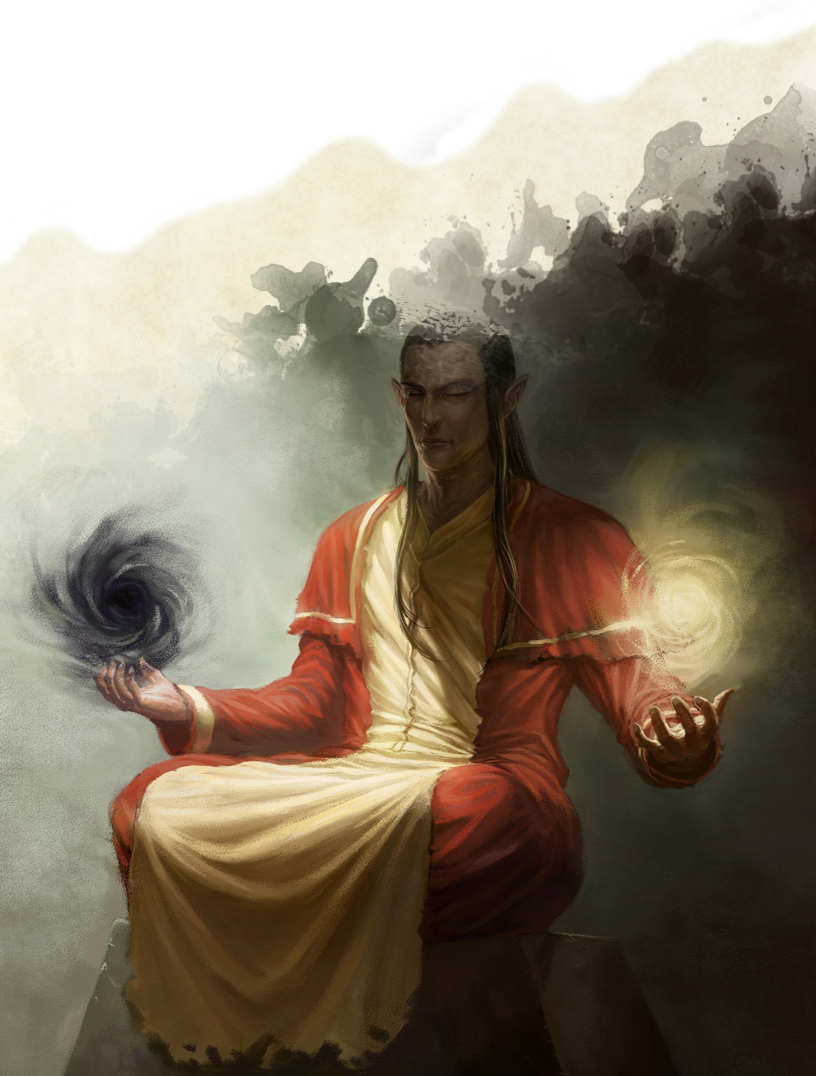
Jinxes are a cantankerous, misanthropic type. They call upon their powers of destiny to enact their petulant spite against those who have done them wrong, which usually manifests hours after they've crossed the Jinx's path. As a Jinx, you may be an ill-tempered widower, a quarry of a vexatious fey such as a hag, or someone whose pure pessimism is enough to pull on the Weave. At your option, you can talk with your DM to determine the source of your bitterness towards others, or you can roll on the Source of Misanthropy table.
Source of Misanthropy
| d6 | Misanthropy |
|---|---|
| 1 | As a newborn, you emerged with a horrifying facial disfigurement. No one has ever treated you as anything more respectable than livestock. |
| 2 | You devoted your life to your temple and pantheon, only to be ignored by the gods and cast into a life of crime and poverty. |
| 3 | Your penchant for the bottle has made you distant to your former friends, who now refuse to respond to your letters. |
| 4 | Noticing that petty thievery and deception is rewarded too often in society, you've lost all hope in humankind. |
| 5 | You've seen one-too-many walking corpses in your adventuring days, and the burning images have twisted your psyche. |
| 6 | As a youngling, a schoolmate ruined your favorite dolly. It was then and there you knew that some people don't deserve life as much as others. |
Jinx Magic
Starting at 3rd level when you choose this fortune, you learn the vicious mockery cantrip if you don't know it already, and it counts as a destine spell for you.
You learn additional spells when you reach certain levels in this class, as shown in the Jinx Spells table. The spell is always prepared, and it doesn't count against the number of spells you prepare each day. If you gain a spell that doesn't appear on the destine spell list, the spell is nonetheless a destine spell for you.
| Destine Level | Spell |
|---|---|
| 3rd | hex |
| 5th | phantasmal force |
| 9th | bestow curse |
| 13th | polymorph |
| 17th | contagion |

Fateful Curses
Also at 3rd level, you can bargain with fate to restore your petty magic. As an action, you can regain a spell slot by expending 2 fate points per level of the spell slot. Once you use this feature, you can't do so again until you finish a short or long rest.
Baleful Vexation
Beginning at 7th level, your malodorous words linger against your wrongdoers. When you use your Destinies Tied feature to tie your destiny to a creature, it becomes the quarry of your vexation, and it has a looming feeling that it is being watched. The creature remains your quarry as long as your destiny is tied to it.
When you cast a spell on your turn, you can cast it as if you were in your quarry's space, instead of your own, using its senses. You perceive only the body of your quarry as if it were floating in an inky void. The spell must only be capable of targeting one creature at its current level, it doesn't have a range of self, and it must target the quarry of your vexation. If the spell requires a ranged attack roll, you make the roll with disadvantage because you are functionally within the quarry's space. Your quarry mentally hears any verbal components you provide for the spell, but is otherwise unaware that you are the one targeting them unless the spell specifies as such. You can cast a spell in this way a number of times equal your Wisdom modifier (minimum of 1), then your bond to them is severed.
Hocus Pocus
At 11th level, you gain one of the following features of your choice.
Haunting Proxy. You can use a bonus action to see through your quarry's eyes and hear what they hear until the start of your next turn, gaining the benefits of any special senses that it has. During this time, you are blind and deaf with regard to your own senses, and the quarry of your vexation has disadvantage on saving throws against your spells.
Wicked Conviction. You have resistance to damage from attacks and spells cast by the quarry of your vexation. Additionally, you are immune to being charmed and frightened by the quarry of your vexation.
Piercing Bewitchment
By 15th level, your mystical incantations peak in power. When you roll the highest number on a damage die that deals psychic or necrotic damage, you gain a bonus to the damage roll equal to your Wisdom modifier (minimum of 1).

Fortune of the Seer
Seers are true soothsayers, using magic as a means to access fate. While other destines like the Transcendent have a constant connection to it, fate lends itself to the Seer in short concentrated bursts ― often at unexpected times. These revelations usually come to Seers as visions, making interpretation the crux of their practice.
Devout Medium
When you choose this fortune at 3rd level, you can cast the clairvoyance spell once without expending a spell slot, and regain the ability to do so once you finish a long rest. Also, you gain proficiency with the Religion skill if you don’t already have it.
Fortuneteller
Also at 3rd level, you can use your oracular abilities to predict events to come. If you spend 10 minutes with a willing creature other than yourself, you can gain brief insights into their future. At the end of the 10 minutes, make an Insight check. Depending on the outcome of your roll, you learn something about that creature’s future according to the Fortunetelling Outcome table.
Fortunetelling Outcome
| Roll | Effect |
|---|---|
| 1-10 | You learn something trivial at best about the creature that will occur within the next hour. The information may be unclear or cryptic. |
| 11-20 | You learn something mildly useful about the creature that will occur within the next week. The information is fairly clear and without any cryptic language. |
| 21-30 | You learn something critically important about the creature that will occur within the next month. The information you divine is very clear. |
| 30+ | You learn a life-changing event about the creature that will occur within the next year. The information you divine is of the utmost clarity. |
Fortunetelling requires extreme focus. While fortunetelling, you must remain within 20 feet of the creature and you must be free of loud noises and distractions.
Additionally, the events you foretell are not set in stone; actions changed upon learning the information have the potential to alter the predicted events. Once you use this feature, you can't use it again for 3 days.
Handling the Fortuneteller Feature as a DM
If you're a DM, you may be reluctant to allow the Fortuneteller feature in your game. Perhaps managing and committing to certain future events seems daunting, or maybe the ability to occasionally glimpse into the future with such clarity is one deemed too potent for lower-leveled players. If this is the case, talk to your players about alternative perks a Seer might get in place of Fortuneteller. For example, the feature could allow a player to learn something about a dungeon they're exploring, such as what kinds of monsters or dangers lie ahead. Perhaps a high Fortuneteller roll would instead grant a player a hint about a puzzle or physical challenge that they're stuck on. As the DM, the final ruling is ultimately up to you, but be sure to define your variant of this feature before one of your players decides to play a Seer.
Acumen of Battle
At 7th level, you gain the following benefits:
- When you deal damage with a spell of 1st level or higher, you deal additional force damage equal to your Wisdom modifier (minimum of +1).
- You gain the uncanny ability to read the fortitude of your opponent. As an action, you can force a creature that you can see to make a Charisma saving throw. On a failure, you learn the current hit points and AC of that creature, as well as any weaknesses, resistances, and immunities they have, if any. If they succeed, you only learn their current hit points and AC. Regardless of whether they fail or succeed on the saving throw, the target has no hint that you tried to read it.
Paranormality
When you reach 13th level, you gain one of the following features of your choice.
Written In The Stars. When you make an ability check, you can use your Arcana bonus instead of the bonus you would otherwise use. You can use this feature three times, and regain all expended uses when you finish a long rest.
Alternate Ending. There is no limit to the number of times a creature can benefit from your Air of Providence feature.
Recompense of the Crystal Ball
Once you reach 15th level, the scales of fate have aligned with your soul, restoring balance in your times of need. When you cast a spell of 1st level or higher that forces one or more creatures to make a saving throw and each target succeeds on their first saving throw against this casting of the spell, you regain the spell slot you expended to cast the spell. The spell cannot be one that deals half as much damage on a success.

Fortune of the Transcendent
While other destines may see their ability to bend fate as a tool for personal gain, the Transcendent sees the bigger picture; they are simply playing their role as one of many in an ever-expansive universe. Transcendents often dissociate from an individualistic paradigm to strengthen their bonds with everything else. It is for this reason that they have the most intimate relationship with the all things ― from the smallest pebble on the seafloor to the most boisterous quasar at the edge of the universe.
Cosmic Will
When you choose this fortune at 3rd level, you can use your Wisdom modifier for the attack and damage rolls for weapons that you are proficient with. Additionally, when you add fate points to a weapon attack roll and hit with the attack, you gain a bonus to the damage roll equal to the number of fate points added.
One With The Universe
Also at 3rd level, you can now speak, read, and write Celestial. Also, you gain proficiency in the Nature skill if you don’t already have it.
Extra Attack
Beginning at 7th level, you can attack twice, instead of once, whenever you take the Attack action on your turn.
Synchronize
When you reach 13th level, you gain one of the following features of your choice.
Synchronous Minds. When you tie your destiny to a friendly creature, choose Wisdom or Intelligence. Whenever you or the bonded creature makes an attack roll that uses the chosen ability, you may expend a use of this feature to combine both of your modifiers for determining the total bonus to the attack and damage rolls. If you tie your destiny to a second friendly creature and pick the same ability as with the first, you may pick which friendly creature's modifier you use as your bonus.
You can use this feature to combine your modifiers for an attack roll a number of times equal to your Wisdom modifier, and you regain all expended uses of this feature when you finish a long rest
Synchronous Bodies. When you tie your destiny to a friendly creature, choose Strength or Dexterity. Whenever you or the bonded creature makes an attack roll that uses the chosen ability, you may expend a use of this feature to combine both of your modifiers for determining the total bonus to the attack and damage rolls. If you tie your destiny to a second friendly creature and pick the same ability as with the first, you may pick which friendly creature's modifier you use as your bonus.
You can use this feature to combine your modifiers for an attack roll a number of times equal to your Wisdom modifier, and you regain all expended uses of this feature when you finish a long rest
Lifelink
Starting at 15th level, your cosmic connections allow you to share pain and restoration with others.
When you regain hit points, creatures of your choice that you are tied to with your Destinies Tied feature gain a number of temporary hit points equal to the number of hit points you healed for. Additionally, when you take damage, creatures of your choice that you are tied to take the same amount of damage. Once a creature takes damage from this feature, your bond to them is severed.

Appendix A: Spell List
As a destine, when you learn spells you can choose from the following list of spells. Note: any spell with an asterisk at the end of its name is a new destine spell. The descriptions for the new destine spells are listed on the following page.
Cantrips
- Blade Ward
- Booming Blade
- Dancing Lights
- Friends
- Green-Flame Blade
- Guidance
- Light
- Mage Hand
- Magic Stone
- Mending
- Message
- Mind Sliver
- Resistance
- Spare the Dying
- Sway*
- Thaumaturgy
- True Strike
1st Level
- Alarm
- Bane
- Bless
- Cause Fear
- Ceremony
- Charm Person
- Command
- Cure Wounds
- Detect Evil and Good
- Dorfcalw's Prodigal Warrior*
- Faerie Fire
- Guiding Bolt
- Healing Word
- Premonition*
- Protection from Evil and Good
- Sanctuary
- Speak with Animals
2nd Level
- Aid
- Augury
- Detect Thoughts
- Enhance Ability
- Eyefire*
- Find Traps
- Hold Person
- Lesser Restoration
- Locate Animals or Plants
- Locate Object
- Magic Weapon
- Mind Spike
- Moonbeam
- See Invisibility
- Silence
- Skywrite
- Suggestion
- Tasha's Mind Whip
- Warding Bond
- Zone of Truth
3rd Level
- Bestow Curse
- Clairvoyance
- Dispel Magic
- Enemies Abound
- Fear
- Intellect Fortress
- Mass Healing Word
- Misfortune*
- Nondetection
- Protection from Energy
- Speak with Dead
- Speak with Plants
- Tongues
4th Level
- Arcane Eye
- Banishment
- Confusion
- Death Ward
- Divination
- Elemental Bane
- Locate Creature
- Meeting*
5th Level
- Awaken
- Dispel Evil and Good
- Dominate Person
- Doom Desire*
- Dream
- Greater Restoration
- Legend Lore
- Scrying
- Skill Empowerment
Appendix B: Spells
Doom Desire
5th-level divination
- Casting Time: 1 action
- Range: 60 feet
- Components: V, M (a raven feather)
- Duration: Concentration, up to 1 minute
You attempt to rend the fate creature you can see within range. A wave of peril washes over it as you bring forth its demise.
For the duration, the target is deafened and perceives the world around it as cast in shades of grey. All other creatures appear as shadowy figures to it. If the target is outdoors, it perceives the sky as a swirling mass of crimson clouds.
The target can use its action to attempt to escape its fate. When it does so, it makes a Wisdom check against your spell save DC. If it succeeds, it escapes, and the spell ends. If the spell ends before 1 minute has passed, nothing happens. Otherwise, the target takes 8d10 psychic damage and 8d10 necrotic damage.
Dorcalw's Prodigal Warrior
1st-level transmutation
- Casting Time: 1 bonus action
- Range: Touch
- Components: V, S, M (a heraldic emblem)
- Duration: 1 minute
You touch a willing creature. Until the spell ends, the target's weapon attack rolls score a critical hit on a roll of 19 or 20.
At Higher Levels: When you cast this spell using a spell slot of 2nd level or higher, the critical hit range increases by 1 for each level above 1st, increasing to 18-20 with a 2nd level slot, 17-20 with a 3rd level slot, 16-20 with a 4th level slot, and 15-20 with a 5th level slot.
Eyefire
2nd-level evocation
- Casting Time: 1 action
- Range: 30 feet
- Components: V, S, M (a heated towel or a glass of herbal tea)
- Duration: Concentration, up to 1 minute
A spectral eye appears on your forehead, ejecting mystic fire from you in a line 30 feet long and 5 feet wide in a direction you choose. Eerie flames linger in the area for the duration. The flames give off no heat or light, can't be doused by water, and can't be snuffed by strong winds.
When a creature enters the spell's area for the first time on a turn or starts its turn there, it must make an Intelligence saving throw. A creature takes 3d6 psychic damage on a failed save, or half as much damage on a successful one. If a creature fails their saving throw and is reduced to 0 hit points by the psychic damage, they are also stunned for the duration of this spell.
At Higher Levels: When you cast this spell using a spell slot of 3rd level or higher, the damage increases by 1d6 for each slot level above 2nd.
Meeting
4th-level conjuration
- Casting Time: 1 minute
- Range: Special
- Components: V, S, M (knotted yarn)
- Duration: 1 hour
You force two creatures you have previously seen (one of which can be you) to make a Charisma saving throw. Creatures can willingly fail this saving throw. If either creature succeeds, the spell ends. If both creatures fail, they are transported to a demiplane.
The demiplane takes the appearance of your choosing, but must be contained within a 100-foot cube and cannot contain other creatures or magical objects. While in the demiplane, creature's only options are to communicate, move around, and interact with the demiplane's environment. When the spell ends, both creatures return to the spaces they occupied when the spell was cast, along with any of their equipment. Also when the spell ends, the plane as well as any objects the originated from it are destroyed.
On its turn, a creature affected by this spell can use an action to repeat the saving throw, ending the spell for them and leaving the demiplane on a success.
The spell ends after an hour, or if you decide to end it early as a bonus action.
Misfortune
3rd-level divination
- Casting Time: 1 action
- Range: 30 feet
- Components: V, S
- Duration: Concentration, up to 10 minutes
A creature you can see within range must succeed on a Wisdom saving throw or become plagued by bad luck. For the duration of the spell, the target has disadvantage on all ability checks, attack rolls, and saving throws.
If the target succeeds on an ability check, attack roll, or saving throw over the spell's duration, they escape the spiral of misfortune and the spell ends. A remove curse spell also ends this effect.
Premonition
1st-level divination
- Casting Time: 1 minute
- Range: Touch
- Components: S, M (a hummingbird beak)
- Duration: 1 hour
You touch a willing creature and grant it brief insight into the future. For the duration, the target can’t be surprised and when the creature makes an ability check, attack roll, or saving throw, they can choose to roll with advantage. Once the creature succeeds on an attack roll, ability check, or saving throw when rolling with advantage from this spell, the spell ends.
This spell immediately ends if you cast it again before its duration ends.

Sway
divination cantrip
- Casting Time: 1 reaction, which you take in response to a random nonmagical event
- Range: 30 feet
- Components: S
- Duration: Instantaneous
You determine the outcome of a minor random event, some examples of which are below. The DM may allow you to determine the outcome of other minor events at their discretion.
- You determine the value a die will land on as it is being rolled.
- You determine the identity of a card being drawn from a deck.
- You determine the sex of a Beast during its birth.
- You determine the victor of a competition between participants of similar skill.
Appendix C: Miscellaneous
Natural Relics
| Relic Name | Location |
|---|---|
| Meteorite Shard | Craters |
| Ancient Fossil | Deep Soil |
| Hieroglyph | Tombs |
| Onyx | Ore Veins |
Credits
Cover Art: DavidRapozaArt
Page 2 Art: Carina Nebula Infrared Panorama Space Wallpaper by Space.com Staff
Page 5 Art: Reverie of the Wise by Jason Rainville
Page 6 Art: Weaver of Fate by David Loebman
Page 7 Art: Twilight by Chris Ng Fhze Yang
Page 8 Art: Medea by RockNOats
Page 10 Art: Christine Mitzuk
Page 11 Art: Sphere of Creation by SergeyDulin
Page 12 Art: Irencrag Feat by Yongjae Choi
Page 13 Art: Divination by Willian Murai
Page 15 Art: VeraPetruk
Special thanks to u/Ogksive for creating the Jinx subclass, and thanks to u/mbumbee for the help playtesting, development, and support!