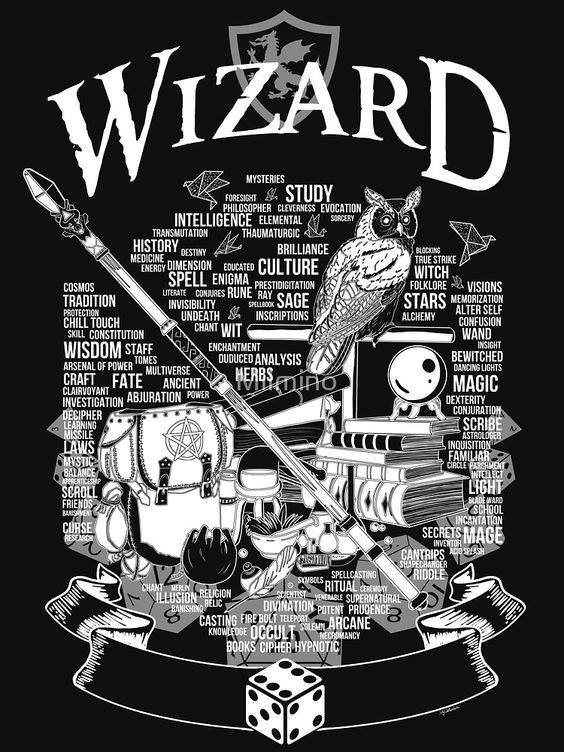
Wizard
Clad in the silver robes that denote her station, an elf closes her eyes to shut out the distractions of the battlefield and begins her quiet chant. Fingers weaving in front of her, she completes her spell and launches a tiny bead of fire toward the enemy ranks, where it erupts into a conflagration that engulfs the soldiers.
Checking and rechecking his work, a human scribes an intricate magic circle in chalk on the bare stone floor, then sprinkles powdered iron along every line and graceful curve. When the circle is complete, he drones a long incantation. A hole opens in space inside the circle, bringing a whiff of brimstone from the otherworldly plane beyond.
Crouching on the floor in a dungeon intersection, a gnome tosses a handful of small bones inscribed with mystic symbols, muttering a few words of power over them. Closing his eyes to see the visions more clearly, he nods slowly, then opens his eyes and points down the passage to his left.
Wizards are supreme magic-users, defined and united as a class by the spells they cast. Drawing on the subtle weave of magic that permeates the cosmos, wizards cast spells of explosive fire, arcing lightning, subtle deception, and brute-force mind control. Their magic conjures monsters from other planes of existence, glimpses the future, or turns slain foes into zombies. Their mightiest spells change one substance into another, call meteors down from the sky, or open portals to other worlds.
Scholars of the Arcane
Wild and enigmatic, varied in form and function, the power of magic draws students who seek to master its mysteries. Some aspire to become like the gods, shaping reality itself. Though the casting of a typical spell requires merely the utterance of a few strange words, fleeting gestures, and sometimes a pinch or clump of exotic materials, these surface components barely hint at the expertise attained after years of apprenticeship and countless hours of study.
Wizards live and die by their spells. Everything else is secondary. They learn new spells as they experiment and grow in experience. They can also learn them from other wizards, from ancient tomes or inscriptions, and from ancient creatures (such as the fey) that are steeped in magic.
The Lure of Knowledge
Wizards’ lives are seldom mundane. The closest a wizard is likely to come to an ordinary life is working as a sage or lecturer in a library or university, teaching others the secrets of the multiverse. Other wizards sell their services as diviners, serve in military forces, or pursue lives of crime or domination.
But the lure of knowledge and power calls even the most unadventurous wizards out of the safety of their libraries and laboratories and into crumbling ruins and lost cities. Most wizards believe that their counterparts in ancient civilizations knew secrets of magic that have been lost to the ages, and discovering those secrets could unlock the path to a power greater than any magic available in the present age.
character demands a backstory dominated by at least one extraordinary event. How did your character first come into contact with magic? How did you discover you had an aptitude for it? Do you have a natural talent, or did you simply study hard and practice incessantly? Did you encounter a magical creature or an ancient tome that taught you the basics of magic?
What drew you forth from your life of study? Did your first taste of magical knowledge leave you hungry for more? Have you received word of a secret repository of knowledge not yet plundered by any other wizard? Perhaps you’re simply eager to put your newfound magical skills to the test in the face of danger.
Time and Practice
Only a select few people in the world are wielders of magic. Of all those, wizards stand at the pinnacle of the craft. Even the least of the mcan manipulate forces that flout the laws of nature, and the most accomplished among them can cast spells with world-shaking effects.
The price that wizards pay for their mastery is that most valuable of commodities: time. It takes years of study, instruction, and experimentation to learn how to harness magical energy and carry spells around in one's own mind. For adventuring wizards and other spellcasters who aspire to the highest echelons of the profession, the study ing never ends, nor does the quest for knowledge and power.
If you're playing a wizard, take advantage of the opportuni ty to make your character more than just a stereotypical spell-slinger. Use the advice that follows to add some intriguing details to how your wizard interacts with the world.
Spellbook
Your wizard character's most prized possession- your spell book- might be an innocuous-looking volume whose covers show no hint of what's inside. Or you might display some flair, as many wizards do, by carrying a spellbook of an unusual sort. If you don't own such an item already, one of your goals might be to find a spell book that sets you a part by its appearance or its means of manufacture.
Spellbooks
| d6 | Spellbook |
|---|---|
| 1 | A tome with pages that are thin sheets of metal, spells etched into them with acid. |
| 2 | Long straps of leather on which spells are written, wrapped around a staff for ease of transport. |
| 3 | A battered tome filled with pictographs that only you can understand |
| 4 | Small stones inscribed with spells and kept in a cloth bag |
| 5 | A scorched book, ravaged by dragon fire, with the script of your spells barely visible on its pages |
| 6 | A tome full of black pages whose writing is visible only in dim light or darkness |
Ambition
Few aspiring wizards undertake the study of magic without some personal goal in mind. Many wizards use their spells as a tool to produce a tangible benefit, in material goods or in status, for themselves or their companions.
For others, the theoretical aspect of magic might have a strong appeal, pushing those wizards to seek out knowledge that supports new theories of the arcane or confirms old ones.
Beyond the obvious, why does your wizard character study magic, and what do you want to achieve? If you haven't given these questions much thought, you can do so now, and the answers you come up with will likely affect how your future unfolds.
Ambitions
| d6 | Ambition |
|---|---|
| 1 | You will prove that the gods aren't as powerful as folk believe. |
| 2 | Immortality is the end goal of your studies. |
| 3 | If you can fully understand magic, you can unlock its use for all and usher in an era of equality. |
| 4 | Magic is a dangerous tool. You use it to protect what you treasure. |
| 5 | Arcane power must be taken away from those who would abuse it. |
| 6 | You will become the greatest wizard the world has seen in generations. |
Eccentricites
Endless hours of solitary study and research can have a negative effect on anyone's social skills. Wizards, who are a breed apart to begin with, are no exception. An odd mannerism or two is not necessarily a drawback, though; an eccentricity of this sort is usually harmless and could provide a source of amusement or serve as a calling card of sorts.
If your character has an eccentricity, is it a physicaltic or a mental one? Are you well known in some circles because of it? Do you fight to overcome it, or do you embrace this minor claim to fame of yours?
Eccentricites
| 1d6 | Eccentricity |
|---|---|
| 1 | You have the habit of tapping your foot incessantly , which often annoys those around you. |
| 2 | Your memory is quite good, but you have no trouble pretending to be absentminded when it suits your purposes. |
| 3 | You never enter a room without looking to see what's hanging from the ceiling. |
| 4 | Your most prized possession is a dead worm that you keep inside a potion vial. |
| 5 | When you want people to leave you alone, you start talking to you rself. That usually does the trick. |
| 6 | Your fashion sense and grooming, or more accurately lack thereof, sometimes cause others to assume you are a beggar. |
Quick Build
You can make a wizard quickly by following these suggestions. First, Intelligence should be your highest ability score, followed by Constitution or Dexterity. If you plan to join the School of Enchantment, make Charisma your next-best score. Second, choose the sage background. Third, choose the mage hand, light, and ray of frost cantrips, along with the following 1st-level spells for your spellbook: burning hands, charm person, feather fall, mage armor, magic missile, and sleep.
Hit Points
- Hit Dice: 1d6 per wizard level
- Hit Points at 1st Level: 6 + your Constitution modifier
- Hit Points at Higher Levels: 1d6 (or 4) + your Constitution modifier per wizard level after 1st
Starting Proficiencies
You are proficient with the following items, in addition to any proficiencies provided by your race or background.
- Armor: none
- Weapons: daggers, darts, slings, quarterstaffs, light crossbows
- Tools: none
- Skills: Choose two from Arcana, History, Insight, Investigation, Medicine, and Religion
- Saving Throws: Intelligence, Wisdom
Starting Equipment
You start with the following items, plus anything provided by your background.
• (a) a Quarterstaff or (b) a Dagger
• (a) a Component pouch or (b) an arcane focus
• (a) a Scholar's Pack or (b) an Explorer's Pack
• A Spellbook
Alternatively, you may start with 4d4 x 10 gp to buy your own Equipment.
Spellcasting
As a student of Arcane Magic, you have a Spellbook containing Spells that show the first glimmerings of your true power.
Cantrips
At 1st level, you know three Cantrips of your choice from the wizard spell list. You learn additional wizard Cantrips of your choice at higher levels, as shown in the Cantrips Known column of the Wizard table.
Spellbook
At 1st level, you have a Spellbook containing six 1st-level wizard Spells of your choice. Your Spellbook is the repository of the wizard Spells you know, except your Cantrips, which are fixed in your mind.
Preparing and Casting Spells
The Wizard table shows how many Spell Slots you have to cast your Spells of 1st level and higher. To cast one of these Spells, you must expend a slot of the spell's level or higher. You regain all expended Spell Slots when you finish a Long Rest.
The Wizard
| Level | Proficiency Bonus | Features | Cantrips Known | 1st | 2nd | 3rd | 4th | 5th | 6th | 7th | 8th | 9th |
|---|---|---|---|---|---|---|---|---|---|---|---|---|
| 1st | +2 | Spellcasting, Arcane Recovery | 3 | 2 | — | — | — | — | — | — | — | — |
| 2nd | +2 | Arcane Tradition | 3 | 3 | — | — | — | — | — | — | — | — |
| 3rd | +2 | — | 3 | 4 | 2 | — | — | — | — | — | — | — |
| 4th | +2 | Ability Score Improvement | 4 | 4 | 3 | — | — | — | — | — | — | — |
| 5th | +3 | — | 4 | 4 | 3 | 2 | — | — | — | — | — | — |
| 6th | +3 | Arcane Tradition feature | 4 | 4 | 3 | 3 | — | — | — | — | — | — |
| 7th | +3 | — | 4 | 4 | 3 | 3 | 1 | — | — | — | — | — |
| 8th | +3 | Ability Score Improvement | 4 | 4 | 3 | 3 | 2 | — | — | — | — | — |
| 9th | +4 | — | 4 | 4 | 3 | 3 | 3 | 1 | — | — | — | — |
| 10th | +4 | Arcane Tradition feature | 5 | 4 | 3 | 3 | 3 | 2 | — | — | — | — |
| 11th | +4 | — | 5 | 4 | 3 | 3 | 3 | 2 | 1 | — | — | — |
| 12th | +4 | Ability Score Improvement | 5 | 4 | 3 | 3 | 3 | 2 | 1 | — | — | — |
| 13th | +5 | — | 5 | 4 | 3 | 3 | 3 | 2 | 1 | 1 | — | — |
| 14th | +5 | Arcane Tradition feature | 5 | 4 | 3 | 3 | 3 | 2 | 1 | 1 | — | — |
| 15th | +5 | — | 5 | 4 | 3 | 3 | 3 | 2 | 1 | 1 | 1 | — |
| 16th | +5 | Ability Score Improvement | 5 | 4 | 3 | 3 | 3 | 2 | 1 | 1 | 1 | — |
| 17th | +6 | — | 5 | 4 | 3 | 3 | 3 | 2 | 1 | 1 | 1 | 1 |
| 18th | +6 | Spell Mastery | 5 | 4 | 3 | 3 | 3 | 3 | 1 | 1 | 1 | 1 |
| 19th | +6 | Ability Score Improvement | 5 | 4 | 3 | 3 | 3 | 3 | 2 | 1 | 1 | 1 |
| 20th | +6 | Signature Spell | 5 | 4 | 3 | 3 | 3 | 3 | 2 | 2 | 1 | 1 |
You prepare the list of wizard Spells that are available for you to cast. To do so, choose a number of wizard Spells from your Spellbook equal to your Intelligence modifier + your wizard level (minimum of one spell). The Spells must be of a level for which you have Spell Slots.
For example, if you're a 3rd-level wizard, you have four 1st-level and two 2nd-level Spell Slots. With an Intelligence of 16, your list of prepared Spells can include six Spells of 1st or 2nd level, in any combination, chosen from your Spellbook. If you prepare the 1st-level spell Magic Missile, you can cast it using a 1st-level or a 2nd-level slot. Casting the spell doesn't remove it from your list of prepared Spells.
You can change your list of prepared Spells when you finish a Long Rest. Preparing a new list of wizard Spells requires time spent studying your Spellbook and memorizing the incantations and gestures you must make to cast the spell: at least 1 minute per Spell Level for each spell on your list.
Spellcasting Ability
Intelligence is your spellcasting ability for your wizard Spells, since you learn your Spells through dedicated study and memorization. You use your Intelligence whenever a spell refers to your spellcasting ability. In addition, you use your Intelligence modifier when Setting the saving throw DC for a wizard spell you cast and when Making an Attack roll with one.
Spell save DC = 8 + your proficiency bonus + your Intelligence modifier
Spell Attack modifier = your proficiency bonus + your Intelligence modifier
Ritual Casting
You can cast a wizard spell as a ritual if that spell has the ritual tag and you have the spell in your Spellbook. You don't need to have the spell prepared.
Spellcasting Focus
You can use an arcane focus as a spellcasting focus for your wizard Spells.
Learning Spells of 1st Level and Higher
Each time you gain a wizard level, you can add two wizard Spells of your choice to your Spellbook for free. Each of these Spells must be of a level for which you have Spell Slots, as shown on the Wizard table. On your adventures, you might find other Spells that you can add to your Spellbook (see “Your Spellbook”).
Arcane Recovery
You have learned to regain some of your magical energy by studying your Spellbook. Once per day when you finish a Short Rest, you can choose expended Spell Slots to recover. The Spell Slots can have a combined level that is equal to or less than half your wizard level (rounded up), and none of the slots can be 6th level or higher.
For example, if you’re a 4th-level wizard, you can recover up to two levels worth of Spell Slots. You can recover either a 2nd-level spell slot or two 1st-level Spell Slots.
Arcane Tradition
When you reach 2nd level, you choose an arcane tradition, shaping your practice of magic through one of eight schools, such as Evocation. Your choice grants you features at 2nd level and again at 6th, 10th, and 14th level.
Ability Score Improvement
When you reach 4th level, and again at 8th, 12th, 16th, and 19th level, you can increase one ability score of your choice by 2, or you can increase two Ability Scores of your choice by 1. As normal, you can’t increase an ability score above 20 using this feature.
Spell Mastery
At 18th level, you have achieved such mastery over certain Spells that you can cast them at will. Choose a 1st-level wizard spell and a 2nd-level wizard spell that are in your Spellbook. You can cast those Spells at their lowest level without expending a spell slot when you have them prepared. If you want to cast either spell at a higher level, you must expend a spell slot as normal.
By spending 8 hours in study, you can exchange one or both of the Spells you chose for different Spells of the same levels.
Signature Spells
When you reach 20th level, you gain mastery over two powerful Spells and can cast them with little effort. Choose two 3rd-level wizard Spells in your Spellbook as your signature Spells. You always have these Spells prepared, they don't count against the number of Spells you have prepared, and you can cast each of them once at 3rd level without expending a spell slot. When you do so, you can't do so again until you finish a short or Long Rest.
If you want to cast either spell at a higher level, you must expend a spell slot as normal.
Mage Sigils
Wizards and many other arcane spellcasters develop a signature rune, which they use to identify their belongings, sign as their name, and warn others. As a mage gains in power, more individuals recognize the sigil and connect it with a mighty spellcaster, not to be trifled with. Some mage sigils are used in conjunction with spells such as glyph of warding, which enforces the tendency of ordinary people to shy away from items marked by such sigils. There are folktales, in fact, about the gods themselves punishing a person who misuse's a wizard's sigil-preposterous tales that were most likely started by wizards themselves. There is no set penalty for violating another mage's signature sigil or using it without permission. Powerful mages tend to punish such activity themselves to discourage further use.
Apprentice wizards in Faerun are reminded of the dangers of misusing another spellcaster's sigil by a rhyme: "Whenever magic one doth weave / 'Tis never, ever, wise to deceive."
Your Spellbook
The Spells that you add to your Spellbook as you gain levels reflect the arcane research you conduct on your own, as well as intellectual breakthroughs you have had about the nature of the multiverse. You might find other Spells during your adventures. You could discover a spell recorded on a scroll in an evil wizard’s chest, for example, or in a dusty tome in an ancient Library.
Copying a Spell into the Book: When you find a wizard spell of 1st level or higher, you can add it to your Spellbook if it is of a Spell Level you can prepare and if you can spare the time to decipher and copy it.
Copying that spell into your Spellbook involves reproducing the basic form of the spell, then deciphering the unique system of notation used by the wizard who wrote it. You must practice the spell until you understand the sounds or gestures required, then transcribe it into your Spellbook using your own notation.
For each level of the spell, the process takes 2 hours and costs 50 gp. The cost represents material Components you expend as you experiment with the spell to master it, as well as the fine inks you need to record it. Once you have spent this time and money, you can prepare the spell just like your other Spells.
Replacing the Book: You can copy a spell from your own Spellbook into another book—for example, if you want to make a backup copy of your Spellbook. This is just like copying a new spell into your Spellbook, but faster and easier, since you understand your own notation and already know how to cast the spell. You need spend only 1 hour and 10 gp for each level of the copied spell.
If you lose your Spellbook, you can use the same procedure to transcribe the Spells that you have prepared into a new Spellbook. Filling out the remainder of your Spellbook requires you to find new Spells to do so, as normal. For this reason, many wizards keep backup spellbooks in a safe place.
The Book’s Appearance: Your Spellbook is a unique compilation of Spells, with its own decorative flourishes and margin notes. It might be a plain, functional leather volume that you received as a gift from your master, a finely bound gilt-edged tome you found in an ancient Library, or even a loose collection of notes scrounged together after you lost your previous Spellbook in a mishap.
Arcane Traditions
The study of wizardry is ancient, stretching back to the earliest mortal discoveries of magic. It is firmly established in fantasy gaming worlds, with various traditions dedicated to its complex study.
The most common arcane traditions in the multiverse revolve around The Schools of Magic. Wizards through the ages have cataloged thousands of Spells, grouping them into eight categories called schools. In some places, these traditions are literally schools. In other institutions, the schools are more like academic departments, with rival faculties competing for students and funding. Even wizards who train apprentices in the solitude of their own towers use the division of magic into schools as a learning device, since the Spells of each school require mastery of different techniques.
Out of Order
1 Arcane Tradition of the Arcane Order
2 Arcane Tradition of Abjuration
3 Arcane Tradition of Beguiler
4 Arcane Tradition of Biomancy
5 Arcane Tradition of Black Powder
6 Arcane Tradition of Bladesinging
7 Arcane Tradition of Broodmasters
9 Arcane Tradition of Chronomancy
10 Arcane Tradition of Conjuration
11 Arcane Tradition of Diabolism
12 Arcane Tradition of Divination
13 Arcane Tradition of Ectomancy
14 Arcane Tradition of Elementalism
15 Arcane Tradition of Enchantment
16 Arcane Tradition of Engineering
17 Arcane Tradition of Evocation
18 Arcane Tradition of Flesh Sculpting
19 Arcane Tradition of Force Missile
20 Arcane Tradition of the Green Star
21 Arcane Tradition of Hedge Wizard
22 Arcane Tradition of Hemomancy
23 Arcane Tradition of Illusion
24 Arcane Tradition of Invention
25 Arcane Tradition of Lore Mastery
26 rcane Tradition of Mage Hunter
27 Arcane Tradition of Mechamancer
28 Arcane Tradition of Necromancy
29 Arcane Tradition of the Pseudonatural
30 Arcane Tradition of Razormancy
31 Arcane Tradition of Reawakening
32 Arcane Tradition of Reconstruction
34 Arcane Tradition of Simulacra
35 Arcane Tradition of Somnomancy
36 Arcane Tradition of Tattooism
37 Arcane Tradition of Theurgy
38 Arcane Tradition of Transmogrification
39 Arcane Tradition of Transmutation
40 Arcane Tradition of Tyromancy
41 Arcane Tradition of Universalism
School of the Arcane Order
Wizards of the Arcane Order, better known as Guildmages, are spellcasters that belong to an arcane academy or guild which serves the same purpose: to educate fledgling mages and advance the understanding of magic as a whole. To that end, guildmages share arcane magical knowledge through a common nexus known as a Spellpool, and can prepare spells known by others by attuning to this source.
Guildmages are not known particularly to specialize in a school of magic, but are instead free to generalize their understanding through the community of the Arcane Order. This makes them some of the most flexible spellcasters in the world, as they are free to prepare spells from diverse branches of magic with ease.
Guild Membership
At 2nd level, as an established and respected member of the Arcane Order, you can rely on certain benefits that membership provides. You can board at the Arcane Order campus for free, and browse its library or use its common laboratory at your leisure. Additionally, you form professional ties with other wizards and sorcerers in the guild, which may lead to alliances or job opportunities in the future.
You must pay dues of 5 gp per month to the guild. If you miss too many payments, you must make up back dues to remain in the guild’s good graces and continue to access the Spellpool.
Spellpool
When you join the Arcane Order at 2nd level, you are granted a special arcane focus that allows you to call spells from the common source of guild members: the Spellpool. When you prepare spells following a long rest, you can choose to prepare two 1st level wizard spells of your choice from the Spellpool, even if the spells haven't been copied into your spellbook. These spells do not count against the total number of spells you can prepare.
The number and level of wizard spells you can prepare from the Spellpool increases as you grow in level and rank within the Arcane Order, as shown in the Spellpool Table.
If your arcane focus is lost or destroyed, or if you fall out of good standing in the Arcane Order, you cannot access the Spellpool. You can replace your arcane focus for 100 gp.
Spellpool Table
| Wizard Level | Spells Prepared | Spell Level |
|---|---|---|
| 2nd | 2 | 1st |
| 6th | 3 | 2nd |
| 10th | 4 | 3rd |
| 14th | 5 | 4th |
Community Spellcasting
Starting at 6th level, you can bolster your spellcaster allies. Whenever you cast a spell, each creature you choose adjacent to you has advantage on the next spell attack roll it makes before the beginning of your next turn.
Spellpool Recovery
At 10th level, when you recover spell slots using Arcane Recovery on a short rest, you can also re-prepare the spells you have prepared from your Spellpool.
Guild Regent
At 14th level, you are awarded the title of regent within the Arcane Order. When you prepare your spells following a long rest, choose one spell you have prepared from your spellpool of 1st or 2nd level. You can cast this spell without expending a spell slot until you take a long rest again.
School of Abjuration
The School of Abjuration emphasizes magic that blocks, banishes, or protects. Detractors of this school say that its tradition is about denial, negation rather than positive assertion. You understand, however, that ending harmful effects, protecting the weak, and banishing evil influences is anything but a philosophical void. It is a proud and respected vocation.
Called abjurers, members of this school are sought when baleful spirits require exorcism, when important locations must be guarded against magical spying, and when portals to other planes of existence must be closed.
Abjuration Savant
Beginning when you select this school at 2nd level, when you gain a level in wizard and you may select an Abjuration spell from any class, including this one and add that spell to your spellbook. A spell you choose must be of a level you can cast, as shown on the Wizard table.
Additionally, the gold and time you must spend to copy an abjuration spell into your spellbook is halved.
Arcane Ward
Starting at 2nd level, you can weave magic around yourself for protection. When you cast an abjuration spell of 1st level or higher, you can simultaneously use a strand of the spell’s magic to create a magical ward on yourself that lasts until you finish a long rest. The ward has hit points equal to twice your wizard level + your Intelligence modifier. Whenever you take damage, the ward takes the damage instead. If this damage reduces the ward to 0 hit points, you take any remaining damage.
While the ward has 0 hit points, it can’t absorb damage, but its magic remains. Whenever you cast an abjuration spell of 1st level or higher, the ward regains a number of hit points equal to twice the level of the spell.
Once you create the ward, you can't create it again until you finish a long rest.
Projected Ward
Starting at 6th level, when a creature that you can see within 30 feet of you takes damage, you can use your reaction to cause your Arcane Ward to absorb that damage. If this damage reduces the ward to 0 hit points, the warded creature takes any remaining damage.
Improved Abjuration
Beginning at 10th level, when you cast an abjuration spell that requires you to make an ability check as a part of casting that spell (as in counterspell and dispel magic), you add your proficiency bonus to that ability check.
Spell Resistance
Starting at 14th level, you have advantage on saving throws against spells.
Furthermore, you have resistance against the damage of spells.
Beguiler
Those who think charm and misdirection are the trades of the bard and warlock never heard of the arcane colleges specializing in Beguiling magic. The tradition blends enchantment and illusion magic, rather than specializing in either of those schools.
Followers of this tradition are known as beguilers and believe a brilliant mind beats a charming personality. They see magic as a way to persuade, deceive, entertain, and hide and believe fooling the mind is magic’s most potent use. Beguilers are suave and adept spies, equipped to infiltrate any organization or compound without detection or with minimal casualties.
Bonus Proficiencies
Beginning when you select this school at 2nd level, you gain proficiency with light armor and your choice of the Deception, Persuasion, or Stealth skills. You also learn one language of your choice.
Erudite Elucidation
Beginning when you select this school at 2nd level, influencing and resisting others is just like solving any other puzzle to you. When you make a Charisma check or saving throw, you can add your Intelligence modifier to the result.
Sneak Spell
Starting at 6th level, you know how to strike subtly with a spell and exploit a foe's distraction. Once per turn, you can deal extra damage equal to your Intelligence modifier (minimum of 1) to one creature you hit with a spell attack from a wizard cantrip if you have advantage on the attack roll.
You don’t need advantage on the attack roll if another enemy of the target is within 5 feet of it, that enemy isn’t incapacitated, and you don’t have disadvantage on the attack roll or your target has made a saving throw against one of your enchantment or illusion spells since the beginning of your last turn.
The amount of the extra damage increases when you reach certain levels in this class: to double your Intelligence modifier at 11th level, and triple your Intelligence modifier at 17th level.
Mind Ambush
Starting at 10th level, if you are hidden from a creature when you cast an enchantment or illusion spell that affects it, the creature has disadvantage on any saving throw it makes against the spell for its duration.
Master Deceiver
Beginning at 14th level, you are immune to the charmed condition.
In addition, when you are concentrating on an enchantment or illusion spell that affects one creature and that creature dies or falls unconscious, you can use your reaction to target a new creature with the spell for the remainder of its duration, until you lose concentration, or become incapacitated by any means.
If the spell requires the target to make saving throw, the new target attempts the saving throw before the spell’s conditions take effect.
School of Biomancy
The nature of magic can be mysterious, but it is well known that arcana flows most freely to and from living beings, and that the weave is strongest around areas rich with life. Even in areas where the weave itself has been ravaged, energy from life can still be manipulated through the study of biomancy. Wizards from such regions practice this tradition out of necessity, but refer to it by a much simpler name: Life Magic.
Though seemingly as benign in nature as any other school of magic, Life Magic deals in utilizing the pure energy of life itself in order to bolster and manipulate the weave and spells cast through it. This process can be performed through the life of plants or the caster.
In the wastes, where life is both precious and scarce and the weave is weakened, those that draw from life and give back in kind are known as Preservers; those that rip the energy from the land without regard for the damage they cause are known as Defilers.
Life Magic
Starting when you choose this tradition at 2nd level, you learn how to channel life energy into your spell. On your turn, when you cast a wizard spell, you can use your bonus action to channel magic through the living things around you to bolster your magic, granting you advantage on the spell's first spell attack roll or advantage on the next saving throw you make, as appropriate.
Additionally, your spells (including this one) are unaffected by antimagic or dead magic zones for a number of minutes equal to your Intelligence modifier.
This life energy can either be drawn from nature or be drawn from yourself. If drawn from nature, nonmagical plants that aren't creatures (such as grasses or shrubs) within a 30-foot radius of you wither and die and no life can grow in this area for 10 years or bolster and bloom wildly, your choice.
You can use this feature a number of times equal to your intellegence modifier, then you must short or long rest before you can use it again.
Life’s Touch
At 2nd level, you learn the spells cure wounds and inflict wounds, and you treat them as wizard spells. These spells are second nature to you and you can prepare them without studying your spellbook. Other wizards cannot learn these spells out of your spellbook.
Living Ward
Starting at 6th level, whenever you cast a spell using Life Magic, you can funnel some of the residual energy of the spell to bolster your own life, if you caused the plants to wither in the area, you gained temporary HP equal to the level of the spell + your Intelligence modifier (minimum 1). If you bolstered the life in the area, you cause the area within 30 feet to be covered in difficult turrain.
Greater Life’s Touch
At 10th level, you learn the contagion and raise dead, and treat them as wizard spells. These spells are second nature to you and you can prepare them without studying your spellbook. Other wizards cannot learn these spells out of your spellbook
Superior Life’s Touch
At 14th level, you have mastered the art of channeling life energy. You may now use Life Magic an additional time between long rests, and wizard spells of 3rd level or lower that you cast are permanently unaffected by dead magic zones.
Additionally, you may use your Life Magic to tear or repair holes in the weave. As an action, you can expend a use of your Life Magic to create a 30-foot radius area of dead magic around yourself. If you are within an area of dead magic, you can use this ability to restore power to the weave, negating an area of dead magic within a 30-foot radius around yourself.
After using your Life Magic this way, you cannot do so again until you finish a long rest.
School of Black Powder
Regarded by traditional wizards as insufferable yahoos at best and dangerous charlatans at worst, the 'students' of the School of Black Powder prefer to see themselves as visionaries paving the way of the future. They seek to integrate the newest weapons into their magical techniques, so as to be able to stand toe-to-toe with the gunslingers and cowboys who populate the frontier. In this way, they find employment in adventuring parties and as bounty hunters, using their magical skills to set themselves apart from the crowd.
Gun Mage
At 2nd level, you gain proficiency with one-handed firearms and can treat a firearm as your arcane focus. In addition, the following spells are added to your spellbook without cost and count as wizard spells for you:
Gun Mage Bonus Spells
| Wizard | Level Spells |
|---|---|
| 1st | bullet spray, chromatic bullet |
| 3rd | jam weapon, protection from ballistics |
| 5th | conjure cannonball |
| 7th | detonate ammunition |
| 9th | conjure volley |
Guided Shot
At 2nd level, you can use your arcane power to bend your shots around corners, so that your firearm attacks ignore half cover and three-quarters cover and can target creatures behind total cover as if it were half cover.
Silver Bullet
Beginning at 6th level, ammunition for your firearms always counts as magical for the purposes of overcoming resistance and immunity to nonmagical damage.
Spellslinging
At 10th level, if you use your action to cast a spell that does not involve making a weapon attack, you can make a ranged attack with a firearm as a bonus action.
Arcane Shooter
When you reach 14th level, you add your Intelligence modifier (minimum of +1) to the damage of attacks from firearms with which you are proficient.
School of Broodmasters
Wizards that keep pets are not out of the ordinary; it’s no accident that find familiar is a popular entry for spellbooks. But wizards that keep entire broods of pets, like pseudodragons, raising them from eggs and experimenting on them on until adulthood, are an entirely different breed. The School of Broodmasters teaches the finer art of training a swarm of pets to tear your enemies to shreds.
Dragon Empathy
Starting when you choose this tradition at 2nd level, you can speak, read, and write Draconic. Additionally, by reading nonverbal cues, you can understand dragons that cannot speak.
Pseudodragon Clutch
Beginning when you choose this tradition at 2nd level, you have begun to raise and experiment with your own clutch of pseudodragons to follow your commands. You begin with two pseudodragons.
You add your wizard level to your pseudodragons’ maximum hit points.
Your pseudodragons act independently of you, but always obey your commands. In combat, your pseudodragons roll initiative as a group and act on one turn. Your pseudodragons can't attack on their turns. However, you can use your action to command each pseudodragon under your control to use its reaction to attack targets that you choose. Your pseudodragons use your spell attack bonus on attack rolls. On a hit, the target is not subjected to the secondary effect of the pseudodragons' Sting attack.
If one or more of your pseudodragons are reduced to 0 hit points, you can revive them and restore the maximum hit points of all your pseudodragons with a 30-minute ritual, which can be performed over a short or long rest.
You gain more pseudodragons as you gain higher levels in this class. At 5th level, you have 3 pseudodragons under your control, at 11th level, you have 4, and at 17th level, you have 5.
Broodrage
Starting at 6th level, whenever one of your pseudodragons is reduced to 0 hit points, your remaining pseudodragons can add your Intelligence modifier to their attack and damage rolls until the end of your next turn.
For the Master
At 10th level, when an attack is made against you, you can use your reaction to command one of your pseudodragons within 5 feet of you to leap in front of the attack. This attack targets the pseudodragon, rather than you.
Pseudocolor
Starting at 14th level, over a long rest you can splice the scales of true dragons into your pseudodragons, giving them unique traits and colors. Each of your pseudodragons can gain one of the following benefits, which you can change when you take a long rest.
Black. This pseudodragon has a swim speed equal to its flying speed, and it can breathe water as well as air. When it hits with its stinger attack, it deals an additional 1d4 acid damage.
Blue. When this pseudodragon is hit with a melee weapon attack by a creature within 5 feet of it, a spark of static electricity leaps out at the attacker, dealing 1d4 lightning damage. When this pseudodragon hits with its stinger attack, it deals an additional 1d4 lightning damage.
Green. When this pseudodragon hits with its stinger attack, the target must succeed on a DC 11 Constitution saving throw or become poisoned until the beginning of your next turn.
Red. The pseudodragon has resistance to fire damage. When it hits with its stinger attack, it deals an additional 1d6 fire damage.
White. When it hits with its stinger attack, it deals an additional 1d4 cold damage and the target's speed is reduced by 5 feet until the beginning of your next turn.
Bladesinging
Bladesingers are elves who bravely defend their people and lands. They are elf wizards who master a school of sword fighting grounded in a tradition of arcane magic.
In combat, a bladesinger uses a series of intricate, elegant maneuvers that fend off harm and allow the bladesinger to channel magic into devastating attacks and a cunning defense.
Restriction: Elves Only
Only elves and half-elves can choose the bladesinger arcane tradition. In the world of Faerun, elves closely guard the secrets of bladesinging.
Your DM can lift this restriction to better suit the campaign. The restriction reflects the story of bladesingers in the Forgotten Realms, but it might not apply to your DM's setting or your DM's version of the Realms.
Training in War and Song
When you adopt this tradition at 2nd level, you gain proficiency with light armor, and you gain proficiency with one type of one-handed melee weapon of your choice. You also gain proficiency in the Performance skill if you don't already have it.
Bladesong
Starting at 2nd level, you can invoke a secret elven magic called the Bladesong, provided that you aren't wearing medium or heavy armor or using a shield. It graces you with supernatural speed, agility, and focus. You can use a bonus action to start the Bladesong, which lasts for 1 minute. It ends early if you are incapacitated, if you don medium or heavy armor or a shield, or if you use two hands to make an attack with a weapon.
You can also dismiss the Bladesong at any time you choose (no action required).
While your Bladesong is active, you gain the following benefits:
You gain a bonus to your AC equal to your Intelligence modifier (minimum of+ 1).
Your walking speed increases by 10 feet.
You have advantage on Dexterity (Acrobatics) checks .
• You gain a bonus to any Constitution saving throw you make to maintain your concentration on a spell. The bonus equals your Intelligence modifier (minimum of +l).
You can use this feature twice. You regain a ll expended uses of it when you fini sh a short or long rest.
Extra Attack
Starting at 6th level, you can attack twice, instead of once, whenever you take the Attack action on your turn.
Song of Defense
Beginning at 10th level, you can direct your magic to absorb damage while your Bladesong is active. When you take damage, you can use your reaction to expend one spell slot and reduce that damage to you by an amount equal to five times the spell slot's level.
Song of Victory
Starting at 14th level, you add your Intelligence modifier (minimum of +1) to the damage of your melee weapon attacks while your Bladesong is active.
Bladesinger Styles
From its inception as a martial and magical art, Bladesinging has been tied to the sword, more specifically the longsword. Yet many generations of study gave rise to various styles of Bladesinging based on the melee weapon employed. The techniques of these styles are passed from master to students in small school s, some of which have a building dedicated to instruction. Even the newest styles are hundreds of yea rs old, but are still taught by their original creators due to the long lives of elves. Most schools of Bladesinging are in Evermeet or Evereska. One was started in Myth Drannor, but the city's destruction has scattered those students who survived.
Styles of Bladesinging are broadly categorized based on the type of weapon employed, and each is associated with a category of animal. Within that style are specializations named after specific animal types, based on the types of spells employed, t,he techniques of the master, and the particular weapon used. Bladesingers who apprentice to a master typically get a tattoo of their chosen style's animal. Some bladesingers learn multiple styles and bear many tattoos, wearing a warning on their skin of their deadly skills.
Cat. Styles that employ a sword belong to this family. The lion style, the eldest, trains practitioners in the use of the longsword and doesn 't favor any particular type of spells. Leopard style focuses on the shortsword and spells of il lusion and stealth. Red tiger, a style just three centuries old, has its bladesingers using the scimitar in a whirling dance of defense from which they launch into sudden leaps and attacks.
Bird. Styles that focus on the use of a hafted weapon, such as an axe or hammer, have been grouped together as bird styles, yet they vary wildly. All relatively new styles, they use weapons not typically favored by elves. Eagle-style bladesingers use small handaxes, and many maneuvers in the style focus on fluid ways to throw the weapon and draw a new one. Raven style uses a pick, and spells associated with it grant the bladesinger more agility in combat.
Snake. Practitioners of these styles use a flail, chain, or whip. Viper style uses a whip, despite its inelegance as a weapon, and has almost as long a history as the lion style. Its masters punctuate their bladesong with a stunningly rapid rhythm of wh ip cracks, which can keep many foes at bay and allow the bladesinger space to cast the cruel spells of poison and disease favored by the style.
School of Candles
The School of Candles is an old and oft forgotten discipline of magic, whose practice is among the most mysterious in all spellcasting. It is based in wax, which is both the base and fuel for flame; a moldable thing, melted and poured in layers to be fed to the fire. Secrets can be held within wax -- secrets, or spells.
Candle casters, as mages of this school are oft known, fashion candles with stores of arcane energy in the wax, and a single spell hidden in the wick, which are revealed as the flame ignites. They are apt to carry many candles with many types of magic, for whatever need might arise, and even a few mundane ones, for when it is merely dark.
Candle-Casting
Starting at 2nd level, you can cast your spells through the lighting of an arcane candle. You can convert any number of nonmagical candles into arcane candles for no cost over a long rest by providing a mix of material components from a material component pouch when you create them.
Whenever you cast a spell that has a somatic and/or a material component without a gp cost, you can replace those components by lighting a candle instead. Doing so ties the spell's power to the candle. If the spell has a duration of instantaneous, it burns the candle to its base in a matter of seconds, as the spell's power is released. If the spell requires your concentration, you automatically succeed ability checks you make to maintain the concentration, but the spell ends if the candle's flame is extinguished (such is by high winds or a splash of water), as if you lost concentration on the spell.
Everburning Candles
At 2nd level, when you light a nonmagical candle, it burns twice as brightly, casting bright light in a 10-foot radius and dim light for an additional 10 feet. Additionally, the candle does not produce heat, consume oxygen, or burn down. You can quench or smother the candle's flame as an action.
Starting at 6th level, when you light an everburning candle, you can choose for the light to only be visible only to yourself and creatures you choose. Additionally, this light penetrates magical, as well as nonmagical, darkness.
Torchling
Starting at 6th level, whenever you cast a spell which deals fire damage or radiant damage or creates a sheds light in an area, you can use your bonus action to conjure a torchling to your side. The torchling is friendly to you and your companions and acts on your turn. It obeys any verbal commands that you issue to them (no action required by you).
The torchling lasts until it is reduced to 0 hit points, or until the spell ends or after a number of rounds equal to the level of the spell cast (minimum of 1), whichever is longer. At the end of this duration, the torchling explodes, as per its Death Burst trait. You can only have one torchling at a time.
Unfettered Candle
Starting at 10th level, you can create arcane candles containing a portion of your own magic. When you prepare spells following a long rest, you can create arcane candles of any spell of 5th level or lower you have prepared, expending spell slots and spell components as if you cast the spell normally.
Any creature with an Intelligence of 10 or higher that lights this candle can cast the spell contained within it. Casting the spell by lighting the candle requires the spell’s normal casting time. Once the spell is cast, the candle burns to its base and can no longer be lit. If the casting is interrupted, the candle is lost.
You can create a number of candles equal to your Intelligence modifier, and all unused candles become mundane candles when you finish a long rest.
Invocation
Starting at 14th level, when you finish a long rest, you can create a lesser candle of invocation. You choose the candle's alignment when you create it. The candle's magic is activated when you light the candle, which requires an action. The candle is destroyed when it is snuffed, or after it burns for 1 minute.
While lit, the candle sheds dim light in a 30-foot radius. Any creature within that light whose alignment matches that of the candle makes attack rolls, saving throws, and ability checks with advantage.
The candle has none of the other effects of a candle of invocation.
School of Chronomancy
The focus of the School of Chronomancy is harnessing the energies of flowing time, and manipulating them to suit your gain. It is a most dangerous tradition, as the practice of slowing, reversing, or diverting the flow of time can accidently tear novices to pieces, spreading them thinly across millennia, or sometimes even drop them wholesale into a new or old era, with no way of returning home. Masters, however, walk the generations as planeswalkers walk the cosmos. Experienced chronomancers can reliably (and literally) end most conflicts before they even begin.
Temporal Savant
Beginning when you select this school at 2nd level, the time you must spend to copy a spell into your spellbook is halved.
Chronoshift
At 2nd level, when you cast a spell that has a casting time of 1 action, you can change the casting time to 1 bonus action for this casting. After you use this ability, you must finish a short or long rest before using it again.
Alter Causality
At 6th level, you add the spells slow and haste to your spellbook, if it they are not there already. You can cast one of these spells without expending a spell slot. If you cast haste, you can target only yourself. Once you cast one of these spells in this way, you can’t do so again until you finish a long rest, though you can still cast it normally.
Quantum Lag
At 10th level, when you cast a spell, you can delay its effect one to three turns. Before the spell is cast, you select the duration, the target, and roll any relevant attack rolls. Any effects on the spell's targets, including saving throws, are resolved when the spell triggers. If any conditions change between casting and effect of the spell that would make the spell impossible – such as the target leaving the spell’s maximum range before the spell goes off – the spell fails. After you use this ability, you must finish a short rest before using it again.
Timewalker
Beginning at 14th level, you can borrow time from the present as an action, and use it in the future. Select a duration, either one round or two rounds. Time stops for you for this duration and you may take no actions. When this duration ends, no time passes for other creatures and you may move and act normally for the chosen duration. Time restores to normal if one of the actions you use during this period, or any effects that you create during this period, affects a creature other than you or an object being worn or carried by someone other than you. In addition, the effect ends if you move to a place more than 100 feet from the location where you cast it. After you use this ability, you must finish a long rest before using it again.
School of Conjuration
As a conjurer, you favor spells that produce objects and creatures out of thin air. You can conjure billowing clouds of killing fog or summon creatures from elsewhere to fight on your behalf. As your mastery grows, you learn spells of transportation and can teleport yourself across vast distances, even to other planes of existence, in an instant.
Conjuration Savant
Beginning when you select this school at 2nd level, when you gain a level in wizard you may select a Conjuration spell from any class, including this one and add that spell to your spellbook. A spell you choose must be of a level you can cast, as shown on the Wizard table.
Additionally, the gold and time you must spend to copy a Conjuration spell into your spellbook is halved.
Minor Conjuration
Starting at 2nd level when you select this school, you can use your action to conjure up an inanimate object in your hand or on the ground in an unoccupied space that you can see within 10 feet of you. This object can be no larger than 3 feet on a side and weigh no more than 10 pounds, and its form must be that of a nonmagical object that you have seen. The object is visibly magical, radiating dim light out to 5 feet.
The object disappears after 1 hour, when you use this feature again, or if it takes any damage.
Benign Transposition
Starting at 6th level, you can use your action to teleport up to 30 feet to an unoccupied space that you can see.
Alternatively, you can choose a space within range that is occupied by a Small or Medium creature. If that creature is willing, you both teleport, swapping places.
Once you use this feature, you can’t use it again until you finish a long rest or you cast a conjuration spell of 1st level or higher.
Focused Conjuration
Beginning at 10th level, while you are concentrating on a conjuration spell, your concentration can’t be broken as a result of taking damage.
Durable Summons
Starting at 14th level, any creature that you summon or create with a conjuration spell has 30 temporary hit points.
School of Diabolism
You have long considered that power is most often profane. Vile fiends, which reside in eternal pits of flame outside the mortal realm, wield power that puts the works of mortal men to shame. Yet, they are unequivocally evil and going so far as to strike a bargain with one is worthy of damnation. Through intense study of obscure summoning and binding rituals, you've reached out to the Lower Planes and have contacted a fiend yourself, not to parlay with, but to command.
Vile Knowledge
By 2nd level, you are well versed in all manner of occult rituals and fiendish summons, and have advantage on Intelligence (Arcana) checks involving them.
Imp Familiar
At 2nd level, you add the find familiar spell to your spellbook, if it was not there already. When you summon your familiar, you can instead summon an imp which obeys your commands as a familiar does. As a bonus action on your turn, you can command your imp familiar to perform an action or make an attack.
Anchor of Hell
At 6th level, as an action you can select 1 creature you can see within 30 feet to make a Charisma saving throw. On a failed save, for the next minute every foot the creature moves costs 1 extra foot. After using this ability, you must complete a short or long rest before using it again.
Devil's Advocate
By 10th level, you are exceptionally shrewd at infernal negotiations, and have advantage on Charisma (Persuasion) checks made against fiends. Additionally, the time required for you to cast the find familiar spell as a ritual to summon an imp is reduced to 1 action.
Form Pact
Beginning at 14th level, by expending a spell slot of 3rd level or higher, a spell slot of 5th level or higher, and a pint of fresh blood, you can perform a ritual requiring 1 hour of concentration to summon a fiend from the lower planes.
By sacrificing a living, intelligent creature to the fiend, or by sacrificing a great quantity of your own blood to the fiend (reducing your hit points by half your maximum, and reducing your Constitution score by 2 until you complete a long rest) you can gain one of the following benefits for the next 24 hours: You can enlist the services of a fiend of challenge 5 or lower for a day.
Roll initiative for the fiend, which has its own turns. The fiend disappears when it drops to 0 hit points or at the end of 24 hours. The fiend is friendly to you and your companions for the duration but otherwise acts according to its alignment. It obeys any verbal commands that you issue to it (no action required by you), but can interpret the command insidiously if proper wording isn't used. If you don’t issue any commands to the fiend, it defends itself from hostile creatures but takes no other actions.
You can gain resistance to nonmagical bludgeoning, piercing, and slashing damage for the duration.
When you roll damage for a spell, you can reroll a number of the damage dice up to your Intelligence modifier. You must use the new rolls.
You can cast any spell of 7th level or lower once in the next 24 hours without expending a spell slot or spell components.
After making a pact, your pact must end and you must take a long rest before making another.
School of Divination
The counsel of a diviner is sought by royalty and commoners alike, for all seek a clearer understanding of the past, present, and future. As a diviner, you strive to part the veils of space, time, and consciousness so that you can see clearly. You work to master spells of discernment, remote viewing, supernatural knowledge, and foresight.
Divination Savant
Beginning when you select this school at 2nd level, when you gain a level in wizard you may select a Divination spell from any class, including this one and add that spell to your spellbook. A spell you choose must be of a level you can cast, as shown on the Wizard table.
Additionally, the gold and time you must spend to copy a Divination spell into your spellbook is halved.
Portent
Starting at 2nd level when you choose this school, glimpses of the future begin to press in on your awareness. When you finish a long rest, roll two d20s and record the numbers rolled. You can replace any attack roll, saving throw, or ability check made by you or a creature that you can see with one of these foretelling rolls. You must choose to do so before the roll, and you can replace a roll in this way only once per turn.
Each foretelling roll can be used only once. When you finish a long rest, you lose any unused foretelling rolls.
Expert Divination
Beginning at 6th level, casting divination spells comes so easily to you that it expends only a fraction of your spellcasting efforts. When you cast a divination spell of 2nd level or higher using a spell slot, you regain one expended spell slot. The slot you regain must be of a level lower than the spell you cast and can’t be higher than 5th level.
The Third Eye
Starting at 10th level, you can use your action to increase your powers of perception. When you do so, choose one of the following benefits, which lasts until you are incapacitated or you take a short or long rest. You can’t use the feature again until you finish a rest.
Darkvision. You gain darkvision out to a range of 60 feet, as described in chapter 8.
Ethereal Sight. You can see into the Ethereal Plane within 60 feet of you.
Greater Comprehension. You can read any language. See Invisibility. You can see invisible creatures and objects within 10 feet of you that are within line of sight.
Greater Portent
Starting at 14th level, the visions in your dreams intensify and paint a more accurate picture in your mind of what is to come. You roll three d20s for your Portent feature, rather than two.
School of Ectomancy
Comments from the Finger: Who ya' gonna call?
Wizards who study in the school of ectomancy research the fabric of the Ethereal Plane, and its strange, spectral denizens. They quickly become experts in identifying ectoplasm, the residue that spirits leave behind on the material world, and by incorporating this substance in their spell components, can stretch their spells to other planes of existence.
Spectral Savant
Starting when you choose this tradition at 2nd level, you can see into the Ethereal Plane within 30 feet of you and your spells affect creatures on the Ethereal Plane as if you were on the same plane of existence.
Deathspeaker
At 2nd level, you can coax a single corpse into repeating its last words. Using your action, you can touch a corpse that has been dead for less than a century. If the corpse could speak at least one language in life, it repeats its final words in a hoarse rasp. Once you have used this ability, you can't use it again on the same corpse.
Ectospell
Starting at 6th level, you can propel your spells through the Ethereal Plane to avoid obstacles. Your spells ignore cover.
Spectral Ally
By 10th level, you can call a restless spirit to your aid. You can use your action to summon a ghost, which is friendly to you and your allies. The ghost acts on your turn, and it obeys any commands you give to it (no action required). After 1 hour, or when the ghost is reduced to 0 hit points, it vanishes and returns to the Ethereal Plane.
Once you use this ability, you can't use it again until you finish a long rest.
Incorporeal Undead
Beginning at 14th level, you can phase your body halfway into the Ethereal Plane, becoming weightless and ghostlike for 1 minute. You can use your action to gain resistance to nonmagical bludgeoning, piercing, and slashing damage, you can cast the spell blink without expending a spell slot or spell components, and you gain a flight speed equal to half your movement speed.
Once you use this ability, you can't use it again until you finish a short or long rest.
School of Elementalism
Wizards who subscribe to the School of Elementalism, sometimes called Elemental Adepts, study the basic building blocks of existence and learn to harness their powers. Each elemental adept becomes expert in the use of a single, chosen element, and with mastery becomes known as an aeromancer, cryomancer, geomancer, or pyromancer. At the peak of their ability, these wizards are known to become like elementals themselves and wield them with ease.
Elemental Specialty
At 2nd level, your arcane research is focused on one of the four elements. Choose one of the elements on the Elemental Adept table. You learn to speak, read, and write the language associated with your element. You also gain resistance to your element's damage type.
Whenever you cast a spell which deals acid, cold, fire, lightning, or thunder damage, you can replace it with your element's damage type.
Elemental Adept
| Element | Damage Type | Language |
|---|---|---|
| Air | Lightning | Auran |
| Earth | Acid | Terran |
| Fire | Fire | Ignan |
| Water | Cold | Aquan |
Elemental Savant
At 2nd level, the gold and time you must spend to copy a spell that deals only damage associated with your chosen element is halved.
Elemental Transition
By 6th level, your research has bombarded your body with elemental energy, and you now display some elemental traits. You gain darkvision out to 60 feet. If you already had darkvision, its distance is increased by 60 feet. Also, you have advantage on saving throws against being paralyzed, petrified, or poisoned.
Elemental Edge
Starting at 10th level, when you cast a spell that deals damage of the type associated with your chosen element, add your Intelligence modifier to that damage.
Elemental Perfection
Starting at 14th level, as an action, you can assume the form of an elemental of your associated element (Elementals can be found on page 123 of the Monster Manual), as per the shapechange spell, with the following differences:
• The effect lasts for 1 minute and does not require concentration, a spell slot, or spell components.
• You retain the ability to cast cantrips.
• When you use your action to cast a cantrip, you can make one weapon attack with your elemental form as a bonus action.
After using this ability, you cannot use it again until you take a long rest.
School of Enchantment
As a member of the School of Enchantment, you have honed your ability to magically entrance and beguile other people and monsters. Some enchanters are peacemakers who bewitch the violent to lay down their arms and charm the cruel into showing mercy. Others are tyrants who magically bind the unwilling into their service. Most enchanters fall somewhere in between.
Enchantment Savant
Beginning when you select this school at 2nd level, when you gain a level in wizard you may select an Enchantment spell from any class, including this one and add that spell to your spellbook. A spell you choose must be of a level you can cast, as shown on the Wizard table.
Additionally, the gold and time you must spend to copy an Enchantment spell into your spellbook is halved.
Hypnotic Gaze
Starting at 2nd level when you choose this school, you soft words and enchanting gaze can magically enthral another creature. As an action, choose one creature tha you can see within 5 feet of you. If the target can see or hear you, it must succeed on a Wisdom saving thro against your wizard spell save DC or be charmed by yo until the end of your next turn. The charmed creature’ speed drops to 0, and the creature is incapacitated an visibly dazed.
On subsequent turns, you can use your action t maintain this effect, extending its duration until th end of your next turn. However, the effect ends if yo move more than 5 feet away from the creature, if th creature can neither see nor hear you, or if the creatur takes damage.
Once the effect ends, or if the creature succeeds on it initial saving throw against this effect, you can’t use thi feature on that creature again until you finish a long rest.
Instinctive Charm
Beginning at 6th level, when a creature you can see within 30 feet of you makes an attack roll against you, you can use your reaction to divert the attack, provided that another creature is within the attack’s range. The attacker must make a Wisdom saving throw against your wizard spell save DC. On a failed save, the attacker must target the creature that is closest to it, not including you or itself. If multiple creatures are closest, the attacker chooses which one to target. On a successful save, you can’t use this feature on the attacker again until you finish a long rest.
You must choose to use this feature before knowing whether the attack hits or misses. Creatures that can’t be charmed are immune to this effect.
Split Enchantment
Starting at 10th level, when you cast an enchantment spell of 1st level or higher that targets only one creature, you can have it target a second creature.
Alter Memories
At 14th level, you gain the ability to make a creature unaware of your magical influence on it. When you cast an enchantment spell to charm one or more creatures, you can alter one creature’s understanding so that it remains unaware of being charmed.
Additionally, once before the spell expires, you can use your action to try to make the chosen creature forget some of the time it spent charmed. The creature must succeed on an Intelligence saving throw against your wizard spell save DC or lose a number of hours of its memories equal to 1 + your Charisma modifier (minimum 1). You can make the creature forget less time, and the amount of time can’t exceed the duration of your enchantment spell.
School of Engineering
A far cry from the tiresome theory and academia of other arcane traditions, mages in the School of Engineering are dedicated to finding real-world applications for magic. The vast base of magical technology, including blasters, starships, and constructs, have originated from this school of thought; engineers are the beating heart of the Dark Matter universe.
As an engineer, your arcane skills can propel a ship, drive a Dark Matter engine, and inflict incredible damage with an arcane cannon. You are a master of the intersection of magic and science, and a force to be reckoned with throughout space.
Engineering Savant
When you choose this tradition at 2nd level, you gain the Chief Engineer feat. If you already have this feat, you gain another feat for which you meet the prerequisites.
Hazmat
Beginning at 6th level, you can raise a personal barrier, intended to shield you from hazardous materials. As a bonus action when you cast a spell, you can activate this barrier, which lasts until the end of your next turn. While this barrier is active, you are immune to nonmagical gases and diseases, have resistance to poison damage, and can't be poisoned.
You can also cause the barrier to block some amount of hazardous energy. As a reaction when you take cold, fire, lightning, necrotic, or radiant damage while the barrier is active, you can reduce the damage taken by 1d10.
Cannon Pulse
By 10th level, you can accelerate the charging of your ship's arcane cannon to be nearly instantaneous. When you use your ship's arcane cannon, you can choose to use the cannon to cast a spell through it immediately, without charging it for 1 round first. Once you do so, however, the cannon overheats, and can't be used again until the end of your next turn.
Upgrade Spell
Starting at 14th level, you have learned to alter your spells with the same techniques you have learned to apply to Dark Matter engines. Whenever you cast a spell using a higher spell slot than its level, you can apply one of the following techniques:
Efficient Spell. The spell is treated as being cast one level higher than the slot used, to a maximum of 9th level.
Evolving Spell. This spell cannot be automatically dispelled or counterspelled if it is 3rd level or lower. Additionally, and ability checks made to dispel or counterspell it have disadvantage.
Turbocharge. If the spell deals damage, it has a bonus on its damage rolls equal to the number of levels higher it was cast at. Also, when you roll a 1 or a 2 on a damage die for that spell, you can reroll the die and must use the new roll, even if it is a 1 or a 2.
School of Evocation
You focus your study on magic that creates powerful elemental effects such as bitter cold, searing flame, rolling thunder, crackling lightning, and burning acid. Some evokers find employment in military forces, serving as artillery to blast enemy armies from afar. Others use their spectacular power to protect the weak, while some seek their own gain as bandits, adventurers, or aspiring tyrants.
Evocation Savant
Beginning when you select this school at 2nd level, when you gain a level in wizard you may select an Evocation spell from any class, including this one and add that spell to your spellbook. A spell you choose must be of a level you can cast, as shown on the Wizard table.
Additionally, the gold and time you must spend to copy an Evocation spell into your spellbook is halved.
Sculpt Spells
Beginning at 2nd level, you can create pockets of relative safety within the effects of your Evocation Spells. When you cast an Evocation spell that affects other creatures that you can see, you can choose a number of them equal to 1 + the spell’s level. The chosen creatures automatically succeed on their saving throws against the spell, and they take no damage if they would normally take half damage on a successful save.
Potent Cantrip
Starting at 6th level, your damaging Cantrips affect even creatures that avoid the brunt of the effect. When a creature succeeds on a saving throw against your cantrip, the creature takes half the cantrip’s damage (if any) but suffers no additional effect from the cantrip.
Empowered Evocation
Beginning at 10th level, you can add your Intelligence modifier to one damage roll of any wizard Evocation spell you cast.
Overchannel
Starting at 14th level, you can increase the power of your simpler Spells. When you cast a wizard spell of 1st through 5th level that deals damage, you can deal maximum damage with that spell.
The first time you do so, you suffer no adverse effect. If you use this feature again before you finish a Long Rest, you take 2d12 necrotic damage for each level of the spell, immediately after you cast it. Each time you use this feature again before finishing a Long Rest, the necrotic damage per Spell Level increases by 1d12. This damage ignores Resistance and immunity.
School of Flesh Sculpting
While other wizards use necromantic magic to gain power over death, you have always been more fascinated with the workings of unlife. Through years of experimentation, you have learned not only how to make zombies and bind them to your will, but also to preserve, train, and improve them far beyond the usual, meager abilities of the run-of-the-mill shambler. Perhaps one day, you will even learn to ignore the scornful looks and upturned noses of your more... conventional colleagues.
Zombie Minion
Starting when you choose this tradition at 2nd level, you learn to use your magic to create a powerful bond with a single zombie. With 8 hours of work and the expenditure of 50 gp worth of rare oils and incenses, you call forth a spirit from beyond the veil to possess the corpse of a medium humanoid. This monster uses the statistics for a zombie. When complete, your zombie minion awakens and gains all the benefits of your Minion’s Bond ability. You can have only one zombie minion at a time.
If your zombie minion is ever slain, the magical bond you share allows you to return it to unlife. With 8 hours of work and the expenditure of a further 25 gp worth of material components, you recall your minion’s spirit and use your magic to create a new body for it. You can return a zombie minion to unlife in this manner even if you do not possess any part of its corpse.
If you use this ability to return a former zombie minion to unlife while you have a current zombie minion, your current minion crumbles to dust and is replaced by the restored companion.
Minion's Bond
Your zombie minion gains a variety of benefits while it is linked to you. The minion obeys your commands as best it can. It rolls for initiative like any other creature, but you determine its actions, decisions, attitudes, and so on. If you are incapacitated or absent, your minion acts on its own.
Your zombie minion has abilities and game statistics determined in part by your level. Your minion uses your proficiency bonus rather than its own. In addition to the areas where it normally uses its proficiency bonus, a zombie minion also adds its proficiency bonus to its damage rolls. The zombie minion is immune to effects that would turn or destroy undead, thanks to the strength of their connection to you.
Your zombie minion gains proficiency in two skills of your choice. It also becomes proficient with all saving throws.
For each level you gain after 2nd, your minion gains an additional hit die and increases its hit points accordingly.
Whenever you gain the Ability Score Improvement class feature, your minion’s abilities also improve. Your minion can increase one ability score of your choice by 2, or it can increase two ability scores of your choice by 1. As normal, your minion can’t increase an ability score above 20 using this feature.
Your minion shares your alignment, and you are free to determine its personality traits and flaws. Your minion shares your ideal and its bond is always: “the wizard who created me is my unquestioned master in all things.”
Leathery Hide
Beginning at 6th level, your zombie minion's hide becomes tough and leathery. Its AC cannot be less than 14 and it gains resistance to lightning damage.
Additionally, your minion is immune to damage from spells you cast of 3rd level or lower.
Zombie Warrior
At 10th level, your zombie minion gains proficiency with all simple and martial melee weapons and has one attunement slot that it can use to attune to a magical item.
Ultimate Minion
When you reach 14th level, you begin to tinker with your minion, customizing it to suit your tastes. With 8 hours of work and the expenditure of 50 gp worth of gold dust, you can improve your minion with one of the following upgrades. A zombie minion can only have one of these at a time, but it can be reconfigured through another 8 hours of work and 50 gp of materials.
Agile Hunter. The minion's base walking speed is increased to 40 feet and it can take the Disengage action as a bonus action.
Multiattack. The minion makes two attacks on its turn.
Regeneration. The zombie regains 10 hit points at the start of its turn if it has at least 1 hit point. If the zombie takes radiant damage or damage from holy water, this trait doesn't function at the start of the zombie's next turn.
Zombie Mage. The minion gains the Magic Initiate feat. It uses half your wizard level and its own ability score for spellcasting.
School of Force Missile
Magic missile is a staple wizard spell, well-loved for its versatility and stopping power. Your fondness for it, however, borders on obsession. You focus your studies on this spell, exploring every rune of the spell's secrets and pressing its power to the limits, resulting in new augmentations and variations on the spell.
Bonus Missile
Beginning when you select this tradition at 2nd level, you learn the spell magic missile, if you do not know it already. Additionally, when you cast this spell, you fire 1 additional dart, as if the spell was cast using a higher level spell slot. The additional number of missiles increases by 1 at 6th level (2 additional missiles), 10th level (3 additional missiles), and 14th level (4 additional missiles).
Missile Magician
At 2nd level, you can cast magic missile a number of times equal to your Intelligence modifier, or half your wizard level, whichever is lower, without using a spell slot. You regain all expended uses when you complete a long rest.
If you choose magic missile for the Spell Mastery feature at 18th level, it is cast as if using a higher level spell slot (5 additional missiles.)
Shield of Missiles
By 6th level, as an action expending one casting of magic missile, you can cast your missiles around you in a tight orbit, providing a deadly aegis from your foes. For 1 minute, your armor class equals 10 + the number of missiles orbiting you, which begins as the number of missiles fired, to a maximum of 8. Whenever an enemy ends its turn adjacent to you, a single missile strikes it, dealing damage as normal and decreasing the number of missiles orbiting you, and also decreasing your bonus to armor class. After using this ability, you may not use it again until you complete a short or long rest.
Energy Missile
By 10th level you have become intimately attuned to the energies that compose the spell magic missile and may alter them in significant ways. During casting, you may change the damage dealt by your magic missile to acid, cold, fire, or lightning.
Overpowering Missile
By 14th level, your missiles become especially potent. Your magic missile ignores resistance. If a creature is immune to your magic missile, or is under the effect of the shield spell, it is treated as only having resistance against it.
Additionally, your magic missile spell can deal maximum damage. After doing this, you cannot do so again until completing a long rest.
School of the Green Star
Once a generation, the legendary Green Star crosses the sky, a portent of great and terrible events. Each time it passes, shooting stars of burning emerald fall from the sky. These fallen stars are the only known source of starmetal, a rare and precious ore infused with mighty magical powers.
A wizard of the School of the Green Star utilizes the wondrous properties of the starmetal, turning himself slowly from a creature of flesh and blood into a statue forged of starmetal, gaining great powers in the process.
Starmetal Rigor
At 2nd level, the starmetal has started to strengthen your body and harden your skin. Your hit point maximum increases by 1 and increases by 1 again whenever you gain a level in this class.
Additionally, when you aren’t wearing armor, your AC equals 13 + your Dexterity modifier.
Fists of Starmetal
At 2nd level, your fists become harder, and can be used to focus your magical energies. Your unarmed strikes use a d4 for damage. These strikes are considered magical for the purpose of overcoming resistance and immunity to nonmagical attacks and damage. At 6th level, your strikes use a d6 for damage, and at 14th level they use a d8 for damage.
When you make a melee spell attack, you can add your unarmed strike damage to the effects of the spell. Also, once per turn, when you make a ranged spell attack roll, you can make it as a melee spell attack instead.
Starmetal Resistance
Starting at 6th level, the magic of the starmetal helps you overcome physical difficulties. You can gain advantage on a Strength, Dexterity, or Constitution saving throw. You must choose to use this ability before you roll the saving throw, and you cannot use this ability again until you finish a short or long rest.
Unbroken Will
At 10th level, the starmetal hardens your mind. Damage cannot break your concentration on spells of 3rd level or lower.
Emerald Perfection
At 14th level, you complete your transformation, and resemble a perfectly sculpted statue of yourself forged from green starmetal. You are changed by the following ways:
• You do not need to eat, sleep or breath.
• You do not age, and you do not die of old age.
• You are immune to poison damage and to all diseases.
• You are immune to the exhausted, paralyzed, petrified, and poisoned conditions.
• You can use your own magical body as an arcane focus. If you do so, your spell save DC and spell attack bonus each increase by 1.
Hedge Wizard
Unlike ordinary wizards who learn their craft through extensive research and formal training, hedge wizards discover arcana on their own, reading what they can find, and uncovering deeper magic through experimentation. Hedge wizardry is defined by a lack of schooling, and consequently, hedge wizards are not grouped in traditional arcane schools. However, self-education is not without its drawbacks, for a hedge wizard is without school specialization, but is exceptionally practiced in lower level spells.
Many norms for wizards do not apply to you. Your knowledge just as extensive, but is spread wider and over more schools than your formally-educated counterparts. Cantrips are your playthings, and you have become an expert in their use.
Cantrip Savant
You learn an additional wizard cantrip at 2nd level, 6th level, and 10th level. These cantrips don't count against your number of cantrips known.
Hedge Magic
At 2nd level, you gain an additional 1st level spell slot. You gain one more 1st level spell slot at 6th level and 14th level.
Migrant Spellcaster
Starting at 6th level, immediately after you cast a wizard cantrip, you can move 10 feet without provoking Opportunity Attacks.
Potent Cantrips
At 10th level, you can add your Intelligence modifier to the damage you deal with any wizard cantrip.
Master Magician
Starting at 14th level, when you cast a wizard cantrip, you can gain advantage on a spell attack roll or give the target of the cantrip disadvantage on their first saving throw made against the spell. You can use this feature a number of times equal to your Intelligence modifier and you regain all expended uses when you complete a long rest.
School of Hemomancy
The School of Hemomancy studies the ancient arcane art of blood magic. As you select this tradition, you learn to manipulate your own life force so that you may manipulate the life force of others. As you progress through this school, you learn how to transform that vital energy into a force of immeasurable power, capable of defeating even the greatest of foes.
Hemomancy Savant
Beginning when you select this school at 2nd level, the time you must spend to copy a spell with the hemomancy tag into your spellbook is halved.
he Instead of playing the gold price for Hemomancy spells you mitigate the gold price by using ink from your own blood.
Arcane Endurance
Starting at 2nd level when you choose this school, you only need to sacrifice a fraction of your life force to cast Hemomancy spells.
When you spend hit points to cast a spell with the hemomancy tag, you gain a number of temporary hit points equal to half the amount spent on the spell. These temporary hit points last for 1 minute.
Deepen Wound
Starting at 6th level, whenever you hit a creature that is below half their hit point maximum with a spell, that creature takes additional necrotic damage equal to your intelligence modifier.
Improved Endurance
At 10th level, your ability to cast Hemomancy spells is greatly augmented. When you spend hitpoints to cast a spell with the hemomancy tag, you now gain temporary hit points equal to the total amount spent.
Master of Blood
Beginning at 14th level, you can choose to expend a number of hit points equal to 5 times the spell’s level to cast a hemomancy spell without using a spell slot. You still need to provide more hitpoints in order to empower the spell; using this feature only removes the spell slot requirement.
School of Illusion
You focus your studies on magic that dazzles the senses, befuddles the mind, and tricks even the wisest folk. Your magic is subtle, but the illusions crafted by your keen mind make the impossible seem real. Some illusionists—including many gnome wizards—are benign tricksters who use their spells to entertain. Others are more sinister masters of deception, using their illusions to frighten and fool others for their personal gain.
Illusion Savant
Beginning when you select this school at 2nd level, when you gain a level in wizard you may select an Illusion spell from any class, including this one and add that spell to your spellbook. A spell you choose must be of a level you can cast, as shown on the Wizard table.
Additionally, the gold and time you must spend to copy an Illusion spell into your spellbook is halved.
Improved Minor Illusion
When you choose this school at 2nd level, you learn the minor illusion cantrip. If you already know this cantrip, you learn a different wizard cantrip of your choice. The cantrip doesn’t count against your number of cantrips known.
When you cast minor illusion, you can create both a sound and an image with a single casting of the spell.
Malleable Illusions
Starting at 6th level, when you cast an illusion spell that has a duration of 1 minute or longer, you can use your action to change the nature of that illusion (using the spell’s normal parameters for the illusion), provided that you can see the illusion.
Illusory Self
Beginning at 10th level, you can create an illusory duplicate of yourself as an instant, almost instinctual reaction to danger. When a creature makes an attack roll against you, you can use your reaction to interpose the illusory duplicate between the attacker and yourself. The attack automatically m isses you, then the illusion dissipates.
Once you use this feature, you can’t use it again until you finish a short or long rest.
Illusory Reality
By 14th level, you have learned the secret of weaving shadow magic into your illusions to give them a semireality. When you cast an illusion spell of 1st level or higher, you can choose one inanimate, nonmagical object that is part of the illusion and make that object real. You can do this on your turn as a bonus action while the spell is ongoing. The object remains real for 1 minute. For example, you can create an illusion of a bridge over a chasm and then make it real long enough for your allies to cross.
The object can’t deal damage or otherwise directly harm anyone.
School of Invention
The School of Invention claims credit for inventing the other schools of magic—a claim other wizards find absurd. Wizards of this school push magic to its limits. They stretch the known laws of arcane power and strive to reveal important truths about the nature of the multiverse.
Adherents of this school believe that innovation is best served through experimentation. They have a reputation for acting first, thinking second. Most wizards are scholars who have mastered their craft through careful study, rigorous practice, and endless hours of repetition. These wizards would rather throw spells together and see what happens. Many wizards of this tradition are gnomes, alchemists, or both, and they take pride in the magic-infused armor they don. The armor not only provides protection, but it is also designed to help the wizard channel magic in unpredictable ways.
Wizards of this tradition are regarded as savants to their faces, but wizards of other traditions often think of them as lunatics.
Tools of the Inventor
At 2nd level, you gain proficiency with two tools of your choice.
Arcanomechanical Armor
Innovation is a dangerous practice, at least as far as members of this school practice it. As a shield against this risk, you have developed a suit of arcane armor.
Starting at 2nd level, you gain proficiency with light armor and gain a suit of arcanomechanical armor—a magic item that only you can attune to. While you are attuned to it and wearing it, it grants you resistance to force damage.
The armor is light armor and provides an AC of 12 + your Dexterity modifier. It weighs 8 pounds.
You can create a new suit of it at the end of a long rest by touching a nonmagical suit of studded leather armor, which magically transforms it. Doing so removes the magic from your previous arcanomechanical armor, turning it into nonmagical studded leather.
Reckless Casting
Starting at 2nd level, you can attempt to cast a spell you don’t have prepared. When you use this ability, you use your action and choose one of the following options:
• Roll on the Reckless Casting table for cantrips and cast the resulting spell as part of this action.
• Expend a spell slot and roll twice on the Reckless Casting table for its level, or the 5thlevel table if the slot is 6th level or higher. Pick which of the two results you want to use and cast the resulting spell as part of this action.
If the spell you cast isn’t a wizard spell, it is nonetheless a wizard spell for you when you cast it with this feature.
Alchemical Casting
At 6th level, you learn to channel magic through your arcanomechanical armor to augment spells in a variety of ways. When you cast a spell while wearing that armor and attuned to it, you can expend one additional spell slot of 1st or 2nd level to alter the spell. The effect depends on the spell slot you expend.
A 1st-level slot allows you to manipulate the spell’s energy. When you cast a spell that deals acid, cold, fire, lightning, or thunder damage, you can substitute that damage type for another one from that list.
A 2nd-level slot increases the spell’s raw force. If you roll damage for the spell when you cast it, increase that damage by 2d10 force damage against one of the spell’s targets (your choice) this turn.
Prodigious Inspiration
At 10th level, you have attained a greater mastery of spell preparation. As a bonus action, you can replace one spell you have prepared with another spell from your spellbook. You can’t use this ability again until you finish a short or long rest.
Controlled Chaos
At 14th level, your ability to improvise magic grows stronger. Whenever you roll on a Reckless Casting table for a spell other than a cantrip, you can roll on the table that is one level higher than the expended spell slot.
Reckless Casting
| d10 | Cantrip |
|---|---|
| 1 | acid splash |
| 2 | chill touch |
| 3 | fire bolt |
| 4 | light |
| 5 | poison spray |
| 6 | ray of frost |
| 7 | shocking grasp |
| 8 | sacred flame |
| 9 | thorn whip |
| 10 | Roll twice and cast each cantrip, but if you roll another 10 on either die, you cast nothing, wasting your action. |
| d10 | 1st-Level Spell |
|---|---|
| 1 | burning hands |
| 2 | chromatic orb |
| 3 | color spray |
| 4 | faerie fire |
| 5 | false life |
| 6 | fog cloud |
| 7 | jump |
| 8 | magic missile |
| 9 | thunderwave |
| 10 | Roll twice and cast each spell, but if you roll another 10 on either die, you cast nothing, wasting your action but not the spell slot. |
| d10 | 2nd-Level Spell |
|---|---|
| 1 | blur |
| 2 | darkness |
| 3 | enlarge/reduce |
| 4 | gust of wind |
| 5 | invisibility |
| 6 | levitate |
| 7 | Melf’s acid arrow |
| 8 | scorching ray |
| 9 | shatter |
| 10 | Roll twice and cast each spell, but if you roll another 10 on either die, you cast nothing, wasting your action but not the spell slot. |
| d10 | 3rd-Level Spell |
|---|---|
| 1 | blink |
| 2 | fear |
| 3 | feign death |
| 4 | fireball |
| 5 | fly |
| 6 | gaseous form |
| 7 | lightning bolt |
| 8 | sleet storm |
| 9 | stinking cloud |
| 10 | Roll twice and cast each spell, but if you roll another 10 on either die, you cast nothing, wasting your action but not the spell slot. |
| d10 | 4th-Level Spell |
|---|---|
| 1 | blight |
| 2 | confusion |
| 3 | Evard’s black tentacles |
| 4 | fire shield |
| 5 | greater invisibility |
| 6 | ice storm |
| 7 | phantasmal killer |
| 8 | stoneskin |
| 9 | wall of fire |
| 10 | Roll twice and cast each spell, but if you roll another 10 on either die, you cast nothing, wasting your action but not the spell slot. |
| d10 | 5th-Level Spell |
|---|---|
| 1 | cloudkill |
| 2 | cone of cold |
| 3 | destructive wave |
| 4 | flame strike |
| 5 | hold monster |
| 6 | insect plague |
| 7 | mass cure wounds |
| 8 | wall of force |
| 9 | wall of stone |
| 10 | Roll twice and cast each spell, but if you roll another 10 on either die, you cast nothing, wasting your action but not the spell slot. |
Lore Mastery
Lore Mastery is an arcane tradition fixated on understanding the underlying mechanics of magic. It is the most academic of all arcane traditions. The promise of uncovering new knowledge or proving (or discrediting) a theory of magic is usually required to rouse its practitioners from their laboratories, academies, and archives to pursue a life of adventure.
Known as savants, followers of this tradition are a bookish lot who see beauty and mystery in the application of magic. The results of a spell are less interesting to them than the process that creates it. Some savants take a haughty attitude toward those who follow a tradition focused on a single school of magic, seeing them as provincial and lacking the sophistication needed to master true magic. Other savants are generous teachers, countering ignorance and deception with deep knowledge and good humor.
Lore Master
Starting at 2nd level, you become a compendium of knowledge on a vast array of topics. Your proficiency bonus is doubled for any ability check you make that uses the Arcana, History, Nature, or Religion skill if you are proficient in that skill.
In addition, your analytical abilities are so well-honed that your initiative in combat can be driven by mental agility, rather than physical agility. When you roll initiative, it is either an Intelligence check or a Dexterity check for you(your choice).
Spell Secrets
At 2nd level, you master the first in a series of arcane secrets uncovered by your extensive studies.
When you cast a spell with a spell slot and the spell deals acid, cold, fire, force, lightning, necrotic, radiant, or thunder damage, you can substitute that damage type with one other typefrom that list (you can change only one damage type per casting of a spell). You replace one energy type for another by altering the spell’s formula as you cast it.
When you cast a spell with a spell slot and thespell requires a saving throw, you can change the saving throw from one ability score to another of your choice. Once you change a saving throw in this way, you can’t do so again until you finish a short or long rest.
Alchemical Casting
At 6th level, you learn to augment spells in a variety of ways. When you cast a spell with a spell slot, you can expend one additional spell slot to augment its effects for this casting, mixing the raw stuff of magic into your spell to amplify it. The effect depends on the spell slot you expend.
An additional 1st-level spell slot can increasethe spell’s raw force. If you roll damage for the spell when you cast it, increase the damageagainst every target by 2d10 force damage. If the spell can deal damage on more than one turn, it deals this extra force damage only on the turn you cast the spell.
An additional 2nd-level spell slot can increase the spell’s range. If the spell’s range is at least 30 feet, it becomes 1 mile.
An additional 3rd-level spell slot can increasethe spell’s potency. Increase the spell’s save DC by 2.
Altering Spells
While the Spell Secrets feature offers increased versatility, at the table its effects can be difficult to spot by the other players. If you’re playing a savant, take a moment to describe how you alter your spells. Think of a signature change your character is particularly proud of. Be inventive, and make the game more fun for everyone by playing up the sudden, unexpected tricks you character can employ. For example, a fireballtransformed to require a Strength save might become a sphere of burning rock that shatters and slams into its target. A charm person that requires a Constitution save might take the form of a vaporous narcotic that altersthe target’s mood.
Prodigious Memory
At 10th level, you have attained a greater mastery of spell preparation. As a bonus action, you can replace one spell you have prepared with another spell from your spellbook. You can’t use this feature again until you finish a short or long rest.
Master of Magic
At 14th level, your knowledge of magic allows you to duplicate almost any spell. As a bonus action, you can call to mind the ability to cast one spell of your choice from any class’s spell list.The spell must be of a level for which you have spell slots, you mustn’t have it prepared, and you follow the normal rules for casting it, including expending a spell slot. If the spell isn’t a wizard spell, it counts as a wizard spell when you cast it. The ability to cast the spell vanishes from your mind when you cast it or when the current turnends.
You can’t use this feature again until you finisha long rest.
Mage Hunter
Some societies deem the practice of magical arts as sacred and too dangerous to be taught to any but a worthy few. In order to prevent the weave from being defiled by renegades some institutions regulated the use of magic in their region. Those who tracked and dealt with offending spellcasters were known as mage hunters.
With the influx of many new creatures and magics from beyond the Material Plane, mage hunters of today have shifted their focus from regulators to preservers. They strive to hunt down and eliminate magical threats and extraplanar entities, vowing to never allow corrupt and twisted magics from ravaging their homeland.
Mage hunters can be found in any setting. They're part of many tribal clans in Chult. They can make up some members of the Sen Sithrian in Anchôromé, the Order of High Sorcery in the Dragonlance setting, or the amongst the Veiled Alliance in the Dark Sun setting.
Mage Hunter Customs
Mage hunter's concerns switch between eliminating otherworldly threats from their homeland and their original purpose of hunting evil wizards. Any spellcaster looking to abuse or defile the magical weave or practice dark arts such as blood magic and necromancy, are sure to draw the wrath of the order's members.
Arcanist Investigator
When you adopt this tradition at 2nd level, you gain proficiency with light armor, and you gain proficiency with one simple melee weapon of your choice. You also gain proficiency in the Perception skill if you don't already have it.
Counter-Weave
Starting at 2nd level, you can hinder the effectiveness of a creature's magical prowess when you identify them as a magical threat. You can use a bonus action to place the counter-weave on a creature you can see within 30 feet of you, which lasts for 1 minute. It ends early if the creature dies, you die, or you are incapacitated.
Until the counter-weave ends, the following conditions apply:
• You gain a bonus to saving throws against spells from a creature affected by counter-weave equal to your Intelligence modifier (minimum of 1).
• You double your ability score modifier to Wisdom (Survival) skill checks to track your quarry, as well as Intelligence checks to identify or recall information about your target.
• The range of your target's cantrips and spells is reduced by 10 feet or to the range of touch, whichever is greater.
• Your target's Constitution saving throws to maintain concentration on a spell is reduced by your Intelligence modifier (minimum of 1).
You can use this feature twice, after which you regain all expended uses when you finish a short or long rest.
Hunter's Armament
At 6th level, you can forge a magical bond with a weapon you have chosen to combat renegade spellcasters and otherworldly beasts. Choose a melee weapon in which you are proficient. Performing the bonding ritual takes 1 hour, which may be done during a short rest. The weapon must be within your reach throughout the ritual. You can't be disarmed of your bonded weapon unless you are incapacitated. If it is on the same plane of existence, you can summon that weapon as a bonus action on your turn, causing it to teleport instantly to your hand. If you attempt to bond to another weapon, you must break the bond with the first.
While your bond exists, you can use your spellcasting ability instead of Strength for the attack and damage rolls of melee attacks using that weapon. The weapon also becomes magical, if it isn't already. At 10th level, your effectiveness with the weapon improves as it gains a bonus of +1 to attack and damage rolls, and then again to a +2 bonus at 14th level.
Arcane Sanctum
At 10th level, you learn the magic circle spell. You always have it prepared and it doesn't count toward your total number of prepared spells for the day.
You can use an action to cast magic circle instantly and at a range of self without expending a spell slot.
Additionally, when you hit a creature affected by counter-weave, you can instead use your bonus action to cast the spell in the same manner, centered on your target.
Once you cast magic circle using this feature, you can't do so again until you finish a short or long rest, though you can still cast it normally using an available spell slot.
Eyes of the Master
At 14th level, you are constantly on the lookout to distinguish the magical from the mundane. Your Intelligence (Arcana) skill proficiency is doubled with checks made to identify persistent magic, magical items, or the presence of magical and otherworldly creatures.
Mechamancer
Mechamancers depart from the traditional realm of the scholarly book-smart mages, in favor of an hands-on mechanical approach to their magic. Experts in tinker's tools and engineering, practitioners of the School of Mechamancy use their magic to imbue mundane parts with animation, creating totally obedient constructs that can be repaired and disassembled. With these constructs under their control, Mechamancers can reside some distance away from the dangers of adventuring, while their creations handle the mess.
Engineering Savant
Beginning at 2nd level, you can create constructs that you can command. You gain proficiency in Tinker's Tools. You also have a total number of Construct points equal to your proficiency modifier. Creating a construct requires using your Tinker's tools and a supply of mundane parts (kept with your tools) to build the mechanical body of the construct, investing the required number of construct points in it, and expending a spell slot to transform it from mundane parts into an obedient construct. Once you have expended a spell slot to make a construct, you may not regain that slot until the construct is disassembled or destroyed. You can fully repair all your constructs to full hit points using your Tinker Tools during a short rest.
Your constructs act on your turn, though they don't take actions unless you command them to. You may expend your move or action to mentally command one or all of your constructs to move or act in a way in which they are capable. You may expend your reaction to allow one of your constructs to make a reaction if is capable.
The connection to your constructs is taxing, and you may not magically summon nor command any creatures while any of your constructs are active.
Mechanical Spiders
Beginning at 2nd level, you can create mechanical spiders, requiring expending a spell slot. You can create any number of mechanical spiders in a short rest. Each mechanical spider requires 1 Construct Point.
When you cast a spell with a range of touch, any one of your spiders can deliver the spell as if it had cast the spell. Your spider must be within 100 feet of you, and it must use its reaction to deliver the spell when you cast it. If the spell requires an attack roll, you use your spell attack modifier for the roll.
Mechanical Spiders are spindly and frail, and never sustain more than one hit before requiring repair.
Automatons
At 6th level, you can create weaponized automatons, requiring 1 hour of work and expending a spell slot. When you expend a spell slot of 2nd level or higher to create your automaton, its maximum hit points increase by 10, its armor class increases by 1, and it gains a +2 bonus to damage on its attacks, for each slot level above 1st. You must supply a simple, mundane, light weapon or a light crossbow to construct this construct. Each automaton requires 2 Construct Points.
Automatons are short and walk on two stubby legs. They do not have arms capable of manipulating objects, and have instead a single weapon which takes up the bulk of their form.
Mechanical Spider
Small Construct, unaligned
- Armor Class 10
- Hit Points 1
- Speed Speed 20ft., climb 20ft.
STR DEX CON INT WIS CHA 6 (-2) 1 (+0) 12 (+1) 2 (-4) 10 (+0) 4 (-3)
- Condition Immunities blinded, charmed, deafened, frightened, paralyzed, petrified, poisoned
- Damage Immunities poison, psychic
- Senses blindsight 60ft. (blind beyond this radius), passive Perception 7
- Languages -
Spider Climb. The mechanical spider can climb difficult surfaces, including upside down on ceilings, without needing to make an ability check. Actions
Carry. The spider can pick up and carry or drop a single object weighing no more than 5 pounds.
Automaton
Small Construct, unaligned
- Armor Class 12
- Hit Points 12
- Speed Speed 20ft.
STR DEX CON INT WIS CHA 14 (+2) 1 (+0) 12 (+1) 2 (-4) 10 (+0) 4 (-3)
- Condition Immunities blinded, charmed, deafened, frightened, paralyzed, petrified, poisoned
- Damage Immunities poison, psychic
- Senses blindsight 60ft. (blind beyond this radius), passive Perception 7
- Languages -
Actions
Weapon attack. Melee Weapon Attack: its creator's spell attack bonus to hit, reach 5 ft., one creature. Hit: damage dice and type as appropriate to the weapon with which the automaton was built + 2.
Construct Empathy
Beginning at 10th level, your connection to machines is second-nature. You gain advantage on Intelligence checks relating to understanding machines.
Clockwork Knight
At 14th level, you may create a humanoid clockwork knight, which can walk and wield weapons as humans do, requiring 6 hours of work and expending a spell slot. When you expend a spell slot of 2nd level or higher to create your clockwork knight, its maximum hit points increase by 10, its armor class increases by 1, and it gains a +2 bonus to damage on its attacks, for each slot level above 1st. Each clockwork knight requires 4 Construct Points.
Clockwork knights are tall and powerful masterpieces of machinery, capable of taking damage and crushing your foes.
Clockwork Knight
Small Construct, unaligned
- Armor Class 12
- Hit Points 20
- Speed Speed 30ft.
STR DEX CON INT WIS CHA 18 (+4) 14 (+2) 12 (+1) 10 (+0) 10 (+0) 10 (+0)
- Condition Immunities blinded, charmed, deafened, frightened, paralyzed, petrified, poisoned
- Damage Immunities necrotic, poison, psychic
- Senses blind sight 60ft. (blind beyond this radius), passive Perception 14
- Languages -
Spell Immunity. The clockwork knight is immune to three spells chosen by its creator. Typical immunities include fireball, heat metal, and lightning bolt. Actions
Action
Multiattack. The clockwork knight makes two longsword attacks.
Longsword. Melee Weapon Attack: Its creator's spell attack bonus to hit, reach 5 ft., one target. Hit: 16 (2d10 + 4) slashing damage.
Thunderwave. The clockwork knight can cast thunderwave as a 4th level using its creator's spell save DC.
School of Necromancy
The School of Necromancy explores the cosmic forces of life, death, and undeath. As you focus your studies in this tradition, you learn to manipulate the energy that animates all living things. As you progress, you learn to sap the life force from a creature as your magic destroys its body, transforming that vital energy into magical power you can manipulate.
Most people see necromancers as menacing, or even villainous, due to the close association with death. Not all necromancers are evil, but the forces they manipulate are considered taboo by many societies.
Necromancy Savant
Beginning when you select this school at 2nd level, when you gain a level in wizard you may select a Necromancy spell from any class, including this one and add that spell to your spellbook. A spell you choose must be of a level you can cast, as shown on the Wizard table.
Additionally, the gold and time you must spend to copy a Necromancy spell into your spellbook is halved.
Grim Harvest
At 2nd level, you gain the ability to reap life energy from creatures you kill with your spells. Once per turn when you kill one or more creatures with a spell of 1st level or higher, you regain hit points equal to twice the spell’s level, or three times its level if the spell belongs to the School of Necromancy. You don’t gain this benefit for killing constructs or undead.
Undead Thralls
At 6th level, you add the animate dead spell to your spellbook if it is not there already. When you cast animate dead, you can target one additional corpse or pile of bones, creating another zombie or skeleton, as appropriate.
Whenever you create an undead using a necromancy spell, it has additional benefits:
• The creature’s hit point maximum is increased by an amount equal to your wizard level.
• The creature adds your proficiency bonus to its weapon damage rolls.
Inured to Undeath
Beginning at 10th level, you have resistance to necrotic damage, and your hit point maximum can't be reduced. You have spent so much time dealing with undead and the forces that animate them that you have become inured to some of their worst effects.
Command Undead
Starting at 14th level, you can use magic to bring undead under your control, even those created by other wizards. As an action, you can choose one undead that you can see within 60 feet of you. That creature must make a Charisma saving throw against your wizard spell save DC. If it succeeds, you can’t use this feature on it again. If it fails, it becomes friendly to you and obeys your commands until you use this feature again. Intelligent undead are harder to control in this way. If the target has an Intelligence of 8 or higher, it has advantage on the saving throw. If it fails the saving throw and has an Intelligence of 12 or higher, it can repeat the saving throw at the end of every hour until it succeeds and breaks free.
School of the Pseudonatural
Ph'nglui mglw'nafh Cthulhu R'lyeh wgah'nagl fhtagn. Ph'nglui mglw'nafh Cthulhu R'lyeh wgah'nagl fhtagn. Ph'nglui mglw'nafh Cthulhu R'lyeh wgah'nagl fhtagn.
In the Far Realm, outside time, Herculean minds drift, absorbed in contemplations of madness. Unspeakable beings whisper terrifying secrets to those who dare communication. These secrets were not meant for mortals, but the alienist plunges into abysses of chaos and entropy that would blast a weaker mind. You toy with these cosmic secrets to achieve true power: triumph of the mind over the rude boundaries of dimension, distance, and ultimately, sanity.
Mad Certainty
Beginning when you select this tradition at 2nd level, you have a madness die, which is a d6. You may expend this madness die and add its result to an ability check, attack roll, or saving throw. Alternatively, you can expend madness dice to use an Elder Rune, if you know one. You regain all of your expended madness dice when you finish a long rest.
If you begin your turn with no madness dice, roll a d100 on the Long-Term Madness table found on page 260 of the Dungeon Master's Guide. You are immediately afflicted with the result which ends when you take a short rest, and regain one madness die.
Pseudonatural Familiar
At 2nd level, you add the find familiar spell to your spellbook, if it was not there already. When you cast the spell, you can choose one of the normal forms for your familiar or one of the following special forms: imp, pseudodragon, quasit, or sprite. The familiar summoned with this spell is of horribly twisted aspect, and gradually loses all semblance to a creature of this earth. It is an aberration, instead of its normal type. At 6th level, your familiar's size becomes Small.
Additionally, when you take the Attack action, you can forgo one of your own attacks to allow your familiar to make one attack of its own. When your familiar makes an attack, it uses your spell attack bonus instead of its own attack bonus on attack rolls, and you can add your proficiency bonus to its damage rolls.
Your familiar's maximum hit points is increased by your level.
Finally, your familiar gains two pseudonatural traits of your choice. At 6th, 10th, and 14th levels you can select an additional trait. When you gain a level in this class, you can replace a trait that your familiar has with a trait for which you meet the prerequisites.
Timeless Body
By 6th level, you have discovered many secrets in your research. Among them, the secret of eternal youth. You no longer age, do not suffer the effects of old age, and cannot be magically aged. You still die at the time of old age, however. When the time comes, you are stolen away by horrible entities, never to be seen again.
Alien Blessing
At 10th level, you become proficient in two saving throws of your choice, and you lose proficiency in Wisdom saving throws.
Summon Alien
Beginning at 14th level, your familiar no longer seems remotely related to earthly creatures. Your familiar's size is Medium, it regains 1 hit point each minute, and it is immune to extra damage from critical hits.
Pseudonatural Traits
If a pseudonatural trait has prerequisites, you must meet them to choose it. You can choose the trait at the same time that you meet its prerequisites. If one of your traits calls for a saving throw, it uses your wizard Spell Save DC.
Pincers
Action
Melee Weapon Attack: reach 5 ft., one target. Hit: (5) 1d8 slashing damage. The target is grappled (escape DC is equal to your spell save DC) if it is a Medium or smaller creature and the familiar doesn't have another creature grappled.
Stinger
Action
Melee Weapon Attack: reach 5 ft., one target. Hit: (5) 1d8 piercing damage, and the target must succeed on a Constitution saving throw or become poisoned for 1 hour. If the saving throw fails by 5 or more, the target falls unconscious for the same duration, or until it takes damage or another creature uses an action to shake it awake.
Tentacles
Action
Melee Weapon Attack: reach 5 ft., one target. Hit: (4) 1d6 bludgeoning damage and (4) 1d4 piercing damage.
Keen Hearing and Smell
You familiar has advantage on Wisdom (Perception) checks that rely on hearing or smell.
Mimicry
Your familiar can mimic animal sounds and humanoid voices. A creature that hears the sounds can tell they are imitations with a successful DC 14 Wisdom (Insight) check.
Nimble Escape
Your familiar can take the Disengage or Hide action as a bonus action on each of its turns.
Unearthly Sight
You familiar can see normally in in fog, darkness, and magical darkness.
Durable Hide
Prerequisite: 6th level
Your familiar gains a +2 bonus to Armor Class.
Scare (1/Day)
Prerequisite: 6th level
One creature of your choice within 20 feet of your familiar must succeed on a Wisdom saving throw or be frightened for 1 minute. The target can repeat the saving throw at the end of each of its turns, with disadvantage if your familiar is within line of sight, ending the effect on itself on a success.
Spider Climb
Prerequisite: 6th level
Your familiar can climb difficult surfaces, including upside down on ceilings, without needing to make an ability check.
Stench (1/Day)
Prerequisite: 6th level
For 1 minute, any creature that starts its turn within 5 feet of your familiar must succeed on a Constitution saving throw or be poisoned until the start of its next turn. On a successful saving throw, the creature is immune to the familiar's Stench for 24 hours.
Death Burst
Prerequisite: 10th level
When your familiar dies, it explodes in a burst of fire. Each creature within 5 feet of it must make a Dexterity saving throw, taking 2d6 fire damage on a failed save, or half as much damage on a successful one.
Echolocation
Prerequisite: 10th level
Your familiar gains blindsight with a range of 60 feet, but can't use it while deafened.
Multiattack
Prerequisite: 10th level
Your familiar makes two attacks when it takes the Attack action. Each attack must use a different attack option.
Tough
Prerequisite: 10th level
You familiar's maximum hit points is increased by twice your wizard level.
Brute
Prerequisite: 14th level
An attack deals one extra die of its damage when your familiar hits with an attack.
Incorporeal Movement
Prerequisite: 14th level
Your familiar can move through other creatures and objects as if they were difficult terrain. It takes 1d10 force damage if it ends its turn in side an object.
Magic Resistance
Prerequisite: 14th level
Your familiar has advantage on saving throws against spells and other magical effects and gains resistance to damage from spells.
School of Razormancy
Conjuration is a specific field of magic, but it takes a special, or at least especially deranged, wizard to specialize in conjuring blades. Wizards of the School of Razormancy, often called Razor Mages, are formidable foes in combat, for their singular obsession with sharp things lends them considerable skill for violence. Often, they are experts in blending stealth, swordplay, and spellcasting in ways few other mages can equal.
Razor Savant
Beginning when you choose this tradition at 2nd level, you gain proficiency with all simple melee weapons, as well as scimitars and shortswords.
Additionally, you can always find a blade at hand. You can use your bonus action to summon a dagger and draw it to your hand out of thin air. This dagger vanishes when you use your bonus action to dismiss it, or 10 minutes after it has left your grasp.
Daggerspell Strike
At 2nd level, when you cast a cantrip which requires a single spell attack roll, you can channel this spell through a melee weapon you are holding. Make a melee weapon attack against a target within your reach. On a hit, the cantrip successfully hits the target and also deals weapon damage as normal.
Uncanny Dodge
Starting at 6th level, when an attacker that you can see hits you with an attack, you can use your reaction to halve the attack’s damage against you.
Spontaneous Cloud of Daggers
Starting at 10th level, you can cast a limited version of the spell cloud of daggers without preparing the spell or expending a spell slot. The effects of this spell last only until the beginning of your next turn.
Warmonger
At 14th level, all melee weapon attacks you make deal triple damage.
School of Reawakening
As a member of the school of reawakening, you combine the forces of necromancy with the power of conjuration. By transforming the necromantic energies of the creatures you kill into completely new conjurations, you bridge the gap between these two school of magic, creating a hybrid school that combines elements of both Conjuration and Necromancy. As you progress, you learn to shape together ever more powerful conjurations.
Conjuration/Necromancy Savant
Beginning when you select this school at 2nd level, when you gain a level in wizard you may select a Conjuration or a Necromancy spell from any class, including this one and add that spell to your spellbook. A spell you choose must be of a level you can cast, as shown on the Wizard table.
Additionally, the gold and time you must spend to copy Conjuration or Necromancy spells into your spellbook is halved.
Reawaken Soul
At 2nd level, you gain the ability to store the essence of a creature’s soul for later use. You gain a Soul Vial, which can be used to store the soul of a creature that has a CR of less than 1/4 your Wizard level, rounded up. By using a 10 minute ritual on a creature that has died within the last hour, you can store that creature’s soul in the vial. If there is already a soul within the vial, then the new soul replaces it.
Once you have a soul contained within your Soul Vial, you can release it to reform that creature. The creature has the same statistics as the creature you gathered the soul from, but it appears
slightly translucent and visibly magical. Once formed, the creature lasts for up to 1 hour, and requires your concentration to maintain. The creature is friendly to you and your companions, and obeys your spoken commands (no action required by you). If you don’t issue any commands to them, they defend themselves from hostile creatures, but otherwise take no actions. Once the duration ends, the creature’s soul is freed and the vial is emptied.
Once you form a creature, you can’t do so again until you finish a long rest.
Volatile Soul
Beginning at 6th level, the creatures you create through your Reawaken Soul feature can be used as arcane explosives. When one of the creatures is reduced to zero hit points, it explodes in a burst of necrotic essence.
Each creature of your choice within a 10 ft radius of the exploding creature must make a Dexterity saving throw against your spell save DC. On a failed save, a creature takes 2d6 necrotic damage for every point of that creature’s CR. Creatures below CR 1 deal 1d6 necrotic damage. On a successful save, a creature takes half damage.
Consume
Starting at 10th level, you can consume the soul within your Soul Vial to restore hitpoints to yourself. As an action, you may drink the contents of the vial, regaining 2d4 hit points for every point of that creature’s CR. This feature cannot restore hitpoints to a creature other than yourself.
Lasting Creation
Starting at 14th level, the creature created through your Soul Reawaken feature lasts for up to 8 hours, and no longer requires concentration to maintain.
School of Reconstruction
You focus your study on manipulating magic in a way that turns the destructive power of arcane evocation into rejuvenating magic. For others, this gift manifests from faith, a pledge to a patron, or a deity’s behest. Many arcane colleges have unlocked these regenerative powers from tireless hours poring over holy texts and alchemical manuals. While most wizards find outlets as talented enchanters, military artillery, or ward-makers, the students of this school could apply their versatility to any employment in nearly every setting, even that of an adventurer.
Creation Savant
Beginning when you select this school at 2nd level, the gold and time you must spend to copy an evocation spell into your spellbook is halved.
Additionally, you learn two cantrips and add one 1st level spell to your spellbook from the cleric spell list. These spells are wizard spells for you, but other wizards can’t copy cleric spells from your spellbook into their own spellbooks.
Applied Reconstruction
Starting at 2nd level, you can reverse the destructive force of your evocation spells, transforming their power into healing energy. When you cast an evocation spell of 1st level or higher that targets only one creature, with an instantaneous duration, and doesn’t require concentration, the target creature takes no damage and instead regains a number of hit points equal to half of the total.
If the spell requires you to make an attack roll or requires a creature to make a saving throw, the creature can choose to be hit or fail the saving throw. The spell doesn’t impose any status conditions.
Undead and constructs can't regain hit points in this way.
Prolonged Regeneration
Beginning at 6th level, when you cast a wizard spell that restores hit points, living creatures affected by the spell continues to regenerate over the next 1d4 rounds. The creature regains hit points equal to your Intelligence modifier at the start of its turn, provided it has at least 1 hit point remaining.
Additionally, while a creature is regenerates in this way, it‘s immune to disease and poison. If the creature is currently diseased or poisoned, any effects are suspended for the duration of its regeneration.
Blossom of Life
Starting at 10th level, you can focus the healing energies around certain pockets within the effects of your evocation spells. When you cast an evocation spells that affects other creatures that you can see, you can choose a number of them equal to 1 + the spell’s level to impose an effect that uses your wizard’s spell save DC. The chosen creatures automatically succeed on their saving throws and take no damage from the spell. They also regain hit points equal to half the damage the spell would have dealt. Undead and constructs can't regain hit points in this way.
Overheal
Starting at 14th level, you can increase the power of your simpler spells. When you cast a wizard spell of 5th level or lower that restores hit points, you can maximize the healing power of that spell.
The first time you do so, you suffer no adverse effect. If you use this feature again before you finish a long rest, you take 1d12 necrotic damage for each level of the spell, immediately after the healing affect occurs. Each time you use this feature again before finishing a long rest, the necrotic damage per spell level increases by 1d12. This damage ignores resistance and immunity.
Additionally, you choose four spells from the cleric spell list to add to your spellbook, one from each of the following levels: 2nd, 3rd, 4th, 5th. These spells are wizard spells for you, but other wizards can’t copy cleric spells from your spellbook into their own spellbooks.
School of Shadow
Some wizards who discover the existence of the Shadow Weave are cautious about using it, altering their magic slowly to take advantage of its effects. Others are more reckless, hurling themselves into the abyss of the Shadow Weave immediately to acquire all the gifts available to the casual student and discover secrets unavailable to all but the most dedicated. These latter spellcasters are the shadow adepts, who make great sacrifices with respect to some aspects of the Art in order to reap greater benefits elsewhere.
Shadow Magic
Beginning when you select this tradition at 2nd level, the exotic nature of the Shadow Weave makes your spells difficult to resist. The saving throw DC for wizard spells you cast increases by 1.
Additionally, your affinity for the dark can shy away lit flames and fireflies. As a bonus action, you can extinguish any number of non-magical sources of illumination within 60 feet of you which can fit in a 5-foot cube.
Darkvision
At 2nd level, you can see in dim light within 60 feet of you as if it were bright light, and in darkness as if it were dim light. You can’t discern color in darkness, only shades of gray. If you already possess darkvision, its range increases by 30 feet.
Starting at 10th level, you can see through magical, as well as nonmagical, darkness.
Shield of Shadows
Starting at 6th level, you can surround yourself with a globe of purple-black force as a bonus action, which lasts for 1 minute. This shield of shadows absorbs magic missiles, and causes disadvantage to ranged weapon and ranged spell attacks against you. You can see and reach through the shield, so provides neither cover nor concealment to your opponents. After using this ability, you must complete a short or long rest before using it again.
Consuming Darkness
At 10th level, as a bonus action when you cast a cantrip, you can shroud a 5-foot cube of space that you can see in 60 feet with enervating shadows. A creature which enters this darkness or begins its turn inside it must make a Constitution saving throw. On a failed save the creature take 2d8 necrotic damage, or half as much on a successful save.
You can have a number of shadowed areas up to your Intelligence modifier at one time. Each shadow vanishes after 1 minute.
Insidious Magic
Starting at 14th level, when you cast a spell which requires a saving throw, you can give one target of the spell disadvantage on their first saving throw made against the spell. You can use this ability 3 times and you regain all expended uses when you take a long rest.
School of Simulacra
Many view the snow as a byproduct of cold weather and a portent of colder times to come, but wizards have long known the potential of snow and ice as special components for their spells. With the right words and gestures, a particularly long ritual, and a potent illusion, a mass of snow or ice can be molded into the exact likeness of a creature, creating a lifelike doppelganger knowns as a simulacrum.
This spell has such versatility and such usefulness, an entire school of magical thinking has sprung up around its use: the School of Simulacra. Its practitioners are called simulators, and are always, except in rare circumstances, accompanied by simulacrums of their own creation.
Copycat
Starting at 2nd level, your study of simulacra has taught you the amazing skill of copying almost anything you watch. When a creature you can see makes an ability check, attack roll, or saving throw, you can use your reaction to record the result of that roll and the type of roll it was (an ability check or saving throw using a particular ability score, or a melee, ranged, or spell attack roll). When you make a roll of the same type, you can replace your roll with this recorded roll. You must choose to do so before the roll, and you can replace a roll in this way only once per turn.
You can use this feature a number of times equal to your Intelligence modifier (a minimum of once). You regain all expended uses when you finish a long rest.
Minor Simulacrum
Starting at 6th level, when you finish a long rest, you can create an illusory duplicate of yourself or another willing creature in your company. The duplicate is a creature, partially real and formed from ice or snow and lasts for 24 hours before it collapses into a melting heap. It can take actions and otherwise be affected as a normal creature. It appears to be the same as the original, but it has one-fourth the creature’s hit point maximum and is formed without any equipment. The duplicate cannot cast spells or make more than one attack on each of its turns. Otherwise, the illusion uses all the statistics of the creature it duplicates.
The simulacrum is friendly to you and creatures you designate. It obeys your spoken commands, moving and acting in accordance with your wishes and acting on your turn in combat. The simulacrum lacks the ability to learn or become more powerful, so it never increases its level or other abilities, nor can it regain expended spell slots.
This simulacrum can't be repaired and reverts to snow if it is reduced to 0 hit points.
Duplicate Spell
By 10th level, you can even copy spells by sight. When you see a wizard spell cast, you can fix its form in your mind for up to 24 hours. You can only have one such spell memorized at a time. While this spell is in your mind, you can copy it into your spellbook without having a written copy of the spell. Doing so requires the same amount of gold, but takes half the amount of time.
Master Simulator
Starting at 14th level, you have become a master of crafting and controlling simulacra. Casting the simulacrum spell and repairing damaged simulacra requires half as much time and gold. In addition to your minor simulacrum, you can have up to two active duplicates created by the simulacrum spell at one time.
School of Somnomancy
The somnomancers are an idiosyncratic bunch, given to fancies, daydreams and odd sartorial choices, and it is no surprise that they are rarely accorded any respect by mages of other schools. Although their obsession with sleep is occasionally useful, such as when someone needs to be hypnotized or must have their dreams interpreted, it is more often a source of humor – much to the chagrin of so-called 'pajama-mages'!
Soporific Savant
When you select this school at 2nd level, you gain some degree of control over your own sleep patterns. From now on, you only require four hours of sleep in a long rest and cannot be put to sleep by magic.
Deep Sleep
Also at 2nd level, you add the sleep spell to your spellbook if it is not there already. Whenever you cast this spell, the total number of hit points that can be affected is equal to double the number rolled on the dice. In addition, the radius of the spell is increased to 30 feet.
Careful Somnomancy
Beginning at 6th level, you can freely choose the order in which creatures are affected by a sleep spell you cast.
Dreamspeaker
At 10th level, you add the spell dream to your spellbook if it is not there already. When you cast this spell, the messenger may jump between up to 12 creatures (each makes their saving throw against the spell separately), conversing with any or all of them. They can only appear monstrous to one of the targets, however, and the spell ends immediately after that option is utilized.
Fitful Slumber
When you reach 14th level, you can give creatures that you put to sleep terrible nightmares. At the start of their turn, you can choose to make any creature that is under the influence of a sleep spell that you cast suffer 3d6 psychic damage. This damage cannot wake a creature up, nor can it reduce a creature below 1 hit point.
School of Tattooism
Mastering the geometry of arcane diagrams is essential to studying any school of wizardry, for it is in this manner that spellbooks are written. However, one school of exceptionally specialized study strives to achieve the complete perfection over these diagrams, and to transcend spellbooks entirely. Tattoo Mages are their own canvases for arcane diagrams, turning their bodies into a beautiful, yet functional, murals of arcane spells.
Tattooist
Beginning when you select this tradition at 2nd level, you do not learn or prepare spells as a normal wizard does. Rather than inscribing arcane diagrams in your spellbook and preparing spells from these each morning, you tattoo your skin with the arcane figures and require no study to prepare them. This replaces your normal means of learning and preparing spells, and you create and maintain no spellbook. Tattooed spells count as spells copied in your spellbook for the purposes of other class features.
There is, however, limited space with which to tattoo your spells, though you can create them smaller and overlap these diagrams as you become more skilled. You have space for a number of spells of 1st level or higher equal to your wizard level + twice your Intelligence modifier (minimum 5). You need not prepare tattooed spells to cast them.
When you find a wizard spell of 1st level or higher, you can craft it into a magical tattoo. For each level of the spell, the process takes 1 hours and costs 50 gp. The cost represents the material cost of magical inks required. Once learned, you can remove a spell through a painful process that takes 1 hour per level of the spell and deals you 1 point of slashing damage per spell level. You learn and can freely tattoo only 1 additional spell when you gain a level in the wizard class.
The use of cantrips is unchanged. You know a number of wizard cantrips of your choice as shown in the Cantrips Known column of the Wizard table.
Rune Scars
At 2nd level, in addition to your spell tattoos, you permanently mark yourself with powerful symbols called Rune Scars. Gain two Rune Scars of your choice. Your selection cannot be changed. Unless otherwise noted, Rune Scars can be selected only once.
Additionally, you can select an additional Rune Scar at 6th, 10th, and 14th level.
Disappearing Ink
By 6th level, as a bonus action you can hide your tattoos, causing them to be invisible so long as you concentrate on the change.
Scar Ally
Beginning at 10th level, you can inscribe 1 willing creature with a temporary version of a Rune Scar that you know which last for 1 hour. This process requires 1 minute. Only 1 creature may gain the effects from a temporary Rune Scar at a time.
Spellglyph
By 14th level, you can inscribe the spell glyph of warding upon your body and are immune to its effects. You can have 1 such glyph of warding active at a time. Additionally, the glyph does not break if you move 10 feet from where you cast it.
Rune Scars
Adept. You gain proficiency with one skill or tool set of your choice. You can select this Scar more than once, choosing a different proficiency or skill set each time.
Aegis. Your armor class while unarmored is equal to is 13 + your Dexterity modifier.
Caestus. Your unarmed strikes deal 1d6 bludgeoning damage.
Crucible. You learn one evocation cantrip of your choice from the Wizard spell list.
Cudgel. You gain proficiency with one weapon of your choice. You can select this Scar more than once, choosing a different weapon proficiency each time.
Ebon. You gain darkvision with a range of 30 feet. If you already possess darkvision, its range increases by 30 feet. Marathon. Your movement speed increases by 5 feet.
Nimble. Your Dexterity increases by 1, to a maximum of 20.
Ruse. You learn one illusion cantrip or 1st level spell of your choice from the Wizard spell list.
Titan. Your Strength increases by 1, to a maximum of 20.
Vigor. Your Constitution increases by 1, to a maximum of 20.
Vigil. You add your proficiency bonus to Initiative rolls.
Theurgy
A number of deities claim arcane magic as their domain, for magic is as much a part of the fabric of the cosmos as wind, fire, lightning, and all other primal forces. Just as there are deities of the sea and gods of warfare, the arcane arts feature their own divine patrons.
Such deities often have clerics, but many gods of magic bid their followers to take up the study of wizardry. These religious magic-users follow the arcane tradition of Theurgy, and are commonly known as theurgists. Such spellcasters are as dedicated and scholarly as any other wizard, but they blend their arcane study with religious devotion.
Divine Inspiration
When you choose this tradition at 2nd level, choose a domain from your chosen deity’s list of eligible domains (see appendix B, “Gods of the Multiverse,” in the Player’s Handbook for examples). The Knowledge and Light domains are especially appropriate choices for a theurgist.
Arcane Initiate
Beginning when you select this tradition at 2nd level, whenever you gain a wizard level, you can replace one of the wizard spells you add to your spellbook with a cleric domain spell for your chosen domain. The spell must be of a level for which you have spell slots.
If you add all of your domain spells to your spellbook, you can subsequently add any spell from the cleric spell list instead. The spell must still be of a level for which you have spell slots.
Any cleric spell you gain from this feature is considered a wizard spell for you, but other wizards can’t copy cleric spells from your spellbook into their own spellbooks.
Channel Arcana
At 2nd level, you gain the ability to channel arcane energy directly from your deity, using that energy to fuel magical effects. You start with two such effects: Divine Arcana and the Channel Divinity option granted at 2nd level by your chosen domain. You employ that Channel Divinity option by using your Channel Arcanaability.
When you use your Channel Arcana, you choose which effect to create. You must then finish a short or long rest to use your Channel Arcana again.
Some Channel Arcana effects require saving throws. When you use such an effect, the save DC equals your wizard spell save DC.
Beginning at 6th level, you can use your Channel Arcana twice between rests, and beginning at 18th level, you can use it three times between rests. When you finish a short or long rest, you regain your expended uses.
If you gain additional Channel Divinity options from your domain, you can employ them by using your Channel Arcana feature.
Channel Arcana: Divine Arcana
As a bonus action, you speak a prayer to controlthe flow of magic around you. The next spell you cast gains a +2 bonus to any attack roll you make for it or to its saving throw DC, as appropriate.
Arcane Acolyte
At 6th level, you gain your chosen domain’s 1stlevelbenefits. However, you do not gain any weapon or armor proficiencies from the domain.
Arcane Priest
At 10th level, you gain your chosen domain’s 6th-level benefits. Your faith and your understanding of magic allow you to delve into your god’s secrets.
Arcane High Priest
At 14th level, you gain your chosen domain’s17th-level benefits. Your academic nature and understanding of magic and doctrine allow you to master this ability sooner than a cleric of your domain.
School of Transmogrification
Perhaps none of the arcane spellcasters mighty powers is as versatile, useful, or spectacular as the ability to change into something else entirely. The School of Transmogrification specializes in just that – altering one’s own body as needed with polymorph, and other shapechanging transmutations.
Natural Adaptation
At 2nd level, you add the spell alter self to your spellbook, if it is not there already. You can cast this spell without expending a spell slot. After doing so, you can’t do so again until you finish a short or long rest, though you can still cast it normally using an available spell slot.
Favored Shapes
At 6th level, choose three beasts as your favored shapes. A favored shape is a specific kind of creature whose form you can assume by means of the polymorph spell. Whenever you gain a level in this class, you can replace one of your favored shapes with another beast of your choice.
You have advantage on Constitution saving throws made to maintain concentration while in one of your favored shapes.
You choose an additional favored shape at 10th, 14th, and 20th level. Your favored shapes chosen or replaced at 17th level and beyond can be any creature, not just beasts.
Natural Transmogrification
At 6th level, you add the spell polymorph to your spellbook, if it is not there already. You can cast this spell without expending a spell slot. When you do so, you can target only yourself and only to become one of your favored shapes. Once you cast polymorph in this way, you can’t do so again until you finish a short or long rest, though you can still cast it normally using an available spell slot.
Reflexive Change
At 10th level, when you are attacked or a creature causes you to make a saving throw, you can use your reaction to cast polymorph (expending a spell slot for a prepared polymorph spell or using the Natural Transmogrification feature) targeting yourself and only into one of your favored shapes. Beginning at 17th level, you can instead cast true polymorph in this way.
After using this feature, you must finish a short or long rest before using it again.
Infinite Variety
At 14th level, you gain the ability to create imaginary forms when casting polymorph, true polymorph, and shapechange on yourself. To create an imaginary form, choose one of your favored shapes as a base form. You then choose a single aspect of a second monster whose form you can assume with the spell being cast and add it to the first creature. Available options include the following.
● Replace the base form’s Armor Class with that of the second form.
● Add the second form’s movement modes (i.e. swim speed, climb speed, burrow speed, fly speed).
● Add one of the second form’s natural attacks if the base form doesn’t already have that attack.
● Add one of the second form’s damage resistances, damage immunities, or senses.
● Add one of the second form’s special qualities, besides Spellcasting or Shapechanger.
● Replace one of the base form’s physical ability scores, if both forms are of the same size category.
For example, if the base form was a Tyrannosaurus Rex, and the second form was a Giant Owl, you could add the fly speed of 60 feet to the Tyrannosaurus Rex, making it a winged T-Rex. If the first form was a Giant Scorpion, and the second a Giant Octopus, you could add the Octopus’s tentacle attack to the Giant Scorpion, grappling enemies from afar, then clawing and stinging them.
School of Transmutation
You are a student of spells that modify energy and matter. To you, the world is not a fixed thing, but eminently mutable, and you delight in being an agent of change. You wield the raw stuff of creation and learn to alter both physical forms and mental qualities. Your m agic gives you the tools to become a smith on reality’s forge. Some transmuters are tinkerers and pranksters, turning people into toads and transforming copper into silver for fun and occasional profit. Others pursue their magical studies with deadly seriousness, seeking the power of the gods to make and destroy worlds.
Transmutation Savant
Beginning when you select this school at 2nd level, when you gain a level in wizard you may select a Transmutation spell from any class, including this one and add that spell to your spellbook. A spell you choose must be of a level you can cast, as shown on the Wizard table.
Additionally, the gold and time you must spend to copy a Transmutation spell into your spellbook is halved.
Minor Alchemy
Starting at 2nd level when you select this school, you can temporarily alter the physical properties of one nonmagical object, changing it from one substance into another. You perform a special alchemical procedure on one object composed entirely of wood, stone (but not a gemstone), iron, copper, or silver, transforming it into a different one of those materials. For each 10 minutes you spend performing the procedure, you can transform up to 1 cubic foot of material. After 1 hour, or until you lose your concentration (as if you were concentrating on a spell), the material reverts to its original substance.
Transmuter’s Stone
Starting at 6th level, you can spend 8 hours creating a transmuter’s stone that stores transmutation magic. You can benefit from the stone yourself or give it to another creature. A creature gains a benefit of your choice as long as the stone is in the creature’s possession. When you create the stone, choose the benefit from the following options:
• Darkvision out to a range of 60 feet, as described in chapter 8
• An increase to speed of 10 feet while the creature is unencumbered
• Proficiency in Constitution saving throws
• Resistance to acid, cold, fire, lightning, or thunder damage (your choice whenever you choose this benefit)
Each time you cast a transmutation spell of 1st level or higher, you can change the effect of your stone if the stone is on your person.
If you create a new transmuter’s stone, the previous one ceases to function.
Shapechanger
At 10th level, you add the polymorph spell to your spellbook, if it is not there already. You can cast polymorph without expending a spell slot. When you do so, you can target only yourself and transform into a beast whose challenge rating is 1 or lower.
Once you cast polymorph in this way, you can’t do so again until you finish a short or long rest, though you can still cast it normally using an available spell slot.
Master Transmuter
Starting at 14th level, you can use your action to consume the reserve of transmutation magic stored within your transmuter’s stone in a single burst. When you do so, choose one of the following effects. Your transmuter’s stone is destroyed and can’t be remade until you finish a long rest.
Major Transformation. You can transmute one nonmagical object—no larger than a 5-foot cube—into another nonmagical object of similar size and mass and of equal or lesser value. You must spend 10 minutes handling the object to transform it.
Panacea. You remove all curses, diseases, and poisons affecting a creature that you touch with the transmuter’s stone. The creature also regains all its hit points.
Restore Life. You cast the raise dead spell on a creature you touch with the transmuter’s stone, without expending a spell slot or needing to have the spell in your spellbook.
Restore Youth. You touch the transmuter’s stone to a willing creature, and that creature’s apparent age is reduced by 3 d 10 years, to a minimum of 13 years. This effect doesn’t extend the creature’s lifespan.
School of Tyromancy
Not all wizards find the right specialization within the conventional schools of magic, and instead turn to even more focused areas of expertise, like the School of Tyromancy. A wizard of this school (often called a Cheese Whiz) specializes in a subsection of gastromancy that uses energy from Semielemental Plane of Cheese to power his magic. The very first Cheese Whiz, Lactose the Intolerable, learned of this magic shortly before his untimely death.
Sharp Cheddar
Starting when you choose this tradition at 2nd level, when you deal damage with a cantrip, you can deal additional slashing damage equal to your Intelligence modifier.
Additionally, your spells adopt a purely cosmetic cheese theme. For example, mage hand appears to be formed from spectral swiss and shield manifests as a wheel of cheese to deflect blows.
Holy Swiss
Swiss cheese has the deepest divine connection amongst cheeses, for it is holy. At 6th level, by exploiting this connection as a bonus action, you can restore a number of hit points equal to twice your wizard level + your Intelligence modifier. After using this ability, you must complete a long rest before using it again.
Right Brie-hind You
At 10th level, you can use your action to teleport up to 60 feet to a space adjacent to a creature you can see.
Legen-dairy Touch
Starting at 14th level, can turn solid objects into cheese with a touch. If you touch a nonmagical object, a 10-foot cube of it becomes a type of cheese of your choice. If you touch a creature, it is affected by a variant of the spell flesh to stone that instead transforms the target into cheese. After using this ability, you must complete a long rest before using it again.
School of Universalism
Though most wizards specialize in a single school of magic, the rare and exceptionally gifted can advance their studies without losing focus on any arcane school. These wizards are known as Universalists, and can wield the forces of any arcane school with equal measure.
Arcane Savant
Beginning when you select this tradition at 2nd level, the amount of gold required to copy a spell into your spellbook is halved.
Arcane Memorization
At 2nd level, choose 1 spell that you know to memorize. This spell is always prepared and does not count against your total number of spells known. You can select an additional spell to memorize at 6th, 10th, and 14th level.
Arcane Condensation
By 6th level, you can expend two spell slots of the same level to cast a spell of 1 level higher.
Arcane Recitation
At 10th level, the time required to cast a spell as a ritual is reduced to 1 minute, unless casting time of the spell is longer.
Arcane Concentration
By 14th level, your focus is legendary. Whenever you would lose your concentration on a spell, you can instead choose to maintain your focus by expending a spell slot of a level greater level or equal to the spell you are concentrating on.
School of Wands
As a practitioner of the School of Wands, you don't entrust your magic to your own, delicate hand movements and material components. Wand wizards instead place their faith in magic wands of all varieties, carefully selecting which to fill with spells and casting them, one in each hand, with reckless abandon.
Wand Apprentice
When you select this school at 2nd level, you learn how to craft temporary wands to channel your arcane power. You can fashion a number of empty wands equal to your Intelligence modifier.
When you prepare spells following a long rest, you can expend a spell slot to imbue an empty wand with magic. The wand becomes capable of casting a single 1st level spell from your spellbook for 1 charge. This wand has a maximum number of charges equal to twice the level of the spell slot expended. For example, a 5th level wand wizard can expend a 3rd level spell slot to craft a burning hands wand with 6 charges. When you take a long rest, your wands revert to empty wands and lose all unused charges.
Because your wands are powered by your magic, only you can use them. Additionally, a wand can't hold a spell that requires material components which have a cost. A created wand counts against the number of spells you can prepare.
At 6th level, you can make wands capable of casting 2nd level spells, which cost 2 charges, if you create it by expending a spell slot of 2nd level or higher. At 10th level, you can make wands capable of casting 3rd level spells, which cost 3 charges, if you create it by expending a spell slot of 3rd level or higher.
Wand Recharge
Starting at 6th level, as a bonus action, you can expend a spell slot and convert it into charges for a wand that you are holding. The wand regains charges equal to the level of the spell expended, up to its charge maximum.
Dual Wand Wielder
By 10th level, you have learned how to wield a wand in each hand, casting one as an action, and the other as a bonus action, consuming 2 charges instead of 1. You can only use 1st level wands in this fashion.
Wand Master
Beginning at 14th level, every wand you make gains an additional charge, and spells cast from them are cast as if using a spell slot 1 higher than normal.
War Magic
A variety of arcane colleges specialize in training wizards for war. The tradition of War Magic blends principles of evocation and abjuration, rather than specializing in either of those schools. It teaches techniques that empower a caster's spells, while also providing methods for wizards to bolster their own defenses.
Followers of this tradition are known as warmages. They see their magic as both a weapon and armor, a resource superior to any piece of steel. Warmages act fast in battle, using their spells to seize tactical control of a situation. Their spells strike hard, while their defensive skills foil their opponents' attempts to counterattack. Warmages are also adept at turning other spellcasters' magical energy against them.
In great battles, a warmage often works with evokers, abjurers, and other types of wizards. Evokers, inparticular, sometimes tease warmages for splitting their a ttention between offense and defense. A warmage's typical response: "What good is being able to throw a mighty fireball if I die before I can cast it?"
Arcane Deflection
At 2nd level, you have learned to weave your magic to fortify yourself against harm. When yo u are hit by an attack or you fail a saving throw, you can use your reaction to gain a +2 bonus to your AC against that attack or a +4 bonus to that saving throw.
When you use this feature, you can't cast spells other than cantrips until the end of your next turn.
Tactical Wit
Starting at 2nd level, your keen ability to assess tactical situations allows you to act quickly in battle. You can give yourself a bonus to your initiative rolls equal to your Intelligence modifier.
Power Surge
Starting at 6th level, you can store magical energy within your self to later empower your damaging spells. In its stored form, this energy is called a power surge.
You can store a maximum number of power surges equal to your Intelligence modifier (minimum of one). Whenever yo u finish a long rest, your number of power surges resets to one. Whenever you successfully end a spell with dispel magic or counterspell, you gain one power surge, as you steal magic from the spell you foiled. If you end a short rest with no power surges, you gain one power surge.
Once per turn when you deal damage to a creature or object with a wizard spell, you can spend one power surge to deal extra force damage to that target. The extra damage equals half your wizard level.
Durable Magic
Beginning at 10th level, the magic you channel helps ward off harm. While you maintain concentration on a spell, you have a +2 bonus to AC and all saving throws.
Deflecting Shroud
At 14th level, your Arcane Deflection becomes infused with deadly magic. When you use your Arcane Deflection feature, you can cause magical energy to arc from you. Up to three creatures of your choice that you can see within 60 feet of you each take force damage equal to half your wizard level.
Wild Mage
Whether this unofficial school of magic was created through a desire to become the most powerful or out of sheer madness, wild magic is perhaps the most misunderstood and confusing method of magic. Wild Magic is understanding the raw powers of arcane energy itself, trying to harness it to the fullest, and seeing where the energy takes you as a result. For obvious reasons, this school of magic faces more persecution than the necromancy school.
With the discovery of wild magic has come to the attention of wizards devoted to its study. Like their traditional specialist brethren, wild mages have thrown themselves into the intense study of a single aspect of magic. This has given them unique benefits and restrictions of their powers. Wild magic is so different from the traditional schools of magic that only those devoted to its study may cast wild magic; no wizard other than a wild mage may attempt to use the spells of wild magic. Wild Mages are by no means specialist wizards--at least not in the traditional sense. Wild mages do not study within the confines of schools. Instead, their research into new theories of wild magic carries them into all different fields. The proponents of wild magic proudly trumpet their art's broad base and flexibility as its great advantages. Of course, these same advocates are quick to downplay wild magic's drawbacks. First and foremost, it is wild magic. On rare occasions, any spell can have dangerously unpredictable results, including backfiring or creating an entirely different effect from what was desired. More commonly, the magnitude of a spell--range, duration, the area of effect, or even damage--may fluctuate from casting to casting. Spells cast by wild mages are inherently unpredictable. While there are no restrictions to the alignment of a Wild Mage. Once taken the character's alignment shifts to the nearest chaotic alignment.
Wild Magic
You unlock access to the Wild Magic school gaining the use of Nahal’s Reckless Dweomer immediately and additionally allowing access to the other wild magic spells as you progress in wild magic levels.
Arcane Flux
Once you've unlocked wild magic, ''all'' of your spells are treated as being 5 slot levels lower than they actually are for the purposes of effects that vary by level. You then roll 2d4+1 and add the total to the effective spell slot level. If the results are either an effective spell slot less than 1 or generating no effect triggers a Wild Surge.
This ability does not effect cantrips, and it cannot raise a spell above 9th level.
This feature can only be used twice. The player will need to take a short or long rest to recover expended uses.
At Higher Levels: 3 Uses at level 5, 4 uses at level 8.
Examples
. Example 1
If you are a 5th level wizard and you choose to cast Magic Missile using a 3rd level spell slot, the effective spell level is -2. You roll for Arcane Flux and get a 3. the effective level is now 1. You will expend the 3rd level spell slot, but cast a 1st spell slot level Magic Missile (3 bolts - each doing 1d4+1). You cast Magic Missile again, expending a 2nd level spell slot (effective spell level -3) and Roll a 5. The spell's effective spell slot level is a 2, and so you cast 4 bolts of energy at 1d4+1.Example 2
A fireball being cast with a 5th level spell slot, does 10d6 fire damage, but if its spell slot level is 2nd or even 1st -- it deals 1d6 damage less per spell slot level lost - just like it would deal more with a higher spell slot. So a fireball would do either as effective 2nd level - 7d6, or effective 1st level spell slot - 6d6.Example 3 You cast Gust of Wind (a 2nd level spell with a 2nd level spell slot). It's effective level is -2, and you roll a 3. So its effective level is 1, and it has no high-level modifications, so the spell goes off as normal
Arcane Flux is ONLY used for determining effects that vary by level. The spell --regardless of the effective level still costs the spell slot chosen by its caster. In the example the fireball, even if cast as 1st level spell, still uses a 3rd level spell slot.
Chaotic Studies
Wild Magic is ultimately a study into the esoteric, as such wild mage wizards gain advantage on all arcana checks, and history checks dealing with magic lore. Also their rarity and Arcane Flux make them nonconventional so opposed arcana checks to determine what they ''are'' casting suffer disadvantage.
Roll a d20 when you are copying a spell into your spellbook, and consult the table below.
Copying Spells
| Roll on d20 | Copying Effect |
|---|---|
| 1 | After spending Twice the Cost and Time, the spell is lost. |
| 2-4 | Twice the Cost and Time |
| 5-9 | Twice the Time; normal price |
| 10-14 | Half the cost; normal time |
| 15-19 | Half the cost and time |
| 20+ | The Spell is immediately transcribed into the spell book, not cost or time spent |
Controlled cHAoS,
Starting at 2nd level, whenever you encounter any random effect, as a reaction you may take advantage on the roll to determine what that effect is. You may do this once per short or long rest.
Example items that work on randomness: Amulet of the Planes, Bag of Beans, Bag of Tricks, Deck of Illusions, Deck of Many Things, Rod of Wonder and the Well of Many Worlds; for such you roll twice to determine its effects. If you are targeted by Prismatic Spray, roll twice to determine which color you are hit by. If you are walking down the street and find a random object or have a random encounter you may roll twice to determine what it is or how many there are. Dm's may wish to do this by themselves. In situations such as treasure or Encounters, the reaction can only be used to determine one of the rolls. In other words, you affect the type of encounter or the number of creatures encountered, but not both. You could effect the results of treasure found, or the number coins, jewels or the like.
Servant of ChAoS
Starting at 6th level, when a wild surge is activated, you may now add ''or'' subtract your level to wild surge results choosing between the two results. (Results that are less than 01 counts as a 1). You may additionally use Controlled Chaos to perform the following:
*You may elect to trade a prepared spell for a spell you did not prepare, but as a result all your ''other'' prepared spells are randomly determined.
*You may choose to change the damage type of offensive/defensive spells you cast for 1 minute. (when you cast such a spell, you become vulnerable to that type of damage until the start of your next turn, and resistant to its opposite.)
| Damage Type | Opposite Damage Type |
|---|---|
| Acid | Electric/Thunder |
| Bludgeoning | Piercing/Slashing |
| Cold | Fire |
| Force | Psychic |
| Necrotic | Radiant |
Student of cHaOS
At level 10, your understanding of chaos increases. You gain an additional use of Controlled Chaos and you may additionally use Controlled Chaos to perform the following:
- You can use Controlled Chaos to prevent a surge from happening entirely (only once per turn).
- Impose disadvantage on saving throw for a spell you cast - (but the first attack against you before your next turn is at advantage.)
Master of ChaoS
At 14th level, whenever you roll a critical failure or critical success, you gain an additional use of Controlled Chaos, until your next short or long rest.
You may also use Controlled Chaos to perform the following:
- Choose to gain advantage on die rolls for spell effects (hp for determining sleep, die rolls for damage dealt, etc) for 1 minute. (your saves are at disadvantage during this time)
- When you attack with a modified damage type, you may choose up to your spell ability modifier in damage types, the resulting total damage is a proportionate distribution of each damage type.
WILD Surge Results
| % (d100) | Result |
|---|---|
| 1 or less | You explode, dealing (your level)d6 damage to every thing within 30ft of you (You immediately go to 0 HP), death saves are at disadvantage). |
| 2 | You instead create an explosion around yourself It functions like Fireball except you’re a target too and damage is 4d4 piercing and 4d4 slashing damage. |
| 3 | You cast Fireball 3rd level spell slot centered on you (you save at disadvantage). |
| 4 | Caster loses (their level)d4 maximum hit points until long rest. |
| 5 | All of your spell slots are instantly spent for the day. |
| 6 | Half of total party wealth vanishes for 1d12 days. |
| 7 | Magic User loses the ability to cast or even use magical items for 2d4 days). |
| 8 | Heat Metal is cast upon your metal objects - last for (your level) rounds. |
| 9 | You cast Full Polymorph on yourself and turn into a random creature (or your DMs choosing). The spell automatically remains Concentrated for the duration. It cannot be made permanent. |
| 10 | If your spell does damage, it will do the minimum. If the original spell has a saving throw, target automatically succeeds. Your spell’s duration will be minimum. |
| 11 | You are transported to the Astral Plane until the end of your next turn, after which time you return to the space you previously occupied or the nearest unoccupied space if that space is occupied. |
| 12 | Roll on the table twice (no advantage possible on next roll) |
| 13 | Anti-Magic field centered on caster (wastes spell) for 1 round; dispels all magic centered on caster, including own spells. |
| 14 | You take 2d8 radiant damage and the ally closest to you regains hit points equal to the damage you took. |
| 15 | Your spell fails, but the spell slot is not expended (if this applies); if it does not save vs your own DC or become blinded and Deafened lasting until they successfully save at the beginning of each of their turns. |
| 16 | Original spell targets caster instead. (if it was already targeting the caster, it targets a random creature. |
| 17 | Everyone in 30 ft hit with Inflict Wounds of the same spell slot level as the intended spell instead. |
| 18 | Caster held (as if failing against Hold Person spell), no spell is cast. |
| 19 | You become allergic to magic items until dispel magic or lesser restore is cast upon you. Every time you have a magic item on you, you itch everywhere and sneeze a lot. (Concentration every time you cast a spell or lose spell.) |
| 20 | For the next minute, MUST move their maximum allowable walking distance away from their current possition EACH TURN. If they would hit a wall, they take 1d6 bludgeoning damage and stop. DC 10 Dex save to not fall prone. The path must be as straight as is possible (They cannot move back and forth between two squares). |
| 21 | Target's clothes itch (-4 to initiative). |
| 22 | You are encumbered. You can only move half of your total speed for 1 minute. |
| 23 | You panic and try to flee! You must run away from your target. |
| 24 | You are enraged! The next time your spell fails or your attack misses during the same encounter, you must take a bonus action to attack the closest target to you. |
| 25 | The caster’s biological sex is changed. |
| 26 | You are the target of a Charm Person spell. Failure = charmed by enemy creature. |
| 27 | You are the target of Bestow Curse spell. |
| 28 | Caster smells like a skunk for spell duration (stinking cloud). |
| 29 | You have become mute for the next minute. |
| 30 | You feel horribly dizzy; must roll concentrate to cast; roll Dexterity saving throw or fall prone. Lasts 2 rounds. |
| 31 | Instead of words, colorful bubbles come out of your mouth when you try to speak for 1 round. |
| 32 | Your hair falls out (But regrows after the next long rest). |
WILD Surge Results
| % (d100) | Result |
|---|---|
| 33 | roll a d10 your age changes (even increases, odd decreases). |
| 34 | Roll a d10 Your height changes by a number of inches equal to the roll (Even you grow, odd you shrink). |
| 35 | A bright light flashes. (wisdom save or become blinded for 1d6 turns.) |
| 36 | Original spell targets ally of the DM’s choosing. |
| 37 | Spell target changes biological sex. |
| 38 | Target must save or become petrified. |
| 39 | You suffer the same effect as your target. |
| 40 | You cast Detect Thoughts on the target you chose. If you didn’t target a creature, you instead take 1d6 psychic damage. |
| 41 | For the next minute any flammable object you touch that isn't being worn or carried by a creature catches fire. |
| 42 | You instead cast Goodberry. |
| 43 | Grass grows on the ground in a 60-foot radius centered on the target. If grass is already there, it grows to ten times its normal size and remains overgrown for 1 minute. |
| 44 | A cloud of 600 oversized butterflies fills a 30-foot-radius centered on the target. The area becomes heavily obscured. The butterflies remain for 10 minutes. |
| 45 | Heavy rain falls in a 60-foot radius centered on the target. The area becomes lightly obscured. The rain falls until the start of your next turn. |
| 46 | An animal appears in the unoccupied space nearest the target at the start of each of their rounds. The animal isn’t under your control and acts as it normally would. Roll a d100 to determine which animal appears. On a 01–25, a rhinoceros appears; on a 26–50, an elephant appears; and on a 51–100, a rat appears. |
| 47 | Your spell turns into a burst of flowers. This does nothing. |
| 48 | A burst of colorful shimmering light extends from you in a 30-foot radius. You and each creature in the area that can see must succeed on a DC 15 Constitution saving throw or become blinded for 1 minute. A creature can repeat the saving throw at the end of each of its turns, ending the effect on itself on a success. |
| 49 | Hold Person cast on everyone in 60 ft radius. |
| 50 | You sound off a magical alarm, can be heard clearly for 60 ft., heard faintly another 60 ft. |
| 51 | You are immune to being intoxicated for 5d6 days. |
| 52 | Leaves grow from the target. If you chose a point in space as the target, leaves sprout from the creature nearest to that point. Unless they are picked off, the leaves turn brown and fall off after 24 hours. |
| 53 | Caster's limbs are invisible. |
| 54 | All cloth on target crumbles to dust. |
| 55 | All doors, windows, chests, and anything locked within 60 ft. of you instantly unlocks. |
| 56 | The target’s skin turns bright blue for 1d10 days. If you chose a point in space, the creature nearest to that point is affected. |
| 57 | Everyone randomly switches places with each other. |
| 58 | Sparkling motes dance about the caster's head until dawn. |
| 59 | The caster glows with a bright light (Creatures ending their turn within 5ft of you is blinded until the end of its next turn. |
| 60 | You feel energetic and antsy (+4 to initiative). |
| 61 | You grow an eye in the middle of your forehead. For the next minute you can see as if with True Seeing, but Charisma skills are disadvantages. |
| 62 | You shrink 1 size for 1 minute. |
| 63 | A Modron chosen and controlled by the DM appears in an unoccupied space. |
WILD Surge Results
| % (d100) | Result |
|---|---|
| 64 | You grow 1 size for 1 minute. |
| 65 | 5d20 gold pieces materialize on your person. |
| 66 | Random item/treasure created on target's person. |
| 67 | A stream of 1d4 × 10 gems, each worth 1 gp, shoots from your finger's tip in a line 30 feet long and 5 feet wide. Each gem deals 1 bludgeoning damage, and the total damage of the gems is divided equally among all creatures in the line. |
| 68 | You cast Bless on yourself instead (no concentration; lasts 1 minute). |
| 69 | You cast Sanctuary on yourself without spending a spell slot (last 1 minute). |
| 70 | The next creature to die will automatically be brought back to full hit points and lose all status effects/conditions. |
| 71 | Target gains the benefits of Mirror Image. |
| 72 | You teleport up to random place up to 60 ft away from your current position. |
| 73 | Target becomes prone. If there is not a target, the caster is immediately prone. |
| 74 | Target becomes in encumbered for 1 minute. Its movement is cut in half. |
| 75 | You create a temporary double of target instead; lasts until next round. Double will follow and mimic same action. (if no target, you are the target). |
| 76 | You instead cast Sleep, centered on you. |
| 77 | A small black rain cloud forms over the target for 10 minute {Recharge 1,2} a bolt of lightning strikes 2d4 Lightening damage. |
| 78 | Target must make a Wisdom save or fall madly in love with the caster. Creatures get a new save every minute. |
| 79 | All creatures with 30ft of caster make a Constitution Save or start to hiccup for 1 hour. |
| 80 | Each creature with 30 ft of you takes 1d6 necrotic damage. You regain HP equal to the sum of necrotic damage dealt. |
| 81 | Everyone in 30 ft hit with Cure Wounds spell of the same slot. |
| 82 | 1d4 local guardsmen emerge from nowhere and fight by your side for up to 5 turns. |
| 83 | Caster is transported to the Astral Plane until the end of their next turn, reappearing in the same square or the nearest adjance one. |
| 84 | Your AC goes up by 2 for 1 minute, and become immune to Magic Missile. |
| 85 | Your maximum HP goes up by 1d10 for 1 minute. |
| 86 | Caster regains 5 hit points every turn for 1 minute. |
| 87 | You cast True Polymorph on yourself and turn into a creature of your choosing. The spell automatically acts as Concentrated. You keep this form until someone dispels its magic. You gain the form’s stats and abilities. |
| 88 | You Polymorph randomly at the end of each round for 1 minute. |
| 89 | A random creature within 60 feet of you becomes poisoned for d4 hours. |
| 90 | You regain your caster level of spell slots. |
| 91 | A random creature appears and begins following the target and singing until the end of your next turn. |
| 92 | Everyone in 20ft radius of you is Hasted. |
| 93 | If you die within the next minute, you immediately come back to life as if by Reincarnate spell. |
| 94 | Your spell effect is normal, but the spell slot is not expended (if this applies). |
| 95 | Your spell effect is normal. For the next minute your 1 Action spells only require a bonus action to cast. |
| 96 | Your spell effect is normal. If the original spell has a saving throw, target automatically fails. |
| 97 | Your spell effect is normal. Your spell’s duration will be maximum without concentration. |
WILD Surge Results
| % (d100) | Result |
|---|---|
| 98 | Your spell effect is normal. If your spell does damage, it will do the maximum. |
| 99 | Your spell effect is normal. Spell effectiveness (range, duration, area of effect, damage, etc.) is doubled. |
| 100 | Your spell effect is normal. |
| 101 | Your spell goes off as normal, but the spell slot is not expended (if this applies). |
| 102 | Spell Effect goes off as normal. If the original spell has a saving throw, target's save is at disadvantage. |
| 103 | Spell Effect goes off as normal. If the original spell has a saving throw, target automatically fails. |
| 104 | Spell Effect goes off as normal. Your spell’s duration will be maximum (does not require concentration). |
| 105 | Your spell goes off as normal. If your spell does damage, it will do the maximum. If it does not, the next damage spell you cast does maxium damage. |
| 106 | You spell goes off as normal, and you gain 1 Temporary HP for each spell slot level of the spell. |
| 107 | Arcane Echos: The spell goes off as normal. Then goes again the next round in the same area or against the same targets again and continues this way for a number of turns equal to the spell's slot level. |
| 108 | The spell goes off as normal, and a charged item on, or within 30ft of you regains d4 charges, or if not item exists a random mundane item becomes magical (The GM may determine what benefit a +1 Messkit provides (if any). |
| 109 | Spell Effect goes off as normal. Spell effectiveness (range, duration, area of effect, damage, etc.) is doubled. |
| 110 | Spell Effect goes off as normal. Your spell’s duration, damage etc will be maximum without concentration without use of the spell slot. |
| 111+ | Spell effectiveness (range, duration, area of effect, damage, etc.) increases 200%, spell slot is not used. |