


Artificer
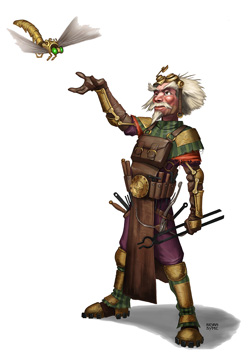
Artificers are the practical technicians of the magical world. Unlike wizards or sorcerers who pursue more theoretical research, or clerics and druids who are tied to the mandates of their deities or churches, artificers take the practice of magic and tailor it to the needs of the situation. From maintaining complex enhancements along lightning rail lines or on board an elemental airship, to customizing the combat enchantments for a strike team deep behind enemy lines, artificers take the magic that is already at hand and apply it in a more efficient manner, essentially getting more spell for the silver.
Role
An artificer takes on the role of a magical item expert, combining much of the flexibility of a wizard with the critical eye of a rogue, and provide access to magical effects that the rest of the party would not normally have. The artificer is often able to provide solutions for situations where either brute strength is not enough or the available spells are not appropriate to the task at hand. While they are not incredibly suited for front-line combat, given the proper time to prepare, an artificer's infusions can easily turn the rest of the party into a tailor-made fighting force against their chosen foe.
Creating an Artificer
An artificer is the preeminent engineer of magical goods and supplies. Consider what drives your artificer to study and experiment. Is if for fame? For the sake of their knowledge? Proof of concept? Is it under the belief they can make a difference? Or is it really about money?
Think about what your artificer is more focused on. In addition to their main interest a within creation, there will be latitude for most to do other things, but the different schools are better at a certain abilities.
Quick Build
 • If you want to be at the edge of the battlefield,
combat medic, empower your team directly
through draughts, potions and consumables
- play the Alchemist.
• If you want to avoid battlefields, be an Ian
Fleming-esque "Q", help fund the group's
ambitions, and be truly focused on magical item
creation - Play the Mystic Sage.
• If you want to be in the middle of the battlefield,
striding through with empowered armor & weapon,
and enchant those around you - play the
Battlesmith.
• If you want to lead a horde of minions - play the
Clockwork Engineer.
• and If you want more utility
class with spell casting and item creation - play an
Arcane Engineer.


The ARTIFICER
| Level | Proficiency Bonus | Features | Infusion Pts | Schema Lvl Limit |
|---|---|---|---|---|
| 1st | +2 | Field of Study, Infusions,Consumable Proficiency | 2 | 1 |
| 2nd | +2 | Artificer’s Expertise, Minion | 3 | 1 |
| 3rd | +2 | Artificer's Senses(Identify), (FOS) Feature | 6 | 2 |
| 4th | +2 | Ability Score Improvement | 8 | 2 |
| 5th | +3 | Dweomer Recovery (1), Enduring Enchantment | 10 | 3 |
| 6th | +3 | Univeral Attunement, (FOS) Feature | 14 | 3 |
| 7th | +3 | Sage's Sight, Vocational Advancement | 16 | 4 |
| 8th | +3 | Ability Score Improvement | 20 | 4 |
| 9th | +4 | Dweomer Recovery (2), Enchant | 24 | 5 |
| 10th | +4 | Universal Attunement Improvement | 28 | 5 |
| 11th | +4 | FOS Feature, Overcharge | 32 | 6 |
| 12th | +4 | Ability Score Improvement | 36 | 6 |
| 13th | +5 | Dweomer Recovery (3) | 40 | 7 |
| 14th | +5 | FOS feature | 44 | 7 |
| 15th | +5 | Univeral Attunement Improvement | 48 | 8 |
| 16th | +5 | Ability Score Improvement, FOS feature | 52 | 8 |
| 17th | +6 | Enduring Enchantment Improvement | 56 | 9 |
| 18th | +6 | Dweomer Absorption, FOS feature | 60 | 9 |
| 19th | +6 | Ability Score Improvement | 64 | 9 |
| 20th | +6 | FOS Final feature | 68 | 9 |
CLASS FEATURE
Hit Points
Hit Die: 1d6
Hit Points at 1st level: 6 + Constitution Modifier
Hit Points at Higher Levels: 1d6 (5) + Constitution Modifier per Artificer level after 1st.
Proficiencies
Armor: Light armor, medium armor, shields.
Weapons: Simple Weapons
Tools: Chose two from {Alchemist's Tools, Artisan's Tools, Healer's Kit, Herbalism Kit, Poisoner's Kit, Smithing Tools, Thief's Tools & Tinkerer's Kit}
Saving Throws: Intelligence, Wisdom
Skills: Choose two skills from Arcana, History, Investigation, Medicine, and Nature.
Equipment
You start with the following equipment, in addition to the equipment granted by your background:
- Traveller's Robes, A Formulae book, A Schema book and
- Arcane Engineer - Calligrapher Supplies, Arcane focus, 2 daggers, and Ritual Book
- Mystic Sage - Calligrapher Supplies, Woodcarver’s Kit and staff
- Battlesmith - Non magical Sword & Scale mail
- Clockwork Engineer - Tinkerer’s Tools, 10 lbs of construct parts
- Alchemist - Two vials of acid, A poisoners kit
Multiclassing
Prerequisites. To qualify for multiclassing into the class, you must meet these prerequisites: Intelligence 15
Proficiencies. When you multiclass into the class, you gain no proficiencies.
Artificer
Infusions
You gain the ability to create Infusions. Infusions are neither arcane nor divine; they are drawn from the complex Magical Schemas and then infused into the forms listed below. They function just like spells and follow all the rules for spells. For example, an infusion can be dispelled, it will not function in an antimagic area, and an artificer must make a Concentration check if injured while attempting to imbue/place an infusion (failure means the infusion is stopped and must be restarted).
As an Artificer, you use Schemas (see below) in combination with your known Infusion Formulae (See Below) from the list formulae you have learned/created/or discovered. Like spell casters, you automatically gain Infusions as you progress. Like Wizards, it is possible for you to learn new infusions and Schemas. These might include ancient infusions you find in the ruins of Xen'drik or secret infusions known only to the members of certain guilds or organizations.
Infusions have longer casting times and you will need to plan ahead as several infusions will take hours (at times even weeks) to cast, and as such you cast them from your books - without them... you are nearly powerless.
Arcane Schema
You are able to learn a spell's schemas that you keep in your schema book. A schema differs from a spell in that a schema doesn't pull the magic to create the effect - it the understanding needed to infuse the power of that Schema into an item but not to cast the spell itself. Therefore, you cannot cast the spell directly (but are able to create scrolls or wands with the spell's ability imbued within it). Some Schema's knowledge also allows you to research and create Formulae that have the prerequisite spell as a requirement for creation.
As with Infusions, schemas are not the same as a warlock's, a cleric, sorcerer or even a wizard's magic - being neither arcane or divine in nature, but are those spell's underlying pattern, the most basic form of the magic's effect. Any other class would not be able to pick up the book and reverse engineer the spell schema into a workable spell. (DM's Fiat obviously overrides that).
You can also copy the addition spells into your schema book by examining a scroll, a spell book, schema book (This does not use up the book). Artificer's automatically know how to use any of their known spells as schemas and does not need to keep schema of the spell in their schema book -- for spells gained from multi-classing, however, this does not go both ways. They may not use Spell Schema's they've learned as spells and cast them through the use of spell slots.
Additionally, Whenever another creature casts a spell (and is within your schema level range), as a reaction you can make an Arcane (Intelligence) check against the caster's spell DC. If successful you remember the details of the spell and can add it to your schema book. You can only hold onto one spell until you've copied it, and you are must maintain concentration to hold the spell schema in memory until the copying is completed. Copying Schemas costs 20gp and 1 hour per spell slot (though some infusions may reduce that time).
When starting off as an Artificer you start with 2 + Intelligence ability modifier spell slot levels of schemas in your schema book. Those schemas must be of a level no greater than your Proficiency bonus (Cantrips count as 1 spell slot.)
Infusion Formulae
Formulae are essentially the pattern and plan of the infusion for the Artificer. A formulae often requires specific schemas and materials which are either used up, may be recovered, or are now forever part of the object being infused.
As a general rule, if the DM allows for Artificers to develop/research additional Formulae it is suggested to use the DMG guidance for magic item creation with the value of 1,000gp cost per infusion point.
Infusion Points
You are limited to certain amount of mystical energy you draw upon each day. This is referred to as your Infusion points. You maximum Infusion points are equal to the Points listed in the table above for your level. At the dawn of each day your used infusion points are restored.¹ In general, Infusions maintain themselves for 24 hours, or until the Dawn of the next day. You may never have unexpended Infusion Points that exceeds the Maximum Infusions points for your level plus your Intelligence modifier.
Creating an Infusion costs a number of Infusion Points, as noted in the Infusion's description, and also costs materials (also noted in the Infusion's Descriptions). When an item is under the effect of an Infusion, that item is considered magical for the purposes of Detect Magic, Identify and Dispel Magic, but unless the infusion states otherwise, NOT for purposes of overcoming damage resistances. The total number of Infusion Points invested in a single item or Automaton cannot exceed the caster's Infusion Maximum. [This is a clarification for when multiple Artificers are working together on a single item]
Spellcasting/Infusion Ability
Artificers do not obtain spell slots, for purposes of spell descriptions and multiclassing, your Artificer levels are full caster levels, but again you gain no spell slots while advancing in Artificer.
Intelligence is your spellcasting ability for you artificer spells. You use your Intelligence modifier whenever an Infusion or spell refers to your spellcasting ability.
Spell/Infusion save DC = 8 + your proficiency bonus + your Intelligence modifier
Spell/Infusion attack modifier = your proficiency bonus + your Intelligence modifier
Cantrip
All Artificers gain use of the Mending cantrip.
Infusion List
At 1st level all Artificers know the Infusions for Light and Repair.
Thereafter you learn 1 infusion with each new level. If your field of study(FOS) grants you an infusion you already know, you may choose another infusion of the same type.
You may not learn an infusion whose base Cost exceeds your current level.
DM Game Mechanics:
You spend the time gaining experience between each level developing your next infusion(s); in your downtime, during rests, doodling at taverns, etc etc.
DM's Option: Artificers may be taught or develop additional infusions, thought this should be viewed as VERY unlikely as the artificers view their formulae as trade secrets/nearly sacred, though still... some guilds and houses may provide specific guidance. Your DM may opt to replace the list of infusions learned at different levels, with specific infusions that are House/Clan/Guild mandated.
Consumable Proficiency
You are considered proficient in improvised weapons for attack rolls required by your Consumables. In addition, you may throw your Consumables twice as far.
Field of Study
At 1st level, you gain a feature from your Field of Study.
You gain additional features as stated in your Field of Study
Artificer's Expertise
At 2nd level, choose either two of your skill proficiencies based on Intelligence, one skill based on Intelligence and one tool proficiency, or two tool proficiencies. Your proficiency bonus is doubled for any ability check you make that uses either of the chosen.
Minions
Starting at 2nd level, if your character is able to cast a summon or familiar spell Traditionally brings a celestial, beast, fey, or fiend. However; if you cast such a spell, while you do choose forms for your summoned/familiar creature, it is always a construct instead of a beast (or celestial, beast, fey, or fiend). It resembles the chosen creature, but is make of clockwork gears, screws, wires, hinges and plates. The summoned creatures are immune to charmed condition, and resistant to Poison damage.
Likewise you may speed 1 week and 250 gp building one of the following: Clockwork Helper, Agent, or Iron Grappler. This does not count against the number of constructs you can control, but does count against your ability to summon a familiar.
You may only have the one minion active at a time at 2nd level. You may not dismiss it as with Familiars. Minions upon reaching 0 Hp are not destroyed (provided it was not disintegrated) it is instead rendered inert and you need only repair the construct to bring it back to functional. An active minion fills an attuned slot.
- At 11th Level you may have 2 minions active at a time.
Artificer's Senses
At 3rd level, you develop your ability to trace the dweomer of magic items. You can expend concentration and take 1 minute to gain the effect of a Detect Magic, and if continue to maintain concentration over a short rest to gain the effects of an Identify spell (This does not require any components Verbal, Somnatic, Material nor use of spell slots)
- At 7th level when you concentrate you are considered to always be under the effect of Detect Magic, and it takes you only 10 minutes to gain the effect of an Identify spell.
Unravel
At 3rd level, as an action, you may spend an infusion point and establish concentration - making an Arcana Check against the caster's spell DC to suppress an ongoing magical effect within 15ft until the beginning of your next round. The magical effect is merely interrupted, and resumes for its remaining duration.
- At 8th level, you may spend three (3) infusion points to either create the effect of a dispel magic, or spend your reaction to attempt to Unravel (Counterspell) the the spell as its being cast using an Arcana check.
Ability Score Increase
When you reach 4th level, and again at 8th, 12th, 16th and 19th level, you can increase one ability score of you choice by 2, or you can increase two ability scores of your choice by 1. Or you may choose a Feat. As normal, you can't increase an ability score above 20 using this feature.
Dweomer Recovery
At 5th level During a short rest, you may regain 1/2 of Infusion Point from used, destroyed or expired infusions, you may do this once per long rest.
- At 9th level, You may use this once per short rest.
Enduring Enchantment
At 5th level when you create an infusion you may choose to enhance the dweomer making it last for 1 step longer. Doing this costs the Artificer dearly, reducing their Maximum Health by twice the Infusion point cost, takes a point of Constitution damage, and gains/adds a level of Exhaustion. The character does not regain the Infusion Point(s), CONstitution damage until either the Infusion(s) is(are) broken, used or a week has passed. Exhaustion can be removed as normal.
- At 11th Level, your Infusions can last up to two weeks. (Charged Items regain charges (not to exceed their MAX) at the start of each day)
- At 17th Level, you no longer gain levels of Exhaustion when you use this feature.
Universal Attunement
At 6th level, the Artificer's intimate familiarity with magic, and magical equipment allows them to gain the benefits of most any item intuitively. The artificer is may spend a short rest to become attuned to any magic item they hold which requires attunement. The artificer can do this even if the item has class or level restrictions.
- At 10th level, you may now attune an additional item (Typically this means 4), and it only takes 10 minutes for you to attune an object.
- At 15th level, It takes you 1 minute to attune. If another creature is already attuned to the item you also become attuned to such, (this does not cancel that creatures attunement to the item, merely preempt such until they regain control. If both are holding it, engage in a magical ''Grapple'' over the item's attunement - Using Arcana checks.
Vocational Advancement
At 7th level you add half of your proficiency bonus to your attempts with any tools you do not have expertise in.
Sage Sight
At 7th level, Once per long rest, you may take 10 minutes to generate the effects of Legend Lore (no components are needed), but the lore is focused on arcane lore, history, and persons around such.
Enchant
At 9th level, once per short rest, as an Action you may (at no cost) surround a melee weapon or up 20 bolts/arrows/stones with a magical field, that counts as a magical weapon but gives no bonus to attack or damage. The effect last until a short or long rest.
OverCharge
At 11th level, when using a magical item with charges, you may use your own infusion points to power the device. By expending 1 Infusion point plus 1 point per spell slot level of the effect, you grant the device an additional charge, and/or (where possible) increase the effective spell slot of the effect being generated.
Dweomer Absorption
At 18th level, whenever you succeed on a saving throw and as a result that spell doesn't generate an effect (damage or impart a condition) You regain a number of infusion points equal to the spell slot used.
Field
of Study
Knowldge is the life's blood of the Artificer. Every new book, every new experiement
is another step towards their master theisis. HOW they go about that differs based off their style
Via pure academics; through Chemistry ; tinkering new friends into existence; playing with
the weft and weave of magic itself; or though battle
Fields of Study
Alchemist
Arcane Engineer
Battlesmith
Clockwork Engineer
Mystic Sage

Fields of Study
Alchemist
Alchemist are masters of concoctions, potions and reagents, they can make potions faster than other Artificers, and are skilled in enhancing creatures' potential. They have some healing abilities and coupled with the Agent Minion, an effective delivery device for the battlefield.
Bonus Proficiency
You gain proficiency with the Alchemist Kit & Glassblower’s Tools.
Bonus Infusion
You gain 1 additional Infusion with each level.
The infusion must be of the type “Consumable”.
Alchemist's Knowledge
At 1st level, you learn the either Acid or Potion of Health and the Potion of¹.. Infusions.
- At 5th level, you learn Potion of².. Infusion.
- At 9th level, you learn Potion of³.. or the Flashbang Infusion Infusions.
- At 13th level, you learn Potion of⁴.. or the Potion of Vitality Infusions.
- At 17th level, you learn Potion of⁵.. or the Bottled Storm Infusion.
Quick and Unstable Consumables
At 1st level you are able to spend a bonus action to create a consumable potion that cost one less infusion point (down to zero), and degrades into uselessness at the end of your turn. The Unstable Consumable may be generated as powerful as if you had spent two points at 6th level, and as powerful as if four points at 14th level.
Acid, Alchemist's Fire, Alchemist's Frost, Holy Water, Holywrath Stone, ICB, Poison, Sympathetic Balm, Phosphorus Stick, Tanglefoot Bag, Thunderstone, or Universal Antidote for no infusion cost.
The Unstable Consumable created degrade into uselessness at end of your turn.
- At 5th level, you may pick another from the additional Unstable Consumable list.
- At 10th level, you add another Unstable Consumable List; which now expands to include: Alchemist's Acid, Greasebomb, and Smokebomb.
- At 15th level, you add another Unstable Consumable that you've figured out how to quickly craft.
Combine Consumables
At 6th level, when you create a Consumable, you can create a single Consumable out of the effects of two Consumables. If both Consumables require a ranged attack, you resolve the Consumable with a single attack roll.
For example, you can spend 2 points on an Acid effect, and 2 point on an Alchemist's Fire effect. On a hit, this Consumable would deal 4d6 + 2 acid damage, and cause the target to begin taking 1d4 fire damage at the start of each of its turns. (Note normally mixing magical potions results in very possible Miscibility Misfires See DMG)
- At 14th level, you can combine 3 Consumable effects.
Enhanced Consumables
At 11th level, the dice used by your Consumables increases by 1 size. (d4 increases to d6, d6 increases to d8, d8 increases to d10, d10 increases to d12, and d12 increases to 2d8).
Healing Infusion
At 14th level, whenever you create a potion, you can also infuse it with one of the following effects:
- Curative Admixture: The character that drinks the potion heals 1 hit points per Infusion Point spent on the potion.
- Resistive Formula: The character that drinks the potion gains resistance to acid, cold, fire, force, lightning, necrotic, poison, psychic, radiant,
or thunder damage until the start
of your next turn. - Shielding Elixir: The character
that drinks the potion gains 1
temporary hit point per Infusion
Point it cost.
Doubled Output
At 20th level, you create two
of that consumable for the
single cost.

Arcane Engineer
Arcane Engineers are more focused upon the engineering of spell schema than on infusion formulae. They trade some of their ability to produce magical devices for magical casting potential. They are a poor sorcerer, but they are the only Artificer that has direct, immediate spell casting ability.
Bonus Proficiency
You gain proficiency in Arcana (or expertise if already proficient).
Cantrip
You learn two Cantrips from the following list: Gust, Control Flames, Mage Hand, Magic Stone, or Light.
Arcane Knowledge
You learn three 1st-level spells of your choice from either the Wizard or the Expanded spell list below.
You learn an additional spell at every odd level taken in the Artificer class. Your spellcasting ability is Intelligence. The spells you learn may not exceed the following chart.
- At 4th level, you can learn 2nd level spells.
- At 7th level, you can learn 3rd level spells.
- At 10th level, you can learn 4th level spells.
- At 14th level, you can learn 5th level spells.
- At 17th level, you can learn 6th level spells.
Arcane Spellcasting
At 1st level you can cast any spell you know. (Spells and Schemas are different things) Doing so uses infusion points equal to twice the spell slot used, you may not use a higher spell slot then the highest spell level you can learn.
You also gain "Overcharge" (as per the 9th level ability).
Ritual Spellcasting: You can cast any spell you know as a ritual if that spell has the ritual tag. Doing so uses 1 infusion point regardless of its level.
Arcane Adaptability: When you learn a spell you may instead learn a variant of that spell (chosen upon leveling up), if the spell does a damage type, you may cast a variant of the spell which does another form of damage or gives another equal condition (ie - deaf and silenced; restrained and grappled) or requires a different Save (Dex vs Wis). You may develop a variant version of 1 spell at every even level taken in the Artificer class.
- At 6th level: You may cast a spell the requires an melee/touch attack roll on a willing recipient that you can touch -- casting the spell as normal but spending an additional Infusion point. The recipient thereafter become the "wielder" of that spell on their turn and can use it with their own attack/action rolls.
Arcane Implement
At 6th level, you craft an implement. The implement costs 500gp and takes 2 weeks to build. This implement can be an orb, a Medallion, a staff, a rod, a Libram, or a wand. When you craft the implement you must choose Verbal or Somatic. When you cast through this implement you can't spend more points than your level maximum level of known spells, but yours spells cast through the object no longer require the chosen (verbal or somatic).
You also learn an additional cantrip from any list.
Implement Expertise
At 11th level, spells cast through your implement gain a +1 bonus to attack rolls, saving throw DC's.
Implement Mastery
At 14th level, your implement adds certain bonuses to spells cast through it, depending on the type of implement you've crafted.
- Libram of Versatility: With each new level you gain you may choose to either gain a new spell or develop another variant.
- Medallion of Metamagic: You gain one Metamagical ability from Sorcerer. Pay the costs in Infusion Points.
- Orb of Imposition: You have advantage on Constitution saving throws made to maintain Concentration on a spell cast from your Orb of Imposition.
- Rod of Power: You deal an extra point of damage per damage die
- Staff of Defense: When you cast a spell out of your Staff of Defense, choose one creature you can see. That creature has disadvantage on attack rolls made against you until the start of your next turn.
- Wand of Accuracy: You add 1d4 to attack rolls of spells cast out of this implement.
Improved Implement Expertise
At 18th level, the bonus granted by your Implement Expertise feature improves to +2.
Arcane Engineer's Additional Spell List
| Level | . Spells |
|---|---|
| 1st | Armor of Agathys, Bless, Chaos Bolt, Entangle |
| 4th | Enhance Ability, Heat Metal, Silence |
| 7th | Beacon of Hope, Call Lightning, Elemental Weapon, Hunger of Hadar |
| 10th | Freedom of Movement, Guardian of Nature, Shadow of Moil |
| 14th | Circle of Power, Destructive Wave, Greater Restoration |
| 17th | Bones of the Earth, Primordial Ward |
Battlesmith
You find the thrill of battle your life's passion.
Bonus Proficiency
You gain proficiency with: all Martial weapons and Heavy Armor; and Smith Tools.
Bonus Cantrip & Schema
You gain one cantrip from the following list; Green Flame Blade, Blade Ward, Shillelagh, or Sword Burst.
Bonus Infusions
You gain 1 additional Constant type Infusion with each level.
- At 1st, You learn the Magic Armor and Magic Weapon Infusions.
- At 5th level, you learn Elemental Resistance and Vengeance Weapon Infusions.
- At 9th level, you learn Protective Armor Infusion.
- At 13th level, you learn Quickened Weapon Infusion.
- At 17th level, you learn Antimagic Armor Infusion.
Arcane Rejuvenation
You can as an action expend a number of Infusion Points no greater than your level plus proficiency bonus. You gain temporary hit points equal 2 * the number of Infusion Points spent. You may do this once per short rest.
Extra Attack
At 6th level, when you take the Attack action, you make two attacks instead of one.
You may use a bonus action to make a single attack at disadvantage if you've cast or used an item that casts a spell as your action.
Signature Enchantment
At 11th level you may choose up to 5 Infusion Points of a single Infusion. The Infusion must be one that affects a weapon or armor. You thereafter lose those infusion points until your next level, but any Infused weapon/armor you wield that you've created gains that Infusion as well at no additional cost. Each level you may reassign those points to a different infusion.
- At 17th level, you may choose up to 8 points for the Infusion.
For example, an 11th level Battle Engineer chooses to have the Signature Enchantment of Elemental Weapon (fire), When they wield an infused greatsword with Bleeding Weapon. Greatsword is infused by both Bleeding Weapon and Elemental Weapon(fire).
Mass Enchantment
At 14th level, all allies within 60 feet of you gain the benefit of your Battle Engineer Signature Enchantment, when they wield one of your infused weapons/armor.
Arcane Army
At 18th level, allies within 150 feet of you may attune themselves to a fourth magic item. This magic item must be a weapon or armor. If your allies are not within 150 feet of you, they cease to gain the benefits of being attuned with that item.
Arcane Defender
At 20th level, You Clockwork Iron Defender Grows Grows to a Mecha Defender, and can acts as your mount.

Clockwork Engineer
Bonus Proficiency
You gain proficiency with Tinkerer’s Kit.
Bonus Schema
You have the Animate Object Schema.
Bonus Infusion
You gain no additional infusions with each level.
Clockwork Engineer's Infusions
- At 1st level, you learn the Arbalest Infusion.
- At 5th level, you learn Clockwork Bomb.
- At 9th level, you learn Total Repair.
Clockwork Companion
When an Automaton Infusion created by you and synced to you is reduced to 0 hit points, it is rendered inert instead of destroyed. It doesn't need to make death saves, but if it's attacked further you will need to take 10 minutes more for each additional assault to restore it's function. If the automaton was dropped to 0 hp after the end of your last turn, you your Turn, as an action and can get into the square with the downed automaton, for two infusion point, you can return the Automaton to functional with 1 hit point.
- At 3rd Level you may have up to ½ your Artificer Level worth of Constructs operative - (though you may never have more than your Charisma Bonus under your control at one time. (all action economy is maintained))
Autonomy
At 3rd Level, Autonomous Engineer’s can assign the Automaton(s) to take the Guard, or Evade, Actions, which they will continue doing so until ordered to stop.
-
Evade Attacks against the Automaton are at disadvantage, if attacked on its next turn it will disengage and takes its move to get away from combat, it will continue to move this way until not attacked for a turn, at which point it will then return.
-
Guard Assign the Automaton a creature or 15ftx15ft cube to watch over. When a creature either attacks creature or a creature not designated by its Sync'd owner enters the space, it attacks them.
-
At 5th level, Automatons gain an Semi-Autonomous Command interpreter. As an Bonus Action you command your Automaton (a single Automaton or a designated sync'd group) to perform a simple a full action command (attack, dash, evade, etc) which it will repeat (ie attack that creature, dig a hole, walk between these points) until attempting the task becomes impossible, it's sync'd companion or creator is killed, or it is given another command. The DM interprets the command's execution unless you specifically are micromanaging (in which case any action/bonus/reaction the automaton uses, so do you)
-
At 7th Level, your synced Automatons execute one additional attack when performing an attack action (May not exceed 3 attack actions a round), if you wish you may now use either a bonus action or a reaction action to modify the semi autonomous command action. Or as a full action you may give two command actions; (commanding different automatons/groups.)
-
At 17th level, your commands may consist of up to your Int Bonus number of Stacked commands. Example:
- (1st Priority) Defend Unconscious Ally
- (2nd Priority) Kill Designated Creature
- (3rd Priority) Assist Closest Ally (Grant Help)
In that a total of 9 words convey that the Automaton should defend an unconscious ally, (and if none exists), attack a designated creature until it’s dead (or until an ally is brought to unconsciousness - at which point the Automaton would disengage and defend the body of the ally), however if the initial target is killed before an ally is dropped to 0 hp. It would move to the closest ally and mirror its engagement (attempting a skill). The DM should limit the number of words the player can use to make them VERY cautious of wording of such.
Infuse Automaton
At 6th level, you can infuse an Automaton with infusions that can target a weapon or armor. You still cannot exceed your level for Infusion Maximum on the total number of points invested in your Automaton. Additionally, if you can cast spells, You may now also cast any spell with self as the target on one of your sync'd Automatons.
Sync
At 11th level, you can sync with multiple Automatons at one time (Each takes 1 attunement slot, but you may never have more than your Charisma Ability Modifier (minimum 1))
Reinforced Automaton
At 14th level, when you create an Automaton or restore it to its full hit points, that Automaton gains 20 temporary hit points.
At 18th level
choose between one of the following;
- Lifelike Automaton Your skill transcends into artistry - your Automaton’s gain proficiency with Deception (+10) for the purposes of appearing to be living creatures, They gain speech (limitedly) and their movements and behavior are disturbingly realistic. Cost of the automatons is doubled. They retain their abilities which often will clearly demonstrate them to be constructs, but a horse, dog, or even child will appear real to the casual inspection. Your Automatons gain +2 bonus to their Intelligence,Wisdom, and a +6 to Charisma ability scores.
- Adamantine Automaton your Automaton’s gain a +1 bonus on their AC, STRength, DEXterity, and CONsitution ability scores, and gain +10 movement.

Mystic Sage
This Artifier focuses on the creation of goods. Written works in particular, and is horrible at combat.
Bonus Proficiency
You gain proficiency with two of the following artisan kit/tools; Calligraphy Supplies, Carpenter's Tools, Cook's Utensils, Painter's Kit, Potter's Tools, Weaver's, and Woodworker’s Tools.
Bonus Cantrip
You learn 2 Cantrips from the Following List: Message, Guidance, or Mage Hand.
Bonus Infusions
You gain one additional infusion of the type Artistic/Wonderous with each level.
- At 1st level, you learn Quill of Longwritting and Quill of Dictation.
- At 3rd level, you learn Wand of ... and Rune Infusions.
- At 5th level, you learn Reading Glasses, and Cynic’s Goggles.
- At 7th level, you learn Goggles of Truesight and Quill of Law.
- At 11th level, you learn Rune of Shadowtendril.
- At 17th level, you learn Bottled Storm.
ReCharged
At 1st level, You may, as a bonus action, use 1 infusion point + 2 points per spell slot level to grant a magic item with a Temporary single charge.
- At 6th level, you reduce the infusion cost of making a wand, stave, rod by 1 point (You still may not exceed your Max Infusion cost).
- At 12th level, if you put a charge into an item that broke within the last hour as a result of expending its last charge, you may repair it. (effectively a revify for charged magical items). When you do this, rather than your overcharge granting an additional charge, it returns the item's ability to gain more charges the next day.
Alternate Rule:
The Artificer must have one or all of the schema(s) necessary to recharge the item to use this ability.
Enduring Enchantment
(This replaces the Enduring Enchantment received at 6th level)
At 1st level, when you create an infusion you may choose to enhance the dweomer making it last one day. Doing so costs the Artificer dearly. In addition to the Infusion point costs the artificer reduces their Maximum Health by that same amount as well as take a point of Constitution damage. You may not regain the Infusion Point(s), CONstitution damage, and damage from Maximum HP until either the item(s) are broken, used or a week has passed.
- At 6th Level you may add infusions points to an Enduring Enchantment, taking it further - you may not add more Infusions points than your Maximum Infusion and your infusions last up to a week.
- At 12th Level you no longer take Constitution damage when you craft an enduring enchantment.
Expeditious Enchanter
At 5th level, you may effect you daily crafting productivity from 25gp a day (DMG pg. 129) for magical goods with your Infusion points. So that at 5th level they would have 35gp productivity of work a day for magical goods. (and from 5 gp a day for mundane to 15gp a day)
- At 10th level, 53 gp(magical); 33gp (Mundane).
- At 15th level, 73gp (Magical); 53gp(Mundane).
- At 20th level, 93gp (Magical); 73gp(Mundane).
| Rarity | 5th | 10th | 15th | 20th |
|---|---|---|---|---|
| Common | 2 Weeks | 1 Week | 4 days | 1 day |
| Uncommon | 3 Months | 6 Weeks | 3 Weeks | 1 Week |
| Rare | 2 Years | 16 Months | 1 year | 8 months |
| Very Rare | n/a | n/a | 6 years | 5 years |
Increased Infusions
At 11th level, your Maximum Infusion Pool in increased by (2 x INTelligence bonus.)
Frugal Fabricator
At 14th level, the costs (gold) for the infusions is ½ the listed expense and 1 less Infusion point (Minimum 1 pt) - provided you are able to work on your project for 2 hours each day your work is not lost.
Bestiary
Minions & Infusions
Mechanical Relay
Tiny construct, unaligned
- Armor Class 16 + (½ level of artificer)
- Hit Points 4 + (level of artificer)
- Speed 30 ft., climb 20ft, fly 15 ft. + (5 x ½ level of artificer)
STR DEX CON INT WIS CHA 4 (-3) 17 (+3) 10 (+0) 5 (-3) 12 (+1) 5 (-3)
- Condition Immunities groggy, weak-kneed
- Senses Blindsense 20 ft., Darkvision 60ft, passive perception 11
- Skills Perception +3, Stealth +5†
- Languages None (the construct itself cannot speak / write / read)
- Challenge ¼
Actions
Poisonous Sting. Melee Weapon Attack: +6 to hit, reach 0ft., one target. Hit 5 (1d2 piercing damage) and then up to three times per short rest the target must succeed Constitution saving throw or become poisoned for 1 minutes. If its saving throw result is 5 or lower, the target falls unconscious for the same duration. Another fluid may be used, but only 1 potion (up to 18 oz) will fit. one does will last for 4 attacks. Each attack does ½ the dose’s possible damage/healing upon a failed save.
- At 5th level its native toxin becomes stunned
- At 10th level its native toxin becomes incapacitated
Crossface Suplex. Melee Weapon Attack: +4 to hit, reach 5ft., one target. Hit 5 (1d6 + 2)
Wayfinder: The artificer can connect to the Mechanical Relay to see through it up to 30ft, and converse/hear through it up to 100ft (+20 ft per level).
Sneaky Lil’ Bugger The Perception checks against the minion at disadvantage when it's been motionless for 1 full round.
†
AUTONOMOUS ACTION
Hide and Peek:
When not directed, the Minion seeks to fly/crawl into a dark unobserved spot and cling there - awaiting orders. Passive Stealth (16 + (½ level of artificer))
- The Artificer can use the relay to speak through or see through, the Mechanical Relay cannot due such by itself. At 5rd level, the Agent may produce light 30ft bright, 60ft dim, upon command. at 6th level, the Agent may take the form of a mundane tiny object. (Lantern,
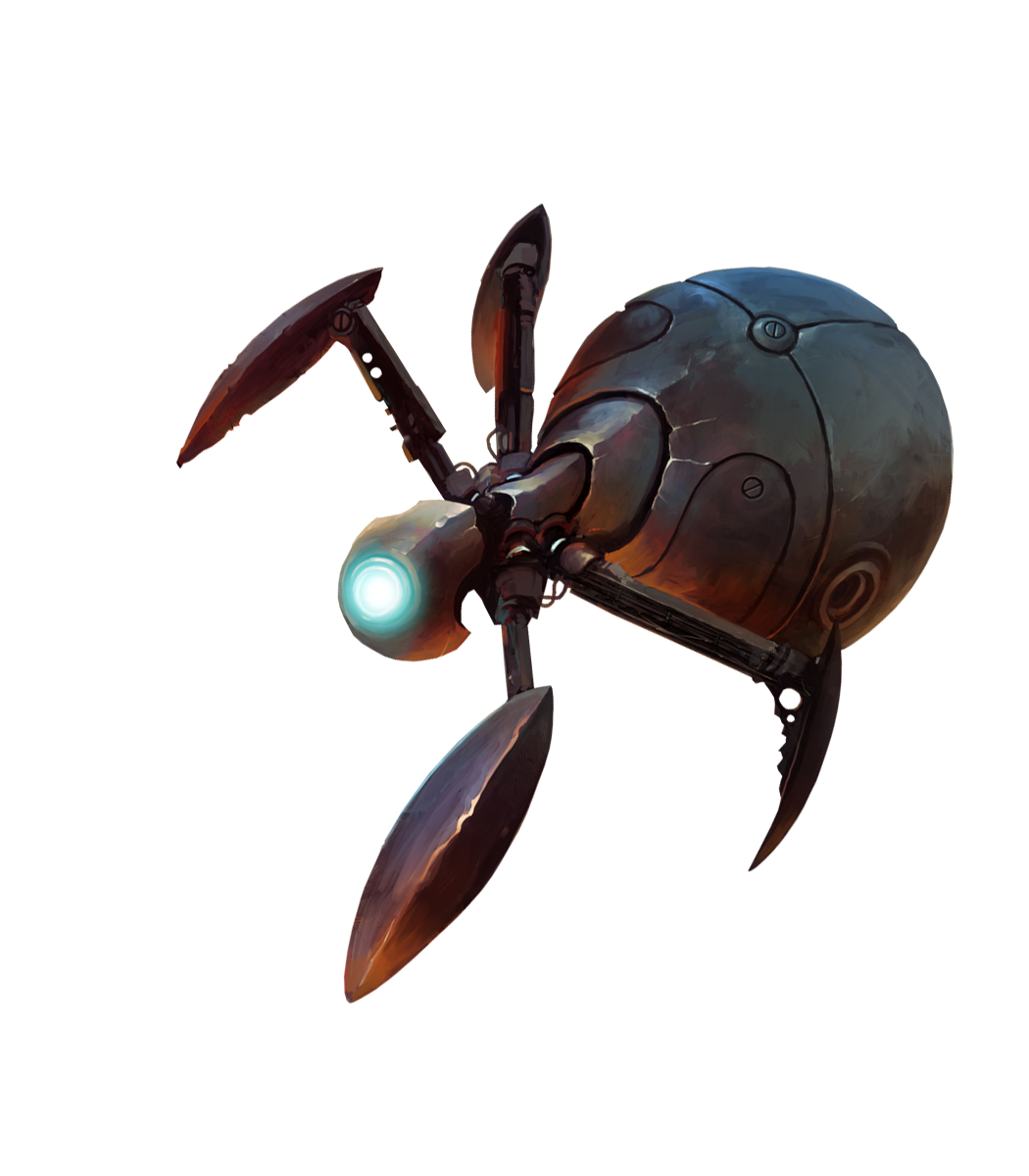
Clockwork Helper
Medium construct, lawful neutral
- Armor Class 10
- Hit Points 14 (1d4 + 5)
- Speed 25ft.
STR DEX CON INT WIS CHA 10 (-1) 8 (-1) 12 (+1) 13 (+1) 14 (+1) 6+† (-2)
- Save: Strength†, Constitution†
- Condition Immunities poisoned, and charmed
- Damage Immunities
- Senses passive Perception 3
- Skills see Crafter†
- Languages All languages known by its creator
- Challenge ¼ ( XP)
Low Gear. The construct is considered Large for the purposes of determining its carrying/lifting/pulling capacity and is not slowed by being encumbered. Snow/Mud/Ice is not considered difficult Terrain - Stairs or changes in height of more than 8” are. The construct cannot jump or ‘side step’ and has disadvantage on Dexterity Checks.
Utilitarian Form. This minion is itself the embodiment of one tool/kits (+ 1 every 3 additional artificer levels), these kits may be exchanged (you must possess the new kit) and requires a long rest.
At 7th level and every 3 levels thereafter - the Artificer could be Clockwork Helper may be given 1 infusion point to be used in its work. Any kit it embodies it is proficient with, and provides resistance to a damage type; Smith - Fire; Alchemist - Acid; Cook’s - Slashing; Leatherworking/Woodcarver - Piercing; Mason - Bludgeoning; Artist - Psychic; Glassblower - Lightening; Weaver - Thunder; Jeweler’s/Tinkerer’s - Radiant;
Crafter. This Minion shares its creator’s proficiencies and their proficiency bonus for checks on tools/kits, nature and investigation, and may craft any mundane item its owner could. The Minion can also assist the artificer on the crafting of a other items (granting advantage) on checks for such, may allow for the item to be completed faster.
Actions
ROCK, Paper Scissors. Melee Weapon Attack: -1 to hit, reach 5ft., one target. Hit 1d3 bludgeoning,piercing, or slashing damage. (Hammer, Knife, Awl Punch)
Crafter. Melee Weapon Attack: +4 to hit, reach 5ft., one target. Hit 5 (1d6 + 2)
AUTONOMOUS ACTION
Obsessively Helpful:
When not actively commanded, the Helper engages in the help action to its owner, or if prevented from such, seeks and gathers reagents (If it possesses an alchemy or herbalism kit), and fixes things if left alone for 10 minutes it will effectively do the same as a ‘’Mending’’ cantrip. If it cannot do that… it tiddies up (regardless of whose things or where it is) This minion is capable of speech and communication.
†- The Artificer’s proficiency bonus is added to the roles and stat.
Iron Grappler
Small construct, lawful neutral
- Armor Class 13
- Hit Points 8 + (3 hp per artificer level)
- Speed 30ft.
STR DEX CON INT WIS CHA 13 (+1) 15 (+2) 13 (+1) 6 (-2) 9 (-1) 6 (-2)
- Condition Immunities groovy, buzzed, swagged
- Senses Passive perception 15
- Skills: Perception +3, Intimidation +2, Athletics +2†
- Languages None (cannot speak / write / read)
- Challenge ¼
Active Defense. As an Autonomous Action (up to your proficiency bonus number of times per long rest) the Iron Grappler will use its straps as a shield (if its not grappling) and defend against attacks gaining a situational +5 AC bonus for that attack only.
- At 10th Level: creatures with weapons must make a Strength or Dexterity Save or else be disarmed, other creatures will be knocked prone.
Pack Tactics. These guys work together. Like super well, you don't even know.
Actions
Whip Bash. Melee Weapon Attack: +2† to hit, reach 10ft., one target. Hit 3 (1d4 + 1) Bludgeoning damage. If the target is a creature, it must succeed on a (Large DC 8) (Medium DC 12) (Small DC 15) Strength or Dexterity saving throw or be knocked prone.
- At 5th Level: Damage increases to d8; saving throw DC (Large DC 10) (Medium DC 14) (Small DC 16)
- At 10th Level: Damage increases to 2d6; saving throw DC (Large DC 10) (Medium DC 16) (Small DC 18)
Binding Straps. Despite its size the Grappler may attempt to grapple up Medium Sized creatures.
- At 7th level it may attempt to Grapple Large Creatures;
- At 11th level it gains advantage on Grappling attempts,
- At 16th it may grapple up to 3 Medium creatures within 15 feet or each other. Prone creatures that are Grappled are considered incapacitated.
AUTONOMOUS ACTION
Active Defense
The Iron Grappler autonomous engages in dodge as its action and disengage as its bonus - whenever it's not directed to engage. Attackers get disadvantage on attack rolls against it, and the Grappler counts as an ally for the purposes of flanking or rogue sneak attacks when within 10ft of the creature.
- †Add your Proficiency Bonus to the Stat

Automatons
Where Credit is Due
This work isn't unique or even very clever, as Piscaso said “Good artists copy, Great artists steal”
I am honored that KibblesTasty so liked the class as to build from it.
I'll reciprocate and see what a collobration would have looked like
Sources:
♦ Eberron Player's Guide, WoTC 2009
♦ Pathfinder Roleplaying Game: Ultimate Equipment
Online Sources
♦ (v0.0.1) OG Artificer
♦ (v0.2.0) UA Artificer Returns
♦ (v0.2.0) UA 2020 Subclasses Part 3
Artificer
♦ (v0.2.0) Artificer
Art is Good
I'm not asking for money for my publication, but... if you like this realize that its in no small part due to the 'feel' of its visual elements.
Please consider supporting these artists on their Patreon accounts where possible, or through PayPal donations.
♦
If you choose not to, then donate to me, and I'll do it on your behalf.
Changelog
19/18/2015
- Posted to DnDWiki
2/26/2020
- Added changelog
- Integrated KibblesTasty's rework of the class.
- Renamed Subclasses; Clockwork Engineer = Golemist
- Renamed Subclasses; Arcane Engineer = Arcanist
- Renamed Subclasses; Mystic Sage = Inventor
- Renamed Subclasses; Battlesmith = Golemist
Current Version: 0.0.2
If you are using the PDF, This will link to the most current version of this class.
FEEDBACK!
- Have a question?
- Want to suggest a change?
- Find an error?
.png) Click HERE
Click HERE