Warmage
A man, clad in brilliant platinum ceremonial armor rides alongside a unit of soldiers, marching in perfect precision. As he shouts marching commands, his men respond almost preternaturally, anticipating his orders. In rapid succession, each of the men reaches a hand skyward and releases a bright pulse of flame, instants later exploding overhead with a thunderous kaboom. The armored rider takes a few notes, nods his head, and the men begin their display again.
A female elf and twenty trainees stand in something reminiscent of an archery range, though constructed entirely from metal. At her signal, they let loose a barrage of energetic bolts downrange at a cluster of statues. Some miss their mark entirely, while others land only a glancing blow. Shaking her head with disapproval, the elf commands the students to gather behind her. Heat and energy wells in her outstretched palm, then flies downrange, exploding into a brilliant fireball, reducing the statues to rubble. Smirking, she turns and snaps her fingers, and the students quickly retrieve brooms, dustpans, and more statues.
A thousand armored troops stand at attention in perfect rank and file. To the fore of the group is a raised dais, upon which a half orc kneels before a fire-haired dwarf matron. She taps one of his shoulders, then the other, with an intricate golden rod. Then he stands, and the matron places the rod in his hand and a shield emblazoned with the visage of a horse in his other. The half orc bows and turns to his comrades, instantly cracking the facade: the boom of a thousand voices rises up in cheer, welcoming their new brother into the fold.
Martial Spellcasters
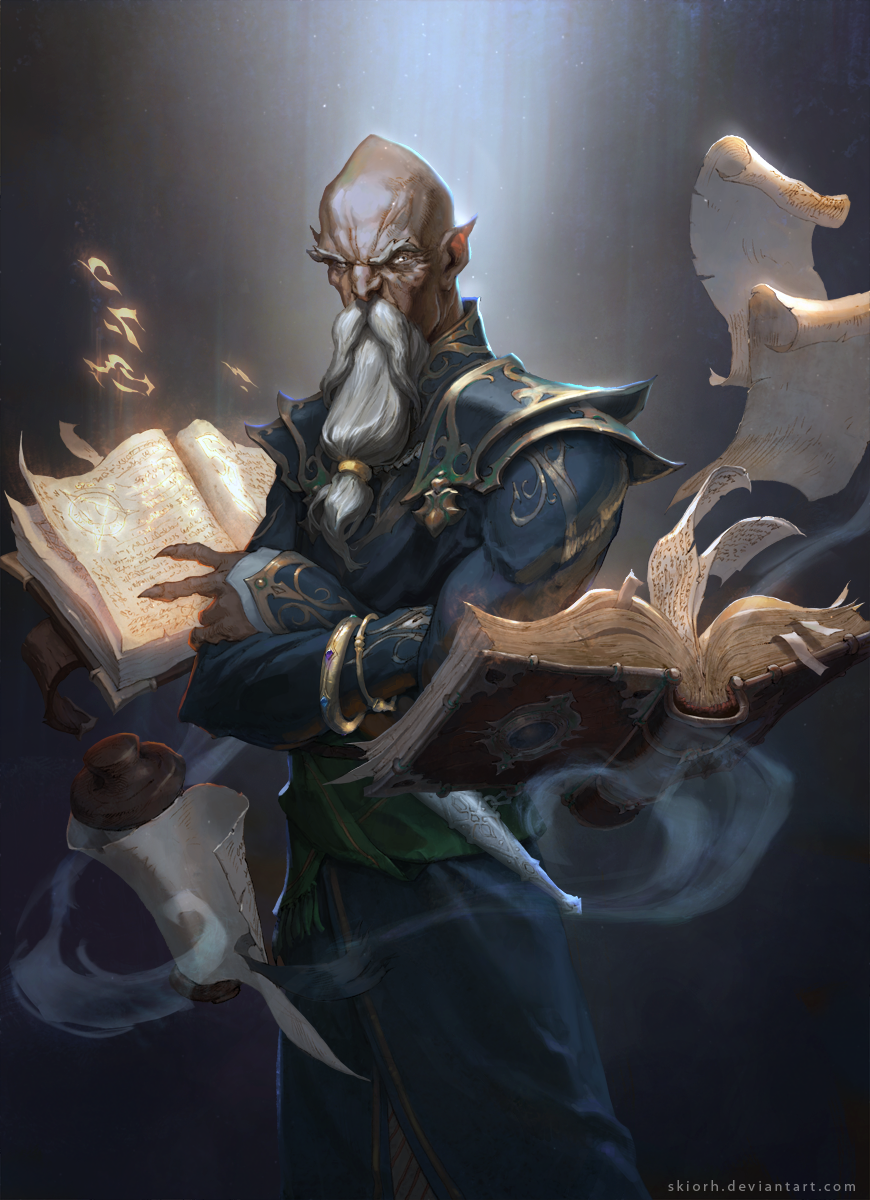
Popular as both wartime mercenaries and as peacekeepers, warmages are a unique breed of spellcaster, one that specializes in and perfects the use of the lowest level spells, cantrips. Warmage philosophy teaches that, with discipline, magic can be used at its lowest level as easily as a common warrior wields a bow, a sword, or an axe. When used in this way, magic is not a mysterious, unknowable force, but a trainable weapon, and can be taught to almost anyone with aptitude. The College of Warmages, as a result, has managed to field an army of highly effective (though comparatively simple) spellcasters.
The College of Warmages is viewed with scrutiny (if not outright hostility) by the rest of the world due to their practices and teachings. For those without magical aptitude, the College's overpowering force is a perpetual threat. The College is a host unto itself, and its army, though certainly still honorable, is nonetheless wholly mercenary. A nation that enlists warmage aide in one war might find warmages allied with their enemies in the next.
Wizards and sorcerers, on the other hand, see warmages as rudimentary and trite, largely because warmages do not understand the nuances of magic. Warmages are not interested in studying magic, nor do they wish to plumb the mysteries that confound spellcasters everywhere; they seek only to destroy. For this reason, warmages are even a threat to other spellcasters. Their single-minded utilization of magic has honed their magic's destructive potential, and their great numbers threaten rarer spellcasters in an outright battle.
Glory and Duty
While rules, traditions, and the chain of command are rule and law in the College, graduates are afforded ample freedom for travel and adventure. Graduates only need fulfill two requirements: first, the College may recall the warmage to serve once a year, and second, the warmage is never to discredit or dishonor the College. Those who do will find themselves before an inquiry board in short order, and punishments range from lashings and imprisonment, to expulsion from the College and even execution.
Rather central to a warmage's character is his Arcane Initiation. Where did you learn of magic? Is it innate, something you were just born with? Did you grow up in a convent or monastery? Were you apprenticed to a proper wizard or alchemist? As well, why did you choose to reject the path to become a proper spellcaster?
Though it is a natural choice to select a militaristic background, nearly any can fit into the mold of the college. Were you perhaps a thief or con man who mistakenly stole from a member of the House of Rooks? Were you perhaps a town guard or militia man who came into contact with a Knight, Pawn, or Queen, and was awed by their prowess?
Lastly, determine which House your warmage wants to belong to. A warmage is initiated into his or her house within the first week of being in the College, but they do not fully graduate until they gain their House subclass at third level. Being a member of a warmage house is much more for a warmage than just selecting a specialty; it is a part of their identity. They will have brothers and sisters the world over who know them by the medal they wear, the symbol they display; there are handshakes, code words, common slang shared between all members of a house, and dozens of other traditions large and small.
Quick Build
You can make a Warmage quickly by following these suggestions. First, Intelligence should be your highest ability score, followed by Constitution. Make Strength your third highest if you plan to take the Hours of Knights or Pawns. Then choose the cantrips chill touch, fire bolt, and mage hand, and the scholar Arcane Initiation.
Class Features
As a warmage, you gain the following class features.
Hit Points
- Hit Dice: 1d8 per warmage level
- Hit Points at 1st Level: 8 + your Constitution modifier
- Hit Points at Higher Levels: 1d8 (or 5) + your Constitution modifier per warmage level after 1st
Proficiencies
- Armor: Light armor
- Weapons: Simple weapons
- Tools: One artisan’s kit, one musical instrument
- Saving Throws: Constitution, Intelligence
- Skills: Choose two from Animal Handling, Arcana, Athletics, Acrobatics, History, Investigation, Medicine, Perception, and Survival.
Equipment
You start with the following equipment, in addition to the equipment granted to you by your background:
• Leather armor, a dagger, and any simple weapon
• (a) a light crossbow and 20 bolts or (b) a shortbow and 20 arrows
• An explorer’s pack an (a) a traveler’s pack or (b) one kit you’re proficient in
Spellcasting
At 1st level, you begin to learn the simple, yet potent, brand of spellcasting for which warmages are known.
Cantrips
At 1st level, you learn 3 cantrips from the warmage spell list. You learn additional warmage cantrips of your choice at higher levels, as shown in the Cantrips Known column of the Warmage table.
Additionally, when you gain a level in this class, you can choose one of the warmage cantrips you know and replace it with another warmage cantrip.
Spellcasting Ability
Intelligence is your spellcasting ability for your warmage spells, since you learn your spells through study and memorization. You use your Intelligence whenever a spell refers to your spellcasting ability. In addition, you use your Intelligence modifier when setting the saving throw DC for a warmage spell you cast and when making an attack roll with one.
Spell save DC = 8 + your proficiency bonus + your Intelligence modifier
Spell attack modifier = your proficiency bonus + your Intelligence modifier
Spellcasting Focus
You can use an arcane focus as a spellcasting focus for your warmage spells.
Arcane Initiation
The College of Warmages takes in students from all walks of life, but only trains those that have some aptitude in magic. At 1st level, choose where you first encountered the spark of magic from the following:
Scholar. You learned your spells and skills through study and practice, likely in a school or under the tutelage of a master. You have a spellbook which begins inscribed with two 1st-level spells of your choice that have the ritual tag from any class’s spell list. With your spellbook in hand, you can cast the chosen spells as rituals.
On your adventures, you can add other ritual spells to your spellbook. When you find such a spell, you can add it to the book if the spell’s level is equal to or less than half your warmage level (rounded up) and if you can spare the time to transcribe the spell. For each level of the spell, the transcription process takes 2 hours and costs 50 gp for the rare inks needed to inscribe it.
Additionally, you learn the cantrips prestidigitation and dancing lights, which don’t count against the total number of cantrips you know.
Savant. You inherited your powers either by birthright or though magical happenstance. In either case, you are less trained than others, but your magic flows out of you with surprising ease. You learn two additional cantrips of your choice from the sorcerer spell list, which don’t count against the total number of cantrips you know, and when you roll a critical hit on a spell attack roll, you deal an extra die of damage.
Arcane Fighting Style
The College of Warmages teaches that magic is the purest of weapons, and can be wielded just as easily as any other. At 1st level, select one of the following fighting styles:
Contingency Cantrip Fighting.
When when you miss with a spell attack, you can use your bonus action to cast the a cantrip that uses a spell attack again the target you missed. You have disadvantage on this attack roll.
If you hit, you can add your spell casting ability to the damage of the second attack.
Blaster.
When you cast a cantrip, you can increase its damage die by one step, to a maximum of d12. A spell that initially deals 1d12 damage instead deals an additional 1d4 damage per damage die. (Die progression is as follows: d4 -> d6 -> d8 -> d10 -> d12.)
Chilling.
When you hit a creature with a spell attack, its speed is reduced by 5 feet until the end of their next turn. If the attack is a critical hit the reduction is instead 10 and they are unable to take the Dash action on their next turn.
Cover-fire.
As a bonus action on your turn you can ready a cantrip, hoping to distract your enemies. Until the start of your next turn, when a friendly creature that you can see is hit by a ranged attack you may use your reaction to cast a cantrip that makes a spell attack roll. If you hit the creature with the spell, they have disadvantage on the attack.
Deflector.
When you have one hand free and a creature hits you with a spell attack or a ranged weapon attack, you can use your reaction to add half your proficiency bonus to your AC, potentially causing the attack to miss.
Fast Cast Riposte.
When a creature targets you with a attack, you can use your reaction to cast a cantrip that makes a ranged spell attack against that creature before their attack happens.
Resistive.
While you are wearing armor or are under the effect of the mage armor spell, you gain a +1 bonus to AC.
Sniper.
When making a ranged spell attack, you gain a +2 bonus to the attack roll.
Striker.
When you roll a 1 or 2 on a damage die for a spell you cast which requires a spell attack, you can reroll the die and must use the new roll, even if the new roll is a 1 or a 2.
Titan Smiter.
You gain a +2 bonus to spell damage rolls you make against creatures larger than you.
Warmage Edge
Starting at 2nd level, whenever you deal damage with a warmage spell, you can add your Intelligence modifier to that damage.
Warmage Trick
Beginning at 2nd level, you learn a Warmage Trick, a special technique that alters the way you fight, move, and cast your spells. You learn 2 tricks at 2nd level, and 2 additional tricks at 5th, 9th, 13th and 17th level.
Additionally, when you gain a level in this class, you can replace a trick that you know with another trick for which you meet the prerequisites.
Warmage House
The College of Warmages divides its students into distinct Houses, teaching different skills, abilities, and techniques. Upon reaching 3rd level, you can select your House from the following: Pawn, Knight, Bishop, Rook, or King. You gain your first house ability at 3rd level, and an additional one at 7th, 10th, 15th, and 18th level.
Ability Score Improvement
When you reach 4th level, and again at 8th, 12th, 16th, and 19th level, you can increase one ability score of your choice by 2, or you can increase two ability scores of your choice by 1. You can’t increase an ability score above 20 using this feature.
Warmage Tactics
At 6th level, you learn how to use ambient magical power to defend yourself from your foes’ magical attacks. You can add your Intelligence modifier to saving throws you make against spells and magical effects that deal damage.
Warmage’s Eye
At 14th level, you are granted a set of innate magical enchantments which greatly enhance your ability to assess the battlefield, determine potential threats, and neutralize them accordingly. You can add your Intelligence modifier to all Perception checks that rely on sight. Additionally, your ranged attacks ignore half and three-quarters cover.
Master Warmage
At 20th level, you reach the pinnacle of your warmage prowess. You can use your Warmage Surge three times between rests.
Warmage Houses
Within the College, different warmages are divided into separate Houses, each of which emphasizes a different approach to combat.
Warmage Cantrips \page
House of Bishops
The House of Bishops focuses solely on spellcasting, expanding the warmage principles to more intricate magic.
Bishop Spellcasting
| Warmage Level | Spells Known | 1st | 2nd | 3rd | 4th |
|---|---|---|---|---|---|
| 3rd | 3 | 2 | ─ | ─ | ─ |
| 4th | 4 | 3 | ─ | ─ | ─ |
| 5th | 4 | 3 | ─ | ─ | ─ |
| 6th | 4 | 3 | ─ | ─ | ─ |
| 7th | 5 | 4 | 2 | ─ | ─ |
| 8th | 6 | 4 | 2 | ─ | ─ |
| 9th | 6 | 4 | 2 | ─ | ─ |
| 10th | 7 | 4 | 3 | ─ | ─ |
| 11th | 8 | 4 | 3 | ─ | ─ |
| 12th | 8 | 4 | 3 | ─ | ─ |
| 13th | 9 | 4 | 3 | 2 | ─ |
| 14th | 10 | 4 | 3 | 2 | ─ |
| 15th | 10 | 4 | 3 | 2 | ─ |
| 16th | 11 | 4 | 3 | 3 | ─ |
| 17th | 11 | 4 | 3 | 3 | ─ |
| 18th | 11 | 4 | 3 | 3 | ─ |
| 19th | 12 | 4 | 3 | 3 | 1 |
| 20th | 13 | 4 | 3 | 3 | 1 |
Spellcasting
At 3rd level, you gain the ability to cast spells more potent than cantrips.
Spell Slots. The Bishop Spellcasting table shows how many spell slots you have to cast your spells of 1st level and higher. To cast one of these spells, you must expend a slot of the spell's level or higher. You regain all expended spell slots when you finish a long rest.
Spells known of 1st-Level or Higher. You know three 1st-level wizard spells of your choice, two of which you must choose from the conjuration and evocation spells on the wizard spell list.
The Spells Known column of the Bishop Spellcasting table shows when you learn more wizard spells of 1st level or higher. Each of these spells must be a conjuration or evocation spell of your choice, except for the spells learned at 8th, and 14th level, and must be of a level for which you have spell slots.
Whenever you gain a level in this class, you can replace one of the wizard spells you know with another spell of your choice from the wizard spell list. The new spell must be of a level for which you have spell slots, and it must be a conjuration or evocation spell, unless you’re replacing the spell you gained at 8th or 14th level.
Arcane Study
At 3rd level, you can select any two skills from Arcana, History, Medicine, Investigation, and Religion. You gain proficiency in that skill if you did not have it before, or double your proficiency bonus if you already have proficiency in it.
Mystical Guardian
At 7th level, you learn the find familiar spell and can cast it as a ritual. The spell doesn’t count against your number of spells known.
When you cast the spell, you can choose one of the normal forms for your familiar or one of the following special forms: imp, pseudodragon, blink dog, or wolf.
Additionally, when you take the Attack action, you can forgo one of your own attacks to allow your familiar to make one attack of its own.
Siege Casting
At 10th level, once per turn, when you deal damage to a creature or object with a warmage spell, you deal an additional 1d8 force damage. Additionally, when you cast a warmage spell on your turn that has a range longer than 5 feet, you can use a bonus action to triple that spell's range.
Arcane Sculpting
Starting at 15th level, when you cast a warmage spell that affects other creatures that you can see, you can choose a number of them equal to your Intelligence modifier. The chosen creatures automatically succeed on their saving throws against the spell, and they take no damage if they would normally take half damage on a successful save.
Arcane Dominance
At 18th level, you learn a powerful magical trick. Select a 1st level wizard spell you know. You can cast this spell at its lowest level without expending a spell slot. \page
House of Cards
Ever-linked to the concept of luck, playing and tarot cards are universally understood to be tools of fate. As such, the House of Cards was the first of the Casino’s fate-focused warmage houses, blending the inherently mystical powers of cards with their own potent magics.
Deck of Fate
Starting at 3rd level, you gain a deck of magical playing or tarot cards, called a Deck of Fate, through which you can enhance the power of your cantrips. Following a short or long rest, you draw a number of cards from a standard playing card deck equal to your spellcasting modifier; these cards are your hand. Whenever you cast a warmage cantrip, you can use one of the cards in your hand to increase the damage of that spell to one target by the number listed on the card, or 1d12 for face cards and Aces.
Once you use a card from your hand, it is gone until you take a short or long rest, at which point all spent cards return to your Deck of Fate and your draw a new hand. Should you lose your Deck of Fate, you can create a new one by performing a ritual lasting 24 hours.
Two of a Kind
Starting at 3rd level, when you cast a cantrip that targets a single creature, you can spend a card from your hand to target an additional creature with that spell.
Fold
Starting at 7th level, when you are hit by an attack, you can use your reaction and spend a card from your hand to cast the shield spell.
Trump Card
At 10th level, select a single 1st level, 2nd level, 3rd level, 4th level, and 5th level wizard spell from any school. These spells are magically scribed into your Deck of Fate. You can cast any of these spells without using a spell slot by spending a number of cards from your hand equal to that spell’s level. Whenever you gain a level in the warmage class, you may replace one of these spells with another of the same level.
Full House
Starting at 15th level, when you roll for initiative and you have no cards remaining in your hand, you can roll 1d4 and draw that many cards to your hand.
Royal Flush
At 18th level, you can burn all of your spell cards in a spectacular display of magical power. As an action, you spend all of the cards you currently have in your hand. Select a number of points you can see within 150 feet equal to the number of cards you spent; you fling a single card to each of those points, which explode, causing each creature within a 20-foot radius of each of those points must make a Dexterity saving throw. A creature takes 5d8 points of force damage on a failed save, or half as much on a successful one. If a creature is caught in a space that is affected by multiple explosions, it must make multiple saving throws.
Once you use this ability, you must take a long rest before you can do so again. \page
House of Dice
Ever the gambler’s loyal, if fickle, companion, dice (and the manipulation of them) are one of the cornerstones of the Casino’s teaching on luck and fate. Despite the fact that dice are, in almost all ways, impossible to affect with skill or knowhow, Dicemages always seems to come out on top of the situations they find themselves in... or, at least, ahead of where they started.
Dice of Fate
Starting at 3rd level when you choose this house, you gain a special pair of 6-sided dice which serve as a spell focus. Whenever you make an ability check, attack roll, or saving throw, you can roll 2d6 and add the result to the d20 roll. Once you use this ability, you must take a short or long rest before you can do so again.
Should you lose your Dice of Fate, you can create a new set by performing a ritual lasting 24 hours.
Boxcars
Starting at 3rd level, whenever you cast a warmage cantrip, if you roll the maximum number on one or more of the cantrip’s damage dice, you can reroll one of those dice and add the new result to the total damage of the spell.
Snake Eyes
Starting at 7th level, you can use your Dice of Fate against hostile creatures. Whenever a hostile creature makes an attack roll, saving throw, or ability check, you can use your reaction to roll your dice of fate and subtract that number from that creatures d20 roll. Once you use this ability, you must take a short or long rest before you can do so again.
Natural
At 10th level, fate turns your way more often than not. Once per turn, when you would make an attack roll, you can choose to make that attack roll an 11 instead of rolling the die. You must make this choice before you make the attack roll. You can use this ability a number of times equal to your Intelligence modifier. You gain back all uses following a long rest.
Big Red
Starting at 10th level, when you use your Dice of Fate or Snake Eyes ability, you can choose for the outcome to be a 7 without rolling the dice.
Master of Fate
Starting at 18th level, you can use your Dice of Fate and Snake Eyes abilities twice before needing to take a rest. \page
House of Kings
The House of Kings trains the lieutenants and generals of the Warmage army, specializing in tactics and strategy.
Bonus Proficiencies
At 3rd level, you gain proficiency in medium armor, shields, and lances.
Arcane Mastery
When you choose this archetype at 3rd level, you learn maneuvers that are fueled by special dice called mastery dice.
Maneuvers. You learn three maneuvers of your choice, chosen from the Kings Maneuvers list. If a maneuver deals additional damage, that damage is your choice of acid, cold, fire, or lightning damage.
You learn two additional maneuvers of your choice at 7th, 10th, 15th, and level. Each time you learn new maneuvers, you can also replace a maneuver you know with a different one.
Mastery Dice. You have four mastery dice, which are d8s. A mastery die is expended when you use it. You regain all of your expended mastery dice when you finish a short or long rest.
You gain another mastery die at 7th level and one more at 15th level.
Saving Throws. When a maneuvers calls for a saving throw to resist the maneuver's effects, use your spell save DC.
Trusted Advisor
At 3rd level, you can use your Intelligence modifier in place of your Charisma modifier when you make Deception, Intimidation, and Persuasion checks.
Lead from the Front
Starting at 7th level, neither you nor any ally within 100 feet that can see you is affected by rough terrain.
Improved Arcane Mastery
At 10th level, your mastery dice turn into d10s. At 18th level, they turn into d12s.
Relentless
Starting at 15th level, when you roll initiative and have no mastery dice remaining, you regain 1 mastery die.
Kings Maneuvers
The maneuvers are presented in alphabetical order.
Arcane Riposte. When a creature misses you with a melee attack, you can use your reaction and expend one mastery die to cast a cantrip targeting that creature.
Check. When you hit a creature with a spell attack, you can spend one mastery die to force that creature to move away from you. You add the mastery die to the attack's damage roll, and the target must make a Charisma saving throw. On a failed save, the target must immediately use its reaction, if available, to move up to half its speed directly away from you.
Checkmate. As a bonus action on your turn, you can direct one of your companions to strike. When you do so, choose a friendly creature who can see or hear you and expend one mastery die. That creature can immediately use its reaction to make one weapon attack or cast a cantrip requiring an attack roll, adding the mastery die to the attack’s damage roll.
Decoy. When you hit with a weapon or spell attack, you can expend one mastery die and use a bonus action to teleport yourself (and your mount, if applicable) up to half your movement speed away from the creature you hit.
Distracting Blast. When you hit a creature with a spell attack, you can expend one mastery die to distract the creature, giving your allies an opening. You add the mastery die to the attack’s damage roll. The next attack roll against the target by an attacker other than you has advantage if the attack is made before the start of your next turn.
Feinting Blast. You can expend one mastery die and use a bonus action on your turn to feint, choosing one creature within 5 feet of you as your target. You have advantage on your next attack roll against that creature. If that attack hits, add the mastery die to the attack’s damage roll.
Impeccable Tactics. On your turn, you can use a bonus action and expend one mastery die to bolster the resolve of one of your companions. When you do so, choose a friendly creature who can see or hear you. That creature gains temporary hit points equal to the mastery die roll + your Intelligence modifier.
King's Order. When you hit a creature with a spell attack, you can expend one mastery die to maneuver one of your comrades into a more advantageous position. You add the mastery die to the attack’s damage roll, and you choose a friendly creature who can see or hear you. That creature can use its reaction to move up to half its speed without provoking opportunity attacks from the target of your attack.
Opening Move. When you take the Attack action on your turn, you can spend a mastery die to double your movement speed until the start of your next turn.
Parry. When another creature damages you with a melee weapon or spell attack, you can use your reaction and expend one mastery die to reduce the damage by the number you roll on your mastery die + your Intelligence modifier.
Precision Attack. When you make a spell attack roll against a creature, you can expend one mastery die to add it to the roll. You can use this maneuver before or after making the attack roll, but before any effects of the attack are applied.
Queen's Gambit. When another creature damages you with a melee or ranged attack, you can use your reaction and expend one mastery die to cast a cantrip targeting that creature.
Stalemate. When you hit a creature with a melee weapon or spell attack, you can expend a mastery die to attempt to grapple it with bands of arcane energy. Add the mastery die to your grapple check: if you are successful, both you and your target are restrained until you end the grapple or the creature breaks free.
Stonewall Attack. When you hit a creature with a spell attack, you can expend one mastery die to hold that creature in place. The target must succeed on a Strength saving throw or be restrained until the start of your next turn. \page
House of Knights
The House of Knights have a long and storied tradition of melding melee combat and swordplay with the warmage's simple spellcasting.
Bonus Proficiencies
At 3rd level, you gain proficiency with medium armor, shields, and martial weapons.
Knight’s Armory
At 3rd level, you gain access to the armory of the House of Knights, an interdimensional space where the weapon stocks of the college are held. You can use your bonus action to summon a simple or martial weapon of your choice from the armory to your empty hand. Any weapon summoned from the armory counts as magical for the purposes of overcoming resistance and immunity to nonmagical attacks and damage. Weapons requiring ammunition are summoned with a quiver or case and 50 pieces of appropriate ammunition.
A weapon summoned from the armory disappears if it is more than 5 feet away from you for 1 minute, and ammunition vanishes immediately after it is used. It also disappears if you summon a new weapon, if you use an action to dismiss your weapon, or if you die.
You can store a personal magic weapon in the armory, accessible only to you, by performing a special ritual during a short or long rest while you hold the weapon. You can then dismiss the weapon to the armory and summon it back at any time thereafter. The weapon is removed from storage if you die, perform the 1-hour ritual on a different weapon, or if you use a 1-hour ritual to break your bond to it.
Knight’s Flurry
Starting at 7th level, when you use your action to cast a cantrip, you can make one attack with your Armory weapon as a bonus action.
Fighting Style
At 10th level, you adopt a style of fighting as your specialty. Choose one of the following options. You can’t take a Fighting Style option more than once, even if you later get to choose again.
Archery. You gain a +2 bonus to attack rolls you make with ranged weapons.
Close Quarters Shooter. You are trained in making ranged attacks at close quarters. When making a ranged attack while you are within 5 feet of a hostile creature, you do not have disadvantage on the attack roll. Your ranged attacks ignore half cover and three-quarters cover against targets within 30 feet of you. Finally, you have a +1 bonus to attack rolls on ranged attacks.
Dueling. When you are wielding a melee weapon in one hand and no other weapons, you gain a +2 bonus to damage rolls with that weapon.
Great Weapon Fighting. When you roll a 1 or 2 on a damage die for an attack you make with a melee weapon that you are wielding with two hands, you can reroll the die and must use the new roll, even if the new roll is a 1 or a 2. The weapon must have the two-handed or versatile property for you to gain this benefit.
Hand-and-a-Half. While wielding a versatile weapon in two hands, you gain a +1 to attack and +1 to damage with that weapon.
Surge of Strength. While you are unarmed you add +1 to your unarmed strike attack and damage rolls.
Titan Fighting. You gain a +2 bonus to melee weapon attack rolls you make against Large or larger creatures.
Two-Weapon Fighting. When you engage in two-weapon fighting, you can add your ability modifier to the damage of the second attack.
Knight’s Maneuver
At 15th level, you can spend your entire movement to teleport up to half your movement speed.
Master Strike
At 18th level, you learn to constantly flood your weapons with arcane energy. When you finish a short or long rest, choose either cold, fire, or lightning damage. Attacks you make with melee weapons deal an additional 1d6 damage of the chosen type. On your turn, when you use your action to cast a warmage cantrip, you can use a bonus action to change your bonus damage type to the same damage type as that cantrip. \page
House of Pawns
The House of Pawns trains the front line troops and forms the defensive bulwark of the college's army.
Bonus Proficiencies
At 3rd level, you gain proficiency in medium armor, heavy armor, and shields.
Fortress Defense
Starting at 3rd level, you can use an action on your turn to summon a defensive wall of force. Select a space within 15 feet of you. Starting from that point, a number of translucent panels of force equal to your Intelligence modifier appear, which connect to form one continuous wall. Each panel is 5 feet wide, 4 feet tall, 1/4 inch thick, and is tall enough to provide half cover for any creature behind it. Creatures cannot move through the wall, though they can jump over it. The wall persists for 1 minute or until you dismiss it. Once you use this ability you must take a short or long rest before you can do so again. You wall improves as you gain levels, as shown below:
• At 7th level, creatures taking cover behind your wall are immune to effects which would move them involuntarily
• At 10th level, your wall is large enough to provide 3/4 cover
• At 15th level, you can use this ability an additional time between rests
• At 18th level, the range and number of panels doubles (30 feet and twice your Intelligence modifier)
Defensive Casting
Beginning at 7th level, you can perform the somatic components of a spell even when you have weapons or a shield in one or both hands, and when a creature provokes an opportunity attack from you, you can use your reaction to cast a cantrip which targets only that creature.
Fighting Style
At 10th level, you adopt a style of fighting as your specialty. Choose one of the following options. You can’t take a Fighting Style option more than once, even if you later get to choose again.
Defensive. While you are wearing armor, you gain a +1 bonus to your AC.
Protection. When a creature you can see attacks a target other than you that is within 5 feet of you, you can use your reaction to impose disadvantage on the attack roll. You must be wielding a shield.
En Passant
Starting at 15th level, when you take the Attack action or use your action to cast a cantrip that requires a melee attack, you can use a bonus action to shove the target of your cantrip or attack. If you move at least 10 feet in a straight line immediately before making this attack, you gain advantage on the shove ability check.
Impenetrable Fortress Defense
At 18th level, you learn to summon stronger and more impressive walls. You learn the spells wall of fire, wall of force, wall of ice, and wall of stone, and can cast each once without using a spell slot. Once you cast one of these spells, you must take a long rest before you can cast it again. \page
House of Rooks
The House of Rooks trains the spies, assassins, and secret operatives required to effectively run an army.
Bonus Proficiencies
At 3rd level, you gain proficiency in hand crossbows, rapiers, shortbows, shortswords, whips, thieves' tools, and the Stealth skill.
Rook Strike
Beginning at 3rd level, once per turn, you can deal an extra 1d4 damage to one creature you hit with an attack if you have advantage on the attack roll. The attack must use a finesse weapon, a ranged weapon, or a warmage cantrip.
You don’t need advantage on the attack roll if another enemy of the target is within 5 feet of it, that enemy isn’t incapacitated, and you don’t have disadvantage on the attack roll.
The amount of the extra damage increases as you gain levels in this class, as shown in the Rook Strike table. At 10th level, you can choose to deal cold, fire, or lightning damage, and at 15th level, you can choose to deal force damage with a rook strike.
Rook’s Flight
At 7th level, you can take the Dash or Hide action as a bonus action.
Rook’s Caw
At 10th level, you gain the message cantrip, if you did not have it before. When casting the spell, you can target a creature you know but cannot see, regardless of range, provided the creature is on the same plane as you and you have a personal item of theirs (such as a sigil, a token, or a letter.)
Rook’s Wings
At 15th level, you gain the ability to fly at your normal movement speed. You must begin and end your movement on solid ground, otherwise you fall.
Rook’s Flash
At 18th level, you can vanish from your enemy's eyes, appearing behind them and striking where they are most vulnerable. As an action, you can teleport next to a creature who is within 100 feet and make a single melee weapon attack or use a cantrip requiring a melee or ranged spell attack. You gain advantage on the attack roll.
Once you use this ability, you can’t use it again until you finish a short or long rest.
Rook Strike
| Warmage Level | Bonus Damage |
|---|---|
| 3rd | 1d4 |
| 7th | 2d4 |
| 10th | 3d4 |
| 15th | 4d4 |
| 18th | 5d4 |
\page
House of Slots
Less concerned with the nature of gaming tools, the House of Slots instead finds focus in the power and combination of numbers, particularly the number 7. While no less reliant on the whims of fate as the other houses of the Casino, the House of Slots often manages to soften the blow of Lady Luck, making her far more even tempered and willing to help.
Wheels of Fate
Starting at 3rd level when you choose this house, you are gifted a special gauntlet fitted with a series of three rollers, attuned to the capricious power of fate. When you make an ability check, attack roll, or saving throw you would normally add your proficiency modifier to, you can roll 3d8 instead of a d20 to determine your success. If you do so, you do not add your proficiency bonus nor any applicable ability modifiers to the roll. If you use this ability to make an attack roll, you cannot critically hit on that roll.
Lucky 7s
Starting at 3rd level, when you use your Wheels of Fate ability to make a roll, you gain a special token of fate when you roll a 7 on all three dice. While you have one of these tokens, when you make an ability check, attack roll, or saving throw, you can spend this token to automatically succeed on the roll. You cannot have more than one of these tokens at a time.
| d8/d8/d8 | Effect |
|---|---|
| 1/1/1 | Your action fails and you are stunned until the start of your next turn. |
| 2/2/2 | You can add 1d4 to your next Wheels of Fate roll. 3/3/3 You regain a number of hit points equal to 7 + your warmage level. |
| 4/4/4 | You can use your reaction to teleport up to your movement speed in any direction. |
| 5/5/5 | You can use your reaction to make a single melee or ranged attack roll against a creature within your reach/range. |
| 6/6/6 | You can use your reaction to cast a single warmage cantrip. |
| 7/7/7 | You gain one token of fate. |
| 8/8/8 | If this roll is an attack roll, it is a critical hit. If not, you automatically succeed on the ability check or saving throw. |
Bonus Multiplier
Starting at 10th level, you can have up to two tokens of fate at a time. Additionally, you automatically gain one Token of Fate when you finish a long rest.
Loose Slots
Starting at 15th level, when you use your Wheels of Fate ability, you roll 4d8 instead of 3d8. You still only need to roll 3 of a given number to gain a Lucky 7s or Bonus Payout effect.
Jackpot
Starting at 18th level, when you use your Wheels of Fate ability to make a roll, if you roll four 7s (7777), you automatically generate 3 tokens of fate, are healed as if you had been effected by a heal spell.
Additionally, you can now store up to three tokens of fate at once.
\page
Warmage Tricks
If a Warmage Trick has prerequisites, you must meet them to choose it. You can choose the Trick at the same time that you meet its prerequisites.
Aces Wild
Prerequisite: House of Cards, card trick cantrip
When you cast the card trick cantrip, you can choose to deal acid, cold, fire, lightning, necrotic, radiant, or thunder damage to your target. If you can make multiple attacks with card trick, each attack must use a different damage type.
Bishop’s Blessing
Prerequisite: House of Bishops
Select one of the following damage types: acid, cold, fire, lightning, poison, radiant, or necrotic. You can replace the damage type of your melee attacks and any Warmage cantrip you cast with the chosen damage type. You can learn this trick multiple times, selecting a new damage type each time.
Bishop’s Maneuver
Prerequisite: 10th level, House of Bishops
You can take the Disengage action as a bonus action, and when you take the Disengage action, your movement speed is doubled.
Blasting Cantrip
Prerequisite: 5th level, force dart or mystical blade cantrip
When you deal force damage to a creature with a warmage cantrip, you can push the creature up to 10 feet away from you in a straight line.
Blinding Light
Prerequisite: light cantrip
When you use the light cantrip to target an object you are holding, you can direct a flare at a creature within 10 feet of you, which must make a Constitution saving throw. On a failed save, it is blinded until the beginning of your next turn. After a creature has failed a saving throw against this ability, it has advantage on all subsequent saving throws against it for 24 hours.
Booming Cantrip
Prerequisite: 5th level, thundering blade cantrip
Once per turn, when you deal thunder damage to a creature with a warmage cantrip, you can force that creature to succeed on a Strength saving throw or be knocked prone.
Castle
Prerequisite: 10th level, House of Rooks
As an action, you magically swap places with a willing Small or Medium creature that is within 100 feet of you, each of you vanishing in a burst of feathers before appearing in the other's previous spot.
Caustic Cantrip
Prerequisite: 5th level, acid splash or acid blade cantrip
When you deal acid damage to a creature with a warmage cantrip, that creature must make a Dexterity saving throw or take half the damage dealt again at the start of its next turn. A creature can only be affected by this ability once per turn.
Charged Blade
Prerequisite: shillelagh cantrip
When you cast shillelagh, you can now target any weapon with the spell. If the weapon's damage die was already 1d8 or greater, its damage die or dice stay the same and the weapon deals an additional 1d4 damage on a hit for the duration of the spell.
Cloak of Feathers
Prerequisite: House of Rooks
While not wearing armor or using a shield, your AC equals 10 + your Dexterity modifier + your Intelligence modifier.
Commander’s Call
Prerequisite: House of Kings
You can cast the spell command without using a spell slot. You can use this ability a number of times equal to your Intelligence modifier. You regain all expended uses when you take a long rest.
Commander’s Steed
Prerequisites: 5th level, House of Kings or House of Knights
You learn the find steed spell, and can cast it without using a spell slot. Your steed is more resilient than most, and has a number of additional hit points equal to your warmage level.
Electrified Cantrip
Prerequisite: 5th level, shocking grasp or storming blade cantrip
When you deal lightning damage to a creature with a warmage cantrip, you can force that creature to succeed on a Constitution saving throw or be stunned until the start of your next turn. You can use this ability a number of times equal to your Intelligence modifier. You regain all expended uses when you finish a long rest.
Entropic Cantrip
Prerequisite: 5th level, chill touch cantrip
When you deal necrotic damage to a creature with a warmage cantrip, it must make a Constitution saving throw or gain one level of exhaustion. After being affected by this trick, a creature is immune to it until it finishes a long rest.
Explosive Cantrip
Prerequisite: 5th level, fire bolt or molten blade cantrip
When you deal fire damage to a creature with a warmage cantrip, each creature except yourself and the target within 5 feet of the target must make a Dexterity saving throw or take half the damage dealt. A creature in the area of more than one explosive burst is affected only once. A creature can only be affected by this ability once per turn.
Extended Range
When you cast a warmage cantrip requiring a ranged spell attack, that cantrip's range is doubled.
\page
Field Medic
Prerequisite: House of Bishops
You learn the cantrip spare the dying and the spell cure wounds. Additionally, when you cast spare the dying on a creature who has 0 hit points, the target heals 1 hit point and gains temporary hit points equal to your level, which last for 1 minute.
Flexible Range
When you cast a warmage cantrip requiring a ranged spell attack in melee, you don't have disadvantage on the attack roll. Additionally, when you cast a warmage cantrip requiring a melee spell attack, you can instead make it as a ranged spell attack with a range of 30 feet.
Flurry of Daggers
Prerequisite: 10th level, magic daggers cantrip
When you use an action to throw weapons summoned by your magic daggers cantrip, you can throw an additional dagger.
Frigid Cantrip
Prerequisite: 5th level, glacial blade or ray of frost cantrip
When you deal cold damage to a creature with a warmage cantrip, that creature must make a Constitution saving throw. On a failed save, it can't make more than one melee or ranged attack until the start of your next turn. A creature can only be affected by this ability once per turn.
Improved Martial Training
Prerequisite: 5th level, House of Knights or House of Kings or House of Pawns
You can attack twice, instead of once, whenever you take the Attack action on your turn.
High Roller
Prerequisite: House of Dice, 10th level, exploding dice cantrip
When you hit a creature with the exploding dice cantrip, you can use your bonus action to make one of the damage dice roll a 6. You must make this choice before you roll the damage dice.
Hit Me
Prerequisite: House of Cards, 5th level
As a bonus action on your turn, you can draw a new spell card from your deck to your hand. You can use this ability a number of times equal to your Intelligence modifier, and regain all uses when you finish a long rest.
Hold ‘Em
Prerequisite: House of Cards, 9th level
As an action on your turn, you can spend a spell card from your hand to cast the spell hold monster. Once you use this ability, you must finish a short or long rest before you can do so again.
Knight’s Shield
Prerequisite: 10th level, House of Knights, force buckler cantrip
When you cast force buckler, it adds +3 to your AC instead of +2.
Knight’s Ward
Prerequisite: House of Knights
You can use your bonus action to gain resistance to your choice of nonmagical bludgeoning, piercing, or slashing damage until the beginning of your next turn.
Legendary Hustler
Prerequisite: House of Slots, House of Cards, or House of Dice, 10th level, cheat cantrip
As long you know the cheat cantrip, you are considered to be constantly under the effect of that spell. Additionally, when you utilize a magic item or spell whose effect relies on random chance (such as drawing from a Deck of Many Things or using a Wand of Wonder) you have advantage on that roll.
Mystical Armor
You can cast the spell mage armor without using a spell slot.
Mystical Athlete
Prerequisite: quickstep and springheel cantrips
When you cast the quickstep cantrip, your speed increases by 20 feet instead of 10 feet. When you cast the springheel cantrip, your jumping distance increases by 20 feet instead of 10 feet. When you cast either of these cantrips, you can instantly cast the other (no action required).
Mystical Vision
You can cast the spell detect magic at will without expending a spell slot.
Mystical Weaponmaster
Prerequisite: 5th level, magic daggers and mystical blade cantrips
When you use your action to throw a weapon summoned by the magic daggers cantrip, you can use your bonus action to throw one additional dagger.
Additionally, the range for the mystical blade cantrip increases to 10 feet.
One-Armed Bandit
Prerequisite: House of Slots
You gain proficiency in the Sleight of Hand skill, if you did not have it already. Additionally, when you hit a creature with a melee attack, you can use your bonus action to pilfer an item or gold from them. Make a melee attack roll against the creature, using your Sleight of Hand bonus instead of your melee attack roll bonus. On a success, you can take an item from the creature. This item cannot be armor that is being worn or a weapon that it being wielded, and you must be able to hold the item with one hand.
Pawn’s Sacrifice
Prerequisite: 10th level, House of Pawns
When a friendly creature within 30 feet of you is hit by a melee or ranged attack, you can spend your reaction to move next to that creature and become the target of the attack instead, potentially causing the attack to miss. Once you use this trick, you must take a short or long rest before you can do so again.
\page
Pawn Storm
Prerequisite: House of Pawns
Your movement speed increases by 10 feet. Additionally, during the first round of combat, your movement speed is doubled.
Phantom Hookshot
Prerequisite: phantom grapnel cantrip
You can cast phantom grapnel as a bonus action. If you do so, its range is reduced to 60 feet. Additionally, creatures and objects hit by your phantom grapnel take 1d6 force damage.
Promotion
Prerequisite: 5th level, House of Pawns
Select another Warmage House when you learn this trick. You can learn tricks available to that house.
Queen’s Charge
Prerequisite: 10th level, House of Kings
As an action, you can move up to three times your movement speed towards a creature you can see, and you can make a single attack or cast a warmage cantrip requiring a melee attack against it. You can perform this action while mounted.
Rapid Fortification
Prerequisites: mending cantrip
You can cast the mending cantrip as a bonus action, or you can cast it as an action for one of the following effects:
• You can restore a single object, such as a door, cart, wall, or window to pristine condition, even if all of the original parts are not present. This object can be no larger than 10 cubic feet, or 1 cubic foot if it is an exceptionally complex object (such as a clock).
• You can create simple fortifications, such as sealing a door shut, adding wooden planks to a window, or building a short stone wall (no larger than 5 square feet). You must have the materials present to use this ability.
Rook’s Perch
Prerequisite: 5th level, House of Rooks
Your base movement speed increases by 10 feet, and you gain a climb speed equal to your normal movement speed.
Select Fire
Prerequisite: 5th level
When you cast a warmage cantrip that requires a spell attack roll, you can select multiple targets and make a spell attack roll against each. You can target a number of creatures equal to the number of damage dice the cantrip deals, and split your damage dice up amongst your targets, to a minimum of 1 die of damage per target.
For example, fire bolt deals 3d10 damage. You can choose to target three creatures and deal 1d10 damage to each creature, or you can target two creatures, dealing 1d10 damage to one creature and 2d10 damage to the other creature, or you can target one creature for 3d10 damage.
Skilled Hand
Prerequisite: 5th level, mage hand cantrip
When you cast the mage hand cantrip, you can use it to wield a weapon. The hand can hold any weapon you are proficient with that isn’t heavy. You must have as many hands free as it would normally take to wield the hand's weapon, otherwise the weapon falls to the ground. Until you direct it to move or attack, the weapon hovers and whirls in place.
When you take the Attack action on your turn, you can forgo one of more of your own attacks to allow the hand to attack a target within its reach instead. You use
your Intelligence modifier, rather than Strength or Dexterity, for the attack and damage rolls of the weapon. If you forgo all of your attacks, you can use your bonus action to make an additional attack with the hand.
On your turn, you can move the hand up to 30 feet without using an action, up to the maximum range of your mage hand cantrip.
Spare Change
Prerequisite: House of Slots, 10th level, ante up cantrip
When you cast the ante up cantrip, you can magically create a number of gp equal to your Intelligence modifier to use for the material component. These gp vanish once the spell has been cast.
Unerring Strike
Prerequisite: 10th level, true strike cantrip
When you cast true strike, you can concentrate on it for a number of rounds equal to your Intelligence modifier. You gain advantage on the first attack roll you make against the target each round while maintaining concentration on true strike.
Venomous Cantrip
Prerequisite: 5th level, poison spray cantrip
When you deal poison damage to a creature with a warmage cantrip, you can force that creature to make a Constitution saving throw or gain the poisoned condition until the start of your next turn. You can use this ability a number of times equal to your Intelligence modifier. You regain all expended uses when you finish a long rest.
Weighted Dice
Prerequisite: House of Dice, exploding dice cantrip
When you hit a creature with the exploding dice cantrip, you roll additional dice of damage whenever you roll a 5 or a 6. \page
Warmage Cantrips
Acidic Blade
Evocation cantrip
- Casting Time: 1 action
- Range: 5 feet
- Components: V, M (a weapon)
- Duration: 1 round As part of the action used to cast this spell, you must make a melee attack with a weapon against one creature within the spell's range, otherwise the spell fails. On a hit, the attack deals damage as normal, except that the entire attack deals acid damage instead of its normal type. The creature must also make a Dexterity saving throw or take 1d8 acid damage at the start of its next turn.
At 5th level, the melee attack and secondary damage each deal an additional 1d8 acid damage to the target. Both damage rolls increase by 1d8 at 11th level (2d8/3d8), and 17th level (3d8/4d8).
Force Buckler
Abjuration cantrip
- Casting Time: 1 bonus action
- Range: Self
- Components: V, S, M (A specially prepared gauntlet worth at least 5 gp)
- Duration: 1 minute
You summon a translucent, yet visible, field of force which appears about you like a shield. For the duration of the spell, as long as you have one hand free and you are not wielding a shield, you gain +2 to your AC. The spell ends immediately if neither of your hands are free.
Force Dart
Evocation cantrip
- Casting Time: 1 action
- Range: 60 feet
- Components: V, S
- Duration: Instantaneous
You fling a dart of magical force at a creature or object within range. Make a ranged spell attack against the target. On a hit, the target takes 1d10 force damage.
This spell's damage increases by 1d10 when you reach 5th level (2d10), 11th level (3d10), and 17th level (4d10).
Glacial Blade
Evocation cantrip
- Casting Time: 1 action
- Range: 5 feet
- Components: V, M (a weapon)
- Duration: 1 round
As part of the action used to cast this spell, you must make a melee attack with a weapon against one creature within the spell's range, otherwise the spell fails. On a hit, the attack does damage as normal, except that the entire attack deals cold damage instead of its normal type. Additionally, the target must make a Constitution saving throw or be covered in brittle frost. If the target is then hit again by an attack before the beginning if your next turn, the target takes an additional 1d8 cold damage.
At 5th level, the melee attack and secondary damage each deal an additional 1d8 cold damage to their targets. Both damage rolls increase by 1d8 at 11th level (2d8/3d8), and 17th level (3d8/4d8).
Magic Daggers
Conjuration cantrip
- Casting Time: 1 bonus action
- Range: Self
- Components: V, S
- Duration: 1 minute
With a flourish, you summon a number of throwing weapons equal to twice your spellcasting modifier. These weapons can be of any type: daggers, handaxes, sling bullets, darts, etc. For the duration of the spell, the summoned weapons float within easy reach, allowing you to grab and throw them with ease. As an action, you can throw one weapon as a ranged spell attack with a range of 60 feet. On a hit, the weapon deals 1d6 magical piercing, slashing, or bludgeoning damage, as appropriate to the weapon thrown. After one attack, the weapon vanishes.
At higher levels, you can make more attacks with your weapons. At 5th level, you can make two attacks, at 11th level, three attacks, and at 17th level, four attacks.
Molten Blade
Evocation cantrip
- Casting Time: 1 action
- Range: 5 feet
- Components: V, M (a weapon)
- Duration: 1 round
As part of the action used to cast this spell, you must make a melee attack with a weapon against one creature within. the spell's range, otherwise the spell fails. On a hit, the attack does damage as normal, except that the entire attack deals fire damage instead of its normal type. Additionally, flame fills the space around the target. Until the start of your next turn, any creature that enters the space or ends its turn there takes 1d8 fire damage.
At 5th level, the melee attack and secondary damage each deal an additional 1d8 fire damage to their targets. Both damage rolls increase by 1d8 at 11th level (2d8/3d8), and 17th level (3d8/4d8).
\page
You conjure a blade of magical force, channeled through a focusing handle, and lash out at your foes. Make a melee spell attack. On a hit, you deal 1d8 force damage. The blade remains in existence for a short time; until the beginning of your next turn, you can make a single strike with your mystical blade as an opportunity attack.
You can make 1 additional strike on your turn at 5th level (2 attacks), at 11th level (3 attacks), and at 17th level (4 attacks).
Phantom Grapnel
Evocation cantrip
- Casting Time: 1 action
- Range: 30 feet
- Components: V, S
- Duration: Instantaneous
You conjure a chain and hook made of magical force, which you propel at a creature, object, or unoccupied space you can see within range. When you target a space, your grapnel pulls you to that spot in a straight line. You provoke opportunity attacks for this movement as normal.
When you target a creature or object, make a ranged spell attack. On a hit, you pull the creature or object up to 20 feet towards you. A creature can make a Strength saving throw to resist this movement. If the target is two or more size categories larger than you (a Huge creature to a Medium creature, for example), you are pulled to the target instead.
Quickstep
Transmutation cantrip
- Casting Time: 1 bonus action
- Range: Self
- Components: V
- Duration: 1 round
You call upon your inner reserves to give you a brief flash of speed. When you cast this spell, your base movement speed increases by 10 feet for the duration.
Springheel
Transmutation cantrip
- Casting Time: 1 bonus action
- Range: Self
- Components: V
- Duration: 1 round
You flood magic into your legs, allowing you to bound high into the air from a standstill. When you cast this spell, your jump distance increases 10 feet for the duration, and you can make a running high jump or a running long jump without a running start.
Storming Blade
Evocation cantrip
- Casting Time: 1 action
- Range: 5 feet
- Components: V, M (a weapon)
- Duration: 1 round
As part of the action used to cast this spell, you must make a melee attack with a weapon against one creature within the spell's range, otherwise the spell fails. On a hit, the attack does damage as normal, except that the entire attack deals lightning damage instead of its normal type. Additionally, you can cause your lightning to jump to a creature within 5 feet of your target, dealing lightning damage equal to your spellcasting modifier.
At 5th level, the melee attack and secondary damage each deal an additional 1d8 lightning damage to their targets. Both damage rolls increase by 1d8 at 11th level (2d8), and 17th level (3d8).
Thundering Blade
Evocation cantrip
- Casting Time: 1 action
- Range: 5 feet
- Components: V, M (a weapon)
- Duration: 1 round
As part of the action used to cast this spell, you must make a melee attack with a weapon against one creature within the spell's range, otherwise the spell fails. On a hit, the attack does damage as normal, except that the entire attack deals thunder damage instead of its normal type. Additionally, a clap of thunder rings out from your strike, forcing all creatures except yourself and the target within 5 feet of the target to succeed on a Dexterity saving throw or take 1d8 thunder damage.
At 5th level, the melee attack and secondary damage each deal an additional 1d8 thunder damage to their targets. Both damage rolls increase by 1d8 at 11th level (2d8/3d8), and 17th level (3d8/4d8). \page
Bard/Cleric/Druid/Witch Cantrips
- Quickstep
- Springheel
Sorcerer/Shugenja/warlock/wizard Cantrips
- Acidic Blade
- Force Buckler
- Force Dart
- Glacial Blade
- Magic Daggers
- Molten Blade
- Mystical Blade
- Phantom Grapnel
- Quickstep
- Springheel
- Storming Blade
- Thundering Blade
Warmage Cantrips
- Acidic Blade
- Acid Splash
- Chill Touch
- Glacial Blade
- Fire Bolt
- Force Buckler
- Force Dart
- Light
- Mage Hand
- Magic Daggers
- Mending
- Molten Blade
- Mystical Blade
- Phantom Grapnel
- Poison Spray
- Quickstep
- Ray of Frost
- Shillelagh
- Shocking Grasp
- Springheel
- Storming Blade
- Thundering Blade
- True Strike
- Bard Cantrips
- Acidic Blade
- Force Buckler
- Force Dart
- Glacial Blade
- Magic Daggers
- Molten Blade
- Quickstep
- Springheel
- Storming Blade
- Thundering Blade
PART X
Summary of Content
PART X
Summary of Content