English Language Arts: Senior English
It's the Final Countdown
As this is English/Language Arts, I am not a fan of multiple choice tests or even tests in general. I am of the firm belief that they do not assess what you are capable of in a field that is rich of nuance and specificity. As a high school, you are required to take a final of some sorts.
With this in mind, your final is a capstone project I have cleverly titled "PROJECT X". Catchy, I know.
Project X is meant to assess all the skills that you have been presented and asked to preform throught the year, not simply Semester Two. This is not a memorization test, as those do nothing to help you prepare for life (most people forget everything they memorize for a test the day after). Instead, as I am focused on skills and your competency in preforming them, you will assess on very specific applications over the course of this project.
We have roughly three (3) weeks left in school before the week of finals. There are a wide variety of tasks and projects from other classes that you will be asked to complete. Some of you are graduating seniors (as this is a Senior English, but we adapted to the welcomed additions), and you have Senior Requirements that need to get completed.
Mandatory (not Fundatory)
I can not stress this enough to you; in order to pass this course, completion of the project is required.
I ask for an honest effort; that means you actively working on this to complete it in a timely fashion.
How will you be Graded?
Grade is a dirty word, especially since soon you will be out of school and the outside world doesn't really give grades for anything.
I will be assessing you on certain skills. These are based on Cross Cutting Competencies & Cross Curricular Competencies. if you have been paying attention to the documents you have been given as assignments, I have placed them at the top as a means of showing specifically what I was looking at for you to show in the final product.
Since this is a school, and you are students, I am still required to give you a letter grade.
This means I will:
- Assess your application and growth regarding specific skills
- Grade your work ethic and attentiveness to the task at hand
You are in charge of your grade. You decide what it will be, becuase it will be based solely on what you show me these next coming weeks.
Table 0.1: Required Assignments for Semester 2
| Assignment | Purpose | |
|---|---|---|
| Active Reading | 3 Questions (you'll need this) to show you've actually read | |
| Quote Analysis 2 & 3 | Analyze 'how's' and 'why's' of text in application of own and other's thoughts | |
| Social Media Quote Assignment | Find information, then explain/support an arguement with it | |
| The Act of Paraphrasing 1 & 2 | How (& how not to) paraphrase wok that isn't your own | |
| "Sermon on Lynching" Assignment | Examine the use of facts to support opinion, as well as difference between pair | |
| Text Types Assignment | Differeniate types of text | |
| Wikipedia Paraphrase Activity | What words & ideas matter when researching |
Project X: Expectations
Because this is a final project, you will not be allowed to start until you've completed all assignments listed on Table 1.1.
The project will take bits and pieces from all previous assignments and as you to apply them in new ways.
Currently, your project will include these components:
-
a reading log that you keep track of all notes Yes: Notes are a required portion of them (The Active Reading Skill)
-
Written Component
-
Creative Product
-
Oral Presentation
All parts of the project are due June 7th, 2018 . Class instructions and time will focus on the sections of the projects in order, but the pace you work at is ultimately up to you. Work on different parts of project should overlap and relate to each other; use that to your advantage.
You should work on each piece with the understanding that it is one project with three parts.
Table 1.2 shows the skills that you will be assessed on, along with their description
Questions? Then ask
Best time to ask questions is when you have them.
PLEASE: if you are confused or need help (anything regarding the class or assignment really), ask immediately. Don't shut down and stop working simply because it is hard.
Table 0.2: Cross Cutting Competencies
| ID | Description |
|---|---|
| CCC 1.2 | Evaluate/Analyze Information |
| Analyze and evaluate information relevant to the question | |
| CCC 1.3 | Strategic Thinking |
| Integrate the information into the development of an argument, problem, solution and/or system-model | |
| CCC 2.2 | Focus |
| Focuses on a topic which inclues ideas, concepts, information, etc; includes consideration of the audience, purpose, and the circumstances surrouding the task | |
| CCC 2.3 | Organization |
| The logical structure and clarity of the work | |
| CCC 2.4 | Use of Language |
| Skillful use of Language (Grammar, Spelling, Punctuation, Generation & Presentation of Ideas, etc.) | |
| CCC 3.3 | Draw upon Personal Knowledge and Make Connections |
| Demonstrate the ability to make multi-dimensional connections between subjectmatter & their lives along the way - Produces creative products that draw on personal knowledge and learned experience | |
| CCC 4.1 | Global Self Awareness |
| Critical Analysis of and has an active engagement with complex, interdependent global systems | |
| CCC 4.5 | Reflection |
| How the product and experience led to a tie to local, regional, and/or globabl communties |
TO SHOW THESE, YOU WILL NEED TO READ & WRITE...
Table of Contents
-
Introduction
-
1Part I: Foundations
-
3Task 1: Genre Defining
-
5Part II: Construction
-
6Task 2.1: Constructing Questions
-
8Task 2.2: Sourcing Out the Info
-
13Part III: Organization
-
15Task 3.1
-
21Task 3.2: Outline
Credits
Written by Kwiatkowski
Special Thanks to
Cover Art:
PART I
Foundations
Wait! Before we Begin!
This is just one method of completing Project X. I needed it as such because, in mathematics, X acts as a variable, and I'm opening up the option and ability to change just about any of this. Within reason.
I still need to see certain skills from you; understand that before you ask.
I am offering freedom and choice. If you need guidance, I can offer that as well
But you have to present to me the ideas of how you want this to change
- what you want to research
- how you wish to present it
- what type of creative product you want to make
I don't like it is not a reason to change anything.
What is Project X?
The goal of Project X is to show a great deal of skills; therefore, the end products must reflect that.
For ELA 4, you're method in showing your skills and abilities will be done through a "presentation" of a genre. You will be researching a Genre of text of your choice:
- examining the history and basics of the genre;
- identifying example texts from a variety of media sources;
- formulating an argument or opinion regarding the effect and importance of the genre;
- and creating a presentation to share your findings.
Step 1: Selecting a Genre
For your project, the best place to start is to decide what Genre you wish to examine. While there as varied ways of categorizing texts as there are texts themselves, we will be keeping it simple for this project.
Examine Table 1.3 for your options of the major Genres. Please note that these are not all of them and only make up the "major" categories of narrative genres. Given our broad definition of text, then it stands that the types of genres would also be as broad.
If you wish to selectsomething different than the list presented, please confer with your teacher regarding the genre, especially if it falls outside of narrative genres (as that might make the project itself harder for you).
table 1.1 - Genre Types
| Name | Description |
|---|---|
| Action/ Adventure | Protagonist Takes a Risk Action in a desperate situation & Travels to dangerous places |
| Comedy | a series of funny, or comical events, intended to make the audience laugh |
| Drama | General narrative genre tending to be serious over comedical |
| Historical | a real person or event |
| Horror | told to deliberately scare or frighten the audience, through suspense, violence or shock |
| Mystery | an investigator as he/she attempts to solve a puzzle (often a crime) |
| Romance | emotion-driven stories that are primarily focused on the relationship between the main characters of the story |
| Speculative Fiction | speculates about worlds that are unlike the real world in various important ways |
| Urban | set in a city landscape; defined by the race and culture of its characters as the urban setting |
| Western | setting of a wilderness or uncivilized area; focus on main character vs. the wilderness |
Background
Defintions
Know these definitions for the sake of the project(in addition to the ones you have been asked to know for the course).
Genre
a category of artistic composition, as in music or literature, characterized by similarities in form, style, or subject matter - (a way of seperating any text into a category)
Text
a printed/created piece of ork through the presence of language shares its contents, purpose, and meaning with the viewer - (There are 4 types of texts; refer back to your previous assignments)
Step 2: Researching the Genre
Not only will you have to research the genre, you will need to use multiple sources. The internet acts a great open field in which you can find anything; thus the dangerous and the significant nature of it.
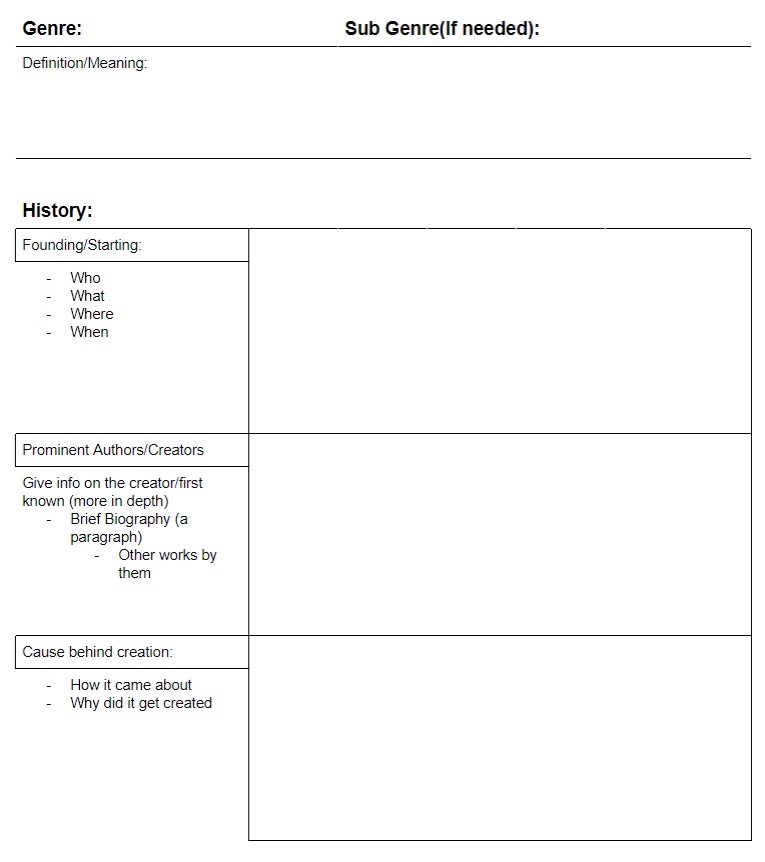
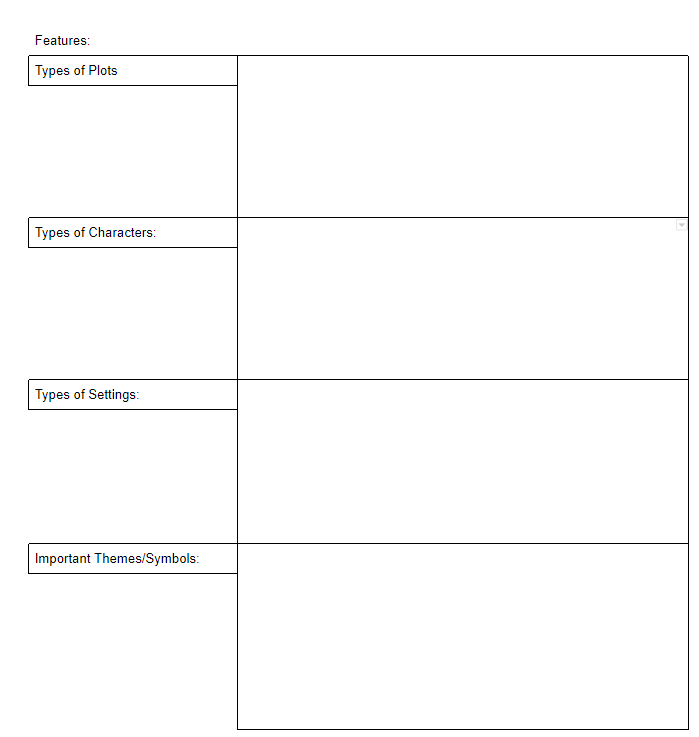
Using the worksheet on page 5 & 6, find information regarding the Genre. Make sure to include sources. PLease notice that page 5, while has some space, will lack in the ability for you to fully complete on one sheet. This is because I want you to have multiple sources and notes.
Getting Started
I want you to create a Google.Doc. This document will act as your "reading log", where you will need to keep your notes, thoughts, and reflections on the entire project. This is important as there is a reflective portion of Project X that everyone is required to complete.
1. Log onto your CCA account and create a google document.
2. Title it 'lastname.pd#.projectx.1'
(for example: mine would be 'kwiatkowski.pd#.projectx.1')
3. Within this document, you must have the following:
- Definition of the Genre
- History of the Genre (who, what, where, when, how, and why of it being started)
- How has it changed
- What does it current form look like
- What types of media use it/How does it look outside of narratives/stories
This is in addition to the work for pages 3 & 4.
The Internet is a dangerous place; be careful
In order to expand the definition, you will need to go out and get answers. The internet is a great source. I'm okay that you will use it, with some rules:
- For every internet source you find, you must have a 2 sentence response why this source had to be used
- Wikipedia is allowed. You can only refer to it once in Project X and you have to complete a note sheet for it (very specific work)
- Social Media is, however -- you must identify who you quote, where it came from, and why it matters
HINT!
The genres listed above are massive. Look at sub genres to help you narrow down your field.
Where to look:
In terms of where to look besides Wikiepdia, I suggest the following:
- tv.tropes.org
- tumblr
These are not all of where you can search, and to do so requires a great deal of patient and effort (heaven forbid). When you look at any of these, simply type in your genre name and explore.
Do not limit yourself. There is a great deal of information out there, and you are required to find a great deal.
Be Creative. Be Bold. Be Willing to Succeed. Be Willing to Fail.
Most of all? Be Willing
Task 1: Genre Defining
Name: _____________________
Date: ______________________
Period: _____________________
Task 1: Genre Defining
PART II
Construction
Building the Argument
No true report of any kind is complete without an argument, a purpose in the effort that went behind the creation of it. This is true in school and everywhere else. For our purposes, you need to create an argument regarding the Genre you selected. To assist, here are some basic questions to start:
- How has the genre changed from when it was first introduced to its current form?
- What are some major issues and problems the genre addresses?
- In what ways is the genre inclusive and exclusive?
- Why is the genre important to society?
- What changes does the genre need to succeed and stay relevant?
- What are some problems within the genre and the community of its fans?
- What are some of the effects the genre has had on culture?
These questions are merely base ones, examples for you to select or follow. A true argument goes past these with additional questions. We'll cover that in a moment.
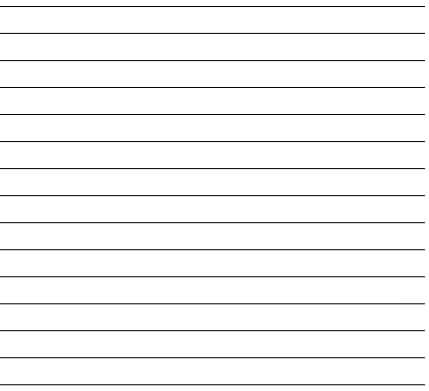
For your efforts, for this project, you will need to have a question that is centered around your genre. This is your base question, your ultimate goal that you are seeking to discuss & prove. In the space below, write your question; you can use any from above to assist your creation.
Your Question:
Developing the question
With a base question created, now comes the time to expand it out and figure out exactly what you can say about it. As you wish to make an argument, taking a side on a topic and supporting it with evidence, the question helps direct where to take your argument.
There are 6 "basic" questions that all others are build off of:
- Who
- What
- Where
- When
- Why
- How
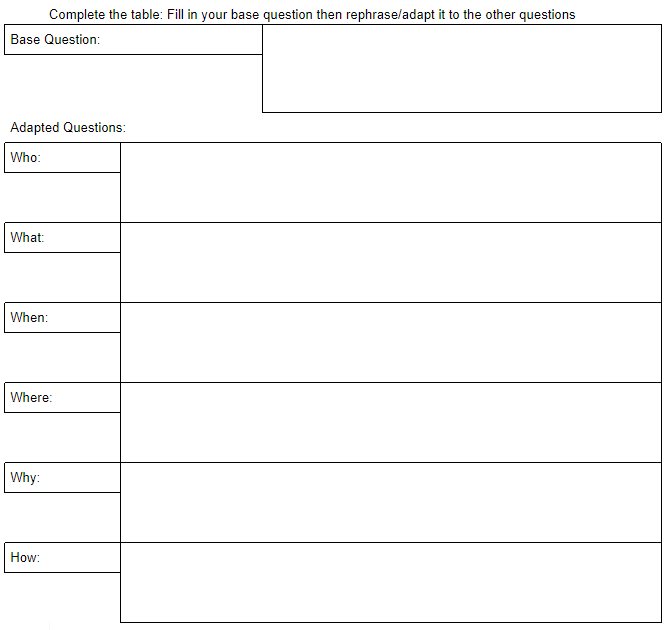
Your base question has already used one of these. To expand it, simply rephrase/adapt a question using the other five, giving you a total of six questions to attempt to answer.
Taking the following as an example, we can adapt it into the other five types of questions. Notice the italicized words: these are from the original question.
Adapting a Question:
Start with your base question. In this case, we'll use one that isn't related to our topic:
- Where in the World is Carmen Sandiago?
A strange question, but it'll work for our purposes. Now, let's take the other five questions (who, what, when, why, and how) and rephrase/adapt our base question to use them. If we are already asking 'where' Carmen Sandiago is, we want to know more about the situation that led to it and what might follow. Hence the questions.
Sometimes we will have to remove words or re-order them in order to make sense. Complete the diagram on page 8. See the example below for help.
- Who: Who is Carmen Sandiago ?
- What: What has Carmen Sandiago done to make us want to find them?
- Where: this is our base question. we can skip it
- When: When did Carmen Sandiago escape/leave or commit her crime?
- Why: Why did Carmen Sandiago do what she did?
- How: How did Carmen Sandiago accomplish her action?
Task 2.1:
Constructing Questions
Name: _____________________
Date: ______________________
Period: _____________________
Why do this?
Why find all these questions? Well, constructing an argument involves having an opinion. You can't have an opinion about something you don't understand. These questions are meant to guide what information you want to find, understand, and apply.
We will be discussing the use of the sources, specifically what you need to do to cite them, later in Part II. For right now, we have a guide to start the real research.
Applying the Questions:
These six questions you've created are meant to guide what you need to be successful at Project X. Each directs you to find some piece of information. The next portion now involves find the answers for these questions and the sources you will be using. You will need to find different types of texts and then apply them to your questions.
Variety of Texts
With the wide definition of text that we use, you have a great deal of things to select as your sources. What limits them is the type of texts you want to use.
You have completed an assignment titled "Text Types" where you identified the differences between descriptive, narrative, expository, and argumentative texts (See table 1.1 for reminder). These are often used to define written works, but unlike genres, where it can be more difficult to place works outside of certain texts (like a piece of music placed in a movie genre), text types refer to the purpose of the text, not the traits of it:
- Descriptive: To create a vivid impression of person, place, object, or event in the mind of the reader/viewer/receiver
- Narrative: To entertain; to gain and hold reader/viewer/receiver's attention and interest through the use of telling a story, a succession of causal events
- Expository: To explain; a thought-based analysis of complex facts
- Argumentative: To persuade/argue; based on the evaluation and subsequent subjective judgment in an answer to a problem or question
Often, a text can fit many of these, if viewed as a whole. Parts of it may be more descriptive than expository, or more narrative-based instead of being an argumentative-response. As receivers of text, you need to understand what is in front of you and what you are taking in.
Note: Narrative and Expository both can cover the same topic or event, but how they present the topic is important. A narrative focuses on story itself, the characters and emotional content of what is happening. An expository would focus on the facts of the event, attempting to be objective on the topic.
Definition of Text:
The definition of texts is extremely wide and inclusive. Thus to assist you, here is a list of the some forms in which a text can take:
- Written: novels, poems, short stories, novellas, blog posts, editorials, new articles, reports, journal articles
- Visual (passive): cinema/film, television, art in all its forms,
- Visual (active): Architecture, Dance
- Audio: Songs and lyrics, musics and instrumentals, speeches, spoken word, chants
These are a few versions of text that I'm certain I forgot some. In all of them, we use language of the form to share content, purpose, and meaning. A specific vocabulary is used to helpd the receiver understand.
table 2.1 - Applied Skills:
| ID | Description |
|---|---|
| CCC 1.3 | Strategic Thinking |
| Integrate the information into the development of an argument, problem, solution and/or system-model | |
| CCC 4.1 | Global Self Awareness |
| Critical Analysis of and has an active engagement with complex, interdependent global systems |
Task 2.2: Sourcing out the Info
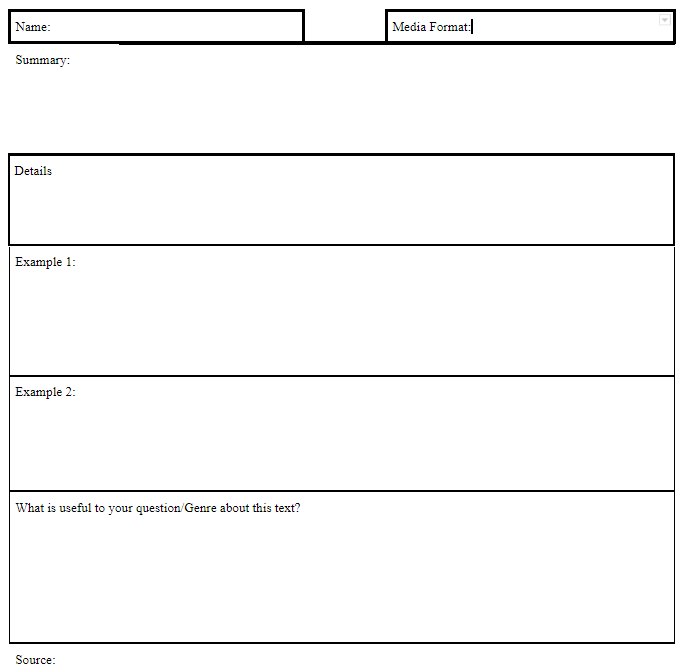
Using the documents on pages 9-12, select a piece of text for each text type: Descriptive, Narrative, Expository, and Argumentative.
You need to be able to:
1. Identify the Name of the Text
2. What media format it is
3. Give a summary of the text
4. Two examples within it
5. What is useful to your question
6. Source: (Where you got the text & info)
Source Info Required
For every source you find, whether from internet, physical form, a film, or whatever, you need to make sure that have info to show that what you have found is not by your.
Every source needs:
- Source Title
- Name of Source's Website or where it came from
- Creator of the Source
- Publisher of Website/Textbook
- When it was published (Date)
if a website, you will also need:
- URL
- Date you visited
This is basic information, and sometimes you will need to have more. Thats why websites like [EasyBib](http://www.easybib.com) are useful.
Remember When looking for Sources
Keep in mind:
- You are attempting to form an opinion on yoru Genre (if you don't have one already)
- You wantt o maek sure that you have a good, basic understanding of your Genre, and the texts you select below are meant to assist with that
- Your questions are your guide; use them when looking for details, examples, and answers
- You are not limited to 4 texts, but you do need at least 1 of each type - 4 thus is the bare minimum (in terms of assessment, bare minimum does not show skill)
- You are not limited to these pages for the sake of notes, nor do you have to use them (you can use your own notebook/reading log.) This should be considered the bare minimum of what you need
- If you did not answer all your questions, you do not have enough information
Descriptive Text:
Identify a text that fits this format & give the info for each section
Narrative Text:
Identify a text that fits this format & give the info for each section
Expository Text:
Identify a text that fits this format & give the info for each section
Argumentative Text:
Identify a text that fits this format & give the info for each section
PART III
Organization
By this point:
At this time, you should have complete and in your possession:
- A Genre of your Choice with details and notes regarding its history, current form, and details of prominent features (Task 1)
- A question designed to help guide what other resources you need (Task 2.1)
- At least 4 texts, one of each type, from the genre, details on selected text including a summary, examples that prove its a specific type, connection to question(s), and any other important facts, including source information (Task 2.2)
From this set of documents you have created and turned in, you have been assessed ion your ability to identify information, evaluate its importance & focus in relation to a question, and start to analyze the importance of the text in terms of global perspective.
What's Next
With all the sources you've found and information you have at hand, you need to organize it in a manner that actually answers your question.
In Task 2.2, you filled in a box briefly outlining how that particular text assists in your base question (or 5 others you developed in Task 2.1.) By planning ahead, analyzing just what the texts do for your question & how well they do it, we can ensure that the foundational work with the historical background information regarding the Genre as well as the construction of the question itself does not go to waste.
Organization
Organization isn't simply putting together whatever you have into an order. In fact, the order is something that should only come at the very end.
Organization is about the development and planning of everything: thesis, evidence, explanatory sentences, connecting sentences, transitions, etc. And those are things that are meant for just written work, not even creative products or such.
Organization is key to success, even if you just use a little bit
table 3.1 - Plan to Work, Work the Plan
| Identify Concerns |
| Establish a Goal |
| Form the Plan |
| Act |
| Follow up |
Plan to Work, Work the Plan
This is meant to be a way of determining how to set up everything you have. In fact, you've already accomplished some of it:
- Identify Concerns - Determine what the issues/problems are with you've been asked to accomplish
- Establsh a Goal - What is the outcome that you wish to seek and achieve
- Form the Plan - We're here now, and there are few things we can do to help set up a plan that will help you reach success
- Act - follow through with your plan (Part IV)
- Follow up - This will be a self-reflective piece done at the end of the project (Part V)
Form the plan:
Write down your goals, and then create a plan to reach those goals. Be as specific as possible in your plan, and include these things:
- WHAT: What needs to be done?
- WHY: Why do you need to do it?
- WHO: Who beyond yourself need to be involved?
- WHEN: When will you reach each part of your plan?
- WHERE: Where will you work on Project X
- HOW: How will you go about it?
- COST: What cost is involved?
- RESOURCES: What people, products, groups, agencies, organizations, places, and time are required?
- EVALUATIONS: How will you know if you've answered the question properly?
You've already answered a few of these in a slightly different way - when you rephrased your question. Now, you need to think about Project X as a whole.
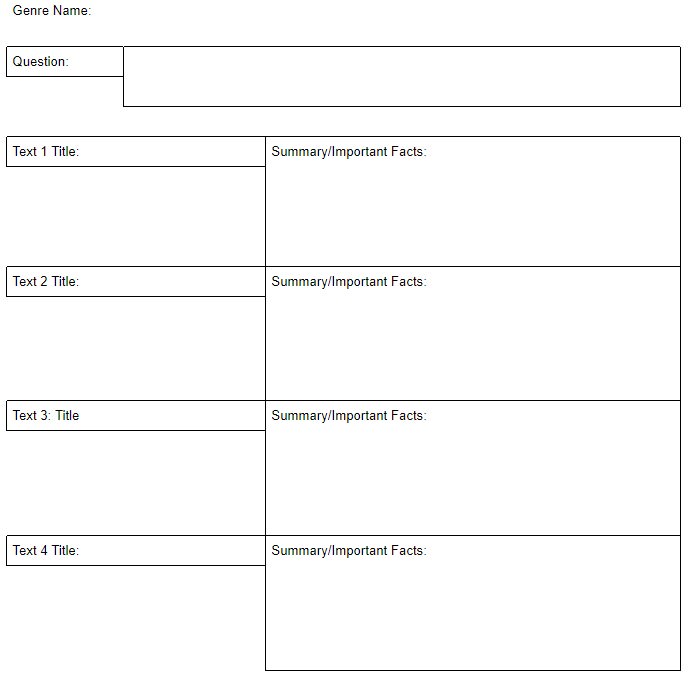
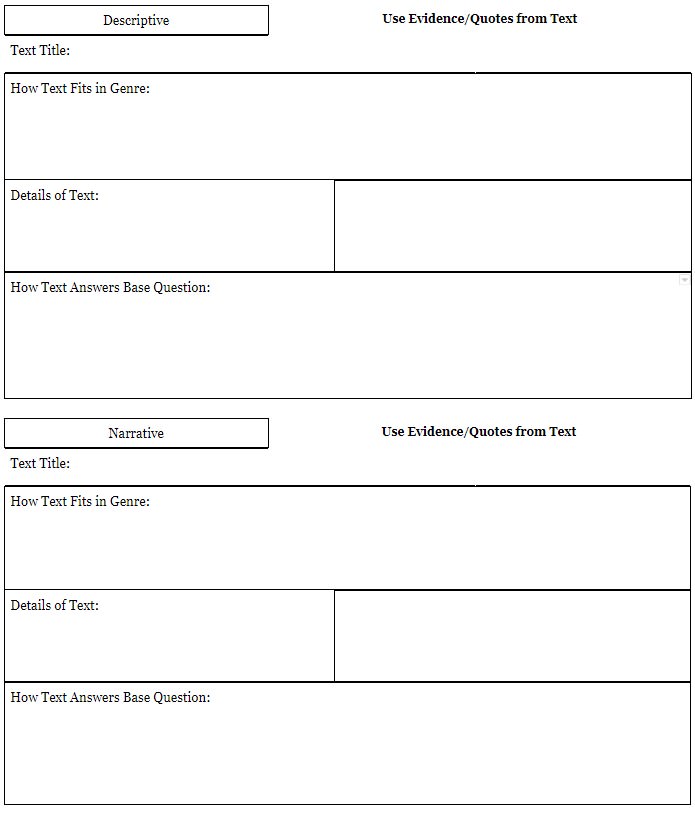
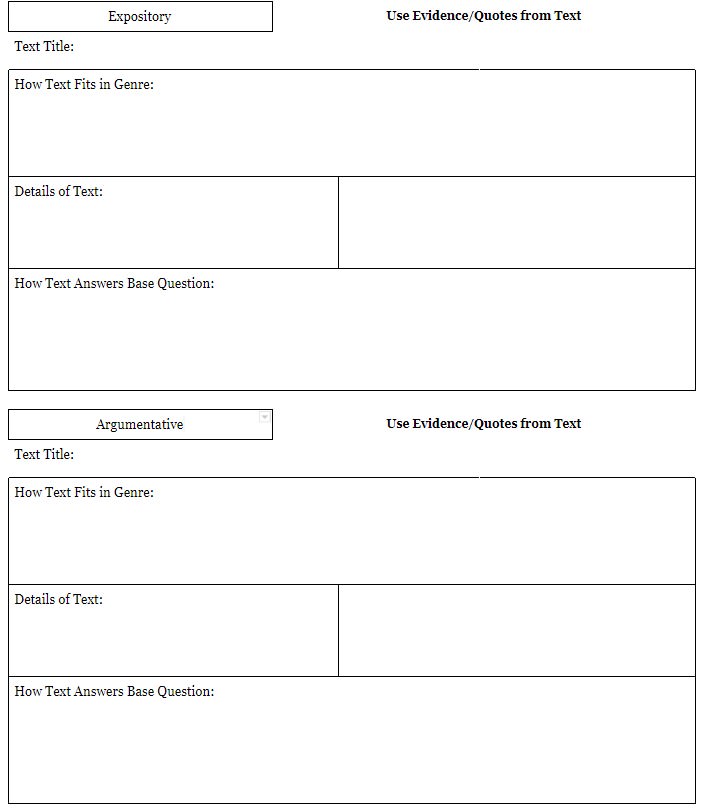
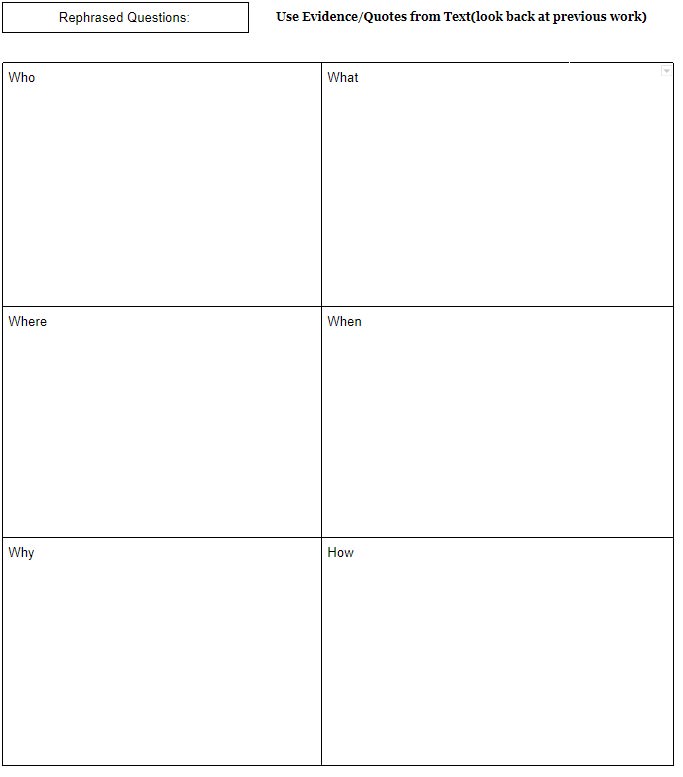
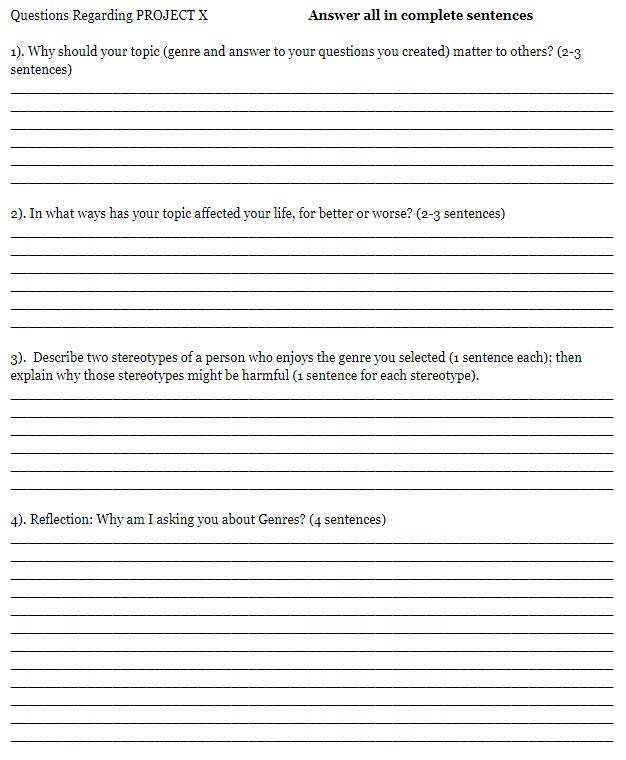
Task 3.1 is set up to help you develop that plan. Along with the questions above, it is meant to be a graphic Organizer of sorts. You will need to use this graphic organizer (as it is the bare minimum of one, so even those of you who hate planning and outlining can do this) and it will form the basis of your written work.
While it may look like repetition, the goal of these documents is for you to focus what you have found in Parts I and II into an answer. Part of this entails putting it all together and seeing what works and what doesn't.
table 3.2 - Directions for Task 3.1
| Each number outlines what needs to be completed on the page of Task 3.1 |
|---|
| 1. Fill out the first page of the Graphic Organizer - your Genre Your Question, Titles of your Texts, and Summaries relating text to your question |
| 2 & 3. Complete the details asked for each text, including how you each answers your base question |
| 4. Identify the ways your texts - your evidence - answers your rephrased questions |
| 5. Answer all questions presented regarding your plan |
These graphic organizers are meant to act as the bare minimum of what you need. Please make sure that you are fully answering the question with support from the text (evidence), you explain how the evidence connects to your answer(thesis), and you are clear in your description of your thought process.
Purpose of Organizing Project X
By having this, and completing the graphic organizers presented to you, I can ensure that even if you may struggle with the written product, I can assess you on everything you have.
I can also ensure that you have answered each question you created, that whatever your final creative product is, you have the requirements becuase you have shown them in the graphic organizers.
This is not busy work. This is your proving you understand how a project can be planned and built (a skill that can be transferred to any career or job you want)
Task 3.1: Form the Plan
Name: _____________________
Date: ______________________
Period: _____________________
NOTE:
With the completion of Task 3.1, you have notes of what you can put to into your written component, an outline essentially. While Task 3.2 asks you to actively think of that & arrange your notes, understand you've already done the bulk of the work.
So relax: take a deep breath: and stop panicking. If you've worked all year, you've prepared for this.
Outlining
Outlining is a strange and often misunderstood beast within the field of writing. Many people claim to hate it, preferring to be spontaneous and free with their writing, while others will swear by all they hold dear to it.
Imagine it as a spectrum, with Pure Freedom at one end and Structure & Order at the other. If one were to write without any plan, then they'd be at the Pure Freedom side, but a strict structure would be the opposite. Almost no one is all the way on either side. Instead, people fall in the middle, leaning towards either Freedom (no outline) or Order (outline).
Dont worry about where you might be. As a student, as a writer, you'll find yourself moving from one side to the other often depending on the task.
Finishing the Plan:
With the notes established in an order of sorts, we can transfer it into a more cohesive and developed state: the written component.
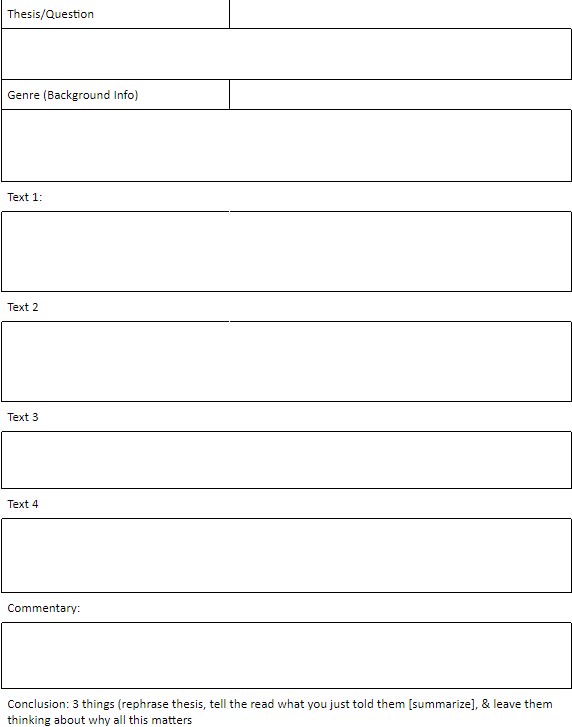
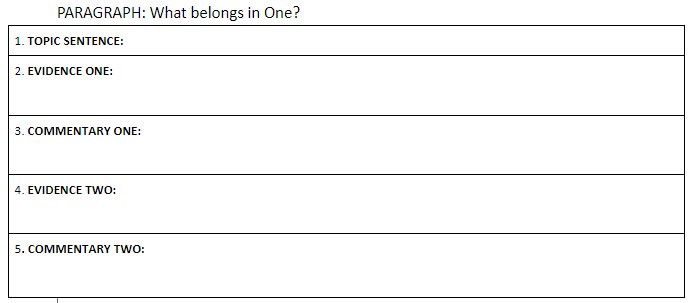
To further assist you, Task 3.2 is designed to take what you have from Task 3.1 and turn it into an outline. There is also a graphic organizer of what a paragraph should look like, taking some guidance from the quote analysises that you have worked on.
Part IV will go through the requirements of the written component. Suffice to say, you will need at least two pieces of evidence from each text to support your argument.
DIRECTIONS:
Complete Task 3.2: Outline; you do not have to fill with complete sentences, but make sure you can show what order you will present your paragraphs & use your evidence.
TASK 3.2: Outline