
Introduction
This middle-school enrichment unit introduces students to the roleplaying game Dungeons & Dragons as a way to engage with the epic Anglo-Saxon poem Beowulf. It is designed to foster a variety of skills, both literary and mathematical, while also engaging with relevant history.
The unit begins with a quick introduction to the world of Beowulf, introducing the history and culture of the Germanic peoples in Scandinavia and Britain. From there, the students will play a very short game of Dungeons & Dragons, set in Iceland. This mini-adventure will engage their new knowledge and teach them the basic rules of the game, including how the dice work and the mathematical implications. (For example, what are the possible outcomes of rolling two six-sided dice versus one twelve-sided die?)
After exploring the basic tenets of the setting and game, students will create their own Anglo-Saxon characters and play a short campaign in Denmark, accompanying Beowulf to Heorot. Throughout, they will learn about creating effective dramatic tension and a variety of social skills.
Unit Outline
This unit is designed to take ten weeks and cover material suitable for middle-school students, but may be adapted for a longer period of time and any grade level.
Week 1: The Poem and Its Setting
Weeks 2-3: Mini-Adventure
Week 4: Dice and Probability
Week 5: Character Creation
Weeks 4-9: Adventure
Week 10: Reflections
Table of Contents
Credits: Where not otherwise attributed, this text was created by Alexander Davis of Mount Greylock Regional School.
I. The Poem and Its Setting
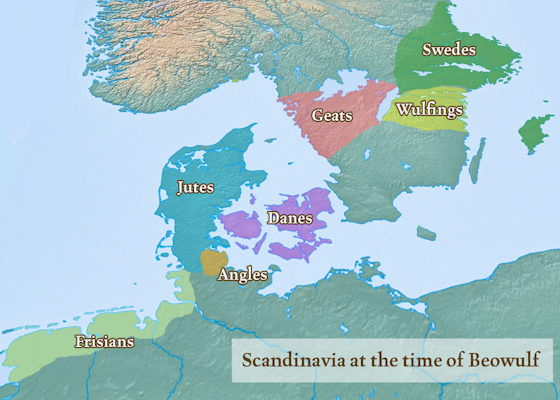
'Beowulf'' is an epic poem with adventure, monsters, dragons, and heroism.
Beowulf (pronounced bey-uh-woolf] is an epic poem. It's actually the longest epic poem in Old English with about 3,000 lines! Old English is different from the language we speak today. It originated with the Germanic people who settled England around the year 400. Some words are found in both modern and Old English, but there are differences in how we spell and say the words. If you tried to read Beowulf in Old English, you'd find it very hard to understand!
Old English
We'll talk more about Old English later, but if you're curious, here are the first lines of Beowulf as an example:
Hwæt! Wē Gār‐Denain geār‐dagum
þēod‐cyningaþrym gefrūnon,
hū þā æðelingasellen fremedon.
Oft Scyld Scēfingsceaðena þrēatum,
monegum mǣgðummeodo‐setla oftēah.
This translates to:
Lo, praise of the prowess of people-kings
of spear-armed Danes, in days long sped,
we have heard, and what honor the nobles won!
Oft Scyld the Scefing from squadroned foes,
from many a tribe, the mead-bench tore.
The Plot
The hero of the poem is a prince named Beowulf. He is part of a tribe called the Geats, living in what we now call Sweden. Beowulf sails across the sea with some friends to the land of the Danes (now Denmark) in order to save them from the evil monster Grendel. For twelve years, Grendel has been attacking the Danes and eating many of them. Beowulf says he'll help get rid of Grendel. The Danes throw Beowulf a big party in gratitude. And sure enough, when Grendel comes to make trouble that same night, Beowulf fights the monster and wins.
The Danes celebrate with a second big party, but soon Grendel's mother comes looking for revenge. Beowulf is able to chase her down to her lair and kill her, too. The people in Denmark are very appreciative. They throw a third big party (they loved to party) and send Beowulf home with many presents.
In the third part of the poem, we jump forward in time fifty years. Beowulf, now king of the Geats, is an old man. After many years of peace, a dragon attacks the Geats. In a brutal battle that is much tougher than the fights with Grendel and Grendel's mother, Beowulf kills the dragon. But Beowulf also gets hurt and dies. The poem ends with Beowulf's funeral.
Source: Homer, Jenny. Beowulf for Kids.
Regional History
Before there was France, Germany, Sweden, and the other countries of northern Europe, there were different Germanic peoples in these areas. Some of these tribes were the Goths, Franks, Angles, Saxons, Jutes, and so on.
By the way, notice the difference between "German" and "Germanic." The Germanic peoples were not only the ancestors of many of today's German people, but also many of the people of France, Sweden, the United Kingdom, Belgium, Norway, Iceland, and even further afield. These ancient Germanic tribes often migrated and came into conflict with the Celts and their other neighbors. Most prominently, the Roman Empire conquered vast swaths of Germanic land from 150 B.C.E to 100 C.E., stretching their power far north into modern Germany and far west into modern England.
Many Germanic peoples successfully repelled the Romans, however, and those that were conquered seldom stayed quiet. During the fourth and fifth centuries in the current era, Germanic peoples had begun making repeated incursions into Roman lands or rebelling against their rulers. By 550 C.E., most of the western Roman Empire had fallen to a variety of Germanic armies, and new Kingdoms of the Goths, a Kingdom of the Franks, and a Kingdom of the Vandals had taken over in Italy, Spain, Germany, and France. In Scandinavia, however, many small tribes held their own little kingdoms.
It was around this time that we think Beowulf is set, somewhere between 500 and 600 C.E.. It was written at least two centuries later, but we're not sure exactly when (all we have today are copies of the original text).
Source: "The Germanic Tribes," LumenLearning.
Did You Know?
German literally translates to "spear-man!"
Germanic Culture
Home Life
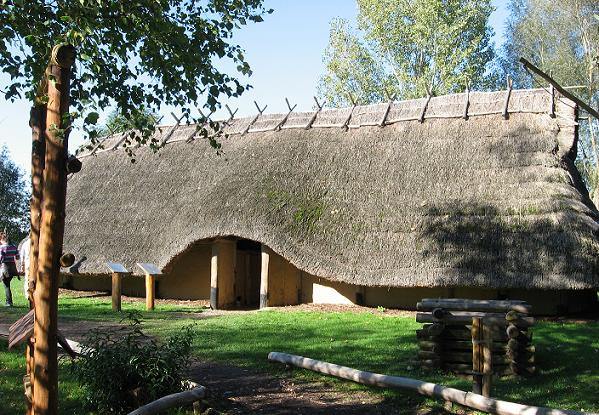
These German peoples usually lived in small communities of five to ten households. Each household would have a central house of timber, where the family lived with the cattle, and several smaller buildings such as granaries and storage rooms. They would grow barley and wheat as their main crops (along with oats and rye, in some areas), supplemented with dairy products from their cattle (and occasionally some meat).
Cattle were the most important resource, and it was typical to measure a household's wealth by stating the size of their herd. Poor Orgetorix might have only five cattle, while rich Verbigenus has forty!
Most members of these tribes, then, were farmers. However, some of them supplemented their farming by creating goods made of metal, leather, or glass. During the Roman era, these goods were highly sought-after for trade by the Romans, and they were still made and used even after the collapse of the Empire (although much less, since you need buyers if you want to sell things).
Slavery existed among most of the Germanic peoples, but it was not very common. Sometimes a household would have a domestic slave, but more often a slave would have a household of their own and would simply be bound to turn over much of the fruit of their labors to their master.
Above: A recreation of a typical home.
Money
The Romans first introduced coins to the Germanic peoples, but this skill was lost to many tribes in the second and third centuries (~100-200 C.E.). By the fifth century, many peoples (such as the Anglo-Saxons in Britain) had reverted to barter economies -- systems where people just traded goods to each other, rather than using money. Coins were still used by some Germanic peoples, and everyone collected them (if only for their decorative value, since they were made of gold and silver), but large-scale coinage slowed or stopped.
In the sixth century, the German peoples began to produce coins once again, showing they were restarting their market economies. Money makes it much easier to decide on something's value, trade an item for something more useful, and loan out and preserve wealth. But the money used by the Germanic peoples was very different than our own! Instead of being worth some set amount that everyone agrees upon, these old currencies simply represented a certain amount of a precious metal. Each gold coin might have one ounce of gold in it, and so it is worth what one ounce of gold can buy.
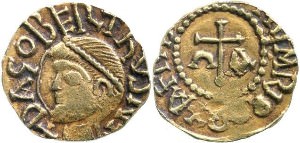
Above: This gold coin, the þrymsa was made in imitation of old Roman coins.
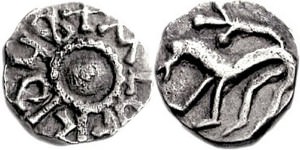
Above: This silver coin, called a sceat, was produced in some parts of England and Denmark. The plural is sceattas.
Another type of silver coin was called the pound, which was divided up into small coins called shillings.
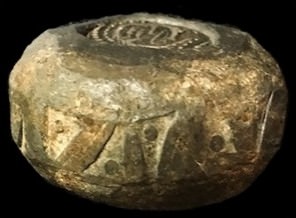
Above: When different kingdoms made different coins, it could be hard to know how much each one was worth. At such times, specialized weights like this one would be used with a small scale. The important thing was not what was written on the coin... it was worth its weight in silver or gold!
Source: Wikipedia. Germanic Peoples.
Government
The Germanic peoples emphasized cohesion and equality in their societies. They were ruled by kings, but that rule depended on the support of a group of followers. These close followers, called thanes ("þegn" in Anglo-Saxon) would have been warriors who were personally loyal to the king and would fight in battle for him. In exchange, the king ruled their tribe, led them in war, and gave them gifts. Women were not allowed to be kings or thanes, which is dumb.
This system was an early version of the later feudal system. The thanes of the ancient Germanics became the barons and earls of Europe!
After his death, a king would be put into a ship and surrounded with treasure. Then the ship would be pushed out to sea, to float away and be lost. Sometimes it would be lit on fire before it was pushed out to sea. Other times it would be buried, instead, leaving a high barrow to serve as a grave for the king.
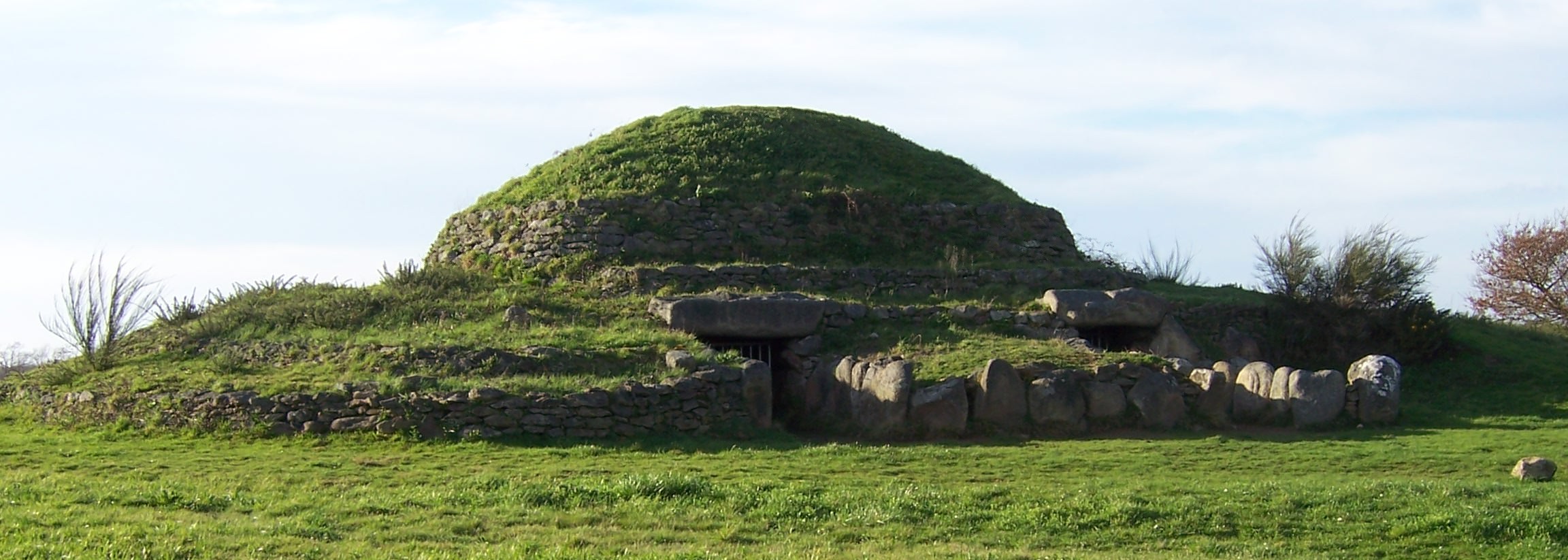
Above: A barrow in modern France, resting place of a king.
From Beowulf....
Þær æt hȳðe stōdhringed-stefna
īsig ond ūt-fūs,æþelinges fær;
ālēdon þālēofne þēoden,
bēaga bryttanon bearm scipes,
mǣrne be mæste.Þǣr wæs mādma fela,
of feor-wegumfrætwa gelǣded.
Ne hȳrde ic cymlīcorcēol gegyrwan
hilde-wǣpnumond heaðo-wǣedum,
billum ond byrnum;him on bearme læg
mādma mænigo,þā him mid scoldon
on flōdes ǣhtfeor gewītan.
In the roadstead rocked a ring-dight vessel,
ice-flecked, outbound, atheling’s barge:
there laid they down their darling lord
on the breast of the boat, the breaker-of-rings,
by the mast the mighty one. Many a treasure
fetched from far was freighted with him.
No ship have I known so nobly dight
with weapons of war and weeds of battle,
with breastplate and blade: on his bosom lay
a heapéd hoard that hence should go
far o’er the flood with him floating away.
Lines 32-42
Laws
Germanic life was mostly governed by long-established customs, rather than laws. This is partly because early Germanic peoples couldn't read or write for the most part. Rules would simply be told from one person to another. This reduced the power that kings had to effect change. However, the Germanic kings were still quite fond of legislating (or writing laws) -- even if their law was just, "let's keep doing the same custom" -- and we have many of their proclamations.
One of the long-established customs was revenge killing. When someone was killed, their relatives would murder the killer (or one of their family members). This payback often got out of control and turned into blood-feuds, however, so another custom evolved alongside of revenge killing: wergild. The wergild (or "man-gold") was a large sum of money that a murderer could pay the victim's family to compensate them for their loss. This helped prevent many revenge killings. The king would decree the wergild that would be paid for each type of person. A slave had a much cheaper wergild than a free person, for example.
The Germanics prohibited many of the same things that we have laws against today, but there were few or no prisons. Instead, almost all crimes were punished with fines, and sometimes by mutilation, banishment, or even execution.
Here are some of the laws from the Law of Æthelberht, a legal code written in the 7th century in Anglo-Saxon England.
-
If a freeman steal from the king, let him pay ninefold.
-
If a freeman steal from a freeman, let him make threefold amends.
-
If a freeman furnish weapons to another where there is strife, though no evil be done, let him make amends with six shillings.
-
If a freeman slay another, let him make amends with a wergild of 100 shillings.
-
If a freeman lie with a freeman's wife, let him pay for it, and provide another wife with his own money, and bring her to the other.
-
If an ear be struck off, let amends be made with twelve shillings.
-
For each of the four front teeth, six shillings; for the tooth which stands next to them four shillings; for that which stands next to that, three shillings; and then afterwards, for each a shilling.
-
If any one strike another with his fist on the nose, three shillings.
-
If a man carry off a slave girl by force, let him pay fifty shillings to the owner, and afterwards come to an agreement with the owner for a price.
Did You Know?
Throughout this period under the law, women were said to be the property of men, typically either their husbands or fathers. This dumbness continued for hundreds of years!
Religion
As with many other aspects of life in the Germanic world, their religious life underwent dramatic shifts. Originally practitioners of paganism, their contact with the Roman world led to their gradual conversion to Christianity. Beowulf depicts a pagan people, but there is nonetheless a strong Christian influence on the world of the text.
Paganism
Germanicic peoples practiced paganism for thousands of years. This faith was polytheistic, worshipping multiple deities. The exact deities differed between tribes. Some deities were worshipped widely across the Germanic lands, just under different names. Other deities were simply local to a specific place.
- Teiwaz, also called Tyr (Norse) or Tiw (Anglo-Saxon), the god of single combat, victory and heroic glory in Norse mythology, portrayed as a one-handed man.
- Wōdanaz, also called Óðinn (Norse) or Woden (Anglo-Saxon), the one-eyed god of wisdom, war, battle and death, and also magic, poetry, prophecy, victory, and the hunt. He is the ruler of the godly realm, Asgard, and he is famously wise. To drink from the Well of Wisdom, Wōdanaz had to sacrifice his eye (which eye he sacrificed is unclear), symbolizing his willingness to gain the knowledge of the past, present and future. As he drank, he saw all the sorrows and troubles that would fall upon all.
- Freyja, a goddess associated with love, beauty, fertility, gold, seiðr, war, and death. She rides a chariot driven by two cats, and possesses a cloak of falcon feathers
- Fraujaz. god of farming and weather, also called Freyr (Norse). He rides the shining dwarf-made boar Gullinbursti and possesses the ship Skíðblaðnir which always has a favorable breeze and can be folded together and carried in a pouch when it is not being used.
- Þunaraz, also called Þórr (Norse) or Thunor (Anglo-Saxon), the hammer-wielding god associated with thunder, lightning, storms, oak trees, strength, destruction, fertility, healing, and the protection of mankind. Þunaraz rides in a cart or chariot pulled by two goats, Tanngrisnir and Tanngnjóstr (that he eats and resurrects), and wields the mountain-crushing hammer, Mjöllnir.
Did You Know?
Thanks to the Germanic heritage of English, we memorialize many of these gods each week with the names of Tuesday (Tyr's Day), Wednesday (Woden's Day), Thursday (Thor's Day), and Friday (Freyr's Day)!
The Germanic pagans worshipped in a variety of ways, but most typically offered prayers at places sacred to a god or gods. These sacred sites might be trees, groves, wells, stones, fences, or cairns (rock-piles). At their sacred sites, Germanic pagans widely practiced ritual sacrifice to their deities. This was often in the form of a blood sacrifice such as that of an animal, but also sometimes (rarely) a human being.
Today, this pagan tradition has mostly died out, with very few practitioners still worshipping the Norse deities.
Source: ReligionWiki. Germanic Paganism.
Christianity
By the time that Beowulf was being written, many of the Germanic peoples had been converted from their ancient paganism to Christianity, a monotheistic religion that had spread during the end period of the Roman Empire and which continued among native Romano-Britons (some Romano-British churches and schools have been operating continuously since before the Germanic peoples arrived!)
Christians worship a single deity ("mono" means one) named Yahweh or Jesus, depending on the incarnation. Jesus was usually represented as a young man, and his symbols included the lamb and the dove. The Christian practice among the early Germanics inherited a lot of cultural influences, as well, mostly from the Celts and Romans. For example, the popular monastic tradition was imported from the Romans, where groups of Christians would live separate from the world in private religious communities. Christians in this era generally acknowledged the authority of the leading Christian in Rome, as well, a priest known as the Pope (this is still the practice for the largest Christian sect, Roman Catholicism).
The Germanic Christians focused on specific ritual gatherings in their practice, such as the Mass, a veneration of the deity that culminated in the Eucharist ("thanksgiving"), a ritual wherein the last meal of their deity was re-enacted. Modern Christians still generally follow this practice.
Language
The Germanic language evolved out of Indo-European thousands of years ago, and by the time of Beowulf, there were enough human beings in enough places in Europe for it to break up into cousin languages in different regions. Each tribe spoke their own version of Germanic with new words that they invented, borrowed, or began pronouncing differently, and that became a tribal dialect of Germanic. The Goths developed Gothic Germanic, for example. And over time, each dialect became its own language. Gothic Germanic became the Gothic language: still closely related to the other Germanic languages, but different enough to be called a new language. This was a gradual process over hundreds of years; there was no particular year that you could say the Goths invented Gothic.
You will see words from many different Germanic languages in this book, including Old Norse and Icelandic, but the most important one is Anglo-Saxon (aka Old English). Anglo-Saxon is the most recent ancestor of our own language, English. It changed into our language about a thousand years ago, after a French people called the Normans conquered England and took over.
Don't worry, youre not going to have to learn Anglo-Saxon. All you're really going to need to learn is a two new letters of the alphabet, just so you can read and pronounce the Old English words that you see.
The thorn is the first letter to learn. An uppercase thorn looks like this: Þ; a lowercase thorn looks like this: þ. It is pronounced the same as our modern "th" sound. So when you see þis, you'd pronounce it as "this." Try it with the name for the coin you learned recently, the þrymsa. How do you pronounce that?
The other letter is the eth. An uppercase eth looks like this: Ð; a lowercase eth looks like this: ð. And it is pronounced... exactly the same as a thorn! Wow!
Setting Questions
- Some questions on the material go here.
I don't have anything insightful to put here yet.
II. Mini-Adventure
Roleplaying
When someone is playing a role, they are pretending to be something that they are not. They try to put themselves in the place of the role, to imagine what they might feel or think or do in that situation. This can be hard. If you're pretending to be a dog, for example, it's easy to think about what you want to do. You might say, "If I were a dog, I'd bite Joe on the butt!"
But in that example, you wouldn't really be playing the role of a dog. You'd just be you in an imaginary dog's body. That's not roleplaying.
If you want to really play the role of a dog, you should try to imagine what the dog might want or fear. Most dogs love food and petting; some of them are scared of strangers. So if you wanted to really play the role of a dog, maybe you don't rush off to do the thing that human-you wants to do (biting Joe's butt). Dog-you is interested in food, and maybe dog-you would rush around behind Joe... but only to jump up and nip at his backpack, where Joe's carrying a bag of beef jerky!
Now, maybe that doesn't sound so fun. After all, maybe you really do just want to bite Joe's butt. But if you want to do that, why pretend you're a dog? You can bite Joe's butt any day of the week! If that's what you want, just own up to it: say to yourself, "I wish I were a dog so that I could bite Joe's butt, since that seems fun." You'll get in trouble, and people will think you're weird, but at least you won't have wasted any time pretending to roleplay.
No, we roleplay because sometimes it's fun to pretend to be other sorts of people or animals. It lets you explore different ways of thinking about the world, shows you things that are impossible in our reality, allows you touch on new experiences, and makes you more sympathetic to other people.
The world is a huge and wonderful place, and roleplaying lets you see the world from a new point of view.
Characters
When you roleplay, you pretend to be someone (or something) else. This is your character. Your character is not you. They do not look like you, sound like you, or act like you. They're a character that you are playing -- a role you're occupying during the game. Don't forget that, even if you get really into the game and your character. Bad things might happen to them on an adventure, since adventures are dangerous, but those bad things can't hurt you.
Remember:
- If your character gets upset, you'll still be fine.
- If your character gets injured, you'll still be fine.
- If your character dies, you'll still be fine.
The worse thing that can possibly happen to you when you're roleplaying is that you have to make a new character. That might make you sad, and that's okay. It's normal to get attached to your character. You've probably been sad when a character died on a television program, right? But when that happens, just remind yourself that you are still fine.
Your character is not you.
Winning
This is a roleplaying game, right? So how do you win this game?
Your goal is very simple: you should aim to create a fun story, working with everyone else. And that's it!
Just like there are all different sorts of stories, there are all different sorts of roleplaying games. An adventure might be scary, exciting, silly, or serious. Your character might care about accumulating as much money as possible, taking over a kingdom and becoming sovereign, protecting their family, or numerous other possibilities.
You'll be playing with other people, including a Dungeon Master (DM) who is in charge of the game, so everyone can work together to make sure the game is fun. It's fun to explore deep into a dungeon, defend a town under attack by monsters, or solve a puzzle together. Remember this, it's important: everyone should have a good time! Don't do things that ruin the game for other people. It might seem like it would be fun for your character to shove a big boulder on top of the other players, but it wouldn't be very fun for them -- and since their characters won't trust yours after that, that makes it much harder to experience the rest of the adventure together.
Softball might be a good analogy. It might be fun to peg another player on your team with the ball when they're not looking, but it won't be fun for very long... and you'll have made them upset and gotten in trouble with the umpire. Softball is far more fun when the whole team works together!
Your fun shouldn't ruin anyone else's fun.
Why Dungeons & Dragons?
In a pretend world where everyone is playing a role, sometimes it's hard to figure out what happens when characters disagree or try to do something difficult. It's not a problem if you want your character to open a door, but what happens when you want your character to jump over a building? How could anything be scary or dangerous if your character could do anything at any time?
Let's say that your character wants to push over someone over. How do we know whether or not they can do that? We'd have to discuss it every time, maybe argue, and maybe disagree. It would take forever and you'd never know what exactly your character could do, or when they could do it.
The way we solve this is by using a set of rules. The rules give structure to the game, so that we can figure out what happens when characters try to do something. You want to push that person over? Okay, let's assign each character a number to measure their strength. Then it's just a question of who has the higher strength number: you or your target?
The rule set we're using is called Dungeons & Dragons (or D&D). It was invented in 1974, and people have been playing different versions of it ever since. It's designed for a fantasy world -- a world of swords, magic, and monsters. That makes it perfect for exploring the story of Beowulf, since the poem is chock-full of swords, magic, and monsters!
Quick D&D Rules
The way Dungeons & Dragons works is basically as follows:
- The DM describes the environment. The DM tells the players where their characters are and what’s around them.
- The players describe what they want to do. Sometimes one player speaks for the whole party, saying, “We’ll take the east door,” for example. Other times, different adventurers do different things: one adventurer might search a treasure chest while a second examines an esoteric symbol engraved on a wall and a third keeps watch for monsters. The players don’t need to take turns, but the DM listens to every player and decides how to resolve those actions. Sometimes, resolving a task is easy. If an adventurer wants to walk across a room and open a door, the DM might just say that the door opens and describe what lies beyond. But the door might be locked, the floor might hide a deadly trap, or some other circumstance might make it challenging for an adventurer to complete a task. In those cases, the DM decides what happens, often relying on the roll of a die to determine the results of an action.
- The DM narrates the results of the adventurers’ actions. Describing the results often leads to another situation, and the process begins again.
There are other little rules about all sorts of things, ranging from how fast your character can run to the ways in which you can cast magic. But the most important rule is this: The DM can override any rule.
Game Dice
The game uses polyhedral dice with different numbers of sides. Your teacher will provide some for you to use.
In these rules, the different dice are referred to by the letter d followed by the number of sides: d4, d6, d8, d10, d12, and d20. For instance, a d6 is a six-sided die (the cube-shaped die that many games use).
Percentile dice, or d100, work a little differently. You generate a number between 1 and 100 by rolling two different ten-sided dice numbered from 0 to 9. One die (designated before you roll) gives the tens digit, and the other gives the ones digit. If you roll a 7 and a 1, for example, the number rolled is 71. Two 0s represent 100. Some ten-sided dice are numbered in tens (00, 10, 20, and so on), making it easier to distinguish the tens digit from the ones digit. In this case, a roll of 70 and 1 is 71, and 00 and 0 is 100.

When you need to roll dice, the rules tell you how many dice to roll of a certain type, as well as what modifiers to add. For example, “3d8 + 5” means you roll three eight-sided dice, add them together, and add 5 to the total.
The D20
Does an adventurer’s sword swing hurt a dragon or just bounce off its iron-hard scales? Will the ogre believe an outrageous bluff? Can a character swim across a raging river? Can a character avoid the main blast of a fireball, or does he or she take full damage from the blaze? In cases where the outcome of an action is uncertain, the Dungeons & Dragons game relies on rolls of a 20-sided die, a d20, to determine success or failure.
Every character and monster in the game has capabilities defined by six ability scores. The abilities are Strength, Dexterity, Constitution, Intelligence, Wisdom, and Charisma, and they typically range from 3 to 18 for most adventurers. (Monsters might have scores as low as 1 or as high as 30.) These ability scores, and the ability modifiers derived from them, are the basis for almost every d20 roll that a player makes on a character’s or monster’s behalf.
Ability checks, attack rolls, and saving throws are the three main kinds of d20 rolls, forming the core of the rules of the game. All three follow these simple steps.
- Roll the die and add a modifier. Roll a d20 and add the relevant modifier. This is typically the modifier derived from one of the six ability scores, and it sometimes includes a proficiency bonus to reflect a character’s particular skill. (See chapter 1 for details on each ability and how to determine an ability’s modifier.)
- Apply bonuses and penalties. A class feature, a spell, a particular circumstance, or some other effect might give a bonus or penalty to the check.
- Compare the total to a target number. If the total equals or exceeds the target number, the ability check, attack roll, or saving throw is a success. Otherwise, it’s a failure. The DM is usually the one who determines target numbers and tells players whether their ability checks, attack rolls, and saving throws succeed or fail. The target number for an ability check or a saving throw is called a Difficulty Class (DC). The target number for an attack roll is called an Armor Class (AC).
Advantage and Disadvantage
Sometimes an ability check, attack roll, or saving throw is modified by special situations called advantage and disadvantage. Advantage reflects the positive circumstances surrounding a d20 roll, while disadvantage reflects the opposite. When you have either advantage or disadvantage, you roll a second d20 when you make the roll. Use the higher of the two rolls if you have advantage, and use the lower roll if you have disadvantage. For example, if you have disadvantage and roll a 17 and a 5, you use the 5. If you instead have advantage and roll those numbers, you use the 17.
Round Down
There’s one more general rule you need to know at the outset. Whenever you divide a number in the game, round down if you end up with a fraction, even if the fraction is one-half or greater.
Source: Wizards of the Coast. D&D System Reference Document.
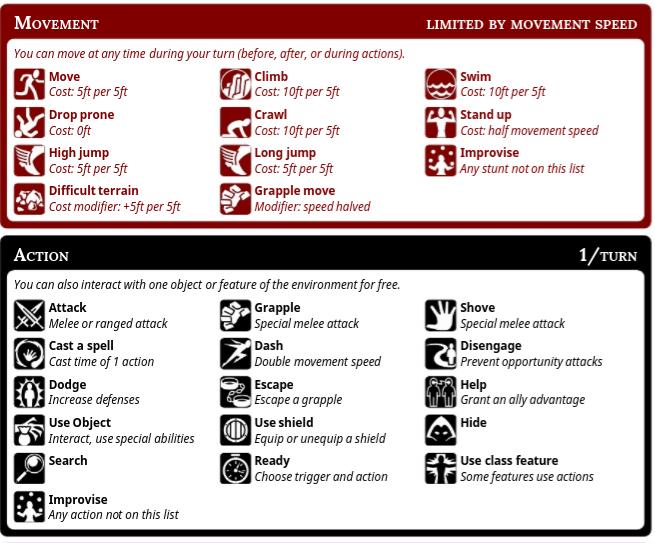
Combat
Each round represents 6 seconds in the game world. Anything a person could reasonably do in 6 seconds, your character can do in 1 round.
Each round, during your turn, you can move and take one action.
Moving
You don’t have to move, but if you choose to, you can move a distance up to your speed. You can move before or after you take an action, or you can move first, take an action, and then move again, as long as the total distance moved doesn’t exceed your speed.
Your move can include jumping onto or off of things, jumping over things, climbing walls or ropes, swinging on ropes or chandeliers, or moving in any way that your character is capable of such as swimming or flying for example.
Actions
You don’t have to take an action during your turn, but if you choose to, you can attempt to do anything that could be accomplished in 6 seconds or less. The most common action taken in combat is the attack action. See "Actions in Combat" (to the right) for a list of actions that can be performed in combat.
Interactions
You can interact with one object as part of either your move or your action. You can manipulate the object in an uncomplicated way. Some examples include:
-
Draw or sheath a weapon
-
Transfer an item from one hand to the other
-
Retrieve or put away a stored item
-
Pick up an item
-
Move an object
-
Open a chest
-
Open a door
Speaking
You can always speak, even when it's not your turn. Speaking doesn't use up either your move or your action. Talk away!
You may be able to take an additional, bonus action.
- A special ability, spell, or other feature of the game may allow you to do something as a bonus action. You are only allowed one bonus action in a round.
- Example: If you have a short sword in one hand and dagger in the other, after using your action to attack with the sword, you can use a bonus action to attack with the dagger (refer to the rules on two-weapon fighting.)
Surprise
If surprised, you lose your turn for the first round of combat. This includes loosing use of any reaction for one round, measured from the beginning of combat until the start of your turn on round two.
Actions in Combat
During your turn in a combat round, you can perform any one of the following actions.
Attack
You can make one melee or ranged attack. Some features may allow you to make more than one attack with this action.
Cast a Spell or Effect
You can cast any spell or effect that you are capable of casting (unless it takes more than one round to cast, which the spell or effect description will tell you).
Dash
Rather than performing any other action, you spend the entire round moving. This allows you to move twice as far this round.
Disengage
If you start the round within 5 feet of an opponent that can see you, you can use this action to move away from him without provoking an opportunity attack.
Dodge
This is a total defense action. You spend the round trying to avoid being hit. Until the start of your next turn, any attack roll made against you has disadvantage if you can see the attacker, and you make Dexterity saving throws with advantage.
Help
You can use your action to help an ally attack an opponent within 5 feet of you. You don’t make an attack yourself, but when your friend attacks, his first attack roll is made with advantage.
You can help another character with any other task. If you are in position to do so, and your assistance could reasonably be seen to be of help, they will gain advantage on their ability check to accomplish the task.
Hide
The act of hiding requires an action to attempt. You must make a Dexterity (Stealth) check to see if you successfully hide from your opponents.
Ready
Rather than taking and action during your turn, you wait for some specific event and then take your action as a reaction. You can still move up to the distance indicated by your move rate, but you can take no other action this round. You must specify two things –
- What the triggering event will be. (If I see a troll... If I get hurt... If anyone comes through the door... etc.)
- What action you will take. ( ...I will attack. ...I will heal myself. ...I will hide in the corner and cry. Etc.)
Search
You can use your action to attempt to find something. The DM might require you to make a Wisdom (Perception) check or an Intelligence (Investigation) check.
Use an Object
An object may require an action for you to use it, or you may need to use this action to interact with more than one object in a round.
Improvised Action
There are many more things that a combatant could do during a round than can be accounted for in the above actions. When you want to attempt something that is not covered by any of the above actions, you can use an improvised action.
Examples of an improvised action:
- “I want to pull the rug out from under that guy.”
- “I want to jump on the monster and attack him with my sword while I ride on to his back.”
- “I want to talk them into surrendering.”
- “I want to break that flask the bad guy is holding.”
- “I want to slide down the stairs on my shield while I fire arrows at the enemy.”
- “I want to intimidate them into running away.”
- “I want to slide under the table and stab that guy in his ankle with my dagger.”
- “I want to sheath my sword and walk up to that guy and tweak his nose.”
- “I want to hit that rope with my arrow in such a way as to cut the rope and let the body that is hanging from it fall to the ground.”
- “I want to push him into the pit.”
- “I want to trip that guy.”
To engage in an improvised action, just tell the DM what you want to do. They will tell you what -- if anything -- you have to roll.
The Bottom Line
Ultimately, the DM will let you try just about anything that is possible. Not everything is a good idea, and not everything is easy, but the only limit on what you can do during a turn is your own imagination.
Source: Olddungeonmaster.com
The Adventure
Choosing a Character
Let's play! That's the best way to really learn any game. We'll begin with a very short adventure set in Iceland, using characters that have already been made for you. You can pick any one of the three character classes on the page to be your character for the adventure. Don't worry if you don't know what some of the terms mean, and don't worry about picking the "best" choice. They're all equal, and they're all going to die at the end of the adventure (so you don't have to worry about screwing up!)
Once you've picked a character, choose a gender and a name for them. Neither of these factors has any effect in the game: men and women are equally capable, and we're going to ignore the stupid attitude of the time which suggested otherwise. But you should still pick a gender and a name, because it's fun and it will make you feel a little more attached to your new character.
Male names: Þorsteinn, Þórðr, Þorkell, Þorbiǫrn, Þórir, Þorgeirr, Helgi, Þórarinn, Ketill, Biǫrn, Þorgrímr, Grímr, Þórólfr, Þorgils, Einarr, Eyvindr, Þorvaldr, Ormr, Þormóðr, Oddr, Þorleifr, Úlfr, Brandr, Hrólfr, and Óláfr.
Female names: Þuríðr, Þorgerðr, Þórdís, Helga, Þórunn, Guðrún, Þóra, Valgerðr, Yngvildr, Vigdís, Þorbiǫrg, Jórunn, Steinunn, Þorkatla, Halldóra, Gróa, Halla, Álǫf, Ástríðr, Hallbera, Þorlaug, Hallveig, Herdís, Rannveig, and Æsa.
Fighter
A warrior, skilled with his glaive and used to combat.
- Armor Class 18
- Hit Points 12
STR DEX CON INT WIS CHA 16 (+3) 9 (-1) 15 (+2) 13 (+1) 11 (0) 14 (+2)
- Saving Throws Str +5, Con +4
- Skills Athletics +5, History +3, Intimidation +4, Nature +1, Perception +2
Actions
Attack. You can attack with your glaive. Melee Weapon Attack: +5 to hit, 1d10+3 slashing damage.
Whirlwind. You can summon up your inner strength. You may attack twice this turn. May not use again until after a short or long rest.
Healer
A priest of the gods, willing to fight but happier healing.
- Armor Class 16
- Hit Points 10
STR DEX CON INT WIS CHA 14 (+2) 8 (-1) 15 (+2) 10 (0) 16 (+3) 12 (+1)
- Saving Throws Wis +5, Cha +3
- Skills Athletics +4, Intimidation +3, Medicine +5, Nature +3, Religion +2
Actions
Attack. You can attack with your axe. Melee Weapon Attack: +4 to hit, 1d8+2 slashing damage.
Heal. You use herbs and bandages to restore another. One target is healed 1d10+1 hit points.
Magician
A spellcaster, dabbling in the forbidden arts of magic.
- Armor Class 12
- Hit Points 8
STR DEX CON INT WIS CHA 10 (0) 15 (+2) 14 (+2) 16 (+3) 12 (+1) 8 (-1)
- Saving Throws +5 Int, +3 Wis
- Skills +5 Arcana, +3 Insight, +5 Investigation, Nature +2, +3 Perception, +5 Religion
Actions
Attack. You can attack with your shortsword. Melee Weapon Attack: +2 to hit, 1d6+2 slashing damage.
Galðr. You cast a curse on an enemy. One target loses a sense of your choice (hearing, sight, etc.) for the next 1d4 turns.
A Dangerous Night
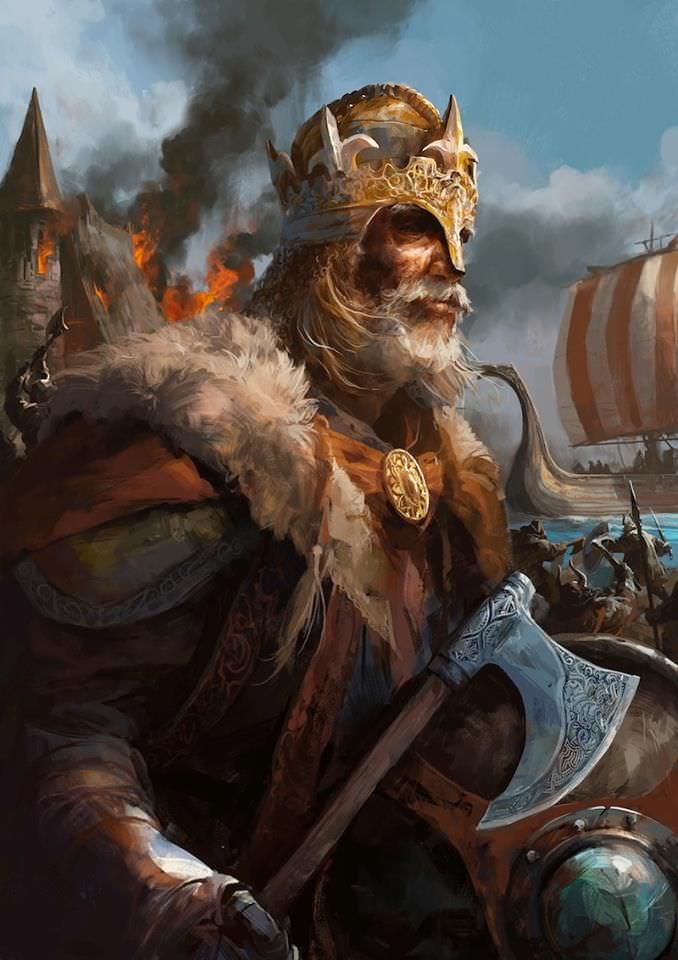 You are a member of the Hunalanders, an Icelandic people. Your kingdom has been ruled for many years by King Sigmund, a great king and a fierce warrior. You have heard many stories about King Sigmund's might and his magic sword Gram from when he was a young man, but now he is grown old. Many in Hunaland worry that he will be unable to lead the kingdom and defend it. But King Sigmund has no children to take over (though his wife Hjördís is pregnant), and so he refuses to step down.
This wouldn't ordinarily be a pressing worry, but Hunaland is under attack. Lyngi the Stríðsherra has marched on the kingdom with his army of sea-raiders. He's already destroyed two villages, and is headed straight for Höfuðborg, your home and the capital town of Hunaland. Lyngi's army is enormous: more than five hundred warriors. Hunaland can muster barely a hundred defenders.
Lyngi will be here in a matter of days. You fear that for your people to survive this battle, King Sigmund will have to reclaim the fire of his youth... and you're not sure that he can.
Still, these matters are beyond you. You are just one of many Hunalanders called to the town square of Höfuðborg by a sullen-looking thane named Olafur. The king has already left that morning, going to scout the fields outside of the town, to examine the path that it is believed Lyngi will be taking.
You are no child, and you have known some little battle in the past. But neither are you prepared to face Lyngi and his blood-crazed army. Hopefully, though, your king will do that for you.
Did You Know?
Hunaland didn't really exist! It was a mythical place that was named for the Huns (an Asian people). At various times, different poets said it was located in modern-day France, Sweden, and Iceland. We're going to say it's in Iceland, though, because we're using an Icelandic source, the Völsunga Saga.
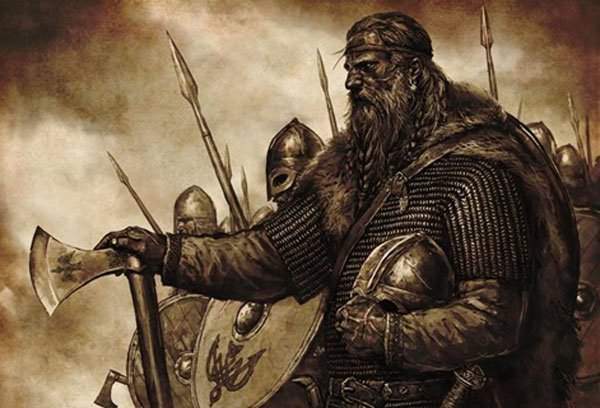
Lyngi and his men threaten the survival of Hunaland.
From the Völsunga Saga...
A story from Sigmund's youth:
Signy was aware that her father was slain, and her brothers taken prisoner and doomed to death, and so she called her husband, King Siggeir, apart to talk with her, and said, "This will I ask of you, that you not slay my brothers hastily, but let them be set awhile in the stocks, for I've been thinking of the proverb that says, 'Sweet to the eye while seen.' I'm not asking for you to spare them, because I know well that my prayer wouldn't help me there."
Siggeir answered, "Surely you are mad and witless, praying for more pain for your brothers than their immediate death; yet this will I grant you, since it's worse for them -- and the longer they suffer or wait to die, the more I like it."
Now he had it done even as she asked: a mighty beam was brought and set on the feet of those ten brothers in a certain place of the wild-wood, and there they sat all day long, until night; but at midnight, as they sat in the stocks, there came on them a she-wolf from out the wood; old she was, and both huge and evil of aspect; and the first thing she did was to bite one of those brothers until he died, and then she ate him up and went on her way.
But the next morning Signy sent a man to the brothers -- someone she trusted -- to hear what happened; and when he came back he told her that one of them was dead, and she thought it would be horrible if they should all suffer the same fate... and yet she could do nothing!
Soon is the tale told thereof: nine nights, one after the other, came the she-wolf at midnight, and each night slew and ate up one of the brethren, until all were dead except the one named Sigmund. But now, before the tenth night came, Signy sent that trusty man to Sigmund, her brother, and gave him some honey to smear over his face and set a little of it in his mouth. The messenger went to Sigmund and did as he was bidden, and then came home again.
The next night came the she-wolf, planning to slay Sigmund and eat him, same as his brothers... but now she sniffs the breeze from him, where he's all smeared with the honey, and she licks his face all over with her tongue and even thrusts her tongue into his mouth.
Sigmund had no fear. He caught the she-wolf's tongue in his teeth, and when she started back and pulled herself away mightily, she set her feet against the stock and pulled it apart. But Sigmund held so fast with his teeth that the tongue came away by the roots, and of that, the wolf had her end.
Chapter 5
The Town of Höfuðborg
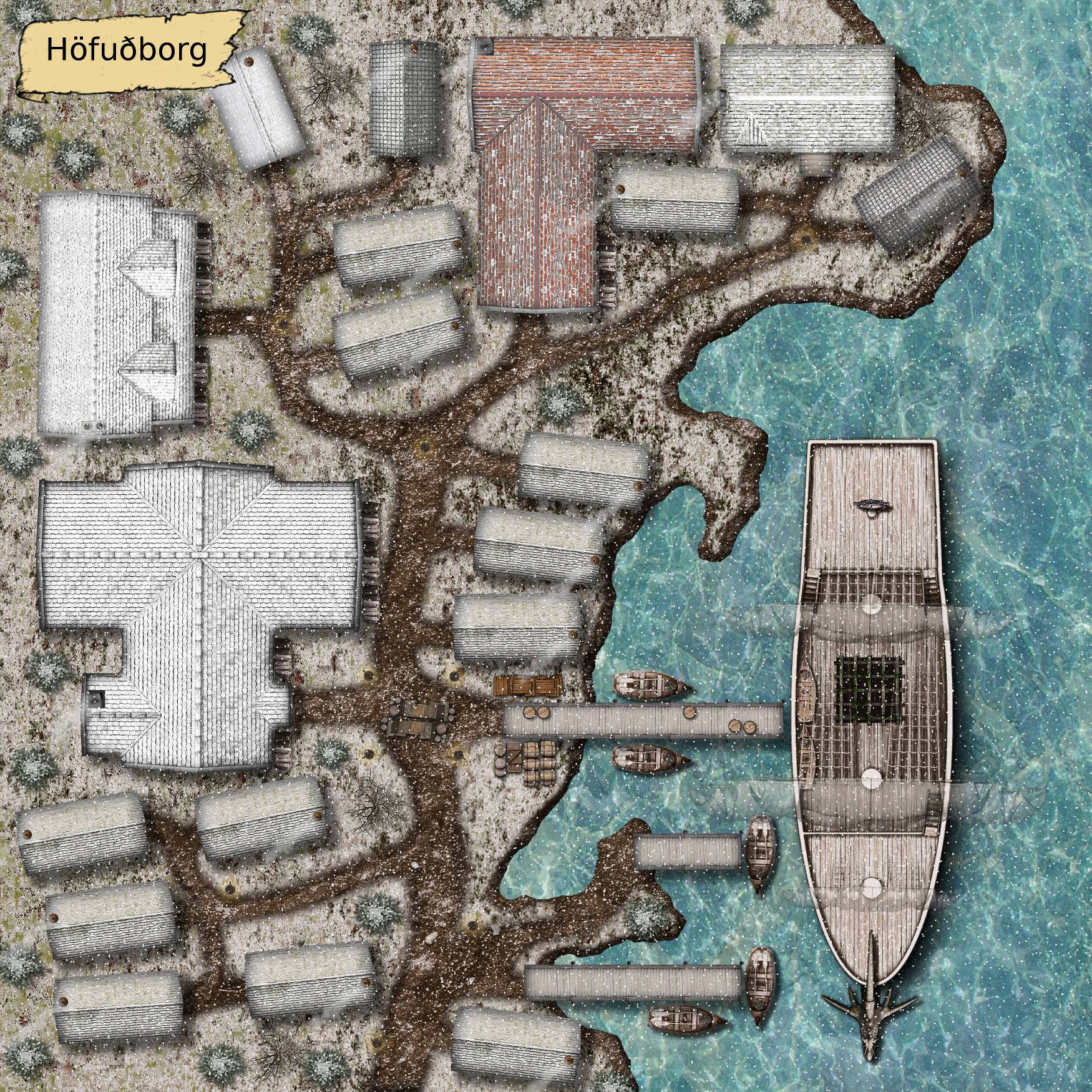
It's the middle of Gormánuður ("slaughter-month"), and the air is crisp and cold. Despite the temperature, the herring-boats moored at the docks have been hard at work in the past few weeks, laying in fish before the weather takes a turn for the worse. Mörsugur ("fat-sucking month") and Þorri ("frozen snow month") are not far off, when every herring counts.
There's a huge knarr also moored at the dock, but it's not seaworthy. It ran aground on some rocks on its last voyage, and was leaking badly when it arrived at Höfuðborg. The shipwright is still working on it, riveting in new planks and caulking it with animal hair and pitch.
The town is dominated by the royal longhouse. Next to that is the barracks, while the rest of the town consists of small homes and workshops.
The Icelandic Year
- Gormánuður (October – November, "slaughter month")
- Ýlir (mid November – December, "Yule month")
- Mörsugur (December – January, "fat-sucking month")
- Þorri (mid January – February, "frozen snow month")
- Góa (mid February – March, "Góa's month")
- Einmánuður (March – April, "lone month")
- Harpa (April – May, "Harpa's month")
- Skerpla (May – June, "Skerpla's month")
- Sólmánuður (June – July, "sun month")
- Heyannir (July – August, "hay business month")
- Tvímánuður (August – September, "second month")
- Haustmánuður (September – October, "autumn month")
Hunaland
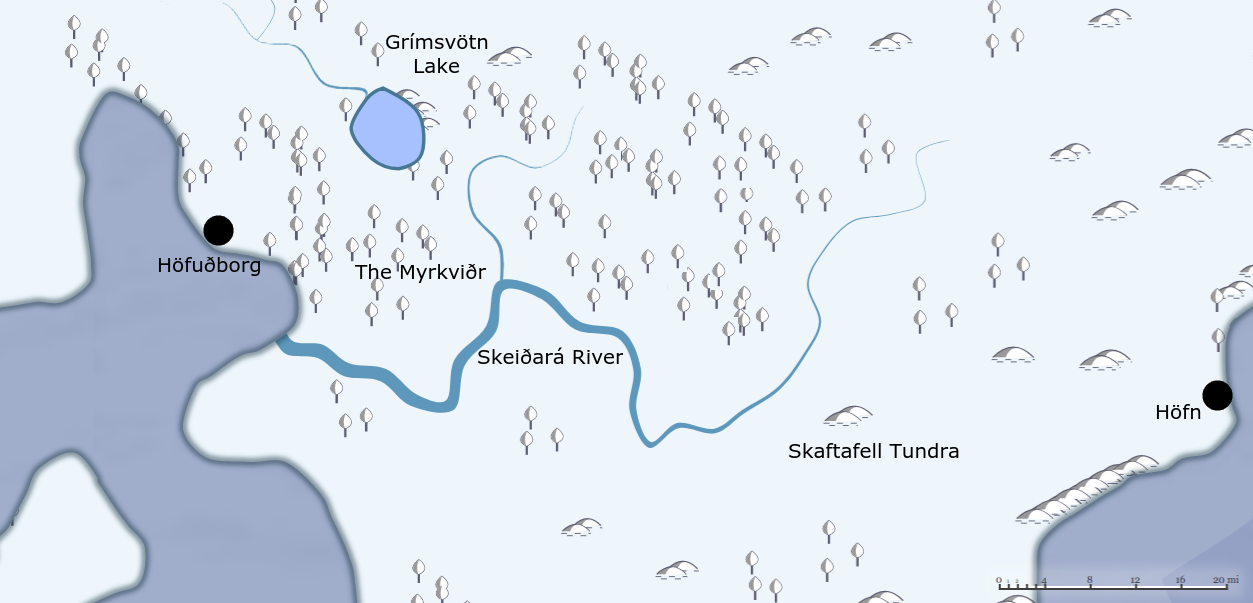
The Myrkviðr
The forest to the east of Höfuðborg is a dark and dangerous place. It is filled with treacherous territory, nasty beasts, and foul creatures of dark magic. It has often protected Hunaland, however, for potential invaders from the south or east fear its depths just as much as Hunalanders do.
Grímsvötn Lake
Grímsvötn is a foul soup of steaming vapor, belching up plumes of smoke and noxious gases at regular intervals. It is surrounded by a thick swamp of warm muds and marshgrass, where it is rumored that witches live in turf huts. However, Iceland has very few mineral resources, and so the bog-iron that can be harvested from the swamps of Grímsvötn make it immensely valuable to King Sigurd.
Skaftafell Tundra
This tundra is a lonely and windswept plain, covered in moss rocks, lichen, and the occasional shrub. In the summer it is wet, but now the bitter pools of water have frozen hard and black in the winter wind.
Skeiðará River
The Skeiðará flows swiftly and deeply, and has claimed the life of many a Hunalander. It is not safe to cross at any time of year, but it is now mostly iced-over and a brave person might risk it. Salmon run plentifully in the Skeiðará, caught mostly with nets cast from the land.
Höfn
This small fishing village, inhabited by no more than two dozen people, has long served as a port for knarrs and longboats to take on provisions and make repairs. It is a part of King Sigurd's demesne, but he has seldom ever had much to do with it beyond the occasional visit from a tax collector.
Iceland's Geography and Biomes
Iceland is one of the youngest landmasses on the planet, and consequently home to some of the world’s most active volcanoes. It is just south of the Arctic Circle, so it is ordinarily quite cold (although the Gulf Stream oceanic current warms it up a bit). Because of these factors, the geography of the country has always been quite unusual: sharp mountain peaks, many long, deep fjords and glaciers, fertile lowlands, numerous bursting geysers and hot springs, vast tundras, swamps, high taigas, and steaming lava fields.
Biomes
- Tundra - Wide plains dominate most of Iceland, held rigid with permafrost most of the year. Small or dwarf shrubs, sedge grasses, moss, and lichen thrive here, as well as mice, numerous birds, and the arctic fox (the only native mammal). Almost 75% of Iceland is tundra.
- Taiga - Birch or conifer forests thrive in some areas near the coast, where the ocean keeps the temperature high enough for trees to grow.
- Swamp - Sedge grasses and wetland shrubs are abundant in the few areas that are warm and moist enough to support them.
- Rock and Ice - Almost a quarter of Iceland is bare rock or ice. These portions never have vegetation, and they have little or no animal life.
Source: Icelandic Bureau of Tourism. "Geography," Promote Iceland.
Did You Know?
The growing season for trees in Iceland is very short, and so it takes a long time for trees to grow (a seedling will reach maturity in fifty years!) When humans first arrived in Iceland in the ninth century, they cut down all of the trees... and then found out no more would grow! Very few trees remain, even a thousand years later.
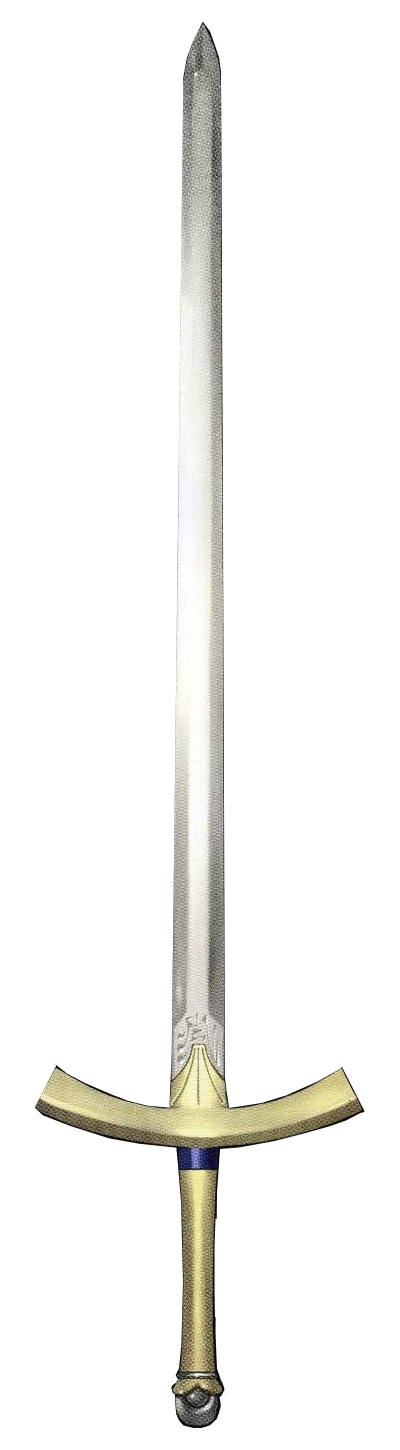
People of Hunaland
King Sigmund
When he was still a teenager, Sigmund proved his great strength: he alone was mighty enough to pull the sword Gram from the oak tree where the god Odin had plunged it. When his brother-in-law King Siggeir was jealous and tried to have Sigmund and his whole family killed, the powerful Sigmund escaped (with his sister's help) and fled to the woods. He killed werewolves and bandits there for years, until returning to civilization to kill Siggeir.
Sigmund is a tall, proud man with white hair and a golden crown. His robes are fine fabric in purples and reds, and he walks with the bearing of someone who has commanded the unquestioned loyalty of his people for forty years.
Hjördís
Hjördís Eylimidóttir is a young woman of twenty winters. To her, it seems like it was only moments ago that she was sitting at her father's feet in his longhouse, listening to his skald tell tales of courage and might. Was it so surprising that, when two men both sought her hand in marriage, she chose the one who was the hero of some of those very tales -- rather than the angry braggart?
Now, though, her one-time suitor, Lyngi, has begun laying waste to Hunaland on his way to seizing Hjördís by force. And with an aged husband and a baby in her belly, Hjördís is worried about what the future holds.
Hjördís is tall and strong, with thick blond hair piled on her head in braids beneath a silver circlet. Her sharp nose and high cheekbones give her a fierce appearance. She wears light tunics of pale blue or green beneath her fur cloak, and keeps a sharp dagger in her belt.
Lyngi the Stríðsherra
Lyngi Hundingsson the Stríðsherra ("Warlord") is an angry man. He is a powerful leader elsewhere in Iceland, and he believes he is mightier than any other person in the world. When he and Sigmund both sought to marry Hjördís, Lyngi assumed he would win, for he was younger and more handsome. But Hjördís preferred Sigmund. Now Lyngi has come to Hunaland to take what he wants.
Lyngi is as stout and powerful as a bear. He wears armor of chainmail and boiled leather, and he carries a huge axe wherever he goes.
Olafur Hjálmarsson
A thin man with a sour disposition, Olafur has been a sworn thane of Sigmund's for many years. He is a skald, not a warrior, and so he has been left behind to help organize the town while the army marches to meet Lyngi. He is not happy about this, since it leaves him no opportunity to gain glory through battle.
From the Völsunga Saga...
A story from Sigmund's youth:
Now after Sigmund was freed and the stocks were broken, he lived in the woods and kept to himself. Signy sent to her servant to him again to find out what had become of him, and upon hearing he was a live, she went and found her brother. They made a house underground in the wild-wood; and so things went on for a while: Signy hiding him there, and sending him such things as he needed. King Siggeir had no idea, thinking that Sigurd and all of his brothers were already dead.
Now Siggeir and Signy had two sons. When the eldest was ten winters old, Signy sent him to Sigmund to help out, so that the boy might learn from her brother and grow, and so that someday he might help Sigurd kill her husband. The youngling went to the wood, and came late in the evening to Sigmund's earth-house. Sigmund welcomed him and said that the boy should make supper. "But I," said Sigurd, "will go seek firewood while you bake bread."
He gave the boy a bag of meal to make into bread, and then went out to get wood. When he returned, no bread was ready.
The boy said, "I didn't really try."
Sigmund thought that the lad had no grit, and that he would be no help at all when it came time to kill King Siggeir his father. When he next saw his sister Signy, he told her so.
Signy said with scorn, "Take him and kill him then; for why should such an one live longer?" And so Sigurd did.
That winter passed. The next winter, Signy sent her other son to Sigmund. There is no need to make a long tale of that, for this child was also not useful to her brother, and so Sigmund killed this second nephew, as well.
Chapter 6
The basic story of this little adventure is as follows:
The adventurers are asked to go on a simple mission to gather resources. This will let them learn basic mechanics of the game, as they pass some skill checks and fight some wolves. While they are gone, Sigmund and the remains of his army return. Sigmund has been mortally wounded, and his sword Gram has been broken. The party is asked to help Hjordis escape with her unborn child and the pieces of Gram.
The route to Hofn is overland, through the forest, across a river, and over a tundra. Lyngi will send patrols to try to catch the party, as well as post some guards at possible points of escape (including Hofn). Depending on time, two or three encounters along the journey are reasonable. At Hofn, the characters will need to obtain a boat and get Hjordis on her way. They will be given a chance to sacrifice themselves to ensure she escapes Hunaland and the vicious Lyngi. If they do not do so, Lyngi kills them anyway for their dishonorable actions.
The adventure is plucked from an early part of the Volsunga Saga. Sigmund, Hjordis, and Lyngi are all real characters from the saga, and Hunaland was the imaginary kingdom where the saga is set. Most everything else is fake, extrapolated from the text and supplemented with my best approximation of Icelandic history.
I think it is important that the players know that their characters aren't leaving the adventure alive, so that they feel free to experiment and take risks, but reasonable people can disagree. Judge based on the group: some kids will be inclined to just mess around with other kids and the group, and they'll get worse if they know there's ultimately no consequences. See Appendix A if you need help with a specific kid or kids.
Call to Action
At the beginning of the story, everyone expects that Lyngi will be attacking soon. Sigmund is away with his army, marching to face them. The players were left behind for one reason or another. If it seems appropriate, have the kids invent the reason why they didn't go.
Olafur is in charge of Hofuthborg, and he has gathered the players together to send them out for supplies in the dark and dangerous Myrkvithr.
Blue text is for you to read aloud, but add whatever else is necessary, whenever you need it... it's not a verbatim script.
"Tomorrow we think we will be fighting Lyngi the Stríðsherra, if he continues to sail as quickly as we have heard," says the sour-faced thane. "The king has left to scout out the field, but there is much we can do back here, too. We'll need to be prepared. I'll group some of you together to go out into the Myrkviðr and get supplies. King Sigurd might slay the whole lot of the Strithsherra's men by himself with his magic sword, Gram, but that doesn't mean we can't do our part."
Olafur jabs a finger at each of you, indicating you'll all be a group. Another group is formed of the remaining townsfolk. Olafur tells them that they should go cut turf to use for fuel. Then he turns to you, his thin lips pursed.
"We'll need more honey, for the injured, and we'll need good wood for repairs. Check over your equipment and ask me if there's anything you need."
They can have any little stuff they want for free -- let them get comfortable. Remind them to talk in character. Answer any questions they have about their belongings (each person has a weapon already, suitable for their character type). Olafur is practical and a little bitter about this assignment, but he does not mock them under any circumstances. He is here to situate them in the game.
Myrkvithr
As you enter Myrkvithr, the taiga forest near Hofuthborg, the ground beneath your feet grows soggy, and you are forced to move unevenly from one tussock to another on the increasingly boggy terrain. The smell of rot bothers you for a while, before you grow used to it. More unsettling is the combination of tree shade and miasma that obscures your view. The tall pines grow thickly here.
If necessary, prompt them on their assigned tasks. Locating useful wood is a Perception check (DC10 for a small amount, DC15 for a good amount, DC20 for an excellent amount) and locating honey is a Nature check (DC10 small, DC15 good, DC20 excellent). Walk them through it.
Results for wood:
After a thorough search, within about (20/40/60) minutes you turn up a pair of fallen trees sheltered by nearby growth.
Results for honey:
Slogging through the mire for a (20/40/60) minutes, you hear a lazy buzzing. You follow the sound to a beehive in the bole of a birch. You'll need to light one of your torches to smoke out the bees and get the honeycombs.
Let them sort themselves out and learn in the forest, but don't let them go nuts. Try to get them moving back to town with enough time to fit in a simple fight.
As you stomp through the slime under the pine-cast shadows, you hear a quiet yip from behind you. It's answered to your left with a low growl, and all of you know the sound instantly: wolves have found you. Wolves don't warn their prey with barks or snarls, you see, until they're right up on you. But once they have you... that's when they try to get their prey to bolt. Better to bite a fleeing back than face a fighting front, after all. Still, it's surprising that they'd attack a large band of humans. They must be hungry or witch-ridden.
One pads in front of you, sidling around a birch trunk with lazy steps and narrowed eyes. A thick gobbet of slaver drips gently from the end of one bared tooth. They are all around you... it looks like you're in for a fight.
Use standard wolf stats (MM341), with half as many wolves as party members. Try not to kill anyone. Send them running after a good hit or death if you're pressed for time.
With a embittered final snarl, the remaining wolves break away from the fight, loping away into the dappled light of the forest. They form a pack as they run, leaving their dead companions and their hope of an easy meal behind. You have won.
Back at Hofuthborg
As you emerge from the forest and approach the town, you see to your surprise that there is a mass of men gathered outside of the royal longhouse. It looks like the army of King Sigurd that left this morning, with three differences: there are far fewer warriors now than when they departed, almost all of those visible are bloodied or injured, and you don't see the king anywhere. There's a visible tumult as a pair of healers and numerous townsfolk rush to help the warriors who are supported by others or prone on the ground.
Olafur is visible, standing near the seaside. His face is ashen.
If they investigate, they see a load of injured guys, sitting on boxes or getting cared for by townspeople. They can speak to Olafur or any random passerby:
Olafur (or the passerby) says, "Lyngi was faster than anyone could have thought."
Before he can continue, one of the wounded warriors nearby limps over, interrupting in a voice strangled by sorrow, "The Strithsherra was waiting for us to the north with his whole army. They were lying in the high grasses on their bellies like beetles! They were on us before we could raise our swords. Half of us lie dead in the mud, and the rest of us..." He gestures at his leg, which you can see is badly mangled and wrapped in crude bandages. "And the king... I could never have thought that the king, with his magic sword... that anyone could stand against him. The king..." But then the wounded man only trails off, his mouth twisting in upset.
Olafur continues, "The other group I sent out... they have not returned. And all of these here," and he gestures at the shattered army, "are injured." He crosses his arms. "You all had reasons why you were not with the king and his army, but those reasons are now irrelevant. You are uninjured and you have shown yourselves capable. Go find whoever is in charge in the longhouse... see how you can best help. I will try to organize these here and begin loading the knarr. I suspect we will soon be making our final departure from Hofuthborg, so I will try to prepare."
None of the mass of injured people will have any further information, although players hunting for more can be obliged with a battlefield description about the ambush, eg how Kjeld's best friend Ivar was cut down by a spear and then Kjeld had to flee for his life. Olafur will organize people and get supplies where they're supposed to be and have the few able-bodied folks start preparing to flee (at least temporarily).
When the players go inside the longhouse as requested, be it immediately or after investigating:
This is not your first visit to the royal longhouse, although few of you have had occasion to be there more than a few times -- usually for occasions of ceremony or celebration. None of you are thanes, after all... you're just ordinary Hunalanders. You see royalty usually from a distance, and rarely. The longhouse is a sturdy, beautiful building: the thick timbers that hold up the walls and ceiling are decorated with intricate curves and designs, the benches at the long tables which dominate the main room are all draped with rich furs, and the high seat of the king stands to one side, huge and gilded and magnificent. Here is where the king would sit and preside over feasts at the tables and benches below, where great trenchers of bread and curds would be served, and sometimes a good haunch of roasted meat, while the poets sang of glory and honor.
It is hard to pay any attention to this grandeur, or to imagine such a scene of joy, however, since the sight that greets you upon entering is so startling. King Sigmund sits on the high seat, but slumped to one side, face slack. It's jarring, as though a mighty oak from your childhood were to suddenly subside into the earth. He is breathing with great shuddering breaths, and blood covers his face and chest and mats the long white hair that has come loose from its braid. The queen is standing next to him, tugging disconsolately at a long loop of bandage that she has wrapped around his waist. Her sharp features are shadowed by distress. At the foot of the high chair is a loose roll of felt.
A servant is sitting near the stone-pit hearth to one side of the room, stoking the fire beneath a hanging iron pot of water.
The king looks up as you enter, wearily.
See if they want to do or say anything. Sigmund is dying, but he is still proud and intimidating. The servant is too scared to say anything. Hjordis will grudgingly address them, but she already knows and disapproves of what is going to happen, and so she will not be exactly ebullient.
"I am... dying," the king says, and the voice that was once a deep growl has been reduced to a reedy whisper. The queen shakes her head fiercely at the words, tears trickling down her face. She clenches her mouth tightly and ties off the bandage she's wrapped around her husband's belly, but says nothing.
"Lyngi the Strithsherra came upon us unawares. He and his men must have been as fast as hares to reach Hunaland so quickly. He..." The king's voice fades and his eyes flutter rapidly for a moment as he slumps lower over the arm of the high seat. He pauses, then pulls himself a little straighter. He is as pale as death. "Lyngi himself found me on the battlefield and smote at me with his axe with the strength of a troll. Nothing could stand before him. Not even Gram..."
The king gestures feebly with one hand at his feet, at the loose roll of felt.
Inside the wool:
The wool makes a quiet metallic click as you open it, revealing what is wrapped within: the mighty sword Gram, the magical blade of the king. It has been broken, the blade snapped in two pieces. According to the legends, the sword was forged by Odin himself. For forty years, it has not left the king's side, and he has used it to cleave a thousand enemies. Seeing it broken in twain is as disturbing as a green sky or black flower.
"You lot... you did not fight today. The reasons do not matter... indeed, I must be grateful for your absence." The king pauses again, wincing. The servant brings over the water they'd been tending, which is now at a rolling boil, and the queen pours some into a mortar and begins to mash herbs into it with a pestle. "Your absence at the battle," King Sigmund continues, "means that you are here now, and can help."
Give them another chance for interaction or comment.
"Queen Hjordis is with child," the king says. Blood from his mouth stains his lips crimson as he speaks. The queen -- who does look somewhat pregnant to your eyes, something you hadn't noticed before -- ignores you all, wrapping the poultice she has created in a wad of bandages, and then shoving it inside of the bandage she'd wrapped around the king's stomach. His face contorts in pain and his fingers spasm and clench at the armrest of the high seat, and for a moment King sigmund must simply sit in silence, trying to recover as he gasps for air. After some time, he continues.
"The queen is with child. She must escape Lyngi. He is a beast, and will kill her if he can. She must escape. You must take her and the pieces of Gram and flee to Hofn -- put her on a boat. If you move quickly and with luck, you will be gone before Lyngi can be here."
"And you will come and join us when you are able," says the queen. It is not a question, but rather a command, spoken in a voice backed by a steel will.
"Yes," agrees King Sigmund, his face relaxing into calmness. "We will be together as soon as possible." He turns his attention back to you all, levering himself off of one elbow until he is able to force himself back upright. He looks down at you with regal scrutiny. "You will do this thing for me, I hope."
Let them discuss and ask questions as needed. Sigmund cannot tell them which path to take, but he does suggest that it would be foolish to attempt to sail from Hofuthborg -- Lyngi will have ships on the way to collect plunder -- and that it would take too long to slog the entire way through the Myrkvithr. The best routes are either to the north, through the region around the lake, or to the south, crossing the river. Either way, their journey will end with passage across the tundra. They can have whatever reasonable supplies they might think they'll need, but no additional soldiers can go with them.
Sigmund wishes them to depart as soon as possible. He and those still able to fight will wait at Hofuthborg for Lyngi, but he doesn't expect to survive for very long. He knows his wound is fatal already, and believes that Odin has deserted him -- why else would Gram have broken?
On the way out:
The queen stops at the door and stares at her husband. He stares back at her, and something unspoken and silent and sweet passes between them. And then the queen turns away and passes through the door, and you sense that they both know that they will never see each other again.
Travel
The party will pass through the Mirkvithr briefly, and then at least two of the three regions (lake, river, tunda) if they take a direct route. Each region should include at least two encounters -- one physical barrier and a fight. Don't be afraid to improvise and adapt -- let them solve problems or avoid them, but be sure to challenge them with some encounters. The whole point of this mini-adventure is to let them experiment and learn how the game works.
As the party travels, the queen will willingly speak to them. She can tell them a story about her husband, discuss how this all began (when she chosen Sigmund over Lyngi), or just generally chat. She is obviously upset and on edge, but she's not unfriendly. Her status is higher than the party's, but this is not a very stratified society, so she doesn't expect them to wait on her or anything. She is pregnant, but not hugely, and so she does not slow the party down -- if anything, she might impress them.
Pause for the night at some point, whenever it's appropriate.
Grimsvotn Lake
Challenge: Cross a big stretch of bog in a reasonable time. They can try to improvise a sledge to drag Hjordis, force their way through while hauling her along, or whatever else they please. Brute force should be fairly hard (DC18 Con check).
For a long while, you are able to pick your way without too much trouble through the area around Grimsvotn. You keep your distance from the wide, steaming lake -- as much to keep firm ground beneath you as to stay away from the vapors of the lake that burn your nose whenever a breeze brings them your way.
Eventually, though, there's no clear way forward. You're all forced to edge into the water until the muck is up to your knees, to try to slog forward. It is very slow-going and exhausting work. It will be very hard to keep this up all the way through the bog, and -- what is more -- it will be slow.
"We can't keep this up," says Hjordis, pausing to gasp for breath. She holds on to the trunk of a slender birch -- there are a few of them around, but not many -- and touches her pregnant belly with one hand unconsciously. She, at least, can't keep on like this... even if you weren't all worried about Lyngi and his men catching up to you.
Fight: A trio of witches. Use the stats for sea hags (MM179) but with no Death Glare.
Out of the bog, your pace picks up. You're beginning to think you'll be out of this swamp soon when you see a strange silver pool. It's quite unlike the rest of the bog. A fat bubble rises to the surface, and pops wetly.
(They can keep walking if they like, and ignore it. They probably won't, but if they do, just drop it. If they investigate...)
Another, even bigger bubble rises slowly from the surface of the pool. It rises, bulbous and trembling, and then it stops, frozen. It wobbles gently, and then two more bubbles emerge from within it. They're pale and slimy, but become far more terrifying when they swivel to face you, and then slowly blink. Below the shining wet eyes, a split emerges, filled with jagged teeth. Then the whole thing shudders and rises from the muck -- a bald, greasy face... a thin and knobbly neck... narrow, naked shoulders... long-fingered hands with ragged claws...
The creature makes a noisome sound that sounds moist and violent, and grins. Behind it, two more big bubbles appear on the surface of the silvery pool. Soon you are faced by three bog-witches, their pale flesh covered with thin strands of slime-greased black hair. Roll initiative.
Skeithara River
Challenge: Cross the frozen river. If they just try to pick their way over, each person has a fairly hard and risky time (DC18 Dex).
The Skeithara stretches before you as you emerge from the Myrkvithr. It is wide and deep, but Hunaland is cold enough this time of year that most of the surface is covered in smooth, bitter blue ice. Rocks stick through the ice here and there, and some parts of the frozen water are thin enough that you can see the river coursing past beneath.
You believe that you can cross, but it will be perilous. One wrong step and any of you could break through the surface. And once beneath the ice, you would be swept away, to drown in the cold darkness. Just the thought of being swallowed by that wet, icy night... You shiver.
How do you want to cross?
Fight: Four bandits. Use the stats for Bandits (MM343).
As you tramp away from the frozen river, thanking your luck and the gods, you see a thin trickle of smoke. It's not too far away, just a bit off of the path you've been following.
(They can ignore it and skip the encounter, but their curiosity will probably drive them to check it out.)
Four dirty-looking men huddle around a campfire, and jump to their feet as you approach. They're thin and they wear ragged clothes -- one of them isn't wearing proper clothes at all, and instead has on crudely-cured raw hides. Each is armed. They look like they have been out here for a long time. One of them steps forward, and there's a nasty, feverish glint in his eyes.
"Hello there. Hello," he says, licking his cracked lips. "Welcome. Would you like to sit with us and share our fire? Rest for a moment?"
(It's a trap, obv. If they acquiesce, then they are dumb and the bandits get a well-deserved surprise round.)
There's barely the span of a breath before the ragged bandits leap forward, trying to take advantage of your surprise. They draw rusty weapons as they attack.
Skaftafell Tundra
Challenge: Rescue Hjordis from a hidden pit. Let them figure something out. She's fine when they get her out.
Travel across the tundra is easy. The biggest challenge is the occasional slippery rock or patch of ice. You move quickly and surely east.
The ease with which you are able to travel is perhaps why you were so surprised to hear a sudden crackle of ice, and then to see that Hjordis was gone. It was as fast as the flash of lightning: one moment she was tromping along, holding her skirts high to keep them from growing ragged on the rocks, and the next she was gone, a wide black hole in her place.
It's the work of only a moment to clear away the powdered snow and see that a thin rime of ice had frosted over the top of a sharp crevasse: a fissure in the rock, split smoothly and dropping down fifteen feet. You can see Hjordis at the bottom, curled up at the bottom of the deep crack in the rocks. She isn't moving.
Fight: Lyngi's patrol. Use the stats for two Guards (MM347) and two Scouts (MM349).
As you tramp along over a grassy stretch of ridge, you hear a quiet whistle. Looking down from the ridge, you can see a tall blond man. He's bearded and covered in tattoos, carrying a spear, and he smiles up at you. It's not a friendly smile. It's the cold smile -- the sort of smile a cat might make as it carefully clawed apart its prey.
Ahead of you, you hear another whistle in answer. It's long and low, made by a short man with a wide gut and a spear in his hand. He smiles a toothless smile and lowers the fingers he used to whistle. "Hello, there. Hunalanders? We're with the Strithsherra, which makes us your new masters. You'll be coming with us, then."
Hjordis sucks in her breath in fear, then grits her teeth. "We can't let them take us," she whispers, harshly.
You hear the scrape of boots on ice, and turn to see a third and fourth warrior standing there. They have spears strapped to their backs, and flatbows in their hands. Each of them has an arrow nocked already, but one of them lowers his bow as he gets a closer look at your party. "Hager, look at that one. Maybe thirty or thirty-five summers. And pregnant. You think...?"
"The queen of Hunaland herself, yes," says the tall man on the slope below you. "The very woman that Lyngi is here to retrieve. Hello, Hjordis Eylimidóttir. We have a new husband for you. Come and meet him."
Hofn
It's only a few hours from the scene of the fight to Hofn. But with all you've been through, by the time the village comes into view on the horizon, it seems like you've been traveling for a week, rather than a couple of days. Still there it is: a few small homes and a sturdy dock, set on the edge of the shoreline like a bead on a string. There's a knarr waiting at the dock. The only people you see are two sailors, busy rigging the sails for departure.
"Almost there," Hjordis says, relief in her voice. "Let us hurry. We will all take ship to safety across the sea at the lands of my father, and await my husband." She quickens her steps, and before too long you're in Hofn. No one comes out to greet you from the homes here. Presumably everyone fled when they heard that the Strithsherra was attacking Hunaland.
Hjordis turns to you. "I want to thank you. This has not been an easy journey, and you are not Hunaland thanes... there was no expectation that you would do this. You are honorable, and I am grateful. I hope to reward you well, when we arrive." For the first time, you see your queen's face relax and become vulnerable in her relief.
Let them have a moment, as necessary. No need to hint that they're not all done... let them be surprised.
Suddenly, behind you, you hear a mighty roar. It is like a bear or some great beast had been granted the gift of speech. "Hjordis! Hjooooordis!" You turn to see a huge man, stout as an oak, standing at the foot of the docks. The door to one of Hofn's homes lies open behind him, and bloody footsteps mark the man's path from door to dock. He's made of seemingly nothing but thick cords of muscle and scars. His short beard is trimmed square and sharp, and his aquiline features are afire with anger. He is wearing a beautiful coat of chainmail, and he carries in one hand an axe that must weigh as much as any one of you.
Four men stand behind him, each heavily armed. Two of them hold a familiar figure between them -- Olafur, the thane of Sigmund who you last saw planning the evacuation of Hofuthborg. It is clear that Olafur has been beaten badly.
Your attention is drawn back to the beast of a man who leads. He swings the axe in his hand angrily to one side, and even from where you are, you can hear the air whistle in its wake. "Hjooooordis!" he shouts again, his face enraged.
Lyngi the Strithsherra has found you. He has come for Hjordis. And now you must decide what to do.
The party is now faced with a decision about what to do. Hjordis wants to run. Lyngi wants Hjordis. The party is obligated by honor to fight Lyngi long enough to send her packing on the ship, perhaps with Olafur (if they wish). They may make any choices they wish. The sailors are too terrified to help, and only cower in the bow of the boat. Olafur is a stabilized 0 HP, and cannot offer any useful assistance.
For Lyngi's four men, use four Guards (MM347). For Lyngi, use the Berserker (MM344) or (if the party isn't up to it) the Scout (MM349).
At the end, they may choose poorly:
Hjordis gives you a final look of terror and betrayal, and you see that something has broken within her. You can see it in her eyes, which look dead and hopeless as Lyngi drags her away by one wrist. She barely resists. The Strithsherra himself only spares you a single look of contempt, as though you were the crushed remains of some slimy thing that crawled out of the swamp only to be trodden beneath his boot. He and his men stride away, taking their prize, leaving you behind with the dying Olafur.
No more is known about your deeds. You are not found in the histories, and no skald sings songs of your glory. This is the end of your story, here on the dark shore as your betrayed queen is dragged away.
Congratulations! You have finished your first D&D adventure! How do you feel? Do you have any questions?
They do not get to know what would happen, had they chosen otherwise. There are consequences to decisions.
At the end, they may also choose well. Put this in the middle, when defeat is certain but someone is still alive.
The ship is far away, now. Hjordis will be safe. You turn to look at her for a moment. And you can see her. There, standing at the ship's bow, looking back at you.
Lyngi's roars, his barks and screams of fury, the whirlwind chopping of his axe and the sound of steel on steel... it all fades away. You don't really go anywhere, not exactly, but they just fade into the background, as though they had stopped being important. For just that moment, all that matters is the look on your queen's face. You can see it clearly, though she's far away. It is a look of gratitude and great honor -- the great honor that you have achieved in this moment. When it came down to it, though it cost you everything, you did the right thing. And you will be remembered for it in legend. Indeed: you will have a role in the histories, now. Hear the words of the Völsunga Saga...
But Lyngi and his brethren gather an army together to fall on Sigmund and find Hjordis, but failed herein, for he found her not.
The tale tells that Hjordis brought forth a man-child. He was sprinkled with water, and named Sigurd, of whom all men speak with one speech and say that none was ever his like for growth and goodliness. Whenso all the noblest men and greatest kings are named in the olden tales, Sigurd is ever put before them all for might and prowess, for high mind and stout heart.
Hear me now when I tell you that Sigurd would grow to be the greatest hero known to all the Germanic world. He saved entire peoples and slew many monsters. But were it not for you, he would never have existed nor saved thousands of innocents. And thus it was that you and your party passed into history. Whatever might have happened to your mortal flesh, future ages will remember your glory forever.
Congratulations! You have finished your first Dungeons & Dragons adventure! How do you feel? Do you have any questions?
III. Dice and Probability
In Dungeons & Dragons, we roll many different-sided dice. Each side of a die is the same size and weight, so each number on the die comes up equally often. If you roll a d8, then the odds that it lands on any number on the die are 1 in 8 (or 12.5%). Every die works the same way.
| Die | Odds of Any Number (As a Fraction) |
Odds of Any Number (As a Percentage) |
|---|---|---|
| d4 | 1 / 4 | 25% |
| d6 | 1 / 6 | 16.67% |
| d8 | 1 / 8 | 12.5% |
| d10 | 1 / 10 | 10% |
| d12 | 1 / 12 | 8.33% |
| d20 | 1 / 20 | 5% |
We don't use dice with 16 sides in Dungeons & Dragons. But let's say you did have a d16...
-
What would be the odds of rolling a 2?
-
What would be the odds of rolling a 16?
This chart might help make the idea clear. This type of chart is called a histogram. It shows the distribution -- or arrangement -- of all outcomes of rolling a d12.
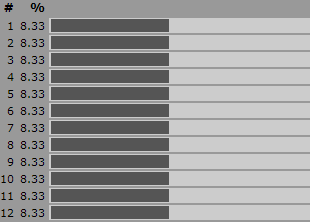
Notice that the distribution is completely even and flat... you have an 8.33% chance of rolling any of the numbers. This sort of distribution is called a uniform distribution.
If you roll more than one die, though, the distribution will look very different. For example, here's the histogram for 2d6:
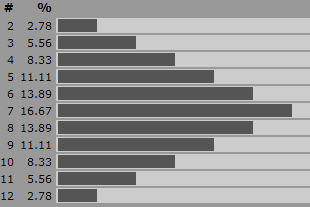
Notice how different is this binomial distribution? It's far more likely you will roll numbers in the center of the distribution than the numbers on the edges.
-
How likely is it that you will roll a 5, 6, 7, 8, or 9?
-
How likely is it that you will roll a 2, 3, 4, 10, 11, or 12?
-
Why is it impossible to roll 1 on 2d6?
The difference in distributions makes sense if we stop to think about it. Think about trying to roll a 6, for example. On 1d12, you have the same chance to roll a 6 as anything else. But on 2d6, you will roll a 6 if the dice come up as any one of five different ways: 3 and 3 (total of 6), 2 and 4 (total of 6), 4 and 2 (total of 6), 5 and 1 (total of 6), or 1 and 5 (total of 6). Contrariwise, it's harder to roll very high or very low; to roll a 12, both dice must be a 6.
-
How many different ways are there to roll a 7 on 2d6?
-
How many different ways are there to roll a 7 on 3d6?
Did You Know?
It may seem like the average roll on a d20 would be 10. After all, isn't that right in the middle? But the average roll on a d20 is 10.5! Think about it: we're not averaging 0 through 20... there's no zero on the die! We're averaging 1 through 20.
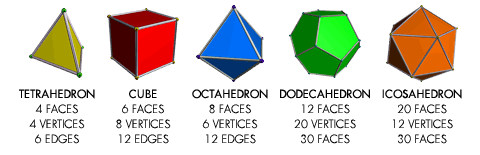
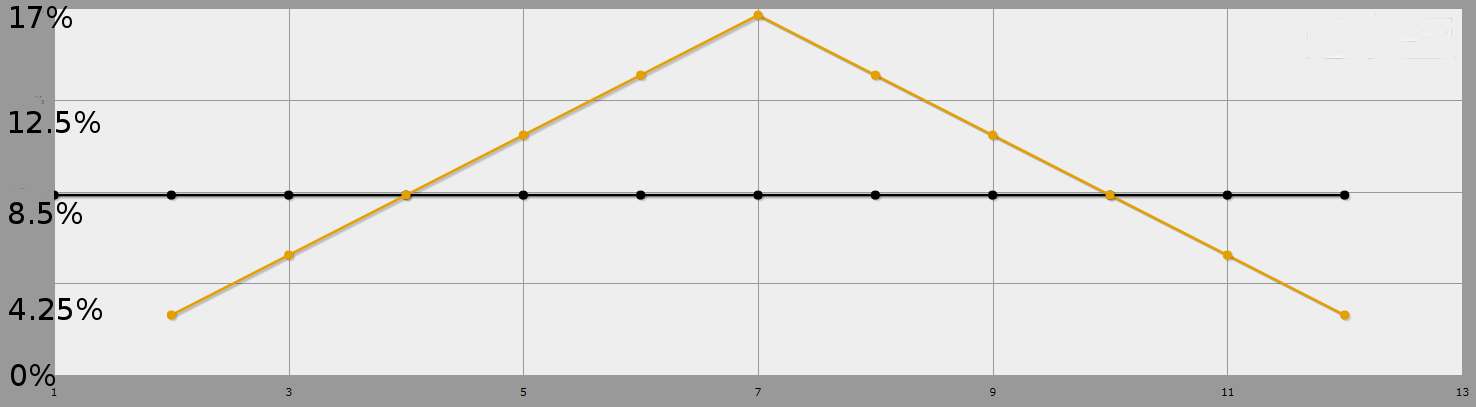
If we combine the data from our histograms into a single chart, the contrast between the two distributions becomes even more obvious.
-
Which color line represents 1d12?
-
Which color line represents 2d6?
Now, let's think about how we can use this knowledge. Let's say you want to pick which weapon your fighter character, Viktoria, will be using. She has her choice between a greataxe, which does 1d12 damage, and a greatsword, which does 2d6 damage.
-
Which weapon do you give Viktoria if you want her to do the most damage, on average, with every attack?
-
Which weapon do you give Viktoria if you want her to have the best chance of doing the maximum damage of 12 with an attack?
Advantage and Disadvantage
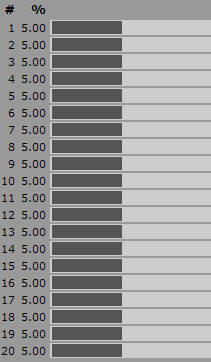
As you have experienced, sometimes in Dungeons & Dragons your character has advantage on a roll, meaning that you roll two dice and discard the lower score. For example, you might roll 2d20 with advantage and get 5 and 15; your result would be 15, since you'd drop the 5. What do those distributions look like?
First, here's the histogram for a normal d20 roll. Notice that it's a uniform distribution, just like the normal d12.
But if we're rolling with advantage or disadvantage, it's not going to be a uniform distribution. You're much less likely to roll with advantage and end up with a very low result, for example (since you're using the higher roll of two possibilities... most of the time, you'll be able to toss out a low roll).
We probably won't see a binomial distribution, either. Remember, a binomial distribution indicates that it's unlikely you'll roll very high or very low. But you know by now that it's a lot easier to roll low when rolling with disadvantage.
No, advantage and disadvantage give you these negative binomial distributions:
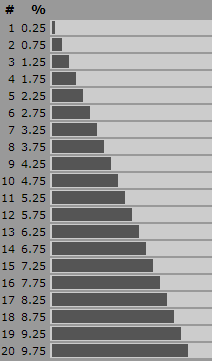
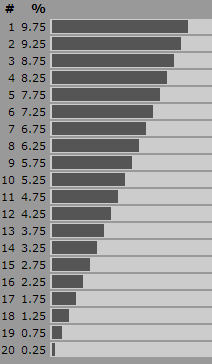
Now here's the data from those three histograms again, in chart form.
-
Which color line represents rolling a d20?
-
Which color line represents rolling a d20 with advantage?
-
Which color line represents rolling a d20 with disadvantage?
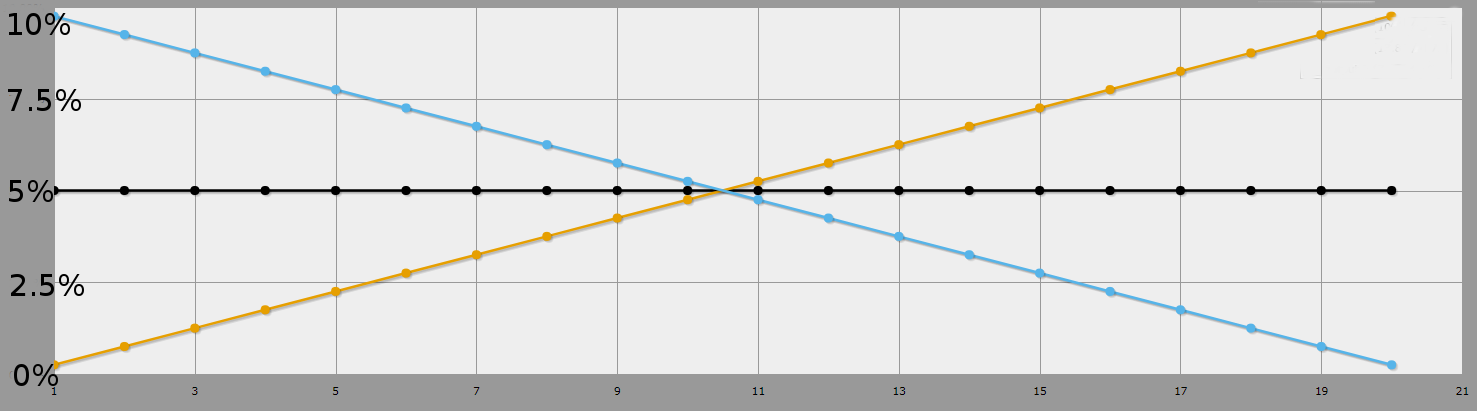
Difficulty Class
You've already seen the necessity in D&D of beating a given Difficulty Class (DC) -- the target number you're seeking when you make a roll for a skill check:
- If you're trying to calm down a horse around lightning, the DC on your Animal Handling roll might be 10.
- If you're trying to calm down a particularly nervous horse when there's lightning and it can smell a wolf, the DC might be 18.
- If you're trying to calm down a hysterical horse while a troll is gnawing on its leg, the DC might be 25.
Ordinarily, you won't know the DC for any particular action. The DM will typically just say something vague, like, "That will be hard to do." But if you do know the DC for an action, you can figure out how likely it is that you will be able to achieve that action.
Look again at the probability distribution for a standard skill check on a d20.
Let's say your character wants to break down a door. It's a pretty flimsy door, so the DC is only 5.
- What is the percentage chance that you will succeed on this roll? What is the percentage chance you will fail?
- If the DC were 10, what would be the percentage chance you would succeed? Fail?
Ability Modifiers
Consider also the role of ability modifiers... as your character gets stronger or smarter, they get bigger and bigger bonuses to skill checks.
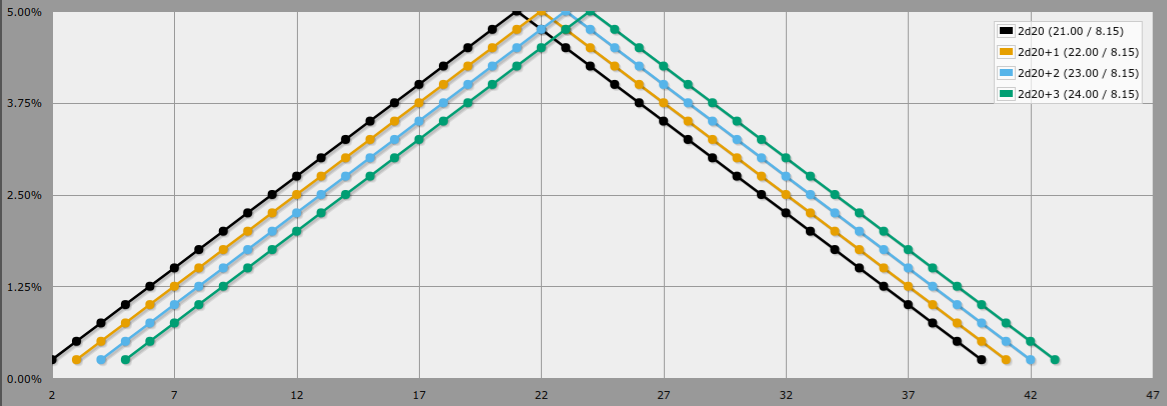
- Your character works out a lot, increasing their Strength to 12. This gives them an ability score modifier of +1. What change would you predict in the shape of the d20 chart to the left -- would it still be flat?
- What is the percentage chance of succeeding on a DC5 check with 1d20+1? DC10?
- What is the percentage chance of succeeding on a DC21 check with 1d20? With 1d20+1?
- Your character takes a Potion of Troll Strength, boosting their Strength to 18. That's about as strong as a human being can get in Dungeons & Dragons! What are you chances of success on DC10 check with 1d20+4?
The chart on the bottom of the page does a good job of showing the effect of modifiers on your rolls. This is a chart of 2d20 rather than 1d20, because the effect is easier to see on a binomial distribution (triangular) than a uniform distribution (flat).
As you can see, each modifier just pushes the distribution one number to the right. So while the peak of the 2d20 distribution is at 21 (the most likely outcome, with a 5% chance of happening), the peak of the 2d20+1 distribution is at 22, and the peak of the 2d20+2 distribution is at 23.
You can also see that it is impossible to roll 1 on 2d20 (just like 2d6, and for the same reason), but that it is also impossible to roll 2 on 2d20+1 and impossible to roll 1, 2, or 3 on 2d20+2. In other words, the minimum possible roll gets better and better as your modifier increases.
- Your character spends a lot of time watching TV, and their Strength score drops to 8. This gives them an ability score modifier of -1. What do you think the percentage chance of them succeeding on a DC10 check with 1d20?
- Your character shrinks down to a tiny little baby with a Strength of 1. This gives them an ability score modifier of -5. What is the likelihood of them making a DC10 check?
Here is a handy rule to remember: the minimum number you can roll on any number of dice equals the number of dice that you are rolling, plus or minus the modifier applied. So if you are rolling 4d8, the least you can roll is 4. If you are rolling 8d10+2, the least you can roll is 10 (eight dice plus the modifier). If you are rolling 4d4-3, the least you can roll is 1 (four dice minus the modifier).
Make a worksheet for their answers.
IV. Character Creation
Let's get ready to play a real campaign! We'll use our Dungeons & Dragons practice in Iceland -- poor Hjördís! -- and our knowledge about life among the medieval Germanic peoples. And just like any game of Dungeons & Dragons, the first step will be creating our characters!
We'll be using a simplified version of the character creation rules, because some choices just don't apply to our Beowulf-themed game. For example, in D&D you don't usually have to be a human being. You can be an elf, an orc, a dwarf, or many other "races." But Beowulf doesn't have any orcs. All of our characters are going to be human. It's much easier, too!
Character Creation Steps In Brief
- Choose ability scores. The different abilities are Strength (STR), Dexterity (DEX), Constitution (CON), Intelligence (INT), Wisdom (WIS), and Charisma (CHA). You are going to assign each one a number from a list to represent your character's ability in that trait. Use these numbers: 16, 15, 14, 12, 10, and 8. So if you wanted a very intelligent character who was also pretty strong, but you didn't care about what people thought about them, you might start by assigning your character 16 INT, 15 STR, and 8 CHA. That would leave you with 14, 12, and 10 to assign among DEX, CON, and WIS.
- Choose your character class. You may assign your character any of the following classes:
- Berserker (Barbarian) - A wild-eyed warrior who can enter a fit of indomitable rage during battles.
- Lareow (Cleric) - An educated healer, capable of binding wounds, setting bones, and brewing poisons.
- Raider (Rogue) - A wily rogue who prefers to steal and destroy, rather than wading into combat.
- Skald (Bard) - A singer of songs, you tell tales of bravery and wield your sword, both with equal skill.
- Thane or Shield Maiden (Fighter) - A skilled fighter, you have devoted your life to the arts of war.
- Vǫlva or Seiðmann (Wizard) - An outcast magician, you command the arcane arts... and the fear of others.
- Adjust your character sheet with your class bonuses. Each class gives your character certain skills or powers. Read the descriptions of your chosen class on the following pages and make the changes it directs.
- Roll for money. Roll 3d6. The total is the number of þrymsa (gold pieces) your character possesses. Roll 1d6. The total is the number of sceatta (silver pieces) your character possesses.
- Choose any additional equipment you wish to buy. This will be in addition to the equipment granted by your class. See the chart on page ????? and "buy" equipment using your character's money. If you buy more armor or equipment, make the changes to your Armor Class or weapon sections on your character sheet.
- Characterization: appearance, personality, interactions with others, and direct description.
- Name your character.

Step One: Ability Scores
Strength (STR)
Strength measures bodily power, athletic training, and the extent to which you can exert raw physical force. A Strength check can model any attempt to lift, push, pull, or break something, to force your body through a space, or to otherwise apply brute force to a situation.
Dexterity (DEX)
Dexterity measures agility, reflexes, and balance. A Dexterity check can model any attempt to move nimbly, quickly, or quietly, or to keep from falling on tricky footing.
Constitution (CON)
Constitution measures health, stamina, and vital force. Constitution checks are uncommon. Your Constitution modifier contributes to your hit points.
Intelligence (INT)
Intelligence measures mental acuity, accuracy of recall, and the ability to reason. Characters use intelligence when they need to draw on logic, education, memory, or deductive reasoning.
Wisdom (WIS)
Wisdom reflects how attuned you are to the world around you and represents perceptiveness and intuition. A Wisdom check might reflect an effort to read body language, understand someone’s feelings, notice things about the environment, or care for an injured person.
Charisma (CHA)
Charisma measures your ability to interact effectively with others. It includes such factors as confidence and eloquence, and it can represent a charming or commanding personality. A Charisma check might arise when you try to influence or entertain others, when you try to make an impression or tell a convincing lie, or when you are navigating a tricky social situation.
Then were King Harald's folk mustered, and many were fallen, and many were sorely hurt. Thorolf was wounded, and Bard yet worse, nor was any man unhurt...
Steps Two and Three: Classes and Adjustments
Berserker
Ardith blinked furiously and staggered to the side as she came back to consciousness. Blood was in her eyes -- not hers. She wiped it away with the back of her hand, looking around. Where was she? Before the Swedes had attacked, she had been sitting quietly in the grove. Now she was in... well, it looked like the well near the village. A battered corpse lay at her feet, and another was slung like a rag doll over the well's lip. A tree had been felled at the wood's edge, just beyond, and Ardith could see more destruction past that. She sighed, and started following her own trail.
A long while and three more corpses later, she found where the fight had begun. There was where she'd been sitting, and there was her bag. She leaned over and picked it up.
A nearby whimper drew Ardith's attention. She kicked aside a pile of leaves. Beneath, a man was curled up, sobbing quietly. It was the first Swede, the one who'd dare lay a hand on her. Ardith smiled. "Why... hello there."
A berserker is a special sort of warrior who has learned to call up the bear-spirit or wolf-spirit within. When they go berserk, putting themselves into the frenzy, a berserker becomes an unreasoning machine of war. They feel no pain, gain great strength, and terrify their enemies.
Berserkers are sanctified to combat. It is their purpose and their pride. For a Germanic king, their berserkers would be their most valuable warriors: first into battle and last to leave it.
Choose a berserker if you wish to play a brutal character who delights in front-line combat above everything else, as they go into an unreasoning rage.
Class Features
As a berserker, make the following changes to your character sheet:
Hit Points
You have 12 hit points at first level.
Proficiencies
You are familiar with every type of armor and every type of weapon, and know how to use them all.
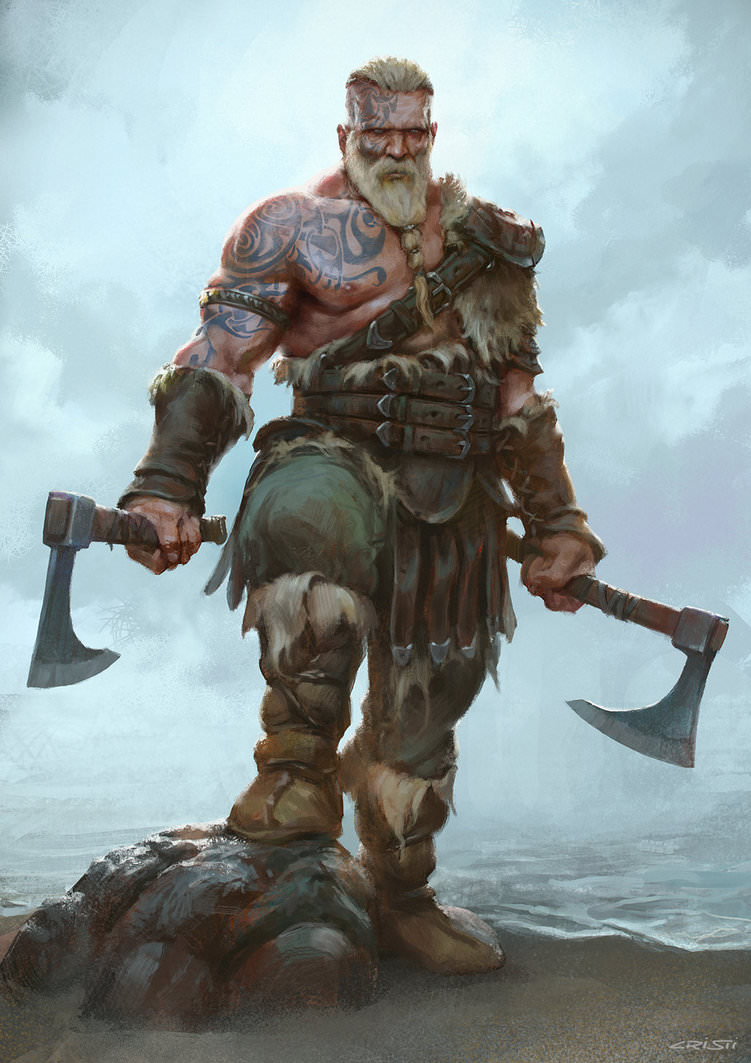
- Saving Throws: You are proficient in Strength and Constitution.
- Skills: Choose any three of the following skills to be proficient in: Athletics, Nature, Animal Handling, Perception, Survival, or Intimidation.
Equipment
You start with the following equipment:
- A dagger, a greataxe, and a seax.
- Leather armor.
Class Name
| Level | Proficiency Bonus | Hit Points | Powers |
|---|---|---|---|
| 1st | +2 | 12 | Beserkergang |
| 2nd | +2 | 20 | Hamask |
| 3rd | +3 | 28 | Hamrammr, Unstoppable |
Did You Know?
Berserkers were very real! There are lots of theories to try to explain how anyone could tear at theri shield with their teeth or go uninjured from fire or weapons. Some people think it was a sort of hysteria, others aver that berserking was a special trait linked to genetics, while others have suggested that berserkers must have taken drugs. Ultimately, we just don't know how it worked!
We do know enough these days to discard some of the stories, at least. For example, we can say with great certainty that berserkers were never able to change into animals!
A book called The Danish History relates one account of an attack by a berserker named Hardbeen:
These men asked Halfdan to attack Hardbeen and his champions man by man; and he not only promised to fight, but assured himself the victory with most confident words. When Hardbeen heard this, a demoniacal frenzy suddenly took him; he furiously bit and devoured the edges of his shield; he kept gulping down fiery coals; he snatched live embers in his mouth and let them pass down into his entrails; he rushed through the perils of crackling fires; and at last, when he had raved through every sort of madness, he turned his sword with raging hand against the hearts of six of his champions. It is doubtful whether this madness came from thirst for battle or natural ferocity. Then with the remaining band of his champions he attacked Halfdan, who crushed him with a hammer of wondrous size, so that he lost both victory and life.
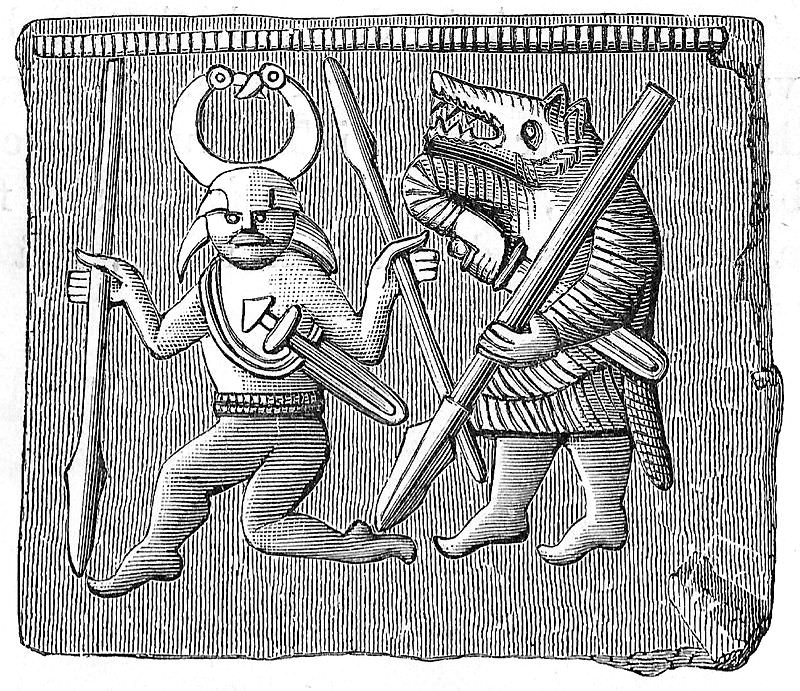
Level One Powers
Berserkergang ("Go berserk")
Twice a day, you can enter a berserker rage. While raging, you attack with a frenzy of speed and reckless power. All of your attack rolls have advantage. Your berserker rage lasts ten turns, or until the end of battle. After your rage, you have disadvantage on all rolls until you rest.
Level Two Powers
Hamask ("Change form")
Your berserkergang has become sufficiently intense that you are resistant to damage while raging.
Level Three Powers
Hamrammr ("Shapestrong")
You have reached the pinnacle of rage, and now your embrace of animal fierceness is so great that your very body changes shape to match your roaring spirit. At will, you can transform into a bear, a boar, or a wolf. You may end the transformation at will. Your hit point total does not change, regardless of your current form. You may not go berserk while shapechanged.
Unstoppable
While you're berserk, having 0 hit points doesn't knock you unconscious. You still must make death saving throws, and you suffer the normal effects of taking damage while at 0 hit points. However, if you would die due to failing death saving throws, you don't die until your rage ends, and you die then only if you still have 0 hit points.

Lareow
Guttrun smiled as she handed the mead-cup to Ibn Mohammed. He squinted at it suspiciously, his mouth pursed. Guttrun sighed theatrically and plucked it from his hands, then took a loud gulp. She swallowed it, raised her eyebrows in amusement, and handed the cup back to him. He smiled back at her in relief, and took a gulp of his own.
"I cannot thank you enough for your help," Ibn Mohammed said. "Without you, the disease would have wiped out my whole village."
"You can't be too happy about that," Guttrun replied, "since you spread the disease in the first place. But I admire your acting ability. I am not a good actor, which is why you guessed there was poison in your mead."
As Ibn Mohammed collapsed the the floor, his face ashen, Guttun leaned over. "It tastes bitter, yes? I taste it, too. But then, I also still taste the the antidote I took ten minutes ago."
Lareow have seen the world, and know a lot about it. They are outsiders in some respect, having dedicated themselves to higher knowledge in a culture that places little value on formal education.
The lareow simply means "doctor" in Anglo-Saxon -- and the class is intended to represent those rare individuals with education. A lareow is a learned person: they have either traveled abroad and spent time with other cultures, or perhaps they have connections to one of the Christian monasteries that function as centers of learning. The lareow knows history, theology, and geography, as well as how to heal others, how to create primitive drugs, and how to craft poisons.
Choose a lareow if you want to play a character with a broader perspective, who tends to support others rather than jump into a fight.
Class Features
As a lareow, make the following changes to your character sheet:
Hit Points
You have 6 hit points at first level.
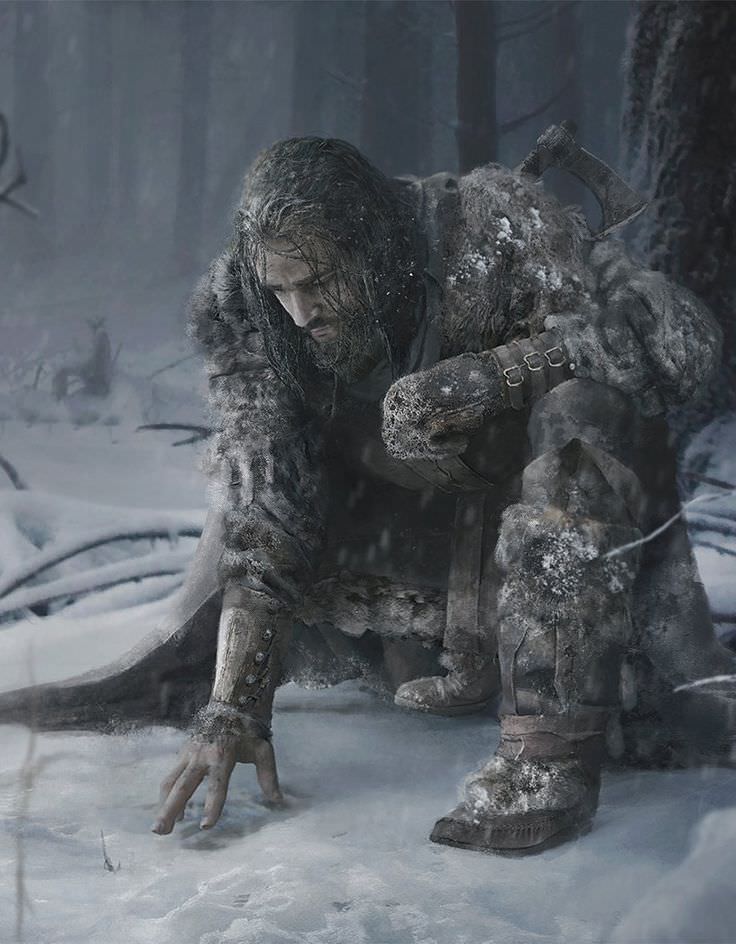
Proficiencies
You know how to wear padded armor, but nothing more complicated than that. You know how to use a shield. You are familiar with the dagger, fighting spear, flatbow, seax, sling, staff, and throwing spear.
- Saving Throws: You are proficient in Constitution and Intelligence.
- Skills: Choose any three of the following skills to be proficient in: Arcana, History, Investigation, Nature, Religion, or Medicine.
Equipment
You start with the following equipment:
- A dagger, a fighting spear, and a throwing spear.
- A tunic and a shield.
- Two tobacco leaves, two belladonna leaves, 2 honey, 2 bandages, and one small clay pot of oil.
Class Name
| Level | Proficiency Bonus | Hit Points | Features |
|---|---|---|---|
| 1st | +2 | 6 | 3 lesser slots |
| 2nd | +2 | 10 | 4 lesser slots, 1 greater slot |
| 3rd | +3 | 16 | 5 lesser slots, 2 greater slots |
Did You Know?
As far as scientists can tell, there's no such thing as real magic. But with science and cleverness, the most educated of the Germanic world would have been able to do many of the things that magical "spells" are said to have been able to accomplish. A magical explosion from an arcane fireball might only have been legend, but a crude bomb could have accomplished the same thing. These effects are rough approximations that have been written for fun -- most of them wouldn't really work if you actually tried them (and obviously you should never try them)!
Lareow can use their great knowledge to create effects that astound the ordinary person. They must decide each day, after resting, which effects they will prepare. They require certain material components for each effect. A lareow might decide that they expect danger, and so they will prepare three doses of healing for that day using their stock of honey and bandages. As a lareow become more experienced, they learn to do more things, and they become more efficient at the creation and storage of necessary materials.
Lesser Effects
Poison
Lesser Lareow Effect
- Casting Time: 1 turn
- Range: 30 feet
- Components: Tobacco, belladonna.
- Duration: Instant
Using a mortar and pestle, you grind up poisonous herbs into a toxic goop and throw a palmful of the muck at your enemy. If you successfully hit, you do 1d6+Int damage.
Heal
Lesser Lareow Effect
- Casting Time: 1 turn
- Range: Touch
- Components: Honey, bandages
- Duration: Instant
You use your knowledge of the human body and herbs to clean someone's wounds, applying honey -- a natural antiseptic -- to the injuries. You heal an amount equal to 1d8+Int.
Burning
Lesser Lareow Effect
- Casting Time: 1 turn
- Range: 30 feet
- Components: Oil, small pot.
- Duration: 5 turns
You throw a small clay pot, specially prepared with oil and wick, at a target of your choice. The resulting fire will burn for 5 turns, and even water cannot put out the flames as the oil burns. May do 1d4+Int damage to any enemies caught in the fire.
Greater Effects
Raise
Greater Lareow Effect
- Casting Time: 1 turn
- Range: Touch
- Components: Sal ammoniac, vinegar, flask.
- Duration: Instant
Using special concoctions and tricks known only to the wise, you bring back to life someone who has been fatally wounded. This must be done within a number of minutes equal to 10+INT.
Greater Poison
Greater Lareow Effect
- Casting Time: 1 turn
- Range: 30 feet
- Components: Tobacco, belladonna, nightshade.
- Duration: Instant
Your poisonous goop is much more effective, and now does 2d8+Int damage.
Greater Heal
Greater Lareow Effect
- Casting Time: 1 turn
- Range: Touch
- Components: Angelica, honey, bandages.
- Duration: Instant
With the addition of special and rare herbs to your poultice, you can now heal 2d8+Int hit points.
Explosion
Greater Lareow Effect
- Casting Time: 1 turn
- Range: 30 feet
- Components: Oil, sulfur, small pot.
- Duration: Instant
Using arcane chemicals and elaborate preparations, your pot of oil will now explode when thrown, rather than simply burning. Enemies hit by the blast suffer 3d6+Int damage, but may attempt a DC15 Dex save to avoid half the damage.
Raider
Snorri waited quietly until the Scottish patrol had walked past, then quickly crossed the trail to the village edge, where the famous church stood. He leapt up and grabbed hold of the roof-edge, pulling himself up onto the beam with a cat's nimbleness. Carefully, he took a few steps up the roof along the solid beam, then knelt down. The roofing was knotted bundles of straw. Snorri plucked a dagger from his belt and carefully slit open one of the bundles, pushing a hole through the middle. He peered through the hole. A metallic gleam drew his eye, and he smiled with satisfaction. Then he tied a neat knot in a thin bit of rope, and lowered it through the hole.
Ten minutes later, Snorri was briskly running through the woods away from the village, a pair of golden statues clinking gently in his loot-bag and a broad smile on his face.
A raider does not believe in foolish notions of honor. They want loot and fame. Why swear yourself to the service of some lord, when you can live outside of that whole system and just take care of yourself? You'll be at risk of a sword in the belly either way, so you might as well live freely in the meantime!
Raiders are not the best fighters, but they are used to being sneaky and they're good at surviving. They tend to favor cheap weapons, especially ones that let them attack from a safe distance, and they're not too honorable to stab someone in the back.
Choose a raider if you want to play someone who survives by wits and stealth, rather than might or magic.
Class Features
As a raider, make the following changes to your character sheet:
Hit Points
You have 8 hit points at first level.
Proficiencies
You are only familiar with padded armor and leather armor. You know how to use a shield. You know how to use the dagger, fighting spear, flatbow, seax, sling, staff, sword, and throwing spear.
- Saving Throws: You are proficient in Dexterity and Wisdom.
- Skills: Choose any three of the following skills to be proficient in: Acrobatics, Sleight of Hand, Stealth, Insight, Deception, or Intimidation.
Equipment
You start with the following equipment:
- A dagger, a fighting spear, and a flatbow.
- A tunic and a shield.
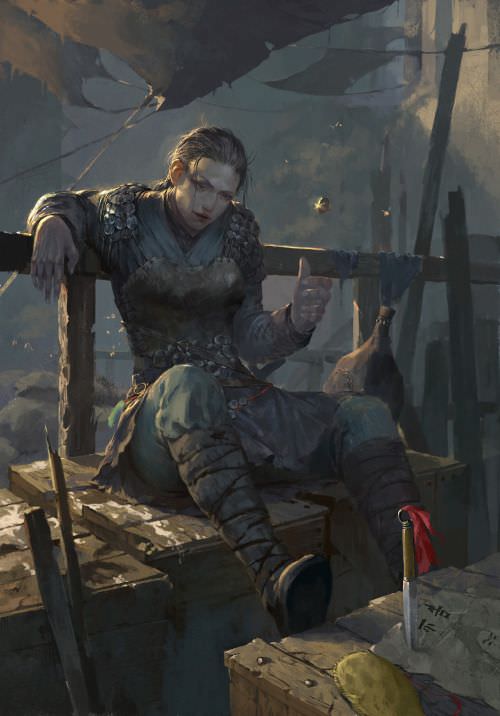
Class Name
| Level | Proficiency Bonus | Hit Points | Features |
|---|---|---|---|
| 1st | +2 | 8 | Sneak attack, Stealthy |
| 2nd | +2 | 14 | Evade, Ear for Deceit, Eye for Flight |
| 3rd | +3 | 20 | Greater sneak attack, Terrify |
Level One Powers
- Sneak attack - 1d6 extra damage if opponent unaware
- Stealthy - Always has advantage on stealth checks if moving at half speed.
Level Two Powers
- Evade - On your turn, you may use a bonus action (an extra action, in addition to your normal one) to disengage from a fight, dash, steal something, or hide.
- Ear for Deceit - You have advantage on Insight rolls to determine if someone is lying.
- Eye for Flight - You have advantage on Perception rolls to find someone who is hiding.
Level Three Powers
- Greater sneak attack - 2d6.
- Terrify - Once per day, you can dramatically charge an enemy with style and fury. All opponents that fail a DC10 Wisdom check lose all heart, and flee.
He took in his hand a hazel-pole, and went to a rocky eminence that looked inward to the mainland. Then he took a horse's head and fixed it on the pole. After that, in solemn form of curse, he thus spake: "Here set I up a curse-pole, and this curse I turn on king Eric and queen Gunnhilda. ..."
This spoken, he planted the pole down in a rift of the rock, and let it stand there. The horse's head he turned inwards to the mainland, and...
Skald
As she stood up from behind the spur of rock at the hill-crest, Sigrid opened her voice in song. She charged down the slope towards the vicious trolls, boots pounding through the frost with crisp crunches, and with every stride her voice rose. Sigrid sang a song of joy and heroism, a saga of her forebears and their battles with giant-kin and night-haunt. By the time she reached the bottom of the hill, her voice was a roar of poetry.
The three trolls dropped their weapons and fled, crude rock-clubs clattering to the ice at their heels. But they could not fly far or fast enough to escape Sigrid's righteous song -- or her scything blade, which mowed them down like wheat.
Skalds are poet-warriors, lovers of beauty and battle. They do not merely tell the tale, for an inglorious poet could only ever sing an inglorious song. No, a skald will take up iron and sail on salt themselves. And the power of their verses can be great: a worthy skald can sling insults to break a person's spirit, bellow war chants to shatter an enemy's resolve, or weave paeans to charm a suspicious stranger.
This class of character is a capable fighter, but supplements those skills with different sorts of songs that may achieve remarkable effects. They are adventurous and creative, and generally set great stock by the traditions and values of the past.
Choose a skald if you want to play a social character and a performer, comfortable taking the spotlight and getting into the thick of things.
Class Features
As a skald, make the following changes to your character sheet:
Hit Points
You have 8 hit points at first level.
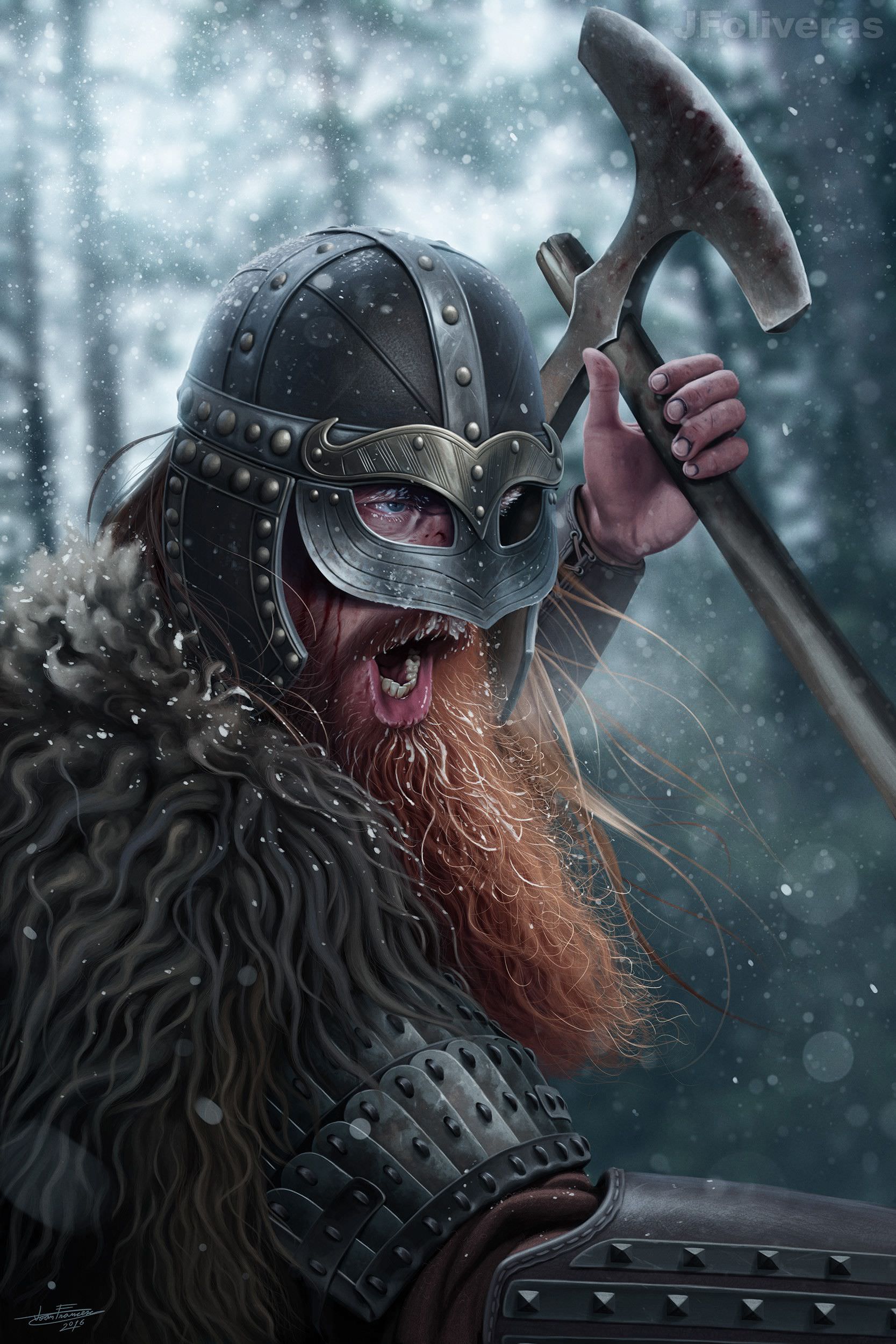
Proficiencies
You are familiar with every type of armor except byrnies. You know how to use a shield. You are familiar every type of weapon, and know how to use them all.
- Saving Throws: You are proficient in Dexterity and Charisma.
- Skills: Choose any three of the following skills to be proficient in: Acrobatics, Arcana, History, Deception, Persuasion, or Performance.
Equipment
You start with the following equipment:
- A dagger, a fighting spear, and a sling.
- A tunic and a shield.
Class Name
| Level | Proficiency Bonus | Hit Points | Features |
|---|---|---|---|
| 1st | +2 | 8 | Insult, Praise |
| 2nd | +2 | 14 | Níðing |
| 3rd | +3 | 20 | ─ |
Level One Powers
- Insult - Give disadvantage on next roll to someone else. May not be used on self.
- Praise - Give advantage on next roll to someone else. May not be used on self.
Level Two Powers
- Níðing - Takes ten minutes, does something bad.
Level Three Powers
Flosi spoke to Kettle of the Mark, and said, "This now I ask of you: how firmly will you pursue righteousness, you and the other sons of Sigfus?"
"My wish is," said Kettle, "that there should be peace between us, but yet I have sworn an oath not to stop this fight till it has been brought somehow to an end...
Thane or Shield Maiden
Unferth ignored the pain in his side as he stepped over the Dane's corpse. The world swam before his eyes, and he swayed to one side for a moment, but then he jerked himself back upright. He hefted his sword between his fingers. His arms felt as numb as wood.
"You can't stop us, Geat," snarled the Dane's companions. "There are five of us yet, and one of you. You will die here today."
"I don't need to stop you and I don't need to live," said Unferth calmly, raising his sword. "I just need to slow you down."
The Danes shrieked their rage and charged, clubs and spears flying at Unferth. But as he met their attacks with a sweep of his blade, he could do nothing but laugh: a big, roaring, glorious laugh. For he could hear, -- finally, at long last -- the battle-horns of his companions. Help had arrived.
Most Germanic soldiers only had a shield and spear -- a seven-foot weapon made of ash and iron. Thanes (male) and shield maidens (female), however, are no common soldier. They are nobility, sworn to a lord's service in war, and they wield swords. Thanes and shield maidens uphold the principles of honor and seek out glory, eager to become famous enough for a poet's song and powerful enough to make their enemies fear their names.
Thanes and shield maidens go right to the front of combat, leading and battling like the nobility that they are. They seek out wrongdoing and the enemies of their lord, and they value honor over their life.
Choose a thane or shield maiden if you want to play an upright warrior, unafraid of man or beast, who wishes to pursue higher goals in life.
Class Features
As a thane or shield maiden, make the following changes to your character sheet:
Hit Points
You have 10 hit points at first level.
Proficiencies
You are familiar with every type of armor and every type of weapon, and know how to use them all.
- Saving Throws: You are proficient in Strength and Wisdom.
- Skills: Choose any three of the following skills to be proficient in: Athletics, Stealth, Investigation, Insight, Survival, or Performance.
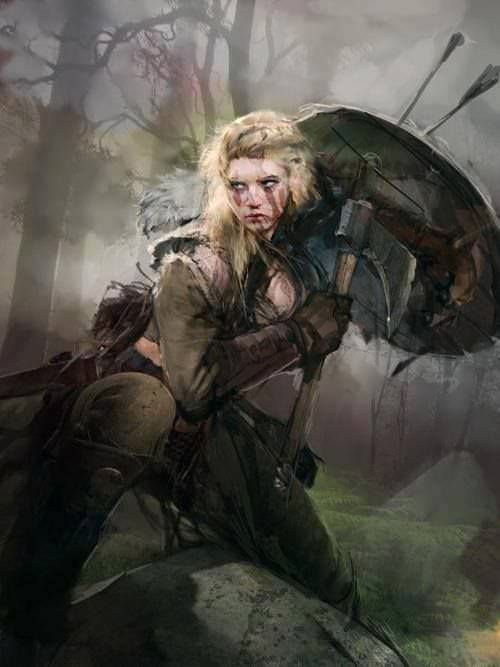
Equipment
You start with the following equipment:
- A dagger, a fighting spear, a sword, and a throwing spear.
- A byrnie and a shield.
Class Name
| Level | Proficiency Bonus | Hit Points | Features |
|---|---|---|---|
| 1st | +2 | 10 | Shield Wall, Goad |
| 2nd | +2 | 18 | |
| 3rd | +3 | 26 | Flurry |
Level One Powers
- Shield Wall - Can join with two or more others with shields, giving all involved +2 AC.
- Goad - You can taunt a target, and they have disadvantage on attacks on all others but you.
Level Two Powers
- Disarm - Can make contested Dex check to disarm opponent.
Level Three Powers
- Flurry - You attack twice per turn.
That hounds shall
Gnaw you in hell
And your soul
Sink into the abyss
Vǫlva or Seiðmann
When the cruel thane spit on him, Winfrid turned his face away. He felt the warmth roll down his cheek, and his stomach roiled. But still, Winfrid kept still. He held his temper and his tongue, and waited until the thane snapped one final insult and stalked out of the room. It didn't matter -- neither spittle nor words could hurt.
Winfred stooped down and reached into his seiðr-sack. He drew out a long and pale bone. It was intricately carved, its surface inscribed with runes older than the stones. Winfred held it in his fingers for a moment, then gently used his fingers to scoop the spittle from his face. He smeared it along the bone, and then he began to chant.
The little hut seemed to grow darker smaller, as though the walls themselves were leaning inwards to hear Winfred's words. He chanted with lost and foul words, obscured by time and madness. And when he was done, he snapped the bone in his hands like it was a twig.
Neither spittle nor words could hurt. But a broken leg could. In the distance, Winfred could hear as the thane collapsed to the ground and began to scream. Winfred smiled, and wiped his cheek clean.
The vǫlva (female) or seiðmann (male) is a person on the edge of Germanic society. They practice the three forbidden magics: curses, spells, and prophecy. This gives them great power, but also makes them the object of contempt and hatred for many of their people. The vǫlva or seiðmann has a supernatural majesty and might, but human society is the price they have paid for their power.
Vǫlvas and seiðmenn have little use for weapons and armor. In conflict or conversation, they dwell on the fringes, wielding otherworldly magic and an intimidating presence.
Choose a vǫlva or seiðmann if you want to play a powerful and dark outcast, using magic from the side of any situation.
Class Features
As a berserker, make the following changes to your character sheet:
Hit Points
You have 6 hit points at first level.
Proficiencies
You are not familiar with any armor better than the tunic or clothes, but you do know how to use a shield. You are familiar with the dagger, flatbow, seax, sling, and staff.
- Saving Throws: You are proficient in Intelligence and Charisma.
- Skills: Choose any three of the following skills to be proficient in: Sleight of Hand, Religion, Animal Handling, Medicine, Perception, or Intimidation.
Equipment
You start with the following equipment:
- A dagger, a sling, and a staff.
- A tunic.
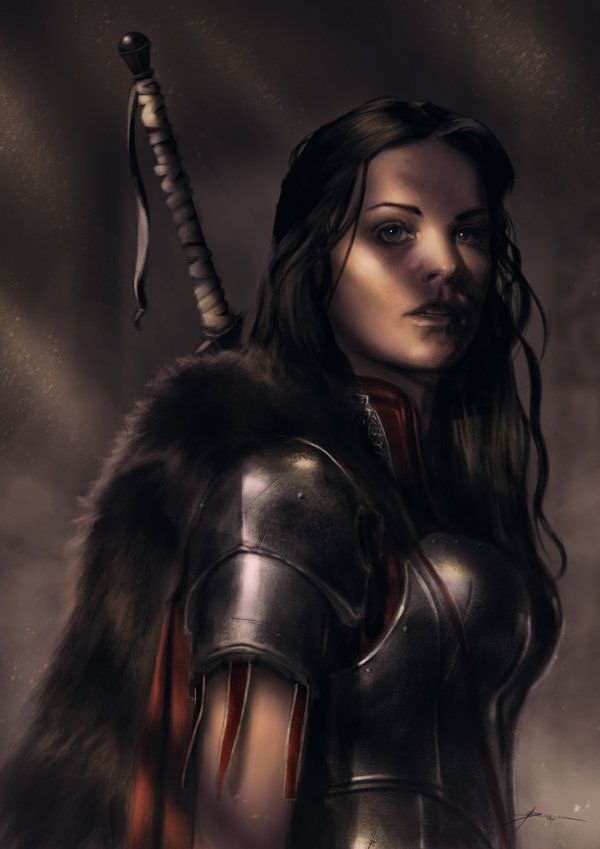
Class Name
| Level | Proficiency Bonus | Hit Points | Features |
|---|---|---|---|
| 1st | +2 | 6 | 3 lesser slots |
| 2nd | +2 | 10 | 4 lesser slots, 1 greater slot |
| 3rd | +3 | 14 | 5 lesser slots, 2 greater slots |
Lesser Spells
Greater Spells
Class Questions
-
It would be possible to make a character class that was proficient in every piece of armor, every weapon, every saving throw, and every skill. If you were making up classes, why not do that? Explain in a thoughtful paragraph.
Make custom character sheets.
Steps Four and Five: Money & Equipment
Money
All characters begin with 3d6 þrymsa (gold pieces) and 1d6 sceatta (silver pieces). Each þrymsa can also be converted to 10 sceatta, if you have insufficient silver for a small purchase.
Weapons
| Item | Cost | Description |
|---|---|---|
| Battleaxe | 10 þrymsas | This one-handed axe ranges from simply-constructed versions of cheap iron all the way to gilded weapons with silver pommels. A battleaxe does 1d8 slashing damage. |
| Dagger | 5 sceatta | This stabbing weapon is cheap and readily-available to most people. Almost everyone but the poorest person owns some sort of dagger or long knife. A dagger does 1d4 piercing damage. |
| Flatbow | 1 þrymsas, 5 sceatta | A bow, often used for hunting. Requires arrows to use. A flatbow does 1d6 piercing damage and can reach up to 60 feet. Can't use with a shield. |
| Fighting spear | 3 þrymsas | A seven-and-a-half foot spear made of high-quality metal and a stout ash shaft, the spear was by far the most common weapon among the Germanic peoples. A fighting spear does 1d6 piercing damage. |
| Glaive | 7 þrymsas | A short blade mounted on the end of a pole, this weapon is similar to a spear, but it's shorter length (six feet) makes it more suitable for individual combat than war. A glaive does 1d10 slashing damage. Can't use with a shield. |
| Greataxe | 25 þrymsas | Also known as a Daneax, this large axe had a longer shaft and double-bitted blade. Must be used with both hands. A greataxe does 1d10 slashing damage. Can't use with a shield. |
| Seax | 3 þrymsas | A large chopping knife with an angle on one side, these blades are somewhere between a dagger and a sword. A seax does 1d6 slashing damage |
| Sling | 2 sceatta | This long-range weapon was easy to make. It is used to hurl small rocks at an enemy from afar. Ammunition is everywhere and free for the taking. A sling does 1d4 bludgeoning damage and can reach up to 60 feet. Can't use with a shield. |
| Staff | Free | A stout branch cut from a tree and smoothed for use. A staff does 1d4 bludgeoning damage. Can't use with a shield. |
| Sword | 20 þrymsas | The apex of Germanic weaponry, swords are expensive and difficult to make. They are made from iron and edged in steel, and often the hilt and pommel are decorated. A sword does 1d8 slashing damage. |
| Throwing spear | 1 þrymsa | Inexpensive, plain iron heads fitted to simple wooden shafts. A throwing spear does 1d6 piercing damage and can be thrown up to 40 feet. |
Armor
| Item | Cost | Description |
|---|---|---|
| Byrnie | 50 þrymsas | A tunic of chain mail made in a special Germanic style, the byrnie was the best armor available. Only kings and the nobility could afford it. A byrnie sets your Armor Class at 13, plus your Dexterity modifier. |
| Leather armor | 20 þrymsas | Plates of hardened leather, mounted to cloth and riveted together, could be quite resistant to damage. Leather armor sets your Armor Class at 12, plus your Dexterity modifier. |
| Padded armor | 3 þrymsas | Padded armor of quilted wool provided some protection, but not much. Padded armor sets your Armor Class at 11, plus your Dexterity modifier. |
| Shield | 1 þrymsa | This round shield is made of wood, with an iron handle and boss (knob) in the center. A shield adds +2 to your Armor Class |
| Tunic/Clothes | 2 sceatta | Most warriors would have been dressed in nothing more protective than a thick tunic. A tunic or other clothing sets your Armor Class at 10, plus your Dexterity modifier. |
Miscellaneous
| Item | Cost | Description |
|---|---|---|
| Arrow | 1 sceat | A simple arrow, fletched with goose feathers and pointed with sharp iron. |
| Blanket | 2 sceatta | A warm blanket of woolen cloth. |
| Bucket | 1 sceat | A wooden bucket, workable but nothing special. |
| Candle | 1 þrymsa | A beeswax candle. Provides 8 hours of light. |
| Cart | 2 þrymsas | A large wooden cart that can carry goods. Must be pulled by people or animals. |
| Climbing spikes | 5 þrymsas | Metal spikes that can be used to assist a climber. |
| Cloth | 4 sceatta | A bolt of servicable hempen cloth. |
| Clothing (Slave) | 2 sceatta | Poor but usable clothing of thin cloth and cords. |
| Clothing (Normal) | 8 sceatta | Simple but sturdy clothing of warm cloth and leather. |
| Clothing (Noble) | 1 þrymsa | Elegant and rich clothing of fine fur and bright colors. |
| Cow | 4 þrymsas | A grown domesticated cow. Can be milked or slaughtered for its flesh. |
| Dice set | 8 sceatta | A set of carved bone dice for games. |
| Dog | 1 þrymsa | A grown domesticated dog. Can provide companionship and help hunters. |
| Drum | 2 þrymsas | A small handheld drum that produces a fine beat. |
| Fishing tackle | 9 sceattas | Everything needed to fish: line, hooks, and a small net. |
| Flour | 1 sceat | A pound of flour. |
| Flute | 8 sceatta | A carved wooden flute, sweet-sounding and delicate. |
| Goat | 1 þrymsa | A grown domesticated goat. Can be milked or slaughtered for its flesh. |
| Hammer | 2 sceatta | It's a hammer. |
| Horse | 5 þrymsas | A grown domesticated horse. Can be ridden or pull a cart. |
| Knarr | 50 þrymsas | A large sailing ship, suitable for trade goods. Crew of five required. |
| Leather bag | 2 sceatta | A sturdy leather bag. |
| Longship | 40 þrymsas | One of the great raiding ships of the Germanic peoples. Crew of five required. |
| Lyre | 4 þrymsas | A handheld harp. |
| Oil | 3 sceatta | A flask of flammable oil, to be burned for light or used as a weapon. |
| Ox | 5 þrymsas | A grown domesticated ox. Can pull a plow or a cart. |
| Perfume | 5 þrymsas | Sweet-smelling oil, made from thing such as cloves or lavender. |
| Pick | 3 sceatta | A sharp-pointed tool with a wooden handle, for breaking up rocky soil. |
| Pig | 1 þrymsa | A grown domesticated pig. Can be slaughtered for its flesh. |
| Pot | 2 sceatta | An iron pot, suitable for cooking. |
| Quiver | 1 þrymsa | A leather case for arrows, complete with straps. |
| Rope | 3 sceatta | Fifty feet of hempen rope. |
| Salt | 5 sceatta | A cup of relatively pure salt, extracted from the sea by dehydration. |
| Shovel | 3 sceatta | You know what a shovel is. |
| Soap | 5 sceatta | A strong-smelling lump of lye soap. |
| Torch | 1 sceat | A stick prepared with tar-soaked rags. Provides one hour of light. |
| Waterskin | 2 sceatta | A waterproof bag that can carry water or any other liquid. |
| Whetstone | 5 sceatta | A shaped stone that can be used to put a sharper edge on a metal blade. |
| Writing materials | 3 þrymsas | Everything needed to write: ink, quill, scraper, pumice stone, and a stack of parchment. |
Equipment Questions
Steps Six and Seven: Characterization
Up until this point, your character has just been a bunch of numbers. Here is where you make them come alive, by assigning them all the big and little details that turn them into a real person. This process of characterization, or character development, has four different parts:
- Describe your character's physical appearance: what do they look like?
- Describe your character's personality: how do they speak, what do they act like, and what do they want?
- Describe how your character interacts with others: how do others see them?
- Directly labeling your character: who are they?
Physical Appearance
Look at your character's Strength, Constitution, Dexterity, and Charisma ability scores. A character with a high Strength is probably muscled or toned, while a character with a low Strength might be delicate or slender. A character with a high Charisma might be dashing or pretty, while a character with a low Charisma might be scarred or smelly. There are all sorts of explanations for each ability score, and you get to decide which one applies. Your character might have a low Constitution, but you're the one who decides what that means!
Personality
Interacting with Others
Direct Description
Adventure
Dramatic Tension and Catharsis
Performance
In this campaign, the party takes the place of Beowulf and his thanes. They have sailed from across the sea to help Hrothgar save Heorot from Grendel and his mother, and they must deal with all of the challenges that Beowulf overcomes: sea monsters and sailing, the treacherous Unferth, the attack by Grendel, and the assault on the lair of Grendel's mother. One character will then become the king of the Geats, and then they whole party will time-skip to the future, where they will deal with the dragon. They should come to know the world of the poem and its plot quite well, especially since it will give them hints about how they should proceed (since they can just read how Beowulf did it!)
Keeping the party on the rails will probably not be too challenging, but operate according to this basic principle: everything outside of the bounds of the central story is available, but kind of boring. They can go to some other village on their ship, if they want, but that village will be small and poor and uneventful. You can't make the party play the main storyline, but you can make sure that it's the most fun thing to do!
Reflections
Appendix A: Behavior
Some kids think they'll like this, but don't. Or maybe they don't get along with someone else. Or maybe they didn't really think before they took the class. But whatever the reason, they're messing with the game on purpose, because they think it's funny.
In an ordinary game of D&D, you'd take the student aside and talk to them about how they're making it hard for other people to have a good time, and ask them what would make the game more interesting. That should be the first approach here, too. And while it's unlikely that the child will be able to articulate exactly what would make the game more fun for them, it's possible that the weight of stern authority might convince them that they need to behave.
If the child doesn't behave, then kick them out of the game for a day. Their character falls ill or goes off on a minor task, and they have to sit and watch for that session. Give them some task to do while they're watching, such as a simple writing exercise... but don't make it too much, and don't make them break away from watching the game to go do it. Let the other kids model how to behave for the student who's having difficulty, so the next day they can jump right back in.
It is possible (even likely) that at least one student will get their character killed, either through making deliberately poor decisions or simple bad luck. This is a wonderful chance for an educator, since the child gets to learn about (a) the consequences of actions, and (b) that they have another chance to give their best effort. The next session, let the student spend the session creating a new character. In fact, let them spend two sessions doing that, if that is what interests them.
Appendix B: Glossary
- berserkergang Icelandic - To go berserk.
- hamask Icelandic - Change form.
- hamrammr Icelandic - Shapestrong.
- lareow Anglo-Saxon - Doctor.
- níðing Old Norse - Dishonored one.
- sceat Anglo-Saxon - A small silver coin.
- seiðmann Old Norse - Witch-man
- skald Old Norse - Singer.
- stríðsherra Icelandic - Warlord.
- thane Anglo-Saxon - Sworn warrior.
- vǫlva Old Norse - Shaman
- þrymsa Anglo-Saxon - A small gold coin.