Prelude
Waterdeep, also known as the City of Splendors or the Crown of the North, is the most important and influential city in the North and perhaps in all Faerûn. For this reason it is considered part of the Western Heartlands of the Realms, even though it lay 150 miles north of Daggerford on the shores of the Sword Coast. The road to Waterdeep is well paved and well patrolled. The city is the hub of trading from the mineral-rich lands to the north, the merchant kingdoms of Amn and Calimshan to the south, the kingdoms of the Inner Sea to the east, and the sea kingdoms and traders to the west. Waterdeep's authority extends between thirty to forty miles from its walls. The surrounding region has a population density of over 200 people per square mile.
This city is where you find yourselves, for whatever purpose you determine. Its wonders are countless, its taverns abundant, and its people from all over. While the majority of the population is human, dwarves and elves have a strong presence, as do other races.
Who are you?
Character Creation
- Choose a background. All available backgrounds are gathered here (See Backgrounds tab). If you wish to change a skill for another that makes sense feel free.
- Instead of normal personality traits, we will be using this.
- In short terms, create one person that you care for, and one that is your 'rival'. For example: Jane, my older sister, who raised me after our parents died, and Austin, my brother, who stole the love of my life away from me. Or Captain Cahuna, who promoted me to sergeant, and Duke Wellington, who knows I know his dirty, little secret, and wants me dead. Note that if this character is in the city, they are much more likely to come up.
- Make sure your character has a reason to come and stay in the city, as this adventure focuses solely on Waterdeep. While that may sound restrictive, there is a lot to do in Waterdeep, known as the City of Splendors or the Crown of the North.
- Use the stats tab in the link above to determine your starting statistics.
- Choose a race and class (You can choose race and class before making your stats if you want, refer to the appropriate tabs).
- Equip yourself! You either get what's listed in the class and background, or the maximum result possible with rolling, determined by your class.
- Send your character to me so we can work some stuff out. Unless your backgrounds are shared, don't show it to another player out-of-character, this invites inter-party discussions.
- Read the rest of this document!
And that's it. You should now be ready. Are you really, though?




Setting
This is set in the Forgotten Realms, after the Spellplague and the Death Curse. You don't need to know what that means, but if you want to pick a home town you can choose one yourself, or you can search your race on the Forgotten Realms Wiki, the quick info on the right will tell you their homelands.
The starting city will be Waterdeep of course. Please don't read too deep into the wiki page for it, as that may spoil things and/or tell you things your character wouldn't know.
Gods
As this is set in the Forgotten Realms, I ask that you please limit yourself to the gods in the Sword Coast Adventurer's Guide. If you want a quick link to that list, here is an image of the list, and you can find more information on each in their respective pages on the Forgotten Realms wiki.
Calendar
The Faerûnian calendar has twelve months that roughly correspond to the months of the Gregorian calendar (real life's calendar). Each month has thirty days divided into three ten-day weeks (each week is called a tenday). Scattered throughout the year are five holidays that aren't considered part of any month. Once every four years, the holiday of Shieldmeet is added to the calendar as a leap day immediately following Midsummer night. Collectively, these days create a cycle similar to what we have on Earth: three 365-day years followed by a leap year.
The days making up a tenday don't have formal names. If precision is required, the number of the day and the number of the tenday were used, as in, "the fourth day of the first tenday of Flamerule". Days of the month were typically written as the numerical date followed by the month name, for example, "15 Hammer" or "15th Hammer". Informally or poetically this could be spoken or written as "the 15th of Deepwinter".
| Gregorian | Harptos | Informal Name |
|---|---|---|
| January | Hammer | Deepwinter |
| February | Alturiak | The Claws of the Cold |
| March | Ches | The Claw of Sunsets |
| April | Tarsakh | The Claw of Storms |
| May | Mirtul | The Melting |
| June | Kythorn | The Time of Flowers |
| July | Flamerule | Summertide |
| August | Eleasis | Highsun |
| September | Eleint | The Fading |
| October | Marpenoth | Leafall |
| November | Uktar | The Rotting |
| December | Nightal | The Drawing Down |
Law & Order
Waterdeep is no village led by hidebound hierarchs or petty fiefdom ruled by the whim of a warlord. It is a city of laws molded by Tyr's spirit of justice. As a rule, you can trust members of the City Watch to do their duty diligently, and you can expect that the city's magisters will be fair. If you have cause to come before the Masked Lords or the Open Lord herself, rest assured that if your cause be just, justice will be done. If, however, you find yourself in the wrong, know that though it might take time to weigh that wrong on Tyr's scales, his hammer will fall-and it will be wielded by Waterdeep with a vengeance.
Unlike in less civilized settlements, punishment for crimes in Waterdeep isn't typically used as public entertainment. Scheduled executions occur behind the high walls of Castle Waterdeep, and floggings are carried out in the watch post nearest the sentencing. The Watch makes every effort to take individuals into custody quietly, so as not to disrupt other citizens. Those bystanders generally return the favor by giving altercations between criminals and the Watch a wide berth.
Guilds
No aspect of life in Waterdeep goes untouched by at least one of its more than forty guilds. Virtually every profession has an associated guild, and there's hardly a citizen of the city who doesn't belong to one or more guilds, or doesn't work for someone who does. As a visitor to Waterdeep, you need to know this, lest you run afoul of "Guild Law." Guild Law isn't technically in the legal code of Waterdeep, but guilds are mentioned in the oldest surviving legal documents-penned by Ahghairon himself - and the rules of Guild Law are respected by wise city folk.
Nobility
The nobility of Waterdeep take their family lineage very seriously. As such, certain courtesies are expected towards them. If your character were to know these courtesies due to their history, please ask the DM and they will inform you of the specifics that you would know.
Player Characters as Locals
You can be a local of the city, if you so choose. Some of the information here you'd know just as much as anyone else, but inform the DM of your chosen background and they will grant you information befitting your station.




Coinage
As should be expected of any city of standing, Waterdeep mints its own coins. All taxes, fines, and guild fees must be paid either in Waterdavian coin or the currency of any member settlement of the Lords' Alliance. Though no law requires you to pay for goods or services in Waterdavian coin, the drudgery of weighing foreign currency and checking its purity prompts many retailers and operators of swift-exchange businesses-including drays and hire-coaches-not to accept anything but coins minted in Waterdeep.
Though you can trade your coinage for Waterdeep currency with anyone willing to do so, the exchequers at the Palace of Waterdeep make exchanges with no associated fee.
Nib: Copper coin about the size of a thumbnail (1 nib = 1 common copper coin)
Shard: Silver coin, slightly smaller than the nib (1 shard = 10 nibs)
Toal: Brass coin, about two inches square with a hole large enough for a nib to fit in (1 taol = 200 nibs)
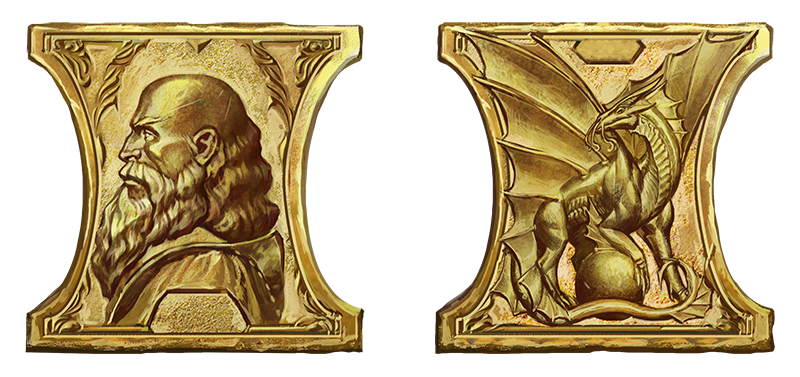
Dragon: Gold coin, half again as large as a nib (1 dragon = 100 nibs)
Sun: Platinum coin, twice as large as a nib (1 sun = 1,000 nibs)
Harbor Moon: platinum crescent inset with electrum, about three inches long with a hole large enough for a nib to fit in (1 harbor moon = 5,000 nibs)
Day to Day Life in the City
A Normal Day in Town
On days that aren't pressed for time, the days will be split up mainly into five periods:
- Morning (8am to noon)
- Afternoon (noon to 4pm)
- Late Afternoon (4pm to 8pm)
- Evening (8pm to midnight)
- Night (midnight to 8am)
This is for ease of tracking. During a period other than Night (unless you plan on not sleeping), you can each choose a few things that would take the better part of a period.
You can set aside two of the periods to do some work in the current tenday you are in (see Downtime section). Each normal day, you'd have to set aside two periods.
Random encounters will be rolled once per period that you are out and about, and due to a period being 4 hours, a vast majority of encounters won't affect your current errand.
Downtime
Downtime will be using tendays. Workweeks will have 3 day weekends, therefore 7 days on & 3 days off. We will be using the Downtime Revisited (XGE) rules with the following changes:
- Magic item prices will be using Sane Magical Prices, along with some changes based on persuasion.
- Buying a Magic Item will use an Investigation check to find items, and a Persuasion check for the prices.
- Selling a Magical Item will have a few more tiers to it.
- Work will use the following modified table:
| Check Total | Wages |
|---|---|
| 9 or lower | 3sp / day |
| 10 – 14 | 1gp / day |
| 15 – 20 | 3gp / day |
| 21 or more | 7gp / day |
Resting
If sleeping in an area exposed to the elements, such as the city streets, characters don't regain hit points at the end of a long rest. Instead, a character can spend Hit Dice to heal at the end of a long rest, just as with a short rest.
In addition, not that it is illegal, but sleeping in the streets may cause the Watch to entertain themselves with you. Other less-than-savory characters may also take interest in you, but for different purposes, hopefully just for your purse.
Tracking Resources
We will be using the Living Expenses detailed in the Player's Handbook, on page 157 (page 147 of the PDF). The Drink Budget column in the table below refers to how much a drink can cost before it costs something.
For example ordering a 1 gold drink at a Wealthy level will cause you to pay for that 1 gold drink, whereas ordering it at an Aristocrat level will not.
| Lifestyle | Food Quality | Drink Budget |
|---|---|---|
| Poor | Low quality | 5 copper |
| Modest | Medium quality | 2 silver |
| Comfortable | High quality | 6 silver |
| Wealthy | Very high quality | 15 silver |
| Aristocrat | Gourmet quality | 5 gold |
Ammunition
If you buy 100 at the start, you are not required to track mundane ammunition. By the time you get through the 100, including the fact that only half of arrows/bolts break upon firing, you'll have enough gold that it won't matter.
Weight
We will be using a somewhat different Encumbrance rule for this campaign. Most of the adventure is set in the city, but if that were not the case at some point, this rule will incentivize buying horses and maybe a form of carriage or cart. Use this one if you have Powerful Build.
Being a city adventure, there are easy ways to get around that:
- For storage purposes, you can have a long-term room rented in order to store things you don't need on your person.
- For travel purposes, you can hail a Hire-Coach.
- For general purposes, you can ask the brawnier one(s) to carry your things temporarily.