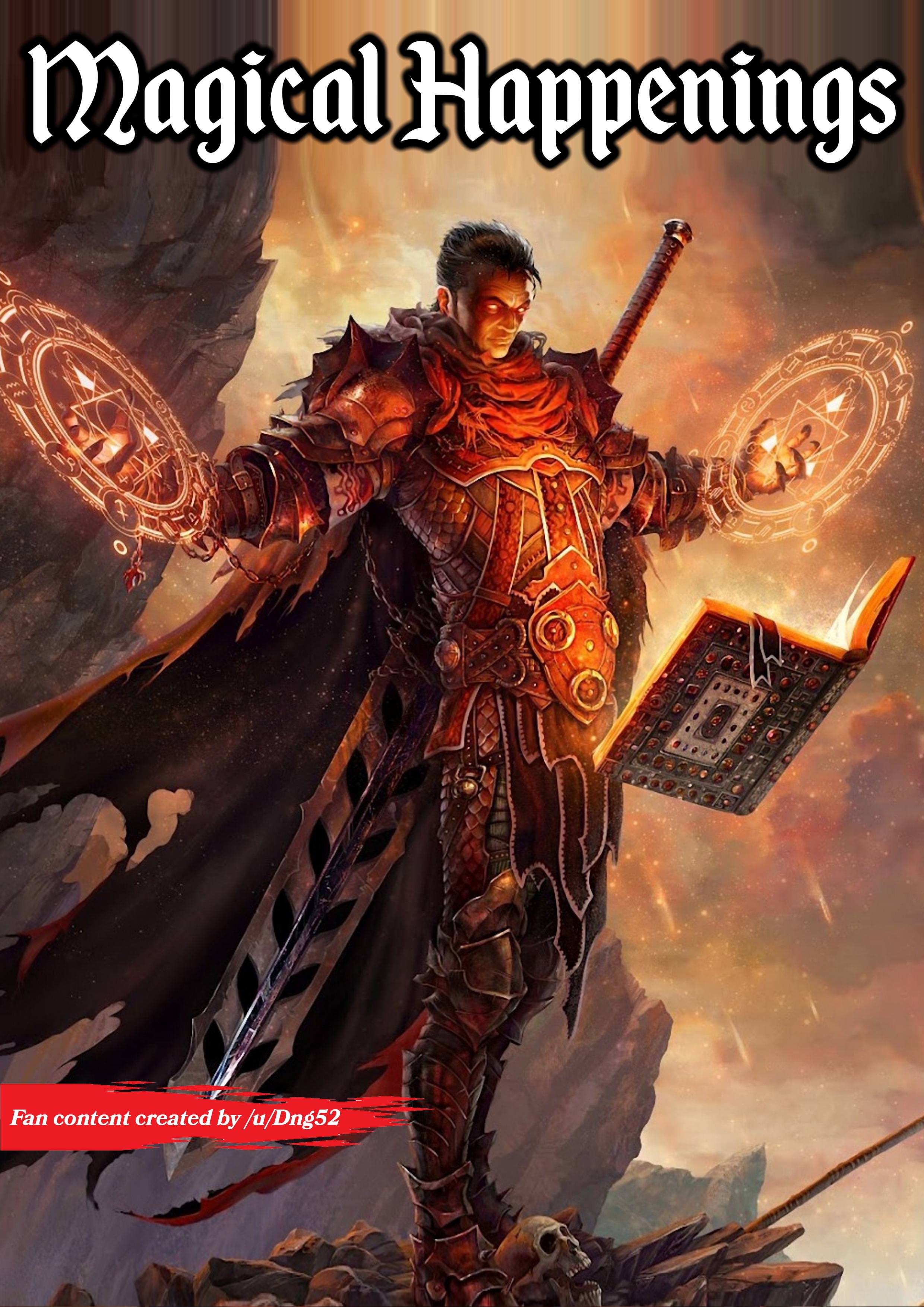
Reality Bender
Across space and time, there resides pure arcane energy that is interwoven with the very fabric of reality. This is the source of magic for many sorcerers, but few can manipulate its raw power to produce astounding results. Having this ability can mean many things. Perhaps you were touched by magic itself as it transformed you into what you are today. Maybe you are made from magic, molded by a higher being and imbued with life.
Reality benders harbor an innate ability to shape raw magic into anything conceivable. The only limit is the imagination and skill of the sorcerer. Spells created by master wizards become play things for reality benders to manipulate to their liking. At your option, you can pick from or roll on the Reality Bender Quirks table to create a quirk for your character.
Reality Bender Quirks
| d6 | Quirk |
|---|---|
| 1 | You sometimes twitch and a faint magical zap can be heard whenever you do. |
| 2 | You radiate a slightly metallic glow and smell |
| 3 | Your eyes change color from time to time, often after using large amounts of magic. |
| 4 | Sometimes you speak with two voices instead of one. |
| 5 | When your blood makes contact with something, there are small wisps of blue light that fade quickly. |
| 6 | You have bouts of confusion where you may speak in the 3rd person as if your body is just a vessel. |
Reality Bender Features
| Sorcerer Level | Feature |
|---|---|
| 1st | Metamastery, Favored Distortion |
| 6th | Warp Spell |
| 14th | Elemental Contortion |
| 18th | Born of Energy |
Metamastery
At 1st level, you control spells more freely than others. You gain two Metamagic options of your choice. You gain another one at 3rd, 10th, and 17th level on top of the options you gain normally.
Favored Distortion
You have a kind of magic that you prefer when shaping spells. Choose an option from the Favored Distortion table and gain the effect listed. You also learn an additional spell based on your choice, as shown below. This spell may be cast using a spell slot or once per long rest at its lowest level. It doesn’t count against your number of sorcerer spells known and cannot be replaced at higher levels.
Favored Distortion
| Type | Effect | Spell |
|---|---|---|
| Acid | You gain resistance to acid damage. | chaos bolt |
| Cold | You gain resistance to cold damage. | ice knife |
| Fire | You gain resistance to fire damage. | burning hands |
| Force | You gain resistance to force damage. Spells you cast that deal force damage deal an extra 1d4 force damage per spell level (minimum of 1) | magic missile |
| Lightning | You gain resistance to lightning damage. | witch bolt |
| Necrotic | You gain resistance to necrotic damage. | false life |
| Poison | You gain resistance to poison damage. | ray of sickness |
| Psychic | You gain resistance to psychic damage. | charm person |
| Radiant | You gain resistance to radiant damage. | Any 1st level cleric spell |
| Thunder | You gain resistance to thunder damage. | thunderwave |
| None | Choose one known 1st level sorcerer spell and replace it with a 1st level spell from any spell list. | chromatic orb |
Warp Spell
Beginning at 6th level, when you cast a spell with an instantaneous duration that affects other creatures that you can see, you can choose a number of them equal to 1 + the spell's level. The chosen creatures have advantage on saving throws to avoid the effects of the spell and they take no damage if they would normally take half damage on a successful save and only take half damage if they would normally take full damage on a failed save.
Elemental Contortion
Beginning at 14th level, you can reshape opposing magic to have different effects. As a reaction, you may target a damaging spell an opponent has cast and change its damage type to any of the following: acid, cold, fire, force, lightning, necrotic, poison, psychic, radiant, thunder. Alternatively, if the spell requires a saving throw, you may change the type of saving throw required. You may use this ability a number of times equal to your Charisma modifier before needing a long rest to recharge.
Born of Energy
At 18th level, you gain 5 special sorcery points called meta points. Meta points may only be used on Metamagic and you regain all 5 meta points after a short or long rest. A spell that was manipulated using meta points deals an extra 1d8 damage per meta point expended. The damage type is determined by the spell used.
Additionally, you may choose two forms of Metamagic. These chosen options cost 1 less sorcery point to use.
Expanded Metamagic List
All sorcerers gain the ability to use Metamagic at 3rd level. Below are more Metamagic options to add in addition to the options provided in the rules.
Bolstering Spell
When an ally casts a spell, as a reaction, you may spend 2 sorcery points to twist Metamagic into the spell. Choose one of your Metamagic options and spend the sorcery points required from that option along with the 2 sorcery points for Bolstering Spell to augment your ally's spell.
Burned Spell
When you cast a spell requires an attack roll, you can spend 2 sorcery points to instantly roll a 20. Once this is done, you cannot use that same spell for 24 hours.
Chilling Spell
When you cast a spell that deals cold damage, you can spend 1 sorcery point to make half the damage deal necrotic damage. Additionally, any spell that you cast that normally deals necrotic damage, you can spend 1 sorcery point to make half the damage deal cold damage. If the total damage is an odd number, the larger half is the damage type of the original spell.
Disarming Spell
When you cast a spell, you can spend 2 sorcery points to try to disarm the target. Make a separate spell attack roll contested by the target's Strength (Athletics) check or Dexterity (Acrobatics) check.
Displaced Spell
When you cast a spell, you can spend 1 sorcery point to make it look like the spell came from a different direction.
Enervating Spell
When you roll damage for a spell, you can spend 1 sorcery point to reduce the targeted creature's movement speed in half until the end of that creature's turn.
Flexible Spell
When you cast a spell that deals damage of a certain type, you can spend 1 sorcery point to change the spell's damage type to any of the following: acid, cold, fire, lightning, poison, thunder.
You can use Flexible Spell even if you have already used a different Metamagic option during the casting of the spell.
Forceful Spell
When you cast a spell that deals thunder or force damage, you may spend 1 sorcery points to cause targetted creatures to make a Strength saving throw vs your spell save DC. Upon failure, the creatures are pushed back 15 feet.
Fortified Spell
When you cast a spell that targets one or more creatures, you can spend 1 sorcery point to choose one creature affected by the spell. That creature gains either +10 ft of movment, a 15 ft fly speed, a 40 ft climb speed, or a 30 ft swim speed for 1 minute. These effects do not stack.
Imitation Spell
When you cast a damaging spell, you may spend a number of sorcery points equal to the spell slot used to replicate the spell. You can cast the same spell again next round without expending a spell slot, but the replicated spell deals half damage. You may choose new targets for the replicated spell.
Intangible Spell
When you cast a spell, you can spell 2 sorcery points to target creatures behind half, three-quarters, and total cover as if the cover was not there. You must know of the location of your targets.
Luminous Spell
When you cast a spell that deals fire damage, you can spend 1 sorcery point to make half the damage deal radiant damage. Additionally, any spell that you cast that normally deals radiant damage, you can spend 1 sorcery point to make half the damage deal fire damage. If the total damage is an odd number, the larger half is the damage type of the original spell.
Methodical Spell
When you cast a spell of 5th level and below, you can spend 2 sorcery points plus sorcery points equal to the cost to create a spell slot of the spell's level. When you do so, you do not need to expend a spell slot on this spell.
Precise Spell
When you cast a spell that forces creatures in an area to make a saving throw you can spend 1 sorcery point to instead make a ranged spell attack against a single target that would be in the range. Upon a successful hit, the target suffers the effects as though they failed their save.
Psionic Spell
When you roll damage for a spell, you can spend 1 sorcery point to add 1d6 + double your Intelligence modifier in psychic damage.
Reckless Spell
When you cast a spell, you can spend 1 sorcery point to cast recklessly. Doing so gives you advantage on this spell, however attack rolls against you have advantage until your next turn.
Refreshing Spell
When you cast a spell with a single target, you can spend 2 sorcery points to heal yourself or the target by 1d8 + Charisma modifier.
Rejuvenating Spell
When you cast a spell, you can spend 1 sorcery point to gain 30 ft of movement until the start of your next turn.
Roaring Spell
When you cast a spell with a verbal component, you can spend 2 sorcery points to shout the incantation in a frighteningly powerful voice. All creatures affected by the spell must make a Constitution saving throw vs your spell save DC or become frightened of you for 1 minute.
Sculpted Spell
When you cast a spell that affects an area, you can spend 2 sorcery points to change the area's shape in one of the following ways:
- A spell with the range of a line can be changed to a cone of half the range.
- A spell with the range of a cone can be changed to a 5 foot line with double the range.
- A spell with the range of a sphere can be changed to a cylinder of half radius and double height.
- A spell with a range of a cylnder can be changed to a sphere of the same radius.
Smiting Spell
When you cast a spell on an undead creature or creatures, you can spend 2 sorcery points to turn undead. Each undead must make a Wisdom saving throw vs your spell save DC. If the creature fails its saving throw, it is turned for 1 minute or until it takes damage.
A turned creature must spend its turns trying to move as far away from you as it can, and it can’t willingly move to a space within 30 feet of you. It also can’t take reactions. For its action, it can use only the dash action or try to escape from an effect that prevents it from moving. If there’s nowhere to move, the creature can use the dodge action.
Stolen Spell
Choose a 5th level or lower spell you have seen in the past 24 hours. You must cast that spell using the proper spell slot and sorcery points equal to half the spell level (rounded up).
Thoughtful Spell
When you cast a spell that requires concentration, you may spend 4 sorcery points to automatically succeed on checks to maintain concentration for the duration of that spell.
Turtle Spell
When you cast a spell that recovers hit points or raises armor class, you can spend 1 sorcery point to gain +1 to AC for 1 minute and 1d6 temporary hit points.
You can use Turtle Spell even if you have already used a different Metamagic option during the casting of the spell.
Unforgiving Spell
When you cast a spell that deals damage, you can spend 2 sorcery points to cause creatures that are resistant to the spell's damage type or types to lose that resistance when taking damage from your spell. Creatures that are normally immune to a damage type take half damage instead.
Unique Spell
When you cast a spell, you can spend 1 sorcery point to obscure how the spell looks. The kind of obscurity cannot change the mechanics of the spell. Creatures attempting to identify your spell have disadvantage on Intelligence (Arcana) checks to do so. For an additional sorcery point, you may impose disadvantage on creatures trying to remove the spell through counterspell or dispel magic.
Vampiric Spell
When you roll damage for a spell, you can spend 5 sorcery points to regain health equal to half of what you will inflict.
Vengeful Spell
When you cast a spell that requires an attack roll on a creature that targeted you on its most recent turn, you can expend 1 sorcery point to gain 1d4 + 1 on the roll.
You can use Vengeful Spell even if you have already used a different Metamagic option during the casting of the spell.
Violent Spell
When you cast a spell that requires an attack roll, you can spend 1 sorcery point to allow the spell to score a critical hit on a roll of 19 or 20.
Wild Spell
When you cast a spell, you can spend 2 sorcery points to roll on the Wild Magic table.
Art Credit
Cover Page Art: Wizard Art - Art Abyss