Revised Goliath
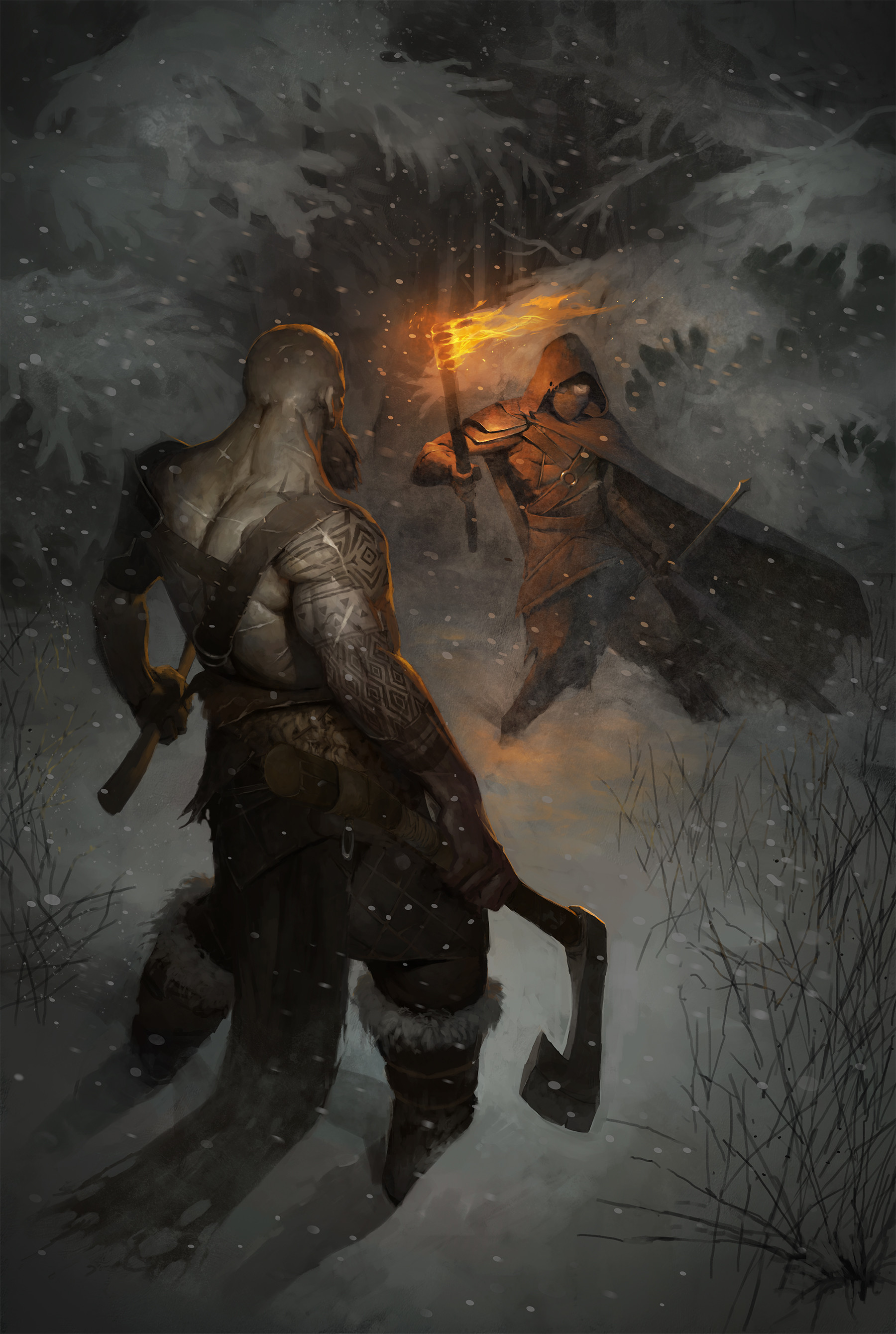
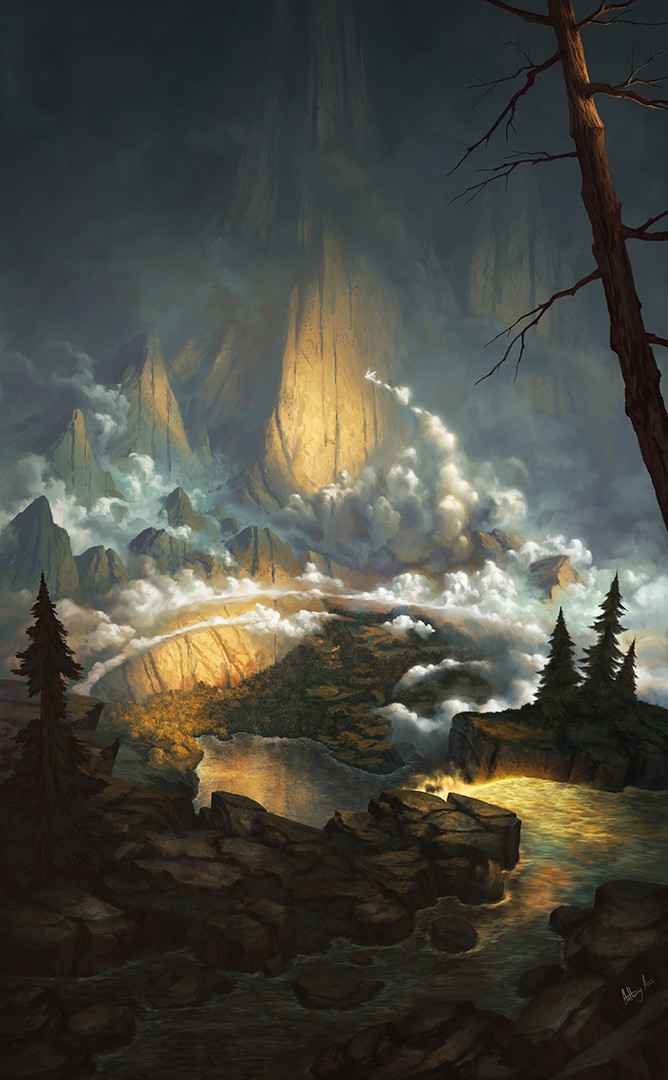
At the highest mountain peaks—far above the slopes where trees grow and where the air is thin and the frigid winds howl—dwell the reclusive goliaths. Few folk can claim to have seen a goliath, and fewer still can claim friendship with them. Goliaths wander a bleak realm of rock, wind, and cold. Their bodies look as if they are carved from mountain stone and give them great physical power. Their spirits take after the wandering wind, making them nomads who wander from peak to peak. Their hearts are infused with the cold regard of their frigid realm, leaving each goliath with the responsibility to earn a place in the tribe or die trying.
Driven Competitors
Every day brings a new challenge to a goliath. Food, water, and shelter are rare in the uppermost mountain reaches.
A single mistake can bring doom to an entire tribe,
while an individual’s heroic effort can ensure the
entire group's survival.
Goliaths thus place a premium on self-sufficiency
and individual skill. They have a compulsion to keep
score, counting their deeds and tallying
their accomplishments to compare to
others. Goliaths love to win, but they see
defeat as a prod to improve their skills.
This dedication to competition has a dark
side. Goliaths are ferocious competitors,
but above all else they are driven to outdo
their past efforts. If a goliath slays a dragon,
he or she might seek out a larger, more
powerful wyrm to battle. Few goliath adventurers
reach old age, as most die attempting to surpass
their past accomplishments.
Fair Play
For goliaths, competition exists only when it is supported
by a level playing field. Competition measures talent, dedication, and effort. Those factors determine
survival in their home territory, not reliance on
magic items, money, or other elements that can
tip the balance one way or the other. Goliaths
happily rely on such benefits, but they are careful to
remember that such an advantage can always be
lost. A goliath who relies too much on them can
grow complacent, a recipe for disaster in the
mountains.
This trait manifests most strongly when
goliaths interact with other folk. The relationship
between peasants and nobles puzzles goliaths. If a
king lacks the intelligence or leadership to lead,
then clearly the most talented person in the
kingdom should take his place. Goliaths rarely
keep such opinions to themselves, and mock folk
who rely on society’s structures or rules to
maintain power.
Survival of the Fittest
Among goliaths, any adult who can't contribute to the tribe is expelled. A lone goliath has little chance of survival, especially an older or weaker one. Goliaths have little pity for adults who can’t take care of themselves, though a sick or injured individual is treated, as a result of the goliath concept of fair play.
A permanently injured goliath is still expected to pull his or her weight in the tribe. Typically, such a goliath dies attempting to keep up, or the goliath slips away in the night to seek the cold will of fate.



In some ways, the goliath drive to outdo themselves feeds into the grim inevitability of their decline and death. A goliath would much rather die in battle, at the peak of strength and skill, than endure the slow decay of old age. Few folk have ever meet an elderly goliath, and even those goliaths who have left their people grapple with the urge to give up their lives as their physical skills decay.
Because of their risk-taking, goliath tribes suffer from a chronic lack of the experience offered by long-term leaders. They hope for innate wisdom in their leadership, for they can rarely count on a wisdom grown with age.
Goliath Names
Every goliath has three names: a birth name assigned by the newborn’s mother and father, a nickname assigned by the tribal chief, and a family or clan name. A birth name is up to three syllables long. Clan names are five syllables or more and end in a vowel.
Birth names are rarely linked to gender. Goliaths see females and males as equal in all things, and they find societies with roles divided by gender to be puzzling or worthy of mockery. To a goliath, the person who is best at a job should be the one tasked with doing it.
A goliath’s nickname is a description that can change on the whim of a chieftain or tribal elder. It refers to a notable deed, either a success or failure, committed by the goliath. Goliaths assign and use nicknames with their friends of other races, and change them to refer to an individual’s notable deeds.
Goliaths present all three names when identifying themselves, in the order of birth name, nickname, and clan name. In casual conversation, they use their nickname.
Birth Names: Aukan, Eglath, Gae-Al, Gauthak, Ilikan, Keothi, Kuori, Lo-Kag, Manneo, Maveith, Nalla, Orilo, Paavu, Pethani, Thalai, Thotham, Uthal, Vaunea, Vimak
Nicknames: Bearkiller, Dawncaller, Fearless, Flintfinder, Horncarver, Keeneye, Lonehunter, Longleaper, Rootsmasher, Skywatcher, Steadyhand, Threadtwister, Twice-Orphaned, Twistedlimb, Wordpainter
Clan Names: Anakalathai, Elanithino, Gathakanathi, Kalagiano, Katho-Olavi, Kolae-Gileana, Ogolakanu, Thuliaga, Thunukalathi, Vaimei-Laga
Goliath Traits
Goliaths share a number of traits in common with each other.
Ability Score Increase. Your Strength score increases by 2, your Constitution score increases by 1, and your Wisdom score is reduced by 2.
Age. Goliaths have lifespans comparable to humans. They enter adulthood in their late teens and usually live less than a century.
Alignment. Goliath society, with its clear roles and tasks, has a strong lawful bent. The goliath sense of fairness, balanced with an emphasis on self-sufficiency and personal accountability, pushes them toward neutrality.
Size. Goliaths are between 10 and 13 feet tall and weigh between 910 and 2,200 pounds. Your size is Large.
Speed. Your base walking speed is 35 feet.
Reach. Your natural reach is 10 feet.
Natural Athlete. You have proficiency in the Athletics skill.
Stone's Endurance. Your hit point maximum increases by 1, and it increases by 1 every time you gain a level.
Mountain Born. You're acclimated to high altitude, including elevations above 20,000 feet. You're also naturally adapted to cold climates, as described in chapter 5 of the Dungeon Master’s Guide.
Palpable Presence. You have disadvantage on ability checks to hide or do subtle movements.
Languages. You can speak, read, and write Giant.

ᛟ
This large-sized race is meant as an upgrade of the Goliath from the Elemental Evil supplement.
It is intended to be played alongside the medium- and small-sized races of the PHB.
The changes introduced here include upgrading size, speed, and reach by one step;
removing Powerful Build; upgrading Stone's Endurance; imposing an ability score
penalty; imposing disadvantage on checks involving stealth;
and keeping Natural
Athlete and Mountain Born unchanged.
Common has also been removed from the languages, though it can be reintroduced here.
This author felt it thematically fitting from the Goliath's race descriptions, as creatures
who rarely meet other races, to only be able to speak their own language.
Remembering the following information may help as you play this large-sized race:
* You consume four times the food and water as a medium-sized creature.
* You can grapple or shove Huge creatures and smaller.
* Small creatures can pass through your space, and you theirs, without penalty.
* Large weapons double the weapon dice of its medium counterparts.
* Your starting gear—including armor and weapons—is medium-sized.
* To buy large-sized gear, you must pay four times the normal amount.
* Medium-sized creatures can also wield large weapons, with disadvantage.
* You can squeeze through medium-sized spaces, spending 2 feet of movement
for every 1 foot moved, and incurring disadvantage on attack rolls and Dex saves,
while attacks against you have advantage.
ART BY:
Maxim Kostin |
Stanislav Dikolenko |
Anthony Avon