Binder


In the multiverse where magic and divinity are no extraordinary, not all deities are blessed with the faith of mortal sentience. When a deity is abandoned, forsaken, or simply forgotten by its followers, it slowly descends into a shadow of its former glory, or known as a vestige. While divinity has a vastly different concept of life and death from those of the mortal beings, those unfortunate enough to dwindle into vestigal status may suffer from the cessation of existence, or what is closest to the death for the gods. Simply put, with strange aeons, even gods may die.
Some mortals, often estranged from the more civilized part of the worlds, would actively seeks and contact such vestiges. By striking a contact with vestiges, these individuals, known as binders, can perform a cryptic rite to suggest their own body as a vessel for the vestiges, who would then bind themselves into the mortal body to manifest what is left of their divine power to interact with the world.
Creating a Binder
As you create a binder, you must answer some questions that makes you binder in the first place. What made you seek for vestigal bind and aid, instead of more formulated and popular religion system and deities? Was it truly acceptable for you to get scorned and shunned by many religions and their followers? Is being a binder your unique way to express respect and devotion toward divine power?
Alternately, what do you attempt to bind vestiges in your own body, rather than striking a contract that only grants you power with less risk? What is the relationship between you and the vestiges? Was it the vestiges that first sought you for their benefits in exchange of their latent power, or were you the first to propose such arrangement for a particular reason?
Quick Build
You can make a binder quickly by follwing these suggestions. First, Charisma should be your highest ability score, followed by Constitution. (Some binders who focus on martial combats make Strength or Dexterity higher than Constitution.) Second, choose the hermit background.
Class Features
As a binder, you gain the following class features.
Hit Points
- Hit Dice: 1d8 per binder level
- Hit Points at 1st Level: 8 + your Constitution modifier
- Hit Points at Higher Levels: 1d8 (or 5) + your Constitution modifier per binder level after 1st
Proficiencies
- Armor: Light armor
- Weapons: Simple weapons
- Tools: None
- Saving Throws: Constitution, Charisma
- Skills: Choose two from Arcana, History, Insight, Intimidation, Nature, and Religion
Table: The Binder
| Level | Proficiency Bonus |
Features | Vestiges Known |
Vestige Bound |
Mana |
|---|---|---|---|---|---|
| 1st | +2 | Vestigal Binding, Vestigal Favor | 2 | 1 | — |
| 2nd | +2 | Mana, Vestigal Favor feature | 2 | 1 | 2 |
| 3rd | +2 | Vestigal Augmentation | 2 | 1 | 3 |
| 4th | +2 | Ability Score Improvement | 2 | 1 | 4 |
| 5th | +3 | — | 3 | 2 | 5 |
| 6th | +3 | Vestigal Favor feature | 3 | 2 | 6 |
| 7th | +3 | Vestigal Clarity | 3 | 2 | 7 |
| 8th | +3 | Ability Score Improvement | 3 | 2 | 8 |
| 9th | +4 | — | 4 | 2 | 9 |
| 10th | +4 | Vestigal Favor feature | 4 | 2 | 10 |
| 11th | +4 | Vestigal Safeguard | 4 | 2 | 11 |
| 12th | +4 | Ability Score Improvement | 4 | 2 | 12 |
| 13th | +5 | — | 5 | 2 | 13 |
| 14th | +5 | Guardian of Souls | 5 | 2 | 14 |
| 15th | +5 | Spiritual Longevity | 5 | 2 | 15 |
| 16th | +5 | Ability Score Improvement | 5 | 2 | 16 |
| 17th | +5 | — | 6 | 3 | 17 |
| 18th | +5 | Vestigal Favor feature | 6 | 3 | 18 |
| 19th | +5 | Ability Score Improvement | 6 | 3 | 19 |
| 20th | +5 | Champion of the Vestiges | 6 | 3 | 20 |
Equipment
You start with the following equipment, in addition to the equipment granted by your background:
- (a) a dagger or (b) two simple weapons
- (a) a light crossbow and 20 bolts or (b) a simple weapon
- (a) a dungeoneer's pack or (b) a priest's pack
- Leather armor and a dagger
Vestigal Binding
As a practitioner of hermetic yet religious rite, you can call forth shadows of the deities, known as the vestiges.
Vestiges Known
At 1st level, you can call forth two vestiges from the list at the end of the class description. You can call additional vestiges as you gain level in this class, as shown in the Vestiges Known column of the Binder table.
Binding Vestiges
You can perform a 1-minute ritual to bind vestiges you know into your body, channeling its remnants of divine power. The ritual can be performed during a short rest or long rest. As long as a vestige is bound to you, you gain specific benefits determined by the vestige, as stated in the vestige's description.
At 1st level, you can bind only one vestige to yourself at a same time. You can bind multiple vestiges when you gain levels in this class, as stated on the Vestiges Bound column from the Binder table.
The vestige is bound to you for a number of hours equal to half your binder level, to a minimum of 30 minutes. After the duration, the vestige is dismissed from you. You can also dismiss your vestige early as a bonus action on your turn.
While the vestige is bound to you, you can perform the ritual again to dismiss any number of vestiges currently bound to you, and bind another vestiges to yourself.
Vestigal Portfolio
A vestige has a list of portfolios that define its principles of actions and behaviours. While the vestige is bound to you, you are required to adhere to its portfolio to the best of your ability. You can willingly act against the vestige's portfolio, but with consequences (see "Acting Against the Vestige" below).
Vestigal Manifestation
When a vestige is bound to you, the vestige manifests its notable traits to your body. Each vestige has a distinctive manifestations, as stated on its description. By observing the manifested traits to your appearance, one can deduce which vestige is bound to you.
Vestigal Gift
When you bind a vestige to yourself, it grants you its gift, which is manifested in a special weapon, armor, or tool that you can use for your benefits.
When you first bind a vestige to yourself, and again as a bonus action on your turn while the vestige is bound to you, you can summon the vestigal gift in one of your empty hands. When the vestige is dismissed from you, the vestigal gift granted by the vestige is also dismissed from you, and disappears into thin air. A vestigal gift is also dismissed if it is more than 5 feet away from you for 1 minute or more.
When you bind more than one vestiges to yourself, you gain access to all gifts granted by each vestige bound to you.
Vestigal Portfolios
As a shade of the divinity past, a vestige has a list of portfolios that illustrates its preferences and codes of action.
Vestiges are normally friendly to you, but they will constantly and actively nudge your behaviors into their behalf, which often involves obeying its portfolios.
Vestigal Favor
As a part of the contract, the vestige grants a number of fragments of its divine power. When you bind a vestige to yourself, it grants you a number of favors, as stated in its description.
A vestige grants you features at 1st level, and again at 2nd, 6th, 10th, and 18th level. You lose all features granted by a vestige when it is dismissed from you.
Choosing Higher-Level Favors
When you bind more than one vestiges to yourself, you gain all favors from the bound vestiges granted at 1st, 2nd, and 6th level. However, gaining higher-level features must be chosen between vestiges. When you bind two or more vestiges to yourself, you must choose one of the bound vestiges to gain its 10th- and 18th-level features. You can choose two different vestiges for each feature, or choose one vestige for both features.
For example, when you reach 18th level and bind Eligor and Leontoeides, you can choose Eligor to gain his 10th- and 18th-level feature, or choose both Eligor and Leontoeides, one for 10th-level feature and another for 18th-level feature.
Mana
At 2nd level, you can channel the power of your vestiges through a reserve of magical energy known as mana.
Acting against the Vestige
Vestiges are normally friendly to its binder, but when the binder acts against the vestige's will, it may attempt to enforce their will. More often that not, acting against the vestige is unavoidable for a binder: Sometimes the vestige's demand is too much for the binder to obey; sometimes a situation shows no other ways than acting against the spectral patron's wills, and sometimes the binder may forget that their body is shared with someone else.
A binder who has acted against their vestige typically performs a special ritual that entreats it, pleading for its pardon. The ritual takes 10 minutes, and can can be performed during a short rest or long rest. After the ritual, the vestige forgives the binder's brief misbehavior.
If a binder actively and deliberately acts against the vestige's will and shows no excuses, the consequences can be more serious. At the DM's discretion, the offended vestige may take one or more of the following actions to enforce its will:
- The vestige attempts to override the binder's body, disrupting their actions. As long as the offended vestige is bound to the binder, they have disadvantage on all ability checks, attack rolls, and saving throws.
- The vestige refuses to grant one or more of its favors to the binder.
- The vestige forcibly unbinds itself from the binder, and refuses the binder's attempt to bind it, until the vestige is properly entreated.
Your binder determines the number of mana you have, as shown in the Mana column of the Binder table. You can spend these points to fuel various binder features, including the vestigal favors granted by your vestige.
When you spend mana, it becomes unavailable until you finish a short rest or long rest, at the end of which you regain all expended mana. You must spend at least 30 minutes of the rest performing a special rite to replenish your mana.
Some of your binder features require your target to make a saving throw to resist the feature's effects. The saving throw DC is calculated as follows:
Mana save DC = 8 + your proficiency bonus + your Charisma modifier
Vestigal Augmentation
Starting at 3rd level, when you make an ability check, attack roll, or saving throw, you can spend 1 mana to gain a bonus to the roll. The bonus equals +1 per each vestige currently bound to you.
Vestigal Clarity
At 7th level, at the start of each of your turn, you can spend 1 mana to end one effect that causes you to be charmed or frightened. For each vestige currently bound to you, you can end one additional effect that causes you to be charmed or frightened.

Vestigal Safeguard
By 11th level, when you would drop to 0 hit points, you can spend 1 mana to drop to 1 hit point instead. You cannot use this feature when no vestige is bound to you.
Guardian of Souls
When you reach 14th level, while you have at least one vestige bound to you, you have advantage on saving throws against being charmed or frightened.
Spiritual Longevity
When you reach 15th level, your attunement to vestiges grant you supernatural vitality. You no longer suffer the frailty of old age, you cannot be aged magically, and your hit point maximum cannot be reduced. You can still die of old age, however.
Champion of the Vestiges
At 20th level, you are the paragon of all binders, and you are one of the most favored of vestiges. You can use an action to dismiss any number of vestiges currently bound to yourself, and then bind up to three vestiges to yourself.
Additionally, when you roll initiative and have no mana remaining, you immediately regain 4 mana.
Vestiges
Once amongst the rank of divinity, the vestiges now exist only as a shade of themselves, stripped of the powers they once held. As such, a vestige has many properties that are almost, but not quite, entirely unlike deities.
Aradia
The Witch-Goddess, the Hostess of the Sabbath
The name Aradia used to belong to other deity, or possibly shared among many deities, but now is exclusively used for one particular vestige. Aradia boasts herself as a former goddess of magical wonders and miracles, but her claim is highly questionable, especially regarding the claim that she was ever a goddess in the first place.
Aradia is still sometimes called forth by witches, hags, and other occult practitioner of obscure and ominous form of rites and ceremonies. Although Aradia's power is limited to fulfill her summoner's greedy wishes, she still has enough number of magical tricks to impress them before they dismiss her with great disappointment.
Manifestation of Aradia
When you bind Aradia to yourself, she manifests into your body as follows:
- Your hair turns pitch black and greatly grows in length, often down to the your waist.
- Your eye gleams with esoteric light, often in the color purple. Pentagram appears on the pupil.
- Spectral shapes and patterns appear on your face and hands. Typical patterns include a skull and skeletal hands, ink blots, and runic scribbles.
- Aradia may occasionally interrupt and borrow your voice to explain whatever magical phenomenon she witnesses, even if there are no apparent listeners other than you.
Table: List of Vestiges
| Vestige | Alignment | Portfolio | Symbol |
|---|---|---|---|
| Aradia, the Witch-Goddess | NE | Pagan magic | A reversed pentagram drawn in a circle |
| Atropal, the Stillborn God | LE | Hatred against the living | A severed head from a rotting corpse |
| Chichimec, It With Countless Wings | N | Air, wind, and storm | A fan decorated with colorful feathers |
| Eligor, the Dragonslayer | LG | Benign quests and errants | A banner in shades of chromatic colors |
| Focalor, the Prince of Tears | NG | Ocean, grief, and remorse | A drop of water over a bowl full of water |
| Kernos, the Horned Hunter | CN | Hunt and wilderness | A deer's skull and three crescent moons |
| Leontoeides, the False Almighty | LE | Ambition to higher hierarchy | A lion's head with flaming mane |
| Orthos, the Howler in the Dark | N | Darkness and mysteries | An unlit candle in pitch-black darkness |
| Phaethon, the Primordial Blaze | CN | Fire and destruction | A bucket filled with molten iron |
| Xixecal, the Shambling Glacier | CN | Winter and frigid climate | A lump of rock-solid ice |
As the hostess of the pagan rites, Aradia's portfolio is associated with magic and rituals. Her portfolios are as follows: When bound, Aradia grants you a magical tome called the Pagan Grimoire. When you first gain the Grimoire, choose three cantrips from any class' spell list (the three need not be from the same list). While the Grimoire is on your person, you can cast those cantrips at will. Charisma is your spellcasting ability for these cantrips. When you first gain the Grimoire, it also holds two 1st-level spells that have the ritual tag from any class' spell list (the two need not be from the same list). While the Grimoire is on your person, you can cast any of the spells as ritual. You cannot cast these spells except as rituals, unless you have learned them by some other means. Charisma is your spellcasting ability for the spells in your Grimoire. On your adventures, you can add other ritual spells to your Grimoire. When you find such a spell, you can add it to the Grimoire if the spell's level is equal to or less than your binder level divided by four (rounded up) and if you can spare the time to transcribe the spell. For each level of the spell, the transcription process takes 2 hours and costs 50 gp for the rare inks, herbs, and incenses needed to inscribe the spell and practice its ritual. Aradia's favors are focused on magical expertise, especially casting a spell and interfering with the spellcasting process. When you bind Aradia to yourself, she grants you the following features. At 1st level, as an action on your turn, you can allow Aradia to perceive any magical anomalies around you through your eyes. Until the end of your next turn, you know the presence of any place or object that has been consecrated or desecrated, as with the hallow spell, within 60 feet of you that is not behind total cover. Additionally, as an action on your turn, you can touch an object or a willing creature to end one cantrip that affects it.Portfolio of Aradia
Vestigal Gift: The Pagan Grimoire
Vestigal Favors
Eye of the Witch-Goddess

Pagan Magic
Starting at 2nd level, you can channel your mana to cast spells inscribed in your Grimoire. Choose two 1st-level spells from the wizard spell list and add them to your Pagan Grimoire. You can also add a wizard spell that does not have the ritual tag, but you must obey all other procedures and restrictions when adding a wizard spell to your Grimoire.
Additionally, you can cast a spell from your Grimore. To cast a spell from your Grimore, you spend a number of mana to create a spell slot of a given level, and then use that spell slot to cast a spell.
The number of mana you have to spend is based on your binder level, as shown in the table below. Your level also determines the maximum-level spell slot you can create. Even if you might have enough points to create a spell slot above this maximum, you cannot do so.
When you cast a spell with this feature, you can use any of your vestigal gifts as the spellcasting focus for the spell.
| Slot Level | Mana Cost | Level Prerequisite |
|---|---|---|
| 1st | 2 | 2nd and higher |
| 2nd | 3 | 5th and higher |
| 3rd | 5 | 9th and higher |
| 4th | 6 | 13th and higher |
| 5th | 7 | 17th and higher |
Rebuke Magic
Beginning at 6th level, when you see a creature within 30 feet of you casting a spell while your Pagan Grimoire is on your person, you can spend 2 mana as a reaction to attempt to hinder the spellcasting process.
If the creature was casting a cantrip, it automatically fails and has no effect. If the target was casting a spell of 1st to 5th level, it must make a saving throw using its spellcasting ability. On a failed save, the spell fails and has no effect.
This feature has no effect if the creature was casting a spell of 6th level and higher.
Protection from Magic
At 10th level, you can choose Aradia to gain her blessings that ward off harmful spells against you. When you make a saving throw against spells and other magical effects, you are considered proficient in all saving throws.
Additionally, when you are subjected to an effect of a spell that allows saving throw to take half damage, you take only half damage on a successful save, and no damage on a successful one.
Pagan Arcana
The first time you bind Aradia to yourself after you reach 18th level, choose two 1st-level spells from your Grimoire. As long as you choose Aradia to gain this favor, you can cast the chosen spells at their lowest level, without expending a spell slot. If you want to cast either spell at a higher level, you must expend a spell slot as normal.
Whenever you finish a long rest while you have the Pagan Grimoire is on your person, you can change one or both of the spells you chose for different 1st-level spells from your Grimoire.
Atropal
The Stillborn God, the Fetal Undead
Very few is known of the vestige now known as Atropal, but its origin is surprisingly well-known among archmages and liches. Before the dawn of time, Atropal was supposed to be born as the newborn god, but for a reason still unknown to anyone, even to Atropal itself, it was instead stillborn and abandoned by its parents. After the reanimation that followed, Atropal was truly born as the stillborn god, with great hatred toward the livings and especially against the deities that disbanded it.
Spite and grudge is the definitive trait of Atropal. It never speaks but screams, in a hoarse and ghastly wail, of how it was fated to be dead from the beginning of its existence, and how it despises the very idea of life that it never had. Despite its hatred against the livings, it would not resist binding itself to a binder; probably it gives the impression of life and warmth it so sought since its unbirth.
Manifestation of Atropal
When you bind Atropal to yourself, it manifests into your body as follows:
- Your heartbeat slows down, and your skin turns pale and cold, although it does not affect your vitality.
- Skeletal apparition appears on your skin.
- You adopt some of Atropal's quirks, which often involves averting light and fire.
- Atropal may occasionally interrupt and borrow your voice to express its hatred against life and gods, often when you witness a symbol that belongs to a deity associated with life and fertility.
Portfolio of Atropal
Atropal's motivation stems from its undeathly origin and its abandonment from divinity. Its portfolios are as follows:
- Defy Deities. Because of its origin as an divine fetus disposed of and reanimated, Atropal holds a tremendous grudge and hatred against gods and divinity in general. When given a chance, Atropal would actively seek to desecrate a deity's temple, shrine, or relic.
- Honor Among Undeads. Atropal's nature lies in the realm of the dead, and it was fated to rule as the lord of the undeads. Destroying a would-be undead servant will most likely provoke the wrath of the Stillborn God.
- Seek Killings. Consumed by its maddened grudge, Atropal has short temper and violent nature. Atropal would not hesitate to kill a living being, even if it makes no difference from nonlethal methods in resolving the problem.
Vestigal Gift: The Dead Pointer
When bound, Atropal grants you a wand made out of a skeletal hand, called the Dead Pointer.
While holding the Dead Pointer, you can use an action to point creature you can see within 30 feet of you with the Dead Pointer, cursing with Atropal's deathly grasp. Make a ranged spell attack against the target, using your Charisma. On a hit, the target takes 1d8 necrotic damage. The damage increases by 1d8 when you reach 5th level (2d8), 11th level (3d8), and 17th level (4d8).
Vestigal Favors
Atropal's favors represent its remnant control over the undeads and its nature as an undead. When you bind Atropal to yourself, it grants you the following features.
Exploit Life
At 1st level, once on each of your turn when you hit a hostile creature other than construct or undead with a melee weapon attack or the Dead Pointer, you gain temporary hit points equal to 1 + your Charisma modifier (minimum of 1).
Additionally, as an action on your turn, you can touch one corpse, pile of bones, or a willing undead creature. The corpse, pile of bones, or creature is destroyed into dust, and you regain hit points equal to 1d8 + your binder level + your Charisma modifier (minimum of 1). Once you use this feature, you must finish a long rest before you can do so again.
Rise and Serve
Starting at 2nd level, you can perform a 1-hour ritual to channel the Stillborn God's power to reanimate the dead. The ritual can be performed during a short rest or long rest, and requires 50 gp worth of rare ink and incenses. You must have the Dead Pointer for the duration of the ritual.
Athe end of the ritual, you touch a pile of bones or a corpse of a Medium of Small humanoid, which must be throughout the entire ritual. The ritual reanimates the remain into an undead creature; a skeleton for a pile of bones, or a zombie for a corpse. The undead is under your control and gains all the benefits of the Deathly Thrall feature, as described below.
You can have only one undead reanimated and controlled with this feature. If you perform the ritual to reanimate another undead while you already have an undead reanimated with this feature, the first undead is automatically destroyed and crumbles into dust.
Deathly Thrall
The undead reanimated with the Rise and Serve feature gains a variety of benefits.
The undead obeys your verbal commands as best it can. It rolls for initiative as normal, but you determine its actions, decisions, attitudes, and so on, with a verbal command (no action required for you). If you are incapacitated or absent, or if you issue no command, the undead acts on its own.
The undead has abilities and game statistics determined in part by your level. The undead uses your proficiency bonus instead of its own.
For each level you gain after 2nd, the undead gains an additional Hit Die and increases its hit points accordingly.
Whenever you gain the Ability Score Improvement class feature, the undead's abilities also improve. The undead can increase one ability score of your choice by 2, or two ability scores of your choice by 1. As normal, the undead cannot increase an ability score above 20 with this feature, unless its description specifies otherwise.
While Atropal is bound to you, you gain the following benefits, in addition to the benefits above:
- You and the undead can communicate telepathically with each other, and you can telepathically issue commands to the undaed, as long as both are within 100 feet of each other.


- Whenever the undead makes a weapon attack, it adds the proficiency bonus to the damage rolls.
- At the undead's turn, you can spend 1 mana to channel the Stillborn God's power to the undead. The undead then use its action to make a special melee spell attack, using your Charisma modifier to the attack roll. On a hit, the attack deals 1d8 nerotic damage. The damage increases by 1d8 when you reach 5th level (2d8), 11th level (3d8), and 17th level (4d8).
Ghoul Touch
Beginning at 6th level, once on each of your turn when you hit a creature other than construct or undead with a melee weapon attack or the Dead Pointer, you can spend 2 mana to force the creature to make a Constitution saving throw. On a failed save, the creature becomes paralyzed until the start of your next turn.
Additionally, the attacks of the undead reanimated with your Rise and Serve feature count as magical for the purpose of overcoming resistance and immunity to nonmagical attacks and damage.
Negative Energy Affinity
When you reach 10th level, you can choose Atropal to imitate its deathless nature. You gain resistance against necrotic damage, and you cannot be paralyzed or petrified. If you are already paralyzed or petrified when you bind Atropal to you, the effect is suspended for the duration.
Till Death Do Us Part
By 18th level, you can choose Atropal to channel its abominable power that reanimates a dying creature.
When you see a humanoid within 30 feet of you drops to 0 hit points while you are holding the Dead Pointer, you can spend 8 mana as a reaction to imbue the creature with a surge of negative energy, reanimating it as a thrall under your command. Creatures that are immune against necrotic damage or cannot be charmed are unaffected by this feature.
The creature reanimated with this feature is not knocked unconscious, but it still must make death saving throws, and it suffers the normal effect of taking damage while at 0 hit points. It is also charmed by you, and obeys your verbal command to the best of its ability.
The effect of this feature lasts for 1 minute or until your concentration is broken (as if concentrating on a spell), after which the reanimated creature falls unconscious. The effect ends early when the creature regains at least 1 hit point.
If the reanimated creature dies while under the effect of this feature, it rises at the start of your next turn as a zombie, as if it has risen with your Rise and Serve feature.
Chichimec
It With Countless Wings, the Feathered Abomination
Born as a bastard child of deities associated with sky, air, and storm, Chichimec takes on a shape of a amalgamation of numerous wings, restlessly flapping, fluttering, and scrabbling, with a single, long tail emerging from the center. Although it speaks only in a rare occasion, those who seek the Feathered Abomination often describes its singing voice as a clear ring of bells.
Despite its divine origin, Chichimec lacks the qualities that would otherwise codify itself as a true deity, hence it was quickly rendered into a vestige immediately after its unfortunate origin. It is safe to know that It With Many Wings care less of its lesser status, and quite enjoys the journey through the storms, unchained, unfettered, and unseen.
Manifestation of Chichimec
When you bind Chichimec to yourself, it manifests into your body as follows:
- Your voice grows high-pitched and develops a distinctive, chiming undertone.
- Spectral visage of small feathers surround you. The feathers are intangible and grants no benefits or penalty.
- You adopt some of Chichimec's quirks, which often involves preferring outdoors to indoors.
- Chichimec may occasionally interrupt and borrow your voice to sing to a tune you hear, in a serene yet loud singing voice, regardless of the timing and occasion.
Portfolio of Chichimec
Chichimec is, in essence, a carefree and socially active, always seeking new sights to see and new people to meet. Its portfolios are as follows:
- Vestige of Taste. Little known fact about Chichimec is its impeccable taste in fine arts, up to and including paintings, sculptures, and especially music and stage performances. Throwing a musical score is one of the quickest and easiest way to entreat Chichimec.
- New Day, New Adventure. Chichimec is highly adventurous and seeks new experience every single moment. It is not uncommon for Chichimec to actively nudge its binder to travel into wildest adventures, meet many unfamiliar faces, and overcome deadly threats on the path.
- Seek Freedom. Just like the breeze and gale it adores, Chichimec prefers to be unchained by any rules or authority. Attempts to bind the Feathered Abomination with any restrictions will easily cause its disgust.
Vestigal Gift: The Windsinger
When bound, Chichimec grants you a magical flute called the Windsinger. You are always proficient in the Windsinger.
Whenever you make a Charisma check that involves playing the Windsinger, your proficiency bonus is doubled for the check, if it applies to the check.
While the Windsinger is on your person, you can cast the friends, gust, and vicious mockery cantrips. Charisma is your spellcasting ability for these cantrips, and you do not require material components for these cantrips, if it has any. To cast a cantrip with the Windsinger, you must play a short tune with the Windsinger.
Vestigal Favors
Chichimec's favors represent its origin as a bastard child of deities associated with air. When you bind Chichimec to yourself, it grants you the following features.
Breeze Tunes
At 1st level, as an action, you can start a musical performance with the Windsinger until the end of your next turn. On subsequent turns, you can use an action to extend the duration of your performance until the end of your next turn. The performance ends early when your concentration is broken (as if concentrating on a spell).
During the performance, a swift breeze surrounds you, blurring your visage from observation. All attack rolls against you have disadvantage, and other creatures have disadvantage on the Intelligence (Investigation) and Wisdom (Perception) checks made to spot you with sight. Creatures that has truesight or does not rely on sight does not suffer these effects.
Flyby Steps
Starting at 2nd level, you can spend 1 mana to take the Dash or Dodge action as a bonus action.
When you take the Dash action with this feature, util the end of the turn, all opportunity attack rolls against you have disadvantage. You lose this benefit if you are incapacitated or if your speed drops to 0.
Alluring Visage
When you reach 6th level, you can spend 3 mana to cast gust of wind or warding wind, without requiring material components. For the verbal component of the spell you cast with this feature, you must play a short tune with the Windsinger.
Additionally, when you fail on a saving throw during the performance of your Breeze Tunes feature, you can spend 2 mana to re-roll the saving throw. You must use the new roll.
Gale Steps
Beginning at 10th level, you can choose Chichimec to gain its favor that eludes yourself from incoming harms, both physical and mental. When you are subjected to an effect that allows you to make a saving throw to take only half damage, you instead take no damage on a successful save, and only half damage on a failed save.
Additionally, you cannot be charmed. If you are already charmed when you bind Chichimec, the effect is suspended for the duration.
Ascendant Tunes
By 18th level, you can choose Chichimec to walk the air. During the performance from Breeze Tunes, you gain flying speed equal to your walking speed.
Additionally, when you take the Dash or Dodge action with your Flyby Steps feature, you gain flying speed equal to your walking speed until the end of the turn. This benefit only works in short bursts; you fall if you end your turn in the air and nothing else is holding you aloft.
Eligor
The Dragonslayer, the Pathfinder for the Lost
One of the most famous tragedy among half-elf minstrels is the tale of Eligor, the legendary half-elf hero, his conquest against evil chromatic dragons, and his double demise. The tale starts all the same before a handful of variations follow: after his demise, the Dragonqueen herself has made a bargain against other deities, claiming his soul to her, and raised him into a mindless servant. One nameless deity stood up against her, and after thousand nights of fight, Eligor was freed from the Avaricious Matron's grasp.
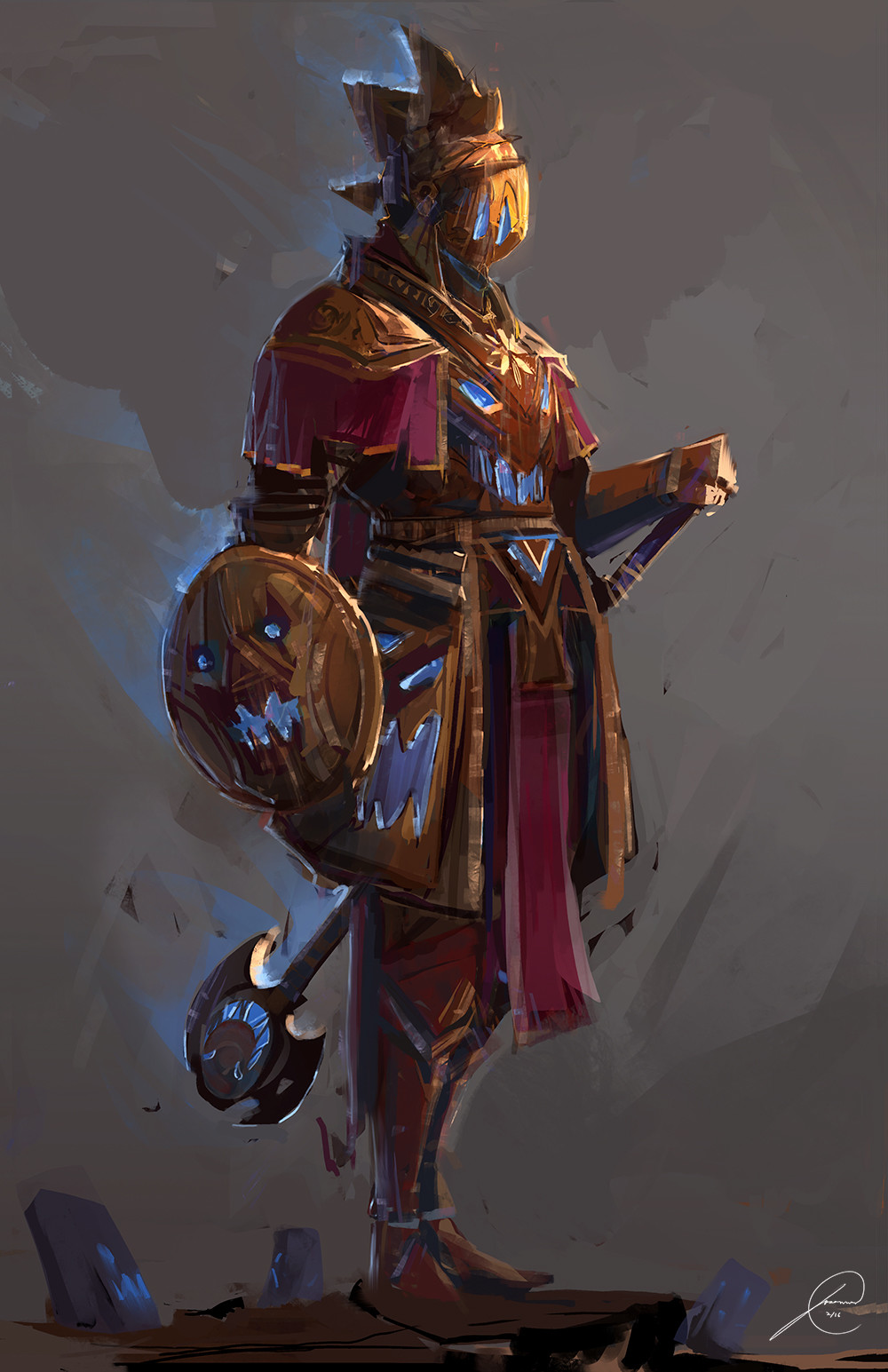
On a rare occasion — that is, as in, one in a million, like any other myths — would a minstrel's tale would sing the truth. Eligor would politely refuse to recall what exactly has happened afterward, but apparently the clash of two divinity has granted him a limited power of his own, however frail and subtle, and to this date the great Dragonslayer would roam the multiverse, in search for those in need.
Manifestation of Eligor
When you bind Eligor to yourself, he manifests into your body as follows:
- Your pupil narrows into a slit, like dragon's eyes.
- Your skin grows scales of chromatic color. These scales have no functional benefits or penalties.
- Eligor may occasionally interrupt and borrow your voice to throw his voice to a beggar, stranded adventurers, or any other people who seems lost and in need.
Portfolio of Eligor
Despite all harms he went through, Eligor is still noble in his heart. His portfolios are as follows:
- Fight Evil. The legendary dragonslayer still lives up to his name, even as a vestige. To those whose heart is evil and foul, Eligor poses no bargain, no negotiation; the Dragonslayer would not hesitate to slay any evil, be it dragons or any other vile beings.
- Seek Aid and Support. Eligor is a vestige that can be best described as the textbook knight errant. Should the binder refuse to help the helpless, Eligor would unleash his anger and contempt.
- Stand Up To Threats. A noble and steadfast knight, Eligor would never dare stand aside from the harm's way. If there is an obstacle that must be overcome, Eligor will, no matter what it takes, or how long it would take.
Vestigal Gift: The Knightclad Armor
When bound, Eligor grants you a set of magical chain mail called the Knightclad Armor. When you summon the Knightclad Armor, you can make it automatically don itself to you, if you are not wearing any armor.
You are always proficient in the Knightclad armor while you are wearing it. The Knightclad Armor is notably lighter than a normal suit of armor; it weighs only 28 pounds, instead of the normal 55 pounds, and for you, it does not has a Strength requirement that a normal chain mail would normally have.
While Eligor is bound to you, you can offer one suit of magical medium or heavy armor to him, transforming it into the Knightclad Armor. To do this, you perform a special ritual over the course of 1 hour, which can be done during a short rest or long rest. The armor must be within your reach throughout the ritual, at the conclusion of which you touch the armor and offer it to Eligor. You cannot affect an artifact or a sentient armor in this way.
After the ritual, the armor appears whenever you summon the Knightclad Armor thereafter. The armor's weight is halved (rounded up), and it loses the Strength requirement for you, if it has any.
You can have only one armor offered to Eligor as the Knightclad Armor. If you attempt to offer a new armor, you must first retrieve the first armor from Eligor's possession.
Vestigal Favors
Eligor's favors are focused on protecting the binder and their allies. When you bind Eligor to yourself, he grants you the following benefits.
Knightclad Stance
At 1st level, while you are wearing the Knightclad Armor, you are considered one size larger for the purpose of avoiding or resisting being shoved or grappled.
Additionally, when you are shoved or otherwise forcibly moved by an outer force while wearing the Knightclad Armor, the distance by which you are moved is decreased up to 5 feet.
Dragonslayer's Will
Starting at 2nd level, when you take damage while you are wearing the Knightclad Armor, you can spend 1 mana as a reaction to gain temporary hit points equal to 1d8 + your binder level + your Charisma modifier (minimum of 1), which takes as much of the triggering damage as possible. You lose all temporary hit points gained this way at the start of your next turn.
The Golden Steed
When you reach 6th level, you can spend 3 mana to cast find steed, without expending a spell slot. When you cast find steed with this feature, your steed summoned this way always takes on the form of a warhorse, is always a celestial, and disappears when Eligor is dismissed from you.
Additionally, you gain the following benefits, but only for the steed you summoned with this feature:
- While you are mounting your steed, you have advantage on saving throws made to avoid falling off the steed.
- If you fall off your steed and descend no more than 10 feet, you can land on your feet if you are not incapacitated.
- Mounting or dismounting your steed costs you only 5 feet of movement, instead of half your speed.
Knightclad Fortitude
By 10th level, you can choose Eligor to gain his protection from earthly weapons. Whenever you finish a short rest or long rest while Eligor is bound to you, choose one of the following damage types: bludgeoning, piercing, slashing. While you are wearing the Knightclad Armor, you gain resistance against damage of the chosen type from nonmagical weapons that are not silvered.
Knightclad Presence
When you reach 18th level, you can choose Eligor to emanate his noble aura within your proximity. While you are wearing the Knightclad Armor, the area within 5 feet of you counts as difficult terrain for hostile creatures.
Additionally, in combat, you gain a special reaction that you can take once on every creature's turn, except your turn. You can use this special reaction only to make an opportunity attack or use your Dragonslayer's Will feature, and you cannot use it on the same turn that you take your normal reaction.
Focalor
The Prince of Tears, He Who Weeps From Depths
The exact nature of the vestige known as Focalor has an elusive history. Even among the obscure and scarce documents, the descriptions of the Prince of Tears vary: A document depicts him as a fiend, another states his nature as celestial, and so forth. Even Focalor himself is oblivious of his origin, which is one of the major source of his perpetual grief.
Perhaps the only aspect that can be sure about the Prince of Tears is that his descent as a shade of himself has ever since imprisoned him into a quagmire of gloom and melancholy. On a rare occasion he would not weep, Focalor would desperately attempt to find out what he really was, which, to his great disdain, often ends in a hollow goal.
Manifestation of Focalor
When you bind Focalor to yourself, he manifests into your body as follows:
- Your eyes begin to weep constantly, regardless of your current mood or thoughts.
- Spectral webs appear between your fingers and toes, and your skin develops a faint texture akin to fish's scales. The webs are intangible and serves no benefits or penalties.
- Focalor may occasionally interrupt and borrow your voice to express his grief and despair according to your current situations, or more often, his grief and despair in general.
Portfolio of Focalor
Focalor is an eternal slave to his own sadness and grief, which is reflected in his general behaviors. His portfolios are as follows:
- Apologize for Everything. He Who Weeps From Depth tends to apologize to anything and everything, even if it is evident that he has no reason to do so. A fast apologize and retreat from the scene is, for Focalor, is the immediate reaction in order to avoid further conflicts — or at least he thinks so.
- Brooding yet Tranquil. The psyche of Focalor is always turbulent and restless, like the tides of the distant seas. Yet deep inside his facade of remorse and helplessness, there is a vivid spark of insight and intuition, which makes the Prince of Tears resourceful.
- Seek Solitude. Forever lamenting and anguishing, if there is one thing the Prince of Tears would want, it would be being left alone. As such, Focalor would actively avoid or resist blending into social meetings or sharing an intimate moment with others.
Vestigal Gift: Sturm Und Drang
When bound, Focalor grants you a magical trident called Sturm Und Drang. You are always proficient with Sturm Und Drang while you wield it.
When you make a ranged weapon attack by throwing Sturm Und Drang, attacking at long range does not imposde disadvantage to the attack roll, and you can choose to deal lightning with the attack instead of the weapon's original damage type. After the attack, Sturm Und Drang immediately teleports into your empty hand, regardless of whether the attack hits or misses the target.

While Focalor is bound to you, you can offer one magical javelin, spear, or trident to him, transforming it into Sturm Und Drang. To do this, you perform a special ritual over the course of 1 hour, which can be done during a short rest or long rest. The weapon must be within your reach throughout the ritual, at the conclusion of which you touch the weapon and offer it to Focalor. You cannot affect an artifact or a sentient weapon in this way. After the ritual, the weapon appears whenever you summon Sturm Und Drang thereafter.
You can have only one weapon offered to Focalor as Sturm Und Drang. If you attempt to offer a new weapon, you must first retrieve the first weapon from Focalor's possession.
Vestigal Favors
Focalor's favors represents both his vague connection with nautical background and the eternal grief that binds him. When you bind Focalor, he grants you the following features.
Seafarer of Grief
At 1st level, you gain swimming speed equal to your walking speed, and you can hold your breath for a number of hours equal to 1 + your Constitution modifier, to a minimum of 30 minutes.
Additionally, you can cast shape water. Charisma is your spellcasting ability for this cantrip.
Ripples of Sorrow
Starting at 2nd level, while you are wielding Sturm Und Drang, you can spend 1 mana as an action to a enchant a creature that you can see within 30 feet of you into an impulse of gloom and melancholy.
The creature must make a Wisdom saving throw. Constructs and undeads automatically succeed on the saving throw, and creatures that cannot be charmed or frightened have advantage on the saving throw. On a successful save, the creature becomes immune against this feature for the next 24 hours.
On a failed save, the creature succumbs to an immense sense of sadness for 1 minute or until it takes damage. The creature has disadvantage on all ability checks, attack rolls, and saving throws. At the end of each of it turn, the creature can repeat the saving throw. On a successful save, the effect of this feature ends for the creature, and it becomes immune against this feature for the next 24 hours.
Into the Turbulent Minds
By 6th level, when you use an action to cast a spell or use your Ripples of Sorrow feature, you can make one weapon attack with Sturm Und Drang as a bonus action.
Additionally, while you are wielding Sturm Und Drang, you can spend 4 mana to cast tidal wave or wall of water, without requiring material components.
Deep-Diver of Grief
When you reach 10th level, you can choose Focalor to gain his blessings through the bodies of water that surrounds you. As long as you are fully immersed in water, your swimming speed is increased by 30 feet, and you gain resistance against all damage except force and psychic.
Additionally, you have advantage on attack rolls against creatures that are fully immersed in water.

At 18th level, you can choose Focalor to channel the tides of ocean and grief from the heart of Prince of Tears. When you use the Ripples of Sorrow feature, you can target a number of creatures up to 1 + your Charisma modifier at the same time (minimum of one creature). Each creature must be within 30 feet of you and not behind total cover. For each creature you target after the first, you must spend an additional 1 mana. Additionally, when a creature fails on the saving throw against your Ripples of Sorrow feature, you can spend an additional 1 mana to engulf its psyche in despair. The engulfed creature falls prone and becomes incapacitated for the duration, and it does not make a saving throw at the end of its turn. The Horned Hunter, the Forerunner to the Wild Hunt Kernos was one of the inhabitant of Feywild, the realm of fey, before his ascension to divinity. For long he reigned as a lesser deity of forest, hunters, predators, and other minor elements of wilderness. But that was long ago, and after centuries of abandonment, Kernos is now a mere shadow of his glorious past. Even as vestige, Kernos still has good connections with feys and other wildlife of the woods. Always eager for a great hunt, Kernos would occasionally guide the fey hunters through the woods, in search for any creatures they come across to hunt. When you bind Kernos to yourself, he manifests into your body as follows: Kernos is a born hunter, always seeking new games and hunt. His portfolios are as follows:Tides of Sorrow
Kernos
Manifestation of Kernos
Portfolio of Kernos
Vestigal Gift: The Gamekeeper's Arch
When bound, Kernos grants you a magical longbow called the Gamekeepr's Arch. You are always proficient with the Gamekeeper's Arch while you wield it.
Once on each of your turn when you miss a creature with a ranged weapon attack made with the Gamekeeper's Arch, you can cause the arrow to magically curve back to the original target, allowing you to make an additional attack against the same creature.
While Kernos is bound to you, you can offer one magical shortbow or longbow to him, transforming it into the Gamekeeper's Arch. To do this, you perform a special ritual over the course of 1 hour, which can be done during a short rest or long rest. The weapon must be within your reach throughout the ritual, at the conclusion of which you touch the weapon and offer it to Kernos. You cannot affect an artifact or a sentient weapon in this way. After the ritual, the weapon appears whenever you summon the Gamekeeper's Arch thereafter.
You can have only one weapon offered to Kernos as the Gamekeeper's Arch. If you attempt to offer a new weapon, you must first retrieve the first weapon from Kernos' possession.
Vestigal Favors
Kernos' favors are centered on his role as the vanguard of the Wild Hunt, which involves fast strides and hunting games. When you bind Kernos to yourself, he grants you the following benefits.
Mark of the Wild Hunt
At 1st level, you can use a bonus action to designate a creature other than construct or undead you can see within 30 feet of you, marking with the curse of the Horned Hunter.
You have advantage on Wisdom (Perception) and Wisdom (Survival) checks made to spot and track the marked creature. Additionally, when you make a ranged weapon against the marked creature, you ignore its half cover and three-quarters cover.
The mark lasts for 1 minute or until your concentration is broken (as if concentrating on a spell). You can end the mark early on your turn (no action required).
Force of Nature
Starting at 2nd level, when you hit a creature with an attack using the Gamekeeper's Arch, you can spend 1 mana to deal an extra 1d8 poison damage with the attack.
When you hit a creature with an additional attack from your Gamekeeper's Arch, you can use this feature with the attack without spending mana.
Hunting Spree
Beginning at 6th level, when you make an additional attack from your Gamekeeper's Arch, you can spend 1 mana to target a different creature that you can see within 30 feet of the original target with the attack.
Additionally, you can spend 3 mana to cast locate animals or plants or pass without trace, without requiring material components.
Gamekeeper of the Wild
By 10th level, you can choose Kernos to implement its supernatural moxie into your defense and mobility. Your walking speed increases by 10 feet, and moving through nonmagical difficult terrain no longer cost extra movement for you.
Additionally, you gain immunity against poison damage, and you cannot be poisoned. if you are already poisoned when you bind Kernos, its effect is suspended for the duration.
Survival of the Fittest
When you reach 18th level, you can choose Kernos to manifest the absolute force of nature. Creatures marked with your Mark of the Wild Hunt feature loses resistance and immunity against poison damage, if it has any.
Additionally, when you hit a creature with an attack with the Gamekeeper's Arch, if the creature is poisoned or marked with your Mark of the Wild Hunt feature, you deal an extra 1d8 poison damage with the attack. If you use your Force of Nature feature with the attack, you add this damage to the extra damage of your Force of Nature feature.
Leontoeides
The False Almighty, the Prideful Sun
Ariel was originally a celestial being created by a deity for the purpose of punishing the wicked. However, for reasons unknown even to himself, a spark of hubris grew within his heart, which caused him to rebel to his former master. After a row of fierce combat, the Divine Lion fell from his grace, mutilated into a hideous shape, and is now known as Leontoeides.
Leontoeides is undoubtedly powerful, but making a contract with him requires patience and tolerance. Arrogant and quick to anger, Leontoeides stubbornly denies his loss, his fall from grace, and even his current name, and would not even bother to listen at all when he does not see fit.
Manifestation of Leontoeides
When you bind Leontoeides to yourself, he manifests into your body as follows:
- Your hair and pupils turn fiery red.
- Your voice develops a booming streak, as if you are speaking through a brass pipe.
- A spectral ring of fire forms around your head. The fire does not emanate heat or light, and has no functional benefits or penalties.
- Leontoeides may occasionally interrupt and borrow your voice to admonish anyone who has been rude to you, even if said person happens to be of a position superior to you.
Portfolio of Leontoeides
Even after his fall from the celestial honor, Leontoeides keeps his arrogance and pride above all others. His portfolios are as follows:

- Ambition for the Ambition's Sake. Despite his false neglect, Leontoeides adores those who will do anything to achieve what they want, be it fortune, power, love. For those who aspires for the best, the Prideful Sun would be the most supportive vestige to ask for power.
- Scorn the Weak. To the Prideful Sun, the weak are there for a reason or another. Arrogant and lusting for power, Leontoeides does not even pretend to pity for those who cannot help for themselves, and will openly mock and gloat them for being a prey for the strong. "Survival of the fittest" is not only the portfolio of the False Almighty; it is the motivation behind every single action he makes.
- Seek Authority. The cause of the fall of the Prideful Sun was his hubris to usurp his master's throne, and even after being reduced to a vestige, he has not given up his ultimate goal. In fact, he already acts as if he is the almighty, and always demands the authority appropriate for his self-claimed position.
Vestigal Gift: The Luster Edge
When bound, Leontoeides grants you a magical longsword called the Luster Edge. You are always proficient with the Luster Edge while you wield it, and when you hit a creature with it, you can choose to deal radiant damage with it instead of its original damage type.
The blade of the Luster Edge shines bright light in a 10-foot radius and dim light for an additional 10 feet. The light is sunlight. While you are wielding the Luster Edge, you can use a bonus action to toggle its light on or off.
While Leontoeides is bound to you, you can offer one magical scimitar, shortsword, or longsword to him, transforming it into the Luster Edge. To do this, you perform a special ritual over the course of 1 hour, which can be done during a short rest or long rest. The weapon must be within your reach throughout the ritual, at the conclusion of which you touch the weapon and offer it to Leontoeides. You cannot affect an artifact or a sentient weapon in this way. After the ritual, the weapon appears whenever you summon the Luster Edge thereafter.
You can have only one weapon offered to Leontoeides as the Luster Edge. If you attempt to offer a new weapon, you must first retrieve the first weapon from Leontoeides' possession.
Vestigal Favors
Leontoeides' favors embodies his arrogant and merciless nature, as well as his former position as a divine servant. When you bind Leontoeides, he grants you the following benefits.
Cull the Meek
At 1st level, when a creature takes radiant damage from the Luster Edge or your binder feature, it must make a Wisdom saving throw. On a failed save, the creature becomes frightened by you. At the end of each of its turn, the frightened creature can repeat the saving throw, ending the effect on a successful save.
On a successful save, the creature becomes immune to this feature for the next 24 hours.
Prideful Smite
Starting at 2nd level, when you hit a creature with the Luster Edge, you can spend 1 mana to deal an extra 1d8 radiant damage with the attack, or 1d12 radiant damage if the target has less than its maximum hit points left.
When you hit a creature that is frightened by you with the Luster Edge, you can use this feature with the attack without spending mana.
Zeal of the Divine Lion
Beginning at 6th level, you can make two attacks with the Luster Edge, instead of one, whenever you take the Attack action on your turn.
Additionally, you can spend 2 mana to cast command as a 1st-level spell, without requiring material components.
Lustrous Presence
When you reach 10th level, you can choose Leontoeides to embody his unflinching presence. As long as a creature that are frightened by you can see or hear you within 30 feet of you, it fails on all saving throws made to end the frightened condition.
Additionally, you gain resistance against radiant damage, and you cannot be frightened. If you are already frightened when you bind Leontoeides, the effect is suspended for the duration.
Contempt the Weak
At 18th level, you can choose Leontoeides to unleash his disdain against the weaklings. You have advantage on an attack roll with the Luster Edge against a creature that is frightened of you.
Additionally, when you hit a creature with the Luster Edge, you deal an extra 1d8 radiant damage with the attack, or 1d12 radiant damage if the target has less than its maximum hit points left. If you use your Prideful Smite feature with the attack, you add this damage to the extra damage of your Prideful Smite feature.
Orthos
The Howler in the Dark, the Primal Shadow
Very little is known of the vestige that answers to the name Orthos. Even the most seasoned and insightful binders doubt whether the name Orthos is the vestige's true name, or one of numerous alias that it chose to respond. The Primal Shadow actively eludes any attempt to know it, and therefore is easily one of the hardest vestige to bind, let alone find and strike a pact with.
Among the few that is known of Orthos shows its nature as an embodiment of the primal darkness, obscure and silent. The Howler in the Dark is one of the oldest among vestiges, if not the oldest of them all.
Manifestation of Orthos
When you bind Orthos to yourself, it manifests into your body as follows:
- Your voice becomes quiet and hoary, as if you are always attempting to speak while being strangled.
- Your feet are perpetually covered in black, spectral fog. The fog can be repelled with brigh light.
- Orthos may occasionally interrupt and silence you when you bring up a subject that is supposed to be secret to anyone else, even if you intend to tell the truth.
Portfolio of Orthos
Silence and mysteries are what defines Orthos, and as such, the Primal Shadow demands the same attitude to its binder. Its portfolios are as follows:
- Golden Silence. Orthos actively avoids bright and noisy places, and its standard for "noisy" is stricter than common beliefs. The Howler in the Dark would, contrary to its fancy alias, not tolerate even the distant howls, the chatters in the pub, or even a bump in the night.
- Lurk, Hide, Observe. Orthos acts like the darkness from which it originates. It never stands but lurks; it never walks but stalks; it never speaks but whispers. Orthos demands its binder to keep the low profile, even if it is evident that nothing is following them.
- Seek Secrecy. The Primal Shadow would prefer not to spill any secrets, even to its allies and friends. Whatever Orthos knows, should be known only to Orthos only, and in some extreme cases, the Howler in the Dark would even blindfold and mute its binder to keep the secrets.
Vestigal Gift: The Duskshroud
When bound, Orthos grants you a magical robe called the Duskshroud. By default, the Duskshroud is a robe made out of pitch-black silk, and when placed within dim light or darkness, patterns of dark shades crawl over its surface.
Whenever you make a Dexterity (Stealth) check to hide while wearing the Duskshroud, you are always considered in the Stealth skill, and your proficiency bonus is doubled for the check. You cannot gain this benefit when you are exposed to bright light.
While Orthos is bound to you, you can offer one magical robe or light armor to it, transforming it to the Duskshroud. To do this, you perform a special ritual over the course of 1 hour, which can be done during a short rest or long rest. The armor must be within your reach throughout the ritual, at the conclusion of which you touch the robe or armor and offer it to Orthos. You cannot affect an artifact or a sentient armor in this way.
After the ritual, the robe or armor appears whenever you summon the Duskshroud thereafter. The armor no longer imposes disadvantage on Dexterity (Stealth) checks, if it normally does.
You can have only one robe or armor offered to Orthos as the Duskshroud. If you attempt to offer a new robe or armor, you must first retrieve the first one from Orthos' possession.
Vestigal Favors
Orthos' favors reflects its nature as the primal embodiment of darkness and secrets. When you bind Orthos, it grants you the following benefits.
The Lurker in the Dark
At 1st level, you gain darkvision out to a range of 60 feet. If you already have darkvision, the radius of your darkvision is increased by 30 feet.
Additionally, while you are wearing the Duskshroud, you can attempt to hide even when you are only lightly obscured by dim light.

Shifting Shadows
Starting at 2nd level, as a bonus action on your turn, or as a reaction when a creature that you can see hits you with an attack, you can spend 1 mana to teleport into an unoccupied space you can see within 10 feet of you. You must wear the Duskshroud to use this feature.
If you use this feature as a reaction, you halve the damage you take from the triggering attack.
Shaper of Darkness
When you reach 6th level, you can see normally in darkness, both magical and nonmagical, within the radius of your darkvision.
Additionally, you can spend 3 mana to cast blindness/deafness or darkness, without requiring material components.
Shroud of Squirming Shadow
By 10th level, you can choose Orthos to blur your shapes with the darkness that it manifests. While you are wearing the Duskshroud and is within the area of darkness, you gain resistance against all damage except force and psychic.
Additionally, when you use the Shifting Shadows while in dim light or darkness, you can teleport up to an unoccupied space you can see within 30 feet of you, which also must be in dim light or darkness.
One with the Dark
At 18th level, you can choose Orthos to meld yourself into the darkness. While you are in the area of darkness, you have advantage on all saving throws.
Additionally, immediately after you teleport with your Shifting Shadow feature, or as a bonus action on your turn, you can spend 1 mana to turn invisible for 1 minute or until your concentration is broken (as if concentrating on a spell). This effect ends early when you are exposed to bright light, or when you take an action, bonus action, or reaction.
Phaethon
The Primal Blaze, It That Bathes in Fire
Phaethon is the prodigal child of deties associated with fire and ferocious nature, namely passion and wrath. It is within its very existence that the Primal Blaze holds the temper like wildfire, perpetually restless and erupting at the slightest trigger.
No fire burns hotter and fiercer than the roaring power that Phaethon radiates. The Primal Blaze devours anything that stands in its way, fueling its fierce tempers with the charred remains of its (former) adversaries.
Manifestation of Phaethon
When you bind Phaethon to yourself, it manifests into your body as follows:
- Your body temperature increases up to 120°F, and you become more tolerant against extreme heat.
- Your skin develops veiny texture that faintly glows in various shades of red.
- Phaethon may occasionally interrupt and borrow your voice to make comments to the current situations, which is often expressed through crude and impulsive words and actions.
Portfolio of Phaethon
Impulsive and destructive, Phaethon does not tolerate anything that stands in its path. Its portfolios are as follows:
- Can't Lie, Won't Lie. It That Bathes in Fire is bad at lying or concealing its thoughts, nor does it find any reason to do so. Whatever that sparks within its primal mind, Phaethon must spill them out, even if its loose tongue puts its binder in dire situations.
- Fight Fire With Fire. Phaethon knows only one solution for everything: Fire. If that fails, Phaethon knows only one plan B: More fire. And when even that fails, Phaethon will unleash the last resort it only knows: Even more fire.
- Seek Consumptions. Phaethon's hunger and thirst cannot be quenched, for nothing can truly satisfy the wildfire. Phaethon will devour any food, quaff on any boozes, and destroy anything that stands in its way.
Vestigal Gift: The Volcanic Fist
When bound, Phaethon grants you a magical warhammer called the Volcanic Fist. You are always proficient with the Volcanic while you wield it, and when you hit a creature with it, you can choose to deal fire damage with it instead of its original damage type. The Volcanic Fist deals double damage to inanimate objects and structures.
While Phaethon is bound to you, you can offer a magical flail, maul, or warhammer to him, transforming it into the Volcanic Fist. To do this, you perform a special ritual over the course of 1 hour, which can be done during a short rest or long rest. The weapon must be within your reach throughout the ritual, at the conclusion of which you touch the weapon and offer it to Phaethon. You cannot affect an artifact or a sentient weapon in this way. After the ritual, the weapon appears whenever you summon the Volcanic Fist thereafter.
You can have only one weapon offered to Phaethon as the Volcanic Fist. If you attempt to offer a new weapon, you must first retrieve the first weapon from Phaethon's possession.
Vestigal Favors
Phaethon's favors are the outlet for its fierce tempers, which manifests into heat and blaze that devours its enemies. While Phaethon is bound to you, it grants you the following benefits.
Searing Momentum
At 1st level, you have advantage on saving throws to resist the effects of extreme heat.
Additionally, once on each of your turn when you hit a creature with the Volcanic Fist, you can deal an extra fire damage with the attack equal to your Charisma modifier + half your binder level (rounded down, minimum of 1).
Volcanic Smelt
Starting at 2nd level, when you take the Attack action on your turn, you can spend 1 mana to make one attack with the Volcanic Fist as a bonus action.
Heart of Prominence
Beginning at 6th level, you can attack with the Volcanic Fist twice, instead of once, whenever you take the Attack action on your turn.
Additionally, you can spend 3 mana to cast burning hands as a 2nd-level spell, without requiring material coomponents.
Molten Body
When you reach 10th level, you can choose Phaethon to embrace its passionate blaze, which sears through incoming harms. You gain resistance against fire damage, and whenever you are hit by a melee attack, the attacker takes fire damage equal to 3 + your Charisma modifier (minimum of 1).
Soul of Prominence
At 18th level, you can choose Phaethon to channel its fierce blaze to fuel your aggression. Whenever you hit a creature with the Volcanic Fist, you deal an additional 1d6 fire damage with the attack. If you also use your Volcanic Smelt with the attack. you add this damage to the extra damage of your Volcanic Smelt.
Additionally, fire damage you deal with the Volcanic Fist, binder spells, or binder features ignores the target's resistance to fire damage, and treats the target's immunity against fire damage as resistance.
Xixecal
The Shambling Glacier, the Arctic Colossus
Xixecal originates from deities whose portfolio include ice, cold, and winter. Before its quick descent as a vestige, Xixecal has manifested as a colossal glacier, shambling through the continents, leaving the trails of arctic remnants that are yet to be excavated.
Wherever Xixecal roams, a blast of chill accompanies its path. Once the Arctic Colossus was, like its name suggests, as magnificent as the mountain ridges that walks, so large that dragons could perch on its shoulders. As a vestige, however, the Shambling Glacier is little more than a cool breeze that seems out of season.
Manifestation of Xixecal
When you bind Xixecal to yourself, it manifests into your body as follows:
- Your body temperature drops down to 50°F, your breath becomes ice-cold, and you become more tolerant against extreme cold.
- Your hands and feet turns pale with a shade of blue, and develops rock-hard skin.
- Xixecal may occasionally interrupt and borrow your voice to nudge its binder to commit to the most pushing .
Portfolio of Xixecal
Xixecal, like the colossal glaciers that it manifests, is constant, stubborn, and unwavering. Its portfolios are as follows:
- Cold Facade, Warm Bemeath. Contrary to popular belief, Xixecal's heart is not frozen solid. It has a deep reserves of emotions and feelings, but its nature as the incarnation of cold and frost, it finds hard to express them, nor does it find a good reason to do so.
- Seek Stability. To Xixecal, to change is to venture into the unknown, and status quo is the golden mean that it should seek. Xixecal would refuse to take sides or make any changes to itself, unless it is absolutely evident that there is no other way.

- Unstoppable Dedication. Unmoving and unwavering like the frozen earth it walks, Xixecal's singular commitment to its objectives is what makes it dangerous and reliable, all at the same time. Once focused on a single goal, it takes more than death to keep it away from achieving it.
Vestigal Gift: The Rimeguard
When bound, Xixecal grants you a magical shield called the Rimeguard. You are always proficient with the Rimeguard while you wield it.
You can use the Rimeguard as a martial weapon that you are proficient in. On a hit, the Rimeguard deals 1d4 bludgeoning or cold damage (your choice), and you add the Rimeguard's Armor Class bonus to the damage roll.
While Xixecal is bound to you, you can offer one magical shield to it, transforming it into the Rimeguard. To do this, you perform a special ritual over the course of 1 hour, which can be done during a short rest or long rest. The shield must be within your reach throughout the ritual, at the conclusion of which you touch the shield and offer it to Xixecal. You cannot affect an artifact or a sentient shield in this way.
After the ritual, the shield appears whenever you summon the Rimeguard thereafter.
You can have only one shield offered to Xixecal as the Rimeguard. If you attempt to offer a new shield, you must first retrieve the first shield from Xixecal's possession.
Vestigal Favors
Xixecal's favors are as frigid and relentless as the bitter coldness that it manifests. While Xixecal is bound to you, it grants you the following benefits.
Glacial Heart
At 1st level, you have advantage on saving throws to resist the effects of extreme cold.
Additionally, when a creature within 5 feet of you makes an attack against a creature other than you, you can use a reaction to impede its attack, imposing disadvantage to its attack roll. You must be wielding the Rimeguard to use this feature.
Frigid Bulwark
Starting at 2nd level, when a creature you can see hits you with a melee attack while you are wielding the Rimeguard, you can exude a blast of cold from the Rimeguard against the attacker. The attacker takes cold damage equal to half your binder level + your Charisma modifier + the damage you took from the triggering attack (rounded down, minimum of 1).
Sentinel of the Dire Winter
When you reach 6th level, when you use an action to take the Attack action or cast a binder spell, you can make one weapon attack with the Rimeguard as a bonus action.
Additionally, when you hit a creature with the Rimeguard, you can spend 1 mana to choose one of the following effects:
- The creature must succeed on a Strength saving throw or becomes knocked prone or pushed back up to 15 feet.
- The creature must succeed on a Constitution saving throw or its speed is reduced to 0 until the start of its next turn.
Glacial Stance
When you reach 10th level, you can choose Xixecal to embody its ice-cold nature. You gain resistance against cold damage, and your speed cannot be decreased.
Additionally, as long as you are conscious, you cannot be grappled, shoved, or magically moved against your will. When you move, you lose this benefit until the start of your next turn.
Harbinger of the Dire Winter
At 18th level, you can choose Xixecal to channel its frigid presence, which manifests as a perpetual blast of cold wind around you. While you are wielding the Rimeguard, when a hostile creature first enters the area within 5 feet of you or starts its turn there, it must make a Constitution saving throw. On a failed save, the creature takes cold damage equal to 1d4 + your Charisma modifier (minimum of 1), and its speed is reduced to 0 until the start of its next turn.
Additionally, in combat, you gain a special reaction that you can take once on every creature's turn, except your turn. You can use this special reaction only to use your Frigid Bulwark feature, and you cannot use it on the same turn that you take your normal reaction.
Credits
All contents are created by Weirdo Whoever unless noted otherwise. Special thanks to D&D Wiki and NaturalCrit Homebrewery tool for providing the templates for my imaginations.
Binder. Converted from 3.5rd edition supplement Tome of Magic.
Vestiges. All vestiges available in the class are derived from various sources:
- Some vestiges are converted from the vestiges of the same name from 3.5rd supplement Tome of Magic. These vestiges are as follows: Eligor, Focalor, Halphax, Haures, Orthos.
- Some vestiges are very loosely "converted" from epic-level abominations introduced in the 3.5rd supplement Epic Level Handbook. These vestiges are as follows: Atropal, Chichimec, Phaethon, Xixecal.
- Aradia is derived from Aradia, or the Gospel of the Witches by Charles Godfrey Leland, or in this particular case, the videogame Shin Megami Tensei III: Nocturne.
- Leontoeides is derived from Yaldabaoth, the false god and the fashioner of the world in Gnostic beliefs.
- Kernos is a corruption of Cernunnos, the Horned God, one of the major deities in Wiccan practices.
Community Feedbacks. A very special thanks to u/LucasPmS, u/zperlo, and all other Redditors for immense insights and involvement.
Artworks. Credits for the awesome artworks goes to the following artists:
- "Possession of the Possessed" by mikezmilenia.
- "Witch Finished Artwork" by atomhakw.
- "Animate Dead / Magic: The Gathering" by Bastien Lecouffe Deharme.
- "SCP-469" by @aldarsign on Twitter.
- "Mystical Knight" by Jason Nguyen.
- "Giant" by Ekaterina Orange.
- "Cernunnos" by Johnathan Vair.
- "Fallen Angel" by Kelton Cram.
- "Wrath of the titans (concept)" by François Baranger.
- "Ice Golem" by Ivan Sevic.
Watercolor. Credit for the clever watercolor goes to Full Page Watercolor Stains by fellow GM Binder users.