IADnDMN Stream Monsters! (2019/01/23)
As always, tune into ItsADnDMonsterNow's weekly monster-making stream on Twitch every Wednesday at 11am Pacific! We hang out, talk DnD, and make monsters together as I explain my process and share my tips for making fun and effective monsters that you can use in your own games!
Cornell, Dark Lord of the Lycans
Suggested by @whistlehunter, continuing last week's Cornell stat block, and still based on the boss from Castlevania: Lords of Shadow.
The man known now only as Cornell was a good, pious man—a man known well for the good deeds he performed for the sake of humanity. He had some evil in him as well, though, as we all do. Unfortunately, when Cornell died, it's said that his goodness left his body to ascend to the heavens, leaving only the evil behind. That evil then possessed his physical remains, turning this once righteous man into a figure of pure wickedness.
Once taken by evil, Cornell had become a lycanthrope. A exemplary, apex specimen of lycankind. This now-immortal man, twisted and empowered by shadow, is larger than more powerful than he had ever been in life, and now commands a small army of lycanthropes which terrorizes the countryside.
Lair Actions
On initiative count 20 (losing initiative ties), Cornell takes a lair action to cause one of the following effects; Cornell can’t use the same effect two rounds in a row:
- Cornell summons 1d4-1 werewolves which appear after 1d3 rounds. This action has no effect if more than one creature summoned by a previous use of it remains in combat.
- Cornell evokes protection from 1d2 magic statues he can see within 60 feet of him, activating them for the duration. While he remains within 60 feet of at least one active statue, Cornell gains resistance to magical and silvered bludgeoning, piercing, or slashing damage, and immunity to all other damage. A statue deactivates if Cornell is ever not within 60 feet of at least one active statue, or if that statue is destroyed (AC 17; hp 25; immunity to fire, poison, and psychic damage; resistance to all other damage from nonmagical attacks that aren't adamantine).
- Cornell commands beams of burning, silvery moonlight which shine down from the sky, even indoors or under cover. Cornell commands d4 beams, re-rolling the d4 at the end of each of his turns, decreasing the number of beams present to the number rolled if that number is fewer. He then can move any number of the beams up to 30 feet each. These beams last for up to 1 minute, until Cornell is incapacitated, or until he chooses to dismiss them (no action). Each beam is a 10-foot wide, 300-foot tall cylinder of dim light. Any creature Cornell chooses that enters a beam's area for the first time on its turn, or that starts its turn there must make a Constitution saving throw, taking 22 (4d10) radiant damage on a failed save, or half as much on a successful one.
When encountered in his lair, Cornell has a challenge rating of 19 (22,000 XP).
Image Source: Castlevania Fandom Wiki Text goes here: If Cornell dies, these effects fade over the course of 1d10 days.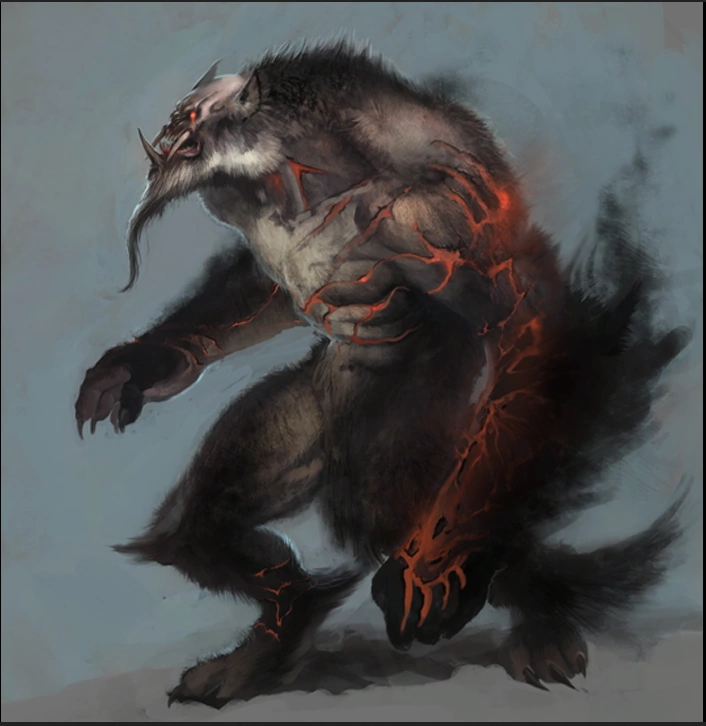
Regional Effects
Cornell, Transformed
Huge fiend, neutral evil
Armor Class 15 (natural armor)
Hit Points 207 (18d12 + 90)
Speed 60 ft.
STR DEX CON INT WIS CHA 24 (+7) 19 (+4) 20 (+5) 7 (-2) 17 (+3) 16 (+3)
Saving Throws Dex +10, Con +11, Wis +9, Cha +9
Skills Athletics +13, Insight +9, Intimidation +9, Perception +9, Survival +9
Damage Resistances cold, fire, lightning; bludgeoning, piercing, and slashing from nonmagical attacks that aren't silvered
Damage Immunities poison
Condition Immunities charmed, frightened, poisoned
Senses darkvision 120 ft., passive Perception 19
Languages Common; understands Abyssal and Infernal but can't speak them
Challenge 17 (18,000 XP)
Rage (2/Day). In battle, Cornell can enter a rage as a bonus action. While raging, he gains the following benefits:
- Cornell has advantage on Strength checks and Strength saving throws.
- When Cornell makes a melee weapon attack using Strength, he gains a +4 bonus to the damage roll.
- He has resistance to all damage that isn't psychic or from silvered weapons.
Cornell can’t cast spells or concentrate on them while raging. His rage lasts for 1 minute. It ends early if he is knocked unconscious or if his turn ends and he hasn't attacked a hostile creature since his last turn or taken damage since then. He can also end his rage on his turn as a bonus action.
Keen Hearing and Smell. Cornell has advantage on Wisdom (Perception) checks that rely on hearing or smell.
Legendary Resistance (3/Day). If Cornell fails a saving throw, he can choose to succeed instead.
Pounce. If Cornell leaps at least 20 feet straight toward a target and then hits it with a bite attack on the same turn, the target takes an extra 16 (3d10) piercing damage. If the target is a creature, it must succeed on a DC 21 Strength saving throw or be knocked prone.
Shadow Weapons. Cornell's weapon attacks are magical.
Standing Leap. Cornell's long jump is up to 40 feet, and his high jump is up to 20 feet, with or without a running start.
Actions
Multiattack. Cornell makes three attacks: one with his bite, and two with his claws. Alternatively, he makes one attack with his claws, and one rock attack.
Bite. Melee Weapon Attack: +13 to hit, reach 10 ft., one target. Hit: 23 (3d10 + 7) piercing damage. If the target is a humanoid, it must succeed on a DC 15 Constitution saving throw or be cursed with werewolf lycanthropy.
Claws. Melee Weapon Attack: +13 to hit, reach 10 ft., one target. Hit: 17 (3d6 + 7) bludgeoning damage.
Rock. Ranged Weapon Attack: +13 to hit, range 60/240 ft., one target. Hit: 29 (4d10 + 7) bludgeoning damage, plus 9 (2d8) force damage. If the target is a creature, it must succeed on a DC 17 Constitution saving throw or be stunned until the end of its next turn. A flying creature stunned by this effect has its fly speed reduced to 0. Immediately after the attack, Tenderizer returns to Cornell's hand.
Deafening Roar (Recharge 5–6). Cornell looses a earth-shaking roar, forcing each creature in a 30-foot cone to make a DC 18 Constitution saving throw. On a failed save, a creature takes 35 (10d6) thunder damage and is deafened for 1 minute. On a successful save, a creature takes half as much thunder damage and is not deafened. A deafened creature can repeat its save at the end of each of its turns, ending the condition on a success.
Legendary Actions
Cornell can take 2 legendary actions, choosing from the options below. Only one legendary action option can be used at a time and only at the end of another creature's turn. Cornell regains spent legendary actions at the start of his turn.
Leap. Cornell jumps up to 30 feet. Opportunity attacks made during this movement have disadvantage.
Quick Swipe. Cornell makes an attack with his claws.
Quake Slam (Costs 2 Actions). Cornell slams the ground, causing it to quake violently in a 30-foot radius. Each other creature on the ground in this area must make a DC 17 Dexterity saving throw, taking 16 (3d10) bludgeoning damage and being knocked prone on failed save, or taking half as much damage and not falling prone on a successful one.
Strange Cloak
Suggested by @SherlockHole, based on Doctor Strange's Cloak of Levitation from the Marvel Universe.
There is a magical cloak which was crafted unknown generations ago by a secretive order of wizard-monks. The cloak is said to grant amazing powers, but only to one who it chooses—an occurrence which hasn't come to pass in a very long time. So long has the cloak gone disused, that the order has all but disappeared, and those who know of its history at all have only heard so through whispered legends and fables. So long in fact, that its name has been forgotten, and it is now referred to simply as, "The Strange Cloak."
No one knows for certain how the cloak chooses its owner, or if it even still has power. This does not deter any who know its true nature from striving to win its favor.
Strange Cloak
Wondrous item, artifact (requires attunement by a humanoid chosen by the cloak)
This luxurious velvet cloak is bright crimson in color with an ornate gold trim of mystical and arcane symbols and glyphs embroidered in gilded thread. The wing-shaped clasps on the collar hold the cloak in place by magic, affixing themselves to the wearer despite no visible means of fastening.
When you wear this cloak, you have a fly speed of 40 feet. You can use this fly speed for up to 8 hours, all at once or in several shorter flights, each one using a minimum of 1 minute from the duration. If you are flying when the duration expires, you descend at a rate of 30 feet per round until you land.
Awakened. The cloak possesses a shade of sentience, and upon attunement it becomes your ally, its personality and alignment changing to match your own.
While not on your person, the cloak is considered a Medium construct with the game statistics listed below. In this case, you can give the cloak verbal commands on each of your turns (no action), which it obeys to the best of its ability. In the absence of a command, it attempts to return to your side, defending itself if it is there already. The cloak always knows the direction and distance to you as long as you and it are on the same plane of existence.
The cloak regains all of its hit points each day at dawn. It can't be healed by any magic that has no effect on constructs, and it can't eat food or imbibe potions. If the cloak is reduced to 0 hit points, it falls unconscious, losing all magical properties as it becomes an inanimate magical cloak. It can't regain hit points by any means for 24 hours, at which point it regains a single hit point.
Attack Deflection. After the end of each of your turns, the first time you are hit by a weapon attack where the attack roll does not exceed your AC by more than 2, the cloak attempts to block or deflect the blow. When it does so, the damage taken from the attack is reduced by 1d10 + 10.
Billowing. At your mental command (no action), the cloak begins to billow dramatically in a phantom wind, or ceases to do so.
Extra Limb. The cloak acts as an extra limb while you wear it, responding instinctively to your thoughts. You can perform an additional object interaction per turn before needing to spend your action to do so. This limb can't be used to wield equipment or make attacks.
Shapeshifting Garment. As an action, you can command the cloak to polymorph itself into a nonmagical version of any garment or outfit you have seen before. This transformation lasts until you use another of the cloak's properties, command it to assume a different form, or use a bonus action to command it to return to its normal form.
Spell Protection. While wearing the cloak, if you take damage from a spell cast by a source you can see or hear and you are not surprised, you can use your reaction to shield yourself with the cloak, granting yourself resistance to the damage dealt by that casting of the spell until the end of your next turn. You can use this property twice. You regain 1 spent use after each hour that passes since you used it last.
Strange Cloak
Medium construct, varies
Armor Class 14
Hit Points 72 (16d8)
Speed 0 ft., fly 60 ft. (hover)
STR DEX CON INT WIS CHA 18 (+4) 18 (+4) 10 (+0) 5 (-3) 6 (-2) 6 (-2)
Saving Throws Dex +7, Con +3, Cha +1
Skills Acrobatics +7, Stealth +7
Damage Resistances cold, fire, force, lightning
Damage Immunities poison, psychic
Condition Immunities blinded, charmed, deafened, frightened, paralyzed, petrified, poisoned
Senses blindsight 120 ft. (blind beyond this radius), passive Perception 8
Languages understands the languages of the creature to which it is attuned, but can't speak
Challenge 8 (3,900 XP)
Antimagic Susceptibility. The cloak is incapacitated while in the area of an antimagic field. If targeted by dispel magic, the cloak must succeed on a Constitution saving throw against the caster's spell save DC or fall unconscious for 1 minute.
Damage Transfer. While it is grappling a creature, the cloak takes only half the damage dealt to it, and the creature grappled by the cloak takes the other half.
False Appearance. While the cloak remains motionless, it is indistinguishable from a normal cloak.
Magic Resistance. The cloak has advantage on saving throws against spells and other magical effects.
Actions
Smother. Melee Weapon Attack: +7 to hit, reach 5 ft., one Medium or smaller creature. Hit: The creature is grappled (escape DC 16). Until this grapple ends, the target is restrained, blinded, and at risk of suffocating, and the cloak can't smother another target. In addition, at the start of each of the target's turns, the target takes 7 (1d6 + 4) bludgeoning damage.
Fey Hunter
Suggested by @whistlehunter and based on this artwork from ArtStation artist romanimp.
A most-feared band of race traitors, Fey Hunters are called so because they are not only fey who are hunters, but also hunters of fey.
Fey hunters are outcasts among their people—for obvious reasons—but this solitude provides them with ample time to spar and hone their deadly skills. While they most often hunt alone, it's not unheard of for them to hunt in small groups of two to four, though they never allow non-fey into their cliques.
These efficient, effective killers move with stealth, and attack with both speed and strength, their brutal attacks unrelenting until their quarry falls.
It's unclear what type of clients provide fey hunters with their targets, but whoever it may be, it almost certainly costs them dearly.
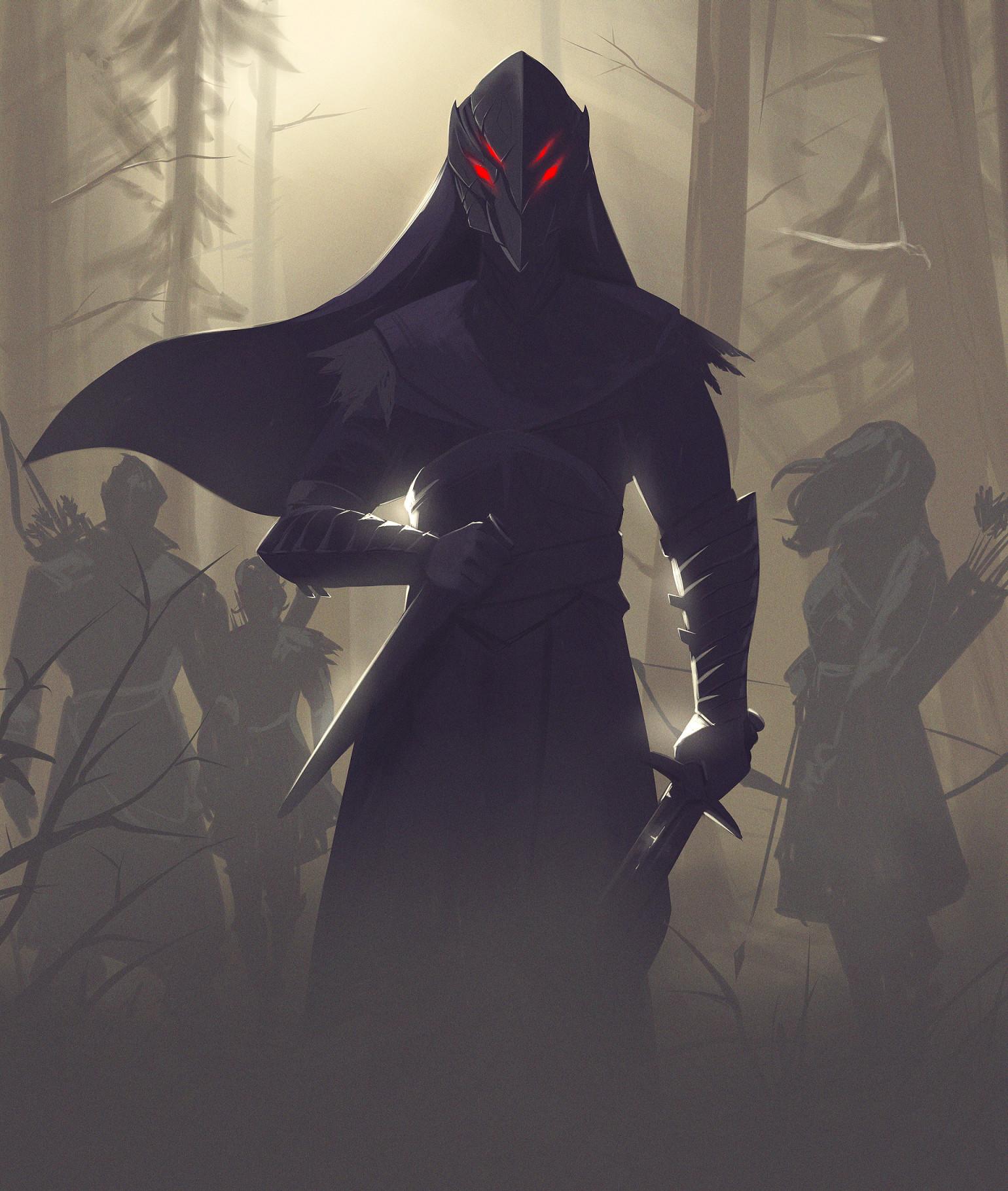
Image Credit: Roman Ankenbrandt
Fey Hunter
Medium fey (shapechanger), neutral evil
Armor Class 16 (breastplate)
Hit Points 78 (12d8 + 24)
Speed 30 ft.
STR DEX CON INT WIS CHA 18 (+4) 19 (+4) 15 (+2) 11 (+0) 17 (+3) 14 (+2)
Saving Throws Str +7, Dex +7, Cha +5
Skills Intimidation +5, Perception +6, Stealth +7, Survival +6
Condition Immunities frightened
Senses truesight 30 ft., darkvision 60 ft., passive Perception 16
Languages Common, Elvish, Sylvan
Challenge 6 (2,300 XP)
Shapechanger. The fey hunter can use its action to polymorph into a raven form (speed 10 ft. fly 50 ft.), or back into its true form. Its statistics are the same in each form, except for the speed change noted. Any equipment it is wearing or carrying merges into its new form. Equipment that merges with the form has no effect until the fey hunter leaves the form.
Cold Iron Weapons. The fey hunter's weapon attacks deal double damage against fey, or creatures with the fey ancestry trait, and are considered magical for the purpose of overcoming these creatures' damage resistances or immunities.
Cunning Action. On each of its turns, the fey hunter can use a bonus action to take the Dash, Disengage, or Hide action.
Helm of Truesight. The fey hunter loses its truesight when not wearing its helmet.
Evasion. If the assassin is subjected to an effect that allows it to make a Dexterity saving throw to take only half damage, the assassin instead takes no damage if it succeeds on the saving throw, and only half damage if it fails.
Fey Ancestry. The fey hunter has advantage on saving throws against being charmed, and magic can’t put the fey hunter to sleep.
Sneak Attack. Once per turn, the fey hunter deals an extra 21 (6d6) damage when it hits a target with a weapon attack and has advantage on the attack roll, or when the target is within 5 feet of an ally of the fey hunter that isn't incapacitated and the fey hunter doesn't have disadvantage on the attack roll.
Actions
Multiattack. The fey hunter makes three attacks: Two with its lonsword, and one with its shortsword. Up to two of these attacks can be replaced by dagger attacks.
Longsword. Melee Weapon Attack: +7 to hit, reach 5 ft., one target. Hit: 8 (1d8 + 4) slashing damage, or 9 (1d10 + 4) slashing damage if wielded with two hands.
Shortsword. Melee Weapon Attack: +7 to hit, reach 5 ft., one target. Hit: 7 (1d6 + 4) piercing damage.
Dagger. Melee or Ranged Weapon Attack: +7 to hit, reach 5 ft. or range 20/60 ft., one target. Hit: 6 (1d4 + 4) piercing damage.
Reactions
Fey Step (Recharge 4–6). When the fey hunter is targeted by an attack from a creature it can see, the fey hunter teleports up to 30 feet to an unoccupied space it can see, imposing disadvantage on the attack roll.
Parry. The fey hunter adds 3 to its AC against one melee attack that would hit it. To do so, the fey hunter must see the attacker and be wielding a melee weapon.