

contents
column balancer
-
1Introduction
-
Part 1: At the Table
-
2Character Options
-
Races
-
Classes
-
Philosophies
-
37Other Options
-
-
37Technology
-
column balancer

Introduction
This work -- and throughout, SteamWorks will be referred to as a "work," rather than a "book" -- is intended to serve as a guide to technology in a fantasy setting, as the subtitle implies. Specifically, it is meant to give you all the tools you need to implement a steampunk-esque feel into your games.
There are a variety of "punk" genres today, of which steampunk is only one: other subgenres of punk that this work draws inspiration from include dieselpunk and a smattering of atompunk. If these terms confuse you, don't worry: not only there are resources you can draw from online, but this work also includes a discussion of what these takes on technology mean, from a thematic standpoint, and how these takes might impact your setting.
Overall, this guide is intended to be comprehensive in nature, and the goal is that you needn't look elsewhere to get your technology fix for your game. That said, there may be things not covered in sufficient detail for your tastes, or there may be technological elements you feel are missing that you desire. While the work presented here is intended to be at least somewhat internally consistent in terms of theme, you are certainly welcome to incorporate other elements, mixing and matching as you see fit.
What This Is and Is Not
The technology level in this work is intended to feel at home in something most akin to the steampunk genre, which is usually Victorian in feel. That said, there are technological effects throughout -- things like holograms, cloaking devices, and thinking machines -- that go far above what is possible even in the modern era. This is where the fantasy aspects come into play: it is assumed throughout this work that in a setting with magic, the rules of nature can be bent, if not outright broken.
While this work is presented as a whole, and is used that
way in my own setting, you are by no means required to use everything contained in it. Feel free to pick through it and use what you think works, and discard what you feel is inappropriate, as you see fit.
Contents
This is an overview of the upcoming sections in this work.
Character Options. This section contains technological races, classes, and subclasses. There is sufficient variety here that you should be able to host an entire party's worth of technological character concepts without necessarily overlapping.
Technology. This section gives an overview of how technology -- as presented in this work -- works in terms of game mechanics, and explains some important concepts regarding how devices diverge from spells. It also details technological equipment, including devices, drones, new firearms, power armor, prosthetics, and vehicles.
Integration. This section gets a bit more philosophical, and discusses the various ways in which you might introduce technology into your game. Also included is a discussion of how you might handle the interactions between magic and technology.
Monsters. This section includes a small selection of technologically-themed monsters.
Backmatter. This section contains the version history, art credits, and legal information.
The Future
This work is intended to be the first of the Works series, in which I explore a variety of different topics, specifically what might be called "power sources" in other game systems.


Character Options
Introducing technology into a game can be done in a variety of ways. This section introduces a number of new character options, including races, classes, and a wide variety of new equipment, all of which are intended to help integrate a technological feeling into your world.
As a GM, you are not expected to allow all of these things into a game at once. Instead, you should read through each and determine which makes the most sense for you and your game.
Races
This work introduces the following races:
- Artilects, a race of sentient machines, with an innate connection to technology.
- Gremlins, cousins of goblinoids with a mischievous streak a mile wide and a natural knack with machines.
- Mogri, an intensely curious people who often see technology as an extension of nature.
Classes
This work introduces the following classes:
- The borg, an inventor who fuses technology with their body, overcoming the limits of their mortal shell.
- The detective, an investigator who uses her intellect and wits to find clues and solve problems.
- The engineer, a student of technology who focuses on building devices capable of wondrous and sundry things.
- The gunslinger, a warrior who wields weapons and martial techniques more befitting a new age.
- The ironman, a fighter who uses technology to augment his own strength, to perform at a superhuman level.
- The physician, a skilled practitioner of the arts of medicine and herbology.
- The rigger, a versatile thinker who commands drones, uses scripts to subvert calculators, and pilots vehicles.
Technology
This work introduces the following sorts of technology:
- Drones, small mechanical minions that you can customize and control.
- Equipment, mundane sorts of equipment suitable for a setting with a more technological bent.
- Firearms, new weapons for a new age.
- Inventions, the technological equivalent to spells.
- Power Armor, a new category of modular armor that can be customized.
- Prosthetics, both of the sort that replace lost limbs and other technological implants.
- Vehicles, both mundane and fantastical.


Artilect
Sometimes, in the pursuit of greater calculating prowess, an individual stumbles across the key to intelligence, and finds the means with which to imbue that trait into a creature not of flesh and blood, but of oil and steel. In other times, powerful organizations or short-sighted politicians seek ways to automate their defenses, giving a machine of war the tools it needs to sense its opponents, to hunt them, understand them -- and this can result in a machine suddenly becoming significantly more self-aware than its builders planned.
Cold Calculations
Unlike most humanoids, artilects are devoid of emotion: they process information and perceive their environment in ways that are wholly unlike people, and as such often come across as having an incredibly alien mindset.
This does not mean that an artilect is incapable of caring about others, nor that they are utterly amoral in their reasoning: artilects often develop strange ethical calculi as they go through life, building a moral framework for themselves based on perceived reactions, predicted responses, and their own unique way of thinking about their actions.
Individual artilects develop their own rationalities and own moral compasses over time. While those artilects who are built by other artilects may receive some amount of training in this regard, the means of constructing an artificial mind
are such that artilect "parents" can do little to directly control how a newly-constructed artilect will mentally behave.
A Reason to Be
It is one thing to be able to engineer a toaster such that it can calculate precisely how long it needs to toast bread -- it is entirely another to give that toaster a mind of its own, such that it wants to be a writer when it "grows up."
While artilects have free will and can determine their own path, they often have difficulty with the concept, and can find it difficult to get themselves out of a behavioral rut. Part of the artilect maturation process involves the artilect discovering a means of finding its own purpose, rather than relying on default programming, and this often leads to a lifelong journey of self-discovery and attempting to find oneself.
Given this, older artilects tend to have a philosophical streak, having spent a good amount of time contemplating the nature of their existence and how they might discover their purpose.
The Will and the Way
Artilects have a tendency to take their self-determination very seriously, and while they may readily agree that they have a tendency to get lost in the clouds in search of meaning, or to find themselves locked in a habitual pattern, they will strongly insist that they have the same free will -- and therefore, the same rights -- as any biological person.

While they are rarely spiritual -- and there may be some question as to whether or not artilects have souls, though few of the mechanically-minded are in a hurry to figure out whether or not they do -- artilects often take well to meditation and other thought-calming exercises. While the process is somewhat different for their mechanical minds, artilects often find behaviors and habits that allow them to exert control over their minds -- rather than the other way around -- to be incredibly self-empowering.
Artilect Names
Artilects are typically given a model name upon construction, though these names may have a tendency to become corrupted over time, much as how humanoid family names may change slightly when emigrating to places with other languages. In addition, artilects typically have a given name, which is either given to them by companions or taken up as a way to try to fit in better with other races.
Model Names: Archer T-7, Corsair 921, HK-9 Worker, Model 18, Ursus 04-C, Viking F, Zephyr Heavy
Personal Names: Bucket, Click, Clank, Johnny, Pernassus, Robbie, Speedy, William
Artilect Traits
Your artilect character has a number of traits resulting from being a constructed being with a mechanical mind.
Ability Score Increase. Your Constitution and Intelligence scores increase by 1.
Age. Artilects, being constructed, do not physically age, and they often maintain the same general appearance over their lifespan. However, it takes time for an artilect personality to stabilize, and so artilects are often comparable to adults of other races at roughly 4 years old. The means by which intelligence arises from a machine plays havoc on mechanical systems, however, and artilects do eventually die from old age, as their systems become incapable of supporting their mind: however, this typically does not happen until an artilect is 450 years old.
Alignment. Artilects, being creatures of logic, have a strong tendency to be lawful, often believing that societal and legal practices that mimic their own thought processes are more sound. They have no particular prediliction towards good or evil, and young artilects often have rather alien stances on morality, often focusing on the "greater good" and "utility functions" to determine whether an action is right or not.
Size. Due to the power requirements of their mechanical minds, artilect body plans do not vary as much as one might expect, and often mimic the shapes of their original creators. The typical artilect stands at around 6 feet tall, and weighs around 300 pounds. Your size is Medium.
Speed. Your base walking speed is 20 feet. Your speed is not reduced by wearing heavy armor.
Iron Body. You count as both a construct and a humanoid for the purpose of effects targeting such creatures. While you aren't wearing armor, you can calculate your AC as 12 + your Dexterity modifier. You can use a shield and still gain this benefit.
You are considered to be a manufactured metal object, for effects such as heat metal, and you are considered to be in physical contact with yourself for purpose of those effects.
Mechanical Mind. The artilect mind is an alien place to most people, and to an artilect, the mental processes of other creatures are often unfathomable. You gain resistance to psychic damage, gain advantage on saving throws to avoid becoming charmed, and have disadvantage on Wisdom (Insight) checks.
Living Construct. Even though you were constructed, you are a living creature. You are immune to disease and poison. You do not need to eat or breathe, but you can ingest food and drink if you wish.
Instead of sleeping, you enter an inactive state for 4 hours each day. You do not dream in this state; you are fully aware of your surroundings and notice approaching enemies and other events as normal.
Languages. You can speak, read, and write Assembly and Common. Assembly is a bizarre mechanical language, composed of rapid clicks, beeps, and whistles, that allows for rapid communication between those who know it and can speak it. Written assembly is incredibly dense, and what may take several pages in other languages can be written in a few square inches of space.
While other humanoids can learn the language, few can speak it at the speed that artilects are comfortable using it at, and so mainly learn it to better understand their mechanical companions.
Artilects in Your Game
Introducing artilects into your game can be an immediate, powerful statement about the presence of technology: after all, if you have thinking machines walking and talking, that implies a heavy presence of technological know-how somewhere in your world.
Artilects may have been mass-manufactured, intended as robotic servants to the upper class, with their intelligence being an unintended side-effect. In this scenario, there may very well be artilects, and then the mechanical servants they resemble, but who have no true mental life. Artilects in this case would be significantly more interested in self-determination, and most likely have deep reservations regarding the societies that gave birth to them.
Alternatively, artilects could have been the result of a single fevered genius, building a variety of machines with the full intention of giving them intelligence and setting them free out into the world. Here, artilects may feel a stronger degree of camaraderie with one another: they can all trace their "ancestry" to the same person. With this approach, you also have greater control over where and how artilects spread.
It could also be the case that artilects are the last remaining remnants of an ancient civilization, or the only survivors of the crash of a foreign spacecraft. Making the origins of artilects both mysterious and irreproducible also curtails their numbers, and can mitigate the background implied by their existence - if they're ancient technology, no one would expect their means of manufacture to still be operable.


Gremlin
A member of the goblinoid family, gremlins have an innate affinity for mischief and pranks. While they gather in much the same sort of settings as goblins, their closest relatives, gremlins have a strong preference for locations with a more technological bent -- abandoned mines are among their favorite, giving them ready access to both tools and raw materials.
While they can be cruel, gremlins have much less interest in malice towards other races. Instead, gremlins have an almost-innate fascination with technology, and prefer to tinker with -- and sometimes disassemble -- the constructions of other races.
Junkyard Living
Gremlins have almost no concept of personal space or private property, living communally with others of their kind in open rooms and sharing everything. A gremlin thinks nothing of taking a tool or sleeping in a space reserved by someone else: for a gremlin, the idea of something being off-limits is utterly foreign.
They also have a tendency to not particularly care about the state of their living quarters. Gremlin dwellings are often disheveled and cluttered, with no clear indicators of a room's purpose. Gremlins often sleep, eat, and build their
contraptions in the same small area. With no sense of claustrophobia, gremlins can get along just fine in tiny, cramped spaces, and will often burrow tunnels beneath and between sites of interest that few other than a gremlin would be comfortable moving through.
For their part, gremlins rarely complain about their living conditions, provided they have access to the sorts of technological gadgets and raw resources they desire. Gremlin inhabitants of cities may even proclaim that they have the choicest parts of the city at their disposal: gremlins have a strong distaste for natural sunlight, as they typically live underground, and so prefer their living conditions to be effectively dismal.
Ghettoized but Tolerable
Unlike most of their goblinoid brethren, gremlins can get along in civilized society, though their opinions on personal space may be off-putting to some. Their tolerance for living in what others would consider squalid conditions, combined with their hygienic practices, typically means that those gremlin tribes that do find themselves among other races often live apart, in dark, dank, and dirty parts of cities.
Where other goblinoids might actively steal or raid from their neighbors, gremlins -- for the most part -- tend to not engage in that sort of activity, instead both building and destroying their inventions in equal measure. Their natural

talent for technology may find them employment in burgeoning technological industries, and it is here that other races can look past some of their unpleasant proclivities and see the use they can bring to society.
Cats of the Goblinoids
In many ways, for most people, gremlins remind them of cats: vaguely aloof, interested in attention when they want it and not otherwise, and generally able to entertain themselves. A gremlin who wants to get your attention will typically do so in as direct a way as possible, but he will usually only do so if he wants or needs something from you, then will return to his business.
An exception to that is their penchant for mischief. Gremlins greatly enjoy practical jokes and have a particular focus on physical humor and comedy: setting someone up for a prat-fall is among the most common activities gremlins will engage in, when they're looking to entertain themselves.
And, much like cats, gremlins can serve useful purposes in society. Their natural knack with machinery -- accompanied by their small size, ability to contort themselves into uncomfortable positions with ease, and preference for dark conditions -- makes them well-suited to working in early-industrial factories. Gremlin workmanship often has a rough, mass-manufactured feel to it, though it is usually as durable as the craftsmanship of other races, with some even claiming that the work of more experienced gremlins can be on par with that of dwarves.
Gremlin Names
Gremlins keep clan names, as well as personal names, which make no real distinction between male or female. Clan names are shared by every gremlin who lives in a given group of gremlins, whether or not they're actually related. Gremlin names overall have a tendency to use sharp, high-pitched sounds, which can be somewhat grating to other races -- and so gremlins often take on nicknames, as well, often relating to their preferred sort of tinkering, but may also reference their physical characteristics.
Personal Names: Dalret, Jarashi, Jortie, Karnis, Grakyl, Larkyl, Lizat, Mirkat, Rykyl, Vakyl
Clan Names: Aj, Biz, Dek, Jer, Ryx, Tyr, Var, Zik
Nicknames: Bowmaker, Featherplucker, Goldenhands, Jeweler, Mohawk, Stitcher, Woodworker
Gremlin Traits
Your gremlin character has the following racial traits.
Ability Score Increase. Your Dexterity score increases by 2, and your Intelligence score increases by 1.
Age. As goblinoids, gremlins mature fairly quickly and live relatively short lives. Gremlins reach adulthood at the age of 8, and rarely live past 45.
Alignment. Gremlins are inherently chaotic creatures, disdainful of rules and having little concept of personal property, and enjoy playing tricks on people. While they can focus with unnerving concentration while working on a piece of machinery, their overall behavior is significantly more riotous. They rarely put much attention towards notions of morality, instead focusing on what they want to do in the here and now with little altruism or cruelty guiding those decisions.
Size. Goblins typically stand just short of 3 feet tall, and weigh around 30 pounds. Your size is Small.
Speed. Your base walking speed is 25 feet.
Darkvision. Accustomed to life underground, you have superior vision in dark and dim conditions. You can see in dim light within 60 feet of you as if it were bright light, and in darkness as if it were dim light. You can't discern color in darkness, only shades of gray.
Sunlight Sensitivity. You have disadvantage on attack rolls and Wisdom (Perception) checks that rely on sight when you are in direct sunlight.
Tinkering. You gain proficiency with thieves' tools, tinker's tools, and one other artisan's tool of your choice.
Trap Sense. You have a sixth sense for recognizing mechanical hazards. When you make an Intelligence (Investigation) or Wisdom (Perception) check to find or notice the presence of mechanical traps, you are considered proficient in that skill and add double your proficiency bonus to the check, instead of your normal proficiency bonus.
Deconstruction. You have a natural knack for destroying complex machinery. You can disable traps, disarm devices, open locks, and otherwise deactivate complex items as though you had thieves' tools, without needing tools.
Contortionist. You can fit into any space that you can get your head into, and operate comfortably in such spaces. You can move through a space as narrow as 1 foot without squeezing.
Languages. You can speak, read, and write Common and Goblin. The gremlin dialect of Goblin borrows a wide variety of architectural and engineering terms from Dwarvish.
Gremlins in Your Game
Gremlins can be a useful avenue for introducing technology to your setting, specifically because they can be explained away as just a variant of goblin prior to such introduction. Gremlins could easily have been in situations where their natural talents never came to the fore, but upon happening across some technological odds and ends, suddenly became fascinated, tracing the trail back to the source in search of new widgets to fiddle with.
You can also introduce gremlins alongside technology as a way to bring in a race with a prediliction for machines without disrupting the fantasy feel of a world: as goblinoids, gremlins fit in just fine with existing races, meaning you don't have to put too much work into explaining their presence.


Borg
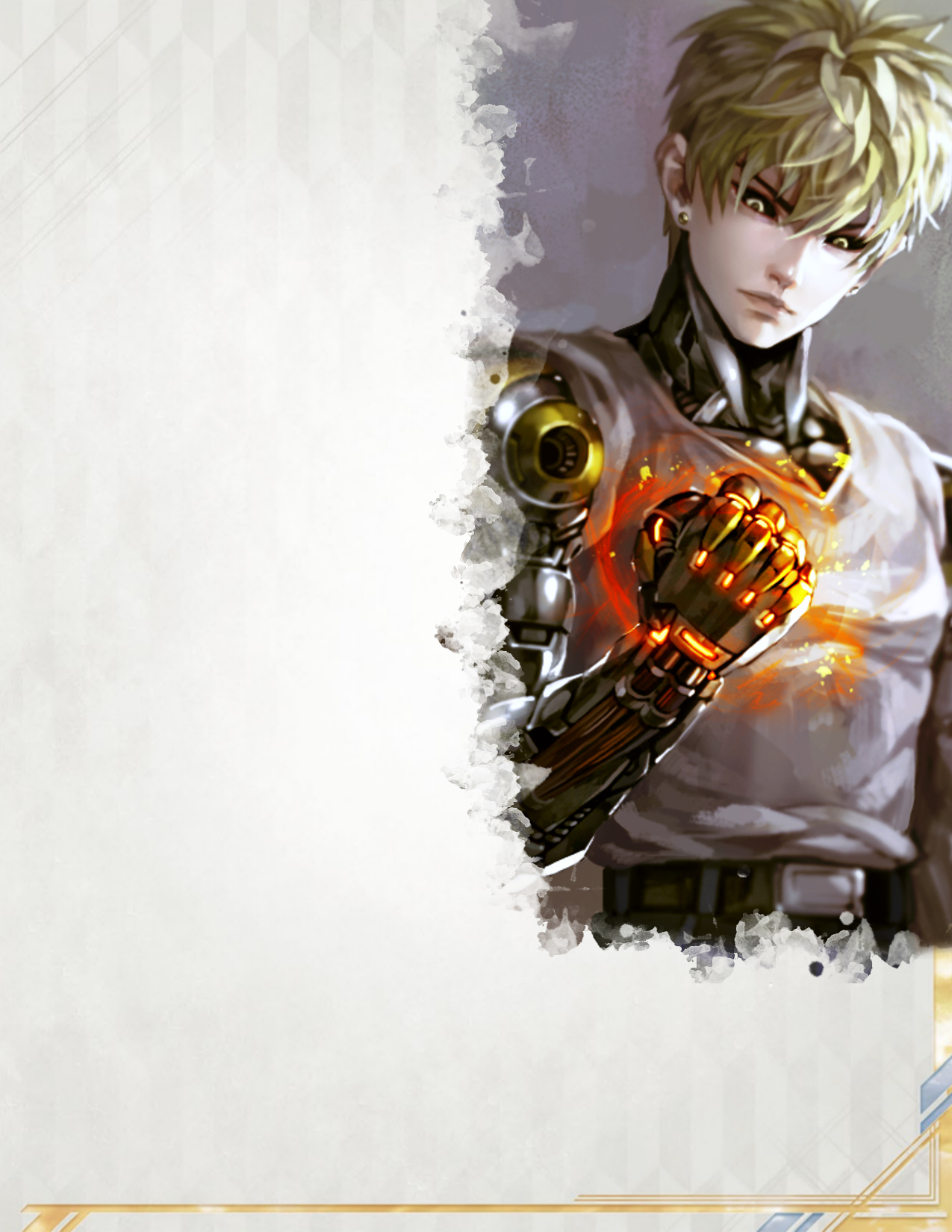
A man chases a thief across the slick rooftops of a cityscape at night, struggling to find purchase with each step. As the thief leaps off a balcony and across an alley, he shakes his head, leveling his mechanical fist at his quarry. With the throw of a switch on his wrist, his hand detaches with the flare of an engine, rocketing towards his target.
On a small hill overlooking a town, a young woman slowly and methodically disassembles her mechanical leg, examining each piece of the mechanism with a practiced eye, blowing out dirt and grime and scraping away flakes of rust. For some of the pieces, she pauses, consulting a nearby blueprint, and makes a small adjustment, looking for a way to improve her running speed.
In the halls of a dungeon, a warrior stands fast against the onslaught of an incoming mechanical golem from a long-lost age. He holds a hand to his head, making minute adjustments to delicate machinery implanted above his ear, and mentally commands the technology embedded there. The golem comes to a lurching stop, now fully under his control.
Borg are individuals who have undergone extensive modification, having parts of their body removed or destroyed, with mechanical and electrical limbs and organs in their place. Some undertake this transformation willingly, seeing it as a means of escaping mortality, while others were not so fortunate, either the result of a drastic attempt at saving their life or the subject of less-than-ethical experiments. Regardless of their origin, borg find themselves suddenly in need of learning technological principles to ensure that they can keep themselves in functioning order, and along the way often find ways to improve upon their modifications, becoming inventors in their own right.
A New Lease on Life
For many who become borgs, the replacement of limbs or internal organs with technological parts is often heralded by a traumatic experience. For others, they may have little memory of their life before being reborn as a mechanical hybrid.
Regardless, most borg see their revival as such a fusion of flesh and machine as a second chance, a way to start over fresh. The capabilities afforded by their new body puts them above most others in terms of raw physical ability, and most borg also find it judicious to study the workings of technology to ensure that they can repair themselves should the worst come to pass.
Embrace the Future
While some may find the idea of replacing their natural body parts with something artificial, others see it as part of the inevitable march of science. Why suffer with a crippled hand or missing leg, when the application of steel and electricity can give you a new limb that -- in some ways -- is even better than the original?
Borg can sometimes come off as almost evangelical with their beliefs in the possibilities of science. However, these views are not universal: not all borg chose their lot in life, seeing what happened to them as an abomination or
something otherwise unwelcome. These borg often take to adventuring as a way of ensuring that this sort of thing doesn't happen to anyone else.
The Borg
| Level | Proficiency Bonus | Augments | Features | Gadgets Known | Inventions Known | Readied Inventions | Max Invention Grade |
|---|---|---|---|---|---|---|---|
| 1st | +2 | — | Borg Drive, Inventions, Mechanization | 4 | 2 | 2 | Prototype |
| 2nd | +2 | 2 | Augmentation | 4 | 3 | 2 | Prototype |
| 3rd | +2 | 3 | Drive Feature | 4 | 4 | 2 | Prototype |
| 4th | +2 | 3 | Ability Score Improvement | 5 | 5 | 3 | Refined |
| 5th | +3 | 4 | — | 5 | 5 | 3 | Refined |
| 6th | +3 | 4 | Drive Feature | 5 | 6 | 3 | Refined |
| 7th | +3 | 5 | — | 5 | 7 | 3 | Refined |
| 8th | +3 | 5 | Ability Score Improvement | 5 | 7 | 3 | Refined |
| 9th | +4 | 6 | — | 5 | 8 | 3 | Improved |
| 10th | +4 | 6 | Mezzode | 6 | 9 | 4 | Improved |
| 11th | +4 | 7 | Eureka | 6 | 10 | 4 | Improved |
| 12th | +4 | 7 | Ability Score Improvement | 6 | 10 | 4 | Improved |
| 13th | +5 | 8 | Drive Feature | 6 | 10 | 4 | Improved |
| 14th | +5 | 8 | Eureka (2) | 6 | 11 | 4 | Improved |
| 15th | +5 | 9 | — | 6 | 11 | 4 | Improved |
| 16th | +5 | 9 | Ability Score Improvement | 6 | 11 | 5 | Improved |
| 17th | +6 | 10 | Eureka (3) | 6 | 12 | 5 | Improved |
| 18th | +6 | 10 | Drive Feature | 6 | 12 | 5 | Improved |
| 19th | +6 | 11 | Ability Score Improvement | 6 | 12 | 5 | Improved |
| 20th | +6 | 11 | Extropic Mezzode | 6 | 13 | 5 | Improved |
Creating a Borg
There are three significant questions when it comes to creating a borg: what sort of person you were before you were turned into a borg, the nature of your prosthetics, and how you respond to your new nature. Taking up the mantle of being a borg implies that you have accepted -- at least on some level -- that your life has changed drastically, and take to the calling of technological improvement of your body.
You could approach these changes with optimism, believing that improving upon yourself is the essence of what it means to be a member of your race. Alternatively you could see it as a necessary evil, something done to keep you alive but that should be avoided at all costs for others. You might see yourself as a champion of technology, a symbol of what it progress is possible with advancements in science, or you could portray yourself as a warning, a dark vision of what is to come if the excesses of science aren't held in check.
Who you were before you became a borg can influence your outlook, as well: a street urchin saved by a kindly technologist might see it as a new lease on life, whereas a spoiled noble might think their life ruined by the need for such crutches as prosthetic limbs. The combination of your past life, outlook on technology, and what sort of modifications you have undergone combined can make for a powerful and interesting story.
Quick Build
You can make a gunslinger quickly by following these suggestions. First, Constitution should be your highest ability score, followed by Intelligence. Then choose the criminal background.
Class Features
As a borg, you have the following class features.
Hit Points
- Hit Dice: 1d8 per borg level
- Hit Points at 1st Level: 8 + your Constitution modifier
- Hit Points at Higher Levels: 1d8 (or 5) + your Constitution modifier per borg level after 1st
Proficiencies
- Armor: Light armor
- Weapons: Simple weapons
- Tools: Tinker's tools
- Saving Throws: Constitution, Intelligence
- Skills: Choose three from Acrobatics, Athletics, Calculation, Engineering, Intimidation, Investigation, Medicine, and Perception
Equipment
You start with the following equipment, in addition to the equipment granted by your background:
- (a) a light crossbow and 20 bolts or (b) two daggers
- (a) a burglar's pack or (b) an explorer's pack
- (a) a basic prosthetic arm, (b) a basic prosthetic leg, or (c) some other organ, dunno
- Tinker's tools
- Leather armor
Borg Drive
Borgs are made, not born: now that you have become one, there is often a reason you have chosen to walk this path, something that drives you from your old life and into the new. The purpose you find in accepting your life as a borg becomes your drive. Choose a drive from the following list: Futurist, Junker, Terminator, or Vector.
Your choice grants you features when you choose it at 1st level and again at 3rd, 6th, 13th, and 18th level.
Inventions
Part of being a borg means that you must have an understanding of science and mechanics, in order to keep your artificial parts operating. This knowledge translates into other scientific knowledge, and this gives you the ability to devise schematics that you can use to build inventions, expressions of technological power that have many useful functions.
See the Technology section later in this work for more information on how inventions work.
Gadgets
You know four gadgets of your choice from the invention list. You learn additional gadgets of your choice at higher levels, as shown in the Gadgets Known column of the Borg table.
Inventions Known
At 1st level, you know two inventions of your choice from the invention list, at prototype grade.
The Inventions Known column of the Borg table shows when you learn more inventions of your choice. When you gain a new invention known, you can either choose a new invention to learn at the prototype grade, or you can improve your understanding of a device you already know, increasing your knowledge of it by one grade, to the max grade indicated on the Borg table.
Building Inventions
You must build inventions before you can make use of them.
Building an invention, or upgrading an existing invention to a higher grade, requires 4 hours of work, tinker's tools, and access to your equipment.
You can carry a number of inventions at a time equal to double the number you can have readied, as part of your equipment, without needing to worry about encumbrance. Because inventions are physical objects, you only have access to your inventions if you have your equipment, and they can be damaged, stolen, or lost like any other object.
Readied Inventions
Readying a new list of inventions requires time spent oiling gears, checking cabling, and generally ensuring that the inventions you wish to use are in good working order.
Readying an invention requires one readied invention slot, regardless of the invention's grade.
You can ready a new list of inventions after a short rest.
Error Rate and Malfunctions
Technology can at times be fickle, and your inventions are no exception.
Any time you activate an invention, you must check for a malfunction. If the invention requires an attack roll, you use the natural value of the d20 you used for the attack roll; otherwise, you roll 1d20 when activating an invention. If the result is equal to or lower than the invention's error rate -- which is 4 for most inventions -- the invention gains the malfunctioning condition; otherwise, it works as intended.
You cannot activate an invention with the malfunctioning condition. You can keep an invention with the malfunctioning condition readied: this indicates that you are working the problem, and will be able to restore the invention to working order. If you choose to replace the malfunctioning invention with another after a short rest, that invention is destroyed, as you give up on restoring it.
You can remove the malfunctioning condition from inventions you have kept readied after you finish a long rest.
Gadgets do not have error rates and cannot malfunction in this manner. If a gadget gains the malfunctioned condition, you can remove that condition from it after a short or long rest.
Inventing Ability
Intelligence is your inventing ability for your inventions, reflecting that the study of science requires a keen mind and a level of curiosity. You use your Intelligence whenever an invention refers to your inventing ability. In addition, you use your Intelligence modifier when setting the saving throw DC for an invention you activate and when making an attack roll with one.
Invention Save DC = 8 + your proficiency bonus + your Intelligence modifier
Invention Attack Modifier = your proficiency bonus + your Intelligence modifier
Mechanization
As a borg, you are partially machine in nature. This has its advantages, but it also has its potential drawbacks.
You are considered a construct in addition to any other creature types you have. If a effect would be able to affect one of your creature types, it can affect you.
In addition, you have some knowledge of how to repair yourself, and can fashion spare parts. You can spend 8 hours to construct a prosthetic. If you do, that prosthetic is uniquely suited to you and your physiology, and other creatures cannot use it. Due to its specificity to your anatomy, prosthetics you
Construct Borgs
Races such as artilects, which are natively artificial in nature, can also take advantage of the borg class. The overall process is similar, though can be less traumatic for constructs than humanoids. You can use the borg class as an artilect - or other construct race - as a way of representing an individual interested in continual self-improvement.
build in this manner are worth only 10% of their original value.
If you take this class as your starting class, this feature applies to prosthetics in your starting equipment.
Augmentation
Starting at 2nd level, the combination of your existing prosthetics, knowledge of engineering, and understanding of the specifics of your own body allows you to engage in extreme self-modification beyond what is possible for most.
You gain two augments of your choice. Your augment options are detailed at the end of the class description. When you gain certain borg levels, you gain additional augments of your choice, as shown in the Augments column of the Borg table.
Building, removing, or changing out an augment requires at least a short rest, and access to tinker's tools and your equipment.
If one of your augment is destroyed -- for instance, if you have a mechanical hand that is somehow lost or dismantled -- you lose access to the effects of that augment until you can build and install a replacement.
Ability Score Improvement
When you reach 4th level, and again at 8th, 12th, 16th, and 19th level, you can increase one ability score of your choice by 2, or you can increase two ability scores of your choice by 1. As normal, you can't increase an ability score above 20 using this feature.
Mezzode
By 10th level, you have undergone sufficient modifications to your body to no longer truly be considered a member of your race -- you are now more artificial than natural.
You gain resistance to bludgeoning, piercing, and slashing damage from nonmagical weapons.
You are immune to disease and poison. You do not need to eat or breathe, but you can ingest food and drink if you wish.
Instead of sleeping, you enter an inactive state for 4 hours each day. You do not dream in this state; you are fully aware of your surroundings and notice approaching enemies and other events as normal.
In addition, you learn the Assembly language. Regardless of your original native language, you now think in Assembly, and at speeds closer to machines than people. Creatures who attempt to detect your thoughts or read your mind must be able to speak Assembly, or else be unable to understand your thoughts.
Eureka
Starting at 11th level, you sometimes have sudden flashes of insight, allowing you to greatly expand on the function of a given invention.
When you activate an invention you know at the improved grade, you can activate it at the augmented grade instead. If you do, the invention automatically malfunctions after its duration ends.
You can use this ability once before finishing a long rest; twice, at 14th level; and three times, at 17th level.
Extropic Mezzode
Once you reach 20th level, you have become a completely artificial and synthetic being: stronger, faster, tougher, and smarter than you could have ever hoped to become.
You lose all of your existing creature types other than construct.
You gain immunity to bludgeoning, piercing, and slashing damage from nonmagical weapons.
Your Strength, Dexterity, Constitution, and Intelligence scores increase by 2. Your maximum for these scores is now 22.
Borg Drives
The past is the past, and as a borg your will to survive combined with extensive modifications has given you the ability to move forward into the future. Borgs vary quite significantly, both in their histories and their outlooks post-modification, and what drives you helps define your abilities and your relationship with the changes made to your mortal shell.
Futurist
The future holds untold wonders, and you strongly believe that science is the lynchpin in that process. Radically modifying your body with technology isn't frightening or terrible, for you: instead, it is an expression of the will to progress, to continue, to grow and change. You are so much more than just your original body and your installed parts: the sum is greater than the whole, and always moving forward to a brighter future.
Modification Specialist
At 1st level, you have focused on knowledge of prosthetics and their proper care -- as well as the procedures to install them with minimal risk.
You gain proficiency in the Engineering and Medicine skills.
You learn the Assembly language.
Implant Expertise
Starting at 3rd level, your knowledge of prosthetics and your body allow you to install more augmentations, pushing yourself to the limit.
You can install an additional augment, and you can install another additional augment at 6th, 13th, and 18th level.
Interchangeable Parts
Beginning at 6th level, your understanding of technology is such that you can build your prostheses, implants, and inventions using the same approach -- allowing you to easily trade out parts when in need.
As a bonus action, you can destroy one of your readied inventions. If you do, you can use your action to do one of the following:
- You can restore a number of your hit points equal to your borg level x 5.
- You can restore one of your prosthetics or augments to working order.
- You can remove the malfunctioned condition from one of your readied devices.
Mechanical Precision
Once you reach 13th level, you are able to work with technology at its speed, rather than with a limited mortal mind.
When you use your action to activate an invention or use an installed augment, you can activate another invention or use another installed augment as a bonus action, provided that invention has an activation time of 1 action or the augment's ability can be used with an action.
Controlled Overload
At 18th level, your knowledge of technology allows you to safely improve an invention's function.
When you use your Eureka feature, the invention does not automatically malfunction.
The invention may still malfunction due to its error rate as normal.
Junker
In your past life, something went terribly wrong, and you almost lost everything. But someone, somehow, saved your life, though to do so required massively changing your body in ways that you might not be entirely comfortable with. Given a second chance, you are determined to not let it go to waste: perhaps you seek out what caused your brush with death, or maybe you'd rather move on and forget it ever happened.
Cling to Life
At 1st level, the trauma of having almost died once makes you cling onto life that much stronger.
You gain advantage on death saving throws.
Fighting Spirit
Starting at 3rd level, your will to fight in the face of adversity makes you tougher than you seem.
Your hit point maximum increases by 2, and increases by another 1 each time you take a level in this class.
Won't Go Down
Once you reach 6th level, your determination to stay alive can thwart even supernatural attempts to bring you down.
You gain resistance to necrotic damage and advantage on saving throws against effects that would reduce your maximum hit points.
Durable
Starting at 13th level, you have learned how to ruggedize your artificial parts and mend your natural ones, allowing you to recover from your wounds faster.
When you roll a Hit Die to regain hit points, the minimum number of hit points you regain from the roll equals twice your Constitution modifier (minimum of 2).
Staying Alive
Beginning at 18th level, your will to live becomes almost insurmountable.
At the start of each of your turns, you regain hit points equal to 5 + your Constitution modifier if you have no more than half of your hit points left. You don't gain this benefit if you have 0 hit points.
Terminator
You may or may not recall your past life before you became a borg, but your life as a half-mortal half-machine began with someone intent on using you for their own ends. Your awakening as a borg also came with a strong sense of purpose, though you retain some amount of free will: do you chafe at the shackles implanted in your mind along with the literal implants in your body, or will you follow your instructions to the bitter end?
Determinator
At 1st level, your mind is difficult to break and your will resistant to subversion.
You gain resistance to psychic damage, and gain advantage on saving throws to avoid becoming charmed.
3rd
Words.
6th
Words.
13th
Words.
18th
Words.
Vector
Your vision is one in which the whole world embraces technology. You see yourself as an icon, a visionary, a revolutionary -- but not of the mundane sort. In the flesh you see only sickness and death: with the power of science, everyone can live healthier, longer lives. You seek not only to change yourself, but others and society itself.
1st
At 1st level, you have focused on knowledge of prosthetics and their proper care -- as well as the procedures to install them mostly safely.
You gain proficiency in the Engineering and Medicine skills.
3rd
Words.
6th
Words.
13th
Words.
18th
Words.
Borg Augments
If a borg augment has prerequisites, you must meet them to learn and install it. You can learn and install an augment at the same time that you meet its prerequisites.
Adrenaline Pumps
Small chemical synthesizers have been installed into some of your vital organs, which can be activated to secrete vast quantities of stimulants for short periods.
As a bonus action, you gain advantage on all Strength checks, and double your carrying capacity, for one minute.
You can use this ability a number of times equal to your Constitution modifier (minimum 1), and regain all expended uses when you finish a short or long rest.
Aerodynamic Fins
You have ray-like fins that you can extrude from your arms and legs, allowing you to slow your fall or glide in the air, and also improve your ability to swim.
When you fall and are not incapacitated, you can subtract up to 100 feet from the fall when calculating falling damage, and you can move up to 5 feet vertically for every 10 feet you fall.
You gain a swim speed equal to half your movement speed.
Auto-otolarynx
Your sense of smell has been vastly improved by the installation of small devices that secrete chemical compounds that react differently with various scents.
You gain advantage on Wisdom (Perception) and Wisdom (Survival) checks that rely on smell.
You suffer disadvantage on saving throws against effects that rely on smell, such as a ghoul's stench ability.
Barbed Skin
Your skin has been implanted with a series of metal barbs and hooks, slashing creatures that touch you.
At the start of your turn, you deal 1d10 nonmagical piercing damage to any creature grappling you or with which you are grappling.
You can activate or deactivate this augment as a reaction.
Integrated Invention
- Prerequisite: 3rd level
You have directly installed one of your inventions into your body, giving you greater control over its function, at the cost of natural ability.
When you select this augment, choose an invention you know, and reduce the number of inventions you can have readied by 1. You always have the selected invention readied, but it does not count against your total number of readied inventions and does not count as a readied invention for purpose of your other abilities, such as Interchangeable Parts.
When the selected invention malfunctions, as a bonus action you can spend a hit die to restore it to working order.
You can change the invention you have selected for this augment after you finish a long rest, so long as you had access to tinker's tools and your equipment during that rest.
You can select this augment multiple times.
Integrated Rockets
- Prerequisite: 9th level
A series of exhaust channels and an internal reservoir of fuel allow you to fly for short periods.
As a bonus action, you gain a fly speed equal to your movement speed for one minute.
For the duration, any creature that begins its turn within 5 feet of you must make a Dexterity saving throw against your invention save DC or take fire damage equal to your Constitution modifier (minimum 1 damage).
You cannot use this ability again until you finish a short or long rest.
Memory Core
- Prerequisite: Terminator, 11th level
A metal memory core has been installed into your brain, along with an intricate interface that allows it to communicate with your physiology on a subconscious level.
Choose one of your existing ideals or bonds, or select a new ideal or bond. If you select a new ideal or bond, you gain it while you have this augment.
While you have this augment, you are immune to compulsions that would force you to act against the selected ideal or bond, even if your actions are otherwise controlled or compelled.
In addition, you are immune to effects that would alter or remove the chosen ideal or bond, and you cannot remove it or act against it of your own volition.
Once you have this augment, you cannot voluntarily take any action that would remove it.
A creature with proficiency in Engineering can create a new memory core, specifying an ideal or bond as part of the creation process, which takes 8 hours. Your memory core can be replaced with another such memory core, provided you are unconscious and the creature replacing it has proficiency in Engineering, with 5 minutes of work.
Nanite Swarm
- Prerequisite: Vector
Your limbs and some of your internal cavities are filled with nanite hives, which you can energize to let loose a swarm of tiny flying machines.
As a bonus action, you can surround yourself with a swarm of small flying machines. The cloud extends 5 feet from you in every direction, but not through total cover. The swarm lasts until you are incapacitated or you dismiss it as a bonus action.
The swarm grants you advantage on Charisma (Intimidation) checks, but disadvantage on all other Charisma checks. Any creature that begins its turn in the cloud takes nonmagical slashing damage equal to your Constitution modifier (minimum 1).
At 5th level, this damage increases to double your Constitution modifier; at 11th, increases to triple your Constitution modifier; and at 17th, increases to four times your Constitution modifier.
Once you use this augment, you cannot use it again until you finish a short or long rest.
Oxidifier Module
Your lungs have been outfitted with a whirring mechanical module that separates oxygen from water, allowing you to breathe some liquids.
You can breathe underwater.
Reactive Plating
- Prerequisite: Terminator, 7th level
Parts of your body have been covered in specially-treated plates that respond to various types of energy, granting you resistance to whatever you encounter.
When you take damage, you can use your reaction to gain resistance to that damage type until the end of your next turn. If this augment's effect is already active, you lose the original effect if you gain resistance to a new damage type.
On your turn, if this augment's effect is active, you can use your bonus action to extend this effect's duration until the end of your next turn.
Redundant Systems
- Prerequisite: Junker, 11th level
For each of the primary systems in your body, you have installed a backup, which can kick into action when your primaries fail -- or serve to reinforce your primary when it is in danger.
When you fail a death saving throw, as a reaction, you can instead succeed on the saving throw.
When you are subject to a critical hit, as a reaction, you can treat it as a normal hit instead.
Once you use this augment, you cannot use it again until after you finish a long rest.
You can select this augment multiple times.
Search Mode
- Prerequisites: Terminator, 3rd level
Your eyes have been augmented with a variety of lenses and connections to a differential data bank stored within your body. These eyes give you the ability to scan objects and creatures quickly and efficiently.
As an action, you instantly become aware of the exact location of all creatures within 30 feet of you. A creature can hide from this effect if it makes a Dexterity saving throw against your invention save DC.
Specialization Module
- Prerequisite: Futurist, 11th level
Your studies of the ways of self-improvement through machinery have culminated in the design of a modular system you can integrate into your body that allows you to take advantage of more specialized augmentations.
Choose a borg subclass other than Futurist. You can take borg augments as though you were also that borg subclass.
If you remove this augment, or it malfunctions, you lose any effect provided by an augment whose prerequisites you no longer meet, until you install this augment again or it is repaired to working order.
You can select this augment multiple times. Each time, you choose a new borg subclass.
Spring-loaded Legs
Your legs and feet have been extensively modified, outfitted with springs and molded into more aerodynamic shapes.
Your long jump is equal to your movement speed, and your high jump equal to half your movement speed, without the need for a running start. With a running start, both of these distances are doubled.
Additionally, your movement speed increases by 5 feet while you are not wearing armor or carrying more than a light load.
Synthetic Setae
Your hands and feet are outfitted with a thin layer of material that can be activated with a small amount of electrical current, giving you an almost supernatural grip.
You gain a climb speed equal to your movement speed, and can climb difficult surfaces, including upside-down on surfaces, without the need to make an ability check.
Therapeutic Blood
- Prerequisite: Junker, 5th level
Part of your blood has been replaced with therapeutic chemicals and oils, allowing you to heal from non-lethal wounds much faster.
At the start of each of your turns, you gain temporary hit points equal to your Constitution modifier (minimum 1) if you have at least 1 hit point.



Detective
A woman ponders the contents of a book of ancient lore, the sigils sketched within reminiscent of something she had seen earlier. She concentrates, focusing on her memory, when she suddenly realizes that she now has all the pieces of the puzzle. She slams the book on the table and heads for the door, already formulating a plan of attack.
On the dirty streets of a large city, a half-orc takes a knee in the street, ignored by the city watch. He touches a finger to the stains left by the body being carted away, and takes a sniff: there is more here than just blood. He glances around, and notices an escarpment high above the street, from which someone would have had clear view of the victim. He rises and, with a subtle nod to one of the watchmen, heads for the building's entrance.
In a crowded tavern, a pair of unruly gentlemen start a ruckus, which quickly turns into a heated argument, then into a drunken brawl. Pulled into the fight, an elderly gentleman intently watches their swaying and slow punches, sidestepping each at the last moment and striking back in ways that seemed to amplify the pain.
Detectives have a keen interest in secrets and puzzles, solving problems that would leave most others scratching their heads. Often equipped with a strong sense of justice, detectives put their skills to use both for governments and private clients, putting together clues and using sound logical reasoning to answer difficult questions. Experts in detection, deduction, and observation, detectives can solve crimes, unravel mysteries, and discover secrets.
Looking for Clues
Detectives excel at gleaning information, be it from a crime scene, a collection of letters, or ancient runes. Their knack for putting the pieces together makes them excel at discovering what their adversaries are up to, negotiating delicate social situations, and can even give them the edge in a bout of fisticuffs.
Not all detectives are adventurers, with many instead leading relatively mundane lives, investigating petty crimes or performing academic research. With their nose for secrets, however, some feel the call of the adventuring life -- while others might happen across a greater secret than they were prepared for, finding themselves caught up in a greater game than they'd anticipated.
Scene of the Crime
Adventurer detectives may not consider themselves adventurers at all: for them, it might just be another job, or perhaps the last big job before they retire. Their interests are often more related to solving the case or cracking the code in front of them, though some have a greater sense of justice and seek out criminals not necessarily as a way to exercise their intellect, but as a way of putting their powers to good use, to try to make the world a better place.
Some detectives dabble in other pursuits, engaged in hobbies that often demand a high level of exacting precision. Others are consumed by passion for their work, working long
hours poring over notes and clues, finding themselves listless when not on a case.
Regardless of their other proclivities and particular habits, however, detectives almost universally dedicate themselves to the task at hand once the game is afoot.
The Detective
| Level | Proficiency Bonus | Features |
|---|---|---|
| 1st | +2 | Inquisitive Senses, Passive Detection |
| 2nd | +2 | Danger Sense, Rational Mind |
| 3rd | +2 | Detective Inclination |
| 4th | +2 | Ability Score Improvement |
| 5th | +3 | Fight Smarter, Saw That Coming |
| 6th | +3 | Inclination Feature |
| 7th | +3 | Logical Insight |
| 8th | +3 | Ability Score Improvement |
| 9th | +4 | Uncanny Dodge |
| 10th | +4 | Inclination Feature |
| 11th | +4 | Analyze Weakness |
| 12th | +4 | Ability Score Improvement |
| 13th | +5 | Acute Observation |
| 14th | +5 | Inclination Feature |
| 15th | +5 | Improved Intuition |
| 16th | +5 | Ability Score Improvement |
| 17th | +6 | Heightened Hearing |
| 18th | +6 | Theory of Mind |
| 19th | +6 | Ability Score Improvement |
| 20th | +6 | Elementary Deduction |
Creating a Detective
The main question to ask when building a detective character is what motivates her. Does her keen intellect cry out to be used for the greater good? Does she have a less-than-healthy obsession with archaeology and ancient secrets? Perhaps some event in her past, like the mysterious death of a loved one, led her down the path of learning how to hone her reasoning skills to a razor's edge.
Also important to consider is how your detective comports herself. Is she an aloof intellectual, unwilling to engage in conversation with someone who can't keep up? Or is she constantly talking, musing over theories and thinking out loud to anyone in earshot, regardless of whether or not they're listening? Perhaps she is one of the more "hardboiled" types, sullen and morose, taking refuge in a bottle after a long day of chasing criminals. These sorts of personality quirks can go a long way in establishing the sort of detective your character is.
Quick Build
You can make a detective quickly by following these suggestions. First, Intelligence should be your highest ability score, followed by either Wisdom or Charisma. Then choose the noble background.
Class Features
As a detective, you have the following class features.
Hit Points
- Hit Dice: 1d8 per detective level
- Hit Points at 1st Level: 8 + your Constitution modifier
- Hit Points at Higher Levels: 1d8 (or 5) + your Constitution modifier per detective level after 1st
Proficiencies
- Armor: Light armor
- Weapons: Simple weapons, hand crossbows, shortswords
- Tools: Disguise kit, thieves' tools
- Saving Throws: Intelligence, Wisdom
- Skills: Choose three from Athletics, Deception, Insight, Intimidation, Persuasion, Sleight of Hand, and Stealth
Equipment
You start with the following equipment, in addition to the equipment granted by your background:
- (a) a hand crossbow and 20 bolts or (b) a shortsword
- (a) a burglar's pack, (b) an explorer's pack or (c) a sage's pack
- (a) a disguise kit or (b) thieves' tools
- Leather armor
Inquisitive Senses
You have developed a knack for picking out things that seem out of place.
Whenever you make a Wisdom (Insight) check to sense if a creature is lying, or a Wisdom (Perception) check to notice a hidden creature or object, you use the total of your check or 8 + your Wisdom modifier, whichever is higher. If you are proficient in Insight or Perception, you add your proficiency bonus to the fixed result for the relevant ability check.
Passive Detection
You have honed your senses and deductive ability to the point where you no longer need to actively look for discrepancies or clues in your environment, as your mind naturally gravitates towards items of interest.
You gain proficiency in the Investigation and Perception skills.
In addition, you have a Passive Investigation score, much like you have a Passive Perception. This is calculated as 10 + your Intelligence modifier + your proficiency bonus. Whenever the GM asks for an Intelligence (Investigation) check with a DC less than or equal to your Passive Investigation score, you automatically pass the check.
Danger Sense
Beginning at 2nd level, you gain an uncanny sense of when things nearby aren't as they should be, giving you an edge

when you dodge away from danger.
You have advantage on Dexterity saving throws against effects you can see, such as traps and spells. To gain this benefit, you can't be blinded, deafened, or incapacitated.
Rational Mind
Starting at 2nd level, you have how to apply your intellect in applications that seem unlikely to the less learned.
Whenever you make an ability check, you can choose to apply your intellect to the problem, giving yourself a bonus equal to your Intelligence modifier. Once you have used this ability, you must finish a short or long rest before you can use it again.
At 5th level, you can also use this ability on saving throws.
At 9th level, you can use this ability twice before you finish a short or long rest.
Detective Inclination
When you reach 3rd level, the particular way you approach problems and contemplate the world allows you to choose an inclination from one of the following: Agent, Archaeologist, Bloodhound, Gumshoe, or Rationalist.
Your choice grants you features at 2nd level, and again at 6th, 10th, and 14th level.
Ability Score Improvement
When you reach 4th level, and again at 8th, 12th, 16th, and 19th level, you can increase one ability score of your choice by 2, or you can increase two ability scores of your choice by 1. As normal, you can't increase an ability score above 20 using this feature.
Fight Smarter
Starting at 5th level, you have learned how to apply your intellect to your fighting style.
Once per round, you can give yourself a bonus on a single weapon attack roll equal to your Intelligence modifier. You must use this ability before you know if the attack hits or misses.
If the attack hits, the attack deals additional damage equal to your Intelligence modifier.
Saw That Coming
At 5th level, you have gained an almost precognitive sense regarding when things are about to turn violent.
You can act normally when surprised, and gain advantage on initiative checks.
Logical Insight
Beginning at 7th level, your natural inclination to use your brain, rather than your brawn, allows you to apply your intellect to physical problems, and advise others in doing the same.
You and all creatures of your choice within 30 feet of you may add your Intelligence modifier to any Strength, Dexterity, and Constitution ability checks.
Creatures other than you must be able to hear you to benefit from this ability.
Uncanny Dodge
Starting at 9th level, you have learned how to deftly turn a dangerous blow into a less lethal one.
When an attacker you can see hits you with an attack, you can use your reaction to halve the attack's damage against you.
Analyze Weakness
At 11th level, your sharp eye and sharper mind can be put to use in combat, allowing you to deduce a creature's weaknesses in the context of the current scenario.
As a bonus action on your turn, you can analyze a creature within 30 feet. That creature gains vulnerability to a damage type of your choice. At the end of each of its turns, it can make an Intelligence saving throw against DC 8 + your Intelligence modifier + your proficiency bonus; if it succeeds, this effect ends.
Creatures with immunity to the selected damage type are immune to this ability with respect to damage types to which they are immune.
Once you have used this ability, you must finish a short rest before you can use it again, and you cannot use it again on the same target until you have finished a long rest.
Acute Observation
At 13th level, your ability to discern truth from the tiniest details becomes honed to a razor's edge.
As an action, you can detect the presence of illusions, shapechanger creatures not in their true form, and other effects designed to fool your senses, within 30 feet of you. Though you determine that an effect is attempting to deceive you, you gain no insight into what is hidden or its true nature.
Improved Intuition
Starting at 15th level, your natural talent for picking out discrepancies in your environment becomes even greater.
Whenever you make a Wisdom (Insight) check to sense if a creature is lying, or a Wisdom (Perception) check to notice a hidden creature or object, you use the total of your check or 12 + your Wisdom modifier, whichever is higher. If you are proficient in Insight or Perception, you add your proficiency bonus to the fixed result for the relevant ability check.
Heightened Hearing
Beginning at 17th level, your aural sense is such that you can detect even the faintest of noises.
When you attack a creature you can't see, your inability to see it doesn't impose disadvantage on your attack rolls against it, as long as you aren't deafened.
You are also aware of the location of any invisible creature within 30 feet of you, provided that the creature isn't hidden from you and you aren't deafened.
Additionally, you gain advantage on all Wisdom (Perception) and Intelligence (Investigation) checks that involve listening or hearing, so long as you aren't deafened.
Theory of Mind
At 18th level, your understanding of how other people think has advanced to the point where you can literally read their thoughts on their faces.
As an action, you can focus on a creature, attempting to glean its mind through analysis of everything you know about it. The target of this ability makes a Wisdom saving throw, with the DC being equal to your Passive Investigation score. If the target fails, you gain insight into its reasoning (if any), its emotional state, and something that looms large in its mind (such as something it worries over, loves, or hates).
If a creature succeeds its saving throw against this ability, you cannot use it again on that creature until you have finished a long rest.
Elementary Deduction
At 20th level, you can make leaps of logic so profound, deductive reasoning so conclusive, perceptive abilities so acute, that it is impossible to debate your arguments.
When you fail an Intelligence (Investigation) or Wisdom (Perception) check, you can choose to instead treat the result of the die as a natural 20.
You can use this ability up to three times before you finish a long rest.
Detective Inclinations
Detectives have a tendency to be a somewhat eclectic sort, and many take up interesting hobbies or activities that challenge their skills, allowing them to keep their intellects honed even when there is no case to solve or riddle to be sorted out.
Agent
Not all of a detective's targets are lowlifes: some are members of the upper crust of society, and to properly dig into their pasts and uncover their crimes, she must learn how to ingratiate herself in the presence of such people. The agent focuses on building her social skills, learning the fine arts of etiquette and deception.
Dilettante
At 3rd level, you have picked up some useful skills and other knowledge that better helps you blend in.
You gain proficiency with the forgery kit.
You also learn two languages of your choice.
Additionally, you can unerringly mimic the speech patterns and accent of a creature that you hear speak for at least 1 minute, enabling you to pass yourself off as a native speaker of a particular land, provided that you know the language.
Witty Banter
At 6th level, you have learned how to turn your intellect to good use in making conversation, putting others at ease with a quick wit where others might use natural charm.
You may add your Intelligence modifier as a bonus on all Charisma checks you make against creatures with an Intelligence score of 2 or higher.
False Identity
Starting at 10th level, you can unfailingly create false identities for yourself, to better blend in with various social circles.
You must spend seven days and 25 gp to establish the history, profession, and affiliations for an identity. You can't establish an identity that belongs to someone else.
Thereafter, if you adopt the new identity as a disguise, other creatures believe you to be that person until given an obvious reason not to.
Become the Role
Starting at 14th level, you have learned how to immerse yourself completely in the role you're playing, making it all but impossible to catch you in a lie.
Your thoughts can't be read by telepathy or other means, unless you allow it. You can present false thoughts by making a Charisma (Deception) check contested by the mind reader's Wisdom (Insight) check.
Additionally, no matter what you say, magic that would determine if you are telling the truth indicates you are being truthful if you so choose, and you can't be compelled to tell the truth by magic.
Archaeologist
Among your interests is the study of the past, and -- more specifically -- what secrets can be gleaned from the ancients. You might have a particular connection to museums, and perhaps even insist that exotic art you find on your adventures be returned to such institutions, where they belong.
Lore of the Past
At 3rd level, you have spent your free time studying ancient texts and tomes, and have gleaned some of their secrets.
You gain proficiency in the History skill.
You also learn two languages of your choice.
Additionally, when you enter a ruin or dungeon, you can correctly ascertain its original purpose and determine its builders, and you can determine the monetary value of art objects more than a century old.
Dungeoneering
At 6th level, you have gained some experience with exploring ancient ruins and forgotten tombs, and have perhaps learned from experience how best to avoid the dangers therein. You gain the following benefits:
- You have advantage on Intelligence (Investigation) and Wisdom (Perception) checks made to detect the presence of secret doors and traps.
- You have advantage on saving throws made to avoid or resist traps.
- You have resistance to damage dealt by traps.
- You can search for traps while traveling at a normal pace, instead of only at a slow pace.
When indoors, you always know which the shortest, most direct physical route to the entrance you used, and to the nearest exit you are aware of.
Relic Identification
At 14th level, you have read much of ancient rites and lost relics, allowing you to readily identify the functions of unusual items, given some time to study them.
You can spend 1 hour studying an item. If it is a magic or technological item, or some other magic-imbued object, you learn its properties and how to use them, whether it requires attunement to use, and how many charges it has, if any. You learn whether any spells are affecting the item and what they are. If the item was created by a spell, you learn which spell created it.
Bloodhound
For some detectives, it isn't enough to solve the question of "who:" they want to see perpetrators brought to justice for their crimes. Some even feel that the law is too slow, or too lax, and see fit to mete out punishment themselves -- perhaps even engaging in a bit of vigilantism on the side.
Follow the Clues
At 3rd level, you have found ways of tracking an individual's movements that involve more than just looking for literal tracks, or spoor.
When tracking creatures, you can make Intelligence (Investigation) checks in place of Wisdom (Perception) checks.
Detective's Mark
At 6th level, you can focus all of your faculties on the primary suspect of your current case -- provided you know who you're hunting.
You can designate one creature that you can identify as your mark. To do so, you must either know the creature's name, possess a likeness of the creature, or have some other means of distinctly identifying the creature.
You have advantage on all Intelligence (Investigation), Wisdom (Perception), and Charisma (Persuasion) checks made to find information about your mark, track your mark, or notice your mark's presence. You also have advantage on Intelligence checks made to recall information about your mark.
You cannot use this ability again until you know your mark is either incarcerated or slain. Otherwise, you can use it again after seven days.
The Drop
At 10th level, you have found that the best way to win a fight is by not letting the other guy even know a fight is happening.
You have advantage on attack rolls against any creature that hasn't taken a turn in the combat yet.
Tactical Strike
At 14th level, your keen mind has mastered the art of planning the perfect ambush.
In combat, your allies have advantage on attack rolls against the first creature you hit during the first round of combat.
Gumshoe
You take the clue-gathering aspect of your chosen profession seriously, and maybe have a knack for more clandestine actions. You've learned the best way to gather information is often to shadow people you think might know something -- barring that, the criminal type seems to have a penchant for leaving their doors unlocked.
Legerdemain
By 3rd level, you've learned how to keep to the shadows, and have a knack for simple acts of legerdemain.
You gain proficiency in the Sleight of Hand and Stealth skills if you don't already have it. Your proficiency bonus is doubled for any ability check you make that uses either of those proficiencies.
Serendipitous Happenstance
Starting at 6th level, you find that all sorts of things just happen to go right for you: people seem to have a habit of dropping incriminating evidence or leaving their doors open.
You can use a bonus action to make a Dexterity (Sleight of Hand) check or use your thieves' tools to open a lock.
Exceptional Detection
Beginning at 10th level, you have developed a keen sixth sense for when you're not alone.
As an action, you instantly become aware of the exact location of all creatures within 30 feet of you. A creature can hide from this effect if it makes a Dexterity saving throw (DC 8 + your Intelligence modifier + your proficiency bonus).
Once you use this feature, you can't use it again until you finish a short or long rest.
Without A Trace
Starting at 14th level, you have learned how to perfectly cover your tracks and quickly get out of eyesight.
You can use the Hide action as a bonus action on your turn. Also, you can’t be tracked by nonmagical means, unless you choose to leave a trail.
Rationalist
The rationalist prides herself on her ability to reason, above all else, and rationality is rooted in an empirically-determined, logically-consistent world. Some worlds, however, seem to not be interested in cooperating, and instead allow for ridiculous things like magic to happen.
For the rationalist, magic is absurdity. It has no place in the natural order, and everything they have gleaned about the world implies that it should not be possible. Your hobby is learning what you can about magic, with your goal perhaps being to find a way to stop the madness, or to determine if it really is part of how reality works.
Occult Knowledge
At 3rd level, you have studied the ways of magic, and are familiar with how it supposedly works, to the point where you can readily identify its presence.
You gain proficiency in the Arcana skill.

In addition, as an action, you can see a faint aura around any visible creature or object within 30 feet of you that bears magic, and you learn its school of magic, if any. This effect can penetrate most barriers, but it is blocked by 1 foot of stone, 1 inch of common metal, a thin sheet of lead, or 3 feet of wood or dirt.
Self-Determination
At 6th level, you have developed a very strong sense of self, and believe strongly in your own self-determination.
You have advantage on saving throws to avoid becoming charmed.
You gain proficiency with Charisma saving throws.
Litany of Tarski
At 10th level, your rationalist beliefs regarding the world help you see it as it truly is.
You have advantage on saving throws and ability checks to detect, and resist the effects of, illusions.
Rejection of the Absurd
At 14th level, your lack of belief in magic becomes so strong, that magic has significantly reduced effects against you.
You have advantage on saving throws against spells.
In addition, you gain resistance against the damage of spells.
Detective Multiclassing
Detectives follow all normal rules for multiclassing.
Prerequisites
Intelligence 13, and Dexterity 13 or Wisdom 13
Proficiencies
Two skills from the class's skill list.


Engineer
A man garbed in brown with a bulky contraption strapped to his back apprehensively approaches a house at dusk, wielding a long staff of wood and steel. As he takes his first step onto the stairs, he thumbs a switch, and steam hisses ominously from his pack, as the sounds of a poltergeist stirring to life within the building echo through the valley.
In a workshop littered with mechanical gadgets and widgets, a gnome studiously pores over a thin strip of paper being laboriously ejected by a clanking and whirring device, while an elven woman and her companion stand nearby. With a sudden exclamation he nods to them, affirming that his machines have calculated the answers they seek.
With a curse unbecoming of her ancestors, a dwarf hastily reloads a heavily-modified crossbow, as the goblins streaming out of an abandoned mineshaft continue their assault. With a harrumph, she forsakes taking aim, instead bracing the weapon against her hip, and lets loose its catch, sending a dozen shafts of steel death hurtling through the air at unconscionable speeds.
Engineers are an unusual breed, putting to use applied scientific theory to work wonders in the form of devices, technological apparatuses that they construct and maintain. For many, they see technology as an equalizing force: one does not have to be born with magic coursing through their veins, or supplicate divine powers for aid, to wield power unimaginable. All it takes is a keen mind, a little creativity, and some elbow grease, and a man and his tools can challenge even the gods.
Students of Science
Above all else, engineers identify as students: while wizards and their ilk might become convinced of their own superiority by wielding powers unfathomable to the common man, engineers are constantly learning about the natural world and how they might make use of new principles uncovered by empirical evidence. Those more inclined to magic might scoff at the brilliance of a well-designed block and tackle, but the engineer knows that even his most wondrous of inventions is firmly rooted in the same principles that people make use of everyday.
The devices at an engineer's disposal may seem strange and unfamiliar, but given time they can be explained to the common man. While the principles of arcane magic and the powers of granted prayers are not beyond the ken of the engineer, she prefers to put her trust instead in her own intellectual prowess and the work of her hands.
Steam and Steel
Engineers are a strange breed of adventurer, a cross between craftsmen and scientists. While many engineers are content to put their skills to use in workshops and centers of higher learning, some seek out new experience in the field, where they might put their inventions to use for any number of goals. Some may want to take a more active hand in helping society progress, while others might seek out new materials or ancient secrets of engineering lost to the modern age.
Engineers can come off as more terrifying to people than even wizards or clerics: wielders of mysterious powers that rarely give outward sign until they are called upon. The engineer, meanwhile, builds and maintains a panopoly of devices with purposes both obvious and obscure - and while a wizard who can suddenly call upon lightning can be terrifying, an engineer with a gun emitting smoke and sparks can be all the more intimidating simply because their powers are that much more obvious.
The Engineer
| Level | Proficiency Bonus | Features | Gadgets Known | Inventions Known | Readied Inventions | Max Invention Grade |
|---|---|---|---|---|---|---|
| 1st | +2 | Inventions, Scientific Method | 3 | 2 | 2 | Prototype |
| 2nd | +2 | Technical Knowledge | 3 | 3 | 2 | Prototype |
| 3rd | +2 | — | 3 | 4 | 3 | Prototype |
| 4th | +2 | Ability Score Improvement | 4 | 5 | 3 | Refined |
| 5th | +3 | — | 4 | 6 | 3 | Refined |
| 6th | +3 | Method Feature | 4 | 7 | 3 | Refined |
| 7th | +3 | — | 4 | 8 | 3 | Refined |
| 8th | +3 | Ability Score Improvement | 4 | 9 | 4 | Refined |
| 9th | +4 | — | 4 | 10 | 4 | Improved |
| 10th | +4 | Method Feature | 5 | 10 | 4 | Improved |
| 11th | +4 | Eureka | 5 | 11 | 4 | Improved |
| 12th | +4 | Ability Score Improvement | 5 | 11 | 4 | Improved |
| 13th | +5 | Eureka (2) | 5 | 12 | 5 | Improved |
| 14th | +5 | Method Feature | 5 | 12 | 5 | Improved |
| 15th | +5 | Eureka (3) | 5 | 13 | 5 | Improved |
| 16th | +5 | Ability Score Improvement | 5 | 13 | 5 | Improved |
| 17th | +6 | Eureka (4) | 5 | 14 | 5 | Improved |
| 18th | +6 | — | 5 | 14 | 6 | Improved |
| 19th | +6 | Ability Score Improvement | 5 | 15 | 6 | Improved |
| 20th | +6 | Wunderwaffe | 5 | 15 | 6 | Improved |
Creating an Engineer
There are two primary things to consider when creating an engineer: how your character came to an understanding of technology, and why they chose their particular field of study. Even in a world in which technology is not yet an active force, the fields of science and wide and varied, and each can have significantly different applications to everyday life. Why did you choose one field over another? What sort of environment were you raised in, that gave you access to the tools and the education necessary to pursue the path of engineering? Were you self-taught, learning about scientific principles from trial and error; or were you an apprentice of someone else, perhaps a blacksmith with a strong grasp of metallurgy and related principles, or even a retired engineer; or perhaps you attended a school or college that taught the basics of the scientific endeavor.
One other thing to keep in mind is how your character feels about technology and its role in society. Do you consider your knowledge of engineering a secret, on par with that of arcane mysteries held by powerful wizards? Or perhaps you feel that technology is the great equalizer between the "haves" and "have nots" of magic, and seek to bring about greater societal change through the application of your devices?
Quick Build
You can make an engineer quickly by following these suggestions. First, Intelligence should be your highest ability score, followed by Dexterity. Then choose the guild artisan background.
Class Features
As an engineer, you have the following class features.
Hit Points
- Hit Dice: 1d6 per engineer level
- Hit Points at 1st Level: 6 + your Constitution modifier
- Hit Points at Higher Levels: 1d6 (or 4) + your Constitution modifier per engineer level after 1st
Proficiencies
- Armor: Light armor
- Weapons: Daggers, darts, light crossbows, light hammers, hand crossbows, heavy crossbows
- Tools: Tinker's tools
- Saving Throws: Dexterity, Intelligence
- Skills: Choose two from Calculation, Engineering, History, Insight, Investigation, Medicine, Nature, and Perception
Equipment
You start with the following equipment, in addition to the equipment granted by your background:
- (a) an explorer's pack, (b) a dungeoneer's pack, or (c) a sage's pack
- A light crossbow and 20 bolts
- Leather armor
- Tinker's tools
Inventions
As a student of the sciences, your understanding of mathematics, logic, and the physical world have given you the knowledge and insight necessary to device schematics that you can use to build inventions, expressions of technological power that have many useful functions.
See the Technology section later in this work for more information on how inventions work.
Gadgets
You know three gadgets of your choice from the engineer invention list. You learn additional gadgets of your choice at higher levels, as shown in the Gadgets Known column of the Engineer table.
Inventions Known
At 1st level, you know two inventions of your choice from the engineer invention list, at prototype grade.
The Inventions Known column of the Engineer table shows when you learn more engineer inventions of your choice. When you gain a new invention known, you can either choose a new invention to learn at the prototype grade, or you can improve your understanding of a device you already know, increasing your knowledge of it by one grade, to the max grade indicated on the Engineer table.
Building Inventions
You must build inventions before you can make use of them.
Building an invention, or upgrading an existing invention to a higher grade, requires 4 hours of work, tinker's tools, and access to your equipment.
You can carry a number of inventions at a time equal to double the number you can have readied, as part of your equipment, without needing to worry about encumbrance. Because inventions are physical objects, you only have access to your inventions if you have your equipment, and they can be damaged, stolen, or lost like any other object.
Readied Inventions
Readying a new list of engineer inventions requires time spent oiling gears, checking cabling, and generally ensuring that the devices you wish to use are in good working order.
Readying an invention requires one readied invention slot, regardless of the invention's grade.
You can ready a new list of engineer inventions after a short rest.
Error Rate and Malfunctions
Technology can at times be fickle, and your inventions are no exception.
Any time you activate an invention, you must check for a malfunction. If the invention requires an attack roll, you use the natural value of the d20 you used for the attack roll; otherwise, you roll 1d20 when activating an invention. If the result is equal to or lower than the invention's error rate -- which is 4 for most inventions -- the invention gains the malfunctioning condition; otherwise, it works as intended.
You cannot activate an invention with the malfunctioning condition. You can keep an invention with the malfunctioning condition readied: this indicates that you are working the problem, and will be able to restore the invention to working order. If you choose to replace the malfunctioning invention with another after a short rest, that invention is destroyed, as you give up on restoring it.
You can remove the malfunctioning condition from inventions you have kept readied after you finish a long rest.
Gadgets do not have error rates and cannot malfunction in this manner. If a gadget gains the malfunctioned condition, you can remove that condition from it after a short or long rest.
Inventing Ability
Intelligence is your inventing ability for your engineer inventions, reflecting that the study of science requires a keen mind and a level of curiosity. You use your Intelligence whenever an invention refers to your inventing ability. In addition, you use your Intelligence modifier when setting the saving throw DC for an engineer invention you activate and when making an attack roll with one.
Invention Save DC = 8 + your proficiency bonus + your Intelligence modifier
Invention Attack Modifier = your proficiency bonus + your Intelligence modifier
Scientific Method
At 1st level, you have developed a particular approach to science, which gives you additional scientific abilities above and beyond your inventions. Choose one of the following scientific methods: Eccentric, Gadgeteer, Inventor, Savant, or Theorist.
Your choice grants you features at 1st level and again at 6th, 10th, and 14th level.
Technical Knowledge
Starting at 2nd level, your general knowledge of technology can be applied to other tasks.
You gain advantage on Intelligence ability checks made to interact with alchemical, mechanical, or otherwise technological items or traps.
Ability Score Improvement
When you reach 4th level, and again at 8th, 12th, 16th, and 19th level, you can increase one ability score of your choice
by 2, or you can increase two ability scores of your choice by 1. As normal, you can't increase an ability score above 20 using this feature.
Eureka
Starting at 11th level, you sometimes have sudden flashes of insight, allowing you to greatly expand on the function of a given invention.
When you activate an invention you know at the improved grade, you can activate it at the augmented grade instead. If you do, the invention automatically malfunctions after its duration ends.
You can use this ability once before finishing a long rest; twice, at 13th level; three times, at 15th level; and four times, at 17th level.
Wunderwaffe
At 20th level, what you have managed with only occasional flashes has become true understanding.
Choose one invention you know. You now know that invention at the augmented grade.
Scientific Methods
While some may claim that the fundamental approach to science is universal, there are many ways to walk that path, and many ways in which an individual can put their scientific knowledge to use.
Eccentric
Some may call you mad, but you prefer to think of that as a reflection of how narrowly most people view the world. You pursue truth and seek to vindicate your theories about the world through demonstrable proof, which you plan to achieve through your own understanding of science.
Passionate Argument
Starting at 1st level, you have great conviction and faith in your theory, such that you can readily sway others to your cause -- or deter them from interfering with your plans.
As an action, you can cause each creature in a 10-foot cube originating from you to make a Wisdom saving throw (DC 8 + your Charisma modifier + your proficiency bonus). The creatures that fail their saving throws are all charmed or frightened by you (your choice) until the end of your next turn.
Once you use this feature, you can't use it again until you finish a short or long rest.
Exotic Theory
At 6th level, you have outlined the generalities of your theories, and while strange, they seem at least somewhat plausible, though bewildering to those unfamiliar with the technicalities.
As an action, you can cause each creature in a 10-foot cube originating from you to make a Wisdom saving throw (DC 8 + your Charisma modifier + your proficiency bonus). The creatures that fail their saving throws are all charmed by you
or confused (your choice) until the end of your next turn.
Once you use this feature, you can't use it again until you finish a short or long rest.
Weird Science
At 10th level, you have realized the potential of your theories, and finally discovered a means of implementing them in your inventions.
Choose two cantrips from any class's spell list. You can construct gadgets that replicate those cantrips, which use your inventing ability rather than any spellcasting ability you may have, and they do not count against your gadgets known.
Reality Warper
By 14th level, your belief in your own theories has become so strong that you warp reality around you.
You gain advantage on saving throws against inventions.
You gain resistance against the damage of inventions.
Gadgeteer
You have had two dreams, often seemingly at odds -- on the one hand, you've yearned to be an adventurer, traveling the world and righting wrongs; on the other, you have a knack for machinery and invention. At some point, you determined that you could combine the two, and have become what could be called a science hero.
Scrappy
Starting at 1st level, you are a bit tougher than those who typically take up the mantle of science.
Your hit point maximum increases by 2, and increases by 1 again each time you take a level in this class.
Daring-Do
At 6th level, your aspirations to be more than just a man of science have led you to improve in other areas.
You gain proficiency in the Acrobatics and Athletics skills if you don't already have it. Your proficiency bonus is doubled for any ability check you make that uses either of those proficiencies.
Utility Belt
At 10th level, you find that having a collection of trusty, more reliable devices can be more helpful than a workshop full of bulky half-finished contraptions.
You learn two additional engineer gadgets of your choice.
For Science
By 14th level, you can inspire both yourself and your allies with the rallying cry of empirical evidence and technological progress.
As a bonus action, you and all allies within 60 feet who can hear you gain advantage on their next weapon attack roll or invention attack roll.
Once you use this feature, you can't use it again until you finish a long rest.
Inventor
You take delight in the simple things: wires clipped to proper length, a well-aligned gear assembly, the smell of iron and oil. You take a no-frills approach to your designs and have a down-to-earth understanding of the sciences, and consider yourself more craftsman than scientist.
Careful Maintenance
Starting at 1st level, you take particular care of your inventions, with a belief in quality over quantity.
So long as you have fewer readied inventions than the number of readied invention slots you have, you reduce your inventions' error rates by 1, to a minimum of 1.
Sticks and Stones
At 6th level, you can make do with just about anything, and can cobble together inventions with little more than your hands and scrap metal.
You do not need access to tinker's tools or your equipment to build inventions.
Salvage
At 10th level, your methods of crafting inventions uses such rigorous standards that you can rapidly use parts from one to repair another.
As a bonus action, you can destroy one of your readied inventions without the malfunctioned condition to remove the malfunctioned condition from one of your other readied inventions.
Repurpose
By 14th level, you can rapidly devise a way to use what you have on hand in unexpected fashions.
As an action, you can destroy two of your readied inventions. If you do, as a bonus action, you can construct a new invention that you know of the same technology field as either of the destroyed inventions, and immediately ready it.
Inventions you construct with this ability are destroyed once their duration ends.
Savant
Your mind works a bit differently from that of others, and you find it easier to understand the workings of a machine than the workings of society. You often retreat from the world into the sanctity of your workshop, where you can create dizzyingly complex machines and edifices that defy common understanding.
Focused Study
Starting at 1st level, you can dedicate yourself tirelessly to the investigation of a single scientific principle, gaining insight into it beyond the ken of others.
When you learn a new invention, you can instead reduce the error rate of an invention you already know by 2, to a minimum of 1.
Tireless Concentration
At 6th level, your ability to focus on your inventions and the
task at hand is so strong that you can ignore distractions.
When you would be forced to make a Constitution saving throw to maintain concentration on an invention, you can instead choose to automatically succeed.
Once you use this feature, you can't use it again until you finish a short or long rest.
Functional Amalgam
At 10th level, you see correlations between functionality that others may have a hard time seeing, and can build multiple functions into a single device.
When you construct an invention, you can combine two inventions into a single one. Readying a combined invention requires one readied invention slot. When you activate the invention, you choose which of its component inventions you use.
The error rate of a combined invention increases to 7. Due to its increased complexity, a combined invention that malfunctions is destroyed.
Behold
By 14th level, you can demonstrate the power of technology by safely overloading one of your inventions, improving its capabilities temporarily, without it exploding or melting.
When you use your Eureka feature, the invention does not automatically malfunction.
The invention may still malfunction due to its error rate as normal.
Theorist
You find your mind wandering often, and have sudden spurts of inspiration -- looking at birds may inspire you to design a gyrocoptor, or the way the light reflects off a pond may lead to you designing an orrery that can focus light. You are always sketching up new ideas, though this sometimes leaves less room for implementation.
Blueprint Sketches
Starting at 1st level, you have more ideas for invention designs than others, but they are often less fleshed out.
You gain one additional invention known, and another invention known at 6th, 10th, and 14th level. You can use these inventions known to improve an invention you already know to a higher grade, if you have access to higher invention grades.
However, your inventions have an error rate of 5.
One Last Adjustment
At 6th level, you can spot potential problems with your inventions before catastrophe can strike.
When you activate an invention, you can spend your bonus action to reduce its error rate by 3, to a minimum of 1.
Once you use this feature, you can't use it again until you finish a short or long rest.
Emergency Power
At 10th level, you can quickly prepare an invention for use, though doing so can be dangerous to its integrity.
You can activate an invention you have constructed that you
do not have readied; if you do, increase its error rate by 6. The device is destroyed if it malfunctions or after its duration ends.
Once you use this feature, you can't use it again until you finish a short or long rest.
Flash of Insight
By 14th level, you sometimes have sudden inspiration for new ideas, and can rapidly prototype something out of what you have at hand -- though such inventions have a tendency to not survive past their first use.
As an action, you can destroy one of your readied devices. If you do, as a bonus action, you can construct a new invention that you do not know, at prototype grade, of the same technology field as the destroyed invention, and immediately ready it.
Using this ability counts as a use of your Eureka feature.
Inventions you construct with this ability cannot benefit from your Eureka feature, and are destroyed once their duration ends.
Engineer Multiclassing
Engineers follow all normal rules for multiclassing.
Prerequisites
Intelligence 13
Proficiencies
The Engineering skill.


Gunslinger
The man clad in black fled across the wastes, and the gunslinger followed his trail. He could recall his father's face, and had no intention of letting the man who killed him get away with the crime, no matter how far the culprit might run. He would see justice, one way or the other, even if the world moved on before then.
A halfling woman lies on the roof of a building, longarm laid carefully before her, as she watches another building in the distance: the target of her crew's most recent caper. A chirrup on her radio informs her of their success, and she lays down, putting her eye to the scope, ready to lend covering fire from her perch as necessary.
In the time-honored hall of a king, a man kneels, clad in leather and armed with a gun, where once his grandfather knelt in plate, carrying a sword. The trappings of the knight-errant may have changed, the king's herald declares, but the honor of a knight is not within the iron he carries: it is held aloft by the ideals in his heart and the oaths of his words. The man rises, and his peers cheer: another light against the darkness is born.
Gunslingers come from a variety of backgrounds, and can even mean different things in the same setting: one country may embrace the concept of firearms wholeheartedly, replacing their swords with pistols and training their knights in lighter armor and a new way of thinking about combat. In a far-away city-state, guns might be used only by a few, the weapons doled out as they're produced by a lone tinker, and those who take them up are considered strange or dishonorable.
Weapons of a New Age
Regardless of how they come about, gunslingers are a new sort of warrior. The weapon a man wields determines how he fights, and firearms are an entirely different paradigm from more classic arms, requiring a new way of thinking about how to approach combat. Simply due to the speed of their projectiles, guns can be significantly more deadly than bows, and this typically leads to an emphasis on speed, agility, and situational awareness: those who wield guns tend to be much more aware of cover than even archers. You can see an arrow being lined up for the shot -- but a trigger can be pulled with a twitch of the finger.
While the gunslinger's approach to combat can be adapted to other weapons -- crossbows are often used as a backup weapon, for instance -- the mindset used when a gunslinger enters combat is with firearms in mind, and this can make it difficult to adapt to other styles of fighting.
The Good, The Bad, and The Ugly
Above all else, firearms are a societal equalizer: swords and axes require a strong arm to make use of properly, and training in bows can take years before an archer can reliably hit his mark. When it comes to guns, however, even a child can pick one up and bring a man down. This has a tendency to make gunslingers, and the societies that produce them, noticeably more equal in terms of social class and gender roles.
While more advanced training in firearms may be difficult to come by, anyone can pick up a gun and start teaching themselves. This leads to gunslingers being an incredibly diverse lot, and some may see gunslinging as a means of achieving justice otherwise denied them.
The Gunslinger
| Level | Proficiency Bonus | Features |
|---|---|---|
| 1st | +2 | Fighting Style, Gunna, Pull Leather |
| 2nd | +2 | Stoicism, Way of the Gun |
| 3rd | +2 | Gunslinger Trail |
| 4th | +2 | Ability Score Improvement |
| 5th | +3 | Extra Attack, Rapid Reload |
| 6th | +3 | Disabling Shot |
| 7th | +3 | Trail Feature, Evasion |
| 8th | +3 | Ability Score Improvement |
| 9th | +4 | Tumble |
| 10th | +4 | Trail Feature |
| 11th | +4 | Seamless Barrage |
| 12th | +4 | Ability Score Improvement |
| 13th | +5 | Return Fire |
| 14th | +5 | Cheat Death |
| 15th | +5 | Trail Feature |
| 16th | +5 | Ability Score Improvement |
| 17th | +6 | Clean Shot |
| 18th | +6 | Matchless Awareness |
| 19th | +6 | Ability Score Improvement |
| 20th | +6 | Perfect Shot |
Creating a Gunslinger
How and why did you first pick up a gun? The story of how you came into firearms and began intensely studying how to use them effectively is arguably the most important part of playing a gunslinger, as it informs quite a bit about your character's view on guns, the world, and his goals. Were you a common man, who sees guns as a way to level the playing field? Are you a knight-errant in a new age, adventuring much as your sword-bearing cousins, looking for chances to prove your worth? Or perhaps you fell on hard times, turning to banditry or thuggery as a way of staying alive -- and guns certainly seemed like a way to make that path significantly easier.
Perhaps equally important is to discuss with your GM the nature of firearms in your game. For some, guns might be part and parcel of their setting; for others, you could be from a distant land, unfamiliar with local customs and wielding foreign weapons; or, you could be a trailblazer of a sort, a new sort of fighter in an old world that hasn't yet moved on.
Quick Build
You can make a gunslinger quickly by following these suggestions. First, Dexterity should be your highest ability score, followed by Charisma. Then choose the folk hero background.
Class Features
As a gunslinger, you have the following class features.
Hit Points
- Hit Dice: 1d10 per gunslinger level
- Hit Points at 1st Level: 10 + your Constitution modifier
- Hit Points at Higher Levels: 1d10 (or 6) + your Constitution modifier per gunslinger level after 1st
Proficiencies
- Armor: Light armor
- Weapons: Simple weapons, martial firearms
- Tools: Gunsmith's tools
- Saving Throws: Dexterity, Charisma
- Skills: Choose two from Acrobatics, Animal Handling, Athletics, Deception, Insight, Intimidation, Perception, Persuasion, and Sleight of Hand
Equipment
You start with the following equipment, in addition to the equipment granted by your background:
- (a) two pistols and 20 bullets or (b) a revolver and 20 bullets
- (a) an explorer's pack or (b) a dungeoneer's pack
- A dagger
- Leather armor
Fighting Style
You have adopted a particular style of gunfighting as your specialty. Choose one of the following options. You can’t take a Fighting Style option more than once, even if you later get to choose again.
Akimbo
When you take the Attack action and attack with a firearm that you're holding in one hand, you can use a bonus action to attack with a different firearm that you're holding in the other hand.
Cover
You can take the Dodge action as a bonus action.
Deadshot
When you roll a 1 or a 2 on a damage die for an attack you make with a firearm, you can reroll the die and must use the new roll, even if the new roll is a 1 or a 2.
Sniping
You gain a +2 bonus to attack rolls you make with firearm weapons.
Gunna
Part of the training in gunslinging is making minute adjustments to your chosen weapons, so that they perfectly match your hands, grip, and height.
So long as you have gunsmith's tools, you can spend 1 hour modifying a firearm. If you do, that weapon is uniquely suited to you, and other creatures have disadvantage on attack rolls with it. However, due to the irreversible modifications, the weapon's value is only 10% of its original value.
If you take this class as your starting class, this feature applies to firearms in your starting equipment.
Pull Leather
In gunslinging, the fate of a combatant often isn't decided by the size of the weapon or the strength of the one using it, but instead only by reflexes. He who shoots first, wins.
You can make opportunity attacks while wielding a firearm.
Additionally, you can draw a firearm as part of making an initiative check.
Stoicism
At 2nd level, masking your intentions has become second nature, as you avoid telegraphing your movements and plans.
You have advantage on ability checks and saving throws made to prevent others from sensing your motives, perceiving your emotions, or reading your thoughts.
Way of the Gun
Beginning at 2nd level, your honed situational awareness allows you to use guns even in tight quarters.
Being within 5 feet of a hostile creature doesn't impose disadvantage on attack rolls you make with firearms.
Gunslinger Trail
At 3rd level, you have chosen a particular way of living and fighting, known as your trail. You can select a gunslinger trail from the following list: Gunsai, Machinist, Musketeer, Regulator, and Riskbreaker.
Your choice grants you features at 3rd level and again at 7th, 10th, and 15th level.
Ability Score Improvement
When you reach 4th level, and again at 8th, 12th, 16th, and 19th level, you can increase one ability score of your choice by 2, or you can increase two ability scores of your choice by 1. As normal, you can't increase an ability score above 20 using this feature.
Extra Attack
Beginning at 5th level, you can attack twice, instead of once, whenever you take the Attack action on your turn.
Rapid Reload
Starting at 5th level, you ignore the loading quality of firearms with which you are proficient.
Disabling Shot
At 6th level, you can shoot not just for effect, but to also disable your target in some fashion.
As a bonus action, you can add an additional effect to the next firearm attack you make on the same turn. If your next firearm attack hits, your target must make a Dexterity saving throw against DC 8 + your Dexterity modifier + your proficiency bonus, or else suffer one of the following effects of your choice:
- stunned, until the end of its next turn
- frightened, until the end of its next turn
- prone
Evasion
At 7th level, your honed reflexes let you dodge out of the way of certain area effects, such as a black dragon’s acid breath or a fireball spell.
When you are subjected to an effect that allows you to make a Dexterity saving throw to take only half damage, you instead take no damage if you succeed on the saving throw, and only half damage if you fail.
Tumble
Starting at 9th level, your extraordinary reflexes allow you to rapidly tumble out of the way of danger.
When a creature that you can see hits you with an attack, you can use your reaction to move up to half your movement speed; if you move at least 5 feet, you halve the attack's damage against you. While moving in this fashion, creatures have disadvantage on opportunity attacks against you.
Seamless Barrage
Beginning at 11th level, you know -- the moment you pull the trigger -- if a shot will be fatal, allowing you to rapidly choose a new target.
When you take the Attack action and attack with a firearm, and deal enough damage to drop a creature to 0 hit points, you can make another attack with that weapon at another creature within 10 feet of the original target.
Return Fire
At 13th level, you can turn your enemy's misfortune into an advantage.
As a reaction, whenever a creature you can see misses you with a ranged, spell, or device attack, you can make an attack against that creature with a firearm you are wielding.
Cheat Death
Starting at 14th level, you have a knack for narrowly escaping death.
When you would be reduced to 0 hit points, you can use your reaction to avoid being incapacitated, and instead be reduced to 1 hit point.
Once you use this feature, you can't use it again until you finish a long rest.
Clean Shot
Starting at 17th level, you are able to shoot a creature in such a way as to set it up for an even more destating followup.
When you take the Attack action to make an attack with a firearm, if you hit a creature, the next attack you make against that same creature deals double damage on a hit.
Matchless Awareness
Beginning at 18th level, you do not aim with your eye, you aim with your mind.
When you attack a creature you can't see, your inability to see it doesn't impose disadvantage on your attack rolls with firearms against it.
You are also aware of the location of any invisible creature within 30 feet of you, provided that the creature isn't hidden from you, and you aren't blinded or deafened.
Perfect Shot
At 20th level, your speed and reflexes have become the stuff of legend: no one can outshoot you, and with a single pull of the trigger, you can end a conflict.
When you make an initiative check, you can draw a firearm and make a single attack with it. If you hit, if the target has less than 100 hit points, it dies. Otherwise, your attack deals 10d10 additional damage. Elementals, oozes, and creatures which lack nervous systems or vital organs take no additional damage from this ability.
Once you use this feature, you can't use it again until you finish a long rest.
Gunslinger Trails
The art of gunfighting is one that can be appreciated by people with many differing styles and different purposes in life. The combination of way of fighting and intent is known among gunslingers as a trail.
Gunsai
For the gunsai, the thrill of combat is transcendental, treating it as an almost religious experience. Gunsais combine the way of the gun with meditation and introspection, treating gunplay almost as a martial art unto itself, and often have more in common with monks and other spiritual types than other gunslingers.
Brilliant Disarm
At 3rd level, your understanding of the motion of weapons and guns in combat is peerless.
When you take the Attack action and attack a creature within 5 feet of you, you can attempt to disarm that creature instead. Your attack roll is contested by the target's Strength (Athletics) check or Dexterity (Acrobatics) check. If you win the contest, your attack causes no damage or other ill effect, but the defender drops the item, or you are now holding it if you have a free hand.
You have disadvantage on your attack roll if the target is holding the item with two or more hands. The target has advantage on its ability check if it is larger than you, or
disadvantage if it is smaller.
If you disarm a creature of a firearm, as a bonus action you can make an attack with that weapon against the creature you disarmed.
The Willow Bends
At 7th level, your understanding of gunfire allows you to seemingly step between bullets.
When you take the Dodge action, all ranged attacks against you have disadvantage.
Bullet Time
Beginning at 10th level, your awareness of your surroundings is such that you can perceive things almost as though they were moving in slow motion.
When you take the Attack action to make an attack with a firearm, you can use your bonus action to gain advantage on the attack roll.
Saint of Smoke and Thunder
Starting at 15th level, you have achieved a transcendental understanding of the battlefield, sliding seamlessly between bullets and arcing gracefully away from blasts of energy.
You gain resistance to damage from ranged attacks.
Machinist
Your understanding of the mechanics of the weapons you use is greater than most, and you find yourself interested in tinkering along with the art of gunnery. Where other gunslingers have a tight focus on improving their ability with firearms, you recognize that having a few other tricks up your sleeve can help in a pinch.
Inventions
When you reach 3rd level, you augment your knowledge of gunplay with the use of technological inventions.
You gain proficiency in the Engineering skill.
Gadgets. You learn two gadgets of your choice from the engineer invention list. You learn an additional engineer gadget of your choice at 10th and 18th level.
Readied Inventions. The Machinist Inventions table shows you how many readied invention slots you have to ready your inventions. You can activate any invention you know, but all your inventions have an error rate of 5, and malfunction on that result or lower on the attack roll (or separate d20 roll when you activate the invention, if it doesn't call for an attack roll). You can change out your readied inventions after a short rest; if you trade out a malfunctioned invention in this fashion, it is destroyed.
Inventions Known. You know three inventions of your choice, at prototype grade, chosen from the engineer invention list. Two of these inventions must be chosen from the electrical or mechanical fields on the engineer invention list.
The Machinist Inventions table indicates when you learn new inventions. When you learn a new invention, you can either learn a new invention at prototype grade, or improve your knowledge of an invention you already know by one grade, to the maximum grade per your level on the table.
Invention Ability. Intelligence is your invention ability for your gunslinger devices, reflecting that the study of science
Machinist Inventions
| Gunslinger Level | Gadgets Known | Inventions Known | Readied Inventions | Max Invention Grade |
|---|---|---|---|---|
| 3rd | 2 | 3 | 1 | Prototype |
| 4th | 2 | 4 | 2 | Prototype |
| 5th | 2 | 4 | 2 | Prototype |
| 6th | 2 | 4 | 2 | Prototype |
| 7th | 2 | 5 | 2 | Prototype |
| 8th | 2 | 5 | 2 | Prototype |
| 9th | 2 | 6 | 2 | Prototype |
| 10th | 3 | 6 | 2 | Prototype |
| 11th | 3 | 6 | 2 | Prototype |
| 12th | 3 | 7 | 2 | Prototype |
| 13th | 3 | 7 | 2 | Refined |
| 14th | 3 | 8 | 2 | Refined |
| 15th | 3 | 8 | 2 | Refined |
| 16th | 3 | 8 | 2 | Refined |
| 17th | 3 | 9 | 2 | Refined |
| 18th | 4 | 9 | 3 | Refined |
| 19th | 4 | 10 | 3 | Refined |
| 20th | 4 | 10 | 3 | Refined |
requires a keen mind and a level of curiosity. You use your Intelligence whenever an invention refers to your invention ability. In addition, you use your Intelligence modifier when setting the saving throw DC for a gunslinger invention you activate and when making an attack roll with one.
Invention Save DC = 8 + your proficiency bonus + your Intelligence modifier
Invention Attack Modifier = your proficiency bonus + your Intelligence modifier
Two Hands, One Mind
Starting at 7th level, you can keep one hand on a device and one on your gun.
When you use your action to activate an invention, you can make one firearm attack as a bonus action.
Kinda Like a Gun
Beginning at 10th level, you can translate some of your knowledge of how to move when using a gun to activating your devices.
Being within 5 feet of a hostile creature doesn't impose disadvantage on attack rolls you make with your inventions.
Make an Opening
At 15th level, you have learned how to use a firearm to make an opening for a device's effect.
When you hit a creature with a firearm attack, that creature has disadvantage on the next saving throw it makes against an invention you activate before the end of your next turn.
Musketeer
Where once a knight would have stood -- plate armor, shield, and sword, all gleaming in the sun -- now you take your place, garbed in leather and carrying a gun. Though the trappings of your order may have changed, you serve much the same purpose as a knight, charged with protecting the realm and upholding justice where you go.
Gun and Sword
Starting at 3rd level, you have trained in the use of more traditional weaponry.
You gain proficiency with rapiers and shortswords.
When you engage in two-weapon fighting while wielding a firearm and a finesse melee weapon, you can add your ability modifier to the damage of the second attack.
Court Intrigue
Beginning at 7th level, you have been practicing your wit for a different sort of battlefield.
You gain proficiency in two of the following skills of your choice: Deception, Persuasion, or Intimidation.
Rapier Wit
At 10th level, you augment your combat skills with witty repartee, adding insult to injury.
When you hit a creature with a firearm or finesse melee weapon attack, you can cast vicious mockery at the same creature as a bonus action, with a saving throw DC of 8 + your Charisma modifier + your proficiency bonus.
All for One, One for All
Starting at 15th level, you can rally your allies to your cause, raising spirits and giving them encouragement to see things through to the end.
As a bonus action, you can give yourself and all allies within 30 feet of you advantage on their next attack roll. A creature must be able to hear you to benefit from this ability.
Once you use this feature, you can't use it again until you finish a long rest.
Regulator
In the wilder places of the world, a man with a gun can make the difference in keeping the peace. Your goal is not necessarily to uphold law and order -- though it certainly could be -- but instead to ensure that people can get on with living, free from predation, of both the monstrous and legal varieties.
Hunter
At 3rd level, you have learned some of the tricks of hunting down what needs hunting down, be it a wild animal or something smarter.
You gain proficiency in the Survival skill.
Eagle Eye
Starting at 6th level, your situational awareness allows you to rapidly scan the situation for new threats.
You can take the Search action as a bonus action.
You also gain proficiency in the Perception skill, if you did not have it already, and you can add twice your proficiency modifier to Wisdom (Perception) checks you make that rely on sight.
Moxie
By 10th level, you are unflappable.
You gain proficiency in Constitution saving throws.
Swift Vengeance
At 15th level, shooting you is much like shooting a bear -- it only makes you angry.
When you take damage from a creature within 15 feet of you, you can use your reaction to make a firearm attack against that creature.
Riskbreaker
Some men live on the edge of a knife, seeking out danger for their own inscrutable purposes. Wandering from place to place, these "riskbreakers" -- called as such for their willingness to risk everything, and yet seemingly always beating the odds -- do what few others will do, be it for coin, the thrill, or some other reason.
Fan the Hammer
At 3rd level, you have learned the best ways of getting the most out of a firearm.
When you take the Attack action and attack with a firearm, you can use your bonus action to make an attack with that weapon.
Pistol Whip
Beginning at 6th level, you know that a firearm has two business ends, and aren't afraid to use either.
As an action, you can make an attack with the butt or handle of a firearm you wield. The damage of your attack is based on the size of your firearm: a one-handed weapon deals
1d6 bludgeoning damage, and a two-handed weapon deals 1d10 bludgeoning damage. For the purpose of this attack, treat the firearm as if it was a simple weapon with the finesse property.
While you wield a firearm, you are considered to be wielding both a melee and a ranged weapon.
Fast and Furious
Starting at 10th, you have trained yourself to shoot faster than most can blink.
You can attack three times, instead of once, whenever you take the Attack action on your turn. Each of these attacks must be made with a firearm you are wielding.
Hail of Bullets
At 15th level, you can unleash a storm of fury and hot lead against all in your path.
Once per turn, when you take the Attack action and attack with a firearm, you can choose to fire a hail of bullets. If you do, all creatures within a cone the size of your weapon's normal range must make a Dexterity saving throw against DC 8 + your Dexterity modifier + your proficiency bonus. You deal double your weapon's normal damage to creatures who fail the saving throw, and its normal damage against creatures that pass the saving throw.
Gunslinger Multiclassing
Gunslingers follow all normal rules for multiclassing.
Prerequisites
Dexterity 13, and Wisdom 13 or Charisma 13
Proficiencies
One martial firearm of your choice.
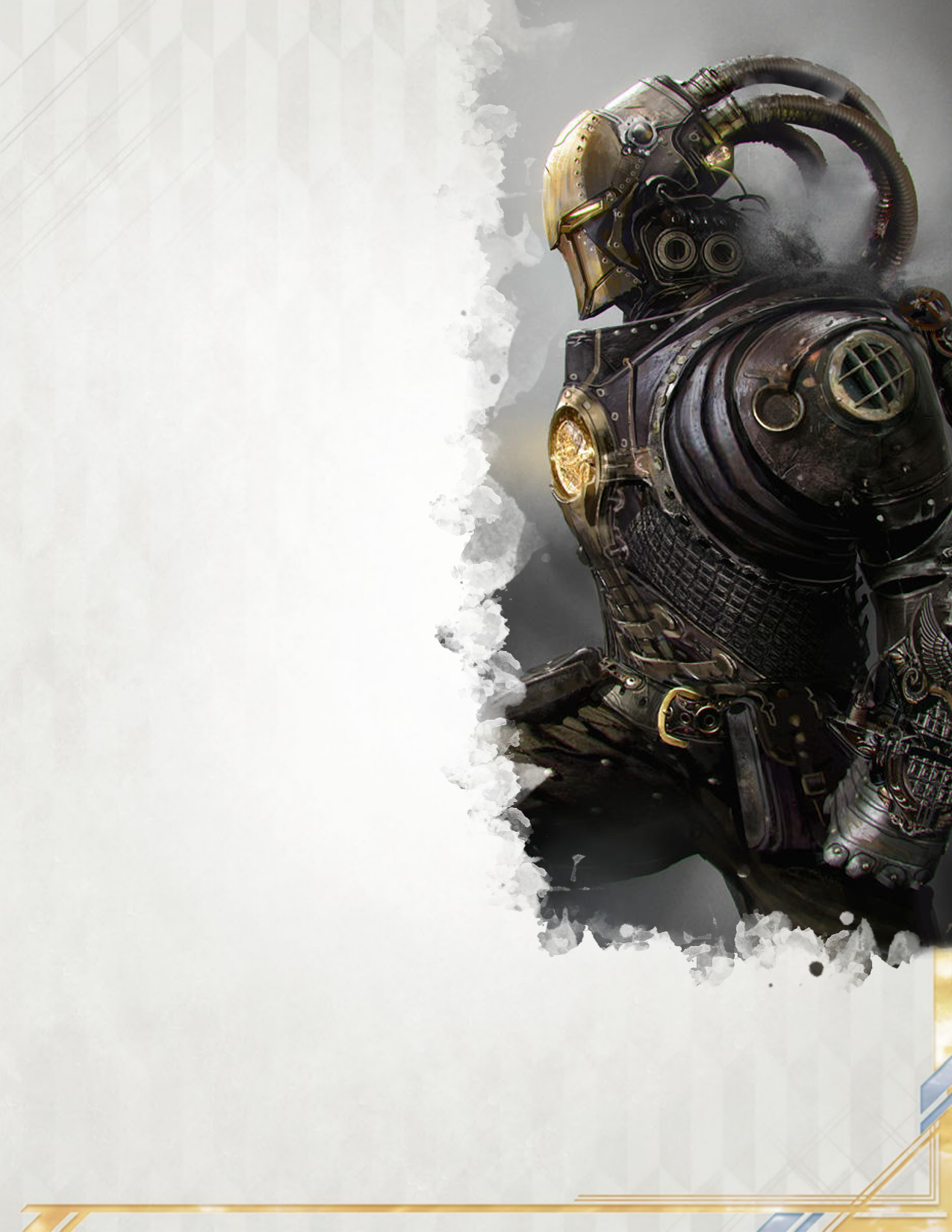

Ironman
A mechanized wagon careens down a street, the city watch powerless to stop them. As they turn a corner, the wall of a nearby building explodes outward, showering them in splintered wood and shattered bricks. Stunned, the criminals watch as a figure clad in all steel, emitting steam as its oversized metal hands glow with the heat of a furnace, steps into their path.
On a trackless path hundreds of miles from the nearest civilization, an old hermit cowers in fear of the dragon circling overhead. With a sound like roaring thunder, one fist raised to the air, his rescuer -- in what seems like heavy armor -- does the seemingly impossible, jets of flame belching from his back as his rises into the sky to do battle with an ancient evil.
An enormous man sits on a chair at a tavern, nursing a drink while he equally nurses his wounds. Nearby, he notices a man getting a little too friendly with one of the barmaids. With a heavy sigh, he rises, trudges over, and pointedly puts a hand on the man's shoulder. The punch to his face is not unexpected: he rolls his eyes and squeezes, as the recipient of his wrath suddenly realizes who he's picked a fight with, and that puts an end to that.
In a world of steam and steel, there is little room for the flesh: and so those who would wade into combat learn to augment their bodies with iron, wearing suits of armor empowered by technology, giving them incredible strength and endurance. Even as machines and guns become more commonplace, they take to the front lines, using their armor to shield others and deliver punishment to their foes.
Tougher Than Nails
It is a known truth that most humanoids are frail beings, compared to many of the denizens of the world. Ancient dragons, fierce chimeras, enduring golems -- compared to these, a normal man is as fragile as a gossamer thread, and it is no wonder that these threats to civilization have endured for so long. It is, if nothing else, the work of divine providence that prior to the age of invention, societies managed to exist at all.
The solution, then -- so far as the ironman is concerned -- is to augment the flesh. The humble armors of mere iron plates of yesteryear are clearly no match for what the world is capable of, and so new armor must be devised: stronger, tougher, faster. With the advent of technology, these armors can be built in such a way that they can improve upon a man's strength, letting him hit harder than ever before, without slowing him down and turning him into a sitting duck. The training, however, is brutal, and precious few are able to withstand the pressure and physical demands of wearing such armor -- those who do, however, find the rewards well worth the pain.
Hold the Line
Ironmen are soldiers, warriors who see the value of technology and the ways it can be used to build upon their capabilities. While others may turn to the new weapons made possible by these advances, ironmen instead see invention as a way of building upon their natural state, improving what
they have and making it functional in a new age. A sword powered only by a human arm may not pierce a dragon's hide, but perhaps one powered by hydraulics will.
As a general rule, ironmen see themselves as defenders. While some may use their armor as a way to throw their weight around, many see it as a symbol of progress and civilization, a way to protect that which is important.
The Ironman
| Level | Proficiency Bonus | Features | Low | Mid | High |
|---|---|---|---|---|---|
| 1st | +2 | Armiger, Heavy Strikes | +1 | +1 | +0 |
| 2nd | +2 | Bastion | +1 | +1 | +0 |
| 3rd | +2 | Advanced Armiger, Ironman Chassis | +1 | +1 | +0 |
| 4th | +2 | Ability Score Improvement | +2 | +1 | +0 |
| 5th | +3 | Vigilance | +2 | +2 | +0 |
| 6th | +3 | Assault, Immovable | +2 | +2 | +1 |
| 7th | +3 | Chassis Feature | +2 | +2 | +1 |
| 8th | +3 | Ability Score Improvement | +3 | +2 | +1 |
| 9th | +4 | Inexhaustible | +3 | +2 | +1 |
| 10th | +4 | Implacable | +3 | +2 | +1 |
| 11th | +4 | Chassis Feature | +3 | +3 | +1 |
| 12th | +4 | Ability Score Improvement | +4 | +3 | +1 |
| 13th | +5 | Invincible | +4 | +3 | +1 |
| 14th | +5 | Indomitable | +4 | +3 | +2 |
| 15th | +5 | Chassis Feature | +4 | +3 | +2 |
| 16th | +5 | Ability Score Improvement | +5 | +3 | +2 |
| 17th | +6 | Impervious | +5 | +4 | +2 |
| 18th | +6 | Chassis Feature | +5 | +4 | +2 |
| 19th | +6 | Ability Score Improvement | +5 | +4 | +2 |
| 20th | +6 | Indestructible | +6 | +4 | +2 |
—Power Armor Module Slots—
Creating an Ironman
The first question you need to ask is how you came into your armor. Was it provided for you as part of your training in a military unit? Or perhaps it's something you've put together yourself. Maybe you came across it in the wilderness, its previous owner gone -- and you took it upon yourself to learn how to put it to use. The story of your armor is also the story of you, and it's important to have an idea of its history as well as your own.
However, while the armor is important, it is nothing but so much scrap if not for the man inside. Who were you before you put the armor on? Were you a criminal, life in a downward spiral, until your armor -- the idea for it, the gift of it, or happening across it -- snapped you out of it? Perhaps you led a more noble and dignified life high above the rabble, until one day you saw their plight and decided to put your wealth to good use, building a suit of armor unparalleled in history, so that you might fight for justice among them.
Quick Build
You can make an ironman quickly by following these
suggestions. First, Strength should be your highest ability score, followed by either Intelligence or Constitution. Then choose the soldier background.
Class Features
As an ironman, you have the following class features.
Hit Points
- Hit Dice: 1d12 per ironman level
- Hit Points at 1st Level: 12 + your Constitution modifier
- Hit Points at Higher Levels: 1d12 (or 7) + your Constitution modifier per ironman level after 1st
Proficiencies
- Armor: All armor, militia power armor
- Weapons: Simple weapons, martial weapons
- Tools: Tinker's tools
- Saving Throws: Strength, Constitution
- Skills: Choose two from Athletics, Engineering, History, Intimidation, Perception, and Survival
Equipment
You start with the following equipment, in addition to the equipment granted by your background:
- (a) a maul or (b) a battleaxe and a war pick
- (a) a glaive or (b) a halberd
- (a) a light crossbow and 20 bolts or (b) five handaxes
- Militia power armor
- Tinker's tools
Armiger
You can construct and wear a suit of powered armor: it might be powered by clockwork, steam, or even an atomical core of some kind, but the precise source of the suit's power doesn't change the power it gives you.
If your armor is destroyed or lost, you can build a new suit of armor with 8 hours worth of work, your tinker's tools, and access to your equipment. Due to how closely calibrated the armor is to your body and measurements, power armor you produce in this fashion is worth 10% of its normal value.
More information on power armor can be found in the "Power Armor" section, found later in this work.
Modules and Slots
You have some technical training, such that you can construct and maintain modules, which can be inserted into your armor to give it different capabilities. Building a module requires 1 hour of work, and you must have access to your tinker's tools and your equipment. You can change which modules you have in your power armor after a short or long rest.
Modules come in three varieties -- low, mid, and high -- representing their size and power draw. While each type of power armor has a base number of slots of each type, your training and knowledge allows you to slot additional modules into power armor you have built, per the Ironman table. A suit of power armor can support a maximum of 8 module slots of a given type.
If a module requires a level, you must be that level in order to build and slot that module into your armor.
Modules are specifically designed to work in the framework of your power armor, and cannot be used independently from it.
Invention Ability
The potency of your armor, its weapons, and all of its modules depend on your Intelligence. You use your Intelligence whenever an module refers to your invention ability. In addition, you use your Intelligence modifier when setting the saving throw DC if a module duplicates the effects of an engineer invention when activated or when making an attack roll with such a module.
Module Save DC = 8 + your proficiency bonus + your Intelligence modifier
Module Attack Modifier = your proficiency bonus + your Intelligence modifier
Heavy Strikes
You are accustomed to wearing armor heavier than yourself, and can take advantage of that strength.
While you are wearing heavy armor or power armor, you can roll a d4 in place of the normal damage of your unarmed strike.
In addition, while you are wearing heavy armor or power armor, you gain a +2 bonus to damage rolls with melee weapons and unarmed strikes.
Bastion
Starting at 2nd level, you can provide cover and refuge to your allies when they are nearby.
As a bonus action, you can enter a defensive stance until the start of your next turn.
While in this stance, when an attacker that you can see targets a creature within 5 feet of you, you can decide to force their attack to target you instead. If you do, the attacker gains advantage on their attack.
Also while in this stance, if you and at least one ally adjacent to you must make Dexterity saving throws, you can take disadvantage on the saving throw to give all adjacent allies advantage on it.
Advanced Armiger
At 3rd level, your knowledge of armorcraft improves, and you specialize in a specific type of power armor.
Choose a specific type of power armor, such as juggernaut power armor. You gain proficiency with that armor, and can both modify militia power armor into that type, as well as construct it from components. Modifying existing armor takes 4 hours, while building a new suit takes 8 hours; both require tinker's tools and access to your equipment.
Due to the armor being built to your personal physique, no one else can wear power armor you modify or construct with this ability, and armor you produce in this fashion is worth 10% of its normal value.
Ironman Chassis
Also at 3rd level, your understanding of your armor and your preferred defensive measures allows you to modify your armor, turning into a suit more specialized for your approach to combat. You can select an ironman chassis from the following list: Angel, Brawler, Infiltrator, Solo, and Titan.
Your choice grants you features at 3rd level and again at 7th, 11th, 15th level, and 18th level.
Ability Score Improvement
When you reach 4th level, and again at 8th, 12th, 16th, and 19th level, you can increase one ability score of your choice by 2, or you can increase two ability scores of your choice by 1. As normal, you can't increase an ability score above 20 using this feature.
Vigilance
Beginning at 5th level, you can prepare yourself to come to an ally's aid at a moment's notice.
As a bonus action on your turn, choose an ally you can see within 30 feet. Until the start of your next turn, if a creature attacks your chosen ally, as a reaction you can move up to your speed, so long as your movement brings you closer to your ally.
If your movement ends adjacent to your ally, the triggering attack is redirected to you instead, and the attacker gains advantage on their attack.
Assault
At 6th level, you have accustomed yourself to the weapons platforms of your armor, and can bring all of its lethal armaments to bear.
When you take the Attack action on your turn to use a weapon slotted into power armor you are wearing, you can make an additional attack with a different weapon slotted into your power armor.
Immovable
Starting at 6th level, the combination of your strength, determination, and sheer weight makes you almost impossible to move against your will.
You have advantage on ability checks and saving throws against effects that would cause you to move against your will.
When an ability or effect used against you has varying effects based upon your size, you are treated as one size larger.
Inexhaustible
At 9th level, you have deep reserves of strength you can call upon to keep going when the going gets tough.
You have advantage on saving throws against exhaustion.
Implacable
Beginning at 10th level, your self confidence and conviction in your own strength lends you courage.
You cannot be frightened.
Invincible
Once you reach 13th level, you can shrug off harm that would kill lesser beings.
When you take hit point damage, you can use your reaction to reduce that damage to 0.
Once you use this feature, you can't use it again until you finish a short or long rest.
Indomitable
Starting at 14th level, you are unshakable in your control over yourself and your mind.
You gain advantage on saving throws against effects that would sense your emotions, read your thoughts, and the charmed condition.
Impervious
At 17th level, you laugh in the face of death.
You have advantage on Constitution saving throws and resistance to necrotic damage.
Indestructible
At 20th level, you have realized the pinnacle of physical might.
Whenever you would drop to 0 hit points, you can make a Constitution saving throw against DC 15. If you succeed, you instead drop to 1 hit point.
If you use this feature again before you finish a long rest, the DC increases by 2 for each time you have used it before you finish a long rest.
In addition, you have advantage on death saving throws.
Ironman Chassis
The modifications you make to the power armor you wear -- regardless of the type of power armor -- reflects what you value, as an ironman: unlike most other professions, what you wear is absolutely indicative of who you are and what you are capable of. Be it a front-line soldier unafraid of danger, the hulk who can protect allies or smash his enemies, or a seemingly-paradoxical mix of size and stealth, you and your power armor work in tandem to achieve your goals.
Angel
For you, prodigious strength is not to be used in anger, but in defense -- and not of yourself, but of others. You are the aegis, the shield, and you believe in putting yourself in harm's way that others might live. For many, you truly are an angel: for those under your care, an angel of protection; for those who threaten your charges, an angel of death.
Angel's Embrace
At 3rd level, you find yourself physically reacting to danger before you are even consciously aware of its presence.
When you use your Bastion ability, you can opt to force an attack to be redirected to you even if you cannot see the attacker.
Deliverance
Starting at 7th level, you can exercise a zone of control around yourself, ensnaring your enemies and reducing their mobility.
When you hit a creature with an opportunity attack, the creature's speed becomes 0 for the rest of the turn.
Creatures within 5 feet of you provoke opportunity attacks from you even if they take the Disengage action before leaving your reach.
Angel's Gaze
At 11th level, you have learned how to keep a mental image of the battlefield in your mind, allowing you to react to danger against any number of individuals.
When you use your Vigilance ability, you can choose any number of creatures.
Paling Extension
At 15th level, you have learned how to modify the paling generator in your armor, extending the field for brief periods of time.
When an adjacent creature takes damage, if you are wearing power armor and have temporary hit points from your armor's paling remaining, you can take the damage instead.
Angel's Protection
At 18th level, your situational awareness ensures that no one will harm those under your wing.
Attacks made against allies adjacent to you have disadvantage.
Brawler
There is delicious irony to be had in being a warrior who uses his fists in a world where guns and magic exist, and you revel in that irony. The strength and power lent by your armor enables you to strike with the force of a thousand hammers, and none can escape the vice-like grip of your hydraulic-assisted limbs. You revel in the glory of personal combat, and in your armor, you are a force to be reckoned with.
Man with the Iron Fists
Starting at 3rd level, you are adept at using your armored fists.
While wearing heavy armor or power armor, you can roll a d6 in place of the normal damage of your unarmed strike.
Inescapable
At 7th level, once you have a creature within your grasp, there is no escape.
You have advantage on attack rolls against a creature you are grappling.
You can use your action to try to pin a creature grappled by you. To do so, make another grapple check. If you succeed, you and the creature are both restrained until the grapple ends.
Awesome Blow
Beginning at 11th level, the force of your blows can send your opponents flying.
When you hit a creature with a melee weapon, you can spend your bonus action to push the target directly away from you 5 feet per point of your Strength modifier. At the end of the movement, the target must make a Strength saving throw (DC 8 + your Strength modifier + your proficiency bonus) or fall prone.
If the target hits a structure, solid object, or another creature at least one size category larger than itself during this forced movement, it has disadvantage on the saving throw against falling prone and takes 1d6 bludgeoning damage for every 5 feet it moved.
In addition, while wearing heavy armor or power armor, you can roll a d8 in place of the normal damage of your unarmed strike.
Pummeling
At 15th level, the combination of powered armor and your muscles allow you to make many blows in the blink of an eye.
When you use the Attack action with an unarmed strike or a melee weapon on your turn, you can make one unarmed strike as a bonus action.
One Punch Man
At 18th level, you have honed your abilities to the point where you can make a single, devastating punch, and end a creature.
While wearing heavy armor or power armor, as an action, you can make a single unarmed attack against a creature. If you hit, if the target has less than 100 hit points, it dies. Otherwise, your attack deals 10d10 additional damage. Elementals, oozes, and creatures which lack nervous systems or vital organs take no additional damage from this ability.
Once you use this feature, you can't use it again until you finish a long rest.
Infiltrator
People are constantly surprised by your ability to sneak up on them, despite your size, weight, and the fact that you're usually wearing several hundred pounds worth of armor. The ability to stealthily infiltrate a location, combined with the armaments platform that power armor can be, is not to be underestimated: being the total package of subtlety and extreme violence puts you into a very particular niche.
Silent and Deadly
At 3rd level, you have studied the art of stealth, and can conceal yourself well despite your brawn.
You gain proficiency in Stealth. Your proficiency bonus is doubled for any ability check you make that uses that proficiency.
Nightvision
At 7th level, you have learned a technique for adapting your eyes to the darkness, though sudden exposure to light can temporarily stun you while doing so.
You can take 1 minute of effort to give yourself darkvision, gaining the ability to see in dim light within 60 feet of you as though it were bright light, and in darkness as though it were dim light. You can't discern color in darkness, only shades of gray. This effect lasts until you spend 1 minute ending it, or until you finish a short rest.
If you already have darkvision, this ability extends to 120 feet, rather than 60.
While you are using this ability, you gain sunlight sensitivity. You have disadvantage on attack rolls and Wisdom (Perception) checks that rely on sight when you, the target of your attack, or whatever you are trying to perceive are in direct sunlight. If you are exposed to bright light or take any amount of radiant damage, you are blinded until the end of your next turn, and lose the benefits of this ability and cannot use it again until after you finish a short rest.
Hide in Plain Sight
At 11th level, you have been taught to pay attention to your surroundings and your own body, allowing you to visually meld seamlessly with your environment.
You can remain perfectly still for long periods of time to set up ambushes. When you attempt to hide on your turn, you can opt to not move on that turn. If you avoid moving, creatures that attempt to detect you take a −10 penalty to their Wisdom (Perception) checks until the start of your next turn. You lose this benefit if you move or fall prone, either voluntarily or because of some external effect. You are still automatically detected if any effect or action causes you to no longer be hidden.
If you are still hidden on your next turn, you can continue to remain motionless and gain this benefit until you are detected.
Subtlety
Starting at 15th level, you have learned how to blend into shadows and conceal your trail.
You can use the Hide action as a bonus action on your turn. Also, you can’t be tracked by nonmagical means, unless you choose to leave a trail.
Hunt the Hunter
At 18th level, your knowledge of stealth and hiding allows you to notice when others are attempting to escape your notice.
When you attack a creature you can't see, your inability to see it doesn't impose disadvantage on your attack rolls against it.
You are also aware of the location of any invisible creature within 30 feet of you, provided that the creature isn't hidden from you and you aren't blinded or deafened.
Solo
You are an elite soldier, trained not only in the way of power armor but also in the study of combat and tactics. Thanks to your power armor, you are worth your weight in common swordsmen -- possibly quite literally. Where you go, the death of your enemies will follow.
Improved Critical
At 3rd level, you know how to strike for effect.
Your weapon attacks score a critical hit on a roll of 19 or 20.
Physical Training
Starting at 7th level, you gain proficiency in the Athletics skill if you don't already have it. Your proficiency bonus is doubled for any ability check you make that uses this proficiency.
In addition, when you make a running long jump, the distance you can cover increases by a number of feet equal to your Strength modifier.
Power Hit
At 11th level, you have learned how to maximize the harm you inflict, though doing so requires careful aim on your part.
Before you make an attack with a weapon, you can choose to take a -5 penalty to the attack roll. If the attack hits, you deal +10 damage.
Superior Critical
Starting at 15th level, your weapon attacks score a critical hit on a roll of 18--20.
Survivor
At 18th level, when the going gets tough, you keep on going.
At the start of each of your turns, you regain hit points equal to 5 + your Constitution modifier if you have no more than half of your hit points left. You don't gain this benefit if you have 0 hit points.
Titan
The pursuit of physical perfection is your goal, and you train and condition yourself so that you can become the absolute best you can be. Thanks to your constant training, you have vigor and vitality of which lesser beings can only dream.
Mighty Thews
At 3rd level, your training regimen has resulted in an impressive physique.
You count as if you were one size larger for the purpose of determining your carrying capacity, and for abilities and effects dependent upon your size.
Durable
At 7th level, you bounce back from injury much faster.
When you roll a Hit Die to regain hit points, the minimum number of hit points you regain from the roll equals twice your Constitution modifier (minimum of 2).
Larger than Life
Starting at 11th level, you are significantly larger than your frame suggests, and you can dominate a room with just your presence.
As a bonus action, you can become one size category larger; you do not actually change your height and weight, you simply adjust your stance and how you comport yourself, bringing the full advantages of your weight to bear. While enlarged, you gain advantage on Strength checks and Strength saving throws. In addition, your weapon attacks deal an additional die of damage.
While enlarged, you can spend a bonus action to revert to your original size.
Immortality
By the time you reach 15th level, you have learned the secrets of a physical regimen that keep your body as strong as it was in your prime.
You can never have disadvantage on Strength or Constitution saving throws.
In addition, you suffer none of the frailty of old age, and you cannot be aged magically. You can still die of old age, however.
Physical Perfection
At 18th level, you have raised your body to its peak physical condition.
Your Strength and Constitution scores increase by 2. Your maximum for those scores is now 22.
Ironman Multiclassing
Ironmen follow all normal rules for multiclassing.
Prerequisites
Strength 13, Constitution 13
Proficiencies
Militia power armor.


Rigger
A young human woman sits quietly by herself at an isolated table in a busy tavern, staring intently at a small device and fiddling with its switches and dials, her nearby drink untouched. Unbeknownst to those watching her, her movements translate into the motions and actions of a trio of whirling thopters lending covering fire to her allies, locked in heated combat with wererats in the sewers beneath the bar.
A boy of no more than ten summers waits restlessly in the driver's seat of what seems to be a normal wagon, though to its underside he has added more than a few haphazard modifications of his own. His two companions burst out of a nearby building and leap onto the wagon with a cry of alarm, and he hurriedly taps commands into a small pad welded into the cab. Suddenly, the horseless carriage leaps into motion, accompanied by a burst of flame out of its back end, leaving their pursuers in its figurative -- and literal -- dust.
In the depths of an ancient ruin from a bygone empire, a group of adventurers peer cautiously into the gloom, looking down three corridors, each lined with ancient devices of unknown design and deadly purpose, as their thief could attest. Their leader looks worriedly at a small device in his hand, as it crackles with static, then the sound of their distant companion fills the air, helping get them their bearings and warning them of the tomb's guardians ahead.
The promises of technology are varied, but among them is one unvoiced that perhaps has more impact than all the advances cheered and praised: a smaller world, one in which people -- and things -- are more connected than ever before. Automation, while difficult to achieve, makes life easier; radio makes communication over long distances feasible; calculating machines can be taught to identify patterns mortal minds could scarce have noticed.
Can't Stop the Signal
As the presence of technology grows and automation becomes more commonplace, a new sort of adventurer emerges: one not of the physical realm, but the technical. Riding the radio waves and manipulating engines from afar, these riggers -- named after those who work in scaffolding, and in particular those who emplace and repair telegraph lines -- can work wonders from afar, hijacking the workings of calculating machines to give up their secrets, ordering thopters to do the dirty work, and even commandeering vehicles equipped with automatic driving to get them from -- or to -- the scene of the crime.
While riggers benefit greatly from more universal adoption of technology -- they have a tendency to be more reliant on existing infrastructure than others -- they can still function in the wilds. Once the knowledge is there, building devices that can create, receive, and respond to radio is not difficult, and a resourceful rigger has the know-how to become her own beacon for the wonders she can command.
Send In the Drones
While there are many different aspects to the craft of rigging, almost universal among riggers is a love for drones: small automatons that can be commanded and controlled from a distance, giving the rigger eyes and ears beyond those of her
limited mortal shell. Drones let her be in multiple places at once, and can even serve as repeaters for her own radio signals, giving her access that might otherwise be unattainable.
Drones also let the rigger operate effectively from the safety of a home base. Why risk life and limb when you can just send a machine to do the job? Many an expedition who retained the services of a rigger have never actually met said
The Rigger
| Level | Proficiency Bonus | Features | Bandwidth | Scripts Known |
|---|---|---|---|---|
| 1st | +2 | Assembly, Bandwidth, Calculator, Drones | 2 | 2 |
| 2nd | +2 | Cunning Action | 3 | 2 |
| 3rd | +2 | Rigger Hat | 3 | 2 |
| 4th | +2 | Ability Score Improvement | 4 | 3 |
| 5th | +3 | — | 5 | 3 |
| 6th | +3 | Hat Feature | 5 | 3 |
| 7th | +3 | — | 6 | 4 |
| 8th | +3 | Ability Score Improvement | 7 | 4 |
| 9th | +4 | Innocent Facade | 7 | 4 |
| 10th | +4 | Hat Feature | 8 | 5 |
| 11th | +4 | — | 9 | 5 |
| 12th | +4 | Ability Score Improvement | 9 | 5 |
| 13th | +5 | Sensor Ghost | 10 | 6 |
| 14th | +5 | Hat Feature | 11 | 6 |
| 15th | +5 | — | 11 | 6 |
| 16th | +5 | Ability Score Improvement | 12 | 7 |
| 17th | +6 | — | 13 | 7 |
| 18th | +6 | Tool Mastery | 13 | 7 |
| 19th | +6 | Ability Score Improvement | 14 | 8 |
| 20th | +6 | Automatic Mastermind | ∞ | 8 |
member of their cadre in person, though this always has the chance of backfiring if a mortal enemy should triangulate the source of the signal.
Creating a Rigger
Riggers can go down a variety of different paths and come into their own in many different ways, and so it is worthwhile to ask yourself what your character is most interested in. Is she an adrenaline junkie, looking to fill her need for thrills by piloting vehicles in high-speed pursuits? Is her curiosity piqued by the possible applications of technology -- not enough to study the hard sciences at work, but enough to look into automatons and how they might serve people? Perhaps she has a history of being a loner, and learned how to build these new machines as a way to augment her own skills, making her own team when she was unable to find fellows willing to join her on her adventures.
It is important to keep in mind that riggers play an unusual role in an adventuring group, able to both provide significant amount of support by way of drones, and improve the party's mobility in relatively mundane ways. It can be helpful to think about why your character is working with your fellow
adventurers, in terms of what she brings to the table, to help you bring out the different feel of the rigger class.
Quick Build
You can make a rigger quickly by following these suggestions. First, Dexterity should be your highest ability score, followed by Intelligence. Then choose the urchin background.
Class Features
As a rigger, you have the following class features.
Hit Points
- Hit Dice: 1d8 per rigger level
- Hit Points at 1st Level: 8 + your Constitution modifier
- Hit Points at Higher Levels: 1d8 (or 5) + your Constitution modifier per rigger level after 1st
Proficiencies
- Armor: Light armor
- Weapons: Simple weapons
- Tools: Calculator, tinker's tools, and vehicles (land)
- Saving Throws: Dexterity, Intelligence
- Skills: Choose three from Acrobatics, Athletics, Calculation, Engineering, Investigation, Perception, Sleight of Hand, and Stealth
Equipment
You start with the following equipment, in addition to the equipment granted by your background:
- (a) an explorer's pack or (b) a dungeoneer's pack
- (a) a quarterstaff or (b) three daggers
- A light crossbow and 20 bolts
- Leather armor
- Tinker's tools
Assembly
You know Assembly, the native language spoken by machines. This is not necessarily a language in the strictest sense, but is the means by which machines send complex data to each other, and uses a series of beeps, clicks, and whistles -- while you can replicate the sounds of the language, you cannot speak it fast enough to reasonably communicate with machines on their own level.
Bandwidth
Your bandwidth represents a combination of your ability to focus intensely on tasks at hand, your ability to multitask accurately at high speeds, and the ability for calculating to process your commands to them.
Bandwidth is a fluid resource, and you can choose to invest it as you see fit during your actions. If you have entities, such as drones or vehicles, that you can maintain through bandwidth, you can adjust your bandwidth invested as a bonus action on your turn, reallocating it as you see fit.
If you invest bandwidth in an effect that is instantaneous, you recover that bandwidth at the beginning of your next turn.
Controlling Drones
Activating a drone requires an hour of work, as you configure both it and your calculator to accurately communicate via radio and electrical waves. Once completed, you have complete control over the drone, and can access its sensors through your controller.
Maintaining control of a drone requires you to invest bandwidth into it equal to its level.
You can only spend up to your rigger level in bandwidth on a single drone, and you may only have a number of controlled drones equal to your proficiency bonus.
Once you have activated a drone and the necessary invested bandwidth into it, the drone obeys your commands as best it can. It rolls for initiative like any other creature, but you determine its actions, decisions, attitudes, and so on. If you are incapacitated or otherwise unable to access your calculator, your drones take no actions.
While you control a drone, you can spend an action on your turn to gain basic information about its surroundings, out to 60 feet around the drone. Through the drone's sensors, you cannot discern color, only shades of gray, and sounds are tinny and distant. You take disadvantage on any Wisdom (Perception) checks made through a drone's sensors.
Executing Scripts
You can invest bandwidth on executing scripts; see the Calculator feature, below.
Piloting Vehicles
You can spend bandwidth on piloting and controlling vehicles. While you can use your calculator and scripts to perform more complex maneuvers, there are some basic maneuvers that all riggers are familiar with.
To use any of the following abilities, you must be piloting a vehicle. You recover any bandwidth expended on these abilities at the start of your next turn after using them.
Juke. As a reaction to your vehicle taking damage, you can spend one bandwidth to reduce the damage taken by 1d10 + your Dexterity modifier.
Lose Tail. You can spend one bandwidth to gain advantage on a check made to lose a pursuer.
Overdrive. As an action, you can spend one bandwidth to double a vehicle's speed until your next turn.
Sideswipe. As part of an attack action, you can spend one bandwidth to gain advantage on an attack made with your vehicle.
Calculator
You can design and build a calculator, a complex piece of differential technology that can accept punch cards to execute algorithms, uses a set of metal alloy wheels as memory storage, and may have several small peripherals which allow you to give commands and inspect the machine's data banks.
You can build a calculator with 8 hours worth of work, tinker's tools, and access to your equipment. Calculators you build in this fashion are are incredibly idiosyncratic to your own technical style and approach to technology, and as such any calculators you produce in this fashion are worth 10% of
their normal value.
More information on calculators can be found in the "Luminet" section, found later in this work.
Scripts
Your knowledge of the language of machines, and your understanding of the fundamentals of how they work, allows you to write and execute scripts, which are complex algorithms that force the calculator to execute a certain behavior in a scripted fashion.
You begin knowing two scripts of your choice. Your script options are detailed at the end of the class description (but note that some reference other technologies, which may require you to reference the appropriate section later in this work). When you gain certain rigger levels, you gain additional scripts of your choice, as shown in the Scripts Known column of the Rigger table.
In order to execute a script, you must have a calculator.
Some scripts cost bandwidth to use. A script's description will indicate how much bandwidth you must invest in the script in order to use it. If you choose to reallocate the bandwidth invested into a script, its effect immediately ends.
Additionally, when you gain a level in this class, you can choose one of the scripts you know and replace it with another script that you could learn at that level.
Drones
At 1st level, you have the knowledge of how to build drones, a specific type of automaton, that you can control and send out into the world to do as you command.
You start with two level 1 drones. Building a new drone from scratch requires 8 hours of work per drone level, or 4 hours for a level 0 drone; upgrading an existing drone's level requires 4 hours of work per level added to the drone. You can build drones and upgrade existing drones to a level up to your rigger level.
You can find more information on drones in the "Drones" section of this work.
Cunning Action
Starting at 2nd level, your quick thinking and agility help you to move and act faster. You can take a bonus action on each of
your turns in combat, but this action can only be used to take the Dash, Disengage, or Hide action.
Rigger Hat
When you reach 3rd level, you have truly come into your own as a rigger, and choose a specialization, known amongst your peers as your "hat." You can select a rigger hat from the following list: Automind, Clacker, Greasemonkey, Operator, and Tinker.
Your choice grants you features at 3rd level, and again at 6th, 10th, and 14th level.
Ability Score Improvement
When you reach 4th level, and again at 8th, 12th, 16th, and 19th level, you can increase one ability score of your choice by 2, or you can increase two ability scores of your choice by 1. As normal, you can't increase an ability score above 20 using this feature.
Innocent Facade
Beginning at 9th level, you have mastered the art of deception and fast-talking to get your way out of trouble.
You gain proficiency in Deception.
Sensor Ghost
At 13th level, your understanding of how machines perceive their environment allows you to mask your presence, and the presence of your drones, from their sight.
As a bonus action, you and all of your drones become invisible to constructs. A construct can make an Intelligence saving throw against DC 8 + your Intelligence modifier + your proficiency bonus to perceive you or one of your drones.
Tool Mastery
At 18th level, your mastery of your tools and your control of vehicles has become almost supernatural.
Your proficiency bonus is doubled for any ability check you make that uses any of your tool proficiencies.
Automatic Mastermind
At 20th level, you have gained complete mastery of your attention and almost perfect fine motor control. Combined, these allow you to command any number of drones, and manipulate vehicles consistently and without error.
You have an unlimited amount of bandwidth.
Rigger Hats
While riggers as a whole generally focus on the applications of radio communications, this is a fairly broad area of expertise, and specialization is typical among riggers. With a wide variety of possible uses, riggers run the gamut, with some focusing on learning more advanced algorithms for their calculators; others, focus on building more and more ambitious drones; while still others may focus on vehicles or other aspects of technology.
Your choice of hat can reflect on your personality in many different ways, and can change how you interact with the
world. Some rigger hats are much more able and willing to get their hands dirty, while others have a significantly more hands-off approach.
Automind
Sometimes also called spiders, autominds earn their hat by becoming true masters of dronecraft. Where other riggers merely control drones, the automind can truly put herself inside the mechanical mind of her minions, and coordinate their efforts with the same grace as a conductor directing an orchestra. Autominds have a tendency to prefer working through their drones than interfacing with people directly, and some teams with a automind rigger have never met her in person.
Drone Orchestration
At 3rd level, your ability to command drones improves.
You can activate and control a number of drones equal to 2 + your proficiency bonus.
You gain additional bandwidth equal to your Dexterity or your Intelligence modifier, whichever is higher.
Immersive Visualization
Beginning at 6th level, you have become so familiar with how your drones function, and improved upon your calculator sufficiently, that you can completely immerse yourself in the sense-data of a drone: in effect, you force your mind to temporarily inhabit the drone, giving you complete, inuitive control of it, at the cost of awareness of your own surroundings.
When you spend an action to perceive a drone's surroundings, you can invest one bandwidth to instead immerse yourself in the drone. While immersed, you lose all awareness of your surroundings, and instead sense only what the drone senses. When using this ability, you can perceive everything in color and can hear sounds clearly, as your mind is able to take note of subtle shades and echoes, filling in the gaps subconsciously.
While immersed, rather than take your own actions on your turn, you instead take the drone's actions; you cannot use any of your abilities, but you can make use of the drone's abilities. When you do so, you use your proficiency bonus, rather than your drone's. You can communicate through the drone, but you can only speak in Assembly, unless the drone has been outfitted with modifications that allow it to use other languages.
However, the immersion does come with drawbacks. While you trick your mind into thinking that you are the drone, this also means that when the drone takes damage, you suffer psychological backlash: whenever the drone takes any amount of damage, you take half that amount, rounded down, as psychic damage (regardless of what type of damage the original damage was).
If the drone is reduced to 0 hit points while you are immersed, the immersion immediately ends, and you must make a Constitution saving throw or be rendered unconscious, reduced to 0 hit points, and stable.
If another creature attempts to commandeer control of the drone, such as with a universal remote, you and the would-be
controller engage in an Intelligence contest. If you win, you retain control of the drone and remain immersed; if you lose, you lose control of the drone and your immersion immediately ends.
For each hour you maintain the immersion, you must invest another point of bandwidth, and this ability requires concentration. Once you've used this ability, you can't use it again until after you finish a long rest.
Multitasking
At 10th level, you have gained the uncanny ability to divide your attention equally between multiple drones at the same time.
You continually perceive all of your active drones' surroundings, without having to spend an action to do so. You retain this ability even while you are immersed in a drone.
You lose the benefits of this ability if any of the following apply: you are both blind and deaf; you are unconscious; you have lost the ability to understand Assembly; or you lose access to your drone controller.
Differential Mind
Beginning at 14th level, you have begun to think on a level more akin to your machines, making your thoughts alien and impenetrable to others.
You gain proficiency in Wisdom saving throws.
In addition, regardless of your original native language, you now think in Assembly, and at speeds closer to machines than people. Creatures who attempt to detect your thoughts or read your mind must be able to speak Assembly, or else be unable to understand your thoughts.
Clacker
For you, calculators represent something new and wondrous: a machine that responds perfectly logically, that does everything you tell it to do, and nothing more. What may have started as a thrill out of getting the machine to simply print out a few numbers has turned into a fascination, and you study the machine and all of its aspects with abandon -- a skill set that you can use to your advantage: as this technology spreads, it becomes rapidly apparent that not everyone understands calculators as you do.
Script Development
At 3rd level, your ability to write and execute scripts improves.
You learn an additional script of your choice, and another additional script at 7th, 11th, and 15th level.
Analytical Mind
Starting at 6th level, your mind has begun to work more akin to the machines that you construct.
You gain resistance to psychic damage.
Your proficiency bonus is doubled for Intelligence saving throws.
You gain proficiency in the Investigation skill if you don't already have it. Your proficiency bonus is doubled for any ability check you make that use that proficiency.
Speed of Computation
Beginning at 10th level, your constant maintenance and oversight of algorithms running on your calculator have improved the speed at which you react.
You can use Intelligence, rather than Dexterity, for your initiative, and you can always act in a surprise round.
Clack the Planet
At 14th level, you get something to do with the Luminet, because you need something.
Greasemonkey
Vehicle spec!
Operator
General spec!
Tinker
Tinkers are more interested in the technical side of what they do, studying the theory behind their machines and gaining improved insights into the nature of science. Becoming a tinker allows you to field technological inventions as a complement to your other skills, and eventually you can add inventions to your drones, giving them unparalleled versatility.
Tinker Inventions
| Rigger Level | Gadgets Known | Inventions Known | Readied Inventions | Max Invention Grade |
|---|---|---|---|---|
| 3rd | 2 | 3 | 1 | Prototype |
| 4th | 2 | 4 | 2 | Prototype |
| 5th | 2 | 4 | 2 | Prototype |
| 6th | 2 | 4 | 2 | Prototype |
| 7th | 2 | 5 | 2 | Prototype |
| 8th | 2 | 5 | 2 | Prototype |
| 9th | 2 | 6 | 2 | Prototype |
| 10th | 3 | 6 | 2 | Prototype |
| 11th | 3 | 6 | 2 | Prototype |
| 12th | 3 | 7 | 2 | Prototype |
| 13th | 3 | 7 | 2 | Refined |
| 14th | 3 | 8 | 2 | Refined |
| 15th | 3 | 8 | 2 | Refined |
| 16th | 3 | 8 | 2 | Refined |
| 17th | 3 | 9 | 2 | Refined |
| 18th | 4 | 9 | 3 | Refined |
| 19th | 4 | 10 | 3 | Refined |
| 20th | 4 | 10 | 3 | Refined |
Inventions
When you reach 3rd level, you augment your knowledge of radio networking with the use of technological inventions.
Gadgets. You learn two gadgets of your choice from the engineer invention list. You learn an additional engineer gadget of your choice at 10th and 18th level.
Readied Inventions. The Tinker Inventions table shows you how many readied invention slots you have to ready your inventions. You can activate any invention you know, but all your inventions have an error rate of 5, and malfunction on that result or lower on the attack roll. You can change your readied inventions after a short rest; if you trade out a malfunctioned invention in this fashion, it is destroyed.
Inventions Known. You know three inventions of your choice, at prototype grade, chosen from the engineer invention list.
The Tinker Inventions table indicates when you learn new inventions. When you learn a new invention, you can either learn a new invention at prototype grade, or improve your knowledge of an invention you already know by one grade, to the maximum grade per your level on the Tinker table.
Invention Ability. Intelligence is your invention ability for your rigger devices, reflecting that the study of science requires a keen mind and a level of curiosity. You use your Intelligence whenever an invention refers to your invention ability. In addition, you use your Intelligence modifier when setting the saving throw DC for a rigger invention you activate and when making an attack roll with one.
Invention Save DC = 8 + your proficiency bonus + your Intelligence modifier
Invention Attack Modifier = your proficiency bonus + your Intelligence modifier
Gearhead
Gearheads are more interested in the technical side of what they do, studying the theory behind their machines and gaining improved insights into the nature of science. Becoming a gearhead allows you to field technological devices as a complement to your drones, and eventually you can add devices to your drones, giving them unparalleled versatility.
Added Functionality
Starting at 6th level, you have learned how to build your devices in such a way that they take up significantly less room, allowing you to incorporate them into your drones.
When you construct a drone, you can build a single device you know into it. As a bonus action, you can instruct a drone to activate one of its devices on its next turn, using your device attack and device save DC, if relevant. The drone must still spend the appropriate action to activate the device.
Devices installed into drones increase their base error rate by 2.
Hardened Controller
At 10th level, your knowledge of technology and the underlying principles of how you communicate with your drones allows you to further secure your drone controller from interference.
Other creatures cannot use your drone controller to control your drones.
Device Specialization
At 15th level, your understanding of one particular piece of technology surpasses all but the brightest of minds.
Choose one device you know at the improved grade. You gain knowledge of its augmented grade. Knowing this device does not improve your device error rates; your error rate with this device at the augmented grade is 6.
Hivemind
Hotwire
Called as such due to their propensity for having short fuses, hotwires are known for working in close tandem with their drones, getting into the thick of things where other riggers would prefer to be working from the shadows. Hotwires seek to complement the skill sets of their drones, making up for their machines' lack of hands and communication skills, while also handy with a heavy wrench when it's called for.
Fighting Style
Beginning at 3rd level, you have gained some knowledge of fighting effectively alongside your drones, though your methods may be a bit unorthodox compared to the traditionally trained. Choose one of the following options. You can't take a Fighting Style option more than once, even if you later get to choose again.
Archery
You gain a +2 bonus to attack rolls with ranged weapons.
Brawler
If you take an attack action on your turn to make one or more melee attacks, but none hit, you can spend your bonus action to make an unarmed strike.
Dirty
Once per turn, you can deal an extra 1d4 damage to one creature you hit with an attack if you have advantage on the attack roll. The attack must use a finesse or a ranged weapon.
You don't need advantage on the attack roll if another enemy of the target is within 5 feet of it, that enemy isn't incapacitated, and you don't have disadvantage on the attack roll.
Skirmish
When you damage a creature from hiding, you may remain hidden until the end of your turn as long as you move.
If you end your turn behind a new piece of cover, as a bonus action, you may make a new Dexterity (Stealth) check to attempt to remain hidden.
Lookout
At 6th level, you have honed your senses to the point where you have an almost supernatural sense for danger. These senses also help you when you're piloting a vehicle, allowing you to find safe passage with ease.
- You, and vehicles you pilot, ignore difficult terrain.
- You have advantage on initiative rolls.
- On your first turn during combat, you have advantage on attack rolls against creatures that have not yet acted.
Quick Work
Starting at 10th level, you can use the bonus action granted by your Cunning Action to make a Dexterity (Sleight of Hand) check, use thieves' tools to disarm a trap or open a lock, or take the Use an Object action.
You gain proficiency with thieves' tools.
Steady Hands
By 15th level, you have learned how to tune out distractions and focus on the task at hand to an almost supernatural degree.
Whenever you make a Dexterity or Intelligence ability check that lets you add your proficiency bonus, you can treat a d20 roll of 9 or lower as a 10.
Rigger Multiclassing
Riggers follow all normal rules for multiclassing.
Prerequisites
Dexterity 13, Intelligence 13
Proficiencies
Vehicles (air), vehicles (land), and vehicles (water).
Other Options
This section details new feats that can give other characters something of a more technological flair.
Skills
This section outlines new skills.
Intelligence Checks
The following are new uses of the Intelligence ability score.
Calculation. Your Intelligence (Calculation) check covers situations involving calculators, such as retrieving files, researching information, or other tasks specifically related to calculators. The GM may also call for an Intelligence (Calculation) check when you want to do complex mathematics or algorithms in your head, such as attempting to work with a cipher.
Engineering. Your Intelligence (Engineering) check measures your knowledge and understanding of the principles of invention, technological items, complex math, scientific research, and the general physics of reality. The GM may also call for an Intelligence (Engineering) check when you want to analyze the architecture of a building, figure out a way to repair a mechanical construct, or perform a similarly math or knowledge intensive technical task.
Feats
This section outlines new feats.
Clacking
You have learned how to interact with calculators, and gain the following benefits:
- Increase your Intelligence score by 1, to a maximum of 20.
- You learn the Assembly language.
- You gain proficiency in the Calculation skill. If you are already proficient in the skill, you add double your proficiency bonus to checks you make with it.
- You can take the Use an Item action as a bonus action to interact with a calculator.
Exotic Vehicle Mastery
Prerequisite: Proficiency with vehicles (air)
You have learned how to operate even the most exotic of vehicles, gaining the following benefits:
- Increase your Dexterity score or your Intelligence score by 1, to a maximum of 20.
- You gain proficiency in vehicles (space).
Firearm Training
You have been taught how to handle firearms, gaining the following benefits:
- You gain proficiency with firearms.
Junkyard Living
Prerequisite: Gremlin
You are well adapted to living in squalid conditions. You gain the following benefits:
- Increase your Constitution score by 1, to a maximum of 20.
- You have resistance to poison damage.
- You have advantage on saving throws against being poisoned and catching diseases.
MacGyvering
Prerequisite: The ability to construct at least one invention
You do not need access to tools or your equipment to build or repair malfunctioned inventions, or to use features that allow you to interact with inventions in an unusual way that would normally require tools and your equipment.
If you have a feature that allows you to build scientific items, such as calculators or power armor, you can build, repair, and modify such items without tools or your equipment.
You must still have access to materials of some sort to build, repair, or modify inventions or other scientific items.
Paling Mastery
Prerequisite: Proficiency with at least one power armor
You have learned how to effectively use a power armor's paling.
Increase the temporary hit points gained from a power armor's paling by 3, plus an additional 3 per level.
Power Armor Training
Prerequisite: Proficiency with heavy armor
You have trained in the usage of power armor, gaining the following benefits:
- Increase your Strength score or your Constitution score by 1, to a maximum of 20.
- You gain proficiency with militia power armor and one other power armor of your choice.
Scientist
You study the scientific method, gaining the following benefits:
- Increase your Intelligence score by 1, to a maximum of 20.
- You gain proficiency in the Engineering skill. If you are already proficient in the skill, you add double your proficiency bonus to checks you make with it.
- You learn the cliche verre and incandescent torch inventions. You can construct these inventions and can use them at will.
Specialized Subcalculator
Prerequisite: Artilect
A subset of your calculating units are optimized for a particular task. You gain the following benefits:
- Increase your Intelligence score by 1, to a maximum of 20.
- You gain proficiency in one skill of your choice.
Technological Student
You learn two gadgets of your choice from the engineer invention list.
In addition, choose one invention from the engineer list. You learn that invention as a prototype, can construct that invention, and can ready it; it has an error rate of 6. Once it malfunctions, you can remove the malfunctioned condition from it after a long rest.
Your invention ability for these inventions is your Intelligence.
Vehicle Expert
You have trained in the use of vehicles for all sorts of terrain, as well as the sky and the open seas, gaining the following benefits:
- Increase your Dexterity score or your Intelligence score by 1, to a maximum of 20.
- You gain proficiency in vehicles (air), vehicles (land), and vehicles (water).
Technology
This section details the various new forms of technology presented in this work. As technology is a rather broad category, the level of technology presented here is roughly "steampunk" in feel: while there is much here that would be out of place in the historical Victorian period, the overall aesthetic of anachronistic technologies has been adapted to fit more into that mold. Later in this work, on the GM's side of things, different possible takes on technology are presented, along with explanations of how that may impact the aesthetics.
This section covers the following technologies:
- Drones. The drones in this work are not tiny, microscopic machines, but instead more akin to cats or dogs, and can be remotely controlled via radio or be calculated to take certain actions.
- Equipment. This section details a small collection of equipment and items that might be found in a more technologically advanced society.
- Firearms. The firearm rules here expand upon those presented in the core rules, offering a greater selection and more balanced take so that firearms do not dominate the game.
- Inventions. This section contains the engineer inventions, as well as their descriptions.
- Luminet. This section covers the "luminet," short for "luminiferous network," which is intended to be analogous to the modern-day internet, albeit more primitive. This section also covers calculators, the machines that constitute the luminet, and their uses.
- Power Armor. Much as with the firearm rules, the power armor presented here builds upon the framework of the existing armor rules and presents these as additional options that are intended to add more options without being overpowered compared to typical armor.
- Prosthetics. From simple peg legs to fully-articulated metal hands, this section details technological replacements for lost limbs. While technological in nature, these rules could be adapted for handling magical prostheses, as well.
- Vehicles. The vehicles presented in this section are specifically those more advanced than those presented in the core rules, though the general vehicle rules here can be used in conjunction with what has come before.
While many of these items should be considered scientific items -- the technological analogue to magic items -- in this case it is pertinent that these items be discussed in the player section, as they have additional rules relevant to players that will be necessary for play.
Throughout these sections will be notes and addendums detailing some of the author's thoughts on these topics, how they are used in the author's games, and how you might adapt them to your table. These additional notes are opinion and not intended to be taken as hard and fast rules, but they may prove helpful in determining how you want to approach a particular technology.
Drones
Whole buncha words 'bout li'l whirly-bird thopters, yay.
Drone Statistics by Level
| Drone Level |
AC | Hit Points |
Attack Bonus |
Base Damage |
Effect DCs |
Percep., Init. & Stealth |
Prof. Bonus |
Saving Throws |
Ability Modifiers |
|---|---|---|---|---|---|---|---|---|---|
| 0 | 12 | 8 | +0 | 1 | 8, 5 | -1 | +1 | +2, +0, -2 | +2, +1, +1, +0, +0, -1 |
| 1 | 12 | 13 | +1 | 2 | 9, 6 | -1 | +2 | +3, +1, -2 | +2, +1, +1, +0, +0, -1 |
| 2 | 12 | 15 | +1 | 3 | 9, 6 | -1 | +2 | +3, +1, -2 | +2, +1, +1, +0, +0, -1 |
| 3 | 12 | 17 | +1 | 4 | 9, 6 | -1 | +2 | +3, +1, -2 | +3, +2, +1, +1, +0, -1 |
| 4 | 13 | 18 | +2 | 5 | 10, 7 | +0 | +2 | +4, +1, -1 | +3, +2, +1, +1, +0, -1 |
| 5 | 14 | 30 | +3 | 6 | 11, 8 | +0 | +3 | +5, +2, -1 | +3, +2, +1, +1, +0, -1 |
| 6 | 14 | 32 | +3 | 7 | 11, 8 | +0 | +3 | +5, +2, -1 | +3, +2, +1, +1, +0, -1 |
| 7 | 14 | 34 | +3 | 8 | 11, 8 | +0 | +3 | +5, +2, -1 | +4, +3, +2, +1, +1, +0 |
| 8 | 15 | 36 | +4 | 10 | 12, 9 | +1 | +3 | +6, +3, -1 | +4, +3, +2, +1, +1, +0 |
| 9 | 16 | 51 | +5 | 11 | 13, 10 | +1 | +4 | +7, +3, +0 | +4, +3, +2, +1, +1, +0 |
| 10 | 16 | 54 | +5 | 12 | 13, 10 | +1 | +4 | +7, +3, +0 | +4, +3, +2, +1, +1, +0 |
| 11 | 16 | 56 | +5 | 13 | 13, 10 | +1 | +4 | +7, +3, +0 | +5, +3, +2, +2, +1, +0 |
| 12 | 16 | 58 | +6 | 16 | 13, 10 | +1 | +4 | +8, +4, +0 | +5, +3, +2, +2, +1, +0 |
| 13 | 17 | 76 | +7 | 17 | 14, 11 | +1 | +5 | +9, +5, +0 | +5, +3, +2, +2, +1, +0 |
| 14 | 17 | 79 | +7 | 18 | 14, 11 | +1 | +5 | +9, +5, +0 | +5, +3, +2, +2, +1, +0 |
| 15 | 17 | 81 | +7 | 20 | 14, 11 | +1 | +5 | +9, +5, +0 | +6, +4, +3, +2, +1, +0 |
| 16 | 18 | 84 | +8 | 24 | 15, 12 | +2 | +5 | +10, +5, +1 | +6, +4, +3, +2, +1, +0 |
| 17 | 19 | 105 | +9 | 25 | 16, 13 | +2 | +6 | +11, +6, +1 | +6, +4, +3, +2, +1, +0 |
| 18 | 19 | 108 | +9 | 26 | 16, 13 | +2 | +6 | +11, +6, +1 | +6, +4, +3, +2, +1, +0 |
| 19 | 19 | 111 | +9 | 27 | 16, 13 | +2 | +6 | +11, +6, +1 | +7, +5, +3, +2, +2, +1 |
| 20 | 20 | 113 | +10 | 29 | 17, 14 | +3 | +6 | +12, +7, +1 | +7, +5, +3, +2, +2, +1 |
Inventions
Inventions are to technology what spells are to magic, and while this comparison can sometimes be offensive to practitioners of either art, it is an apt analogy. While wizards weave arcane energies and chant unintelligible languages to warp reality to their whim, inventors seek a greater understanding of the universe through studying it in all its myriad manifestations, using this knowledge to build devices that do not act against natural law, but instead in accordance with it, taking advantage of what already exists to their ends.
This section presumes familiarity with the spellcasting rules found in the core rules, and it is advised that players playing characters who use inventions read through that section. Inventions and spells are mechanically similar in a number of respects, and those similarities will not be covered here (but will be called out as such, as appropriate).
Overview
Inventions behave generally similar to spells, and follow much of the same rules. The differences will be called out here. In general, it is safe to assume that -- for most game mechanics -- effects that interact with spells also interact with inventions in a similar fashion, unless otherwise indicated in this section. For instance, a monster with an ability that disrupts concentration on spells will also disrupt concentration on inventions.
Likewise, activating inventions follows many of the same conventions as casting a spell: inventions have activation times in place of casting times, but otherwise behaves as casting times. Ranges, durations, targeting, and areas of effect also work similarly, as do saving throws and attack rolls.
What Is An Invention?
An invention is a constructed device capable of producing one -- or potentially more -- discrete technological effects. When constructing a device, a character specifically builds upon known physical principles of the world, taking advantage of properties of natural materials or laws of physics. Once constructed, a device is often equipped with a trigger or other sort of mechanism that allows its natural functions to occur.
The limits of inventions are the limits of physics: an invention can conceivably do anything that is physically possible, and in the context of a fantasy setting, it may even be possible for technology to bend -- or even break -- those rules. The inventions presented here are intended to be a reasonable cross-section of what can be accomplished.
Invention Grades
Every invention has a grade, in the following progression: prototype, refined, improved, and augmented. An invention's grade is a general indicator of its power. Gadgets -- relatively simple devices that have much fewer moving parts or rely on more basic aspects of physics -- are treated as a grade of their own, and are below prototype grade in complexity and power. The higher an invention's grade, the higher level an inventor must be to understand, build, and activate it.
Inventions: Costs and Carrying
This work assumes that constructing inventions requires no money, and that inventions have no impact on encumbrance.
These assumptions are the result of many years of playing with similar rules in d20 system games. The author has tinkered with a number of different systems, including requiring the expenditure of cash, unique currencies for constructing devices gathered from materials, and so on. The conclusion the author has drawn is that none of these techniques work for a number of reasons, but at the end of the day it comes down to game balance: requiring money, time, and carrying capacity on the side of inventors, as opposed to "other" spellcasting classes, puts technology at a notably unfair disadvantage, and are just not worth the hassle.
You can, of course, require these sorts of things, and in a setting where magic is either unavailable or very rare, it may be entirely sensible to institute these requirements. The author leaves the precise implementations as an exercise to the GM in such cases: while there have made some nods to versimilitude in terms of carrying inventions, this author believes that anything past that is actively detrimental to the game.
Inventions use grades partially to differentiate their power from character levels. While possibly less convenient than a numbered scale, there is less potential for confusion over when a particular grade is accessible when compared to the possible confusion over when a character gains access to new spell levels.
Known Inventions
Understanding the underlying principles behind an invention requires a significant amount of math and physics education, not to mention the specific sorts of knowledge required for a particular field. For that reason, all inventors only know a set number of inventions, based upon their education and the general thrust of their research as they gain in power.
In general, an inventing class learns new inventions at the prototype grade, and -- when given the opportunity to learn new inventions -- can instead improve their understanding of an invention they already know, increasing their knowledge of it by one grade, depending upon their specific class and level.
Constructing and Carrying Inventions
Unlike spells, inventions must first be constructed. In addition, because they are physical objects, inventions must be carried on the inventor's person if he wishes to make use of them, or otherwise be accessible if the invention is too large to be carried.
An inventor can construct one new invention he knows, of any grade, after taking a long rest, provided he has had access to tinker's tools and his equipment since his last long
rest. It is assumed in this work that a character capable of building inventions is constantly working on a new invention in his spare moments, and is gathering raw materials over the course of his adventures.
If an inventor learns an invention at a new grade and already has constructed copies of that invention, he can upgrade all of his existing inventions to the new grade after a long rest, provided he has access to tinker's tools and his equipment.
When not adventuring, an inventor can construct an invention with 8 hours of work, provided access to tinker's tools and his equipment.
An inventor can reasonably carry a number of inventions at a time equal to double the number of readied invention slots he has, without unduly encumbering himself with inventions. Beyond that, the average invention weighs 5 pounds.
Readying Inventions
Before an invention can be used, it must first be readied: this process represents the inventor ensuring that the device is in proper working order and primed for activation. An invention that is not readied is, while not disassembled, in a nonfunctioning state, and cannot be activated.
An inventor only has so much attention that he can spend on inventions, represented by the number of readied invention slots he has. An invention requires a single slot, regardless of its grade (with gadgets as an exception).
An inventor can ready a new selection of his constructed inventions after a short or long rest.
Malfunctioned Inventions
Inventions which have gained the malfunctioned condition (see below) are in a state of disrepair and cannot be activated.
While an inventor keeps a malfunctioned invention in one of his readied invention slots, it is assumed that he is working towards fixing the problems with it as the day progresses. This may involve simply pondering the problem in quiet moments, or actively working on repairing bits and pieces of the invention over the course of the day. Regardless, after a long rest, he repairs any malfunctioned inventions in his readied invention slots to working order.
However, an inventor can choose to abandon an invention: perhaps prudence demands that he bring everything to bear, or perhaps he has a backup constructed. If an inventor replaces a malfunctioned invention with another invention in the same readied invention slot, the malfunctioned invention is destroyed and unsalvageable (though perhaps the inventor keeps the destroyed invention around for spare parts).
Gadgets
A gadget is an invention that can be activated at will, without requiring a readied invention slot, and has no malfunction rate (see below). These inventions are relatively simple applications of technology and do not require much maintenance to keep working.
Activating an Invention
Activating an invention is very similar to casting a spell, and in except where noted below, follows the same rules.
The Fields of Technology
Technology is broadly grouped into five categories, called the fields of technology. Due to the unified nature of technology, it is generally recognized that all inventions and scientific items, regardless of source, fall into one of these five groups.
The fields of technology help describe inventions; they have no rules of their own, though some rules may refer to fields.
Atomical inventions involve the application of atomical energy or other bizarre forms of radiation or energy. Often poorly-understood and touted as capable of many things, atomical science is capable of generating effects that other fields struggle with, and can interact with the world in bizarre and unexpected ways.
Chemical inventions focus on matter, and the interactions of it on various levels. Often delving into the biological, chemical inventions can alter a creature or object, or use seemingly mundane materials to produce amazing effects. Manipulation of the physical world is chemical science's primary use.
Differential inventions utilize information and the manipulation thereof. Specifically, this allows differential inventions to produce incredibly complicated effects, using algorithms and heuristics to produce intricate illusions or draw profound conclusions from mere scraps of data.
Electrical inventions manipulate the use of electricity to achieve their ends. While lightning is typically understood as a destructive force, when harnessed it can be used for all sorts of interesting effects, including communication or even manipulating the weather.
Mechanical inventions are the inventions of using force and energy to produce work. The most physical of the technological fields, mechanical inventions often make use of potential and stored energy in the form of flywheels, hydraulics, and springs, unleashing their power in single tumultuous moments for drastic effect.
Functions
Inventions can have multiple modes of operation, known as functions. If a given invention uses functions, it is called out as such in its description; otherwise, the entire invention's description is effectively describing a single function.
If an invention has multiple functions, you must choose which function you are using when you activate the invention. In addition, it is important to note that some functions can alter some of the parameters of how an invention is activated, such as its activation time, range, or duration. The characteristics described within the function description always supercede those indicated by the base invention.
Malfunctions
Technology is not always reliable, and this is reflected by an invention's malfunction rate. Unless otherwise modified, an invention has a malfunction rate of 4; some effects or class features can alter this rate, but it is always a minimum of 1.
If an invention calls for an invention attack roll, you use the natural result of the die to determine if the invention malfunctions. Otherwise, you roll 1d20 as part of the invention's activation. This is not an ability check of any kind, and so you cannot benefit from advantage -- or suffer from disadvantage -- on a malfunction check. If the natural result of the die is equal to or less than the invention's malfunction rate, the invention fails to operate as intended, and gains the malfunctioned condition.
The "Self" Range
Unlike spells, the effects of an invention do not originate from whoever activated it, but instead from the invention itself. In invention descriptions, the range of "self" should be read to not refer to the inventor who activated it, but instead to the invention.
This means that you can activate an invention, such as an inferno driver, which affects an area around it with a range of "self," then vacate the area, while the invention continues to function.
Technology and Magic
The default assumption of this work is that technology and magic use vastly different principles and work in different frameworks. This means that effects that cancel or prevent the use of magic have no effect on activating inventions, and effects that prevent the usage of inventions or technology in general have no impact on spells.
Your GM, however, may choose to take a different approach to how technology and magic interact. A more thorough description of options regarding that interaction can be found in the "Technology and Magic" section, later in this work.

Invention List
This section describes the invention list, accessible to all classes described in this work that are capable of invention. Because unlike spells, each invention has a variant at each grade, the inventions are listed by field. Invention descriptions are presented in alphabetical order by name of invention.
Atomical
Gadgets
- Corporeal Displacer
- Deleterious Isotype
- Hoverboard
- Noneuclidean Pocket
- Phase Disruptor
Inventions
- Aperture Inducer
- Atomic Discombobulator
- Chronoton Rifle
- Dimensional Deformer
-
- Flux Capacitor
- Gravitic Inverter
- Interdiction Compass
- Monadic Oscillator
- Noumenal Occluder
- Protonic Accelerator
- Zheron Emitter
Chemical
Gadgets
- Binding Mucilage
- Noxious Fumigator
- Salutary Coagulant
- Sulphureous Resin
- Unctious Lubricant
Inventions
- Dissolution Tincture
- Elan Vital
- Nootropic Cordial
- Oxidification Powder
- Polyvolver Serum
- Psychotoxic Vapors
- Refractional Aerosol
- Refurbishment Oil
- Steroidal Roborant
- Tanglefoot Emulsion
- Transmogrification Catalyst
-
Differential
Gadgets
- Cliche Verre
- Dictation Apparatus
- Heterodyning Orchestrion
- Indelible Diagnostician
- Solicitation Indicator
Inventions
- Antipathic Deharmonizer
- Bayesian Assembler
- Cortical Replicator
-
- Disseminative Cognimatrix
- Enigma Machine
- Holography Calculator
- Resonance Inducer
- Synaesthesiagraphic Interpreter
- Tactical Calibrator
- Universal Remote
- Zoogramophone
Electrical
Gadgets
- Arc Gauntlet
- Focalized Magnet
- Gauss Destabilizer
- Incandescent Torch
- Static Pulsar
Inventions
- Auroral Dynamo
- Boreal... Something
- Cathodic Magnifiers
- Cloaking Device
-
- Electromagnetic Disruptor
- Heliographic Manifold
- Neural Scrambler
- Proactive Weathervane
- Radiogram Transceiver
- Shield Generator
- Tesla Cannon
- Voltaic Rampart
Mechanical
Gadgets
- Autocaltrops
- Clawshot
- Determent Spring
- Hydraulic Fist
- Vacuum Lock
Inventions
- Autocrossbow
- Expandable Bulwark
- Exoskeleton
-
- Inferno Driver
- Locomotive Automaton
- Menschausen Dolls
- Ornithopter
- Perigord Raptor
- Perpetual Osteotome
- Portative Manufactory
- Skeleton Key
- Zephyr Hammer
Invention Descriptions
The inventions are presented in alphabetical order.
Antipathic Deharmonizer
- Differential invention
- Activation Time: 1 action
- Range: 60 feet
- Duration: Concentration, up to 1 minute
In addition to the standard gears and iron cores that comprise an analytical engine, this invention also contains the apparatus necessary to produce music, both audible and on subharmonic frequencies. As your understanding of this invention's principles improve, you can produce more and more dissonant music, causing a variety of deleterious mental effects in specific creatures.
Prototype
This invention has the following two functions.
Play Sounds. You can use this invention to create sounds. Its volume can range from a whisper to a scream. It can be your voice, someone else's voice, a lion's roar, a beating of drums, or any other sound you choose. The sound continues unabated throughout the duration, or you can make discrete sounds at different times before the invention ends.
If a creature uses its action to examine the sound, the creature can determine that it is a production with a successful Intelligence (Investigation) check against your spell save DC.
Subharmonic Dissonance. You can cause the invention to produce a maddening tone, whine, or other noise on a subharmonic frequency specifically tuned to a single creature; the duration of this function is "Duration: Instantaneous." The target must succeed on a Wisdom saving throw or take 3d6 psychic damage and immediately use its reaction to move as far as its speed allows from the invention. The creature doesn't move into obviously dangerous ground. On a successful save, the target takes half as much damage and doesn't have to move.
A deafened creature is immune to this effect.
Improved
This invention gains the following functions.
Silence. You can cause the invention to detect incoming harmonics and produce disharmonics on the same frequency, perfectly canceling out the original signal; the duration of this effect is "Duration: 10 minutes."
For the duration, no sound can be created within or pass through a 20-foot-radius sphere centered on the invention. Any creature or object entirely inside the sphere is immune to thunder damage, and creatures are deafened while entirely inside it. Casting a spell that includes a verbal component is impossible within the affected area.
Confusion. The invention produces a confusing and cacophonous medley of harmonics and disharmonics, which you can cause to happen at a distance by manipulating the acoustical properties of the invention. This effect's range is "Range: 90 feet," and its duration is "Duration: 1 minute."
Each creature in a 10-foot-radius sphere centered on a point you choose within range must succeed on a Wisdom saving throw when you activate this invention or be affected by it.
An affected target can't take reactions and must roll a d10 at the start of each of its turns to determine its behavior for that turn.
| d10 | Behavior |
|---|---|
| 1 |
The creature uses all its movement to move in a random direction. To determine the direction, roll a d8 and assign a direction to each die face. The creature doesn't take an action this turn. |
| 2-6 | The creature doesn't move or take actions this turn. |
| 7-8 | The creature uses its action to make a melee attack against a randomly determined creature within its reach. If there is no creature within its reach, the creature does nothing this turn. |
| 9-10 | The creature can act and move normally. |
At the end of each of its turns, an affected target can make a Wisdom saving throw. If it succeeds, this effect ends for that target.
Refined
This invention gains the following function.
Shout. You manipulate the acoustical properties of the invention such that the harmonics it produce converge on a particular point, resulting in an ear-shatteringly loud ringing noise. The duration of this effect is "Duration: Instantaneous."
Each creature in a 10-foot-radius sphere centered on a point within range must make a Constitution saving throw. A creature takes 6d8 thunder damage on a failed save and is deafened, or half as much damage on a successful one. A creature made of inorganic material such as stone, crystal, or metal has disadvantage on this saving throw.
A nonmagical object that isn't being worn or carried also takes the damage if it's in the effect's area.
Augmented
This invention gains the following function.
Repulsion. You can alter the disharmonics of this invention in such a way as to make a particular type of creature move away from it. Devising the particular algorithm for the invention to run to produce such sounds takes significantly longer - however, the invention can run the effect on a loop, allowing it to last much longer. The activation time of this effect is "Activation Time: 1 hour," and its duration is "Duration: 10 days."
When you activate this invention, specify a kind of intelligent creature, such as red dragons, goblins, or vampires. The harmonics it produces cause creatures of the kind you designated to feel an intense urge to leave the area and avoid the invention. When such a creature can see the invention or comes within 60 feet of it, the creature must succeed on a Wisdom saving throw or become frightened. The creature remains frightened while it can see the invention or is within 60 feet of it.
While frightened by the invention, the creature must use its movement to move to the nearest safe spot from which it can't see the invention. If the creature moves more than 60 feet from the invention and can't see it, the creature is no longer frightened, but the creature becomes frightened again if it regains sight of the invention or moves within 60 feet of it.
If an affected creature ends its turn while not within 60 feet of the invention or able to see it, the creature makes a Wisdom saving throw. On a successful save, the creature is no longer affected by the invention and recognizes the feeling of repugnance or attraction as technological. In addition, a creature affected by the invention is allowed another Wisdom saving throw every 24 hours while the invention persists.
A creature that successfully saves against this effect is immune to it for 1 minute, after which time it can be affected again.
Aperture Inducer
- Atomical invention
- Activation Time: 1 action
- Range: 60 feet
- Duration: Concentration, up to 1 minute
This strange-looking invention may appear to be a weapon, but it has a far different function. When you activate this invention, you can target a level surface within range, upon which a shimmering circular energy field appears. While maintaining concentration on it, you can spend an action on the invention to target another level surface, creating another energy field - at which point the fields connect, forming a temporary interspatial connection between the two points.
A creature can enter one of the portals and appear, with the same original orientation, out one of the others, choosing which portal it exits. Objects can also pass through the portals; if there is more than one possible exit point, an unattended object exits a random portal. Objects like flowing water or magma can also pass through the portals, and effectively pass through all possible exits, at an appropriately reduced rate (so if water is flowing into a portal with two possible exit portals, each exit portal has half the original flow). The portals remain open while you maintain concentration, and can provide line of sight, allowing you and other creatures to use weapons through them and otherwise see normally through the portal.
If you attempt to open more portals than your invention can currently support, one of them immediately winks out of existence. You choose which disappears.
Effects that cancel or otherwise prevent teleportation effects cause these portals to immediately wink out of existence.
Prototype
You can maintain up to two portals.
Improved
You can maintain up to three portals, and this invention's duration becomes "Duration: Concentration, up to 10 minutes."
Refined
This invention functions as though it were improved, but you
can also choose to activate it as a reaction to falling, and you can open a new portal with this invention as a bonus action.
In addition, its range becomes "Range: 120 feet," and when you activate it, you can open two portals within range, rather than one.
Augmented
This invention functions as though it were refined, but you can maintain up to four portals, and when you activate the invention, you can open any number of portals, up to the maximum number you can maintain.
Arc Gauntlet
- Electrical gadget
- Activation Time: 1 action
- Range: Touch
- Duration: Instantaneous
A light brass and leather gauntlet, inlaid with wiring, a small power supply, and a set of electrodes in the palm. With just a touch, this gadget can deliver a painfully powerful shock that can also temporarily disorient its target.
Electricity arcs out of this gauntlet to shock a creature you try to touch. Make a melee invention attack against the target. You have advantage on the attack roll if the target is wearing armor made of metal. On a hit, the target takes 1d8 lightning damage, and it can't take reactions until the start of its next turn.
The invention's damage increases by 1d8 when you reach 5th level (2d8), 11th level (3d8), and 17th level (4d8).
Atomic Discombobulator
- Atomical invention
- Activation Time: 1 action
- Range: 60 feet
- Duration: Instantaneous
When activated, this invention fires a bright green ray, which can massively rearrange the constituent pieces of a creature or object, possibly even rendering it into inert gray dust.
The target of this invention can be a creature, an object, or an effect produced by magical or technological force, such as a wall of force. You make a ranged invention attack against the target. If the damage dealt by this invention reduces the target to 0 hit points, it may be disintegrated.
A disintegrated creature and everything it is wearing and carrying, except magical and technological items, are reduced to a pile of fine gray dust. The creature can be restored to life only by means of a true resurrection or a wish spell.
Magical items are unaffected by this invention.
Prototype
This invention deals 1d6+4 force damage.
Creatures you reduce to 0 hit points with this invention must make a Constitution saving throw with advantage against your invention save DC, or be disintegrated.
Objects you reduce to 0 hit points are only disintegrated if they are Tiny or smaller. This invention can disintegrate up to a 1 inch cube of a larger object with a single activation.
Improved
This invention deals 4d6+12 force damage.
Creatures you reduce to 0 hit points with this invention must make a Constitution saving throw against your invention save DC, or be disintegrated.
Objects you reduce to 0 hit points are only disintegrated if they are Small or smaller. This invention can disintegrate up to a 1 foot cube of a larger object with a single activation.
Refined
This invention deals 8d6+20 force damage.
Any creature or object you reduce to 0 hit points with this invention is disintegrated.
This invention can disintegrate up to a 10 foot cube of a Huge or larger object with a single activation.
Augmented
This invention functions as though it were refined, but deals 12d6+40 force damage.
Autocaltrops
- Mechanical gadget
- Activation Time: 1 action
- Range: 30 feet
- Duration: 1 minute
A small set of automated caltrops mounted on tiny springs and wheels which, when activated, move about erratically.
You can toss a handful of autocaltrops, which cover a single 5 foot square. A creature who begins their turn in the area or enters the area must make a Dexterity saving throw against your invention save DC or take 1d6 piercing damage and fall prone, or half damage and doesn't fall prone on a successful save.
The invention's damage increases by 1d6 when you reach 5th level (2d6), 11th level (3d6), and 17th level (4d6).
Autocrossbow
- Mechanical invention
- Activation Time: 1 action
- Range: 60 feet
- Duration: Instantaneous
You can use this invention to deal piercing damage to creatures in an area. As your knowledge of this invention's underlying principles improve, you can increase its range, increase its damage, and reduce its activation time.
This invention also does extensive damage to objects in the area, peppering the area with crossbow bolts regardless of how many creatures you hit. Objects in the area that are unattended and particularly fragile - such as glass bottles, clothing, or objects made of thin wood - are essentially destroyed. You can use this side-effect to your advantage (for instance, attacking an area that contains no creatures but a lot of vials of acid).
Prototype
When you activate this invention, you can make a invention attack against up to three creatures within range; you cannot choose the same target more than once. If you hit, you deal 1d8 piercing damage. Damage dealt with this invention is nonmagical in nature.
Improved
This invention functions as though it were a prototype, but deals 2d8 damage.
In addition, you can choose one:
- You can activate this invention as a bonus action; or,
- This invention's range becomes "Range: Self (60-foot cone)," and affects all creatures within the cone. If you choose this option, you do not make a invention attack with this invention, but instead all creatures in the area must make a Dexterity saving throw against your invention save DC, taking only half damage on a successful save.
Refined
This invention functions as though it were improved, but its range becomes 90 feet, and its damage becomes 3d8.
You can choose to change its range to "Range: Self (90-foot line)." If you do, you do not make a invention attack with this invention, but instead all creatures in the area must make a Dexterity saving throw against your invention save DC, taking half damage on a successful save.
Augmented
This invention functions as though it were refined, but also ignores a creature's piercing resistance, and its damage becomes 6d8.
Bayesian Assembler
- Differential invention
- Activation Time: 1 minute
- Range: Self
- Duration: Instantaneous
A compact difference engine with many unusual wheels installed, along with a typing apparatus that allows you to enter various parameters into its algorithms and a long string of ticker tape onto which it imprints tiny font, illegible to anyone other than the engineer who built the invention. You can use this invention to attempt to glean the outcome of future events.
If you activate this invention two or more times before completing your next long rest, during which you calibrate the calculator, there is a cumulative 25 percent chance for each activation after the first that you get a random reading. The GM makes this roll in secret.
Effects that block or prevent divination spells from learning information block the use of this invention in a similar fashion. In such instances, the invention displays unintelligible gibberish.
Prototype
You can receive a general prediction of the results of a specific course of action that you plan to take within the next 30 minutes. The GM chooses from the following possible responses:
- Weal, for good results
- Woe, for bad results
- Weal and woe, for both good and bad results
- Nothing, for results that are neither particularly good or bad
The invention doesn't take into account any possible circumstances that might change the outcome, such as the use of additional invention or the loss or gain of a companion.
Improved
You can ask a single question concerning a specific goal, event, or activity to occur within three days. The GM offers a truthful reply, which might be a short phrase, cryptic rhyme, or an omen.
The invention doesn't take into account any possible circumstances that might change the outcome, such as the use of additional invention or the loss or gain of a companion.
Refined
You can ask up to three questions. The GM answers each question with one word, such as "yes," "no," "maybe," "never," "irrelevant," or "unclear" (if the invention is unable to perform the calculations in a reasonable amount of time). If a one-word answer would be misleading, the GM might instead offer a short phrase as an answer.
Augmented
This invention functions as though it were improved or refined.
In addition, you gain a pool of precognitive edge equal to your Intelligence modifier, which lasts for up to seven days. Whenever you or an ally within 60 feet of you takes an action that requires a d20 roll related to the questions you asked of this invention, you can expend one precognitive edge to grant yourself or your ally advantage on the roll.
Once you have gained precognitive edge for a particular question or course of action, you cannot gain more precognitive edge for that question or course of action again for seven days.
Cathodic Magnifiers
- Electrical invention
- Activation Time: 1 action
- Range: Self
- Duration: Concentration, up to 1 hour
A set of goggles or other eyeware, heavily modified to incorporate an electrical apparatus that stimulates both the air and the humors of the eye, allowing a trained wearer to more greatly analyze their surroundings.
This invention can penetrate most barriers, but it is blocked by 1 foot of stone, 1 inch of common metal, a thin sheet of lead, or 3 feet of wood or dirt.
Prototype
This invention has the following functions.
Analyze. You choose one object that you must handle throughout the activation of the invention. If it is a magic item or some other magic-imbued object, or a technological item or some other technologically-made object, you learn its properties and how to use them, whether it requires attunement to use, and how many charges it has, if any. You learn whether any spells or devices are affecting the item and what they are. If the item was created by a spell or invention, you learn which spell or invention created it.
If you instead touch a creature throughout the activation, you learn what spells and devices, if any, are currently affecting it.
The activation time of this invention's function is "Activation Time: 1 minute," its range is "Range: Touch," and its duration is "Duration: Instantaneous."
Detect Magic. For the duration, you sense the presence of magic within 30 feet of you. If you sense magic in this way, you can use your action to see a faint aura around any visible creature or object in the area that bears magic, and you learn its school of magic, if any.
Detect Technology. For the duration, you sense the presence of technology within 30 feet of you. If you sense technology in this way, you can use your action to see a faint aura around any visible creature or object in the area that bears technology, and you learn its field of technology, if any.
Improved
This invention gains the following functions. In addition, its duration becomes "Duration: Concentration, up to 4 hours."
Etheric Detection. For the duration, you see invisible creatures and objects as if they were visible, and you can see into the Ethereal Plane. Ethereal creatures and objects appear ghostly and translucent.
Nightvision. For the duration, you gain darkvision out to a range of 60 feet.
Trap Detection. For the duration, you sense the presence of any trap within range that is within line of sight. A trap, for the purpose of this invention, includes anything that would inflict a sudden or unexpected effect you consider harmful or undesirable, which was specifically intended as such by its creator. Thus, the invention would sense an area affected by the alarm spell, a glyph of warding, or a mechanical pit trap, but it would not reveal a natural weakness in the floor, an unstable ceiling, or a hidden sinkhole.
Once you have detected the presence of a trap, you can spend an action on your turn to find the location of the trap.
Refined
This invention gains the following function.
Thought Detection. For the duration, you can read the thoughts of certain creatures by analyzing the energy produced by their brains. When you activate the invention, and as your action on each turn until the invention ends, you can focus your mind on any one creature that you can see within 30 feet of you. If the creature you choose has an Intelligence of 3 or lower or doesn't speak any language, the creature is unaffected.
You initially learn the surface thoughts of the creature - what is most on its mind in that moment. As an action, you can either shift your attention to another creature's thoughts or attempt to probe deeper into the same creature's mind. If you probe deeper, the target must make a Wisdom saving throw against your invention save DC. If it fails, you gain insight into its reasoning (if any), its emotional state, and something that looms large in its mind (such as something it worries over, loves, or hates). If it succeeds, the invention overloads as it attempts to parse the information, and its effect ends. Either way, the target knows that you are probing into its mind, and unless you shift your attention to another creature's thoughts, the creature can use its action on its turn to make an Intelligence check contested by your Intelligence check; if it succeeds, the invention overloads as it attempts to parse the information, and its effect ends.
Questions verbally directed at the target creature naturally shape the course of its thoughts, so this invention is particularly effective as part of an interrogation.
You can also use this invention to detect the presence of thinking creatures you can't see. When you acivate the invention, or as your action during the duration, you can search for thoughts within 30 feet of you. You can't detect a creature with an Intelligence of 3 or lower or one that doesn't speak any language.
Once you detect the presence of a creature in this way, you can read its thoughts for the rest of the duration as described above, even if you can't see it, but it must still be within range.
This invention does not work on creatures without brains, nor does it work on constructs, elementals, plants, or undead.
Augmented
This invention gains the following function.
Truesight. For the duration, you have truesight, notice secret doors hidden by magic or other effects, and can see into the Ethereal Plane, all out to a range of 120 feet.
Chronoton Rifle
- Atomical invention
- Activation Time: 1 reaction, which you can use at any time
- Range: 60 feet
- Duration: Instantaneous
This unusual rifle-like invention has an unusual temporal feedback mechanism, allowing it to fire before the trigger is pulled.
Make a ranged invention attack against a single creature within range. If you hit, you deal aetheric damage to your target based upon the invention's grade.
On your next turn after activating this invention, you must spend an action interacting with this invention. If you do not, you suffer significant temporal backlash, and you take aetheric damage equal to your total hit dice.
Prototype
This invention deals 2d8 aetheric damage.
Improved
This invention deals 4d8 aetheric damage.
In addition, if you hit a creature, the target's speed is halved, it takes a -2 penalty to AC and Dexterity saving throws, and it can't use reactions. On its turn, it can use either an action or a bonus action, not both. Regardless of the creature's abilities or magic items, it can't make more than one melee or ranged attack during its turn.
If the creature attempts to cast a spell or activate a invention with a casting or activation time of 1 action, roll a d20. On an 11 or higher the spell or invention doesn't take effect until the creature's next turn, and the creature must use its action on that turn to complete the action. If it can't, the action is wasted.
This additional effect lasts until the end of the creature's next turn.
Refined
This invention deals 6d8 aetheric damage.
Augmented
This invention deals 8d8 aetheric damage.
Clawshot
- Mechanical gadget
- Activation Time: 1 action
- Range: 20 feet
- Duration: Instantaneous
A heavy metal gauntlet, equipped with an actuated grappling hook attached to a lightweight chain, armed with a spring-loaded mechanism. When activated, the hook shoots out at rapid speed, firmly attaching itself to objects or creatures, then retracts rapidly.
When you activate this invention, make a ranged invention attack against a target, which can be a creature, object, or structure. On a hit, the target takes 1d8 slashing damage, and you and the target make contested Strength checks. If you win, you pull the target into a space adjacent to you; if you lose, you are pulled to a square adjacent to the target.
You can choose whether or not this invention releases after the forced movement. If you do not, you and the target are subject to additional effects depending on the target; regardless of the effect, you can freely choose to end it at any time:
- If you targeted a creature, you and the target gain advantage on saving throws and ability checks made against forced movement; if either of you are subject to forced movement, you and the target move together. On its turn, the target can -- as an action -- make an Athletics or Acrobatics check opposed by your Strength check to break free of this effect.
- If you targeted an object, you gain advantage on ability checks and saving throws against effects that would disarm you of the object.
- If you targeted a structure, you gain advantage on ability checks and saving throws against forced movement, and can maintain your position (such as braced against a wall, or hanging from a ceiling).
The invention's range increases by 10 feet when you reach 5th level (30 feet), 11th level (40 feet), and 17th level (50 feet).
Cliche Verre
- Differential gadget
- Activation Time: 1 action
- Range: 60 feet
- Duration: Instantaneous
You can use this invention to produce permanent images of things you point it at.
When you activate this invention, it reproduces an image of what it was pointed at, which is printed onto a small scroll or paper. Objects in motion when the invention is activated appear blurry; otherwise, the image is fairly clear. Once the image is produced, the paper can be destroyed, which also destroys the image.
Ability checks made to examine the image and glean details from it are made at disadvantage, due to graininess, loss of color, and the size of the image. At 11th level, checks made using these images no longer suffer disadvantage.
Cloaking Device
- Electrical invention
- Activation Time: 1 action
- Range: Self
- Duration: Concentration, up to 2 rounds
A complex electrical invention with a convenient clip to attach it to a belt or other strap, this invention generates interference on the visible electromagnetic spectrum, refracting light and rendering you effectively invisible. As your knowledge of the principles of the invention improve, you can expand its interference generation to other bands, protecting you from other more obscure forms of detection.
Prototype
You become invisible for the duration. Anything you are wearing or carrying is invisible as long as it remains on your person. The effect ends if you attack, cast a spell, or activate a invention.
Improved
This invention functions as though it were a prototype, but its duration becomes "Duration: Concentration, up to 1 hour."
Refined
This invention functions as though it were improved, but the effect no longer ends if you attack, cast a spell, or activate a invention.
While the invention is active, you cannot be targeted by any divination magic, differential technology, or perceived through scrying sensors.
Augmented
This invention functions as though it were refined, and while the invention is active, you gain immunity to psychic damage and any effect that would sense your emotions or read your thoughts.
Corporeal Displacer
- Atomical gadget
- Activation Time: 1 action
- Range: Self
- Duration: Instantaneous
This handheld atomical device links into the fabric of the universe for a brief moment, allowing you to slip through small cracks in reality and travel not through space, but between it.
When you activate this device, you teleport up to 10 feet to an unoccupied space that you can see. This effect only works if you can move freely, and only if an object could move from your current location to your target location in a direct path: you could use this gadget to teleport through the gaps of the bars of a jail cell, but not through a glass window in an otherwise solid stone wall.
You cannot take actions on your next turn after you use this invention.
The range you can teleport increases by 5 feet when you reach 5th level (15 feet), 11th level (20 feet), and 17th level (25 feet).
Determent Spring
- Mechanical gadget
- Activation Time: 1 action
- Range: Touch
- Duration: Instantaneous
A powerful clockwork spring, you can direct this device at a nearby creature to launch them away from you.
Make a melee invention attack against a creature. If you hit, you deal no damage, but if the target is Large or smaller, you push the creature 10 feet in a direction of your choice.
At 5th level, this invention can affect a creature Huge or smaller. At 11th level, it pushes the target back 20 feet. At 17th level, it can affect a creature of any size.
Dictation Apparatus
- Differential gadget
- Activation Time: 1 action
- Range: Self
- Duration: 1 minute
A relatively simple differential engine, with a large phonographic horn and an automatic quill. You can use this device to take dictation, transcribing notes as you -- or others -- speak.
While this invention is active, it records everything spoken within 30 feet. It makes no distinction between speakers or volume, and transcribes spoken words in a language you know, chosen when you activate it. Languages you do not know are transcribed phonetically in the script of the language you chose.
Written transcripts produced by this invention can later be destroyed.
Disseminative Cognimatrix
- Differential invention
- Activation Time: 1 action
- Range: Self
- Duration: 1 hour
A metallic skull-like object that contains a coil of wires and machinery, as well as the memory wheels common to differential devices, the dissemnitive cognimatrix maintains a repository for an evolving copy of your brain. The disseminative cognimatrix constantly checks your mind against its stored database via a sort of technological telepathy and sends a mental query if it notes dramatic and unusual changes of the sort most often brought on by mind-affecting abilities.
Prototype
You gain proficiency on saving throws against effects that would sense your emotions or read your thoughts. If you already have proficiency in the allowed saving throw, you gain expertise instead, allowing you to add double your proficiency bonus to the roll instead of just your proficiency bonus.
Improved
This invention functions as though it were a prototype, and you gain immunity to effects that would reduce your Intelligence, Wisdom, or Charisma scores.
Refined
This invention functions as though it were improved, and you gain immunity to being charmed. Its duration changes to "Duration: 8 hours."
Augmented
This invention functions as though it were refined, and you gain immunity to psychic damage. Its duration changes to "Duration: 24 hours."
Dissolution Tincture
- Chemical invention
- Activation Time: 1 action
- Range: Self
- Duration: Instantaneous
An off-color, acrid-smelling liquid, this invention is capable of eating through almost anything. As your knowledge of acids improves, you can increase the damage this invention deals, as well as what sort of material it can destroy.
Objects made of glass are immune to the acid damage dealt by this invention.
Prototype
When you activate this invention, make a ranged invention attack against a creature or object within 30 feet. If you hit, you deal 1d12 acid damage.
Improved
This invention functions as though it were a prototype, but deals 2d12 acid damage. If you hit a creature, on its next turn it must make a Constitution saving throw against your invention save DC, or suffer another 1d12 acid damage; an object takes this damage automatically.
Refined
This invention functions as though it were a prototype, but deals 3d12 acid damage.
When you hit a creature, that creature must make a Constitution saving throw against your invention save DC, taking 1d12 acid damage on a failure. The creature must continue to make this saving throw until it succeeds.
An object you hit with this invention continues to take 1d12 acid damage at the start of your turn until it is destroyed.
Augmented
This invention functions as though it were refined, but deals 5d12 acid damage, and creatures and objects take 2d12 acid damage each round instead.
Elan Vital
- Chemical invention
- Activation Time: 1 action
- Range: Touch
- Duration: Instantaneous
A concoction of herbs and chemicals, this herbal ointment is a powerful remedy for wounds and illness. As your knowledge of biology and this invention grow, your ability to synthesize remedies improves, eventually allowing you to conquer even death.
Prototype
This invention has the following function.
Healing. A creature you touch with this invention regains a number of hit points equal to 1d6 + your invention ability modifier. This invention has no effect on undead or constructs.
Improved
The invention gains the following functions.
Restoration. You can end either one disease or one condition afflicting a creature you touch with this invention. The condition can be blinded, deafened, paralyzed, or poisoned.
Revivification. You touch a creature with this invention that has died within the last minute. That creature returns to life with 1 hit point. This invention can't return to life a creature that has died of old age, nor can it restore any missing body parts.
Refined
The invention gains the following functions.
Refined Restoration. You touch a creature with this invention, and infuse them with restorative fluids. You can reduce the target's exhaustion level by one, or end one of the following effects on the target:
- One effect that charmed or petrified the target
- Any reduction to one of the target's ability scores
- One effect reducing the target's hit point maximum
Augmented
The invention gains the following function.
Regeneration. You touch a creature with this invention, stimulating its natural healing ability into overdrive. The target regains 4d8 + 15 hit points. For the duration of the invention, the target regains 1 hit point at the start of each of its turns (or 10 hit points each minute).
The target's severed body members (fingers, legs, tails, and so on), if any, are restored after 2 minutes. If you have the severed part and hold it to the stump, the invention's effect instantaneously causes the limb to knit to the stump.
This use of this invention has a duration of "Duration: 1 hour."
Electromagnetic Disruptor
- Electrical invention
- Activation Time: 1 action
- Range: 60 feet
- Duration: Instantaneous
An enormous neodymium magnet within a complex orrery of copper wiring, there is nothing subtle about this invention, which can be used to induce failure in technology with the flick of a switch. As your understanding of the principles of this grows, you can alter the interference it produces, causing it to interact with technology in different ways.
Prototype
This invention gains the following function.
Disrupt. Choose one creature, object, or technological effect within range. One invention of improved grade or lower on the target ends.
Improved
This invention gains the following functions.
Counter. The activation time of this invention becomes "Activation Time: 1 reaction, which you can take when you see a creature within 60 feet of you activating a invention."
You attempt to interrupt a creature in the process of activating a invention. If the creature is activating a invention of improved grade or lower, its invention fails and has no effect. If it is activating a invention of refined grade or higher, make an ability check using your activation ability. The DC equals 10 + the invention's level. On a success, the creature's invention fails and has no effect, but does not accrue additional error rate.
Improved Disrupt. Choose one creature, object, or technological effect within range. All inventions of improved grade or lower on the target end. For each invention of refined grade or higher on the target, make an ability check using your activation ability. The DC is 16 for refined inventions, and 19 for augmented. On a successful check, the invention ends.
Refined
This invention gains the following function.
Static Resonance Field. A faintly shimmering barrier springs into existence in a 10-foot radius around the invention and remains for the duration.
Any invention of refined grade or lower activated from outside the barrier can't affect creatures or objects within it. Such a invention can target creatures and objects within the barrier, but the invention has no effect on them. Similarly, the area within the barrier is excluded from the areas affected by such inventions.
Augmented
This invention gains the following function.
Physics Negation. A 10-foot-radius invisible sphere of antiphysics surrounds you. This area is divorced from the fundamental laws of the multiverse. Within the sphere, inventions can't be activated. Until the effect ends, the sphere moves with the invention, centered on it.
Devices and other technological effects, except those created by an artifact or a deity, are suppressed in the sphere and can't protrude into it. A slot expended to cast a suppressed spell is consumed. While an effect is suppressed, it doesn't function, but the time it spends suppressed counts against its duration.
Targeted Effects. Devices and other technological effects that target a creature or an object in the sphere have no effect on that target.
Areas of Technology. The area of another invention or technological effect, such as a holography calculator, can't extend into the sphere. If the sphere overlaps an area of technological effect, the part of the area that is covered by the sphere is suppressed. For example, the area of invisibility generated by a clutched cloak generator are suppressed within the sphere, creating a gap in the invisibility if the overlap is large enough.
Devices. Any active invention or other technological effect on a creature or an object in the sphere is suppressed while the creature or object is in it.
Technological Travel. Teleportation and planar travel fail to work in the sphere, whether the sphere is the destination or the departure point for such technological travel. A portal to another location, world, or plane of existence, as well as an opening to an extradimensional space such as that created by the aperture inducer invention, temporarily closes while in the sphere.
Electromagnet. Devices and technological effects such as monadic oscillators have no effect on the sphere. Likewise, the spheres created by different electromagnetic disruptor inventions don't nullify each other.
Enigma Machine
- Differential invention
- Activation Time: 1 action
- Range: Self
- Duration: 1 hour
A series of wheels inscribed with different scripts, along with a sizeable iron core for data storage and a complex lens array, distinguish this calculating machine from others. With it, you can translate spoken language and written text. As your knowledge of this invention and cryptography grows, you can use it to generate and crack codes, and translate ancient languages long since forgotten.
Prototype
This invention can only translate languages commonly spoken or written: the GM can determine if a given language is common or not, for purposes of this invention.
For the duration, you can spend an action to interact with the invention to understand the literal meaning of any spoken language you hear.
You can also spend an action to understand any written language that you see, but the surface on which the words are written must be accessible with the invention. It takes roughly 1 minute for the invention to translate one page of text.
Improved
This invention functions as though it were a prototype, but you can also use it to translate coded language, such as thieves' cant, or secret languages, such as Druidic.
You can also use this invention to break codes. You gain advantage on any Intelligence check made to decipher a code while using this invention in this fashion.
You can also use this invention to generate a cipher. The Intelligence DC to break your cipher is equal to your invention save DC, and because your code was generated by a machine, creatures take disadvantage on Intelligence checks to attempt to break the cipher without using magic or technology.
Refined
This invention functions as though it were improved, but you can use it to understand any spoken or written language, regardless of rarity.
Ciphers you generate with this invention cannot be broken without the aid of magic or technology, and all Intelligence checks made to break your ciphers made with this invention
are made with disadvantage. Creatures who use magic such as comprehend languages used on text you have encoded with a cipher generated by this invention must make an Intelligence saving throw against your invention save DC or be unable to break the code.
Augmented
This invention functions as though it were refined.
When you generate a cipher, you can choose to produce text using a cipher that is unbreakable. A creature can only decrypt text you have ciphered in this fashion if they use an enigma machine built from your schematic.
Exoskeleton
- Mechanical invention
- Activation Time: 1 action
- Range: Self
- Duration: Concentration, up to 8 hours (see text)
A densely-packed amalgamation of gears, pistons, and plates: when its switch is flipped, the entire array of metal unfolds into something resembling a hollow person, allowing you to step inside and encase yourself in metal.
When you activate this invention, you cannot wear armor. While the invention is active, you can remove it or don it as though it were medium armor, and you can allow other creatures to don the invention. You cannot wear this invention and other armor at the same time.
While wearing this invention, the wearer has disadvantage on Dexterity (Stealth) checks.
Creatures who do not know the exoskeleton invention are not considered proficient with this armor.
This invention functions for up to 8 hours, regardless of whether or not you concentrate on it. A creature wearing it must concentrate on it to gain its effects; if a wearer does not concentrate on this invention after donning it, it provides no benefit, and halves the wearer's speed.
Prototype
While you are wearing this invention, your base AC becomes 12 + your Dexterity modifier (max 2).
Improved
While you are wearing this invention, your base AC becomes 14 + your Dexterity modifier (max 2).
In addition, when you activate the invention, you can choose one of the following effects. Whoever wears the invention enjoys the selected benefit.
- The wearer has advantage on Strength checks, and his or her carrying capacity doubles.
- The wearer has advantage on Dexterity checks. It also doesn't take damage from falling 20 feet or less if it isn't incapacitated.
- The wearer has advantage on Constitution checks. It also gains 2d6 temporary hit points, which are lost when the invention's effect ends or when a new creature dons the invention, at which point the remaining temporary hit points are transferred to the new wearer.
Refined
This invention functions as though it were improved, but your base AC becomes 16.
In addition, when you activate the invention, you can choose two of the following effects. Whoever wears the invention enjoys the selected benefits.
- The wearer has advantage on Strength checks, his or her carrying capacity doubles, and it gains advantage on melee attack rolls.
- The wearer has advantage on Dexterity checks. It also doesn't take damage from falling 60 feet or less if it isn't incapacitated.
- The wearer has advantage on Constitution checks. It also gains 4d6 temporary hit points, which are lost when the invention's effect ends or when a new creature dons the invention, at which point the remaining temporary hit points are transferred to the new wearer.
Augmented
This invention functions as though it were improved, but your base AC becomes 18.
In addition, when you activate the invention, you can choose two of the following effects. Whoever wears the invention enjoys the selected benefits.
- The wearer has advantage on Strength checks, his or her carrying capacity triples, it gains advantage on melee attack rolls, and deals double damage with melee attacks.
- The wearer has advantage on Dexterity checks. It also doesn't take falling damage if it isn't incapacitated.
- The wearer has advantage on Constitution checks. It also gains 8d6 temporary hit points, which are lost when the invention's effect ends or when a new creature dons the invention, at which point the remaining temporary hit points are transferred to the new wearer.
Expandable Bulwark
- Mechanical invention
- Activation Time: 1 action
- Range: 60 feet
- Duration: 1 minute
A densely-packed amalgamation of gears, pistons, and plates: when its switch is flipped, the entire array of metal unfolds into a solid wall of metal and gears, providing cover and protection.
After the duration ends, the components of the invention fold back in on themselves, simultaneously also rewinding the internal deployment mechanism.
The wall is an object that can be damaged and thus breached. Reducing a 5-foot section of wall to 0 hit points destroys it.
Prototype
You can produce a wall of steel and gears up to 20 feet long, 5 feet high, and 1 foot thick. The wall is opaque, and lasts for the duration. The wall has AC 11, and 10 hit points per 5-foot section.
When the wall appears, each creature within its area must make a Dexterity saving throw. On a failed save, a creature takes 1d8 nonmagical bludgeoning damage, or half as much on an unsuccessful save.
Improved
This invention functions as though it were a prototype, but can be up to 30 feet long and up to 10 feet high. The wall has AC 12, and 15 hit points per 5-foot section.
You can also choose to instead make a ringed wall, up to 10 feet in diameter, 10 feet high, and 1 foot thick.
Refined
This invention functions as though it were improved, but the wall has AC 12, and 20 hit points per 5-foot section.
When you activate this invention, you can also select one side of the wall to protrude dangerous whirling gears and rotating blades. Creatures on that side of the wall that end their turn within 10 feet of it suffer 5d8 nonmagical slashing damage. A creature takes the same damage when it enters the wall for the first time on a turn or ends its turn there. The other side of the wall deals no damage.
Augmented
This invention functions as though it were improved, but can be up to 60 feet long, and up to 20 feet high. A ringed wall can instead be up to 20 feet in diameter and up to 20 feet high. The wall has AC 14, and 40 hit points per 5-foot section.
Flux Capacitor
- Atomical invention
- Activation Time: 1 action
- Range: 60 feet
- Duration: Varies (see text)
A silver box, with a Y-shaped glowing conduit embedded into it, with a number of switches and dials. Even while inactive, the air around the invention wavers slightly, and it seems simultaneously lighter and heavier than it should be. As your knowledge of this invention and its principles expands, you can use it to manipulate time in more and more egregious ways.
Prototype
The invention has the following function.
Time Hop. You can use this invention to hurl a creature or object forward in time.
The duration of this use of this invention is "Duration: 1d4 rounds."
The target is thrown forward in time for the duration. In effect, the subject seems to disappear in a shimmer of silver energy, then reappears after the indicated number of rounds. From the subject's point of view, no time has passed at all.
In each round of the invention's duration, on what would have been the subject’s turn, it can attempt a Wisdom saving throw against your invention save DC. Success allows the subject to return. The subject can act normally on its next turn after this invention ends.
If the space from which the subject departed is occupied upon his return to the time stream, he appears in the closest unoccupied space, still in his original orientation. Determine the closest space randomly if necessary.
Improved
This invention's Time Hop function's duration becomes "Duration: 10 minutes." During the invention's duration, you can spend an action to interact with this invention to end its duration.
In addition, the invention gains the following function.
Haste. You can use this invention to slow down you or another creature's perception of time, allowing them to act faster.
The duration of this use of this invention is "Duration: Concentration, up to 1 minute."
Until the invention ends, the target's speed is doubled, it gains a +2 bonus to AC, it has advantage on Dexterity saving throws, and it gains an additional action on each of its turns. That action can be used only to take the Attack (one weapon attack only), Dash, Disengage, Hide, or Use an Object action.
When the invention ends, the target can't move or take actions until after its next turn, as a wave of lethargy sweeps over it.
Refined
This invention's Time Hop function functions as though it were improved, but you can also choose one: its duration becomes "Duration: 8 hours;" or, you can target up to five creatures. If you choose to target multiple creatures, all of them disappear for the same duration.
When you use this invention's ''Haste'' function, you can target up to five creatures.
This invention also gains the following function.
Time Stop. When you activate this invention, you briefly stop time for the target, giving the target 1 turn during which no time passes for other creatures, while the target can use actions and move as normal.
This additional effect ends if one of the actions used during this period, or any effects created during this period, affects a creature other than the target or an object being worn or carried by someone other than the target.
The duration of this use of this invention is "Duration: Instantaneous."
Augmented
This invention gains the following functions.
Teleport. You can use this invention to instantly transport you and up to eight other willing creatures of your choice that you can see within range, or a single object you can see within range, to a destination you select. If you target an object, it must be able to fit entirely inside a lO-foot cube, and it can't be held or carried by an unwilling creature.
The duration of this use of this invention is "Duration: Instantaneous."
The destination you choose must be known to you, and it must be on the same plane of existence as you. Your
| Familiarity | Mishap | Similar Area | Off Target | On Target |
|---|---|---|---|---|
| Very familiar | 01-05 | 06-13 | 14-24 | 25-100 |
| Seen casually | 01-33 | 34-43 | 44-53 | 54-100 |
| Viewed once | 01-43 | 44-53 | 54-73 | 74-100 |
| Description | 01-43 | 44-53 | 54-73 | 74-100 |
| False destination | 01-50 | 51-100 | - | - |
familiarity with the destination determines whether you arrive there successfully. The DM rolls d100 and consults the table.
Familiarity. "Very familiar" is a place you have been very often, a place you have carefully studied, or a place you can see when you activate the invention. "Seen casually" is someplace you have seen more than once but with which you aren't very familiar. "Viewed once" is a place you have seen once, possibly using magic or technology. "Description" is a place whose location and appearance you know through someone else's description, perhaps from a map.
"False destination" is a place that doesn't exist. Perhaps you tried to scry an enemy's sanctum but instead viewed an illusion, or you are attempting to teleport to a familiar location that no longer exists.
On Target. You and your group (or the target object) appear where you want to.
Off Target. You and your group (or the target object) appear a random distance away from the destination in a random direction. Distance off target is 1d10 x 1d10 percent of the distance that was to be traveled. The DM determines the direction off target randomly by rolling a d8 and designating 1 as north, 2 as northeast, 3 as east, and so on around the points of the compass.
Similar Area. You and your group (or the target object) wind up in a different area that's visually or thematically similar to the target area. If you are heading for your home workshop, for example, you might wind up in another engineer's workshop or in an alchemical supply shop that has many of the same tools and implements as your workshop. Generally, you appear in the closest similar place, but since the invention has no range limit, you could conceivably wind up anywhere on the plane.
Mishap. The spell's unpredictable magic results in a difficult journey. Each teleporting creature (or the target object) takes 3d10 aetheric damage, and the DM rerolls on the table to see where you wind up (multiple mishaps can occur, dealing damage each time).
Stasis. You can suspend a creature or object in time. If a creature, the target can make a Charisma saving throw to avoid the effect. On a success, the effect ends; on a failure, the target is stunned.
The duration of this use of this invention is "Duration: 1d10 days." The GM rolls this result in secret, though so long as you have the invention, you know when the duration ends.
At the beginning of its next turn, the target makes another Charisma saving throw. If the saving throw fails, the creature is suspended in time, appearing only as a faint frozen image. During the duration, the creature is considered to have the Petrified condition, except that in addition it is immune to damage.
A creature may choose to willingly fail saving throws against this effect.
Focalized Magnet
- Electrical gadget
- Activation Time: 1 action
- Range: 30 feet
- Duration: 1 minute
A powerful magnet housed in an electrically-charged and shaped shell, allowing you to direct its power and control specific objects at range.
You can use the magnetic force generated by this invention to manipulate objects within range. While it works better on metal objects, this invention also works on non-metal objects, manipulating minute traces of metal within them. You can use it to open an unlocked door or container, stow or retrieve an item from an open container, or pour the contents out of a vial. You can move a manipulated object up to 30 feet with a given action.
This invention can't attack, activate magic or scientific items, or lift more than 10 pounds.
Gravitic Inverter
- Atomical invention
- Activation Time: 1 action
- Range: Self
- Duration: Varies (see text)
A complex array of magnets and electromagnetics arranged in a confusing orrery, this device gives you the power to manipulate gravity, able to both weaken it and strength it. As your understanding of gravity improves, you can manipulate it in even stranger ways, like reversing it, or using this invention as a focal point of a gravitic field all of its own.
Prototype
The invention has the following function.
Float. The activation time for this function is "Activation Time: 1 reaction, which you take when you or a creature within 60 feet of you falls," its range is "Range: 60 feet," and its duration is "Duration: 1 minute."
Choose up to five falling creatures within range. A falling creature's rate of descent slows to 60 feet per round until the invention's effect ends. If the creature lands before the effect ends, it takes no falling damage and can land on its feet, and the effect ends for that creature.
Weight. The duration for this function is "Duration: Instantaneous."
This function targets a single flying creature within 60 feet. The target must make a Dexterity saving throw; on a failed save, if the creature is flying, the creature immediately falls 60 feet.
Improved
The invention gains the following function.
False Gravity. The range for this function is "Range: 60 feet," and its duration is "Duration: 1 minute."
You can target one creature in range. The target of this invention can travel on any solid surface as though that surface possessed its own gravity. For example, the subject could walk or even run up a wall as though the wall were a perfectly level floor. The target can switch “down” as often as it likes during the effect's duration, though only once per round. Unattended objects fall, as normal.
The target of this function can fly by choosing a solid surface and letting itself fall through the air toward it. A
creature “flying” in this fashion moves at 30 feet per round and can make one turn, in any direction, once per round, by redefining its personal gravity. A creature falling in this fashion loses all "downward" momentum when it changes its gravity.
Gravity Pulse. The duration for this function is "Duration: Instantaneous."
You cause the invention to generate a pulse of gravitic energy; given the nature of these gravitic waves, however, you can also generate safe zones within the area. Choose any number of creatures within 30 feet of the invention. Each target must make a Constitution saving throw, or take 3d6 nonmagical bludgeoning damage and be knocked prone; creatures who make a successful save take half damage. Flying creatures within 30 feet of the invention who fail the save are knocked to the ground and take an additional 2d6 nonmagical bludgeoning damage.
Refined
This invention gains the following function.
Reverse Gravity. The range for this function is "Range: 120 feet," and its duration is "Duration: Concentration, up to 1 minute."
This invention reverses gravity in a 50-foot-radius, 100-foot high cylinder centered on a point within range. All creatures and objects that aren't somehow anchored to the ground in the area fall upward and reach the top of the area when you activate this device. A creature can make a Dexterity saving throw to grab onto a fixed object it can reach, thus avoiding the fall.
If some solid object (such as a ceiling) is encountered in this fall, falling objects and creatures strike it just as they would during a normal downward fall. If an object or creature reaches the top of the area without striking anything, it remains there, oscillating slightly, for the duration.
At the end of the duration, affected objects and creatures fall back down.
Augmented
This invention gains the following function.
Singularity. The range for this function is "Range: 120 feet," and its duration is "Duration: 1 minute."
You cause the device to overload and generate a gravitational singularity within range. All area within 60 feet of the singularity it generates is considered difficult terrain, and creatures fall towards the singularity at a rate of 30 feet at the end of their turns.
Each creature within 60 feet of the singularity suffers nonmagical bludgeoning damage at the start of its turn dependent upon how close to the singularity it is; a creature affected by this invention can make a Constitution saving throw, and if successful, only takes half damage. Creatures that are Huge or larger have advantage on this saving throw.
| Range (in feet) | Damage |
|---|---|
| 60-50 | 2d8 |
| 45-30 | 4d8 |
| 25-10 | 8d8 |
| 5-0 | 16d8 |
Objects weighing less than 300 pounds are also affected, drawn to the singularity and automatically taking damage each round.
A creature reduced to 0 hit points by this effect is reduced to a small inert cube of compact grey matter.
Heliographic Manifold
- Electrical invention
- Activation Time: 1 action
- Range: 60 feet
- Duration: Varies (see text)
An array of mirrors, prisms, and glass bulbs, with levers and armatures for adjustment and cabling running throughout its structure, this device allows you to harness the power of the sun in several ways. As your understanding of light improves, you can produce stronger light-based effects.
Prototype
The invention has the following function.
Infuse Light. You can direct the light stored in this invention, causing it to envelope creatures and objects in a soft light, which they gradually diffuse over time, though you can maintain the effect with constant tinkering with this invention. The duration of this function is "Duration: Concentration, up to 1 minute."
Each object in a 2O-foot cube within range is outlined in soft white light. Any creature in the area when the invention is activated is also outlined in light if it fails a Dexterity saving throw. For the duration, objects and affected creatures shed dim light in a 10-foot radius.
Any attack roll against an affected creature or object has advantage if the attacker can see it, and the affected creature or object can't benefit from being invisible.
Light Refraction. You can adjust the invention so that it constantly generates light, reflecting it internally and strengthening it via prisms, mirrors, and electrically-charged filaments. The range of this function is "Range: Touch," and its duration is "Duration: Until cancelled."
The invention generates light equivalent in brightness to that of a torch, but doesn't consume oxygen and doesn't generate heat. The invention can be covered while it generates this light, but it can't be smothered or quenched.
Improved
The invention gains the following function.
Blinding Beam. The range of this function is "Range: 30 feet," and its duration is "Duration: 1 minute."
You can focus the light stored in this invention in a singular, coherent beam, which you can use to blind a creature. Choose one creature you can see within range to make a Constitution saving throw. If it fails, the target is blinded for the duration. At the end of each of its turns, the target can make a Constitution saving throw. On a success, the effect ends.
Daylight. The range of this function is "Range: Self," and its duration is "Duration: 1 hour."
The invention emits a 60-foot-radius sphere of bright light, and sheds dim light for an additional 60 feet. Completely covering the invention while it is emitting this light with an
opaque object, such as a bowl or a helm, blocks the light.
If any of this invention's area overlaps with an area of darkness created by a spell of 3rd level or lower, or an invention of improved grade or lower, the spell or invention that created the darkness is dispelled or cancelled.
Refined
This invention gains the following function.
Solar Ray. The range of this function is "Range: Self (60-foot line)," and its duration is "Duration: Instantaneous."
This invention emits a beam of brilliant light in a 5-foot-wide, 60-foot-long line. Each creature in the line must make a Constitution saving throw. On a failed save, a creature takes 6d8 radiant damage and is blinded until your next turn. On a successful save, it takes half as much damage and isn't blinded by this effect.
This effect dispels any darkness in its area that was created by a spell or invention.
Augmented
This invention gains the following function.
Solar Burst. This function operates as per this invention's Solar Ray function, except that its range is "Range: 120 feet," and it affects a 60-foot radius centered on a point you choose within range. This function deals 12d8 radiant damage, rather than 6d8.
Holography Calculator
- Differential invention
- Activation Time: 1 action
- Range: Varies (see text)
- Duration: Varies (see text)
A complex computational engine with a number of metallic dishes attached and affixed at irregular itervals across its top, the holography calculator runs complex imaging scripts that project light. As your understanding of the principles of this invention improve, you can create more and more elaborate holograms.
Prototype
This invention has the following two functions.
Disguise. You make yourself -- including your clothing, armor, weapons, and other belongings on your person -- look different until the invention ends or until you use your action to dismiss it. You can seem 1 foot shorter or taller and can appear thin, fat, or in between. You can't change your body type, so you must adopt a form that has the same basic arrangement of limbs. Otherwise, the extent of the illusion is up to you.
The range of this usage is "Range: Self," and its duration is "Duration: 1 hour."
The changes wrought by this invention fail to hold up to physical inspection. For example, if you use this invention to add a hat to your outfit, objects pass through the hat, and anyone who touches it would feel nothing or would feel your head and hair. If you use this invention to appear thinner than you are, the hand of someone who reaches out to touch you would bump into you while it was seemingly still in midair.
To discern that you are disguised, a creature can use its action to inspect your appearance and must succeed on an Intelligence (Investigation) check against your invention save DC.
Image. You create the image of an object, a creature, or some other visible phenomenon that is no larger than a 15-foot cube, with a range of "Range: 60 feet." The image appears at a spot within range and lasts for the duration, which for this usage is "Duration: Concentration, up to 10 minutes." The image is purely visual; it isn't accompanied by sound, smell, or other sensory effects.
You can use your action to cause the image to move to any spot within range. As the image changes location, you can alter its appearance so that its movements appear natural for the image. For example, if you create an image of a creature and move it, you can alter the image so that it appears to be walking.
Physical interaction with the image reveals it to be an illusion, because things can pass through it. A creature that uses its action to examine the image can determine that it is an illusion with a successful Intelligence (Investigation) check against your invention save DC. If a creature discerns the illusion for what it is, the creature can see through the image.
Improved
The invention gains the following function.
Improved Image. You create the image of an object, a creature, or some other visible phenomenon that is no larger than a 20-foot cube. The image appears at a spot that you can see within range and lasts for the duration. It seems completely real, including sounds, smells, and temperature appropriate to the thing depicted. You can't create sufficient heat or cold to cause damage, a sound loud enough to deal thunder damage or deafen a creature, or a smell that might sicken a creature (like a troglodyte's stench). This usage of this invention has a range of "Range: 120 feet," and a duration of "Duration: Concentration, up to 10 minutes."
As long as you are within range of the illusion, you can use your action to cause the image to move to any other spot within range. As the image changes location, you can alter its appearance so that its movements appear natural for the image. For example, if you create an image of a creature and move it, you can alter the image so that it appears to be walking. Similarly, you can cause the illusion to make different sounds at different times, even making it carry on a conversation, for example.
Physical interaction with the image reveals it to be an illusion, because things can pass through it. A creature that uses its action to examine the image can determine that it is an illusion with a successful Intelligence (Investigation) check against your invention save DC. If a creature discerns the illusion for what it is, the creature can see through the image, and its other sensory qualities become faint to the creature.
Refined
The invention gains the following function.
Terrain. You make natural terrain in a 150-foot cube in range look, sound, and smell like some other sort of natural terrain. Thus, open fields or a road can be made to resemble
a swamp, hill, crevasse, or some other difficult or impassable terrain. A pond can be made to seem like a grassy meadow, a precipice like a gentle slope, or a rock-strewn gully like a wide and smooth road. Manufactured structures, equipment, and creatures within the area aren't changed in appearance. This usage of this invention has a range of "Range: 300 feet," and a duration of "Duration: 12 hours."
The tactile characteristics of the terrain are unchanged, so creatures entering the area are likely to see through the illusion. If the difference isn't obvious by touch, a creature carefully examining the illusion can attempt an Intelligence (Investigation) check against your invention save DC to disbelieve it. A creature who discerns the illusion for what it is, sees it as a vague image superimposed on the terrain.
Augmented
The invention gains the following function.
Scripted Image. You create an illusion of an object, a creature, or some other visible phenomenon within range that activates when a specific condition occurs. The illusion is imperceptible until then. It must be no larger than a 30-foot cube, and you decide when you activate the invention how the illusion behaves and what sounds it makes. This scripted performance can last up to 5 minutes. The origin of this effect is the invention itself. This usage of this invention has a range of "Range: 120 feet," and a duration of "Duration: Until dispelled."
When the condition you specify occurs, the illusion springs into existence and performs in the manner you described. Once the illusion finishes performing, it disappears and remains dormant for 10 minutes. After this time, the illusion can be activated again.
The triggering condition can be as general or as detailed as you like, though it must be based on visual or audible conditions that occur within 30 feet of the invention. For example, you could create an illusion of yourself to appear and warn off others who attempt to open a trapped door, or you could set the illusion to trigger only when a creature says the correct word or phrase.
Physical interaction with the image reveals it to be an illusion, because things can pass through it. A creature that uses its action to examine the image can determine that it is an illusion with a successful Intelligence (Investigation) check against your invention save DC. If a creature discerns the illusion for what it is, the creature can see through the image, and any noise it makes sounds hollow to the creature.
Hydraulic Fist
- Mechanical gadget
- Activation Time: 1 action
- Range: Touch
- Duration: Instantaneous
A gauntlet of heavy metal with an articulated hydraulic pump behind it, allowing you to make mighty blows with your fist.
You can use this invention to make incredibly powerful blows against a creature. Make a melee invention attack against the target. On a hit, the target takes 1d10 nonmagical bludgeoning damage.
The invention's damage increases by 1d10 when you reach 5th level (2d10), 11th level (3d10), and 18th level (4d10).
Incandescent Torch
- Electrical gadget
- Activation Time: 1 action
- Range: Touch
- Duration: 1 hour
A thin metal tube houses an incandescent electrical filament, as well as the power source necessary to keep it going. On its business end, a convex glass shield both protects its innards and focuses the light it produces.
Until the invention ends, it sheds bright light in a 20-foot cone and dim light for an additional 20 feet; the light cast by this gadget is typically white or soft yellow, but colored lenses can be used to make it other colors as you see fit. Completely covering the object with something opaque blocks the light. The invention ends if you activate it again.
Indelible Diagnostician
- Differential gadget
- Activation Time: 1 action
- Range: Touch
- Duration: Instantaneous
Equipped with medical information, syringes, and various other medical apparatus, this device allows you to glean information about the health and status of a creature.
You touch a target with this invention, which allows you to determine the state of the target's health. You immediately discern if the target is alive or dead, and conscious or unconscious. You also become aware of any status effects the target is currently suffering, including their level of exhaustion and the presence or absence of disease, madness, or poisons.
Any Wisdom (Medicine) checks you make with regard to the target have advantage for an hour after using this invention on a creature.
An unwilling target can make a Wisdom saving throw to deny these effects.
This invention has no effect on nonliving creatures, such as constructs or undead.
Inferno Driver
- Mechanical invention
- Activation Time: 1 action
- Range: Self
- Duration: Varies (see text)
A complex set of pistons and gears attached to a long nozzle. Once activated, the pistons pump, generating steam, smoke, and flame.
During this invention's duration, it generates a significant amount of noise; while you concentrate on it, you have disadvantage on Dexterity (Stealth) checks.
Built with a rugged frame and engineered to withstand its own pressures, this invention is immune to fire damage and has resistance to bludgeoning damage.
Prototype
This invention has the following functions.
Firejet. The invention bellows forth a sheet of flame; this use of this invention has a duration of "Duration: Instantaneous." Each creature in a 15-foot cone must make a Dexterity saving throw against your invention save DC. A creature takes 3d6 fire damage on a failed save, or half as much damage on a successful one.
The fire ignites any flammable objects in the area that aren't being worn or carried.
Smoke Cloud. The invention generates a 20-foot-radius sphere of smoke, centered on itself; this use of this invention has a duration of "Duration: Concentration, up to 1 hour." The sphere spreads around corners, and its area is heavily obscured. It lasts for the duration or until a wind of moderate or greater speed (at least 10 miles per hour) disperses it.
Improved
This invention gains the following function.
Cinder Cloud. The invention generates a whirling cloud of ash and burning cinders in a 20-foot-radius sphere, centered on the invention; this use of this invention has a duration of "Duration: Concentration, up to 1 minute." The cloud spreads around corners and is heavily obscured. It lasts for the duration or until a wind of moderate or greater speed (at least 10 miles per hour) disperses it.
Any creature within the area affected by the cloud takes 2d6 fire damage at the beginning of its turn, and must make a Constitution saving throw against your invention save DC or else become blinded for 1d4 rounds.
Flamethrower. The invention belches a line of flame; this use of this invention has a duration of "Duration: Instantaneous." Each creature in a 60-foot line must make a Dexterity saving throw against your invention save DC. A creature takes 6d6 fire damage on a failed save, or half as much damage on a successful one.
If a creature fails a saving throw against this function, the creature is set on fire. At the beginning of each of its turns, it must make another Dexterity saving throw, or suffer 2d6 fire damage.
Refined
This invention gains the following functions.
Propane Cloud. You modify the workings of the invention, causing it to evaporate its fuel rather than use it to produce flame. This causes it to generate a cloud of highly flammable gas in a 20-foot-radius sphere, centered on the invention; this use of this invention has a duration of "Duration: Concentration, up to 1 minute." The cloud spreads around corners and lasts for the duration or until a wind of moderate or greater speed (at least 10 miles per hour) disperses it.
When a creature enters the invention's area for the first time on a turn or starts its turn there, that creature must make a Constitution saving throw. A creature takes 2d8 poison damage on a failed save, or half as much damage on a successful one. Creatures who do not need to breathe or who hold their breath do not take this damage.
Creatures and objects within the area gain vulnerability to fire damage.
Augmented
This invention gains the following function.
Incendiary Cloud. The invention generates a swirling cloud of smoke shot through with white-hot embers appears in a 20-foot-radius sphere, centered on the invention; this use of this invention has a duration of "Duration: Concentration, up to 1 hour." The cloud spreads around corners and is heavily obscured. It lasts for the duration or until a wind of moderate or greater speed (at least 10 miles per hour) disperses it.
When a creature enters the invention's area for the first time on a turn or starts its turn there, that creature must make a Dexterity saving throw. A creature takes 10d8 fire damage on a failed save, or half as much damage on a successful one.
Interdiction Compass
- Atomical invention
- Activation Time: 1 action
- Range: Self
- Duration: 1 minute
A navigational tool that has been heavily modified with atomical machinery, the interdiction compass can prevent interdimensional travel and shunt other creatures back into the material world.
Prototype
For the duration, you and creatures within 30 feet of you cannot use abilities that allow them to teleport. A creature can attempt to use an ability that allows them to teleport, which fails unless they make a Charisma saving throw against your invention save DC.
Creatures from outside this area can teleport into it, but are subject to the invention's effect once within its range.
Improved
This invention functions as though it were a prototype, and creatures within the area cannot enter the Ethereal Plane, nor can they take advantage of incorporeal movement. Creatures on the Ethereal Plane within the area affected by this invention must make a Charisma saving throw against your invention save DC, or be shunted onto the Material Plane.
A creature can attempt to use an ability that allows them to enter the Ethereal Plane, which fails unless they make a Charisma saving throw against your invention save DC.
Refined
This invention functions as though it were improved, and creatures attempting to teleport into the affected area must make a Charisma saving throw against your invention save DC, or the ability fails.
The range of this effect increases to 60 feet.
Augmented
This invention functions as though it were refined, and creatures cannot use abilities that allow them to travel to
another plane of existence, nor can effects that produce entrances to other planes of existence function within the range.
Creatures from other planes can enter the area through interplanar travel effects, but are subject to the invention's effect once within its range.
Locomotive Automaton
- Mechanical invention
- Activation Time: 1 action
- Range: Self
- Duration: Concentration, up to 1 minute
A densely-packed amalgam of steel, gears, and pistons, this device unfolds itself into the shape of a mechanical monstrosity when you flick its switch, giving you a short-lived mechanical minion to do your bidding.
For the duration, this invention becomes a drone under your control, which appears in a square adjacent to you.
The constructed drone is friendly to you and your companions for the duration. Roll initiative for the constructed drone separately, as it has its own turns. It obeys any verbal commands that you issue to it, with no action required by you to give it a command. If you don't issue any commands to it, it defends itself from hostile creatures, but otherwise take no actions.
If your concentration is broken, the drone does not deactivate. Instead, you lose control of it, it becomes hostile toward you and your companions, and it might attack. You cannot deactivate an uncontrolled drone.
When this invention's duration ends, or if the drone reaches 0 hit points (at which point the duration also ends), it folds back into a compact cube.
See the "Drones" section for more information on drones.
Prototype
The drone constructed by this invention is a level 0 drone of a role of your choice, selected when you activate it.
Improved
The drone constructed by this invention is a level 2 drone of a role of your choice, selected when you activate it.
Refined
The drone constructed by this invention is a level 4 drone of a role of your choice, selected when you activate it.
Augmented
The drone constructed by this invention is a level 6 drone of a role of your choice, selected when you activate it.
Menschausen Dolls
- Mechanical invention
- Activation Time: 1 action
- Range: 60 feet
- Duration: Concentration, up to 1 minute
Tiny drones, menschausen dolls are equipped with tiny rotors and intricate radio transceivers, allowing them to
communicate with one another and receive commands from a control unit. Once released, they scurry about and attach themselves to objects, lifting them and moving them as you direct.
When you activate this invention, you can indicate objects that you want the tiny drones to commandeer, bringing them to life. You can choose a number of nonmagical objects within range that are not being worn or carried. Medium targets count as two objects, Large targets count as four objects, Huge targets count as eight objects. You can't animate any object larger than Huge. Each target animates and becomes a creature under your control until the invention ends or until reduced to 0 hit points.
As a bonus action, you can mentally command any creature you made with this invention if the creature is within 500 feet of you (if you control multiple creatures, you can command any or all of them at the same time, issuing the same command to each one). You decide what action the creature will take and where it will move during its next turn, or you can issue a general command, such as to guard a particular chamber or corridor. If you issue no commands, the creature only defends itself against hostile creatures. Once given an order, the creature continues to follow it until its task is complete.
While this invention is active, you can redirect the drones to commandeer new objects as an action. The previously animated objects immediately return to being inanimate objects, and the drones animate the indicated objects; this counts as an action on the part of the drones.
Animated Object Statistics
| Size | HP | AC | Attack | Str | Dex |
|---|---|---|---|---|---|
| Tiny | 10 | 16 | +6 to hit, 1d4+2 damage | 4 | 18 |
| Small | 15 | 14 | +4 to hit, 1d8+1 damage | 6 | 14 |
| Medium | 20 | 12 | +4 to hit, 2d6+1 damage | 10 | 12 |
| Large | 45 | 10 | +6 to hit, 2d10+2 damage | 14 | 10 |
| Huge | 60 | 10 | +8 to hit, 2d12+4 damage | 18 | 6 |
An animated object is a construct with AC, hit points, attacks, Strength, and Dexterity determined by its size. Its Constitution is 10 and its Intelligence and Wisdom are 3, and its Charisma is 1. Its speed is 30 feet; if the object lacks legs or other appendages it can use for locomotion, it instead has a flying speed of 30 feet and can hover. If the object is securely attached to a surface or a larger object, such as a chain bolted to a wall, its speed is 0. It has blindsight with a radius of 30 feet and is blind beyond that distance. When the animated object drops to 0 hit points, it reverts to its original object form, and any remaining damage carries over to its original object form.
If you command an object to attack, it can make a single melee attack against a creature within 5 feet of it. It makes a slam attack with an attack bonus and bludgeoning damage determined by its size. The GM might rule that a specific object inflicts slashing or piercing damage based on its form.
Prototype
You can control up to two objects with this invention.
Improved
You can control up to six objects with this invention.
Refined
You can control up to ten objects with this invention.
Augmented
You can control up to sixteen objects with this invention.
Monadic Oscillator
- Atomical invention
- Activation Time: 1 action
- Range: Self
- Duration: Concentration, up to 10 minutes (see text)
This invention seems as though it may have once been a simple magnet encased in a metal box, but it has since been modified with strategically placed metal rods, bits of crystal, and other seemingly-bizarre odds and ends, the result of which is a invention capable of interacting with the radiation generated by metaphysical individuals and energies. As your knowledge of this invention grows, you can use it to interact with increasingly esoteric effects.
You can don or remove this invention as an action, and give it to another creature once it is activated. Whoever wears the invention gains its benefit.
Prototype
This invention gains the following function.
Protection from Metaphysics. You gain protection against celestials, elementals, fey, fiends, and undead.
The protection grants several benefits. Creatures of those types have disadvantage on attack rolls against you. You also can't be charmed, frightened, or possessed by them. If you are already charmed, frightened, or possessed by such a creature, you have advantage or any new saving throw against the relevant effect.
Improved
This invention gains the following functions.
Arcane Disruption. The range of this invention becomes "Range: 120 feet," and its duration becomes "Duration: Instantaneous." Choose one creature, object, or magical effect within range. Any spell of 3rd level or lower on the target ends. For each spell of 4th level or higher on the target, make an ability check using your activation ability. The DC equals 10 + the spell's level. On a successful check, the spell ends.
Protection from Magic. You gain advantage on saving throws against spells and other magical effects.
Refined
This invention gains the following function.
Dampening Field. An immobile, faintly shimmering barrier springs into existence in a 10-foot radius around the invention and remains for the duration.
Any spell of 5th level or lower cast from outside the barrier can't affect creatures or objects within it, even if the spell is cast using a higher level spell slot. Such a spell can target creatures and objects within the barrier, but the spell has no effect on them. Similarly, the area within the barrier is excluded from the areas affected by such spells.
Augmented
This invention gains the following function.
Reflective Oscillation. Whenever any spell of 7th level or lower targets you, or you are in the area affected by such a spell, the caster must make a Charisma saving throw against your invention save DC. If the caster fails, the spell is reflected back at the caster: if the spell targets individual creatures, it targets the caster; if the spell targets an area, the spell's area is now centered on the caster.
Each time this invention successfully reflects a spell, make a malfunction check for this invention. If it fails, the invention's effect ends, and it malfunctions. If it succeeds, increase its error rate by 1, until after you complete a long rest.
Neural Scrambler
- Electrical invention
- Activation Time: 1 action
- Range: 60 feet
- Duration: Instantaneous
A small metal rod with a red crystal lens, this device is built to produce bright flashes in dizzying patterns, specifically timed to disrupt normal brain activity. As your understanding of this device's principles improve, you can induce more bizarre behavior.
Prototype
This invention has the following function.
Incapacitate. You can target a single creature within range. The target must make a Wisdom saving throw; on a failed save, the target is incapacitated until the end of its next turn.
Improved
When you use this invention's Incapacitate function, the target also takes 2d8 psychic damage, halved on a successful save.
This invention also gains the following function.
Confusion. The invention produces a confusing and cacophonous medley of flashing lights that induce bizarre behavior. This effect's duration is "Duration: 1 minute."
Each creature in a 10-foot-radius sphere centered on a point you choose within range must succeed on a Wisdom saving throw when you activate this invention or be affected by it.
| d10 | Behavior |
|---|---|
| 1 |
The creature uses all its movement to move in a random direction. To determine the direction, roll a d8 and assign a direction to each die face. The creature doesn't take an action this turn. |
| 2-6 | The creature doesn't move or take actions this turn. |
| 7-8 | The creature uses its action to make a melee attack against a randomly determined creature within its reach. If there is no creature within its reach, the creature does nothing this turn. |
| 9-10 | The creature can act and move normally. |
An affected target can't take reactions and must roll a d10 at the start of each of its turns to determine its behavior for that turn.
At the end of each of its turns, an affected target can make a Wisdom saving throw. If it succeeds, this effect ends for that target.
Refined
This invention gains the following function.
Amnesia. You can target a single creature within range, who can make an Intelligence saving throw to avoid its effects. If the target fails the save, that creature forgets everything that has happened in the last 5 minutes, including being affected by this invention.
For the next minute, the target is susceptible to verbal suggestion, and takes any description of the missing time given in that period to be an accurate explanation of what happened. During this period, any damage to the target causes the period to end; once the period ends, the target is no longer subject to this type of verbal suggestion.
Augmented
This invention gains the following function.
Psyche Rewiring. This function has an activation time of "Activation Time: 10 minutes," and a duration of "Duration: 1d4 weeks."
You drastically alter the target's personality, using a combination of well-tuned flashes of light and neurolinguistic reprogramming to add or remove personality quirks or flaws, whether they are friendly or hostile to you, as well as modifying the target's memory of their history, as you see fit. The target can make two of the following, of their choice: an Intelligence saving throw; a Wisdom saving throw; and a Charisma saving throw. If the target makes both saving throws, this effect fails; if one saving throw succeeds while the other fails, this effect's duration is reduced to 1d4 days.
If the target fails both saving throws, this effect proceeds as you direct. The new personality, including flaws, quirks, and memories, becomes the target's personality. Over the course of this effect's duration, the target's original personality begins to take hold, gradually replacing what you implanted until the end of the duration, when the target's original personality completely reasserts itself.
In general, creatures who recover from the effects of this invention become hostile to you.
Noneuclidean Pocket
- Atomical gadget
- Activation Time: 1 action
- Range: Touch
- Duration: Instantaneous
A flexible metallic ring, outfitted with an exotic power supply. Reaching into the ring while the device is active allows you to reach into a subdimensional space, in which you can store small objects.
To store or retrieve an object, you must activate this invention. Items stored within must be nonmagical and nonscientific in nature, cannot weigh more than 5 pounds, and must be smaller than a 1-foot cube.
While you can build multiple copies of this gadget, the nature of the subdimensional space is that it is also tied to the gadget's builder, and as such all copies of this invention that you build go to the same subdimensional space.
You can store up to 3 objects within the pocket. You can store an additional two objects at 5th level (5 objects), 11th level (7 objects), and 18th level (9 objects).
Nootropic Cordial
- Chemical invention
- Activation Time: 1 action
- Range: Touch
- Duration: Concentration, up to 1 hour
A concoction made of stimulants and other chemicals that increase cranial bloodflow and induce hyper awareness, this drink improves the imbiber's mental faculties considerably.
Activating this invention results in a tonic that you or another creature can drink as a bonus action. Whoever benefits from the invention is the one who must concentrate on it to maintain its effect: a lapse of focus or even other distracting tasks can be enough to cause the fragile mental state induced by this invention to unravel, rendering it impotent.
Prototype
When you activate the invention, you can choose one of the following effects. Whoever drinks the resulting brew enjoys the selected benefit.
- The drinker has advantage on Intelligence checks.
- The drinker has advantage on Wisdom checks.
- The drinker has advantage on Charisma checks.
Improved
This invention functions as though it were a prototype, but the drinker also gains proficiency with saving throws of the same ability. A creature who already has proficiency with that saving throw gains no additional benefit.
Refined
When you activate the invention, you can choose up to two of the following effects. Whoever drinks the resulting brew enjoys the selected benefits.
- The drinker has advantage on Intelligence checks and proficiency with Intelligence saving throws. In addition, the drinker chooses one skill, tool, or language; for the duration of the effect, the drinker gains proficiency with the selected skill, tool, or language.
- The drinker has advantage on Wisdom checks and proficiency with Wisdom saving throws. During this invention's duration, the drinker cannot be surprised, and acts in surprise rounds normally.
- The drinker has advantage on Charisma checks and proficiency with Charisma saving throws. The drinker can automatically determine when a creature lies to her.
Augmented
This invention functions as though it were refined, but its duration becomes "Duration: Concentration, up to 8 hours."
Noumenal Occluder
- Atomical invention
- Activation Time: 1 action
- Range: 60 feet
- Duration: Instantaneous
An odd amalgam of crystal, wiring, and exotic power sources, the noumenal occluder produces bizarre radiation capable of shunting creatures back to their home planes of existence.
Prototype
When you activate this invention, you can target a single creature within range, and make a ranged invention attack against the target. If you hit, you deal 1d10 radiation damage. If the damage dealt by this invention reduces a creature to fewer than half of its maximum hit points, if the creature is native to a different plane of existence than the one you're on, that creature must also make a Charisma saving throw or disappear, returning to its home plane.
Improved
This invention functions as though it were a prototype, but deals 2d10 radiation damage.
A creature banished by this invention is prevented from returning to the plane it was banished from for 1 minute.
Refined
This invention functions as though it were improved, but deals 4d10 radiation damage, and you can target up to three creatures when you activate it.
Augmented
This invention functions as though it were refined, but deals 6d10 radiation damage.
Noxious Fumigator
- Chemical gadget
- Activation Time: 1 action
- Range: Touch
- Duration: Instantaneous
A horrific blend of chemicals, when shaken this gadget produces a plume of acrid smoke that is hazardous when inhaled.
You can throw this gadget at a creature, who must succeed on a Constitution saving throw or take 1d12 poison damage.
This invention's damage increases by 1d12 when you reach 5th level (2d12), 1lth level (3d12), and 17th level (4d12).
Ornithopter
- Mechanical invention
- Activation Time: 1 action
- Range: Self
- Duration: Concentration, up to 1 minute
A bulky backpack-like contraption, upon activation this device extends a set of articulated wings made of lightweight material, which gives you a limited mode of flight.
You can don or doff this invention while it is inactive, which takes 1 minute. Other creatures can wear it, but unless they know the ornithopter invention they have disadvantage on all ability checks made while the invention is active. A creature wearing it must concentrate on it to gain its effects; if a wearer does not concentrate on this invention after donning it, it provides no benefit.
If you are flying when this device's duration ends, you fall unless you have some other ability to stop your fall.
Prototype
You gain a flying speed of 10 feet for the duration.
Improved
This invention functions as though it were a prototype, but its duration becomes "Duration: Concentration, up to 10 minutes."
You gain a flying speed of 30 feet for the duration.
Refined
This invention functions as though it were improved, but its duration becomes "Duration: Concentration, up to 1 hour."
You gain a flying speed of 60 feet for the duration.
Augmented
This invention functions as though it were refined, but grants a flying speed of 120 feet for the duration.
Oxidification Powder
- Chemical invention
- Activation Time: 1 action
- Range: 30 feet
- Duration: Varies (see text)
A mix of various oxygenating chemicals, this powder has a variety of uses, from allowing creatures to breathe water to causing metal to instantly rust.
Prototype
This invention has the following function.
Air Purifier. The duration of this invention is "Duration: 1 minute."
You use this invention to purify the air around you, nullifying toxic gases and clouds. Creatures in a 10-foot radius area around a point in range you choose gain advantage on saving throws against effects caused by clouds, fogs, gasses, and similar phenomena.
Improved
This invention gains the following function.
Lung Oxidification. The duration of this invention is "Duration: 10 minutes."
You can use this invention on up to four creatures, who breathe in the powder. A creature affected by this invention can breathe water as though it were air for the duration.
Refined
This invention gains the following function.
Rust Grenade. The duration of this invention is "Duration: Instantaneous."
You can use this invention to cause a small metal object to instantly rust. You can cause a 1-foot cube of nonmagical ferrous metal within range to instantly rust and be destroyed; if the object is worn or carried by a creature, the creature can make a Dexterity saving throw to avoid this effect.
Metal weapons you affect with this invention suffer a permanent -1 penalty to damage. If a weapon suffers a -5 penalty to its damage, it is destroyed.
Metal armor and shields you affect with this invention suffer a permanent -1 penalty to the AC it offers. Armor reduced to an AC of 10 or a shield that drops to a +0 bonus is destroyed.
Metal creatures instead take 4d8 acid damage, or half damage with a successful Dexterity saving throw.
Augmented
This invention functions as though it were refined.
When you use this invention's Air Purifier function, it instead affects a 30-foot radius area.
When you use this invention's Lung Oxidification function, it instead has a duration of "Duration: 8 hours."
When you use this invention's Rust Grenade function, it instead affects a 5-foot cube of nonmagical ferrous metal.
Perigord Raptor
- Mechanical invention
- Activation Time: 1 action
- Range: Self
- Duration: 8 hours, or until triggered
This device is a collapsible bladed booby-trap that can be unfolded and erected in several different shapes. In its folded form it is bulky, but fits into a backpack. Set up, the raptor has a thin, flat base and an extendable arm equipped with two guillotine-like blades.
When you activate this invention, you set it up in a 5-foot square. When a Tiny or larger creature enters that square, it sets off the trap.
Ability checks made to notice the trap or disarm it are made against your invention save DC.
Prototype
Creatures who set off the trap take 2d6 nonmagical slashing damage. A creature can make a Dexterity saving throw against this effect, and takes half damage on a successful save.
Improved
Creatures who set off the trap take 4d6 nonmagical slashing damage. A creature can make a Dexterity saving throw against this effect, and takes half damage on a successful save.
In addition, a creature that takes damage from this invention is also restrained. At the start of each of its turns it can make a Strength saving throw against this invention to remove the restrained condition.
Refined
This invention functions as though it were improved, but deals 8d6 nonmagical slashing damage, and it can be set up
to cover up to four contiguous 5-foot squares.
Augmented
This invention functions as though it were refined, but also deals 4d6 poison damage to creatures who fail the Dexterity saving throw, and creatures who take poison damage from this invention are also poisoned.
Phase Disruptor
- Atomical gadget
- Activation Time: 1 action
- Range: 60 feet
- Duration: Instantaneous
Resembling a thick metal rod with two bare metal prongs projecting from its business end, this device generates a mild temporal shock that puts a creature temporarily out of temporal phase.
What looks like blue lightning zaps out of this device when you activate it. Make a ranged invention attack against a creature within range. On a hit, the target takes 1d6 aetheric damage, and reduce its Initiative by 4, to a minimum of 0. This effect doesn't allow a creature to take two turns in a given combat round.
The invention's damage increases by 1d6 when you reach 5th level (2d6), 11th level (3d6), and 17th level (4d6).
Polyvolver Serum
- Chemical invention
- Activation Time: 1 action
- Range: Touch
- Duration: 1 hour
This invention often takes the form of a fluorescent color of some variety, filled with a concoction intended to not only unlock an individual's latent abilities, but also attempt to grant them some measure of control over their manifestations. As your understanding of this invention's principles improves, you can concoct serums capable of unleashing increasingly deeper - and more unusual - abilities.
The target of this invention gains limited control over their form, able to cause latent abilities to manifest.
Prototype
For the duration, the target can choose one of the following effects. As a bonus action, the target can change which effect they have. The effect lasts until this invention's duration ends, the target changes which effect they have, or the target dies.
Amphibious. You gain gills, and can breathe air and water.
Climbing. You grow tiny hooked claws that give you gain a climbing speed equal to your walking speed.
Keen Senses. Your eyes and ears become more sensitive. You gain advantage on Wisdom (Perception) checks.
Swimming. You gain fins and webbing between your fingers and toes; you gain a swimming speed equal to your walking speed.
Tough Hide. Your skin becomes as tough as leather, giving you a baseline of protection. If you are wearing light or no armor, you gain a +2 bonus to AC; if you are wearing medium armor, you gain a +1 bonus to AC. You gain no benefit from
this effect if you are wearing heavy armor.
Improved
This invention functions as though it were a prototype, but the target can choose either two effects from the prototype list, or one effect from the following list.
Chameleon. As an action, you can attempt to hide even if you fail to meet the requirements needed to do so. At the end of the current turn, you remain hidden only if you then meet the normal requirements for hiding.
Environmental Adaptation. You ignore the effects of extreme heat or cold (but not cold or fire damage).
Flight. Wings sprout from your back. You gain a flying speed equal to your walking speed.
Perfect Senses. You gain a keen sense of smell. You can see invisible creatures and objects within 10 feet of you, even if you are blinded.
Refined
This invention functions as though it were improved, but the target can choose either three effects from the prototype list, two effects from the improved list, or one effect from the following list. In addition, this invention's duration becomes "Duration: 8 hours."
Boosted Immune System. You gain immunity to poison and disease.
Echolocation. You gain blindsight (60 feet).
Organ Redundancy. You do not suffer additional damage from critical hits.
Wakefulness. You do not need to sleep. To gain the benefits of a long rest, you can spend 8 hours engaged in light activity, rather than sleeping during any of it.
Augmented
This invention functions as though it were refined, but the target can choose up to six effects from any list. In addition, this invention's duration becomes "Duration: 24 hours."
Biological Immortality. You do not age.
Portative Manufactory
- Mechanical invention
- Activation Time: 10 minutes
- Range: Touch
- Duration: Instantaneous
A complicated automated assembly of molds, gears, and presses, you can use this invention to rapidly produce finished goods from raw materials.
You convert raw materials into products of the same material. For example, you can fabricate a wooden bridge from a clump of trees, a rope from a patch of hemp, and clothes from flax or wool.
The quality of objects made by this invention is commensurate with the quality of the raw materials.
Creatures, magic items, and scientific items can't be created or transmuted by this invention. You also can't use it to create items that ordinarily require a high degree of craftsmanship, such as jewelry, weapons, glass, or armor, unless you have proficiency with the type of artisan's tools used to craft such objects.
Prototype
This invention can produce one item that fits inside a 1-foot cube, with a maximum value of 10 gp.
Improved
This invention can produce one item that fits inside a 3-foot cube, or three contiguous 1-foot cubes, with a maximum value of 100 gp.
Refined
This invention can produce one item that fits inside a 5-foot cube, or five contiguous 1-foot cubes, with a maximum value of 500 gp.
Augmented
This invention can produce one item that fits inside a 10-foot cube, or eight contiguous 5-foot cubes, with a maximum value of 5000 gp.
Proactive Weathervane
- Electrical invention
- Activation Time: Varies (see text)
- Range: Self
- Duration: Varies (see text)
This device looks like a complicated orrery representing the movement of various meteorological forces, along with an attached control pad and a long antenna that reaches up toward the sky. As your understanding of meteorological science improves, you can use this invention to produce more drastic weather effects.
Prototype
This invention has the following functions.
Fog Cloud. This function has an activation time of "Activation Time: 1 action," and a duration of "Duration: Concentration, up to 1 hour."
You create a 20-foot-radius sphere of fog centered on the invention. The sphere spreads around corners, and its area is heavily obscured. It lasts for the duration or until a wind of moderate or greater speed (at least 10 miles per hour) disperses it.
Predict Weather. This function has an activation time of "Activation Time: 1 action," and a duration of "Duration: Instantaneous."
You predict what the weather will be at your location for the next 24 hours.
Improved
This invention gains the following function.
Control Weather. This function has an activation time of "Activation Time: 10 minutes," and a duration of "Duration: Concentration, up to 8 hours."
You take control of the weather within 5 miles of the invention for the duration. You must be outdoors to activate this function. Moving to a place where you don’t have a clear path to the sky ends the effect early.
When you activate this invention, you change the current weather conditions, which are determined by the GM based
on the climate and season. You can change precipitation, temperature, and wind. It takes 1d4 × 10 minutes for the new conditions to take effect. Once they do so, you can change the conditions again. When the effect ends, the weather gradually returns to normal.
When you change the weather conditions, find a current condition on the following tables and change its stage by one, up or down. When changing the wind, you can change its direction.
Precipitation
| Stage | Condition |
|---|---|
| 1 | Clear |
| 2 | Light clouds |
| 3 | Overcast or ground fog |
| 4 | Rain, hail, or snow |
| 5 | Torrential rain, driving hail, or blizzard |
Temperature
| Stage | Condition |
|---|---|
| 1 | Unbearable heat |
| 2 | Hot |
| 3 | Warm |
| 4 | Cool |
| 5 | Cold |
| 6 | Arctic cold |
Wind
| Stage | Condition |
|---|---|
| 1 | Calm |
| 2 | Moderate wind |
| 3 | Strong wind |
| 4 | Gale |
| 5 | Storm |
Refined
This invention gains the following functions.
Call Lightning. This function has an activation time of "Activation Time: 1 action," a range of "Range: 120 feet," and a duration of "Duration: Concentration, up to 10 minutes."
A storm cloud appears in the shape of a cylinder that is 10 feet tall with a 60-foot radius, centered on a point you can see within range directly above you. This invention fails if you can't see a point in the air where the storm cloud could appear (for example, if you are in a room that can't accommodate the cloud).
When you activate this invention, choose a point you can see under the cloud. A bolt of lightning flashes down from the cloud to that point. Each creature within 5 feet of that point must make a Dexterity saving throw. A creature takes 5d10 lightning damage on a failed save, or half as much damage on a successful one. On each of your turns until the effect ends, you can use your action to call down lightning in this way again, targeting the same point or a different one.
If you are outdoors in stormy conditions when you activate this invention, it gives you control over the existing storm instead of creating a new one. Under such conditions, this invention's damage increases by 1d10.
Hailstorm. This function has an activation time of "Activation Time: 1 action," a range of "Range: 120 feet," and a duration of "Duration: Concentration, up to 1 minute."
A hail of rock-hard ice pounds to the ground in a 20-foot-radius, 40-foot-high cylinder centered on a point within range. Each creature in the cylinder must make a Dexterity saving throw at the start of its turn. A creature takes 2d6 bludgeoning damage and 2d8 cold damage on a failed save, or half as much damage on a successful one.
Hailstones turn the storm's area of effect into difficult terrain until the end of the effect's duration.
Augmented
This invention gains the following function.
Tornado. This function has an activation time of "Activation Time: 1 action," a range of "Range: 120 feet," and a duration of "Duration: Concentration, up to 1 minute."
You create a spiraling cylinder of wind in range, which has a 20 foot radius and 40 foot height. This cylinder becomes difficult terrain for the duration, even for flying creatures. Unattended objects in this cylinder that are Large or smaller are pulled towards the center. A creature that starts its turn in the cylinder must succeed on a Strength save or be pulled to the center of the cylinder, and be restrained while it remains in the center.
All creatures inside the cylinder take 12d6 bludgeoning damage when this invention is activated, and again at the start of each of your turns.
A creature within the tornado can attempt to escape the center of the cylinder and thus remove its restrained condition, by making a Strength saving throw, with a successful saving throw allowing the creature to move up to its speed away from the cylinder. A creature with abilities that transport it instantly, such as the misty step spell or other forms of teleportation, can also be used to escape.
Protonic Accelerator
- Atomical invention
- Activation Time: 1 action
- Range: 60 feet
- Duration: Instantaneous
A backpack-sized assembly attached by a cable to a long metal rod, this device is designed to generate an exotic form of energy that can cross planar boundaries and harm ethereal creatures. As your understanding of protonic science improves, you can shunt etheric creatures back onto the prime, ensnaring them and destabilizing them further.
You can target creatures on the Border Ethereal with this invention, and they are affected by it even if they have abilities that would otherwise prevent them from being affected by effects from the material plane.
Prototype
When you activate this invention, you can target a creature on the Border Ethereal, or a creature with the Incorporeal Movement quality. Make a ranged invention attack against the
target. If you hit, you deal 2d8 aetheric damage to the target.
Improved
This device functions as though it were a prototype, but it deals 4d8 aetheric damage on a hit.
In addition, the target must make a Constitution saving throw. On a failure, the creature is fully shunted onto the material plane, and loses the Incorporeal Movement quality (if it has it) and cannot become ethereal until the end of its next turn.
Refined
This device functions as though it were improved, but it deals 6d8 aetheric damage on a hit.
The creature is fully shunted onto the material plane, and loses the Incorporeal Movement quality (if it has it) and cannot become ethereal until the end of its next turn.
In addition, if the target must make a Constitution saving throw, and if it fails it is restrained until the end of its next turn.
Augmented
This device functions as though it were refined, but it deals 8d8 aetheric damage on a hit.
In addition, if the target must make a Constitution saving throw, and if it fails it is incapacitated instead of restrained until the end of its next turn.
Psychotoxic Vapors
- Chemical invention
- Activation Time: 1 action
- Range: 120 feet
- Duration: 1 minute
A collection of oils and herbal extracts that, when burned, produce a dark smoke that has innumerable deleterious effects on the mind and body, rendering those exposed to it sluggish and dying.
This invention generates a cloud of smoke, centered on a point you choose within range. The cloud spreads around corners. It lasts for the duration, or until dispersed by a strong wind, which ends the invention's effect. Its area is heavily obscured.
When a creature enters the cloud's area for the first time or begins its turn there, that creature must make a Constitution saving throw. Creatures are affected even if they hold their breath or don't need to breathe.
Prototype
The cloud generated by this invention is a 5-foot radius sphere.
Creatures who fail the saving throw against this invention take 1d8 poison damage and 1d4 psychic damage, or half as much on a successful save.
In addition, failing the saving throw halves the creature's speed, it takes a -2 penalty to AC and Dexterity saving throws, and it can't use reactions. On its turn, it can use either an action or a bonus action, not both. Regardless of the creature's abilities or magic items, it can't make more than one melee or ranged attack during its turn.
If the creature attempts to cast a spell with a casting time of 1 action, roll a d20. On an 11 or higher the spell doesn't take effect until the creature's next turn, and the creature must use its action on that turn to complete the spell. If it can't, the spell is wasted.
A creature affected by this invention can make a Constitution saving throw at the start of each of its turns, with the effect ending on a successful save. A creature no longer in the cloud created by this invention makes this saving throw with advantage.
Improved
This invention functions as though it were a prototype, but the cloud generated is a 10-foot radius sphere, and the cloud deals 2d8 poison damage and 1d8 psychic damage.
In addition, a creature who fails the saving throw against this invention becomes restrained.
Refined
This invention functions as though it were improved, but the cloud generated is a 20-foot radius sphere, and the cloud deals 3d8 poison damage and 2d8 psychic damage.
In addition, a creature who fails the saving throw against this invention becomes unconscious.
Augmented
This invention functions as though it were improved, but the cloud generated is a 40-foot radius sphere, and the cloud deals 5d8 poison damage and 4d8 psychic damage.
In addition, creatures who fail the saving throw against this invention and have 100 or fewer hit points are reduced to 0 hit points.
Radiogram Transceiver
- Electrical invention
- Activation Time: 1 action
- Range: Self (see text)
- Duration: 10 minutes
This invention is actually a set of large, somewhat awkwardly-shaped handheld devices, each equipped with large metal antennae. Upon activation the set is tuned to allow wielders of one of the devices to communicate mostly freely with the others.
When you activate this device, it becomes a number handheld devices. Speaking into one of these devices causes the speaker's voice to be emitted from the others in the set. A creature does not have to be proficient with these devices to use them.
A handheld radio device can be temporarily muted or silenced, and returned to normal function with little effort.
Once activated, each of the component devices lasts for the duration of this invention, after which their internal power supplies fail.
Prototype
This invention produces two handheld radio devices, which can communicate with each other to a maximum of 1 mile apart.
Improved
This invention produces up to four handheld radio devices, which can communicate with each other to a maximum of 10 miles apart, and its duration is "Duration: 1 hour."
Refined
This invention produces up to eight handheld radio devices, which can communicate with each other to a maximum of 100 miles apart, and its duration is "Duration: 8 hours."
Augmented
This invention produces up to twenty handheld radio devices, which can communicate with each other across any distance, but not across planar boundaries. Its duration is "Duration: 24 hours."
Refractional Aerosol
- Chemical invention
- Activation Time: 1 action
- Range: Self
- Duration: 1 minute
A highly-pressurized canister, when activated this device emits a light, sparkling mist, to which certain chemical compounds can be added that allow the mist to deflect, refract, and dissipate incoming energies.
When you activate this device, choose a damage type other than bludgeoning, slashing, piercing, poison, or psychic. This invention produces a light sparkling cloud of gas, which is visible but does not obscure vision, in a 20-foot radius cloud around you. The cloud spreads around corners. It lasts for the duration, or until dispersed by a strong wind, which ends the invention's effect.
A creature only gains the benefits of this invention while within the cloud it produces. The effects of this invention are obvious to creatures that can see it.
Prototype
Attacks made against creatures within the cloud that would deal damage of the selected damage type are made with disadvantage. Creatures within the cloud gain advantage on saving throws against effects that deal damage of the selected type.
Improved
This invention functions as though it were a prototype, but creatures within the cloud also gain resistance to the selected damage type.
Refined
Creatures within the cloud gain immunity to the selected damage type.
Augmented
Whenever a spell or effect that would deal damage of the selected energy type targets a creature within the cloud, or an area completely or partially covered by the cloud, that effect is reflected back at its origin: if the effect targets a single creature, it targets the caster; if the effect targets an area, its area is now centered on the caster.
Each time this invention successfully reflects an effect, make a malfunction check for this invention. If it fails, the invention's effect ends, and it malfunctions. If it succeeds, increase its error rate by 1, until after you complete a long rest.
Refurbishment Oil
- Chemical invention
- Activation Time: 1 action
- Range: Touch
- Duration: Instantaneous
This complex slurry of oil and tiny mechanical components has been designed to adhere to manufactured surfaces, filling in cracks and - with a small amount of electrical stimulus - shape itself onto damaged parts, congealing into a solid that is just as good as the original.
This device can be used on constructs and objects.
Prototype
The targeted object or construct regains a number of hit points equal to 2d8 + your invention ability modifier.
Improved
The targeted object or construct regains a number of hit points equal to 4d8 + your invention ability modifier.
Refined
The targeted object or construct regains a number of hit points equal to 6d8 + your invention ability modifier.
Augmented
The targeted object or construct regains a number of hit points equal to 8d8 + your invention ability modifier.
Resonance Inducer
- Differential invention
- Activation Time: 1 action
- Range: 60 feet
- Duration: Instantaneous
This calculating machine has a complex array of horns and focusing apparatuses, and is equipped with a specialized set of phonographic equipment. You can use it to focus on a particular creature or object, causing it to produce sonic vibrations that resonate on specific frequencies anathema to the target.
Prototype
When you activate this invention, make an invention attack against a creature or object within range. If you hit, this invention deals 1d8 thunder damage, and if the target was a creature, the target must make a Constitution saving throw against your invention save DC or suffer one level of exhaustion.
This invention cannot cause a creature to exceed one level of exhaustion.
Improved
This invention functions as though it were a prototype, but deals 3d8 thunder damage, and the target must make a Constitution saving throw against your invention save DC or suffer two levels of exhaustion.
This invention cannot cause a creature to exceed two levels of exhaustion.
Refined
This invention functions as though it were improved, but deals 5d8 thunder damage. Creatures that make the Constitution saving throw suffer one level of exhaustion.
Augmented
This invention functions as though it were refined, but deals 6d8 thunder damage. Creatures that fail the Constitution saving throw suffer four levels of exhaustion, while creatures who pass suffer two levels of exhaustion.
This invention cannot cause a creature to exceed four levels of exhaustion.
Salutary Coagulant
- Chemical gadget
- Activation Time: 1 action
- Range: Touch
- Duration: Instantaneous
A poultice of herbs, chemicals, and salts, designed to staunch the flow of blood.
You touch this invention to a living creature that has 0 hit points. The creature becomes stable. This invention has no effect on undead or constructs.
Shield Generator
- Electrical invention
- Activation Time: 1 action
- Range: Self
- Duration: 1 hour
This strangely toric invention is often accompanied by a jug or skin of water. When activated, electricity arcs through the center of the torus, while the water shunts itself into something akin to a shell in a sphere a fair distance from the invention, becoming almost imperceptible to the eye, held in place through a combination of hydrostatic, electrical, and magnetic forces. As your understanding of this invention's principles improves, you can alter the hydrostatic shell it generates, reducing the impact of certain types of damage.
You can don or remove this invention as an action, or give it to another creature once it is activated. Whoever wears the invention gains its benefit.
Prototype
You gain 8 temporary hit points. So long as you have at least 1 temporary hit point granted by this invention remaining, you gain 1 temporary hit point every minute, to a maximum of the amount initially granted.
Improved
This invention functions as though it were a prototype, but grants 16 temporary hit points.
In addition, when you activate this invention, you can reduce the temporary hit points it grants by 5 points. If you do, choose a damage type. You gain resistance to that damage type so long as you have temporary hit points granted by this invention remaining.
Refined
This invention functions as though it were improved, but grants 24 temporary hit points.
In addition, when you activate this invention, you can reduce the temporary hit points it grants by any amount, in increments of 5. If you do, choose a damage type for every 5 temporary hit points so reduced. You gain resistance to those damage types so long as you have temporary hit points granted by this invention remaining.
Augmented
This invention functions as though it were refined, but grants 48 temporary hit points.
In addition, when you activate this invention, you can reduce the temporary hit points it grants by 20. If you do, choose a damage type. You gain immunity to that damage type so long as you have temporary hit points granted by this invention remaining.
Steroidal Roborant
- Chemical invention
- Activation Time: 1 action
- Range: Touch
- Duration: 1 minute
This thick liquid seems to be constantly on the verge of boiling. When injected into a creature, it destabilizes their humours, increasing their aggression and quickens the body's response to harm. As your understanding of hormonal science improves, you can cause even more drastic effects, like temporarily increasing a creature's size.
This invention can target one creature within range. An unwilling creature can make a Constitution saving throw to avoid this invention's effects.
Prototype
This invention has the following function.
Rage. The target becomes filled with a mindless rage. While so affected, the target gains advantage on Strength ability checks, and his melee attacks deal an additional 1d4 damage.
However, the affected creature cannot use any spells, abilities that require concentration, or ranged weapons while under the effects of this invention.
Improved
This invention gains the following function.
Enlarge. The target's size doubles in all dimensions, and its weight is multiplied by eight. This growth increases its size by one category -- from Medium to Large, for example. If there isn't enough room for the target to double its size, the creature or object attains the maximum possible size in the space available.
Until the invention ends, the target also has advantage on Strength checks and Strength saving throws. The target's melee attacks deal an additional 1d4 damage.
Refined
This invention gains the following function.
Rapid Healing. The target's blood quickens and his body's natural healing abilities are amplified. At the start of each of the target's turns, he regains hit points equal to 5 + his Constitution modifier if he has no more than half of his hit points left. The target does not gain this benefit if he is at 0 hit points.
Augmented
The target gains the benefit of this invention's Enlarge and Rapid Healing functions.
Sulphureous Resin
- Chemical gadget
- Activation Time: 1 action
- Range: 60 feet
- Duration: Instantaneous
A stoppered jug of volatile chemicals which, upon exposure to air, burst into violent flame -- which cannot be extinguished with water.
Make a ranged invention attack against a creature or object in range. If you hit, you deal 1d8 fire damage to that creature, and if the target fails a Dexterity saving throw, that creature is now on fire. Objects are automatically set on fire.
A creature on fire takes 1d4 fire damage at the start of each of its turns, and can make a Dexterity saving throw as an action to end this effect. Adjacent creatures can use the Help action on their turn to allow the creature to make another Dexterity saving throw against this invention to end its effect.
Objects you attack with this invention continue to take fire damage each round until a creature puts out the fire, or it is reduced to 0 hit points, at which point the object is reduced to ash and is no longer on fire.
The invention's initial damage increases by 1d8 when you reach 5th level (2d8) and 17th level (3d8), and its secondary damage increases by 1d4 when you reach 11th level (2d4).
Synaesthesiagraphic Interpreter
- Differential invention
- Activation Time: 1 action
- Range: Self
- Duration: Concentration, up to 1 minute
This invention consists of a portable turn-table and a multi-pronged needle mounted on a swiveling arm. While activated, it records information onto a dense metal sphere, designed as a detachable memory unit, which can be replayed at a later date.
This invention records data onto jonnespheres, lacquered metal spheres specifically designed as external data storage for this invention. Once you know this invention, you can build a new jonnesphere with 5 minutes of work and access to raw materials. If a jonnesphere is recorded on, any existing recordings on the sphere are erased.
Prototype
This invention has the following functions.
Playback. As part of activating this invention, you can load a previously-recorded jonnesphere into the invention. This invention then recreates the sounds and images recorded on the jonnesphere loaded into it, and replays so long as you concentrate on the invention, up to the duration of the recording.
The images produced by this function are hard to distinguish from the real thing. Actual objects and sounds inside the 20-foot radius of the playback are drowned out by the replaying unless a real sound is very loud or a real object is very large or very bright.
Record. When you activate this invention, it records all of the sounds and visual stimuli within 20 feet. It can record up to this invention's duration worth of information on a single jonnesphere.
Refined
This invention's Playback and Record functions have a duration of "Duration: Concentration, up to 10 minutes."
Improved
This invention gains the following function.
Map. With additional tuning prongs and crystal matrices attuned to very specific frequencies, you can adjust this invention to allow you to produce larger maps of your surroundings, albeit at lower resolution than its normal recording functionality. This function's activation time is "Activation Time: 10 minutes," and its duration is "Duration: Instantaneous."
Rather than record its local surroundings, the invention records lower-resolution data about the area around you, out to 1 mile in relatively closed terrain (cities, dungeons, underground), or 100 feet outdoors, where the frequencies dissipate more rapidly.
When you use this invention's Playback function, you can play back information recorded with this function. If you do, you can spend the duration studying the information to glean one of the following:
- The general layout of the terrain.
- The rough number of corporeal creatures in the area (to the nearest multiple of 5).
- The presence and location of nontechnological constructs, elementals, outsiders, or undead.
- The presence and general location of the 5 closest secret doors.
- The presence and general location of the 5 closest nonmagical traps or hazards.
Augmented
This invention's Map function instead affects an area out to 10 miles in relatively closed terrain, or 1 mile outdoors.
Tactical Calibrator
- Differential invention
- Activation Time: 1 action
- Range: Self
- Duration: Concentration, up to 1 minute
This device consists of a small complex orrery and calculation engine specifically designed to handle trigonometric data, as well as a glass lens designed to fit over the eye. While worn, it analyzes movement and motion and displays holographic information onto the lens, improving the wearer's combat ability.
Once this device is activated, it can be donned or doffed as an action. This invention functions for its duration, regardless of whether or not you concentrate on it. A creature wearing it must concentrate on it to gain its effects; if a wearer does not concentrate on this invention after donning it, it provides no benefit.
Prototype
As an action, the wearer can designate a single creature within 30 feet.
On his next turn, the wearer gains advantage on his first attack roll against the target, provided this invention's duration has not ended.
Refined
This invention functions as though it were a prototype, but the wearer can target a creature within 60 feet.
In addition, when the wearer designates a creature with this invention, the target's attacks gain disadvantage against the wearer until the end of the target's next turn.
Improved
This invention functions as though it were refined, but the wearer can target a creature within 90 feet.
In addition, when the wearer designates a creature with this invention, the wearer's next attack against the target deals an additional 2d8 damage, of the same damage type as the attack dealt.
Augmented
This invention functions as though it were improved, but the wearer can target a creature within 120 feet.
In addition, if the wearer cannot see the target, his inability to see it doesn't impose disadvantage on his attack rolls against it, as long as he isn't blinded.
He is also aware of the location of the target even if the target is invisible, provided that the creature isn't hidden from him and he isn't blinded.
Tanglefoot Emulsion
- Chemical invention
- Activation Time: 1 action
- Range: 60 feet
- Duration: 1 minute
This invention contains a heavy, clay-like compound that, upon exposure to air, rapidly hardens into a dense, rigid material, though it shortly becomes brittle and crumbles under its own weight.
Prototype
Make a ranged invention attack against a creature within range. If you hit, the target is restrained for this invention's duration.
At the end of each of its turns, the target can make a Strength saving throw against this invention, with a successful save ending the restrained condition.
Refined
This invention functions as though it were a prototype, but instead of choosing a single creature in range, you target a point within range, and all creatures within 10 feet of that point must make a Dexterity saving throw or be restrained.
Improved
This invention functions as though it were refined, but creatures must make two Strength saving throws to end the restrained condition.
Augmented
This invention functions as though it were improved, but creatures who fail the saving throw three times are petrified until the effect is removed. If the creature is physically broken while petrified, it suffers from similar deformities if it reverts to its original state.
Tesla Cannon
- Electrical invention
- Activation Time: 1 action
- Range: 60 feet
- Duration: Instantaneous
What looks like a rifle has been extensively modified, and now crackles with electricity, hissing steam and glowing ominously. You can use this invention to deal lightning damage to a creature at range. As your knowledge of this invention's underlying principles improve, you can alter the electrical charge so that it can jump between targets, and eventually produce a devastating blast of lightning that affects all creatures in an area.
You can also target objects with this invention. The lightning it generates can set fire to combustibles and, if it affects an area, damages objects in its path. It can melt metals with a low melting point, such as lead, gold, copper, silver, and bronze. If this invention affects an area and causes sufficient damage to an interposing barrier to shatter or break through it, the effect may continue on beyond the barrier if the invention's range permits.
Prototype
Make a ranged invention attack against a target within range. If you hit, the target takes 1d8 lightning damage, and must make a Constitution saving throw against your invention save DC. If the target fails the saving throw, it is restrained until the start of your next turn.
Improved
This invention functions as though it were a prototype, but deals 2d8 lightning damage, and you can target up to three creatures in range, each of which must be within 15 feet of at least one other target.
Refined
This invention functions as though it were improved, but deals 4d8 lightning damage, and targets who fail the Constitution saving throw are stunned instead of restrained.
Augmented
This invention functions as though it were refined, but deals 6d8 lightning damage, and its range becomes "Range: Self (90-foot line)." Rather than choosing targets within the range, this invention affects all creatures in range; an affected creature can make a Dexterity saving throw, and takes half damage on a success.
Universal Remote
- Differential invention
- Activation Time: 1 action
- Range: 30 feet
- Duration: 1 hour
A small handheld contraption with a variety of antennae protruding from it, and a touchpad of mechanical keys, this device allows you to temporarily take control of constructs.
Prototype
This invention has the following function.
Charm. You can use this invention to charm a construct you can see within range. It must make a Wisdom saving throw, and does so with advantage if you or your companions are fighting it. If it fails the saving throw, it is charmed by you until the invention ends or until you or your companions do anything harmful to it. The charmed creature regards you as a friendly acquaintance. When the invention ends, the creature knows it was charmed by you.
Improved
This invention gains the following function.
Command. You can use this invention to issue a simple command to a construct you can see within range. The target must succeed on a Wisdom saving throw or follow the command on its next turn. The invention has no effect if the target is not a construct or if your command is directly harmful to it. The duration of this function is "Duration: 1 round."
Some typical commands and their effects follow. You might issue a command other than one described here. If you do so, the GM determines how the target behaves. If the target can't follow your command, the invention ends.
Approach. The target moves toward you by the shortest and most direct route, ending its turn if it moves within 5 feet of you.
Drop. The target drops whatever it is holding and then ends its turn.
Fall. The target falls prone and then ends its turn.
Flee. The target spends its turn moving away from you by the fastest available means.
Halt. The target doesn't move and takes no actions. A flying creature stays aloft, provided that it is able to do so. If it must move to stay aloft, it flies the minimum distance needed to remain in the air.
Refined
This invention gains the following function.
Control. You attempt to commandeer a construct that you can see within range. It must succeed on a Wisdom saving throw or be charmed by you for the duration. If you or creatures that are friendly to you are fighting it, it has advantage on the saving throw. The duration of this function is "Duration: Concentration, up to 1 minute."
While the target is charmed, you can use this invention to issue commands to the creature while you are conscious (no action required), which it does its best to obey. You can specify a simple and general course of action, such as "Attack that creature," "Run over there," or "Fetch that object." If the creature completes the order and doesn't receive further direction from you, it defends and preserves itself to the best of its ability.
You can use your action to take total and precise control of the target, Until the end of your next turn, the creature takes only the actions you choose, and doesn't do anything that you don't allow it to do. During this time you can also cause the creature to use a reaction, but this requires you to use your own reaction as well.
Each time the target takes damage, it makes a new Wisdom saving throw against the invention. If the saving throw succeeds, the invention ends.
Augmented
The Control function of this invention has its duration increased to "Duration: Concentration, up to 1 hour."
Luminet
The luminet -- the "luminiferous aether network" -- is the culmination of all the devices, gadgets, and other technological inventions, in constant or near-constant communication with one another via radio.
The implications of this are that anyone with a sufficiently advanced calculating device, equipped with a device that can generate radio waves, can attempt to communicate with any other device within range that can receive such signals. Given that being able to communicate over long distances is useful and having something automate tasks is among the goals of technology, this means that -- at least in a setting more steeped in technology -- calculating machines start controlling more and more aspects of life, and as these machines communicate with other machines, enterprising individuals can insert themselves into that stream of information and get into all sorts of trouble.
This section outlines a brief description of how luminets work, their presence in the world, and their history, as well as the game mechanics for using them. It is important to note that this is but one story that could be told regarding luminets, and is intended to be illustrative of how they could be brought to a setting: if you are a GM or otherwise engaged in worldbuilding, you should read this section as inspiration, not law.
Scope and Access
Though many cities across the world that have embraced technology have a luminet, the luminet is not a worldwide phenomenon: due to the nature of radio, each individual city or larger settlements have their own luminets, separate and distinct from one another. While it is probable that there is some tinker somewhere working on solving the problem and developing an antennae large enough to allow for city-to-city communication, it is possible that such will never be developed.
Once radio communications are demonstrated as being possible, this sort of technology rapidly explodes in society, becoming used for all sorts of things. Entertainers may use it to put on dramas; city watches might use it to better coordinate and share information across the city; monarchs and other leaders could use it to communicate in a seemingly more personal manner with their subjects. Essentially this means that, once a luminet exists, there will be a significant amount of traffic on it only a short period after its implementation.
Calculators and Communication
The technical aspects of how radio functions in the real world are beyond the scope of this work, but suffice to say that it is somewhat complicated, and requires that a transmitter be on a unique frequency, and a listener tune in to that frequency to hear the transmitter.
In a world with calculating engines, an enterprising individual could find this problem and decide to apply an algorithm to attempt to find a solution. This yields fantastic results: calculating machines so encoded are able to
But In The Real World...
If you know more about how radio works than you surmise that this author does, it is entirely possible that you may find logical errors here in the text, or things inconsistent with how the real world works.
In such a case, you have two choices: you can either modify the approach to the luminet so that it is more realistic, or you can simply ignore what you know and go with what is presented here.
The story of the luminet is important to give context to GMs and players, so that they at least have an idea of what is going on and how to explain, in the fiction, what is happening. This is important, as without a clear picture of what is going on in the world, it becomes harder for everyone to be on the same page, which can lead to miscommunication, which is never a good thing at the table. If you want to modify that story, you should absolutely feel free to do so: this work is not intended to be the last word on how a radio-based internet would work, and if you think something doesn't quite fit, change it!
However, the game mechanics are a different story. While the rules presented here may not be entirely realistic and are not reflective of how traversing the internet in the real world works, they are intended as a way to keep the "clacker" from boring the rest of the table with endless minutiae about hacking analytical engines, and to keep them engaged with the rest of the party. This work has a more cinematic approach, which - while not realistic - is at least more exciting than the real deal.
communicate with one another, determine an appropriate frequency on which to communicate, and proceed to only use that frequency when sending information back and forth.
While this allowed for two machines to communicate clearly, and also could successfully handle adding additional machines, this could not resolve issues between existing networks: communications between multiple groups of machines that had determined frequencies were chaotic and unclear, with garbled messages and general communications failures.
The solution to this, of course, is yet another calculator: this one whose purpose would be to listen for incoming radio signals, and reply to those with radiophonic information that would allow the new calculator access to itself. Once a proper communication channel is established, it then takes incoming signals from the newly-added machine and reroutes it according to its own signal table, allowing for an orderly approach to the chaos of signals coming and going and, conveniently for the local government, allows for centralized control over inter-calculator information sharing.
Thus is the luminet born.
Power Armor
Power armor -- called as such because unlike conventional armor, it requires a power source to assist the wearer in bearing its weight -- is one of the many possible expressions of technology, and one particularly suited for both industry and combat. The intent of early power armor designs are often to augment existing strength, making the wearer able to carry heavier loads and heavier weaponry, and over time -- as the overall design is improved -- additional modifications are added, like onboard weapon systems or material analyzers, that improve the wearer's senses, agility, and lethality.
Overview
In a world with firearms, magic, and perhaps even airships and tanks, the nature of combat becomes less reliant upon the warrior's physical attributes, and more about the tools he brings to bear. For those interested in heavy protection, this comes in the form of power armor.
Power armor is an additional category of armor, and has different rules regarding how it functions.
Armor Proficiency. Unlike other armors, due to the tight fitting of power armor and the more complicated aspects of its use, only those proficient with power armor can wear it. Power armor proficiency is not included with an "all armor" armor proficiency.
Militia Power Armor. Characters without power armor proficiency can wear militia power armor, as it is often looser and has fewer components that require an exacting fit. If you wear militia power armor without power armor proficiency, you have disadvantage on any ability check, saving throw, or attack roll that involves Strength or Dexterity, and you can't cast spells or activate devices.
Paling. One of the signature differences between normal armor and power armor is that, thanks to their internal power supply, power armor can generate a paling, a shield of energy that protects the wearer from harm. A suit of power armor grants you temporary hit points based upon what kind of power armor it is, and your total character level, and after a short rest the paling is restored to full strength.
Strength. Like heavy armor, power armor typically interferes with the wearer's ability to move stealthily, quickly, and freely. If a power armor lists a Strength score, the armor
reduces your movement speed by 20 feet unless the wearer has a Strength score equal to or higher than the listed score.
Module Slots. Power armor is significantly more modular than other armor types, and different types of power armor have varying internal architectures and sizes that allow for different types of modules to be installed. If you have power armor proficiency, you can change out a power armor's modules with a short rest.
Shields. Due to the nature of the armor's paling effect, individuals wearing power armor cannot also benefit from shields. You can wield a shield while wearing power armor, but it does not increase your AC while you have temporary hit points remaining from your paling.
Attunement. Power armor other than militia power armor is considered a scientific item, on par with magical items, and you must be attuned to it before you can gain its benefits.
Power Armor
Power armor offers unparalleled protection, at the cost of incredibly specialized training and knowledge in its use, as well as requiring minute adjustments that help fit it perfectly to the wearer.
Power armor doesn't let you add your Dexterity modifier to your Armor Class, but it also doesn't penalize you if your Dexterity modifier is negative. In addition, you cannot benefit from using shields while wearing power armor.
Assault. Assault power armor balances speed, power, and utility, with a steel basic frame that fits snugly against the body onto which are bolted form-fitting steel-plated armor pieces that completely envelope the wearer, including a full-visor helm that locks snugly into place.
Commando. Designed for blitz-style attacks and full-frontal assaults, commando power armor trades out the utility functionality of the assault design in favor of heavier gauntlets and power conduits, and hydraulic assists in the arms and torso, allowing the user to carry more weaponry -- and thus be able to answer a wider variety of threats.
Juggernaut. Every vital area of this armor is protected by ceramic shells and rolled steel plates, giving it a level of unparalleled protection -- at the cost of being obscenely heavy. The design sacrifices utility functionality for greater defenses, reducing the room needed for sensitive equipment and allowing more armor to take its place.
Armor
| Armor | Cost | AC | Paling | Strength | Stealth | Weight | Low | Mid | High |
|---|---|---|---|---|---|---|---|---|---|
| Power Armor | |||||||||
| Assault | — | 18 | 2 + 3/level | Str 15 | Disadvantage | 125 lb. | 1 | 1 | 1 |
| Commando | — | 18 | 3 + 5/level | Str 17 | Disadvantage | 200 lb. | 1 | 0 | 2 |
| Juggernaut | — | 19 | 4 + 6/level | Str 19 | Disadvantage | 400 lb. | 0 | 0 | 1 |
| Logistics | — | 18 | 3 + 5/level | Str 17 | Disadvantage | 300 lb. | 2 | 2 | 0 |
| Militia | 5,000 gp | 17 | 3 + 2/level | Str 15 | Disadvantage | 100 lb. | 0 | 0 | 0 |
| Scout | — | 16 | 2 + 2/level | — | — | 50 lb. | 1 | 1 | 0 |
—Module Slots—
Logistics. Equipped with significantly more external pockets and satchels than other power armor, the logistics power armor is intended for individuals not being sent into combat, but to work in manufacturing or to provide other forms of support. As such, its power systems are designed specifically with modularity in mind, and are not suitable for weaponry.
Militia. Relatively basic power armor, equipped with little more than an exoskeleton, steel or iron plates that bolt onto the frame, a power source that powers simple hydraulics in the limbs, and a paling generation system. The power system of militia power armor is typically too rudimentary and fragile to support the addition of modifications.
Scout. Unlike other power armors, scout power armor is designed specifically with infiltration in mind, often painted with camouflage patterns and outfitted with a power system that supports the more unusual module requirements of those who go far afield.
Power Armor Modules
If a power armor module has prerequisites, you must meet them in order to build and use it.
If you are proficient with power armor and tinker's tools, you can construct a power armor module whose prerequisites you meet. Doing so requires 1 hour of work, if you have access to tinker's tools and your equipment.
A module must be slotted into a specific type of slot -- low, mid, or high -- in a suit of power armor. In addition, some modules can only be slotted into specific types of power armor.
The benefits of a power armor module can only be gained while wearing the armor the module is slotted into. Modules provide no benefit on their own outside of power armor.
Active Scanner
- Prerequisite: 3rd level
- Mid Slot (Scout)
As an action, you instantly become aware of the exact location of all creatures within 30 feet of you. A creature can hide from this effect if it makes a Dexterity saving throw against your module save DC.
You can use this module once before finishing a short rest.
Armor Plates
- Low Slot
The AC provided by this armor increases by 1, and your movement speed while wearing it decreases by 10 feet.
Cardiac Stimulant
- Prerequisite: 11th level
- Low Slot
You gain advantage on Constitution saving throws.
Firearm Hardpoint
- High Slot
You can integrate a firearm into the armor via this module; once done, that weapon permanently becomes part of this module, and cannot be removed without destroying both the weapon and the module.
You gain a +2 bonus to attack rolls made with this weapon.
Kinetic Catalyzer
- Low Slot
Your movement speed increases by 10 feet.
Paling Booster
- Prerequisite: 7th level
- Mid Slot
As an action, you gain 20 temporary hit points, to the maximum your paling can provide.
You can use this module once before finishing a short rest.
Paling Extender
- Prerequisite: 3rd level
- Mid Slot
The maximum temporary hit points provided by your paling increases by 10.
Paling Regulator
- Prerequisite: 11th level
- Mid Slot
At the end of your turn, so long as you have at least 1 temporary hit point, you gain 2d4+2 temporary hit points, to the maximum your paling can provide.
Power Distributor
- Mid Slot
This power armor gains two additional low slots, to a maximum of 8.
You can only have one power distributor fitted to a suit of power armor at a time.
Profile Dampener
- Prerequisite: 3rd level
- Low Slot
This armor no longer gives you disadvantage on Dexterity (Stealth) checks.
Sensor Bafflers
- Prerequisite: 5th level, profile dampener slotted
- Low Slot (Scout)
You gain advantage on Dexterity (Stealth) checks.
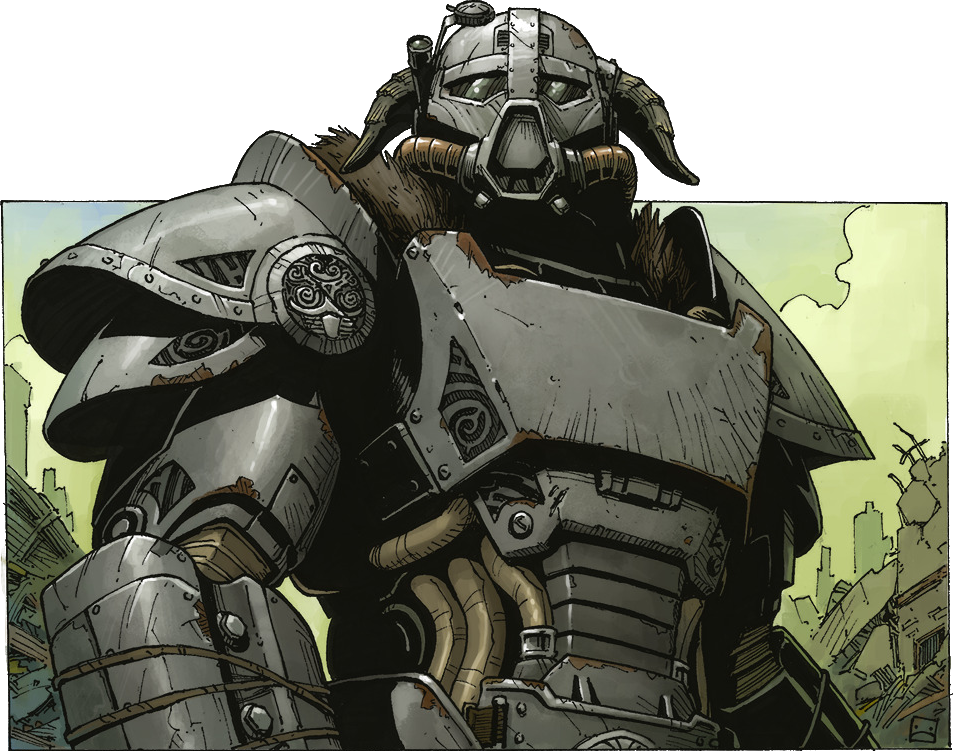
Vehicles
Vehicles are among the most obvious expressions of technology and one of the most disruptive to a world. The ability to travel reliably and safely across significant amounts of terrain improves trade and communication between distant regions, which has the effect of making the world an effectively smaller place.
While some magic, like teleportation, can also have this effect, such magic is often beyond the ability of commoners and peasants to make use of. The relative rarity of spellcasters able to invoke such magic also makes teleportation more of a luxury than a world-changing advancement. Vehicles, on the other hand, can theoretically be operated by anyone: while some may require more training than others to use, it takes significantly less effort to learn how to operate an automobile than it does to learn arcane secrets.
The nature of technology is also such that once someone invents a motorized vehicle, that technique can theoretically be replicated by anyone with the know-how, tools, and raw materials.
Overview
The vehicles presented here follow the same general layout as the vehicles presented in Unearthed Arcana: Of Ships and the Sea, and as such the general rules for vehicles will not be covered here.
Vehicles can be purchased, though are often prohibitively expensive. Individuals with proficiency in a particular type of vehicle can usually also construct vehicles of that type, which may reduce costs but also can take a significant amount of time and may also require unusual materials.
Velocipede
Large vehicle (10 ft. by 5 ft.)
- Creature Capacity 1 crew, 1 passenger
- Cargo Capacity 150 lbs.
- Travel Pace 15 miles per hour (360 miles per day)
STR DEX CON INT WIS CHA 12 (+1) 16 (+3) 12 (+1) 0 0 0
- Damage Immunities necrotic, poison, psychic
- Condition Immunities blinded, charmed, deafened, exhaustion, frightened,incapacitated, paralyzed, petrified, poisoned, prone, stunned, unconscious
Hull
- Armor Class 15
- Hit Points 40 (damage threshold 5)
Control: Helm
- Armor Class 18
- Hit Points 10
Move up to the speed of one of its movement components, with one 90-degree turn. If the helm is destroyed, the velocipede can't move or attack.
Movement: Tires
- Armor Class 14
- Hit Points 45; -15 ft. speed per 15 damage taken
- Locomotion (land) tires, speed 45 ft.
Modules
- High Slots 1
- Mid Slots 1
- Low Slots 1
Actions
On its turn, the velocipede can move using its helm. It can also fire any fitted weapon modules. If it has half its crew or fewer, it cannot move or use its modules.
Gyrocopter
Large vehicle (10 ft. by 10 ft.)
- Creature Capacity 1 crew, 2 passengers
- Cargo Capacity 500 lbs.
- Travel Pace 11 miles per hour (264 miles per day)
STR DEX CON INT WIS CHA 14 (+2) 14 (+2) 10 (+0) 0 0 0
- Damage Immunities necrotic, poison, psychic
- Condition Immunities blinded, charmed, deafened, exhaustion, frightened,incapacitated, paralyzed, petrified, poisoned, prone, stunned, unconscious
Hull
- Armor Class 14
- Hit Points 50 (damage threshold 6)
Control: Helm
- Armor Class 16
- Hit Points 15
Move up to the speed of one of its movement components, with one 90-degree turn. If the helm is destroyed, the gyrocopter can't move or attack.
Movement: Propellers
- Armor Class 13
- Hit Points 30; -10 ft. speed per 10 damage taken
- Locomotion (air) propellers, speed 30 ft.; this vehicle can hover in place
Modules
- High Slots 1
- Mid Slots 1
- Low Slots 1
Actions
On its turn, the gyrocopter can move using its helm. It can also fire any fitted weapon modules. If it has half its crew or fewer, it cannot move or use its modules.
Automobile
Huge vehicle (15 ft. by 10 ft.)
- Creature Capacity 1 crew, 3 passengers
- Cargo Capacity 500 lbs.
- Travel Pace 9 miles per hour (216 miles per day)
STR DEX CON INT WIS CHA 16 (+3) 12 (+1) 14 (+2) 0 0 0
- Damage Immunities necrotic, poison, psychic
- Condition Immunities blinded, charmed, deafened, exhaustion, frightened,incapacitated, paralyzed, petrified, poisoned, prone, stunned, unconscious
Hull
- Armor Class 13
- Hit Points 80 (damage threshold 6)
Control: Helm
- Armor Class 15
- Hit Points 25
Move up to the speed of one of its movement components, with one 90-degree turn. If the helm is destroyed, the automobile can't move.
Movement: Tires
- Armor Class 14
- Hit Points 30; -10 ft. speed per 10 damage taken
- Locomotion (land) tires, speed 30 ft.
Modules
- High Slots 1
- Mid Slots 2
- Low Slots 2
Actions
On its turn, the automobile can move using its helm. It can also fire any fitted weapon modules. If it has half its crew or fewer, it cannot move or use its modules.
Dirigible
Huge vehicle (15 ft. by 15 ft.)
- Creature Capacity 2 crew, 6 passengers
- Cargo Capacity 1 ton
- Travel Pace 6 miles per hour (144 miles per day)
STR DEX CON INT WIS CHA 12 (+1) 14 (+2) 14 (+2) 0 0 0
- Damage Immunities poison, psychic
- Condition Immunities blinded, charmed, deafened, exhaustion, frightened,incapacitated, paralyzed, petrified, poisoned, prone, stunned, unconscious
Hull
- Armor Class 13
- Hit Points 120 (damage threshold 8)
Control: Helm
- Armor Class 15
- Hit Points 40
Move up to the speed of one of its movement components, with one 90-degree turn. If the helm is destroyed, the dirigible can't turn.
Movement: Air Balloon
- Armor Class 14
- Hit Points 30; -10 ft. speed per 10 damage taken
- Locomotion (land) air balloon, speed 30 ft. If the balloon is destroyed, the dirigible immediately crashes.
Modules
- High Slots 1
- Mid Slots 1
- Low Slots 2
Actions
On its turn, the dirigible can move using its helm. It can also fire any fitted weapon modules. If it has half its crew or fewer, it cannot use its modules.
Hovercraft
Huge vehicle (15 ft. by 10 ft.)
- Creature Capacity 1 crew, 3 passengers
- Cargo Capacity 250 lbs.
- Travel Pace 7 miles per hour (168 miles per day)
STR DEX CON INT WIS CHA 10 (+0) 14 (+2) 12 (+1) 0 0 0
- Damage Immunities necrotic, poison, psychic
- Condition Immunities blinded, charmed, deafened, exhaustion, frightened,incapacitated, paralyzed, petrified, poisoned, prone, stunned, unconscious
Hull
- Armor Class 13
- Hit Points 60 (damage threshold 6)
Control: Helm
- Armor Class 15
- Hit Points 25
Move up to the speed of one of its movement components, with one 90-degree turn. If the helm is destroyed, the hovercraft can't turn.
Movement: Air Bladder
- Armor Class 14
- Hit Points 20
- Locomotion (land) air bladder, speed 0 ft. The hovercraft ignores difficult terrain and can traverse shallow water, no deeper than five feet. If the air bladder is destroyed, the hovercraft immediately crashes.
Movement: Propeller
- Armor Class 14
- Hit Points 30; -10 ft. speed per 10 damage taken
- Locomotion (land) propeller, speed 30 ft. If the propeller is destroyed the hovercraft cannot move.
Modules
- High Slots 1
- Mid Slots 1
- Low Slots 0
Actions
On its turn, the hovercraft can move using its helm. It can also fire any fitted weapon modules. If it has half its crew or fewer, it cannot move or use its modules.
Sandskiff
Gargantuan vehicle (30 ft. by 15 ft.)
- Creature Capacity 2 crew, 4 passengers
- Cargo Capacity 1 ton
- Travel Pace 10 miles per hour (240 miles per day)
STR DEX CON INT WIS CHA 16 (+3) 12 (+1) 14 (+2) 0 0 0
- Damage Immunities poison, psychic
- Condition Immunities blinded, charmed, deafened, exhaustion, frightened,incapacitated, paralyzed, petrified, poisoned, prone, stunned, unconscious
Hull
- Armor Class 14
- Hit Points 80 (damage threshold 5)
Control: Helm
- Armor Class 15
- Hit Points 25
Move up to the speed of one of its movement components, with one 90-degree turn. If the helm is destroyed, the hovercraft can't turn.
Movement: Sails
- Armor Class 12
- Hit Points 50; -5 ft. speed per 10 damage taken
- Locomotion (land) sails, speed 25 ft.; 15 ft. while sailing into the wind; 35 ft. while sailing with the wind. The sandskiff's speed is reduced to 0 if not on sand, snow, or a similar material.
Modules
- High Slots 1
- Mid Slots 1
- Low Slots 1
Actions
On its turn, the sandskiff can move using its helm. It can also fire any fitted weapon modules. If it has half its crew or fewer, it moves at half speed and cannot use its modules.
Technology and the Lore
Presenting a new class in this work is all well and good, but the decision to add technology to a game - or even an entire setting - is perhaps something that would benefit from some exposition and thoughts on how best to approach the question. In this section, we will get a bit more philosophical, and discuss the "why" of technology in fantasy settings, how to integrate this material into your game and setting, and perhaps some other topics.
What is Technology?
In the context of this work, the bounds and possibilities presented by technology diverge significantly from what we can do in the real world, at least at the time of this writing. While the naming scheme and overall presentation is intended to give a vaguely Victorian, steampunk feel to the engineer, there are a number of effects that are beyond what was possible during the Edwardian era, and some that are still well within the realm of fiction even in our time.
The premise of the technology as presented here is that in a world where magic exists, the rules of reality can be bent, and sometimes broken. Building and using fantastical technology fulfills a different fantasy from that of wielding magic: compare Iron Man and Doctor Strange. The two characters feel quite different, and that feel is part of why tabletop roleplaying games have wide varieties of classes, to achieve different "feel" and provide fulfillment of different fantasies.
With that in mind, the goal of this work is to keep enough of the technology presented grounded in what seems reasonable, while gleefully ignoring what's possible in our reality. Holographic imaging is something we're still working on, but it's been part of the cultural consciousness for decades now: why couldn't we have a steampunk device that does that?
Why the Steampunk Aesthetic?
It's one thing to introduce dirigibles and pistols to a setting or fantasy game, but quite another to introduce modern tactical body armor, high-powered rifles, and familiar-to-us computers. One of the draws of fantasy is escapism, and specifically an escape from the trappings of our modern lives.
Introducing technology into a fantasy setting, then, calls for careful attention to the aesthetics. In our cultural awareness, the Edwardian era and the Roman era may seem to bleed into each other, as ridiculous as that may seem: thousands of years apart, and yet they are both sufficiently far enough in the past that they might as well have been neighbors, temporally speaking. While we can identify obvious anachronisms, there are more similarities in technology level than we might like to admit (for instance, the Romans had access to steam engines, but just couldn't think of a use for them).
With all that in mind, bringing the steampunk aesthetic into a fairly standard fantasy game is probably not that over the top. It is entirely reasonable to assume that this sort of thing might be in one isolated part of the world, or it
could just be a small group of eccentrics. So long as everyone doesn't start walking around with top hats and poorly imitating Cockney accents, it will probably do little to disrupt suspension of disbelief at the table.
The Guns Question
Of all the technological wonders contained herein, the one thing that was not discussed much was the topic of guns. While some devices are named similarly, like the chronoton rifle, they are not firearms per se, and that distinction is important.
In my experience, many people start to feel uncomfortable once you start introducing guns to fantasy settings, and this makes some amount of sense. Historically, once gunsmithing reached the point where firearms could regularly puncture armor at fair distances, the combination of power and less training required to handle them spelled the end of medieval warfare as it was known and began ushering in the modern take on war.
Specifically, guns take combat away from the hand-to-hand melee we've come to associate with fantasy tabletop, and bring it closer to what we see in the modern world. That's a pretty significant change, and in any setting where guns start becoming ubiquitous and have nothing preventing their spread or use, it makes sense that they would rapidly overtake most other weapons and transform military tactics to suit. If you're looking to play a fantasy game because you want to play a character who uses a sword, envisioning a noble knight or a savage barbarian - in a world with guns, you're probably out of luck.
Which is why this work avoids the question of guns entirely. From my perspective, the rules for guns are already included in the game: they're there if you want to use them. You could easily justify including or excluding them from a game in which you use these rules - include them if you think that guns are a natural extension of some of the technologies presented here, or exclude them with the justification that they're just an avenue that no one has yet thought about, and by the time someone suggested them, engineers had things like tesla cannons and flux capacitors: who wants to fling a ball of lead when you can shoot lightning?
Technology and Your Game
Now that we've addressed some of the aesthetic questions and one of the probably more major concerns about technology in fantasy settings, we can get to how you can implement technology in your games.
In this section, I'll bring up a few different ways you can introduce this material, and how you can left players interact with it. These methods should work for both a game that's already running, or one you're planning on starting up; they should also work both for homebrew worlds and prebuilt ones, though the latter might prove to be a bit troublesome, depending on how much you're willing to get your hands dirty.
Secrets of the Ancients
In this model, technology in your game is presumed to be old and ancient, forgotten lore strewn across forbidden tombs and lost cities. There are lots of different ways to approach this, but the overall trend is that some old civilization had climbed the heights of technological achievement, only to come tumbling down, all their knowledge unable to save them. Whether it was the deities casting them down for their hubris, or their reliance on their new-fangled tools over the old natural ways, the precise cause of the fall is up to you.
Engineers, then, are also part archaeologist, and it gives a great incentive for them to be adventurers. While an individual engineer might be able to suss out a new theory along with a new schematic now and then, the real source of technology is out there, in the ruins and caves and other forgotten places. This also explains why the rest of the setting might not be keen on picking this new-but-old work: after all, the ancients had it, and look how they ended up. Who is going to put their trust in some rusted thousand-year-old piece of junk, when the blacksmith down the road can forge you a perfectly fine sword?
This approach can also have a bit of a darker feel to it, if the world is caught in the throes of what is effectively a dark age after the fall of a technologically-advanced empire. It would not be entirely unreasonable to give this a bit of an edgier, almost post-apocalyptic feel - though if that's not what you're going for, taking the concept that far isn't necessary and can certainly be avoided.
The Bleeding Edge
In this model, technology is just now coming to the fore, never having been seen or developed in the past. Recent advances in metallurgy, or maybe an apple falling on someone's head, has - for whatever reason - put technological development into overdrive, and cities and nations everywhere are suddenly in a race against each other, trying both to develop theories and put these new-fangled things into production so that they have a leg up on the competition.
This sort of approach might work best with a world you've been in for awhile, or if your group has been playing the same sort of fantasy games for some time: the introduction of technology as a "new and shiny" thing, in the greater context of a world caught up in the change, might bring back a sense of wonder that - ironically - magic may have long since lost. You can play up the rush of people trying to latch on to the new craze, some dismissing it as the newest fad while some nobles might throw all their money at it with wild-eyed idealism.
This could also work in a scenario where magic is fading from the world. While the "magic v. technology" conflict may be an old trope at this point, there's certainly nothing wrong with it, and putting the two at odds - one an ancient, venerated tradition; the other, untested and young but full of promise - can make for an entertaining dynamic.
Crazy Old Man on the Hill
In this model, technology is the purview of a single individual, or at most a small enclave. Isolated from the world, performing their work in relative secrecy, technology has a single chokepoint. You might allow players to play engineers in this setup, with the understanding that they are
effectively piggy-backing off of this one individual: once he's out of the picture, that might put a stop to their research and they may find themselves stuck at an ideological dead-end.
This approach might work best if you want to slowly introduce technology, or try to get a feel for it without endangering the integrity of your setting. If you isolate the source of technology and make it clear that most folk in society think he's strange or eccentric and don't want much to do with what he's working on, then if it turns out to be disruptive, it's fairly easy and innocuous to remove. Alternatively, if you like the results and think that you'd like to play around with expanding on the idea, you can say that his apprentices have moved on to other cities to carry on his work, slowly spreading the word of the power of technology.
The only difficulty with this approach might be determining the relationship between a player who wants to play an engineer, and the "crazy old man" in particular. How you implement the individual solely responsible for technology, who your player will presumably need to interact with a good deal over the course of a game, will most likely have a strong impact on how players perceive technology as a whole.
The Mana Wastes
In this model, there is some part of your setting in which magic doesn't function, or is otherwise haywire. Maybe an ancient druidic curse has caused the magic to leech out of the land, or a curious celestial alignment has activated a magical monument that actively interferes with magic: for some reason, there is a part of the world in which clerics and wizards don't go, and so the population looks to other answers. In this case, that answer would be the disciplines of technology.
Engineers in this model are individuals who come from a culture where magic just isn't available. That might lead to strange customs, strange garb, and all the other aspects associated with being a person from "elsewhere," which can make handling their interactions with the rest of the setting a bit easier: if someone talks and dresses funny, then the fact that they use funny toys that do weird things is probably not going to be all that surprising or noteworthy.
One other element that this adds is that you can play around with how people from areas with weak or no magic respond to being in places with access to magic. In addition, this one can also limit the impact of technology on your setting: if you decide it's not for you, maybe the magic comes back eventually, or all the folk living in such an inhospitable place just die out over time, with the moral learned that technology just isn't enough to save you.
Travelers from Beyond
In this model, technology is something alien to your world, brought there by travelers from either elsewhere in time or space, or perhaps both. Surprisingly, this has historical precedent: some of the earliest modules for tabletop roleplaying games had science-fiction elements, including crashed spacecraft, robots, and aliens.
With this approach, technology is something bizarre, alien, and weird, unfamiliar to most people in your setting because it is literally beyond them. Engineers might be less respected researchers and academics and regarded with more suspicion and distrust, talking about things and ideas that don't quite fit in with most peoples model
of how the world works.
You can play up the alien angle as much or as little as you like. Alien technology might be truly alien, with what engineers produce being crude facsimiles of it; or it could be remnants of some sort of alternate timeline that got shunted into what your setting considers the real timeline. It could have been brought there by travelers from one of the outer planes, or some strange beings that dwell in something like the astral sea. No matter how it got there, however, keeping it a mystery to your players - even one playing an engineer - could certainly be part of the fun with this take on technology.
Combinational Approaches
Of course, these approaches don't all have to be mutually exclusive. Technology as presented here runs the gamut from Victorian-style computers to atomic energy to generally-reasonable mechanical technologies: some of the technological fields presented could have different origins compared to others. Maybe electrical engineering makes complete sense for a particular city you have in mind, but atomical devices are just too bizarre for you, so you relegate them to being the remnants of an ancient culture now long-forgotten. You should feel free to mix and match to find what works best for you and your table.
Also don't be afraid to experiment on your own with different ways to introduce technology. This list is by no means exhaustive, and there are certainly other ways and other explanations for why technology is available in your setting.
Technology and Magic
Of course, when considering the nature of technology within the context of a fantasy setting, we also need to talk about its relationship to magic, both from the lore and mechanical perspectives.
Arcane and Divine
The core rules don't much distinguish between arcane magic - that used by sorcerers, warlocks, and wizards - and divine magic - used by clerics, druids, and paladins. When discussing technology, however, that distinction could potentially become important.
Backmatter
Changelog
v0.4
v0.3 (02/24/2019)
- Character options section, races, etc; change from "The Engineer" to "SteamWorks"
- Expanded on device activation, and how that's intended to work.
- New section on lore, discussion of interaction between magic and technology.
- Some device changes.
- Autocrossbow damage toned down.
- Elan Vital now only revive creatures who died in the last minute.
- Additional devices.
- Whole bunch of other stuff.
v0.2.1 (02/22/2019)
- Bunch of art changes.
v0.2 (02/20/2019)
- Page background image and border changed to improve legibility.
- Added light hammer proficiency.
- Rebalance on device error rates.
- Device error rates now increase by 1 with successful use.
- Engineer ability "nuclear meltdown" renamed to "oppenheimer's lament," to fit the theme.
- "Nietzschean strength" renamed to "survival of the fittest."
- Adjustments to mechanical ability "percussive maintenance."
- Additional devices (will not be listing all of them, generally more will be added with each update).
- Some devices saw some rebalancing and wording changes.
v0.1 (02/18/2019)
- Initial Release
Art Credits
Front/Back Cover
- Once upon a time in the Steampunk City, Ricardo Echeverry
Page Background
- Xanathar's Guide
Airship Page Art
- Airship City, Min Nguen
Flying City Page Art
- Card Chronicles, Thomas Chamberlain-Keen
Artilect Race Art
- Chappie and Number 5 are Alive, Emily Stepp
Gremlin Race Art
- Gremlin, Jonathan Chua
Borg Class Art
- One Punch Man - Genos, Yura Kim
Borg Class Icon
- AI Icon, Eucalyp Studio
Detective Class Art
- Manalee, Laura Sava
Detective Class Icon
- Magnifying Glass, lorc
Body Page Art
- Noir Detective, Rebecca Hu
Engineer Class Art
- Tesla Cannon, django-red
Engineer Class Icon
- Auto Repair Icon, lorc
Generator Page Art
- Frostpunk, Jakub Kowalczyk
Gunslinger Class Art
- Gunslinger, Brian Taylor
Gunslinger Class Icon
- Revolver Icon, Delapouite
Pistol Page Art
- 2d art, Anastasiia Dinzhos
Ironman Class Art
- Steampunk Iron Man, Mateusz Ozminski
Ironman Class Icon
- Ironman, Aitor Picon
Rigger Class Art
- Cloudscape, Victor Pflug
Rigger Class Icon
- Quadcopter Icon, Nanmulti Sanhawan
Drone Controller Splash Art
- Cloudscape, Victor Pflug
Hovercraft Page Art
- Dieselpunk Hovercraft, Alexey Lipatov
Laboratory Page Art
- Steaming Bad, Joan Piqué Llorens
Time Machine Page Art
- Time Machine, Lorenz Hideyoshi Ruwwe
Dragonborn Power Armor Page Art
- Dragonborn of Steel, zerahoc
Legal
This is unofficial Fan Content permitted under the Fan Content Policy. Not approved/endorsed by Wizards. Portions of the materials used are property of Wizards of the Coast. © Wizards of the Coast LLC.
OGL Credits
- The Fantastic Science: A Technologist Handbook, Copyright 2005, EN Publishing.
- Steamworks, Copyright 2008, Korey 'GnomeWorks' MacVittie, published by 12 to Midnight.
Steam
and
Steel
Magic isn't the only force in the cosmos worth harnessing. With science, you can achieve power that mages wouldn't dare dream of: bayesian calculators to predict the future, proactive weathervanes to change the weather, and tesla cannons to shoot your enemies full of lightning.
Inside, you will find new races, new classes, and new options for technological characters. Included throughout are discussions of how to integrate these options into your game, so that you can get just the feel you're looking for, and even thoughts on the various roles technology can play in a fantasy setting, from ancient technologies to cutting-edge research.
Created for