Credits
Written By: Dustin Huber
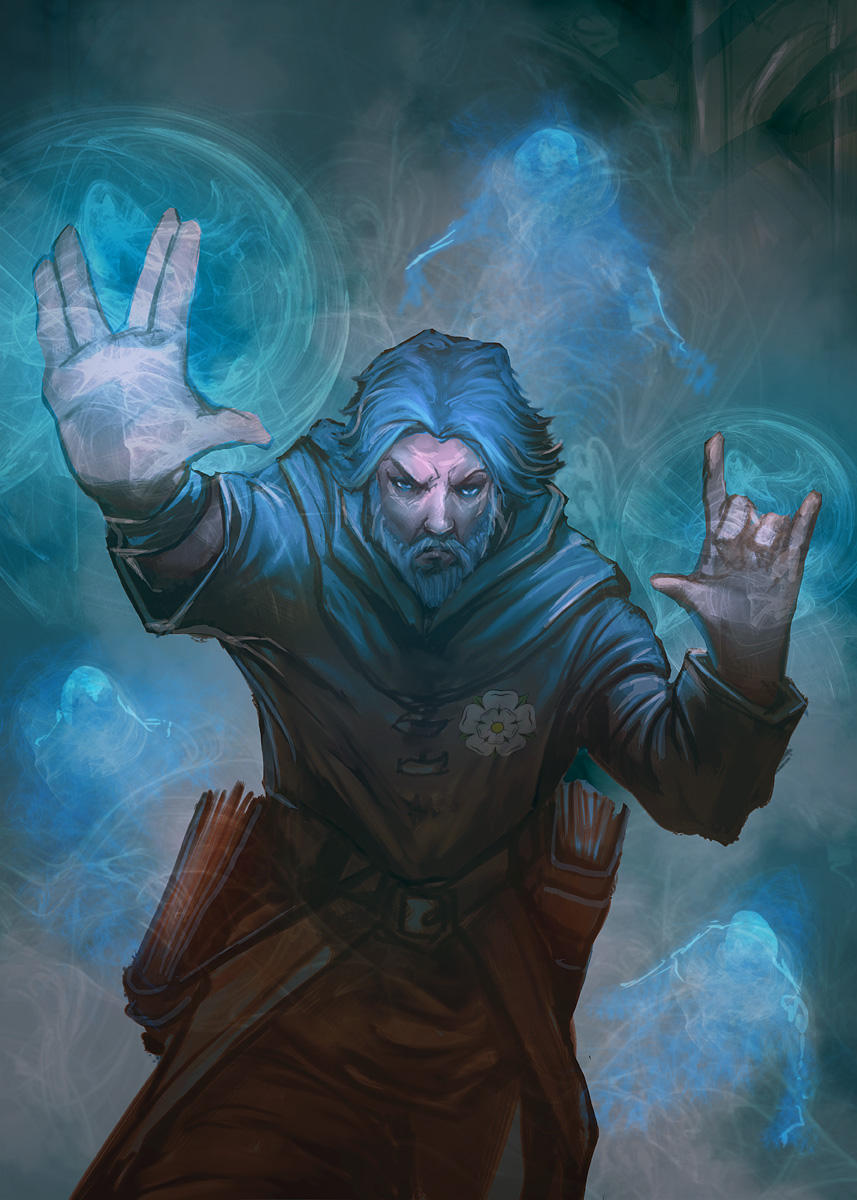
Cover Art: "Magi" by mattforsyth
https://www.deviantart.com/mattforsyth
Special Thanks
Billie - for putting up with my constant tippy typing at all hours and for not being mad when I don't come to bed because I have to get my ideas out of my head.
Mage: the Ascension & Ars Magica - without which I never would have realized my love of a freeform magic system.
The Magician
Some are born with an arcane spark in their soul. This spark grants them the ability to reshape the world around them to their will. By weaving together the very threads of existence, a Magician is capable of some impressive feats of magic.
The Magician
| Level | Proficiency Bonus | Features | Arcane Skills | Arcane Knacks |
|---|---|---|---|---|
| 1st | +2 | Spellcasting, Arcane Style | 3 | 2 |
| 2nd | +2 | Rote Magic | 3 | 2 |
| 3rd | +2 | 3 | 2 | |
| 4th | +2 | Ability Score Improvement | 4 | 2 |
| 5th | +3 | ─ | 4 | 3 |
| 6th | +3 | ─ | 4 | 3 |
| 7th | +3 | ─ | 4 | 3 |
| 8th | +3 | Ability Score Improvement | 4 | 4 |
| 9th | +4 | ─ | 4 | 4 |
| 10th | +4 | ─ | 5 | 4 |
| 11th | +4 | ─ | 5 | 5 |
| 12th | +4 | Ability Score Improvement | 5 | 5 |
| 13th | +5 | ─ | 5 | 5 |
| 14th | +5 | ─ | 5 | 6 |
| 15th | +5 | ─ | 5 | 6 |
| 16th | +5 | Ability Score Improvement | 5 | 6 |
| 17th | +6 | ─ | 5 | 7 |
| 18th | +6 | ─ | 5 | 7 |
| 19th | +6 | Ability Score Improvement | 5 | 7 |
| 20th | +6 | ─ | 5 | 8 |
Class Features
As a Magician, you gain the following class features.
Hit Points
Hit Dice: 1d6 per magician level
Hit Points at 1st Level: 6 + your Constitution modifier
Hit Points at Higher Levels: 1d6 (or 4) + your Constitution modifier per magician level after 1st
Proficiencies
Armor: None
Weapons: Daggers, darts, slings, quarterstaffs, light crossbows
Tools: None
Saving Throws: Intelligence, Wisdom
Skills: Choose two from Arcana, History, Insight, Investigation, Medicine, and Religion
Equipment
You start with the following equipment, in addition to the equipment granted by your background:
(a) a quarterstaff or (b) a dagger
(a) a component pouch or (b) an arcane focus
(a) a scholar’s pack or (b) an explorer’s pack
A spellbook
Spellcasting
As a true magician, you can channel your magical spark to work miracles.
Arcane Skills
Your arcane skills determine what you can do with your magic. Think of these as Verbs describing the kinds of effects you can generate.
More details about these Arcane Skills can be found in the spell casting section.
Arcane Knacks
Your arcane knacks determine what you can affect. Think of these as nouns describing what you can affect with your arcane skills.
More details about these Arcane Knacks can be found in the Spell Casting section.
Arcane Style
For some, magic is a science. For others, it is an art. This determined exactly how a Magician casts his spells. For those who treat magic as a science, Intelligence is their spell casting ability. Magical artists use Charisma instead.
Ability Score Increase
When you reach 4th level, and again at 8th, 12th, 16th, and 19th level, you can increase one ability score of your choice by 2, or you can increase two ability scores of your choice by 1. As normal, you can’t increase an ability score above 20 using this feature.
Rote Magic
Beginning at 2n level, a magician gains the ability to cast certain spells faster. He may have a number of spells equal to his proficiency bonus + spell casting ability modifier held in his mind to cast without taking a round to form them first.
More details can be found in the spell casting section.
Spell Casting
The following system will allow a spellcrafting character to craft spells on the fly. It is highly encouraged that you familiarize yourself with this system to speed up gameplay at the table.
Forming your Spell
Spellcasting breaks down to two steps – forming the spell and releasing it. During the formation round, the spellcaster may not perform any other actions; they may move up to one-half their speed however. The spellcaster can be disrupted during this round. It is during this round that the spell may be disrupted.
Disruption
During the formation of a spell, the magicians concentration is dedicated to it. Anything that would call for a concentration saving throw (see "Duration") can disrupt the formation of a spell.
Summary
Every spell consists of two parts – Knack and Skill. When you weave your spell, you determine what it should do, based on the Knacks and Skills your character possesses.
Arcane Skills
Control - allows the spellcaster to control and manipulate without affecting its base characteristics.
Destroy - allows the spellcaster to destroy, deteriorate, or age the target. Basically the opposite of Create.
Sense - allows the spellcaster to sense and understand.
Summon - allows the spellcaster to create from nothingness, or refine something into a more "perfect" version of itself. This includes mending the target.
Transform - allows the spellcaster to change the basic characteristics of his target, even granting the target characteristics it does not naturally have.
Knacks
Entropy - Entropy covers luck and the flow of systems – or the breakdown of the same.
Forces - This Knack covers things such as electricity, fire, and other forms of energy.
Glamour - Glamour is used for deceiving the senses.
Life - If its organic, this Knack covers it.
Matter - This Knack covers the physical substance of the universe.
Mind - Memory, thought, all things mental are covered by this Knack.
Power - This Knack influences raw magical forces.
Spirit - Spirit can affect anything from ghosts to demons to the wolf of a werewolf.
Time - This Knack allows affecting the ebb and flow of time.
Spell Complexity
The following tables are used to determine the spell casting DC of your True Magic spells
Arcane Skills
Some spells may require multiple Arcane Skills; for such spells, increase the complexity by +1 for each additional skill.
Knacks
Select which Knack(s) you need to generate your effect. You may use any Knack, but if you use a Knack you don't possess, your spell casting DC increases by +1 for each such Knack.
Range
Range determines the reach of your magic.
| Spell Casting Modifier |
Range |
|---|---|
| +0 | Self/Touch |
| +1 | 25' |
| +2 | 75' |
| +3 | 150' |
| +4 | Line of Sight |
Like Affects Life
If you have a piece of your target, you can ignore the range modifier for spell casting. Affecting the part, affects the whole.
Targets (Use Targets or Area)
The targets modifier allows you to single out targets for your spells. This is ideal for when you don't want to threaten your allies or innocent bystanders.
| Spell Casting Modifier |
Max Targets |
|---|---|
| 0 | Self |
| +1 | 1 |
| +2 | 2 |
| +3 | 3 |
| +4 | 4 |
Each additional target increases the difficulty by 1
Unerring Strike
If you are using the targets modifier, you may choose to eliminate your Spell Attack Roll for an additional +2 modifier to your spell's complexity.
Area (Use Area or Target)
Area of Effect spells do not descriminate between friend and foe. Anyone in the targeted area is affected.
| Spell Casting Modifier |
Area Radius |
|---|---|
| 0 | Immediately surrounding caster |
| +1 | 5' Radius |
| +2 | 10' Radius/15' Line/10' Cone |
| +3 | 15' Radius/30' Line/20' Cone |
| +4 | 20' Radius60' Line/40' Cone |
The shape of magic
When selecting the area modifier, you may select shape of the effect.
- Radius allows you to create a sphere or a cube. To make a cylinder, increase the complexity by +1.
- Line affects a 5' wide straight line starting from the tip of your finger.
- Cone starts at your extended finger and ends in a circle with a radius equal to 1/2 the length of the cone.
Duration
Most spells take effect and fade away as soon as they are released. For a little more complexity, the spells can be maintained longer.
| Spell Casting Modifier |
Max Targets |
|---|---|
| +0 | Instantaneous |
| +1 | 1 Turn |
| +2 | 1 Minute |
| +3 | 1 Hour |
Each additional increase extends to day, month, year, etc.
Power
| Spell Casting Modifier |
Max Targets |
|---|---|
| +0 | Trivial/Small Effects |
| +1 | Lesser (1d6 damage/1 AC) |
| +2 | Moderate (2d6 damage/2 AC) |
| +3 | Greater (3d6 damage/3 AC) |
Additional damage is +1 per difficulty increase.
Concentration
Selecting a duration longer than instant requires the magician to maintain concentration on that spell. If you lose concentration, such a spell ends.
You can end concentration at any time (no action required).
Normal activity, such as moving and attacking, doesn’t interfere with concentration. The following factors can break concentration:
Casting another spell that requires concentration. You lose concentration on a spell if you cast another spell that requires concentration. You can’t concentrate on two spells at once.
Taking damage. Whenever you take damage while you are concentrating on a spell, you must make a Constitution saving throw to maintain your concentration. The DC equals 10 or half the damage you take, whichever number is higher. If you take damage from multiple sources, such as an arrow and a dragon’s breath, you make a separate saving throw for each source of damage. Being incapacitated or killed. You lose concentration on a spell if you are incapacitated or if you die.
The GM might also decide that certain environmental phenomena, such as a wave crashing over you while you’re on a storm-tossed ship, require you to succeed on a DC 10 Constitution saving throw to maintain concentration on a spell.
You may increase the damage die for an additional cost to the spell's complexity.
Damage Dice
Damage Die
Complexity Bonus
1 damage
-1
d4
-1
d6
+0
d8
+1
d10
+2
d12
+3
Components
All spells require a Material, Somatic, and Verbal component. For each component you wish to eliminate from your spell, increase the spell's complexity by +2.
Verbal The words themselves aren’t the source of the spell’s power; rather, the particular combination of sounds, with specific pitch and resonance, sets the threads of magic in motion. Thus, a character who is gagged or in an area of silence, such as one created by a spell, can’t cast a spell with a verbal component.
Somatic Spellcasting gestures might include a forceful gesticulation or an intricate set of gestures. If a spell requires a somatic component, the caster must have free use of at least one hand to perform these gestures.
Material A character can use a component pouch or a spellcasting focus in place of the components specified for a spell. But if a cost is indicated for a component, a character must have that specific component before he or she can cast the spell.
If a spell states that a material component is consumed by the spell, the caster must provide this component for each casting of the spell. The material component needing to be consumed reduces the complexity by 1 as the component's destruction helps to fuel the spell.
A spellcaster must have a hand free to access a spell’s material components—or to hold a spellcasting focus—but it can be the same hand that he or she uses to perform somatic components.
Spellcasting Roll
Once you have determined the complexity of your spell, you can determine the spell casting DC of the spell. Failing this roll means the spell dissipates with no effect.
Spell Casting Roll
d20 + Proficiency Bonus + Spell Casting Ability Modifier
Spell Casting DC
12 + Spell Complexity
Releasing your Spell
You do not have to release the spell the round immediately following your formation round, but until the spell is released it can be disrupted.
Saving Throws
Magic does not automatically affect it's target. Spells that attempt to alter a target's mind or body allow the target to make a Saving Throw. The kind of saving throw is determined by what the spell is attempting to affect.
- Dexterity is used to save against area effect damaging spells.
- Constitution is used to save against spells transforming the body.
- Intelligence is used to save against mind effecting spells.
- Wisdom is used to save against spells affecting the senses.
- Charisma is used to save against spells affecting the target's identity.
Spell Save DC
8 + Proficiency Bonus + Spell casting Ability Modifier
Spell Attack Roll
Spells that use the target modifier require an attack roll. For such rolls, apply your Spell Attack Modifier to a d20 roll.
Spell Attack Modifier
Your Proficiency bonus + Spell Casting Ability Modifier
Resistances and Immunities
Some targets may have resistances specific to the magic you are trying to use. In such cases, they may make their Saving Throw with Advantage.
Counter Spells
Sometimes you'll find yourself facing off against another character who is capable of true magic. One of the best ways to shut down another caster is to use your own magic to counter them. Counterspelling is a special Action that requires the Power knack and Destroy skill.
Unweaving
When you take this action as a spell is being formed, you turn the caster's roll into a contested roll. You try to cut them off from the power they are drawing on. If you successfully beat the caster's roll, his spell dissipates without taking effect.
Spell Turning
You may use your reaction to counter a spell as it is being released. The attempt is a spell casting roll made with Disadvantage against a DC equal to the caster's spell casting roll.
Failure means their spell takes effect as usual. Success causes the spell to dissipate with no effect. Rolling a Natural 20 allows you to redirect the spell against a different target (including the original caster).
Rote Magic
Over time, you develop a number of spells that you cast so often, you have their forms ingrained in your mind. These spells are so much a part of your character they can be formed and released reflexively - allowing them to be used as Reaction or formed and released within the same round.
You may have a number of Rote spells equal to your Proficiency Bonus + your Spell Casting Ability Modifier.
It requires a number of days equal to the spells complexity to add a formula to your list of Rote Spells.
Ritual Casting
Not all spell casting is done in the heat of the moment. Sometimes a true magician wants to take his time to get the spell just right and guarantee its results. In such cases, ritual casting is the prefered method.
For a ritual spell, the casting time is increased to 10 + Spell Complexity minutes. There is no Arcana roll. Instead, you apply a flat ritual power to the DC to determine success.
Ritual Power
10 + Proficiency Bonus + Spellcasting Ability Modifier
The threads of magic are delicate and a ritual spell can be disrupted any time during the casting process.
Magic Formulas
Spells are a very personal thing for each magician. Even between master and student, magic formulas may be different. Depending on the training, education, and disposition of the magician, completely different formulas may have nearly identical effects.
To that end, this section is meant to guide apprentice magicians in creating their own formulas. It is highly encouraged that the player of a magician keep a "spellbook" of their own to detail their magician's formulas, even if they aren't part of his Rote Spells. This will help play at the table go much faster than if everyone has to wait on your turn as you figure out all the details of your spell.
Spell Name
Skill and Knack
- Casting Time: Casting Time
- Range: Range
- Targets:
- Components: V, S
- Duration: Duration
- Spell Casting DC:
A description bursts from the caster's fingers and spreads at the speed of the reader's comprehension.