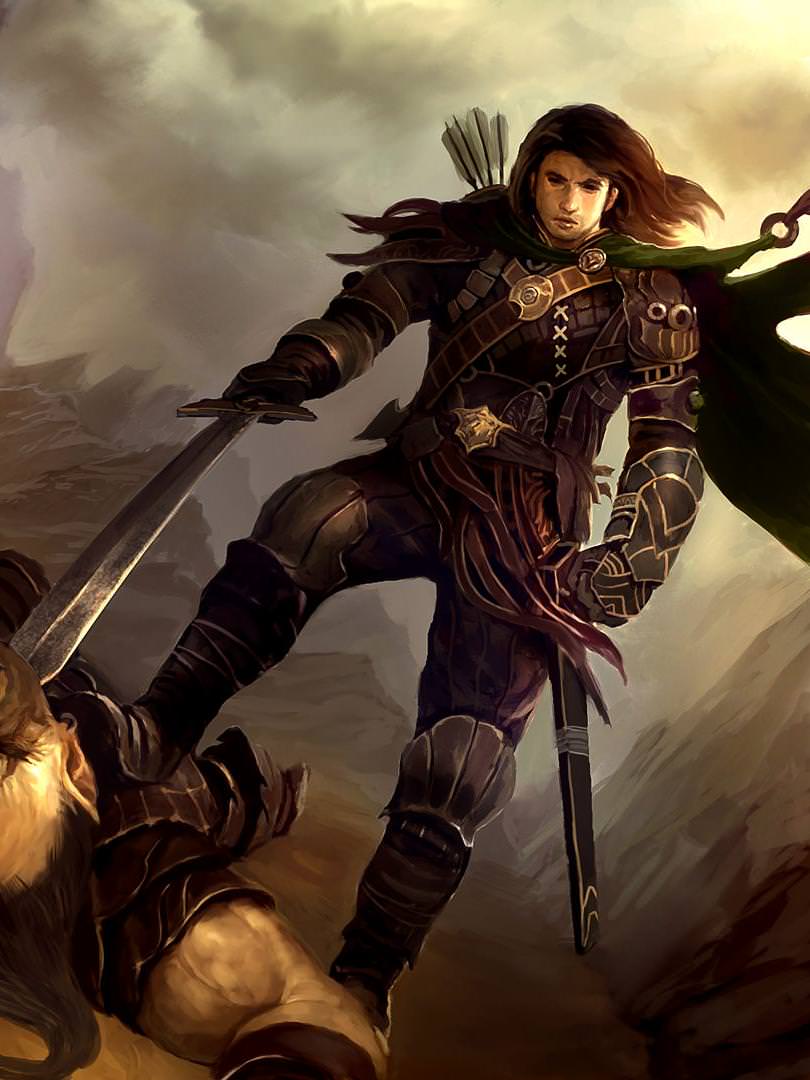
Warrior
Quick Build
You can make a warrior quickly by following these suggestions. First, make Strength or Dexterity your highest ability score, depending on whether you want to focus on melee weapons or on archery (or finesse weapons). Your next highest score should be Constitution, or Intelligence if you plan to adopt a spellcasting martial archetype. Second, choose the soldier background.
The Warrior
| Level | Proficiency Bonus | Features |
|---|---|---|
| 1st | +2 | Fighting Style, Second Wind |
| 2nd | +2 | Action Surge, Maneuvers |
| 3rd | +2 | Martial Archetype |
| 4th | +2 | Ability Score Improvement |
| 5th | +3 | Extra Attack |
| 6th | +3 | Ability Score Improvement |
| 7th | +3 | Martial Archetype Feature |
| 8th | +3 | Ability Score Improvement |
| 9th | +4 | Indomitable (one use) |
| 10th | +4 | Martial Archetype Feature |
| 11th | +4 | Extra Attack (2) |
| 12th | +4 | Ability Score Improvement |
| 13th | +5 | Indomitable (two uses) |
| 14th | +5 | Ability Score Improvement |
| 15th | +5 | Martial Archetype Feature |
| 16th | +5 | Ability Score Improvement |
| 17th | +6 | Action Surge (two uses), Indomitable (three uses) |
| 18th | +6 | Martial Archetype Feature |
| 19th | +6 | Ability Score Improvement |
| 20th | +6 | Extra Attack (3) |
Class Features
As a warrior you gain the following class features.
Hit Points
Hit Dice: 1d10 per warrior level
Hit Points at 1st Level: 10 + your Constitution modifier
Hit Points at Higher Levels: 1d10 (or 6) + your Constitution modifier per warrior level after 1st
Proficiencies
Armor: All armor, shields
Weapons: Simple weapons, martial weapons
Tools: None
Saving Throws: Strength, Constitution
Skills: Choose two skills from Acrobatics, Animal Handling, Athletics, History, Insight, Intimidation, Perception, and Survival
Equipment
You start with the following equipment, in addition to the equipment granted by your background.
(a) chain mail or (b) leather, longbow, and 20 arrows
(a) a martial weapon and a shield or (b) two martial weapons
(a) a light crossbow and 20 bolts or (b) two hand axes
(a) a dungeoneer’s pack or (b) an explorer’s pack
Fighting Stvle
You adopt a particular style of fighting as your specialty. Choose one of the following options. You can’t take a Fighting Style option more than once, even if you later get to choose again.
Archery
You gain a +2 bonus to attack rolls you make with ranged weapons.
Defense
While you are wearing armor, you gain a +1 bonus to AC.
Dueling
When you are wielding a melee weapon in one hand and no other weapons, you gain a +2 bonus to damage rolls with that weapon.
Great Weapon Fighting
When you critically hit with a weapon you are wielding in two hands, you can use a bonus action to attempt a shove or trip attack. The weapon must have the two-handed or versatile property for you to gain this benefit.
Protection
When a creature you can see hits a target other than you that is within 5 feet of you, you can use your reaction to force the enemy to reroll the attack. If you are wielding a shield, the enemy rerolls the attack with disadvantage. You must use the new result.
Two-Weapon Fighting
When you engage in two-weapon fighting, you can add your ability modifier to the damage of the second attack.
Second Wind
You have a limited well of stamina that you can draw on to protect yourself from harm. On your turn, you can use a bonus action to regain hit points equal to 1d10 + your warrior level.
Once you use this feature, you must finish a short or long rest before you can use it again.
Action Surge
Starting at 2nd level, you can push yourself beyond your normal limits for a moment. On your turn, you can take one additional action on top of your regular action.
Once you use this feature, you must finish a short or long rest before you can use it again. Starting at 17th level, you can use it twice before a rest, but only once on the same turn
Maneuvers
Also starting at 2nd level, you’ve learned several martial maneuvers. You learn two maneuvers of your choice. Your maneuver options are detailed at the end of the class description. Many maneuvers enhance an attack in some way. You can use only one maneuver per attack.
You learn one additional maneuver of your choice at 3rd, 7th, 10th, 15th, and 18th level. Each time you learn new maneuvers, you can also replace one maneuver you know with a different one.
Some of your maneuvers require your target to make a saving throw to resist the maneuver's effects. The saving throw DC is calculated as follows:
Maneuver Save DC
Whenever you use a maneuver, you can choose to trigger its superiority option which is described in the maneuver. You can do this twice. You regain all expended uses after completing a short or long rest.
Martial Archetype
At 3rd level, you choose an archetype that you strive to emulate in your combat styles and techniques. Choose Vanquisher, Tactician, or one of the additional subclasses in this supplement, all detailed at the end of the class description. The archetype you choose grants you features at 3rd level and again at 7th, 10th, 15th, and 18th level.
Ability Score Improvement
When you reach 4th level, and again at 6th, 8th, 12th 14th, 16th, and 19th level, you can increase one ability score of your choice by 2, or you can increase two ability scores of your choice by 1. As normal, you can’t increase an ability score above 20 using this feature.
Extra Attack
Beginning at 5th level, you can attack twice, instead of once, whenever you take the Attack action on your turn. The number of attacks increases to three when you reach 11th level in this class and to four when you reach 20th level in this class.
Indomitable
Beginning at 9th level, you can reroll a saving throw that you fail. If you do so, you must use the new roll, and you can’t use this feature again until you finish a long rest.
You can use this feature twice between long rests starting at 13th level and three times between long rests starting at 17th level.
Arcane Marksman
The archetypal Arcane Marksman has spent a significant amount of time off the battlefield, in rigorous study of eldritch texts and spellcasting manuals. They have not eschewed their martial talents entirely and have chosen instead to augment that talent with magical power delivered at a distance.
Spell Shots
At 3rd level, you've learned a unique set of arcane maneuvers. You have access to all the Spell Shots listed but must spend time to prepare them. Spell Shot maneuvers that are prepared can be used in the same way as any other maneuver.
During a short or long rest, you can prepare up to two Spell Shot maneuvers this way. You can prepare an additional Spell Shot maneuver at 7th, 10th, 15th, and 18th level.
The saving throw for your Spell Shots maneuvers is calculated as follows:
Maneuver Save DC
Archer Lore
Also at 3rd level, you gain proficiency in one of the following skills of your choice: Arcana, Nature, or Perception.
Utility Projectile
Starting at 7th level, you can use your arcane magic to imbue your ranged weapon to create an effect. You gain the following shots, which can be performed as an action by imbuing a thrown weapon or piece of ammunition with magic that is cast when the projectile hits its target.
Ascension Shot. When this shot impacts a point on a solid surface within range of the weapon that you can see, it sprouts sinewy tendrils that grip the surface and reinforce the projectile. Once embedded, it can support a weight of up to 300 pounds for a duration of 1 hour, after which the magic fades and it falls to the ground.
Illusion Shot. When this shot impacts a surface within 30 feet that you can see, it creates the effect of the minor illusion spell where it impacts. This lasts 1 minute and uses your maneuver save DC
Curving Shot
At 10th level, you learn how to direct an errant shot toward a new target. When you make an attack roll with a spell shot maneuver and miss, you can use a bonus action to reroll the attack roll against a different target within 30 feet of the original target that you can see.
Celestial Shot
Starting at 15th level, you've woven the arcane nature of the lunar cycles into your shots. You gain the following shots, which can be performed as an action by imbuing a thrown weapon or piece of ammunition with magic that is cast when the projectile reaches its target.
Blackout Shot. When this shot is fired, when it impacts a surface or after 60 feet of travel it bursts into a harmless globe of inky black magic, which fills a 30-foot radius sphere with magical darkness, which lasts 1 minute.
Flare Shot. When this shot is fired, when it impacts a surface or after 60 feet of travel it bursts into a harmless globe of light and sparks, which illuminates a 30-foot radius sphere with bright magical light and sheds dim light for an additional 30 feet. The globe slowly descends and fades after 1 minute.
Ever-Forceful Shot
Starting at 18th level, your marksmanship is always at the ready. When you roll initiative, you regain one use of your superiority feature.
Additionally, your spell shot maneuvers can deliver a more stinging blow. Creatures hit by the attack made as part of the maneuver take an additional 1d8 damage.
Spell Shot Maneuvers
In addition to the maneuvers available to the Arcane Marksman, listed here are the Spell Shots made available by the 3rd level feature. These are all considered known, but must be prepared as described in the feature
Spell Shot: Banish
When you take the Attack action on your turn, this shot becomes imbued with abjuration magic. On a hit, you create a ward that hinders this creature’s attacks. Until the end of its next turn, any nonmagical weapon attacks made by this creature don't add their Strength or Dexterity modifier to their damage.
Superiority. If this shot hits a creature, that creature must succeed on a Charisma saving throw or be banished. While banished in this way, its speed is 0 and it is incapacitated. At the end of its next turn, the target reappears in the space it vacated or in the nearest unoccupied space.
Spell Shot: Brute Bane
When you take the Attack action on your turn, this shot becomes imbued with necromantic magic. On a hit, a ghostly energy surrounds the target, preventing it from regaining hit points until the start of its turn.
Superiority. If this shot hits a creature, it takes an additional 1d8 necrotic damage. In addition, that creature must succeed on a Constitution saving throw. On a failed save, the damage of the creature’s weapon attacks is halved until the start of your next turn.
Spell Shot: Bursting
When you take the Attack action on your turn, this shot becomes imbued with evocation magic. On a hit, the projectile splinters. Each other creature within 5 feet of the target must make a Dexterity saving throw or take 1d4 piercing damage.
Superiority. If this shot hits a creature, each other creature within 10 feet of it take an additional 1d8 force damage.
Spell Shot: Charming
When you take the Attack action on your turn, this shot becomes imbued with enchantment magic. On a hit, choose an ally within 30 feet of the target. The affected creature has disadvantage until the end of its next turn on attack rolls against that ally.
Superiority. If the shot hits a creature, it deals an additional 1d8 psychic damage. Additionally, choose one of your allies within 30 feet of the target. Your target must succeed on a Wisdom saving throw or it is charmed by the chosen ally until the start of your next turn. This effect ends early if the chosen ally deals any damage to the target.
Spell Shot: Grasping
When you take the Attack action on your turn, this shot becomes imbued with conjuration magic. On a hit, the target must make a Strength saving throw. On a failed save, its movement speed is reduced by half until the end of its next turn.
Superiority. If this shot hits a creature, brambles form and wrap around the target dealing an additional 1d8 slashing damage. Its speed is reduced by an additional 10 feet and it takes 1d8 slashing damage moves 1 foot or more without teleporting. The target or any creature that can reach it can use its action to remove on each turn it the brambles with a successful Strength (Athletics) check against your maneuver save DC. Otherwise, the brambles last for 1 minute.
Spell Shot: Ethereal
When you take the Attack action on your turn, this shot becomes imbued with transmutation magic. This attack ignores half cover, and treats three quarters cover as half cover instead.
Superiority. Instead of an attack roll, this shot fires forward in a line that is 1 foot wide and 30 feet long. The shot passes harmlessly through objects, ignoring cover. Each creature in that line must making a Dexterity saving throw. On a failed save, a target takes damage as if it were hit by the shot plus an additional 1d8 force damage. On a successful save, a target takes half as much damage.
Spell Shot: Shadow
When you take the Attack action on your turn, this shot becomes imbued with illusion magic. On a hit, the creature suffers from disadvantage on ability checks that rely on sight until the start of its next turn.
Superiority. Instead of an attack roll, choose a target point within normal range of your weapon. On impact, all creatures within 10 feet of this point must make a Wisdom saving throw. Affected creatures that fail this save take 1d8 psychic damage and are unable to see anything father than 5 feet away from itself until the start of your next turn.
Arcane Marksman Maneuvers
These maneuvers are unique to this martial archetype.
Dancing Weapons
Prerequisite: Arcane Marksman archetype
You can draw a number of thrown weapons up to your Intelligence modifier as a bonus action, causing them to float in the air in front of you. You can draw one of these weapons as part of your attack as long as you are making a ranged weapon attack. After the attack hits, the thrown weapon returns to float beside you. At the end of your turn, the magic fades and any weapons still floating drop to the ground at your feet.
Superiority. The effect lasts for 1 minute or until you end it as a bonus action.
Grounding Strike
Prerequisite: Arcane Marksman archetype
As an action, you imbue a thrown weapon or piece of ammunition with a burdening transmutation magic. This projectile seeks out a target of your choice within range. That creature must succeed on a Strength saving throw or become laden with the heavy magic. If that creature has a flying speed, it is reduced by half until the end of its next turn. An airborne creature affected by this magioc descends at 30 feet per round until it reaches the ground or the effect ends.
Superiority. Instead of lasting until the end of the target’s next turn, this effect instead lasts 1 minute, and the creature’s walking speed is reduced by half as well.
Bounty Hunter
Those who model themselves after the bounty hunter are those who feel as though their skill is worth its weight in gold. They are often contract mercenaries, or at the very least hold a strong grudge against those that sleight them. Either way, they good at both tracking and hunting certain groups of creatures and those they study and do so with great efficacy.
Favored Enemy
Beginning at 3rd level, you have learned enough about your enemies to begin to put the knowledge to practice in defeating them. Choose either two types of favored enemy from the following list, or one type from the list and two races of humanoid (such as gnolls and orcs), abberations, beasts, celestials, constructs, dragons, elementals, fey, fiends, giants, monstrosities, oozes, plants, or undead. You have advantage on all Wisdom or Intelligence checks related to your favored enemies, including tracking them, detecting them, intuiting or recalling information about them, and discerning their motives or intentions.
Hunter's Prey
Also at 3rd level, with enough time you can extend your favored enemy to a single individual. Over the duration of a short rest, you can focus intently on a creature you've met and interacted with, or have significant enough information about to understand. This creature also becomes a favored enemy for you until you know its been killed or you choose another prey.
In addition, any maneuver you use that affects a favored enemy also causes it to take Id6 damage of a damage type a weapon you're wielding can deal as your knowledge allows you to exploit their weaknesses.
Prepared
Starting at 7th level, your expectations of your favored enemies gives you a preternatural sense to avoid ambush. When determining if creatures are surprised, you cannot be surprised if at least one favored enemy is within 60 feet of you.
In addition, you have advantage on checks to notice and avoid traps set by a favored enemy.
Allied Tactics
At 10th level, your experience with hunting your favored enemy allows you to announce weaknesses to your allies.
Fortitude
Starting at 15th level, you gain advantage on non-magical saving throws and skill contests from attacks from your favored enemies. Additionally, you cannot be charmed, possessed, or frightened by them and have advantage on death saving throws while within 60 feet of a favored enemy that is hostile to you.
If a blow from one of your favored enemies would reduce you to 0 hit points without killing you outright, it reduces you to 1 hit point instead. Once you use this feature, you cannot use it again until you finish a long rest.
Foe Slayer
At 18th level, you become a master of slaying your most hunted foes. Once per turn, when you hit one of your favored enemies with a weapon attack, it takes an additional 3d6 force damage.
Bounty Hunter Maneuvers
These maneuvers are unique to this martial archetype.
Knock-Out Strike
When making an attack against a creature, you can attempt a nonlethal blow. If that attack hits and the damage reduces the creature to 0 hit points, it is knocked unconscious instead of dying outright.
Superiority. The target is knocked unconscious if the creature has any number of hit points less than your Warrior level.
Foe Retribution
When a favored enemy within 60 feet hits or misses you with an attack, you can use your reaction to attack that creature immediately after its attack, provided you can see that creature.
Superiority. Being within 5 feet of a hostile creature doesn't impose disadvantage on this attack and you have advantage on this attack.
Restraining Order
You can use your reaction to make a ranged weapon attack against a creature you can see within the normal range of your weapon, immediately before it leaves your line of sight using its movement. If this attack hits, instead of rolling damage, that creature is restrained until the end of its next turn.
Superiority. The creature is stunned instead of restrained.
Duelist
The archetypal duelist has gained his skill in combat as a product of his upbringing. Sometimes a civilized form of combat, married with an overt arrogance. Other times a crass combination of vicious mockery and infamous legend. Those who model themselves after this archetype combine fencing and bravado to entangle and distract foes, utilizing a final strike to put an end to cowards or punctuate whatever point they were making.
Signature Maneuver
At 3rd level, you know the Finisher maneuver in addition to other maneuvers you know.
Taunt
Also at 3rd level, you have learned to entangle your foe in a deadly dance of strikes. Once per round after making a weapon attack against a creature, you can taunt them. This taunt lasts until the end of your next turn. When a creature taunted by you makes an attack or casts a spell that doesn't include you as a target, you can use your reaction to cast vicious mockery on that creature. Charisma is your spellcasting ability for this spell.
Quick Retort
Starting at 7th level, your gilded tongue can get you out of as many confrontations as it gets you into. When making an Intimidation or Persuasion check against a creature, you add double your proficiency bonus if you are deliberating insulting or threatening that creature, or if that creature is affected by your taunt ability.
Improved Duelist
Starting at 10th level, your training has honed the harmony between your weapon and fighting techniques. If you have successfully hit a creature with a weapon attack this round, that creature has disadvantage on any saving throw from the next maneuver you use against it before the start of its next turn.
Insolent Cur
Upon reaching 15th level, your confidence inspires fear in your enemies. When you use your Action Surge feature, you can spout a threat to any number of creatures within 20 feet that can see and hear you. Each creature affected must make a Wisdom saving throw against your maneuver save DC. Any creatures that fail this saving throw drops what they are holding and become frightened of you until the start of your next turn.
A creature affected by your taunt ability automatically fails this saving throw.
Punishing Flourish
Starting at 18th level, your mastery and flourish leave your opponents open to more punishing strikes. The next attack you make against a creature after you have successfully affected it with a maneuver deals additional damage equal to your Charisma modifier.
Duelist Maneuvers
These maneuvers are unique to this martial archetype.
Defensive Flourish
When you take the Attack action on your turn, you can forgo one of your attacks to attempt a defensive flourish against a creature within range of a melee weapon you are holding. Instead of an attack roll, the target must make a Dexterity saving throw. On a failed save, that creature has disadvantage on attack rolls against you until the start of your next turn.
Superiority. In addition, the creature cannot willingly move away from you until until the start of your next turn.
Finisher
When you take the Attack action and make a melee weapon attack with a light or finesse weapon you are holding in one hand, you can use a bonus action to make ranged weapon attack with a light weapon you are holding in the other hand.
Superiority. The bonus action roll hits on any result other than a 1 and is a critical hit on a roll of 19-20.
Foil
When a creature misses you with a melee attack, you can use your reaction to attempt to disarm them as long as you have an empty hand to do so. You must make a Strength or Dexterity check, with a DC equal to the creature's attack roll. If you succeed, you disarm them of that weapon and if falls to the ground at their feet.
Superiority. If you successfully disarm the creature, instead of the weapon falling to the ground at the creature's feet, you catch it with your free hand.
Elementalist
Elementalists are multi-faceted wielders of ancient elemental forces -- fire, earth, air, and water. They have learned to blend these energies with their martial arts in order to become a storm of steel and magic.
Primordial Power
At 3rd level, you learn four cantrips from the elementalist spell list. Wisdom is your spellcasting ability for these spells. When you deal damage with an elementalist cantrip you add your Wisdom modifier to the damage.
Additionally, when you gain a level in this class, you can choose one of the elementalist cantrips you know and replace it with another cantrip from the elementalist spell list
Critical Momentum
At 7th level, after you critically hit a target with a weapon attack and deal damage, you can use your reaction to cast an elementalist cantrip targeting the same creature.
Adaptability
At 10th level, whenever you finish a long rest, you can replace some or all of the elementalist cantrips you know with any other cantrips from the elementalist spell list.
Elemental Affinity
At 15th level, you gain an affinity to the elements. When you take acid, cold, fire, or lightning damage, you can use your reaction to gain resistance to the triggering damage type until the start of your next turn. Also, the first time you hit with a melee attack on your next turn, the target takes an extra 3d6 damage of the triggering type.
Elemental Maelstrom
At 18th level, you have learned to harness the power of the elements to become a swirling maelstrom of elemental power. Once per short rest, as a bonus action, you gain the following benefits for the next minute.
- Your speed increases by 10 feet, and your speed cannot be reduced and you cannot be grappled or restrained.
- A creature that touches you or hits you with a melee attack while within 5 feet of you takes 1d10 fire damage.
- You shed bright light in a 30-foot radius and dim light in an additional 30 feet.
Elementalist Spells
- Acid Splash
- Create Bonfire
- Fire Bolt
- Fire Nova
- Frostbite
- Gust
- Ice Lance
- Lightning Helix
- Lightning Lure
- Nature's Grasp
- Produce Flame
- Primal Savagery
- Ray of Frost
- Shocking Grasp
- Thorn Whip
Elementalist Maneuvers
These maneuvers are unique to this martial archetype.
Titan Strike
When you make a weapon attack, your weapon becomes infused with elemental energy. Choose either acid, cold, fire, or lightning. This attack deals an additional 1d4 damage of that type. Instead of adding your Strength or Dexterity modifier to the damage roll as normal, you add your Wisdom modifier.
Superiority. The creature takes an additional 3d4 elemental damage (4d4 total).
Unleash Elements
Instead of a weapon attack, you cast one of your elementalist cantrips. When cast this way, the cantrip does not scale beyond 1 die of damage.
Superiority. If the cantrip is a spell attack, the attack has advantage. If the cantrip requires a saving throw, you impose disadvantage on one target's saving throw to resist this spell.
Mesmer
Mesmers are magical duelists who wield deception as a weapon. Using phantasmal clones to confuse and distract their foes, mesmers ensure every fight is in their favor and their opponents can't believe their eyes.
Bonus Spells
At 3rd level, you learn the minor illusion cantrip. You learn the disguise self spell and can cast it a number of times per day equal to your Intelligence modifier. Intelligence is your spellcasting ability for these spells.
Identical Clone
At 3rd level, while you are not wearing heavy armor, you can create phantasmal clones of yourself. On your turn, you can forgo a weapon attack to create a clone in an unoccupied space within 5 feet of you. The clone immediately attacks for you, but you do not add your ability modifier to the damage it deals.
The clones are identical copies of your character with the same weapons and armor as you, but they have a movement speed of 0, 1 hit point, and automatically fail saving throws against magic and magical effects.
When a creature leaves melee range with one of your clones, you can use your reaction to have the clone make one opportunity attack against that creature.
In order to discern illusion from reality, a creature can use its action to make an Intelligence (Investigation) check. The DC for this check is 8 + your proficiency bonus + your Intelligence modifier. If it succeeds, the creature discovers the phantasmal nature of any clones it can see.
If more than 3 clones exist at the end of your turn, all but 3 of them disappear, of your choosing. You can dismiss any or all of your clones as a bonus action. They automatically disappear after 1 minute.
Elusive Illusions
At 7th level, when you and your clones are subjected to an effect that allows you to roll a Dexterity saving throw to take only half damage, your clones take no damage if you succeed on the saving throw.
Shimmering Clones
Additionally at 7th level, you learn how to make a new version of your clones. These clones add your Intelligence modifier to the damage they deal, but they are obviously illusions. When you create a clone, you can choose to create either type.
As a bonus action, you can convert one identical clone within 60 feet of you into a shimmering clone.
Expert Mesmer
When you reach 10th level, your minor illusion and disguise self spells gain the following benefits.
- The spell casting time becomes 1 bonus action.
- The spell duration lasts a number of hours equal to your Intelligence modifier.
- The spell loses any verbal or material component costs.
Shatter
Also at 10th level, you can use your bonus action and choose to shatter all of your clones, destroying them. Before a clone shatters, you can choose to move it up to 10 feet to a space you can see. Creatures of your choice within 5 feet of the shattered clone suffer one of the following effects of your choice.
- It must succeed on a Wisdom saving throw or else it takes 2d8 psychic damage.
- It must succeed on a Dexterity saving throw or its speed is reduced by half.
- It must make a Strength saving throw. If it fails, you can push it up to 10 feet away from the clone.
- It can't take reactions until the end of your next turn.
The saving throw DC is calculated as 8 + your proficiency bonus + your Intelligence modifier.
Replicate
At 15th level, as a bonus action, one clone of your choice within 60 feet creates an identical copy of itself in an adjacent unoccupied space of your choice.
Surging Replication
At 18th level, when you Action Surge, every clone within 30 feet of you instantly replicates without using your bonus action.
Mesmer Maneuvers
The following maneuvers are unique to this martial archetype.
Shuffle
When you take the Attack action on your turn, you can forgo one of your attacks to swap places with one clone within 10 feet of you. You and all your clones in range shift and blur together across the battlefield, disorienting your foes, and confusing them as to which of you is real and which is a phantasm.
Superiortiy. The range of this ability increases to 30 feet.
Clone Attack
When you take the Attack action on your turn, you can forgo one of your attacks to cause one of your clones to attack instead.
Superiority. The clone can move up to 30 feet before the attack.
Illusory Dash
When you take the Attack action on your turn, you can forgo one of your attacks and spend a bonus action to move up to 10 feet, creating a clone in the space you just occupied. This movement does not provoke opportunity attacks. If you already have 3 clones, one clone of your choice disappears at the end of your turn.
Superiority. You can move up to 30 feet instead of 10.
Survivalist
Those who model themselves after this archetype have developed the skills to persist and flourish in any environment. They have an innate ability to blend in and use their knowledge of the terrain and its denizens to take every advantage and succeed the day.
Ranger of the Wild
Beginning at 3rd level, your time spent in the wilderness has honed your survival skills. You gain your choice of three of the following features:
Forager. When you forage, you find twice as much food as you normally would.
Strider. Moving through nonmagical difficult terrain costs you no extra movement.
Tracker. While tracking other creatures, you also learn their exact number, their sizes, and how long ago they passed through the area.
Trapper. You add your proficiency bonus to the DC for detecting and avoiding the hunting traps that you place.
Trainer. You have advantage on Wisdom (Animal Handling) checks.
Traveler. You learn one language of your choice.
Hunter's Quarry
Also starting at 3rd level, you've learned to hone your sights in on a creature and mark it. As a bonus action, you choose a creature you can see within 100 feet and mark it as your quarry. You must concentrate on this mark as if you were concentrating on a spell, and it lasts up to 1 hour.
Until the mark ends, any maneuvers you use that affect this creature also cause it to take damage equal to Id4 + your Wisdom modifier of a damage type a weapon you're wielding can deal. In addition, you have advantage on any Wisdom (Perception) or Wisdom (Survival) check you make to find it. If the target drops to 0 hit points before this mark ends, you can use a bonus action on a subsequent turn of yours to mark a new creature.
You can use this feature a number of times equal to your Wisdom modifier (minimum of once). You regain all expended uses when you complete a long rest.
Wilderness Guide
At 7th level, your adeptness at traveling and surviving in the rough and untamed regions of the world allows you to lead others more easily through any environment. While traveling for an hour or more in the wilderness, you gain the following benefits.
- Difficult terrain doesn't slow your group's travel.
- You remain alert to danger even while you are engaged in another activity while traveling (such as foraging or tracking).
- You do not suffer the penalty to Passive Perception checks imposed by moving at a fast pace.
- Your group can move stealthily at a normal pace.
Hide in Plain Sight
Starting at 10th level, you can spend one minute creating natural camouflage for yourself. You must have access to fresh mud, dirt, plants, soot, and other naturally occurring materials with which to create your camouflage.
Once you are camouflaged this way, you gain a +10 bonus to Dexterity (Stealth) checks against creatures while you remain in terrain similar to your natural disguise. Once you move or make an attack, this effect is suppressed until the start of your next turn.
Your camouflage lasts 1 hour or until physical conditions otherwise ruin it (such as swimming or rain).
Stand Against the Tide
At 15th level, whenever a creature attacks you and does not have advantage, you can use your reaction and impose disadvantage on the creature's attack roll against you. You can use this feature before or after the attack roll is made, but it must be used before the outcome of the roll is determined.
Sixth Sense
At 18th level, you gain preternatural senses that help you fight creatures you can't see. When you attack a creature you can't see, your inability to see it doesn't impose disadvantage on your attack rolls against it.
You are also aware of the location of any invisible creature within 30 feet of you, provided the creature isn't outside your line of sight from you and you aren't blinded or deafened.
Survivalist Maneuvers
These maneuvers are unique to this martial archetype.
Multi Shot
Choose two creatures within 5 feet of each other that you can see within your weapon's normal range. You can forgo one of your attacks and make a single attack against both creatures. You must have enough ammunition for each target. Make a single attack roll against both creatures. If this attack hits, the targets take your weapon's normal damage, but you do not add your ability modifier.
Superiority. You can target any number of creatures within 5 feet of a single point that you can see within your weapon's range. You must have enough ammunition for each target.
Whirlwind
Choose any number of creatures within your reach. You can use your action to make a separate melee attack against each of them. The creatures take your weapon's normal damage, but you do not add your ability modifier.
Superiority. You deal normal weapon damage to each creature you hit.
Swordmage
The archetypal swordmage combines the martial mastery common to all fighters with a careful study of magic. Swordmages use magical techniques similar to those practiced by wizards. They focus their study on three of the eight schools of magic: abjuration, conjuration, and evocation. These warriors learn a comparatively small number of spells, committing them to memory instead of keeping them in a spellbook.
Swordmage Spellcasting
| Warrior Level | Cantrips Known | Spells Known | 1st | 2nd | 3rd | 4th |
|---|---|---|---|---|---|---|
| 3rd | 2 | 3 | 2 | ─ | ─ | ─ |
| 4th | 2 | 4 | 3 | ─ | ─ | ─ |
| 5th | 2 | 4 | 3 | ─ | ─ | ─ |
| 6th | 2 | 4 | 3 | ─ | ─ | ─ |
| 7th | 2 | 5 | 4 | 2 | ─ | ─ |
| 8th | 2 | 6 | 4 | 2 | ─ | ─ |
| 9th | 2 | 6 | 4 | 2 | ─ | ─ |
| 10th | 3 | 7 | 4 | 3 | ─ | ─ |
| 11th | 3 | 8 | 4 | 3 | ─ | ─ |
| 12th | 3 | 8 | 4 | 3 | ─ | ─ |
| 13th | 3 | 9 | 4 | 3 | 2 | ─ |
| 14th | 3 | 10 | 4 | 3 | 2 | ─ |
| 15th | 3 | 10 | 4 | 3 | 2 | ─ |
| 16th | 3 | 11 | 4 | 3 | 3 | ─ |
| 17th | 3 | 11 | 4 | 3 | 3 | ─ |
| 18th | 3 | 11 | 4 | 3 | 3 | ─ |
| 19th | 3 | 12 | 4 | 3 | 3 | 1 |
| 20th | 3 | 13 | 4 | 3 | 3 | 1 |
Spellcasting
When you reach 3rd level, you augment your martial prowess with the ability to cast spells.
Cantrips. You learn two cantrips of your choice from the wizard spell list. You learn an additional wizard cantrip of your choice at 10th level.
Spell Slots. The Swordmage Spellcasting table shows how many spell slots you have to cast your spells of 1st level and higher. To cast one of these spells, you must expend a slot of the spell's level or higher. You regain all expended spell slots when you finish a long rest.
For example, if you know the 1st-level spell Shield and have a 1st-level and a 2nd-level spell slot available, you can cast Shield using either slot.
Spells Known of 1st-Level and Higher. You know three 1st-level wizard spells of your choice, two of which you must choose from the abjuration, conjuration, and evocation spells on the wizard spell list.
The Spells Known column of the Swordmage Spellcasting table shows when you learn more wizard spells of 1st level or higher. Each of these spells must be an abjuration, conjuration, or evocation spell of your choice, and must be of a level for which you have spell slots. For instance, when you reach 7th level in this class, you can learn one new spell of 1st or 2nd level.
The spells you learn at 8th, 14th, and 20th level can come from any school of magic.
Whenever you gain a level in this class, you can replace one of the wizard spells you know with another spell of your choice from the wizard spell list. The new spell must be of a level for which you have spell slots, and it must be an abjuration, conjuration or evocation spell, unless you're replacing the spell you gained at 3rd, 8th, 14th, or 20th level from any school of magic.
Spellcasting Ability. Intelligence is your spellcasting ability for your wizard spells, since you learn your spells through study and memorization. You use your Intelligence whenever a spell refers to your spellcasting ability. In addition, you use your Intelligence modifier when setting the saving throw DC for a wizard spell you cast and when making an attack roll with one.
Spell Save DC
Spell attack modifier
Weapon Bond
At 3rd level, you learn a ritual that creates a magical bond between yourself and one weapon. You perform the ritual over the course of 1 hour, which can be done during a short rest. The weapon must be within your reach throughout the ritual, at the conclusion of which you touch the weapon and forge the bond.
Once you have bonded a weapon to yourself, you can't be disarmed of that weapon unless you are incapacitated. If it is on the same plane of existence, you can summon that weapon as a bonus action on your turn, causing it to teleport instantly to your hand.
You can have up to two bonded weapons and you can summon both with your bonus action, one in each hand. If you attempt to bond with a third weapon, you must break the bond with one of the other two.
War Magic
Beginning at 7th level, when you use your action to cast a cantrip, you can make one weapon attack as a bonus action.
Mystic Strike
At 10th level, you learn how to make your weapon strikes undercut a creature's resistance to your spells. When you hit a creature with a weapon attack, that creature has disadvantage on the next saving throw it makes against a spell you cast before the end of your next turn.
Arcane Charge
At 15th level, you gain the ability to teleport up to 30 feet to an unoccupied space you can see when you use your Action Surge. You can teleport before or after the additional action.
Improved War Magic
Starting at 18th level, when you use your action to cast a spell, you can make one weapon attack as a bonus action.
Swordmage Maneuvers
These maneuvers are unique to this martial archetype.
Ethereal Edge
When you make an attack with your bonded weapon on your turn, you convert the edge of the weapon into eldritch energy. This attack deals force damage instead of its regular type.
Superiority. You can teleport up to 10 feet to an unoccupied space you can see.
Infused Strike
After casting a spell of 1st-level or higher that deals damage, your next weapon attack made with your bonded weapon before the end of your next turn that hits deals an additional 1d6 damage of the same type as the spell.
Superiority. When making an attack that has been infused by this maneuver, you deal the additional damage to all creatures of your choice within 10 feet of the target of your attack.
Tactician
Those who emulate the archetypal Tactician employ a studied knowledge of combat and battlefield leadership. To a Tactician, combat is an academic field, sometimes including subjects beyond battle such as weapon smithing and calligraphy. Not every warrior absorbs the lessons of history, theory, and artistry that are reflected in the Tactician archetype, but those who do are well rounded warriors of great skill and knowledge.
Battle Master
When you choose this archetype at 3rd level, you learn additional maneuvers and are able to use your maneuver superiority to issue commands among the battlefield.
Bonus Maneuvers. You learn one additional maneuver of your choice. You learn one additional maneuver of your choice at 7th, 10th, 15th, and 18th level.
Combat Superiority. When using the superiority option of a maneuver, you can instruct an ally to take an action as well. Choose one friendly creature that can see or hear you. That creature can immediately use its reaction to make one weapon attack or move up to half its movement.
Student of War
At 3rd level, you gain proficiency with one type of artisan's tools of your choice.
Know Your Enemy
Starting at 7th level, if you spend at least 1 minute observing or interacting with another creature outside combat, or use a bonus action in combat, you can learn certain information about its capabilities. The DM tells you two of the following characteristics of your choice:
- Strength score
- Dexterity score
- Constitution score
- Armor Class
- Current hit points
- Challenge rating
- NPC class levels, if any
Harden Resolve
At 10th level, your inspiring presence on the battlefield helps your companions push past their maladies and return to the fray. When you use the superiority option of a maneuver, you can choose one friendly creature that can see or hear you. That creature can immediately end one condition affecting it. If you use this feature, you cannot have a creature benefit from your Combat Superiority feature.
Improved Superiority
At 15th level, your ability to push the limits of your maneuvers has exceeded that of most other warriors. You can use the superiority option for maneuvers an additional two times, regaining all expended uses after taking a short or long rest.
Display of Tactics
Starting at 18th level, when you use the superiority option of a maneuver, you can choose one friendly creature that can see or hear you. That creature can use its reaction to use the original maneuver you used. Your maneuver DC is used for any saving throws. If you use this feature, you cannot have a creature benefit from your Combat Superiority feature.
Tactician Maneuvers
These maneuvers are unique to this martial archetype.
Commander's Strike
When you take the Attack action on your turn, you can forgo one of your attacks and use a bonus action to direct one of your companions to strike. When you do so, choose a friendly creature who can see or hear you. That creature can immediately use its reaction to make one weapon attack.
Superiority. This attack is made with advantage.
Maneuvering Attack
When you take the Attack action on your turn, you can forgo one of your attacks and use a bonus action to direct one of your companions to reposition themselves. When you do so, choose a friendly creature who can see or hear you. That creature can immediately use its reaction to move up to half its speed.
Superiority. That creature can use its reaction to move up to its full movement and does not provoke opportunity attacks while doing so.
Quick Positioning
You can use the Dash action as a bonus action.
Superiority. You gain the benefit of the Disengage action as well.
Rally
On your turn, you can use a bonus action to bolster the resolve of one of your companions. When you do so, choose a friendly creature that can see or hear you. That creature gains temporary hit points equal to your proficiency bonus.
Superiority. All creatures of your choice within 30 feet of you that can see or hear you gain temporary hit points equal to twice your proficiency bonus.
Templar
Those who model themselves after the archetypal Templar have dedicated themselves to eradicating profane magic and defending locations or objects sacred to the gods.
Sacred Rites
At 3rd level, you gain the ability to channel divine energy directly from your deity, using that energy to produce a magical effect. You must finish a short or long rest to use your Sacred Rites again.
As an action, you present a symbol of your faith and speak a prayer calling for assistance from your deity. When you use this feature, you can cast a single divination or enchantment spell from the cleric spell list of 1st-level or lower. Charisma is your spellcasting modifier and the DC for these spells is 8 + your proficiency bonus + your Charisma modifier.
Beginning at 6th level, you can use your Sacred Rites feature twice between rests.
The highest level spell you can cast with this feature increases to 2nd-level when you reach 7th level, and again to 3rd-level at 13th, and 4th-level at 19th.
Blessed Direction
Also at 3rd level, you learn the guidance cantrip and gain proficiency in either Religion or History (your choice). You also gain the ability to use a holy symbol as a spellcasting focus for spells you cast granted by your Sacred Rites.
Countermagic
Starting at 7th level, you've become adept at predicting the nature of magic and delaying its effect. If a creature you can see or hear within 60 feet casts a spell, you can use your reaction to attempt to stall its effect and potentially end it. If that spell is 3rd level or lower and has a casting time of 1 action or less, that creature must make a contested Charisma check to resist your delaying effect. If you succeed, the creature is forced to concentrate on the spell until it's next turn, and the creature must cast the spell immediately at the start of its turn (no action required). If the target can't, the spell is wasted.
You can use this feature twice per long rest.
Residual Defense
Beginning at 10th level, you have learned to defend yourself against harmful magic. After taking damage from a spell or magical effect, you can use your reaction to that damage type until the start of your next turn.
Boon of Fervor
At 15th level, your deity has rewarded you for your furious pursuit of your goal. You and any number of creatures within 30 feet that can see or hear you gains temporary hit points equal to half your warrior level when you Action Surge.
Disruption
Starting at 18th level, your mastery over fighting spellcasters has allowed you to develop a technique for interrupting their ongoing magic boons. Any maneuver you use that affects a creature forces that creature to make a Constitution saving throw to maintain their concentration. The DC for this is equal to your maneuver save DC. If the maneuver also deals damage to the creature, it must make a separate concentration check for that damage as normal.
Maneuvers
The following maneuvers are unique to this martial archetype.
Anti-Magic Aura
You emanate a dampening aura with a radius of 15 feet around you. Whenever a creature casts a spell within this aura, you can use your reaction to attempt to punish them for it. That creature must make a Wisdom saving throw, taking 1d4 psychic damage per spell level on a failed saving throw.
Superiority. The damage die increases to d10.
Feedback Strike
If a creature hit by this attack is forced to make a Constitution saving throw to maintain concentration on a spell and fails, that creature takes an additional 1d8 psychic damage.
Superiority. You impose disadvantage on the Constitution saving throw to maintain concentration.
Vanquisher
The archetypal Vanquisher focuses on the development of raw physical power honed to deadly perfection. Those who model themselves on this archetype combine rigorous training with physical excellence to deal devastating blows.
Improved Critical
When you choose this archetype at 3rd level, your weapon attacks score a critical hit on a roll of 19 or 20.
Brute Advantage
Also starting at 3rd level, your overwhelming presence and the unrefined nature of your maneuvers allows you to impose yourself against your targets. You can have a creature who has been affected by one of your maneuvers take damage equal to your Strength or Dexterity modifier (your choice) as well. A creature can only be affected by this feature once until the start of your next turn.
Remarkable Athlete
Starting at 7th level, you can add half your proficiency bonus (round up) to any Strength, Dexterity, or Constitution check you make In addition, when you make a running long jump, the distance you can cover increases by a number of feet equal to your Strength modifier.
Additional Fighting Style
At 10th level, you can choose a second option from the Fighting Style class feature.
Superior Critical
Starting at 15th level, your weapon attacks score a critical hit on a roll of 18-20.
Survivor
At 18th level, you attain the pinnacle of resilience in battle. At the start of each of your turns, you regain hit points equal to 5 + your Constitution modifier if you have no more than half of your hit points left. You don't gain this benefit if you have 0 hit points.
Vanquisher Maneuvers
These maneuvers are unique to this martial archetype.
Menacing Attack
When you hit a creature with a weapon attack, instead of dealing weapon damage you can attempt to frighten the target. The target must make a Wisdom saving throw. On a failed save, it is frightened of you until the end of your next turn
Superiority. All creatures that can see or hear you within 15 feet when you make this attack must also make this Wisdom saving throw or become frightened of you until the end of your next turn.
Pushing Attack
When you hit a creature with a weapon attack, you can attempt to drive the target back. If the target is Large or smaller, you can push the target up to 5 feet away from you.
Superiority. The target you push can be Huge or smaller. If the target is smaller than you, it is pushed 20 feet instead.
Sweeping Attack
When you hit a creature with a melee weapon attack you can attempt to damage another creature with the same attack. Choose another creature within 5 feet of the original target and within your reach. If the original attack roll would hit the second creature, it takes damage equal to your Strength modifier. The damage is of the same type dealt by the original attack.
Superiority. You can choose an additional creature within 5 feet of the original target or secondary target that is within your reach.
Maneuvers
The following maneuvers are available to any martial archetype.
Arresting Strike
When a creature within the normal range of a weapon you're wielding moves, you can use a reaction to attempt to arrest that creature’s movement. It must make a Strength saving throw. On a failed save, it’s remaining movement becomes halved until the end of its turn
Superiority. If the creature fails this saving throw, it is knocked prone as well.
Disarming Attack
When you take the Attack action on your turn, you can forgo one of your attacks to attempt to disarm a creature within range of a weapon you're wielding, forcing it to drop one item of your choice that it’s holding. Instead of an attack roll, the target must make a Strength saving throw. On a failed save, it drops the object you choose. The object lands at its feet.
Superiority. You can make a weapon attack against the target as part of this maneuver
Distracting Strike
When you take the Attack action on your turn, you can forgo one of your attacks to creating an opening against a creature within range of a weapon you're wielding. You flourish, distract the target, or in some other way team up to make your ally's attack more effective. If an ally attacks the target before your next turn, the first attack roll is made with advantage.
Superiority. You can make a weapon attack against the target as part of this maneuver.
Feinting Attack
When you take the Attack action on your turn, you can forgo one of your attacks and attempt to feint, creating an opening for yourself to strike. Choose one creature within 5 feet of you as your target. You have advantage on the next attack roll against that creature.
Superiority. In addition, the target cannot take any reactions until the end of your next turn.
Goading Attack
When you take the Attack action on your turn, you can forgo one of your attacks and attempt to goad a creature within range of a weapon you're wielding into attacking you. That creature must make a Wisdom saving throw. On a failed save, the target has disadvantage on all attack rolls against targets other than you until the end of your next turn.
Superiority. You can make a melee weapon attack against the target as part of this maneuver.
Lunging Attack
When you take the Attack action on your turn, you can forgo one of your attacks to make a lunging strike. You attack in a line 5 feet wide and as long as your reach. Any creature affected must make a Dexterity saving throw or suffer your normal weapon damage.
Superiority. Your reach for this attack increases by 5 feet.
Parry
When a creature damages you with a non-magical weapon, you can use your reaction to reduce bludgeoning, piercing, and slashing damage by an amount equal to your Dexterity modifier.
Superiority. You reduce the damage taken by half instead.
Riposte
When a creature misses you with a melee attack, you can use your reaction to make a melee weapon attack against that creature with disadvantage.
Superiority. You can use your reaction to make a melee weapon attack with advantage or cast a cantrip that targets a single creature.