Setting Overview
Sixty generations ago, the people of Cerilia fought a great battle against the Shadow at Mount Deismaar. They stood alongside their gods and prevailed against the evil god Azrai, and in so doing they changed the world. The old gods died in that battle, as did many mortals, but those who survived were imbued with a divine essence. This power can be passed through blood inheritance, and the land itself responds to it, recognizing some of those with this divine heritage as having the right to rule.
Core Elements
- Characters can be scions, inheritors of a divine bloodline. Some scions choose (or are forced by circumstance) to become regents. Each regent rules a domain. A domain can be a kingdom, but it could also be a religious order, a network of merchant guilds, or a network of mystical power sources and ley lines.
- Scions have a bloodline. This bloodline marks them as descendants of those who fought at the battle of Mount Deismaar, some 1500 years ago. There, the old gods died to destroy Azrai, god of evil, and their divine essence wound up imbued into mortal participants in the battle. Those closest to the old gods garnered enough divine power to become gods themselves, while others remained mortal but developed supernatural abilities.
- Some scions of Azrai have been corrupted by their blood, turning them into monstrous awnsheghlien.
- The campaign takes place on the continent of Cerilia on the world Aebrynis. Humans are not native to Cerilia. They arrived about 2000 years ago, fleeing Azrai and his minions and displacing the native population of elves, dwarves, goblins, and orogs.
- Humans dominate Cerilia. There are five main cultural divisions among humans. One group, the Anuireans, built a great empire that spanned the continent in the aftermath of Deismaar, but about 500 years ago it collapsed when the last emperor died without an heir. The other human and nonhuman cultures were dominated by the Anuireans, but since the fall of the empire they have reasserted themselves.
- Cerilia has no central authority, although many Anuireans dream of the resurgence of their lost empire.
Campaign Details
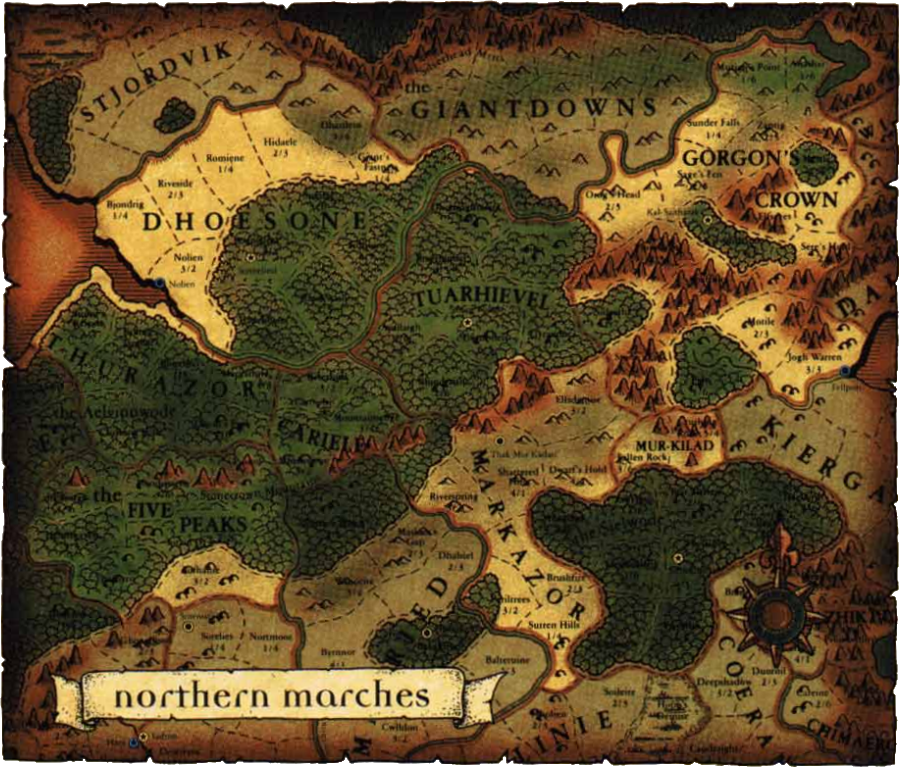
The campaign will begin in the Five Peaks. This domain, in the Northern Marches of Anuire, has no single regent. Rather, it is a haven for brigands, bandits, and worse. The first part of the campaign will consist in the PCs forging their domains out of the Five Peaks and taking their place on the political stage. After that, the PCs will have to protect what they have built, as well as expand their holdings if they choose. This part of the campaign will be largely self-directed.
The Five Peaks
The Five Peaks contain some of the most rugged terrain in Anuire, including five of the most forbidding mountains in the region. Set along the range between the Seamists and the Stonecrowns, this kingdom is the original spawning grounds of the goblins and orogs that so plagued the dwarves and elves of ancient Cerilia. Besides the brigands, goblins, and orogs, rumors populate the domain with griffons and giant tribes as well. Many have spotted the dragon Lifesbane touching down on peaks in this realm. Each of the seven provinces of the Five Peaks has its own hierarchy.





Character Creation
Ability Scores
Characters in Birthright have an additional, optional ability score: Bloodline. Having a Bloodline score is a prerequisite for ruling a domain; it also grants certain supernatural powers. During character creation, you have 30 points to spend on ability scores, including Bloodline. Like all other ability scores, Bloodline starts at 8 and can be raised by putting points in it, to a maximum of 17 at character creation.
As Bloodline is an optional ability score, you can also choose not to have a Bloodline score at all. If you do, you are unblooded. Unblooded characters cannot rule domains, but after ability scores are determined you can increase any ability score of your choice that hasn’t already been increased by your ancestry by 1.
Bloodline ability checks are used as part of various domain actions. Your Bloodline ability modifier is also used as part of certain blood abilities.
Your Bloodline score represents the strength of your blood, as seen on the following table. Like other ability scores, you cannot typically increase your Bloodline score past 20. Attaining a True bloodline is almost impossible; those with a True bloodline were typically at the Battle of Deismaar when it happened 2000 years ago.
Bloodline Strength
| Bloodline Score | Bloodline Strength |
|---|---|
| 1-8 | Tainted |
| 9-11 | Minor |
| 12-14 | Major |
| 15-20 | Great |
| 21+ | True |
Your Bloodline score cannot be increased during play by the Ability Score Improvement class feature. However, regents can invest regency earned through ruling their domains into improving their bloodline. To increase your bloodline score by 1, you must spend RP equal to the new score x 3. This can only be done once per character. In this way, even the weakest bloodline can become great over time.
A more direct route to strengthening your bloodline is called bloodtheft. When a blooded scion is killed by being pierced through the heart by another blooded character, the slayer's Bloodline score increases by 1 if the slayer's Bloodline is stronger or equal to the victim's or 2 if the slayer's Bloodline is weaker. If the slain scion was the last of their line, the slayer's Bloodline score increases by 1 additional point. Committing bloodtheft against a scion with a True bloodline is one of the few ways to improve your Bloodline score past 20.
You also have a bloodline derivation. This represents which of the old gods you derive power from and can be chosen or rolled randomly.
Bloodline Derivation
| d8 | Bloodline Derivation |
|---|---|
| 1 | Anduiras, god of war and nobility |
| 2 | Azrai, god of evil and darkness |
| 3 | Basaia, goddess of the sun and beauty |
| 4 | Brenna, goddess of fortune and wealth |
| 5 | Masela, goddess of weather and the sea |
| 6 | Reynir, god of hunting and the wilds |
| 7 | Vorynn, god of magic and the moon |
| 8 | Roll again |
Those unlucky souls cursed with the blood of Azrai are at risk of being corrupted into one of the monstrous awnsheglien. It is not known why some who bear his blood become monsters while others do not, but it does seem like the more potent your bloodline, the more likely you are to fall.
Blood Abilities
Your bloodline can grant you special abilities, known as blood abilities, based on its strength and derivation. At character creation, you get one ability chosen from the list below. You can choose any ability appropriate for your bloodline’s strength and derivation. If you qualify for a major blood ability, you also get the minor version of the ability you choose should one exist. For bloodline abilities that grant the ability to cast a spell, your spellcasting ability is Bloodline. The DC to resist your bloodline abilities is 8 + your Bloodline ability modifier + your proficiency bonus + any special modifiers. Unless otherwise noted, all spells cast through blood abilities are cast at the lowest possible level and can’t be cast at a higher level. For cantrips where level matters, use the character’s level.
If your bloodline strength later increases, your existing blood abilities grow stronger as well. If your blood ability does not have a stronger version, you can gain a new blood ability instead. You can also acquire additional blood abilities by taking the Potent Bloodline feat.
Characters with tainted bloodlines do not qualify for any blood abilities. They can acquire abilities if their bloodline strength increases. Their blood often manifests as a bloodmark, which is an unusual and supernatural birthmark. Any blooded character can have a bloodmark. If it is displayed prominently it usually serves as proof of your identity. It can somethimes grant advantage on Charisma (Persuasion) checks, depending on the audience.
Blood Abilities by Strength and Derivation
Anduiras
- Animal Affinity (Minor, Major, Great)
- Battlewise (Major)
- Courage (Minor, Major, Great)
- Deny Illusion (Minor)
- Divine Aura (Major, Great)
- Divine Wrath (Major)
- Elemental Control (Great)
- Enhanced Sense (Minor, Major)
- Healing (Minor, Major, Great)
- Iron Will (Minor)
- Long Life (Minor)
- Protective Veil (Major)
- Regeneration (Great)
- Resistance (Minor)
- Unreadable Thoughts (Minor)
Azrai
- Alertness (Minor)
- Alter Appearance (Major)
- Animal Affinity (Minor, Major, Great)
- Battlewise (Major)
- Charm Aura (Major, Great)
- Divine Aura (Major, Great)
- Enhanced Sense (Minor, Major)
- Fearsome Mien (Major)
- Iron Will (Minor)
- Long Life (Minor, Major, Great)
- Poison Sense (Minor)
- Poison Touch (Minor, Major)
- Regeneration (Great)
- Resistance (Minor)
- Touch of Decay (Great)
- Travel (Great)
- Unreadable Thoughts (Minor)
Basaia
- Alertness (Minor)
- Animal Affinity (Minor, Major, Great)
- Blood History (Minor)
- Character Reading (Major)
- Charm Aura (Major, Great)
- Deny Illusion (Minor)
- Divine Aura (Major, Great)
- Divine Wrath (Major)
- Elemental Control (Great)
- Enhanced Sense (Minor, Major)
- Long Life (Minor, Major, Great)
- Protective Veil (Major)
- Resistance (Minor)
- Travel (Great)
- Unreadable Thoughts (Minor)
Brenna
- Alertness (Minor)
- Alter Appearance (Major)
- Animal Affinity (Minor, Major, Great)
- Character Reading (Major)
- Charm Aura (Major, Great)
- Deny Illusion (Minor)
- Enhanced Sense (Minor, Major)
- Home Hearkening (Major, Great)
- Iron Will (Minor)
- Long Life (Minor, Major, Great)
- Protective Veil (Major)
- Resistance (Minor)
- Travel (Great)
- Unreadable Thoughts (Minor)
Masela
- Animal Affinity (Minor, Major, Great)
- Blood History (Minor)
- Direction Sense (Minor)
- Divine Aura (Major, Great)
- Divine Wrath (Major)
- Elemental Control (Great)
- Enhanced Sense (Minor, Major)
- Long Life (Minor, Major, Great)
- Protective Veil (Major)
- Resistance (Minor)
- Travel (Great)
- Unreadable Thoughts (Minor)
Reynir
- Alertness (Minor)
- Animal Affinity (Minor, Major, Great)
- Deny Illusion (Minor)
- Direction Sense (Minor)
- Divine Aura (Major, Great)
- Elemental Control (Great)
- Enhanced Sense (Minor, Major)
- Healing (Minor, Major, Great)
- Iron Will (Minor)
- Long Life (Minor, Major, Great)
- Poison Sense (Minor)
- Protective Veil (Major)
- Regeneration (Great)
- Resistance (Minor)
- Unreadable Thoughts (Minor)
Vorynn
- Alter Appearance (Major)
- Animal Affinity (Minor, Major, Great)
- Blood History (Minor)
- Character Reading (Major)
- Deny Illusion (Minor)
- Divine Aura (Major, Great)
- Enhanced Sense (Minor, Major)
- Long Life (Minor, Major, Great)
- Mebhaighl Sense (Minor, Major)
- Protective Veil (Major)
- Resistance (Minor)
- Travel (Great)
- Unreadable Thoughts (Minor)
Blood Abilities in Detail
Alertness (Minor)
Derivations: Azrai, Basaia, Brenna, Reynir
You gain a bonus on Initiative and Wisdom (Perception) checks equal to your Bloodline ability score modifier (minimum +1).
Alter Appearance (Major)
Derivations: Azrai, Brenna, Vorynn
You can cast disguise self. Once you cast it, you must finish a short rest or long rest before you can cast it again.
Animal Affinity (Minor, Major, Great)
Derivations: All
You have kinship with the totem animal of the god from whom your bloodline derives. Anduiras’s animal was the lion, Azrai’s was the serpent, Basaia’s the eagle, Brenna’s the cat, Masela’s the dolphin, Reynir’s the wolf, and Vorynn’s the owl. The power granted by this blood ability depends on your bloodline strength.
Minor. You can cast detect thoughts at will, but only to detect the surface thoughts and emotions of your totem animal.
Major. You can cast speak with animals at will, but only to speak with your totem animal. In addition, you can cast animal friendship targeting your totem animal. Once you cast animal friendship, you must finish a long rest before you can cast it again.
Great. You can cast polymorph in order to transform into your totem animal. Once you cast it, you must finish a long rest before you can cast it again. You cannot transform others into your totem animal. If your have the blood of Anduiras, you cannot use this ability until you reach 3rd level.
Battlewise (Major)
Derivations: Anduiras, Azrai
You are preternaturally skilled at leading troops. When you are personally leading your troops in mass battle, you have advantage on all initiative checks. In addition, when you fight alongside your troops, the unit you command has advantage on all of its attack rolls, Morale checks and saving throws.
Blood History (Minor)
Derivations: Basaia, Masela, Vorynn
You can, with concentration, call upon the memories of your ancestors. You have advantage on all Intelligence (History) checks to recall events of the past. In addition, you can draw upon the skills of your ancestors to gain advantage on another ability check (except for a Bloodline ability check). Once you use this power, you cannot use it again until you complete a long rest.
Character Reading (Major)
Derivations: Basaia, Brenna, Vorynn
You are unnaturally good at judging character and intentions. You gain advantage on Wisdom (Insight) checks to gauge someone’s intentions or detect whether or not they are under some form of magical compulsion.

Charm Aura (Major, Great)
Derivations: Azrai, Basaia, Brenna
You can project an aura that allows you to mesmerize and control those who see you.
Major. You can cast charm person. Once you cast it, you must finish a short or long rest before you cast it again.
Great. You can cast suggestion. Once you cast it, you must finish a short or long rest before you cast it again.
Courage (Minor, Major, Great)
Derivations: Anduiras
Minor. You gain advantage on all saving throws against the frightened condition.
Major. You gain an aura of courage; all allies within 30 feet also gain advantage on all saving throws against the frightened condition.
Great. When you personally command a unit on the battlefield, it automatically passes all Morale saving throws and will not flee unless you command it to do so. All other units on your side during the battle have advantage on their Morale saving throws.
Deny Illusion (Minor)
Derivations: All except Azrai and Masela
You are rarely fooled by illusions. You gain advantage on all saving throws against illusion spells that allow a save.
Direction Sense (Minor)
Derivations: Masela, Reynir
You always know which direction is north and can never become lost at sea, in the wilderness, or in rural settings.
Divine Aura (Major, Great)
Derivations: All
You can call upon your divine blood to cloak yourself in a mantle of power and nobility. When you first meet a creature, if it would be indifferent toward you it is instead friendly.
Major. You can cast enthrall. Once you cast it, you must finish a long rest before you cast it again.
Great. You can cast hypnotic pattern. Once you cast it, you must finish a long rest before you cast it again.
Divine Wrath (Major)
Derivations: Anduiras, Basaia, Masela
When you grow angry, you become a terrible foe, imbued with extreme strength and able to instill terror in your foes. As a bonus action, you can enter a divine rage. While in this state, you get your Bloodline ability modifier as a bonus to all attack and damage rolls, including spell attacks. Your divine rage lasts for 1 minute. After your rage ends, you cannot use this ability again until you have completed a long rest.
Elemental Control (Great)
Derivations: Anduiras, Basaia, Masela, Reynir
Each of the elements had its patron god. Anduiras was god of the skies. Basaia held dominion over fire. Masela, as goddess of the sea, controlled water, and finally Reynir was the patron of earth.
You can speak with elemental creatures affiliated with your element. Elementals of that type will not attack you unless compelled by an outside source. In addition, at 7th level you can cast conjure minor elementals to summon elementals of that type. Once you cast it, you must finish a long rest before you can cast it again. At 9th level you can instead cast conjure elemental.
Enhanced Sense (Minor, Major)
Derivations: All
You have improved powers of perception.
Anduiras. You can cast detect evil and good. Once you cast it, you must finish a short or long rest before you can cast it again. As a major ability, you can cast it at will.
Azrai. You have darkvision out to a range of 60 feet. If you already have darkvision, increase its range by 60 feet. As a major ability, you can also see through magical darkness effects as if they did not exist.
Basaia. You do not suffer disadvantage for making ranged attacks at long range. As a major ability, you are immune to the blinded condition when inflicted by anything short of having your eyes removed or destroyed.
Brenna. You have advantage on any Wisdom (Perception) and Intelligence (Investigation) checks associated with hearing. As a major ability, you are immune to the deafened condition and you cannot be surprised.
Masela. You never suffer disadvantage on skill checks as a result of wind, rain, snow, fog, or other weather-related conditions. Your sight and hearing are not hampered by poor weather. As a major ability, whenever anyone within 10 miles speaks your name and both of you are outdoors, the wind carries their words to you. You hear their words as well as what is said about you.
Reynir. You have advantage on Wisdom (Survival) checks to track quarry. As a major ability, you automatically succeed on these checks and you cannot be surprised in wilderness or rural environments.
Vorynn. You have a limited ability to see the future. You can cast augury. Once you cast it, you must finish a long rest before you can cast it again. As a major ability, at 5th level you can also cast divination. Once you cast it, you must finish a long rest before you can cast it again.
Fearsome Mien (Major)
Derivations: Azrai
You can awaken the deepest fears of those around you. You can cast wrathful smite. Once you cast it, you must complete a short or long rest before you can cast it again. At 5th level, you can also cast fear. Once you cast it, you must complete a long rest before you can cast it again.
Healing (Minor, Major, Great)
Derivations: Anduiras, Basaia, Reynir
You gain the ability to heal with a touch.
Minor. You can cast cure wounds. Once you cast it, you must complete a short or long rest before you can cast it again.
Major. You can cast lesser restoration. Once you cast it, you must complete a short or long rest before you can cast it again.
Great. When you reach 7th level, you can cast greater restoration. Once you cast it, you must complete a long rest before you can cast it again.
Home Hearkening (Major, Great)
Derivations: Brenna
You have a strong connection to your domain. If any of your holdings experience a challenge or threat, you immediately know it, though you do not know the nature of the threat. As a great ability, you can address the issue from a distance, imposing your will on your domain from another location. You can take a single domain action to address the threat, even if you are not in your domain.
Iron Will (Minor)
Derivations: Anduiras, Azrai, Brenna, Reynir
You gain advantage on all saving throws against the charmed condition.
Long Life (Minor, Major, Great)
Derivations: All (Anduiras: Minor only)
Minor. You age only one year for every five that pass.
Major. You age only one year for every ten that pass. In addition, your Constitution score increases by 1.
Great. You do not age.
Mebhaighl Sense (Minor, Major)
Derivations: Vorynn
You are in tune with the natural magic of Cerilia.
Minor. You can cast detect magic at will, although you can only use it to detect arcane magic. In addition, you can detect ley lines and mebhaighl sources within one mile.
Major. You no longer need to concentrate to use detect magic. It is simply always active. You must concentrate to learn the school of magic for any magical effects that you spot. Your ability to detect ley lines and mebhaighl sources extends to five miles.
Poison Sense (Minor)
Derivations: Azrai, Reynir
You can cast detect poison and disease at will.
Poison Touch (Minor, Major)
Derivations: Azrai
Minor. You can cast poison spray at will.
Major. You can poison food or water at a touch at will. Anyone eating or drinking a poisoned substance must succeed on a Constitution saving throw or take 1d6 poison damage and become poisoned. The poisoned creature must repeat the saving throw every 24 hours, taking 1d6 poison damage on a failed save. Until the poison ends, the damage the poison deals can’t be healed by any means. After seven successful saving throws, the poison effect ends.
Protective Veil (Major)
Derivations: All except Azrai
You can cast protection from evil and good. Once you cast it, you must complete a short or long rest before you can cast it again.
Regeneration (Great)
Derivations: Anduiras, Azrai, Reynir
You heal unnaturally fast. When you take a short rest, you heal additional hit points equal to your Bloodline ability modifier for each Hit Die you expend. You regain all your Hit Dice at the end of a long rest. You automatically succeed on death saving throws. Finally, you can recover from lingering injuries given enough time. An injury that can be cured by magical healing is removed after a short rest. If the injury requires magical healing of 6th level or higher, it is removed after a long rest. Injuries requiring a regenerate spell can be healed after three months (one domain turn).
Resistance (Minor)
Derivations: All
The ancient gods grant some of their scions improved ability to resist harm.
Anduiras. You gain resistance to psychic damage.
Azrai. Choose necrotic or poison damage. You gain resistance to that damage type.
Basaia. You gain resistance to fire damage.
Brenna. You gain advantage on all saving throws against effects that would inflict the paralyzed or restrained conditions.
Masela. You gain the ability to breathe water.
Reynir. You gain resistance to cold damage.
Vorynn. As a reaction, you can shield yourself against magical effects and gain advantage on a saving throw against a spell. Once you have used this ability, you must complete a short or long rest before you can cast it again.
Touch of Decay (Great)
Derivations: Azrai
You can cast inflict wounds. When you cast it, you can target objects as well as creatures, and the spell automatically inflicts maximum damage on objects. Once you cast it, you must complete a short or long rest before you can cast it again.
Travel (Great)
Derivations: Azrai, Basaia, Brenna, Masela, Vorynn
Your blood grants you the ability to transport yourself long distances. To use this power, you must be familiar with your destination. This power is similar to the teleport spell, except as noted below. Once you have used this ability, you must complete a long rest before you can cast it again. In all cases, using this ability requires several minutes of focus, and the journey itself takes an hour.
Azrai. You travel through the Shadow World. You can only use this power between sunset and sunrise, and your entry and exit points must be in places where the barrier between the worlds is thin, such as a graveyard, deep cavern, or bloody battlefield.
Basaia. You travel through fire. You must enter and exit through a fire large enough to cover your entire body. You are protected from the flames during the transition.
Brenna. You travel along the roads of Cerilia. You must be standing on a road to use this power, and your destination can be anywhere you could reach without leaving the roads.
Masela. You travel through the sea and other bodies of water connected to it. You must enter and exit through a natural body of water large enough to immerse you to the waist.
Vorynn. You can travel only while the moon is visible. You must be able to see the moon from your entry and exit point.
Unreadable Thoughts (Minor)
Derivations: All
You are immune to the detect thoughts spell and gain advantage on saving throws against all other spells and effects that read your mind or emotions. Attempts to use Insight to determine your motives have disadvantage.


Ancestry
Most of the standard races are available in a Birthright campaign, but some of them have been changed to account for differences between the PHB and the Cerilian versions.
Ability Score Increases. All characters, regardless of ancestry, can choose one of the following: either increase any ability score by 2 and another score by 1, or increase three different ability scores by 1.
Dwarf (Karamhul)
Dwarven myths say they were born of the mountain stone, and they lived in the mountains of Kuldarzik (their name for Cerilia) long before humans arrived. They did not find themselves at odds with humans after their arrival, although they have remained somewhat insular.
Size. Dwarves stand between 4 and 5 feet tall, but are incredibly dense. They typically weigh 300 to 350 pounds. Your size is Medium.
Speed. Your base walking speed is 25 feet. Your speed is not reduced by wearing heavy armor.
Tool Proficiency. You gain proficiency with smith’s tools, brewer’s supplies, or mason’s tools.
Dwarven Resilience. You have advantage on saving throws against poison, and you have resistance against poison damage.
Stonecunning. When you make an Intelligence (History) check related to the origin of stonework, you are considered proficient in the History skill and add double your proficiency bonus to the check.
Tough as Stone. You have resistance against damage from non-magical bludgeoning attacks. Treat your Strength score as 4 higher for the purposes of determining your carrying capacity. You automatically fail Strength (Athletics) checks made to swim or float in water.
Languages. You speak Karamhul and one additional language of your choice.
Culture. Choose your cultural heritage from surface-dweller or deep-dweller.
Surface-Dweller
Darkvision. You have superior vision in dark and dim conditions. You can see in dim light within 60 feet as if it were bright light, and in darkness as if it were dim light. You can’t discern color in darkness.
Dwarven Toughness. Your hit point maximum increases by 1, and it increases by 1 every time you gain a level.
Deep-Dweller
Dwarven Combat Training. You have proficiency with the battleaxe, handaxe, throwing hammer, and warhammer.
Superior Darkvision. You have superior vision in dark and dim conditions. You can see in dim light within 120 feet as if it were bright light, and in darkness as if it were dim light. You can’t discern color in darkness.
Elf (Sidhelien)
The elves of Cerilia are graceful, elegant, and reclusive. They are deeply suspicious of humankind, having been driven from their forests by the spreading tide of humankind. For some, this suspicion manifests in the form of isolationism; these elves close off their realms, and their forests are dark and forbidding. Others prefer to engage with the humans, hoping to bridge the divide that stands between the two races.
Size. Elves are similar in height to humans, but typically have more slender builds. Your size is Medium.
Speed. Your base walking speed is 30 feet.
Darkvision. You have superior vision in dark and dim conditions. You can see in dim light within 60 feet as if it were bright light, and in darkness as if it were dim light. You can’t discern color in darkness.
Keen Senses. You have proficiency in the Perception skill.
Fey Ancestry. You have advantage on saving throws against being charmed, and magic can’t put you to sleep.
Languages. You are fluent in Sidhelien and one additional language of your choice.
Culture. Choose a cultural heritage.
Open
Elf Weapon Training. You have proficiency with the longsword, shortsword, shortbow, and longbow.
Touch the World Lightly. Your base walking speed is 35 feet. While moving through natural environments, you cannot be tracked except by magical means. Moving through nonmagical difficult terrain costs you no extra movement.
Reclusive
Elder Arts. You have an innate connection to the land that provides you with magical power. You know one cantrip of your choice from the wizard spell list. Intelligence is your spellcasting ability for it.
Mask of the Wild. When you make a Dexterity (Stealth) check to hide in natural environments, you are considered proficient in the Stealth skill and add double your proficiency bonus to the check.
Goblin
Cerilia’s goblins tend to emulate the cultures around them, albeit with a somewhat bloodthirsty twist. They control several domains, and they are organized enough to maintain diplomatic relations with other realms.
Size. Common goblins are between 3 and 4 feet tall and weigh between 40 and 80 pounds. Your size is Small. Elite goblins, on the other hand, stand around 6 feet tall and weigh around 200 pounds. If you’re an elite goblin you are size Medium.
Darkvision. You have superior vision in dark and dim conditions. You can see in dim light within 60 feet as if it were bright light, and in darkness as if it were dim light. You can’t discern color in darkness.
Languages. You are fluent in Goblin as well as one human language of your choice.
Status. Choose your status from among common and elite.
Common
Fury of the Small. When you damage a creature that is larger than you with an attack or spell, you can deal extra damage equal to your level. Once you use this trait, you can’t use it again until you finish a short or long rest.
Nimble Escape. You can take the Disengage or Hide action as a bonus action on your turn.
Elite
Powerful Build. You count as one size larger when determining your carrying capacity as well as the weight you can push, drag, or lift.
Imposing Presence. You have proficiency in Intimidation.
Half-Elf
Half-elves are rare in Cerilia. Those who live among humans can face ostracism and suspicion, which tends to result in the half-elf traveling widely. The elves are more welcoming, treating the half-elf as one of their own. Often, half-elves serve as the public face of elven communities.
Size. Half-elves are the same size as humans. Your size is Medium.
Speed. Your base walking speed is 30 feet.
Darkvision. You have superior vision in dark and dim conditions. You can see in dim light within 60 feet as if it were bright light, and in darkness as if it were dim light. You can’t discern color in darkness.
Fey Ancestry. You have advantage on saving throws against being charmed, and magic can’t put you to sleep.
Versatility. You gain proficiency in two skills of your choice.
Languages. You are fluent in Sidhelien, one human language, and one additional language of your choice.
Halfling
The halflings of Cerilia fled to this world from the Shadow World, a realm of twilight and magic. Once they could walk between the worlds freely, but now they are tethered to this world and cannot move across the border as they wish. Halflings tend to adapt and emulate the cultures surrounding them, leading to cultural distinctions between those who live in human realms and those who live among the elves.
Size. Halflings average about 3 feet tall and weigh about 40 pounds. Your size is Small.
Speed. Your base walking speed is 25 feet.
Lucky. When you roll a 1 on an attack roll, ability check, or saving throw, your can reroll the die and must use the new roll.
Nimbleness. You can move through the space of any creature whose size is larger than yours.
From Shadow. As an action, you can attune your senses to the Shadow World, allowing you to cast detect evil and good and detect magic (necromancy only). You must complete a short or long rest before you can use this ability again. When you reach 3rd level, you can cast the misty step spell, but only while standing in a region of dim or darker lighting. You must complete a short or long rest before you can use this ability again. When you reach 7th level, you can cast dimension door once per day, but only under the same conditions.
Languages. You speak Umbric and one additional language of your choice.
Culture. Choose your cultural heritage from among Sidhe-friend and Human-friend.
Human-friend
Brave. You have advantage on saving throws against being frightened.
Languages. You speak an additional human language of your choice.
Sidhe-friend
Easily Overlooked. You have proficiency in the Stealth skill.
Languages. You speak Sidhelien.
Human
Humans are the most populous race in Cerilia and inhabit every part of the continent. Most are descended from the tribes of Aduria—save for the Khinasi, who ancestors sailed to Cerilia from across the Sea of Dragons.
Feat. You gain one feat of your choice.
Languages. You speak one language of your choice as well as the language of your culture.
Culture. Choose your cultural heritage from among Anuirean, Brecht, Khinasi, Rjuven, and Vos.
Anuirean
Chivalric Culture. You have proficiency in the History skill. Double your proficiency bonus on checks to recount the history of Anuire, identify the heraldry of Anuirean regents, or recall facts about the lineage and station of Anuirean nobility.
Brecht
Merchant Culture. You have proficiency in the Investigation skill and can always determine the approximate worth of an object after studying it briefly.
Khinasi
Scholarly Traditions. You have proficiency in one Intelligence skill of your choice, and you are fluent in one additional language of your choice.
Rjuven
Doom. You have a doom—a special fate which was assigned when you were born. You don’t necessarily know your doom, and it need not be negative. Simply knowing you have some purpose grants you drive and focus. You have advantage on saving throws against fear or exhaustion.
Animal-friend. Choose Animal Handling or Nature. You have proficiency in that skill.
Vos
Wastelander. You have proficiency in the Survival skill. Your hit point maximum increases by 1, and increases by 1 every time you gain a level. In addition, you are naturally adapted to cold climates and do not need to make Constitution saving throws to resist exhaustion in cold environments.
Orog
Orogs are a subterranean race of miners and warriors that inhabit Cerilia’s mountain ranges. Most orog holdings are in a state of perpetual war against all their neighbors. Like their traditional enemies, the dwarves, orogs are skilled artisans. Their culture values strength and skill at arms.
Size. Orogs stand between 6 and 7 feet tall and weigh close to 300 pounds. Your size is Medium.
Speed. Your base walking speed is 30 feet.
Orog Endurance. When you are reduced to 0 hit points but not killed outright, you can drop to 1 hit point instead. You can’t use this feature again until you finish a long rest.
Aggressive. As a bonus action, you can move up to your speed toward an enemy of your choice that you can see or hear. You must end this move closer to the enemy than you started.
Martial Training. You are proficient with two martial weapons of your choice and light armor.
Languages. You are fluent in Orog as well as an additional human language of your choice.


Class
The standard classes are available in a Birthright campaign. The available subclasses are listed below.
Barbarian
- Ancestral Guardian (XGE)
- Battlerager (SCAG)
- Berserker (PH)
- Storm Herald (XGE)
- Totem Warrior (PH, additional totems in SCAG)
- Zealot (XGE)
Bard
- Glamour (XGE)
- Lore (PH)
- Satire (UA)
- Swords (XGE)
- Valor (PH)
- Whispers (XGE)
Cleric
Blooded clerics can cast realm spells using temple holdings. Halflings have no gods of their own but adopt the religious practices of the communities that surround them. Elves similarly lack their own divinities; they tend to be druids, or on extremely rare occasions clerics of one of the human gods.
- Haelyn, Lord of Noble War: Order (GGR), Protection (UA), War (PH)
- Erik, Old Father of the Forests: Life (PH), Nature (PH)
- Cuiraécen, Stormlord: Nature (PH), Tempest (PH), War (PH)
- Nesirie, Lady of Mourning: Grave (XGE), Tempest (PH)
- Ruornil, Silver Prince: Arcana (SCAG), Knowledge (PH)
- Sera, Lady of Fortune: Forge (XGE), Trickery (PH)
- Avani, Lady of Reason: Knowledge (PH), Life (PH), Light (PH)
- Eloéle, Sister of Thieves: Grave (XGE), Trickery (PH)
- Laerme, Goddess of Fire, Beauty, and Art: Light (PH), Protection (UA)
- Kriesha, The Winter Witch: Nature (PH), Tempest (PH)
- Belinik, Lord of Strike: Death (DMG), Strength (PSA), War (PH)
- Moradin: Forge (XGE), Order (UA), Protection (UA); dwarves only
- Kartathok: Order (UA), Trickery (PH), War (PH); goblins only
- Orog Ancestor Spirits: Forge (XGE), Strength (PSA), War (PH); orogs only
Druid
Blooded druids can cast realm spells using source or temple holdings.
- Dreams (XGE)
- Land (PH)
- Moon (PH)
- Seasons (XLN)
- Shepherd (XGE)
Fighter
- Arcane Archer (XGE)
- Banneret (SCAG)
- Battle Master (PH)
- Brute (UA)
- Cavalier (XGE)
- Champion (PH)
- Eldritch Knight (PH)
The available fighting styles for fighters are:
- Archery
- Close Quarters Shooter
- Defense
- Dueling
- Great Weapon Fighting
- Protection
- Tunnel Fighter
- Two-Weapon Fighting
Monk
The stereotypical monk is very rare in Cerilia, as monastic orders that train in the martial arts are all but unheard of.
- Drunken Master (XGE)
- Four Elements (PH)
- Kensei (XGE)
- Long Death (SCAG)
- Open Hand (PH)
- Shadow (PH)
- Sun Soul (XGE)
Paladin
- Ancients (PH)
- Conquest (XGE)
- Crown (SCAG)
- Devotion (PH)
- Oathbreaker (DMG)
- Redemption (XGE)
- Vengeance (PH)
The available fighting styles for paladins are:
- Defense
- Dueling
- Great Weapon Fighting
- Protection
- Tunnel Fighter
Ranger
Rangers can be built using the rules in the PHB or the Ranged Revisited (UA) supplement. Revisited rangers are limited to the conclaves in that supplement. When multiclassing, you cannot use the revisited ranger.
- Beast Master (PH)
- Field Marshal (MM)
- Gloom Stalker (XGE)
- Horizon Walker (XGE)
- Hunter (PH)
- Monster Slayer (XGE)
- Primeval Guardian (UA)
The available fighting styles for rangers are:
- Archery
- Close Quarters Shooter
- Defense
- Dueling
- Tunnel Fighter
- Two-Weapon Fighting
Rogue
- Assassin (PH)
- Arcane Trickster (PH)
- Mastermind (SCAG)
- Inquisitive (XGE)
- Scout (XGE)
- Swashbuckler (SCAG)
- Thief (PH)
Sorcerer
Only elves, half-elves, and blooded characters can be sorcerers. Blooded sorcerers can cast realm spells using source holdings. Sorcerers can be built using the rules in the PHB or the Sorcerer Revisited (3PP) supplement. When multiclassing, you cannot use the revisited sorcerer.
- Divine Soul (XGE)
- Draconic (PH)
- Fey (XLN)
- Giant Soul (UA)
- Phoenix (UA)
- Pyromancer (PSK)
- Sea (UA)
- Shadow (XGE)
- Stone (UA)
- Storm (SCAG)
- Wild (PH)
Warlock
- Archfey (PH)
- Celestial (XGE)
- Cold Rider (UA; reflavored Raven Queen)
- Fiend (PH)
- Great Old One (PH)
- Hexblade (XGE)
- Undying (SCAG)
Wizard
Only elves, half-elves, and blooded characters can be wizards. Blooded wizards can cast realm spells using source holdings.
- Abjuration (PH)
- Conjuration (PH)
- Divination (PH)
- Enchantment (PH)
- Evocation (PH)
- Illusion (PH)
- Necromancy (PH)
- Transmutation (PH)
- War Magic (XGE)
Backgrounds
The following backgrounds are available to characters in a Birthright campaign.
- Acolyte (PH)
- Archaeologist (TOA)
- Charlatan (PH)
- Clan Crafter (SCAG)
- Cloistered Scholar (SCAG)
- Courtier (SCAG)
- Criminal (PH)
- Entertainer (PH)
- Far Traveler (SCAG)
- Folk Hero (PH)
- Gladiator (PH)
- Guild Artisan (PH)
- Guild Merchant (PH)
- Haunted One (COS)
- Hermit (PH)
- Inheritor (SCAG)
- Knight (PH)
- Mercenary Veteran (SCAG)
- Noble (PH)
- Outlander (PH)
- Sage (PH)
- Sailor (PH)
- Soldier (PH)
- Smuggler (GOS)
- Spy (PH)
- Urchin (PH)
Available Feats
The following feats are available to characters in a Birthright campaign.
- Acrobat (UA)
- Actor (PH)
- Alchemist (UA)
- Alert (PH)
- Animal Handler (UA)
- Arcanist (UA)
- Athlete (PH)
- Blade Mastery (UA)
- Brawny (UA)
- Bountiful Luck (XGE)
- Burglar (UA)
- Charger (PH)
- Crossbow Expert (PH)
- Defensive Duelist (PH)
- Diplomat (UA)
- Dual Wielder (PH)
- Dungeon Delver (PH)
- Durable (PH)
- Dwarven Fortitude (XGE)
- Elemental Adept (PH)
- Elven Accuracy (XGE)
- Empathetic (UA)
- Fade Away (XGE; available to halflings)
- Fell-Handed (UA)
- Fey Teleportation (XGE; available to all elves)
- Flail Mastery (UA)
- Gourmand (UA)
- Grappler (PH)
- Great Weapon Master (PH)
- Grudge Bearer (UA)
- Healer (PH)
- Heavily Armored (PH)
- Heavy Armor Master (PH)
- Historian (UA)
- Inspiring Leader (PH)
- Investigator (UA)
- Keen Mind (PH)
- Lightly Armored (PH)
- Linguist (PH)
- Mage Slayer (PH)
- Magic Initiate (PH)
- Martial Adept (PH)
- Master of Disguise (UA)
- Medic (UA)
- Medium Armor Master (PH)
- Menacing (UA)
- Mobile (PH)
- Moderately Armored (PH)
- Mounted Combatant (PH)
- Naturalist (UA)
- Observant (PH)
- Orog Fury (XGE; as orcish fury, but available to orogs)
- Perceptive (UA)
- Performer (UA)
- Polearm Master (PH)
- Potent Bloodline (custom)
- Prodigy (XGE)
- Quick-Fingered (UA)
- Resilient (PH)
- Ritual Caster (PH)
- Savage Attacker (PH)
- Second Chance (XGE)
- Sentinel (PH)
- Sharpshooter (PH)
- Shield Master (PH)
- Skilled (PH)
- Skulker (PH)
- Silver-Tongued (UA)
- Spear Mastery (UA)
- Spell Sniper (PH)
- Squat Nimbleness (XGE)
- Stealthy (UA)
- Survivalist (UA)
- Tavern Brawler (PH)
- Theologian (UA)
- Tough (PH)
- War Caster (PH)
- Weapon Master (PH)
- Wood Elf Magic (XGE; available to all elves)
Potent Bloodline
Prerequisite: you must have a Bloodline score.
Your divine bloodline is exceptionally powerful. You increase your Bloodline score by 1, to a maximum of 20. In addition, choose a bloodline ability that you qualify for. You gain that bloodline ability.
House Rules
We will be using the following optional rules from various sources.
Feats. At certain levels, your class gives you the Ability Score Increase feature. Rather than increase your ability scores, you can take a feat. (PHB p 165)
Multiclassing. Characters can take levels in more than one class. (PHB p 163)
Healer’s Kit Dependency. In order to spend Hit Dice after a short rest, someone must expend one use of a healer’s kit to treat the character’s wounds. (DMG p 266)
Longer Rests. Short rests require 8 hours of rest. Long rests require a full week. (DMG p 267)
Injuries. Whenever a character drops to 0 hit points and survives, they suffer a lingering injury. (DMG p 272)
Loyalty. NPC allies have a loyalty score, ranging from 0 to 20. Loyalty is tracked in secret; an NPC whose loyalty drops to 0 is likely to betray the PCs. (DMG p 93)
Mixing Potions. Drinking multiple potions can cause unusual and unpredictable effects. (DMG 140)
Difficult Magic Item Identification. Magic items cannot be identified without experimentation or research. The identify spell does not exist. (DMG p 136)
Downtime. Characters can take downtime actions in order to work on long-term projects or advance their interests. (XGE p 123)
Modified Three-Pillar Experience. Characters always need 100 XP to level. You gain XP for defeating threats, bringing important NPCs around to your side, discovering items and places of power, and advancing the interests of your domain. (UA)
Stunning Strike. The monk stunning strike class feature can only be used once per turn.
No Magic Item Shops. Magic items can only be purchased or sold during downtime using the appropriate downtime actions.
Difficult Crafting. Magic items can be crafted, but it will always require an adventure to do so.
Ritual Magic. When casting a spell as a ritual, it takes 1 hour longer than normal, rather than 10 minutes. In addition, ritual magic can only be performed in a specially prepared location. Arcane spells require a magical laboratory; divine spells require a temple, shrine, or other consecrated space. There are a few spells that can be cast as rituals using the standard rules (increasing the casting time by 10 minutes and without a special location). They are:
- Alarm
- Augury
- Commune with Nature
- Comprehend Languages
- Detect Magic
- Divination
- Feign Death
- Locate Animals or Plants
- Magic Mouth
- Purify Food and Drink
- Skywrite
Unknown Charge Counts. When a wand, staff, or similar item with charges regains expended charges, the amount regained is secret. The current charge count cannot be learned, even with magic.
Feats and Proficiency. Feats do not grant proficiency unless they say they do. The Shield Master feat requires shield proficiency.
Limited Troupe Play. When a character gains a lieutenant, the new lieutenant will be created as a new PC played by another player.
Warlocks and Familiars. Warlocks who gain access to ritual casting through the Pact of the Tome cannot learn the find familiar ritual.
Ruling a Domain
Some characters in Birthright come to rule their own domains. These characters are known as regents. Their divine bloodlines give them a mystical connection to their holdings, letting them shape the domain as they will.
There are two currencies that a regent must trade in to rule: money, and regency. Money is measured in gold bars (GB). One gold bar is roughly 2000 gold pieces. Regency is measured in regency points (RP) and measures the respect and authority that the ruler can call on to enforce their will. Only blooded characters can collect regency and become regents.
Regents rule domains. Domains always consist in one or more holdings. There are five types of holding:
- Provinces are the physical territory controlled by a regent
- Law holdings are the institutions that allow the regent to control the populace and enforce their laws, such as the city watch, a group of traveling magistrates, or a band of legbreakers
- Temple holdings are religious institutions of the character’s faith, used by clerics and druids to channel the faith of the masses into powerful realm spells
- Guild holdings are mercantile and commercial organizations, such as artisans’ guilds and crime rings
- Source holdings are wellsprings of magical energy, used by druids, sorcerers, and wizards to cast realm spells
Any given regent may control holdings of any type, but not all regents will be able to make full use of all types of holdings. Holdings have levels (between 0 and 10) representing their size and significance. For provinces, level represents the province’s population and development. The level of the province determines the maximum level of all other holdings in the province. For law, temple, and guild holdings, the maximum level is the same as the province level.
Source holdings are different. The maximum level for a source is determined by the terrain type of the province. In addition, natural magical power is spoiled by the encroachment of civilization, and as such the province level reduces the maximum source level. For example, a level 2 province in the plains has a maximum source level of 3.
| Terrain | Magical Potential |
|---|---|
| Plains, Desert, Hills, Tundra, Marsh, Moor | 5 |
| Forest, Mountain, River, Coast | 7 |
| Glacier, Swamp | 8 |
| High Mountains, Ancient Forest | 9 |
In addition, domains can include various assets above and beyond the holdings that make it up, such as armies, fortifications, ley lines, and trade routes.
The Domain Turn
Realm management is handled during domain turns. Each domain turn represents a season (about 3 months); four domain turns make up a year. During a domain turn, each regent will have the opportunity to take domain actions, directing their domain’s growth. In addition, wars play out over the course of domain turns, with units moving and engaging in mass battles.
Domain Turn Sequence
Each domain turn plays out according to the following sequence.
- Determine random events
- Determine domain initiative
- Collect regency
- Collect income
- Tax provinces
- Collect income from guilds and temples
- Collect income from trade routes
- Claim money from law holdings
- Pillage provinces
- Pay costs
- Domain maintenance
- Army payroll
- Lieutenant payroll
- Court expenses
- First action round
- Domain action and bonus action
- Move units
- Fight battles
- Occupy provinces or retreat
- Second action round
- Third action round
- Bookkeeping and cleanup
Random Events
At the beginning of each domain turn, the DM determines what events, if any, occur in each player’s domain. These events can be positive or negative, and they are laid out at the beginning of the season so each regent can determine their responses.
Domain Initiative
Domain initiative is determined by an unmodified d20 roll.
Collect Regency
After determining initiative, all regents collect regency. To determine the amount of regency collected, first determine which holdings they collect regency from. In order to collect regency from a holding, you need to have the proper skills to run it.
| Holding Type | Required Skill Proficiency |
|---|---|
| Province | None |
| Law | Insight or Investigation |
| Guild | Deception or Persuasion |
| Temple | History or Religion |
| Source | Arcana or Nature |
If you have the right skills, you gain regency for your holding equal to the holding’s level. If not, you gain regency equal to half the holding’s level, rounded down.
Regents have a cap on how much regency they can collect in a turn. No regent can gain more regency than their Bloodline ability score x 3 per turn. There is no cap on how much regency can be stored.
Collect Income
After collecting regency, the regent next collects income in the form of gold bars (GB). GB come from a number of sources. Provinces can be taxed. Guilds, temples, and trade routes provide income from trade and tithes. Law holdings in foreign provinces allow you to skim from their income. Finally, occupied provinces can be pillaged.
You can also get income from a few other sources. Random events can provide wealth. Treasures gained by adventuring can be turned into domain assets. Vassal regents can send you tribute using the Grant bonus action. However, this income arrives during other phases of the domain turn.
Taxation
Determine how heavily you wish to tax your provinces, then roll using the table below, treating all negative results as 0.
| Province Level | Light | Moderate | Harsh |
|---|---|---|---|
| 0 | 0 | 0 | 1d3-2 |
| 1 | 1d3-2 | 1d3-1 | 1d3 |
| 2 | 1d3-1 | 1d3 | 1d4 |
| 3 | 1d3 | 1d4 | 1d4+1 |
| 4 | 1d4 | 1d4+1 | 1d6+1 |
| 5 | 1d4+1 | 1d6+1 | 1d8+1 |
| 6 | 1d6+1 | 1d8+1 | 1d10+1 |
| 7 | 1d8+1 | 1d10+1 | 1d12+1 |
| 8 | 1d10+1 | 1d12+1 | 2d8 |
| 9 | 1d12+1 | 2d8 | 2d8+2 |
| 10 | 2d8 | 2d8+2 | 2d10+2 |
Collect Income From Guilds and Temples
Guilds and temples collect income based on their level and the level of the province they're in. Roll using the table below, treating all negative results as 0.
| Province Level | Holding | Level | |||
|---|---|---|---|---|---|
| — | 1 | 2 | 3 | 4-5 | 6+ |
| 0 | — | — | — | — | — |
| 1 | 1d3-2 | — | — | — | — |
| 2 | 1d2-1 | 1d2 | — | — | — |
| 3 | 1d2-1 | 1d3 | 1d4 | — | — |
| 4 | 1d2 | 1d3 | 1d4 | 1d6 | — |
| 5 | 1d2 | 1d3 | 1d4 | 1d6 | — |
| 6 | 1d2 | 1d3 | 2d2 | 2d3 | 2d4+1 |
| 7+ | 1d3 | 1d2+1 | 1d4+1 | 1d6+1 | 2d4+2 |
Collect Income From Trade Routes
Trade routes provide income based on the levels of the provinces they connect. Add the province levels together and divide by 2, rounding down. Both regents gain this much income from the trade route.
Claim Money From Law Holdings
You can use law holdings in a province to claim some of the money generated by other regents in the same province. Technically you can claim money generated by your holdings in the province, but as you're simply claiming your own money, you just break even. Consult the table below and roll, treating all negative results as 0.
| Comparative Holding Level | Target | Income | |||
|---|---|---|---|---|---|
| — | 1 | 2 | 3 | 4-5 | 6+ |
| Law < Target | — | d4-3 | d3-2 | d2-1 | d2-1 |
| Law = Target | — | d3-2 | d2-1 | d3-1 | d4-1 |
| Law > Target | d4-3 | d2-1 | d3-1 | d4-1 | d3 |
Pillage Provinces
If you have occupied a foreign province using your military, you can pillage that province. When you pillage, you perform the equivalent of harsh taxation using the lower of the province's actual level or the number of units in the occupying force as the province level. The pillaging army cannot leave the province this domain turn. When you pillage, you also reduce the province level by 1, to a minimum of 0. Pillaging tends to make the residents unhappy with you, to say the least. You can pillage your own provinces, but your armies may disobey the order, and if they do carry it out then there will be widespread repercussions for the loyalty of your holdings.





Pay Costs
Once you’ve collected your income, you must pay to keep your domain functioning. Any mustered units must be maintained, and soldiers must be paid. So to must your lieutenants. Your domain itself requires upkeep, and you may wish to pay for a lavish and well-appointed court to project an image of wealth and power (and to help your diplomatic efforts).
Domain Maintenance
Your holdings and assets cost money to run. Count the number of non-Source holdings in your domain and divide by 5, rounding up. You owe that many GB.
In addition, each castle, palace, and fortified holding you control costs 1 GB per domain turn. Failure to pay leads to the castle or holding degrading; reduce its level by 1. You must also pay to administer foreign provinces that you occupy. Each such province also costs 1 GB per domain turn. If you do not pay this cost, the province rises up in rebellion against your occupying forces.
Source holdings and ley lines do not cost any GB to maintain. Each ley line you control requires 1 RP in maintenance.
Unit Maintenance
All units mustered by the regent must be paid. Each unit has a maintenance cost; you pay those costs during this phase. Unpaid units generally disband. You can trade on your reputation for a time in order to prevent the units from disbanding. You can pay 5 RP for each GB you owe your units. Unpaid mercenary units desert and become brigands.
Lieutenant Payroll
The lieutenants in your service require your support as well. You pay 1 GB for each lieutenant. Unpaid lieutenants leave your service. As with units, you can make up for shortfalls by spending 5 RP for each missing GB.
Holding Court
For the most part, regents are expected not to live like paupers. You must spend money to maintain a court in order to conduct diplomacy, issue decrees, and so on. Determine how much you will spent on court this turn. If you own palaces and have paid their maintenance cost, they effectively increase the GB you spend on your court.
0 GB. If you put nothing into maintaining your court, you cannot take the Diplomacy, Decree, or Grant actions during this domain turn. You may be unable to respond to certain random events. In addition, your courtiers will drift away; when you want to restore your court, you will need to pay double the normal amount in order to lure them back and return the court to proper working order.
1 GB. If you pay only 1 GB, you cannot take the Diplomacy, Decree, or Grant actions during this domain turn. However, your court will continue to function, and you will not pay a premium if you wish to increase its funding on subsequent turns.
3 GB. If you pay 3 GB, your court functions, but it is barely acceptable by the standards of other regents. All Bloodline ability checks made as part of Diplomacy, Decree, and Grant actions this turn suffer disadvantage.
5 GB For 5 GB, your maintain an average court, with plentiful servants, decent food, and good facilities. You can take Diplomacy, Decree, and Grant actions as normal.
8 GB Paying 8 GB ensures that your court is opulence itself. All Bloodline ability checks made as part of Diplomacy, Decree, and Grant actions gain advantage this turn.
Action Rounds
There are three action rounds in each domain turn, each corresponding to about a month of in-game time. During each action round in initiative order, each regent will take a single domain action and, if desired, a single bonus action. Then, if any domains are at war, the warring regents will move their units, fight any battles that arise as a result, and finally choose to occupy or retreat from foreign provinces where they have troops.
After all actions are resolved, regents prosecute their wars by moving units and resolving battles. If, after these battles, a regent's units are in control of a foreign province, the regent can then choose to either occupy those provinces or retreat to their own borders.
Bookkeeping and Cleanup
After the round is complete, everyone tallies up any expenditures or lingering effects from the round, including adjusting province loyalty if necessary. If the regent did not adequately address certain random events, their results become known during this phase. Untaxed provinces increase their loyalty by one level; harshly taxed provinces decrease their loyalty by one level.
Domain Actions
Domain actions have several properties. Every domain action has a scope, which determines what they affect. There are three possible scopes: holding actions affect a single holding (or, in some cases, a pair of holdings). Realm actions affect multiple holdings simultaneously. Realm and holding actions can only be taken by regents. Finally, character actions are personal undertakings that don’t directly affect the domain. Character actions can be taken by non-regents.
In addition, most domain actions have a base cost expressed in GB, RP, or both. Some domain actions have a DC associated with them. In order to succeed at the action, the character must succeed on a Bloodline ability check with the indicated DC. Regents also add their proficiency bonus to this check. You can increase your chance of success on the check by spending additional GB. Each GB spent gives you an additional +1 on the check. Other regents can assist by spending GB from their treasuries as long as they own a holding in the same province where the action is being undertaken. No more than 10 GB total can be contributed to affect the action in this way.
However, other regents can also attempt to interfere with your success. This requires them to spend regency; for every 1 RP spent, they impose a -1 penalty on your Bloodline check. As with regents attempting to assist you, interfering regents must have a holding in the province in question. If your action directly affects a regent, they can attempt to interfere even if they have no holdings. A maximum of 10 RP total can be spent to affect the result.
When an action is declared, all regents with the ability to affect the result are given the chance to spend GB or RP. All expenditures are public, and regents can increase the amount they spend after hearing about new support or opposition. All expenditures occur regardless of the success or failure of the action.
Regular Actions
Adventure
Scope: Character
Base Cost: None
DC: None
Regents may spend much of their time ruling their domains, but some things call for a more personal touch. This domain action is used whenever the regent goes on an adventure. If the adventure lasts for more than a month, an additional domain action is spent for each extra month. The regent cannot issue new orders or take any domain or bonus actions while they are away.
Agitate
Scope: Domain/Realm
Base Cost: 1 RP, 1 GB
DC: 12+
You attempt to build or diminish support for a province’s ruler. You may use this action to affect multiple provinces at once. You must pay the base cost for each province you affect, and you must have a holding in each affected province. All provinces affected must be part of the same domain. If you are the regent of the affected provinces, you gain advantage on the Bloodline check. If you are not the regent and the regent opposes your efforts, you suffer a penalty to the check equal to their Law holding level in that province. You check for success in each province individually. On a success, you increase or decrease the loyalty of the affected province by one step. If you succeed and your check result is more than 10 higher than the DC, loyalty changes by two steps instead. Popular sentiment can only swing so far at once; once a province has had its loyalty improved by this action during a domain turn, it cannot be improved again. The same goes for reducing its loyalty.
Sway the Faithful. If you control a Temple holding in all affected provinces, you can Agitate as a bonus action.
Contest Holding
Scope: Domain/Realm
Base Cost: 1 RP
DC: 10+
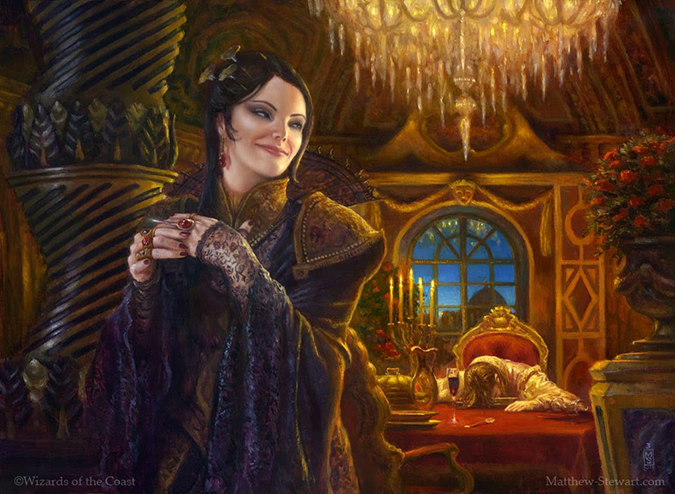
One regent can attempt to undermine another regent’s holding by contesting their influence. To contest a holding, you must have a holding of your own in the same province or control the province itself. You must pay the base cost for each affected holding. The DC is increased by the level of the holding; contesting a level 6 Source holding requires a successful DC 16 Bloodline ability check. If you choose to affect multiple holdings simultaneously, you must roll a Bloodline check for each such holding.
On a success, the holding is contested. It generates no RP or GB for its owner during subsequent domain turns until the contest is ended. The holding is contested until either:
- The regent who owns the contested holding successfully uses the Rule action to end the contest
- The contesting regent decides to let it drop (no action required)
- The contesting regent loses control of the province or of all their holdings in the province
A contested holding can be targeted by a second Contest action. If the second action is also successful, the holding becomes uncontrolled and can be taken over by another regent (see the Investiture action, later).
Some special rules apply when contesting a province. To do so, no regent in the province other than the contesting regent can possess any Law holdings that are higher than level 0. The province must be rebellious or have poor loyalty. If you have an occupying army in a province, it is automatically contested. Contested provinces are good targets for forcible divestiture.
Cast Realm Spell
Scope: Special
Base Cost: Varies
DC: Varies
You can use your connection to your domain to fuel vast and potent magical effects. Each realm spell has its own special rules, covered later. Realm spells always require either source holdings (for druids, sorcerers, and wizards) or temple holdings (for clerics and druids). The holding level required is determined by the spell being cast. You must have these holdings in the province you’re affecting with the spell (but see the Forge Ley Line action).
Create Holding
Scope: Domain
Base Cost: 1 GB
DC: 12+
You use this action to establish a foothold in a given province. If you are attempting to create a holding in a province you don’t control and the regent of that province opposes your efforts, the DC is increased by the level of the province. If you succeed, you create a new level 0 law, guild, temple, or source holding.
If you have access to unclaimed territory, you can also use this action to create a new level 0 province. This requires DM approval and increases the base cost to 3 GB.
Create Trade Route
Scope: Domain
Base Cost: 1 RP, 1 GB
DC: 10+
Trade is an excellent way to increase your income. Trade routes are forged between two provinces. The provinces must be connected either by water or by a network of roads. In order to create a trade route, you must control a Guild holding in one of the provinces. There must also be a Guild holding in the other province, controlled by another regent who agrees to allow a trade route. Finally, the provinces must have different terrain types.
Once a trade route is formed, the regents controlling the Guild holdings can collect income from it in subsequent domain turns. This income stops if either Guild holding is contested or if either province is occupied. If either Guild holding is destroyed, the trade route is destroyed as well.
A province can only support so many trade routes, based on its population. Level 0 provinces cannot support any trade. Provinces of level 1-3 or less can support a single trade route. Level 4-6 provinces can support two. Level 7+ provinces can support 3.
Declare War
Scope: Realm
Base Cost: None
DC: None
You begin a war. This action doesn’t just represent the public declaration of war, but also the logistics of establishing supply chains and preparing to enter enemy territory. Taking this action enables you to move troops into provinces that do not belong to you. If you have been attacked, you do not need to declare war to defend yourself, but you must do so in order to launch a counterattack into enemy territory. Regents who do not control provinces can still declare war if they control any troops. Moving soldiers through another regent’s territory can be accomplished without war after a successful Diplomacy action.

Diplomacy
Scope: Realm
Base Cost: 1 RP, 1 GB
DC: Special
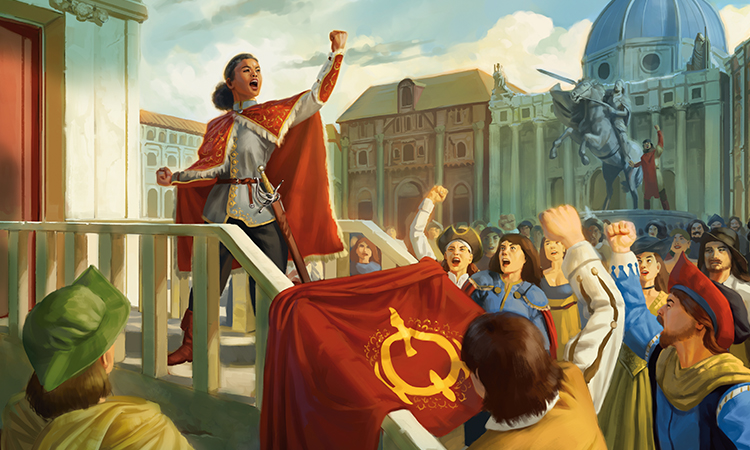
Negotiations with other domains over matters of import require the Diplomacy action. Routine messages and correspondence are assumed to happen as a matter of course; Diplomacy instead represents a court affair in which you aim to achieve some specific goal. For example, Diplomacy can be used to accomplish any of the following ends, among others:
- Create or break an alliance
- Create an agreement to allow trade between two kingdoms
- Convince a regent to allow foreign troops to move through their territory
- Force concessions from a regent, such as tribute or territory
- Respond to random events, such as feuds or unrest
The DC of the Bloodline ability check is set by the DM and depends on several factors, including the attitudes of the regents affected, the nature of the goal, the relative strength of the domains involved, and the nature of the diplomatic effort itself (an elven community is unlikely to be impressed by a diplomatic effort headed by a mercantile guild with an interest in logging, for example).
Diplomacy between PCs still requires the Diplomacy action, but no ability check is required to determine success. The PCs can simply decide what to do when confronted by a diplomatic request.
Downtime
Scope: Character
Base Cost: None
DC: None
You spend time working on a personal project or endeavor. This domain action allows you to take a single downtime action (XGE p 123). For example, you might spend time forging a suit of armor, engaged in criminal activity, plying a trade, or doing research on a bit of occult lore.
Espionage
Scope: Domain
Base Cost: 1 GB
DC: 15+
By taking the Espionage action, you engage in spying or covert action. Like Diplomacy, this action is somewhat open-ended. It can have any of the following effects, among others:
- Reveal a diplomatic agreement between two domains
- Catalog troop movements and strengths in a province
- Create a “random” event such as an assassination attempt, intrigue, or corruption in another domain
- Determine responsibility for another Espionage action
- Secretly move messages, items, or individuals
The goal of the Espionage action must be stated in advance. The DC of the action is increased based on the level of the province in which it is being performed as well as any Law holdings in that province controlled by opposing regents. For example, if you wish to perform Espionage in a level 5 province containing a level 3 Law holding controlled by the target and a level 1 Law holding controlled by an ally, the DC is 23—15 base, plus 5 for the province level and 3 for the opposing law law level. If an attempt at espionage fails by 10 or more, your agents are caught and imprisoned. If it succeeds by 10 or more, you also accomplish a secondary goal, as if you’d performed another successful Espionage action in the same province.
Mercantile Cover. If you control a Guild holding in the affected province, you can perform Espionage as a bonus action.
Forge Ley Line
Scope: Domain
Base Cost: 1+ RP, 1+ GB
DC: 8
Casting certain realm spells requires access to powerful sources of mebhaighl. This magical energy stems from the land itself and is diminished by the encroachment of civilization. Regents who wish to use their realm magic when they are away from the sources they control can do so by forging ley lines, allowing them to tap into that power from a distance.
To forge a ley line, choose a source province and a target province. You must have a Source holding in the source province. Draw a path from the source province to the target province. Forging a ley line costs 1 GB and 1 RP for each province this path passes through. Once forged, the ley line allows you to cast realm spells in the target province as if you controlled a Source of the same level as in the source province. Once you have forged a ley line, you can extend it by taking this action again.
Fortify
Scope: Domain/Realm
Base Cost: 1 RP, 1+ GB
DC: 8
This action allows regents to fortify their holdings, either by building strongholds in the case of provinces or fortifications in the case of other holdings.
Strongholds. To build a stronghold, choose a province you own. Strongholds, like holdings, have levels which denote how difficult they are to take. Building a castle costs 6 GB per level of the stronghold, up to the level of the province. A stronghold can be higher level that the province it’s in, but this imposes extra costs; every level of a stronghold above the province level instead costs 9 GB. A domain can only have one stronghold asset. This asset might represent a single powerful stronghold or a network of smaller castles and keeps.
Building a stronghold takes time. When you take this action, you must pay half the cost up front. During subsequent domain turns, you can pay up to 6 GB. Once you’ve paid the full amount, the stronghold is complete. You cannot construct strongholds during the winter domain turn. If you do not pay at least 2 GB per domain turn (except the winter) you lose ground, losing 1d6 GB invested in the project.
When a regent builds a castle in a province, they automatically fortify their other holdings in the province up to the level of the castle. For example, if you build a level 5 castle, you can fortify up to 5 levels of other holdings in the same province. You cannot have a partially fortified holding.
Holdings. Fortifying holdings allows them to function even when the province is occupied by hostile troops and makes it harder for enemies to break your control over them. Fortifying a holding costs 4 GB per level of the holding. Like building a stronghold, you must pay half the price up front and then contribute additional resources on subsequent turns.
Improve Holding
Scope: Domain/Realm
Base Cost: 1+ RP, 1+ GB
DC: 12
You spend time and energy on furthering your political causes, building up your holdings. This action allows you to increase the level of one or more holdings. You can affect a single province at a time with this action. Alternatively, you can affect any number of non-province holdings at once. To improve a province, you must pay GB and RP equal to the new level of the province. For other holdings, you must pay 1 GB per holding affected as well as RP equal to the sum of the new levels of the holdings affected.
Investiture
Scope: Realm
Base Cost: 1+ RP
DC: Special
This domain action allows you to claim dominion over existing holdings. Investiture is most often performed willingly, when a regent passes control of their domain to their heir. However, it can be used to forcibly take holdings from another regent, as well as to take their bloodline itself. This action can be taken by nonregents. The RP cost for nonregents is incurred as a debt.
Investing Holdings. The regent being invested must pay 1 RP per level of the affected holding. Multiple holdings can be invested simultaneously; the regent must pay this cost for all holdings. Success is automatic if the regent being divested is willing; magical compulsion does not suffice to make a regent willing. If the regent whose holdings are being divested is unwilling, the other regent must have have successfully conquered or contested the affected holdings. An opposed Bloodline ability check is called for here; both regents roll 1d20 + their Bloodline ability modifier + their proficiency bonus. Both regents can spend GB and RP normally to affect their roll or their opponent’s roll.
Investing Bloodlines. This action also allows one character to transfer their bloodline to another. Both characters involved must be present, although the character being divested need not be willing. The divested character loses their Bloodline ability score and all blood abilities. If the character being invested is unblooded, they gain the Bloodline score, derivation, and blood abilities of the divested character. If they already have a bloodline, their score increases as though they had performed bloodtheft. Unwilling regents can resist as described above.
Recruit Lieutenant
Scope: Character
Base Cost: None
DC: None
By taking this action, you gain the services of a lieutenant. You cannot necessarily determine what lieutenant they get. Typically, the DM will present a few options and allow you to choose a lieutenant from among them. If you have at least one lieutenant, you gain one additional domain action per domain turn, which can be taken alongside your normal action during one action round. You pay all costs for the action and cannot spend GB to improve its chance of success. You do not add your Bloodline check modifier or proficiency bonus to the ability check to determine success; instead, you add the lieutenant’s proficiency bonus if they have skills relevant to the action in question. Additional lieutenants do not allow you additional actions. Lieutenants cannot be regents themselves.
Vassalage
Scope: Realm
Base Cost: 1+ RP
DC: 8
You use this domain action to formalize a pact of vassalage between two regents. Choose an amount of RP. Both regents involved in the pact pay this many RP; during each subsequent turn, the vassal automatically pays the same amount to their liege. The vassal make break this pact at any time, but the liege is aware of this immediately. A regent may have many vassals, but only one liege. Two regents cannot be each others’ vassals.
Bonus Actions
Build
Scope: Domain
Base Cost: 1+ GB
DC: 8+
You order the construction of a building, road, or other structure within your domain. You do not use this action to construct fortifications; that requires the Fortify action. A few of the things that can be built using this action include:
- Roads. Roads facilitate moving troops and are required for trade routes. Choose two provinces where you have holdings. You build a road between those provinces. The cost for building a road in a province is determined by the terrain in the province. Roads through plains cost 1 GB. A forest, tundra, or desert province costs 2 GB. Hills and swamps 4 GB. Mountains cost 8 GB.
- Bridges. Roads that cross rivers require bridges. It costs 1d4+1 GB to build a wooden bridge across a small river. Stone bridges add 1d4+1 GB to the cost, while large rivers double the total cost. The same costs apply to bridges across canyons or ravines.
- Palaces. You spend money building an elaborate palace. This costs at least 5 GB to build, and after construction is complete it requires 1 GB per turn to maintain. However, for each 5 GB spent in constructing your palace you add +1 GB to your effective court expenditure each turn. You cannot benefit from spending more than 30 GB on palaces.
- Buildings. Buildings can include city halls, stadiums, monasteries, and so on. The cost of a building increases based on its size and grandeur. Some buildings may have mechanical effects; this is handled on a case-by-case basis. For example, you may build a network of watchtowers in a province, allowing you to see troop movements in adjacent provinces as if you had stationed a unit of scouts there.
All buildings follow similar rules to the Fortify action regarding time to completion. You pay half the price up front; on subsequent turns, pay up to 6 GB. Once you’ve paid the full amount, construction is complete. Buildings that cost 6 GB or less can be built all at once. In addition, it’s more expensive to build in remote or underpopulated areas. Double the cost of all buildings in level 0 or 1 provinces. Increase the cost by 50% for all buildings in level 2 provinces.
Convert Wealth
Scope: Character
Base Cost: None
DC: None
You either draw money from your treasury to add to your personal wealth or vice versa. Every GB is equivalent to 2000 gp. There is no limit on how many gp you can convert to GB this way, but you can only withdraw up to your Bloodline modifier plus the number of Guild holdings you control from the treasury at once. Using this action to enrich yourself can lead to public unrest.
Decree
Scope: Domain
Base Cost: 1 RP, 1 GB
DC: 12
This action is something of a catch-all, covering the various special tasks and commands a regent can give. A decree cannot affect another regent’s domain, and it cannot change the loyalty or level of any holding. Decrees cannot do anything that would normally be done by another domain action. Some possible effects for decrees include:
- Generating money. You generate 1d6 GB by imposing tariffs or seizing assets of those in your domain.
- Interfering with another regent. By investigating or arrests the agents of another regent you can impose a small penalty on their actions in your domain during this action round (typically, -1d4).
- Create a “random” event. You can create a minor random event for another regent by driving brigands into their territory, sending minor diplomatic missions, etc.
In general, any game effects of a decree will be determined by the DM, and there may be long-term repercussions for any decree. You will not necessarily know what the result of a decree will be until you make it.
Disband
Scope: Realm
Base Cost: None
DC: Special
You dismiss your troops, allowing them to return home. Troops that you have mustered always disband when you say so. When you disband a mercenary unit, however, it may not obey. You must make a Bloodline ability check with a DC equal to 12 + the mercenary commander’s proficiency bonus; if you fail, they become brigands afflicting one of your provinces.
Grant
Scope: Character
Base Cost: 1+ GB
DC: Special
When you take this action, you grant some other character wealth and (possibly) a noble title. You can use this action to transfer GB to other regents. This action is always successful, but you must make a Bloodline ability check with a DC equal to 8 + the number of GB transferred when you take the action. If it fails, then someone is angered by the transaction.
Hold Action
Scope: Character
Base Cost: None
DC: None
You delay your domain action during this action round, moving to the bottom of the current initiative order.
Move Troops
Scope: Domain
Base Cost: 1+ GB
DC: None
You move your troops within your domain and through domains with which you're at war or which have granted you free passage as part of some diplomatic accord. For each GB spent, you gain 10 movement points which can be spent to move your troops during the appropriate phase of the action round. You spend the GB at that time as well. When units move, they are unavailable until the start of the next action round. If you are invaded while your units are moving, you can have them return to their starting positions, but you forfeit the GB spent.
Muster Armies
Scope: Domain
Base Cost: 0+ GB
DC: None
You create new units by mustering troops, raising a levy, or hiring mercenaries.
Mustering Troops. Recruiting and training skilled soldiers takes time. You can muster any number of units at once, as long as you have the money to pay for it. The maximum number of units that can be mustered in a particular province in one action is equal to the level of that province. Mustered troops are not available for movement or combat until the start of the next action round. If you are not the regent of the province where you’re attempting to muster troops, then you must have permission from the regent of the province in order to do so. Success is otherwise automatic.
Raise Levies. You must be the regent of a province in order to raise levies there. To raise levies, reduce the level of the province by 1 temporarily. Levies cost nothing to raise and are available immediately. However, if the levies are destroyed when outside of your domain, the level loss in the province is permanent.
Hire Mercenaries. Hiring mercenaries is similar to mustering troops, except that it is always successful and the mercenaries are available immediately. In addition, when hiring mercenaries you can ignore the normal holding level requirements. However, mercenaries are more expensive than normal troops, and their loyalty is sometimes suspect.
Travel
Scope: Domain
Base Cost: 1 GB
DC: None
You move to any province within your domain or any friendly domain. The cost associated with this action covers the logistics involved in moving not only your person but your court, your assistants, and so on. The costs associated with this action are included in other domain actions that involve movement (such as attending a parley for a Diplomacy action). As part of taking the Travel action, you can procure any reasonable amounts of inexpensive nonmagical equipment you might need.

War
Units
The combatants in a mass battle are units, rather than individual characters. Like characters, units have several stats that are used in battle. They are:
- Melee: used in melee combat
- Missile: used in ranged combat
- Defense: used to set DC of incoming attacks as well as for saves
- Morale: used in morale checks and saves
- Move: speed in combat
- Hits: how many hits the unit can take
Moving Units
Units move during each action round, after all domain and bonus actions are resolved. At this point, anyone who has taken the Move Troops action moves their troops. Each GB spent grants 10 movement points. A unit can move up to its Move rating in provinces per action round.
| Terrain Type | Movement Cost |
|---|---|
| Ancient Forest | 4 |
| Desert | 2 |
| Forest | 2 |
| Glacier | 4 |
| High Mountains | 4 |
| Hills | 2 |
| Plains | 1 |
| Marsh | 3 |
| Moor | 2 |
| Mountain | 3 |
| Swamp | 3 |
| Tundra | 3 |
Elf units can move through forests at half cost. Dwarf and orog units do the same with mountains. Moving through hostile territory or during winter doubles the cost.
Two other important terrain features are rivers and roads. Units traveling along a road can do so at half cost; this stacks with the cost reduction for elves, dwarves, and orogs moving through appropriate terrain. A unit that crosses a river without a bridge must stop and cannot move further this turn.
When an army enters a province containing hostile units, they become the aggressor; the units already present are defenders. The defenders have a choice: they can either stand their ground or fall back. If they fall back, they retreat to an adjacent friendly province, leaving the aggressors occupying the province. If they stand their ground, the aggressors cannot continue moving; there will be a mass battle after all remaining movement is resolved.
Spotting Enemy Units
Unless a regent uses the espionage action, they normally do not know the location or composition of enemy forces. Whenever enemy forces move into a regent's province, however, the regent is immediately informed of the location of the invasion. If friendly units or holdings are present, the regent also learns the composition of the enemy forces. Scout units automatically detect the location and composition of all enemy units in every adjacent province.
Occupation and Conquest
When all the defending forces in a province have been destroyed or routed, the province is occupied by the attacking forces. If the province has a stronghold, it must be neutralized before the province can be occupied. Occupied provinces generate no income or regency for the province ruler. The occupier can pillage the province, generating income at the cost of decreasing the province's level.
Alternately, the occupiers can use their army to perform one of the following actions:
- Quash Law: You reduce the level of all unfortified Law holdings in the province to zero.
- Close Guilds: You reduce the level of all unfortified Guild holdings in the province to zero.
- Raze Temples: You reduce the level of all unfortified Temple holdings in the province to zero.
- Vandalize Sources: You reduce the level of all unfortified Source holdings in the province by one.
Units that engage in any of these actions cannot move during the next action round. It is possible to occupy one's own provinces and use the military to destroy foreign holdings in your provinces, but doing so reduces the province's loyalty by one level.
Strongholds
Hostile units cannot pass through provinces containing a stronghold unless it is neutralized. To neutralize a stronghold, the attackers must hold the province with a number of units equal to the stronghold's rating plus the number of units in the stronghold's garrison. Once a stronghold is neutralized, it no longer affects movement. Artillerists, sappers, and dwarven engineers count as two units for the purposes of neutralizing strongholds.
Once a stronghold is neutralized, it is considered to be under siege as long as the attackers maintain their presence in the province. Every domain turn, the stronghold's level is reduced by one. When it is reduced to 0, the stronghold is captured. If the siege ends before the stronghold is fully reduced, it returns to its original level.
If the sieging army has at least one unit of artillerists, sappers, or dwarven engineers, the attackers can attempt an assault. This is conducted as a normal mass battle with the stronghold as defensive terrain. In addition, the defenders are considered to have a number of light infantry units equal to the stronghold's level as bonus defending units.
Fortified Holdings
Fortified holdings cannot be destroyed by occupying armies. Fortified holdings do not interfere with enemy troop movement. They can be beseiged or assaulted like strongholds. Use the level of the holding for the level of the fortification where needed.
Mass Battles
When opposing armies meet in the same province, the result is a mass battle.
Order of Combat
Mass battles are resolved in a way that’s similar to, but not quite the same as, ordinary combat. Like ordinary combat, mass battles are resolved in a sequence of rounds. Step-by-step, mass combat looks like this:
- Roll initiative.
- Establish starting positions.
- Resolve combat round.
- Take turns moving units and issuing orders.
- Resolve attacks.
- Ranged
- Charges
- Melee
- Spell
- Check morale.
- Determine new initiative and begin the next round.
Initiative
Initiative is rolled at the beginning of combat, then again at the start of each new round. Each commander makes an Intelligence check; the highest roll chooses whether they will go first or last this round. Bonuses to personal-scale initiative (e.g. from a barbarian’s Feral Instinct class ability) do not apply to initiative checks in mass combat.
Establish Starting Positions
The DM decides what sort of terrain features are present based on the circumstances under which the battle takes place. Then both sides take turns deploying units to the battlefield. Whichever commander won the initiative decides whether to take the first turn or let their opponent deploy first.
Resolving the Combat Round
Unlike normal combat, mass battles are a somewhat slower affair. Rather than having each side take a full turn all at once, mass combat rounds are broken up into Movement, Attack, and Morale phases.
Movement
During the movement phase, the commanders take turns moving their units, one unit at a time. Units that are engaged in melee combat with enemy units cannot move unless they retreat. A unit becomes engaged after it is targeted by a melee attack from an enemy unit. After moving a unit, the commander can declare issue orders to that unit. The most common order is to attack.
A unit can move up to its Move rating in squares, and diagonal movement is not treated differently than orthogonal movement. This movement can be impacted by terrain.
Battlefield Terrain
Terrain features affect the battlefield in a number of ways. They can hinder movement, provide cover or concealment, or offer a defensive or offensive advantage.
Difficult Terrain. Brush, marshes, stands of trees, and the like can impair movement. It costs two points of Move to enter a square of difficult terrain. Units with a Move rating of 1 can enter difficult terrain, but they must do so with their first square of movement on the turn and they cannot leave it on the same turn even if they are given the Quick March order. Units cannot charge into or through difficult terrain.
Defensible Terrain. Units fighting from a defensible position, such as from the top of a hill or while defending a choke point, gain advantage on all Morale saving throws. In addition, incoming melee attacks against them have disadvantage.
Covering Terrain. Thickets, forests, and bogs can be used to protect units from missile fire. All missile attacks against a unit occupying a square of covering terrain have disadvantage.
Impassable Terrain. Cliffs, deep rivers, and canyons are effectively impassable during mass combat. A unit cannot retreat into impassable squares if routed. Some terrain is impassable to cavalry but can be traversed by units moving on foot.
Hazardous Terrain. Dense, thorny thickets and areas affected by the spike growth spell are examples of hazardous terrain. Units entering hazardous terrain must make a Morale check or suffer one Hit. The DC for most natural hazardous terrain is 10; especially dangerous terrain might have higher DCs. Hazardous terrain created by spells use the spellcaster's save DC.
Fortifications
Strongholds, barricades, and palisades function as terrain in most respects. The exact effects of a fortification depend on its size and composition, but in general units occupying squares with fortifications gain the advantage of holding defensible terrain. Often, fortifications also count as covering terrain. In some cases, they also prevent charging and may even grant automatic successes on Morale checks and saves.
For example, an army has had time to prepare some field fortifications in a lightly forested province before battle commences. They have constructed an abatis—a sort of barricade made of felled trees, with sharpened branches pointing outward to the enemy. The abatis is difficult and defensible terrain. In addition, the thicket of sharpened branches renders it impassible to cavalry.
If the army had longer to prepare, they might have constructed a palisade which would serve as covering terrain, or dig a deep trench and line it with stakes to serve as hazardous terrain.
Orders
A commander issues orders to their units each turn. In the absence of communication, units can sometimes act independently, but this requires a Morale saving throw (DC 15). If this fails, the unit will defend itself if attacked but will not do anything else.
Attack
The most common order given to a unit is for it to attack an enemy. The mechanics for resolving attacks are given in the next section.
Quick March
Units that do not attack during their turn can cover more ground. By taking the Quick March action, the unit can travel its Move in squares.
Rally
A unit that has been routed can attempt to rally. In order to rally, it must not be engaged in combat. Make a DC 15 Morale check. On a success, the unit recovers its morale and can re-enter the fray. On a failure, it ceases to be an effective fighting force for the duration of combat. After the battle, however, the unit can reform, though it reforms with however many Hits it had suffered before being routed.
Retreat
In order to leave melee combat, an engaged unit must retreat. To retreat, make a Morale check with a DC equal to 10 + the engaged enemy unit’s Melee bonus. On a success, the retreated unit can move up to its Move in squares. On a failure, it suffers a Hit, but can move afterward.
Attacks
Attacks are resolved by rolling 1d20 and adding the unit’s attack modifier as well as any other applicable modifiers. If the result equals or exceeds the target unit’s Defense, the attack succeeds, inflicting one Hit on the targeted unit. A unit that takes more hits than it can is removed from battle; enough members have fallen, become injured, or fled that it can no longer meaningfully affect the battle. Hits also degrade a unit’s performance in battle. Each Hit suffered reduces the unit’s Melee, Missile, and Morale bonuses by 1.
In addition, after any successful attack, the targeted unit must make a DC 12 Morale save. On a failed save, the target becomes routed. Routed units must retreat on subsequent turns. If the unit cannot retreat, or if it is routed a second time, it is destroyed. Their commander can attempt to rally them by making Morale checks.
Once a unit initiates a charge or melee attack against another unit, the two units become _engaged. _Engaged units cannot move unless they retreat, which prevents them from making charge attacks. They cannot make ranged or spell attacks either. One exception to this rule: a unit that’s just been charged or attacked in melee can still make a ranged attack in the same round.
Melee Attacks
In order for a unit to make a melee attack against an enemy unit, it must first move into the same square as the enemy unit. Any number of units can occupy the same square, and any number of units can be engaged in the same melee combat simultaneously.
Ranged Attacks
In order to declare a ranged attack, the attacking unit must be capable of making missile attacks, and there must be an enemy unit within their missile range. In addition, they must not be engaged with an enemy unit, and unless otherwise noted they may not have moved during the movement phase this round. A unit that’s just been charged or attacked in melee can still make a ranged attack in the same round, but in subsequent rounds they will be unable to launch ranged attacks. Attacking an enemy unit engaged in melee combat with a friendly unit is risky. The attack roll is is compared to the Defense scores of both units, and it may inflict a Hit on either or both.
Charging
When a unit first enters melee combat, it can charge. In order to charge, the unit must not be engaged when it is activated. It must move at least one square and up to its full Move in a straight line, ending in the same square as the target it is charging. Charge attacks are resolved before regular melee attacks. In addition, some units (such as cavalry) gain a bonus on charge attacks.

Spells
Spellcasters are rare enough in Cerilia to make it effectively impossible to muster entire units of spellcasters. However, individual spellcasters can be attached to units. Most spells do not affect a large enough area to be useful during mass combat, but there are some exceptions. Units with an attached spellcaster can make spell attacks. They cannot make spell attacks during any turn where they make a ranged, charge, or melee attack; the hectic nature of mass combat makes concentrating on spellcasting effectively impossible while the unit is directly in combat. In addition, units cannot make spell attacks while engaged by an enemy unit.
Spellcasters can also serve as solo units on the battlefield. This frees them from the need to act alongside a unit and allows them to cast spells independently; however, if attacked by any full unit they are automatically removed from play.
Unless otherwise noted, all spells have a range of 2 squares.
The following spells can be used to inflict an automatic Hit on an enemy unit.
- Abi-Dalzim's Horrid Wilting
- Call Lightning
- Cone of Cold
- Conjure Volley
- Cloudkill
- Dawn
- Destructive Wave (also inflicts one Hit on attached friendly unit)
- Earthquake
- Fireball
- Flame Strike
- Hunger of Hadar
- Ice Storm
- Incendiary Cloud
- Insect Plague
- Lightning Bolt
- Maelstrom
- Sickening Radiance
- Storm Sphere
- Synaptic Static
- Tidal Wave
- Vitriolic Sphere
- Weird
These spells force an enemy unit to make an immediate Morale saving throw. On a failure, the unit is routed.
- Confusion
- Fear
- Stinking Cloud
These spells instantly destroy an enemy unit.
- Circle of Death
- Fire Storm
- Maddening Darkness
- Meteor Swarm (alternately, Meteor Swarm can be used to inflict one Hit on up to four enemy units)
- Otiluke’s Freezing Sphere
- Storm of Vengeance
- Sunburst
Finally, these spells affect the terrain or battlefield. Their exact effect is dependent on the circumstances in which the spell is cast. Often, the result will be to create one or more squares of hazardous, difficult, or defensible terrain.
- Control Winds
- Fog Cloud
- Move Earth
- Plant Growth
- Reverse Gravity
- Sleet Storm
- Spike Growth
- Transmute Rock
- Wall of Fire
- Wall of Force
- Wall of Light
- Wall of Ice
- Wall of Sand
- Wall of Stone
- Wall of Water
- Whirlwind
- Wind Wall
- Wrath of Nature
Units
Unless otherwise noted, all units in the following table are human; nonhuman versions of the units are available with the same stats. Nonhuman units can generally only be hired as mercenaries, unless the regent has access to a community of the relevant ancestry. Mercenary units are the same as their normal counterparts, but their maintenance cost is doubled.
| Unit | Melee | Missile | Defense | Morale | Move | Hits | Muster | Maintenance | Requirements |
|---|---|---|---|---|---|---|---|---|---|
| Levies | +2 | — | 10 | +0 | 1 | 2 | 0 | 1 | — |
| Scouts | +2 | +2 (range 2) | 12 | +1 | 3 | 2 | 2 | 1 | — |
| Light Infantry | +3 | +2 (range 2) | 13 | +1 | 2 | 2 | 2 | 1 | Level 1 Holding |
| Heavy Infantry | +4 | — | 15 | +2 | 1 | 3 | 4 | 2 | Level 3 Holding |
| Pikemen | +3 | — | 13 | +1 | 1 | 2 | 2 | 1 | Level 2 Holding |
| Cavalry | +3 | — | 14 | +1 | 3 | 2 | 4 | 2 | Level 3 Holding |
| Knights | +4 | — | 16 | +2 | 3 | 3 | 6 | 2 | Level 4 Holding |
| Archers | +1 | +4 (range 2) | 12 | +1 | 2 | 2 | 2 | 1 | Level 2 Holding |
| Crossbowmen | +2 | +3 (range 2) | 13 | +1 | 2 | 2 | 2 | 1 | Level 2 Holding |
| Artillerists | +0 | +4 (range 3) | 12 | +1 | 1 | 2 | 4 | 2 | Level 5 Holding |
| Sappers | +3 | — | 14 | +1 | 1 | 2 | 4 | 1 | Level 4 Holding |
| Mounted Archers | +3 | +3 (range 1) | 13 | +2 | 3 | 2 | 6 | 2 | Level 4 Holding |
| Rjurik Berserkers | +5 | — | 11 | +3 | 2 | 3 | 6 | 1 | Level 2 Holding |
| Vos Varsk Riders | +5 | — | 14 | +2 | 2 | 2 | 5 | 2 | Level 3 Holding |
| Dwarf Guards | +3 | — | 16 | +3 | 1 | 2 | 4 | 2 | Level 4 Holding |
| Dwarf Crossbowmen | +2 | +3 (range 2) | 14 | +2 | 1 | 2 | 2 | 1 | Level 4 Holding |
| Dwarf Engineers | +1 | +4 (range 3) | 12 | +2 | 1 | 2 | 6 | 3 | Level 6 Holding |
| Elven Archers | +1 | +5 (range 2) | 12 | +1 | 2 | 2 | 4 | 2 | Level 3 Holding |
| Elven Cavalry | +3 | +4 (range 1) | 13 | +2 | 3 | 2 | 6 | 3 | Level 4 Holding |
| Goblin Wolf Riders | +4 | +2 (range 1) | 13 | +1 | 3 | 2 | 4 | 1 | Level 2 Holding |
| Orog Reavers | +4 | +2 (range 2) | 14 | +2 | 2 | 3 | 5 | 2 | Level 2 Holding |
| Orog Aurochs Riders | +5 | — | 14 | +2 | 3 | 3 | 6 | 2 | Level 4 Holding |
| Gnoll Marauders | +5 | — | 13 | +3 | 3 | 2 | 3 | 1 | — |
| Halfling Slingers | +0 | +4 (range 2) | 12 | +1 | 2 | 2 | 2 | 1 | Level 1 Holding |
| Forest Legion | +7 | — | 16 | +3 | 1 | 3 | — | — | — |
| Elemental Horde | +4 | — | 15 | +3 | 1 | 3 | — | — | |
| Undead Company | +3 | +3 (range 2) | 13 | — | 2 | 2 | — | — | |
| Ogre Warband | +7 | — | 13 | +2 | 2 | 4 | 6 | 5 |
Unit Special Rules
Levies. Levies are easily broken. Rally checks involving levies have disadvantage.
Scouts. An army containing at least one unit of scouts can automatically identify enemy forces in all adjacent provinces. Scouts can ignore natural terrain features while moving.
Heavy Infantry. Heavy infantry are good at breaking formations and have advantage when attacking pikemen.
Pikemen. Pikemen cannot be charged. Mounted units attacking pikemen in melee have disadvantage.
Cavalry. As a mounted unit, cavalry have advantage on their attack rolls when charging.
Knights. As a mounted unit, knights have advantage on their attack rolls when charging.
Artillerists. Artillerists ignore any defensive bonuses granted to their targets due to terrain or fortifications. A unit of artillerists counts as two units for the purposes of siege warfare. In addition, an army containing a unit of artillerists can mount an assault on a beseiged fortification.
Sappers. Sappers ignore any defensive bonuses granted to their targets due to terrain or fortifications. A unit of sappers counts as two units for the purposes of siege warfare. In addition, an army containing a unit of sappers can mount an assault on a beseiged fortification.
Mounted Archers. Mounted archers can move and make ranged attacks in the same round.
Vos Varsk Riders. As a mounted unit, varsk riders have advantage on their attack rolls when charging. Varsk riders move freely across tundra and mountain terrain.
Dwarf Engineers. Dwarves are famous for their fortifications, and their skill in building them translates to skill at destroying them. Dwarven engineers ignore any defensive bonuses granted to their targets due to terrain or fortifications. A unit of engineers counts as two units for the purposes of siege warfare. In addition, an army containing a unit of engineers can mount an assault on a beseiged fortification.
Elven Cavalry. Elven cavalry have advantage on their attack rolls when charging. They can also move and make ranged attacks in the same round.
Goblin Wolf Riders. Wolf riders can move and make ranged attacks in the same round.
Orog Reavers. When pillaging an occupied province, orog reavers count as two units.
Orog Aurochs Riders. As a mounted unit, varsk riders have advantage on their attack rolls when charging. Orog aurochs riders count as two units when pillaging an occupied province.
Halfling Slingers. Halfling slingers can ignore natural terrain features while moving.
Elemental Horde. Melee attacks against the elemental horde have disadvantage. The elemental horde can fly, allowing them to ignore most terrain features.
Undead Company. The undead feel no fear. They automatically pass all Morale checks and saving throws.
Realm Magic
Spellcasting regents can channel the power of the land or of the faithful into powerful ritual magic. This involves taking a domain action to cast a realm spell. In order to cast a realm spell, the regent must have access to minimum level of source or temple holdings in the province in which the spell is being cast and will take effect. Druids, sorcerers, and wizards can forge ley lines to allow them to tap into their sources at a distance, though they still need a ley line terminating in the province where they intend to cast the spell. Most realm spells also have a cost in RP and GB.
Researching new realm spells requires the regent to take the Downtime action and use it to research the spells. This always requires at least 1 GB in materials.
Cleric Realm Spells
Bless Army
Cost: 1 RP/unit affected, 1 GB
Required Holding: 3
Duration: One domain turn
This spell improves the offensive power of a unit, increasing their melee and missile attack bonuses by 1 while it lasts. All affected units must be in the same province when the spell is cast. The caster can affect one unit per level.
Bless Land
Cost: 3 RP/province, 1 GB
Required Holding: 1
Duration: One domain turn
You invoke the blessing of your deity, granting prosperity to a province. Each non-Source holding in the province as well as the province itself immediately grants an additional GB and an additional RP to its regent. The province also increases its loyalty one level. You can affect two provinces with this spell at 5th level, three at 11th level, and four at 17th level.
Blight
Cost: 3 RP/province affected, 2 GB
Required Holding: 3
Duration: One domain turn
This spell is in many ways the opposite of bless land. When cast, you call upon your deity to curse a province. All other regents who control a holding in the province immediately lose 1 GB for each holding they control. The owner of the province also loses 1 GB and must make a Bloodline saving throw; on a failure, the province loses one level of loyalty. You can affect two provinces with this spell at 5th level, three at 11th level, and four at 17th level.
Crusade
Cost: 1 RP/province affected, 1 GB/province affected
Required Holding: 3
Duration: One domain turn
You call upon the power of your god to inspire soldiers to fight for your cause. This spell allows you to muster troops in the affected provinces this turn even if the local ruler does not grant permission.
Honest Dealings
Cost: 3 RP/province affected, 3 GB
Required Holding: 3
Duration: One domain turn/5 levels (round up)
When cast, this spell subtly influences the inhabitants of one or more provinces, instilling in them a sense of fair play and honesty. While in effect, all Bloodline ability checks to resolve Agitate and Espionage actions in the affected provinces have disadvantage. In addition, Guild holdings in the affected provinces only collect half as much income. Finally, anyone who attempts to lie or commit a crime in the affected provinces must make a successful Wisdom saving throw or be unable to do so.
Maintain Armies
Cost: 2 RP/unit affected
Required Holding: 3
Duration: One domain turn
Through miraculous intervention, you conjure up food, water, and supplies for an army in the field. The owners of the targeted units need not pay their maintenance costs during the next domain turn.
Mass Destruction
Cost: 10 RP/unit affected, 5 GB
Required Holding: 5
Duration: Instantaneous
By unleashing a massive barrage of fire, devastating hail, coruscating lightning, or poisonous winds, you can slay hundreds or thousands of enemies at once. Choose a unit that you can see. It must make a Morale saving throw; if it fails, it is instantly destroyed. On a success, it suffers one Hit, which may still be enough to destroy it. Solo troops who are capable of acting as units on the battlefield cannot be targeted with this spell. Characters attached to destroyed units must make a Dexterity saving throw. A target takes 10d10 damage on a failed save, or half as much damage on a successful one.
This spell lays waste to the surrounding countryside as well, which can cause side effects such as loss of loyalty depending on the circumstances of its casting.
Ward Against Realm Magic
Cost: Special
Required Holding: 1
Duration: Instantaneous or one domain turn/3 levels
This spell allows you to protect against hostile realm magic. It can be cast to negate a realm spell that’s already been cast or to provide a shield against future spells. When cast to dispel realm magic, it costs an amount of RP equal to the amount spent to cast the spell you are seeking to end. In addition, you must make an ability check using your spellcasting ability. The DC equals 10 + the other spellcaster’s spellcasting ability.
Alternately, you can cast this spell to provide a shield to negate incoming realm spells. You can shield a province, a unit, or an individual using this spell. When you cast the spell in this fashion, pay any amount of RP. While the shield is in place, any incoming realm spell that costs less RP than you spent on the shield is negated, and the shield is reduced by that amount.
Druid Realm Spells
Bless Land
Cost: 3 RP/province, 1 GB
Required Holding: 1
Duration: One domain turn
You invoke the blessing of your deity, granting prosperity to a province. Each non-Source holding in the province as well as the province itself immediately grants an additional GB and an additional RP to its regent. The province also increases its loyalty one level. You can affect two provinces with this spell at 5th level, three at 11th level, and four at 17th level.
Blight
Cost: 3 RP/province affected, 2 GB
Required Holding: 3
Duration: One domain turn
This spell is in many ways the opposite of bless land. When cast, you call upon your deity to curse a province. All other regents who control a holding in the province immediately lose 1 GB for each holding they control. The owner of the province also loses 1 GB and must make a Bloodline saving throw; on a failure, the province loses one level of loyalty. You can affect two provinces with this spell at 5th level, three at 11th level, and four at 17th level.
Maintain Armies
Cost: 2 RP/unit affected
Required Holding: 3
Duration: One domain turn
Through miraculous intervention, you conjure up food, water, and supplies for an army in the field. The owners of the targeted units need not pay their maintenance costs during the next domain turn.
Mass Destruction
Cost: 10 RP/unit affected, 5 GB
Required Holding: 5
Duration: Instantaneous
By unleashing a massive barrage of fire, devastating hail, coruscating lightning, or poisonous winds, you can slay hundreds or thousands of enemies at once. Choose a unit that you can see. It must make a Morale saving throw; if it fails, it is instantly destroyed. On a success, it suffers one Hit, which may still be enough to destroy it. Solo troops who are capable of acting as units on the battlefield cannot be targeted with this spell. Characters attached to destroyed units must make a Dexterity saving throw. A target takes 10d10 damage on a failed save, or half as much damage on a successful one.
This spell lays waste to the surrounding countryside as well, which can cause side effects such as loss of loyalty, depending on the circumstances of its casting.
Mighty Forests
Cost: 4 RP/unit created, 1 GB/unit created
Required Holding: 3
Duration: One domain turn
You can only cast this spell in a forested province. When you cast it, you animate the trees, turning them into soldiers who will fight on your behalf. The forest legion cannot leave the province it which it is created. In a heavily forested province, you can create up to 10 units; a light forest allows you to create up to 5.
Raze
Cost: 10 RP/level of structure, 2 GB/level of structure
Required Holding: 5
Duration: Instantaneous
This spectacular spell allows to to reduce a fortification or building to rubble in the blink of an eye. When targeting a stronghold, every 10 RP and 2 GB spent allows you to reduce the stronghold by one level. If you reduce the level of a stronghold to 0, it is destroyed. Fortified holdings can also be reduced if you pay enough to reduce them completely. This destroys the fortification but does not destroy the holding itself. Other buildings can be leveled as well; the DM will decide the RP and GP cost for doing so based on the building’s size and construction.
Scry
Cost: 5+ RP, 1 GB
Required Holding: 1
Duration: Instantaneous
When you cast this spell, you peer outside of your domain, seeking out information. This spell costs 5 RP plus 3 RP for each province between the province where you cast the spell and the province where you are scrying. When you scry, you effectively take an Espionage action in order to gather information. You cannot use this spell to get any of the other possible results of an Espionage action. However, you need not roll a Bloodline ability check; the action is automatically successful.
Ward Against Realm Magic
Cost: Special
Required Holding: 1
Duration: Instantaneous or one domain turn/3 levels
This spell allows you to protect against hostile realm magic. It can be cast to negate a realm spell that’s already been cast or to provide a shield against future spells. When cast to dispel realm magic, it costs an amount of RP equal to the amount spent to cast the spell you are seeking to end. In addition, you must make an ability check using your spellcasting ability. The DC equals 10 + the other spellcaster’s spellcasting ability.
Alternately, you can cast this spell to provide a shield to negate incoming realm spells. You can shield a province, a unit, or an individual using this spell. When you cast the spell in this fashion, pay any amount of RP. While the shield is in place, any incoming realm spell that costs less RP than you spent on the shield is negated, and the shield is reduced by that amount.
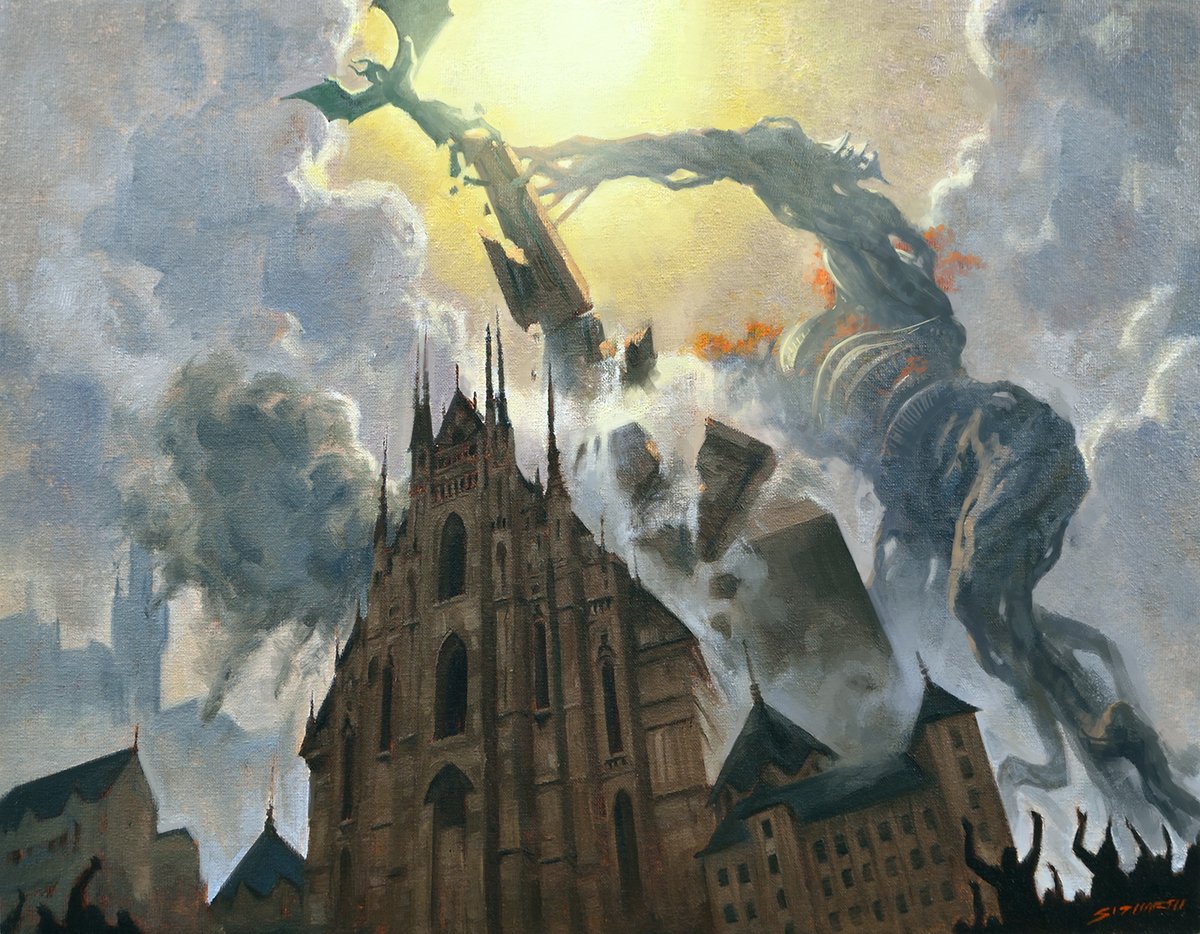
Ward Borders
Cost: 5 RP/province affected, 2 GB/province affected
Required Holding: 5
Duration: One domain turn
You conjure up a shroud of mist that prevents exit or entry from the affected provinces. Units may not cross the border, and trade and diplomacy are all but impossible with the targeted provinces. Trade routes that have an end in the province do not generate income, and it is impossible to use the Agitate or Contest actions on affected provinces unless the regent performing the act is inside the mists. The caster of this spell is immune to its effects.
Sorcerer/Wizard Realm Spells
Alchemy
Cost: 4 RP/GB created, 1 GB
Required Holding: 3
Duration: Instantaneous
You can transform worthless substances into gold with this spell. For every 4 RP you spend, you create 1 GB. This spell does require 1 GB of materials and components to cast, and it can only be cast once per domain turn.
Battle Fury
Cost: 1 RP/unit affected, 1 GB/unit affected
Required Holding: 2
Duration: One domain turn
You inspire troops to fight with little regard to their personal safety. Affected units roll their melee and charge attack checks with advantage and get +1 to Move. However, their frenzied state also means that melee and charge attacks against them have advantage as well. You cannot
Conjure Elemental Horde
Cost: 5 RP/unit summoned, 2 GB/unit summoned
Required Holding: 7
Duration: One domain turn
You summon a legion of minor elementals who serve at your command. When you cast this spell, you conjure an elemental legion. You can summon two units with this spell at 5th level, three at 11th level, and four at 17th level.
Death Plague
Cost: 2 RP/province level, 2 GB
Required Holding: 5
Duration: One domain turn
This sinister spell creates a terrible plague that infects a province, spreading rapidly and killing the population. Once the spell’s duration ends, the province level is reduced by one. During this time, it can be cured by means of a ward against realm magic spell. If it is cast again on the same province before its duration ends, the plague spreads to one adjacent province of the caster’s choice with each subsequent casting. Using this spell is often considered an evil act and draws the ire of many regents.
Demagogue
Cost: 5 RP/province affected, 1 GB
Required Holding: 3
Duration: Instantaneous
You unleash a subtle enchantment that manipulates the loyalty of the population of a province. When you cast this spell, you improve or worsen the loyalty grade of the target province by one step. You can affect two provinces with this spell at 5th level, three at 11th level, and four at 17th level.
Legion of the Dead
Cost: 4 RP/unit animated, 1 GB/unit animated
Required Holding: 3
Duration: Special
Any necromancer can animate the dead. With this spell, you do something far more impressive, animating entire companies of skeletal warriors to serve you. When you cast it, you create a unit of undead heavy infantry. The undead soldiers remain animated for one domain turn. At the end of the turn, you can spend RP equal to half the cost of animating them to keep them active for an additional domain turn. You can summon two units with this spell at 5th level, three at 11th level, and four at 17th level.
Mass Destruction
Cost: 10 RP/unit affected, 5 GB
Required Holding: 5
Duration: Instantaneous
By unleashing a massive barrage of fire, devastating hail, coruscating lightning, or poisonous winds, you can slay hundreds or thousands of enemies at once. Choose a unit that you can see. It must make a Morale saving throw; if it fails, it is instantly destroyed. On a success, it suffers one Hit, which may still be enough to destroy it. Solo troops who are capable of acting as units on the battlefield cannot be targeted with this spell. Characters attached to destroyed units must make a Dexterity saving throw. A target takes 10d10 damage on a failed save, or half as much damage on a successful one.
This spell lays waste to the surrounding countryside as well, which can cause side effects such as loss of loyalty, depending on the circumstances of its casting.
Raze
Cost: 10 RP/level of structure, 2 GB/level of structure
Required Holding: 5
Duration: Instantaneous
This spectacular spell allows to to reduce a fortification or building to rubble in the blink of an eye. When targeting a stronghold, every 10 RP and 2 GB spent allows you to reduce the stronghold by one level. If you reduce the level of a stronghold to 0, it is destroyed. Fortified holdings can also be reduced if you pay enough to reduce them completely. This destroys the fortification but does not destroy the holding itself. Other buildings can be leveled as well; the DM will decide the RP and GP cost for doing so based on the building’s size and construction.
Scry
Cost: 5+ RP, 1 GB
Required Holding: 1
Duration: Instantaneous
When you cast this spell, you peer outside of your domain, seeking out information. This spell costs 5 RP plus 3 RP for each province between the province where you cast the spell and the province where you are scrying. When you scry, you effectively take an Espionage action in order to gather information. You cannot use this spell to get any of the other possible results of an Espionage action. However, you need not roll a Bloodline ability check; the action is automatically successful.
Stronghold
Cost: 10 RP/stronghold level
Required Holding: 7
Duration: One domain turn per 3 levels
This spell lets you create a castle, stronghold, or other fortification. You must pay RP equal to the GB cost of constructing the stronghold. It appears immediately. When the duration ends, it disappears, but it does so gradually so as not to harm its inhabitants.
Subversion
Cost: Special
Required Holding: 1
Duration: One action round
Your mystic whispers compel a holding, unit, or lieutenant belonging to another regent to take a domain or bonus action of your choice. This occurs immediately, and it doesn’t matter if the asset or holding can’t normally take the relevant kind of action. For example, you could seize control of an army unit and force it to declare war and invade a neighboring country, or you could force a holding to contest another holding in the same province. The action granted by subversion does not take up the target’s action for the action round.
Subverting a holding costs 3 RP per level of the holding. Subverting a lieutenant costs 3 RP per character level of the lieutenant. Subverting a unit costs 5 RP. The regent whose asset is subverted can make a Bloodline saving throw; on a success, the subversion spell fails with no effect.
Transport
Cost: 4 RP/unit affected, 1 GB
Required Holding: 5
Duration: Instantaneous
You instantly move troops from one province to another. You can move one unit one province per level, ignoring terrain. For example, at tenth level you can move five units two provinces each. Units moved with this spell are available to be moved through mundane means later in the domain turn. You can use this spell on unwilling units, but the regency cost doubles, and the affected units can make a Morale saving throw to negate the effect.
Ward Against Realm Magic
Cost: Special
Required Holding: 1
Duration: Instantaneous or one domain turn/3 levels
This spell allows you to protect against hostile realm magic. It can be cast to negate a realm spell that’s already been cast or to provide a shield against future spells. When cast to dispel realm magic, it costs an amount of RP equal to the amount spent to cast the spell you are seeking to end. In addition, you must make an ability check using your spellcasting ability. The DC equals 10 + the other spellcaster’s spellcasting ability.
Alternately, you can cast this spell to provide a shield to negate incoming realm spells. You can shield a province, a unit, or an individual using this spell. When you cast the spell in this fashion, pay any amount of RP. While the shield is in place, any incoming realm spell that costs less RP than you spent on the shield is negated, and the shield is reduced by that amount.
Ward Borders
Cost: 5 RP/province affected, 2 GB/province affected
Required Holding: 5
Duration: One domain turn
You conjure up a shroud of mist that prevents exit or entry from the affected provinces. Units may not cross the border, and trade and diplomacy are all but impossible with the targeted provinces. Trade routes that have an end in the province do not generate income, and it is impossible to use the Agitate or Contest actions on affected provinces unless the regent performing the act is inside the mists. The caster of this spell is immune to its effects.
Monsters of Cerilia
Most, but not all, of the creatures from *Dungeons & Dragons* can be found in Cerilia. However, some monsters do not exist or differ from their familiar forms.
Dragonborn, drow, and gnomes do not exist on Cerilia. Aasimar and tieflings are basically unheard of, though as angels, demons, and devils exist it is possible for someone to have some celestial or infernal blood in their ancestry. Orcs do not exist; orogs and gnolls occupy a similar space. Cerilian goblins are an especially varied race, and the creatures known as goblins, hobgoblins, and bugbears are all just called goblins here.
Many Cerilian monsters bear the cursed blood of Azrai or are descended from those who do. For example, all hydras are descendants of the Hydra, a powerful awnshegh who dwells in the Harrowmarsh near the Anuire-Khinasi border. There are some creatures that are unique to Cerilia as well.
In addition, other creatures can be empowered by a divine bloodline, such as a noble charger empowered by the blood of Anduiras or a vicious boar made all the more terrible by the cursed touch of Azrai.
Blood Hound
The blood hound is a breed of blooded war dog, specially bred to hunt and track blooded scions.
Blood Hound
Medium fey
- Armor Class 14
- Hit Points 22 (4d8+4)
- Speed 40 ft.
STR DEX CON INT WIS CHA Str 12 (+1) Dex 17 (+3) Con 12 (+1) Int 3 (-4) Wis 13 (+1) Cha 11 (+0)
- Skills Perception +3, Stealth +5
- Senses passive Perception 13
- Languages —
- Challenge 1/4 (50 xp)
Blood Sense. The blood hound can detect scions by scent. Their senses are keen enough to distinguish between bloodline derivations.
Keen Hearing and Smell. The blood hound has advantage on Wisdom (Perception) checks that rely on hearing or smell.
Actions
Bite. Melee Weapon Attack: +3 to hit, reach 5 ft., one target. Hit: 7 (2d4+2) piercing damage.
Varsk
Varsks are enormous, carnivorous white lizards native to Vosgaard. The elite Vos varsk riders use them as mounts.
Varsk
Large beast
- Armor Class 14 (natural armor)
- Hit Points 26 (4d10+4)
- Speed 40 ft.
STR DEX CON INT WIS CHA Str 19 (+4) Dex 11 (+0) Con 17 (+3) Int 2 (-4) Wis 10 (+0) Cha 7 (-2)
- Damage Resistances cold
- Senses passive Perception 10
- Languages —
- Challenge 1/2 (100 xp)
Natural Camouflage. The varsk has advantage on Dexterity (Stealth) checks made in snowy or arctic enviroments.
Skilled Climber. The varsk has advantage on Strength (Athletics) checks made to climb.
Actions
Bite. Melee Weapon Attack: +4 to hit, reach 5 ft., one target. Hit: 11 (2d6+4) piercing damage.
Shadow Steed
Resembling a mighty stallion made of shadow, shadow steeds are popular mounts among the fey of the Shadow World.
Their otherworldly nature makes them hard to harm with ordinary mortal weapons. They are tougher, stronger, and faster than normal warhorses. They are, however, all but impossible to train and domesticate en masse. This, combined with the fact that they are not native to the mortal world, means that they are not useful as mounts for cavalry units.
However, if someone learned the secret of raising and training these beasts, they could use them to equip a truly terrifying regiment of knights.
Shadow Steed
Large fey
- Armor Class 13
- Hit Points 68 (8d10+24)
- Speed 60 ft.
STR DEX CON INT WIS CHA Str 18 (+4) Dex 15 (+2) Con 16 (+3) Int 7 (-2) Wis 13 (+1) Cha 10 (+0)
- Damage Vulnerabilities radiant
- Damage Resistances necrotic; bludgeoning, piercing, and slashing from nonmagical weapons that aren't silvered
- Senses passive Perception 11
- Languages —
- Challenge 3 (700 xp)
Trampling Charge. If a shadow steed moves at least 20 feet straight toward a creature then hits it with a hooves attack on the same turn, the target must succeed on a DC 14 Strength saving throw or be knocked prone. If the target is prone, the shadow steed can make another attack with its hooves against it as a bonus action.
Actions
Hooves. Melee Weapon Attack: +4 to hit, reach 5 ft., one target. Hit: 15 (2d10+4) bludgeoning damage.

Dragons
Dragons on Cerilia are powerful creatures of legend. Since humans arrived on the continent over 1500 years ago, fewer than two dozen dragons have been known to exist, and scholars believe that only a half dozen or so are still alive. Even the youngest of them is many centuries old.
Each dragon is a unique creature, and all are ancient and powerful beyond reckoning. They are reclusive, but brave adventurers sometimes seek them out. All Cerilian dragons are believed to have vast hoards of treasure, and they are said to possess ancient secrets of draconic sorcery unknown by other races.
Cerilian Dragon
Gargantuan dragon
- Armor Class 22
- Hit Points 546 (28d20 + 252)
- Speed 40 ft., climb 40 ft., fly 80 ft.
STR DEX CON INT WIS CHA Str 30 (+10) Dex 10 (+0) Con 29 (+9) Int 18 (+4) Wis 15 (+2) Cha 23 (+6)
- Saving Throws Dex +7, Con +16, Wis +9, Cha +13
- Skills Insight +8, Perception +16, Stealth +7
- Damage Immunities fire; bludgeoning, piercing, and slashing from nonmagical weapons
- Senses blindsight 60 ft., darkvision 120 ft., passive Perception 26
- Languages varies
- Challenge 24 (36,500 XP)
Legendary Resistance (3/day). If the dragon fails a saving throw, it can choose to succeed instead.
Paralyzing Gaze. When a creature that can see the dragon's eyes starts its turn within 30 feet of the dragon, the dragon can force it to make a DC 21 Constitution saving throw if the dragon isn't incapacitated and can see the creature. If the saving throw fails by 5 or more, the creature is frightened and paralyzed. Otherwise, a creature that fails the save becomes terrified and is frightened and restrained . The creature must repeat the saving throw at the end of its next turn, ending the effect on a success.
Unless surprised, a creature can avert its eyes to avoid the saving throw at the start of its turn. If the creature does so, it can't see the dragon until the start of its next turn, when it can avert its eyes again. If the creature looks at the dragon in the meantime, it must immediately make the save.
Spellcasting. The dragon is a spellcaster. All Cerilian dragons are at least 14th level spellcasters; some are more powerful. Its spellcasting ability is Charisma (spell save DC 21, +13 to hit with spell attacks). The dragon chooses spells from the sorcerer spell list.
Magic Resistance. The dragon has advantage on saving throws against spells and other magical effects.
Actions
Multiattack. The dragon can use its Frightful Presence. It then makes three attacks: one with its bite and two with its claws.
Bite. Melee Weapon Attack: +17 to hit, reach 15 ft., one target. Hit: 21 (2d10+10) piercing damage plus 14 (4d6) fire and acid damage.
Claw. Melee Weapon Attack: +17 to hit, reach 10 ft., one target. Hit: 17 (2d6+10) piercing damage.
Tail. Melee Weapon Attack: +17 to hit, reach 20 ft., one target. Hit: 19 (2d8+10).
Frightful Presence. Each creature of the dragon's choice that is within 120 feet of the dragon and aware of it must succeed on a DC 21 Wisdom saving throw or become frightened for 1 minute. A creature can repeat the saving throw at the end of each of its turns, ending the effect on itself on a success. If a creature's saving throw is successful or the effect ends for it, the creature is immune to the dragon's Frightful Presence for the next 24 hours.
Fire Breath (Recharge 5-6). The dragon exhales a stream of burning venom in a 90-foot cone, combining the worst properties of acid and fire. Each creature in that area must make a DC 24 Dexterity saving throw, taking 91 (26d6) fire and acid damage on a failed save, or half as much damage on a successful one.
Legendary Actions
The dragon can take 3 legendary actions, choosing from the options below. Only one legendary action option can be used at a time and only at the end of another creature's turn. The dragon regains spent legendary actions at the start of its turn.
Detect. The dragon makes a Wisdom (Perception) check.
Tail Attack. The dragon makes a tail attack.
Wing Attack (Costs 2 Actions). The dragon beats its wings. Each creature within 15 feet of the dragon must succeed on a DC 25 Dexterity saving throw or take 17 (2d6 + 10) bludgeoning damage and be knocked prone. The dragon can then fly up to half its flying speed.
Reference Tables
Domain Actions
| Name | Scope | Base Cost | DC |
|---|---|---|---|
| Adventure | Character | None | None |
| Agitate | Domain/Realm | 1 RP, 1 GB | 12+ |
| Contest Holding | Domain/Realm | 1 RP | 10+ |
| Cast Realm Spell | Special | Varies | Varies |
| Create Holding | Domain | 1 GB | 12+ |
| Create Trade Route | Domain | 1 RP, 1 GB | 10+ |
| Declare War | Realm | None | None |
| Diplomacy | Realm | 1 GB, 1 RP | Special |
| Downtime | Character | None | None |
| Espionage | Domain | 1 GB | 15+ |
| Forge Ley Line | Domain | 1+ RP, 1+ GB | 8 |
| Fortify | Domain/Realm | 1 RP, 1+ GB | 8 |
| Improve Holding | Domain/Realm | 1+ RP, 1+ GB | 12 |
| Investiture | Realm | 1+ RP | Special |
| Recruit Lieutenant | Character | None | None |
| Vassalage | Realm | 1+ RP | 8 |
Bonus Actions
| Name | Scope | Base Cost | DC |
|---|---|---|---|
| Build | Domain | 1+ GB | 8+ |
| Convert Wealth | Character | None | None |
| Decree | Domain | 1 RP, 1 GB | 12 |
| Disband | Realm | None | Special |
| Grant | Character | 1+ GB | Special |
| Hold Action | Character | None | None |
| Move Troops | Domain | 1+ GB | None |
| Muster Armies | Domain | 0+ GB | None |
| Travel | Domain | 1 GB | None |
Random Events
| 2d12 Roll | Event | Description |
|---|---|---|
| 2-3 | Blood Challenge | You are threatened by someone who wishes to commit bloodtheft |
| 4 | Assassination | An attempt is made on your life, or the life of an important figure in your realm |
| 5 | Festival | Your presence is required at an important celebration or event |
| 6 | Feud | Two important groups in your realm come into conflict |
| 7 | Natural Event | Your realm is affected by an unexpected event, such as an early frost or a rich harvest |
| 8 | Diplomatic Matter | An ambassador from another realm requires your attention |
| 9 | Adventure Site Discovered | Someone in your realm finds an ancient ruin or other adventure site |
| 10 | Corruption/Crime | Your followers become embroiled in dishonest doings |
| 11-14 | No Event | Nothing happens |
| 15-16 | Monsters/Brigandage | Raiders, bandits, or monsters afflict your holdings |
| 17 | Trade Matter | Something happens affecting the economic life of your domain |
| 18 | Intrigue | An individual or faction in your court conspires to further their own ends |
| 19 | Unrest/Rebellion | Disloyalty spreads in your domain |
| 20 | Matter of Justice | A legal matter arises, demanding your attention |
| 21 | Great Captain/Heresy | A charismatic individual or influential movement captures the interest of your subjects |
| 22 | Public Scandal | Someone in your court is implicated in an embarrassing affair |
| 23-24 | Magical Event | A supernatural occurrence takes place in your domain, for good or for ill |