
Vespidan
"Vespidan? They are pretty much giant wasps! Just as aggressive, but a lot bigger to boot. Still, provided you can distinguish their meekly males, you can actually establish good relations, as Vespidan are renowned builders. Don't try and take advantage of them though, their female counterparts wouldn't like that. And those they don't like usually die."
— Tordek, dwarf fighter and adventurer
The insectile race known as Vespidans were created in the First World as a side project by Calistria, the elven goddess of lust, revenge, and wasps. Loosely related to elves, wasps, and fey, the highly social vespidan formed societies of rigid caste-based hierarchies centered around a reproductive queen. Calistria quickly grew bored of the strongly lawful aligned societies of her creations and soon abandoned them for other ventures, though she still regards their wasp-like form and tenacious territorial ways fondly and they still revere her as the mother of their species.
Physical and appearance notes
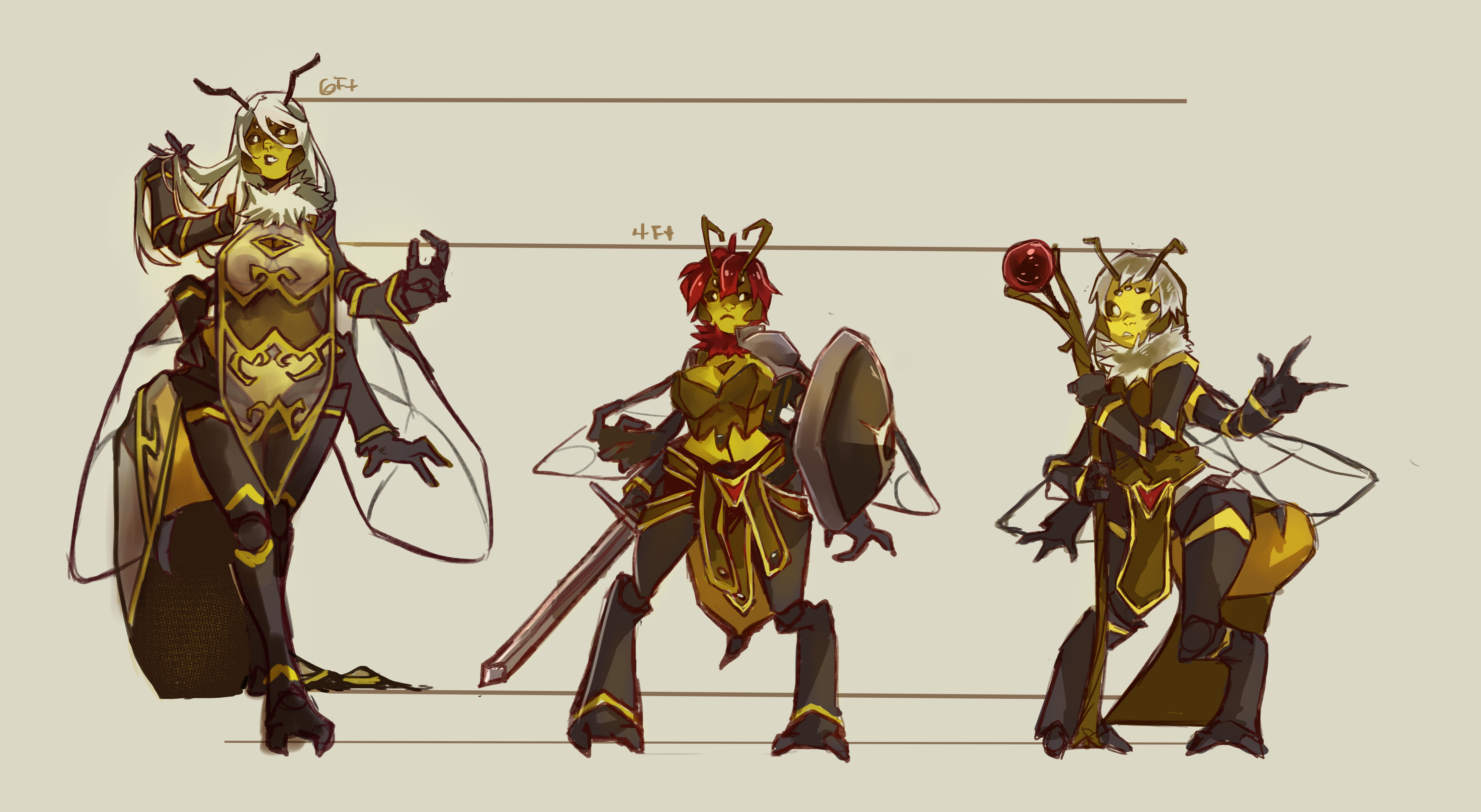
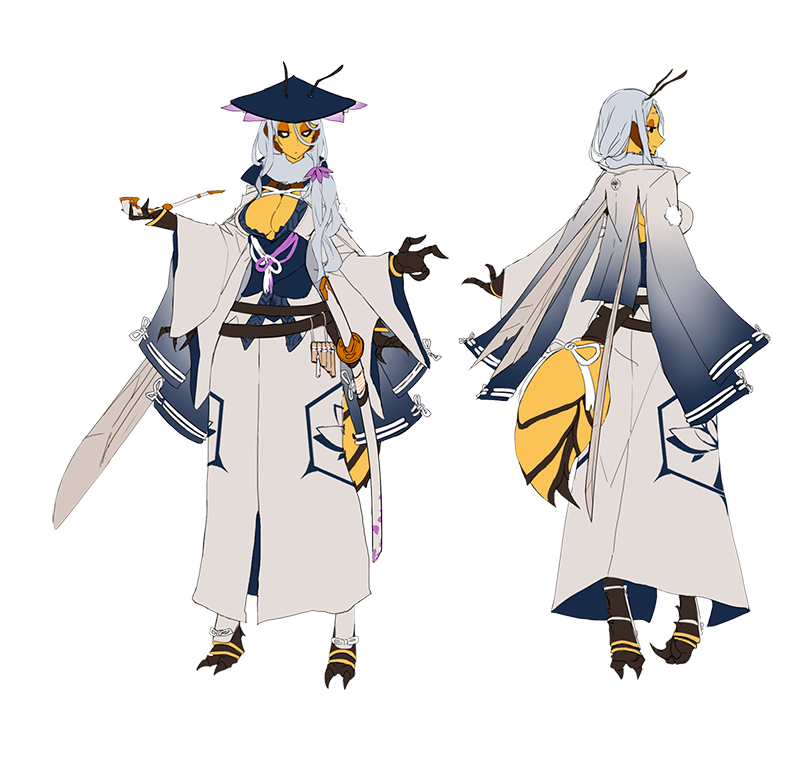
Vespidan body structure is relatively similar across the castes with the noteworthy visual differences being in size, proportions, and hair colors. Their carapace is largely a single color usually ranging from yellow to yellow-orange to orange to red and accented with dark stripings from brown to black, with their limbs reversing the primary and secondary colors. Members of the same hive generally share the same color and pattern and there even being little variation between hives in a region. Their crafting techniques are largely alchemical based and use very little fire, most commonly working with giant insect chitin, leathers, and silks. Their armor and clothing designs reminiscent of elven and fey fashions.
Society
Vespidan society is built and relies on the instinctive dedication to the good of the hive exhibited by every member. A single Queen acts as the central authority in all matters of a hive and is the sole reproductive member capable of producing an egg at a rate of up to one per month, twin eggs are possible but un- common, while triples are rare in the extreme, and greater
numbers are unheard of. An egg takes about two weeks to hatch into a soft pale infant-like vespid baby, or 'larva'. In very small colonies (those with less than a couple dozen individuals) the eggs and larva are protected and cared for solely by the queen. In the largest colonies (up to a thousand or more members) they are protected and cared for by both the queen and the most experienced and elite of the worker caste.
Larva are nursed by both the queen and any caretaker sisters assigned to them, nurturing them like mammals would, until their carapace hardens enough to eat food on their own after about one year of age. The vespid child, appearing much like a wingless, stingerless child version of an adult, is then allowed to grow and experience hive life and is encouraged to learn what it means to contribute to the hive. At eight years of age they molt their wings, and stingers in females, and are now considered adolescents and are expected to begin pursuing a path to benefit the hive. At twelve a vespid is considered to be a full adult and given all of the responsibilities that go with it.
Those that begin to place their own needs and/or individuality above the needs of the hive risk being cast out as 'hive-broken', considered a taboo mental illness in hive society. The hive-broken, while might act more like any other individual of another humanoid race pursuing their own wants and dreams, are treated as bogeymen within hives with young being told stories of mad cannibalistic hive-broken.
These are merely fairy tales, as Vespids generally do not consume the flesh of their own or of sentient humanoids unless emergency demands it. Though they culturally detest wastefulness and will usually feed their dead and those of their enemies to the young of the giant wasps a hive tends to keep in a fashion similar to cattle and horses. Also, young vespids, those under 12 but above 1 year old, are strictly carnivorous while the adults over 12 become largely herbivorous, becoming intolerant of solid meat proteins, though liquid like blood and broths are fine, resorting to hunting only to feed their young.
The domesticated giant wasps of the vespidan serve many purposes depending on their needs and training.
They can serve as battle steeds for cavaliers, draft beasts pulling small carts, plows, and other devices for vespid agriculture, and, like cattle to humanoids, can be a source of wasp honey and meat for vespidan and their young. There are rare particularly gifted vespidan ranchers who can extend their ability to train wasps to not attack giant honeybees, whose honey, meat, and domestic uses are far more desirable. If such an individual is able to peacefully keep both wasps and bees she'll find herself as one of the most valuable members of a hive.
Drones (males) are considerably less desirable as they are physically weaker than their female counterparts, lacking any natural defenses, and have weaker overall cooperative instincts. A drone's real purpose is in their necessity for reproduction. For this reason they are prized and treated more like royal treasures than actual people. To prevent inbreeding, Drones are traded with other Hives for either another drone or they are traded for a small fortune of resources. This combined with their more gregarious and less xenophobic tendencies makes drones prone to becoming hive-broken as well. Despite this stigma, Drones are highly respected for their raw magical talent. And they are often deployed as diplomats to other races due to their Gregarious nature. Because while Vespidan Hives are usually isolated, and fiercely defended by the territorial Vespidans, eventually these expanding Hives will encroach up the lands of other civilized races, making contact inevitable.
In the event of the death of a queen, or prolonged absence, a hive can usually keep up as normal but is severely weakened in it's ability to respond to new threats to the hive. The Queen's absence will cause a small amount of Workers (around 3%) to develop into Queens themselves. In this event the queens develop increasingly aggressive tendencies toward one-another until a 'Queen-War' breaks out until one queen is determined the winner with any surviving contenders exiled from the hive's territory, forced to survive on their own until they are able to acquire a drone and begin their own hive, are driven hive-broken by despair, or worse fates. Sometimes a Queen leaves with a sizable contingent to create a new Hive, or sends one away to colonize a new area, with the intend to force this effect. Thus allowing new Hives to be created.
Workers form the vast majority of a hive's population and manage nearly all aspects of a hive's infrastructure, agriculture, production and virtually all non-authoritarian roles of colony society. Their most noteworthy professions involve their abilities to train giant wasps as livestock and mounts and create massive, impressively strong structures out of durable paper and mud that dries harder than stone and their ability to create weapons and armor from chitin through secretive alchemical shaping and treatment processes that leaves it as hard as steel and also produces exquisite quality leathers. The workers in the field often travel in teams and are usually fighters, rangers, rogues, or clerics.
Vespidan Hives are renowned for their tenacity in facing threats, often relying on guerilla tactics and making use of the terrain against their foes. But they are also more than willing to face their foes head on should the need arise. Most members of the Hive can fight, and will do so till their dying breath. Workers are led by tacticians, and supported by Priestesses of Calistria as well as the magical might of the Hive's Drones.
Should the threat be sufficiently high, then several Hives will often join together, even if there were previous tensions between them. They recognize that the need for survival comes first, and those that attack a single Hive will eventually have to face as many Hives as it takes for them to deal with the new threat.
Relations
Vespids are inherently xenophobic and can quickly see any sentients in their territory as a threat, though they are significantly more tolerant of the presence of elves and any obvious followers of Calistria. Hives that find the need to make arrangements with neighboring species will try to make use of their drone's innate charisma to create treaties and alliances.
As such, Hives that have regular contact with humanoids might produce more drones to act as diplomats as they have an easier time communicating with the neighbors.
Hive-broken usually get better opportunities to meet with other races. They find halflings and gnome's small stature to be more approachable but their whimsical tendencies off putting. They usually can't tell the difference between humans, half-elves, and half-orcs and with their highly varied natures often find someone of these races to identify with and rely on as a guide to humanoid society. They tend to find the stout build of dwarves almost comical, but find their rigid tradition based culture the easiest to understand.
Hive-broken Vespid often find difficulty fitting in. They are drawn to human settlements where the people share a similar freedom of thought as the broken, but they often find themselves feared or reviled for their wasp-like visage and the various dangers, both real and imagined, that the hive-folk can inflict on travelers along with a distinct unfamiliarity with human society, the value of money for example. Should the broken find camaraderie, their new allies often find themselves with a staunchly loyal compatriot that excels in teamwork.
Religion
The primary religion of the Vespidan is their racial goddess, The Waspmother. This is specifically Calistria but the form of worship is so removed as to be a completely different religion altogether. A structured religion promoting teamwork, self-sacrifice for your allies, and strict acknowledgment of leadership runs anathema to the chaotic whims of the fickle elven goddess. Sages believe that vespid divine casters are powered not by Calistria but by their very faith in the philosophy the Waspmother represents to them. Any vespid
that is approached with this contradiction often becomes immediately incensed and aggressive. Virtually all hives worship the Waspmother, though there are a few queens who have been made to see the truth and have turned their hive to the worship of other lawful deities that better fit with their ethos. Hive-broken generally still revere the Waspmother but are much more likely to worship other deities than their hive-bound kin.
Names
Vespid names are elven in origin, the language given to them by their creator Goddess. A vespid takes the name of their mother queen as their surname in situations where it is needed. Queens usually discard their mother's name entirely upon their advancement believing it no longer important to their identity. Hive-broken often discard their mother's name as well, out of shame, anger, or frustration, they are just as likely to adopt a new name entirely, usually one based on whatever culture in which they've grown comfortable.
Vespidan Traits
Your Vespidan character has the following racial traits.
Age. All Vespids reach maturity at 12, beyond this workers live about as long as 75 years, drones as long as 350 years, and workers that become queens can live as long as 750 years.
Alignment. Vespidan societies are invariably highly structured and caste-based. They are almost always strongly lawful and usually lawful neutral as the good of the hive supersedes all other concerns. The exception are the hive-broken who are still often lawful by upbringing, but can easily stray into any form of thinking from there.
Size. Workers and Drones are small sized, while Queens are medium sized.
Speed. Vespidan Workers and Drones have a base walking speed of 25 feet, and Vespidan Queens have a base walking speed of 30 feet. In addition, all Vespidans have a climbing speed of 20 feet.
Ability Score Increase. Your Dexterity score increases by 1.
Multiarmed. All Vespids are born with 4 arms. Your two additional arms allow you to interact with an additional object or feature of the environment for free on your turn. You may not carry and use shields for defense with these additional arms. Nor do they grant you additional attacks, or allow you to wield weapons with them for combat.
Gliding Wings. Using your insect like wings, you can slow your fall by rapidly flapping them, and glide short distances. When falling you can use your reaction to slow your descent, as if under the effects of a feather fall spell. However you can move two feet horizontally for each foot that you fall. At the DM's discretion, you can ride strong wind currents, either no longer descending or even ascending, while you can continue to fly up to 30 feet. If you already have a flying speed then that flying speed will increase by 20 feet instead. Your clothes and armor have to be modified to accommodate your wings, and you can't use your wings while wearing heavy armor.
Carapace. Your Carapace provides limited protection, and makes you accustomed to wearing armor. You can calculate your base AC as 11 + your Dexterity modifier while not wearing armor, and a shield’s benefits apply as normal while you use this AC. While wearing medium armor, your maximum Dexterity modifier bonus is increased by 1.
Languages. You can speak, read, and write Common and Elven.
Subraces. Choose one of the following subraces. Your choice will determine additional benefits.
Drone
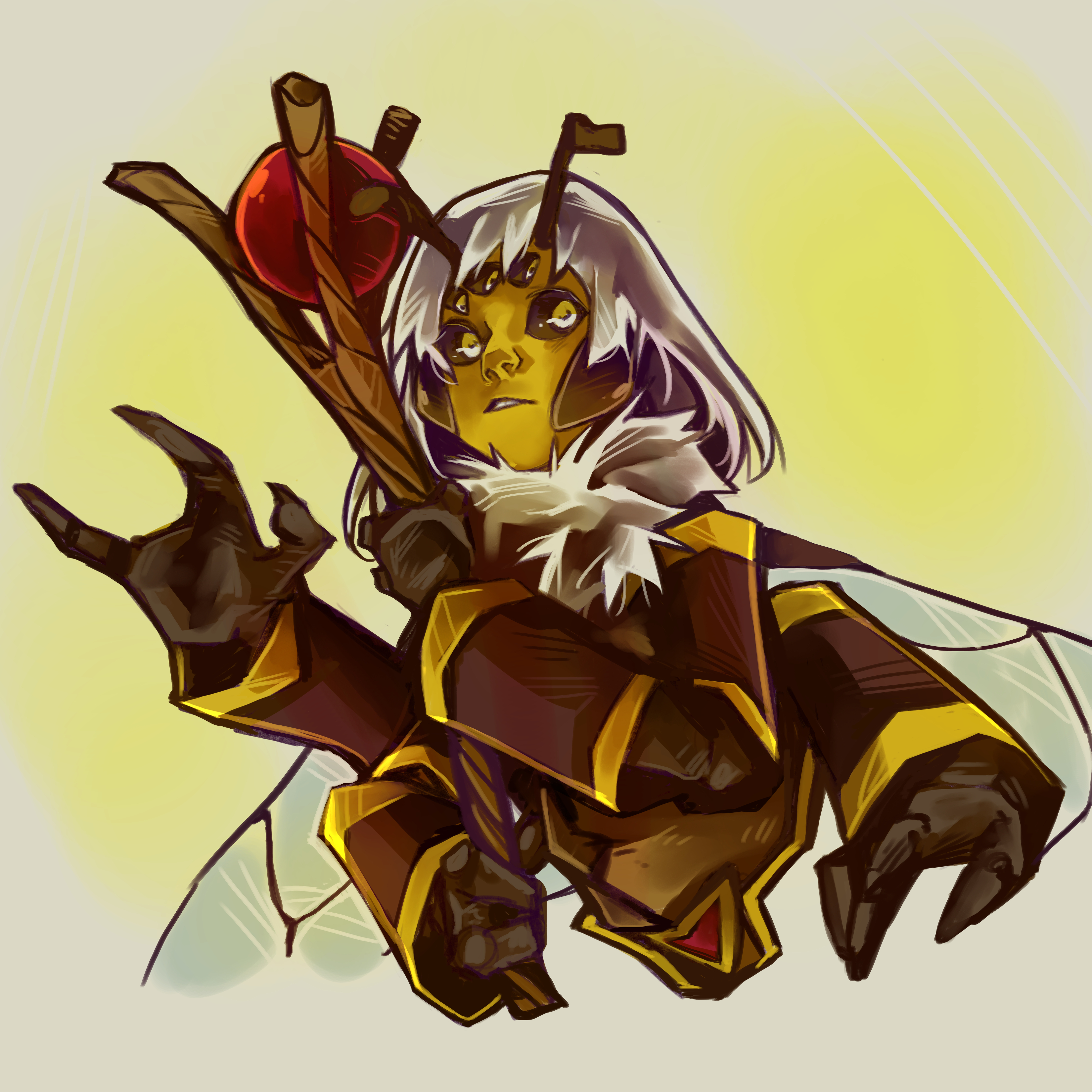
Drones, the males of the species, are much more docile than the other vespidan subraces. Standing about 4 feet like the workers, they look much like their female counterpart, except slightly frailer, which is an evolutionary bluff inherited from their wasp relatives as they lack the female's dangerous stingers. Their hair and neck fluff can be any color common to queens or workers. They often wear light, flowy clothing, and because of their innate magical talent they are usually spellcasters.
Ability Score Increase. You gain a +1 to your Intelligence and Charisma scores. Drones are nimble, intelligent and gregarious, often curious about other races.
Magic Savant. After finishing a short or long rest you may choose one of the following spells: animal friendship, misty step, or shield. You may cast this chosen spell once without expending a spell slot. You regain the ability to choose and cast a spell in this manner after finishing a short or long rest. Charisma is your spellcasting ability for these spells.
Harmonic Casting. When you cast a non-cantrip spell you may channel some of the magic into yourself or a creature you can see within 60 feet. The chosen creature gains temporary hit points equal to the spell's level plus your proficiency bonus. Creatures may only be affected by this trait once, after which they may be affected again after they finish a short or long rest.
Gregarious. You have proficiency in the Persuasion skill. Giant Wasps you Charm will actively protect and fight for you.
Queen
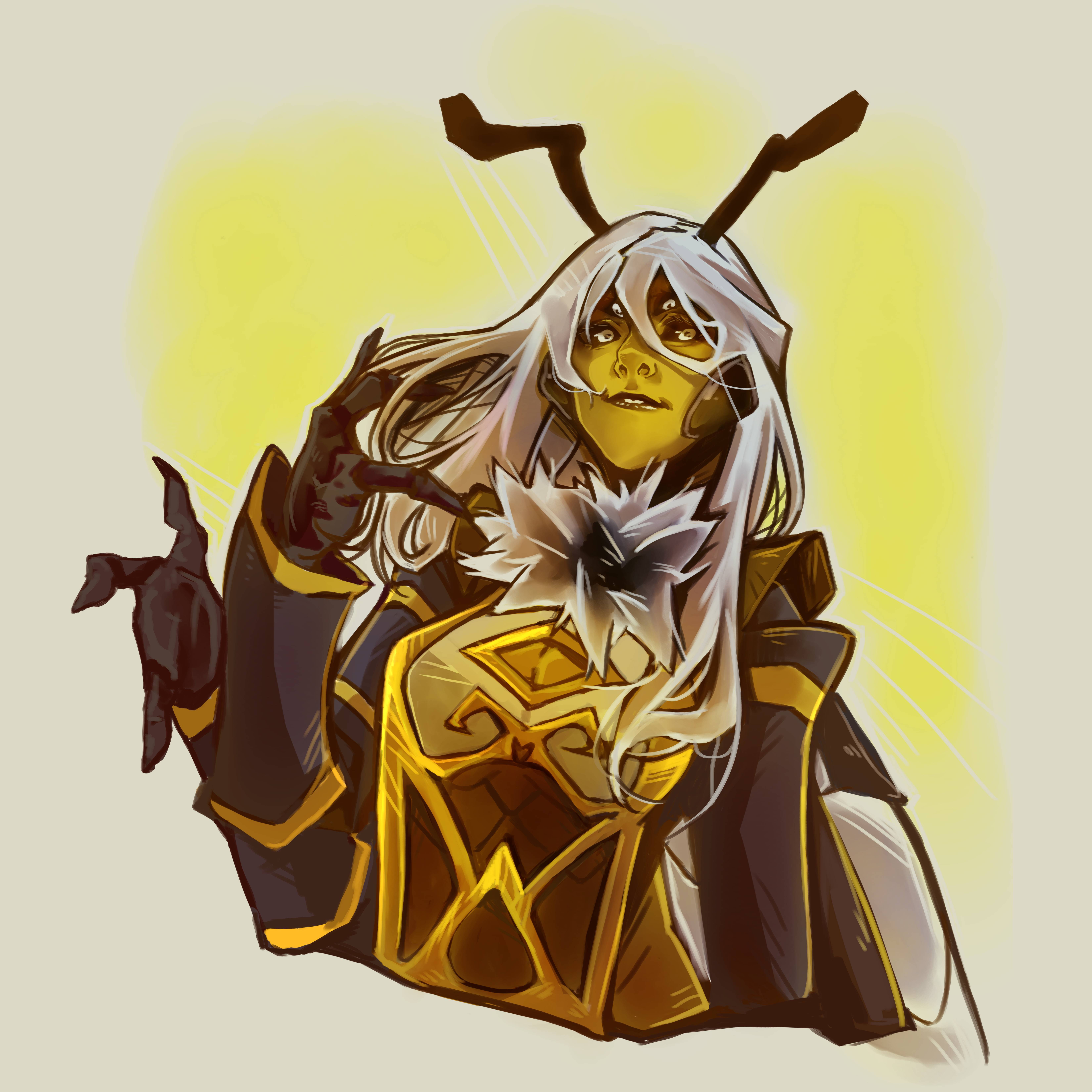
Queens are the natural leaders of vespid hive structure and often stoic and regal, standing about 6 feet in height on average with a lithe grace. Their hair and neck fluff tend to be pale in color (Silver, blonde, pale red, etc). They tend to wear armored flowing attire that is regal in appearance and favor elegant or elaborate weapons or can be powerful spellcasters.
Ability Score Increase. You gain a +1 to your Strength score, and a +1 to your Wisdom or Charisma score. Vespidan Queens are graceful yet powerful, and possess innate leadership skills.
Inspiring Queen. You may use the Help action as a bonus action, for a number of times equal to your Proficiency bonus. You regain the ability to use the Help action this way after finishing a short or long rest. At level 3, when you use the Help action to aid an ally in attacking a creature, the target of that attack can be within 30 feet of you, rather than within 5 feet of you. Should the ally already have advantage, then it may add half your proficiency bonus (rounded up) to the attack's hit and damage roll instead.
Sting. Your sting is a natural weapon, which you can use to make a unarmed strike with. If you hit with it, you deal piercing damage equal to 1d6 + your Strength modifier, instead of the bludgeoning damage normal for an unarmed strike. On a hit, you may choose to inject the target with your venom, after which you must spend a long rest before you can use your venom again. This venom causes the target to take 2d6 poison damage, and it must make a Constitution saving throw (DC: 10+ your Proficiency bonus+ your Strength modifier). On a failed save, it is also poisoned until the start of your next turn. The poison damage increases to 3d6 at 5th level. 4d6 at 10th level, 5d6 at 15th level, and 6d6 at 20th level.
Insightful Monarch. You have proficiency in the Insight skill, and advantage on saving throws to avoid being charmed.
Worker
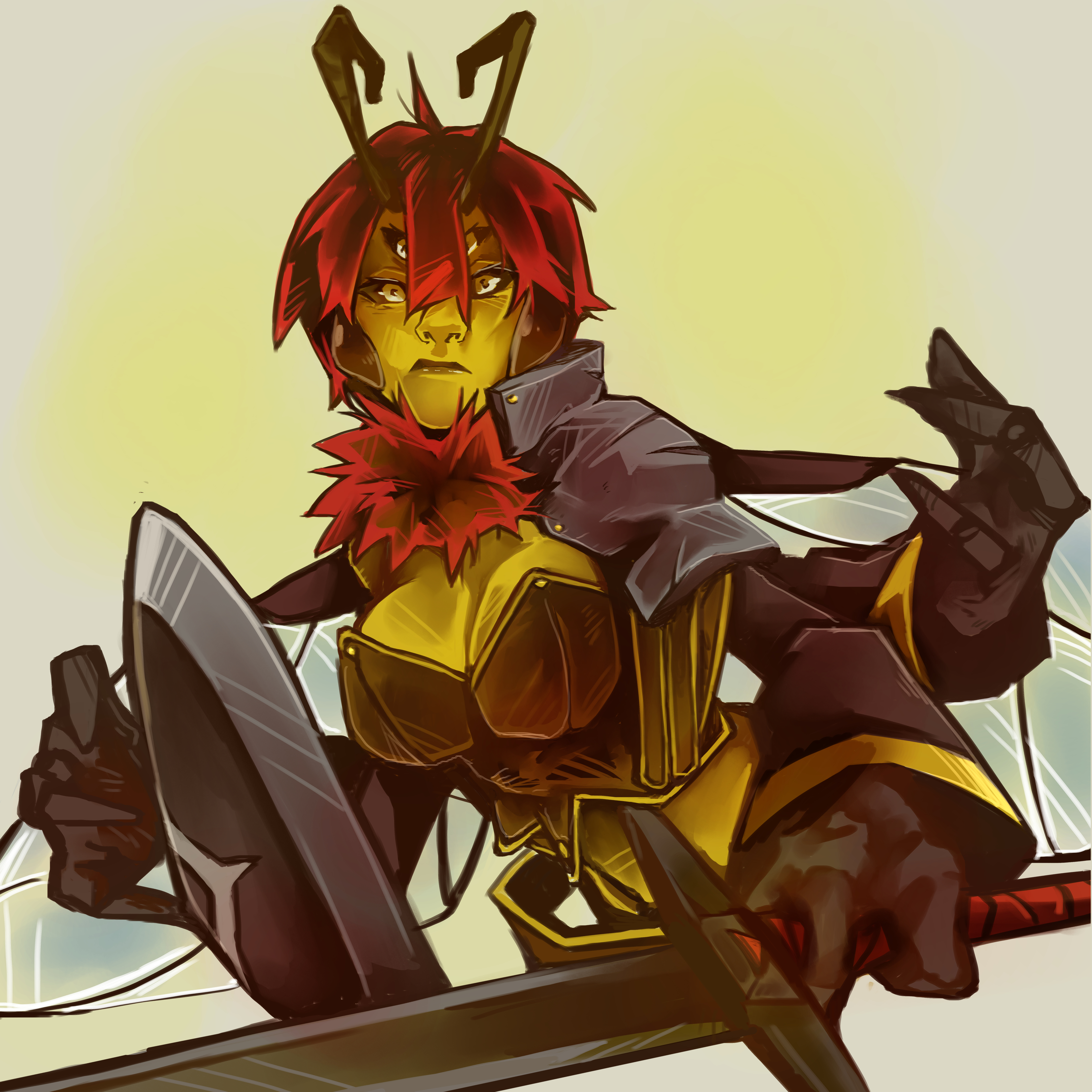
Workers stand about 4 feet on average with an athletic build. They are extremely loyal and quick to turn aggressive toward perceived threats to the hive. Their hair and neck fluff tend toward dark colors (black, brown, auburn, etc. With Auburn being the most common). They tend to wear simple, efficient armor and wield light weapons and shields or ranged weapons.
Ability Score Increase. You gain a +1 on your Constitution and Wisdom scores. Vespidan Workers are agile, tough, and possess excellent instincts.
Swarm Tactics. You have advantage on an attack roll against a creature if at least one of your allies is within 5 feet of the creature and the ally isn’t incapacitated. You may only benefit from this trait once per turn.
Sting. Your sting is a natural weapon, which you can use to make a unarmed strike with. If you hit with it, you deal piercing damage equal to 1d6 + your Strength modifier, instead of the bludgeoning damage normal for an unarmed strike. On a hit, you may choose to inject the target with your venom, after which you must spend a long rest before you can use your venom again. This venom causes the target to take 2d6 poison damage, and it must make a Constitution saving throw (DC: 10+ your Proficiency bonus+ your Strength modifier). On a failed save, it is also poisoned until the start of your next turn. The poison damage increases to 3d6 at 5th level. 4d6 at 10th level, 5d6 at 15th level, and 6d6 at 20th level.
Talented Builder. You have proficiency in one Tool of your choice. In addition, you learn new Tool proficiencies within 100 days instead of the standard 250 days.
Additional Feats
The following feats are available to Vespidans.
Gifted Drone
Prerequisite: Vespidan Drone
The Elven goddess of lust, revenge and Wasps favors you; blessing you with her divine might, and granting you the following benefits:
- Increase your Intelligence or Charisma score by 1, to a maximum of 20
- You can add double your proficiency bonus to your Persuasion checks. In addition you know the message cantrip, can communicate with it to any intelligent
creature (regardless of language) or beast, and you
can use your antenna as the material component
of the spell. - When you use your Harmonic Casting ability
to grant an ally temporary hit points, you gain
half as many temporary hit points (rounded
up). When you gain temporary hit points in
this manner, it does not count as using the
Harmonic Casting trait on yourself.
Gifted Queen
Prerequisite: Vespidan Queen
The Elven goddess of lust, revenge and Wasps favors you; blessing you with her divine might, and granting you the following benefits:
- Increase your Charisma score by 1, to a maximum of 20.
- Your Sting now also counts as a Finesse weapon, and those who fail its poison DC now suffer the Paralyzed condition instead of the Poisoned condition for its duration.
- You gain "inspire points" equal to 1 + your Charisma Modifier (minimum of 1). You regain any expended uses when you finish a long rest. You can spend inspire points in the following ways: After you make an attack roll, you can spend an inspire point to immediately enable one creature within 60 feet of you to use its reaction to make one weapon attack. After you use the Dash action, you can spend one inspire point to immediately enable one creature within 60 feet of you to use its reaction to move up to its speed. After you use the Dodge action, you can spend an inspire point to immediately enable one creature within 60 feet of you to use its reaction to gain the benefits of the Dodge action until the start of your next turn. You gain an additional inspire point at 6th level, 11th level, and 16th level.
Note: Should your world not have Calistria as a goddess, your DM can alter the lore slightly and choose a different fitting god as the creator of this species. These must be deities with the chaotic alignment, but they can be both neutral or good. Recommended domains would be the Trickery, Knowledge and Life domains, as well as which-ever domain your DM deems appropriate. A possible candidate could be Sune, chaotic good goddess of love.
Gifted Worker
Prerequisite: Vespidan Worker
The Elven goddess of lust, revenge and Wasps favors you; blessing you with her divine might, and granting you the following benefits:
- Increase your Strength or Constitution score by 1, to a maximum of 20. You count as one size larger when determining your carrying capacity and the weight you can push, drag, or lift.
- Your Sting now also counts as a Finesse weapon, and those who fail its poison DC now suffer the Paralyzed condition instead of the Poisoned condition for its duration.
- Whenever you gain the benefits of the Dodge action in combat, you can spend one Hit Die to heal yourself. Roll the die, add your Constitution modifier, and regain a number of hit points equal to the total (minimum of 1).
Winds of Calistria
Prerequisite: Vespidan
Supernatural winds flow around you, granting you and your kin the gift of flight.
- You gain a flying speed of 30 feet. To use this speed, you can’t be wearing heavy armor.
- Allies who start their turn within 30 feet of you, and who have the Gliding Wings trait or a similar trait or feature, gain a flying speed of 30 feet until the end of their next turn.