
Roguish Archetype
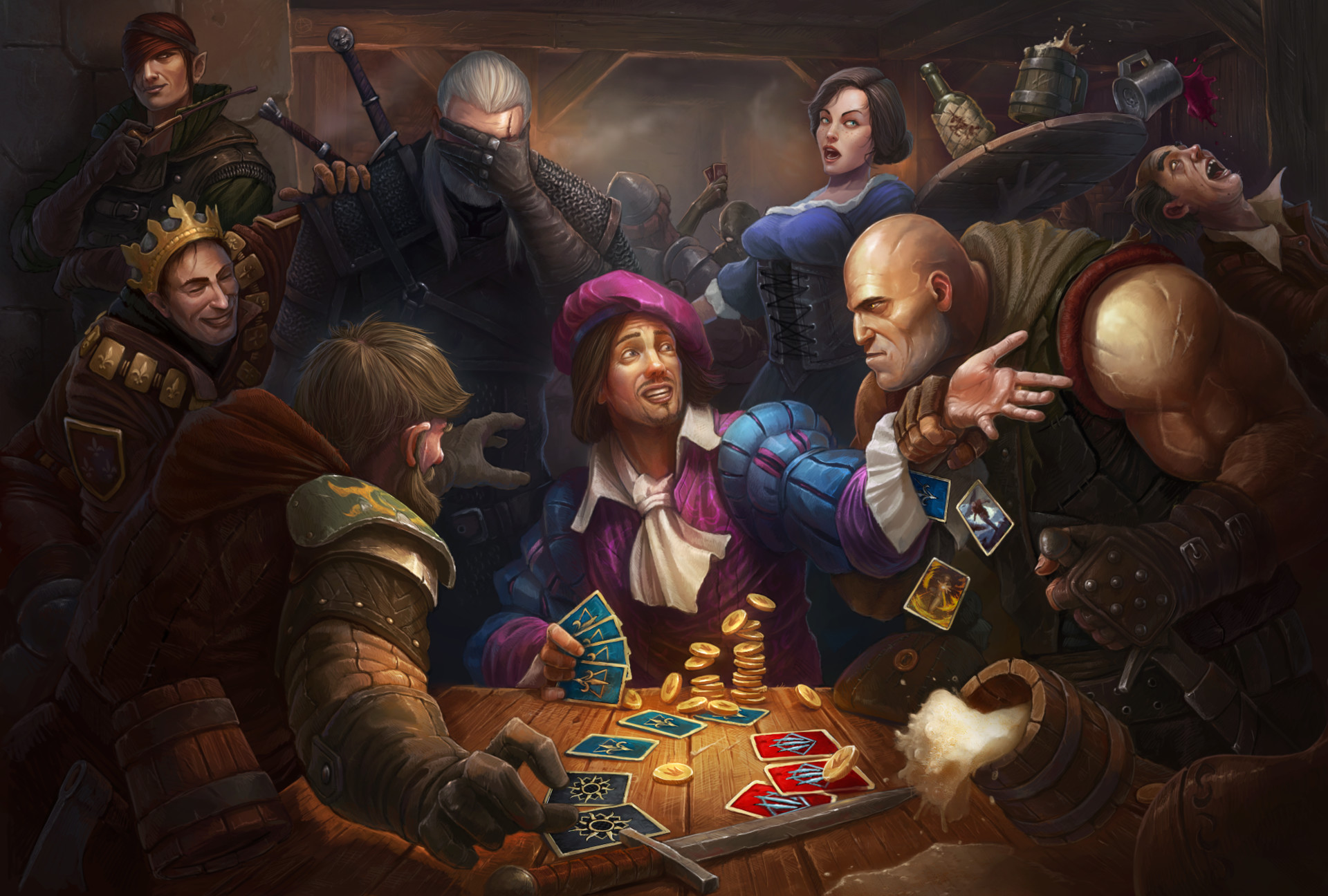
Cardsharp
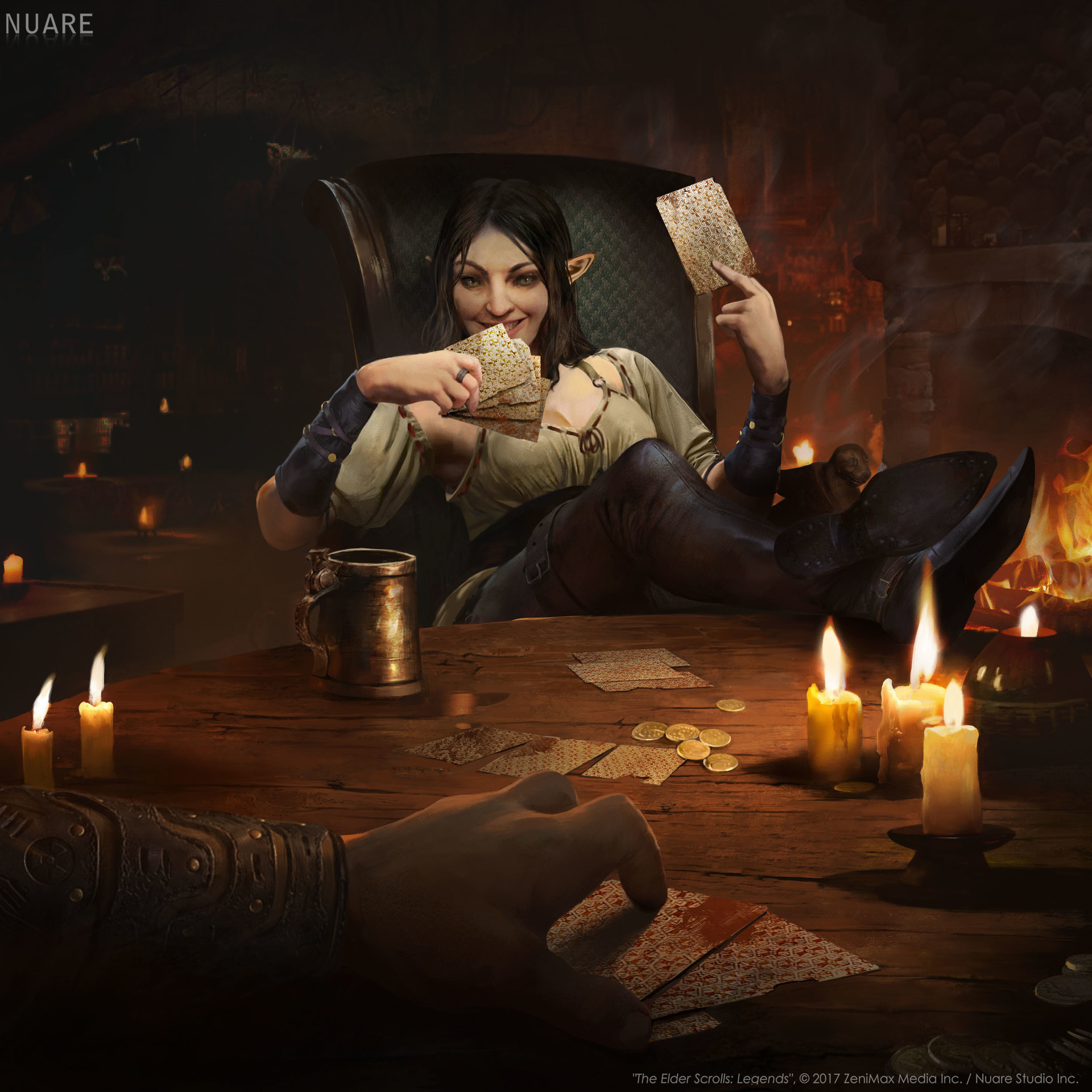
You love a good game of cards. You've focused training on sleight of hand and winning at any cost. Your natural skill and use of deception has made you a very successful cardsharp. You travel the land looking for your next mark. You excel at reading people and situations allowing you to avoid trouble before it starts. During one of your excursions, you obtained the means to a deck of enchanted cards that come in handy when you can't avoid said trouble.
How did you obtain your spellbound deck of cards?
| d6 | How the deck was acquired |
|---|---|
| 1 | Won the deck and enchantment in a card game |
| 2 | Stole the deck and enchantment from a fellow gambler |
| 3 | Received the deck and enchantment as payment for a job done |
| 4 | Stole the enchantment from a fellow gambler |
| 5 | Won the enchantment in a card game |
| 6 | Received the enchantment as payment for a job done |
What are your cards made of?
| d4 | Material | Type |
|---|---|---|
| 1 | Wood | Oak, Birch, Ash |
| 2 | Stone | Marble, Flint, Obsidian, Quartz |
| 3 | Metal | Steel, Iron, Copper |
| 4 | Bone | Dragon, Bear, Wolf |
Card Material
When picking the material of your cards think of how you got them? If you won them in a card game or stole them, what do you know about the region they came from? If you acquired the knowledge of the enchantment and made the deck yourself, what makes the most sense to your character? If you are Elven, maybe it's made from the wood of your homeland. If a dwarf, maybe a special ore that your community mines. Whatever the material you choose let it make sense for your character.
Spellcasting
Aces Up Your Sleeves. At third level, you have designed three Ace cards with a cantrip each. One of them is the Sword Burst cantrip. The other two can be chosen from abjuration and conjuration on the wizard spell list.
At 10th level, when you learn another cantrip you can design your final Ace card. You can also exchange two of your previous cantrips for new ones by spending time to redesign the previous cards with their new cantrip.
Sketchbook. At 3rd level, you have a sketchbook containing three 1st-level abjuration and conjuration spells, from the wizards spell list, of your choice. Your sketchbook is the repository of the wizard spells you know, including cantrips.
Face Cards. The Cardsharp Spellcasting table shows how many Face cards you have to cast your spells of 1st level and higher. To cast one of these spells, you must expend a Face card. You regain all expended Face cards when you finish a long rest. The spells must be of a level for which you have Face cards, and you must design the Face card with the level of the spell you wish to use.
For example, if you're a 7th-level Cardsharp, you have four 1st-1evel and two 2nd-level Face cards. If you prepare the spell Magic Missile design onto a Face card as a 1st-level spell, it can only be used as a 1st-level spell. To cast it as a 2nd-level spell you must design a Face card for the Magic Missile as a 2nd-level spell.
You can change the spell design on your Face cards when you finish a long rest. Preparing new Face cards requires time spent etching your design of the spell into the Face card: at least 5 minute per spell level for each Face card.
Spellcasting Ability. Wisdom is your spellcasting ability for your wizard spells, since you use a studied eye to transfer the essence of the spell onto your Face card. You use your Wisdom whenever a spell refers to your spellcasting ability. In addition, you use your Wisdom modifier when setting the saving throw DC for a wizard spell you cast and when making an attack roll with one. Due to the unique way your spells are cast you do not require material components except those listed with a gold amount.
Spell Save DC
Spell attack modifier
Cardsharp Spellcasting
| Rogue Level | Cantrips Known | ---Face Cards Per Level--- 1st 2nd 3rd 4th |
|---|---|---|
| 3rd | 3 | 2 ---- ---- ---- |
| 4th | 3 | 3 ---- ---- ---- |
| 5th | 3 | 3 ---- ---- ---- |
| 6th | 3 | 3 ---- ---- ---- |
| 7th | 3 | 4 2 ---- ---- |
| 8th | 3 | 4 2 ---- ---- |
| 9th | 3 | 4 2 ---- ---- |
| 10th | 4 | 4 3 ---- ---- |
| 11th | 4 | 4 3 ---- ---- |
| 12th | 4 | 4 3 ---- ---- |
| 13th | 4 | 4 3 2 ---- |
| 14th | 4 | 4 3 2 ---- |
| 15th | 4 | 4 3 2 ---- |
| 16th | 4 | 4 3 3 ---- |
| 17th | 4 | 4 3 3 ---- |
| 18th | 4 | 4 3 3 ---- |
| 19th | 4 | 4 3 3 1 |
| 20th | 4 | 4 3 3 1 |

Bonus Proficiencies
At 3rd level, you gain proficiency in playing card sets and one other of Woodcarver's tools or Mason's tools.
Treat a roll of 5 or below as a 6 on Wisdom (Insight) and Charisma (Deception) skill checks.
Plain Cards
When you choose this archetype at 3rd level, Plain cards in your Spellbound Deck can be used as a weapon. You have proficiency with them. (See. Spellbound Deck of Cards at the end of this subclass for Damage and Properties information.)
When you take the Attack action with Plain cards, you can throw one card as an attack during the Attack action, or take from the Draw and instead throw two, or three cards as an attack during the Attack action.
Your Sketchbook
As you gain levels as a rogue, each spell added to your sketchbook reflects your Cardsharp abilities. You might find other spells during your adventures. You could win a spell recorded on a scroll in a game of cards, for example, or swiped one off a an unsuspecting individual.
Copying a Spell into the Book. When you find a wizard spell of 1st level or higher, that is from the school of abjuration or conjuration, you can add it to your sketchbook if it is of a spell level you can prepare and if you can spare the time to create a design that represents the spell. Sketching the design of that spell into your sketchbook involves representing the intrinsic nature of the spell. You must sketch the spells design until you understand its very essence. For each level of the spell, the process takes 2 hours and costs 25 gp. The cost represents material components you expend as you experiment with the design of the spell to master it, as well as the fine inks you need to record it. Once you have spent this time and money, you can prepare the spell just like your other spells.
Replacing the Book. You can copy a spell from your own sketchbook into another book — for example, if you want to make a backup copy of your sketchbook. This is just like sketching a new spell into your sketchbook, but faster and easier, since you understand the reasons behind your own design. You need spend only 1 hour and 5 gp for each level of the copied spell.
If you lose your sketchbook, you can use the same procedure to sketch the Face cards that you have prepared into a new sketchbook. Filling out the remainder of your sketchbook requires you to find new spells to do so, as normal. For this reason, many Cardsharps keep backup sketchbooks in a safe place. The Book’s Appearance. Your sketchbook is a unique compilation of spell designs, with its own decorative flourishes and margin notes. It might be a plain, functional leather volume that you received as a game prize, a finely bound gilt-edged tome you procured from an ancient library, or even a loose collection of notes scrounged together after you lost your previous sketchbook in a mishap.
The Draw
The Draw is a number of cards with which you are able to attack using two or three cards during the Attack action. The Draw is equal to your Wisdom modifier + your Dexterity modifier + your proficiency bonus.
For example, if at 3rd level your Wisdom modifier is 3, Dexterity modifier is 4, and your proficiency bonus is 2, the Draw equals nine cards. You then use three cards to make an attack during your Attack action, leaving you with six cards left in the Draw. On your next turn, you choose to take the Attack action and attack by throwing two cards. You now have four cards remaining in the Draw.
With those four cards, you can choose to throw three on your next turn when you take the Attack action, leaving you with a single card, or you can use the four remaining cards on two separate turns. On your next two turns you choose to take the Attack action and attack by throwing two cards (once each turn), depleting the Draw of any available cards. You regain the Draw after a long rest.
Ante Up
Starting at 9th level, you gain the option to make an Ante. An Ante allows you the opportunity to receive greater benefits in certain circumstances.
Antes are to be used before you know if an attack hits or misses, or before a saving throw is made. You can only use one Ante per turn, and may have no more than two of the same Antes in your deck. You can spend 5 minutes per Face card during a long rest to change your Antes. You gain back any Antes spent after the long rest.
At 9th level, you are allowed two Antes. You choose Antes from the Antes Options list. They do not have to be different. You then etch the design of it into a Face card like you would a spell.
You gain two more Antes at 13th level (total of four) and then one more at 17th (total of 5).
Ante Options
Hearts When you take the Attack action and hit, you gain temporary hit points equal to your Constitution modifier + proficiency bonus.
Clubs When you take the Attack action and hit, you deal additional damage equal to your Wisdom modifier + half your Rogue level (rounded up).
Diamonds When you take the Attack action and hit, the target must make an Intelligence saving throw or become stunned until the end of its next turn.
Spades When you take the Attack action and hit, you ignore the targets resistance damage equal to your Intelligence modifier + proficiency.



Joker When you are attacked, you can deflect some of the damage back onto your attacker. As with other Antes, you must use this before you know if it is a hit or miss. If you are hit, your attacker takes half the damage intended for you.
Shuffle When you use the Attack action and miss, you can reroll for a second chance.
Double Down
Beginning at 13th level, when taking the Attack action and attacking by throwing two or three Plain cards, the cards are imbued with force damage according to the Double Down table.
Double Down Table
| # of Cards Thrown | Plain Cards Sum Total | Damage |
|---|---|---|
| 2 | 2 | Reroll and cards do half damage; target is not pushed back |
| 2 | 3 - 8 | 2d4 force; pushed back 5ft |
| 2 | 9 - 14 | 3d4 force; pushed back 10ft |
| 2 | 15 - 20 | 4d4 force; pushed back 15ft |
| 3 | 3 | Reroll and cards do half damage, target is not pushed back |
| 3 | 4 - 12 | 3d4 force; pushed back 10ft |
| 3 | 13 - 21 | 4d4 force; pushed back 10ft and falls prone |
| 3 | 22 - 30 | 5d4 force; pushed back 15ft and falls prone |
Double Down: Using an actual deck of cards, or dice?
If using a regular deck, first remove all face cards, then shuffle the remaining cards. Draw the desired amount of cards, 2 or 3, and add them together for the Sum Total, follow the directions on the Double Down Table. Aces count as one.
When using dice, roll xd10, add them together for the Sum Total, then follow the rules on the Double Down Table.
Hand Mucking
Beginning at 17th level, you use your extensive experience as a Cardsharp to palm a number of cards equal to your Dexterity modifier to add to the Draw. This can be done twice per long rest.
Spellbound Deck of Cards
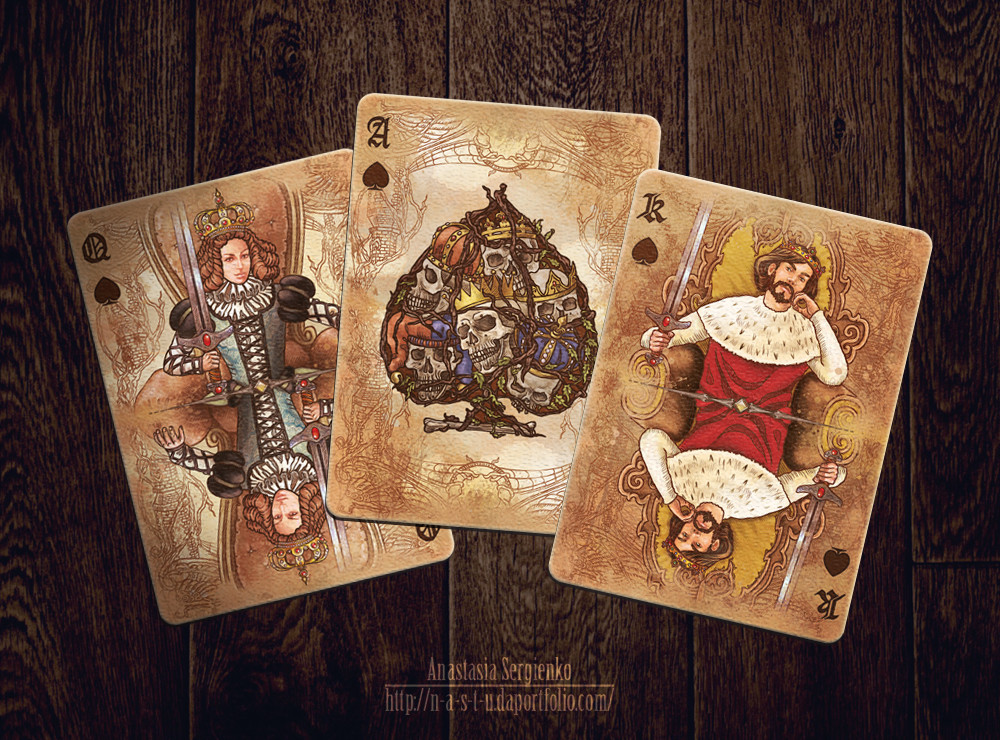
These cards are made of a sturdy material that can be chosen by the owner. The design on each card has been painstakingly etched into the surface in a ritual that binds the artist to the deck. As soon as the cards change hands, becoming the property of someone else, they become a blank deck of playing cards and the binding ritual must be completed before they work for the new owner. (See. Attunement for "binding ritual"; Spellbound Deck does not count as one of your Attuned items.)
Plain cards (number cards) are used like a standard weapon, reappearing in the deck after use, while Face cards (Court cards) are used to cast spells or as Antes disappearing after their use and only reappearing after a long rest. Aces are used for cantrips. The damage type of your deck can be changed. (See. Spellbound Deck: Modifications.)
Plain Card Damage
| # of Plain Cards | Damage | Properties |
|---|---|---|
| One | 1d4 bludgeoning | Finesse, thrown (range 20/60) |
| Two | 2d4 bludgeoning | Finesse, thrown (range 20/60) |
| Three | 3d4 bludgeoning | Finesse, thrown (range 20/60) |

Spellbound Deck: Modifications
Your Spellbound deck can be modified to cause Slashing damage. It can be done by an artisan in a town you stop by, or by your character during their downtime.
If done by someone who is not your character, the DM picks a reasonable time and price for the work being done.
If your character chooses to sharpen the cards edges on their own, it requires 8 hours of downtime. This time can be broken up between short and long rests, requires a d20 roll of 12 or higher, and artisan tools (add your proficiency bonus to the d20 roll if proficient in the tools you use). If the roll fails, add one hour to the required time.
The cards do not cause Slashing damage until the complete deck has been sharpened.
Spellbound Deck: Replacement
The life of an Adventurer can be perilous and hard. If at anytime your Spellbound Deck is lost, stolen, or worst case destroyed, it can be replaced, and the binding ritual recast. (See. Attunement)
Costs based on materials and time taken to make:
- Wood 75gp (damage as shown in Plain Card Damage chart)
- Stone 125gp (short/long range increased by 10ft)
- Bone 250gp (initiative increases by +1)
- Gemstone 375gp (increases damage by +1)
- Metal 500gp (increases damage done by 1d4)
Credits
- made by reddit user Gift_of_Goob
- Tony Sart Cardsharper artwork from ArtStation
- Anastasia Sergienko Poker cards artwork from ArtStation
- Larry Wilson Smokin' Aces artwork from ArtStation
- Tatyana Kupriyanova Cornerclub Gambler artwork from ArtStation
- Reddit user flamableconcrete page stains Imgur