The Mage Knight


A martial arcane half caster
The Mage Knight
| Level | Proficiency Bonus | Features | Cantrips Known | 1st | 2nd | 3rd | 4th | 5th |
|---|---|---|---|---|---|---|---|---|
| 1st | +2 | Arcane Senses, Spellcasting | 2 | 2 | — | — | — | — |
| 2nd | +2 | Knightly Discipline, Fighting Style | 2 | 2 | — | — | — | — |
| 3rd | +2 | Arcane Pool, Fusion Casting, Knightly Feature | 2 | 3 | — | — | — | — |
| 4th | +2 | Ability Score Improvement | 2 | 3 | — | — | — | — |
| 5th | +3 | Extra Attack, Spell Combat | 2 | 4 | 2 | — | — | — |
| 6th | +3 | Fusion Casting (3rd level) | 3 | 4 | 2 | — | — | — |
| 7th | +3 | Knightly Feature | 3 | 4 | 3 | — | — | — |
| 8th | +3 | Ability Score Improvement | 3 | 4 | 3 | — | — | — |
| 9th | +4 | — | 3 | 4 | 3 | 2 | — | — |
| 10th | +4 | Fusion Casting (4th level) | 3 | 4 | 3 | 2 | — | — |
| 11th | +4 | Improved Spell Combat | 3 | 4 | 3 | 3 | — | — |
| 12th | +4 | Ability Score Improvement | 3 | 4 | 3 | 3 | — | — |
| 13th | +5 | — | 4 | 4 | 3 | 3 | 1 | — |
| 14th | +5 | Fusion Casting (5th level) | 4 | 4 | 3 | 3 | 1 | — |
| 15th | +5 | Knightly Feature | 4 | 4 | 3 | 3 | 2 | — |
| 16th | +5 | Ability Score Improvement | 4 | 4 | 3 | 3 | 2 | — |
| 17th | +6 | — | 4 | 4 | 3 | 3 | 3 | 1 |
| 18th | +6 | Fusion Casting (6th level) | 4 | 4 | 3 | 3 | 3 | 1 |
| 19th | +6 | Ability Score Improvement | 4 | 4 | 3 | 3 | 3 | 2 |
| 20th | +6 | Fusion Casting (7th level) | 4 | 4 | 3 | 3 | 3 | 2 |
Class Features
As a Mage Knight, you gain the following class features
Hit Points
- Hit Dice: 1d10 per mage knight level
- Hit Points at 1st Level: 10 + your Constitution modifier
- Hit Points at Higher Levels: 1d10 (or 6) + your Constitution modifier per mage knight level after 1st
Proficiencies
- Armor: Light, medium, and heavy armor, shields
- Weapons: Simple and martial weapons
- Tools: None
- Saving Throws: Constitution, Intelligence
- Skills: Choose two from Arcana, Athletics, History, Insight, Investigation, and Perception
Equipment
You start with the following equipment, in addition to the equipment granted by your background:
- (a) a martial weapon and a shield or (b) two martial weapons
- (a) five javelins or (b) any ranged weapon without the special tag and 20 pieces of appropriate ammunition
- (a) a Scholar’s Pack or (b) an Explorer’s Pack
- An arcane focus and (a) leather armor or (b) scale mail or (c) chain mail
Alternatively, you may ignore the equipment from your class and background and start with 5d4 x 10 gp.
Arcane Senses
At 1st level, you become capable of detecting magical energy. As an action, you can sharpen your magical senses to discern the presence of highly magical creatures around you. Until the end of your next turn, you sense the presence of any aberration, elemental, or fey within 60 feet of you that is not behind total cover. You know the type (aberration, elemental, or fey) of any being whose presence you sense, but not its identity (if it is Queen Mab of the Winter Court, for instance). You can use this feature a number of times equal to 1 + your Intelligence modifier. When you finish a long rest, you regain all expended uses.
Spellcasting
As a mage knight, you have a spellbook containing spells that show the first glimmerings of your true power
Cantrips
At 1st level, you know two cantrips of your choice from the mage knight spell list. You learn additional mage knight cantrips of your choice at higher levels, as shown in the Cantrips Known column of the mage knight table.
Spellbook
At 1st level, you have a spellbook containing 5 1st-level mage knight spells of your choice.
Preparing and Casting Spells
The mage knight table shows how many spell slots you have to cast your spells of 1st level and higher. To cast one of these spells, you must expend a slot of the spell's level or higher. You regain all expended spell slots when you finish a long rest.
You prepare the list of mage knight spells that are available for you to cast. To do so, choose a number of mage knight spells from your spellbook equal to your Intelligence modifier + your proficiency bonus + half your mage knight level (rounded up). The spells must be of a level for which you have spell slots.
For example, if you're a 5th-level mage knight, you have four 1st-level and two 2nd-level spell slots. With an Intelligence of 16, your list of prepared spells can include 9 spells of 1st or 2nd level, in any combination, chosen from your spellbook. If you prepare the 1st-level spell Magic Missile, you can cast it using a 1st-level or a 2nd-level slot. Casting the spell doesn't remove it from your list of prepared spells.
You can change your list of prepared spells when you finish a long rest. Preparing a new list of mage knight spells requires time spent studying your spellbook and memorizing the incantations and gestures you must make to cast the spell: at least 1 minute per spell level for each spell on your list.
Spellcasting Ability
Intelligence is your spellcasting ability for your mage knight spells, since you learn your spells through dedicated study and memorization. You use your Intelligence whenever a spell refers to your spellcasting ability. In addition, you use your Intelligence modifier when setting the saving throw DC for a mage knight spell you cast and when making an attack roll with one.
Spell Save DC = 8 + your proficiency bonus +
Spell attack modifier = your proficiency bonus +
Spellcasting Focus
You can use your spellbook or an arcane focus as a spellcasting focus for your mage knight spells.
Your Spellbook
The spells that you add to your spellbook as you gain levels reflect the arcane research you conduct on your own, as well as intellectual breakthroughs you have had about the nature of the multiverse. You might find other spells during your adventures. You could discover a spell recorded on a scroll in an evil mage knight' chest, for example, or in a dusty tome in an ancient library.
Copying a Spell into the Book. When you find a mage knight spell of 1st level or higher, you can add it to your spellbook if it is of a level for which you have spell slots and if you can spare the time to decipher and copy it.
Copying a spell into your spellbook involves reproducing the basic form of the spell, then deciphering the unique system of notation used by the mage knight who wrote it. You must practice the spell until you understand the sounds or gestures required, then transcribe it into your spellbook using your own notation. For each level of the spell, the process takes 2 hours and costs 50 gp. The cost represents material components you expend as you experiment with the spell to master it, as well as the fine inks you need to record it. Once you have spent this time and money, you can prepare the spell just like your other spells.
A mage knight can learn spells from a wizard’s spellbook, just as a wizard can from a mage knight' spellbook. The spells learned must be on the mage knight spell list, as normal.
Replacing the Book. You can copy a spell from your own spellbook into another book-for example, if you want to make a backup copy of your spellbook. This is just like copying a new spell into your spellbook, but faster and easier, since you understand your own notation and already know how to cast the spell. You need spend only 1 hour and 10 gp for each level of the copied spell. If you lose your spellbook, you can use the same procedure to transcribe the spells that you have prepared into a new spellbook. Filling out the remainder of your spellbook requires you to find new spells to do so, as normal. For this reason, many mage knights keep backup spellbooks in a safe place.
The Book's Appearance. Your spellbook is a unique compilation of spells, with its own decorative flourishes and margin notes. It might be a plain, functional leather volume that you received as a gift from your master, a finely bound gilt-edged tome you found in an ancient library or even a loose collection of notes scrounged together after you lost your previous spellbook in a mishap.
Learning Spells of 1st Level and Higher
Each time you gain a mage knight level, you can add one mage knight spell of your choice to your spellbook. Each of these spells must be of a level for which you have spell slots, as shown on the mage knight table. On your adventures, you might find other spells that you can add to your spellbook.
Knightly Discipline
At 2nd level, you choose a discipline that defines your knighthood. This will determine your preferred approach to combat as well as shape your approach to other aspects of life. You gain additional features from your Knightly Discipline at 7th and 15th level.
- Elementalist Discipline
- Guardian Discipline
- Sword Saint Discipline
Fighting Style
At 2nd level, you adopt a particular style of fighting as your specialty. Choose one of the following options. You can't take a Fighting Style option more than once, even if you later get to choose again.
Archery
You gain a +2 bonus to attack rolls you make with ranged weapons.
Defense
While you are wearing armor, you gain a +1 bonus to AC.
Dueling
When you are wielding a melee weapon in one hand and no other weapons, you gain a +2 bonus to damage rolls with that weapon.
Great Weapon Fighting
When you roll a 1 or 2 on a damage die for an attack you make with a melee weapon that you are wielding with two hands, you can reroll the die and must use the new roll, even if the new roll is a 1 or a 2. The weapon must have the two-handed or versatile property for you to gain this benefit.
Arcane Pool
Your training has brought forth hidden magical prowess that you can use to fuel new abilities. At 3rd level, you gain a number of Arcane Points equal to your mage knight level + your Intelligence modifier. You can use these points on some class features. Additionally you can use them on one of the options below.
Lesser Arcane Recovery. You have learned to convert the energy from your arcane pool to some of your magical energy by studying your spellbook. Once per day when you finish a short rest, you can spend arcane points and choose expended spell slots to recover. The spell slots can have a combined level that is equal to or less than a half your Mage Knight level (rounded down), and none of the slots can be 4th level or higher, and you spend a number of arcane points equal to total level of spells you recovered
For example, if you're a 5th-level mage knight, you can spend up to 2 arcane points to recover up to two levels worth of spell slots. You can recover either a 2nd-level spell slot or two 1st-level spell slots.
Rituals. You can spend an arcane point to cast a mage knight spell as a ritual if the spell has the ritual tag, and you have the spell in your spellbook. You don't need to have the spell prepared.
Strategic Actions. You have learned to apply your knowledge to scenarios and improve your odds of success. You can spend an arcane point to add your Intelligence modifier to an ability check. You can wait until after you roll the d20 , but must decide before the DM says whether the roll succeeds or fails.
Fusion Casting
At 3rd level, you gain the ability to fuel and cast spells beyond your normal capabilities. You can learn and cast spells of a higher level by combining 2 spell slots and spending arcane points
To use your fusion casting feature, you must spend both 2 spell slots equal to the level of spell you cast and a number of arcane points equal to the spells level.
Your maximum fusion casting spell level is 2nd. This increases to 3rd level spells at 6th level, 4th level spells at 10th level, 5th level spells at 14th level, 6th level spells at 18th level, and 7th level spells at 20th level.
You prepare spells that can only be used through fusion casting as normal Whenever your maximum fusion casting spell level increases, you can add 2 spells of the new maximum level to your spellbook. You prepare these spells as normal.



If you get a spellbook or spell scroll with a spell that you can cast through fusion casting and not through your spellcasting feature, you can still add it to your spellbook, but it requires double the time and cost. You must also succeed on an Intelligence check equal to 10 + the spell's level. On a failure, you must spend an additional 2 hours and 100 gp before you can attempt the intelligence check again.
Ability Score Improvement
When you reach 4th level, and again at 8th, 12th, 16th, and 19th level, you can increase one ability score of your choice by 2, or you can increase two ability scores of your choice by 1. As normal, you can't increase an ability score above 20 using this feature
Extra Attack
Starting at 5th level, you can attack twice, instead of once, whenever you take the Attack action on your turn.
Spell combat
At 5th level, you have learned to weave magic while you strike. When you take the Attack action on your turn, you can spend 1 arcane point to cast one of your cantrips with a casting time of 1 action in place of one of those attacks.
Improved Spell combat
By 11th level, you have learned to weave powerful magic while you strike. When you take the Attack action on your turn, you can now either spend 1 Arcane Point to cast a cantrip in place of an attack, or you spend 2 arcane points to cast one of your spells of 1st level or higher with the casting time of 1 action in place of one of those attacks.
Superior Spell Combat
By 18th level, you have learned to seamlessly blend spellcasting and attacks. When you use your spell combat and improved spell combat features to cast one of your cantrips or spells of 1st level or higher with a casting time of 1 action, you can now do so without replacing one of your attacks.


Knightly Disciplines
Elementalist Discipline
Elementalists focus upon the mastery of one element. This singular focus grants them unparalleled capabilities with their chosen element. Some masters are even known to elevate the potential of their element by altering the fundamental structure of their spells.
Elemental School
As an elementalist, you must choose to specialize in one of the following elemental schools and gain the benefits listed:
Aeromancy. You choose mastery of the air. When you cast a cantrip or spell that would deal lightning damage, you can choose to make it deal thunder damage instead. When you cast a spell that would deal thunder damage, you can choose to make it deal lightning damage instead. Additionally, when you cast a spell that deals lightning or thunder damage, your movement speed increases by 10 feet until the beginning of your next turn.
Cryomancy. You choose mastery over ice. When you cast a cantrip or spell that deals cold damage, creatures that take damage from the spell have their movement speed reduced by 5 feet until the end of your next turn.
Geomancy. You choose mastery over the earth. When you roll damage for a cantrip or spell that deals acid, bludgeoning, or poison damage, you can treat any 1 on a damage die as a 2.
Pyromancy. You choose mastery over fire. When you cast a spell that deals fire damage, you wreathe yourself in protective flames and gain temporary hit points equal to the level of the spell slot used. You do not gain any temporary hit points when you cast a cantrip.
Additionally, you learn the spell Absorb Elements. You always have it prepared, and it doesn't count against your number of spells prepared. When you would take damage of the same type as one of the ones listed in your elemental school, you can use your reaction to cast Absorb Elements at 1st level without expending a spell slot.

Elemental Assault
At 3rd level, whenever you cast a spell, you can spend 1 arcane point to change the damage type to one of the damage types listed in your elemental school.
Additionally, you add your Intelligence modifier (minimum of +1) to the damage roll of any mage knight spell that deals damage of the same type as the one chosen for your elemental specialization feature. The damage bonus applies to one damage roll of a spell, not multiple rolls.
Elemental Weapons
At 7th level, you learn to infuse your weapons with power from your elemental school. You learn the spell Elemental Weapon. You always have it prepared, and it doesn't count against your number of spells prepared. When you use this spell and choose the same damage type as your elemental specialization, you can cast it at 3rd level with 3 arcane points instead of a spell slot or fusion casting. If you cast the spell in this way, you can use the spell on magical weapons, but you do not gain the +1 bonus when you do so.
At 11th level, you can cast the spell Elemental Weapon at 5th level using 4 arcane points. At 15th level, you can cast it at 7th level with 5 arcane points.
Perfect Elemental Defense
At 11th level, whenever you take damage of the same type as one of the types in your elemental school, you can cast absorb elements without using your reaction.
Elemental Mastery
At 15th level, you can choose a second elemental school. When you finish a long rest you can change your second elemental school to a different one.
Guardian Discipline
Guardians focus on protecting themselves and their allies. They achieve this goal by developing unsurpassed defensive techniques that are fueled by their spellcraft.
Shield Bond
As a Guardian, you learn a ritual that creates a magical bond between yourself and one shield. You perform the ritual over the course of 1 hour, which can be done during a short rest. The shield must be within your reach throughout the ritual, at the conclusion of which you touch the shield and forge the bond.
Once you have bonded a shield to yourself, you can't be disarmed of that shield unless you are unconscious, and it can be used as an arcane focus. If it is on the same plane of existence, you can summon and don that shield as a bonus action on your turn, causing it to teleport instantly.
Additionally, you learn the spell magic armor (see appendix A for the spell's description). You always have it prepared, and it doesn't count against your number of spells prepared. While you have a bonded shield, you can also cast this spell at 2nd level without expending a spell slot. You can use the spell in this way once per short or long rest.
Spell Shield
At 3rd level, you have learned to weave defensive energy around your allies. You can spend arcane points to form a shield.
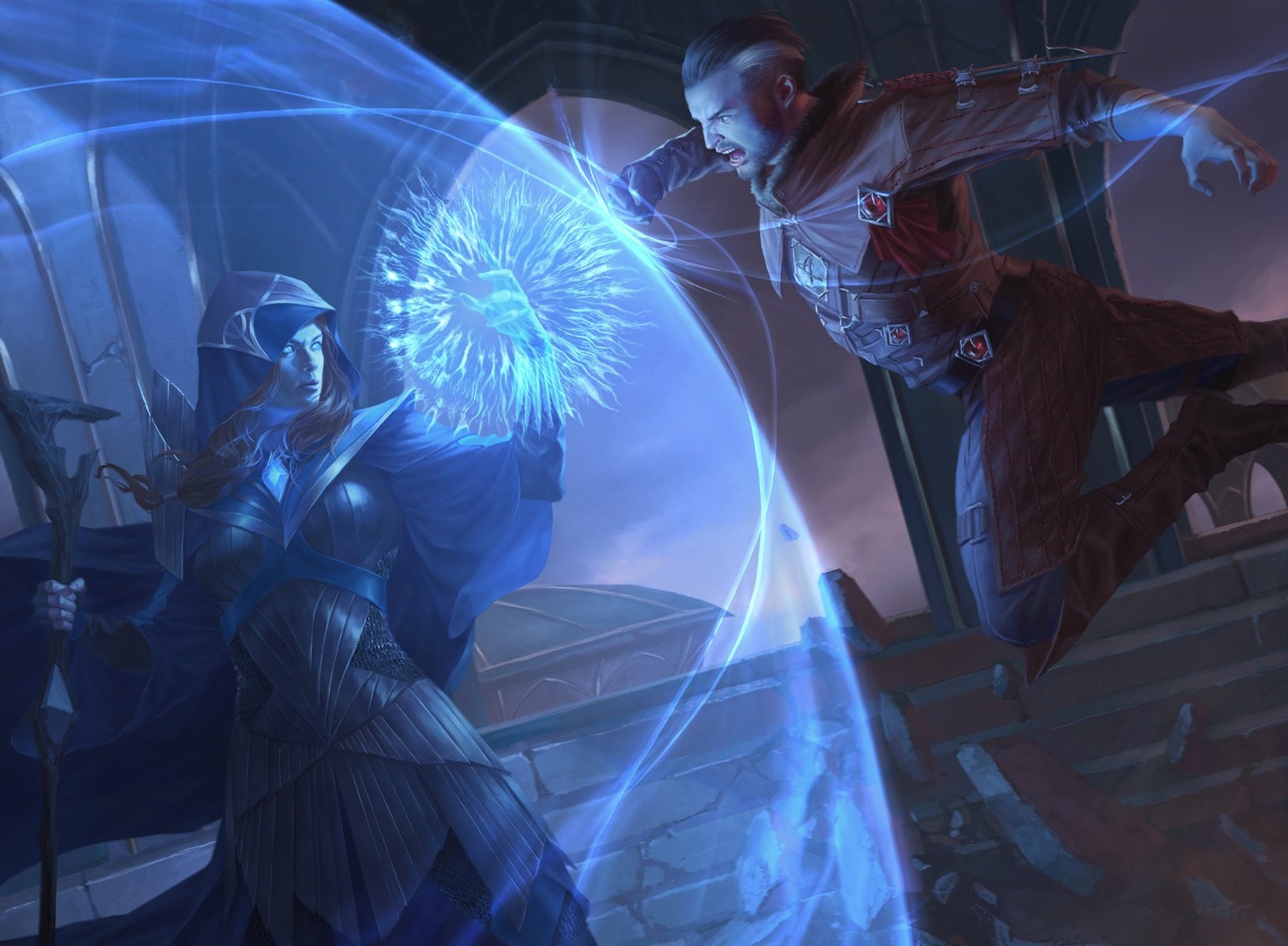
As a reaction to a creature taking damage within 30 feet of you, you can reduce the damage dealt to them by 1d6. At 3rd level, you can also increase the damage reduced by spending arcane points. The amount of damage reduced increases by an additional d6 per arcane point spent. The maximum arcane points you can spend at once equals your Intelligence modifier (minimum of one additional die). Roll the dice, add them together, and reduce the damage dealt to the target allied creature. Immediately after absorbing damage, the spell shield fades.
At 7th level, your spell shield die size increases to a d8; at 11th level, it increases to a d10; and at 15th level, it increases to a d12.
Shoulder Their Burdens
Guardians do not just defend against damage but other detrimental effects as well. At 7th level, when an allied creature is under the effects of a hostile spell or other magical effect, you can use an action to draw the effect from your ally, ending it, and placing it upon yourself. You make any saving throws associated with the spell or effect as if it had just occurred, and the duration of the spell or effect is reset. You can only remove one hostile spell or effect at a time. You can use this feature a number of times equal to your Intelligence modifier, and you regain all uses at the end of a long rest.
Greater Spell Shield
At 11th level, you have trained to enhance your protective capabilities even further. When you use your spell shield feature, you can now target an ally within 60 feet of you.
Additionally when you roll a 1 or a 2 on your spell shield die, you can reroll the die and must use the new roll, even if the new roll is a 1 or a 2.
Shielding Aura
At 15th level, your spell shield has become second nature. Whenever an allied creature within 10 feet of you takes damage, you can reduce the damage dealt to them by 1d12 without using your reaction.
Sword Saint
Sword saints are mage knights who have chosen to focus on perfecting the art of a single weapon. They spend years honing their skills and magic to a razor's edge, forgoing armor in favor of robes and defensive magic.
Saint's Style
Those who become sword saints choose one of two styles upon their path to martial and magical perfection: the swift, deadly River Style or the deliberate, obdurate Mountain Style. They also pick a single weapon type to specialize in, called a chosen weapon. When you gain this feature at 2nd level, select one type of weapon to become your chosen weapon, which can be used as an arcane focus. You also select one of the styles listed below, which grants you benefits while you wield your chosen weapon and are wearing no armor.
River Style
As a follower of the River Style, when you use your chosen weapon type and are unarmored, you can add your Dexterity modifier, instead of your Strength modifier, to the attack and damage rolls when you attack with this type of melee weapon, even if it lacks the finesse property.
You also learn to weave a veil of protective energy around yourself, while you are wearing no armor and wield your chosen weapon, your AC equals 10 + your Dexterity modifier + your Intelligence modifier. You cannot use a shield and still benefit from this feature.

Mountain Style
As a follower of the Mountain Style, you have learned to channel your physical strength into focused moments to dodge incoming danger and move with uncanny swiftness. While you are unarmored and wield your chosen weapon, when make a Dexterity saving throw or Dexterity (acrobatics check), you can add your Strength modifier, instead of your Dexterity modifier, to the saving throw or check.
You also create a potent layer of magical scales around yourself. While you are wearing no armor and wield your chosen weapon, your AC equals 13 + your Intelligence modifier. You can use a shield and still benefit from this feature.
Sword Saint Techniques
At 3rd level, you learn to apply your latent magic into techniques that further enhance your martial combat capabilities. These techniques use 1 arcane point to create a special die called a saint's die, which is a d6. You can use the saint's die on one of the following sword saint techniques. Unless noted otherwise, you can only use one sword saint technique per turn.
Aftershock. You create a burst of magical energy that flattens your opponent after striking them. When you hit a creature with a weapon attack, you can expend one saint's die to attempt to knock the target down. If the target is Large or smaller, it must make a Strength saving throw against your spell save DC. On a failed save, you knock the target prone.
Flowing Strike (River Style only). You propel yourself forward using a tide of magical energy and momentum. When you make a melee weapon attack on your turn, you can expend one saint's die. If you hit, you add the saint's die to the attack's damage roll, and you move 10 feet in a direction of your choice. This movement does not provoke an opportunity attack from the target creature, but other creatures within range can make opportunity attacks.
Overwhelming Blow (Mountain Style only). You can use your magical prowess to blow through a target's defenses. When you make a weapon attack roll against a creature, you can expend one saint's die to add it to the roll. You can use this technique before or after making the attack roll, but before any effects of the attack are applied.
Wave Strike. You lash out with your chosen weapon and create a blade of magical energy that flows out in a wave towards the target. When you make a melee weapon attack on your turn, you can expend one saint's die to increase your reach for that attack by 15 feet. If you hit, you replace the damage type with force damage, and you add the saint's die to the attack's damage roll. You can use this technique more than once per turn, if you have not used any other techniques besides wave strike.
Saint Saber
By 7th level, you can extend your natural magical energies into your chosen weapon and gain the following benefits:
Magical Chosen Weapons. Your attacks with your chosen weapon type counts as magical for the purpose of overcoming resistance and immunity to nonmagical attacks and damage.
Honed Weapon As a bonus action, you can expend up to 3 arcane points to grant one chosen weapon you touch a bonus to attack and damage rolls when you attack with it. The bonus equals the number of arcane points you spent. This bonus lasts for 1 minute or until you use this feature again. This feature has no effect on a magic weapon that already has a bonus to attack and damage rolls.
Improved Techniques
At 11th level, your saint's dice turn into d8s.
Additionally, once per short or long rest, you can use a sword saint technique without expending arcane points.
Extra Attack (2)
Beginning at 15th level, you can attack three times, instead of twice, whenever you take the Attack action on your turn.


Cantrips (0 Level)
- Acid Splash
- Blade Ward
- Booming Blade
- Control Flames
- Dancing Lights
- Fire Bolt
- Friends
- Green-Flame Blade
- Light
- Lightning Lure
- Mage Hand
- Mending
- Message
- Minor Illusion
- Poison Spray
- Prestidigitation
- Ray of Frost
- Shocking Grasp
- True Strike
1st Level
- Absorb Elements
- Binding Blade Mage Knight
- Burning Hands
- Chromatic Orb
- Detect Magic
- Disguise Self
- Expeditious Retreat
- False Life
- Feather Fall
- Ice Knife
- Jump
- Longstrider
- Magic Missile
- Shield
- Silent Image
- Sleep
2nd Level
- Aganazzar's Scorcher
- Blur
- Darkness
- Darkvision
- Earthbind
- Enlarge/Reduce
- Flaming Sphere
- Levitate
- Magic Armor Mage Knight
- Magic Weapon
- Melf's Acid Arrow
- Misty Step
- Ray of Enfeeblement
- Shadow Blade
- Spider Climb
- Web
3rd Level
- Bestow Curse
- Blink
- Counterspell
- Dispel Magic
- Icicle Swarm Mage Knight
- Elemental Weapon
- Erupting Earth
- Fireball
- Flame Arrows
- Haste
- Life Transference
- Lightning Bolt
- Magic Circle
- Remove Curse
- Slow
- Stinking Cloud
- Tidal Wave
- Vampiric Touch
4th Level
- Banishment
- Confusion
- Control Water
- Dimension Door
- Fire Shield
- Otiluke's Resilient Sphere
- Polymorph
- Streen's Emerald Lance Mage Knight
- Storm Sphere
- Wall of Fire
- Watery Sphere
5th Level
- Cloudkill
- Contagion
- Dream
- Earth Storm
- Enervation
- Far Step
- Geas
- Immolation
- Scrying
- Steel Wind Strike
- Telekinesis
- Wall of Force
6th level
- Blade Barrier
- Blood of the Earth Mage Knight
- Chain Lightning
- Disintegrate
- Investiture of Flame
- Investiture of Ice
- Investiture of Stone
- Investiture of Wind
- Tenser's Transformation
- True Seeing
- Wall of Ice
7th level
- Crown of Stars
- Delayed Blast Fireball
- Mordenkainen's Sword
- Power Word Pain
- Project Image
- Streen's Sword Dance Mage Knight
- Teleport
Custom Spells
Appendix A: Unique Mage Knight Spells
Binding Blade
1st-Level conjuration
- Casting Time: 1 bonus action
- Range: Self
- Components: V, M (a melee weapon)
- Duration: Concentration, up to 1 minute
The next time you hit a creature with a weapon attack before this spell ends, your weapon creates spectral chains that attempt to hold it. The target creature must succeed on a Strength saving throw, or their movement speed is reduced to 0 until the end of their next turn.
Blood of the Earth
6th-level conjuration
- Casting Time: 1 action
- Range: 150 feet
- Components: V, S, M (a piece of obsidian)
- Duration: 1 minute
You reach forth and draw magma from the depths of the earth, creating a wall of lava 100 feet long, 50 feet high, and 5 feet wide. The wall is opaque and is difficult terrain.
When the lava appears, each creature within its area must make a Dexterity saving throw. On a failed save, a creature takes 8d10 fire damage, or half as much damage on a successful save. Any creature that enters the wall or ends its turn inside it takes 8d10 fire damage. Any creature that first enters within 10 feet of the wall or ends its turn within 10 feet of it takes 4d10 fire damage. At the end of each of your turns, the wall's height is reduced by 5 feet.
This spell automatically fails if you are on ground that does not have magma below it, such as a floating island on the air elemental plane. However, once the spell has taken effect, it cannot be dispelled as the lava was only brought there by magic.
Higher Levels. When you cast this spell using a spell slot of 7th level or higher, the fire damage increases by 1d10 for each slot level above 6th.
Icicle Swarm
3rd-level evocation
- Casting Time: 1 action
- Range: Self (15-foot radius)
- Components: V, S, M (a wind chime that was dipped in snow)
- Duration: Instantaneous
You draw water from your surroundings and freeze it into thousands of tiny icicles before launching them out in a sphere around you. All other creatures within 15 feet of you, must make a Dexterity Saving throw. On a failed, save they take 8d4 piercing damage and 8d4 cold damage, or half as much on a success.
Magic Armor
2nd-level transmutation
- Casting Time: 1 bonus action
- Range: Touch
- Components: V, S
- Duration: Concentration, up to 1 hour
You touch a suit of nonmagical armor or a nonmagical shield. Until the spell ends, that armor or shield becomes magic with a +1 bonus to AC.
At Higher Levels. When you cast this spell using a spell slot of 4th level or higher, the bonus increases to +2. When you use a spell slot of 6th level or higher, the bonus increases to +3.
Earth Storm
5th-level conjuration
- Casting Time: 1 action
- Range: Self (60-foot cone)
- Components: S, M (a charm in the shape of a pickax)
- Duration: Instantaneous
You stomp your foot upon the ground and cause a wave of earth to erupt in a 60 foot cone. All creatures within the cone must make a Dexterity saving throw or take 6d10 points of bludgeoning damage and are knocked prone. On as success, they take half damage and they are not knocked prone.
Streen's Emerald Lance
4th-level conjuration
- Casting Time: 1 action
- Range: 150 feet
- Components: V, S, M (a charm in the shape of a spear made of mithril with an emerald head, worth 100gp)
- Duration: Instantaneous
You clap your hands together once then draw them apart, creating a long thin spear of unstable green magical energy in your hands. As part of the same action, you hurl it at one creature within range. Make a ranged spell attack against the target. On a hit, the creature takes 3d12 piercing damage. Hit or miss, the lance then explodes. The target and each creature within 10 feet of it must succeed on a Dexterity saving throw or take 4d8 force damage.
Higher Levels. When you cast this spell using a spell slot of 5th level or higher, the force damage increases by 1d8 for each slot level above 4th.
Streen's Sword Dance
7th-Level conjuration
- Casting Time: 1 bonus action
- Range: Self
- Components: V, S, M (a melee weapon worth at least 1 sp)
- Duration: Concentration, up to 1 minute
You flourish the weapon used in the casting and then vanish to strike like the wind. You teleport up to 60 feet to an unoccupied space you can see. If you teleport within 5 feet of a creature, you can make a melee spell attack against the creatur. On a hit, the creature takes 5d10 force damage. On each of your turns before the spell ends, you can use a bonus action to teleport and attack in this way again.
Credits
“The Mage Knight is unofficial Fan Content permitted under the Fan Content Policy. Not approved/endorsed by Wizards. Portions of the materials used are property of Wizards of the Coast. ©Wizards of the Coast LLC.”
Artwork (in order of appearance)
- Vow of Lightning MtG Art by Randy Vargas
- Hofri Ghostforge MtG Art by Daarken
- The Royal Scions MtG Art by Paul Scott Canavan
- Jared Carthalion, True Heir MtG Art by Lius Lasahido
- Test of Talents MtG Art by Lie Setiawan
- Annul MtG Art by Caio Monteiro
- Blade Banish MtG Art by Lie Setiawan