Classifying Shields
Much like armor, shields can potentially be categorized into weight classes of heavy, light, and medium.
Shield Constitution. Shields each have their own Constitution scores, but rather than determine anything like poison immunity or weather tolerance, this form of Constitution determines how easily a shield will break. Each time an attack misses the wearer by a margin equal to the shield's AC modifier, the wearer rolls 1d20. On a result less than or equal to the shield's Constitution score, the wearer (or the DM) rolls 1d8 and consults the Shield Failure table below. Magical shields have advantage on these "Constitution saving throws."
| d8 | Failure Effect |
|---|---|
| 1 | Destruction: The shield shatters into 2d8 pieces or is otherwise rendered unusable until it can be repaired with smith's tools or a mending spell. |
| 2 | Fracture: The shield's integrity is injured. Its AC bonus decreases by 1 (to a minumum of 0) and its Constitution score decreases by 2. |
| 3-4 | Scrape: The shield takes visible but minor damage. Its Constitution score decreases by 1. |
| 5-6 | Safety: The shield holds firm. |
| 7-8 | Knocked Away: The wearer loses grip of the shield, then rolls again on this table to determine any additional effects, rerolling 7s and 8s. |
For example, Bruenor is wearing chain mail and carrying a mundane tower shield, lending him a total AC of 20. If an attack misses him a roll from 16 to 20, he must roll on the shield failure table.
Simplifying Shield Failure
If you or the DM wishes to accelerate combat by minimizing the number of rolls made, the DM can instead ask for a Strength or Dexterity saving throw (depending on the nature of the attack you are deflecting) instead of rolling on the Shield Failure Table. The severity of a failure determines the exact outcome.
Additionally, you can simply nix having to roll on the table for magical shields
Light Shields
Made with only the flimsiest of protection in mind, light shields aim to deflect critical blows away from the wearer when armor won't do the job. They have low Constitution scores and provide a small, flat bonus to AC when worn.
| Shield Type | Cost | AC Buff | Con. | Stealth | Weight |
|---|---|---|---|---|---|
| Patchwork | 2 gp | 1 | 10 | Dis. | 3 lbs. |
| Tanned | 5 gp | 1 | 8 | - | 3 lbs. |
| Wood | 8 gp | 1 | 4 | - | 4 lbs. |
| Studded Wood | 10 gp | 2 | 3 | - | 6 lbs. |
Patchwork Shield
More of a quilt with a handle than a shield, assembled with loose scraps of hide, wood, and fabric. Constitution 10.
Tanned Shield
Made of a tough tanned hide. A favorite of hunters and craftsmen. Constitution 8.
Wooden Shield
A very plain and modest wooden shield, usually held together by nails. Not hard to come by at all. Constitution 4.
Studded Wooden Shield
A thoughtfully-designed shield, held together by firm metal studs. Constitution 3.

Medium Shields
Much better suited to taking blows, medium shields are more commonplace amongst proper battlegrounds. While not indestructible by any means, they are compact enough to permit freedom of movement. They provide a maximum Armor Class modifier depending on the wielder's Strength.
| Shield Type | Cost | AC Buff | Con. | Stealth | Weight |
|---|---|---|---|---|---|
| Sheet Metal | 5 gp | 1 + Str modifier (max 1) | 5 | Dis. | 8 lbs. |
| Reinforced Wood | 15 gp | 1 + Str modifier (max 1) | 3 | - | 7 lbs. |
| Scale | 35 gp | 1 + Str modifier (max 2) | 2 | Dis. | 15 lbs. |
Sheet Metal
A plain, thin piece of metal used for defensive purposes, sometimes even in the form of scrap. Constitution 5.
Reinforced Wooden Shield
While the core of this shield is regular wood, it features metal reinforcements throughout. Constitution 3.
Scale
A sturdy wood frame, plated with small metal scales like a fish. Constitution 2.
Heavy Shields
The penultimate form of protection. Heavy shields provide significant AC modifiers and have high Constitution scores, but require a certain degree of Strength to carry. If you do not have a Strength score greater than or equal to a heavy shield's listed value, your movement speed is reduced by 5 feet and your Dexterity score drops by 3.
| Shield Type | Cost | AC Buff | Con. | Stealth | Weight | Str. |
|---|---|---|---|---|---|---|
| Chainlink | 150 gp | 2 | 2 | Dis. | 15 lbs. | - |
| Full Metal | 400 gp | 3 | 1 | - | 25 lbs. | 13 |
| Tower | 1,000 gp | 4 | 1 | Dis. | 35 lbs. | 15 |
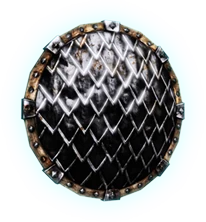
Chainlink Shield
Finely-woven metal rings encompass the outward face of this shield, making it difficult to pierce. Constitution 2.
Full Metal Shield
Made entirely out of solid metal, these shields perfectly balance weight and durability. Constitution 1.
Tower Shield
Carried only by the hardiest of warriors, the wielder of a tower shield can use an action to give themselves total cover if they have not moved on their turn. Remaining behind the shield requires continuous action and movement sacrifice. Constitution 1.
Spiked Shields
Spiked Shields function identically to ordinary shields, but feature a blade either at the center of the plate or along an edge to use for attacking. Unless proficiency with spiked shields is explicitly stated (such as in the Battlerager's case), a character proficient in both martial weapons and either medium or heavy shields is proficient with spiked shields.
Medium spiked shields have a damage roll of 1d4 + Strength modifier. Heavy spiked shields have a damage roll of 2d4 + Strength modifier, both of which dealing either piercing or slashing damage depending on the shape of the shield's spike. Light shields are physically incapable of bearing spikes.
Shield Proficiencies
Martial classes are likely to have proficiency with all shields, while those less focused on physical strength only have select shield proficiencies.
| Class | Shields |
|---|---|
| Artificer | None |
| Barbarian | Light, Medium |
| Bard | None |
| Cleric | Medium, Heavy |
| Druid | Light, Medium (non-metal only) |
| Fighter | All |
| Class | Shields |
|---|---|
| Monk | None |
| Paladin | Medium, Heavy |
| Ranger | Light |
| Rogue | Light |
| Sorcerer | None |
| Wizard | None |
| Warlock | None |
Generally speaking, any feature which would grant proficiency in an armor type (such as a Bard's College of Valor or Wizard's Bladesinging) should also grant shield proficiency of the same weight class and below.

More Shield Feats
All of these feats cumulatively replace the Shield Master feat from the Player's Handbook.
Shield Expert
Prerequisite: Str 13
You've spent considerable time honing your defensive prowess with a new form of shield, learnings the ins and outs of shielded combat. You gain the following benefits:
- Increase your Strength or Dexterity score by 1, to a maximum of 20.
- If you are not proficient with any shields, you gain proficiency with light shields. If you are proficient with any form of shield, you gain proficiency in the shield which is one weight class higher than the heaviest shield you are proficient with.
- Once per short or long rest, you can reroll your shield's Constitution save.
- If you use the Help action to aid an ally's melee attack while you're carrying a shield, you knock the target's shield aside momentarily. In addition to the ally gaining advantage on the attack roll, the ally gains a bonus to the roll equal to the your shield's AC buff if the target is using a shield.
Shield Thrower
Prerequisite: Str or Dex 13, prof. w/ shields
You've learned how to use your shield as an effective, albeit risky, ranged weapon. You gain the following benefits:
- Increase your Strength or Dexterity score by 1, to a maximum of 20.
- You may use your shield as a ranged weapon, with a range of thrown (20/60 ft). If it is a spiked shield, it deals damage equal to its damage roll. If it is a light or non-spiked shield, it deals bludgeoning damage equal to your Strength or Dexterity modifier. If you miss with an attack using your thrown shield, you must roll a Constitution save for the shield. Once you throw your shield, you stop carrying it.
- Whenever you have advantage on an attack roll you make with a shield and hit, the target is stunned for 1 round if the lower of the two d20 rolls would also hit the target.
Light Shield Master
Prerequisite: Prof. w/ light shields
You've trained to make up for your lack of defense with offense by way of your shield. You gain the following benefits while you are wielding a light shield:
- If you take the Attack action on your turn, you can use a bonus action to try to shove a creature within 5 feet of you with your shield.
- If you aren't incapacitated, you can add your shield's AC bonus to any Dexterity saving throw you make against a spell or other harmful effect that targets only you.
- If you are subjected to an effect that allows you to make a Dexterity saving throw to take only half damage, you can use your reaction to take no damage if you succeed on the saving throw, interposing your shield between yourself and the source of the effect.
Medium Shield Master
Prerequisite: Prof. w/ medium shields
You have practiced moving with medium shields to gain the following benefits:
- Wearing a medium shield doesn't impose disadvantage on your Dexterity (Stealth) checks.
- When you wear a medium shield, you can add 3 to your AC if you have a Dexterity of 16 or higher.
Heavy Shield Master
Prerequisite: Prof. w/ heavy shields
You can use your shield to deflect strikes that would kill others. You gain the following benefits:
- Increase your Strength score by 1, to a maximum of 20.
- While you are wearing a heavy shield, bludgeoning, piercing, and slashing damage that you take from nonmagical weapons is reduced by 3.
- All push and pull effects you experience are reduced by 5 feet.
Spiked Shield Master
Prerequisite: Prof. w/ spiked shields
You can wield your spiked shield to deadly effectiveness. You gain the following benefits:
- You may roll d6s in place of d4s for damage rolls using your spiked shield.
- Whenever you have disadvantage on a melee attack roll you make with a spiked shield, the target takes damage equal to your Strength modifier (minimum of 0) if the attack misses but the higher of the two d20 rolls would have hit.
