


Table Of Contents
| Topic | Page |
|---|---|
| Part 1 - Creature in your campaign | x |
| The Creature | x |
| Creature - Creature | x |
| Creature - High Creature | x |
| Creature in your Campaign | x |
| Unique Creature | x |
| Class Influences - Monk | x |
| Class Influences - Warlock | x |
| Class Influences - Sorcerer | x |
| Magic Spells | x |
| Magic Items | x |
| Part 2 - The Creature of Location | x |
| Creature in Location - Introduction | x |
| Unique Creature from Location | x |
| Part 3 - Finding The Creature | x |
| Adventure Module | x |
| Part 4 - Epic Variants | x |
| Epic Creature | x |
| Epic High Creature | x |
Welcome
Rolling Stats
Races & Lineages
Backgrounds & Professions
Classes & Subclasses
The Artificer
| Level | Proficiency Bonus | Features | Cantrips Known | Discoveries | Mana Points | Max Spell Level |
|---|---|---|---|---|---|---|
| 1st | +2 | Spellcasting, Mage Tradition | 3 | — | 1 + casting modifier | 1st |
| 2nd | +2 | Mage Tradition Feature | 3 | — | 2 + casting modifier | 1st |
| 3rd | +2 | School of Focus | 3 | — | 4 + casting modifier | 2nd |
| 4th | +2 | ─ | 4 | 1 | 5 + casting modifier | 2nd |
| 5th | +3 | ─ | 4 | 1 | 8 + casting modifier | 3rd |
| 6th | +3 | Mage Tradition Feature | 4 | 1 | 10 + casting modifier | 3rd |
| 7th | +3 | School of Focus Advancement | 4 | 1 | 12 + casting modifier | 4th |
| 8th | +3 | ─ | 4 | 2 | 14 + casting modifier | 4th |
| 9th | +4 | ─ | 4 | 2 | 18 + casting modifier | 5th |
| 10th | +4 | Mage Tradition Feature | 5 | 2 | 21 + casting modifier | 5th |
| 11th | +4 | ─ | 5 | 2 | 24 + casting modifier | 6th |
| 12th | +4 | School of Focus Advancement | 5 | 3 | 24 + casting modifier | 6th |
| 13th | +5 | ─ | 5 | 3 | 27 + casting modifier | 7th |
| 14th | +5 | Mage Tradition Feature | 5 | 3 | 27 + casting modifier | 7th |
| 15th | +5 | ─ | 5 | 3 | 31 + casting modifier | 8th |
| 16th | +5 | ─ | 6 | 4 | 31 + casting modifier | 8th |
| 17th | +6 | School of Focus Advancement | 6 | 4 | 36 + casting modifier | 9th |
| 18th | +6 | Spell Mastery | 6 | 4 | 38 + casting modifier | 9th |
| 19th | +6 | ─ | 6 | 4 | 41 + casting modifier | 9th |
| 20th | +6 | Signature Spell | 6 | 5 | 45 + casting modifier | 10th |
The Bard
| Level | Proficiency Bonus | Features | Cantrips Known | Spells Known | Mana Points | Max Spell Level |
|---|---|---|---|---|---|---|
| 1st | +2 | Bardic Inspiration, Spellcasting | 3 | — | 1 + casting modifier | 1st |
| 2nd | +2 | Jack of All Trades, Song of Rest | 3 | — | 2 + casting modifier | 1st |
| 3rd | +2 | School of Focus | 3 | — | 4 + casting modifier | 2nd |
| 4th | +2 | ─ | 4 | 1 | 5 + casting modifier | 2nd |
| 5th | +3 | ─ | 4 | 1 | 8 + casting modifier | 3rd |
| 6th | +3 | Mage Tradition Feature | 4 | 1 | 10 + casting modifier | 3rd |
| 7th | +3 | School of Focus Advancement | 4 | 1 | 12 + casting modifier | 4th |
| 8th | +3 | ─ | 4 | 2 | 14 + casting modifier | 4th |
| 9th | +4 | ─ | 4 | 2 | 18 + casting modifier | 5th |
| 10th | +4 | Mage Tradition Feature | 5 | 2 | 21 + casting modifier | 5th |
| 11th | +4 | ─ | 5 | 2 | 24 + casting modifier | 6th |
| 12th | +4 | School of Focus Advancement | 5 | 3 | 24 + casting modifier | 6th |
| 13th | +5 | ─ | 5 | 3 | 27 + casting modifier | 7th |
| 14th | +5 | Mage Tradition Feature | 5 | 3 | 27 + casting modifier | 7th |
| 15th | +5 | ─ | 5 | 3 | 31 + casting modifier | 8th |
| 16th | +5 | ─ | 6 | 4 | 31 + casting modifier | 8th |
| 17th | +6 | School of Focus Advancement | 6 | 4 | 36 + casting modifier | 9th |
| 18th | +6 | Spell Mastery | 6 | 4 | 38 + casting modifier | 9th |
| 19th | +6 | ─ | 6 | 4 | 41 + casting modifier | 9th |
| 20th | +6 | Signature Spell | 6 | 5 | 45 + casting modifier | 9th |
Bard Features
As a Bard, you gain the following class features
Hit Points
- Hit Dice: 1d6 per bard level
- Hit Points at 1st Level: 6 + racial bonus
- Hit Points at Higher Levels: d6 each level or 4
Combat Stamina
- Combat Stamina at 1st level: 4 + constitution modifier
- Combat Stamina at Higher levels: 1d4 + constitution modifier
Proficiencies
- Armor: light armor
- Weapons: simple weapons, hand crossbows, longswords, rapiers, shortswords
- Tools: three musical instruments of your choice
- Saving Throws: Dexterity, Charisma
- Skills: Choose any 3 skills
Equipment
You start with the following equipment, in addition to the equipment granted by your background:
- (a) a Rapier, (b) a Longsword, or (c) any simple weapon
- (a) a Diplomat's Pack or (b) an Entertainer's Pack
- (a) a lute or (b) any other musical instrument
- Leather Armor, and a Dagger
Bardic Inspiration
You can inspire others through stirring words or music. You gain a Bardic Action that can use once per round outside your normal three actions on Your Turn to choose one creature other than yourself within 60 feet of you who can hear you. That creature gains one Bardic Inspiration die, a d6.
Once within the next 10 minutes, the creature can roll the die and add the number rolled to one ability check, Attack roll, or saving throw it makes. The creature can wait until after it rolls The D20 before deciding to use the Bardic Inspiration die, but must decide before the DM says whether the roll succeeds or fails. Once the Bardic Inspiration die is rolled, it is lost. A creature can have only one Bardic Inspiration die at a time.
You can use this feature a number of times equal to your Charisma modifier + your proficiency modifier (a minimum of once). You regain any expended uses when you finish a Long Rest.
Magical Inspiration
At 2nd level you gain an upgrade to Bardic Inspiration.
If a creature has a Bardic Inspiration die from you and casts a spell that restores hit points or deals damage, the creature can roll that die and choose a target affected by the spell. Add the number rolled as a bonus to the hit points regained or the damage dealt. The Bardic Inspiration die is then lost.
Your Bardic Inspiration die changes when you reach certain levels in this class. The die becomes a d8 at 5th Level, a d10 at 10th level, and a d12 at 15th level.
Spellcasting
You have learned to untangle and reshape the fabric of reality in harmony with your wishes and music. Your Spells are part of your vast repertoire, magic that you can tune to different situations.
Cantrips
You know two Cantrips of your choice from the bard spell list. You learn additional bard Cantrips of your choice at higher levels, as shown in the Cantrips Known column of the Bard table.
Spell Slots
The Bard table shows how many Spell Slots you have to cast your Spells of 1st level and higher. To cast one of these Spells, you must expend a slot of the spell's level or higher. You regain all expended Spell Slots when you finish a Long Rest.
For example, if you know the 1st-level spell Cure Wounds and have a 1st-level and a 2nd-level spell slot available, you can cast Cure Wounds using either slot.
Spells Known of 1st level and Higher
You know four 1st-level Spells of your choice from the bard spell list.
The Spells Known column of the Bard table shows when you learn more Bard Spells of your choice. Each of these Spells must be of a level for which you have Spell Slots. For instance, when you reach 3rd Level in this class, you can learn one new spell of 1st or 2nd Level.
Additionally, when you gain a level in this class, you can choose one of the Bard Spells you know and replace it with another spell from the bard spell list, which also must be of a level for which you have Spell Slots.
Spellcasting Ability
Charisma or Intelligence is your Spellcasting Ability for your Bard Spells. Your magic comes from the heart and soul you pour into the Performance of your music or oration. You use your Charisma whenever a spell refers to your Spellcasting Ability. In addition, you use your Charisma modifier when setting the saving throw DC for a bard spell you cast and when Making an Attack roll with one.
Spell save DC = 8 + your Proficiency Bonus + your Charisma or Intelligence modifier
Spell Attack modifier = your Proficiency Bonus + your Charisma modifier
Ritual Casting
You can cast any bard spell you know as a ritual if that spell has the ritual tag.
Spellcasting Focus
You can use a musical instrument (see "Equipment") as a Spellcasting Focus for your Bard Spells.
Spell Versatility
1st-level bard feature (enhances Spellcasting)
Whenever you finish a long rest, you can replace one spell you learned from this Spellcasting feature with another spell from the bard spell list. The new spell must be the same level as the spell you replace.
Jack of All Trades
Starting at 2nd Level, you can add half your Proficiency Bonus, rounded down, to any ability check you make that doesn't already include your Proficiency Bonus.
Song of Rest
Beginning at 2nd Level, you can use soothing music or oration to help Revitalize your wounded allies during a Short Rest. If you or any friendly creatures who can hear your Performance regain Hit Points by spending Hit Dice at the end of the Short Rest, each of those creatures regains an extra 1d6 Hit Points.
The extra Hit Points increase when you reach certain levels in this class: to 1d8 at 9th level, to 1d10 at 13th level, and to 1d12 at 17th level.
Also any spellcasters who spend a hit die during this short rest also gain mana equal to half the roll on the extra dice.
Bard College
At 3rd Level, you delve into the advanced Techniques of a Bard College of your choice, such as the College of Lore. Your choice grants you features at 3rd Level and again at 6th and 14th level.
Expertise
At 3rd Level, choose two of your skill Proficiencies. Your Proficiency Bonus is doubled for any ability check you make that uses either of the chosen Proficiencies.
At 10th level, you can choose another two skill Proficiencies to gain this benefit.
Font of Inspiration
Beginning when you reach 5th Level, you regain all of your expended uses of Bardic Inspiration when you finish a short or Long Rest.
Countercharm
At 6th level, you gain the ability to use musical notes or words of power to disrupt mind-influencing Effects. As an action, you can start a Performance that lasts until the end of your next turn. During that time, you and any friendly creatures within 30 feet of you have advantage on Saving Throws against being Frightened or Charmed. A creature must be able to hear you to gain this benefit. The Performance ends early if you are Incapacitated or silenced or if you voluntarily end it (no action required).
Magical Secrets
By 10th level, you have plundered magical knowledge from a wide spectrum of disciplines. Choose two Spells from any class, including this one. A spell you choose must be of a level you can cast, as shown on the Bard table, or a cantrip.
The chosen Spells count as Bard Spells for you and are included in the number in the Spells Known column of the Bard table.
You learn two additional Spells from any class at 14th level and again at 18th level.
Superior Inspiration
At 20th level, when you roll Initiative and have no uses of Bardic Inspiration left, you regain one use.
The Druid
| Level | Proficiency Bonus | Features | Cantrips Known | Discoveries | Mana Points | Max Spell Level |
|---|---|---|---|---|---|---|
| 1st | +2 | Spellcasting, Mage Tradition | 3 | — | 1 + casting modifier | 1st |
| 2nd | +2 | Mage Tradition Feature | 3 | — | 2 + casting modifier | 1st |
| 3rd | +2 | School of Focus | 3 | — | 4 + casting modifier | 2nd |
| 4th | +2 | ─ | 4 | 1 | 5 + casting modifier | 2nd |
| 5th | +3 | ─ | 4 | 1 | 8 + casting modifier | 3rd |
| 6th | +3 | Mage Tradition Feature | 4 | 1 | 10 + casting modifier | 3rd |
| 7th | +3 | School of Focus Advancement | 4 | 1 | 12 + casting modifier | 4th |
| 8th | +3 | ─ | 4 | 2 | 14 + casting modifier | 4th |
| 9th | +4 | ─ | 4 | 2 | 18 + casting modifier | 5th |
| 10th | +4 | Mage Tradition Feature | 5 | 2 | 21 + casting modifier | 5th |
| 11th | +4 | ─ | 5 | 2 | 24 + casting modifier | 6th |
| 12th | +4 | School of Focus Advancement | 5 | 3 | 24 + casting modifier | 6th |
| 13th | +5 | ─ | 5 | 3 | 27 + casting modifier | 7th |
| 14th | +5 | Mage Tradition Feature | 5 | 3 | 27 + casting modifier | 7th |
| 15th | +5 | ─ | 5 | 3 | 31 + casting modifier | 8th |
| 16th | +5 | ─ | 6 | 4 | 31 + casting modifier | 8th |
| 17th | +6 | School of Focus Advancement | 6 | 4 | 36 + casting modifier | 9th |
| 18th | +6 | Spell Mastery | 6 | 4 | 38 + casting modifier | 9th |
| 19th | +6 | ─ | 6 | 4 | 41 + casting modifier | 9th |
| 20th | +6 | Signature Spell | 6 | 5 | 45 + casting modifier | 10th |
The Guardian
| Level | Proficiency Bonus | Features | Cantrips Known | Discoveries | Mana Points | Max Spell Level |
|---|---|---|---|---|---|---|
| 1st | +2 | Spellcasting, Mage Tradition | 3 | — | 1 + casting modifier | 1st |
| 2nd | +2 | Mage Tradition Feature | 3 | — | 2 + casting modifier | 1st |
| 3rd | +2 | School of Focus | 3 | — | 4 + casting modifier | 2nd |
| 4th | +2 | ─ | 4 | 1 | 5 + casting modifier | 2nd |
| 5th | +3 | ─ | 4 | 1 | 8 + casting modifier | 3rd |
| 6th | +3 | Mage Tradition Feature | 4 | 1 | 10 + casting modifier | 3rd |
| 7th | +3 | School of Focus Advancement | 4 | 1 | 12 + casting modifier | 4th |
| 8th | +3 | ─ | 4 | 2 | 14 + casting modifier | 4th |
| 9th | +4 | ─ | 4 | 2 | 18 + casting modifier | 5th |
| 10th | +4 | Mage Tradition Feature | 5 | 2 | 21 + casting modifier | 5th |
| 11th | +4 | ─ | 5 | 2 | 24 + casting modifier | 6th |
| 12th | +4 | School of Focus Advancement | 5 | 3 | 24 + casting modifier | 6th |
| 13th | +5 | ─ | 5 | 3 | 27 + casting modifier | 7th |
| 14th | +5 | Mage Tradition Feature | 5 | 3 | 27 + casting modifier | 7th |
| 15th | +5 | ─ | 5 | 3 | 31 + casting modifier | 8th |
| 16th | +5 | ─ | 6 | 4 | 31 + casting modifier | 8th |
| 17th | +6 | School of Focus Advancement | 6 | 4 | 36 + casting modifier | 9th |
| 18th | +6 | Spell Mastery | 6 | 4 | 38 + casting modifier | 9th |
| 19th | +6 | ─ | 6 | 4 | 41 + casting modifier | 9th |
| 20th | +6 | Signature Spell | 6 | 5 | 45 + casting modifier | 10th |
The Invoker
| Level | Proficiency Bonus | Features | Cantrips Known | Invocations | Mana Points |
|---|---|---|---|---|---|
| 1st | +2 | Pact Magic, Pact Boon | 2 | — | — |
| 2nd | +2 | Invocations | 2 | 2 | 1 + casting modifier |
| 3rd | +2 | Patron, Pact Boon Upgrade | 2 | 3 | 1 + casting modifier |
| 4th | +2 | ─ | 3 | 3 | 3 + casting modifier |
| 5th | +3 | ─ | 4 | 4 | 3 + casting modifier |
| 6th | +3 | Mage Tradition Feature | 3 | 4 | 5 + casting modifier |
| 7th | +3 | School of Focus Advancement | 3 | 5 | 5 + casting modifier |
| 8th | +3 | ─ | 3 | 5 | 7 + casting modifier |
| 9th | +4 | ─ | 4 | 6 | 7 + casting modifier |
| 10th | +4 | Mage Tradition Feature | 4 | 6 | 9 + casting modifier |
| 11th | +4 | ─ | 4 | 7 | 9 + casting modifier |
| 12th | +4 | School of Focus Advancement | 4 | 8 | 11 + casting modifier |
| 13th | +5 | ─ | 4 | 8 | 11 + casting modifier |
| 14th | +5 | Mage Tradition Feature | 4 | 9 | 13 + casting modifier |
| 15th | +5 | ─ | 5 | 9 | 13 + casting modifier |
| 16th | +5 | ─ | 5 | 10 | 15 + casting modifier |
| 17th | +6 | School of Focus Advancement | 5 | 10 | 15 + casting modifier |
| 18th | +6 | Spell Mastery | 5 | 11 | 19 + casting modifier |
| 19th | +6 | ─ | 5 | 11 | 19 + casting modifier |
| 20th | +6 | Signature Spell | 5 | 12 | 21 + casting modifier |
The Keeper
| Level | Proficiency Bonus | Features | Cantrips Known | Discoveries | Mana Points | Max Spell Level |
|---|---|---|---|---|---|---|
| 1st | +2 | Spellcasting, Mage Tradition | 3 | — | 1 + casting modifier | 1st |
| 2nd | +2 | Mage Tradition Feature | 3 | — | 2 + casting modifier | 1st |
| 3rd | +2 | School of Focus | 3 | — | 4 + casting modifier | 2nd |
| 4th | +2 | ─ | 4 | 1 | 5 + casting modifier | 2nd |
| 5th | +3 | ─ | 4 | 1 | 8 + casting modifier | 3rd |
| 6th | +3 | Mage Tradition Feature | 4 | 1 | 10 + casting modifier | 3rd |
| 7th | +3 | School of Focus Advancement | 4 | 1 | 12 + casting modifier | 4th |
| 8th | +3 | ─ | 4 | 2 | 14 + casting modifier | 4th |
| 9th | +4 | ─ | 4 | 2 | 18 + casting modifier | 5th |
| 10th | +4 | Mage Tradition Feature | 5 | 2 | 21 + casting modifier | 5th |
| 11th | +4 | ─ | 5 | 2 | 24 + casting modifier | 6th |
| 12th | +4 | School of Focus Advancement | 5 | 3 | 24 + casting modifier | 6th |
| 13th | +5 | ─ | 5 | 3 | 27 + casting modifier | 7th |
| 14th | +5 | Mage Tradition Feature | 5 | 3 | 27 + casting modifier | 7th |
| 15th | +5 | ─ | 5 | 3 | 31 + casting modifier | 8th |
| 16th | +5 | ─ | 6 | 4 | 31 + casting modifier | 8th |
| 17th | +6 | School of Focus Advancement | 6 | 4 | 36 + casting modifier | 9th |
| 18th | +6 | Spell Mastery | 6 | 4 | 38 + casting modifier | 9th |
| 19th | +6 | ─ | 6 | 4 | 41 + casting modifier | 9th |
| 20th | +6 | Signature Spell | 6 | 5 | 45 + casting modifier | 10th |
The Mage
| Level | Proficiency Bonus | Features | Cantrips Known | Discoveries | Mana Points | Max Spell Level |
|---|---|---|---|---|---|---|
| 1st | +2 | Spellcasting, Mage Tradition | 3 | — | 1 + casting modifier | 1st |
| 2nd | +2 | Mage Tradition Feature | 3 | — | 2 + casting modifier | 1st |
| 3rd | +2 | School of Focus | 3 | — | 4 + casting modifier | 2nd |
| 4th | +2 | ─ | 4 | 1 | 5 + casting modifier | 2nd |
| 5th | +3 | ─ | 4 | 1 | 8 + casting modifier | 3rd |
| 6th | +3 | Mage Tradition Feature | 4 | 1 | 10 + casting modifier | 3rd |
| 7th | +3 | — | 4 | 1 | 12 + casting modifier | 4th |
| 8th | +3 | ─ | 4 | 2 | 14 + casting modifier | 4th |
| 9th | +4 | ─ | 4 | 2 | 18 + casting modifier | 5th |
| 10th | +4 | Mage Tradition Feature | 5 | 2 | 21 + casting modifier | 5th |
| 11th | +4 | ─ | 5 | 2 | 24 + casting modifier | 6th |
| 12th | +4 | — | 5 | 3 | 24 + casting modifier | 6th |
| 13th | +5 | ─ | 5 | 3 | 27 + casting modifier | 7th |
| 14th | +5 | Mage Tradition Feature | 5 | 3 | 27 + casting modifier | 7th |
| 15th | +5 | ─ | 5 | 3 | 31 + casting modifier | 8th |
| 16th | +5 | ─ | 6 | 4 | 31 + casting modifier | 8th |
| 17th | +6 | — | 6 | 4 | 36 + casting modifier | 9th |
| 18th | +6 | Cantrip Mastery | 6 | 4 | 38 + casting modifier | 9th |
| 19th | +6 | ─ | 6 | 4 | 41 + casting modifier | 9th |
| 20th | +6 | Signature Spell | 6 | 5 | 45 + casting modifier | 10th |
Spellcasting
As a student of arcane magic, you have a spellbook containing spells that show the first glimmerings of your true power.
Cantrips
At 1st level, you know three cantrips of your choice from the Mage spell list. You learn additional Mage cantrips of your choice at higher levels, as shown in the Cantrips Known column of the Mage table.
Spellbook
At 1st level, you have a spellbook containing six 1st- level Mage spells of your choice. Your spellbook is the repository of the Mage spells you know, except your cantrips, which are fixed in your mind.
Preparing and Casting Spells
Table: The Mage shows how many Mana Points you have to cast your spells of 1st level and higher. To cast one of these spells, you must expend Mana of the spell’s level or higher, see the rules for casting with mana on pg.() . You regain all expended Mana when you finish a long rest.
You prepare the list of Mage spells that are available for you to cast. To do so, choose a number of Mage spells from your spellbook equal to your Intelligence modifier + your Mage level (minimum of one spell). The spells must be of a level for which you have spell slots.
For example, if you’re a 3rd-level Mage, you have four 1st-level and two 2nd-level spell slots. With an Intelligence of 16, your list of prepared spells can include six spells of 1st or 2nd level, in any combination, chosen from your spellbook. If you prepare the 1st-level spell magic missile, you can cast it by spending 1 mana or more. Casting the spell doesn’t remove it from your list of prepared spells.
You can change your list of prepared spells when you finish a long rest. Preparing a new list of Mage spells requires time spent studying your spellbook and memorizing the incantations and gestures you must make to cast the spell: at least 1 minute per spell level for each spell on your list. This is called taking the Spell Prep Action and is usually done in the morning or the night before sleeping.
If you have your spellbook out in one hand you can ready one spell page per round no action required allowing you to cast a non readied spell as normal. After the first one it takes an action to ready another page.
Spellcasting Ability
Intelligence is your spellcasting ability for your Mage spells, since you learn your spells through dedicated study and memorization. Some mage traditions have trained to use other parts of their mind to control their magic allowing them to use wisdom or even charisma to cast spells. You use your Intelligence whenever a spell refers to your spellcasting ability. In addition, you use your Intelligence modifier when setting the saving throw DC for a Mage spell you cast and when making an attack roll with one.
Spell save DC = 8 + your proficiency bonus + your Intelligence modifier
Spell attack modifier = your proficiency bonus + your Intelligence modifier
Ritual Casting
You can cast a Mage spell as a ritual if that spell has the ritual tag and you have the spell in your spellbook. You don’t need to have the spell prepared.
Learning Spells of 1st Level and Higher
Each time you gain a Mage level, you can add two Mage spells of your choice to your spellbook for free. Each of these spells must be of your max spell level you can cast or lower, as shown on the Mage table. On your adventures, you might find other spells that you can add to your spellbook (see “Your Spellbook”). A Mage can record spells up to 2 levels above their max spell level. And they can cast these spells up to their max spell level.
Mage Tradition
When you become a mage, you choose a Mage tradition, giving you formidable powers and a set of spells to accompany them. See Traditions and expanded spell list.
Your choice grants you features at 2nd level and again at 6th, 10th, and 14th level.
School of focus
When you reach 3rd level, you choose a School of Focus, shaping your practice of magic through one of eight schools: Abjuration, Conjuration, Divination, Enchantment, Evocation, Illusion, Necromancy, or Transmutation, all detailed at the end of the class description. A Mage can also choose to take an elemental school, sin magic, and even an alternate version of one of the eight origin schools. A mage who does not choose a school becomes a mage of the universalist school.
When a mage chooses a school of focus from the eight arcane schools they must choose two opposition schools gaining benefits for their choice and drawbacks for the two opposition schools.
When a mage chooses an elemental school of focus they must choose and opposition element.
See "Choosing a path" for more info on schools of focus and sin magic.
Your choice grants you features at 3rd level and again at 7th, 12th, and 17th level.
Your Spellbook
The spells that You add to your spellbook as You gain levels reflect the arcane research You conduct on your own, as well as intellectual breakthroughs You have had about the nature of the multiverse. You might find other spells during your adventures. You could discover a spell recorded on a scroll in an evil wizard's chest, for example, or in a dusty tome in an ancient library.
Copying a Spell into the Book. When You find a arcanist spell of 1st level or higher, You can add it to your spellbook if it is of a level for which You have spell slots and if You can spare the time to decipher and copy it. Copying a spell into your spellbook involves reproducing the basic form of the spell, then deciphering the unique system of notation used by the mage who wrote it. You must practice the spell until You understand the sounds or gestures required, then transcribe it into your spellbook using your own notation.
For each level of the spell, the process takes 2 hours and costs 50 gp. The cost represents material components You expend as You experiment with the spell to master it, as well as the fine inks You need to record it. Once You have spent this time and money, You can prepare the spell just like your other spells.
Replacing the Book. You can copy a spell from your own spellbook into another book-for example, if You want to make a backup copy of your spellbook. This is just like copying a new spell into your spellbook, but faster and easier, since You understand your own notation and already know how to cast the spell. You need spend only 1 hour and 10 gp for each level of the copied spell. If You lose your spellbook, You can use the same procedure to transcribe the spells that You have prepared into a new spellbook. Filling out the remainder of your spellbook requires You to find new spells to do so, as normal. For this reason, many mages keep backup spellbooks in a safe place.
The Book's Appearance. Your spellbook is a unique compilation of spells, with its own decorative flourishes and margin notes. It might be a plain, functional leather volume that You received as a gift from your master, a finely bound gold-edged tome you found in an ancient library, or even a loose collection of notes scrounged together.
Cantrip Mastery
At 18th level, you have achieved such mastery over certain spells that you can cast them at will. Choose a 1st-level Mage spell and a 2nd-level Mage spell that are in your spellbook. You can cast those spells at their lowest level without expending any mana when you have them prepared. If you want to cast either spell at a higher level, you must expend mana as normal.
By spending 8 hours in study, you can exchange one or both of the spells you chose for different spells of the same levels.
Signature Spells
When you reach 20th level, you gain mastery over two powerful spells and can cast them with little effort. Choose two 3rd-level mage spells in your spellbook as your signature spells. You always have these spells prepared, they don’t count against the number of spells you have prepared, and you can cast each of them once at 3rd level without expending a spell slot. When you do so, you can’t do so again until you finish a short or long rest.
If you want to cast either spell at a higher level, you must expend mana as normal.
Traditions
Traditions grant you unique abilities at 2nd, 6th, 10th and 14th level. You also gain access to an expanded spell list which are spells you get for free and always have readied.
Tradition of the Black Mage
| Level | Features | Max Aether |
|---|---|---|
| 1st | Expanded Spell List | ─ |
| 2nd | Unstable Aether, Leylines | 2 |
| 6th | Surecaster | 3 |
| 10th | Aetherial Manipulation | 4 |
| 14th | Devastating Force | 5 |
A Dark Past
In days long past, there existed an powerful clan of mages and their arcane art known as black magic—a potent magic of pure destructive force born forth by a sorceress of unparalleled power. Those who learned to wield this instrument of ruin came to be called black mages, out of both fear and respect for their gift. Yet great power served to corrupt the judgment of mortal man, and so he unknowingly set out upon the path of ruin.
Adventurers who take the black will become agents of devastation, capable of annihilating those who oppose them through little more than the force of their will.
Ties to the Void
In order for a mage to don the black, they must extensively research what they call the void. This is another plane of existence from which Black Mages draw knowledge from in order to unlock power within themselves. Most black mages are able to explore the knowledge gained from the void through tomes and texts now, but some who thirst for new power may attempt to tap into the void directly. Black Mages continue to grow within their craft through continuing their study of the dark arts.
Creating a Black Mage
Black Mages are earnest in their desires and reasons for taking the black. More often than not it is in the pursuit of power or out of sheer curiousity. You must know why you are pursuing this power, or why you are curious about the dark arts. You must also decide where you began to dip your toes into the world of black magic. Did you join a cult of mages who studied the art? Perhaps a proper school which provides the proper materials to explore black mage. Maybe you were taken under the wing of a mentor who has mastered the art
Expanded Spell list
Black mages are allowed to use their charisma instead of intelligence
| Spell Level | Spells |
|---|---|
| 1st | Chromatic Orb, Witch Bolt |
| 2nd | Aganazzar's Scorcher, Snilloc's Snowball Swarm |
| 3rd | Call Lighting, Sleet Storm |
| 4th | Ice Storm, Storm Sphere |
| 5th | Cone of Cold, Immolation |
Unstable Aether
When you cast a spell with mana you generate a point of aether for each mana spent but up to your Max Aether found on the Tradition of the Black Mage chart. For each point of Aether you have you gain a static +1 to your spell DC, spell to hit and spell damage rolls. You keep this Aether up to 1 minute after combat.
Leylines
When you cast a spell, the residual mana from your spell temporarily creates a leyline, which can be manipulated with your Aether. If you cast a spell last turn and have not moved or taken any other actions during your current turn, you may spend a number of Aether points equal to that spell's level to cast a spell of the same or lower level. Your turn immediately ends after casting the spell. Spells cast with Aether do no generate Aether.
Surecaster
Beginning at the 6th level, you may expend three Aether to achieve an impregnable state of mind as an action. You pass all concentration checks automatically for the next 10 minutes.
Aetherial Manipulation
Beginning at the 10th level, you are able to more effectively manipulate your Leylines. Your movement is no longer restricted when making use of your Leylines feature. Casting a spell with the effect of Leylines still immediately ends your turn but now you can take actions before using leylines, on the same turn.
Additionally, if you expended any mana during your last turn, as an action, you may spend one mana to magically teleport back to the location you were standing in when you cast the spell if the space is unoccupied.
Devastating Force
Beginning at the 14th level, when you cast a spell, you may spend one Aether to reroll all damage die which resulted in a 1 or 2, also adding your casting stat to the damage of the spell. You must use the resulting rolls. Spells affected by this feature do not generate Aether.
Also when you roll damage for a spell and roll the highest number possible on any of the dice, choose one of those dice, roll it again and add that roll to the damage. This does not affect dice added by this feature.
Tradition of the White Mage
| Level | Features | Max Confession |
|---|---|---|
| 1st | Divine Study, Confession | 1 |
| 2nd | Minor Blessings | 2 |
| 6th | Nymian Healer | 3 |
| 10th | Adloquiem | 4 |
| 14th | Nymian Savior | 5 |
One with the land
White Mage's strength stems from an art they refer to as conjury. Conjury calls upon the elements of earth, wind, and water and concentrates them to a potency at which spells can be weaved. Through practiced meditation on the essences of creation, conjurers draw forth and absorb magic from their immediate surroundings. Versed also in magicks that restore and strengthen, White Mages are regarded as accomplished healers.
Patrons of Light
White Mages find their roots in a society which revered nature as an ally, borrowing the power of the land and elementals to soothe wounds and protect from the wicked.
Over time, the White Mages of the past overused this power causing the elementals to act out and smite the land, alongside the damage wrought by the opposing Black Mages, the world fell into a dark age. Today White Mages are few and far between, practicing the forbidden art to wield the powers of nature and light to drive off evil in protection of the world again.
Creating a White Mage
When creating a White Mage one must question how they came into the art of conjury and the profession of White Mage. Did a kindly mentor take you under their wing? Did your studies of magic from the past lead you to discovering how to draw power from the world you lived in? Perhaps the elementals which inhabit the land reached out to you and their whispers guided you to the path of a White Mage. Nonetheless a White Mage's role in the world is that of a protector, soothing the wounds of those who need it most, settling enraged elementals and driving the beings who bring destruction back from hence they came.
Divine Study
White mages are allowed to ready any orisons (cleric spells) as part of their daily spells prepared as long as they are of a level to do so. You can have no more than your proficiency modifier in orisons readied in this way. To cast any of these spells they must have a charge of confession or take the prayer action as part of casting the spell. White mages can use wisdom instead of intelligence as their casting modifier.
Confession
Beginning at 1st level, you gain the action "Prayer". When you use "Prayer" you gain a charge of Confession. When you use prayer while you already have a charge of confession, you double the number of charges you currently have, then gain 1 more charge.
You may hold a number of confession charges based on the white mage chart. You must be in combat to use prayer, your confession charges fade away after spending 1 minute outside of combat. You may spend confession to cast blessings. You can not use blessings out of combat.
As long as you have one of charge of confession you can use your mana to cast an Orison. You can cast Orison's out of combat by taking the prayer action within one round of casting the Orison.
Minor Blessings
Afflatus Blessing of Nature:
| Charges Spent | Effect |
|---|---|
| 1 | The damage type of the weapon changes to cold, radiant or thunder. |
| 2 | The weapon gains a +1 bonus on attack rolls. |
| 3 | The weapon's damage rolls deal bonus damage equal to your proficiency bonus. |
Afflatus Blessing of Nature:
Beginning at the 2nd level, as an action you may expend Confession charges to bless weapons with elemental power for a number of rounds equal to your casting modifier. The number of charges you spend increase the effectiveness of your blessing. You gain each blessing below the tier you use.
Afflatus Blessing of Solace:
Beginning at the 2nd level, as an action you may spend any number of your confession charges. You heal a creature within 30ft. of you for #d4 + your proficiency bonus, where # is equal to the charges of confession spent.
Your Prayer action cannot have been used before or after using Afflatus Solace on your turn. The target creature must have more than 0 hit points.
Afflatus Blessing of Misery:
Beginning at the 2nd level, as an action you may spend any number of confession charges to make a ranged spell attack against a creature within 60ft. of you. Your attack deals 1d6 + your proficiency bonus radiant damage for each confession charge spent.
Nymian Healer
At 6th level you gain the ability to improve your healing capabilities. When ever you cast a healing spell of 1st lvl or higher you also heal for additional hit points equal to your proficiency + mana spent.
Also your healing spells have the potential to cause a critical heal. When you cast a healing spell and one of the die results in its highest possible result. Roll another die of the same value and add that number to the amount of hit points recovered. A critical heal may only occur once per healing spell.
Adloquiem
Starting at the 10th level, when you cast a spell of 1st level or higher to restore hit points to a creature, you may expend one charge of confession. Your healing spell creates a protective ward on the creature, granting them temporary hit points equal to the hit points recovered for 10 minutes. If a critical heal occurred, the target gains additional temporary hit points equal to half of the amount of hit points recovered.
Nymian Savior
Starting at the 14th level, when you cast a healing spell which will not grant temporary hit points, that creature gains 1d10 temporary hitpoints.
Tradition of the Red Mage
| Level | Features | Max Flair |
|---|---|---|
| 1st | Expanded Spell List | 3 |
| 2nd | Flair Points, Flair Techniques | 5 |
| 6th | Heroic Flair | 7 |
| 10th | Heroic Flair Techniques | 9 |
| 14th | Flair Mastery | 11 |
Crimson Mage
Some fairy tales of Gyr Abania speak of the heroic deeds and daring adventures of mages clothed in crimson. These adventurers are known as Red Mages, and travel the world protecting the good in the world by drawing on both white and black magic, while mixing martial prowess into a flawless battle style.
Its Not About Fame
Their thirst for adventure, flashy style and renowned flair may lead many to believe that a Red Mage becomes an adventurer for the admiration of their fellow man, but that is not the case. Those who take the Red do so in order to take up arms to protect the good in the world and bring wrongdoers to justice. It is their heroic spirit which drives them to action, the garnered fame is just a perk.
Creating a Red Mage
When creating a Red Mage, you must consider why they may be heading out on their adventure. Did they become fed up with the oppressive nature of the world and seek the need to become a hero to the common man? They may have learned of a plot which endangers their home, perhaps the world as a whole and will stop at nothing to end it. Maybe it is simply a need to chase the thrill of adventure and become a hero of legend.
One key consideration to make as a Red Mage is where you came to learn your myriad of skills. Was it through the study of old tomes you discovered in an abandoned warehouse or library? Did you meet a mentor who saw great potential in you and introduced you to the art? Whatever the origin, you wield powerful skills with an artistic flair. Red mages may use their charisma instead of intelligence for mage features and casting spells.
Expanded Spell list
| Spell Level | Spells |
|---|---|
| 1st | Zephyr Strike, Dissonant Whispers |
| 2nd | Shadow Blade, Warding Wind |
| 3rd | Haste, Thunder Step |
| 4th | Fire Shield, Dimension Door |
| 5th | Animate Objects, Flame Strike |
Flair Points
At 2nd level, you gain access to Flair Points. Certain Red Mage abilities require you to spend flair points from your pool. All expended flair points are recovered after a short or long rest.
At 5th level, as long as you have one flair point you can take the Multi-Attack (1) Action once per round.
Flair Techniques
Manafication: At 2nd level, as an action you may spend a number of flair points equal to twice the level of a spell you wish to cast, in place of spending mana.
Corps-a-corps: At 2nd level, you have mastered the art of approaching a foe with lightning speed and dilevering a powerful strike. To perform Corps-la-corps you spend 1 flair point and select one target within 30ft. of you. You move in a straight line towards that target, stopping at the first creature you encounter in your path. This movement does not provoke attacks of opportunity. You take the attack action against the target, dealing a bonus 1d8 piercing damage if your attack lands.
Dazzling Diversion: At 2nd level, you have learned to mix magic with your movements to pull the attention of an enemy, allowing your allies to strike. As an action you may spend 2 flair points to distract a target in melee within 5ft. of yourself. All melee weapon attacks performed by your allies against the target gain advantage until your next turn.
Dual Cast: At 2nd level, when you cast a spell that has a casting time of 1 to 2 actions, you can spend 2 flair point to cast a second spell as part of the same action(s). You may not do so with a spell greater than 4th level.
Heroic Flair
Charmed I'm Sure: At 6th level, the trace amounts of magic in your body influence those you come into contact with. You may spend a flair point to gain advantage on a charisma, wisdom or intelligence ability check.
In Good Company: At 6th level, you may spend 1 flair point to tutor your ally in the art of appealing to others. One ally may add your Spellcasting ability modifier to their charisma ability checks for up to 5 minutes. You may only use this once before requiring a short rest.
Heroic Luck: At 6th level, your renaissance man nature has given you an edge in conversation. You may spend 2 flair point to reroll one intelligence, wisdom or charisma save.
Advanced Flair Techniques
Displacement: At 10th level, you have learned to flow between martial and magic combat effortlessly. By spending 1 flair point after taking the attack action you leap backwards through the air, landing upto 30ft. in a straight line behind you. You are considered to travel over the heads of medium creatures or smaller, but your travel is stopped by creatures larger than this. This movement does not provoke attacks of opportunity. When you take this action, make a ranged spell attack against the target of your attack action, dealing 2d8 + your Charisma modifier force damage on hit.
Embolden: At 10th level, you have learned to fill your allies with fervor using your natural appeal. As an action you may spend 1 flair point to empower all allies within 10ft. of you. Damaging effects from your allies deal an extra 1d8 damage until the end of your next turn.
Quicksilver Casting: At 10th level, if you deal damage to a target with a cantrip, you may spend one flair point to gain advantage on a ranged spell attack against the target or cause the target to make dexterity saving throws against your spells with disadvantage until the end of your turn.
Flair Mastery
Enchanted Blade: At 14th level, your magical power seeps into any weapon you hold. After attuning to a one handed weapon for one hour, magical or not, you are able to summon the weapon to your hand as an action. You may spend one flair point to deal an additional 2d8 force damage on each damage roll when you take the attack action with this weapon. You must declare you are doing so prior to your attack roll.
Follow My Lead: At 14th level, as an action you may spend 2 flair points to move an ally who is lower in the initiative order than you up in the order, such that they act directly after you. You may use this effect once before requiring a short rest.
Liquification: At 14th level, as an action you may spend a spell slot of any level to gain a number of flair points equal to twice the spell slot level. You may not gain flair points over your maximum number of points.
Choosing a Path
At 3rd level a mage chooses a school to focus on gaining some minor benefits and the schools principle techniques.
School of Abjuration Focus
The School of Abjuration emphasizes magic that blocks, banishes, or protects. Detractors of this school say that its tradition is about denial, negation rather than positive assertion. You understand, however, that ending harmful effects, protecting the weak, and banishing evil influences is anything but a philosophical void. It is a proud and respected vocation
Called abjurers, members of this school are sought when baleful spirits require exorcism, when important locations must be guarded against magical spying, and when portals to other planes of existence must be closed.
Abjuration Savant
Beginning when you select this school, the gold and time you must spend to copy a Conjuration spell into your spellbook is halved.
Resistance:
You gain resistance to an damage type of your choice, chosen when you prepare spells. This resistance can be changed each day.
Arcane Ward:
When you cast an abjuration spell of 1st level or higher, you can simultaneously use a strand of the spell's magic to create a magical ward on yourself that lasts until you finish a long rest. The ward has hit points equal to twice your mage level + your casting modifier. Whenever you take damage, the ward takes the damage instead. If this damage reduces the ward to 0 hit points, you take any remaining damage.
While the ward has 0 hit points, it can't absorb damage, but its magic remains. Whenever you cast an abjuration spell of 1st level or higher, the ward regains a number of hit points equal to twice the mana spent on the spell.
When a creature that you can see within 30 feet of you takes damage, you can use your reaction to cause your Arcane Ward to absorb that damage. If this damage reduces the ward to 0 hit points, the warded creature takes any remaining damage.
Once you create the ward, you can't create it again until you finish a long rest.
Protective Ward:
As a standard action, you can create a 10-foot-radius field of protective magic centered on you that lasts for a number of rounds equal to your casting modifier. All allies in this area (including you) receive a +1 deflection bonus to their Armor Class. This bonus increases by +1 for every five mage levels you possess. You can use this ability a number of times per day equal to 3 + your casting modifier.
School of Conjuration Focus
As a conjurer, you favor spells that produce objects and creatures out of thin air. You can conjure billowing clouds of killing fog or summon creatures from elsewhere to fight on your behalf. As your mastery grows, you learn spells of transportation and can teleport yourself across vast distances, even to other planes of existence, in an instant.
Conjuration Savant
Beginning when you select this school, the gold and time you must spend to copy a Conjuration spell into your spellbook is halved.
Minor Conjuration:
You can use your action to conjure up a copy of an inanimate object in your hand or on the ground in an unoccupied space that you can see within 10 feet of you.
This object can be no larger than 4 feet on a side and weighs no more than 25 pounds, and its form must be that of a nonmagical object that you have seen or you can make a Crafting check to make an object you have only thought of or heard of, DM discretion. The object is visibly magical, radiating dim light out to 5 feet.
The object disappears after 1 hour, when you use this feature again, if it is outright broken, or if it takes up to 10 points of damage. Using or attacking with the conjured object does not end the effect early.
Benign Transposition:
You can use your action to teleport up to 30 feet to an unoccupied space that you can see. Alternatively, you can choose a space within range that is occupied by a Small or Medium creature. If that creature is willing, you both teleport, swapping places.
If you target an unwilling creature, the target must succeed on a Charisma saving throw against your spell save DC, or swap places with you.
Once you use this feature, you can't use it again until you finish a short or long rest or until you cast a conjuration spell or use an action for a conjuration spell.
School of Divination Focus
The counsel of a diviner is sought by royalty and commoners alike, for all seek a clearer understanding of the past, present, and future. As a diviner, you strive to part the veils of space, time, and consciousness so that you can see clearly. You work to master spells of discernment, remote viewing, supernatural knowledge, and foresight.
Divination Savant
Beginning when you select this school, the gold and time you must spend to copy a Divination spell into your spellbook is halved.
Forewarned:
You can not be surprised allowing you to act in the surprise round. In addition, you receive a bonus on initiative checks equal to 1/2 your mage level (minimum +1).
Portent:
When you choose this school, glimpses of the future begin to press in on your awareness. When you finish a long rest, roll two d20s and record the numbers rolled. You can replace any attack roll, saving throw, or ability check made by you or a creature that you can see with one of these foretelling rolls. You must choose to do so before the roll, and you can replace a roll in this way only once per turn.
Each foretelling roll can be used only once. When you finish a long rest, you lose any unused foretelling rolls.
Expert Divination:
Casting divination spells comes so easily to you that it expends only a fraction of your spellcasting efforts. When you cast a divination spell of 2nd level to 5th level using mana, you regain mana equal to half the mana spent rounded down.
School of Enchantment Focus
As a member of the School of Enchantment, you have honed your ability to magically entrance and beguile other people and monsters. Some enchanters are peacemakers who bewitch the violent to lay down their arms and charm the cruel into showing mercy. Others are tyrants who magically bind the unwilling into their service. Most enchanters fall somewhere in between.
Enchantment Savant
Beginning when you select this school, the gold and time you must spend to copy a Enchantment spell into your spellbook is halved.
Split Enchantment
When you cast an enchantment spell of 1st level or higher that targets only one creature, you can have it target a second creature.
Hypnotic Gaze:
When you choose this school, your soft words and enchanting gaze can magically enthrall another creature. As an action, choose one creature that you can see within 5 feet of you. If the target can see or hear you, it must succeed on a Wisdom saving throw against your mage spell save DC or be charmed by you until the end of your next turn. The charmed creature's speed drops to 0, and the creature is incapacitated and visibly dazed.
On subsequent turns, you can use your action to maintain this effect, extending its duration until the end of your next turn. However, the effect ends if you move more than 5 feet away from the creature, if the creature can neither see nor hear you, or if the creature takes damage.
Once the effect ends, or if the creature succeeds on its initial saving throw against this effect, you can't use this feature on that creature again until you finish a long rest.
Instinctive Charm:
When a creature you can see within 30 feet of you makes an attack roll against you, you can use your reaction to divert the attack, provided that another creature is within the attack's range. The attacker must make a Wisdom saving throw against your wizard spell save DC. On a failed save, the attacker must target the creature that is closest to it, not including you or itself. If multiple creatures are closest, the attacker chooses which one to target.
On a successful save, you can't use this feature on the attacker again until you finish a long rest.
You must choose to use this feature before knowing whether the attack hits or misses. Creatures that can't be charmed are immune to this effect.
School of Evocation Focus
You focus your study on magic that creates powerful elemental effects such as bitter cold, searing flame, rolling thunder, crackling lightning, and burning acid. Some evokers find employment in military forces, serving as artillery to blast enemy armies from afar. Others use their spectacular power to protect the weak, while some seek their own gain as bandits, adventurers, or aspiring tyrants.
Evocation Savant
Beginning when you select this school, the gold and time you must spend to copy a Evocation spell into your spellbook is halved.
Sculpt Spells:
You can create pockets of relative safety within the effects of your evocation spells. When you cast an evocation spell that affects other creatures that you can see, you can choose a number of them equal to 1 + the spell's level. The chosen creatures automatically succeed on their saving throws against the spell, and they take no damage if they would normally take half damage on a successful save.
Intense spells:
Your damaging cantrips affect even creatures that avoid the brunt of the effect. When a creature succeeds on a saving throw against your cantrip, the creature takes half the cantrip's damage (if any) but suffers no additional effect from the cantrip.
Whenever you cast an evocation spell that deals damage, add 1/2 your mage level to the damage rounded down (minimum +1). This bonus only applies once to a spell, not once per missile or ray, and cannot be split between multiple missiles or rays. This bonus damage is not increased by Empower Spell or similar effects. This damage is of the same type as the spell.
Force Missiles:
As an action you can unleash a force missile that automatically strikes a foe, as magic missile. The force missile deals 1d4 points of force damage plus the damage from your intense spells evocation power. You can use this ability a number of times per day equal to 3 + your casting modifier.
School of Illusion Focus
You focus your studies on magic that dazzles the senses, befuddles the mind, and tricks even the wisest folk. Your magic is subtle, but the illusions crafted by your keen mind make the impossible seem real. Some illusionists – including many gnome wizards – are benign tricksters who use their spells to entertain. Others are more sinister masters of deception, using their illusions to frighten and fool others for their personal gain.
Illusion Savant
Beginning when you select this school, the gold and time you must spend to copy a Illusion spell into your spellbook is halved.
Improved Minor Illusion:
You learn the Minor Illusion cantrip. If you already know this cantrip, you learn a different wizard cantrip of your choice. The cantrip doesn't count against your number of cantrips known. When you cast Minor Illusion, you can create both a sound and an image with a single casting of the spell.
Also when you cast an illusion spell that has a duration of 1 minute or longer, you can use your action to change the nature of that illusion (using the spell's normal parameters for the illusion), provided that you can see the illusion.
All illusion spells you cast linger for rounds equal half your mage level after their duration ends or concentration ends.
Illusory Self:
You can create an illusory duplicate of yourself as an instant, almost instinctual reaction to danger. When a creature makes an attack roll against you, you can use your reaction to interpose the illusory duplicate between the attacker and yourself. The attack automatically misses you and you turn invisible. The invisibility and the illusion last for rounds equal to your proficiency
Once you use this feature, you can't use it again until you finish a short or long rest.
Illusory Reality:
You have learned the secret of weaving shadow magic into your illusions to give them a semi-reality. When you cast an illusion spell of 1st level or higher, you can choose one inanimate, nonmagical object that is part of the illusion and make that object real. You can do this on your turn as an action while the spell is ongoing. The object remains real for 1 minute. For example, you can create an illusion of a bridge over a chasm and then make it real long enough for your allies to cross. The object can't deal damage or otherwise directly harm anyone.
School of Necromancy Focus
The School of Necromancy explores the cosmic forces of life, death, and undeath. As you focus your studies in this tradition, you learn to manipulate the energy that animates all living things. As you progress, you learn to sap the life force from a creature as your magic destroys its body, transforming that vital energy into magical power you can manipulate.
Most people see necromancers as menacing, or even villainous, due to the close association with death. Not all necromancers are evil, but the forces they manipulate are considered taboo by many societies.
Necromancy Savant
Beginning when you select this school, the gold and time you must spend to copy a Necromancy spell into your spellbook is halved.
Grim Harvest:
You gain the ability to reap life energy from creatures you kill with your spells. Once per turn when you kill one or more creatures with a spell of 1st level or higher, you regain hit points equal to twice the spell's level, or three times its level if the spell belongs to the School of Necromancy. You don't gain this benefit for killing constructs or undead.
Undead Thralls:
You add the Animate Dead spell to your spellbook if it is not there already. When you cast Animate Dead, you can target one additional corpse or pile of bones, creating another zombie or skeleton, as appropriate or reassert control over an additional undead.
Whenever you create an undead using a necromancy spell, it has additional benefits:
-
The creature's hit point maximum is increased by an amount equal to your Mage level.
-
The creature adds your proficiency bonus to its weapon damage rolls and to hits.
Command Undead:
You can use magic to bring undead under your control, even those created by other wizards. As an action, you can choose one undead that you can see within 60 feet of you. That creature must make a Charisma saving throw against your wizard spell save DC. If it succeeds, you can't use this feature on it again. If it fails, it becomes friendly to you and obeys your commands until you use this feature again.
Intelligent undead are harder to control in this way. If the target has an Intelligence of 8 or higher, it has advantage on the saving throw. If it fails the saving throw and has an Intelligence of 12 or higher, it can repeat the saving throw at the end of every hour until it succeeds and breaks free.
School of Transmutation Focus
You are a student of spells that modify energy and matter. To you, the world is not a fixed thing, but eminently mutable, and you delight in being an agent of change. You wield the raw stuff of creation and learn to alter both physical forms and mental qualities. Your magic gives you the tools to become a smith on reality's forge.
Some transmuters are tinkerers and pranksters, turning people into toads and transforming copper into silver for fun and occasional profit. Others pursue their magical studies with deadly seriousness, seeking the power of the gods to make and destroy worlds.
Transmutation Savant
Beginning when you select this school, the gold and time you must spend to copy a Transmutation spell into your spellbook is halved.
Minor Alchemy: You gain access to the Transmutation Circle Spell if you don't already have it and can cast the ritual version as a 1 minute ritual instead of 10 minutes.
Physical Enhancement:
You gain a +1 enhancement bonus to one physical ability score (Strength, Dexterity, or Constitution). This bonus increases by +1 for every five mage levels you possess to a maximum of +5 at 20th level. You can change this bonus to a new ability score when you prepare spells. At 20th level, this bonus applies to two physical ability scores of your choice.
Transmuter's Stone:
Starting at 6th level, you can spend 8 hours creating a transmuter's stone that stores transmutation magic. You can benefit from the stone yourself or give it to another creature. A creature gains a benefit of your choice as long as the stone is in the creature's possession. When you create the stone, choose the benefit from the following options:
-
Darkvision out to a range of 60 feet
-
An increase to speed of 10 feet while the creature is unencumbered
-
Proficiency in Constitution saving throws
-
Resistance to acid, cold, fire, lightning, or thunder damage (your choice whenever you choose this benefit).
Each time you cast a transmutation spell of 1st level or higher, you can change the effect of your stone if the stone is on your person. If you create a new transmuter's stone, the previous one ceases to function.
The Monk
| Level | Proficiency Bonus | Features | Cantrips Known | Discoveries | Mana Points | Max Spell Level |
|---|---|---|---|---|---|---|
| 1st | +2 | Spellcasting, Mage Tradition | 3 | — | 1 + casting modifier | 1st |
| 2nd | +2 | Mage Tradition Feature | 3 | — | 2 + casting modifier | 1st |
| 3rd | +2 | School of Focus | 3 | — | 4 + casting modifier | 2nd |
| 4th | +2 | ─ | 4 | 1 | 5 + casting modifier | 2nd |
| 5th | +3 | ─ | 4 | 1 | 8 + casting modifier | 3rd |
| 6th | +3 | Mage Tradition Feature | 4 | 1 | 10 + casting modifier | 3rd |
| 7th | +3 | School of Focus Advancement | 4 | 1 | 12 + casting modifier | 4th |
| 8th | +3 | ─ | 4 | 2 | 14 + casting modifier | 4th |
| 9th | +4 | ─ | 4 | 2 | 18 + casting modifier | 5th |
| 10th | +4 | Mage Tradition Feature | 5 | 2 | 21 + casting modifier | 5th |
| 11th | +4 | ─ | 5 | 2 | 24 + casting modifier | 6th |
| 12th | +4 | School of Focus Advancement | 5 | 3 | 24 + casting modifier | 6th |
| 13th | +5 | ─ | 5 | 3 | 27 + casting modifier | 7th |
| 14th | +5 | Mage Tradition Feature | 5 | 3 | 27 + casting modifier | 7th |
| 15th | +5 | ─ | 5 | 3 | 31 + casting modifier | 8th |
| 16th | +5 | ─ | 6 | 4 | 31 + casting modifier | 8th |
| 17th | +6 | School of Focus Advancement | 6 | 4 | 36 + casting modifier | 9th |
| 18th | +6 | Spell Mastery | 6 | 4 | 38 + casting modifier | 9th |
| 19th | +6 | ─ | 6 | 4 | 41 + casting modifier | 9th |
| 20th | +6 | Signature Spell | 6 | 5 | 45 + casting modifier | 10th |
The Ninja
| Level | Proficiency Bonus | Features | Cantrips Known | Discoveries | Mana Points | Max Spell Level |
|---|---|---|---|---|---|---|
| 1st | +2 | Spellcasting, Mage Tradition | 3 | — | 1 + casting modifier | 1st |
| 2nd | +2 | Mage Tradition Feature | 3 | — | 2 + casting modifier | 1st |
| 3rd | +2 | School of Focus | 3 | — | 4 + casting modifier | 2nd |
| 4th | +2 | ─ | 4 | 1 | 5 + casting modifier | 2nd |
| 5th | +3 | ─ | 4 | 1 | 8 + casting modifier | 3rd |
| 6th | +3 | Mage Tradition Feature | 4 | 1 | 10 + casting modifier | 3rd |
| 7th | +3 | School of Focus Advancement | 4 | 1 | 12 + casting modifier | 4th |
| 8th | +3 | ─ | 4 | 2 | 14 + casting modifier | 4th |
| 9th | +4 | ─ | 4 | 2 | 18 + casting modifier | 5th |
| 10th | +4 | Mage Tradition Feature | 5 | 2 | 21 + casting modifier | 5th |
| 11th | +4 | ─ | 5 | 2 | 24 + casting modifier | 6th |
| 12th | +4 | School of Focus Advancement | 5 | 3 | 24 + casting modifier | 6th |
| 13th | +5 | ─ | 5 | 3 | 27 + casting modifier | 7th |
| 14th | +5 | Mage Tradition Feature | 5 | 3 | 27 + casting modifier | 7th |
| 15th | +5 | ─ | 5 | 3 | 31 + casting modifier | 8th |
| 16th | +5 | ─ | 6 | 4 | 31 + casting modifier | 8th |
| 17th | +6 | School of Focus Advancement | 6 | 4 | 36 + casting modifier | 9th |
| 18th | +6 | Spell Mastery | 6 | 4 | 38 + casting modifier | 9th |
| 19th | +6 | ─ | 6 | 4 | 41 + casting modifier | 9th |
| 20th | +6 | Signature Spell | 6 | 5 | 45 + casting modifier | 10th |
The Ranger
| Level | Proficiency Bonus | Features | Cantrips Known | Discoveries | Mana Points | Max Spell Level |
|---|---|---|---|---|---|---|
| 1st | +2 | Spellcasting, Mage Tradition | 3 | — | 1 + casting modifier | 1st |
| 2nd | +2 | Mage Tradition Feature | 3 | — | 2 + casting modifier | 1st |
| 3rd | +2 | School of Focus | 3 | — | 4 + casting modifier | 2nd |
| 4th | +2 | ─ | 4 | 1 | 5 + casting modifier | 2nd |
| 5th | +3 | ─ | 4 | 1 | 8 + casting modifier | 3rd |
| 6th | +3 | Mage Tradition Feature | 4 | 1 | 10 + casting modifier | 3rd |
| 7th | +3 | School of Focus Advancement | 4 | 1 | 12 + casting modifier | 4th |
| 8th | +3 | ─ | 4 | 2 | 14 + casting modifier | 4th |
| 9th | +4 | ─ | 4 | 2 | 18 + casting modifier | 5th |
| 10th | +4 | Mage Tradition Feature | 5 | 2 | 21 + casting modifier | 5th |
| 11th | +4 | ─ | 5 | 2 | 24 + casting modifier | 6th |
| 12th | +4 | School of Focus Advancement | 5 | 3 | 24 + casting modifier | 6th |
| 13th | +5 | ─ | 5 | 3 | 27 + casting modifier | 7th |
| 14th | +5 | Mage Tradition Feature | 5 | 3 | 27 + casting modifier | 7th |
| 15th | +5 | ─ | 5 | 3 | 31 + casting modifier | 8th |
| 16th | +5 | ─ | 6 | 4 | 31 + casting modifier | 8th |
| 17th | +6 | School of Focus Advancement | 6 | 4 | 36 + casting modifier | 9th |
| 18th | +6 | Spell Mastery | 6 | 4 | 38 + casting modifier | 9th |
| 19th | +6 | ─ | 6 | 4 | 41 + casting modifier | 9th |
| 20th | +6 | Signature Spell | 6 | 5 | 45 + casting modifier | 10th |
The Rogue
| Level | Proficiency Bonus | Features | Cantrips Known | Discoveries | Mana Points | Max Spell Level |
|---|---|---|---|---|---|---|
| 1st | +2 | Spellcasting, Mage Tradition | 3 | — | 1 + casting modifier | 1st |
| 2nd | +2 | Mage Tradition Feature | 3 | — | 2 + casting modifier | 1st |
| 3rd | +2 | School of Focus | 3 | — | 4 + casting modifier | 2nd |
| 4th | +2 | ─ | 4 | 1 | 5 + casting modifier | 2nd |
| 5th | +3 | ─ | 4 | 1 | 8 + casting modifier | 3rd |
| 6th | +3 | Mage Tradition Feature | 4 | 1 | 10 + casting modifier | 3rd |
| 7th | +3 | School of Focus Advancement | 4 | 1 | 12 + casting modifier | 4th |
| 8th | +3 | ─ | 4 | 2 | 14 + casting modifier | 4th |
| 9th | +4 | ─ | 4 | 2 | 18 + casting modifier | 5th |
| 10th | +4 | Mage Tradition Feature | 5 | 2 | 21 + casting modifier | 5th |
| 11th | +4 | ─ | 5 | 2 | 24 + casting modifier | 6th |
| 12th | +4 | School of Focus Advancement | 5 | 3 | 24 + casting modifier | 6th |
| 13th | +5 | ─ | 5 | 3 | 27 + casting modifier | 7th |
| 14th | +5 | Mage Tradition Feature | 5 | 3 | 27 + casting modifier | 7th |
| 15th | +5 | ─ | 5 | 3 | 31 + casting modifier | 8th |
| 16th | +5 | ─ | 6 | 4 | 31 + casting modifier | 8th |
| 17th | +6 | School of Focus Advancement | 6 | 4 | 36 + casting modifier | 9th |
| 18th | +6 | Spell Mastery | 6 | 4 | 38 + casting modifier | 9th |
| 19th | +6 | ─ | 6 | 4 | 41 + casting modifier | 9th |
| 20th | +6 | Signature Spell | 6 | 5 | 45 + casting modifier | 10th |
The Sorcerer
| Level | Proficiency Bonus | Features | Cantrips Known | Discoveries | Mana Points | Max Spell Level |
|---|---|---|---|---|---|---|
| 1st | +2 | Spellcasting, Mage Tradition | 3 | — | 1 + casting modifier | 1st |
| 2nd | +2 | Mage Tradition Feature | 3 | — | 2 + casting modifier | 1st |
| 3rd | +2 | School of Focus | 3 | — | 4 + casting modifier | 2nd |
| 4th | +2 | ─ | 4 | 1 | 5 + casting modifier | 2nd |
| 5th | +3 | ─ | 4 | 1 | 8 + casting modifier | 3rd |
| 6th | +3 | Mage Tradition Feature | 4 | 1 | 10 + casting modifier | 3rd |
| 7th | +3 | School of Focus Advancement | 4 | 1 | 12 + casting modifier | 4th |
| 8th | +3 | ─ | 4 | 2 | 14 + casting modifier | 4th |
| 9th | +4 | ─ | 4 | 2 | 18 + casting modifier | 5th |
| 10th | +4 | Mage Tradition Feature | 5 | 2 | 21 + casting modifier | 5th |
| 11th | +4 | ─ | 5 | 2 | 24 + casting modifier | 6th |
| 12th | +4 | School of Focus Advancement | 5 | 3 | 24 + casting modifier | 6th |
| 13th | +5 | ─ | 5 | 3 | 27 + casting modifier | 7th |
| 14th | +5 | Mage Tradition Feature | 5 | 3 | 27 + casting modifier | 7th |
| 15th | +5 | ─ | 5 | 3 | 31 + casting modifier | 8th |
| 16th | +5 | ─ | 6 | 4 | 31 + casting modifier | 8th |
| 17th | +6 | School of Focus Advancement | 6 | 4 | 36 + casting modifier | 9th |
| 18th | +6 | Spell Mastery | 6 | 4 | 38 + casting modifier | 9th |
| 19th | +6 | ─ | 6 | 4 | 41 + casting modifier | 9th |
| 20th | +6 | Signature Spell | 6 | 5 | 45 + casting modifier | 10th |
The Warrior
| Level | Proficiency Bonus | Features | Cantrips Known | Discoveries | Mana Points | Max Spell Level |
|---|---|---|---|---|---|---|
| 1st | +2 | Spellcasting, Mage Tradition | 3 | — | 1 + casting modifier | 1st |
| 2nd | +2 | Mage Tradition Feature | 3 | — | 2 + casting modifier | 1st |
| 3rd | +2 | School of Focus | 3 | — | 4 + casting modifier | 2nd |
| 4th | +2 | ─ | 4 | 1 | 5 + casting modifier | 2nd |
| 5th | +3 | ─ | 4 | 1 | 8 + casting modifier | 3rd |
| 6th | +3 | Mage Tradition Feature | 4 | 1 | 10 + casting modifier | 3rd |
| 7th | +3 | School of Focus Advancement | 4 | 1 | 12 + casting modifier | 4th |
| 8th | +3 | ─ | 4 | 2 | 14 + casting modifier | 4th |
| 9th | +4 | ─ | 4 | 2 | 18 + casting modifier | 5th |
| 10th | +4 | Mage Tradition Feature | 5 | 2 | 21 + casting modifier | 5th |
| 11th | +4 | ─ | 5 | 2 | 24 + casting modifier | 6th |
| 12th | +4 | School of Focus Advancement | 5 | 3 | 24 + casting modifier | 6th |
| 13th | +5 | ─ | 5 | 3 | 27 + casting modifier | 7th |
| 14th | +5 | Mage Tradition Feature | 5 | 3 | 27 + casting modifier | 7th |
| 15th | +5 | ─ | 5 | 3 | 31 + casting modifier | 8th |
| 16th | +5 | ─ | 6 | 4 | 31 + casting modifier | 8th |
| 17th | +6 | School of Focus Advancement | 6 | 4 | 36 + casting modifier | 9th |
| 18th | +6 | Spell Mastery | 6 | 4 | 38 + casting modifier | 9th |
| 19th | +6 | ─ | 6 | 4 | 41 + casting modifier | 9th |
| 20th | +6 | Signature Spell | 6 | 5 | 45 + casting modifier | 10th |
Backgrounds
Personality
Equipment
Realistic Melee Weapons
In the world of Soul Works all weapon damage types are represented by icons:
 bludgeoning /
  piercing /
  slashing.
Unarmed Gear
Unarmed weapons increase your own unarmed strike damage by 1, and add weapon properties to it.
| Name | Cost | Damage | Weight | Crit | Properties |
|---|---|---|---|---|---|
| Glove, Armored | 2 gp | +1 |
1 Ib. | x2 | Beatdown(1d6), finesse, free-handed, light, nonlethal, worn |
| Gauntlet, Clawed | 5 gp | +1 |
1 Ib. | x2 | Beatdown(1d6), finesse, free-handed, light, vicious, worn |
| Knuckles, Brass | 1 gp | +1 |
1 Ib. | x2 | Concealed, beatdown(1d4) finesse, free-handed, light, nonlethal |
Simple Axes
| Name | Cost | Damage | Weight | Crit | Properties |
|---|---|---|---|---|---|
| Handaxe | 5 gp | 1d6 |
2 Ib. | x3 | Finesse, light, thrown (20/60) |
| Hatchet | 3 gp | 1d4 |
1 Ib. | x2 | Finesse, light, thrown (30/60) |
Martial Axes
| Name | Cost | Damage | Weight | Crit | Properties |
|---|---|---|---|---|---|
| Battleaxe | 10 gp | 1d8 |
4 Ib. | x3 | Sweeping, versatile(1d10) |
| Broadaxe | 8 gp | 1d10 |
5 Ib. | x2 | Sweeping, two-handed |
| Greataxe | 30 gp | 1d12 |
7 Ib. | x3 | Heavy, slow, sweeping, two-handed, wounding |
| Maulaxe | 25 gp | 1d8 |
4 Ib. | x3 | Sweeping, sundering(1), versatile(1d10) |
| Urgosh, dwarven | 50 gp | 2d4 |
12 Ib. | x3 | Heavy, double-sided, slow, sweeping, two-handed |
| Waraxe | 7 gp | 1d8 |
3 Ib. | x3 | Sweeping |
Simple Blades
| Name | Cost | Damage | Weight | Crit | Properties |
|---|---|---|---|---|---|
| Dagger | 2 gp | 1d4 |
1 Ib. | 19-20/x2 | Finesse, light, thrown (20/60) |
| Dagger, Punch | 2 gp | 1d4 |
1 Ib. | x3 | Concealed, finesse, light, vicious |
| Stiletto | 5 gp | 1d4 |
1 Ib. | 17-20/x2 | Concealed, brutal, finesse, light |
Martial Blades
| Name | Cost | Damage | Weight | Crit | Properties |
|---|---|---|---|---|---|
| Curveblade, Elven | 80 gp | 1d10 |
7 Ib. | 18-20/x2 | Critical, finesse, parry, two-handed |
| Dagger, Dueling | 12 gp | 1d4 |
1 Ib. | 19-20/x2 | Finesse, light, parry |
| Dueling sword | 10 gp | 1d6 |
1 Ib. | 19-20/x2 | Defensive, finesse, parry |
| Falchion | 15 gp | 2d4 |
8 Ib. | 18-20/x2 | Brutal, parry |
| Flamberge | 50 gp | 1d10 |
6 Ib. | 19-20/x2 | Heavy, parry, slow, two-handed, vicious |
| Greatsword | 50 gp | 3d4 |
6 Ib. | 19-20/x2 | Heavy, parry, slow, two-handed, wounding |
| Longsword | 10 gp | 1d10 |
3 Ib. | 19-20/x2 | Parry, two-handed |
| Rapier | 25 gp | 1d8 |
2 Ib. | 18-20/x2 | Critical, finesse, parry |
| Sabre | 25 gp | 2d4 |
4 Ib. | 19-20/x2 | Finesse, mounted strike, parry |
| Scimitar | 25 gp | 1d6 |
3 Ib. | 18-20.x2 | Finesse, light, mounted strike, parry |
| Shortsword | 10 gp | 1d6 |
2 Ib. | 19-20/x2 | Finesse, light, opportunistic, parry |
| Sword, Bastard | 15 gp | 2d4 |
6 Ib. | 19-20/x2 | Parry, versatile(1d10) |
| Sword, Broad | 5 gp | 2d4 |
4 Ib. | 19-20/x2 | Parry |
| Sword, Double-bladed | 50 gp | 2d4 |
10 Ib. | 19-20/x2 | Heavy, double-sided, parry, two-handed |
Simple Bludgeoning Weapons
| Name | Cost | Damage | Weight | Crit | Properties |
|---|---|---|---|---|---|
| Club | 1 sp | 1d8 |
2 Ib. | x2 | Nonlethal |
| Hammer, Light | 2 gp | 1d4 |
2 Ib. | x2 | Finesse, light, thrown(30/60) |
| Greatclub | 2 sp | 1d10 |
10 Ib. | x2 | Heavy, nonlethal, two-handed |
| Mace, Light | 5 gp | 1d6 |
4 Ib. | x2 | Finesse, light |
| Sap | 1 gp | 1d4 |
2 Ib. | x2 | Brutal, concealed, finesse, light, nonlethal |
Critical Hits in Soul Works
When a critical hit is rolled you multiple the result on the damage die by its Crit multiplier.
Crit Properties
If you have any features such as the Brutal weapon property you add the extra die of damage before applying your weapons Crit modifier. However the weapon has the Critical property then you add the max die damage after multiplying the damage die by its Crit multiplier.
Martial Bludgeoning Weapons
| Name | Cost | Damage | Weight | Crit | Properties |
|---|---|---|---|---|---|
| Earthbreaker | 40 gp | 2d6 |
14 Ib. | x3 | Heavy, slow, sundering(1), two-handed, wounding |
| Hammer, Great | 8 gp | 1d10 |
9 Ib. | x3 | Sundering (1), two-handed |
| Mace | 7 gp | 1d8 |
8 Ib. | x2 | Sundering (1) |
| Maul | 10 gp | 1d10 |
10 Ib. | x3 | Heavy, sundering (1), slow, two-handed, vicious |
| Morningstar | 15 gp | 1d8 |
4 Ib. | x2 | Sundering(1), vicious |
| Warhammer | 15 gp | 1d8 |
2 Ib. | x3 | Sundering (1), versatile(1d10) |
Simple Polearms
| Name | Cost | Damage | Weight | Crit | Properties |
|---|---|---|---|---|---|
| Crook | 1 gp | 2d4 |
5 Ib. | x2 | Finesse, nonlethal, tripping, two-handed |
| Javelin | 5 sp | 1d6 |
2 Ib. | x2 | Fragile(5), sharp(1), thrown(30/120) |
| Longspear | 5 gp | 1d8 |
9 Ib. | x3 | Heavy, long, mounted strike, reach, sharp(1), threatening, two-handed |
| Quarterstaff | 2 sp | 1d6 |
4 Ib. | x2 | Finesse, nonlethal, parry, versatile(2d4) |
| Spear | 1 gp | 1d6 |
3 Ib. | x3 | Finesse, mounted strike, sharp(1), threatening, thrown(20/60), versatile(1d8) |
| Spear, boar | 5 gp | 1d6 |
8 Ib. | x2 | Grappling, preventing, versatile(1d8) |
Martial Polearms
| Name | Cost | Damage | Weight | Crit | Properties |
|---|---|---|---|---|---|
| Boarding Gaff | 8 gp | 2d4 |
8 Ib. | x2 | Double-sided, grappling, hooked, tripping, two-handed |
| Glaive | 20 gp | 1d10 |
6 Ib. | x3 | Heavy, reach, sweeping, two-handed |
| Guisarme | 12 gp | 1d10 |
10 Ib. | x3 | Heavy, long, reach, slow, threatening, tripping, two-handed |
| Halberd | 20 gp | 1d12 |
6 Ib. | x3 | Heavy, long, reach, slow, threatening, two-handed, wounding |
| Lance, Combat | 10 gp | 1d10 |
6 Ib. | x3 | Limit(mounted), long, mounted strike, reach |
| Lance, Light | 7 gp | 2d4 |
4 Ib. | x3 | Finesse, limit(mounted), long, mounted strike, reach |
| Lance, Great | 20 gp | 2d6 |
10 Ib. | x3 | Heavy, limit(mounted), long, mounted strike, reach, slow, wounding |
| Lucerne | 20 gp | 2d6 |
12 Ib | x2 | Heavy, long, reach, sundering(1), slow, threatening, two-handed |
| Pike | 5 gp | 1d10 |
18 Ib. | x3 | Heavy, long, reach, sharp(1), slow, threatening, two-handed |
| Pincer staff | 15 gp | 1d4 |
10 Ib. | x2 | Grappling, long, preventing, reach, two-handed |
| Ranseur | 25 gp | 2d4 |
12 Ib. | x3 | Disarming, heavy, long, reach, sharp(1), slow, threatening two-handed |
| Spear, Hooked | 2 gp | 1d6 |
3 Ib. | x2 | Finesse, grappling, hooked, light, sharp(1), tripping, versatile(1d8) |
| Spear, Talon | 5 gp | 1d6 |
4 Ib. | x2 | Disarming, finesse, sharp(1), versatile(1d8) |
| Spear, Weighted | 7 sp | 2d4 |
8 Ib. | x3 | Finesse, parry, sharp(1), two-handed |
| Trident | 5 gp | 1d8 |
4 Ib. | x2 | Disarming, finesse, sharp (1), threatening, thrown (20/60), versatile (1d10) |
| Trident, Great | 12 gp | 1d12 |
8 Ib. | x2 | Disarming, sharp(1), slow, threatening, two-handed |
Simple Flexible Weapons
| Name | Cost | Damage | Weight | Crit | Properties |
|---|---|---|---|---|---|
| Whip | 2 gp | 1d4 |
3 Ib. | x2 | Bypass, disarming, finesse, grappling, nonlethal, reach, restraining(hand), tripping, weak |
| Lasso | 1 sp | - | 5 Ib. | - | Breakable, bypass, finesse, grappling, restraining(body/legs), reach, thrown(20/60) |
| Peasant Flail | 8 gp | 1d8 |
5 Ib. | x2 | Bypass, two-handed |
| Scourge | 1 gp | 1d4 |
1 Ib. | x2 | Bypass, disarming, finesse, nonlethal |
Martial Flexible Weapons
| Name | Cost | Damage | Weight | Crit | Properties |
|---|---|---|---|---|---|
| Bolas | 5 gp | - | 2 Ib. | - | Breakable, bypass, finesse, grappling, restraining(legs), reach, thrown(20/60) |
| Net | 1 gp | - | 3 Ib. | - | Breakable, finesse, grappling, restraining(all/hand), thrown(5/15) |
| Net, Barbed | 20 gp | - | 6 Ib. | - | Breakable, finesse, grappling, ongoing(1), restraining(all/hand), thrown(5/15) |
| Chain, Light | 15 gp | 1d4 |
5 Ib. | x2 | Breakable, bypass, finesse, grappling, restraining(hand), reach, tripping, two-handed |
| Chain, Spiked | 25 gp | 2d4 |
10 Ib. | x2 | Breakable, bypass, finesse, grappling, ongoing(1), reach, two-handed |
| Flail | 10 gp | 1d8 |
2 Ib. | x2 | Bypass |
| Flail, Dire | 90 gp | 2d4 |
10 Ib. | x2 | Bypass, double-sided, heavy, two-handed |
| Flail, Heavy | 15 gp | 1d10 |
10 Ib. | 19-20/x2 | Bypass, heavy, two-handed |
| Flail, Staff | 15 gp | 2d4 |
10 Ib. | x2 | Bypass, parry, reach, two-handed |
| Whip, combat | 5 gp | 1d4 |
3 Ib. | x2 | Bypass, disarming, finesse, grappling, reach, restraining(hand), tripping, vicious |
Other Simple Melee Weapons
| Name | Cost | Damage | Weight | Crit | Properties |
|---|---|---|---|---|---|
| Plancon | 10 sp | 1d6 |
10 Ib. | x2 | Finesse |
| Hook, Prosthetic | 10 gp | 1d4 |
1 Ib. | x2 | Disarming, worn |
| Pick, Light | 4 gp | 1d4 |
2 Ib. | x4 | Finesse, light, sundering (1) |
| Scythe | 18 gp | 1d8 |
4 Ib. | x4 | Critical, fragile(4), slow, tripping, two-handed |
| Sickle | 1 gp | 1d4 |
2 Ib. | x2 | Finesse, fragile(6), light |
| Stake, Wooden | - | 1d4 |
1 Ib. | x2 | Finesse, light |
Other Martial Melee Weapons
| Name | Cost | Damage | Weight | Crit | Properties |
|---|---|---|---|---|---|
| Garotte, Wire | 3 gp | 1d6 |
1 Ib. | 19-20/x2 | Finesse, grappling, light, suffocating, two-handed |
| Scythe, War | 25 gp | 2d4 |
10 IB. | x4 | Critical, heavy, long, reach, slow, sweeping, tripping, two-handed |
| Warpick, Horse | 5 gp | 1d6 |
2 Ib. | x4 | mounted strike, sundering(1), versatile(1d8) |
| Warpick, Foot | 5 gp | 1d8 |
3 Ib. | x4 | sundering(1), versatile (1d10) |
Weapon Options: Melee
Some melee properties count as Combat Options which are common martial techniques available to anyone of any class.
Combat Options with  take your whole Action. Options with
  can modify your attacks offering special attacks. Options with
  can be used as a reaction.
Bashing
You may attack with a shield with the bashing property as though it were a weapon, rolling the damage dice shown in parenthesis.
Beatdown
You can make a special unarmored attack beating down on a defenseless target.
If your target is either restrained, or is both grappled and prone, you may choose to beat it down with a special melee attack that deals additional damage of the same type as shown in parenthesis.
Breakable
The weapon has AC and HP values and can be attacked with melee attacks as long as the weapon is grappling you (see Grappling property). You may also be allowed a Strength check to break the weapon. Common breakable objects are:
- Net. AC 10 and HP 5. Immune to bludgeoning and piercing damage. Can also be broken with a DC 12 Strength check but if the Net is Barbed, you take 2d4 piercing damage breaking it.
- Bola or Lasso. AC 10 and HP 5. Immune to bludgeoning and piercing damage. Can also be broken with a DC 12 Strength check.
- Chain. AC 10 and HP 10. Immune to piercing damage. Takes no damage from attacks dealing 5 damage or less. Can also be broken with a DC 20 Strength check.
Once broken, weapons immediately release their grapple with their target and unless held by you they drop to the ground.
Brutal
Weapons with the Brutal property deal devastating critical hits. When you score a critical hit, you add one additional weapon die to the damage total.
Bypass
Flexible weapons with the bypass property are unaffected by directly blocking the blow. These weapons ignore the AC bonus from shields. The target can still use the Raise Shield combat action () to make your attack miss.
Concealed
Weapons with the Concealed property can be hidden from plain sight until wielded or used. You can use your Dexterity (Slieght of Hand) skill to hide the weapon.
If the weapon does not have the Light property, anyone who uses Sense (Perception) check to detect the weapon may benefit from Passive Perception.
Cover
Shields with the Cover property provide exceptional protection but hinder you in combat. While wielding this shield, your attack rolls are made at disadvantage. Also, all attempts to Overrun or Tumble () through space you occupy are made at disadvantage unless you allow them, and treat your space as difficult terrain.
As an action, you can set down a shield with the Cover property as stationary protection. The shield faces in a direction of your choice, and it takes an action to change its orientation while stationary. You benefit from three-quarters cover (+5 AC) instead the shield's bonus to Armor Class, and one adjacent ally standing behind you benefit from half-cover (+2 AC). You can also apply the cover bonus against effects that require a Dexterity saving throw, such as the fireball spell. You get no cover from attacks that pass through other edges of your square.
Critical
Upon a critical hit, this weapon can produce a devastating blow. When your attack is a critical hit add the maximum amount of damage that the weapons damage dice could roll after applying crit multiplier.
Defensive
While using the Deflect combat reaction with a weapon with Defensive property and not wielding a shield, you roll the weapon damage die twice and subtract the total from the damage you would have taken.
Disarming
When your attack beats the AC of your target by 5 or more, you may attempt to Disarm the same target as part of the same attack.
You can also choose to take the Disarm Action gaining advantage and adding the weapons damage die to your contested roll.
Double-sided
This weapon has two striking heads on each side of its haft. When you take the attack action and make a two-handed attack with a Double-sided weapon, you can make another melee attack with the opposite end of the weapon as part of the same action. This attack uses the same ability modifier as the primary attack. The weapon’s damage die for this attack is a d4, and it deals one of the weapon's damage types.
Finesse
When Making an Attack with a finesse weapon, you use your choice of your Strength or Dexterity modifier for the Attack and Damage Rolls. You must use the same modifier for both rolls.
Melee weapons with this property that do not also have the Light property require Strength 11 or higher to use Dexterity in this way.
Fragile
Whenever you make an attack roll with a melee weapon with the Fragile property and the result on the d20 die is equal to or lower than the weapon’s Fragile value, the weapon breaks immediately after the attack.
Free-handed
This weapon or shield attaches to the arm but the hand remains unoccupied to hold a weapon or an item but not a shield. If you attack with a weapon held in that unoccupied hand (such as a two-handed weapon), you must either choose to do so with disadvantage or you cannot benefit from the AC bonus of your shield until the start of your next turn.
Grappling
When you hit with a melee or thrown attack using a weapon with the Grappling property, you can attempt an opposed Grapple contest. You must use your Аttack roll, and the target uses their Dexterity (Acrobatics) skill. If you succeed, your weapon grapples the target. Other weapon properties (Restraining, Preventing, etc.) list this condition as prerequisite.
While your weapon is grappling the target, any attack with the same weapon breaks the grapple. The grapple is broken if you or the target move out of reach. The grappled enemy can also spend an action and attempt a Strength (Athletics) or Dexterity (Acrobatics) check against your Weapon Mastery DC. If it succeeds, the weapon grapple is broken. If it is not grappled by a thrown weapon, the target can also break the weapon grapple if it succeeds in Disarming you.
While your weapon is grappling the target and you are holding onto your weapon, you can attempt Shove a Creature action using your Attack roll instead of Strength (Athletics).
Hooked
The weapon has a hooked head that can get stuck into your opponent. While your weapon is grappling the target and you are holding on your weapon, if the target attempts to break the grapple by leaving your reach or is Shoved away from you, it provokes an opportunity attack from you that automatically hits.
Light
A light weapon is small and easy to handle, making it ideal for use when fighting with two Weapons.
The weapon is able to be used just as effectively while you are laying on the ground or while you are standing. When you are prone and attack with this weapon, you do not suffer disadvantage if you are proficient with the weapon.
Limit
Weapons with the Limit property impose disadvantage when not used in the specific way described in parenthesis, such as only or never on a mount, or only when stationary.
Long
Weapons with the Long property impose a disadvantage to attacks within 5 feet. You also cannot attempt any combat options or special melee attacks with this weapon against any target within that range.
Mounted Strike
When you are riding upon a creature capable of movement at a speed 40 feet or faster, you can use the momentum of your mount to deal one powerful strike at a target that is not prone or smaller than you. If the weapon also has reach, being prone or size differences doesn't prevent your mounter strike.
You must command your mount to Dash in a straight line through the position of your target. When you enter reach, you can spend one of your attacks to make a special melee attack. If it hits, the target suffers vulnerability to the attack damage. You can then continue the movement of your mount and you do not provoke an opportunity attack if you leave the reach of your target unless your special melee attack missed.
Nonlethal
The weapon is designed to incapacitate, or is otherwise capable of delivering a hit that does not kill the target. Weapons with this property still deal their full damage when dealing nonlethal damage.
Ongoing
While a weapon with the Ongoing property is grappling the target (see Grappling weapon property), the target takes damage at the beginning of each of its turns equal to the value shown in parenthesis.
Opportunistic
This weapon is great for striking back at opponents who threaten you.
When using your reaction to make an opportunity attack with this weapon, you benefit from advantage to the attack roll.
Parry
The weapon has a catching or deflecting feature, allowing it to be used to parry incoming attacks.
You can use the Deflect combat action () even if the weapon has the Light or Finesse properties and if you negate all damage you can Riposte as part of the same reaction.
If duel wielding weapons both with the parry property you may add both damage die to your deflect action.
Preventing
While your weapon is grappling the target (see Grappling weapon property) and you are holding your weapon, the target is unable to approach you and can only move away from you.
The target can only move towards you if it attempts to Shove you. If it succeeds, it also provokes an opportunity attack from you that automatically hits.
Reach
The weapon has an extended length. This weapon adds 5 feet to your Reach when you attack with it, and when determining your Reach for attacks of opportunity with it.
Restraining
While your weapon is grappling the target (see Grappling weapon property), the weapon restricts some of the actions of the creature. The Restrain effect depends on the location listed in parenthesis. If more than one is listed, pick one.
- All. The creature is Restrained by your weapon.
- Body. The creature is Restrained by your weapon, except its speed is not reduced to 0.
- Hand. Choose a free hand or a hand wielding a Light weapon. The target cannot use that hand to attack or use items (unless activated) while Restrained.
- Legs. The creature is Restrained by your weapon, but it doesn’t suffer disadvantage to attacks. If the creature used its movement in its turn before it was hit by this attack, it also falls prone.
While your weapon is restraining the creature and you are wielding your weapon, on your turn you may spend an attack to deal damage equal to your Strength modifier without rolling to attack. Creatures that are formless or have size category of Huge or Gargantuan cannot be Restrained.
Sharp 
The weapon is particularly adept at making the most of the advantageous situation when an enemy is unarmored.
When you attack a target that is unarmoured or with an armor AC of 12 or less, you gain a bonus to the attack roll equal to the value written in parenthesis. Creatures with natural armor or an armor AC of 13 or higher (including spells such as mage armor) are immune to this property.
Slow
A Slow weapon is massive and cumbersome, and requires great strength to wield and multiattack with. The weapon can make only one attack per turn if wielded by a character with a Strength score of 14 or less. It can make up to one extra attack if wielded by a character with a Strength score of 15 or 16, or up to two extra attacks if wielded by a character with Strength score 17 or 18. It can make any number of attacks if wielded by a character with a Strength score of 19 or more (duel wielding slow weapons, two-weapon fighting).
The limit to the number of attacks also affects attacks that use a bonus action and opportunity attacks.
| Strength | Max Attacks |
|---|---|
| < 15 | 1 attack |
| 15–16 | 2 attacks |
| Strength | Max Attacks |
|---|---|
| 17–18 | 3 attacks |
| >19 | no limit |
Suffocating
While your weapon is grappling the target (see Grappling weapon property) and you are holding your weapon, the target is also Suffocating.
If the target attempts to break the weapon grapple by moving out of reach, it provokes an opportunity grapple check against your Weapon Mastery DC. It can only move away from you if it succeeds on the check
Sundering
The weapon has qualities that crush or pierce armor, making it more effective against targets that employ such defenses.
When you attack a target wearing armor components with the Hard property, or natural armor and its armor AC is 15 or more, you gain a bonus to the attack roll equal to the value in parenthesis.
Sweeping
The weapon makes attacks in broad, sweeping motions. You can make your attack into a special Sweeping attack. If there's another creature adjacent to both you and your target, and your attack roll would hit both of them, your target takes normal damage and the other creature takes 1d6 in damage (this damage is not modified by damage bonus modifiers or other abilities).
If there are multiple walls, friendly characters sized Medium or larger adjacent to your target, or other such obstructions adjacent to you, you cannot use this property.
Threatening 
You can spend your reaction to perform an opportunity attack against any opponent that enters your weapon's reach after moving 10 feet or further.
If the opportunity attack is against a mounted target, it or its mount has vulnerability to the damage from that attack.
Tripping 
Weapons with the Tripping property are designed to catch a target off balance. When your attack beats the AC of your target by 5 or more, you may make a Trip combat action () against the same target.
You can also choose to take the Trip Action gaining advantage and adding the weapons damage die to your contested roll.
Thrown
If a weapon has the thrown property, you can throw the weapon to make a ranged Attack. If the weapon is a melee weapon, you use the same ability modifier for that Attack roll and damage roll that you would use for a melee Attack with the weapon. For example, if you throw a Handaxe, you use your Strength, but if you throw a Dagger, you can use either your Strength or your Dexterity, since the Dagger has the finesse property.
Drawing a Thrown weapon is part of the attack, but you need a free hand. You may use an action to recover any Thrown weapon within your reach. At the end of combat, you can recover all undamaged Thrown weapons by taking up to a minute to search the battlefield.
When you take damage from a thrown weapon and it causes an Open Wound (), the weapon remains lodged in the target. Any time you use your action during your turn with one or several lodged weapons in you, you take 1d4 internal damage. Removing a lodged weapon is an action.
Two-Handed, Versatile
Two-Handed weapons require two hands when you Attack with it.
Versatile weapons can be used with one or two hands. A damage value in parentheses appears with the property for the damage the weapon deals when used with two hands to make a melee Attack.
In addition, when a weapon is held in two hands attempts to disarm you are made at disadvantage.
Vicious
If a weapon with the Vicious property deals damage, you may reroll any of the weapon dice if it rolls a value of 1. You must use the new value even if it is also a 1. If you have the Great Weapon Fighting style, the two rerolls stack to 1-3 instead.
Weak
Creatures that wear any Hauberk, or Medium, armor have resistance to damage dealt by weapons with the Weak property unless it is an exceptional or critical hit.
Worn
Weapons with the Worn property are equipped in a way similar to armor, by strapping it firmly to the body. It takes up to 1 minute to don or doff the weapon or shield, and you can do it as part of donning or doffing armor. The DM may allow you to skip the required time if you ignore the Worn property of the weapon or shield until the end of combat.
While the weapon or shield benefits from the Worn property, it cannot be disarmed unless the attack or skill check is an exceptional or critical hit.
Wounding
The weapon is particularly potent in maximizing its unique damage type. When you cause an Open Wound () with this weapon, it will inflict an additional effect based upon the type of damage dealt. A critical hit guarantees the Wounding effect even if the attack doesn't cause an Open Wound.
Slashing weapons can tear through defencses or otherwise leave a target more vulnerable. The target's AC is lowered by 2 until the end of its next turn.
Bludgeoning weapons can hit with a singularly bone-shaking blow, stunning the target. The target becomes Stunned until the end of its next turn.
Piercing weapons can inflict gaping wounds and cause profuse bleeding. The target loses an extra 1 hp at the start of its turns, or extra 2 hp if caused by a critical hit. To stop the excessive bleeding, the Medicine check DC is raised to 15. Objects, Constructs, and Elementals are immune to this effect.
Weapon Mastery
Some weapon properties allow your target to resist your attacks or find weakness in your stance. In such a situation, the target must make a skill check against your Weapon Mastery DC.
You can add your Proficiency to the Weapon Mastery DC only if you are proficient with the weapon you are wielding.
Weapon Mastery DC = 8 + Proficiency + Strength (or Dexterity Modifier,
if their weapon has Finesse)Realistic Nonlethal Damage
All weapons may be used to deal Nonlethal strikes, but they deal bludgeoning damage equal to 1 plus Strength instead of their typical value. Only listed weapons with the Nonlethal property can deal their full damage as nonlethal. All improvised Weapons have this property if they do bludgeoning damage.
Critical hits dealt with weapons without the Nonlethal property cannot deal nonlethal damage and may lead to accidental kills.
Option: Two-Handed Strength
Wielding melee weapons with the Two-Handed and Versatile property allows you to put more of your brute strength behind blows when held with both hands.
At the start of your turn you can enter a combat stance that increases the bonus damage by ×1.5 times as shown on the table below. While in this stance, your attacks or reactions cannot be spent on Combat Options. You can leave this stance at the start of any of your turns.
Strength Modifier Extra Damage +1 +1 +2 +1 +3 +2 +4 +2
Strength Modifier Extra Damage +5 +3 +6 +3 +7 +4 +8 +4
Ranged Weapons
Simple Thrown Weapons
| Name | Cost | Damage | Weight | Range | Crit | Properties |
|---|---|---|---|---|---|---|
| Dagger, throwing | 8 gp | 1d4 |
¼ lb. | 30/120 | 19-20/x2 | Light, limit(only thrown) |
| Dart | 5 cp | 1d4 |
¼ lb. | 20/60 | x2 | Light |
| Sling | 1 sp | 1d4 |
- | 30/120 | x2 | Light, pellets |
Simple Bows
| Name | Cost | Damage | Weight | Range | Crit | Properties |
|---|---|---|---|---|---|---|
| Bow, hunter's | 20 gp | 1d6 |
2 lb. | 80/320 | x2 | Two-handed |
| Bow, pellet | 15 gp | 1d4 |
2 lb. | 40/160 | 19-20/x2 | Pellets, two-handed |
Martial Bows
| Name | Cost | Damage | Weight | Range | Crit | Properties |
|---|---|---|---|---|---|---|
| Shortbow | 25 gp | 1d6 |
2 lb. | 80/320 | x3 | Brutal, strength(9), two-handed |
| Shortbow, recurve | 50 gp | 1d6 |
2 lb. | 80/320 | x3 | Brutal, two-handed |
Shortbow, composite |
75 gp | 1d8 |
2 lb. | 100/400 | x3 | Brutal, strength(11), two-handed |
| Longbow | 50 gp | 1d8 |
2 lb. | 150/600 | x3 | Brutal, limit(not mounted), strength(11), two-handed |
| Longbow, recurve | 75 gp | 1d8 |
2 lb. | 150/600 | x3 | Brutal, limit(not mounted), strength(9), two-handed |
Longbow, composite |
125 gp | 1d10 |
2 lb. | 200/800 | x3 | Brutal, limit(not mounted), strength(13), two-handed |
| Greatbow | 150 gp | 1d12 |
4 lb. | 250/1000 | x3 |
Brutal, heavy, limit(not mounted), slow, strength(13), two-handed, volley, wounding |
Simple Crossbows
| Name | Cost | Damage | Weight | Range | Crit | Properties |
|---|---|---|---|---|---|---|
| Hand, standard | 75 gp | 1d6 |
3 lb. | 30/120 | 19-20/x2 | Light, loading, point-blank |
| Hand, repeating | 400 gp | 1d6 |
5 lb. | 30/120 | 19-20/x2 | Light, loading(5), mag(6), point-blank |
| Light, standard | 25 gp | 1d8 |
5 lb. | 80/320 | 19-20/x2 | Loading(1), stock, two-handed |
| Light, double | 50 gp | 1d8 |
9 lb. | 80/320 | 19-20/x2 | Loading(2), mag(2), stock, two-handed |
| Light, repeating | 250 gp | 1d8 |
8 lb. | 30/120 | 19-20/x2 | Loading(5), mag(6), two-handed |
| Heavy, standard | 50 gp | 1d10 |
18 lb. | 100/400 | 19-20/x2 | Heavy, loading(2), stock, two-handed |
| Heavy, double | 100 gp | 1d10 |
36 lb. | 75/300 | 19-20/x2 | Heavy, loading(4), mag(2), two-handed |
| Heavy, repeating | 300 gp | 1d10 |
24 lb. | 50/200 | 19-20/x2 | eavy, loading(7), mag(6), two-handed |
| Blade Crossbow | 300 gp | 1d4 |
19 lb. | 50/200 | 19-20/x2 | Caliber(3), loading(1), stock, two-handed |
| Pellet Crossbow | 20 gp | 1d6 |
5 lb. | 40/160 | 19-20/x2 | Loading, pellets, stock, two-handed |
Other Martial Ranged Weapons
| Name | Cost | Damage | Weight | Range | Crit | Properties |
|---|---|---|---|---|---|---|
| Blowgun | 10 gp | 1 |
1 lb. | 25/100 | x2 | Loading |
| Blowgun, large | 15 gp | 1d4 |
2 lb. | 30/120 | x2 | Loading |
Realistic Firearms
Medieval Firearms
All Medieval Firearms have the Misfire(2) and Sundering(3) properties in addition to those listed below.
| Name | Cost | Damage | Weight | Range | Crit | Properties |
|---|---|---|---|---|---|---|
| Handgonne | 240 gp | 2d12 |
7 lb. | 150/600 | x4 | Loading(4), two-handed |
| Two-Faced Gonne | 370 gp | 2d12 |
11 lb. | 150/600 | x4 | Loading(8), heavy, mag(2), two-handed |
| Ten-Eyed Gonne | 920 gp | 2d12 |
27 lb. | 15/45 | x4 | Buckshot(5), heavy, loading(40), mag(2), two-handed |
Renaissance Firearms
All Renaissance Firearms have the Misfire(1) and Velocity properties in addition to those listed below.
| Name | Cost | Damage | Weight | Range | Crit | Properties |
|---|---|---|---|---|---|---|
| Wheellock Pistol | 400 gp | 1d10 |
3 lb. | 200/800 | x3 | Light, loading(3), point blank |
| Pocket Pistol | 380 gp | 1d8 |
½ lb. | 80/320 | x3 | Concealed, light, loading(3), point blank |
| Flintlock Pistol | 400 gp | 2d10 |
3 lb. | 200/800 | x3 | Light, loading(2), point blank |
| Duck's Foot Pistol | 550 gp | 1d8 |
2 lb. | 30/90 | x3 | Buckshot(4), light, loading(12) |
| Snaphaunce Pistol | 250 gp | 1d8 |
1 lb. | 125/500 | x3 | Light, loading(3), point blank |
| Tantsutsu | 350 gp | 1d12 |
5 lb. | 125/500 | x3 | Light, loading(7), point blank |
| Arquebus | 300 gp | 2d10 |
10 lb. | 200/800 | x3 | Loading(9), two-handed |
| Caliver | 270 gp | 2d10 |
7 lb. | 250/1000 | x3 | Caliber(1), loading(9), two-handed |
| Carbine | 580 gp | 2d12 |
7 lb. | 250/1000 | x3 | Caliber(1), loading(6), two-handed |
| Flintlock Carbine | 490 gp | 2d12 |
4 lb. | 200/800 | x3 | Loading(6), two-handed |
| Fusil Ordinaire | 300 gp | 2d12 |
7 lb. | 200/800 | x3 | Caliber(1), loading(6), two-handed |
| Matchlock Musket | 350 gp | 2d12 |
21 lb. | 300/1000 | x3 | Caliber(2), loading(9), two-handed |
| Flintlock Musket | 400 gp | 2d12 |
13 lb. | 300/1000 | x3 | Caliber(2), loading(3), two-handed |
| Puckle Gun | 3600 gp | 2d12 |
90 lb. | 150/600 | x3 | Limited(tripod), loading(14), mag(9), two-handed |
| Teppo | 340 gp | 1d10 |
9 lb. | 150/600 | x3 | Loading(9), two-handed |
| Wall Gun | 850 gp | 2d12 |
28 lb. | 300/1000 | x3 | Caliber(3), limited(tripod), loading(6), two-handed |
| Winged Tiger Gun | 440 gp | 2d10 |
7 lb. | 150/600 | x3 | Loading(27), mag(3), two-handed |
| Breechloading Carbine | 540 gp | 2d10 |
9 lb. | 150/1500 | x3 | Loading(1), two-handed |
| Jäger Rifle | 600 gp | 2d10 |
11 lb. | 200/2000 | x3 | Caliber(1), loading(9), two-handed |
| Jäger Rifle, Double | 1000 gp | 2d10 |
20 lb. | 200/2000 | x3 | Caliber(1), loading(18), mag(2), two-handed |
| Blunderbuss | 330 gp | 2d8 |
11 lb. | 30/90 | x3 | Buckshot(3), loading(2), two-handed |
| Fowling Piece, Single | 270 gp | 1d6 |
10 lb. | 30/90 | x3 | Buckshot(5), loading(6), two-handed |
| Fowling Piece, Double | 340 gp | 1d6 |
17 lb. | 30/90 | x3 | Buckshot(5), loading(12), mag(2), two-handed |
Industrial Firearms
All Industrial Firearms have the Velocity property in addition to those listed below.
| Name | Cost | Damage | Weight | Range | Crit | Properties |
|---|---|---|---|---|---|---|
| Derringer | 400 gp | 1d10 |
½ lb. | 200/2000 | 19-20/x3 | Concealed, loading(1), light, mag(2), point blank |
| Revolver | 600 gp | 2d8 |
2½ lb. | 400/4000 | 19-20/x3 | Loading(2), light, mag(6), point blank |
| Rifle-Musket | 600 gp | 2d10 |
9 lb. | 2000/6000 | 19-20/x3 | Caliber(2), loading(2), two-handed |
| Cartridge Rifle | 800 gp | 2d10 |
6 lb. | 2000/6000 | 19-20/x3 | Caliber(3), loading, two-handed |
| Lever-Action Carbine | 2400 gp | 2d8 |
7 lb. | 1500/9000 | 19-20/x3 | Caliber(3), loading(3), mag(7), two-handed |
| Double-Barreled Shotgun | 1800 gp | 2d8 |
10 lb. | 30/90 | 19-20/x3 | Buckshot(5), heavy, loading(1), mag(2), two-handed |
Weapon Options: Ranged
Ammunition (Ammo)
Uses an item die based on ammo storage available.
At the end of combat, you can recover half of your expended Ammunition by taking a minute to search the battlefield. This does not apply to bullets and pellets.
Buckshot
The ranged weapon spreads multiple fragments in a scatter cone in short range. Both the weapon and the ammunition used must have the Buckshot property.
If the target is within the normal range increment you can select a number of secondary targets within 5 feet of the primary target up to the value in parenthesis. The primary target cannot be selected as secondary target. Secondary targets behind the primary target or behind another secondary target cannot be selected. Make one attack and damage roll to apply to all targets.
If the target is within 5 feet reach instead of selecting secondary targets, the primary target takes additional damage. Roll additional damage dice equal to the value in parenthesis.
Buckshot attacks with this weapon do not add your ability modifier to damage unless the modifier is negative.
Caliber
Ranged weapons with the Caliber property deal additional damage when you shoot from an advantageous position. The following conditions allow you to add extra damage dice of the same damage type up to the value shown in parenthesis.
- If your target is within 15 feet of you, the attack deals 1 additional damage die
- For each 3 points by which you beat the target's AC, the attack deals 1 additional damage die.
Limit
Check the Limit ranged weapon property on ()
Ammunition
| Name | Cost (20x) | Weight | Weapon | Properties |
|---|---|---|---|---|
| Stone Pellet | – | 1 lb. | Sling | can find 10 for free when searching for 1 hour. |
| Sling Pellet | 1 sp | ½ lb. | Sling | double the Near range of the sling or pellet weapon |
| Blowgun needle | 1 sp | ½ lb. | Blowgun | – |
| Quarrel | 1 gp | 1 lb. | Crossbow | – |
| Arrow | 1 gp | 1 lb. | Bow | – |
| Bodkin arrow | 4 gp | 1 lb. | Bow | Sundering(1) |
| Broadhead arrow | 4 gp | 1 lb. | Bow | Wounding |
| Greatbow arrow | 10 gp | 2 lbs. | Bow | Required by Greatbow |
| Bullet | 5 gp | 1 lb. | Gun | – |
| Buckshot shells | 20 gp | 1 lb. | Gun | Used by ranged weapons with Buckshot property |
Loading
Some weapons take longer to reload and you must spend a number of actions to reload equal to the value in parenthesis.
Mag
When you reload a ranged weapon with the Mag property, an amount of Ammunition is placed in it ready to be fired. You must have the ammunition in a quiver, case or another container. As long as there is ammunition in the weapon, you can ignore the Loading property of the weapon.
Misfire
Whenever you make an attack roll with a ranged weapon with the Misfire property and the attack roll is equal to or lower than the weapon’s Misfire value, the weapon misfires. The attack misses, and the weapon cannot be used again until you spend an action to try and clean or repair it.
To repair a firearm, you must make a successful Tinker’s Tools check (DC equal to 8 + Misfire score). If your check fails, the weapon is unusable until the end of combat and may need to be mended out of combat at a quarter of the cost of the firearm (DM's discretion). Creatures who use a firearm without being proficient increase the weapon’s Misfire score by 1.
Pellets
This weapon uses free ammunition intended for a sling, even if it's weapon type is not a sling. Pellets do not leave a trace of the direction they were shot from unless the victim is alive to notice, or the wound is inspected with a DC 15 Intelligence (Investigation) check, or the environment is searched with a DC 20 Wisdom (Perception) check.
Point Blank
Ranged weapons with the Point Blank property allow for exact precision when pointing at nearby targets. Attacks with ranged weapons that have this property do not suffer disadvantage when made within 5 feet of a hostile creature and also apply an extra die of damage.
Stock
Ranged weapons with the Stock property can improve your aim when set on firm ground.
If you lay prone and make a ranged attack with it, you can ignore disadvantage when shooting at long range (but no further than 1000 feet), but you suffer disadvantage if you shoot at targets within close range.
Strength
Ranged weapons with the Strength property require raw strength to draw the string. You must have the minimum Strength score as shown in parenthesis in order to use them.
Velocity
Advanced firearms shoot projectiles at a higher velocity than all other ranged weapons. While causing less bleeding than arrows, bullets deal more trauma and are very effective at killing quickly. When rolling for damage, roll one additional weapon die then remove the die with the lowest result.
When using weapons with the Velocity property the target does not benefit from any AC bonus from armor components with the Hard property or any DR applied by said armor.
Volley
Weapons with the Volley property are less effective at close distances. Your attacks against targets that are within 30 feet from you suffer disadvantage.
Long Range Aiming
Even if a weapon's long range is listed as over 1000 feet, you cannot aim beyond 1000 feet without optical, magical or divine aid.
Optical Scope
Firearms with ranges above 1000 feet require optical scopes for extreme range increments. Your weapon must have an optical or arcane attachment costing a minimum of 100gp per 1000 feet increment beyond the natural limit of 1000 feet.
Aiming Down Sights
If you have not moved since the end of your last turn, you can use an action to aim down the scope of a firearm that has this trait at a specific target. Once you do so, you are incapacitated and your speed becomes 0 until the start of your next turn. However, the first attack you make against the target at the start of your next turn can extend beyond the 1000 feet natural range, and ignore disadvantage on your attack roll from long range.
Lodged Arrows and Bullets
When you take damage from a ranged weapon using arrow projectiles and it causes you to suffer an Open Wound (), the arrow lodges deep into your body. Anytime you use your action during your turn with one or several lodged arrows in you, you take 1d4 internal damage. Removing a lodged arrow is an action. You can use your action to remove the arrow, make a DC 10 Mind (Medicine) check. If you fail, the arrow breaks and the arrowhead remains in your body.
When you take damage from a ranged weapon using bullet projectiles and it causes you to suffer an Open Wound (), the whole bullet or a fragment of it remains lodged in your body. Normal bullets leave one fragment while Buckshot bullets () leave 1d4 fragments.
Having arrows or fragments of bullets in your body will elicit a foreign body reaction and become encapsulated by connective tissue unless removed. Until all fragments are removed, any time you have one or more open Wounds you always take the minimum roll from healing by restorative abilities, magical healing or using hit dice during rest.
To remove all fragments left by bullets in your body, you or an ally must spend one use of a Healer's Kit and make a Mind (Medicine) skill check at DC 10 + the number of lodged pieces lodged in your body (maximum DC 20). If the check fails, you can still remove any amount of fragments but you lose 1 hit point for each fragment removed. The manipulation takes 1 minute per fragment removed.
If you do not have Healer's Kit available, you can use a blade or even your fingers to attempt to remove fragments lodged in your body. If you choose to do so the DC is 12 + the number of fragments lodged in your body (maximum DC 20) and if you fail, you can remove any number of fragments but you lose 1d4 hit points for each fragment removed. The manipulation takes 2 minutes per fragment removed.
Light Armor, Overlay
| Armor | AC | Layer | Qualities | Strength | Weight | Price |
|---|---|---|---|---|---|---|
| Overcoat | — | Overlay | Coverage 1 | - | 3 lbs | 5 gp |
| Gambeson | 1 | Overlay | — | — | 3 lbs | 35 gp |
Light Armor, Underlay
| Armor | AC | Layer | Qualities | Strength | Weight | Price |
|---|---|---|---|---|---|---|
| Aketon | 1 | underlay | Concealed, Soak (Bludgeoning) | - | 8 lbs | 10 gp |
| Leather Tunic | 1 | underlay | Concealed, Soak (Piercing) | - | 10 lbs | 10 gp |
| Jack of Plates | 1 | underlay | Concealed, Soak (Slashing) | - | 18 lbs | 10 gp |
| Gambeson | 2 | underlay | Noisy, Soak (All) | - | 8 lbs | 50 gp |
Light Components
| Armor | AC | Layer | Qualities | Strength | Weight | Price |
|---|---|---|---|---|---|---|
| Padded Coif | — | Head | Coverage 1 | - | 1 lbs | 5 gp |
| Padded Limb Guards | — | Hands | Coverage 1 | - | 2 lbs | 5 gp |
| Light Cloak | — | Cloak | Stealthy | - | 1 lbs | 5 gp |
Medium Armor, Overlay
| Armor | AC | Layer | Qualities | Strength | Weight | Price |
|---|---|---|---|---|---|---|
| Hide Tunic | 1 | Mesolay | — | - | 2 lbs | 2 gp |
| Padded Jack | 1 | Mesolay | Bulky, DR: 1/Slashing | 9 | 8 lbs | 5 gp |
| Pelt Armor | 1 | Mesolay | Bulky, DR: 1/Slashing | 9 | 10 lbs | 10 gp |
| Chain Shirt | 2 | Mesolay | — | 9 | 10 lbs | 40 gp |
| Scale Mail | 3 | Mesolay | Bulky, Noisy | 11 | 35 lbs | 40 gp |
| Breastplate | 3 | Mesolay | Hard | 11 | 10 lbs | 390 gp |
| Half Plate | 4 | Mesolay | Bulky, Hard, Noisy | 13 | 30 lbs | 740 gp |
Medium Armor, Mesolay
| Armor | AC | Layer | Qualities | Strength | Weight | Price |
|---|---|---|---|---|---|---|
| Lamellar Mail | — | Mesolay | Concealed, DR: 2/Bludgeoning | 11 | 10 lbs | 300 gp |
| Buff Coat | — | Mesolay | Concealed, DR: 2/Piercing | 11 | 10 lbs | 300 gp |
| Coat of Plates | — | Mesolay | Concealed, DR: 2/Piercing | 11 | 10 lbs | 300 gp |
Medium Components
| Armor | AC | Layer | Qualities | Strength | Weight | Price |
|---|---|---|---|---|---|---|
| Chain Coif | — | Head | Coverage 2 | — | 8 lbs | 40 gp |
| Steel Bracers | — | Hands | Coverage 1, Beatdown(1 bludgeoning) | — | 2 lbs | 10 gp |
| Spiked Bracers | — | Hands | Coverage 1, Beatdown(1d4 piercing) | — | 4 lbs | 15 gp |
| Full Cloak | — | Cloak | Bulky, DR: 1/Bludgeoning | 9 | 8 lbs | 5 gp |
| Mail Cloak | 1 | Cloak | Bulky, Cumbersome, Noisy | 11 | 40 lbs | 100 gp |
Heavy Armor, Overlay
| Armor | AC | Layer | Qualities | Strength | Weight | Price |
|---|---|---|---|---|---|---|
| Ring Mail | 3 | Overlay | Bulky, Cumbersome, Noisy | 13 | 30 lbs | 20 gp |
| Chain Mail | 5 | Overolay | Bulky, Cumbersome, Noisy | 13 | 45 lbs | 65 gp |
| Splint Mail | 6 | Overolay | Bulky, Hard, Noisy | 15 | 50 lbs | 190 gp |
| Full Plate | 7 | Overolay | Bulky, Hard, Noisy | 15 | 55 lbs | 1490 gp |
Heavy Armor, Mesolay
| Armor | AC | Layer | Qualities | Strength | Weight | Price |
|---|---|---|---|---|---|---|
| Banded Mail | — | Mesolay | DR: 3/Bludgeoning, Bulky, Noisy | 13 | 20 lbs | 450 gp |
| Loricated Mail | — | Mesolay | DR: 3/Piercing, Bulky, Noisy | 13 | 20 lbs | 450 gp |
| Brigandine | — | Mesolay | DR: 3/Slashing, Bulky, Noisy | 13 | 20 lbs | 450 gp |
Heavy Components
| Armor | AC | Layer | Qualities | Strength | Weight | Price |
|---|---|---|---|---|---|---|
| Hide Tunic | 1 | Head | Visor, Coverage 1 | 9 | 2 lbs | 75 gp |
| Padded Jack | 1 | Head | Visor(always lowered), Coverage 2 | 11 | 5 lbs | 90 gp |
| Pelt Armor | 1 | Vitals | Coverage 2, Noisy | 11 | 4 lbs | 60 gp |
| Chain Shirt | 2 | Vitals | Coverage 1 | 11 | 1 lbs | 50 gp |
Shields
For description of the Bashing, Cover, Free-Handed, Nonlethal and Worn properties, see Melee Weapon Properties ().
| Name | Cost | +AC | Strength | Weight | Properties |
|---|---|---|---|---|---|
| Buckler | 5 gp | +1 |
— | 5 lb. | Bashing(1d4 bludgeoning), free-handed, light, nonlethal, worn |
| Shield, light | 3 gp | +1 |
— | 5 lb. | Bashing(1d4 bludgeoning), light, nonlethal |
| Shield | 10 gp | +2 |
— | 6 lb. | Bashing(1d6 bludgeoning), nonlethal |
| Shield, spiked | 17 gp | +2 |
— | 11 lb. | Bashing(1d6 piercing) |
| Tower Shield | 30 gp | +4 |
13 | 45 lb. | Bulky, cover, heavy |
Armor Layers
Medieval armor consists of protective layers that combined provide the Armor Class as well as additional qualities to the wearer. You may wear one armor component on each of the three layers, and one supplemental component on your Head, Hands and Vitals. Your Armor Class is equal to 10 plus the AC bonus provided by each worn armor component.
Underlay is the worn protection directly in contact with the body. It is usually soft and thick clothing that protects the skin from weapon materials. These components are easy to conceal under civil clothing and soak damage from powerful hits that manage to penetrate your external armor.
Mesolay is the worn protection on top of the underlay that is used to mitigate much of the damage from a blow that penetrates the Overlay. These components provide solid damage reduction to specific types of melee damage and are considered a secondary layer of a warrior's suit of armor.
Overlay is the worn protection on the outside, what a mere layman with no training would call armor. An overlay serves as an impenetrable carapace that stops much of the strength of the blow. The overlay is the main source of Armor Class.
Cloaks is a supplementary layer that covers the body and protects from environmental hazards such as rain or snow, or provides concealment for the facial features, clothing (including light armor) and hands movement.
Head, Hands and Vitals components are intended to protect your exposed head and limbs, or any gaps in the armor. Each provides a tiny bit of coverage that helps to protect from called shots and suffering open wounds.
Armor Frame
An armor’s frame determines its core materials and how the wearer's mobility is impacted. When wearing multiple armor components from different frames, the rules regarding the most rigid frame apply to your Dexterity bonus to armor.
Jack: Requires Light Armor proficiency. This armor is flexible and easy to move in. Most are made of canvas or leather, often stiffened and reinforced in places. When you only wear a jack, add your Dexterity modifier to your AC.
Hauberk: Requires Medium Armor proficiency. A hauberk is a shirt of armor that is still flexible enough to dodge blows, but restricts the wearer’s agility. The most common hauberk is made of interlocking links of steel or iron chain. When you wear a hauberk, your Dexterity bonus to armor is limited to +2 even if your Dexterity modifier is higher.
Cuirass: Requires Heavy Armor proficiency. Formidable armour built around a rigid carapace protecting the wearer’s vital organs. The armor is uncomfortable when worn bare and needs an underlay to avoid chafing. When you wear a cuirass, do not add your Dexterity bonus to armor. You must deduct your Dexterity penalty if your Dexterity is below 10.
Cuirass armor parts have a restrictive design tailored to specific body proportions, such as height and bulk. Typically, fitted armor is made by special order and requires an armor smith to make it usable for other wearers. There are three distinctive body shapes and the armor fitting depends on its previous wearer or is decided by rolling a 1d6: lean (1-2), stout (3-4), and athletic (5-6). If the wearer and armor's fit differ, the wearer takes disadvantage to Dexterity checks and saving throws.
Magical Armors
When you wear multiple armor components with magical enhancement bonus, each layer of armor to applies enhancement bonus to its signature armor property:
- Underlay armor. Soak prevents +1, +2 or +3 more damage for each 10 points of weapon damage.
- Mesolay armor. Damage Reduction prevents +1, +2 or +3 more damage of its associated type.
- Overlay armor. Armor Class improves with +1, +2 or +3, as stated in the Player's Handbook.
Armor Properties
Beatdown
Check beatdown weapon property on ().
Bulky
Bulky armor is usually exposed and may draw attention or even intimidate others, or provoke the use of a Heat Metal spell from hostile spell-casters if made of metal. Bulky armor cannot be hidden from plain sight and you cannot benefit from the Concealed armor property while wearing any Bulky armor component.
Bulky armor has a Strength score requirement of 9 or more. If your Strength score is less than the requirement, your are considered to carry Medium Load () until you doff the armor.
Bulky armor imposes disadvantage on Strength (Athletics) and Dexterity (Acrobatics) checks to swim, climb, run, and similar activities. These penalties can be avoided if your Strength score is at least 2 points higher than the armor's Strength requirement.
Bulky armor impedes your initiative in combat. When you roll for Initiative, subtract 2 for each Bulky armor component you wear. Bulky armor also impedes your movement when standing from Prone. Add +1 to the Standing from Prone DC for each Bulky armor component you wear.
Concealed
This armor consists of protective reinforcement that can be inconspicuously worn under ordinary looking clothing.
When only such armor is worn under clothes, the wearer appears unarmored unless an observer succeeds on a DC 15 Sense (Perception) check. If the observer has physical contact with the wearer, this check is made with advantage.
Coverage
When rolling to confirm Wound Risk at the end of combat turn, add the total Coverage bonus from all worn armor components to your Wound Confirmation roll.
Cumbersome
Armors with the Cumbersome property do not distribute their weight across the whole torso. Wearing such armors for more than 8 hours results in prolonged shoulder and back fatigue, and you gain 1 level of Exhaustion. Armors made of mithral lose the Cumbersome property.
The Order of Damage Reduction
- Calculate weapon damage and note its damage type: bludgeoning, piercing or slashing.
- If you have Damage Reduction for the same damage type, subtract it from the damage total.
- If you have Soak for the same damage type, subtract 1 point for each 10 points of damage.
- If you have resistance to the damage type, you only take half of the remaining damage.
Damage Reduction
After damage is calculated and before damage resistance (if any) is applied, reduce the damage taken by the amount of Damage Reduction.
If multiple armor components provide Damage Reduction to the same damage type, they stack together.
Hard
The armor is made of large hard plates making it vulnerable to the Sundering weapon property. When taking a long or full rest in Hard armor, you do not recover levels of Exhaustion.
Noisy
This type of armor reduces your ability to move quietly, due to metal components striking against each other. When you wear Noisy armor, you suffer disadvantage on any Dexterity (Stealth) checks that you make to move silently. Other situations, such as hiding without movement or magical silence, are up to the DM.
Soak
After damage is calculated and Damage Reduction is applied but before damage resistance (if any) is applied, if the damage is 10 points or more reduce its amount by 1 for each 10 points of damage.
Stealthy
Cloaks with the Stealthy property let you hide your face, shape and the contents of your hands. You benefit from advantage to Dexterity (Stealth) and (Sleight of Hand) checks to hide your identity (but not your presence) or items you are carrying in your hands. As long as you wear no Bulky Armor, you appear unarmored to others.
Visor
Helmets with a protective visor provide additional protection to the face. The visor is optional (unless stated otherwise) and can be raised or lowered as part of a move action.
While the visor is lowered, your face is hidden and you benefit from an additional +1 to AC. However the visor limits
the effective field of view. You suffer -2 to AC when attacked by creatures that you are not directly looking at, or did not attack or target with abilities and spells during your last combat turn.
You also suffer disadvantage on all Wisdom (Perception) skill checks to notice things out of your direct field of view.
Armor Degradation
During the heat of combat, armor is what keeps you alive. When used normally, armor only suffers minimal damage during combat. Cleaning and repairing is part of a long rest.
The only way armor can degrade is when not taken care for a long time (such as old leather armor or rusted metal plate) or when Sundered by enemies in combat.
Armor Conditions
Worn Out
The armor has not seen care in a long time, or recent repairs have failed. The leather is cracked and prone to tears, and the mail vest or plates are badly bent or barely holding together. When such armor is sundered, it suffers a -4 penalty to AC instead the usual -2 to AC (up to your total Armor Class).
Unless the condition is permanent, the armor can be fully repaired using repair parts worth 25% of the armor value, 1 hour of work and a successful DC 12 Leatherworker’s tools or Smith’s tools skill check. Access to a workshop or a smithy lets you double your proficiency modifier with this roll.
Sundered
The armor has been sundered in combat. Leather or mail is has large lacerations, and plate armor is bent or severed. The armor suffers -2 to AC when used.
The armor can be fully repaired using repair parts worth 25% of the armor value, 3 hours of work and a successful DC 15 Leatherworker’s tools or Smith’s tools skill check. Access to a workshop or a smithy lets you double your proficiency modifier with this roll.
Permanent Armor Damage
When you make an attempt to repair a Sundered armor and you fail the check, it becomes Broken and unusable (except for spare parts).
However if the armor is not already Worn Out, you can turn the failure in a success but the armor suffers a permanent Worn Out condition that can no longer be removed. If the armor is also magical, you may also choose to permanently decrease its magical enhancement bonus by 1 instead of the armor suffering a permanent Worn Out condition.
Salvaging Repair Material
You can salvage spare parts from armors of the same type. If you are proficient with Leatherworker’s tools or Smith’s tools, you may spend 10 minutes to salvage repair parts worth 50% of armor's nonmagical item value. The salvaged armor is destroyed in the process.
Armor Materials
Armors made of materials such as Mithril or Adamantine are usually harder to sunder. The DM may rule that the sunder damage roll must beat the armor's Hardness by a certain amount (for a steel weapon to sunder mithril armor, the damage roll must beat the armor’s Hardness by 5 or more) or that only weapons made of the same or harder material may sunder it (such as adamantine weapons).
Customization
Using Ability Scores
Adventuring
Chapter ?: Combat
Initiative Deck
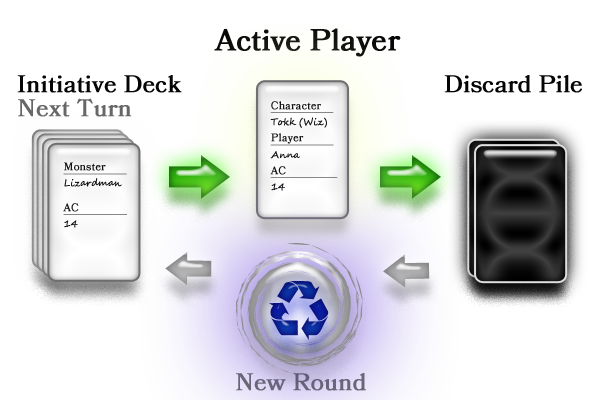 To get started you need only a few things:
- Standard size playing cards.
- Plastic sleeves of the same size.
- Pen & Paper
Roll For Initiative.: Surprise round
When using an initiative deck you still roll for initiative for what is called the Surprise round. Everyone rolls initiative which is a d20 + wisdom and dexterity modifiers and then goes in order. During this round you can not take reactions until after you have taken your turn. If you attack anyone during this surprise round before they go in initiative it is at advantage. After the surprise round has passed all players will hand the dm a combat card which the dm will shuffle with more cards to create the initiative deck.
Creating Your Initiative Deck
All you need to do is to sleeve one card per player or use the tear away cards in the book and one card per monster. If you use group initiative for all monsters of the same type you only need one card per monster group. You might also want to sleeve a couple of generic monster cards for random encounters. Another option is to use cards for environmental affects and other variables in combat that you can slip into the deck as the rounds go on.
Now, insert a piece of paper with the character or monster name inside the sleeve on the face-up side of the card. The DM can now collect all cards and put them behind the DM-screen. How much information you add to the note is up to you, AC or resistances for instance might be handy to add.
The next level. But wait, there is more! The DM can also use this system to mark conditions or triggers as a reminder, all that is needed is a wet-marker. Since the cards are sleeved or using the tear away cards because they are glossy the wet-marker comes off easily with the swipe of a finger if the note is no longer relevant.
Using Your Initiative Deck
Once all monsters and players have a card representing their creature you have a created a little initiative deck. Once combat initates simply shuffle the deck (face down) so that a random initiative order is established.
Draw the top card from the pile and declare it as the active player (or monster) but also declare what card is now showing on the top of the deck, this gives the players information about the next turn too. When a player or monster has taken its turn you put their card in the discard pile face down.
Continue drawing cards until the deck is empty, at which point you shuffle the deck again and simply repeat the process, starting a new combat round.
Influencing Deck
There are also ways that players and npcs can manipulate the initiative Deck. Some monsters can force their way to the top of a round by howling slowing everyone down. The Astrologian Job Title gives you the ability to use fate cards to manipulate the deck forcing someone up in the deck either makeing them go first or right after the Astrologian.
Some Martial Jobs give the action surge ability and allows them to go first in a round. Using any of these abilities means the dm takes your card out of the deck, shuffles the deck and then puts your card at top making you go first.
Grapple 
Flanking
To make it more realistic, at the beginning of your turn while being flanked you may choose one of the attackers that are flanking you and deny them the benefit of flanking until the start of your next turn. You can choose a different attacker that is flanking you during each of your turns.
Disarming
When using the Disarm action, the attacker's attack roll is made against a DC equal to 10 + Strength Saving Throw or Dexterity Saving Throw modifier of the target (its choice).
The attacker has advantage on their attack roll if they grappled using Opportunity Grapple or with a weapon with the Grappling property or if they are larger than the target. The attacker has disadvantage on their attack roll if the target is holding the item with two or more hands, or if they are smaller than the target.
If you succeed, the weapon, shield or item is no longer held by the target. You can use your move action to either kick the weapon into an adjacent area (your choice) or take the item if you have a free hand, otherwise the target may use its move action on their turn to take it back.
Marking
When you use the Mark action, you gain another reaction that can only be used for opportunity attack provoked by your marked target, and only this attack benefits from advantage.
However, you cannot perform reactions against any hostile creatures other than your marked target until the end of your next turn.
Overrun & Tumble
As part of a move action, you are able to pass through hostile creatures spaces. Make an Strength (Athletics) or Dexterity (Acrobatics) check against the hostile creatures passive Strength (Athletics) or Dexterity (Acrobatics). If you succeed, you do not provoke an Opportunity Attack when leaving the hostile creature's reach that you passed through.
If you fail your check, you may still choose to pass through hostile creature's space. If you choose so, treat the space as difficult terrain and you provoke an Opportunity Attack or a Grapple check from the hostile creature (their choice). If you miss by 5 or more, you are denied this option.
If you attempt to move through more than one hostile creature per turn, all checks after the first are made at disadvantage. If you are bigger than the hostile creature you make the first check at advantage and all others as normal. If you are smaller than the hostile creature you make the all checks at disadvantage.
Attack Action
The most common action to take in combat is the Attack action, whether you are swinging a sword, firing an arrow from a bow, or brawling with your fists. With this action, you make one melee or ranged attack. Certain features, such as Double-Sided weapon property or the Florentine fighting style allow you to make 2 attacks as a single action. If Two-weapon fighting you make your second attack at a -5 to hit and do not apply modifier to damage.
Other Combat Options
Melee Strikes
Power Attack Common Strike
Feint Common Strike
Shove/Trip Common Strike
Shove/Trip 

While wielding a melee weapon with the Reach property, or any Polearm weapon, you can use the Shove a Creature action as part of an attack without the need of a free hand. Make an Attack roll instead of a Strength (Athletics) check.
Stagger (Bludgeoning)
Before you make a melee attack with a bludgeoning weapon, you can choose to take a -5 penalty to the attack roll and try to disrupt the movement of your target while attacking.
If the target takes damage, the target's movement speed
is reduced by 10 until the end of its next turn. If its speed is reduced to 0 in this way, it immediately drops prone. Until the target recovers its movement speed to full it cannot use the Dash, Disengage and Dodge actions.





Standin from Prone
Rising from a throw or fall is a difficult thing in the heat of battle. It takes training and skill to do so very quickly and even more so when faced with an aggressive adversary.
Standing provokes an opportunity attack from all threatening creatures unless you make a Dexterity (Acrobatics) or Strength (Athletics) skill check at DC 10 + 2 for each enemy engaged with you. If any opportunity attack roll beats your AC by 10 or more, you remain prone.
Creatures that are knocked prone usually fall in supine position. In order to attempt a Strength (Athletics) saving throw to stand up, they must spend an additional 5 ft movement to turn around.
If you beat the Stand from Prone DC by 5 or more, you may also choose to tumble 5 feet into unoccupied space not provoking an attack of oppurtunity and standing up there.
Melee Reactions
Deflect
When a creature that you can see declares a melee attack against you, you may use your reaction, with a non finesse weapon, to attempt to deflect the attack. You can attempt to deflect only before damage is rolled. Attacks by Flexible weapons (such as flails) cannot be deflected.
If you do and you are proficient with the weapon that you are currently wielding, roll your weapon damage dice without any modifiers. The damage is reduced by that result.
Riposte. If your weapon has the Parry property and your Deflect result negates all attack damage, you can follow up with a single melee attack against the same target as part of the same reaction.
Counter (Finesse or Parry)
When a creature misses you with a melee attack by 10 or more, you may use your reaction to perform a single melee attack against that creature. You cannot Counter while using the Dodge action.
Raise Shield
If you are wielding a shield and another creature hits you with a melee attack you may use your reaction to interpose your shield between yourself and the attack and increase
your AC by 2 potentially causing the attack to miss you. Your shield is damaged in the process and suffers a -1 penalty to its AC each time you block in this fashion. If your shield's AC reaches 0, it is destroyed.
Magical shields self repair AC equal to their enchantment bonus each long rest and may block critical hits that meet the above criteria.
Opportunity Grapple
You use one of your Free Hand(s) to reach out and attempt to grapple an opponent.
Make a Grapple check. If this opportunity grapple is provoked by a movement and you succeed, both you and the opponent move 5 feet in the direction the target tried to move into and the target's speed becomes 0.
Give Ground 
When you are hit with a melee attack and you haven't moved during your last turn, you can use your reaction to move 5 feet away from the creature, reducing the damage you take by 1d6 points (minimum of 1), as long as your movement speed is greater than 0. This movement does not provoke an opportunity attack from the attacker, and the attacker may immediately follow you into the space you just left as a free action.
You cannot Give Ground while you are grappled by any creature, or knocked prone. You cannot Give Ground if
you are already on, or would walk into difficult terrain.
Ranged Actions
Aim
If your target hasn't moved during its previous turn, you can as part of an attack, hold your breath and aim with a ranged weapon. Your ranged attack against that target has advantage.
You can instead choose to spend an action to take the Aim action and your next attack against that target will be at advantage and deal +10 damage on hit.
Aiming requires concentration. If you maintain spells requiring Concentration, Aiming causes them to end.
Movement Actions
Charge
When you move at least 20 feet towards a target, you may declare a charge attack as an action. You must have a clear path towards your target, and nothing should hinder your path (such as difficult terrain or obstacles). If you finish your movement within reach of your target, you may use your action to follow it with one of these options:
Strike. You may make a single melee attack with advantage. The attack deals additional damage equal to the distance you charged divided by 5, up to your Strength or Constitution modifier (your choice, minimum of 1). If you are riding a mounted animal that provides the movement instead of you, you may use its Strength or Constitution instead your own.
Slam. You may perform the Shove action with advantage. If you succeed, the creature is shoved twice the normal distance, or shoved as normal then knocked prone. You may choose to move up to five feet in the direction you are shoving your target. If you fail, you provoke an attack of opportunity from your target.
Tackle. You may make a single Grapple attempt with advantage. If the Grapple fails, you provoke an attack of opportunity from your target and are knocked prone. If you succeed, both you and your opponent are knocked prone and your target is subjected to the Grappled condition.
Drive Back
Using one of your Attacks, you attempt to force back a standing creature. The target must be no larger than you in size. Make a Charisma (Intimidation) check against DC 10 + the target's Wisdom (Insight) check.
If you win the contest, the target backs away from you by 5 feet. As part of this attack, you can move 5 feet in the direction of the target. If you lose the contest, you provoke an attack of opportunity from the target or it may choose to use its reaction to perform a Drive Back action.
Brace
You can use your movement action to move up to half your speed to a solid object and brace yourself for additional support. This requires the use of both hands. For as long as you maintain your grip, any checks to move you or knock you prone are made with disadvantage. Furthermore, saving throws to resist being moved or knocked prone are made with advantage.
Once braced, you can maintain this effect as long as you do not release your grip or use your hands for anything else. If you are moved further than 5 feet away from the braced object, or knocked prone, the effect ends.
Lunge
You can make a special melee weapon attack, with a piercing non heavy or light weapon, that extends the reach of your weapon by 5 feet. You provoke opportunity attacks from enemies within 5 feet of you or if you enter someones weapon range.
Special Actions
Dirty Fighting
Dirty fighting is a catch-all name for many socially rejected grappling techniques that exploit the opponent. (Free Hand)
You can change one of your attacks into a dirty move from the list below applying the affect along with an attack. Engage in a contested Grapple check with your target. If you fail, you provoke an attack of opportunity from your opponent. If you succeed, apply the dirty move effect.
Restrain. The target is grappled and restrained by you.
Headlock. The target is grappled by you and suffocating (Player's Handbook, pg. 183) until the grapple is broken.
Eyejab. The target is Blinded until the end of its next turn. You may also Shove the creature as part of the Dirty Trick, but at disadvantage.
Groin shot. The target is Stunned until the end of its next turn. You may also Shove the creature as part of the Dirty Trick, but at disadvantage.
Once you use a dirty move against a target, you cannot succeed with the same trick again until end of combat.
Sunder (Heavy or Sundering)
You can spend your action to deliver a series of blows aimed at chinks in a creature's armor or shield. Instead of damage to the target, you attempt to apply the Sundered condition to Heavy Armor (or a component with the Hard property). Flexible armors such as chain mail, and materials such as leather cannot be Sundered.
Make a single melee attack against the target, and you get advantage to that attack. If it hits, roll for damage. For each extra attack you can make in a round, add 2 to the damage. If the target is Grappled or Prone, add 2 to the damage for each condition. If your weapon has the Sundering property, add 5 to the damage.
If the damage total is equal to or higher than the creature's armor Hardness (the hardenss of Iron and Steel is 19), you sunder the armor or shield (your choice). Sundered armor or shields decrease their bonus to AC by 2 until repaired. Sundered armor or shields cannot be sundered again. For optional rules, check Armor Degradation .
You can also sunder smaller items if held in a hand (up to DM's decision) but the Sunder attack roll must be made at disadvantage.
Body-Shield (Restrained Target)
While a creature is Restrained or Pinned () by you, you may as an action make an opposed Grapple check against that creature in order to position it in such a way that it shields you from one or more hostile creatures that you are aware of. If the creature is of your size it provides half cover and +2 AC, or, if the creature is one size larger than you, three-quarters cover and +5 AC.
If the creature you shield yourself with becomes stunned, paralyzed or unconscious, when attacked make a Strength (Athletics) check at DC 15 plus 5 for each size category above yours. On a failure, you do not benefit from the cover.
When using someone as a body shield you can choose to use the Raise Shield action with them making them take the damage of the attack whether it blocks or not.
Stealth Actions
Distraction
While you are hidden from a creature, you throw a pebble or make a sound meant to confuse and distract them. You must be aware of the creature's approximate location or direction of movement. Make a Dexterity (Sleight of Hand) or Charisma (Performance) check depending on your distraction method, contested by Sense (Insight) or Mind (Investigation) check (the targets choose the ability to use). If the creatures is alert, Passive Insight or Passive Investigation applies.
If you succeed, the creature is Distracted until the end of its next turn. Distracted creatures have disadvantage to Sense (Perception) skill checks and cannot use their Passive Perception. You have advantage on attacks and grapple checks against any Distracted creature, and if grappled while Distracted it is Surprised until the end of its next turn.
If you fail, you provoke a Sense (Perception) check with advantage from your targets opposed by your Dexterity (Stealth) skill.
Stealth Grapple
While you are hidden from your target, as long as your Stealth check total or Passive Stealth are above the Passive Perception of all nearby targets, you can come out of stealth and perform an opposed Grapple check with advantage. If you succeed, you may use your reaction to follow it with one of the following effects. If you fail, you provoke an attack of opportunity or grapple of opportunity from your target.
The chosen effect applies as long as the stealth grapple is maintained. While maintaining it, creatures other than your target have advantage on attack rolls against you, and you have disadvantage on Dexterity saving throws.
Gag. You attempt to gag the target's mouth to prevent it from making any sound. Make another opposed Grapple check with your target. On a success, the target is gagged until the grapple ends. A gagged creature cannot cast spells with verbal components and its speech is muffled and difficult to understand.
Choke Hold. You try to grab the creature by the throat and prevent it from breathing. Make another opposed Grapple check with your target. you have disadvantage on your roll. On a success, the target is also gagged and suffocating until the grapple ends.
Silent Takedown. If your target is already grappled and gagged, you may attempt to strike it with a weapon with the Finesse or Concealed property. Make an opposed Grapple check to maintain the hold on your target. If you succeed, you can make a single special melee attack. Your target has vulnerability towards the damage dealt by that attack.
Stealth Drag
While you are grappling a creature that is unable to speak, you may attempt to return to stealth. The Stealth check is made at disadvantage. On a success,the movement speed penalty from dragging a grappled creature does not apply.
Coup de Grace
When you make an attack that qualifies as an automatic critical hit against a defenseless target, roll a regular Attack roll. If you hit the target's AC minus Dexterity modifier, the creature takes damage equal to its current HP and is dying.
If you miss, the creature instead takes damage equal to half its current HP.
Spellcasting
Spells
Fireball Spell 2
somatic, verbal