Tiny Tome: Playing Tiny Characters
Introduction
This book will present rules and variants will enable playing as Tiny characters. Instead of playing as Medium sized creatures, the player characters will be Tiny, with entirely new perspectives, challenges, and stories. This book will try to provide some general rules and some specific rules for several different styles of play.
Survival in a world too large for you:
This can also be used to turn the mundane into the alien. For a tiny size creature, a house cat becomes a tiger, bugs become credible threats and the machinations of larger creatures become unknowable, only seen through glimpses. Survival can become the primary challenge at this scale or you can use scale as a lens to view things differently.
This recommended is for characters from levels 1 to 4 and will play as a Tier 0, facing weaker threats and facing lower stakes than the typical "first tier" gameplay.
Underdog Heroes:
Fantasy stories often tell of the underdog, the physically unimposing protagonist having to challenge and overcome the powerful and large antagonist. Myths and stories, such as "David and Goliath" or "Jack and the Beanstalk", show that this is an inspiring narrative. Perhaps you want to run a story where tiny adventurers strike out and become such heroes.
Once characters reach level 5, they can face threats from the First Tier. In general, tiny characters will be facing dangers and risk stakes one tier below what medium scale characters would face at the same level.
Communication is key
This style of game will bend or break some of the assumptions of the base roleplaying game. It is vital that all players and dungeon masters communicate what exactly they want out of a game. A pre-session discussion or "Session 0" is highly recommended before using these rules to ensure everyone's expectations are understood. A consent worksheet and discussions are also great topics to have during the Session 0.
Scale and size
This design philosophy is trying to tweak the feel of the base rules without having to rewrite huge blocks of text or introduce complicated conversions. As such, most measures of distance and speed will be converted in generic "squares" and the shortest length of time is still a "round" but neither term will have a firm connection to length, area or seconds. If you need to reference the base scale, it will be called "Medium Scale" whereas most rules added in this book will use a new "Tiny Scale".
In the hands of a tiny character, spells and weapon attacks have smaller ranges and areas of effect, proportional in size to the caster and wielder. If you use a grid based map, please use the following charts to roughly consider how large different creatures might appear or how to adapt spell ranges into Tiny scales.
| Creature Size | Map Dimensions (in Tiny Squares) |
|---|---|
| Tiny | 1x1 |
| Small | 2x2 |
| Medium | 3x3 |
| Large | 4x4 |
| Huge | 5x5 |
| Gargantuan | 6x6 |
| Class Ability Ranges | Tiny Square Distances |
|---|---|
| 5 ft | 1 |
| 10 ft | 2 |
| 15 ft | 3 |
| 30 ft | 6 |
| 60 ft | 12 |
| 120 ft | 24 |
| 150 ft | 30 |
| 600 ft | 120 |
If you need concrete numbers to tie Tiny Scale to, please consider a Tiny Square to be roughly equal to 1 and 2/3 feet (20 inches or approximately 50 centimeters) from a Medium sized creature's perspective. A Tiny Round will roughly be equal to 2 to 3 seconds in length. These are rough guidelines, please feel free to adjust to match the style of game that you are intending.
Weight
Carrying capacity and equipment weight will be redefined to use ounces in place of pounds for tiny scale equipment. A tiny longsword weighs 3 ounces, a tiny breastplate weighs 20 ounces and so on. A tiny sized Mage Hand can lift 10 ounces worth of weight and a tiny Floating Disk or Levitate can move 500 ounces or just over 30 pounds in medium scale.
This is meant as a guideline and can be adjusted for your style of play.
Note: There are 16 ounces in a pound. 1 ounce is roughly 28 grams.
Tiny Peoples
Animated Toys
Almost anywhere that wizards and children interact, some mage will get the brilliant idea that the child's toy could be improved by magic. However, most wizards underestimate the sheer power of a child's belief and imagination. Toys will drink in magic to animate them greedily and hold it longer than most objects. Sometimes, the magic never fades completely.
You are a toy which has been animated, but due to a quirk of magic, are now a sentient being. In most cases, you had a child to play with and your understanding of the wider world is likely influenced by this bond. This will likely determine why you adventure: You might stand vigil over your child at night, be questing to locate your missing child or maybe your child outgrew you and you are looking for a new purpose.
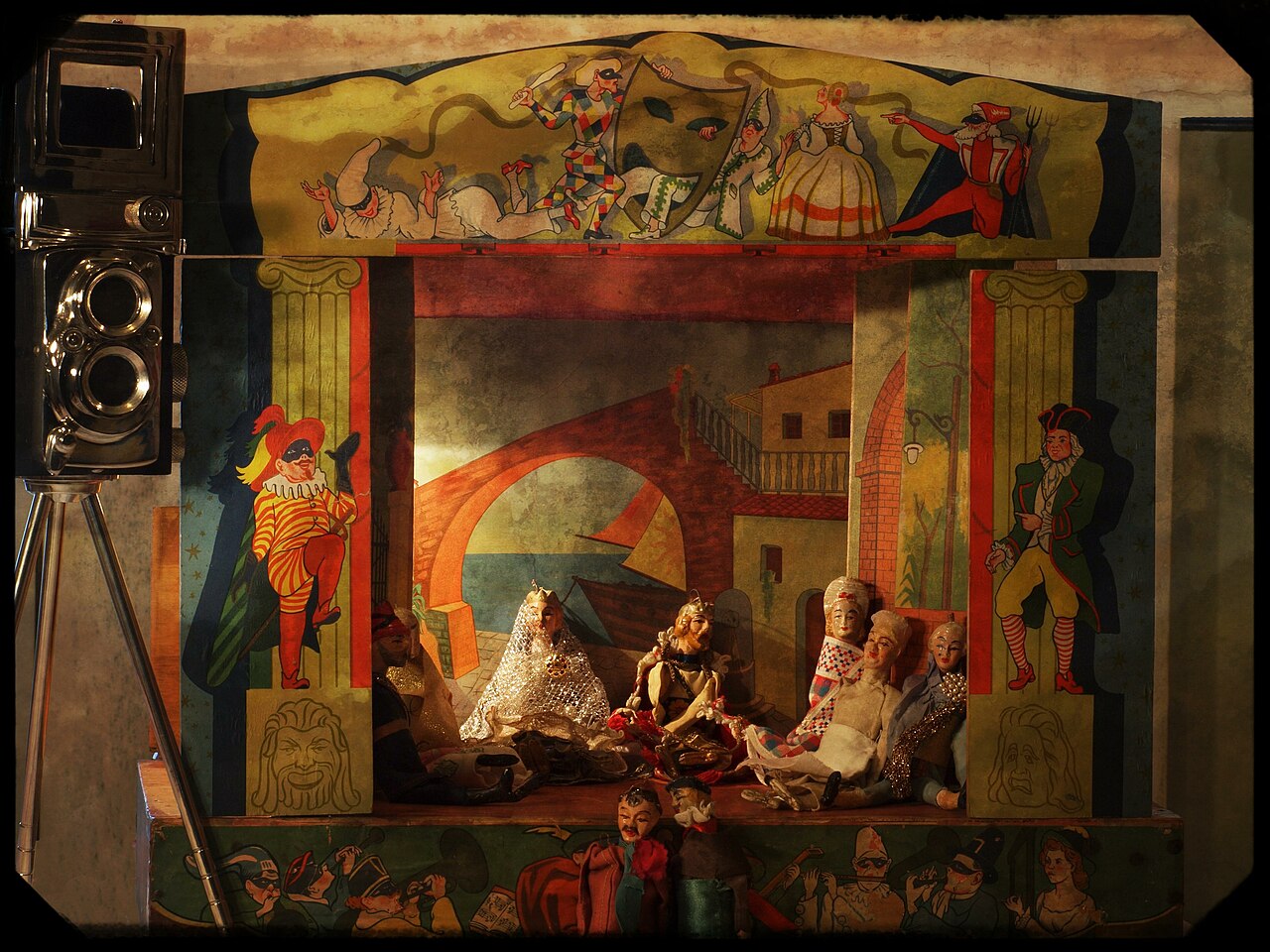
Alessandroga80 (CC BY-SA 3.0)
Marionette
- Ability Score Increase. Your Constitution score increases by 2 and your Charisma increases by 1.
- Age. It may take several years for you to mentally adapt to sentience, during which time you may be confused at the difference between reality and play. You take damage and can wear out but you otherwise show no signs of aging.
- Alignment. Marionettes often begin mimicking the alignment of the character that you are designed after but can develop their own alignment with time.
- Size. Marionettes are often 18 to 24 inches tall and weigh between 2 and 4 pounds (32 to 64 ounces). Your size is Tiny.
- Speed. Your base walking speed is 6 squares and you have a climb speed of 4 squares.
- Darkvision. You can see in dim light within 12 squares of you as if it were bright light, and in darkness as if it were dim light. You can’t discern color in darkness, only shades of gray.
- Living Toy. Even though you were constructed, you are a living creature. You are immune to disease. You have advantage on saving throws against being poisoned, and you have resistance to poison damage. You do not need to eat or breathe, but you can ingest food and drink if you wish. You don’t need to sleep, and magic can’t put you to sleep. Instead of sleeping, you enter an inactive state for four hours each day. You do not dream in this state; you are fully aware of your surroundings and notice approaching enemies and other events as normal.
- Enact Repairs. You are proficient with the artisan’s tools used to construct you (typically Woodworker’s tools) and know how to repair yourself. When you roll a 1 or 2 on any Hit Die you spend at the end of a short rest, you can reroll the die and must use the new roll.
- Construct Armor. When you aren’t wearing armor, your AC is 12 + your Constitution modifier. You can use your construct armor to determine your AC if the armor you wear would leave you with a lower AC. A shield’s benefits apply as normal while you use your construct armor.
- Animated Strings. You have limited control over your strings. You may manipulate objects using your strings, with the same limitations as Mage Hand with the ability to lift 10 ounces of weight.
- Always on stage. You have proficiency in the Performance skill.
- Languages. You can speak, read, and write Common and one language that your creator knew.
Porcelain Doll
- Ability Score Increase. Your Wisdom score increases by 1 and your Charisma increases by 2.
- Age. It may take several years for you to mentally adapt to sentience, during which time you may be confused at the difference between reality and play. You take damage and can wear out but you otherwise show no signs of aging.
- Alignment. Dolls often begin mimicking the alignment of the character that you are designed after but can develop their own alignment with time.
- Size. Dolls are often 12 to 18 inches tall and weigh between 1 and 3 pounds (16 to 48 ounces). Your size is Tiny.
- Speed. Your base walking speed is 6 squares.
- Darkvision. You can see in dim light within 12 squares of you as if it were bright light, and in darkness as if it were dim light. You can’t discern color in darkness, only shades of gray.
- Living Toy. Even though you were constructed, you are a living creature. You are immune to disease. You have advantage on saving throws against being poisoned, and you have resistance to poison damage. You do not need to eat or breathe, but you can ingest food and drink if you wish. You don’t need to sleep, and magic can’t put you to sleep. Instead of sleeping, you enter an inactive state for four hours each day. You do not dream in this state; you are fully aware of your surroundings and notice approaching enemies and other events as normal.
- Enact Repairs. You are proficient with the artisan’s tools used to construct you (typically Potter’s tools) and know how to repair yourself. When you roll a 1 or 2 on any Hit Die you spend at the end of a short rest, you can reroll the die and must use the new roll.
- Serene Visage. You automatically know the cantrip Friends and you have proficiency in one of the following skills of your choice: Deception, Intimidation or Persuasion. You may speak without moving your mouth.
- Languages. You can speak, read, and write Common and one language that your creator knew.
Stuffed Animal
- Ability Score Increase. Your Constitution score increases by 1 and your Wisdom increases by 2.
- Age. It may take several years for you to mentally adapt to sentience, during which time you may be confused at the difference between reality and play. You take damage and can wear out but you otherwise show no signs of aging.
- Alignment. Stuffed animals often begin neutral after animation but can develop their own alignment with time.
- Size. Stuffed animals are often 12 to 24 inches tall and weigh between 1 and 2 pounds (16 to 32 ounces). Your size is Tiny.
- Speed. Your base walking speed is 6 squares.
- Darkvision. You can see in dim light within 12 squares of you as if it were bright light, and in darkness as if it were dim light. You can’t discern color in darkness, only shades of gray.
- Living Toy. Even though you were constructed, you are a living creature. You are immune to disease. You have advantage on saving throws against being poisoned, and you have resistance to poison damage. You do not need to eat or breathe, but you can ingest food and drink if you wish. You don’t need to sleep, and magic can’t put you to sleep. Instead of sleeping, you enter an inactive state for four hours each day. You do not dream in this state; you are fully aware of your surroundings and notice approaching enemies and other events as normal.
- Enact Repairs. You are proficient with the artisan’s tools used to construct you (typically a Sewing Kit) and know how to repair yourself. When you roll a 1 or 2 on any Hit Die you spend at the end of a short rest, you can reroll the die and must use the new roll.
- Natural Attack. Your unarmed strikes deal 1d4+ Str bludgeoning damage. You appear to be attacking with whatever natural weapons that your design is based on, such as a horn, claw or bite.
- Speak With Related Beasts. Through sounds and gestures, you can communicate simple ideas with beasts which share a form as your design. For example, if you are designed to look like a tiger, you could speak with felines.
- Keen Smell. You have advantage on Wisdom (Perception) and Wisdom (Survival) checks that rely on smell.
- Animal Instinct. You have proficiency in the Animal Handling and Survival skills.
- Languages. You can speak, read, and write Common and one language that your creator knew.
Fairies
In magical forests, each flower bud and mushroom is protected and tended. Each animal is treated with respect and not a little fear. These Tiny fey, collectively called fairies, flirt and flutter between flora and warily watch strangers wander into their domain.
You are a fairy, blessed with the ability to fly and a strong connection to the natural world. Pixies tend to be the peaceful, if shy, emissaries to outsiders, using tricks to gather valuable insight into the stranger's temperament. Sprites are the flip of the coin, acting as a fragile line of defense for the forests denizens against outsider threats.
Sylvan Sign Language - Many fairies cannot speak normally but only make a single repeated sound, such as the sound of a bell ringing. As such, all fairies learn Sylvan Sign Language as a dialect of Sylvan. Fairy versions of spells often replace verbal components with somanic and the fairy version of Message allows signing in addition to whispering. If invisible, fairies can temporarily coat their hands in pixie dust or pollen to sign discreetly.
- If a character knows Sylvan they can understand Sylvan Sign Language and might already know how to sign it; if not they can take five days of instruction to learn to sign it.
- Any character can learn Sylvan Sign Language, but it takes longer if they do not already know Sylvan. It takes twenty five days of instruction to learn Sylvan Sign Language, which does not impart spoken or written Sylvan.
Pixie
- Ability Score Increase. Your Dexterity score increases by 1 and your Charisma increases by 2.
- Age. Pixies mature at the same rate humans do and reach adulthood in their late teens. If their forest stays healthy, they do not further age but any time spent out of the forest or if the forest is stressed, then they age slightly faster than humans. Outside of a healthy forest, pixies rarely live past sixty years.
- Alignment. Pixies are often neutral good, but can be of any alignment.
- Size. Pixies are often 8 to 14 inches tall and weigh between 1 and 2 pounds (16 to 32 ounces). Your size is Tiny.
- Speed. Your base walking speed is 4 squares and a flight speed of 6 squares. See Limited Flight.
- Limited Flight. Between levels 1 and 4 (inclusive), your wings tire you easily and must land at the end of each turn. If you are still flying when you end your turn, you fall but do not take falling damage. At level 5, you have true flight and are not required to land at the end of your turn.
- Invisibility. When you reach 5th level, you can cast the invisibility spell on yourself once, you regain this ability when you finish a long rest.
- Natural Tricksters. You have proficiency in the Sleight of Hand skill and automatically know the cantrip Druidcraft.
- Languages. You can speak, read, and write Common and Sylvan. You can sign and understand Sylvan Sign Language.

Jannie Sandholm (Public Domain)
Sprite
- Ability Score Increase. Your Dexterity score increases by 2 and your Intelligence increases by 1.
- Age. Sprites mature at the same rate humans do and reach adulthood in their late teens. If their forest stays healthy, they do not further age but any time spent out of the forest or if the forest is stressed, then they age slightly faster than humans. Outside of a healthy forest, sprites rarely live past sixty years.
- Alignment. Sprites are often neutral good, but can be of any alignment.
- Size. Sprites are often 8 to 14 inches tall and weigh between 1 and 2 pounds (16 to 32 ounces). Your size is Tiny.
- Speed. Your base walking speed is 4 squares and a flight speed of 6 squares. See Limited Flight.
- Limited Flight. Between levels 1 and 4 (inclusive), your wings tire you easily and must land at the end of each turn. If you are still flying when you end your turn, you fall but do not take falling damage. At level 5, you have true flight and are not required to land at the end of your turn.
- Invisibility. When you reach 5th level, you can cast the invisibility spell on yourself once, you regain this ability when you finish a long rest.
- Heart Sight. You can touch a creature and magically know the creature's current emotional state. If the target fails a DC 10 Charisma saving throw, you also know the creature's alignment. Celestials, fiends, and undead automatically fail the saving throw.
- Poison Brewers. You have proficiency with the Poisoner's Kit.
- Languages. You can speak, read, and write Common and Sylvan. You can sign and understand Sylvan Sign Language.
Lilliputian
In many different planes, time and space might not be entirely synchronized. Traveling through these planes are not without risk. Many years ago, several ships full of industrious humans struck out exploring through a portal discovered in their oceans and ended up on an entirely new world. However, this portal only worked in one direction and thus they were stuck in this new world. Even more worryingly, their mighty sailing ships could be mistaken for children's toys in this new world.
You are a Lilliputian human, a descendant of those other worldly humans. You appear similar to this world's humans in almost every aspect except for size. You tend to live on the edges of medium sized civilization, remembering a cultural legacy in which you had cities and kingdoms of your own. You often live in the walls or attics of business or houses, sustaining yourself on morsels which the occupants ought to never miss.
Lilliputian Human
- Ability Score Increase. Two ability scores of your choice increase by +1
- Age. Lilliputian humans reach adulthood in their late teens and live less than a century.
- Alignment. Lilliputian humans can be of any alignment.
- Size. Lilliputian humans are often 8 to 14 inches tall and weigh between between 2 and 4 pounds (32 to 64 ounces). Your size is Tiny.
- Speed. Your base walking speed is 6 squares.
- Skills. You gain proficiency in one skill of your choice.
- Feat. You gain one feat of your choice.
- Languages. You can speak, read, and write Common and one extra language of your choice.
Tiny versions of other races
Perhaps the Lilliputian world also had other races that ventured with them on their expedition into the unknown. Alternatively, maybe powerful magic shrunk them to their current scale.
- Feel free to include other races into your world at a tiny scale if you'd like.
Player Options
Giant Slayer (Martial Archetype)
The Giant Slayer specializes in fighting creatures much larger than themselves. Using knowledge of weak spots and impressive athletic ability, they are able to climb and defeat imposingly large foes.
Climb and Cling
When you choose this archetype at 3rd level, you gain proficiency in Athletics (or a class skill of your choice if already proficient). You also gain the ability to climb faster than normal; climbing no longer costs you extra movement.
If climbing (or using the Climb Foe rules (see sidebar)), you may attack with both hands, but must have a hand free at the end of your turn to remain climbing.
The Bigger They Are...
Starting at 3rd level, you've learned where to attack larger foes to deal the most damage. If you attack a target larger than you, your first hit per round deals +5 extra damage.
Shielding Bulk
At 7th level, if there is a target larger than you within 5 ft, you can use the target as protection from attacks. As a reaction in response to an attack roll which hits you, you can give yourself resistance to the attack's damage. If the triggering attack roll beats the target's AC, it also takes half the attack's damage.
Distracting Gnat
At 10th level, with taunts, prods, and being constantly underfoot, you've learned how to be utterly obnoxious to a foe. As a bonus action, you can hinder a target within 5 ft, giving it disadvantage on the next ability check or attack roll that it makes before the end of its next turn.
...The Harder They Fall
Starting at 15th level, you've improved your knowledge of weak points. Your extra damage from "The Bigger They Are..." becomes +10.
Peerless Athlete
At 18th level, when you make a Strength (Athletics) check, you can treat a d20 roll of 14 or lower as a 15.
Climb Foe (modified grapple rules)
When you want to climb a larger foe, you can use the Attack action to make a special melee attack. If you're able to make multiple attacks with the Attack action, this attack replaces one of them.
The target of your climb must be at least two sizes larger than you. Using at least one free hand, you try to scale the target. Make a Strength (Athletics) check contested by the target's Strength (Athletics) or Dexterity (Acrobatics) check (the target chooses the ability to use). If you succeed, you are climbing the target and can move into and through squares that it fills. While climbing the target, you have half cover against all foes other than the target you are climbing and will move with the target if it moves.
The target can use its action to remove you. It must succeed on a Strength (Athletics) or Dexterity (Acrobatics) check contested by your Strength (Athletics) check. If you become incapacitated, release the target (no action required), or are knocked prone you are removed. If removed, you end up in the nearest available square.
Traits which modify Grapple often apply to Climb Foe. Creatures immune to the Grappled condition cannot be Climbed. Although these rules work well with Giant Slayer, any character can attempt to climb a foe.

Louis Huard (Public Domain)
Equipment
Salvaging Equipment
A character may spend a time salvaging, an activity to locate and repurpose equipment, often improvising a new use for something that larger characters might not miss. In order to salvage, the player character will need to declare three things:
- The desired object that they are trying to salvage. The type of desired object will often determine the ability check used for the salvage check. For example, attempting to salvage leather armor would benefit from proficiency in leatherworker's tools. Alternatively, the character can look for random salvage; see the "Random Salvage" table, which defaults to Intelligence (Investigation) for the salvage check.
- The location that they are salvaging in. Certain locations are ideal for certain objects, such as a tailor's shop for textile materials and may grant advantage to the salvage check.
- How long are they intending to salvage at that location, up to 8 hours per day. This determines how much progress that they can make toward their desired object.
The game master can use this information to set the salvage check DC and determine any consequences for failure. If the desired item is suitable to the location, a reasonable DC is 10. If they are unsuitable but possible, the DC may be 15. If the desired item is impossible, the salvage fails without a roll. If a location has been previously salvaged, increase the DC by 1 for each attempt in the last 7 days.
Salvage Results
| Result | Value |
|---|---|
| Natural 1 | Lost 2d6 gp of progress [1] |
| DC -10 or worse | Lost 1d6 gp of progress [1] |
| DC -5 or worse | No progress made or lost |
| DC | Made .5 gp of progress per hour (max 4 gp) |
| DC +5 | Made .75 gp of progress per hour (max 6 gp) |
| DC +10 | Made 1 gp of progress per hour (max 8 gp) |
| Natural 20 | Made 8 gp progress and find additional item from Random Salvage table |
- [1] If these was no progress to lose, then a piece of equipment worth that much or less breaks in the attempt. Other consequences of failure may happen as well, such as alerting the owner of the location to the missing items.
Random Salvage
| d10 | Random Salvage |
|---|---|
| 1 | Sling and Sling Bullets (20) |
| 2 | 2 Clubs |
| 3 | Staff |
| 4 | 2 Javelins |
| 5 | Shield |
| 6 | Lamp and Oil (2 Flasks) |
| 7 | Paper (2 Sheets), Ink and Ink Pen |
| 8 | Healer's kit (10 charges) |
| 9 | Rope (10 squares) and Grappling Hook |
| 10 | Rations (10 days) |
New Equipment
Equipment is described at medium scale for consistency with the rest of the rules, but can exist at tiny scale.
Artisan's Tools
- Sewing Kit - Cost: 2 gp, Weight 2 lb. This pouch contains needles, thread, fasteners, patches and other small tools. Can be used to adjust or mend clothing or fabric items. If combined with fabric, can be used to craft items.
Variant Rules
Rule Variant: Escape Checks
Characters might not be able to win every fight. They should always have an escape plan and know when to run away. To that extent, please consider the following rules for Escaping Combat.
Escape Combat
When combat has been joined but one side wishes to escape, please consider the following procedure to allow that to take please. Each character can try to escape independently, successes and failures are tracked on a per character basis.
Step 1: Hide
Characters which wish to escape start by finding something to hide behind or within. In general, a heavily obscured area should be sufficient, but some traits might allow hiding within lightly obscured areas. Hiding uses the normal rules presented within the Core Rules, involving Dexterity (Stealth) checks.
Step 2: Escape
If a character has remained hidden (both unseen and unheard) for at least 1 Round, they may spend an action to attempt to Escape. In general, this will involve an additional Ability Check, commonly Strength (Athletics), Dexterity (Acrobatics) or Wisdom (Survival), depending on the environment. In many environments, the character can pick which of applicable skill to use, to reflect multiple different escape paths. The DC for this check is the highest Passive Perception of foes which are trying to prevent the escape. If the character succeeds, they've Escape from combat and are removed from the map in a direction of the GM's choice. If they fail, they haven't escaped but this does not break Stealth from Step 1 (however, the Stealth might be broken by the foes using the Search action, as normal.
Step 3: (Optional) Assist or Return
If some characters have escaped, they often remain close enough to vaguely understand what is going on behind them and may assist others in minor ways (such as helping those behind climb or squeeze into escape paths). If the GM permits, on their turn in initiative, they can spend an action to Help a party member try to Escape. Alternatively, they can spend an action to return to the map in a logical position.
Escape Combat example:
A party of four characters (cleric, wizard, fighter and rogue) were spotted by an angry foe. The party decides to try to escape, with the fighter and rogue will distract the foe while letting the cleric and wizard try to leave first.
- The first round of combat, the cleric and wizard manage to Hide using Dexterity (Stealth).
- The second round of combat, the fighter and rogue try to Hide but the Fighter fails. The cleric and wizard try to escape using Strength (Athletics) to climb a low wall but the wizard fails. The fighter is not hidden, the rogue and wizard are hidden and the cleric has escaped.
- The third round of combat, the rogue attacks from stealth and hides again with their Cunning Action to try to distract the foe. The fighter manages to hide this round. The cleric helps the wizard, who manages to escape. The fighters and rogue are hidden and the cleric and wizard have escaped.
- The fourth round of combat, The cleric and wizard help the fighter and rogue escape, which both manage.
Tweaking Escape rules:
Game Masters may adjust how many rounds a character must stay hidden or set a minimum distance from the next foe to make escaping more difficult. Certain spells or abilities may automatically enable escape, such as Dimension Door, Invisibility, or Pass Without Trace.
Game Masters might also use other DCs for the Escape step, such as based on the obstacle, the Passive Perception was picked for convenience and consistency.
Other skills might be used for the Escape step but I strongly recommend against allowing Dexterity (Stealth) to be the Ability Check for Step 2 as that may over emphasizes the Stealth skill.
Rule Variant: Gradual Awareness
Based on the assumption that hidden peoples are not generally known to exist to public peoples, then there can be interesting narrative space to play around with. The hidden characters might wish to sneak around near public characters but a single failed stealth check should not irrevocably change the narrative dynamic. To that intent, please consider using a gradual awareness system.
This system is meant to be generic for any dynamic where the existence of set of characters (called the hidden) is completely unknown to the another set of characters (called the public). You could use this for Urban Fantasy where the magical world is hidden from the mundane, tiny characters living under the floorboards of medium characters or monstrous heroes protecting an unaware city. The basic assumption is that the public characters generally have a numbers advantage over the hidden and the hidden characters have an information advantage over the public, in order to maintain a dynamic that resets with time.
Stages of Awareness
- Unaware - A public character has no idea that the hidden characters exist. Generally, any circumstance evidence will be ignored or explained away and fleeting observations will be disbelieved as "tricks of the light" or "dreams". Public characters in the unaware stage have disadvantage on Perception and Survival checks to detect the hidden characters, since they're not looking in the right places.
- Uncertain - A public character has seen or heard something which allows them to suspect that the hidden characters exist, but are still uncertain as to their nature. At this point, the public characters treat the hidden as rumors or mysteries. Public characters have disadvantage on insight checks regarding the nature and existence of the hidden characters, as they do not have the framework to critically evaluate such information.
- Stressed - The public characters now believe that the hidden characters exist but have trouble adapting to the change of world view. Stressed public characters have disadvantage in convincing Unaware or Uncertain public characters that they understand the nature of the hidden characters.
- Aware - The public characters are completely aware and adapted to the nature of the hidden characters. They have advantages on Perception and Survival checks to detect the existence of the hidden characters and on social checks to convince Uncertain characters regarding the existence.
Moving between stages of awareness
Individual public characters move through the stages at different rates and times. Here are some guidelines for when a character should change between stages of awareness:
- A single full encounter or scene with the hidden characters can move the public character one stage toward Aware. Drastic or extreme encounters might move the character more than one stage at a time.
- A partial encounter might move the public character toward Aware. The Game Master can determine based on the circumstances or have the public character succeed a Wisdom check (base DC 10) to determine if it was enough to move them toward Aware.
- An Uncertain or Stress character can move back toward Unaware over time. After seven days of not encountering the hidden characters, the Game Master might have the public character fails a Wisdom check (base DC 10), move one stage toward Unaware.
- Once a character becomes Aware, they will generally remain Aware, baring drastic circumstances.
- A character can attempt to modify another character's awareness via social skills, perhaps moving one stage per scene and day. See note below.
- Some spells (notably Enchantments and Illusions in general, Pass Without Trace and Modify Memory in specific) might alter the public character's awareness. See note below.
Awareness, Enchantment, and Social Skills
The nature of manipulating another character's awareness and agency is a massive breach of trust and consent. This is an important topic to discuss during a Session 0 to ensure that all players are comfortable with and would like to engage in this manner of play.
My general guidance would be to not track Gradual Awareness for player characters and not allowing player characters to use enchantments and social skills on other players character. I also advise having a very light touch with PC-NPC interactions, usually with clear, direct, and short term enchantments.
Monsters from a new perspective.
Gigantic Threat Template
This template is meant to turn normal medium or larger sized NPCs and monsters into credible threats to tiny creatures. This is meant as a starting point.
- Size: Must be at least Medium. Name of size remains the same, the space on a grid increases by 2 squares in each dimension.)
- Hit Points: Increase by 30, gains Damage Threshold 5 (see note)
- Speed: Unchanged, but add squares at 5 ft equal to 1 square to account for faster rounds
- Saving Throws and Ability Checks: Gains advantage on Strength saving throws and checks.
- Senses: Unchanged, but add squares at 5 ft equal to 3 squares of sense range.
- Gigantic Resistance: If targeted by an ability by a tiny creature which only targets one creature or whose area does not completely cover the creature, the Gigantic creature can spend their reaction to gain a +5 bonus the saving throw.
- Extra Attack or Multiattack: If the creature had two or more attacks, it makes one less attack.
- Attacks: Attack ranges are converted into squares using 5 ft is equal to 3 squares. Weapon Attacks deal +2d6 more damage.
- The Gigantic creature gains a new attack: Stomp
- Stomp. Melee Weapon Attack, Strength based, reach 1 square, dealing 2d6 + Strength Modifier bludgeoning damage. The only attack that the Gigantic creature can use to make an opportunity attack against a Tiny creature is stomp.
- Challenge. Approximately increases by 2
Why Damage Threshold?
This is meant to represent damage too weak to do lasting damage to the target (normally objects).
- It enforces that idea that these larger threats aren't just bigger, they're also tougher than you. Thick clothing, tough hides, the sheer difference of scale means that weak attacks shouldn't bother it.
- Prevents Death-Of-A-Thousand-Papercuts, where a normally scary creature is beaten by a slow drawn-out battle of attrition.
If the creature already has better defenses (such as damage immunity or resistances), reduce or remove the Damage Threshold. If the creature is especially large or tough, increase the Damage Threshold.
Gigantic Commoner
Medium (3x3 squares) humanoid (any race), any alignment
- Armor Class 10
- Hit Points 34 (1d8+30) (Damage Threshold 5)
- Speed 30 ft. (6 squares)
STR DEX CON INT WIS CHA 10 (+0) 10 (+0) 10 (+0) 10 (+0) 10 (+0) 10 (+0)
- Saving Throws STR +0 (Adv)
- Senses Passive Perception 10
- Languages Any one language (usually Common)
- Challenge 2 (450 XP)
Actions
Club. Melee Weapon Attack: +2 to hit, reach 5 ft. (3 squares), one target. Hit: 9 (1d4+2d6) bludgeoning damage.
Stomp. Melee Weapon Attack: +2 to hit, reach 0 ft. (1 square), one target. Hit: 7 (2d6) bludgeoning damage. The only attack that the Gigantic creature can use to make an opportunity attack against a Tiny creature is stomp.
Reactions
Gigantic Resistance. If targeted by an ability by a tiny creature which only targets one creature or whose area does not completely cover the creature, the Gigantic creature can spend their reaction to gain a +5 bonus the saving throw.
Gigantic Bear (Mama bear)
Large (4x4 squares) beast, unaligned
- Armor Class 12 (Natural Armor)
- Hit Points 72 (5d10+45) (Damage Threshold 5)
- Speed 40 ft. (8 squares), swim 30 ft. (6 squares)
STR DEX CON INT WIS CHA 20 (+5) 10 (+0) 16 (+3) 2 (-4) 13 (+1) 7 (-2)
- Saving Throws STR +5 (Adv)
- Skills Perception +3
- Senses Darkvision 60 ft. (36 squares), Passive Perception 13
- Languages --
- Challenge 4 (1,100 XP)
Keen Smell. The bear has advantage on Wisdom (Perception) checks that rely on smell.
Actions
Bite. Melee Weapon Attack: +7 to hit, reach 5 ft. (3 squares), one target. Hit: 16 (1d8+2d6+5) piercing damage.
Claws. Melee Weapon Attack: +7 to hit, reach 5 ft. (3 squares), one target. Hit: 21 (4d6+5) slashing damage.
Stomp. Melee Weapon Attack: +2 to hit, reach 0 ft. (1 square), one target. Hit: 12 (2d6+5) bludgeoning damage. The only attack that the Gigantic creature can use to make an opportunity attack against a Tiny creature is stomp.
Reactions
Gigantic Resistance. If targeted by an ability by a tiny creature which only targets one creature or whose area does not completely cover the creature, the Gigantic creature can spend their reaction to gain a +5 bonus the saving throw.
Gigantic Knight
Medium (3x3 squares) humanoid (any race), any alignment
- Armor Class 18 (Plate)
- Hit Points 82 (8d8+46) (Damage Threshold 10)
- Speed 30 ft. (6 squares)
STR DEX CON INT WIS CHA 16 (+3) 11 (+0) 14 (+2) 11 (+0) 11 (+0) 15 (+2)
- Saving Throws STR +3 (Adv), CON +4, WIS +2
- Senses Passive Perception 10
- Languages Any one language (usually Common)
- Challenge 5 (1,800 XP)
Brave. The knight has advantage on saving throws against being frightened.
Actions
Greatsword. Melee Weapon Attack: +5 to hit, reach 5 ft. (3 squares), one target. Hit: 17 (4d6+3) slashing damage.
Heavy Crossbow. Ranged Weapon Attack: +2 to hit, reach 100/400 ft. (600/2400 squares), one target. Hit: 12 (1d10+2d6) Piercing damage.
Stomp. Melee Weapon Attack: +5 to hit, reach 0 ft. (1 square), one target. Hit: 10 (2d6+3) bludgeoning damage. The only attack that the Gigantic creature can use to make an opportunity attack against a Tiny creature is stomp.
Reactions
Gigantic Resistance. If targeted by an ability by a tiny creature which only targets one creature or whose area does not completely cover the creature, the Gigantic creature can spend their reaction to gain a +5 bonus the saving throw.
Parry. The knight adds 2 to its AC against one melee attack that would hit it. To do so, the knight must see the attacker and be wielding a melee weapon.
Adapting existing beasts:
The following beasts are already scaled proportional to medium creatures and can be run with minor changes, mostly due to redefining their size down two steps and renaming them. This is not an exhaustive list (it does not include CR 0 beasts for space).
| Original Monster | Renamed Monster | Tweaks |
|---|---|---|
| Ape | Monkey | Becomes Tiny |
| Black Bear | Bear Cub | Becomes Tiny |
| Brown Bear | Bear Juvenile | Becomes Small |
| Diseased Giant Rat | Diseased Rat | Becomes Tiny |
| Dire Wolf | Wolf or Dog | Becomes Small |
| Elk | Roe Deer | Becomes Small |
| Giant Ape | Ape | Becomes Medium |
| Giant Badger | Badger | Becomes Tiny |
| Giant Bat | Bat | Becomes Tiny |
| Giant Boar | Boar | Becomes Small |
| Giant Centipede | Centipede | Becomes Tiny |
| Giant Constrictor Snake | Constrictor Snake | Becomes Medium |
| Giant Crab | Crab | Becomes Tiny |
| Giant Crocodile | Crocodile | Becomes Medium |
| Giant Eagle | Eagle | Becomes Small, Int becomes 2, loses languages. |
| Giant Elk | Deer | Becomes Medium, Int becomes 2, loses languages. |
| Giant Frog | Frog | Becomes Tiny, Swallow only effect Tiny |
| Giant Goat | Goat | Becomes Small |
| Original Monster | Renamed Monster | Tweaks |
|---|---|---|
| Giant Hyena | Hyena | Becomes Small |
| Giant Lizard | Lizard | Becomes Small |
| Giant Octopus | Octopus | Becomes Small |
| Giant Owl | Owl | Becomes Small, Int becomes 2, loses languages. |
| Giant Poisonous Snake | Poisonous Snake | Becomes Tiny |
| Giant Rat | Rat | Becomes Tiny |
| Giant Scorpion | Monstrous Scorpion | Becomes Small |
| Giant Sea Horse | Monstrous Sea Horse | Becomes Small |
| Giant Shark | Spinner Shark | Becomes Medium |
| Giant Spider | Monstrous Spider | Becomes Small |
| Giant Toad | Monstrous Toad | Becomes Small, Swallow only effect Tiny |
| Giant Vulture | Vulture | Becomes Small, Int becomes 2, loses languages. |
| Giant Wasp | Wasp | Becomes Tiny |
| Giant Weasel | Weasel | Becomes Tiny |
| Giant Wolf Spider | Wolf Spider | Becomes Tiny |
| Hunter Shark | Blacktip Shark | Becomes Small |
| Killer Whale | Dolphin | Becomes Medium |
| Lion | Leopard | Becomes Small |
| Mammoth | Pygmy Elephant | Becomes Medium |
| Reef Shark | Spiny Dogfish Shark | Becomes Tiny |
| Tiger | Wildcat | Becomes Small |
| Wolf | Small-breed dog | Becomes Tiny |
Tiny Tomes
Variant ruleset and drop in setting.
Tiny Tomes is unofficial Fan Content permitted under the Fan Content Policy. Not approved/endorsed by Wizards. Portions of the materials used are property of Wizards of the Coast. ©Wizards of the Coast LLC.
This is a rough draft, version 0.2 by Kyace
Acknowledgements
- Thanks for SpiderNettles, SgtBriar for feedback.
- Inspiration drawn from SwordMeow's JØTUNGARD and a lot of published 5E material.
- Thanks to WOTC for having such an enjoyable game to homebrew in.
Art Sources:
-
https://commons.wikimedia.org/wiki/File:Marionette_Theatre.jpg by Alessandroga80 (CC BY-SA 3.0)
-
https://commons.wikimedia.org/wiki/File:Little-Fairy-Girl.jpg by Jannie Sandholm (Public Domain)
-
https://en.wikipedia.org/wiki/File:Louis_Huard_-_Giant_Skrymir_and_Thor.jpg by Louis Huard (Public Domain)