Censure
6th-level abjuration
- Casting Time: 10 minutes
- Range: Self
- Components: V, S, M (a blank scroll and fine inks worth 150gp, which the spell consumes)
- Duration: 24 hours
- Classes Bard, Cleric, Wizard
Choose three spells of 5th level or lower that you know or can prepare and transcribe them on your scroll. For the duration, when a creature you can see or hear casts one of these spells at 5th level or lower, you can use reaction to cause the spell to fail, as if counterspelled.
If the spell is cast a level greater than 5th, you can use your reaction to make an ability check using your spellcasting ability. The DC equals 10 + the spell's level. On a success the spell fails.
At Higher Levels. When you cast this spell using a spell slot of 7th-level or higher, the interrupted spell has no effect if its level is less than the level of the spell slot you used, and you may increase the number of spells on your list by 1 for each level.
Embolden
3rd-level abjuration
- Casting Time: 1 reaction, which you take when a creature within range that you can see or hear becomes frightened
- Range: 60 feet
- Components: V
- Duration: Instantaneous
- Classes: Bard, Cleric, Paladin
You call out, reassuring the target of its strength and heroism. The creature is no longer frightened and has advantage on Wisdom saving throws until the start of its next turn.
At Higher Levels. When you cast this spell using a spell slot of 4th-level or higher, you may target an additional frightened creature for each slot level after 3rd.
Rigid Root
1st-level evocation
- Casting Time: 1 reaction, which you take when you or another willing creature within range that you can see is knocked prone or forced to move from its current space
- Range: 30 feet
- Components: V, S, M (an ivy seed)
- Duration: Instantaneous
- Classes: Druid, Ranger
A dozen roots shoot from the ground beneath the target, bracing it against the force that would move it. If knocked prone, the roots lift the target upright and it is not knocked prone. If the target would be moved from its current space, the roots grasp tightly, holding it in place and stopping the forced movement.
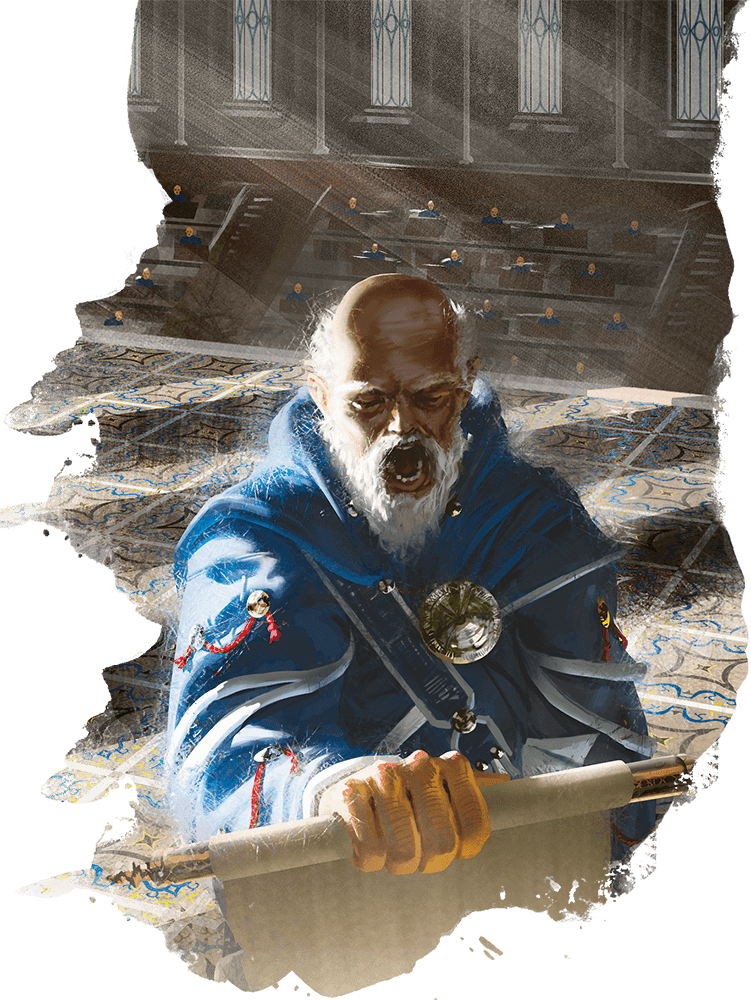
Censure Scroll Appearance
To the casual observer, a censure scroll may look like the arcane or divine gibberish found in any spell scroll, but depending on the caster that transcribes it, the content takes on a wholly unique appearance. As the scroll does not need to be on the caster's person after it has been made, it is possible that players might come upon such scrolls while they are active. Potential appearances are described below, and may be described to players who come up against a caster who has cast censure.
Bard. Designed with extravagant flourishes and unnecessary filigree, the scroll contains music notes metered out in a discordant melody that disrupts the sounds present in the transcribed spell's original casting.
Cleric. In precise and declarative language, the scroll entreats a god, gods, or a domain itself, requesting that the transcribed spells be forbidden in the caster's presence.
Wizard. While the contents of a wizard's spellbook are often personalized in such a way that only the caster instantly understands the spells within, a censured spell appears as a basic arcane formula that inverts the very idea of the transcribed spell's casting, breaking it down into its simplest arcane parts and negating them.