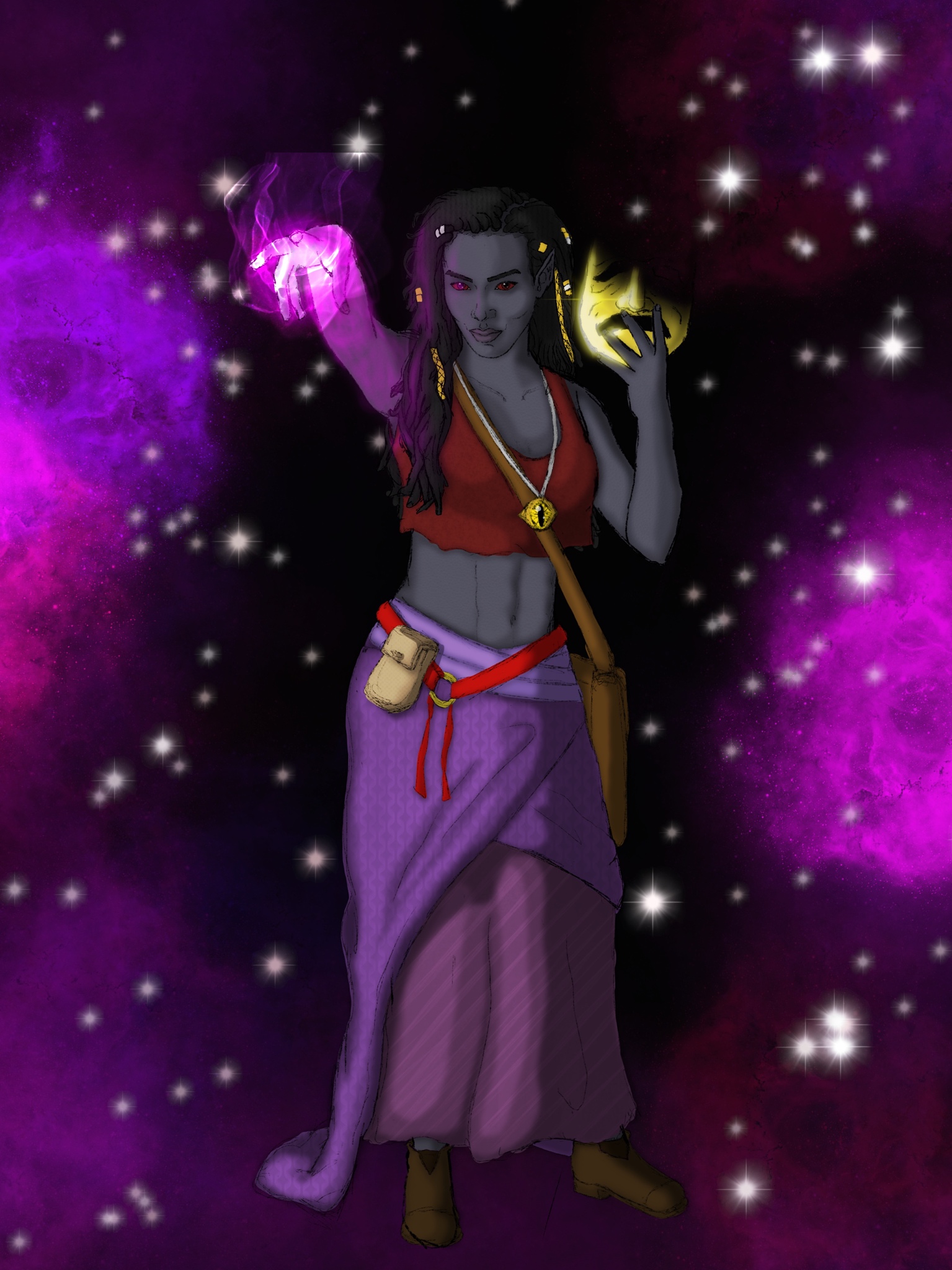
Thomas' Take on Heritage
An Approach to Redesigning Race in D&D 5th Edition
Table of Contents
| Section | Page |
|---|---|
| Design Goals | 4 |
| System Outline | 6 |
| Ancestry | 6 |
| Heritage | 8 |
| Attribute Bonuses | 10 |
| Credits | 10 |
The First Choice
The first choice I ever made in relation to playing a game of Dungeons & Dragons was to choose what race my character would be. I was presented with a handful of mainstream fantasy options: elves, dwarves, humans, etc.. While perusing my options I saw the dark elves who seemed mechanically interesting. I then read this line in the player's handbook (PHB pg. 19) "Drow are more often evil than not." I casually mentioned to my friend helping me through the process that the line seemed a bit racist and they responded with "Well, in the D&D world the races actually are different, so it's ok."
That phrase stuck with me. I never shook how eerily similar that line was to lines I had heard defending real-life racism as being based not on hatred and fear, but on "science" and "facts". It immediately turned me off from how D&D handles races mechanically for its players. D&D was essentially presenting me with a world where racists were right.
The longstanding tradition within Dungeons & Dragons has been to create a tailored selection of bespoke playable races for players to choose from. Every race has come with benefits, and some have come with detriments. In earlier editions of the game, the player's chosen race even defined what classes and gameplay styles were available to them.
Recently there has been a movement to challenge the value of this tradition not only in an effort to enhance player freedom and expression, but also in light of the real world harm that fictionalized racism causes. To put it very directly: a system in which dark skinned races are made to genetically have penalties to their intelligence and advantages to their ability to intimidate others is grotesque, abhorrent, and has no excuse for existing in the modern world. That is of course only one example of the insidious racism and white supremacy that has permeated the design space of D&D from the beginning.
We can build better systems. We must build better systems. If D&D wants to become a place where people of all genders, races, creeds, and sexual orientations can truly belong and represent themselves as the heroes they aspire to be, then the racism built into that very first choice needs to be pulled out by the roots. That is the goal of this system. It is not a perfect solution, but I have tried as best as I can to address and combat the ingrained problems within the original system of races in Dungeons & Dragons. I hope you enjoy, thanks for reading.
Design Goals
My design goals for this variant system for Dungeons & Dragons 5th edition revolve around 4 major points:
- Remove references to "race" and the underlying racism they create.
- Separate the mechanical structure of the game system from the narrative baggage of specific game settings and cultures.
- Provide compelling mechanical decisions for players to make about the story of their unique adventurer.
- Enhance player freedom and expression.
Lets look at each of these points individually.
Remove
Removing both the references to race and the underlying racism they create was difficult, and I am still unsure of how successful my attempt is. In the variant rules text provided you will not find the word "race". That part was easy. Other terms that imply grouping (i.e. folk) or biological disparity (i.e. heritage) have been used to convey the ideas previously conveyed by "race".
The other half of the design was inspired by the treatment of biological sex in D&D 5th edition. In previous editions, your choice of sex was limited male or female. There were no options for being sexless, intersex, hermaphroditic, or any other nonbinary sex category, thus failing to represent real world groups. There were also mechanical consequences that specifically penalized you for being female, which further reinforced real world sexism.
5th edition (in my opinion) elegantly solved this issue by removing any mechanical consequences from your chosen sex. Your character can belong to any sex category and be just as good as anyone else at swinging a sword or casting a spell. The choice of your character's sex only effects the story that you want to tell, not the mechanics of the game.
Your choice of ancestry in these variant rules is similar. It can effect the story you want to tell, but will not help or hinder you mechanically in the game. An orc can be naturally just as good at casting spells as an elf, and a gnome can be naturally just as good at swinging a sword as a goliath.
The immediate response when presenting this concept to most D&D players is "But part of why i chose a race is because of the bespoke narrative that race provided. I wanted to be strong, so I chose an orc. I wanted to be smart so I chose an elf. What is the purpose of choosing any race at all if they are all the same?" I will address this in the Provide section. I want to provide compelling decisions for the player to make about their unique character's story.
Separate
In the Player's Handbook, every race is presented pre-packaged with a culture, deities, and alignments. Most often the cultures are monolithic, or perhaps there is one unique culture per sub-race. This has always frustrated me as both a player and DM, as it makes assumptions about the world I will be presenting to my players.
According to the Player's Handbook, elves hate dark elves for betraying them and following the spider goddess Lolth into the underdark, where they became an evil matriarchal slave society. I am not just presented with dark elves mechanically having superior darkvision. I am also given their religion, narrative, temperament, culture, political system, and relation to all other races. The world of D&D exists in a multiverse with multiple overlapping settings: The Forgotten Realms, Grey Hawk, Dragon Lance, Ebberon, Ravenloft, Spelljammer, etc. These each present a certain reality, with a history, religions, cultures, and races.
My frustration was feeling like no matter what setting I played my game in, even in a completely home-brewed world, I was limited by certain narrative elements that the Player's Handbook presents. So my goal was to completely separate the mechanics and presentation of the heritages from any single setting; to create a setting-agnostic system. If we want to pre-package the Forgotten Realms with the PHB, that is fine, but I want to make sure there is a distinction presented. The lore presented in the Player's Handbook will be considered true "In the Forgotten Realms".
If a player wants to create an elven character in a homebrew setting, but doesn't want to be shackled to the narrative constraints of elves in the Forgotten Realms, then they can simply ignore that the Player's Handbook lore and can feel within their right to do so. If a DM wants to use the pre-built world of the Forgotten Realms, then the resource is there to inform how the different heritages and cultures interact, with details about their religions, alignments, politics, etc..
When a new setting reference book is written, there would be the opportunity for "In the world of Spelljammer" (or whatever setting) to be added to define the narrative of heritages within that setting. But my goal is to make the base foundation in this document assume as little as possible about the game world, allowing the maximum amount of player freedom in defining the heritage and culture of their unique character.
Provide
So, if we remove all mechanics inherent to races, and remove all narrative inherent to races, what are we left to play with? Not much, which is why I wanted to provide a new system that creates compelling decisions for players to make in regards to mechanics and narrative. I wanted this system to be limited to physical traits and qualities that could be attributed to biological differences. I wanted to stay as far away from "Some people are just born smarter or braver than others" as I could. So I found every racial ability in the Player's Handbook that could be directly attributed to biology, and brought it into this system.
Some of those traits required re-tuning due to no longer being re-packaged with other traits, and I created some new ones to fill out the tables, but overall the basis of these traits are found in the PHB. I organized these traits into 4 categories: Physical Traits, Mythical Inheritances, Natural Resistances, and Magical Attunements. Every trait has a point cost associated with it. I landed on 6 points being a fair amount to have available, although I allowed for DMs discretion with the number of available points and available categories in the setting of your game.
A flat +2 to one attribute and +1 to another, both of your choice, is built into the system. My eventual goal is to redesign and expand the Backgrounds system in a future document, and have attribute bonuses come from the player's chosen background.
With this a la carte method of selecting heritage abilities all races have access to all abilities, though the amount and combinations of those abilities are limited. A human can have darkvision and be sized as small (little people exist, duh). An elf can be amphibious and immune to all poison. An orc can have a swift gait and a draconic breath weapon. These choices can be made to enhance the character's class abilities, or used narratively to tell a personal story about the character's heritage.
Enhance
The freedom found from this new system should greatly increase the amount of player expression available. A player can now choose abilities that line up with their idea of a fantasy race, or can purposely choose to go against the grain and create something completely unique. This system also allows for narrative involving a mixing of peoples.
A player can choose for their human character to have the Trance ability and justify it with a personal narrative of a distant ancestor from the feywild. A gnome can have relentless endurance and superior fortitude, claiming to be part of a long line of gnomish heroes descended from a brave Gnomish king and his powerful Goliath queen. These are personal choices that can enhance a player's interaction with the history of the world, and do not imply racist generalizations like all orcs being less intelligent, or all gnomes being tricky. A player can choose to play a dumb orc who has strength enhancing physical characteristics, but that is the Player's choice about that singular orc, not an inherent truth about the entirety of orcish people.
The other freedom provided is one of aesthetics. While certain characteristic are emblematic of fantasy peoples (ie. pointed ears for elves) some are rooted in racist tropes. Players have complete freedom to decide the aesthetics of their character based on their personal narrative. If your character is the child of an orcish mother and a dwarven father, perhaps they have tusks poking out from under their large mustache and beard. Half-elves and half-orcs cease being bespoke races, and instead can be narrative choices that the player has complete freedom to make without worrying about how it effects abilities or attributes. This hopefully creates a space where all kinds of unique people can be represented and where folks of all sorts can exist.
The Heritage System
In Dungeons & Dragons, a character's personal heritage can influence their physical traits. In this system you will find options for designing a player character that best tells the story you have in mind for your adventurer. Every character has a unique personal history and heritage that combine to make them who they are. No one else is quite like your character. No one is pre-disposed to good or evil. Every character has agency in defining how they act and who they want to be.
All character's default to being sized as medium with a base walking speed of 30 ft.. The heritage process has 3 steps:
-
Selecting the ancestry of your character will give you aesthetic guidelines for their physical appearance.
-
Spending heritage points on the heritage tables will define how your character's personal heritage effects their physical abilities.
-
Assigning attribute bonuses will complete the creation of your character's personal history.
Ancestry
Select a personal ancestry for your character from the following options. This will give you guidelines on the physical appearance of your character. Remember that these are guidelines, and there can always be exceptions within any group. For guidelines on how to role-play these ancestries in the Forgotten Realms setting, read Chapter 2 of the Player's Handbook.
Dwarf
Characters with dwarven ancestry can have skin tones ranging everywhere from pale pinkish tan to dark blackish brown. They can have black, red, brown, blonde, or silver hair. They stand at an average of 4' 6" tall, and weigh an average of 150 lbs. They are often more stout and stocky, and often have ample body hair.
Elf
Characters with elven ancestry can have skin tones ranging everywhere from pale pinkish tan to dark blackish brown, but can also have skin tones in shades of copper, bronze, or almost bluish-white. They can have hair of any color, even unusual tones like green or blue. Their eyes can sometimes look like pools of liquid gold or silver. They stand at an average of 5' 2" tall, and weigh an average of 120 lbs. They are often more slender and androgynous, and often have very little body hair. They often have pointed ears.
Halfling
Characters with halfling ancestry can have skin tones ranging everywhere from pale pinkish tan to dark blackish brown. They can have black, red, brown, blonde, or silver hair. They stand at an average of 4' tall, and weigh an average of 45 lbs. They are often stout, and often have large hairy feet.
Human
Characters with human ancestry can have skin tones ranging everywhere from pale pinkish tan to dark blackish brown. They can have black, red, brown, blonde, or silver hair. They stand at an average of 5' 4" tall, and weigh an average of 140 lbs.
Dragonborn
Characters with dragonborn ancestry can look very much like humanoid dragons standing on two legs, though they only rarely have wings or a tail, and even more rarely have both. They can have scales in tones of red, green, blue, white, black, gold, silver, brass, copper, or bronze. They stand at an average of 6' 6" tall, and weigh an average of 300 lbs. They often have talon-like claws with three fingers and a thumb on each hand.
Gnome
Characters with gnomish ancestry can have skin tones ranging everywhere from pale pinkish tan to dark blackish brown. They can have black, red, brown, blonde, or silver hair. They stand at an average of 4' tall, and weigh an average of 40 lbs. They are often slender, and often have pronounced noses. They often have large pointed ears
Orc
Characters with orcish ancestry can have skin tones in shades of green and turquoise, ranging from pale grayish green to deep vibrant teal. They can have black, red, brown, blonde, or silver hair. They stand at an average of 6' tall, and weigh an average of 215 lbs. They are often broad and thick-set. They often have two prominent tusks on their lower set of teeth, and often have pointed ears.
Tiefling
Characters with tiefling ancestry can have skin tones of any color. They can have black, red, brown, blonde, purple, blue, or silver hair. Their eyes are often solid colors like gold, black, red, white, or silver, with no visible sclera or pupil. They stand at an average of 5' 4" tall, and weigh an average of 145 lbs. They often have horns varying in size and complexity greatly, from small points to thick curling ram horns, to intricate elk antlers. The sometimes have thick tails, four to five feet long.
Aasimar
Characters with aasimar ancestry often have skin tones ranging everywhere from pale pinkish tan to dark blackish brown, but can also have skin tones in shades of copper, teal, silver, or gold. They can have hair of any color. Their eyes can sometimes glow with a flickering internal light. They stand at an average of 5' 4" tall, and weigh an average of 140 lbs.
Firbolg
Characters with firbolg ancestry often have skin tones ranging from pale greyish blue to dark warm brown. They can have hair of any color, but most often have hair in shades of red. Their faces often have a vague animalistic quality to them, bringing to mind a deer or wildcat. They stand at an average of 7' 6" tall, and weigh an average of 270 lbs. They are often gangly with large hands and feet, and often have ample body hair. They often have deer-like ears that stick out from either side of their head, and straight ruddy noses.
Goliath
Characters with goliath ancestry can have skin tones in shades of gray, from nearly white to nearly black, with vertically symmetrical patches of skin covering their bodies often in an opposite shade to the rest of their skin. They are often hairless. They stand at an average of 7' 5" tall, and weigh an average of 310 lbs. They often have broad shoulders and thick limbs. They often have bony growths on their skin resembling studded pebbles.
Kenku
Characters with kenku ancestry can look very much like humanoid birds standing on two legs, though they do not have wings. They can have feathers in dark browns, grays, and black often with iridescent qualities in the light. They stand at an average of 5' tall, and weigh an average of 105 lbs. Their hands and feet are often talon like, with three long front toes and one back toe on each foot.
Lizardfolk
Characters with lizardfolk ancestry can look very much like humanoid lizards standing on two legs. They often have scales in greens and earth-tones, with brightly colored frills on top of their heads or around their faces. They stand at an average of 5' 5" tall, and weigh an average of 150 lbs. They often have thick scaly tails that drag behind them, and large clawed hands and feet.
Tabaxi
Characters with tabaxi ancestry can look very much like humanoid cats standing on two legs. Their fur is often colored or patterned like a large wildcat's, ranging from orange with tiger stripes, to yellow and black cheetah spots, to completely black like a panther. They stand at an average of 5' 6" tall, and weigh an average of 130 lbs. They often have tails of various lengths and fluffiness.
Triton
Characters with triton ancestry can have skin tones ranging everywhere from sea-foam green to dark stormy blue. They often have patches of fish-like scales across their body. They often have hair in pastel shades found in coral and other ocean life. They stand at an average of 5' tall, and weigh an average of 120 lbs. They often have webbed hands and feet, and sometimes even have small fins along their arms and legs.
Bugbear
Characters with bugbear ancestry are often covered in fur in shades of brown and gray. They stand at an average of 7' tall, and weigh an average of 300 lbs. They are often broad and thick-set. They often have large bat-like ears, and thick bushy eyebrows.
Goblin
Characters with goblin ancestry can have skin tones in shades of green and yellow, ranging from bright acid green to dark blotchy yellow. They can have black, red, brown, blonde, or silver hair. They stand at an average of 4' tall, and weigh an average of 60 lbs. They are often wiry with long fingers and toes. They often have large bat-like ears, and often have pointed teeth.
Hobgoblin
Characters with hobgoblin ancestry can have skin tones in shades of red and orange, ranging from pale dusty red to deep burnt orange. They can have black, red, brown, blonde, or silver hair. Their eyes are often golden or yellow. They stand at an average of 5' 5" tall, and weigh an average of 150 lbs. They often have medium sized bat-like ears.
Kobold
Characters with kobold ancestry can look very much like humanoid lizards standing on two legs. They often have scales in reds and earth-tones. Rarely, they will have small flightless dragon-like wings. They stand at an average of 4' tall, and weigh an average of 40 lbs. They often have thin scaly tails, and often have clawed hands and feet.
Yuan-ti
Characters with yuan-ti ancestry can have skin tones ranging everywhere from pale pinkish tan to dark blackish brown. They can have black, red, brown, blonde, or silver hair. Their eyes often have vertically slitted pupils, and are often brightly colored solid green or yellow. They stand at an average of 5' 4" tall, and weigh an average of 140 lbs. They often have forked tongues, and often have patches of rough skin similar to snake scales.
Mixed
Characters with mixed ancestry can have physical appearances blending two or more of the available ancestry options together.
Heritage
When making your character's personal heritage, you can select options from the following tables to modify their physical abilities. All characters have 6 available heritage points, and each heritage ability has a listed point cost.
At your DM's discretion you may have more or fewer heritage points available to build your character, and you may be limited as to which tables you can choose abilities from. For low magic and gritty realism settings, try limiting the available heritage points to 4 or limiting your choices to the Physical Traits table, or both! For high magic or heroic settings, try increasing the available heritage points to 8. The setting you are playing in may effect what heritage abilities are available to you. Check with your DM about the details of the setting your game is set in.
Physical Traits
| Point Cost | Name |
|---|---|
| 1 | Darkvision |
| 1 | Superior Darkvision |
| 1 | Superior Lung Capacity |
| 2 | Aquatic Adaptation |
| 2 | Altitudinal Adaptation |
| 2 | Heightened Agility |
| 2 | Natural Camouflage |
| 2 | Diminutive Stature |
| 3 | Swift Gait |
| 3 | Relentless Endurance |
| 3 | Superior Fortitude |
| 3 | Natural Grit |
Mythical Inheritances
| Point Cost | Name |
|---|---|
| 3 | Healing Hands |
| 3 | Natural Armor |
| 3 | Amphibious |
| 3 | Long-Limbed |
| 3 | Trance |
| 4 | Powerful Build |
| 5 | Born Lucky |
| 5 | Draconic Ancestry |
| 6 | Radiant Soul |
| 6 | Necrotic Shroud |
Natural Resistances
| Point Cost | Name |
|---|---|
| 1 | Fire Resistance |
| 1 | Poison Resistance |
| 1 | Cold Resistance |
| 2 | Chosen Resistance |
| 3 | Mithridatic |
| 6 | Magic Resistance |
Magical Attunements
| Point Cost | Name |
|---|---|
| 1 | Luminescence |
| 1 | Legerdemain |
| 2 | Arcane Spark |
| 2 | Innate Sortilege |
| 3 | Positive Attunement |
| 3 | Neutral Attunement |
| 3 | Negative Attunement |
Altitudinal Adaptation
Physical Trait
You ignore any of the drawbacks caused by high altitude and cold climates.
Amphibious
Mythical Inheritance
You can breathe water and air.
Aquatic Adaptation
Physical Trait
You ignore any of the drawbacks caused by a deep underwater environment.
Arcane Spark
Magical Attunement
You know a cantrip from the wizard spell list. Intelligence is your spellcasting modifier for this spell.
Born Lucky
Mythical Inheritance
When you roll a 1 on the d20 for an attack roll, ability check, or saving throw, you can reroll the die and must use the new roll.
Chosen Resistance
Natural Resistance
You are resistant to one damage type of your choice.
Cold Resistance
Natural Resistance
You are resistant to cold damage.
Darkvision
Physical Trait
You can see in dim light within 60 feet of you as if it were bright light, and in darkness as if it were dim light. You can't discern color in darkness, only shades of gray.
Diminutive Stature
Physical Trait
Your size is small. You can attempt to hide even when obscured only by a creature that is at least one size category larger than you.
Draconic Ancestry
Mythical Inheritance
You have a natural breath weapon. This weapon creates a 15 ft cone that deals your choice of acid, cold, fire, lightning, or poison damage. When you use your breath weapon, each creature in the area of effect must make a Dexterity saving throw. The DC for this saving throw equals 8 + your Constitution modifier + your proficiency bonus. A creature takes 2d6 damage on a failed save, and half as much damage on a successful one. The damage increases to 4d6 at 6th level, 8d6 at 11th level, and 10d6 at 16th level. After you use your breath weapon, you can’t use it again until you complete a short or long rest.
Fire Resistance
Natural Resistance
You are resistant to fire damage.
Healing Hands
Mythical Inheritance
As an action, you can touch a creature and cause it to regain a number of hit points equal to your level. Once you use this trait, you can't use it again until you finish a long rest.
Heightened Agility
Physical Trait
When you move on your tum in combat, you can double your speed until the end of the tum. Once you use this trait, you can't use it again until you move 0 feet on one of your turns.
Innate Sortilege
Magical Attunement
You can cast detect magic or disguise self using this trait. Wisdom is your spellcasting ability for these spells. Once you use this ability you cannot do so again until you finish long rest.
Legerdemain
Magical Attunement
You know the minor illusion cantrip. Charisma is your spellcasting ability for this spell.
Long-Limbed
Mythical Inheritance
Your reach is 5 feet greater when you make a melee attack.
Luminescence
Magical Attunement
You know the light cantrip. Intelligence is your spellcasting ability for this spell.
Magic Resistance
Natural Resistance
You have advantage on saving throws against spells and other magical effects.
Mithridatic
Natural Resistance
You are immune to poison damage and to the poisoned condition.
Natural Armor
Mythical Inheritance
When you aren't wearing armor, your AC is 13 + your Dexterity modifier. You can use your natural armor to determine your AC if the armor you wear would leave you with a lower AC. A shield's benefits apply as normal while you use your natural armor.
Natural Camouflage
Physical Trait
You can hide when lightly obscured by natural elements or phenomena (fog, rain, underbrush, etc.)
Natural Grit
Physical Trait
When you take damage you can use your reaction to roll a d12, add your Constitution modifier to the number rolled and reduce the damage by that total. Once you use this trait, you can't use it again until you finish a long rest.
Necrotic Shroud
Mythical Inheritance
You can use an action to unleash infernal energy within yourself, causing your eyes to turn into pools of darkness and two skeletal, demonic, flightless wings to sprout from your back. The instant you transform, other creatures within 10 feet of you that can see you must each succeed on a Charisma saving throw (DC 8 + your proficiency bonus + your Charisma modifier) or become frightened of you until the end of your next turn.
Your transformation lasts for 1 minute or until you end it as a bonus action. During it, once on each of your turns, you can deal extra necrotic damage to one target when you deal damage to it with an attack or a spell. The extra necrotic damage equals your level. Once you use this trait, you can't use it again until you finish a long rest.
Negative Attunement
Magical Attunement
You know the thaumaturgy cantrip. When you reach 3rd Level, you can cast the hellish rebuke spell as a 2nd-level spell once with this trait and regain the ability to do so when you finish a Long Rest. When you reach 5th Level, you can cast the darkness spell once with this trait and regain the ability to do so when you finish a Long Rest. Charisma is your Spellcasting Ability for these Spells.
Neutral Attunment
Magical Attunement
You know the dancing lights cantrip. When you reach 3rd Level, you can cast the faerie fire spell once with this trait and regain the ability to do so when you finish a Long Rest. When you reach 5th Level, you can cast the enthrall spell once with this trait and regain the ability to do so when you finish a Long Rest. Charisma is your Spellcasting Ability for these Spells.
Poison Resistance
Natural Resistance
You are resistant to poison damage.
Positive Attunement
Magical Attunement
You know the guidance cantrip. When you reach 3rd Level, you can cast the divine favor spell once with this trait and regain the ability to do so when you finish a Long Rest. When you reach 5th Level, you can cast the lesser restoration spell once with this trait and regain the ability to do so when you finish a Long Rest. Charisma is your Spellcasting Ability for these Spells.
Powerful Build
Mythical Inheritance
You count as one size larger when determining your carrying capacity and the weight you can push, drag, or lift. Once per long rest, you can grant yourself advantage on the next Strength (Athletics) check you make within the next minute.
Radiant Soul
Mythical Attunement
You can use an action to unleash divine energy from within yourself, causing your eyes to glimmer and two luminous, incorporeal wings to sprout from your back.
Your transformation lasts for 1 minute or until you end it as a bonus action. During it, you have a flying speed of 30 feet, and once on each of your turns, you can deal extra radiant damage to one target when you deal damage to it with an attack or a spell. The extra radiant damage equals your level. Once you use this trait, you can't use it again until you finish a long rest.
Relentless Endurance
Physical Trait
Once per long rest, when you are reduced to 0 hit points but not killed outright, you can drop to 1 hit point instead.
Superior Darkvision
Physical Trait
You can see in dim light within 120 feet of you as if it were bright light, and in darkness as if it were dim light. You can't discern color in darkness, only shades of gray. You have disadvantage on Wisdom (Perception) checks that rely on sight when whatever you are trying to perceive is in bright light.
Superior Fortitude
Physical Trait
Your hit point maximum is increased by 1, and increases by 1 every time you gain a level.
Superior Lung Capacity
Physical Trait
You can hold your breath for up to 15 minutes.
Swift Gait
Physical Trait
Your base walking speed is increased to 35 feet.
Trance
Mythical Inheritance
You do not sleep. If you meditate deeply for at least 4 hours during a long rest, you gain the benefits of 8 hours of sleep. While meditating this way you are still conscious, but you have disadvantage on Wisdom (Perception) checks. You cannot be put to sleep by magical means.
Attribute Bonuses
To finalize your character's heritage before moving on to selecting your class, add +2 to any one attribute and add +1 to any other attribute of your choosing. In the future, these bonuses will come from your selected background. Your character is also proficient in any 2 languages of your choice. Thanks for reading. Keep on adventuring!
created by: Thomas the Human Bard (u/Regthejouster)
art credit: NuMel the Magnificent by Thomas the Human bard