This is a Work-in-Progress
A Currently Unfinished Class Revision
The Wizard Revisited
Clad in the silver robes that denote her station, an elf closes her eyes to shut out the distractions of the battlefield and begins her quiet chant. Fingers weaving in front of her, she completes her spell and launches a tiny bead of fire toward the enemy ranks, where it erupts into a conflagration that engulfs the soldiers.
Checking and rechecking his work, a human scribes an intricate magic circle in chalk on the bare stone floor, then sprinkles powdered iron along every line and graceful curve. When the circle is complete, he drones a long incantation. A hole opens in space inside the circle, bringing a whiff of brimstone from the otherworldly plane beyond.
Crouching on the floor in a dungeon intersection, a gnome tosses a handful of small bones inscribed with mystic symbols, muttering a few words of power over them. Closing his eyes to see the visions more clearly, he nods slowly, then opens his eyes and points down the passage to his left.
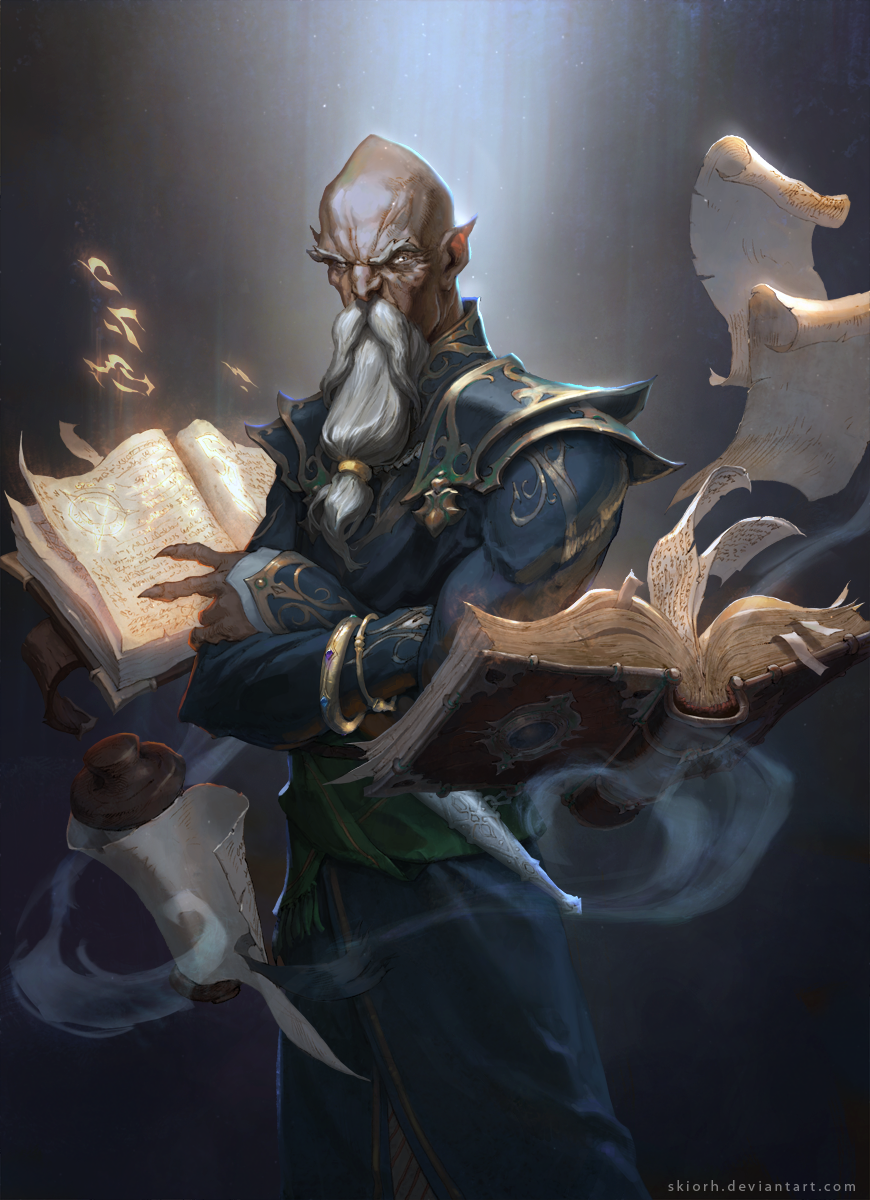
Wizards are supreme magic-users, defined and united as a class by the spells they cast. Drawing on the subtle weave of magic that permeates the cosmos, wizards cast spells of explosive fire, arcing lightning, subtle deception, and brute-force mind control. Their magic conjures monsters from other planes of existence, glimpses the future, or turns slain foes into zombies. Their mightiest spells change one substance into another, call meteors down from the sky, or open portals to other worlds.
Scholars of the Arcane
Wild and enigmatic, varied in form and function, the power of magic draws students who seek to master its mysteries. Some aspire to become like the gods, shaping reality itself. Though the casting of a typical spell requires merely the utterance of a few strange words, fleeting gestures, and sometimes a pinch or clump of exotic materials, these surface components barely hint at the expertise attained after years of apprenticeship and countless hours of study.
Wizards live and die by their spells. Everything else is secondary. They learn new spells as they experiment and grow in experience. They can also learn them from other wizards, from ancient tomes or inscriptions, and from ancient creatures (such as the fey) that are steeped in magic.
The Lure of Knowledge
Wizards’ lives are seldom mundane. The closest a wizard is likely to come to an ordinary life is working as a sage or lecturer in a library or university, teaching others the secrets of the multiverse. Other wizards sell their services as diviners, serve in military forces, or pursue lives of crime or domination.
But the lure of knowledge and power calls even the most unadventurous wizards out of the safety of their libraries and laboratories and into crumbling ruins and lost cities. Most wizards believe that their counterparts in ancient civilizations knew secrets of magic that have been lost to the ages, and discovering those secrets could unlock the path to a power greater than any magic available in the present age.
Creating a Wizard
Creating a wizard character demands a backstory dominated by at least one extraordinary event. How did your character first come into contact with magic? How did you discover you had an aptitude for it? Do you have a natural talent, or did you simply study hard and practice incessantly? Did you encounter a magical creature or an ancient tome that taught you the basics of magic?
What drew you forth from your life of study? Did your first taste of magical knowledge leave you hungry for more? Have you received word of a secret repository of knowledge not yet plundered by any other wizard? Perhaps you’re simply eager to put your newfound magical skills to the test in the face of danger.
Quick Build
You can make a wizard quickly by following these suggestions. First, Intelligence should be your highest ability score, followed by Constitution or Dexterity. If you plan to join the School of Enchantment, make Charisma your next-best score. Second, choose the sage background. Third, choose the firebolt, light, mage hand, message, and minor illusion cantrips, along with the following 1st-level spells for your spellbook: alarm, detect magic, find familiar, magic missile, shield, and sleep.
Class Features
As a wizard, you gain the following class features.
Hit Points
- Hit Dice: 1d6 per wizard level
- Hit Points at 1st Level: 6 + your Constitution modifier
- Hit Points at Higher Levels: 1d6 (or 4) + your Constitution modifier per wizard level after 1st
Proficiencies
- Armor: None
- Weapons: Daggers, darts, slings, quarterstaffs, light crossbows
- Tools: None
- Saving Throws: Intelligence, Wisdom
- Skills: Choose two from Arcana, History, Insight, Investigation, Medicine, and Religion
Equipment
You start with the following equipment, in addition to the equipment granted by your background:
- (a) a quarterstaff or (b) a dagger
- (a) a component pouch or (b) an arcane focus
- (a) a scholar’s pack or (b) an explorer’s pack
- A spellbook
The Wizard
| Level | Proficiency Bonus | Features | Known Cantrips | Spell Points | Spell Level | 6th | 7th | 8th | 9th |
|---|---|---|---|---|---|---|---|---|---|
| 1st | +2 | Spellcasting, Arcane Recovery | 2 | 2 | 1st | — | — | — | — |
| 2nd | +2 | Arcane Tradition | 2 | 3 | 1st | — | — | — | — |
| 3rd | +2 | ─ | 2 | 8 | 2nd | — | — | — | — |
| 4th | +2 | Ability Score Increase, Expertise | 3 | 10 | 2nd | — | — | — | — |
| 5th | +3 | Spell Mastery | 3 | 16 | 3rd | — | — | — | — |
| 6th | +3 | Arcane Tradition Feature | 3 | 19 | 3rd | — | — | — | — |
| 7th | +3 | ─ | 3 | 23 | 4th | — | — | — | — |
| 8th | +3 | Ability Score Increase | 3 | 27 | 4th | — | — | — | — |
| 9th | +4 | ─ | 3 | 36 | 5th | — | — | — | — |
| 10th | +4 | Arcane Tradition Feature | 4 | 41 | 5th | — | — | — | — |
| 11th | +4 | Arcane Supremacy | 4 | 41 | 5th | 1 | — | — | — |
| 12th | +4 | Ability Score Increase | 4 | 41 | 5th | 1 | — | — | — |
| 13th | +5 | ─ | 4 | 41 | 5th | 1 | 1 | — | — |
| 14th | +5 | Arcane Tradition Feature | 4 | 41 | 5th | 1 | 1 | — | — |
| 15th | +5 | ─ | 4 | 41 | 5th | 1 | 1 | 1 | — |
| 16th | +5 | Ability Score Increase | 5 | 41 | 5th | 1 | 1 | 1 | — |
| 17th | +6 | ─ | 5 | 41 | 5th | 1 | 1 | 1 | 1 |
| 18th | +6 | Signature Spells | 5 | 46 | 5th | 1 | 1 | 1 | 1 |
| 19th | +6 | Ability Score Increase | 5 | 46 | 5th | 2 | 1 | 1 | 1 |
| 20th | +6 | Capstone Ability | 5 | 46 | 5th | 2 | 2 | 1 | 1 |
Spellcasting
As a student of Arcane Magic, you have a Spellbook containing Spells that show the first glimmerings of your true power.
Cantrips
At 1st Level, you know the prestidigitation Cantrip, plus one Cantrip of your choice from the Wizard spell list. You learn additional Wizard Cantrips of your choice at higher levels, as indicated in the Known Cantrips column of the Wizard table. These Cantrips are always available and cannot be changed.
Additionally, whenever you prepare your spells, you may prepare two Cantrips from your spellbook.
Spellbook
At 1st Level, you have a Spellbook containing the two cantrips you know, plus four additional cantrips and six 1st-level spells of your choice from the Wizard spell list. Your Spellbook is a repository of all the Wizard Spells you have learned. Whenever you learn additional spells, they are added to your Spellbook.
Arcane Conduit
You have learned to draw magical energies into yourself through complex arcane rituals. You use this energy to fuel most of your spells and arcane abilities. This energy is represented by a number of Spell Points. The number of Spell Points you have available is indicated in the Spell Points column of the Wizard table.
Preparing Spells
In order to cast Wizard Spells of 1st level and higher, you must study your Spellbook and prepare a list of Wizard Spells available for you to cast. Choose a number of Wizard Spells from your Spellbook equal to your Intelligence modifier + your Wizard class level (minimum of one spell). You can only prepare Spells of a level equal to or less than the level indicated in the Spell Level column of the Wizard table.
Whenever you finish a Short Rest, you may change one of your prepared Cantrips or Spells with another Cantrip or Spell available in your Spellbook, if your Spellbook is available. When you finish a Long Rest, you may change all of your prepared Cantrips and Spells in this manner.
Casting Spells
In order to cast a Spell, you must know or have that Spell prepared, and you must have enough Spell Points available to cast the Spell. When you cast a spell, it consumes a number of Spell Points equal to the level of the Spell, or the level at which you cast the Spell, if that level is higher. You may not cast a Spell at a level higher than you are capable of casting, as indicated in the Spell Level column of the Wizard table. You may not use spell points to cast spells above 5th level.
For example, if you are a 3rd-level Wizard, you have nine Spell Points available. With an Intelligence of 16, your list of prepared Spells can include six Spells of 1st or 2nd Level, in any combination, chosen from your Spellbook. If you prepare the 1st-level spell Magic Missile, you can cast it as a 1st-level Spell for one Spell Point, or as a 2nd-level Spell for two Spell Points. Casting the spell does not remove it from your list of prepared Spells.
Casting a cantrip does not consume Spell Points.
Spellcasting Ability
Intelligence is your Spellcasting Ability for your Wizard Spells, since you learn your Spells through dedicated study and memorization. You use your Intelligence whenever a spell refers to your Spellcasting Ability. In addition, you use your Intelligence modifier when setting the saving throw DC for a Wizard spell you cast and when Making an Attack roll with one.
Spell save DC = 8 + your Proficiency Bonus + your Intelligence modifier
Spell Attack modifier = your Proficiency Bonus + your Intelligence modifier
Spellcasting Focus
You can use an arcane focus as a Spellcasting focus for your Wizard Spells.
Learning Spells of 1st Level and Higher
Each time you gain a level in the Wizard class, you can add two Wizard Spells of your choice to your Spellbook for free. These selections may include Cantrips. Each of these Spells must be of a level for which you can cast, as indicated in the Spell Level and Spell Slots columns of the Wizard table. On your Adventures, you might find other Wizard Spells that you can add to your Spellbook (see “Your Spellbook”). You may only add a Wizard Spell to your Spellbook when it is of a level for which you can cast.
Ritual Casting
You can cast a Wizard spell as a ritual if that spell has the ritual tag and you have the spell in your Spellbook. When cast in this manner, you do not need to have the spell prepared, and it does not use any of your Spell Points or Spell Slots.
Arcane Recovery
You have learned to store and regain magical energy through complex mystical rites. Once per day when you finish a Short Rest, you can recover a number of Spell Points equal to your Wizard class level. You cannot recover your Spell Slots of 6th level and higher in this manner.
For example, if you’re a 4th-level Wizard, you can recover four Spell Points once per day at the end of a Short Rest.
Once per day, when you perform these rites at the end of a Long Rest, you recover all of your expended Spell Points and Spell Slots.
Arcane Tradition
When you reach 2nd Level, you choose an Arcane Tradition, either specializing in one of the eight schools, such as Evocation, or pursuing some other esoteric, regional, or otherwise specialized system of arcane study and research. Your choice grants you features at 2nd level, and again at 6th, 10th, and 14th level.
Ability Score Improvement
When you reach 4th level, and again at 8th, 12th, 16th, and 19th level, you can increase one ability score of your choice by 2, or you can increase two ability scores of your choice by 1. As normal, you can’t increase an ability score above 20 using this feature.
Using the optional feats rule, you can forgo taking this feature to take a feat of your choice instead.
Expertise
At 4th level, choose one of your skill or tool proficiencies. Your proficiency bonus is doubled for any ability check you make that uses the chosen proficiency. The chosen proficiency must be one available from the wizard class, or one gained from your arcane tradition selection.
Spell Mastery
At 5th level, you achieve such mastery over certain spells that you can cast them at will. Choose a 1st-level wizard spell that is in your spellbook. You can cast that spell at its lowest level without expending a spell slot when you have it prepared. If you want to cast this spell at a higher level, you must expend a spell slot as normal. At 11th level, you may choose two 1st-level wizard spells using this feature. At 17th level, you may also choose a 2nd-level wizard spell.
By spending 8 hours in study, you can exchange any of the spells you chose for different spells of the same levels.
Arcane Supremacy
At 11th level, your study of complex spells and rituals has begun to unlock access to some of the most powerful magics known. You can learn and prepare spells of 6th level and higher, casting them using spell slots, as indicated on the Wizard table.
Your arcane supremacy spell slots can only be recovered at the end of a long rest.
At higher levels, as you gain access to higher level spells and spell slots, you may use your higher spell slots to fuel or increase the caster level of lower level spells.
Signature Spells
When you reach 18th level, you gain mastery over two powerful spells and can cast them with little effort. Choose two 3rd-level wizard spells in your spellbook as your signature spells. You always have these spells prepared, they don’t count against the number of spells you have prepared, and you can cast each of them once at 3rd level without expending a spell slot. When you do so, you can’t do so again until you finish a short or long rest.
If you want to cast either spell at a higher level, you must expend a spell slot as normal.
Capstone Ability
Something really cool, deserving of being a reward for sticking to 20 levels in a single class.
Your Spellbook
The Spells that you add to your Spellbook as you gain levels reflect the arcane Research you conduct on your own, as well as intellectual breakthroughs you have had about the Nature of the multiverse. You might find other Spells during your Adventures. You could discover a spell recorded on a scroll in an evil wizard’s chest, for example, or in a dusty tome in an ancient Library.
Copying a Spell into the Book: When you find a Wizard Spell of 1st Level or higher, you can add it to your Spellbook if it is of a Spell Level you can prepare and if you can spare the time to decipher and copy it.
Copying that Spell into your Spellbook involves reproducing the basic form of the Spell, then deciphering the unique system of notation used by the Wizard who wrote it. You must practice the Spell until you understand the incantations or gestures required, then transcribe it into your Spellbook using your own notation.
For each level of the Spell, the process takes two hours and costs 50 gp. The cost represents material Components you expend as you experiment with the Spell to master it, as well as the fine inks you need to record it. Once you have spent this time and money, you can prepare the Spell just like your other Spells. Copying a Cantrip into your Spellbook takes only one hour and costs 5 gp.
Replacing the Book: You can copy a Spell from your own Spellbook into another book—for example, if you want to make a backup copy of your Spellbook. This is just like copying a new Spell into your Spellbook, but faster and easier, since you understand your own notation and already know how to cast the Spell. You need spend only 1 hour and 10 gp for each level of the copied Spell. Cantrips cost only 10 minutes and 1 gp each.
If you lose your Spellbook, you can use the same procedure to transcribe the Spells that you have prepared into a new Spellbook. Filling out the remainder of your Spellbook requires you to find new Spells to do so, as normal. For this reason, many wizards keep backup Spellbooks in safe places.
The Book’s Appearance: Your Spellbook is a unique compilation of Spells, with its own decorative flourishes and margin notes. It might be a plain, functional leather volume that you received as a gift from your master, a finely bound gilt-edged tome you found in an ancient library, or even a loose collection of notes scrounged together after you lost your previous Spellbook in a mishap.
Arcane Traditions
Pact Mage
Eschewing the tradition of specialized scholarly pursuits, the allure of unconventional and taboo eldritch rites has drawn you into bargaining with strange and otherworldly entities.
School of Binding
Wizards who bind themselves to extra-planar entities.
Wu-Jen
Magic, Martial Arts, and personal taboos. (Based on wu-jen lore, maybe this archetype is more befitting the Druid class. Shugenja, as well. Sohei as clerics or monks/ascetics.)