Companions
A companion is a creature who accompanies you on your adventures. It might take the form of a fearsome beast, a padawan learner, a droid sidekick, or a mischievous spirit. Some companions are an integral part of an archetype, while others are simple NPCs that characters encounter and adopt during their adventures.
Companions In Your Game
Companions are not for the faint of heart. They add a significant power boost to a party, and can really bog down your game if their player's are not prepared. You might choose to allow your players to use the companion archetypes, but not the feats, vice versa, both options, or none. It's up to you.
Downtime Activities. Companions should not be able to perform downtime activities separately from their player's character. However, companions should be able to help others perform their downtime activities. Additionally, a player can choose to have their companion perform a downtime activity, though their character must spend their downtime helping the companion.
Encounter Building and Experience Allocation. A companion's level matches that of their owner, so they do not need to gain experience. However, you should consider treating a companion as half a character when building encounters and distributing experience. For instance, if your party is three characters and one companion, you should generate encounters and divide experience gained 3.5 ways, instead of simply three ways.
Enhanced Items. Companions should not count towards party size when allocating enhanced items. Additionally, while companion classes share names with their player character class counterparts, companions can not attune to items that require that class.
Starships and Deployments. Companions can not deploy as pilots, though they can fill other deployments as normal. Additionally, companions can gain deployment ranks, though they accrue prestige at half the rate of player characters, and they can not exceed 4 ranks in a deployment.
Gaining a Companion
Certain archetypes, such as the Astrotech Engineer, Saboteur Operative, or Zoologist Scholar, have their companions as the focus of their archetype's features. Alternatively, a companion can be gained through taking the Companion Keeper feat, detailed later in this chapter.
Regardless of how a companion is obtained, each player may have no more than one active companion at a given time.
Generating Your Companion
First, you should determine your companion's nature and appearance, as determined by your archetype feature of companion feat. Second, allocate your companion's ability scores, as determined by its nature. Finally, you should generate your companion from 1st level, and increase its level one level at a time, until its level equals your own. Be sure to update your companion's hit points, ability scores, proficiency bonus, and any features it gains as it levels.
Class and Features
Your companion gains features when it reaches certain levels, as shown in the follower table.
Companion Nature
Your companion's nature, discussed later in this chapter, is determined by your archetype feature or companion feat. Your companion's nature determines its type, its hit points and Hit Dice, its proficiencies and other features, and its companion traits. At 1st level, your companion starts with two traits. It gains additional traits when it reaches higher levels, as shown in the follower table.
Leveling Your Companion
Your companion's level equals your own, and each time you gain a level, so does your companion.
Proficiency Bonus
Your companion's proficiency bonus is equal to that of a player character of the same level, as shown in the follower table.
Companions in Combat
In combat, companions generally behave as a player character would, with the following differences.
Actions in Combat
Unless you use your bonus action to direct your companion, your companion can only use its action to Dash, Dodge, Disengage, Guard, or Hide.
Companion Initiative
Both you and your companion roll initiative, but you act together on the lesser of the two results. You act on one turn, and you can each move or take actions in any order.
Companion Natures
Certain class features grant a specific companion nature, while the Companion Keeper feat offers your choice of companion nature. You must meet a companion nature's requirement in order to choose that companion. You may only have one active companion at a time.
Alternative Companions
Your archetype feature may grant you one type of companion, whereas your character can be better realized utilizing a different companion. For instance, an astrotech engineer might prefer to have a tracker droid over one of the larger droid options. Work with your GM to determine if a different companion is better suited, and mechanically appropriate, to your character's identity.
You may choose your companion's nature from the following options or roll on the table below to determine it randomly.
| d10 | Companion Nature |
|---|---|
| 1 | Aberrant |
| 2 | Beast |
| 3 | Droid |
| 4 | Humanoid |
| 5 | Spirit |
| d10 | Companion Nature |
|---|---|
| 6 | Thrall |
| 7 | Tracker Droid |
| 8 | Turret |
| 9 | Vehicle |
| 10 |
If you determine your companion's nature randomly, and the result is a nature for which you are ineligible, simply reroll until you get a proper result.
Aberrant Companion
Prerequisite:
Beast Companion
Prerequisite: Proficiency in Animal Handling
Through spending time in the wilderness or discovering a forlorn creature in a foreign environment, you gain the loyalty of a beast companion.
Droid Companion
Prerequisite: Proficiency with astrotech's implements
Through creation of your own or capture of another, you gain the services of a droid companion.
Humanoid Companion
Prerequisite: Proficiency in Intimidation or Persuasion
Through menacing or recruitment, you gain the fidelity of a humanoid companion.
Humanoid companions will encompass all humanoid companions. They currently exist as part of the WIP Tutelage consular and Vonil/Ishu guardian.
Spirit Companion
Prerequisite: Discovery of a spirit's essence
Through happenstance or misfortune, you gain the curiosity of a spirit companion.
Spirits don't exist yet, but they will as a part of the Path of Communion sentinel rework c. 2023.
Thrall Companion
Prerequisite: The ability to cast force powers
Undead thralls are part of a WIP consular archetype.
Tracker Droid Companion
Prerequisite: The ability to cast tech powers
Through fabrication of your own or purchase from a vendor, you gain the assistance of a tracker droid companion.
Turret Companion
Prerequisite: Proficiency with artillerist's implements
Through construction of your own or coopting someone else's, you gain the use of a turret companion.
Vehicle Companion
Prerequisite: Proficiency with mechanic's kits
Through construction of your own or repair of another, you gain the utility of a vehicle companion.
Vehicle companions will be part of an engineer archetype, and a rework of the Mounted Specialist fighter.
Beast Companion
Your beast takes a form of your choosing. Alternatively, your GM can choose what form your beast takes based on your environment.
Once you've chosen the form of your beast, you assign your beast companion's ability scores. Your beast's Intelligence score is 6, and you assign its other ability scores using a limited standard array (16, 14, 12, 10, 8) as you see fit.
Beast Features
All beasts share the following traits.
Hit Points
- Hit Dice: 1d4 per beast companion level
- Hit Points at 1st Level: 4 + your beast's Constitution modifier
- Hit Points at Higher Levels: 1d4 (or 3) + your beast's Constitution modifier per beast level after 1st
Proficiencies and Features
- Languages: Your beast can understand simple commands spoken in two languages of your choice, as well as hand signals, but it can not speak
- Size: Tiny
- Speed: 20 ft.
- Type: Beast
- Armor Class: Your beast's armor class equals 10 + its Dexterity modifier.
- Barding: Your beast requires proficiency in armor in order to have it made into barding for them, and if the your beast's size increases, the barding must be upgraded accordingly.
- Natural Weapon: Your beast companion attacks with a natural weapon, such as claws or a bite. On a hit, it deals 1d4 kinetic damage.
- Attitude: The beast obeys your commands as best it can. It acts on your turn, and you determine its actions, decisions, attitudes, and so on. If you are incapacitated or absent, your beast acts on its own.
Bestial Traits
The traits are presented in alphabetical order. If a trait has prerequisites, your companion must meet them to adopt it. Your companion can adopt a trait at the same time that it meets the trait's prerequisites. Whenever your companion gains a level, it can exchange one trait for another one.
Aerial
Your beast companion has a flying speed equal to its walking speed, and opportunity attacks made against it have disadvantage.
Amphibious
Your beast companion has a swimming speed equal to its walking speed, and it can breathe air and water.
Burrower
Your beast companion has a burrowing speed equal to its walking speed, and it has blindsight out to 10 feet.
Charger
If your beast moves at least half its speed straight towards a target before making a melee attack, it deals an additional 1d8 damage on a hit.
Climber
Your beast companion has a climbing speed equal to its walking speed, and it has advantage on Strength saving throws and Strength (Athletics) checks that involve climbing.
Closed Mind
Your beast has advantage on Wisdom and Charisma saving throws against force powers.
Darkvision
Your beast companion is accustomed to low-light environments. Your beast can see in dim light within 60 feet as if it were bright light, and in darkness as if it were dim light. Your beast can't discern color in darkness, only shades of gray.
Evasive
Your beast companion can take the Disengage action as a bonus action.
Force Adept
Prerequisite: Force Sensitive
Your beast companion learns one 2nd-level force power of your choice, and once per long rest it can cast it at 2nd-level without expending force points. Your beast's forcecasting ability is Wisdom or Charisma (depending on power alignment).
Force Contention
Your beast has advantage on Strength and Constitution saving throws against force powers.
Force-Sensitive
Your beast learns one at-will force power and one 1st-level force power, which it can cast at its lowest level once per long rest. Your beast's forcecasting ability is Wisdom or Charisma (depending on power alignment). At-will powers chosen by your companion do not scale normally at higher levels. Instead, if they would scale at 5th level, they instead scale at 11th level, and if they would scale at 11th level, they instead scale at 18th level.
Grappler
When your beast hits with a melee weapon attack, it can use a bonus action to attempt to grapple the target. On a success, the target is both grappled and restrained, and your beast can't attack again while it has a creature grappled.
Heavy Hide
Your beast companion's armor class becomes 14.
Keen Hearing
Your beast companion has advantage on Wisdom (Perception) checks that rely on hearing.
Keen Sight
Your beast companion has advantage on Wisdom (Perception) checks that rely on sight.
Keen Smell
Your beast companion has advantage on Wisdom (Perception) checks that rely on smell.
Light Hide
Your beast companion's armor class becomes 11 + its Dexterity modifier.
Medium Hide
Your beast companion's armor class becomes 13 + its Dexterity modifier, to a maximum of +2.
Natural Camouflage
When your beast companion attempts to hide, it can opt to not move on its turn. If it avoids moving, it is considered lightly obscured until it moves.
Nimble Reflexes
Your beast has advantage on Dexterity and Intelligence saving throws against force powers.
Nimble Weapon
Your beast companion can use Dexterity instead of Strength for its attack and damage rolls.
Pack Tactics
Your beast companion has advantage on an attack roll against a creature if at least one ally of your beast companion is within 5 feet of the creature and the ally isn't incapacitated.
Pouncer
If your beast moves at least half its speed straight toward a creature and hits it with a melee attack, the creature must make a Strength saving throw (DC = 8 + your beast's proficiency bonus + its Strength modifier). If the creature is larger than your beast, it makes this save with advantage. On a failed save, the creature is knocked prone, and your beast can make one additional attack against it as a bonus action.
Powerful Build
Your beast companion's carrying capacity and the weight it can push, drag, or lift doubles. If it would already double, it instead triples.
Rampager
If your beast reduces a creature to 0 hit points with a melee attack on its turn, your beast can take a bonus action to move up to half its speed and make a melee attack.
Ranged Weapon
Your beast companion has a natural ranged weapon, such as a spitter or tail spikes. It has a normal range of 30 feet and a long range of 90 feet, and on a hit it deals kinetic damage equal to its natural weapon damage die.
Reach Weapon
Your beast companion has a natural weapon with reach, such as a tail or wings. It has the reach property, and on a hit it deals kinetic damage equal to its natural weapon damage die.
Size: Huge
Prerequisite: 9th level
Prerequisite: Size Large
Your beast companion's size is Huge. Its hit points increase by an amount equal to its level + 1, its Hit Die becomes a d12, its natural weapon damage die becomes a d12, and its walking speed increases to 40.
Size: Large
Prerequisite: Size Medium
Your beast companion's size is Large. Its hit points increase by an amount equal to its level + 1, its Hit Die becomes a d10, its natural weapon damage die becomes a d10, and its walking speed increases to 35.
Size: Medium
Prerequisite: Size Small
Your beast companion's size is Medium. Its hit points increase by an amount equal to its level + 1, its Hit Die becomes a d8, its natural weapon damage die becomes a d8, and its walking speed increases to 30.
Size: Small
Your beast companion's size is Small. Its hit points increase by an amount equal to its level + 1, its Hit Die becomes a d6, its natural weapon damage die becomes a d6, and its walking speed increases to 25.
Sturdy-Legged
Your beast companion's long jump is up to 20 feet and its high jump is up to 10 feet, with or without a running start, and it has advantage on Strength and Dexterity saving throws made against effects that would knock it prone.
Swift
Your beast companion can take the Dash action as a bonus action.
Tremorsense
Your beast companion gains tremorsense out to 30 feet.
Venomous Weapon
When your beast companion deals damage to a creature, it must make a Constitution saving throw (DC = 8 + your beast's proficiency bonus + your beast's Constitution modifier) or become poisoned until the end of its next turn.
Droid Companion
Your droid takes a form of your choosing. The class of droid you choose determines its features.
Once you've selected your type of droid class, you assign your droid's ability scores using standard array (16, 14, 14, 12, 10, 8) as you see fit.
Droid Features
All droids share the following features.
Resistances and Vulnerabilities
- Droid Resistances: Your droid is resistant to necrotic, poison, and psychic damage, and immune to poison and disease.
- Droid Vulnerabilities: Your droid is vulnerable to ion damage. Additionally, your droid has disadvantage on saving throws against effects that would deal ion or lightning damage.
Proficiencies and Features
- Type: Droid
- Armor Class: Your droid's armor class equals 10 + its Dexterity modifier.
- Armor Integration: Your droid can not wear armor, but it can have the armor professionally integrated into its chassis over the course of a long rest. This work must be done by someone proficient with astrotech's implements. Your droid must be proficient in armor in order to have it integrated.
- Droid Systems: Your droid does not need to eat or drink. Additionally, your droid does not require a tech focus to cast tech powers.
- Force Insensitive: Your droid can not use force powers or take levels in forcecasting classes.
- Maintenance Mode: Rather than sleep, your droid must spend 3 hours performing routine maintenance during a long rest to gain its benefits, during which it has disadvantage on Wisdom (Perception) checks. Additionally, if your droid's long rest would be interrupted, it only needs to complete the long rest instead of restarting it.
- Attitude: The droid obeys your commands as best it can. It acts on your turn, and you determine its actions, decisions, attitudes, and so on. If you are incapacitated or absent, your droid acts on its own.
Class I Droid
Class I droids, programmed for the mathematical, medical, or physical sciences, are subcategorized as medical droids, biological science droids, physical science droids, and mathematics droids.
As a class I droid, your droid companion has the following features.
Hit Points
- Hit Dice: 1d8 per droid level
- Hit Points at 1st Level: 8 + your droid's Constitution modifier
- Hit Points at Higher Levels: 1d8 (or 5) + your droid's Constitution modifier per droid level after 1st
Proficiencies and Features
- Languages: Your droid can speak, read, and write Galactic Basic and one language of your choice. It can understand spoken and written Binary, but can not speak it.
- Skills: One Intelligence, Wisdom, or Charisma skill of your choice
- Size: Medium
- Speed: 25 ft.
Class II Droid
Class II droids, programmed for the application of engineering and other technical sciences, are subcategorized as astromech droids, exploration droids, environmental droids, engineering droids, and maintenance droids.
As a class II droid, your droid companion has the following features.
Hit Points
- Hit Dice: 1d6 per droid level
- Hit Points at 1st Level: 6 + your droid's Constitution modifier
- Hit Points at Higher Levels: 1d6 (or 4) + your droid's Constitution modifier per droid level after 1st
Proficiencies and Features
- Skills: One of your choice
- Tools: One specialist's kit of your choice
- Languages: Your droid can speak, read, and write Binary. It can understand spoken and written Galactic Basic and one language of your choice, but can not speak it.
- Size: Small
- Speed: 25 ft.
- Undersized: Your droid's small stature makes it hard for it to wield bigger weapons. Your droid can't use heavy shields. Additionally, it can't use martial weapons with the two-handed property unless it also has the light property, and if a martial weapon has the versatile property, your droid can only wield it in two hands.
Class III Droid
Class III droids, programmed to interact with humans and said to be the most advanced droids ever invented, are subcategorized as protocol droids, servant droids, tutor droids, and child care droids.
As a class III droid, your droid companion has the following features.
Hit Points
- Hit Dice: 1d8 per droid level
- Hit Points at 1st Level: 8 + your droid's Constitution modifier
- Hit Points at Higher Levels: 1d8 (or 5) + your droid's Constitution modifier per droid level after 1st
Proficiencies and Features
- Languages: Your droid can speak and understand all registered languages
- Size: Medium
- Speed: 25 ft.
Class IV Droid
Class IV droids, programmed for military and security purposes, are subcategorized as assassin droids, battle droids, gladiator droids, and security droids.
As a class IV droid, your droid companion has the following features.
Hit Points
- Hit Dice: 1d8 per droid level
- Hit Points at 1st Level: 8 + your droid's Constitution modifier
- Hit Points at Higher Levels: 1d8 (or 5) + your droid's Constitution modifier per droid level after 1st
Proficiencies and Features
- Languages: Your droid can speak, read, and write Galactic Basic and one language of your choice. It can understand spoken and written Binary, but can not speak it.
- Size: Medium
- Speed: 30 ft.
- Armored: Your droid has proficiency in light armor. If it would already have proficiency in light armor, it instead has proficiency in medium armor. If it would already have proficiency in light and medium armor, it instead has proficiency in heavy armor. If it would already have proficiency in all armor, it instead has proficiency in a skill or tool of your choice.
Class V Droid
Class V droids, programmed for menial and low-skill tasks, are subcategorized as construction droids, lifting droids, mining droids, sanitation droids, and transportation droids.
As a class V droid, your droid companion has the following features.
Hit Points
- Hit Dice: 1d8 per droid level
- Hit Points at 1st Level: 8 + your droid's Constitution modifier
- Hit Points at Higher Levels: 1d8 (or 5) + your droid's Constitution modifier per droid level after 1st
Proficiencies and Features
- Skills: Athletics
- Tools: One set of artisan's implements
- Languages: Your droid can speak, read, and write Binary. It can understand spoken and written Galactic Basic and one language of your choice, but can not speak it.
- Size: Medium
- Speed: 30 ft.
Droid Traits
The traits are presented in alphabetical order. If a trait has prerequisites, your companion must meet them to adopt it. Your companion can adopt a trait at the same time that it meets the trait's prerequisites. Whenever your companion gains a level, it can exchange one trait for another one.
Alarm Protocol
You install an alarm module in your droid, granting it the following benefits:
- Your droid gains a +5 bonus to initiative.
- You and your droid can't be surprised while your droid is conscious.
Analysis Protocol
Prerequisite: 9th level, Class I Droid
Your droid can analyze a target, develop a plan on how to best overcome any potential obstacle, and execute that plan with ruthless efficiency. As a bonus action on your droid's turn, your droid can analyze a target it can see within 60 feet of it. For the next minute, or until it analyzes another target, it gains the following benefits:
- When it analyzes a hostile creature, its attack and damage rolls made with weapons with the finesse property or blaster weapons against that target may use its Intelligence modifier instead of Strength or Dexterity.
- When it analyzes a friendly creature, the target can end your droid's Analysis Protocol on them (no action required) to add half your droid's Intelligence modifier (rounded down, minimum of +1) to one attack roll, ability check, or saving throw. Once a friendly creature has benefited from this ability, they can not do so again until they complete a short or long rest.
Arm Cannons
You install dual arm cannons in your droid. The arm cannons have 2 charges. As an action, your droid can use charges to cast the overload tech power, using 1 charge per level. The saving throw is made against your droid's tech save DC (8 + your droid's proficiency bonus + your droid's Intelligence modifier).
You can choose this trait multiple times. Each time you do so, the arm cannons gain another charge, to a maximum of 4. The arm cannons regain all charges after a long rest.
Back-Up Protocol
You install an emergency protocol in your droid, prompting a quick reboot after critical damage is taken. If your droid would be reduced to 0 hit points, it instead is reduced to 1.
Once your droid uses this feature, it must finish a long rest before it can use it again.
Celerity Augment
You augment your droid to move a little faster. Your droid's speed increases by 5 feet.
You can choose this trait multiple times.
Charisma Chip
Prerequisite: Class III Droid
You install a charisma chip in your droid. When an ally your droid can see makes an ability check, attack roll, or saving throw, your droid can use its reaction to give them advantage on the roll. It can do so before or after they roll the d20, but before the GM says the roll succeeds or fails. Once your droid uses this ability, it can't use it again until it finishes a short or long rest.
Darkvision Optics
Your droid has darkvision to a range of 60 feet. If your droid already has darkvision, this trait increases its range by 30 feet.
Durability Module
You enhance your droid's durability, granting the following benefits:
- When your droid rolls a Hit Die to regain hit points, the minimum number of hit points your droid can regain from the roll equals twice your droid's Constitution modifier (minimum of 2).
- Your droid's hit point maximum increases by an amount equal to twice its level when you install this protocol. Whenever your droid gains a level thereafter, its hit point maximum increases by an additional 2 hit points.
Emergency Mode
Prerequisite: Back-Up Protocol
You modify your droid's back-up protocol. When your droid's back-up protocol is initiated, it can use its reaction to make one attack roll against a target within range. If the target is the source of the damage that reduced your droid to 0, the attack roll has advantage.
Energy Shield
You install an energy shield in your droid, which has 1 charge. As an action, your droid can use 1 charge to cast the energy shield tech power.
You can choose this trait multiple times. Each time you do so, the energy shield gains another charge, to a maximum of 3. The energy shield regains all expended charges after a long rest.
False Combustion
Prerequisite: Class II Droid
As a reaction in response to taking damage, your droid can feign an explosion. For 1 minute, it appears to be destroyed to all outward inspection. A creature can use its action to inspect your droid and make an Intelligence (Investigation) check (DC = 8 + your droid's proficiency bonus + your droid's Intelligence modifier). If it succeeds, it becomes aware that your droid still functions.
Fighting Style Protocol
Your droid adopts a particular style of fighting as its specialty. Choose one of the Fighting Style options, detailed in chapter 6 of the Player's Handbook. Your droid can't take a Fighting Style option more than once, even if it later gets to choose again.
Flamethrower
You install a flamethrower in your droid. The flamethrower has 1 charge. As an action, your droid can cast the jet of flame tech power, though it does not scale with higher levels, or use 1 charge to cast the flame sweep tech power at 1st level. The saving throw is made against your droid's tech save DC (8 + your droid's proficiency bonus + your droid's Intelligence modifier).
You can choose this trait multiple times. Each time you do so, the flamethrower gains another charge, to a maximum of 3. If the flamethrower has multiple charges, you can use multiple charges to cast flame sweep at a higher level, 1 point per charge. The flamethrower regains all expended charges after a long rest.
Four-Armed Combatant
Prerequisite: Class IV Droid
You install two additional arms to improve your droid's combat capabilities, granting it four arms which it can use independently of one another. Your droid can only gain the benefit of items held by two of its arms at any given time, and once per round your droid can switch which arms it is benefiting from (no action required).
While your droid has at least 3 arms free, it has a climbing speed equal to its walking speed.
Heavy Plating
Prerequisite: Proficiency with medium armor
Your droid gains proficiency in heavy armor. If your droid is already proficient in heavy armor, instead critical hits are treated as normal hits against it.
Interface Protocol
Your droid becomes a valid target for the tracker droid interface tech power.
Light Plating
Your droid gains proficiency in light armor. If your droid is already proficient in light armor, instead your droid's speed increases by 5 feet while light armor is integrated.
Martial Protocol
Prerequisite: 9th level, Class IV Droid
Your droid has martial training that allows it to perform special combat maneuvers. It gains the following benefits:
- It learns two maneuvers of your choice from among those available to the fighter class. If a maneuver it uses requires its target to make a saving throw to resist the maneuver's effects, the saving throw DC equals 8 + your droid's proficiency bonus + your droid's Strength or Dexterity modifier (your choice).
- Your droid has two superiority dice, which are d4s. These dice are used to fuel its maneuvers. A superiority die is expended when your droid uses it. It regain all of its expended superiority dice when you finish a short or long rest.
Medium Plating
Prerequisite: Proficiency with light armor
Your droid gains proficiency in medium armor. If your droid is already proficient in medium armor, the maximum Dexterity bonus your droid can add to AC increases to 3 from 2 while medium armor is integrated.
Memory Protocol
Prerequisite: Class I Droid
Your droid can recall anything it has read in the past month that it understood. This includes but is not limited to books, maps, signs, and lists.
Observant Protocol
Prerequisite: Alarm Protocol
You modify the alarm module in your droid, granting the following benefits:
- If your droid can see a creature's mouth while it is speaking a language it understands, your droid can interpret what it's saying by reading its lips.
- Your droid is considered to have advantage when determining its passive Wisdom (Perception) and passive Intelligence (Investigation) scores.
Performance Protocol
Prerequisite: 9th level, Class III Droid
You modify your droid's charisma chip, granting the following benefits:
- Your droid has advantage on Charisma (Performance) checks.
- Your droid can also use its bonus action to motivate an ally within 30 feet of it. Until the start of your droid's next turn, the ally can add the droid's Charisma modifier (minimum of +1) to the first attack roll, ability check, or saving throw they make. Your droid can use this feature a number of time equal to its Charisma modifier, and it regains all expended uses after it completes a long rest.
Powerful Droid
Prerequisite: Class V Droid
Your droid's carrying capacity and the weight it can push, drag, or lift doubles. If it would already double, it instead triples.
Power Core
Your droid's hit points increase by an amount equal to its level + 1 and its Hit Die increases by one step (from d6 to d8, d8 to d10, or d10 to d12).
You can choose this trait multiple times.
Powerful Grip
Prerequisite: 9th level, Class V Droid
When your droid hits a creature with a melee weapon attack on its turn and has a free hand, it can use a bonus action to attempt to grapple the target. If it does so, and the grapple succeeds, your droid can make one additional attack against the target (no action required).
Proficiency Protocol
You install a protocol in your droid that grants it proficiency in a skill or tool. Your droid gains proficiency in a skill or tool of your choice.
You can choose this trait multiple times.
Rapid Reconstructor
Prerequisite 5th level
Your droid can control and focus its healing. As a bonus action, it can choose to spend one of its Hit Dice to recover hit points.
Repulsor Coil
Prerequisite: 9th level, Class II Droid
Your droid has a flying speed equal to its walking speed. While medium or heavy armor is integrated, its flying speed is reduced by half.
Sensor Augmentation
You augment your droid with an advanced sensor, granting the following benefits:
- Your droid has advantage on Wisdom (Perception) and Intelligence (Investigation) checks made to detect the presence of secret doors.
- Your droid has advantage on saving throws made to avoid or resist traps.
- Your droid has resistance to the damage dealt by traps.
- Your droid can search for traps while traveling at a normal pace, instead of only at a slow pace.
Shard Modification
You specially modify your droid to house a shard. Shards are sentient crystals native to the planet Orax, roughly a foot in length, that communicate with each other through pulses of light. While inhabiting a specialized droid host, shards are able to overcome the droid’s inability to wield the Force, granting the following benefits:
- Your droid loses the Force Insensitive trait.
- Your droid can cast the sense force force power once per day. Wisdom or Charisma (your choice) is your droid's forcecasting ability for this power.
Stun Ray
You install a stun ray in your droid. The stun ray has 1 charge. As an action, your droid can use 1 charge to cast the hold droid or paralyze humanoid tech power. The saving throw is made against your droid's tech save DC (8 + your droid's proficiency bonus + your droid's Intelligence modifier).
You can choose this trait multiple times. Each time you do so, the stun ray gains another charge, to a maximum of 3. The stun ray regains all expended charges after a long rest.
Techcasting Protocol
Your droid learns one at-will tech power and one 1st-level tech power, which it can cast at its lowest level once per long rest. Your droid's techcasting ability is Intelligence. At-will powers chosen by your companion do not scale normally at higher levels. Instead, if they would scale at 5th level, they instead scale at 11th level, and if they would scale at 11th level, they instead scale at 18th level.
Techcasting Protocol Mark II
Prerequisite: Techcasting Protocol
Your droid learns one 2nd-level tech power of your choice, and once per long rest it can cast it at 2nd-level without expending tech points. Your droid's techcasting ability is Intelligence.
Toughness Module
Prerequisite: Durability Module
You modify the durability module in your droid, granting the following benefit:
- Whenever your droid takes the Dodge action in combat, it can spend one Hit Die to heal itself. Roll the die, add its Constitution modifier, and it regains a number of hit points equal to the total (minimum of one).
Truesight Optics
Prerequisite: 13th level
Prerequisite: Darkvision Optics
Your droid can see through illusions and detect invisibility within 30 feet, as with truesight.
Tracker Droid Companion
Your tracker droid takes a form of your choosing.
Once you've selected your tracker droid, you assign your tracker droid's ability scores using a varied standard array (16, 14, 12, 10, 8, 6) as you see fit.
Tracker Droid Features
All tracker droids share the following traits.
Hit Points
- Hit Dice: 1d4 per tracker droid companion level
- Hit Points at 1st Level: 4 + your tracker droid's Constitution modifier
- Hit Points at Higher Levels: 1d4 (or 3) + your tracker droid's Constitution modifier per tracker droid level after 1st
Resistances and Vulnerabilities
- Droid Resistances: Your tracker droid is resistant to necrotic, poison, and psychic damage, and immune to poison and disease.
- Droid Vulnerabilities: Your tracker droid is vulnerable to ion damage. Additionally, your tracker droid has disadvantage on saving throws against effects that would deal ion or lightning damage.
Proficiencies and Features
- Skills: Two of your choice
- Tools: One of your choice, which comes integrated into the droid
- Languages: Tracker droids can speak, read, and write Binary. They can understand spoken and written Galactic Basic and one language of your choice, but can not speak it.
- Size: Tiny
- Speed: 20 feet
- Type: Droid
- Armor Class: Your tracker droid's armor class equals 10 + its Dexterity modifier. Your tracker droid can't wear armor or have it integrated.
- Droid Systems: Your tracker droid does not need to eat or drink. Additionally, your tracker droid does not require a tech focus to cast tech powers, and it is a valid target of the tracker droid interface tech power.
- Droid Weaponry: Your tracker droid has an integrated shockprod with which it can make weapon attacks. This weapon can't be removed while your tracker droid is conscious. Your tracker droid's shockprod deals 1 lightning damage on a hit, and it has the finesse property.
- Force Insensitive: Your tracker droid can not use force powers or take levels in forcecasting classes.
- Maintenance Mode: Rather than sleep, your droid must spend 3 hours performing routine maintenance during a long rest to gain its benefits, during which it has disadvantage on Wisdom (Perception) checks. Additionally, if your droid's long rest would be interrupted, it only needs to complete the long rest instead of restarting it.
- Attitude: The tracker droid obeys your commands as best it can. It acts on your turn, and you determine its actions, decisions, attitudes, and so on. If you are incapacitated or absent, your tracker droid acts on its own.
Tracker Droid Traits
The traits are presented in alphabetical order. If a trait has prerequisites, your companion must meet them to adopt it. Your companion can adopt a trait at the same time that it meets the trait's prerequisites. Whenever your companion gains a level, it can exchange one trait for another one.
Aerial Travel Package
Your tracker droid companion has a 30 foot flying speed, and opportunity attacks made against it have disadvantage.
Camouflage Module
You install a camouflage module in your tracker droid. You tracker droid can activate its camouflage module to become invisible. While it is invisible, anything it is carrying or wearing is also invisible. It becomes visible when it deactivates the module. Activating or deactivating the module requires an action.
Deduct the time your tracker droid is invisible, in increments of 1 minute, from the module's maximum duration of 2 hours. After 2 hours of use, the module ceases to function. For every uninterrupted period of 12 hours the module goes unused, it regains 1 hour of use.
Darkvision Optics
Your tracker droid has darkvision to a range of 60 feet. If your tracker droid already has darkvision, this trait increases its range by 30 feet.
Four-Armed Tracker
Prerequisite: Pintsized Arms or Undersized Arms
Your tracker droid gains two additional arms which they can use independently of one another. Your tracker droid can only gain the benefit of items held by two of its arms at any given time, and once per round it can switch which arms it is benefiting from (no action required).
Heavy Plating
Your tracker droid companion's armor class becomes 14.
Interfaced Assistance Protocol
Prerequisite: 5th level
While you are interfaced with your tracker droid via the tracker droid interface tech power, whenever you have advantage on an ability check or attack roll granted by your tracker droid taking the Help action, you can reroll one of the dice once.
Interfaced Crafting Protocol
Prerequisite: 5th level
While you are interfaced with your tracker droid via the tracker droid interface tech power, whenever you make an ability check using artisan's implements with which the you are also proficient, you have advantage on the check. If you already have advantage, you can instead reroll one of the dice once.
Interfaced Distraction Protocol
Prerequisite: 5th level
While you are interfaced with your tracker droid via the tracker droid interface tech power, when your tracker droid is within 5 feet of a target, you do not provoke opportunity attacks when moving out of that creature's reach.
Interfaced Healing Protocol
Prerequisite: 5th level
While you are interfaced with your tracker droid via the tracker droid interface tech power, when you restore hit points to a creature that is within 5 feet of your tracker droid, you can roll the dice twice and take either total.
Interfaced Tracking Protocol
Prerequisite: 5th level
While you are interfaced with your tracker droid via the tracker droid interface tech power, when you make a Wisdom (Survival) check to track a target, and your tracker droid is also tracking that target, you gain advantage on the check. If you already have advantage, you can instead reroll one of the dice once.
Keen Hearing
Your tracker droid companion has advantage on Wisdom (Perception) checks that rely on hearing.
Keen Sight
Your tracker droid companion has advantage on Wisdom (Perception) checks that rely on sight.
Keen Smell
Your tracker droid companion has advantage on Wisdom (Perception) checks that rely on smell.
Laser Cutter
Your tracker droid can cut through 1-inch-thick glass at a rate of 3 inches per round.
Light Plating
Your tracker droid companion's armor class becomes 11 + its Dexterity modifier.
Medium Plating
Your tracker droid companion's armor class becomes 13 + its Dexterity modifier, to a maximum of +2.
Pintsized Arms
Prerequisite: Size Tiny
Your Tiny tracker droid gains two arms that struggle to wield bigger weapons. Your tracker droid can't use medium or heavy shields. Additionally, your tracker droid can't wield weapons with the two-handed or versatile property, and it can only wield one-handed weapons in two hands unless they have the light property.
Proficiency Protocol
You install a protocol in your tracker droid that grants it proficiency in a skill or tool of your choice.
Ranged Interface Protocol
The range within which you can interact with your tracker droid increases by 50 feet. This increases by an additional 50 feet at 5th level (100), 9th level (150), 13th level (200), 17th level (250), and 20th level (300).
Ranged Shockshot
Your tracker droid companion gains a ranged shockshot. It has a normal range of 30 feet and a long range of 90 feet, and on a hit it deal lightning damage equal to its shockprod damage.
Scomp Link
Prerequisite: 9th level
Your tracker droid gets an integrated scomp link which it can use to interface with computers. While interfaced, when you or your tracker droid makes an Intelligence (slicer's kit) check, you can choose to reroll the check. You must use the new roll. You can wait until after you roll the d20 before deciding to use this feature, but you must decide before the GM says whether the check succeeds or fails.
Sentry Dish
Your tracker droid learns the alarm tech power. It can cast it once, without spending tech points, and it regains the ability to do so when it finishes a long rest. Intelligence is its techcasting ability for this power.
Size: Small
Your tracker droid companion's size is Small. Its hit points increase by an amount equal to its level + 1, its Hit Die becomes a d6, its shockprod damage die becomes a d4, and it's walking speed increases to 25.
Spider Legs
Your tracker droid has a climbing speed equal to its walking speed. Additionally, your tracker droid has advantage on Strength saving throws and Strength (Athletics) checks that involve climbing.
Storage
Your tracker droid comes with a hidden storage compartment which can store up to 1 lb. Finding finding this hidden pocket requires a DC 15 Investigation check.
Techcasting Range Protocol
You can cast tech powers with a range of 5 feet or greater through your tracker droid while interfaced with it, but your tracker droid must be within 5 feet of the target of the power. This increases to 10 feet at 5th level, 20 feet at 9th level, 30 feet at 13th level, 60 feet at 17th level, and 120 feet at 20th level.
Truesight Optics
Prerequisite: 13th level
Prerequisite: Darkvision Optics
Your droid can see through illusions and detect invisibility within 60 feet, as with truesight.
Undersized Arms
Prerequisite: Size Small
Your Small tracker droid gains two arms that struggle to wield bigger weapons. Your tracker droid can't use heavy shields. Additionally, your tracker droid can't use martial weapons with the two-handed property unless it also has the light property, and if a martial weapon has the versatile property, your tracker droid can only wield it in two hands.
Turret Companion
Your turret is a portable companion that you can upgrade over time.
Your turret uses your Intelligence score, and its Charisma is 6. You assign your turret's Strength, Dexterity, Constitution, and Wisdom scores using a limited standard array (16, 14, 12, 8) as you see fit.
Turret Features
All turrets share the following traits.
Hit Points
- Hit Dice: 1d6 per turret companion level
- Hit Points at 1st Level: 6 + your turret's Constitution modifier
- Hit Points at Higher Levels: 1d6 (or 4) + your turret's Constitution modifier per turret level after 1st
Resistances and Vulnerabilities
- Turret Resistances: Your turret is resistant to necrotic, poison, and psychic damage, and immune to poison and disease.
- Turret Vulnerabilities: Your turret is vulnerable to ion damage. Additionally, your turret has disadvantage on saving throws against effects that would deal ion or lightning damage.
Proficiencies and Features
- Languages: Your turret does not understand any languages, and it cannot speak.
- Size: Small
- Speed: Your turret has two modes: undeployed and deployed. While undeployed, your turret's speed equals your own and it can take no actions. While deployed, your turret has a speed of 25 feet and can take actions. You can deploy or undeploy your turret at any time on your turn (no action required), but the effect doesn't occur until the start of your next turn.
- Type: Construct
- Armor Class: Your turret uses its Intelligence score for its Armor Class.
- Force Insensitive: Your turret can not use force powers or take levels in forcecasting classes.
- Integrated Weaponry: Your turret has an integrated vibroweapon and blaster with which it can make weapon attacks. Neither weapon can be removed while your turret is not disabled. Your turret's vibroweapon deals 1d8 kinetic damage on a hit. Your turret's blaster has the ammunition (range 100/400) and reload 20 properties, and it deals 1d6 kinetic or energy damage on it a hit, depending on its loaded ammunition. It can use both slug cartridges and power cells for ammunition. Your turret can't reload itself. You can choose which weapon your turret uses each time it attacks (no action required).
- Turret Systems: Your turret does not need to eat or drink. Additionally, your turret does not require a tech focus to cast tech powers.
- Attitude: Your turret has a remote control, which you can use to direct it while within 120 feet of it (no action required). If you are incapacitated or absent, your turret takes no actions unless a trait says otherwise.
Turret Traits
The traits are presented in alphabetical order. If a trait has prerequisites, your companion must meet them to adopt it. Your companion can adopt a trait at the same time that it meets the trait's prerequisites. Whenever your companion gains a level, it can exchange one trait for another one.
Augmenting Barrier
Prerequisite: 5th level
As an action, you can reduce your turret's speed and have it create a barrier that surrounds in a radius depending on its size. A Small turret's speed is reduced to 10 feet and has a 5-foot radius, a Medium turret's speed is reduced to 5 feet and has a 10-foot radius, and a Large turret's speed is to reduce to 0 and has a 15-foot radius. While active, when damage is dealt by a tech power originating from inside the barrier against a target outside the barrier, that tech power gains a bonus to damage equal to half your Intelligence modifier (rounded up).
This barrier lasts for 1 minute. You can end it early as a bonus action on your turn. Once you've used this feature, you must complete a short or long rest before you can use it again.
Autoreload
You can preload your turret's blaster with additional ammunition. You can preload two additional power cells, or you can replace each power cell with 20 slug cartridges. Once on each of your turns, you can reload your turret without using an action. Once you've expended the preloaded ammunition, you can't reload your turret's blaster in this way again until you reload it with an action.
Climbing Turret
Your turret companion has a climbing speed equal to its walking speed, and it has advantage on Strength saving throws and Strength (Athletics) checks that involve climbing.
Cloaking Barrier
Prerequisite: 5th level
As an action, you can reduce your turret's speed and have it create a barrier that surrounds in a radius depending on its size. A Small turret's speed is reduced to 10 feet and has a 5-foot radius, a Medium turret's speed is reduced to 5 feet and has a 10-foot radius, and a Large turret's speed is to reduce to 0 and has a 15-foot radius. While active, this barrier creates an area that is lightly obscured. Wisdom (Perception) checks that originate outside the barrier take a -10 penalty when attempting to detect anything inside the barrier.
This barrier lasts for 1 minute. You can end it early as a bonus action on your turn. Once you've used this feature, you must complete a short or long rest before you can use it again.
Deployment Accelerator
Your turret now deploys and undeploys instantly, but you can only do so once on each of your turns.
Disguised Turret
Your turret can collapse into an innocuous looking container while undeployed. You have advantage on Charisma (Deception) checks to hide the nature of your turret while it is undeployed.
Fighting Style
Your turret adopts a particular style of fighting as its specialty. Choose one of the Fighting Style options, detailed in chapter 6 of the Player's Handbook. Your turret can't take a Fighting Style option more than once, even if it later gets to choose again.
Hovering Turret
Your turret can hover 5 feet over the ground while deployed. It ignores difficult terrain while hovering in this way.
Integrated Grenade Launcher
You integrate a grenade launcher into your turret.
You can choose this upgrade multiple times. Each time you do so, the weapon's reload number increases by 1.
Integrated Projector
You integrate a vapor projector into your turret.
You can choose this upgrade multiple times. Each time you do so, the weapon's reload number increases by 1.
Integrated Rocket Launcher
You integrate a rocket launcher into your turret.
You can choose this upgrade multiple times. Each time you do so, the weapon's reload number increases by 1.
Modifiable Weaponry
You can replace your turret's integrated vibroweapon or blaster with a different weapon of the same type. The new weapon cannot be removed while your turret is not disabled.
You can choose this upgrade twice.
Phalanx Barrier
Prerequisite: 5th level
As an action, you can reduce your turret's speed and have it create a barrier that surrounds in a radius depending on its size. A Small turret's speed is reduced to 10 feet and has a 5-foot radius, a Medium turret's speed is reduced to 5 feet and has a 10-foot radius, and a Large turret's speed is to reduce to 0 and has a 15-foot radius. While active, ranged weapon attacks originating from outside the barrier that pass through it have disadvantage. Ranged weapon attacks originating from inside the barrier are unaffected.
This barrier lasts for 1 minute. You can end it early as a bonus action on your turn. Once you've used this feature, you must complete a short or long rest before you can use it again.
Ram Attachment
You integrate a battering ram into your turret. When your turret makes a Strength check to break down physical doors, it gains a bonus to the check, depending on its size. A Small turret gains a +2 bonus, a Medium turret gains a +3 bonus, and a Large turret gains a +5 bonus.
Rejuvenating Barrier
Prerequisite: 5th level
As an action, you can reduce your turret's speed and have it create a barrier that surrounds in a radius depending on its size. A Small turret's speed is reduced to 10 feet and has a 5-foot radius, a Medium turret's speed is reduced to 5 feet and has a 10-foot radius, and a Large turret's speed is to reduce to 0 and has a 15-foot radius. While active, friendly creatures that enter this barrier for the first time or start their turn there regain hit points equal to your Intelligence modifier, and gain temporary hit points equal to your Intelligence modifier. This feature can restore a creature to no more than half of its hit point maximum.
This barrier lasts for 1 minute. You can end it early as a bonus action on your turn. Once you've used this feature, you must complete a short or long rest before you can use it again.
Sentry
You add an overwatch suite to your turret companion. When you cast the alarm tech power, you can choose to have your turret notified when the alarm is triggered. If you do so, when the alarm is triggered, your turret immediately makes a number of weapon attacks against the triggering creature up to your turret's proficiency bonus. If multiple creatures trigger the alarm simultaneously, your turret targets each creature randomly.
Size: Large
Prerequisite: Size: Medium
Your turret's size is Large. Its hit points increase by an amount equal to its level + 1, its Hit Die becomes a d10, its vibroweapon and blaster damages increase to 1d12 and 1d10, respectively, and its deployed walking speed decreases to 15 feet.
Size: Medium
Your turret's size is Medium. Its hit points increase by an amount equal to its level + 1, its Hit Die becomes a d8, its vibroweapon and blaster damages increase to 1d10 and 1d8, respectively, and its deployed walking speed decreases to 20 feet.
Suppressing Fire
Prerequisite: 13th level
When a creature within 30 feet of you moves at least 5 feet, you can use your reaction to have your turret make a ranged weapon attack with its blaster against the creature. If the attack hits, the creature's speed is reduce by half until the start of your next turn.
Turret Coverage
As an action, you can have your turret anchor itself to the ground or recover itself. While anchored, its speed is reduce to 0, it has resistance to energy and kinetic damage, and it provides cover to creatures within 5 feet of it, depending on its size. A Small turret provides one-quarter cover, a Medium turret provides half cover, and a Large turret provides three-quarters cover. If an attack would miss a creature by an amount less than or equal to the bonus to AC granted by your turret's cover, your turret instead takes the damage.
Follower
As a follower, your companion gains the following features.
Companion Traits
Beginning at 1st level, your companion gains two traits, determined by its nature. Companion natures are discussed later in this chapter. Your companion gains an additional trait at 5th, 9th, 13th, and 17th level.
Helpful
At 2nd level, your companion can take the Help action as a bonus action, but it can only help you in this way.
Companion Class
When your companion reaches 3rd level, it can choose a class that determines how it focuses its training, which is detailed at the end of the follower's description. Your companion's class grants features at 3rd level, and again at 7th, 11th, 15th, and 18th level.
Ability Score Improvement
When your companion reaches 4th level, and again at 8th, 12th, 16th, and 19th level, it can increase one ability score of its choice by 2, or it can increase two ability scores of its choice by 1. As normal, you can’t increase an ability score above 20 using this feature
Expertise
At 6th level, choose one of your companion's skill or tool proficiencies. It gains expertise in the chosen skill or tool.
At 14th level, your companion gains expertise in another skill or tool.
Companion Freedom
Once you're companion has reached 10th level, your companion no longer requires you to use your bonus action to allow it to take an action other than Dash, Disengage, Guard, or Hide.
Feat
Also at 10th level, your companion gains one feat of your choice. Your companion
can't take a feat that would
grant them a companion.
Companion Capstone
By 20th level, your companion
has reached the peak of its
capabilities. Two ability scores
of its choice increase by 2. Its
maximum for those scores
increases by 2.
The Follower
| Level | Proficiency Bonus |
Features |
|---|---|---|
| 1st | +2 | Companion Traits (two traits) |
| 2nd | +2 | Helpful |
| 3rd | +2 | Companion Class |
| 4th | +2 | Ability Score Improvement |
| 5th | +3 | Companion Traits (three traits) |
| 6th | +3 | Expertise |
| 7th | +3 | Companion Class feature |
| 8th | +3 | Ability Score Improvement |
| 9th | +4 | Companion Traits (four traits) |
| 10th | +4 | Companion Freedom, Feat |
| 11th | +4 | Companion Class feature |
| 12th | +4 | Ability Score Improvement |
| 13th | +5 | Companion Traits (five traits) |
| 14th | +5 | Expertise |
| 15th | +5 | Companion Class feature |
| 16th | +5 | Ability Score Improvement |
| 17th | +6 | Companion Traits (six traits) |
| 18th | +6 | Companion Class feature |
| 19th | +6 | Ability Score Improvement |
| 20th | +6 | Companion Capstone |
Companion Classes
Your companion's class grants it features at 3rd level, and again at 7th, 11th, 15th, and 18th level.
You may choose your companion's class from the following options or roll on the table below to determine it randomly.
| d10 | Companion Class |
|---|---|
| 1 | Berserker |
| 2 | Consular |
| 3 | Engineer |
| 4 | Fighter |
| 5 | Guardian |
| d10 | Companion Class |
|---|---|
| 6 | Monk |
| 7 | Operative |
| 8 | Scholar |
| 9 | Scout |
| 10 | Sentinel |
If you determine your companion's class randomly, and the result is a class for which the companion is ineligible, simply reroll until you get a proper result.
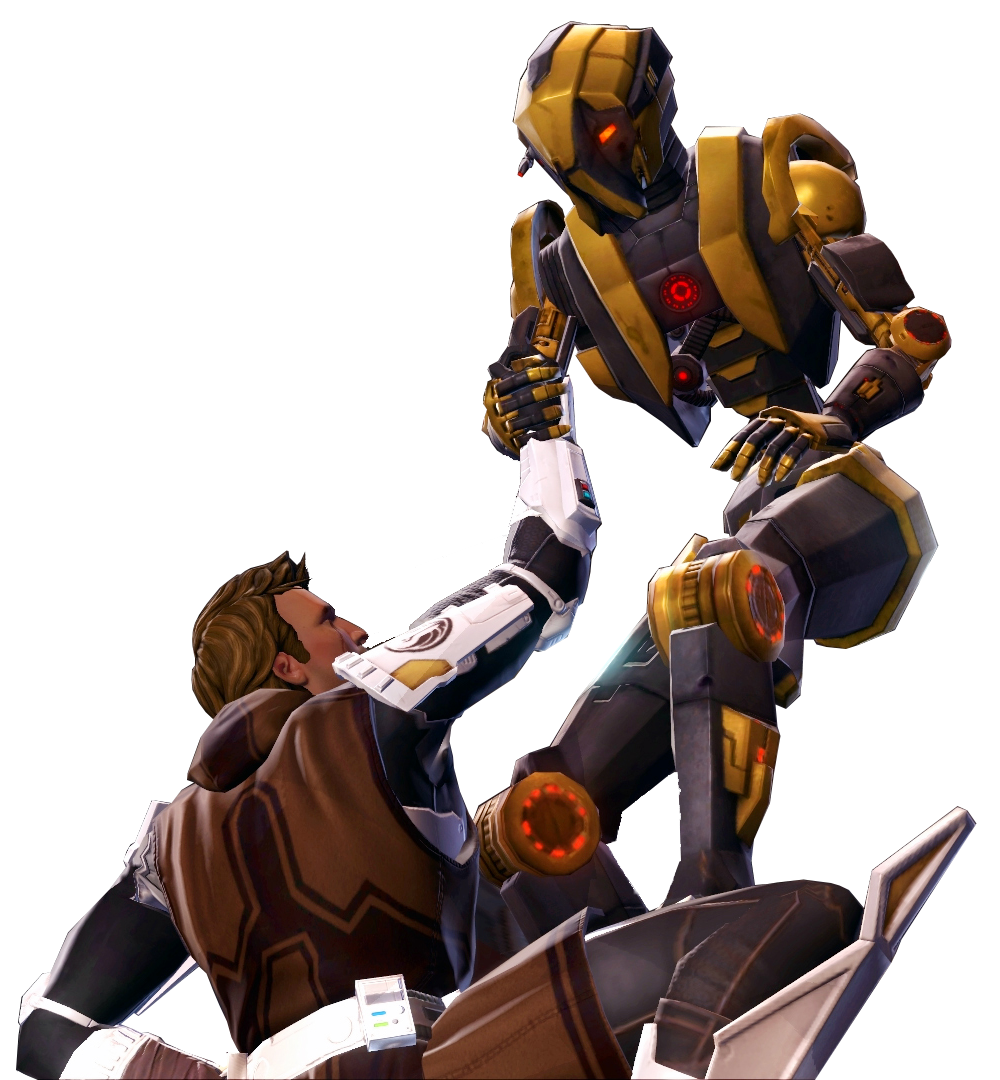
Berserker
In order to become a berserker, your companion must have a Strength score of 13 or higher.
As a berserker, your companion gains the following class features.
Proficiencies
- Armor: Light armor, medium armor
- Weapons: All vibroweapons, simple blasters
- Tools: None
- Saving Throws: Strength, Constitution
- Skills: Choose two from Animal Handling, Athletics, Intimidation, Nature, Perception, Survival
Rage
Beginning when your companion chooses this class at 3rd level, in battle, it fights with primal ferocity. On your companion's turn, it can enter a rage as a bonus action if it isn't wearing heavy armor.
While raging, your companion gains the following benefits:
- It has advantage on Strength checks and Strength saving throws.
- When it makes a melee weapon attack using Strength, it gains a +2 bonus to the damage roll. This bonus increases to +3 at 11th level.
- It has resistance to kinetic and energy damage.
- If it is able to cast powers, it can't cast them or concentrate on them while raging.
Your companion's rage lasts for 1 minute. It ends early if your companion is knocked unconscious, it dons heavy armor, or if its turn ends and it hasn't attacked a hostile creature or taken damage since its last turn. It can also end its rage on your turn as a bonus action.
Your companion can use this feature twice. It gains an additional use at 11th level. Your companion regains all expended uses when it finishes a long rest.
Reckless Attack
Also at 3rd level, your companion can throw aside all concern for defense to attack with fierce desperation. When you make your first attack on your turn, you can decide to attack recklessly. Doing so gives you advantage on melee weapon attack rolls using Strength during this turn, but attack rolls against you have advantage until your next turn.
Danger Sense
At 7th level, your companion gains an uncanny sense of when things nearby aren't as they should be, giving it an edge when it dodges away from danger.
Your companion has advantage on Dexterity saving throws against effects that it can see, such as traps and powers. To gain this benefit, it can't be blinded, deafened, or incapacitated.
Extra Attack
By 11th level, your companion can attack twice, instead of once, whenever it takes the Attack action on its turn.
Brutal Critical
At 15th level, your companion can roll one additional weapon damage die when determining the extra damage for a critical hit with a melee attack.
Relentless Rage
As of 18th level, your companion's rage can keep it fighting despite grievous wounds. If your companion drops to 0 hit points while it's raging and it doesn't die outright, it can make a DC 10 Constitution saving throw. If it succeeds, it drops to 1 hit point instead.
Each time you use this feature after the first, the DC increases by 5. When you finish a short or long rest, the DC resets to 10.
Consular
In order to become a consular, your companion must have a Wisdom or Charisma score of 13 or higher.
As a consular, your companion gains the following class features.
Proficiencies
- Armor: None
- Weapons: Simple lightweapons, simple vibroweapons
- Tools: None
- Saving Throws: Wisdom, Charisma
- Skills: Choose two from Deception, Insight, Intimidation, Investigation, Lore, Medicine, and Persuasion
Forcecasting
Beginning when your companion chooses this class at 3rd level, it has learned powers, fragments of knowledge that imbue it with an abiding force ability. See chapter 10 of the Player's Handbook for the general rules of forcecasting and chapter 11 of the Player's Handbook for the force powers list.
Force Powers Known
Your companion learns three force powers of its choice of no higher level than its Max Power Level. It may learn a force power at the same time it learns its prerequisite.
At-will powers chosen by your companion do not scale normally at higher levels. Instead, if they would scale at 5th level, they instead scale at 11th level, and if they would scale at 11th level, they instead scale at 18th level.
Force Points
Your companion does not require force points. Instead, it can only cast powers at 1st-level twice. It regains all expended uses after completing a long rest.
Max Power Level
Your companion's Max Power Level is 1st.
Forcecasting Ability
Your companion's forcecasting ability varies based on the alignment of the powers you cast. It uses Wisdom for light side powers, Charisma for dark side powers, and Wisdom or Charisma for universal powers (its choice). It uses this ability score modifier whenever a power refers to its forcecasting ability. Additionally, it uses this ability score modifier when setting the saving throw DC for a force power it casts and when making an attack roll with one.
Force save DC = 8 + its proficiency bonus +
its forcecasting ability modifier
Force attack modifier = its proficiency bonus +
its forcecasting ability modifier
Force Shield
Also at 3rd level, your companion learns how to defend itself purely through its strength with the Force. When your companion is hit by an attack, it can use its reaction to shroud itself in Force energy. Until the start of its next turn, it has a bonus to AC equal to its Wisdom or Charisma modifier (your companion's choice, a minimum of +1). This includes the triggering attack.
Your companion can use this feature twice. It gains an additional use at 11th level. Your companion regains all expended uses when it finishes a long rest.
Apprentice Forcecasting
At 7th level, your companion's Max Power Level increases to 2nd, and it learns two additional powers.
Additionally, your companion can cast powers at 2nd-level twice. It regains all expended uses after completing a long rest.
Journeyman Forcecasting
By 11th level, your companion's Max Power Level increases to 3rd, and it learns two additional powers.
Additionally, your companion can cast powers at 3rd-level twice. It regains all expended uses after completing a long rest.
Adept Forcecasting
At 15th level, your companion's Max Power Level increases to 4th, and it learns two additional powers.
Additionally, your companion can cast powers at 4th-level twice. It regains all expended uses after completing a long rest.
Master Forcecasting
As of 18th level, your companion's Max Power Level increases to 5th, and it learns two additional powers.
Additionally, your companion can cast powers at 5th-level once. It regains the ability to do so after completing a long rest.
Engineer
In order to become an engineer, your companion must have an Intelligence score of 13 or higher.
As an engineer, your companion gains the following class features.
Proficiencies
- Armor: Light armor
- Weapons: Simple blasters, simple vibroweapons
- Tools: Tinker's implements and one of your choice
- Saving Throws: Constitution, Intelligence
- Skills: Choose three from Investigation, Lore, Medicine, Nature, Piloting, and Technology
Techcasting
Beginning when your companion chooses this class at 3rd level, during its training it has derived powers from schematics with the aid of a wristpad. See chapter 10 of the Player's Handbook for the general rules of techcasting and chapter 12 of the Player's Handbook for the tech powers list.
Tech Powers Known
Your companion learns two tech powers of its choice of no higher level than its Max Power Level.
At-will powers chosen by your companion do not scale normally at higher levels. Instead, if they would scale at 5th level, they instead scale at 11th level, and if they would scale at 11th level, they instead scale at 18th level.
Tech Points
Your companion does not require tech points. Instead, it can only cast powers at 1st-level once. It regains the ability to do so after completing a short or long rest.
Max Power Level
Your companion's Max Power Level is 1st.
Techcasting Ability
Intelligence is your companion's techcasting ability for its tech powers. It uses Intelligence whenever a power refers to its techcasting ability. Additionally, it use its Intelligence modifier when setting the saving throw DC for a tech power it casts and when making an attack roll with one.
Force save DC = 8 + its proficiency bonus +
its Intelligence modifier
Force attack modifier = its proficiency bonus +
its Intelligence modifier
Techcasting Focus
Your companion uses a wristpad (found in chapter 5 of the Player's Handbook) as a techcasting focus for its tech powers.
Potent Aptitude
Also at 3rd level, your companion's technological experience lends it an uncommon insight that it can use to bolster its allies. To do so, it uses a bonus action on its turn to choose one creature other than itself within 60 feet of it who can hear it. That creature gains one Potent Aptitude die, a d4. This die increases to a d6 at 7th level and a d8 at 15th level.
Once within the next 10 minutes, the creature can roll the die and add the number rolled to one ability check, attack roll, or saving throw it makes. The creature can wait until after it rolls the d20 before deciding to use the Potent Aptitude die, but must decide before the GM says whether the roll succeeds or fails. Once the Potent Aptitude die is rolled, it is lost.
A creature can have only one Potent Aptitude die at a time.
Your companion can use this feature a number of times equal to its Intelligence modifier (a minimum of once). It regains any expended uses when it finishes a long rest.
Techcasting, Mark II
At 7th level, your companion's Max Power Level increases to 2nd, and it learns two additional powers.
Additionally, your companion can cast powers at 2nd-level once. It regains the ability to do so after completing a short or long rest.
Techcasting, Mark III
By 11th level, your companion's Max Power Level increases to 3rd, and it learns one additional power.
Additionally, your companion can cast powers at 3rd-level once. It regains the ability to do so after completing a short or long rest.
Techcasting, Mark IV
At 15th level, your companion's Max Power Level increases to 4th, and it learns two additional powers.
Additionally, your companion can cast powers at 4th-level once. It regains the ability to do so after completing a short or long rest.
Techcasting, Mark V
As of 18th level, your companion's Max Power Level increases to 5th, and it learns two additional powers.
Additionally, your companion can cast powers at 5th-level once. It regains all expended uses after completing a long rest.
Fighter
In order to become a warrior, your companion must have a Strength, Dexterity, or Constitution score of 13 or higher.
As a fighter, your companion gains the following class features.
Proficiencies
- Armor: All armor
- Weapons: All blasters, all vibroweapons
- Tools: None
- Saving Throws: Strength, Constitution
- Skills: Choose two skills from Acrobatics, Animal Handling, Athletics, Lore, Insight, Intimidation, Perception, and Survival
Second Wind
Beginning when your companion chooses this class at 3rd level, it has a limited well of stamina that it can draw on to protect itself from harm. On its turn, your companion can use a bonus action to regain hit points. It rolls a Hit Die without expending it, regaining a number of hit points equal to the result of the Hit Die + its level.
Once your companion has used this feature, it must finish a short or long rest before it can use it again.
Action Surge
Also at 3rd level, your companion can push itself beyond its normal limits for a moment. On its turn, it can take one additional action on top of its regular action and possible bonus actions.
Once your companion has used this feature, it must finish a short or long rest before it can use it again.
Martial Superiority
At 7th level, your companion has learned maneuvers that are fueled by special dice called superiority dice.
Maneuvers
Your companion learns two maneuvers of its choice from those available to the fighter class. Many maneuvers enhance an attack in some way. Your companion can use only one maneuver per attack, and it may only use each maneuver once per turn.
Your companion learns an additional maneuver at 11th level. Each time your companion gains a level, it can also replace one maneuver it knows with a different one.
Superiority Dice
Your companion has two superiority dice, which are d4s. This die increases to a d6 at 7th level and a d8 at 15th level. A superiority die is expended when your companion uses it. Your companion regains all of its expended superiority dice when it finishes a short or long rest.
Your companion gains an additional superiority die at 11th level.
Saving Throws
Some of your companion's maneuvers require its target to make a saving throw to resist the maneuver's effects. The saving throw DC is calculated as follows:
Maneuver save DC = 8 + its proficiency bonus +
its Strength or Dexterity modifier (its choice)
Extra Attack
By 11th level, your companion can attack twice, instead of once, whenever it takes the Attack action on its turn.
Indomitable
At 15th level, your companion can reroll a saving throw that it fails. If it does so, it must use the new roll.
Your companion can use this feature twice. It regains all expended uses when it completes a long rest.
Greater Extra Attack
As of 18th level, your companion can attack three times, instead of once, whenever it takes the Attack action on its turn.
Additionally, when your companion uses a bonus action to engage in Double- or Two-Weapon Fighting, it can make two attacks, instead of one.
Guardian
In order to become a guardian, your companion must have a Constitution, Wisdom, or Charisma score of 13 or higher.
As a guardian, your companion gains the following class features.
Proficiencies
- Armor: Light armor, medium armor
- Weapons: All lightweapons, all vibroweapons
- Tools: None
- Saving Throws: Constitution, Charisma
- Skills: Choose two from Acrobatics, Athletics, Deception, Insight, Intimidation, Lore, Perception, Persuasion, and Piloting
Forcecasting
Beginning when your companion chooses this class at 3rd level, it has learned powers, fragments of knowledge that imbue it with an abiding force ability. See chapter 10 of the Player's Handbook for the general rules of forcecasting and chapter 11 of the Player's Handbook for the force powers list.
Force Powers Known
Your companion learns three force powers of its choice of no higher level than its Max Power Level. It may learn a force power at the same time it learns its prerequisite.
At-will powers chosen by your companion do not scale normally at higher levels. Instead, if they would scale at 5th level, they instead scale at 11th level, and if they would scale at 11th level, they instead scale at 18th level.
Force Points
Your companion does not require force points. Instead, it can only cast powers at 1st-level twice. It regains all expended uses after completing a long rest.
Max Power Level
Your companion's Max Power Level is 1st.
Forcecasting Ability
Your companion's forcecasting ability varies based on the alignment of the powers you cast. It uses Wisdom for light side powers, Charisma for dark side powers, and Wisdom or Charisma for universal powers (its choice). It uses this ability score modifier whenever a power refers to its forcecasting ability. Additionally, it uses this ability score modifier when setting the saving throw DC for a force power it casts and when making an attack roll with one.
Force save DC = 8 + its proficiency bonus +
its forcecasting ability modifier
Force attack modifier = its proficiency bonus +
its forcecasting ability modifier
Channel the Force
Also at 3rd level, your companion knows how to channel the Force to create a unique effect. Your companion starts with its choice of one from two such effects: Cause Harm or Lend Aid.
Some Channel the Force effects require saving throws. When your companion uses such an effect from this class, the DC equals its universal force save DC.
Your companion can use this feature a number of times equal to its Wisdom or Charisma modifier (your companion's choice, minimum of once). Your companion regains all expended uses when it finishes a short or long rest.
Cause Harm
As an action, your companion can expend a use of its Channel the Force to sap the life from a hostile creature it can see within 60 feet. That creature must make a Constitution saving throw. On a failed save, the creature takes necrotic damage equal to your companion's level + its Charisma modifier (minimum of one), or half as much on a successful one.
Lend Aid
As a bonus action, your companion can expend a use of its Channel the Force and touch a beast or humanoid within 5 feet of it. That creature regains hit points equal to your companion's guardian level + its Wisdom modifier (minimum of one). Alternatively, if the beast or humanoid is poisoned or diseased, your companion neutralizes the poison or disease. If more than one poison or disease afflicts the target, your companion neutralizes one poison or disease that it knows is present, or it neutralizes one at random.
Apprentice Forcecasting
At 7th level, your companion's Max Power Level increases to 2nd, and it learns two additional powers.
Additionally, your companion can cast powers at 2nd-level twice. It regains all expended uses after completing a long rest.
Extra Attack
By 11th level, your companion can attack twice, instead of once, whenever it takes the Attack action on its turn.
Force Purity
At 15th level, the Force flowing through your companion makes it immune to poison and disease.
Journeyman Forcecasting
As of 18th level, your companion's Max Power Level increases to 3rd, and it learns two additional powers.
Additionally, your companion can cast powers at 3rd-level once. It regains the ability to do so after completing a long rest.
Monk
In order to become a monk, your companion must have a Dexterity, Wisdom, or Charisma score of 13 or higher.
As a monk, your companion gains the following class features.
Proficiencies
- Armor: None
- Weapons: Simple blasters, simple vibroweapons, chakrams, techblades
- Tools: None
- Saving Throws: Strength, Dexterity
- Skills: Choose two from Acrobatics, Athletics, Insight, Lore, Perception, and Stealth
Martial Arts
Beginning when your companion chooses this class at 3rd level, your companion's practice of martial arts gives it mastery of combat styles that use unarmed strikes and martial artist weapons, which are any simple vibroweapons that don't have the two-handed property.
Your companion gains the following benefits while it is unarmed or wielding only martial artist weapons and isn't wearing armor or wielding a shield:
- Your companion can use Dexterity instead of Strength for the attack and damage rolls of its unarmed strikes and martial artist weapons.
- Your companion can roll a d4 in place of the normal damage of its unarmed strike or martial artist weapons. This die becomes a d6 at 7th level and a d8 at 15th level.
- Your companion can use Dexterity instead of Strength whenever it would make a Strength (Athletics) check to grapple, shove, or trip a creature.
- When your companion takes the Attack action with an unarmed strike or a martial artist weapon on your turn, it can make one unarmed strike as a bonus action.
- Your companion can take the Dash and Disengage actions as a bonus action.
Unarmored Defense
Also at 3rd level, while your companion is wearing no armor and not wielding a shield, its AC equals 10 + its Dexterity modifier + its Wisdom or Charisma modifier (your companion's choice).
Focus
At 7th level, your companion's training allows it to harness the mystic energy of focus. Its access to this energy is represented by a number of focus points. Your companion has three focus points. It gains an additional focus point at 9th, 13th, and 17th level.
Your companion can spend these points to fuel various focus features. Your companion knows three such features: Flurry of Blows, Patient Defense, and Step of the Wind.
When your companion spends a focus point, it is unavailable until your companion finishes a short or long rest, at the end of which it draws all of its expended focus back into itself. Your companion must spend at least 30 minutes of the rest meditating to regain its focus points.
Some of your companion's focus features require your target to make a saving throw to resist the feature's effects. The saving throw DC is calculated as follows:
Focus save DC = 8 + your proficiency bonus + your Wisdom or Charisma modifier (your choice)
Flurry of Blows
When your companion makes its Martial Arts bonus action unarmed strike, it can spend 1 focus point to make an additional unarmed strike (no action required). At 18 level, it can instead spend 2 focus points to make two additional unarmed strikes.
Patient Defense
When your companion uses its bonus action to Disengage, it can spend 1 focus point to also Dodge (no action required). At 18th level, it can instead spend 2 focus points to Dodge and gain an additional reaction until the start of its next turn. It can only take one reaction per turn.
Step of the Wind
When your companion uses its bonus action to Dash, it can spend 1 focus point to double its jump distance for the turn. At 18th level, it can instead spend 2 focus points to gain a flying speed equal to its walking speed until the end of your turn, though it falls if it ends its speed in the air and nothing else is holding it aloft.
Enhanced Strikes
Also at 7th level, your companion's unarmed strikes count as enhanced for the purpose of overcoming resistance and immunity to unenhanced attacks and damage.
Extra Attack
By 11th level, your companion can attack twice, instead of once, whenever it takes the Attack action on its turn.
Evasion
At 15th level, when your companion is subjected to an effect, such as a consular's force storm or an engineer's explosion, that allows it to make a Dexterity saving throw to take only half damage, it instead take no damage if it succeeds on a saving throw, and only half damage if it fails.
Diamond Soul
As of 18th level, your companion gains proficiency in all saving throws. Additionally, whenever your companion fails a saving throw, it can spend 1 focus point to reroll it and take the second result.
Operative
In order to become an operative, your companion must have a Dexterity or Intelligence score of 13 or higher.
As an operative, your companion gains the following class features.
Proficiencies
- Armor: Light armor
- Weapons: Simple blasters, simple vibroweapons, blaster pistol, hidden blade, techblade, vibrorapier
- Tools: One specialist's kit of your choice
- Saving Throws: Dexterity, Intelligence
- Skills: Choose any four
Sneak Attack
Beginning when your companion chooses this class at 3rd level, your companion knows how to strike subtly and exploit a foe's distraction. Once per turn, it can deal an extra 1d6 damage to one creature it hits with an attack if it has advantage on the attack roll. The attack must use a finesse or a ranged weapon.
Your companion doesn't need advantage on the attack roll if another enemy of the target is within 5 feet of it, that enemy isn't incapacitated, and your companion doesn't have disadvantage on the attack roll.
The amount of extra damage increases to 2d6 at 7th level, 3d6 at 11th level, 4d6 at 15th level, and 5d6 at 17th level.
Cunning Action
Also at 3rd level, your companion's quick thinking and agility allow it to move and act quickly. Your companion can take a bonus action on each of its turns in combat. This action can be used only to take the Dash, Disengage, or Hide action.
Bad Feeling
At 7th level, your companion has a wary eye, bordering on paranoia. When your companion rolls for initiative, it can move up to its speed. This movement happens before the initiative order is determined.
Once your companion has used this feature, it must finish a long rest before it can use it again.
Uncanny Dodge
By 11th level, when an attacker that your companion can see hits it with an attack, your companion can use its reaction to halve the attack's damage against it.
Evasion
At 15th level, when your companion is subjected to an effect, such as a consular's force storm or an engineer's explosion, that allows it to make a Dexterity saving throw to take only half damage, it instead take no damage if it succeeds on a saving throw, and only half damage if it fails.
Reliable Talent
As of 18th level, your companion has refined its chosen skills until they approach perfection. Whenever your companion makes an ability check that lets it add its proficiency bonus, it can treat a d20 roll of 9 or lower as a 10.
Scholar
In order to become a scholar, your companion must have an Intelligence score of 13 or higher.
As a scholar, your companion gains the following class features.
Proficiencies
- Armor: Light armor
- Weapons: Simple blasters, simple vibroweapons, techblades
- Tools: Any one
- Saving Throws: Wisdom, Intelligence
- Skills: Choose three from Deception, Insight, Intimidation, Investigation, Lore, Medicine, Nature, Persuasion, and Survival
Academic Superiority
Beginning when your companion chooses this class at 3rd level, your companion has learned maneuvers that are fueled by special dice called superiority dice.
Maneuvers
Your companion learns two maneuvers of its choice from those available to the scholar class. Many maneuvers enhance an attack in some way. Your companion can use only one maneuver per attack, and it may only use each maneuver once per turn.
Your companion learns an additional maneuver at 7th, 11th, and 15th level. Each time your companion gains a level, it can also replace one maneuver it knows with a different one.
Superiority Dice
Your companion has two superiority dice, which are d4s. A superiority die is expended when your companion uses it. Your companion regains all of its expended superiority dice when it finishes a short or long rest.
Your companion gains an additional superiority die at 7th, 11th, and 15th level.
Saving Throws
Some of your companion's maneuvers require its target to make a saving throw to resist the maneuver's effects. The saving throw DC is calculated as follows:
Maneuver save DC = 8 + its proficiency bonus +
its Intelligence modifier
Critical Analysis
Also at 3rd level, it is able to analyze a target, develop a plan on how to best overcome any potential obstacle, and execute that plan with ruthless efficiency. As a bonus action on its turn, your companion can analyze a target it can see within 60 feet of it. For the next minute, or until your companion analyzes another target, it gain the following benefits:
- When your companion analyzes a hostile creature, its attack and damage rolls made with weapons with the finesse property or blaster weapons against that target may use its Intelligence modifier instead of Strength or Dexterity.
- When your companion analyzes a friendly creature, the target can end your companion's Critical Analysis on them (no action required) to add its Intelligence modifier to one attack roll, ability check, or saving throw. Once a friendly creature has benefited from this ability, they can not do so again until they complete a short or long rest.
Discoveries
At 7th level, your companion learns two discoveries from those available to the scholar class or any of the scholar's archetypes.
Multitasker
By 11th level, your companion can take a second reaction each round. It can only take one reaction per turn.
Sage Advice
At 15th level, your companion can spend 1 minute spread its knowledge and experience, advising those around it. When it does so, your companion chooses a skill or tool it is proficient with and a number of friendly creatures up to its Intelligence modifier with 30 feet of it who can hear it and understand it. Once within the next hour, the next time each creature would make an ability check with the chosen skill or tool, they may add their proficiency bonus to the roll if they are not already proficient. A creature may only benefit from this feature once. If a creature is targeted by this feature again before using it, they can choose to retain the first benefit or replace it with the new skill or tool instead.
Once your companion has used this feature, it must complete a short or long rest before it can use it again.
Calm and Collected
As of 18th level, when your companion makes a saving throw caused by an effect it can see, it may gain a bonus to the saving throw equal to its Intelligence modifier.
Once your companion has used this feature, it must complete a short or long rest before it can use it again.
Scout
In order to become a scout, your companion must have a Strength, Dexterity, or Intelligence score of 13 or higher.
As a scout, your companion gains the following class features.
Proficiencies
- Armor: Light armor, medium armor
- Weapons: All blasters, all vibroweapons
- Tools: None
- Saving Throws: Strength, Dexterity
- Skills: Choose three from Animal Handling, Athletics, Insight, Investigation, Perception, Piloting, Stealth, Survival, and Technology
Techcasting
Beginning when your companion chooses this class at 3rd level, during its training it has derived powers from schematics with the aid of a wristpad. See chapter 10 of the Player's Handbook for the general rules of techcasting and chapter 12 of the Player's Handbook for the tech powers list.
Tech Powers Known
Your companion learns two tech powers of its choice of no higher level than its Max Power Level.
At-will powers chosen by your companion do not scale normally at higher levels. Instead, if they would scale at 5th level, they instead scale at 11th level, and if they would scale at 11th level, they instead scale at 18th level.
Tech Points
Your companion does not require tech points. Instead, it can only cast powers at 1st-level once. It regains the ability to do so after completing a short or long rest.
Max Power Level
Your companion's Max Power Level is 1st.
Techcasting Ability
Intelligence is your companion's techcasting ability for its tech powers. It uses Intelligence whenever a power refers to its techcasting ability. Additionally, it use its Intelligence modifier when setting the saving throw DC for a tech power it casts and when making an attack roll with one.
Force save DC = 8 + its proficiency bonus +
its Intelligence modifier
Force attack modifier = its proficiency bonus +
its Intelligence modifier
Techcasting Focus
Your companion uses a wristpad (found in chapter 5 of the Player's Handbook) as a techcasting focus for its tech powers.
Ranger's Quarry
Also at 3rd level, your companion learns how to effectively read and track its prey. Once on each of its turns, your companion can choose a creature it can see within 120 feet and mark it as its quarry (no action
required). For the next hour, your companion gains the following benefits:
- Once per turn, when your companion hits the target with a weapon attack, it can deal 1d4 additional damage to it of the same type as the weapon's damage. This die increases to a d6 at 7th level and a d8 at 15th level.
- Your companion has advantage on any Wisdom (Perception) or Wisdom (Survival) check it makes to find the target while it's on the same planet as your companion.
Your companion can only have one creature marked in this way at a time. Beginning at 11th level, your companion can use its reaction to mark a creature when it enters its line of sight, provided it is within range of your companion's Ranger's Quarry.
The duration increases to 8 hours at 11th level.
Techcasting, Mark II
At 7th level, your companion's Max Power Level increases to 2nd, and it learns two additional powers.
Additionally, your companion can cast powers at 2nd-level once. It regains the ability to do so after completing a short or long rest.
Extra Attack
By 11th level, your companion can attack twice, instead of once, whenever it takes the Attack action on its turn.
Commando
At 15th level, your companion can take the Dash or Hide actions as a bonus action on each of its turns. Additionally, it can remain perfectly still for long periods of time to set up ambushes.
When your companion attempts to hide on its turn, it can opt to not move on that turn. If it avoids moving, creatures that attempt to detect it take a -10 penalty to their Wisdom (Perception) checks until the start of your companion's next turn. Your companion loses this benefit if it moves or falls prone, either voluntarily or because of some external effect. It is still automatically detected if any effect or action causes it to no longer be hidden.
If your companion is still hidden on its next turn, it can continue to remain motionless and gain this benefit until it is detected.
Additionally, your companion can no longer be tracked by unenhanced means, unless it chooses to leave a trail.
Techcasting, Mark III
As of 18th level, your companion's Max Power Level increases to 3rd, and it learns one additional power.
Additionally, your companion can cast powers at 3rd-level once. It regains the ability to do so after completing a long rest.
Sentinel
In order to become a sentinel, your companion must have a Dexterity, Wisdom, or Charisma score of 13 or higher.
As a sentinel, your companion gains the following class features.
Proficiencies
- Armor: Light armor
- Weapons: Simple vibroweapons, simple lightweapons, chakram, doubleblade, doublesaber, doubleshoto, doublesword, hidden blade, lightfoil, light ring, saberwhip, vibrorapier, vibrowhip
- Tools: One specialist's kit of your choice
- Saving Throws: Dexterity, Charisma
- Skills: Choose three from Acrobatics, Animal Handling, Insight, Intimidation, Perception, Persuasion, Piloting, Stealth, and Technology
Forcecasting
Beginning when your companion chooses this class at 3rd level, it has learned powers, fragments of knowledge that imbue it with an abiding force ability. See chapter 10 of the Player's Handbook for the general rules of forcecasting and chapter 11 of the Player's Handbook for the force powers list.
Force Powers Known
Your companion learns three force powers of its choice of no higher level than its Max Power Level. It may learn a force power at the same time it learns its prerequisite.
At-will powers chosen by your companion do not scale normally at higher levels. Instead, if they would scale at 5th level, they instead scale at 11th level, and if they would scale at 11th level, they instead scale at 18th level.
Force Points
Your companion does not require force points. Instead, it can only cast powers at 1st-level twice. It regains all expended uses after completing a long rest.
Max Power Level
Your companion's Max Power Level is 1st.
Forcecasting Ability
Your companion's forcecasting ability varies based on the alignment of the powers you cast. It uses Wisdom for light side powers, Charisma for dark side powers, and Wisdom or Charisma for universal powers (its choice). It uses this ability score modifier whenever a power refers to its forcecasting ability. Additionally, it uses this ability score modifier when setting the saving throw DC for a force power it casts and when making an attack roll with one.
Force save DC = 8 + its proficiency bonus +
its forcecasting ability modifier
Force attack modifier = its proficiency bonus +
its forcecasting ability modifier
Led by the Force
Also at 3rd level, your companion can add half its proficiency bonus, rounded down, to any ability check it makes that doesn't already include its proficiency bonus.
Apprentice Forcecasting
At 7th level, your companion's Max Power Level increases to 2nd, and it learns two additional powers.
Additionally, your companion can cast powers at 2nd-level twice. It regains all expended uses after completing a long rest.
Extra Attack
By 11th level, your companion can attack twice, instead of once, whenever it takes the Attack action on its turn.
Journeyman Forcecasting
At 15th level, your companion's Max Power Level increases to 3rd, and it learns two additional powers.
Additionally, your companion can cast powers at 3rd-level twice. It regains all expended uses after completing a long rest.
Adept Forcecasting
As of 18th level, your companion's Max Power Level increases to 4th, and it learns two additional powers.
Additionally, your companion can cast powers at 4th-level once. It regains the ability to do so after completing a long rest.