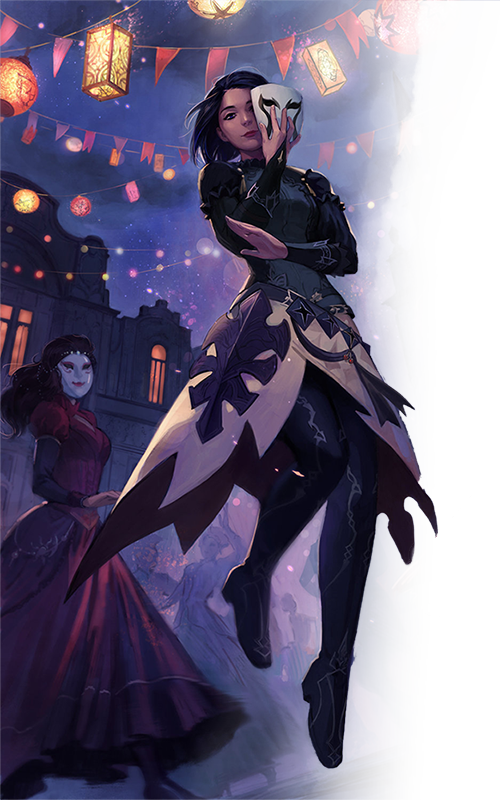
Rogue: The Masquerader
It is wrong to judge by appearances. Despite his expression, which was that of a piglet having a bright idea, and his mode of speech, which might put you in mind of a small, breathless, neurotic but ridiculously expensive dog, Mr Horsefry might well have been a kind, generous and pious man. In the same way, the man climbing out of your window in a stripy jumper, a mask and a great hurry might merely be lost on the way to a fancy-dress party.
You are a cunning social manipulator. Your focus is on people, your outward appearance, and the art of misdirection.
Masqueraders often lead double lives as charlatans, performers, socialites, and spies due to their mastery of social dynamics. They are frequently hired by powerful figures to infiltrate their rivals without notice. Deception is the tool of the trade as they rely on disguises and underhanded tricks to mask their true nature.
Masquerader Features
| Level | Feature |
|---|---|
| 3rd | Mask of the Impostor, Deceptive Fighting |
| 9th | Gentle Twist |
| 13th | It Could Be You |
| 17th | A Face You Can Forget |
Mask of the Impostor
At 3rd level, you gain proficiency with disguise kits. Your proficiency bonus is doubled for any ability check that uses your proficiency with disguise kits. You also gain a disguise kit if you don't have one already.
You have a number of prepared disguises equal to your Charisma modifier (minimum of 1) that you can quickly don or doff over the course of one minute. Each disguise must be of a creature that is the same size as you and has the same basic arrangement of limbs. When you finish a long rest you can prepare a new set of disguises if you have your disguise kit on you. You determine each disguise's apparent race, age, gender, clothing style, and other visual details when you prepare it.
Deceptive Fighting
Also at 3rd level, you gain an additional way to use your bonus action: to mislead a creature in the heat of battle. For instance, you may pretend to be an injured combatant while clutching a hidden weapon, or use your off-hand to create a diversion that opens a creature to your attack.
When you use this feature, you target a creature that can see you within 60 feet and make a Charisma (Deception) check contested by the target's Wisdom (Insight) check. The target automatically fails its check if it's charmed by you. If your check succeeds, your next attack against it has advantage, and it has disadvantage on attacks against you until you attack it or deal damage to it. You must make your attack before the end of your next turn, otherwise the effect ends.

Variant Ruling: Deceptive Fighting
This ruling offers a variant way for DMs to run the Deceptive Fighting feature, acting as a deception based counterpart to the Hide action.
Using this ruling, when a character uses their Deceptive Fighting, they make their Charisma (Deception) check against the target's passive Insight, instead of rolling a separate Wisdom (Insight) check for the target. The character's check automatically succeeds if the target is charmed by them.
Gentle Twist
At 9th level, if you speak to a non-hostile creature for at least 1 minute, you can attempt to charm it into believing you to be a trustworthy ally. If the target can understand you, it must succeed on a Wisdom saving throw or be charmed by you for one hour. The save DC for this effect equals 8 + your proficiency bonus + your Charisma modifier. While charmed in this way, the target trusts you as it would a close friend. It will perform basic tasks at your request but will avoid violence unless it was already inclined to fight on your behalf. It also believes anything you say without the need for a Charisma check, though the DM might deem something you say to be too nonsensical for anyone to believe you. This effect ends early on the target if you attack it, if you do something harmful to it, or if it witnesses you attacking or doing something harmful to its allies.
You can exploit the target's trust to strike when it least expects you to. If you hit the target with a weapon attack before the effect ends, you can end the charm effect on it to turn your hit into a critical hit.
If the target succeeds on its saving throw it knows that you tried to manipulate it and becomes hostile toward you. A creature prone to violence might attack you. Another creature might seek retribution in other ways.
It Could Be You
At 13th level, using your disguise kit, you can quickly craft a disguise over the span of one minute that resembles a corpse or creature within 5 feet of you. You must remain within range of the corpse or creature for the duration, and if you select a corpse, it must belong to a creature that died no more than 24 hours ago. The creature must have the same basic form as you and can be up to one foot taller or shorter than you.
You construct the disguise by combining cosmetics and small props with materials taken from the creature (such as bits of its clothing), but may not include armor that you aren't proficient with. You gain the disguise as if you had it prepared and can immediately don it. It does not count towards your total number of prepared disguises. If you had a previous disguise from this feature, the new one replaces it.
While wearing the disguise, you appear to be a perfect clone of the original creature: other creatures automatically believe you to be the original creature until given an obvious reason not to.
A Face You Can Forget
At 17th level, your beguiling words can alter a creature's recollection of its most recent events. When a creature that can hear you stops being charmed by you, you can force it to make a Wisdom saving throw against a save DC equal to 8 + your proficiency bonus + your Charisma modifier. If it fails, you alter its understanding so that it remains unaware of having been charmed. You can also alter its memory of any events that it witnessed within the last minute, either erasing them from its memory altogether or replacing them with a false narrative, though your description of the events must make logical sense. For instance, you may cause the creature to think that an injury it received was accidentally self inflicted.
The creature believes its altered memories to be completely true. Its mind fills in any gaps or inconsistencies in your description to the best of its ability. The only way to restore its original memories is through a greater restoration spell or more powerful magic.
If the creature succeeds on its saving throw, you can't use this feature on it again until you finish a long rest.
Credits
Art Credits
Julia Zhuravleva — Carnival
Grafit Studio — Doppleganger
Version 3.5