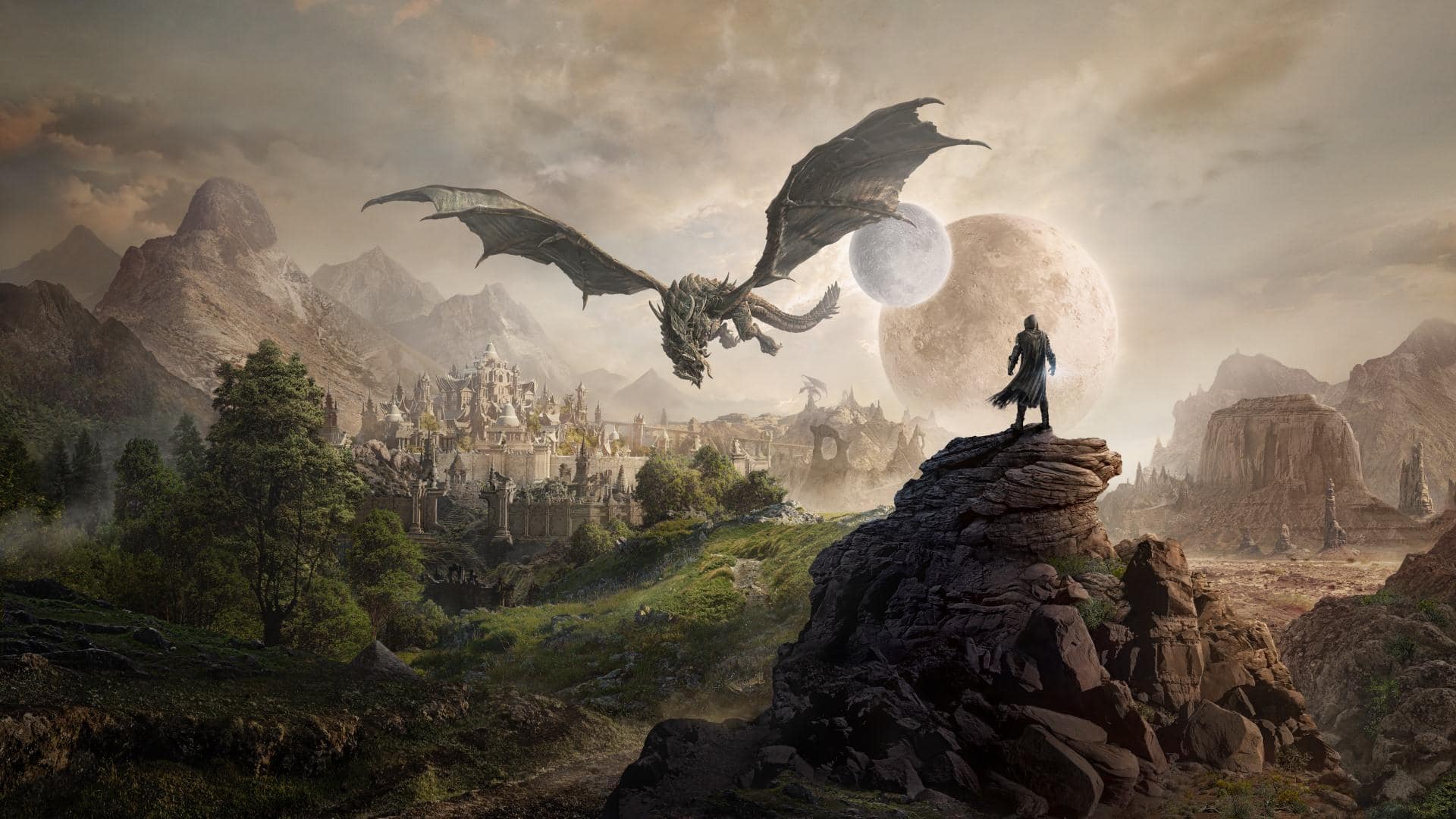
The Elder Scrolls: Dragonbreak
1. Player Expectations
One Line Summary
What if Skyrim/Oblivion/Morrowind, but you just live in the world instead of save it?
Tone
You’re a small inhabitant of a diverse & dangerous world; there are so many more ways to suffer than to succeed. Often bleak & gritty, sometimes absurd & silly, the common thread is a grounded and personal tale of remarkable people leaving their mark on a much larger world.
The age rating for this game is 15. While The Elder Scrolls has always referenced adult themes such as sex, rape, racism, drug abuse & torture, there is no precedent for these being depicted, and so I will keep them “off-camera”. To reiterate: if any character engages in any of these acts we will simply state that it happened, and move on.
Setting
This game takes place in the province known as Cyrodiil. It is the seat of the Empire, and sits in the centre of the continent of Tamriel. There are 8 other provinces, some loyal and some hostile to the Empire.
This game takes place after all of the Elder Scrolls video games, meaning the events of Skyrim are in the past. The game takes place during a (not unprecedented) Dragonbreak. What does that mean? It means time itself has splintered and is yet to be consolidated into one consistent reality. Past & future are malleable, and contradictory events can coexist. What does is really mean? It means if we get something wrong about the lore or history of the setting we can blame it on the Dragonbreak and move on.
If you’re hungry for more lore I recommend: Elder Scrolls Lore (UESP)
The Role Of The Players
You play as a character unburdened by prophecy. You are not here to save the world, you are here to leave your mark upon it however you please. You could be a mighty warrior, powerful spellcaster, silent thief, shrewd politician, fanatical devotee of the mysterious Daedric Princes, a local town guard or a simple farmhand. Whatever path you choose, this world and its denizens will challenge your will, your wits, and in the end you will learn that nothing is gained without sacrifice
Genre
The Elder Scrolls is a high-fantasy setting where magic, monsters, gods & bandits have a strong presence in the everyday world. Western RPG tropes mix with elements of steampunk, horror, & Eastern mysticism. Underground cities filled with historical artefacts are guarded by clockwork automatons, cities infiltrated by vampires and cultists keep the citizens and guilds safe from wild monsters and Daedra worshippers, dragons meet on mountain tops and debate whether to save or subjugate the races below, and trade caravans cross through deserts, jungles, ashy wastelands and snowy valleys selling exotic wares.
But not everything is as it seems! Are the gods really all-powerful? Do our leaders really know what’s best? Can history be separated from propaganda?
In this world everyone is fallible and everyone has an agenda, so mystery and political intrigue are as present and dangerous as werewolves, trolls & giant flying jellyfish. And yet groups are stronger than individuals, so even thieves have guilds.
What This Game Is Not
This is not a recreation of the experience of an Elder Scrolls video game. This is not dungeon crawls, level advancement, or treasure acquisition. This is not prophesied heroes saving the world. This is not solve-everything-with-violence.
2. Rules & Houserules
Powered By fate
This game uses the Fate Core Rules, with the following changes:
Stress
Each character gets 3 stress boxes of escalating value. These do not change based on your skill.
Skill List
The in-depth skill list is at the end of this document, but here’s the short version:
Physical
- Athletics
- Fight
- Marksman
- Physique
- Ride
Magical
- Conjuration
- Destruction
- Restoration
Sneaky Skills
- Deceive
- Legerdemain
- Stealth
Mental/Knowledge
- Education
- Investigate
- Mechanics
- Notice
- Will
House Rules
No PvP Without Consent
Players cannot take narrative control of each other’s characters regardless of character skill. Say you want to pickpocket another player; you don’t roll dice, you simply agree with the other player on an outcome. If you can’t agree, nothing happens.
X-Card
The X-Card by John Stavropoulos is a way of censoring content from the game which would cause harm or undue emotional distress to any player.
Fighting In Spirit
If a character is not present in a scene (having been taken out doesn’t count here), they can use flashbacks with another character they have an established history with (i.e. an aspect is needed to justify this) to Create An Advantage for inspiring them in some way.
Magic
Magic is available to anybody who has time, money, mental fortitude and access to a teacher. Its use is fairly common in that most decent-sized villages will have one or maybe two practitioners, usually temple healers or court wizards. Magic is commonly used as a weapon alongside traditional arms, and as a source of healing especially in temples. Necromancy is common outside of civilised society, and anything goes behind locked doors in magical academies. Magic users tend to occupy official positions or be social outcasts, with not much in between. Different societies view magic users differently. While the Altmer and Dumner have a proud history of mighty mages, the Cyrodiils and Nords are highly suspicious of magic users because of their role in historical calamities.
Physically casting a spell requires spoken words and precise gestures.
Characters will require a permission-granting aspect to cast spells, which is handled as a normal skill roll. Many skills can be used to express magical effects, not only the three magic specific skills. Without a magical aspect, characters can use the magic skills only for theoretical knowledge of magic.
Magic Aspect
In The Elder Scrolls, magical skill comes from patient study, and magical spells and effects must be passed on by a teacher who already knows them. Magical effects are not intuitive or improvisational. Therefore, to cast magic at all, a character needs an aspect to establish where or with whom they studied magic.
Characters
You play as a character unburdened by prophecy. You are not here to save the world, you are here to leave your mark upon it however you please. You could be a mighty warrior, powerful spellcaster, silent thief, shrewd politician, fanatical devotee of the mysterious Daedric Princes, a local town guard or a simple farmhand. Whatever path you choose, this world and its denizens will challenge your will, your wits, and in the end you will learn that nothing is gained without sacrifice.
Aspects
High Concept and Trouble are no longer formal aspects. You aspects should cover the following:
- Race
- Profession/Function in the world
- Reputation (will change to reflect criminal bounty)
- Something for the GM to compel
Logistics Of Play
I am in a UK time zone and have quite a flexible schedule. I’ll establish a play group of those who are interested, and use the following online tools to run the game.
Discord
- Voice chat only
- Dice bot
- Updates, announcements & general chat
Roll20.net
- Character sheets
- Virtual tabletop
WhenIsGood.net
- Comparing availability to select game times
This mini series will be between 5 and 10 weekly episodes. That’s my expectation but I’m flexible we want to depart from this in some way.
We will begin with a Session 0 to establish expectations and fine tune the skills list & character aspects.
To get in touch find me on Discord: Dgerrimea#9388
The rest of this document is reference material regarding the races and skills available to players.
Reference
Playable Races
- Altmer (High Elves) Altmer are the light-skinned and tall Elves of the Summerset Isles, part of the Aldmeri Dominion ruled by the Elven-supremacist group known as the Thalmor.
- Argonians A reptilian race from Black Marsh who have a spiritual connection to the Hist trees.
- Bosmer (Wood Elves) Bosmer are the elven people of Valenwood. They prefer a simple existence, living in harmony with the land and wild animals, but in the Fourth Era were absorbed into the Aldmeri Dominion.
- Bretons Of mixed elven and human descent, the Bretons of High Rock excel at both magical abilities and political intrigue.
- Dunmer (Dark Elves) The Dumner of Morrowind have suffered the loss of their living gods, and the destruction of much of their homeland since the closing years of the Third Era.
- Imperials (Cyrodiils) Hailing from the cosmopolitan region of Cyrodiil, seat of the Mede Empire, these shrewd diplomats and disciplined soldiers were the dominant race in Tamriel until the Aldmeri Dominion challenged them in the Great War.
- Khajiit A cat-like race hailing from Elsweyr, their natural affinity for stealth has earned them the distrust of many other races. Though they come in all shapes and sizes, only the more humanoid ones tend to travel far from their homeland.
- Nords The tall, fair-skinned warriors of the snowy land of Skyrim.
- Orsimer (Orcs) The Orsimer, are the native people of the Wrothgarian and Dragontail Mountains. Following in the footsteps of the god Trinimac, who became Malacath, Orcs are regarded as some of Tamriel’s greatest warriors and smiths.
- Redguards Redguards hail from the great desert province of Hammerfell. They are descended from a long line of warriors and mystic seers. Legend has it that Redguards are innately more proficient with the use of weaponry than any other race, especially regarding blades and shields.
More Detailed Skill List
The skill list is somewhat home-brew and not rigorously tested for balance and enjoyment. Take this as a rough starting point, because in Session 0 we will fine tune it.
Physical Skills
Athletics
The Athletics skill represents your character’s general level of physical fitness, whether through training or natural gifts. It’s how good you are at moving your body.
Fight
The Fight skill covers all forms of close-quarters combat (in other words, within the same zone), both unarmed and using weapons.
Marksman
Marksman covers the use of ranged weaponry, either in a conflict or on targets that don’t actively resist your attempts to hit them (like a bull’s-eye or the broad side of a barn). It covers projectile and thrown weapons.
Physique
The Physique skill is a counterpart to Athletics, representing the character’s natural physical aptitudes, such as raw strength and endurance. If Athletics is your ability to move your own body, Physique is how you move someone else’s.
Ride
This skill covers riding & controlling horses, as well as simple vehicles like wagons. It can even cover staying on top of something large that is trying to buck you off.
Magical Skills
Conjuration
Conjuration involves applying your knowledge of the realm of Oblivion to summon/commune with Daedra and raise the dead to serve you.
Destruction
This school of magic is about manipulating the elements fire, ice & lighting, and tends to keep healers in business. This is literal elemental energy, you can’t use ice magic to cool some’s temper, but you could always hurl an icicle at their head.
Restoration
The favoured skill of priests and healers, restoration is about healing injuries and curing disease, poison, and all manner of bodily maladies.
Sneaky Skills
Deceive
Deceive is about lying, disguises, and misdirection generally.
Legerdemain
In short; trickery or stunts via manual dexterity. Things like picking pockets, forging documents, palming or concealing small objects, and picking locks all fall under this skill.
Stealth
The Stealth skill allows you to avoid detection, both when hiding in place and trying to move about unseen.
Mental/Knowledge Skills
Education
Your academic knowledge of subjects like history, religion, creatures, & politics. This skill doesn’t represent experience, only knowledge, and it doesn’t cover current affairs or rumours.
Investigate
Investigate is the skill you use to find things out. It’s a counterpart to Notice — whereas Notice revolves around situational alertness and surface observation, Investigate revolves around concentrated effort and in-depth scrutiny. Use this skill to examine a crime scene, research information in a library, canvass everyone in an area and so on.
Mechanics
This is the skill of interacting with mechanisms, with a focus on Dwarven technology. Use this skill to de/activate a Dwarven mechanism or construct, create custom mechanical devices like a self-loading crossbow, as well as dis/arm traps and pick locks.
Notice
Notice is a character’s overall perception, ability to pick out details at a glance, and situational awareness. It also serves to measure how quick your reflexes are, and tends to be in-the-moment. If you’re taking your time to uncover some piece of information, you’re probably using the Investigate skill instead.
Will
The Will skill represents your character’s general level of mental fortitude, and is generally used to defend against mental attacks, including magic which messes with your mind.
Honourable Mentions
Soul trapping, enchanting, alchemy. These are a lot of fun in the video games, but I haven’t figured out how to represent them in an interesting cinematic/narrative way without the game becoming a tactical resource-management affair.