Kibbles Crafting
This is a crafting system for D&D 5e. Crafting has long been a major focus of the game, and something countless players have sought to engage with since the early days - after all, what adventurer wouldn't want to be better outfitted, better equipped and more prepared... and what adventurer wouldn't want the chance to put their personal mark on their gear?
D&D 5e does have a crafting system presented in the DMG and XGE, but both of these forms of crafting are based on the simple assumption that crafting is a downtime activity that doesn't directly overlap with adventuring. Unfortunately, the world will not always wait for you to take a few weeks off for potion crafting, so many adventurers have to leave their hopes and dreams of brewing vintage potions behind. No longer!
Why do you need Crafting?
Some people may wonder - why do you need a crafting system? Isn't that what loot is for? The truth is, in some games, that's true. Not every adventurer is going to want to pursue crafting. But with a crafting system, not only can you craft what you need without finding it in a dragon hoard, what you find in that dragon hoard can be so much more.
In a game with a robust crafting system, there is no junk, there is just more opportunities and fresh possibilities. A +1 shortsword that no one can use could be the valuable basis of a new spear. Gems, gold, relics, and recyclables... all valid entry points for the crafter's creativity.
Adventurers are inherently innovative folks on a quest for creative solutions to difficult problems. Crafting gives them that toolbox.
So... why do you need crafting? You don't. But you should probably want it.
Who can craft?
Anyone! Who can succeed in making something useful? Perhaps a bit of a different story. Crafting is not inherently tied to class, though in some cases some classes may give benefits to it (like Artificer); crafting may come from your background in the form of a tool proficiency, or it may be something you learn during your adventures following the old adage of necessity being the mother of invention.
Crafting is mostly about the time, effort, knowledge and materials. As such, most of crafting is knowing the recipe and having the time and materials needed... but a skilled craftsman works quicker and is more successful, and in this business practice makes perfect, so there are various progression modifiers that apply. Your DM can determine if your background would merit starting your adventure with any, otherwise guidelines for how to gain them are included.
What can I craft?
Anything! But this guide is made by a mere mortal, and is thus limited in scope. This guide will provide the principles of crafting for many fields - from alchemy to engineering to woodworking.
The basis of how crafting works is similar between each field, but the recipes, material, and most important results will be radically different... After all, a healing potion, a catapult, and a magic sword are all things you can craft, but the process for each varies quite a bit.
The goal of this document is teach you how to get started, and provide the basics that will get you a long way into your adventure, but not make a complete codex of everything that could potentially be crafted. When you hit something that doesn't appear in this document, just reference the closest items and make a bit of a leap to what extra steps might be needed to realize your vision into your D&D world!
A Player Driven System
One of the fundamental goals and inspirations of the crafting system is to make it a player driven system. It is a system where the player can say "I would like to harvest the monster for ingredients" and "I would like to forage as we go through the forest looking for alchemy reagents" and ultimately "I would like to make a healing potion" and all those rules can be exposed in a PHB like style to the player. The DM still adjudicates many instances of them, but the ideal is to have a system in which the DM does not have to handcraft every instance of gathering materials and crafting.
Hooking Your Players In
On the other hand, if the DM wants to get the players into it, there are some tools they can use. By far the most effective tool is to give the players reagents as part of loot that don't have an obvious place to sell them. If you give players 2 curative reagents, they are going to start looking into how they can use those, as they'd much rather have a healing potion.
If you want to go one further though, if you give them 5 curative reagents and they realize they will have a remainder of one... then they start looking into "Well, how do we get a 6th!"
Depth and Complexity
This system has two goals: to be simple and easy to use, and to be deep and extensible. Naturally these are somewhat at odds, and accomplished by having a great deal of optional depth. To produce standard items with standard effects, the process for finding or buying the materials and using them to make what you want to make will be straightforward. However, it always allows a degree of customization and specificity for those that look further. Whipping up a potion of healing is fairly easy, but you can also delve into the custom potions and brew something entirely unique.
How much of the detail you want to engage with as a DM can be easily adjusted by how you hand out reagents. By sticking to the standard ingredients and using their generic names, the materials are no more complicated than handing out gold or other rewards (and can even be fully converted easily to a gold based system if you want the most simplified version), but if you'd like to have specific ingredient names and exotic ingredients with special effects, those are there for you to pull from.
How to Craft
Crafting under this system is very simple. You collect the ingredients for a particular thing you want to make, and use your skills with tools to make it into that item. The crafting time of this system is very compressed compared to the systems you might find in the DMG or XGE because this system is not intended to use downtime to gate crafting.
Rather, this is built to work with an adventuring lifestyle. You might need a little time here and there, but it will be measured in hours rather than days and weeks. Consequently, the gates to crafted items are instead the materials and skill required rather than time and gold, though you can certainly use gold to buy those materials in some cases.
Generic Ingredients
Above and throughout the document, you will see that ingredients are referred to by generic tags like "common curative reagent" rather than specific natures. For example, you may harvest magical herbs, and find Kingsbane in the forest, a poisonous plant. For the purposes of crafting, this can be recorded simply as a "common poisonous reagent" and used as such in crafting.
This greatly simplifies the process of crafting and recording what your supplies are. Narratively speaking, a skilled alchemist can render down the ingredients they want to use in the form they need.
Each crafting profession will have some profession wide materials that are used in their recipes - reagents for alchemy, metals for blacksmithing, etc.
Some very rare and legendary items will have specific ingredients; this is for flavor rather than balance, though is up to your DM.
Materials
Without materials, there is nothing to craft from. Crafting does not make things from thin air, it makes more useful things from less useful things. Gathering the materials will be an essential first step in any job. Materials are generally found in three ways.
Loot: Nothing is useless when you have a party of crafters. One of the main sources of materials will be the things you find - nothing is useless when you have an expert craftsman in the party.
Gathered: How something is gathered varies on the profession - in many cases, it can only be gathered when the opportunity arises. Dragon scales, for example, are a lot easier to gather when there is a dead dragon nearby. Be it harvesting rare herbs, monster parts, or minerals, gathering is an opportunity you won't want to pass up.
Purchased: Rarely will everything you need to craft what you want fall into you hands without the assistance of the oldest and most powerful tool of any craftsman - money. When you don't have what you need, frequently you can buy it. For some professions, there will be a lot more materials that can be purchased, while others will rely more on the other routes.
Selling and Buying Materials
In general, the buying price of a material is it's listed value, and its selling price is usually half of that to an interested property.
Between negotiation, market fluctuation, and DM moods, you may get better or worse prices. Note that many materials are simply junk to a party that does not have a use for them, and will only sell to interested parties that can use or resell them.
Threatening to burn down a merchants shop because they will not offer you the listed price may result in an intimidation check, but does not change market realities and is typically not beneficial to your reputation.
One may notice that these three sources of materials rather closely match the three pillars of gameplay - Purchasing falling into Social interactions, Gathering falling into Exploration, and Loot falling into Combat. This means that wherever you go and whatever you do, you can take your crafting system with you.
Essences
In addition to the crafting profession specific types of materials (such as reagents), there are Magical Essences. These come in three types: Arcane, Divine and Primal as well as in the five normal rarities (common, uncommon, rare, very rare, and legendary). These essences are the pure stuff of magic that makes things work.
You can get these by rendering down magical reagents, salvaging magic items, harvesting them from magical monsters, or through the hard work of spell casters. Or you can find them as loot from people that have already done one of those harder steps. The rules for rendering them down from materials are contained within each branch of crafting, while the rules for creating them yourself are under Enchanting, as it is their domain and skill set needed to do so.
While all branches occasionally use essences when extra magical power is needed, they are the primary material of Enchanters, and their pricing can be found in that section.
Item Gold Costs: DMG Standard
The gold costs for ingredients and materials here are listed at DMG converted prices (which is what the PHB and XGE roughly use as well). I don't personally use that pricing model, to convert from DMG prices to KSP (Kibbles-Standard-Pricing), you can use the following tables for conversion.
DMG Pricing
Rarity Consumable Price Price Common 25-50 gp 50-100 gp Uncommon 50-250 gp 101-500 gp Rare 250-2,500 gp 501-5,000 gp Very Rare 2,500-25,000 gp 5,001-50,000 gp Legendary 25,000+ gp 50,000+ gp. Kibbles Pricing
Rarity Consumable Price Price Common 1-10 gp. 1-10 gp. Uncommon 10-20 gp. 100-200 gp. Rare 50-100 gp. 400-800 gp. Very Rare 100-200 gp. 1,000+ gp. Legendary 1000+ gp. 1,000+ gp.
Spell Scrolls
Frequently (particularly with magic items) you will see one of the component materials be a spell scroll. These are great for the flexibility of the crafting system as they allow a great deal of extensibility, and are something that can be reasonable attained (or made with the system). The reason these are often requires is that imbued with the systematic and consistent magic that magic items need; they form a template and basis for the power within the item in a way that is very difficult for even a caster of that spell to replicate - they would often have to go through process of first transcribe the method to the scroll before making it a magic item, and that should be considered part of the process of making the magic item during a typical effort to craft, though the process can be "skipped" by attaining the scroll directly.
Crafting Time
All items have a crafting time measured in hours. Some items can be completed in multiple sessions (Blacksmithing, Enchanting) while some must be completed in one session (Alchemy, Poisoncraft). A crafting roll is made every 2 hours. In the case of professions that can be completed over time, you can stop after a roll is made; in the case of single craft items, you can abort after a roll is made, but doing so counts as a failure.
Crafting During a Rest
During a long rest, you can make up to 2 hours of progress during a crafting project if you do nothing else during the long rest besides craft and sleep. During this time, you have disadvantage on any Wisdom (Perception) checks and a -5 to all Passive Perception checks as you are focused on your craft.
You can make 2 hours of progress on any crafting project by taking this camp action. For most projects, this progress can be banked completing the project 2 hours at a time. For some types of crafting, like alchemy, you cannot make incremental progress, but you can continue for 2 additional hours of crafting before or after a long rest in which you took the camp action "craft" to get 4 hours (for example).
Camp Actions
A recommended system is the Kibbles Camp Actions which can be found here and provide more formalized rules for how to make use of your time during a long rest.
Crafting Rolls
The crafting roll is a d20 + your related ability score + your related tool proficiency. Each profession lists the related ability score, tool, and what the variants thereof might be. If you attempt to craft without tools, you do not add your proficiency to the roll, and at your DMs discretion, the craft may be impossible or made with disadvantage.
You cannot add temporary bonuses to your roll (such as Bardic Inspiration or Guidance) as the crafting roll represents the entire time you spend working the item. You can gain can advantage if another player with proficiency in the related tool helps for the whole crafting time.
Taking 10
When you craft something, double the crafting period (from 2 hours to 4 hours per check) to "take a 10" on the crafting roll, meaning that your crafting checks are 10 + your related ability score + your related tool proficiency. This provides a floor level that you can always succeed on if you choose to take your time.
Putting it Together
While I have used a lot of words to explain the why and how of the system, it is very simple actually.
- Materials: Acquire the materials (through gathering, harvesting, looting, or purchasing).
- Crafting: (a) Take the crafting action during a long rest to put 2 hours toward your project and make a crafting roll. or (b) spend hours equal to the crafting time of the item making a crafting check every 2 hours, or (c) spend 4 hours to make 2 hours of consistent progress taking 10 on your crafting roll.
- Shiny New Item: If your crafting rolls average higher than the difficulty of the item, you have your new item.
Workdays
When a character is spending all day working, they make 8 hours of progress, and cannot exceed 8 hours working on a crafting project during a day. Players will occasionally want to work longer than 8 hours, but this fails to account for the limitations of mortals - player characters still need to eat, sleep, and will eventually lose their focus and ability to work. This is primarily implemented for balance reasons, but also helps model how much productive time a character can spend - they are not just working 8 hours straight and idling for 8 hours, but rather a model of the natural flow of a day, taking breaks, etc.
A DM can choose to overrule this and allow extreme crafting days in special circumstances, but in almost all cases working over 8 hours on a crafting project would leave a character with one or more levels of Exhaustion.
Notation
Some things within the document are marked with a K. This symbolizes that I've directly changed something and this document refers to my version, or denotes things from my content (such as my classes), either replaced an item, or straight out changed the rarity of an item to be more compatible with templates.
Alchemy
Alchemy is a crafting art that almost all adventures have some degree of interest in the results of. The source of the ever in demand Healing Potions, it is a versatile trade that fuels (sometimes quite literally) the adventuring life.
It doesn't take many experiences with the powers of potions for an adventure to consider if they can get away with simmering a healing potion next to the stew over that night's cooking fire... of course it's easier said than done for the result of such things to come away not poisonous.
Alchemy tends to be a very quick form of crafting, but with this comes additional risks with most crafts resting on a single roll, and failure resulting in the loss of all materials. Although taking that chance is frequently worth it during a busy adventuring season, consider the "Taking 10" option outlined in the craft introduction when speed is not of the essence.
Quick Reference
While each step will go into more depth, the quick reference allows you to at a glance follow the steps to make a potion in its most basic form:
- Select a potion that you would like to craft from the "Standard Potions Crafting Table".
- Acquire the items listed in the materials column for that potion.
- Use your Alchemy Supplies tool to craft the potion using the number hours listed in the Crafting Time column, or during a long rest using the crafting camp action if the crafting times is 2 hours or less. Alchemy items must be crafted in a single session.
- For every 2 hours, make a crafting roll of 1d20 + your Intelligence or Wisdom modifier (your choice) + your proficiency bonus with Alchemy Supplies. You can abort the craft after a bad crafting roll if you wish, this counts as a failure.
- If the average of these checks is equal to or higher than the value listed in the Difficulty column for that potion, you succeed. If it is lower, you fail and lose all materials.
Materials: Reagents
The materials for Alchemy is reagents. As there are many different ways to make a potion. Consequently, the materials are sorted into categories. These categories include curative, reactive, poisonous, and exotic. These each come in the standard material rarities: common, uncommon, rare, very rare, and legendary.
A potion may require "3 uncommon curative ingredients", in which case any three ingredients can be used so long as they are uncommon and curative.
Reagents can be rendered into Primal Essence. Three of any reagent can be rendered into one Primal Essence of the same rarity with a crafting action during a long rest (4 hours if done during downtime).
Interchangeable Materials
Note that with the exception of exotic ingredients, all curative, reactive, and poisonous ingredients are interchangeable. This is intentional to drastically simplify the crafting process and tracking thereof. Individual names are included only to deepen the immersion of the finding and buying ingredients, and can be treated as interchangeable by their label if preferred.
Shelf Life & Expired Potions
A unique attribute to alchemy, potions once crafted have a shelf life of 1 year before coming expired. This shelf life is shortened to 1 month if the potion contains any reactive ingredient.
If an expired potion is used or consumed within double its shelf life, roll a d4. On a 1, you become poisoned for 1 minute. On a 2 or 3, the potion will work with reduced effect; it's duration will be halved if it had a duration, and damage or healing it dealt with by halved. On a 4, it works as expected.
Any potion that is older than twice its shelf life has no effect besides causing the imbiber to become poisoned for 1 minute.
Crafting Roll
Putting that together means that when you want to work on Alchemy, your crafting roll is as follows:
Alchemy Modifier = your Alchemy Supplies tool proficiency bonus + your Intelligence or Wisdom modifier (your choice).
Success and Failure
For alchemy, after you make the crafting rolls and succeed (by average), you have a completed potion. If you fail (by average), all materials are lost and the result is unusable.
Exotic Ingredients & Potions
While standard potions are made from curative, reactive, or poisonous ingredients, exotic ingredients have specialized effects. When making a potion from these ingredients, the potions effect is a combination of the effect of the exotic ingredients added.
An Exotic Potion (potion brewed entirely from exotic ingredients) does not need a recipe and has a crafting time of 1 hour, and a difficulty of the difficulty of all the exotic ingredients used added together, with 1 check needed per exotic ingredient added.
An exotic ingredients can be combined with a standard potion by adding the DC of the standard potion to the combined difficulty of the exotic ingredients. This can result in very powerful potions, but will frequently result in unattainable high difficulty to make it work, as adding random new components to potions typically wrecks the effect.
Acquiring Reagents
Foraging Materials
Many of the magical ingredients to alchemy can simply be found grothing in the wild, and can be gathered by someone that knows what to look for and spends the time doing just that. When traveling at a slow pace through wilderness for 8 hours or more (i.e. not urban land or farmland) you can make a gathering check with disadvantage. If you dedicate 8 hours to gathering without traveling, you can make two checks (without disadvantage).
If you have a Herbalism Kit and proficiency with it, you can add your proficiency modifier to the roll.
| Roll | Gathered Ingredients |
|---|---|
| 1-5 | 1 common |
| 5-10 | 2 common |
| 10-15 | 1 common, 1 uncommon |
| 15-20 | 2 uncommon |
| 20-25 | 1 uncommon, 1 rare |
| 25+ | 1 rare, 1 very rare |
If more than one ingredient is available for the terrain type you are traveling, roll a d4 for each ingredient found. Each 1 is a curative ingredient found, each 2 is a reactive ingredient found, each 3 is a poisonous ingredient found, and each 4 is an exotic ingredient found.
Variant: Locale Based Gathering
On the material lists, each locale has specifically named ingredients. Rather than randomly roll for the type, the DM can opt to use the ingredients from that table.
Monster Harvesting
Another somewhat more gruesome source of the essential catalysts needed for magical ingredients can be harvested from magical monsters. Typically a magical monster will be from the categories dragon, monstrosity, elemental, or plant. Aberrations are too twisted, while beasts are too typically mundane.
For harvesting ingredients from monsters, the monster must be freshly slain (within the last 8 hours) to make a check. Depending on how the monster was slain, the check may be made with disadvantage or even be impossible at the DMs discretion (for example a CR 1 creature slain by a fireball may be too charred for any useful remains to be solved).
In order to harvest, you make a harvesting check (one per qualifying monster corpse), make a Wisdom (Medicine) check. If you meet the DC needed to harvest from that creature, you gain the ingredients listed in the Gathered Ingredient column. On a failed check, nothing alchemically useful can be harvested from the monster. You can optionally refer to Appendix C for specific results based on the monster type.
| Monster CR | Check DC | Gathered Ingredients |
|---|---|---|
| 1/2 | 15 | 1 common |
| 1 | 16 | 1 common |
| 2-4 | 17 | 2 common |
| 5-8 | 18 | 1 uncommon |
| 9-12 | 20 | 1 rare |
| 13-16 | 22 | 2 rare |
| 16-20 | 24 | 1 very rare |
| 20+ | 30 | 1 legendary |
If you roll 5 over the DC of a gathering check, you are additionally able to harvest primal essence of equal rarity.
Gathering Seems Hard...
It is! While healing potions may grow on trees, the process of converting time to healing potions has to be considerably slower than the process of converting gold or looted materials into potions, as it's, well, free! That this is difficult is why Healing Potions tend to sell to adventurers so well.
Purchasing
The easiest and quickest way to gather reagents is to simply buy them. The problem with this approach is that you are generally not going to be saving much money over simply buying the potions themselves, as most places that would have reagents to sell would have a competent Alchemist capable of making them. However, sometimes it can be cheaper or more flexible - for example, if you aren't sure what potions you'll need, you can buy reagents and make them later, or sometimes you will have all but one of the reagents to a potion and just need to complete the recipe.
The standard pricing is following, but modifiers may apply based on locale - generally speaking more remote locations will sell at a better price, as cities have lower supply and higher demand, but rare or rarer reagents are generally only found in cities.
| Rarity | Price |
|---|---|
| Glass Vial | 1 gp |
| Glass Flask | 1 gp |
| Crystal Vial | 10 gp |
| Common Reagent | 15 gp |
| Uncommon Reagent | 40 gp |
| Rare Reagent | 200 gp |
| Very Rare Reagent | 2,000 gp |
| Legendary Reagent | 5,000 gp |
Reagents with the special property have a pricing multiplier based on their rarity as defined in the special property. Exotic ingredients have individual pricing listed on the ingredient.
Standard Potions Crafting Table
| Name | Materials | Crafting Time | Checks | Difficulty | Rarity | Value |
|---|---|---|---|---|---|---|
| Alchemical AcidK | 2 common reactive reagent 1 common poisonous reagent 1 glass flask |
1 hour | 1 | DC 13 | Common | 50 gp |
| Alchemical FireK | 3 common reactive reagent 1 glass flask |
1 hour | 1 | DC 13 | Common | 50 gp |
| Alchemical NapalmK | 3 common reactive reagent 1 common curative 1 glass flask |
2 hours | 1 | DC 14 | Common | 70 gp |
| Antitoxin | 2 common curative reagent 1 common poisonous reagent 1 glass vial |
1 hour | 1 | DC 13 | Common | 50 gp |
| Bottled WindK | 2 common reactive reagents 1 glass flask |
1 hour | 1 | DC 14 | Common | 35 gp |
| Burning OilK | 2 common reactive reagents 1 glass vial |
1 hour | 1 | DC 13 | Common | 35 gp |
| Healing Potion | 3 common curative reagent 1 glass vial |
1 hour | 1 | DC 13 | Common | 50 gp |
| Potion of Climbing | 1 common reactive 1 common poisonous 1 uncommon reactive 1 glass vial |
1 hour | 1 | DC 14 | Common | 75 gp |
| Potent Alchemical AcidK | 2 uncommon reactive reagent 1 uncommon poisonous reagent 1 glass flask |
1 hour | 1 | DC 15 | Uncommon | 135 gp |
| Flametongue OilK | 2 uncommon reactive reagents 1 uncommon arcane essence 1 glass vial |
1 hour | 1 | DC 16 | uncommon | 180 gp |
| Dust of Dryness | 1 uncommon poisonous reagent 3 uncommon reactive reagents |
4 hours | 2 | DC 16 | Uncommon | 200 gp |
| Sticky Goo PotionK | 1 finely shredded scroll of web or 2 uncommon poisonous reagents 1 uncommon reactive reagent 1 glass flask |
2 hours | 1 | DC 14 | Uncommon | 120 gp |
| Potent Alchemical FireK | 3 uncommon reactive reagent 1 glass flask |
1 hour | 1 | DC 15 | Uncommon | 135 gp |
| Potion of Animal Friendship | 2 common reactive 1 common poisonous 1 uncommon curative 1 primal common essence 1 glass vial |
1 hour | 1 | DC 13 | Uncommon | 100 gp |
| Potion of Firebreath | 1 common reactive 1 uncommon reactive 1 glass vial |
2 hours | 1 | DC 15 | Uncommon | 60 gp |
| Potion of Growth | 1 common reactive reagent 1 uncommon curative reagent 1 uncommon reactive reagent glass vial |
2 hours | 1 | DC 14 | Uncommon | 100 gp |
| Greater Healing Potion | 1 common curative reagent 2 uncommon curative reagent 1 glass vial |
2 hours | 1 | DC 16 | Uncommon | 100 gp |
| Potion of Poison | 1 common poisonous 1 uncommon poisonous 1 glass vial |
1 hour | 1 | DC 14 | Uncommon | 65 gold |
Standard Potions Crafting Table (Cont)
| Name | Materials | Crafting Time | Checks | Difficulty | Rarity | Value |
|---|---|---|---|---|---|---|
| Potion of Resistance | 1 uncommon primal essence 1 uncommon reactive reagent 1 common curative reagent 1 glass vial |
2 hours | 1 | DC 15 | Uncommon | 200 gp |
| Potion of Water Breathing | 1 common reactive 1 uncommon poisonous 1 uncommon reactive 1 glass vial |
2 hours | 1 | DC 15 | Uncommon | 100 gp |
| Potion of Clairvoyance | 1 uncommon reactive 1 uncommon poisonous 1 rare curative 1 rare reactive 1 arcane common essence 1 glass vial |
2 hours | 1 | DC 16 | Rare | 550 gp |
| Potion of Hill Giant Strength |
1 uncommon primal essence 1 uncommon reactive reagent 1 uncommon curative reagent |
4 hours | 2 | DC 15 | Uncommon | 320 gp |
| Potion of Gaseous Form | 1 uncommon curative 1 uncommon reactive 1 rare curative 1 rare reactive 1 glass vial |
2 hours | 1 | DC 16 | Rare | 500 gp |
| Potion of Diminution | 1 uncommon curative 1 rare curative 1 rare poisonous 1 glass vial |
2 hours | 1 | DC 16 | Rare | 450 gp |
| Potion of Heroism | 1 uncommon curative 1 uncommon reactive 1 rare curative 1 rare reactive 1 common divine essence 1 glass vial |
2 hours | 1 | DC 16 | Rare | 540 gp. |
| Potion of Mind Reading | 1 uncommon poisonous 1 uncommon reactive 1 rare poisonous 1 rare reactive 1 glass vial |
2 hours | 1 | DC 16 | Rare | 500 gp |
| Powerful Alchemical AcidK | 2 rare reactive reagent 1 rare poisonous reagent 1 glass flask |
2 hours | 1 | DC 17 | Rare | 650 gp |
| Powerful Alchemical FireK | 3 rare reactive reagent 1 glass flask |
2 hours | 1 | DC 17 | Rare | 650 gp |
| Superior Healing Potion | 2 uncommon curative 2 rare curative 1 glass vial |
4 hours | 2 | DC 15 | Rare | 500 gp |
| Supreme Healing Potion | 2 uncommon curative 2 rare curative 2 very rare curative 1 rare divine essence 1 crystal vial |
4 hours | 2 | DC 20 | Very Rare | 5000 gp |
| Oil of Sharpness | 1 rare poisonous 2 very rare reactive 400 gold of precious metal flakes. 1 crystal vial |
4 hours | 2 | DC 20 | Very Rare | 5,200 gp |
Standard Potions Crafting Table (Cont)
| Name | Ingredients | Crafting Time | Checks | Difficulty | Rarity | Value |
|---|---|---|---|---|---|---|
| Potion of Flying | 2 uncommon reactive 2 rare curative 2 very rare reactive 1 uncommon primal essence 1 uncommon arcane essence 1 crystal vial |
4 hours | 2 | DC 19 | Very Rare | 5,000 gp |
| Potion of Invisibility | 2 uncommon reactive 2 rare curative 1 very rare reactive 1 very rare curative 1 crystal vial |
4 hours | 2 | DC 19 | Very Rare | 5,100 gp |
| Potion of Speed | 2 uncommon reactive 2 rare reactive 1 very rare reactive 1 very rare curative 1 rare arcane essence 1 crystal vial |
4 hours | 2 | DC 20 | Very Rare | 5,500 gp |
| Potion of Storm Giant Strength |
1 legendary reactive reagent 1 legendary curative reagent 1 legendary primal essence 1 crystal vial |
8 hours | 4 | DC 28 | Legendary | 25,000 gp |
Explosives
| Name | Ingredients | Crafting Time | Checks | Difficulty | Rarity | Value |
|---|---|---|---|---|---|---|
| Packet of Blasting Powder | 2 common reactive reagent | 2 hours | 1 | DC 14 | Common | 40 gp |
| Smoke Powder | 2 common reactive regent | 2 hours | 1 | DC 15 | Common | 40 gp |
| Simple Explosive | 2 packets blasting powder 2 common reactive reagent |
2 hours | 1 | DC 15 | Common | 100 gp |
| Potent Explosive | 4 packets blasting powder 2 uncommon reactive reagent |
2 hours | 1 | DC 17 | Uncommon | 250 gp |
| Powerful Explosive | 8 packets blasting powder 2 rare reactive reagent |
4 hours | 2 | DC 19 | Rare | 750 gp |
| Nail Bomb | 1 packet of nails 2 uncommon reactive reagent |
2 hours | 1 | DC 17 | Uncommon | 300 gp |
| Dwarven Alcohol | 1 flask of alcohol 1 common reactive reagents 1 sturdy metal flask |
8 hours | 4 | DC 12 | Common | 20 gp. |
Magical Ink
| Name | Ingredients | Crafting Time | Checks | Difficulty | Rarity | Value |
|---|---|---|---|---|---|---|
| Common Magical Ink | 2 common alchemical reagent 1 glass vial |
2 hours | 1 | DC 10 | Common | 30 gp |
| Uncommon Magical Ink | 2 uncommon alchemical reagent 1 glass vial |
2 hours | 1 | DC 12 | Uncommon | 80 gp |
| Rare Magical Ink | 2 rare alchemical reagent 1 glass vial |
2 hours | 1 | DC 14 | Rare | 400 gp |
| Very Rare Magical Ink | 2 very rare alchemical reagent 1 glass vial |
4 hours | 2 | DC 16 | Very Rare | 4,000 gp |
| Legendary Magical Ink | 2 legendary alchemical reagent 1 glass vial |
8 hours | 4 | DC 18 | Legendary | 10,000 gp |
Potions
Healing Potion
Potion, common
You regain 2d4 + 2 Hit Points when you drink this potion. The potion's red liquid glimmers when agitated.
| Quality | Rarity | Hit Points Restored |
|---|---|---|
| Common | Common | 2d4 + 2 |
| Greater | Uncommon | 4d4 + 4 |
| Superior | Rare | 8d4 + 8 |
| Supreme | Very Rare | 10d4 + 20 |
Potion of Animal Friendship
Potion, uncommon
When you drink this potion, you can cast the animal friendship spell (save DC 13) for 1 hour at will.
A murky, muddy potion, it leaves various animal shapes and tracks on the side of the container as it swirls.
Potion of Clairvoyance
Potion, rare
When you drink this potion, you gain the effect of the clairvoyance spell. An eyeball bobs in this yellowish liquid but vanishes when the potion is opened.
Potion of Climbing
Potion, uncommon
When you drink this potion, you gain a climbing speed equal to your walking speed for 1 hour. During this time, you have advantage on Strength (Athletics) checks you make to climb. The potion is separated into brown, silver, and gray layers resembling bands of stone. Shaking the bottle fails to mix the colors.
Potion of Diminution
Potion, rare
When you drink this potion, you gain the “reduce” effect of the enlarge/reduce spell for 1d4 hours (no concentration required). The red in the potion’s liquid continuously contracts to a tiny bead and then expands to color the clear liquid around it. Shaking the bottle fails to interrupt this process.
Potion of Flying
Potion, very rare
When you drink this potion, you gain a flying speed equal to your walking speed for 1 hour and can hover. If you're in the air when the potion wears off, you fall unless you have some other means of staying aloft. This potion’s clear liquid floats at the top of its container and has cloudy white impurities drifting in it.
Potion of Fire Breath
Potion, uncommon
After drinking this potion, you can use a bonus action to exhale fire at a target within 30 feet of you. The target must make a DC 13 Dexterity saving throw, taking 4d6 fire damage on a failed save, or half as much damage on a successful one. The effect ends after you exhale the fire three times or when 1 hour has passed. This potion's orange liquid flickers, and smoke fills the top of the container and wafts out whenever it is opened.
Potion of Gaseous Form
Potion, rare
When you drink this potion, you gain the effect of the gaseous form spell for 1 hour (no concentration required) or until you end the effect as a bonus action. This potion’s container seems to hold fog that moves and pours like water.
Potion of Growth
Potion, rare
When you drink this potion, you gain the “enlarge” effect of the enlarge/reduce spell for 1d4 hours (no concentration required). The red in the potion’s liquid continuously expands from a tiny bead to color the clear liquid around it and then contracts. Shaking the bottle fails to interrupt this process.
Potion of Heroism
Potion, rare
For 1 hour after drinking it, you gain 10 temporary hit points that last for 1 hour. For the same duration, you are under the effect of the bless spell (no concentration required). This blue potion bubbles and steams as if boiling.
Potion of Invisibility
Potion, very rare
This potion’s container looks empty but feels as though it holds liquid. When you drink it, you become invisible for 1 hour. Anything you wear or carry is invisible with you. The effect ends early if you attack or cast a spell.

Potion of Resistance
Potion, uncommon
When you make this potion, you can make it resist one particular image type. For Necrotic or Radiant resistance, substitute an uncommon divine essence for the primal essence. For Force resistance, substitute an uncommon arcane essence. For psychic, substitute an uncommon psionic essence.
The color of the potion depends on what kind of resistance it is, often having that element swirling within it.
When you drink this potion, you gain resistance to the selected damage type of the potion for 1 hour.
Potion of Speed
Potion, very rare
When you drink this potion, you gain the effect of the haste spell for 1 minute (no concentration required). The potion’s yellow fluid is streaked with black and swirls on its own.
Potion of Water Breathing
Potion, uncommon
You can breathe underwater for 1 hour after drinking this potion. Its cloudy green fluid smells of the sea and has a jellyfish-like bubble floating in it.
Potion of Mind Reading
Potion, rare
When you drink this potion, you gain the effect of the detect thoughts spell (save DC 13, no concentration required) for 1 hour. The potion’s dense, purple liquid has an ovoid cloud of pink floating in it.
Potion of Poison
Potion, uncommon
This concoction looks, smells, and tastes like a potion of healing or other beneficial potion. However, it is actually poison masked by illusion magic. An identify spell reveals its true nature.
If you drink it, you take 3d6 poison damage, and you must succeed on a DC 13 Constitution saving throw or be poisoned. At the start of each of your turns while you are poisoned in this way, you take 3d6 poison damage. At the end of each of your turns, you can repeat the saving throw. On a successful save, the poison damage you take on your subsequent turns decreases by 1d6. The poison ends when the damage decreases to 0.
Concoctions
Alchemical AcidK
Concoction, common
A small flask of burbling acid, a strange hissing green viscous liquid. It deals 4d4 acid damage when poured on an object. Can be used as a simple ranged weapon with the thrown (20/60) property, dealing 4d4 acid damage on hit. You do not add your modifier to the damage roll.
| Quality | Rarity | Acid Damage |
|---|---|---|
| Common | Common | 4d4 |
| Potent | Uncommon | 6d4 |
| Powerful | Rare | 8d4 |
Alchemical FireK
Concoction, common
A small flask of volatile orange liquid. It deals 2d10 fire damage when poured on an object. Can be used as a simple ranged weapon with the thrown (20/60) property, dealing 2d10 fire damage on hit. You do not add your modifier to the damage roll.
| Quality | Rarity | Fire Damage |
|---|---|---|
| Common | Common | 2d10 |
| Potent | Uncommon | 3d10 |
| Powerful | Rare | 4d10 |
Alchemical NapalmK
Concoction, common
A vicious sticky flammable substance. It deals 3d4 fire damage when poured on an object. Can be used as a simple ranged weapon with the thrown (20/60) property, dealing 3d4 fire damage on hit. You do not add your modifier to the damage roll.
On hit, the target creature or object continues to burn for one minute, taking 1d4 fire damage at the start of their turn (or at the start of your turn for an object without a turn) until a creature spends an action to put the flames out.
Bottled WindK
Concoction, common
As an action, you can open this casting gust without verbal or somatic components. Alternatively, you can breath from it, letting out only a little bit at a time, breathing directly from the bottle, but each time you must make a DC 5 athletics checks. On failure, you cast gust as above and all the air is lost. You can get 10 minutes of breathable air from one bottle.
Sticky Goo PotionK
Concotion, common
When broken and exposed to air, it creates a very sticky rapidly expanding web like foam, with the effect of the spell web centered on where the flask breaks. You can reliably throw the flask to a target point within 30 feet, shattering it on impact.
Oils
Burning OilK
Oil, common
As an action, you can coat a weapon in this oil and ignite it. For 1 minute, the ignited weapon burns, dealing an additional 1d4 fire to attacks made with it, and providing bright light in a 20-foot radius and dim light for an additional 20 feet.
Flametongue OilK
Oil, uncommon
As an action, you can coat a weapon in this oil and ignite it. For 1 minute, the ignited weapon burns, dealing an additional 2d6 fire to attacks made with it, and providing bright light in a 20-foot radius and dim light for an additional 20 feet.
Oil of Sharpness
Oil, very rare
This clear, gelatinous oil sparkles with tiny, ultrathin silver shards. The oil can coat one slashing or piercing weapon or up to 5 pieces of slashing or piercing ammunition. Applying the oil takes 1 minute. For 1 hour, the coated item is magical and has a +3 bonus to attack and damage rolls.
Explosives
Blasting Powder
Explosive, common
A fine grey powder with large grains and the faint smell of sulfur and charcoal that comes in small packets weighing 1/2 pound.
When ignited by 1 or more fire or lightning damage, it explodes violently. All creatures within 10 feet of it must make a DC 14 Dexterity saving throw. On failure, they take 1d4 fire + 1d4 thunder damage, or half as much on a success. The amount of damage increases by 1d4 (both the fire and thunder) and the radius increases by 5 feet for each additional packet of Blasting Powder detonated in the same spot, up to a maximum of five packets. Deals double damage to buildings and structures. Creatures in range of more than one stack of up to 5 explosives at the same time take damage only from the highest damage effect.
Frequently used for mining and other responsible things... until adventurers get their hands on it.
Nail Bomb
Explosive, uncommon
A brutal instrument, this mixes explosive powder and nails to create a devastating fragmentation device. An exceedingly dangerous device. Heavier and more deadly than other explosives, the primary damage comes from the metal shrapnel (nails) flung in all directions. It can be detonated by dealing 1 fire or lightning damage to it. As an action, a packet of this explosive can be accurately thrown 20 feet, but will not detonate on impact (usually). When it detonates, all creatures within 20 feet (for common) of the target point must make a Dexterity saving throw with a DC 8 + the crafter's proficiency modifier. On failure, they take 8d4 piercing damage, or half as much on a success.
You can fuse your explosives. When fused, intentionally dealing fire damage to the explosives (or otherwise lighting the fuse) causes it to detonate on a delay, selected from: short (the end of your turn), medium (the start of your next turn), and long (2 rounds, at the start of your turn).
Dwarven Alcohol
Only dwarves really know if the name of this liquid explosive is a joke or not, but must assume it is an acquired taste. An explosively flammable liquid that comes in a flask, this flask can be splashed across a 5 foot square within 5 feet. Once splashed, it can be ignited by 1 or more fire or lightning damage it explodes in a plume of fire, dealing 2d4 fire damage to all creatures within 5 feet of the container, or within a square that has been soaked with it.
Smoke Powder
Explosive, common
A fine grey powder with large grains and the faint smell of sulfur and charcoal that comes in small packets weighing 1/2 pound.
When ignited by 1 or more fire or lightning damage, it releases a blast of thick black smoke that fills a 20 foot radius. Everything in this smoke is heavily obscured for 2d4 rounds. At the start of your next turn after the number of rounds rolled, the smoke begins to fade leaving everything within the radius lightly obscured, and it clears completely at the start of your next after that.
Additionally uses of the smoke powder extend the duration of heavy obscurement for an additional 1d4 rounds.
Simple/Potent/Powerful Explosive
Explosive, common/uncommon/rare
A bundled explosive alchemical preparation. It can be detonated by dealing 1 fire or lightning damage to it. As an action, a packet of this explosive can be accurately thrown 20 feet, but will not detonate on impact (usually). When it detonates, all creatures within 10 feet (for common) of the target point must make a Dexterity saving throw with a DC 8 + the crafter's proficiency modifier. On failure, they take 1d8 + 1d8 thunder damage, or half as much on a success. Creatures in range of more than one explosive take damage only from the highest damage effect.
| Name | Radius | Damage |
|---|---|---|
| Common | 10 feet | 1d8 fire + 1d8 thunder. |
| Potent | 15 feet | 2d8 fire + 2d8 thunder. |
| Powerful | 20 feet | 4d8 fire + 4d8 thunder. |
You can fuse your explosives. When fused, intentionally dealing fire damage to the explosives (or otherwise lighting the fuse) causes it to detonate on a delay, selected from: short (the end of your turn), medium (the start of your next turn), and long (2 rounds, at the start of your turn).
Grenade Casing
Explosive, uncommon
A simple construction of a two chambered projectile (typically made of glass). When you add an Alchemist Fire and an Explosive to its separate compartments, it becomes an incredibly dangerous device. As an action, a character can light this bomb and throw it at a point up to 60 feet away. Creatures within the range of the explosive used must make a Dexterity saving throw against the DC of the explosive used, or take damage equal to the explosion + 1d4 piercing damage + 1d4 fire damage.
Miscellaneous
Magical Ink
Component, common/uncommon/rare/very rare/legendary
Magical ink that is used by Enchanters to create scrolls, made by rendering down magical alchemical ingredients.
Custom Potions
While there are many known formulas for potions, you can always craft something a little more boutique by mixing and matching the ingredients into a Custom Potion. These are far more challenging to make, and have a DC calculated as follows. A potion can have up to four reagents in (including any reagents in a base potion) when using a glass vial, and up to 5 when using a crystal vial. The crafting time is 2 hours, increasing to 4 if a rare reagent is used, and 8 if a very rare or rarer reagent is used.
| Ingredient | Custom Potion DC |
|---|---|
| Base | 10 |
| Common Reagent | +1 per |
| Uncommon | +2 per |
| Rare | +3 per |
| Very Rare | +4 per |
| Legendary | +5 per |
| "Special" | +1 per |
| Exotic | +as listed |
As noted, any reagent with a "Special" tag adds +1 to the value otherwise shown on the table. Each exotic reagent has a specific DC that it adds to the potion.
You can modify a standard potion, in which case you replace the "Base" DC of 10 with the potion's DC.
Example Custom Potions
Potion Go Boom. A potion as explosive as you can make it.
- crystal vial
- 5 x common reactive reagents.
This potion has only common ingredients, so it's crafting time is 2 hours. This has a blank base, so we take the default of 10 for the base difficulty of a custom potion. We have 5 common ingredients, so it becomes +5. Our DC is consequently 15. It's difficult to pack that much explosives into one vial.
If we succeed on making this, it would deal 5d4 fire damage to creatures within 5 feet of where it is shattered.
Potent! As long as we ignore that we've just thrown 85 gold of materials and some hard work at the enemy!
Ingredient Effects
Each ingredient has an effect on it's own. If used as part of a standard recipe, these effects are ignored, but these effects determine what an ingredient does when being added to a Custom Potion.
For Curative, Reactive, and Poisonous effects, these are standard effects. For exotic effects, each ingredient has its own effect. Almost anything can be an exotic ingredient at the discretion of your DM, though many things may not have much effect, or the effect you hoped for.
Basic Effects
Curative
When brewed into a potion, a Curative reagent restores 1d4 hit points per rarity (1d4 at common to 5d4 at legendary) to someone that consumes the potion.
Reactive
When brewed into a potion, a Reactive reagent will cause the potion to deal 1d4 fire per rarity damage (1d4 at common to 5d4 at legendary) anything within 5 feet of the potion vial breaking that fails a Dexterity saving throw of a DC equal to 8 + the alchemy supplies proficiency.
When mixed with a Poisonous ingredient, the damage becomes acid damage.
Poisonous
When brewed into a potion, a Poisonous reagent will cause the potion to deal 1d4 poisonous damage (1d4 at common to 5d4 at legendary) per rarity to someone that consumes the potion.
When mixed with a Reactive ingredient, the damage becomes acid damage.
More Effective Poisons?
An astute reader may note that it is difficult to make a good poison. Note that while an Alchemist can make something that is poisonous, effective poisons are the domain of the sub-discipline for poisoners, requiring proficiency with a Poisoner's Kit.
Special Effects
Divine
Curative
A special modifier for curative ingredients that carry special divine energy within them. When added to a potion, it curse additional effects based on rarity as per the table below. A rarity additionally cures all conditions of lower rarities.
| Rarity | Effects |
|---|---|
| Common | Removes Poisoned |
| Uncommon | Removes Blinded, Defeaned, and cures Disease |
| Rare | Has the effect of remove curse |
| Very Rare | Removes Poisoned, Stunned, Frightened |
| Legendary | Removes Exhaustion (all levels) |
Icy
Reactive
A special modifier for reactive ingredients that turns the reaction endothermic, converting it to cold damage. This converts both custom potions and standard potions that would otherwise deal fire damage (for example, potion of fire breathing).
Insidious
Poisonous
A special modifier for poisonous reagents that make the undetectable in a potion. They cannot be detected by magic (such as indentify), and can only be determined by an Alchemy Tool's check with a DC of the 25.
Tempestuous
Reactive
A special modifier for reactive reagents. When added to a potion with an area of effect, makes the radius of the area of effect increase by 5 feet per radius.
Exotic Effects
Apple of Arborea
Legendary, Exotic, Difficulty +6
Consuming this apple has the effect of greater restoration cast upon the person that consumes it. If the creature that consumes it is Good aligned, they gain the of death ward until they complete a long rest.
Adding it to a potion makes that potion confer the effects of eating it, but has no alignment restrictions.
Catfern
Common, Exotic, Difficult +1
A light and airy fern that tends to get easily caught in the wind and slightly glows.
When added to any potion you consume, you gain 30 feet of darkvision for the duration of the potion effect. If you already have darkvision, the range of your darkvision increases by 30 feet for the duration of the effect.
When added to a Potion of Climbing, it also grants you a climbing speed equal to your movement speed in addition to its normal effects.
Dragongrass
Common, Exotic, Difficulty +2
This is a strange grass that burns very hot and tastes terrible.
When added to a Potion of Fire Breath, it allows you to replace one or more breaths with breathing fire in a cone with the effect of the spell burning hands.
When added to a Custom Potion that would deal damage to a target area, it allows you to instead drink the potion and breath of a 15 foot cone of the damaging effect the potion would have had.
Basilik Eye
Common, Exotic, Difficulty +3
At first glance, it looks like a stone.
When this and 1 common divine essence is added to any healing potion, that healing potion also removes the Petrified condition when used.
Gargoyle's Heart
Common, Exotic, Difficulty +3
A gem like heart that forms inside gargoyles that have been animated for a certain number of years.
When you add this to a potion, any creature that consumes the potion develops are tough rock-like skin. Their AC can't be less than 16, regardless of what kind of armor they are wearing, and they become immune to critical strikes. These effects fade when the effects of the potion fade, or last 1 hour if the potion would otherwise not have duration.
Mimic Heart
Common, Exotic, Difficulty +2
This strange ever shifting fleshy organ has potent shifting properties that can make the following Exotic Potions.
When added to a Potion of Climbing, it turns it into a Potion of Alter Self, granting the effect of the spell alter self for 1 hour (no concentration required).
When added to a Potion of Growth along with at least one other rare reactive ingredient, it becomes a Potion of Polymorph granting the effect of the polymorph spell for 10 minutes (no concentration required).
Poisoncraft
A subdomain of alchemy, the profession of poisoncraft is often seen as the "dark side" of Alchemy. While Alchemy often deals in poisonous reagents, typically speaking they aim to tame the poison, channeling it into useful effects. While capable of making crudely poisonous potions, such things are generally considered failures to an alchemist. To a poisoner, they are considered the art itself.
Poisoncraft shares Self Life and Reagents with Alchemy; for details regarding those, see Alchemy.
Quick Reference
While each step will go into more depth, the quick reference allows you to at a glance follow the steps to make a potion in its most basic form:
- Select a poison that you would like to craft from the "Poison Crafting Table".
- Acquire the items listed in the materials column for that potion.
- Use your Poisoner's Kit tool to craft the option using the number hours listed in the Crafting Time column, or during a long rest using the crafting camp action if the crafting times is 2 hours or less. Poisoncraft items must be crafted in a single session.
- For every 2 hours, make a crafting roll of 1d20 + your Intelligence or Wisdom modifier (your choice) + your proficiency bonus with a Poisoner's Kit. You can abort the craft after a bad crafting roll if you wish, this counts as a failure.
- If the average of these checks is equal to or higher than the value listed in the Difficulty column for that potion, you succeed. If it is lower, you fail and lose all materials.
Materials: Reagents
The material for Poisoncraft is reagents (like Alchemy). Reagents come in the categories include curative, reactive, poisonous, and exotic, though poisoncraft mainly uses the poisonous variety. These each come in the standard material rarities: common, uncommon, rare, very rare, and legendary.
A poison may require "3 uncommon poisonous ingredients", in which case any three ingredients can be used so long as the are uncommon and poisonous.
Reagents can be rendered into Primal Essence. Three of any reagent can be rendered into one Primal Essence of the same rarity with a crafting action during a long rest (2 hours if done during downtime).
Applying the Poison
To apply an Injury to a weapon or a Contact poison to an object, you must have a poisoner's kit and proficiency with it to apply poison to a weapon. To do so without requiring a DC 15 dexterity check, on failure the poison is lost, and if you fail by 5 or more you suffer the effect of the poison. No check is required when using a poisoner's kit with proficiency.
Crafting Roll
Putting that together that means that when you would like to create potion, your crafting roll is as follows:
Poisoncraft Modifier = your Poisoner's Kit tool proficiency bonus + your Intelligence or Wisdom modifier (your choice).
Success and Failure
For poisoncrafting, after you make the crafting rolls and succeed (by average), you have a completed potion. If you fail, all materials are lost and the result is unusable.
Poisons
Given their insidious and deadly nature, poisons are illegal in most societies but are a favorite tool among assassins, drow, and other evil creatures.
Poisons come in the following four types.
Contact. Contact poison can be smeared on an object and remains potent until it is touched or washed off. A creature that touches contact poison with exposed skin suffers its effects.
Ingested. A creature must swallow an entire dose of ingested poison to suffer its effects. The dose can be delivered in food or a liquid. You might decide that a partial dose has a reduced effect, such as allowing advantage on the saving throw or dealing only half damage on a failed save.
Inhaled. These poisons are powders or gases that take effect when inhaled. Blowing the powder or releasing the gas subjects creatures in a 5-foot cube to its effect. The resulting cloud dissipates immediately afterward. Holding one’s breath is ineffective against inhaled poisons, as they affect nasal membranes, tear ducts, and other parts of the body.
Injury. Injury poison can be applied to weapons, ammunition, trap components, and other objects that deal piercing or slashing damage. An injury poison typically lasts 1 minute on a weapon, and lasts for up to 5 hits. A creature that takes piercing or slashing damage from an object coated with the poison is exposed to its effects.
Poison Crafting Table
| Name | Ingredients | Crafting Time | Checks | Difficulty | Rarity | Value |
|---|---|---|---|---|---|---|
| Simple Injury Poison | 2 common poisonous | 1 hour | 1 | 14 | Common | 40 gp |
| Simple Inhaled Poison | 2 common poisonous 1 common reactive |
1 hour | 1 | 14 | Common | 60 gp |
| Simple Contact Poison | 2 common poisonous | 1 hour | 1 | 15 | Common | 40 gp |
| Simple Ingested Poison | 2 common poisonous | 1 hour | 1 | 12 | Common | 30 gp |
| Potent Injury Poison | 2 uncommon poisonous | 2 hours | 1 | 5+ | Uncommon | 100 gp |
| Potent Inhaled Poison | 2 uncommon poisonous 1 uncommon reactive 1 glass vial |
2 hours | 1 | 16 | Uncommon | 125 gp |
| Potent Contact Poison | 2 uncommon poisonous | 2 hours | 1 | 15 | Uncommon | 100 gp |
| Potent Ingested Poison | 2 uncommon poisonous | 2 hour | 1 | 14 | Uncommon | 80 gp |
| Dark Elf Poison | 3 rare poisonous 1 glass vial |
2 hour | 1 | 16 | Rare | 2,000 gp |
| Grievous Injury Poison | 1 very rare poisonous reagent 1 glass vial |
4 hours | 2 | 18 | Very Rare | 2,500 gp |
Drow Poison (Injury)
Poison, rare
Applied to a melee weapon or up to 5 pieces of ammunition. A creature subjected to this poison must make a Constitution saving throw with a DC equal to 8 + the crafting proficiency bonus of the creator.
On failure, the target becomes poisoned for 1 hour. If the saving throw fails by 5 or more, the creature is also unconscious while poisoned in this way. The creature wakes up if it takes damage or if another creature takes an action to shake it awake.
Once applied, the poison retains potency for 1 minute before drying, and wears off of a weapon after that weapon has delivered the effect 5 times.
Grievous Poison (Injury)
Poison, very rare, harvested
Applied to a melee weapon or up to 5 pieces of ammunition. A creature subjected to this poison must make a Constitution saving throw with a DC equal to 8 + the crafting proficiency bonus of creator, taking 6d6 poison damage on a failed save, or half as much damage on a successful save.
Once applied, the poison retains potency for 1 minute before drying, and wears off of a weapon after that weapon has delivered the effect 5 times.
Simple Injury Poison (Injury)
Poison, common
Applied to a melee weapon or up to 5 pieces of ammunition that deals piercing or slashing damage. If a creature deals piercing or slashing damage from that weapon, they must make a Constitution saving throw a DC equal to 8 + the crafting proficiency bonus of creator or take 2d4 Poison damage.
Once applied, the poison retains potency for 1 minute before drying, and wears off of a weapon after that weapon has delivered the effect 5 times.
Simple Inhaled Poison (Inhaled)
Poison, common
When released (be it throwing powder or breaking a vial of it), this poison affects a 5 foot cube from where it was released. A creature subjected to this poison must make a Constitution saving throw a DC equal to 8 + the crafting proficiency bonus of the creator. On failure, they take 2d4 Poison damage. If stored as powder, you can throw this powder 5 feet. If stored in a vial, you can throw 20 feet.
Simple Contact Poison (Contact)
Poison, common
Applied to an object. The first creature that touches must make a Constitution saving throw a DC equal to 8 + the crafting proficiency bonus of creator or take 2d4 Poison damage, after which the poison is rubbed off.
Simple Ingested Poison (Ingested)
Poison, common
Applied to food or beverage. A creature that consumes this poison must make a Constitution saving throw a DC equal to 8 + the crafting proficiency bonus of the creator. On failure, they take 2d6 Poison damage and suffer the poisoned condition for 1 hour.
Potent Injury Poison (Injury)
Poison, uncommon
Applied to a melee weapon or up to 5 pieces of ammunition that deals piercing or slashing damage.
If a creature deals piercing or slashing damage from that weapon it must make a Constitution saving throw with a DC equal to 8 + the crafting proficiency bonus of the creator.
On failure, they take 2d6 Poison damage and become Poisoned for 1 hour. At the end of a poisoned creature's turn, it can repeat the saving throw, ending the condition on success.
Once applied, the poison retains potency for 1 minute before drying, and wears off of a weapon after that weapon has delivered the effect 5 times.
Potent Inhaled Poison (Inhaled)
Poison, uncommon
When released (be throwing powder or breaking a vial of it), this poison affects a 5 radius from where it was released. A creature subjected to this poison must make a Constitution saving throw a DC equal to 8 + the crafting proficiency bonus of the creator.
On failure, they take 2d4 Poison damage and become Poisoned for 1 hour. At the end of a poisoned creature's turn, it can repeat the saving throw, ending the condition on success.
This effect lingers in the area it was released for 1d4 rounds. A strong wind will clear away and disperse the poison. A creature that enters the area for the first time must save against the poison.
Potent Contact Poison (Contact)
Poison, uncommon
Applied to an object. The first creature that touches that object after it is applied must make a Constitution saving throw DC equal to + the crafting proficiency bonus of the creator.
On failure, they take 4d4 Poison damage and become Poisoned for 1 hour. At the end of a poisoned creature's turn, it can repeat the saving throw, ending the condition on success.
Potent Ingested Poison (Ingested)
Poison, uncommon
A creature subjected to this poison must make a Constitution saving throw a DC equal to + the crafting proficiency bonus of creator. On failure, they take 3d6 Poison damage and suffer the poisoned condition for 1 hour.
Optional Specific Gathering Results
Artic Locale
| Name | Rarity | Description | Properties | Purchase Price |
|---|---|---|---|---|
| Cold Snaps | Common | Frozen berries that burst violently when broken. | Reactive (Icy) | 20 gp |
| Ice Bamboo | Common | Bamboo formed entirely out of ice, does not melt. | Curative | 15 gp |
| Snake Tracks | Common | A dead looking weed found beneath layers of snow and ice. | Poisonous | 15 gp |
| Blizzard Bones | Common | Bones that have been through three blizzards. | Curative | 15 gp |
| Yeti Droppings | Common | Particularly potent yeti droppings. | Poisonous | 15 gp |
| Snowmelt Flower | Uncommon | A strange flower that grows up through the snow melting a patch of it | Reactive | 40 gp |
| Unicorn Fur | Rare | Glistening pure white stalks that grow in sheltered spots | Curative | 200 gp |
| White Lotus | Rare | A glistening white flower | Curative, Poisonous | 300 gp |
Desert Locale
| Name | Rarity | Description | Properties | Purchase Price |
|---|---|---|---|---|
| Waterdrop Cactus | Common | A tiny cactus containing a single drop of water. | Curative | 15 gp |
| Lighting Sand | Common | Glassy sand struck by lightning. | Reactive | 15 gp |
| Dry Cough | Common | A gnarled point that looks inedible. | Poisonous | 15 gp |
| Morninglord | Uncommon | A cactus that produces little white flowers in the dawn's light | Curative | 40 gp |
| Oasis Bane | Uncommon | A small root sucks up water and looks edible. | Poisonous | 40 gp |
| Blacksand | Uncommon | A strange black sand, particularly find grains with an odd smell | Reactive | 40 gp |
Forest Locale
| Name | Rarity | Description | Properties | Purchase Price |
|---|---|---|---|---|
| Elfmarks | Common | Small twisting vines with pale flowers. | Curative | 15 gp |
| Fairy Steps | Common | Tiny white flowers in the shape of fairy wings. | Curative | 15 gp |
| King's Salvation | Common | A golden brown root. | Curative | 15 gp |
| King's Damnation | Common | A reddish brown root. | Poisonous | 15 gp |
| Catfern | Common | Green cattail fern. | Exotic | 15 gp |
| Silverscale | Uncommon | Silvery tree bark with a scale like texture. | Curative | 40 gp |
| Sweetpetal | Uncommon | Rose-like flower petals found on the forest floor | Poisonous | 40 gp |
| Dyradtears | Rare | Small blue flowers that grow near dead trees. | Curative | 200 gp |
| Divine Laurel | Very Rare | Golden leaves that glimmer as if gilded. | Curative | 2,000 gp |
Mountains/Caves Locale
| Name | Rarity | Description | Properties | Purchase Price |
|---|---|---|---|---|
| Goldbane | Common | Clumpy yellow powder. | Reactive | 15 gp |
| Rare Earth Powders | Common | Dirt with traces of rare vitamins. | Curative | 15 gp |
| Dragongrass | Uncommon | Red leafy grass. | Reactive, Exotic | 40 gp |
| Minebane | Uncommon | Long black roots that give off smoke. | Reactive | 40 gp |
| Crystal Spider Webbing | Uncommon | Crystalline Webs | Poisonous | 40 gp |
Plains Locale
| Name | Rarity | Description | Properties | Purchase Price |
|---|---|---|---|---|
| Lightning Roots | Common | Still living roots from a tree hit by lightning | Reactive | 15 gp |
| Hoof Thistle | Common | Small snaring weeds with an unpleasant thistle | Curative | 15 gp |
| Humming Berries | Common | Small red berries the hum slightly when held | Reactive | 15 gp |
| Dried Tar | Common | Black flakes of sludge like substance | Reactive | 15 gp |
| Goldshine Grass | Uncommon | Strange grass that looks like it is gilded | Poisonous | 40 gp |
| Centaur Droppings | Uncommon | Strange foul smelling mud. | Curative | 40 gp |
| Burned Belladonna | Uncommon | A strange plant that looks like it is burned. | Reactive, Poisonous | 60 gp |
Swamps Locale
| Name | Rarity | Description | Properties | Purchase Price |
|---|---|---|---|---|
| Drooping Death | Common | Drooping dead looking ferns. | Curative | 15 gp |
| Wartflower | Common | A sickly yellow flower with strange growths | Curative | 15 gp |
| Swamp Oil | Common | A rainbow sheened oily substance | Reactive | 15 gp |
| Hag Trail | Uncommon | Wilted plants that grow on corpses | Poisonous | 40 gp |
| Sad Salvation | Uncommon | A brilliantly blue flower that grows in decay | Curative | 40 gp |
| Burning Sludge | Uncommon | Watery sludge that seems is burning hot and slightly smokes | Reactive | 40 gp |
| Hag Fruit | Rare | A pleasantly apple looking fruit that grows on gnarled trees | Poisonous | 200 gp |
| Shambling Seedling | Rare | A seedling that sprouted on a shambling mound. | Curative | 200 gp |
| Fetid Gas | Rare | Rare swap gas that smells of sulfur. | Reactive, Poisonous | 300 gp |
Coastal Locale
| Name | Rarity | Description | Properties | Purchase Price |
|---|---|---|---|---|
| Merweed | Common | Always damp blue leaves. | Curative | 15 gold |
| Rotweed | Common | Seaweed like weeds that give off an unpleasant smell. | Poisonous | 15 gold. |
| Oyster Flowers | Uncommon | Oyster shaped white and blue flowers with an odd smell. | Curative | 15 gold. |
Exotic Locale
| Name | Rarity | Description | Properties | Gathering Locale | Purchase Price |
|---|---|---|---|---|---|
| Elemental Earth | Rare | Loose soil | Poisonous | Plane of Earth | 200 gold |
| Elemental Fire | Rare | Ever burning fire | Reactive | Plane of Fire | 200 gold |
| Elemental Water | Rare | Water | Curative | Plane of Water | 200 gold |
| Apple of Arborea | Legendary | A golden apple. | Curative, Exotic | Arborea | 5,000 gold |
| Spider Queen's Steps | Legendary | Dark purple flowers. | Poisonous | Underdark | 5,000 gold |
Optional Specific Harvesting Results
Monstrosity
| Monster | Rarity | Organ | Description | Properties | Purchase Price |
|---|---|---|---|---|---|
| Ankheg | Common | Ankheg Acid Gland | Squishy brown organ prone to leaking green stuff | Poisonous, Reactive | 15 gp |
| Basilisk | Uncommon | Basilisk Eye | Beedy and hard, almost rocklike in texture. | Exotic | 40 gp |
| Behir | Rare | Pristine Behir Scale | Humming with static charge, grinding it can be a hazardous process. | Reactive | 200 gp. |
| Bulette | Uncommon | Bulette Liver Fat | A giggling gelatin like substance with a grey hue. | Curative | 40 gp |
| Chimera | Uncommon | Ram Horn Marrow | Scrapped from the inside of the ram's horn. | Curative | 40 gp |
| Cockatrice | Common | Cockatrice Tongue | A hideous worm-like thing that is very tough | Exotic | 15 gp |
| Darkmantle | Common | Darkmantle Pigment Sac | A small gland that changes color to whatever surface it is on. | Exotic | 15 gp. |
| Death Dog | Common | Unbroken fang | Jagged foul smelling fangs. | Poisonous | 15 gp |
| Ettercap | Common | Webbing Mass | A sticky white substance that must be carefully handled. | Special | 10 gp |
| Gorgon | Uncommon | Metalized Gorgon Heart | A heart that has started to turn metallic with iron shot through it | Curative | 40 gp |
| Grick | Common | Grick Beak | Incredibly hard surface; shiny when polished. | Poisonous | 15 gp. |
| Harpy | Common | Harpy Claws | Sort of like very large chicken feet. | Poisonous | 15 gp. |
| Hydra | Uncommon | Hydra Blood | Syrupy black liquid with a swamp gas smell | Curative, Poisonous | 40 gp. |
| Kraken | Legendary | Astral Grey Matter | A slimy material with strange properties. | Reactive | 5,000 gp. |
| Manticore | Common | Pristine Tail Spike | A long vicious looking thing that must be carefully ground | Poisonous | 10 gp |
| Medusa | Uncommon | Hair snake fangs | Tiny fangs from the snakes of a medusa's hair. | Poisonous | 40 gp |
| Mimic | Common | Mimic's "Heart" | An odd organ that keeps changing shape. | Exotic | 15 gp. |
| Purple Worm Poison | Very Rare | Fang Venom | Poison extracted from a Purple Worm's maw | Poisonous | 2,000 gp |
Elementals
| Monster | Rarity | Organ | Description | Properties | Purchase Price |
|---|---|---|---|---|---|
| Mud Mephit | Common | Foul Dust | The crusty dried remains of it's head | Poisonous | 15 gp |
| Smoke Mephit | Common | Swirling Soot | Little flecks of ash that never quite settle. | Reactive | 15 gp |
| Stream Mephit | Common | Steaming Droplets | Droplets of water that are never quite cool. | Reactive | 15 gp |
| Stream Mephit | Common | Frozen Droplets | Droplets of water that never quite thaw. | Curative | 15 gp |
| Magma Mephit | Common | Burning Rocks | Small rock chips that are painfully hot to the touch. | Reactive | 15 gp |
| Magmin | Common | Magmin Charcoal | Small pieces of ever warm charcoal. | Reactive | 15 gp |
| Fire Snake | Common | Fire Snake Scales | Small red scales that are warm to the touch. | Reactive | 15 gp |
| Azer | Common | Flaming Beard Hairs | Small beard hairs made of fire. Smells faintly like burning hair. | Reactive | 15 gp |
| Gargoyle | Common | Gargoyle's Stone Heart | A gem like heart. | Exotic | 15 gp |
| Water Weird | Common | Essence of Tainted Water | Brackish water with high surface tension. | Poisonous | 15 gp |
| Air Element | Uncommon | Uncommon Primal Essence | An eddy of every swirling wind magic. | Primal Essence | 40 gp |
| Earth Element | Uncommon | Uncommon Primal Essence | An unremarkable looking stone. | Primal Essence | 40 gp |
| Fire Element | Uncommon | Uncommon Primal Essence | Small sourceless fires. | Primal Essence | 40 gp |
| Water Element | Uncommon | Uncommon Primal Essence | A cup of water that never dries. | Essence | 40 gp |
| Salamander | Uncommon | Salamander's Tongue | A long leathery tongue. | Exotic | 40 gp |
| Xorn | Uncommon | Xorn's Stomach Acid | A burbling very acidic substance. | Reactive, Poisonous | 40 gp |
| Galeb Duhr | Uncommon | Duhrian Heart | A strange rock with veins of crystal throughout. | Curative | 40 gp |
| Invisible Stalker | Uncommon | Uncommon Primal Essence | An eddy of wind that always swirls toward you. | Primal Essence | 40 gp |
| Dao | Rare | Heart | A heart shaped stone with dark veins. | Primal Essence | 200 gp |
| Djinni | Rare | Heart | A floating blue heart that slowly spins. | Primal Essence | 200 gp |
| Efreeti | Rare | Heart | An ever burning coal the size of a fist. | Primal Essence | 200 gp |
| Marid | Rare | Heart | A flabby heart that never stops oozing. | Primal Essence | 200 gp |
Dragons
| Monster | Rarity | Organ | Description | Properties | Purchase Price |
|---|---|---|---|---|---|
| Pseudodragon | Common | Pseudodragon Stringer | A small sharp barb | Poisonous | 15 gp |
| Wyrmling | Common | Wyrmling Heart | A heart in the color of the wyrmling | Reactive, Essence | 30 gp |
| Faerie Dragon | Common | Faerie Dragon Heart | A small sparkling liver. | Poisonous | 15 gp |
| Wyvern | Uncommon | Wyvern Stinger | Pieces of the wyvern's tail singer. | Poisonous | 40 gp |
| Young Dragon | Rare | Dragon Heart | A large heart flaring with elemental power | Reactive, Primal Essence | 300 gp |
| Shadow Dragon Heart | Rare | Shadow Dragon Heart | An ethereal heart that casts a pitch black shadow. | Arcane Essence | 200 gp |
| Adult Dragon | Very Rare | Dragon Heart | A huge heart flaring with elemental power | Reactive, Primal Essence | 3,000 gp |
| Dragon Turtle | Very Rare | Dragon Turtle Lungs | The rubbery flesh from the lung tubes | Curative | 2,000 gp |
| Ancient Dragon | Legendary | Dragon Heart | A massive heart flaring with elemental power | Reactive, Primal Essence | 7,500 gp |
Blacksmithing
Blacksmithing is a popular professional interest of two sorts of adventurers: those that want to hit things with heavy metal objects, and those that want a heavy metal object between them and the thing hitting them.
While often relying on the town blacksmith to do their work for them is a fine option, rolling up your sleeves and doing the work yourself can allow you to express your creativity... and may save you a few coins in the process.
Blacksmithing is slow hard work, but has a higher tolerance for failure than most, and is more dependent on knowing your material, as the templates you work from tend to be common across many of them.
Quick Reference
While each step will go into more depth, the quick reference allows you to at a glance follow the steps to make a blacksmith item in its most basic form:
- Select the item that you would like to craft from any of the Blacksmithing Crafting Tables.
- Acquire the items listed in the materials column for that item.
- Use your Blacksmithing Tools tool to craft the option using the number hours listed in the Crafting Time column, or during a long rest using the crafting camp action if the crafting times is 2 hours or less.
- For every 2 hours, make a crafting roll of 1d20 + your Strength modifier + your proficiency bonus with a Blacksmithing Tools.
- On success, you mark 2 hours of completed time. Once the completed time is equal to the crafting time, the item is complete. On failure, the crafting time is lost and no progress has been made during the 2 hours. If you fail 3 times in a row, the crafting is a failure and all materials are lost.
Crafting Roll
Putting that together that means that when you would like to smith an item, your crafting roll is as follows:
Blacksmithing Modifier = your Blacksmiths' Tools proficiency bonus + your Strength modifier
Success and Failure
For Blacksmithing, after you make the crafting roll and succeed marks your progress on a crafting project. If you succeed, you make 2 hours of progress toward the total crafting item (and have completed one of the required checks for making an item). Checks for Blacksmithing do not need to be immediately consecutive. Failure means that no progress is made during that time. Once an item is started, even if no progress is made, the components reserved for that item can only be recovered via salvage.
If you fail three times in a row, all progress and materials are lost and can no longer be salvaged.
Materials: Ingots & Components
Blacksmithing uses various metals that typically come in Ingots. The default ingot listed in all the crafting tables is an ingot of Steel. These cost 2 gp per ingot. There are cheaper metals (such as Iron); pure Iron cannot be used to craft weapons and armor, but can be used for other items, resulting in a cheaper item. On the other end of the spectrum, more advanced metals such as Mithral and Adamantine can be used conferring special properties, but being far more difficult to work with and costing more. See the Material Modifiers section for more details. Ingots are assumed to weigh 2 pounds, but may vary based on type of metal.
In addition to ingots, various components may appear that form the non-metal parts of the craft. For example, an axe requires a haft in addition to form the handle.
Maintenance & Modifications
While the primary purpose of Blacksmithing is to forge armor and weapons from metal, for an adventurer such events are important milestones that generally will not occur everyday. The following are some tasks that require proficiency with Blacksmith's Tools that provide a more day-to-day utility to the proficiency, giving them minor ways to enhance or adapt their gear.
These are minor crafts can be completed in 2 hours (or as one camp action when using the Kibbles' Camp Actions rules) with the expenditure of 5 gold worth of materials. They can be done as part of a long rest, but have limitations the normally crafted items do not (such as a maximum stockpile of minor crafts).
The following are "minor crafting options" for Blacksmiths:
Sharpen Weapon
Blacksmithing Improvement
You spend some time maintaining a weapon - this includes sharpening edged weapons, adjusting and maintaining balance of hammers and polearms, etc, taking care of the wear and tear put on it by adventuring and putting it in peak condition.
This peak condition is represented by giving the wielder of that weapon the ability to reroll damage dice equal the Blacksmith's proficiency bonus. You can reroll one or more dice at a time, but once each reroll is expended, you cannot do so again until the weapon is maintained again. You must use the new result after rerolling the die.
You can maintain a number of weapons in 2 hours equal to your proficiency bonus divided by 2 (rounded down), and can have a total number of items benefiting from your Blacksmithing Improvements equal to your proficiency bonus.
Maintain Armor
Blacksmithing Improvement
You buff and repair a set of metal armor, bringing it to peak condition. This peak condition is represented giving the armor special durability hit points; while wearing this armor whenever you take bludgeoning, piercing or slashing damage, these hit points are consumed first (functioning like an Abjuration Wizard's Arcane Ward). If this damage reduces the durability hit points to zero, you take any remaining damage as normal. These hit points are equal to your proficiency bonus.
You can maintain a number of sets of armor in 2 hours equal to your proficiency bonus divided by 2 (rounded down), and can have a total number of items benefiting from your Blacksmithing Improvements equal to your proficiency bonus.
Modify Armor
While the field crafting of armor is often not possible, you can make smaller adjustments on. Over the course of two hours, can turn a set of plate mail into a half plate or a breastplate, refit a set of heavy or medium armor to fit another user that is equal in size or smaller than the original user.
Modify Weapon
Every adventure has slightly different preferences in their gear, and your skills allow you make slight modifications to nonmagical weapons made of metal. These modifications take 2 hours, require a heat source, and require you to pass a DC 15 blacksmithing tool's check (on failure, the weapon is damaged and has -1 to it's attack rolls until fixed). You can perform on of the following modifications:
- You can weight a weapon, giving the heavy property to a weapon without the light property.
- You can remove the heavy property from a weapon, reducing its damage dice by d2.
- You can add the light property to a weapon without the heavy property, reducing its damage dice by d2.
Note: Imperfect Results
Using this method will make some... bad weapons. That is largely intentional. If you want to make a more functional weapon, you can make it from scratch using the Weapon Template. This represents quick hacks to an existing weapon.
Repair Gear
Sometime in the course of adventuring, weapons or armor will become severely damaged, suffering a penalty to it's attack rolls or AC. Over the course of two hours you can repair this damage, though at the discretion of the DM you may need other materials to perform this task if it is heavily damaged. Weapons that are entirely broken (such as a snapped sword) are generally beyond simple repair.
Blacksmithing Crafting Table
Simple Weapons
| Name | Materials | Crafting Time | Checks | Difficulty | Rarity | Value |
|---|---|---|---|---|---|---|
| 2x Daggers | 1 ingot | 2 hours | 1 | DC 12 | Common | 2 gp |
| Handaxe | 2 ingots 1 short haft |
2 hours | 1 | DC 11 | Common | 5 gp |
| Javelin | 1 ingot 1 short haft |
2 hours | 1 | DC 11 | Common | 3 gp |
| Light Hammer | 1 ingots 1 short haft |
2 hours | 1 | DC 10 | Common | 3 gp |
| Mace | 2 ingots 1 short haft |
2 hours | 1 | DC 10 | Common | 5 gp |
| Sickle | 1 ingot 1 short haft |
2 hours | 1 | DC 12 | Common | 3 gp |
| Spear | 1 ingot 1 long haft |
2 hours | 1 | DC 10 | Common | 3 gp |
Martial Weapons
| Name | Materials | Crafting Time | Checks | Difficulty | Rarity | Value |
|---|---|---|---|---|---|---|
| Battleaxe | 4 ingot 1 short haft |
4 hours | 2 | DC 13 | Common | 10 gp |
| Flail | 3 ingots 1 short haft 1 short chain |
4 hours | 2 | DC 13 | Common | 10 gp |
| Glaive | 8 ingot 1 long haft |
4 hours | 2 | DC 14 | Common | 20 gp |
| Greataxe | 9 ingots 1 short haft |
4 hours | 2 | DC 13 | Common | 25 gp |
| Greatsword | 10 ingots | 4 hours | 2 | DC 15 | Common | 35 gp |
| Halberd | 8 ingot 1 long haft |
4 hours | 2 | DC 14 | Common | 20 gp |
| Longsword | 4 ingot | 4 hours | 2 | DC 14 | Common | 15 gp |
| Maul | 9 ingots 1 short haft |
4 hours | 2 | DC 13 | Common | 25 gp |
| Morning Star | 4 ingot 1 short haft |
4 hours | 2 | DC 14 | Common | 15 gp |
| Pike | 6 ingot 1 long haft |
4 hours | 2 | DC 14 | Common | 15 gp |
| Rapier | 2 ingot | 4 hours | 2 | DC 15 | Common | 15 gp |
| Scimitar | 2 ingot | 4 hours | 2 | DC 15 | Common | 15 gp |
| Shortsword | 2 ingot | 4 hours | 2 | DC 15 | Common | 15 gp |
| War Pick | 4 ingot 1 short haft |
4 hours | 2 | DC 13 | Common | 10 gp |
| War Hammer | 4 ingot 1 short haft |
4 hours | 2 | DC 13 | Common | 10 gp |
Blacksmithing Crafting Table
Armor
| Name | Materials | Crafting Time | Checks | Difficulty | Rarity | Value |
|---|---|---|---|---|---|---|
| Chain Shirt | 5 ingots | 12 hours (1.5 days) | 6 | DC 13 | Common | 50 gp |
| Scale Mail | 6 ingots armor padding |
12 hours (1.5 days) | 6 | DC 12 | Common | 50 gp |
| Breastplate | 8 ingots | 16 hours (2 days) | 8 | DC 14 | Common | 400 gp |
| Half Plate | 12 ingots armor padding |
24 hours (3 days) | 12 | DC 15 | Common | 750 gp |
| Ring mail | 6 ingots armor padding |
12 hours (1.5 days) | 6 | DC 13 | Common | 30 gp |
| Chain mail | 7 ingots armor padding |
12 hours (1.5 days) | 6 | DC 13 | Common | 75 gp |
| Splint | 10 ingots armor padding |
16 hours (2 days) | 8 | DC 14 | Common | 200 gp |
| Plate | 20 ingots armor padding |
40 hours (5 days) | 16 | DC 15 | Common | 1,500 gp |
| Shield | 5 ingots | 4 hours | 2 | DC 12 | Common | 10 gp |
| Tower Shield | 10 ingots | 8 hours | 4 | DC 14 | Common | 35 gp |
| Bracers | 2 ingots | 4 hours | 2 | DC 14 | Common | 10 gp |
Misc Gear
| Name | Materials | Crafting Time | Checks | Difficulty | Rarity | Value |
|---|---|---|---|---|---|---|
| Ring | 1 ingot | 2 hours | 1 | DC 12 | Common | 2 gp |
| Horseshoe (4) | 2 ingots | 4 hours | 2 | DC 10 | Common | 4 gp |
| Chain(5 feet) | 1 ingot | 4 hours | 2 | DC 12 | Common | 2 gp |
| Caltrops | 1 ingot | 4 hours | 2 | DC 12 | Common | 2 gp |
| Ball Bearings | 1 ingot | 4 hours | 2 | DC 12 | Common | 2 gp |
Components and Materials
| Name | Materials | Crafting Time | Checks | Difficulty | Rarity | Value |
|---|---|---|---|---|---|---|
| Adamantine Ingot | 1 steel ingot 1 adamant ingot requires magical forge |
4 hours | 2 | DC 18 | Uncommon | 50 gp |
Firearms*
| Name | Materials | Crafting Time | Checks | Difficulty | Rarity | Value |
|---|---|---|---|---|---|---|
| 10 x Firearm ammunition |
2 lead ingots 1 packet of blasting powder |
4 hours | 2 | DC 14 | Uncommon | 50 gp |
| Pistol | 3 ingots | 24 hours (3 days) | 12 | DC 16 | Uncommon | 250 gp |
| Musket | 6 ingots | 40 hours (5 days) | 20 | DC 18 | Uncommon | 400 gp |
| 10 x Thunder Cannon Ammo |
2 ingots | 2 hours | 1 | DC 16 | Common | 20 gp. |
| Thunder Cannon | 6 ingots 2 uncommon primal essence 2 uncommon arcane essence |
48 hours (6 days) | 24 | DC 17 | Uncommon | 400 gp |
*Firearms & Thunder Cannons are not found in all settings. Consult your DM
Custom Weapon Guide
At first glance, it seems that the weapon selection in 5e D&D is quite limited, but with a little knowledge of the system, you can largely expose that template that builds those weapons, and from there, well, the opportunities are limitless! When you would like to craft an template weapon, just follow the steps below:
Weapon Creation Template
To create a weapon go through five steps to determine the final damage and properties of the weapon. Adding a d2 means increasing the die by one size (i.e a d6 + d2 = d8) and the converse for subtracting a d2.
Step 1: Select one of...
| Property | Base Damage Die | Crafting Modifier | Material Modifier | Notes |
|---|---|---|---|---|
| Simple | d6 | 12 Base DC | 1 ingot | -- |
| Martial | d8 | 15 Base DC | 3 ingots | Becomes a martial weapon. |
Step 2: Select one of...
| Property | Weapon Modifier | Crafting Modifier | Material Modifier | Notes |
|---|---|---|---|---|
| Light | -d2 | +1 Base DC | -1 ingot | -- |
| None | -- | -- | ||
| Versatile | -- | +1 Base DC | +1 ingot | +d2 when wielded with two hands. |
| Two-Handed | +d2 | -- | 2x ingots |
Step 3: Select all that apply...
| Property | Weapon Modifier | Crafting Modifier | Material Modifier | Notes |
|---|---|---|---|---|
| Reach | -d2 | +2 Base DC | -1 ingot + 1 long haft | -- |
| Finesse | -d2 | +3 Base DC | -1 ingot | No damage die cost if the weapon is Light or has no other properties. |
| Thrown | -- | +2 Base DC | -- | -- |
| Heavy | +d2 | +1 Base DC | +4 ingots | Requires two-handed. |
Step 4: Set Damage Die/Dice...
You can divide your damage die into smaller dice that equal the same total. For example, a d12 can become 2d6 or be reduced again to 3d4. Each time you do this, the crafting Base DC increases by +1.
Step 5: Select Damage Type
| Type | Effect |
|---|---|
| Slashing | Deals Slashing Damage |
| Piercing | Deals Piercing Damage |
| Bludgeoning | Deals Bludgeoning Damage |
Bonus Step 6: Modifiers and Materials
You can additionally add Material Modifiers and Crafting Modifiers to template weapons.
Notes:
- Thrown can be ranged weapons instead of melee weapons (example: Dart)
- The DM can waive the restriction on Heavy property requiring Two-Handed property but should be aware it opens the door to GWM + Shield builds.
- Add one short haft for axes, maces or similar.
- Weapons made of metal require a minimum of half an ingot (like a dagger), even if the table would reduce them zero.
Example Template Weapons
Simple Weapons
| Weapon | Cost | Damage | Weight | Properties |
|---|---|---|---|---|
| Finesse Spear | 3 gp | 1d4 piercing | 2 lbs. | Finesse, Versatile (1d6). |
| Sturdy 10-Foot Pole | 1 sp | 1d6 bludgeoning | 5 lbs. | Reach, Two-handed. |
| Chain | 5 gp | 1d4 bludgeoning | 10lbs. | Reach. |
| Heavy Greatclub | 3 gp | 1d10 bludgeoning | 15 lbs. | Two-handed, Heavy. |
| Brass Knuckles | 2 sp | 1d4 bludgeoning | 2 lbs. | Light |
Martial Weapons
| Weapon | Cost | Damage | Weight | Properties |
|---|---|---|---|---|
| War Spear | 5 gp | 1d8 piercing | 2 lbs. | Versatile (1d10). |
| Long Chain Flail | 15 gp | 1d6 piercing | 12 lbs. | Reach. |
| Finesse Glaive | 25 gp | 1d4 slashing | 5 lbs | Versatile (1d6), Reach, Finesse. |
| Saber | 15 gp | 1d8 slashing | 2 lbs. | Finesse |
| Broadsword | 8 gp | 2d4 slashing | 3 lbs. | -- |
| Katana | 15 gp | 1d6 slashing | 2 lbs. | Versatile (2d4), Finesse |
| Cestus | 2 gp | 1d6 bludgeoning | 1 lb. | Light |
Example Template Weapon Crafting:
Simple Weapons
| Name | Materials | Crafting Time | Checks | Difficulty | Rarity | Value |
|---|---|---|---|---|---|---|
| Finesse Spear | 1 ingot 1 long haft |
2 hours | 1 | DC 12 | Common | 3 gp |
| Sturdy 10-Foot Pole | 1 extra long haft | 0 hours | 0 | DC 0 | Common | 1 sp |
| Chain | 2 ingots | 2 hours | 1 | DC 14 | Common | 5 gp |
| Heavy Greatclub | 2 ingot 3 short hafts |
2 hours | 1 | DC 8 | Common | 3 gp. |
| Brass Knuckles | 1 ingot | 2 hours | 1 | DC 8 | Common | 2 gp. |
Martial Weapons
| Name | Materials | Crafting Time | Checks | Difficulty | Rarity | Value |
|---|---|---|---|---|---|---|
| War Spear | 4 ingots long haft |
4 hours | 2 | DC 13 | Common | 12 gp |
| Long Chain Flail | 2 ingots short haft chain |
4 hours | 2 | DC 14 | Common | 15 gp |
| Finesse Glaive | 1 ingot 1 long haft |
4 hours | 2 | DC 17 | Common | 25 gp |
| Saber | 2 ingot | 4 hours | 2 | DC 15 | Common | 15 gp |
| Broadsword | 3 ingots | 4 hours | 2 | DC 12 | Common | 8 gp |
| Katana | 3 ingots | 4 hours | 2 | DC 15 | Common | 15 gp |
| Cestus | 2 ingots | 4 hours | 2 | DC 8 | Common | 5 gp. |
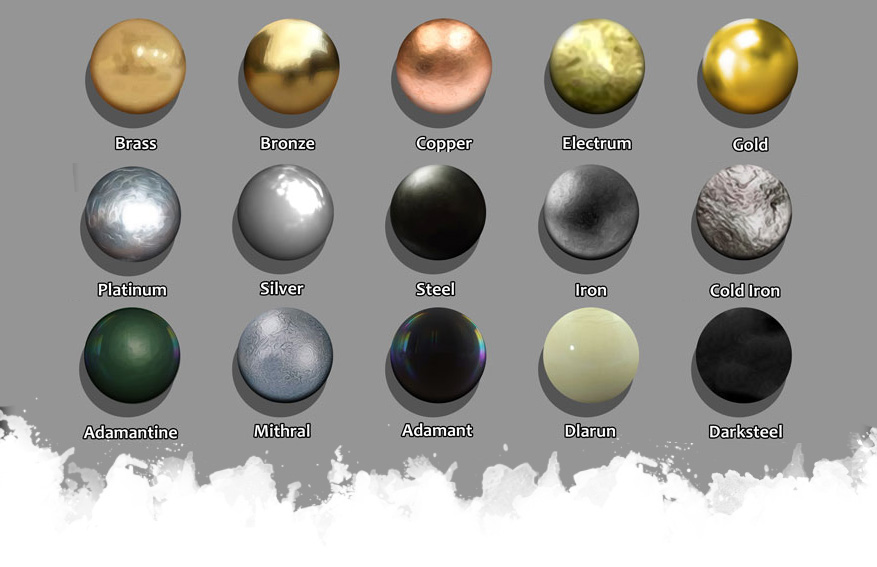
Material Modifiers
| Metal | Difficulty Modifier | Weapon Effect | Armor Effect |
|---|---|---|---|
| Adamantine | +8 | A weapon forged from Adamantine is naturally a +1 weapon and gains the "Special: Critical Strikes with this weapon permanently damage nonmagical weapons, shields or armor of the defending creature that are not forged from Adamantine (reducing the attack roll of a weapon or the AC of armor by 2)". | While you're wearing it, any critical hit against you becomes a normal hit. |
| Mithral | +6 | A weapon with the heavy property forged from it loses the heavy property. If the weapon didn't have the heavy property, it gains the light property. The DC of an Enchanter applying an Enchantment to it is reduced by 6, and it always counts has having 1 common essence of any type as part of the craft | If the armor normally imposes disadvantage on Dexterity (Stealth) checks or has a Strength requirement, the mithral version of the armor doesn't. Easier for Enchanters to Enchant. |
| Bronze | -4 | Weapons forged from Bronze are inferior, having -2 to attack and damage rolls. Gains the Fragile property. | Armor forged from Bronze is inferior, having -2 to its AC. Gains the Fragile property. |
| Cold Iron (Meteoric Iron) | -2 | Weapons forged from Cold Iron are inferior, having -1 to attack and damage rolls. Gains the Fragile property. | Armor forged from Cold Iron is inferior, having -1 to its AC. Gains the Fragile property. |
| Dlarun (Icesteel) | +6 | A weapon forged from Dlarun deals an additional 1d4 cold damage on hit. | Wearing armor forged from Dlarun grants resistance to Fire Damage. |
| Adamant | +8 | "Special: Critical Strikes with this weapon damage nonmagical weapons, shields or armor the defending creature that are not forged from Adamantine (reducing the attack roll of a weapon or the AC of armor by 4)". Due to its brittle nature, it gains the Fragile property. | Armor forged from this grants +1 AC. Due to its brittle nature, it gains the Fragile property. |
| Darksteel | +6 | You have advantage on attack rolls while in darkness wielding Darksteel weapons. | You have advantage on Dexterity (Stealth) checks when wearing Darksteel armor. |
Crafting Modifiers
| Modifier | Difficulty Modifier | Weapon Effect | Armor Effect |
|---|---|---|---|
| Aerodynamic | +5 | The weapon gains the Thrown (10/30) property if it does not have the Thrown property. If it has the Thrown property, the range increases by 10/30 feet instead. | Your falling speed increases to 520 feet per round while wearing this armor. |
| Masterwork | +8* | A Masterwork weapon gains +1 to attack rolls. | A set of Masterwork armor gains a Damage Reduction value of 2. |
| Chained | +4 | You add a long chain to a weapon. As a bonus action after throwing it 15 feet or less, you can pull it back to your hand. | N/A |
| Elven | +8 | N/A | You are considered proficient with this armor even if you lack proficiency |
| Weighted (Dwarven) | +5 | A weapon with the light property forged from it loses the light property. If the weapon didn't have the light property, it gains the heavy property. | If an Effect moves you against your will along the ground while wearing this armor, you can use your Reaction to reduce the distance you are moved by up to 10 feet. The weight of the armor is increased by 50% |
| Fragile | N/A | A Fragile weapon breaks on an attack roll of 1 against an armored target (a target wearing armor or with the natural armor property) if that armor does not have the Fragile property. | A Fragile set of armor is destroyed when you take a critical strike from a creature wielding a weapon without the Fragile property. |
| Spiked | +2 | If a weapon deals bludgeoning damage, it now deals piercing damage. | Armor is less defensively effective, and has -1 AC. Attackers that strike you with unarmed strikes or natural weapons take 1d4 piercing damage. A creature that ends its turn while grappling you takes 1d4 piercing damage. |
| Slotted | +2 | This weapon can hold 1 magical gem crafted by an Enchanter | This armor can hold 1 magical gem crafted by Enchanter. |
| Runeforged | +2 | This weapon can Runecrafted by an Enchanter | This armor can be Runecrafted by an Enchanter |
- *Masterwork: Failing a crafting roll for Masterwork does not cause a failure, but the resulting weapon is only a Masterwork if all crafting roll successes pass the DC of Masterwork. An item is automatically masterwork if every roll qualified for a Masterwork version.
- *Damage Reduction: While you are wearing heavy armor, bludgeoning, piercing, and slashing damage that you take from nonmagical weapons is reduced by the value of your Damage Reduction to a minimum of 1.
Acquiring Materials
Foraging Materials
Mining is generally out of the scope of something that can be accomplished during an adventure - the process is labor intensive and requires quite a few steps to process ore into usable metal. That said, on rare occasions you may find a vein of some rare ore during your travels. Fortunately, you can often find preworked metals that can be subsequently salvaged.
Salvaging
Metal is one of the more recyclable materials out there, but the process of trying to salvage worked metal into something usable is fraught with some difficulty. You can salvage complete metal items, incomplete crafts, or damaged metal goods. When salvaging things, you need access to a forge to smelt it back down to ingots.
Salvaging an item takes 2 hours, and returns a number of ingots equal to half the number it would take to craft the item. Magical materials can only be salvaged at the discretion of the DM, and may require skill checks.
Monster Harvesting
Typically speaking, metal ingots cannot be harvested from monsters. That said, there are cases where monster parts can be substituted for metal components - most often scales, but occasionally scales or claws. This is only rarely possible, but consult your DM if you believe something might be harvested from a monster and you can consult the list of exotic ingredients or argue that case for a new one, though the DM would determine the effectiveness it might have.
Harvesting requires a Survival check with a DC equal to 15 + half the monster's CR (rounded up); you can make this check multiple times, but each time you fail a harvesting check, the amount that can be harvested is halved (rounded down).
Purchasing
The easiest and quickest way to gather materials is to simply buy them. The problem with this approach is that you are generally not going to be saving much money over simply buying the gear itself, as most places that would have materials to sell would have a competent Blacksmith capable of making them. However, sometimes it can be cheaper or more flexible - for example, if you are interested in making something unusual or customized, you can buy materials and make them later, or sometimes you will have the materials you need, and can just buy the rest cheaper than making the gear.
The standard pricing is following, but modifiers may apply based on locale - generally speaking more remote locations will sell at a better price, as cities have lower supply and higher demand, but rare or rarer reagents are generally only found in cities.
| Rarity | Price |
|---|---|
| Short Haft | 1 sp |
| Long Haft | 2 sp |
| Short Chain | 1 gp |
| Steel Ingot | 2 gp |
| Armor Padding | 5 gp |
| Mithril Ingot | 20 gp |
| Adamant Ingot | 40 gp |
| Adamantine Ingot | 50 gp |
Reagents with the special property have a pricing multiplier based on their rarity as defined in the special property. Exotic ingredients have individual pricing listed on the ingredient.
Additional Items
Tower Shield
This is a massive unwieldy shield. While carrying it, your movement speed is reduced by 10 feet. At the end of each of your turns, pick a direction. You have half cover in that direction.
Ring
This has no default statistical modifier, but can be enchanted or slotted for additional benefits. May look pretty.
Bracers
While wearing bracers, as a reaction to being hit by an attack, you can attempt to parry the attack with your bracer, adding gaining +1 AC bonus AC against the triggering attack.
- Adamantite Bracers: Adds +2 AC against the triggering attack. Successfully parrying an attack (turning a hit into a miss) with adamantite bracers destroys the attacking weapon if it is made of a common metal (Steel, Iron, Bronze).
Thunder Cannon
Requires attunement
The principle weapon of a Thundersmith. Deals 1d12 piercing damage, and has the Ammunition (60/180), Two-Handed, Loud, and Stormcharged properties.
- Stormcharged. When you use an action, bonus action, or reaction to attack with a Stormcharged Weapon, you can make only one Attack regardless of the number of attacks you can normally make. If you could otherwise make additional attacks with that action, the weapon deals an additional 3d6 lightning or thunder damage per attack that was foregone.
- Loud: Your weapon rings with thunder that is audible within 300 feet of you whenever it makes an attack.
Cooking
Quick Reference
While each step will go into more depth, the quick reference allows you to at a glance follow the steps to make a potion in its most basic form:
- Acquire a fresh ingredient by harvesting or finding it.
- Review the Recipe Tables for Feasts, Snacks or Rations that ingredient would qualify for, and gather the other materials needed listed in the Materials column.
- Use your Cooking Utensils tool to craft the option using the number hours listed in the Crafting Time column, or during a long rest using the crafting camp action if the crafting times is 2 hours or less. Meals must be crafted in a single crafting session. All meals require a heat source (such as a campfire).
- For every 2 hours, make a crafting roll of 1d20 + your Wisdom modifier (your choice) + your proficiency bonus with Cooking Utensils. You can abort the craft after a bad crafting roll if you wish, this counts as a failure.
- If the average of these checks is equal to or higher than the value listed in the Difficulty column for that potion, you succeed. If it is lower, you fail and lose all materials.
Duration
The duration a meal remains edible depends on the type of meal made. A feast must be consumed within an hour, a snack lasts for 1 day, and ration lasts 1 month.
Ingredients
The material for cooking are fresh ingredients and supplies. A fresh ingredient is something you harvest that can increase the quality of your food and sometimes provide supernatural boosts beyond mere satiation. Staples include seasoning and spices, but also things like flour and turnips - food that lasts awhile and can cooked into perfectly fine meals, but have no benefits you wouldn't expect from eating a good meal.
Some ingredients additionally have the exotic property, and may confer special effects.
General System, Specific Examples
Like with all aspects, this crafting system does not attempt to provide systematic specific examples (though they are provided in the appendix), but rather a system that allows you to know the outcome of anything you could cook. For example, a party could acquire 1 common fresh ingredient by harvesting a Hook Horror, and than combine that with 1 common supplies to cook either Hook Turkey Sandwiches or Murder Chicken Tenders, but the benefit from either example would still fall into a Monstrosity Meat Quality Meal category (one step above standard rations).
Ingredient Expiration
Normal Ingredients expire very quickly, and must be used within 24 hours of being harvested or they become unusable. Preserved rations would fall into the staples category and cannot typically be used to cook anything besides basic meals. The ability to gain any sort of magical benefit is linked its freshness; even will prepared preserved foods provide only the benefit of a Basic Meal (which is a satisfying and good tasting meal, but its benefits are not otherwise magical).
Unlike Fresh Ingredients, Staples last significantly longer and do not need to have their expiration tracked for the purposes of this system.
Satiation
The magical benefits you get consuming rare and more magical foods cannot be gained again until 24 hours have passed any particular food. When combined with the ingredient expiration above, this typically means that any ingredient collected is only good for a single meal - this is intentionally; you can harvest more if you wish, but cooking by its natural is a profession of fleeting achievement and fickle opportunity.
Crafting Roll
Putting that together that means that when you would like to create a meal, your crafting roll is as follows:
Cooking Modifier = your Cooking Utensils tool proficiency bonus + your Wisdom modifier.
Success and Failure
For cooking, after you make the crafting rolls and succeed (by average), you have a completed meal. If you fail (by average), all materials are lost and the result is unusable.
Exotic Ingredients
While standard meals are made from from a selection of ingredient types and generally a seasoning, exotic ingredients have specialized effects. When making a meal from these ingredients, the meal's effect is a combination of the effect of the exotic ingredients added.
An Exotic Meal (meal cooked entirely from exotic ingredients) does not need a recipe and has a crafting time of 1 hour, and the difficulty is the difficulty of all the exotic ingredients used added together, with 1 check needed per exotic ingredient added.
An exotic ingredients can be combined with a standard meal by adding the DC of the standard meal to the combined difficulty of the exotic ingredients added. This can result in very unusual meals, but will frequently result in unattainably high difficulty to make it work, as adding random new components to meals typically wrecks the taste.
Basic Cooking & Camp Actions
While the rules present a handful of ways to use cooking for more exotic ends, the most common application of cooking is just to produce an edible meal on during a long rest - something any adventuring group would welcome; this is called a Quality Meal, and provides greater benefit than rations, though the benefits it provides are not magical, and merely stem from it being a satisfying meals. You can do so by expending 1 fresh ingredient of any type and 1 common supplies for up to 5 people, or by spending common supplies per person being cooked for. These materials must have been purchased within the last week.
Any creature, even one not proficient with Cooking Utensils can take this action. You and all willing creatures (willing to eat your cooking) regain an additional hit die (up to their maximum). If you have proficiency with Cooking Utensils, creatures regain additional hit dice equal to your Proficiency bonus
Purchasing Materials
Due the rules on ingredient freshness, typically speaking ingredients cannot be purchased in a way that is relevant for cooking recipes. You can purchase Supplies (of any type) that can be used to make Basic Meals.
| Rarity | Material Price |
|---|---|
| Supplies (Salt, Staples, etc) | 1 gp |
| Uncommon Supplies (Uncommon spices, oils, rare seeds, etc) |
10 gp |
| Rare Supplies (Hard to luxury goods) |
100 gp |
Harvesting Ingredients
Unlike other things you can harvest from monsters, there's little chance of failure in harvesting - there's generally more to harvest than be meaningfully used.
You can consume Monstrosity, Dragon, Beast and Plant Type creatures for magical benefits; your DM may allow other creature types as special delicacies at their discretion.
| Monster CR | Gathered Ingredients |
|---|---|
| 1/4 to 4 | Common |
| 5-8 | Uncommon |
| 9-12 | Rare |
| 13-16 | Very Rare |
| 16-20 | Legendary |
Feast Crafting Table
| Name | Materials | Crafting Time | Checks | Difficulty | Rarity | Value |
|---|---|---|---|---|---|---|
| Common Feast (Quality Meal) | 1 common fresh ingredient 1 common supplies |
1 hour | 1 | DC 8 | common | 3 gp |
| Enhancing FeastK | 1 uncommon fresh ingredient 1 uncommon supplies 2 common supplies |
2 hours | 1 | DC 14 | uncommon | 15 gp |
| Meat FeastK | 1 uncommon meat 1 uncommon supplies 2 common supplies |
2 hours | 1 | DC 14 | uncommon | 15 gp |
| Wondrous FeastK | 1 rare fresh ingredient 1 uncommon reagent (any) 1 rare supplies 1 uncommon supplies 2 common supplies |
2 hours | 1 | DC 16 | rare | 150 gp |
| Hearty Meat FeastK | 1 rare meat 1 uncommon reagent (any) 1 rare supplies 1 uncommon supplies 2 common supplies |
2 hours | 1 | DC 16 | rare | 150 gp |
| Superb FeastK | 1 very rare fresh ingredient 1 rare reagent (any) 2 rare supplies 2 uncommon supplies 2 common supplies |
4 hours | 2 | DC 18 | very rare | 300 gp |
| Superb Meat FeastK | 1 very rare meat 1 rare reagent (any) 2 rare supplies 2 uncommon supplies 2 common supplies |
4 hours | 2 | DC 18 | very rare | 300 gp |
| Legendary FeastK | 1 legendary fresh ingredient 1 very rare reagent (any) 3 rare supplies 3 uncommon supplies 1 common supplies |
6 hours | 3 | DC 20 | legendary | 3000 gp |
| Legendary Meat FeastK | 1 legendary meat 1 very rare reagent (any) 3 rare supplies 3 uncommon supplies 1 common supplies |
6 hours | 3 | DC 20 | legendary | 3000 gp |
| Elementally Fortifying FeastK |
1 rare meat from a creature with an elemental resistance or immunity 2 uncommon reactive reagent 1 common primal essence 2 rare supplies 2 uncommon supplies 2 common supplies |
2 hours | 1 | DC 16 | rare | 325 gp |
| What Doesn't Kill You... FeastK |
1 uncommon meat from a creature that deals poison damage 2 uncommon poisonous reagents 1 uncommon supplies 2 common supplies |
2 hours | 1 | DC 16 | uncommon | 110 gp |
| Seaworthy Bouillabaisse | 1 uncommon meat from a creature with a swim speed greater than its walking speed. 2 uncommon supplies 2 common supplies |
2 hours | 1 | DC 12 | uncommon | 25 gp |
| Heroes' Feast | 4 rare curative reagent 2 uncommon divine essence 4 rare supplies 4 supplies |
4 hours | 2 | DC 18 | rare | 1,500 |
Snack Crafting Table
| Name | Materials | Crafting Time | Checks | Difficulty | Rarity | Value |
|---|---|---|---|---|---|---|
| Flame Breathing JerkyK x 5 | 1 uncommon or rarer meat from a creature immune to fire damage 2 uncommon reactive reagents 1 rare supplies |
6 hours | 3 | DC 15 | uncommon | 250 gp |
| Mint ChewK x 5 | 2 uncommon curative reagent 1 uncommon supplies |
4 hours | 2 | DC 14 | uncommon | 100 gp |
| Morph CookiesK x 5 | 1 ingredient harvested from a shapeshifter 1 rare supplies 1 uncommon supplies 1 common supplies |
2 hours | 2 | DC 15 | uncommon | 125 gp |
| Seeing SticksK x 5 | 1 ingredient from a creature with blindsight or tremorsense 1 uncommon reactive reagent 1 rare supplies 1 common supplies (optional) |
4 hours | 2 | DC 15 | uncommon | 150 gp |
Ration Crafting Table
| Name | Materials | Crafting Time | Checks | Difficulty | Rarity | Value |
|---|---|---|---|---|---|---|
| Elvish BreadK x 10 | 1 uncommon curative reagent 1 uncommon supplies 1 common supplies |
6 hours | 3 | DC 15 | uncommon | 60 gp |
| Iron Rations x 10 | 2 common supplies | 1 hour | 1 | DC 8 | common | 2 gp |
Feasts
Common Feast
Food, feast, common
Up to 5 creatures can consume this feast within an hour of it being prepared. After consuming this hearty meal, you become satiated for the next 24 hours. This is a hearty meal well surpassing the benefits of normal meals or rations, and each creature that consumes it regains an additional hit die during the next long rest.
If cooked by a creature with proficiency in Cooking Utensils, creatures that consume this feast regain additional hit dice equal to the cook's proficiency bonus during the next long rest instead.
Uncommon Feast
Enhancing/Wondrous/Superb/Legendary
Food, feast, uncommon/rare/very rare/legendary
Up to 5 creatures can consume this feast within an hour of it being prepared. After consuming this hearty meal, you become satiated for the next 24 hours. You gain the benefits for a common feast, but can gain additional benefits by trading hit dice as part of your next long rest after consuming this meal - these hit dice are consumed after calculating how many you would have after the rest (including the benefits of the feast), but you can trade hit dice in this way you would normally lose if you have more than your maximum hit dice.
You can trade hit dice in this way up to a number equal to your proficiency bonus. The benefits scale based on the rarity on the feast.
| Benefit [Uncommon/Rare/Very Rare/Legendary] |
|---|
| Roll a [d4/d6/d8/d12] per hit die traded and gain temporary hit points equal to the value rolled. |
| Trade three hit dice for an additional spell slot of [1st/2nd/3rd/4th/5th] level |
| Gain a point point that can be expended like Inspiration by trading [5/4/3/2] hit dice per point. |
Any benefit from a feast fades after 24 hours.
How Feast Spent Dice Work
If, for example, at level 4, if you start a rest with 2 hit dice, and consume a meal that would give an additional hit die, you would end the rest with 5, but your maximum is 4, so you would lose the 5th. This allows you to spend that extra fifth hit die for additional benefits. You could spend 3 hit dice on these benefits, but doing so would mean you only have 2 hit dice after the long rest.
Meat Feast
Meat/Hearty/Superb/Legendary
Up to 5 creatures can consume this feast within an hour of it being prepared. After consuming this hearty meal, you become satiated for the next 24 hours. Consuming the essence of a properly prepared creature of great power confers some of its power to you while satiated by the feast.
You can add +1/+2/+3/+4 to ability checks and saving throws of the prepared creatures highest stat (if multiple stats are tied, the cook chooses which when preparing the meal). Alternatively, the cook can bring forth exotic properties of the creature, conferring one trait of the cooked animal to those that consume it as per the following table (this replaces the benefit to ability checks and saves):
| Minimum Rarity | Creature Boon |
|---|---|
| uncommon | Hold Breath, Keen Senses, Pounce, Stone Camouflage |
| rare | Amphibious/Water Breathing, Web Walker |
| very rare | Pack Tactics, Spider Climb |
| legendary | Magic Resistance, Regeneration, Shapechanger(Mimic) |
The details from the creature boon can be found on the creature stat block. The cook must be aware of the creature's property to make the meal imbue that property, and the DM may adjust the property in cases where it would not work for players or be too powerful as written. At the DMs discretion, any of ability can be added to this list.
Elementally Fortifying Feast
Food, feast, rare
Up to 5 creatures can consume this feast within an hour of it being prepared. After consuming this hearty meal, you become satiated for the next 24 hours. The magical properties of the meal confer the following special benefits:
| Element | Benefit |
|---|---|
| Cold | Advantage on saves against cold climates and cold damage. |
| Fire | Advantage on saves against hot climates and fire damage. |
| Lightning | Advantage on saves against being stunned and lightning damage |
These benefits fade after 24 hours. You cannot gain the benefits of another feats until these benefits fade and you are no longer satiated.
Seaworthy Bouillabaisse
Food, feast, uncommon
Up to 5 creatures can consume this feast within an hour of it being prepared. After consuming this hearty meal, you become satiated for the next 24 hours. The magical properties of the meal grant you immunity to sea sickness as well as advantage on Dexterity or Constitution saving throws involving the motion of sea vessels.
Additionally, if you do not have proficiency in Water Vehicles, you can add half your proficiency bonus (rounded down) to any check involving them for the duration.
Heroes' Feast
Food, feast, rare
A magnificent spread of food. Cooking this has the effect of casting the spell heroe's feast, expect it's made of real food and not poofed by into existence strange magics.
Snacks
Flaming Tongue Jerky
Food, snack, uncommon
A tough jerky with exotic flavoring. Very spicy, uncomfortable so. After a creature consumes this snack as an action, they gain the following benefits for the next 10 minutes:
- You cannot be put to sleep by magical means.
- You have disadvantage on Wisdom ability checks.
- You have disadvantage on Constitution saving throws to maintain concentration on a spell.
- You can use a bonus action to exhale fire at a target within 10 feet of you. The target must make a DC 13 Dexterity saving throw, taking 2d6 fire damage on a failed save, or half as much damage on a successful one.
You can eat a number of pieces of this jerky equal to your Constitution modifier per day.
Mint Chew
Food, snack, uncommon
A chewy minty candy. You can pop one into your mouth as a bonus action. While being chewed (for up to 10 minutes), are energized and can ignore the effects of up to 3 levels Exhaustion for the duration, and cannot be put to sleep by magical means.
You can only gain this benefit once per day, after which consuming additional pieces of the candy has no effect until you complete a long rest.
Seeing Sticks
Food, snack, uncommon
A stick of hard tacky substance. You can pop one into your mouth as a bonus action. While being sucked (for up to 10 minutes), you gain expanded senses and have advantage on Wisdom (Perception) checks, saving throws against a Illusion spells, and Intelligence (Investigation) checks to see through illusions, though because of the bad taste inherent to the formulation, continuing to suck on the seeing stick requires concentration, as if concentrating on a spell.
By adding the optional common supplies ingredient, they can be sweetened, giving concentration checks to keep from spitting them out advantage; this increases the DC of the recipe by 1.
Rations
Elvish Bread
Food, ration, uncommon
A creature can use its action to eat one bite of this bite (1 ration of it). Eating a piece restores 1 hit point, and the bread provides enough nourishment to sustain a creature for one day.
Iron Rations
Food, ration, common
A basic food ration that will keep you from starving for a day after consuming them. Common side effects include a craving for real food after prolonged exposure.
Appendix A
Specific Example Table
| Creature | Example | Meal Type |
|---|---|---|
| Ape | Should We Eat This? Sliced Roast | Meat Feast |
| Beholder | Eyestock Unagi Shushi | Risky Aberration Snack |
| Crocodile | Spicy Croc Gumbo | Common Feast |
| Kraken | Sea Aged Unagi | Legendary Meat Feast |
| Kraken | Titan Tri tip | Legendary Meat Feast |
| Roc | Roc Drumstick Gyros | Superb Meat Dish |
| Tyrannosaurus Rex | Primeval Pot Pie | Meat Feast |
| Tyrannosaurus Rex | Giant's Chicken Breast | Meat Feast |
| Young Hook Horror | Hook Turkey Sandwiches | Common Feast |
| Young Hook Horror | Murder Chicken Tenders | Common Feast |
| Young Red Dragon | Dragon Steak Tartare | Elementally Fortifying Feast |
| Wyvern | Purple Poison Curry | Meat Feast |
Enchanting
Enchanting is a hard and expensive profession, but one eagerly pursued by many all the same. The makers of miracles, the craftsmen of wonder, no other profession holds the fascination of adventurers quite like Enchanter, for their domain encompasses the large majority of magical items.
An item need not pass through an enchanter's hands to be magical, indeed many a blacksmith has forged a magical blade with the right materials, but the true wonder of enchantment is to turn the mundane magical. An enchanter can turn even the most base and commonplace item into something wonderful and powerful, and when given the head start of working with an already well crafted item can craft things of legend.
Many enchanters further specialize in subdomains such as Scroll Scribing or Wand Whittling for more specialized good that require more specialized tools, with many even pursuing such things as Jewelery Crafting in order to create the precious items that most easily enchant, but the general field of Enchanting still covers a large swath of the wondrous.
Scrolls are heavily featured as component of nearly all magical items forming the basis for the powerful enchantments that imbue them with their magic - templates of sort, and thus the ability to craft scrolls with Scroll Scribery is often the most desired of the subdomains for an Enchanter.
Quick Reference
While each step will go into more depth, the quick reference allows you to at a glance follow the steps to make a magic item in its most basic form:
- Select the magic item that you would like to craft from any of the Magic Item Tables.
- Acquire the items listed in the materials column for that item.
- Use your Arcana skill to infuse the option using the number hours listed in the Crafting Time column, or during a long rest using the crafting camp action if the crafting times is 2 hours or less.
- For every 2 hours, make a crafting roll of 1d20 + your Intelligence modifier + your Arcana proficiency.
- On success, you mark 2 hours of completed time. Once the completed time is equal to the crafting time, the magic item is complete. On failure, the crafting time is lost and no progress has been made during the 2 hours. If you fail 3 times in a row, the crafting is a failure and all materials are lost.
Materials: Essences & Components
The materials of enchanting are Essences and Components. Essences come in three different types - Arcane, Primal, and Divine, as well as five rarities - common, uncommon, rare, very rare, and legendary. What an Essence is can vary greatly, as they are things of innate magic that is used to power the Enchanter's creations. They could be organs of magical monsters (such as the heart of a dragon which would be a rare primal essence) or they can be synthesized from magical reagents into a magical compound. Components are a broad category of items ranging from the base item you are enchanting to any extraneous bits needed to be added. One unique component that is present in many enchantments is a Spell Scroll of various types of spells that form the basis of the sort of the magic the item has.
Replacing Spell Scrolls
A crafter that is capable of casting magic can replace the spell scroll in an enchantment with the ability to cast that spell, but when doing so they must cast that spell for each crafting check they make on that item. This is an exhausting process, draining their magic far more deeply than normal casting, and confers a level of exhaustion each time this technique is used to replace a crafting check. If a magic item requires multiple scrolls, only one of them can be replaced in this way, though if an additional spell caster that can cast the necessary spell can assist you, they can replace a second scroll, though suffering the same penalty.
Exhausting & Difficult Method
This mechanic is intentionally quite difficult to use - even for casters that are capable of casting the spell, the typically process would be to make the scroll first to formalize their thoughts and process, laying down the patterns and templates for the magic item. It also removes a very costly gate in the process, so should not be easily bypassed.
Crafting Roll
Putting that together that means that when you would like to enchant an item, your crafting roll is as follows:
Enchanting Modifier = your Arcana proficiency bonus + your Intelligence modifier
Success and Failure
For Enchanting, after you make the crafting roll and succeed marks your progress on a crafting project. If you succeed, you make 2 hours of progress toward the total crafting item (and have completed one of the required checks for making an item). Checks for Enchanting do not need to be immediately consecutive. Failure means that no progress is made during that time. Once an item is started, even if no progress is made, the components reserved for that item can only be recovered via salvage.
If you fail three times in a row, all progress and materials are lost and can no longer be salvaged.
Temporary Enchantments
While the primary purpose of Enchanting is to create wondrous items, for an adventurer such events are important milestones that generally will not occur everyday. The following are some tasks that require proficiency with Arcana that provide a more day-to-day utility.
These minor crafts can be completed in 2 hours (or as one camp action when using the Kibbles' Camp Actions rules) with the expenditure of 10 gold worth of materials. They can be done as part of a long rest, but have limitations the normally enchanted items do not (such as a maximum stockpile of minor crafts).
The following are "minor crafting options" for Enchanters:
Coming Soon
Wondrous Item Crafting Table
| Name | Materials | Crafting Time | Crafting Checks | Difficulty | Rarity | Value |
|---|---|---|---|---|---|---|
| Bag of Holding | 1 bag 1 scroll of secret chest 2 uncommon arcane essence |
16 hours (2 days) | 8 | DC 15 | uncommon | 1,000 gp |
| Broom of Flying | 1 broom 1 scroll of levitate 1 scroll of fly 1 scroll of animate object 2 uncommon primal essence |
16 hours (2 days) | 8 | DC 16 | uncommon | 1,000 gp |
| Belt of Hill Giant Strength |
1 belt 1 scroll of enhance ability 1 scroll of enlarge/reduce 3 rare primal essence |
16 hours (2 days) | 8 | DC 18 | rare | 3,500 gp |
| Belt of Stone Giant Strength |
1 belt 1 scroll of enhance ability 1 scroll of enlarge/reduce 1 scroll of stoneskin 3 very rare primal essence |
24 hours (3 days) | 12 | DC 20 | very rare | 27,000 gp |
| Belt of Fire Giant Strength |
1 belt 1 scroll of enhance ability 1 scroll of transformation 1 scroll of investiture of fire 1 very rare arcane essence 3 very rare primal essence |
32 hours (4 days) | 16 | DC 22 | very rare | 35,000 gp |
| Belt of Cloud Giant Strength |
1 belt 1 scroll of enhance ability 1 scroll of transformation 1 scroll of investiture of wind 1 very rare arcane essence 3 very rare primal essence 1 legendary primal essence |
40 hours (5 days) | 20 | DC 26 | legendary | 60,000 gp |
| Belt of Storm Giant Strength |
1 belt 1 scroll of enhance ability 1 scroll of transformation 1 scroll of invulnerability 1 very rare arcane essence 3 very rare primal essence 3 legendary primal essence |
48 hours (6 days) | 24 | DC 28 | legendary | 120,000 gp |
| Cap of Water Breathing |
1 leather cap 1 scroll of water breathing 1 common arcane essence 1 commom primal essence |
8 hours | 4 | DC 12 | uncommon | 200 gp |
| Circle of Blasting | 1 circlet worth at least 50 gp 1 scroll of scorching ray 1 common arcane essence 1 common primal essence |
8 hours | 4 | DC 12 | uncommon | 250 gp |
| Goggles of Night | 1 pair of goggles 1 scroll of darkvision 1 common primal essence 1 uncommon arcane essence |
8 hours | 4 | DC 13 | uncommon | 300 gp |
| Pearl of Power | 1 pearl worth at least 100 gp 5 common arcane essence |
8 hours | 4 | DC 12 | uncommon | 350 gp |
| Periapt of Health | 1 necklace worth 50 gold 1 scroll of purify food and drink 1 scroll of lesser restoration 2 common divine essence |
12 hours (1.5 days) | 6 | DC 12 | uncommon | 300 gp |
Wondrous Item Crafting Table (cont)
| Name | Materials | Crafting Time | Crafting Checks | Difficulty | Rarity | Value |
|---|---|---|---|---|---|---|
| Sending Stones | 1 set of the same kind of stones 1 scroll of sending 2 common arcane essence |
4 hours | 2 | DC 14 | uncommon | 350 gp |
| Cloak of Protection | 1 cloak 1 scroll of shield of faith 1 scroll of mage armor 1 scroll of protection from energy 1 scroll of shield 1 scroll of absorb elements 1 rare arcane essence 1 rare divine essence |
16 hours (2 days) | 12 | DC 15 | rare | 2,500 gp |
Weapon Enchanting Table
| Name | Materials | Crafting Time | Crafting Checks | Difficulty | Rarity | Value |
|---|---|---|---|---|---|---|
| +1 Weapon | 1 weapon 1 scroll of magic weapon 2 common arcane essence 2 uncommon arcane essence |
8 hours | 4 | DC 15 | uncommon | 500 gp |
| +2 Weapon | 1 weapon weapon 1 scroll of magic weapon 2 uncommon arcane essence 2 rare arcane essence 2 rare divine essence 2 rare primal essence |
16 hours (2 days) | 8 | DC 18 | rare | 5,000 gp |
| +3 Weapon | 1 weapon worth at least 1,000 gp 1 scroll of magic weapon 1 scroll of elemental weapon 1 scroll of vorpal weaponK 1 very rare arcane essence 1 very rare divine essence 1 very rare primal essence |
32 hours (4 days) | 20 | DC 20 | very rare | 25,000 gp |
| Berserker Axe | 1 axe 1 scroll of crown of madness 1 scroll of magic weapon 1 scroll of aid 2 uncommon primal essence |
8 hours | 4 | DC 14 | uncommonK | 500 gp |
| Bow of Magic MissilesTAG |
1 bow (short or long) 1 scroll of magic missile 1 scroll of magic weapon 3 rare arcane essence 1 very rare arcane essence |
24 hours (3 days) | 12 | DC 18 | very rare | 10,000 gp |
| Dagger of Venom |
1 +1 weapon 1 potent injury poison 1 scroll of nauseating poisonK 1 rare primal essence 1 rare arcane essence |
12 hours (1.5 days) | 6 | DC 16 | Rare | 2,200 gp |
| Flametongue Weapon | 1 weapon 1 scroll of elemental weapon 1 flametongue oil 3 rare primal essence 1 rare arcane essence |
16 hours (2 days) | 8 | DC 19 | rare | 5,200 gp |
| Javelin of Lightning |
1 javalin 1 scroll of lightning bolt 1 uncommon primal essence |
8 hours | 4 | DC 15 | uncommon | 400 gp |
Weapon Enchanting Table
| Name | Materials | Crafting Time | Crafting Checks | Difficulty | Rarity | Value |
|---|---|---|---|---|---|---|
| Trident of Fish Command |
1 trident 1 scroll of dominate beast 1 common primal essence 1 uncommon primal essence |
8 hours | 4 | DC 15 | uncommon | 500 gp |
| Giant Slayer | 1 weapon worth at least 100 gp 1 scroll of magic weapon 1 rare primal essence from a giant 2 uncommon arcane essence 2 uncommon primal essence |
16 hours (2 days) | 8 | DC 18 | rare | 1,700 gp |
| Mace of Disruption | 1 mace 1 scroll of banishment 2 rare divine essence 1 uncommon divine essence 1 uncommon arcane essence |
16 hours (2 days) | 8 | DC 18 | rare | 2,200 gp |
| Mace of Smiting | 1 mace 1 scroll of dispel construct 1 rare arcane essence 1 uncommon arcane essence 1 uncommon divine essence |
12 hours (1.5 days) | 6 | DC 17 | rare | 1,300 gp |
| Dragon Slayer | 1 weapon worth at least 100 gp 1 scroll of magic weapon 2 rare primal essence 1 rare divine essence 2 uncommon arcane essence |
16 hours (2 days) | 8 | DC 19 | rare | 3,000 gp |
| Mace of Terror | 1 mace 1 scroll of fear 1 rare arcane essence 2 uncommon arcane essence |
12 hours (1.5 days) | 6 | DC 17 | rare | 1,400 gp |
| Sun Blade | 1 sword hilt worth 200 gp 1 scroll of holy weapon 1 scroll of shadowblade 1 scroll of daylight 3 rare divine essence 2 uncommon arcane essence 2 uncommon primal essence |
24 hours (3 days) | 12 | DC 19 | rare | 4,800 gp |
| Sword of Life Stealing |
1 sword 1 scroll of vampiric touch 1 rare arcane essence 2 uncommon arcane essence |
12 hours (1.5 days) | 6 | DC 17 | rare | 1,300 gp |
| Sword of Wounding |
1 sword 1 scroll of rotting curseK 1 scroll of inflict wound 1 rare arcane essence 3 uncommon arcane essences from an evil source |
12 hours (1.5 days) | 6 | DC 18 | rare | 1,350 gp |
| Vicious Weapon | 1 weapon 1 scroll of vorpal weapon 3 uncommon arcane essence |
12 hours (1.5 days) | 6 | DC 17 | rare | 1,700 gp |
| Dancing Sword | 1 sword worth 100 gp 1 scroll of animate objects 2 very rare arcane essence 4 uncommon arcane essence |
24 hours (3 days) | 12 | DC 19 | very rare | 16,500 gp |
| Dwarven Thrower | 1 +3 warhammer 1 scroll of weapon of throwing 1 very rare primal essence |
16 hours (2 days) | 9 | DC 20 | very rare | 35,000 gp |
Armor Enchanting Table
| Name | Materials | Crafting Time | Crafting Checks | Difficulty | Rarity | Value |
|---|---|---|---|---|---|---|
| +1 Armor | 1 set of armor 1 scroll of mage armor 1 scroll of shield 1 scroll of shield of faith 1 rare arcane essence 1 rare divine essence 1 rare primal essence |
24 hours (3 days) | 12 | DC 18 | rare | 2,500* gp |
| +2 Armor | 1 set of armor worth at least 2,000 gp 1 scroll of globe of invulnerability 1 scroll of steelskin 1 scroll of mage armor 1 scroll of shield 1 scroll of shield of faith 1 rare very arcane essence 1 rare divine essence 1 rare primal essence |
32 hours (4 days) | 16 | DC 21 | very rare | 26,000* gp |
| +3 Armor | 1 set of armor worth at least 4,000gp scroll of invulnerability 1 legendary arcane essence 1 very rare primal essence 1 very rare divine essence |
48 hours (6 days) | 24 | DC 25 | legendary | 80,000 gp |
| Shield +1 | 1 shield 1 scroll of shield 1 scroll of shield of faith 2 uncommon arcane essence 2 uncommon divine essence |
8 hours | 4 | DC 15 | uncommon | 500 gp |
| Shield +2 | 1 shield 1 scroll of shield 1 scroll of shield of faith 1 scroll of glyph of warding 2 rare arcane essence 2 rare divine essence |
16 hours (2 days) | 8 | DC 17 | rare | 3,200 gp |
| Shield +3 | 1 shield worth at least 1,000 gp 1 scroll of wall of stone 1 scroll of wall of force 1 scroll of wind wall 1 scroll of shield 1 scroll of shield of faith 1 very rare arcane essence 2 rare arcane essence 1 very rare divine essence 2 rare divine essence |
24 hours (3 days) | 12 | DC 20 | very rare | 21,000 gp |
- *Armor Prices do not include the base set of base armor type, as the cost of those varies considerably.
Rod Crafting Table
| Name | Materials | Crafting Time | Crafting Checks | Difficulty | Rarity | Value |
|---|---|---|---|---|---|---|
| Immovable Rod | 1 rod worth at least 100 gp 1 scroll of gravity surgeK 4 uncommon arcane essence |
8 hours | 4 | DC 15 | Uncommon | 800 gp |
| Rod of the Pact Keeper +1 |
1 rod worth at least 100 gp (a) 1 entrapped humanoid soul or (b) 3 uncommon arcane essence |
8 hours | 4 | DC 15 | Uncommon | 550 gp |
| Rod of Rulership | 1 rod worth at least 500 gp 1 scroll of command 1 scroll of charm person 1 scroll of suggestion 1 scroll of charm monster 2 rare arcane essence |
16 hours (2 days) | 8 | DC 17 | Rare | 3,500 gp |
| Rod of the Pact Keeper +2 |
1 rod worth at least 500 gp (a) 3 entrapped humanoid souls of CR/Level 5 or higher or (b) 4 rare arcane essence |
16 hours (2 days) | 8 | DC 17 | Rare | 3,500 gp |
| Tentacle Rod | 1 rod worth at least 500 gp 1 scroll of black tentacle 3 tentacles at least 5 feet long 2 rare arcane essence |
8 hours | 4 | DC 16 | Rare | 1500 gp |
| Rod of Absorption | 1 rod worth at least 3,000 gp 1 scroll of spelltrapK 1 scroll of counterspell 2 rare arcane essence |
8 hours | 4 | DC 16 | Very Rare | 5,000 gp |
| Rod of Alertness | 1 rod worth at least 3,000 gp 1 scroll of alarm 1 scroll of detect evil and good 1 scroll of detect magic 1 scroll of detect poison and disease 1 scroll of see invisibility 3 rare arcane essence |
16 hours (2 days) | 8 | DC 17 | Very Rare | 5,500 gp |
| Rod of Security | 1 rod worth at least 5,000 gp 1 scroll of demiplane 1 very rare divine essence |
24 hours (3 days) | 12 | DC 18 | Very Rare | 25,000 gp |
| Rod of the Pact Keeper +3 |
1 rod worth at least 5,000 gp (a) 1 entrapped soul of a devil or demon CR 15 or higher 2 very rare arcane essence or (b) 4 very rare arcane essence |
24 hours (3 days) | 12 | DC 19 | Very Rare | 33,000 gp |
| Rod of Lordly Might | 1 rod worth at least 10,000 gp 1 scroll of magic weapon 1 scroll of elemental weapon 1 scroll of fear 1 scroll of hold monster 1 scroll of vampiric touch 1 very rare primal essence 1 very rare arcane essence 1 very rare arcane essence 1 +3 weapon mace or battleaxe |
40 hours (5 days) | 20 | DC 22 | Legendary | 60,000 gp |
| Rod of Resurrection | 1 rod worth at least 10,000 gp 1 scroll of revivify 1 scroll of raise dead 1 scroll of resurrection 1 scroll of true resurrection 1 very rare divine essence 1 legendary divine essence |
80 hours (10 days) | 40 | DC 24 | Legendary | 95,000 gp |
Ring Crafting Table
| Name | Materials | Crafting Time | Crafting Checks | Difficulty | Rarity | Value |
|---|---|---|---|---|---|---|
| Ring of Jumping |
1 ring worth at least 10 gp 1 scroll of jump 1 common primal essence |
8 hours | 4 | DC 14 | uncommon | 140 gp |
| Ring of Mind Shielding |
1 ring worth at least 20 gp 1 scroll of protection from good and evil 1 scroll of detect good and evil 1 scroll of detect thoughts 1 common psionic essence |
12 hours (1.5 days) | 6 | DC 15 | uncommon | 300 gp |
| Ring of Swimming |
1 ring 1 scroll of alter self 1 common primal essence |
4 hours | 2 | DC 14 | uncommon | 140 gp |
| Ring of Warmth | 1 ring 1 scroll of create bonfire 1 scroll of protection from energy 2 common primal essence 1 uncommon primal essence |
16 hours (2 days) | 8 | DC 15 | uncommon | 550 gp |
| Ring of Waterwalking |
1 ring worth at least 10 gp 1 scroll of water walking 2 common primal essnece |
8 hours | 4 | DC 15 | uncommon | 350 gp |
| Ring of Animal Influence |
1 ring worth at least 50 gp 1 scroll of animal friendship 1 scroll of fear 1 scroll of speak with animals 1 uncommon primal essence 1 rare primal essence |
16 hours (2 days) | 8 | DC 16 | rare | 1,300 gp |
| Ring of Evasion | 1 ring worth at least 500 gp 1 scroll of haste 1 rare primal essence 1 rare arcane essence |
16 hours (2 days) | 8 | DC 17 | rare | 2,500 gp |
| Ring of Feather Falling |
1 ring worth at least 50 gp 1 scroll of feather fall 1 scroll of levitate 1 uncommon primal essence 1 uncommon arcane essence |
8 hours | 4 | DC 16 | rare | 500 gp |
| Ring of Free Action |
1 ring worth at least 200 gp 1 scroll of freedom of movement 2 rare divine essence 2 rare arcane essence 1 rare primal essence |
24 hours (3 days) | 12 | DC 17 | rare | 4000 gp |
| Ring of Protection |
1 ring worth at least 300 gp 1 scroll of shield of faith 1 scroll of mage armor 1 scroll of protection from energy 1 scroll of shield 1 scroll of absorb elements 1 rare arcane essence 1 rare divine essence |
16 hours (2 days) | 8 | DC 17 | rare | 3,500 gp |
| Ring of Resistance |
1 ring 1 gem worth 50 gp 1 scroll of protection from energy 1 common primal essence 1 uncommon primal essence 1 rare primal essence |
16 hours (2 days) | 8 | DC 16 | uncommon | 1,200 gp |
Bow of Magic MissilesTAG
Weapon (any bow), very rare (requires attunement by a creature that is proficient with shortbows or longbows)
You gain a +1 bonus to attack and damage rolls made with this magic weapon. In addition, it has 5 charges. While holding it, you can expend 1 charge as an action and draw the bowstring, causing two gleaming arrows of magical force to materialize. You immediately fire each arrow at a creature that you can see within 600 feet. You can direct the arrows at one creature or multiple, and each arrow automatically hits its target, striking simultaneously. You can choose to expend additional charges as part of the same action to fire one extra arrow per charge expended. Each arrow deals force damage equal to 1d6 + your proficiency bonus. The bow regains 1d4 + 1 expended charges daily at dawn. If you expend the bow’s last charge, roll a d20. On a 1, the bow retains its +1 bonus to attack and damage rolls but loses all other properties.
Item created by TAG (The Arena Guy) of Spectre Creations!
Essences
Essences can be found as loot during the courses of your adventures, but can also be harvested (from monsters), salvaged (from magical equipment), synthesized (from reagents), or created from the raw power of a spell caster, though the method is long and arduous.
Essences are flexible in their exact nature. There are many paths to each desired outcome, and this flexibility is represented in Essences. While the traditional way to make a Belt of Hill Giant Strength may call for a Hill Giant heart as its essence, and enchanting substituted a dragon heart as their primal essences may make a Belt of Dragon Strength that just has the same statistical effect.
Harvesting Essences
Harvesting Essences can be found under "Acquiring Reagents" under the Monster Harvesting session. An essence is harvested when you roll 5+ over the DC of harvesting an Reagent. As such, they are very difficult to harvest in such a manner, as even successful checks generally result in Reagents.
Salvaging Essences
You also may be able to salvage magical essence from unwanted or broken magical items, though such a reclamation process can be difficult, and rarely results in more than a fraction of the essence infused into the original item. An item returns one essence equal to its rarity when harvested. The process takes 2 hours to complete, and does not work if the item is currently attuned to any creature. An essence cannot be salvaged from items that do not recharge, or for items that currently do not have full charges or uses of the item.
The item becomes nonmagical after the essence is salvaged from it. If it required magic to function or exist, it is destroyed.
Synthesizing Essences
In addition to harvesting essences from magical monsters fully intact, a more approachable and incremental way is to combine several reagents to get an essence. You have to combine three essences of the same rarity to gain one essence of that rarity. You can combine essences in the following ways:
| Essence | Component Reagents |
|---|---|
| Arcane | 1 curative, 1 poisonous, 1 reactive |
| Primal | 3 reactive |
| Divine | 2 curative, 1 reactive |
Making Essences
Another potential source of an Essence is being created by a spellcaster. This process is long and arduous, and typically only suited to downtime. A creature with the spell casting feature can create 1 essence during 1 workweek (5 days, 8 hours a day); this process cannot be completed faster and for the duration they are considered to have spent all of their spell slots.
At 1st level or higher can make a common essence in this way, a caster 5th level or higher can make an uncommon essence this way, a caster at 11th level can make a rare essence in this way, and a caster at 17th level or higher can make a very rare essence this way. Legendary essences require special rituals requiring more casters and take far longer - they are exceedingly hard to make.
The type of essence produced depends on the source of the spell casting levels as per the table below:
| Caster | Essence Type |
|---|---|
| ArtificerK | Arcane |
| Bard | Arcane |
| Cleric | Divine |
| Druid | Primal |
| Monk | Psionic |
| OccultistK | Any* |
| Paladin | Divine |
| PsionK | Psionic |
| Ranger | Primal |
| Sorcerer | Arcane |
| Warlock | Varies* |
| Sorcerer | Varies* |
| Wizard | Arcane |
Special Cases Explained
Sorcerers produce a type based on their subclass; Dragon or Wild makes Primal, Divine Soul makes Divine, and Shadow makes Arcane. Warlocks likewise produce a type based on their subclass; Archfey makes Primal, Celestial makes Divine, and all others make Arcane. An Occultist can produce any type, but takes 1.5x as long to produce an Essence in this manner. A DM can rule based on the special circumstances of a character their power source may be different than normal.
A 1/2 or 1/3 caster would generate essences at 1/3 or 1/2 their character level.
Purchasing Essences
Like with many materials, one popular method of acquisition is to simple spend gold. Remember that when dealing with purchasing essences, essences
| Rarity | Essence Price |
|---|---|
| Common | 45 gp |
| Uncommon | 150 gp |
| Rare | 700 gp |
| Very Rare | 7000 gp |
| Legendary | 25,000 gp |
Scroll Scribing
Quick Reference
While each step will go into more depth, the quick reference allows you to at a glance follow the steps to make a scroll in its most basic form:
- Select the a spell you know that you would like to craft from spells you are able to cast, or through Alternate Methods (see "Magic Formula").
- Acquire the items listed in the materials column for a scroll of that level and type.
- Use your Calligraphy Tools to write the scroll using the number hours listed in the Crafting Time column, or during a long rest using the crafting camp action if the crafting times is 2 hours or less.
- For every 2 hours, make a crafting roll of 1d20 + your Intelligence modifier + your proficiency with Calligraphy Tools.
- On success, you mark 2 hours of completed time. Once the completed time is equal to the crafting time, the magic item is complete. On failure, the crafting time is lost and no progress has been made during the 2 hours. If you fail 3 times in a row, the crafting is a failure and all materials are lost.
Materials: Ink & Parchment
The Materials for Scrollcrafting are Ink and Parchment. Ink and Parchment used in scrolls is typically purchased, and below are the table prices. Some types of rare parchment may be processed from rare alchemical ingredients by an alchemist or from the hides of magical creatures by a leatherworker. If they are found as part of treasure, they are calculated as any other precious non-currency treasure would be calculated.
The ink used to create scrolls must be a special formulation that allows it to contain the magical essence behind the glyphs, script, runes, and words that make up a magical scroll. This ink is created by alchemist, but can be purchased at the below rates:
| Component | Price |
|---|---|
| Common Magical Ink | 15 gp |
| Common Parchment | 1 sp |
| Uncommon Magical Ink | 40 gp |
| Uncommon Parchment | 41 gp |
| Rare Magical Ink | 200 gp |
| Rare Parchment | 200 gp |
| Very Rare Magical Ink | 2,000 gp |
| Very Rare Parchment | 2,000 gp |
| Legendary Magical Ink | 5,000 gp |
| Legendary Parchment | 5,000 gp |
Crafting Roll
Putting that together that means that when you would like to enchant an item, your crafting roll is as follows:
Scrollcrafting Modifier = your Calligrapher's Tools proficiency bonus + your Intelligence modifier.
Crafting Without Essence
A crafter that is capable of casting magic can replace the essence when crafting a spell scroll with the ability to cast that spell, but when doing so they must cast that spell for each crafting check they make on that item. This is an exhausting process, draining their magic far more deeply than normal casting, and confers a level of exhaustion for each crafting check made this way.
A Difficult Process
This is intentionally a difficult process, as stockpiling spell scrolls is something that should be challenging, otherwise magic can end up trivializing many encounters, and this method of crafting removes a large potential cost barrier.
Magical Formula
To craft a spell scroll, you must know the Magic Formula of the spell you want to make a Spell Scroll of. The easiest way to do this is to be able to cast the spell. You always know the Magic Formula of a spell you know how to cast. Otherwise, you need to have deep knowledge of the spell to be able to make a scroll of it. The following are some ways you can gain that knowledge:
- Have it in your spellbook as a Wizard.
- Have it in your spellmanual as an Infusionsmith Artificer.
- Have it your ritual book as a ritual caster.
- Have a spell scroll of it (DC +2)
- Study its magical formula and record it. To learn a spell in this way requires proficiency in arcana and 1 day (8 hours per day) of study per level of the spell, as well as access to a teacher or book that records the spell. Once learned, you can record it in a Magical Formula book and can subsequently make scrolls of it.
Scroll Crafting Table
| Name | Materials | Crafting Time | Crafting Checks | Difficulty | Rarity | Value |
|---|---|---|---|---|---|---|
| Cantrip | 1 common magical ink 1 common parchment |
2 hours | 1 | DC 12 | Common | 20 gp |
| 1st Level Spell | 1 common essence 1 common magical ink 1 common parchment |
2 hours | 1 | DC 14 | Uncommon | 65 gp |
| 2nd Level Spell | 1 common essence 2 common magical ink 1 common parchment |
2 hours | 1 | DC 15 | Uncommon | 90 gp |
| 3rd Level Spell | 1 uncommon essence 1 uncommon magical ink 1 uncommon parchment |
2 hours | 2 | DC 16 | Rare | 250 gp |
| 4th Level Spell | 1 uncommon essence 2 uncommon magical ink 1 uncommon parchment |
4 hours | 2 | DC 17 | Rare | 300 gp |
| 5th Level Spell | 1 rare essence 1 rare magical ink 1 rare parchment |
4 hours | 2 | DC 18 | Rare | 1200 gp |
| 6th Level Spell | 1 rare essence 2 rare magical ink 1 rare parchment |
4 hours | 2 | DC 19 | Rare | 1500 gp |
| 7th Level Spell | 1 very rare essence 1 very rare magical ink 1 very rare parchment |
8 hours | 4 | DC 20 | Very Rare | 12,000 gp |
| 8th Level Spell | 1 very rare essence 2 very rare magical ink 1 very rare parchment |
8 hours | 4 | DC 22 | Very Rare | 14,000 gp |
| 9th Level Spell | 1 legendary essence 1 legendary magical ink 1 legendary parchment |
24 hours (three days) |
12 | DC 24 | Legendary | 36,000 gp. |
Scroll Essence Type
The type of Essence is determined by the spell list the spell comes from; if it is on multiple spell lists, it is determined by how you have access to the spell. If you have access to the spell via multiple lists or the written form of the spell, you can pick which Essence to use for spells that have multiple options.
| Essence Type | Spell List |
|---|---|
| Arcane | Artificer, Bard, Occultist, Sorcerer, Warlock, Wizard |
| Divine | Cleric, Occultist, Paladin |
| Primal | Druid, Occultist, Ranger |
| Psionic | Monk, Psion |
Wand Whittling
Unlike many magic items that are crafted and than enchanted with magic, a wand is purpose built for to store the magic it will continue, worked from wood and infused with magic as a single process, with different intricacies based on the type of magic it will wield.
Wands are very valuable to adventurers, and the power the wield should never be underestimated, as they can save precious resources. While the typical wand is an attunement item that can recharge, there is a weaker variety of less wands which are consumable items, more akin to multi-use scrolls that are easier to make.
Quick Reference
While each step will go into more depth, the quick reference allows you to at a glance follow the steps to make a wand in its most basic form:
- Select a wand from the Greater Wand Table you would like to make, or a spell you would like to make a Lesser Wand of.
- Acquire the items listed in the materials column for a Wand from the appropriate table.
- Use your Woodcarver’s tools to create the wand using the number hours listed in the Crafting Time column, or during a long rest using the crafting camp action if the crafting times is 2 hours or less.
- For every 2 hours, make a crafting roll of 1d20 + your Intelligence modifier + your proficiency with Woodcarver’s tools.
- On success, you mark 2 hours of completed time. Once the completed time is equal to the crafting time, the wand is complete. On failure, the crafting time is lost and no progress has been made during the 2 hours. If you fail 3 times in a row, the crafting is a failure and all materials are lost.
Materials: Wood & Essence
The Materials for Wand Whittling are wood and essences. The wood used in wands is typically purchased, and below are the table prices. If they are found as part of treasure, they are calculated as any other precious non-currency treasure would be calculated. Low level wands can use common woods that are not magically attuned, but more powerful magic will cause such mundane wood to instantly splinter or catch fire, requiring the use of rare and exotic woods.
Essences are varied in nature, but are what power wands. Essences are shared with Enchanting, and more details can be gleaned from the Essences section under Enchanting.
What Are Rare Woods?
The most common examples would be from trees in exotic locations - wood from the feywild or from the outer planes. The exact nature of the wands can match the spell for flavor, but the details beyond rarity are not considered by default for the system. Some examples are provided at the end of this section.
Purchasing Wooden Branches
Like with many materials, one popular method of acquisition is to simple spend gold. A piece of wood here is typically a branch about 2-3 feet long and moderately narrow, suitable for a wand with some whittling.
| Rarity | Essence Price |
|---|---|
| Common Branch | 1 cp |
| Uncommon Branch | 25 gp |
| Rare Branch | 80 gp |
| Very Rare Branch | 800 gp |
| Legendary Branch | 2,000 gp |
Crafting Roll
Wand Whittling Crafting Modifier = your Woodcarver’s tools proficiency bonus + your Intelligence modifier.
Lesser & Greater Wands
Many adventurers are most familiar with greater wands, forged with such skill and power that their power regerates each day at dawn, providing nearly unlimited ability to wield magic. These are however the more rare exception; Greater Wands. Their weaker cousins (Lesser Wands) work in a similar fashion, but do not naturally recharge, and must be recharged to be used again.
Recharging Lesser Wands
Recharging lesser wands is fairly simple; you can either expend 1 essence of the rarity required to craft that wand and perform a ritual that takes 2 hours, expending the essence and restoring all charges to the Lesser Wand (this only works with Lesser Wands), or you can expend 2 spell slots equal to the level of the spell the wand can cast (1st level for cantrip) during this ritual to recharge a single charge; you can repeat this ritual to recharge the wand multiple times, up to its maximum charges.
Magical Formula
For Greater Wands, they are known formula that can be deduced as part of crafting as with Enchanting, and you do not need to know the spell or effect before crafting the Wand, though they are typically harder to craft. To craft a Lesser Wand, you must know the Magic Formula of the spell you want to make a Lesser Wand of. The easiest way to do this is to be able to cast the spell. You always know the Magic Formula of a spell you know how to cast. Otherwise, you need to have deep knowledge of the spell to be able to make a scroll of it. The following are some ways you can gain that knowledge:
- Have it in your spellbook as a Wizard.
- Have it in your spellmanual as an Infusionsmith Artificer.
- Have it your ritual book as a ritual caster.
- Have a spell scroll of it (DC +2)
- Study its magical formula and record it. To learn a spell in this way requires proficiency in arcana and 1 week of study per level of the spell, as well as access to a book or teacher that records the spell. Once learned, you can record it in a Magical Formula book and can subsequently make scrolls of it.
Lesser Wand Essence Type
The type of Essence is determined by the spell list the spell comes from; if it is on multiple spell lists, it is determined by how you have access to the spell. If you have access to the spell via multiple lists or the written form of the spell, you can pick which Essence to use for spells that have multiple options.
| Essence Type | Spell List |
|---|---|
| Arcane | Artificer, Bard, Occultist, Sorcerer, Warlock, Wizard |
| Divine | Cleric, Occultist, Paladin |
| Primal | Druid, Occultist, Ranger |
| Psionic | Monk, Psion |
Lesser Wand Crafting Table
| Name | Materials | Crafting Time | Crafting Checks | Difficulty | Rarity | Value |
|---|---|---|---|---|---|---|
| Lesser Wand of Cantrip |
1 scroll of the spell 1 common branch |
4 hours | 1 | DC 14 | Common | 30 gp |
| Lesser Wand of 1st Level Spell |
1 common essence 1 scroll of the spell 1 common branch |
4 hours | 1 | DC 16 | Uncommon | 120 gp |
| Lesser Wand of 2nd Level Spell |
1 common essence 1 scroll of the spell 1 common branch |
4 hours | 1 | DC 17 | Uncommon | 160 gp |
| Lesser Wand of 3rd Level Spell |
1 uncommon essence 1 scroll of the spell 1 uncommon branch |
8 hours | 2 | DC 18 | Rare | 450 gp |
| Lesser Wand of 4th Level Spell |
1 uncommon essence 1 scroll of the spell 1 uncommon branch |
8 hours | 2 | DC 19 | Rare | 500 gp |
| Lesser Wand of 5th Level Spell |
1 rare essence 1 scroll of the spell 1 rare branch |
16 hours (2 days) | 2 | DC 20 | Rare | 2100 gp |
| Lesser Wand of 6th Level Spell |
1 rare essence 1 scroll of the spell 1 rare branch |
16 hours (2 days) | 2 | DC 21 | Rare | 2300 gp |
| Lesser Wand of 7th Level Spell |
1 very rare essence 1 scroll of the spell 1 very rare branch |
16 hours (2 days) | 4 | DC 22 | Very Rare | 21,000 gp |
| Lesser Wand of 8th Level Spell |
1 very rare essence 1 scroll of the spell 1 very rare branch |
16 hours (2 days) | 4 | DC 23 | Very Rare | 32,000 gp |
| Lesser Wand of 9th Level Spell |
1 legendary essence 1 scroll of the spell 1 legendary branch |
32 hours (4 days) | 12 | DC 25 | Legendary | 60,000 gp. |
Lesser Wand
Wand, Common/Uncommon/Rare/Very Rare/Legendary
This wand has 3 charges. While holding it, you can use an action to expend 1 or more of its charges to cast the spell infused in it it. For 1 charge, you cast the base version of the spell. You can increase the spell slot level by one for each additional charge you expend (if applicable for the spell). The DC of spell is 10 + the crafter's proficiency bonus + their intelligence modifier.
The wand does not regain charges naturally, but can be recharged (see recharge rules for Lesser Wands).
Greater Wand Crafting Table
| Name | Materials | Crafting Time | Crafting Checks | Difficulty | Rarity | Value |
|---|---|---|---|---|---|---|
| Wand of ChoresK | 1 scroll of prestidigitation 2 common arcane essence 1 common branch |
8 hours | 4 | DC 15 | common | 125 gp |
| Goodberry DispenserK |
1 scroll of goodberry 3 common primal essence 1 common branch |
8 hours | 4 | DC 16 | common | 200 gp |
| WhisperstickK | 1 scroll of message 1 common arcane essence 1 common psionic essence 1 common branch |
8 hours | 4 | DC 15 | common | 130 gp |
| Wand of Magic Detection |
1 scroll of detect magic 1 uncommon arcane essence 1 uncommon branch |
8 hours | 4 | DC 17 | uncommon | 250 gp |
| Wand of Magic Missiles |
1 scroll of magic missile 3 uncommon arcane essence 1 gem worth 50 gp 1 uncommon branch |
16 hours (2 days) | 8 | DC 18 | uncommon | 650 gp |
| Wand of Secrets | 1 scroll of find traps 1 common arcane essence 1 common primal essence 1 uncommon branch |
8 hours | 4 | DC 16 | uncommon | 210 gp |
| Wand of Web | 1 scroll of web 2 uncommon arcane essence 1 uncommon primal essence 1 uncommon branch |
16 hours (2 days) | 8 | DC 17 | uncommon | 600 gp |
| Wand of the War Mage +1 |
1 uncommon arcane essence 1 uncommon primal essnece 1 uncommon divine essence 1 jewel worth 300 gp 1 uncommon branch |
8 hours | 4 | DC 16 | uncommon | 800 gp |
| Wand of Biding | 1 scroll of hold monster 1 scroll of hold person 4 rare arcane essence 1 rare branch |
24 hours (3 days) | 12 | DC 19 | rare | 4,600 gp |
| Wand of Enemy Detection |
1 scroll of see invisbility 1 scroll of true seeing 1 rare arcane essence 1 rare branch |
12 hours (1.5 days) | 6 | DC 18 | rare | 4,200 gp |
| Wand of Fear | 1 scroll of fear 2 rare arcane essence 1 uncommon divine essence 1 rare branch |
16 hours (2 days) | 8 | DC 19 | rare | 2,000 gp |
| Wand of Fireballs |
1 scroll of fireball 3 rare arcane essence 2 rare primal essence 1 ruby worth 500 gp 1 rare branch |
24 hours (3 days) | 12 | DC 20 | rare | 5,000 gp |
| Wand of Lightning Bolts |
1 scroll of lightning bolt 2 rare arcane essence 3 rare primal essence 1 topaz worth 500 gp 1 rare branch |
24 hours (3 days) | 12 | DC 20 | rare | 5,000 gp |
| Wand of Paralysis | 1 wand of binding 4 rare arcane essence 1 rare branch |
24 hours (3 days) | 12 | DC 20 | rare | 8,000 gp |
Greater Wand Crafting Table
| Name | Materials | Crafting Time | Crafting Checks | Difficulty | Rarity | Value |
|---|---|---|---|---|---|---|
| Wand of Wonder | 1 scroll of prestidigitation 1 scroll of faerie fire 1 scroll of stinking cloud 1 scroll of darkness 1 scroll of enlarge/reduce 1 scroll of invisibility 1 scroll of lightning bolt A handful of colorful gems worth 250 gp 1 uncommon primal essence 1 uncommon divine essence 1 uncommon arcane essence 1 rare branch |
16 hours (2 days) | 8 | DC 18 | rare | 2,000 gp |
| Wand of the Warmage +2 | 2 rare arcane essence 2 rare primal essence 2 rare divine essence 1 jewel worth 300 gp 1 rare branch |
24 hours (3 days) | 12 | DC 19 | rare | 5,000 gp |
| Wand of Polymorph | 1 scroll of polymorph 2 very rare arcane essence 1 very rare primal essence 1 very rare branch |
40 hours (5 days) | 20 | DC 21 | very rare | 24,000 gp |
| Wand of the Warmage +3 | 1 legendary arcane essence 1 very rare primal essence 1 very rare divine essence 1 jewel worth 500 gp 1 very rare branch |
48 hours (6 days) | 24 | DC 21 | very rare | 40,000 gp |
Wand of ChoresK
Wand, Common
This wand has 6 charges. While holding it, you can use an action to expend 1 of its charges to cast prestidigitation.
The wand regains 1d6 + 1 expended charges daily at dawn. If you expend the wand's last charge, roll a d20. On a 1, the wand breaks, dumping the last 10 instances of filth it has cleaned up.
Goodberry DispenserK
Wand, Common
This wand has 10 charges. While holding it as an an action you can tap the tip to your palm and expend 1 of its charges to cast to create a single berry as if from the goodberry spell in your hand.
The wand regains 1d10 expended charges daily at dawn. If you expend the wand's last charge, roll a d20. On a 1, the wand breaks, dumping the last 10 instances of filth it has cleaned up.
WhisperstickK
Wand, Common
This wand has 6 charges. While holding it, you can use an action to expend 1 of its charges to cast message. You need to point the wand at the target to cast it in this way.
The wand regains 1d6 + 1 expended charges daily at dawn. If you expend the wand's last charge, roll a d20. On a 1, the wand breaks, dumping the last 10 instances of filth it has cleaned up.
Runecraft
Quick Reference
Materials: Ink & Parchment
Crafting Roll
Jeweler
Quick Reference
Materials: Ink & Parchment
Crafting Roll
Tinkering
Quick Reference
Materials: Ink & Parchment
Crafting Roll
Appendix V: Variant Rules
Old School
Experience-Based Crafting
In the olden days crafting checks took experience as a fundamentally component. This is not a feature of this sytem, but the following is a variant for those that want to run a hateful and archaic system that will cause great suffering. In this system, certain components can be (or must, as per your DM), be replaced with experience, using the following ratios:
| Material | Experience Cost |
|---|---|
| Common Reagent | 30 |
| Uncommon Reagent | 90 |
| Rare Reagent | 650 |
| Very Rare Reagent | 8,500 |
| Legendary Reagent | 35,500 |
| Common Essence | 90 |
| Uncommon Essence | 270 |
| Rare Essence | 1,950 |
| Very Rare Essence | 25,500 |
| Legendary Essence | 106,500 |
Arcanist Crafting
This harkens back to the tales of the Arcanists of certain ancient empires investing their very life force and power in magic items, and somewhat models the system as presented in early editions. I don't necessarily recommend it for 5e, and this isn't how I run crafting, but I wouldn't to present the option here. This will make magic items more of an investment, but easier to access.
Assistance
Group Based Crafting & Minions
When being assisted by a skilled craftsman (who has proficiency in the related tool and skills of the crafting branch), you gain advantage on the crafting roll. If one roll succeeds, the check passes and the crafting continues as normal. If both of your rolls succeed, it counts as twice as much progress. If both of the rolls would be a failure, it counts as two failures and no progress is made. Too many cooks in a kitchen can be dangerous! More than one helper when crafting this method does not have additional benefits.
If you are using the "Take 10" approach during downtime crafting, you can pick the most skilled crafter's modifier to the crafting roll to use. Each additional person assisting during downtime crafting, the period crafting time per check is reduced by 1 hour to a minimum of 1 hour (with three helpers). People can only qualify as helpers if they have proficiency in the tool being used for the crafting project.
Actual Blacksmithing
Actual Blacksmiths have opinions
Since posting this system, I've heard from plenty of actual blacksmiths, letting me know blacksmithing is hard. This system is a model that balances game mechanics, fun, practicality, and realism in equal parts, but if you want a system that will make them happier, double all blacksmithing times, and triple armor crafting time per check. This means that making 1 check would for weapons or items would be 4 hours, and making 1 check for armor would take 6 hours.
I would recommend only using this variant when downtime is plentiful, or when combined with the "Assistance" variant rules. When combined with the assistance variant rules, the maximum number of helpers remains 3 (each reducing the time to make a check by 1 hour still).
Appendix K: Kibbles Pricing
In my games I do not use the PHB Pricing, as I find the notion that a Potion of Invisibility costs 100 pounds of gold to be unwieldy. The following is the pricing conversion to Kibbles Standard Pricing.
Alchemy Pricing
| Item | Price |
|---|---|
| Glass Vial | 1gp. |
| Glass Flask | 1 gp. |
| Common Reagent | 2 gp. |
| Uncommon Reagent | 8 gp. |
| Rare Reagent | 16 gp. |
| Very Rare Reagent | 40 gp. |
| Legendary Reagent | 100 gp. |
| Alchemical Acid | 5 gp. |
| Alchemical Fire | 5 gp. |
| Antitoxin | 3 gp. |
| Greater Healing Potion | 20 gp. |
| Healing Potion | 10 gp. |
| Oil of Sharpness | 150 gp. |
| Potion of Animal Friendship | 20 gp. |
| Potion of Clairvoyance | 50 gp. |
| Potion of Climbing | 25 gp. |
| Potion of Diminution | 50 gp. |
| Potion of Flying | 150 gp. |
| Potion of Firebreath | 25 gp. |
| Potion of Gaseous Form | 90 gp. |
| Potion of Growth | 25 gp. |
| Potion of Heroism | 50 gp. |
| Potion of Invisibility | 100 gp. |
| Potion of Mind Reading | 50 gp. |
| Potion of Poison | 15 gp. |
| Potion of Speed | 150 gp. |
| Potion of Water Breathing | 20 gp. |
| Superior Healing Potion | 40 gp. |
| Supreme Healing Potion | 100 gp. |
| Potion of Vitality | 120 gp. |
| Potion of Storm Giant Strength | 250 gp. |
Blacksmithing Pricing
| Item | Price |
|---|
Supported By
Creation is made possible by generous patrons.:
- Abeezy
- Abyssal Knight
- Alec Carlyle
- Amara
- Andrew Hoertt
- Andrew Valenti
- Angel Gomez
- Austin Fox
- Baguette
- Brandon Emory Lake
- Brendan
- C. Dobb
- Caleb Smith
- Chris Lynch
- Cosmo Manperson
- CovertMuffin
- Dallas blanch
- David Santistevan
- Derique
- Fencing Bucket
- Fox Dragoon
- FS-1414
- Garion Pankievich
- Glacirus
- Glider Onair
- GMBinder
- Kainoa Pacarro
- herdsheep
- Ihileath
- Kybernetes
- lastnamefirst
- Micheal Molik
- Nannette Groft
- PenMeister
- PrussiAntique
- Rory Collier
- Sean Wilson
- Seffykun
- Seranata
- Solarfed
- Slippygate
- SpectreCreations
- Thortron
- Verixa Okblek
- WitchDoctorXera
Additional Credits:
- Bow of Magic Missiles: TheArenaGuy of SpectreCreations
Art Credits
All art is commissioned artwork for this document, copyright KibblesTasty.
- Dwarven Blacksmith by Trung Tin Shinji
- Blacksmith Shop by Alifka Hammam
- Alchemist by Alifka Hammam
- Potionsmith by Trung Tin Shinji
- Metal Samples by Alex Gavrilas
- Cook by Alifka Hammam
- Enchanter by Alifka Hammam
License
OPEN GAME License Version 1.0a The following text is the property of Wizards of the Coast, LLC. and is Copyright 2000 Wizards of the Coast, Inc ("Wizards"). All Rights Reserved.
-
Definitions: (a)"Contributors" means the copyright and/or trademark owners who have contributed Open Game Content; (b)"Derivative Material" means copyrighted material including derivative works and translations (including into other computer languages), potation, modification, correction, addition, extension, upgrade, improvement, compilation, abridgment or other form in which an existing work may be recast, transformed or adapted; (c) "Distribute" means to reproduce, License, rent, lease, sell, broadcast, publicly display, transmit or otherwise distribute; (d)"Open Game Content" means the game mechanic and includes the methods, procedures, processes and routines to the extent such content does not embody the Product Identity and is an enhancement over the prior art and any additional content clearly identified as Open Game Content by the Contributor, and means any work covered by this License, including translations and derivative works under copyright law, but specifically excludes Product Identity. (e) "Product Identity" means product and product line names, logos and identifying marks including trade dress; artifacts; creatures characters; stories, storylines, plots, thematic elements, dialogue, incidents, language, artwork, symbols, designs, depictions, likenesses, formats, poses, concepts, themes and graphic, photographic and other visual or audio representations; names and descriptions of characters, Spells, enchantments, personalities, teams, personas, likenesses and Special abilities; places, locations, environments, creatures, Equipment, magical or supernatural Abilities or Effects, logos, symbols, or graphic designs; and any other trademark or registered trademark clearly identified as Product identity by the owner of the Product Identity, and which specifically excludes the OPEN Game Content; (f) "Trademark" means the logos, names, mark, sign, motto, designs that are used by a Contributor to Identify itself or its products or the associated products contributed to the Open Game License by the Contributor (g) "Use", "Used" or "Using" means to use, Distribute, copy, edit, format, modify, translate and otherwise create Derivative Material of Open Game Content. (h) "You" or "Your" means the licensee in terms of this agreement.
-
The License: This License applies to any Open Game Content that contains a notice indicating that the Open Game Content may only be Used under and in terms of this License. You must affix such a notice to any Open Game Content that you Use. No terms may be added to or subtracted from this License except as described by the License itself. No other terms or Conditions may be applied to any Open Game Content distributed using this License.
-
Offer and Acceptance: By Using the Open Game Content You indicate Your acceptance of the terms of this License.
-
Grant and Consideration: In consideration for agreeing to use this License, the Contributors grant You a perpetual, worldwide, royalty-free, nonexclusive License with the exact terms of this License to Use, the Open Game Content.
-
Representation of Authority to Contribute: If You are contributing original material as Open Game Content, You represent that Your Contributions are Your original Creation and/or You have sufficient rights to grant the rights conveyed by this License.
-
Notice of License Copyright: You must update the COPYRIGHT NOTICE portion of this License to include the exact text of the COPYRIGHT NOTICE of any Open Game Content You are copying, modifying or distributing, and You must add the title, the copyright date, and the copyright holder's name to the COPYRIGHT NOTICE of any original Open Game Content you Distribute.
-
Use of Product Identity: You agree not to Use any Product Identity, including as an indication as to compatibility, except as expressly licensed in another, independent Agreement with the owner of each element of that Product Identity. You agree not to indicate compatibility or co-adaptability with any Trademark or Registered Trademark in conjunction with a work containing Open Game Content except as expressly licensed in another, independent Agreement with the owner of such Trademark or Registered Trademark. The use of any Product Identity in Open Game Content does not constitute a Challenge to the ownership of that Product Identity. The owner of any Product Identity used in Open Game Content shall retain all rights, title and interest in and to that Product Identity.
-
Identification: If you distribute Open Game Content You must clearly indicate which portions of the work that you are distributing are Open Game Content.
-
Updating the License: Wizards or its designated Agents may publish updated versions of this License. You may use any authorized version of this License to copy, modify and distribute any Open Game Content originally distributed under any version of this License.
-
Copy of this License: You MUST include a copy of this License with every copy of the Open Game Content You Distribute.
-
Use of Contributor Credits: You may not market or advertise the Open Game Content using the name of any Contributor unless You have written permission from the Contributor to do so.
-
Inability to Comply: If it is impossible for You to comply with any of the terms of this License with respect to some or all of the Open Game Content due to statute, judicial order, or governmental regulation then You may not Use any Open Game Material so affected.
-
Termination: This License will terminate automatically if You fail to comply with all terms herein and fail to cure such breach within 30 days of becoming aware of the breach. All sublicenses shall survive the termination of this License.
-
Reformation: If any provision of this License is held to be unenforceable, such provision shall be reformed only to the extent necessary to make it enforceable.
-
COPYRIGHT NOTICE Open Game License v 1.0a Copyright 2000, Wizards of the Coast, LLC. System Reference Document 5.1 Copyright 2016, Wizards of the Coast, LLC.; Authors Mike Mearls, Jeremy Crawford, Chris Perkins, Rodney Thompson, Peter Lee, James Wyatt, Robert J. Schwalb, Bruce R. Cordell, Chris Sims, and Steve Townshend, based on original material by E. Gary Gygax and Dave Arneson.
System Reference Document 5.1 Copyright 2016, Wizards of the Coast, Inc.; Authors Mike Mearls, Jeremy Crawford, Chris Perkins, Rodney Thompson, Peter Lee, James Wyatt, Robert J. Schwalb, Bruce R. Cordell, Chris Sims, and Steve Townshend, based on original material by E. Gary Gygax and Dave Arneson.
END OF LICENSE