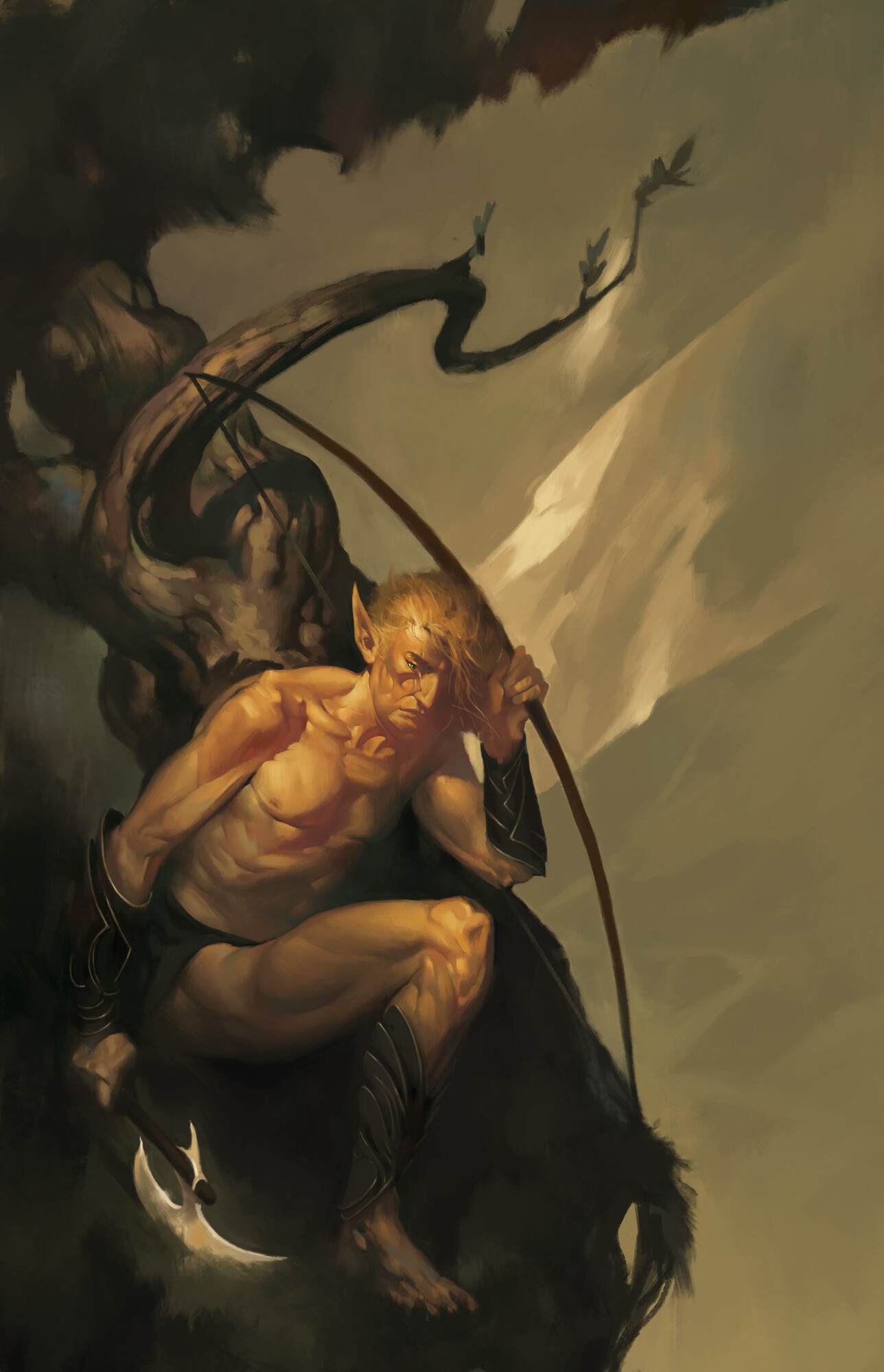
Yet another Ranger
Rough and wild looking, a human stalks alone through the shadows of trees, hunting the orcs he knows are planning a raid on a nearby farm. Clutching a shortsword in each hand, he becomes a whirlwind of steel, cutting down one enemy after another.
After tumbling away from a cone of freezing air, an elf finds her feet and draws back her bow to loose an arrow at the white dragon. Shrugging off the wave of fear that emanates from the dragon like the cold of its breath, she sends one arrow after another to find the gaps between the dragon’s thick scales.
Holding his hand high, a half-elf whistles to the hawk that circles high above him, calling the bird back to his side. Whispering instructions in Elvish, he points to the owlbear he’s been tracking and sends the hawk to distract the creature while he readies his bow.
Far from the bustle of cities and towns, past the hedges that shelter the most distant farms from the terrors of the wild, amid the dense-packed trees of trackless forests and across wide and empty plains, rangers keep their unending watch.
Deadly Hunters
Warriors of the wilderness, rangers specialize in hunting the monsters that threaten the edges of civilization—humanoid raiders, rampaging beasts and monstrosities, terrible giants, and deadly dragons. They learn to track their quarry as a predator does, moving stealthily through the wilds and hiding themselves in brush and rubble. Rangers focus their combat training on techniques that are particularly useful against their specific favored foes.
Thanks to their familiarity with the wilds, rangers acquire the ability to cast spells that harness nature’s power, much as a druid does. Their spells, like their combat abilities, emphasize speed, stealth, and the hunt. A ranger’s talents and abilities are honed with deadly focus on the grim task of protecting the borderlands.
Independent Adventurers
Though a ranger might make a living as a hunter, a guide, or a tracker, a ranger’s true calling is to defend the outskirts of civilization from the ravages of monsters and humanoid hordes that press in from the wild. In some places, rangers gather in secretive orders or join forces with druidic circles. Many rangers, though, are independent almost to a fault, knowing that, when a dragon or a band of orcs attacks, a ranger might be the first—and possibly the last—line of defense.
This fierce independence makes rangers well suited to adventuring, since they are accustomed to life far from the comforts of a dry bed and a hot bath. Faced with city-bred adventurers who grouse and whine about the hardships of the wild, rangers respond with some mixture of amusement, frustration, and compassion. But they quickly learn that other adventurers who can carry their own weight in a fight against civilization’s foes are worth any extra burden. Coddled city folk might not know how to feed themselves or find fresh water in the wild, but they make up for it in other ways.
Creating a Ranger
As you create your ranger character, consider the nature of the training that gave you your particular capabilities. Did you train with a single mentor, wandering the wilds together until you mastered the ranger’s ways? Did you leave your apprenticeship, or was your mentor slain—perhaps by the same kind of monster that became your favored enemy? Or perhaps you learned your skills as part of a band of rangers affiliated with a druidic circle, trained in mystic paths as well as wilderness lore. You might be self-taught, a recluse who learned combat skills, tracking, and even a magical connection to nature through the necessity of surviving in the wilds.
What’s the source of your particular hatred of a certain kind of enemy? Did a monster kill someone you loved or destroy your home village? Or did you see too much of the destruction these monsters cause and commit yourself to reining in their depredations? Is your adventuring career a continuation of your work in protecting the borderlands, or a significant change? What made you join up with a band of adventurers? Do you find it challenging to teach new allies the ways of the wild, or do you welcome the relief from solitude that they offer?
Quick Build
You can make a ranger quickly by following these suggestions. First, make Dexterity your highest ability score, followed by Wisdom. (Some rangers who focus on two-weapon fighting make Strength higher than Dexterity.) Second, choose the outlander background.
The Ranger Table
Benik's Ranger
| Level | Proficiency Bonus | Features | Huntsman Die | 1st | 2nd | 3rd | 4th | 5th |
|---|---|---|---|---|---|---|---|---|
| 1st | +2 | Huntsman Die, Outstanding Explorer, Strider | d4 | — | — | — | — | — |
| 2nd | +2 | Fighting Style, Predator's Strike, Spellcasting | d4 | 2 | — | — | — | — |
| 3rd | +2 | Primal Awareness, Ranger Conclave | d4 | 3 | — | — | — | — |
| 4th | +2 | Ability Score Improvement | d4 | 3 | — | — | — | — |
| 5th | +3 | Extra Attack | d6 | 4 | 2 | — | — | — |
| 6th | +3 | Devastating Weakness | d6 | 4 | 2 | — | — | — |
| 7th | +3 | Conclave Feature | d6 | 4 | 3 | — | — | — |
| 8th | +3 | Ability Score Improvement | d6 | 4 | 3 | — | — | — |
| 9th | +4 | One with the Land | d8 | 4 | 3 | 2 | — | — |
| 10th | +4 | Disappearance, Strider Improvements | d8 | 4 | 3 | 2 | — | — |
| 11th | +4 | Conclave Feature | d8 | 4 | 3 | 3 | — | — |
| 12th | +4 | Ability Score Improvement | d8 | 4 | 3 | 3 | — | — |
| 13th | +5 | — | d10 | 4 | 3 | 3 | 1 | — |
| 14th | +5 | Unwavering Endurance | d10 | 4 | 3 | 3 | 1 | — |
| 15th | +5 | Conclave Feature | d10 | 4 | 3 | 3 | 2 | — |
| 16th | +5 | Ability Score Improvement | d10 | 4 | 3 | 3 | 2 | — |
| 17th | +6 | ─ | d12 | 4 | 3 | 3 | 3 | 1 |
| 18th | +6 | Heightened Senses | d12 | 4 | 3 | 3 | 3 | 1 |
| 19th | +6 | Ability Score Improvement | d12 | 4 | 3 | 3 | 3 | 2 |
| 20th | +6 | Slayer of Men and Beast | d12 | 4 | 3 | 3 | 3 | 2 |
Class Features
As a Ranger, you gain the following class features
Hit Points
- Hit Dice: 1d10 per Ranger level
- Hit Points at 1st Level: 10 + Constitution modifier
- Hit Points at Higher Levels: 1d10 (or 6) + your Constitution modifier per ranger level after 1st
Proficiencies
- Armor: Light armor, medium armor, shields
- Weapons: Simple weapons, martial weapons
- Tools: one type of artisan's tools of your choice
- Saving Throws: Strength, Dexterity
- Skills: Choose three from Animal Handling, Athletics, Insight, Investigation, Nature, Perception, Stealth, and Survival
Equipment
You start with the following equipment, in addition to the equipment granted by your background:
- (a) scale mail or (b) leather armor
- (a) two shortswords or (b) two simple melee weapons
- (a) a dungeoneer’s pack or (b) an explorer’s pack
- A longbow and a quiver of 20 arrows
Huntsman Die
Your growing experience and knowledge is represented by your Huntsman Die. Some features allow you to add your Huntsman Die to certain rolls.
As shown in the class table, you start with a d4 as your Huntsman Die. The die increases to a d6 at 5th level, to a d8 at 9th level, to a d10 at 13th level and finally to a d12 at 17th level.
Outstanding Explorer
At 1st level, you gain proficiency in the Nature or Survival skills if you don’t already have it. Your proficiency bonus is doubled for any ability check you make that uses the chosen proficiency. Also you learn a language of your choice.
Additionally, whenever you make a check to recall information about a location or a creature, you can add your Huntsman Die to the check.
Strider
Beginning at 1st level, your knowledge of terrain types helps you with moving as fast as you can. You ignore any reduction to movement speed from non-magical difficult terrain.
Beginning at 10th level, you add 1 Huntsman Die to your initiative rolls and starting at 15th level, you ignore any difficult terrain.
Fighting Style
At 2nd level, you adopt a particular style of fighting as your specialty. Choose one of the following options.
You can’t take a Fighting Style option more than once, even if you later get to choose again.
Archery
You gain a +2 bonus to attack rolls you make with ranged weapons.
Defense
While you are wearing armor, you gain a +1 bonus to AC.
Druidic Warrior
You learn two cantrips of your choice from the Druid spell list. They count as Ranger spells for you, and Wisdom is your spellcasting ability for them. Whenever you gain a level in this class, you can replace one of these cantrips with another cantrip from the Druid spell list.
Dueling
When you are wielding a melee weapon in one hand and no other weapons, you gain a +2 bonus to damage rolls with that weapon.
Great Weapon Fighting
When you roll a 1 or 2 on a damage die for an attack you make with a melee weapon that you are wielding with two hands, you can reroll the die and must use the new roll, even if the new roll is a 1 or a 2. The weapon must have the two-handed or versatile property for you to gain this benefit.
Two-Weapon Fighting
When you engage in two-weapon fighting, you can add your ability modifier to the damage of the second attack.
Predator's Strike
Starting at 2nd level you know how to use your abilities to create possibilities to hit your enemies where it hurts most. Under certain conditions you inflict extra damage on your hits. You can add one d4 to the damage of your first hit during a turn for each of the following conditions:
- You haven't attacked another target since the beginning of your last turn
- The target's movement speed is reduced
- There is no ally of your target within 5 feet of it
- You have advantage on the attack roll
The extra damage is of the same type as your weapon.
The d4 increases in size at levels 5, 9, 13 and 17 as shown in the Huntsman Die column in the class table. The additional damage you deal is the same as your weapon's unless specified otherwise and you can't add more than 4 Huntsman Dice to one attack.
Spellcasting
By the time you reach 2nd level, you have learned to use the magical essence of nature to cast spells, much as a Druid does. See chapter 11 of the Player's Handbook for the general rules of spellcasting and the Ranger spell list.
Preparing and Casting Spells
The Ranger table shows how many spell slots you have to cast your spells. To cast one of your Ranger spells of 1st-level or higher, you must expend a slot of the spell's level or higher. You regain all spell slots when you finish a long rest.
You prepare the list of Ranger spells that are available for you to cast, choosing from the Ranger spell list. When you do so, choose a number of Ranger spells equal to your Wisdom modifier + half your Ranger level, rounded down. The spells must be of a level for which you have spell slots.
For example, if you are a 5th-level Ranger, you have four 1st-level and two 2nd-level spell slots. With a Wisdom of 14, your list of prepared spells can include four spells of 1st or 2nd level, in any combination. If you prepare the 1st-level spell cure wounds, you can cast it using a 1st-level or a 2ndlevel slot. Casting the spell doesn't remove it from your list of prepared spells. You can change your list of prepared spells when you finish a long rest.
Spellcasting Focus
You can use a druidic focus as a spellcasting focus for your Ranger spells. See chapter 5, of the Player’s Handbook for a list of things that count as druidic foci.
Ritual Casting
You can cast a Ranger spell as a ritual if that spell has the ritual tag and you have the spell prepared.
Spellcasting Ability
Wisdom is your spellcasting ability for your Ranger spells, since your magic draws on your attunement to nature. You use your Wisdom whenever a spell refers to your spellcasting ability. In addition, you use your Wisdom modifier when setting the saving throw DC for a Ranger spell you cast and when making an attack roll with one.
Spell Save DC
Spell attack modifier


Ranger Conclave
At 3rd level, you choose to emulate the ideals and training of a Conclave, a society of Rangers specialized in defending civilization from specific threats.
Choose one of the Conclaves detailed at the end of this class description or one of the officially published Ranger Conclaves/Archetypes from the PHB, Xanathar's Guide to Everything; all work as written with this Ranger. Your Ranger Conclave grants you features at 3rd, 7th, 11th, and 15th level.
Primal Awareness
You can focus your awareness through the interconnections of nature: you learn additional spells when you reach certain levels in this class and always have them prepared, as shown in the Primal Awareness Spells table. These spells don’t count against the number of ranger spells you can prepare.
Primal Awareness Spells
| Level | Spell |
|---|---|
| 3rd | detect magic, speak with animals |
| 5th | beast speech, locate animals or plants |
| 9th | speak with plants |
| 13th | locate creature |
| 17th | commune with nature |
Ability Score Improvement
When you reach 4th level, and again at 6th, 8th, 12th, 14th, 16th, and 19th level, you can increase one ability score of your choice by 2, or you can increase two ability scores of your choice by 1. As normal, you can’t increase an ability score above 20 using this feature.
Using the optional feats rule, you can forgo taking this feature to take a feat of your choice instead.
Extra Attack
Beginning at 5th level, you can attack twice, instead of once, whenever you take the Attack action on your turn.
Devastating Weakness
At 6th level, attacks made with your Predator's Strike feature, ignore resistance to non-magical attacks.
One with the Land
Beginning at 9th level, your mastery of the land grants you a climbing or swimming speed equal to your walking speed.
Disappearance
Beginning at 10th level, you have learned how to conceal yourself from unwanted eyes. You can add your Huntsman Die to any stealth checks and all perception checks made to search for hidden creatures.
Additionally you can use your bonus action to Hide or Disengage. Also, you can't be tracked by non-magical means unless you choose to leave a trail.
Unwavering Endurance
At 14th level, you can endure even the toughest of hardships with relative ease. You gain proficiency in Constitution saving throws. If you are already proficient in them, choose either Intelligence or Charisma saving throws.
Additionally, whenever you finish a short rest, your exhaustion level, if any, is decreased by 1 and you recover from 2 levels of exhaustion from a long rest.
Heightened Senses
At 18th level, your senses exceeds that of other mortals. As long as you aren't both blinded and deafened, you have blindsight and tremorsense out to a range of 30 feet. If you are either blinded or deafened, the range is reduced to 15 feet.
Slayer of Men and Beast
At 20th level you become the Apex predator, no one can keep up with your tenacious hunting spirit. You always deal at least 2 dice of damage from your Predator's Strike feature on your first hit, even if none or only one of the conditions for the extra damage are fulfilled.
Beastmaster
The Beast Master archetype embodies a friendship between the civilized races and the beasts of the wild. United in focus, beast and ranger fight the monsters that threaten civilization and the wilderness alike.
Beastmaster Spells
| Ranger Level | Spells |
|---|---|
| 3rd | heroism |
| 5th | warding bond |
| 9th | haste |
| 13th | death ward |
| 17th | awaken |
Beast Companion
At 3rd level, a special type of beast awaits a Beast Master in the wilds, a creature whose lineage stretches back to the beginnings of the world: a primal beast known as a Beast of the Air or a Beast of the Earth. Such a creature seeks out the type of companionship that a Beast Master offers, ready for the two of them to battle the imbalances in the natural world.
The primal beast is a special creature that a Beast Master can choose for the Ranger’s Companion feature. When choosing such a creature, you decide whether it is a Beast of the Air or the Earth, and you determine its appearance. Stories describe primal beasts that mystically change form to align with the spirit of their companion.
Add your proficiency bonus to the beast’s AC, attack rolls, and damage rolls, as well as to any saving throws and skills it is proficient in.
The beast obeys your commands as best as it can. It takes its turn directly after your initiative. On your turn, you can verbally command the beast where to move (no action required by you). You can use your bonus action to verbally command it to take the Attack, Dash, Disengage, Help or Hide action. If you don't issue a command, the beast takes the Dodge action.


Soothing Presence
At 7th level, your furry friend feels calmer when around you. While your beast companion is within 30 feet of you and can see you, you can add your Huntsman die to all your saving throws.
In addition, the beast's attacks now count as magical for the purpose of overcoming resistance and immunity to nonmagical attacks and damage.
Animalistic Rage
Starting at 11th level, when you command your beast companion to take the Attack action, you can choose for the beast to make two attacks instead of one.
You can use this feature a number of times equal to your Wisdom modifier per short or long rest.
Additionally, whenever your beast companion is within 5 feet of a target, you may add 1 Huntsman Die to your Predator's Strike.
Beast of the Earth
Medium beast, neutral
- Armor Class 12 + your proficiency bonus
- Hit Points equal the beast’s Constitution modifier + your Wisdom modifier + five times your ranger level (the beast has a number of Hit Dice [d8s] equal to your ranger level)
- Speed 40 ft., climb or swim 40 ft. (your choice when you bond with the beast)
STR DEX CON INT WIS CHA 14 (+2) 14 (+2) 15 (+2) 8 (-1) 14 (+2) 11 (+0)
- Saving Throws Dex +4, Con +4, Wis +4
- Skills Perception +4, Stealth +4
- Senses darkvision 60 ft., passive perception 14
- Languages understands the languages you speak
- Charge. If the beast moves at least 20 feet straight toward a target and then hits it with a maul attack on the same turn, the target takes an extra 1d6 slashing damage. The DC equals your spell save DC. If the target is a creature, it must succeed on a Strength saving throw against your spell save DC or be knocked prone.
- Primal Rebirth. If the beast has died within the last hour, you can use your action to touch it and expend a spell slot of 1st level or higher. The beast returns to life after 1 minute with all its hit points restored.
Actions
Maul. Melee Attack: +4 to hit, reach 5 ft., one target. Hit: 1d6+2 slashing damage. (add your proficiency bonus to both the attack and damage roll)
Spelllist Changes
1st Level
- Entangle
- Searing Smite
2nd Level
- Aid
- Gust of Wind
- Magic Weapon
- Enhance Ability
- Warding Bond
3rd Level
- Blinding Smite
- Meld into Stone
- Tongues
4th Level
- Death Ward
- Dominate Beast
5th Level
- Awaken
The Spell Hunter's Mark becomes the following:
Hunter's Sense for Weakness
1st level divination
- Casting Time: 1 Bonus Action
- Range: 90 ft.
- Components: V
- Duration: concentration, up to 1 minute
You choose a creature you can see within range and mystically mark it as your quarry. Until the spell ends, you always deal 1 Huntsman Die of damage to the target whenever you first hit it with a weapon attack on your turn. This die does not stack. Additionally, you have advantage on any Wisdom (Perception) or Wisdom (Survival) check you make to find it. If the target drops to 0 hit points before this spell ends, you can use a bonus action on a subsequent turn of yours to mark a new creature.
At Higher Levels. When you cast this spell using a spell slot of 3rd or 4th level, you can maintain your concentration on the spell for up to 8 hours. When you use a spell slot of 5th level or higher, you can maintain your concentration on the spell for up to 24 hours.
Art Credit
Cover Art: Martin Sobr
Female Ranger: Jeehyung Lee
Male Ranger: Alexandr Kolomiets
This version draws a lot of things from u/laserllama's Alternate Ranger and the Community Ranger Subbreddit's Ranger.
Multiclassing
Ability Score Minimum. As a multiclass character, you must have at least a 13 in both Dexterity (or Strength) and Wisdom to take a level in this class, or to take a level in another class if you are already a Ranger.
Proficiencies Gained. If Ranger isn't your initial class, you gain proficiency in light armor, medium armor, shields, simple weapons, martial weapons, and one skill from the Ranger class's skill list.