Hunter
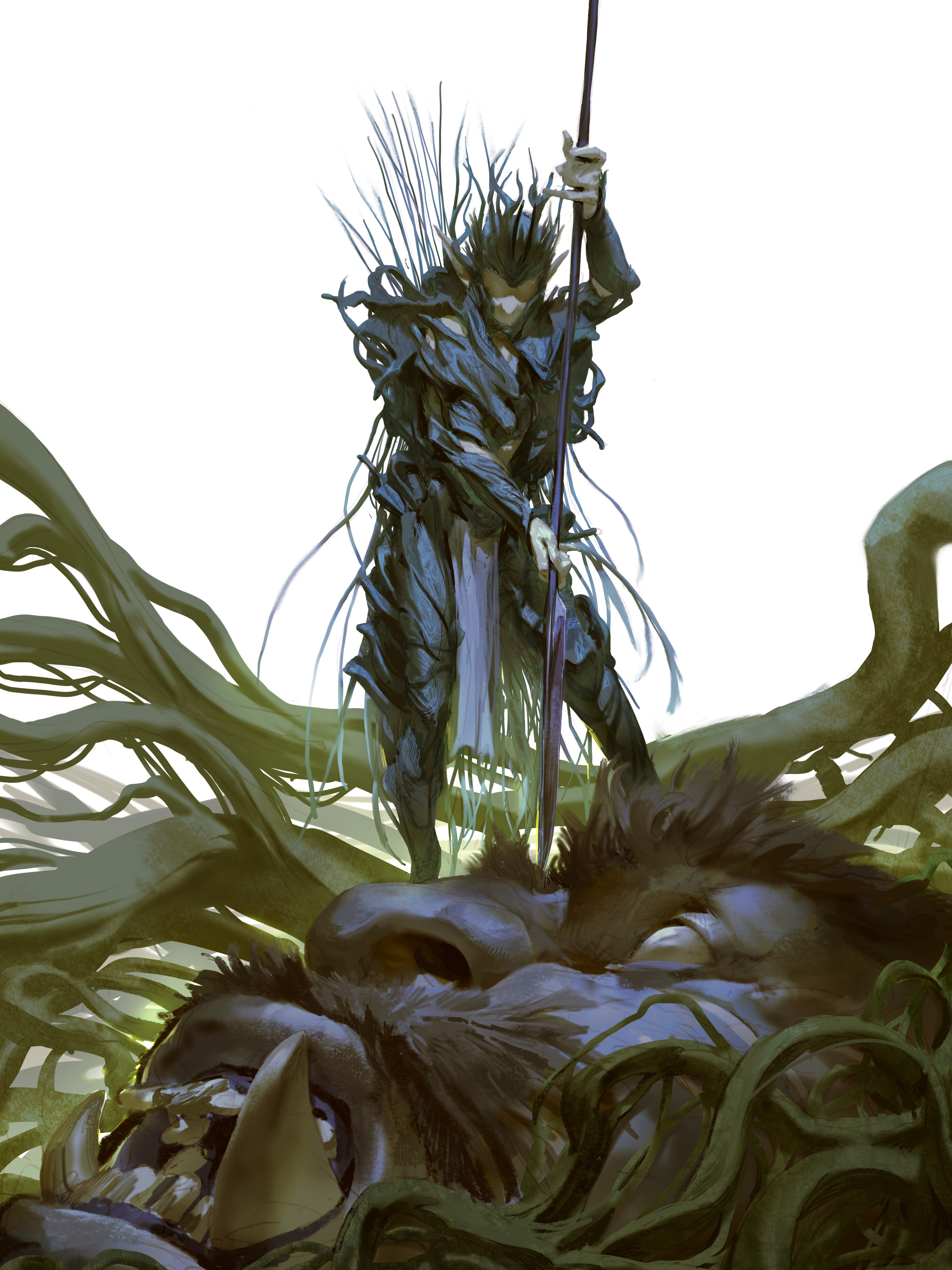
The foliage moves, and an arrow flies from its shadows, striking an orc in an unprotected chink in its crude armor. It falls, and its brothers turn and charge in the direction of the attack, screaming a war cry. The brush erupts again, but this time an elf covered in leafs springs from its midst, drawing swords and gracefully singing its own battle hymn.
A lion nudges the corpse of an elk, searching for savory flesh. A snap and a crack echoes amongst the forest, and the lion roars in anger and pain. As it tries to escape the trap that has bound it, a shadow descends from the branches above with a slash. Frantic cries of resistance ebb into silence.
A werewolf bursts through the door of a small residency, and the inhabitants jump in fear. The wolf man falls and tumbles forwards, slamming into a table, its objects clanging loudly to the ground. From behind it a menacing figure in a torn cloak steps in through the doorway nimbly. Its bloodstained features illuminated by a longsword it wields brimming with radiant energy. The family stare at the figure now standing within their home towering above the dying lycanthrope with fear in their eyes. For the mans aura of hatred burns brighter than the light of his sword.
Keen Combatants
Observant and keen. These are the qualities of a hunter. Some hunters choose to ambush their prey, while others take pride in challenging them head on, finding confidence they can defeat their foe with other research and preparations they have made before hand. You may come across a hunter fighting along side a fearsome beast, shooting its prey from a far distance, or even grappling its foe before driving a blade into its temple. Regardless of method, all hunt with piercing tactical foresight, and are masters of finding, researching, and then exploiting the weaknesses of their marks.
.
Observe and React
Observant and keen. These are the qualities of a hunter. Some hunters choose to ambush their prey, while others take pride in challenging them head on, finding confidence they can defeat their foe with other research and preparations they have made before hand.
Playing a Hunter
Observant and keen. These are the qualities of a hunter. Some hunters choose to ambush their prey, while others take pride in challenging them head on, finding confidence they can defeat their foe with other research and preparations they have made before hand.
Multi Classing
If you wish to multiclass into a hunter, the prerequisites and proficiencies gained are as follows.
Prerequisites
Strength 13 or Dexterity 13, and Wisdom 13
Proficiencies
Light armor, medium armor, shields, simple weapons, martial weapons, choose two skills from the class's skill list.
Spellcasting
Multiclass characters who choose the Mage Hunter, Purifier, or Warden subclasses, divide their hunter levels by 3 (rounded down) for the purposes of determining how many spell slots they get.
Written By: James Rathwell


The Hunter
| Level | Proficiency Bonus | Features | Weak Spot |
|---|---|---|---|
| 1st | +2 | On the Hunt, Resourceful, Favored Enemy | - |
| 2nd | +2 | Fighting Style, Weak Spot | 1d4 |
| 3rd | +2 | Hunter Archetype | 1d4 |
| 4th | +2 | Ability Score Improvement | 1d4 |
| 5th | +3 | Extra Attack | 2d4 |
| 6th | +3 | Hunters Eye, Assess and Adapt | 2d4 |
| 7th | +3 | Hunter Archetype Feature | 2d4 |
| 8th | +3 | Ability Score Improvement | 2d4 |
| 9th | +4 | Stride, Traps | 3d4 |
| 10th | +4 | On the Hunt Improvement | 3d4 |
| 11th | +4 | Hunter Archetype Feature | 3d4 |
| 12th | +4 | Ability Score Improvement | 3d4 |
| 13th | +5 | Assess and Adapt Improvement | 4d4 |
| 14th | +5 | Favored Enemy Improvement | 4d4 |
| 15th | +5 | Hunter Archetype Feature | 4d4 |
| 16th | +5 | Ability Score Improvement | 4d4 |
| 17th | +6 | Afar and Nigh | 5d4 |
| 18th | +6 | Rapid Acumen | 5d4 |
| 19th | +6 | Ability Score Improvement | 5d4 |
| 20th | +6 | Big Game Hunter | 5d4 |
Class Features
As a hunter, you gain the following class features.
Hit Points
- Hit Dice: 1d10 per Hunter level
- Hit Points at 1st Level: 10 + your Constitution modifier
- Hit Points at Higher Levels: 1d10 (or 6) + your Constitution modifier per hunter level after 1st
Proficiencies
- Armor: Light armor, medium armor, shields
- Weapons: Simple weapons, martial weapons
- Tools: None
- Saving Throws: Strength, Dexterity
- Skills: Choose three from Animal Handling, Athletics, Insight, Investigation, Nature, Perception, Stealth, and Survival
.
Equipment
You start with the following equipment, in addition to the equipment granted by your background:
- (a) a scale mail (b) leather armor
- (a) two shortswords or (b) two simple melee weapons
- (a) a dungeoneer’s pack or (b) an explorer’s pack
- A longbow and a quiver of 20 arrows


On the Hunt
Starting at 1st level, when you see a creature, or find clues of a creatures presence, be they tracks or markings, you can use a bonus action to mark the creature as your prey. You can have multiple different prey at the same time. When you mark a creature as your prey you can choose to gain one of the benefits from the following list:
- You gain advantage on survival and nature checks to track and find it.
- You learn its damage Immunities, Resistances, and Vulnerabilities.
- You learn its Condition Immunities, and if it is a spell caster, the level of its highest level spell slot.
If you find new clues that would reveal more about it, or you can see it, you can assess it further as a bonus action, gaining one additional benefit from the list, possibly doing this repeatedly until you have gained all of the benefits from the list.
Whenever you complete a long rest, any creature currently marked as your prey, loses its mark, but you retain any knowledge you have learned about the creature.
Resourceful
As a hunter at 1st level, you are adept at scavenging for useful supplies. Whenever you forage for food or water, the rations you gain as a result are doubled.
Also, you can spend 1 hour to forage for potion and oil supplies to give you the edge within upcoming hunts. Doing so allows you to roll upon the common potions and oils table on pg 6. You gain the result.
At 10th level in this class you can roll upon the uncommon potions and oils table on pg 6 and gain the result.
You can only have three potions and oils created through this feature at a given time.
Favored Enemy
At 1st level, choose a type of favored enemy: aberrations, beasts, celestials, constructs, dragons, elementals, fey, fiends, giants, monstrosities, oozes, plants, or undead. Alternatively, you can select two races of humanoid (such as gnolls and orcs) as favored enemies. You can double your proficiency bonus on any survival, history, medicine, or nature check made against them. You also learn one language associated with this enemy, and whenever you mark them as your prey, you gain all of the listed benefits instead of just one, and can critically hit them on a roll of 19-20 while they are marked.
You can choose one additional favored enemy at 6th and 14th level in this class, learning more languages accordingly.
Fighting Style
At 2nd level, you adopt a particular style of hunting as your specialty. Choose one of the following options. You cant take a Fighting Style option more than once, even if you later get to choose again.
Archery
You gain a +2 bonus to attack rolls you make with ranged weapons.
Mutilator
If you know everything about a creature listed on your On the Hunt feature, and attempt to mutilate or remove one of their attack options, they suffer disadvantage on the saving throw.
Pack Wolf
Melee attacks you make against creatures within 5ft of an ally gain +3 to hit.
Muzzler
You gain a +3 bonus to damage rolls with weapon attacks you make against creatures who are afflicted with a condition.
Scrappy
If you hit an enemy with disadvantage, you can add 1d6 to the damage roll as extra damage.
Slow and Steady
If you choose to not expend any of your movement on your turn, you gain advantage with one weapon attack that turn.
Thrown Weapon Fighting
You can draw a weapon that has the thrown property as part of the attack you make with the weapon. In addition, when you hit with a ranged attack using a thrown weapon, you gain a +2 bonus to the damage roll.
Two-Weapon Fighting
When you engage in two weapon fighting, you can add your ability modifier to the damage of the second attack.
Weak Spot
Also at 2nd level, you can steady yourself in combat to target your preys weaknesses with precision. If you choose to not expend any of your movement during your turn, you gain the following benefits against those marked as your prey until the beginning of your next turn.
- You can add your Weak Spot damage (as displayed on the Hunter class table) as extra damage to all weapon attacks you make against them.
- If you hit them with advantage, and both rolls would have hit, you can force the target to make a Constitution saving throw (DC = 8 + your proficiency bonus + your Wisdom modifier). On a failure you can select one of their attack options you have seen them use. They suffer disadvantage on attack rolls with the attack option until the end of their next turn, as you mutilate the body part needed to use it.
Hunter Archetype
At 3rd level, you choose an archetype that you aim to emulate. These 10 archetypes can be found on pages 8-21. Your choice grants you features at 3rd level and again at 7th, 11th, and 15th level.
Ability Score Improvement
When you reach 4th level, and again at 8th, 12th, 16th, and 19th level, you can increase one ability score of your choice by 2, or you can increase two ability scores of your choice by 1. As normal, you can’t increase an ability score above 20 using this feature. Using the optional feats rule, you can forgo taking this feature to take a feat of your choice instead.
Extra Attack
Beginning at 5th level, you can attack twice, instead of once, whenever you take the Attack action on your turn.
Hunters Eye
At 6th level, your visual and physical reaction time increases.
- You can add your Wisdom modifier to your initiative rolls.
- You can use an object interaction or make a perception check (that would require an action) as a bonus action.
Assess and Adapt
Also at 6th level, when you steady yourself in battle, you can more precisely perceive and react to oncoming threats. If you do not expend any of your movement on your turn, then for the rest of the round when an enemy misses you with an attack, or you succeed a Dexterity saving throw, you can roll, slide, or vault 10ft without expending any of your movement, shifting yourself out of danger. When moving in this way, enemies suffer disadvantage on opportunity attacks against you. You can do this a maximum of twice each round.
Stride
At 9th level, moving through creatures and rough terrain no longer slows your movement, and you can move while stealthing, climbing, and swimming, normally without your movement being slowed.
Traps
Also at 9th level, traps are added to your hunting arsenal.
Each time you complete a short or long rest, you can set a trap. You must set it up within 100ft of where the rest was taken. The different traps you can craft are outlined on pg 6.
The traps save DC = 8 + your proficiency bonus + your Wisdom modifier.
On the Hunt Improvement
At 10th level, whenever you learn everything about a creature listed in your On the Hunt feature you gain the following benefits against them while they are marked as your prey:
- You can add your Wisdom modifier to any Dexterity based saving throw you make against them.
- Once per round when they attempt to hit you with an attack, you can expend your reaction to add your Wisdom modifier to your AC against this attack and any other attack they make against you until the beginning of your next turn. While you have this bonus to your AC, if they hit you, you lose this bonus to your AC.
Assess and Adapt Improvement
Beginning at 13th level, your ability to assess and adapt accordingly improves. Whenever you use an action or bonus action to make a Strength, Dexterity, or Wisdom based check, or mark a creature as your prey, you can roll, slide, or vault 10ft without expending any of your movement. Attacks of opportunity made against you while you move in this way suffer disadvantage.
Afar and Nigh
At 17th level, when you see creature marked as your prey use their movement, you can expend your reaction to make a weapon attack against them, counting the range from where they started. Furthermore, you no longer suffer disadvantage with ranged attacks due to targets being within 5ft of you.
Rapid Acumen
At 18th level, if you roll, slide, or vault 30ft or more without expending any of your movement during the same round, you can add your Wisdom modifier to the attack and damage rolls of all of your attacks until the end of your next turn.
Big Game Hunter
Finally when you reach 20th level in this class, your ability to assess the weaknesses in your enemies becomes legendary. Whenever you critically hit a target marked as your prey, they must make a Strength saving throw (DC = 8 + your proficiency bonus + your Wisdom modifier.). On a failure, you can choose to remove one of the creatures attack options, this includes legendary attack options. If you choose an attack option that has the recharge trait, instead of removing the attack option, the next time the creature uses the attack option it also suffers the attacks effects. If the creature has only one attack option or succeeds the save, it instead suffers disadvantage on attacks made with that option until the end of its next turn.
Hunter Tables
Common Potions and Oils
| d6 | Result |
|---|---|
| 1 | Potion of Climbing |
| 2 | Potion of Courage |
| 3 | Potion of Watchful Rest |
| 4 | Potion of Mediocrity |
| 5 | Potion of Gliding |
| 6 | Potion of Healing |
Uncommon Potions and Oils
| d8 | Result |
|---|---|
| 1 | Potion of Animal Friendship |
| 2 | Potion of of Fire Breath |
| 3 | Potion of Water Breathing |
| 4 | Potion of Growth |
| 5 | Potion of Resistance (choose acid, poison, or necrotic) |
| 6 | Potion of Poison |
| 7 | Potion of Resistance (choose fire, cold, or thunder) |
| 8 | Potion of Greater Healing |
New Potions
Potion of Courage
Potion, common
This concoction looks, smells, and tastes of strong alcohol.
After drinking this potion you gain advantage on saving throws against being frightened but suffer disadvantage on saving throws against being charmed. You also gain a +2 to any Charisma based check, but suffer disadvantage on Dexterity, Wisdom, and Intelligence based checks. You gain these effects for 1 hour.
Upon further inspection you discover that this concoction is strong alcohol.
Potion of Gliding
Potion, common
This potion is filled with a clear liquid. It is as light as a feather.
After drinking this potion you gain the effects of the spell feather fall for 1 hour. Additionally, while falling, you can choose to move 10ft laterally for every 30ft you fall vertically.
Potion of Mediocrity
Potion, common
This potion looks impeccably plain and boring.
After drinking this potion you must set one of your ability scores to 10 for 1 hour (which one you choose is your choice, however you cannot select one that is already at 10).
Traps
When traps are set up they are hidden, and can only be seen by succeeding a perception check verses the traps save DC.
Bear Trap
This trap resides within a 5ft x 5ft square. Any creature that steps into the square must succeed a Dexterity Saving throw or suffer 1d6 piercing damage and become restrained. While restrained they can make a Strength check as an action against the traps save DC to free themselves. The bear trap is destroyed if it takes 10 or more damage.
Tripwire Trap
This trap resides within a 5ft x 15ft line between two objects such as trees or walls. Any creatures that step into the line must succeed a Dexterity Saving throw or trigger the tripwire, as it knocks them prone, and lets out a loud noise that can be heard from up to 200ft away. Once the tripwire has been triggered cannot be triggered again.
Net Trap
You can only craft this trap as part of a long rest.
This trap is perched above a 10ft x 10ft circle, on an object such as a tree or ledge. Any creatures that step into the circle trigger the net and must succeed a Dexterity saving throw or be restrained by it. While restrained they can use their action to make a Strength check against the traps save DC to free themselves. The net is destroyed if it takes 10 or more damage.
Pit Trap
You can only craft this trap as part of a long rest, and must be dug into an area with soil.
This pit is 15ft wide on either side, 20ft high, filled with stakes, and covered with camoflauge. Any creatures that steps into the pit must succeed a Dexterity Saving throw or fall into it, suffering falling damage as normal and an additional 1d8 piercing damage from the stakes at its bottom.
Better Traps
Available to trappers at 9th level in this class.
Deployable Bear Trap
Your bear traps can now be carried on your person instead of having to set them up at the end of a rest. When carried they can be deployed as an object interaction.
Grease Tripwire Trap
When the tripwire is triggered, it releases grease in a 15ft x 15ft cube originating from its center. Creatures in the grease have their movement speed reduced by half, and must succeed a Dexterity saving throw at the beginning of each of their turns or are knocked prone.
Strong Net Trap
The net is not destroyed until it takes 30 or more damage.
Fire Pit Trap
Creatures who fall into your pit trap suffer your Weak Spot dice as fire damage at the beginning of their turns until they escape the pit.
Subclasses
A-Z
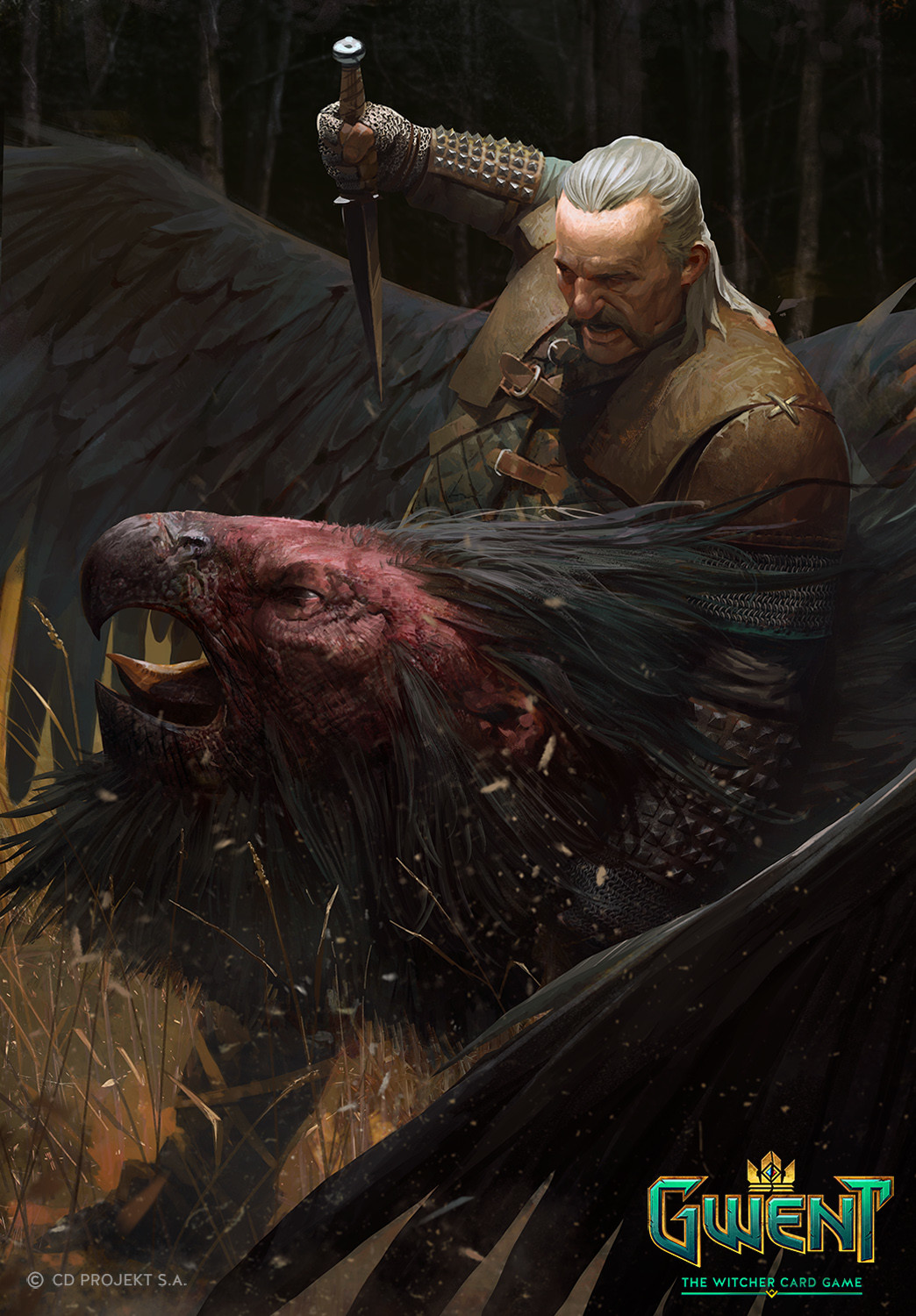
Anatomist
Anatomists distinguish themselves from other hunters with their superior medical knowledge. Physicians, beastiary authors, and witch doctors, anatomists set about their work actively, seeking rare beasts and cadavers to study that they themselves must often catch or slay. Their medical prowess allows them to mend and deal wounds with surgical precision, skills that are indispensable when on the perilous pursuit of esoteric medical knowledge.
Mend and Rend
Beginning at 3rd level, you can utilize your medical knowledge to heal and harm friends and foe.
- You can perform medicine checks that would normally require an action as a bonus action.
- You gain advantage on medicine checks to stabilize creatures.
- When using a healing kit, you can roll your Weak Spot dice and heal the target an amount equal to the result.
- Whenever you deal your Weak Spot damage to a creature, you can reduce the amount of Weak Spot dice you deal to them by 1. This allows you to instead inflict the target with the bleeding condition.
- If you spend at least 1 hour analyzing a cadaver, you learn everything about the creature listed as part of your On the Hunt feature, and can add your Wisdom modifier to one damage roll against them each turn.
Bloodletter
At 7th level, your anatomical knowledge grows, and with it your speed and efficiency when harming and healing.
- You can replace any weapon attack you make with utilizing a healing kit instead.
- Whenever you deal your Weak Spot damage to a creature that is bleeding, you can reduce the amount of Weak Spot dice you deal to them by 2. This allows you to instead inflict the target with the hemorrhaging condition.
- Whenever you inflicted the hemorrhaging condition on a creature you can choose one ability. The creature has disadvantage on all ability checks made with the ability until the condition is removed.
- When you or an ally within 30ft of you makes a weapon attack against a hemorrhaging target, you can expend your reaction to grant them advantage on the attack roll (before the rolls result is declared).
.
New Conditions:
A creature must have blood to gain these conditions.
Bleeding
- A bleeding creature takes 1d4 damage at the beginning of each of its turns.
- The creature or an ally within 5ft of them can end the condition by completing a DC 10 medicine check as an action.
Hemorrhaging
- A hemorrhaging creature is bleeding (see the condition).
- At the beginning of each of the creatures turns the amount of bleeding damage it takes increases by 1d4.
- Anything that ends the bleeding condition also ends the hemorrhaging condition.
Beyond Flesh
Starting at 11th level, you have broadened your field of anatomical knowledge beyond that of organic creatures, and into the metaphysical, arcane, and ephemeral realms. You have found many similarities and differences between these entities, and this knowledge allows you perform things most cannot. You can inflict the bleeding and hemorrhaging conditions on any creature, regardless if they do or do not have blood.
Anatomical Prodigy
Finally, at 15th level, creatures you have inflicted with the hemorrhaging condition must subtract 1d4 from their attack rolls, as the lacerations you inflict on them fester and worsen when they move and act.
Furthermore, whenever you successfully use a healing kit on a creature, they regain 2d4 hit points at the beginning of each of their turns for 1 minute. This effect ends as soon as they receive damage from an enemy, and cannot bring them above half their maximum hit points.
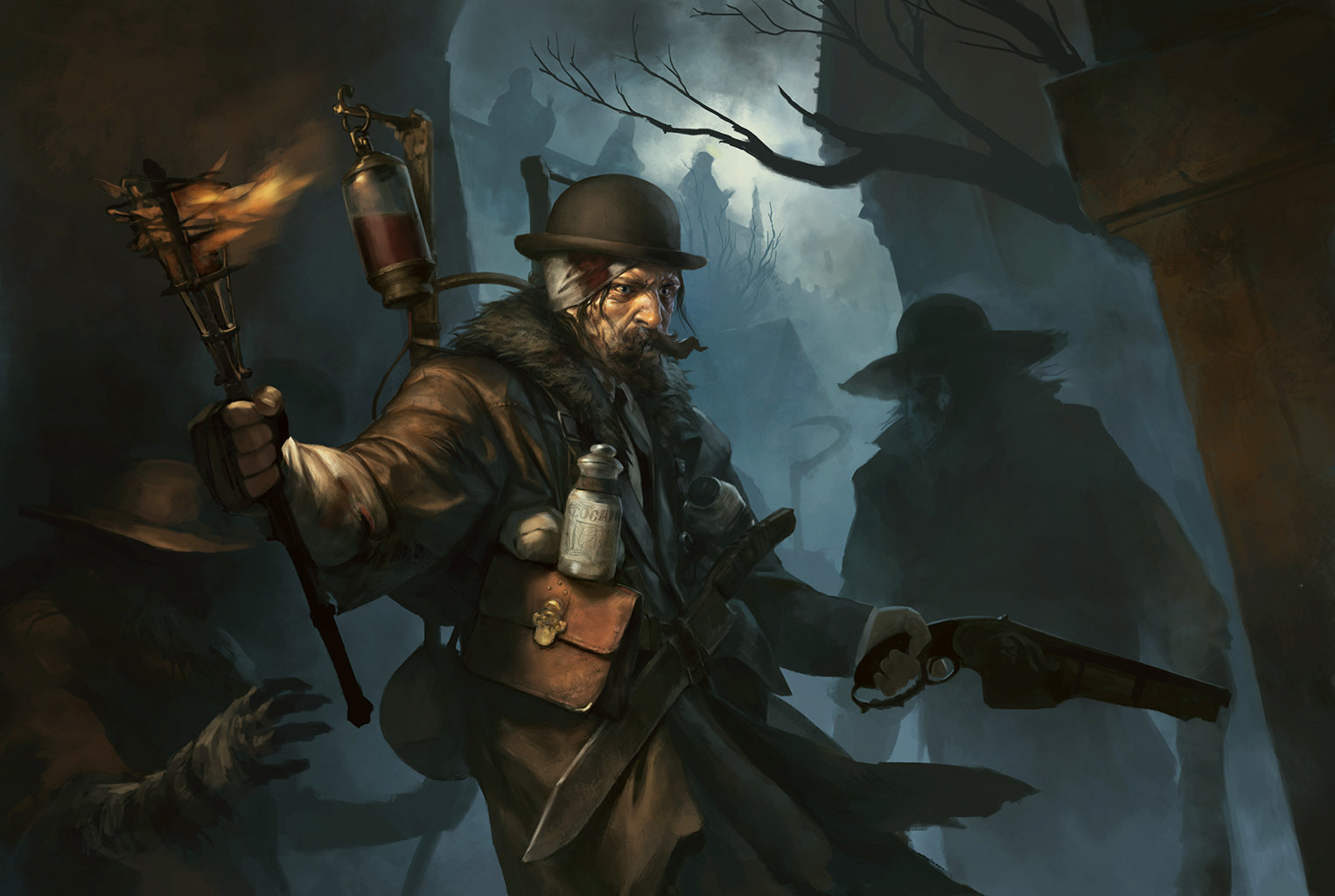
Beast Master
Beast masters attack their prey alongside tamed animals, striking simultaneously and deftly with their pets and companions. Beast masters train and improve their companions as much as they hone their own skills, utilizing teamwork to slay their prey.
Hunters Companion
Beginning at 3rd level, you gain a companion that accompanies you and fights alongside you it battle. Choose a beast no larger than Medium and that has a challenge rating of 1/4 or lower (appendix D of the players handbook presents statistics for the hawk, mastiff, and panther as examples). Add your proficiency bonus to the beasts AC, attack rolls, and damage rolls, as well as to any saving throws and skills it is proficient in. Its hit point maximum equals the hit point number in its stat block or 5x your ranger level, whichever is higher. Like any creature, it can spend Hit Dice during a short rest to regain hit points.
The companion obeys your commands as best as it can. It takes its turn on your initiative, though it doesn't take an action unless you command it to. On your turn, you can verbally command the beast where to move, and can command it to take the Dash, Disengage, Dodge, or Help action (no action required by you). If you use your action to do this, you can command it to attack a target. It will continue to attack the target without requiring your action on following turns until the target dies or falls unconscious. If you do not issue a command to your companion the DM decides what it does. Once you gain the Extra Attack feature, when taking the attack action you can instead give up one attack to command your companion to take the attack action.
If you are incapacitated or absent, your companion acts on its own, focusing on protecting you and itself. The Companion never requires your command to use its reaction, such as when making an opportunity attack.
If the your companion dies, you can obtain a new companion by spending 1 hour magically bonding with a beast that isn't hostile to you and that meets the requirements.
.
Exceptional Training
At 7th level, your companions exceptional training grants it the following benefits:
- Your companion gains your Assess and Adapt feature.
- Your companion can use its multi attack feature if it has it.
- Your companion can nimbly dodge out of the way of certain area Effects, such as a red dragon's fiery breath or an Ice Storm spell. Whenever it is subjected to an effect that allows it to make a Dexterity saving throw to take only half damage, it instead take no damage if it succeeds on the saving throw, and only half damage if it fails.
- You can now choose a companion with a size of Large. If your beast is size Medium, you can change it to size Large, as it matures and evolves. It evolves in this way on the completion of a long rest.
- The beasts attacks count as magical for the purposes of overcoming resistances and immunities to non magical attacks and damage.
Beastial Fury
Starting at 11th level, when you command your companion to take the Attack action, the beast can make two attacks. If it has the multi attack feature you can choose which attack option it uses.
In addition, whenever you add your Wisdom modifier to your AC, it is added to your beasts AC for the same duration.
One With the Wild
Finally, at 15th level, you and your companion fight together with masterful synchronicity.
Whenever you deal your Weak Spot damage to a target, your companion deals your Weak Spot damage on any attack it makes against the same target until the end of the round.
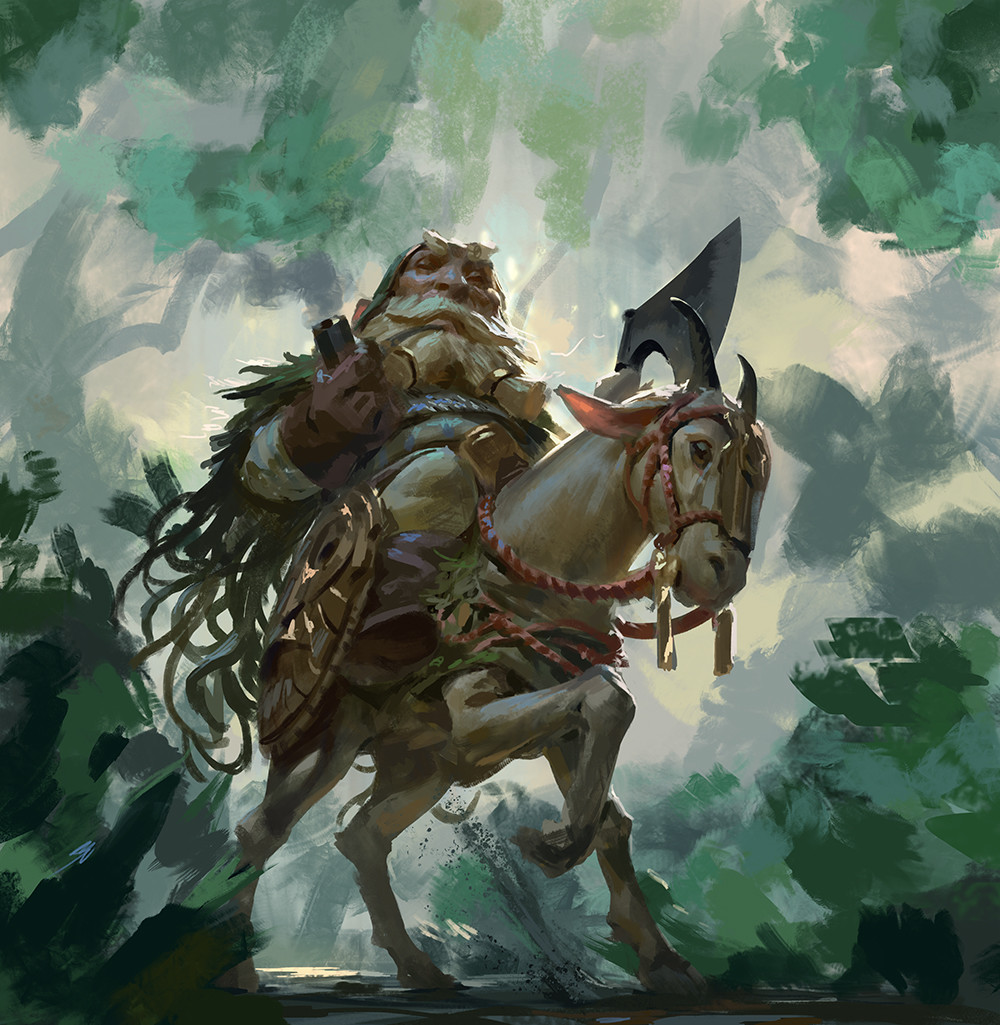
Blood Hunter
Blood Hunters are mysterious and frightening. They study occult arts and rituals in order to eliminate their prey, causing many hunters to distrust them. They guard their secret hunting methods closely, but will exploit them often, taking steep sacrifices when necessary to slaughter their prey. This is no better exemplified than by the dangerous ritual all blood hunters undergo to transmute and mutate themselves. Once completed this allows them to harness their own life force as a weapon in combat, but also often leaves them with scars and blemishes. Some appearing almost untouched, while others gaining a new eye color or disfigured complexion.
Anything for the Hunt
Beginning at 3rd level, the ritual you have undergone has granted you superior senses, resilience, speed, and lethality. You gain resistance to necrotic damage, and gain darkvision within a radius of 60ft. If you already had darkvision from your race its radius is increased 30ft.
Furthermore, you can invoke your unnatural speed at the beginning of your turn, dealing half your Weak Spot damage dice to your own hit points as necrotic damage (rounded down, to a minimum of 1 dice). This allows you to fully gain the benefits of any feature within this class as if you have not expend any of your movement this round.
Alternatively, you can choose to not half the amount of Weak Spot dice dealt yourself. This allows you to also choose a different damage type for your Weak Spot damage for 1 minute, as you draw your blood, harnessing it as fuel. You can choose between fire, cold, necrotic and lightning damage. When you reach 10th level in this class you can extend this to acid, poison, radiant, psychic, and thunder damage.
Occult Manipulations
At 7th level, your ability to manipulate the power within your blood increases. You can deal 2d4 necrotic damage to yourself to perform one of the following Occult Manipulations.
- When you mutilate or remove a creatures attack option, they must succeed a Wisdom saving throw (DC = 8 + your proficiency bonus + your Wisdom modifier) or become frightened of you until the end of your next turn.
- Once per turn you can re roll a missed attack roll. You suffer disadvantage on this roll while above half your maximum hit points.
- When you deal your Weak Spot damage with a bonus action or reaction, you do not need to half the Weak Spot damage dice for this attack or any other attack, until the beginning of your next turn.
- When you critically hit a creature and deal your Weak Spot damage to it, all other enemies within 10ft of the target must succeed a Dexterity saving throw (DC = 8 + your proficiency bonus + your Wisdom modifier) or suffer the same amount of Weak Spot damage.
- Before you make a saving throw against a spell, you can expend your reaction to add your Wisdom modifier to this save and any other spell saves you make until the beginning of your next turn.
- Once per turn when one of your prey within 30ft of you makes a weapon attack, you can use your reaction to impose disadvantage on the attack. You must do this before the attack rolls result is declared. If this causes the attack to miss, you can deal your Weak Spot damage to it (as necrotic damage, or the damage type you chose as part of Anything for the Hunt).
Hunt With Hate
At 11th level, your resolve thickens to an unnatural and frightening degree. You can no longer become frightened, and gain advantage on attacks against frightened targets. You also gain advantage on saving throws against becoming Charmed, and whenever a creature fails to frighten, intimidate, or charm you, you can expend your reaction to force a number of creatures within 30ft of you equal to you Wisdom modifier to make a Wisdom saving throw (DC = 8 + your proficiency bonus + your Wisdom modifier). On a failure they become frightened of you until the end of your next turn.
Lastly, you learn to manipulate your preys blood to mend your own wounds. If you reduce one of your prey to 0 hit points, or mutilate or remove one of your preys attack options, you are healed an amount equal to your Wisdom modifier.
Sanguine Mastery
At 15th level whenever you roll a 4 on a Weak Spot damage dice, you can deal 1d4 necrotic damage to yourself to deal 1 additional Weak Spot damage dice to the same target.
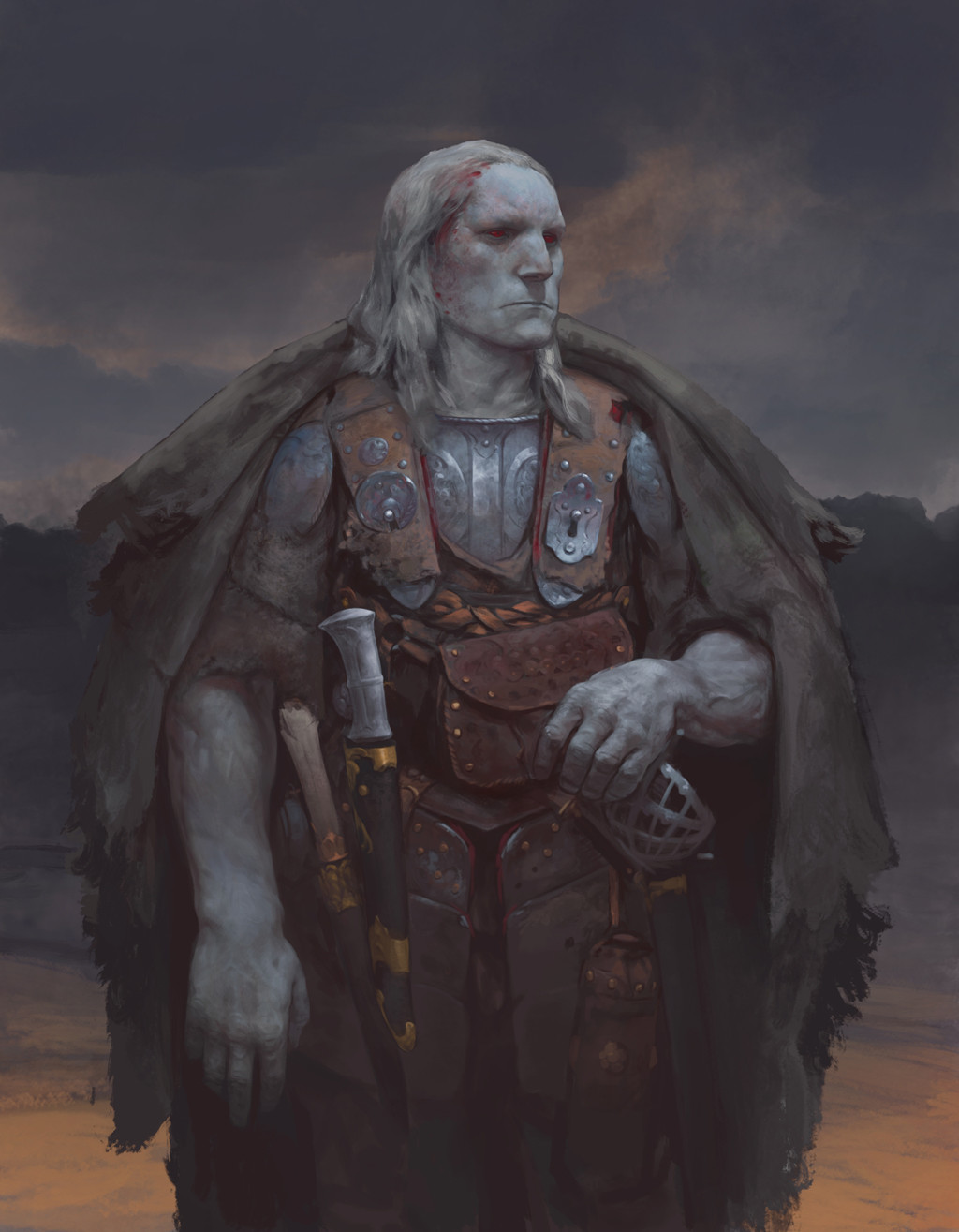

Daredevil
Daredevils are seen as fools and farces by many hunters. This is due to their style of waging battle, as unlike other hunters they take pride in fighting with a flourish. For a daredevil a good hunt is one worthy of story, and while other hunters may despise them and their unnecessary and dull minded tactics, the common folk and storytellers flock to them to see and listen to their new tricks and tales.
Adrenaline
At 3rd level, the thrill of battle fuels you.
Adrenaline Points You can gain adrenaline points during battle and can then expend them to perform tricks. A tricks adrenaline point cost is found in brackets before its name.
Doing the following grants you 1 adrenaline point:
- Rolling a natural 20 on a check, saving throw, or attack.
- Succeeding a check or saving throw with disadvantage.
- Hitting an enemy with disadvantage.
- An enemy misses you with an attack while you are not wearing heavy armor.
At the beginning of your turn, if you did not gain any adrenaline points on your previous turn, you lose one of your adrenaline points.
Saving Throws. Some of your tricks require your target to make a saving throw to resist the trick's effects. The saving throw DC is calculated as follows:
Trick save DC = 8 + your proficiency bonus + your Wisdom modifier.
Tricks
You can attempt the following tricks at 3rd level.
(0) Trick Attack. You can attack with style. When making a weapon attack, you can choose suffer disadvantage on the attack. Doing so allows you to add your Wisdom modifier to hit for this attack.
(0) Flourish. Whenever you roll a check or saving throw, you can choose to do it with a flourish. Doing so makes you suffer disadvantage on the roll, but increases your amount of Weak Spot damage dice by 1 for the remainder of the round, as the thrill of the flourish invigorates you.
(1) Feint. As a bonus action you can force a creature you can see within 10ft of you to make a Wisdom save. On a failure you gain advantage on your next attack against them this turn.
(2) Flow. Expending your movement does not stop you from dealing your Weak Spot damage this round.
(2) Piercing Trick Once per weapon attack when rolling your Weak Spot damage dice you can re roll any results of 1 and must use the new results.
(2) Ricochet. When making a ranged weapon attack, you can target a creature not visible to you due to obstructing objects or terrain features, but suffer disadvantage on the attack roll. You cannot target creatures that are invisible or hidden by magical means in this way.
(3) Relent. When you make a roll with disadvantage, and roll a natural 20 on one of the dice, you can choose to use the natural 20 as the result, even if it was the highest roll.
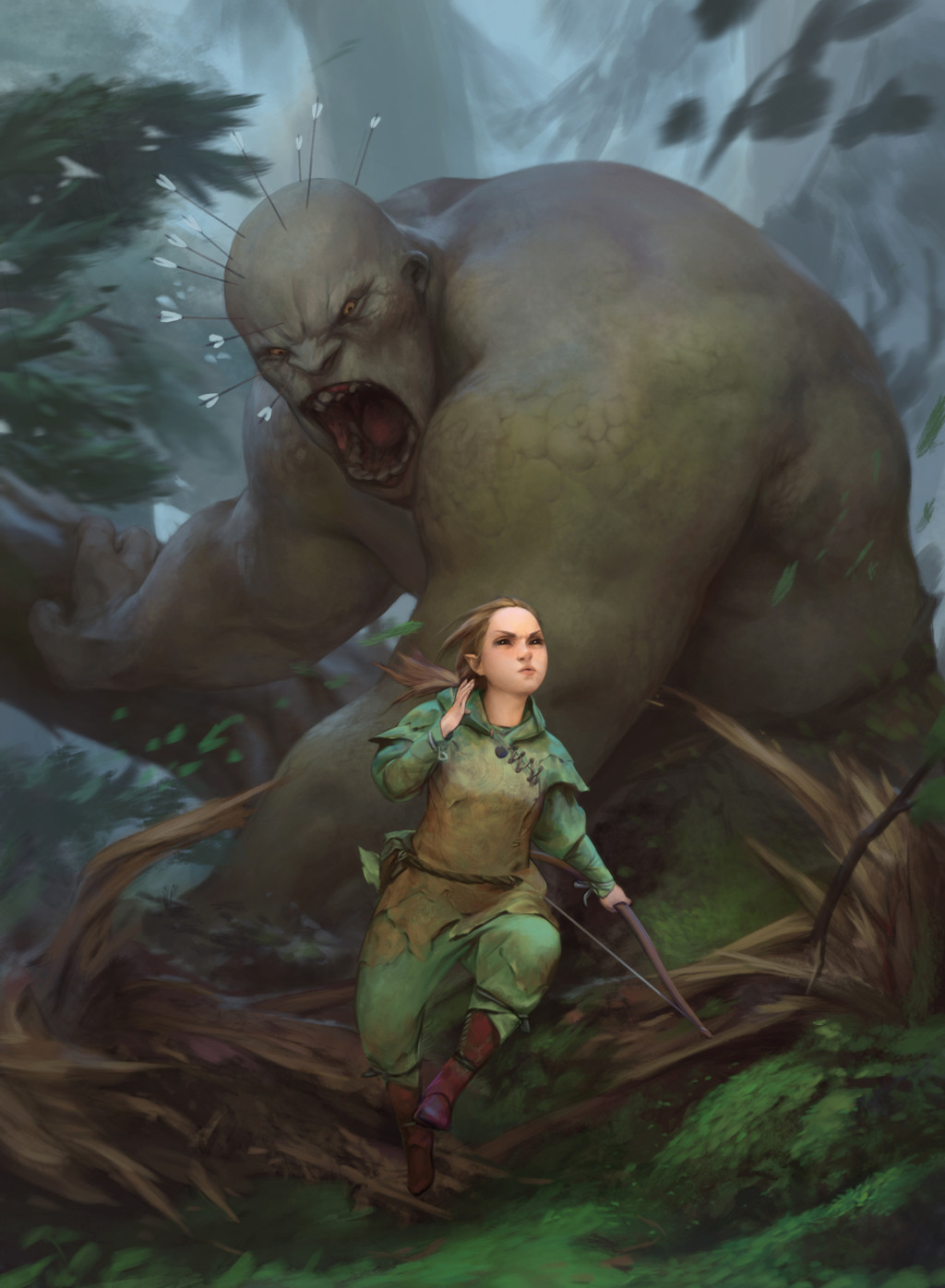

.
Daring Feats
At 7th level, you gain access to more complex tricks that require a higher amount of skill to pull off.
(3) Duck and Weave. As a bonus action you can grant yourself the benefits of half cover, and whenever you roll, slide, or vault 10ft without expending your movement, you can instead move 15ft. You gain these effects until the beginning of your next turn.
(3) Blinding Potion As an action you can throw a potion you have concocted at a point you can see within 30ft of you and shoot it or simply let it fall to the ground. All creatures within 10ft radius sphere centered on that point must succeed a dexterity saving throw or take 1d8 force damage + your Weak Spot damage and are blinded until the beginning of your next turn. On a successful save they take half damage.
(5) Lightning Trick You can cast the spell lightning arrow as a bonus action.
(6) Volley As an action, you can cast the spell conjure volley.
(7) Slashing Wind. As an action, you can cast the spell steel wind strike. When casting the spell in this way, instead of making melee spell attacks you make melee weapon attacks, and the spells damage replaces the damage for these weapon attacks.
(7) Show Stopper As an action or bonus action, you can throw an explosive potion you have concocted in the air and shoot it or simply let it fall to the ground. All creatures within 20ft radius sphere originating from the potion must succeed a Dexterity saving throw or take 5d8 bludgeoning, slashing, or piercing damage (your choice) + your Weak Spot damage and are blinded until the beginning of your next turn. Creatures take half damage on a successful save. If you used your bonus action for this trick you must also make the save. You cannot be blinded by this trick.
(10) Adrenaline Rush. As a bonus action, you gain the effects of the spell haste for 1 minute.
Hat Trick
At 11th level, your reaction time and ability to capitalize on your speed improves. While you are not wearing heavy armor and you gain an adrenaline point from one of the events described in your 3rd level feature Adrenaline, you regain your reaction if you have expended it previously on the same round. You can do this a once each round, increasing to twice at 15th level, and three times at 20th level in this class.
Show Off
Finally at 15th level, you can expend your reaction while performing the following tricks to increase their effects.
Trick Attack You can use this trick once more this turn.
Feint You can target one additional creature.
Ricochet. You do to not suffer disadvantage on the attack.
Show Stopper. You can teleport up to 30ft to a point you can see. As you vanish in the smoke of the blast and re appear some where else in a flurry of speed. You also avoid any damage caused by the explosion.
Adrenaline Rush. If you are below half your maximum hit points, you can roll your Weak Spot damage dice and gain an amount of temporary hit points equal to the amount rolled. This temporary HP lasts until the adrenaline rush fades.

Mage Hunter
If you would like to procure the dilapidated head of a Mage, hire a Mage Hunter. Mage Hunters specialize in debilitating and slaying spellcasters with the use of their own nulifying magic. They generally use their arcane powers to fuel their weapons and speed, allowing them to close the gap between themselves and their foe, making sure their prey cannot flee, by both physical and arcane means. To the gleeful benefit of many Mage Hunters wallets, their are even occurances where Warlocks and Wizards will hire Mage Hunters to protect themselves from other Mage Hunters.
Spellcasting
Starting at 3rd level, you have learned to cast spells, much as your prey do. See Spells Rules for the general rules of spellcasting and the Spells Listing for the Mage Hunter spell list.
Spell Slots The Mage Hunter table shows how many spell slots you have to cast your Mage Hunter spells of 1st level and higher. To cast one of these spells, you must expend a slot of the spell’s level or higher. You regain all expended spell slots when you finish a long rest.
For example, if you know the 1st-level spell animal absorb elements and have a 1st-level and a 2nd-level spell slot available, you can cast absorb elements using either slot.
Spells Known of 3rd Level and Higher You know three 1st-level spells of your choice from the Mage Hunter spell list.
The Spells Known column of the Mage Hunter table shows when you learn more Mage Hunter spells of your choice. Each of these spells must be of a level for which you have spell slots. For instance, when you reach 7th level in this class, you can learn one new spell of 1st or 2nd level.
Additionally, when you gain a level in this class, you can choose one of the Mage Hunter spells you know and replace it with another spell from the Mage Hunter spell list, which also must be of a level for which you have spell slots.
Spellcasting Ability Wisdom is your spellcasting ability for your mage hunter spells, since your magic draws on your attunement to the arcane. You use your Wisdom whenever a spell refers to your spellcasting ability. In addition, you use your Wisdom modifier when setting the saving throw DC for a mage hunter spell you cast and when making an attack roll with one.
Spell Save DC
Spell attack modifier
.
Mage Hunter Spellcasting
| Hunter Level | Spells Known | 1st | 2nd | 3rd | 4th |
|---|---|---|---|---|---|
| 3rd | 3 | 2 | — | — | — |
| 4th | 4 | 3 | — | — | — |
| 5th | 4 | 3 | — | — | — |
| 6th | 4 | 3 | — | — | — |
| 7th | 5 | 4 | 2 | — | — |
| 8th | 6 | 4 | 2 | — | — |
| 9th | 6 | 4 | 2 | — | — |
| 10th | 7 | 4 | 3 | — | — |
| 11th | 8 | 4 | 3 | — | — |
| 12th | 8 | 4 | 3 | — | — |
| 13th | 9 | 4 | 3 | 2 | — |
| 14th | 10 | 4 | 3 | 2 | — |
| 15th | 10 | 4 | 3 | 2 | — |
| 16th | 11 | 4 | 3 | 3 | — |
| 17th | 11 | 4 | 3 | 3 | — |
| 18th | 11 | 4 | 3 | 3 | — |
| 19th | 12 | 4 | 3 | 3 | 1 |
| 20th | 13 | 4 | 3 | 3 | 1 |
Attuned Armory
Additionally at 3rd level, you learn a ritual that creates a magical bond between yourself and one weapon. You perform the ritual over the course of 1 hour, which can be done during a short rest. The weapon must be within your reach throughout the ritual, at the conclusion of which you touch the weapon and forge the bond. Once you have bonded a weapon to yourself, you can't be disarmed of that weapon unless you are incapacitated. If it is on the same plane of existence, you can summon that weapon as a bonus action on your turn, causing it to teleport instantly to your hand.
You can have up to two bonded weapons, but can summon only one at a time with a bonus action or object interaction. If you attempt to bond with a third weapon, you must break the bond with one of the other two. Additionally you can use your Wisdom modifier for attack and damage rolls with the weapons.
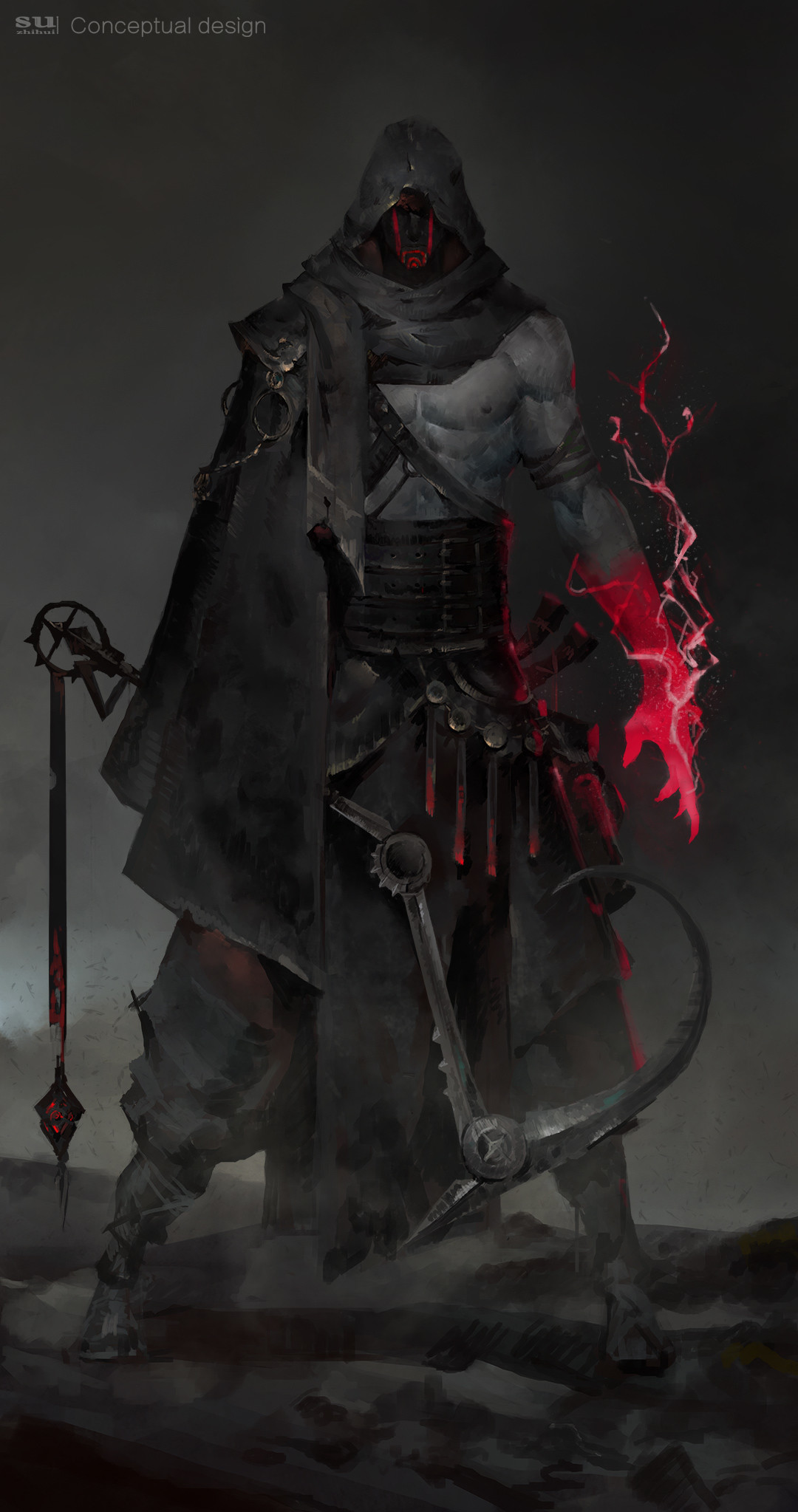
Alternatively, In place of one of these weapons, you can attune yourself to a shield to protect both your body and mind, doing so allows you to add the shields AC to saving throws you make against spell effects. Lastly, choosing a thrown weapon with this feature allows you to instead choose up to 5 thrown weapons and count them as one weapon bond.
Arcane Momentum
At 7th level, your experience with fighting mages increases. You can now utilize both your magic and momentum to attack with greater efficiency.
- Whenever you mutilate or remove an enemies attack option, you can instead choose to remove some of their spell slots. You can remove a number of spell slots equal to half your proficiency bonus (rounded down). When removing a spell slot, for each level it is higher than first, the number of spell slots you can remove is reduced by one.
- Whenever you hit an enemy with a weapon attack, you can expend a spell slot to tare into the enemy with arcane momentum. For every 10ft you have moved directly before the attack in a straight line towards the enemy (this includes teleporting, falling, and flying), they suffer an additional 1d4 force damage, to a maximum of 6d4. This benefit lasts for 1 minute per level of the spell slot used.
- Whenever you roll, slide, or vault 10ft without expending any of your movement, you can expend a spell slot to teleport 10ft before, during, or after, moving in this way. This benefit lasts for 1 minute per level of the spell slot used.
- Once per turn when an enemy you can see within 30ft of you casts a spell, you can expend your reaction and a spell slot to teleport to a point within 5ft of them and/or make a weapon attack against them. If the attack hits they must make a Constitution saving throw against your spell save DC. On a failure they suffer disadvantage on any attack roll made as part of the spell, and creatures targeted with the spell have advantage on any saving throw against it.
Rend Magic
Beginning at 11th Level, you learn counterspell and dispel magic as Mage Hunter spells. They do not count against your number spells known. Whenever you cast these spells they require a spell slot of one level lower than the level they are being cast at.
Arcane Feedback
Finally, at 15th level, whenever you successfully counterspell an enemy or dispel one of their spells, you can deal your Weak Spot damage to them as force damage.
Also, whenever you remove spell slots form an enemy, you can store some of the energy you purged from them, allowing you to cast one 3rd level spell without expending a spell slot within the next minute. This extends to 4th and 5th level spells at 18th level. The 5th level spells you can cast with this feature include Swift Quiver, Steel Wind Strike, Far Step, and Conjure Volley. All of these spells count as Mage Hunter spells and do not count against your number of spells known.
You can use this feature a number of times equal to your Wisdom modifier every long rest.
Purifier Spellcasting
| Hunter Level | Spells Known | 1st | 2nd | 3rd | 4th |
|---|---|---|---|---|---|
| 3rd | 3 | 2 | — | — | — |
| 4th | 4 | 3 | — | — | — |
| 5th | 4 | 3 | — | — | — |
| 6th | 4 | 3 | — | — | — |
| 7th | 5 | 4 | 2 | — | — |
| 8th | 6 | 4 | 2 | — | — |
| 9th | 6 | 4 | 2 | — | — |
| 10th | 7 | 4 | 3 | — | — |
| 11th | 8 | 4 | 3 | — | — |
| 12th | 8 | 4 | 3 | — | — |
| 13th | 9 | 4 | 3 | 2 | — |
| 14th | 10 | 4 | 3 | 2 | — |
| 15th | 10 | 4 | 3 | 2 | — |
| 16th | 11 | 4 | 3 | 3 | — |
| 17th | 11 | 4 | 3 | 3 | — |
| 18th | 11 | 4 | 3 | 3 | — |
| 19th | 12 | 4 | 3 | 3 | 1 |
| 20th | 13 | 4 | 3 | 3 | 1 |
Purifier
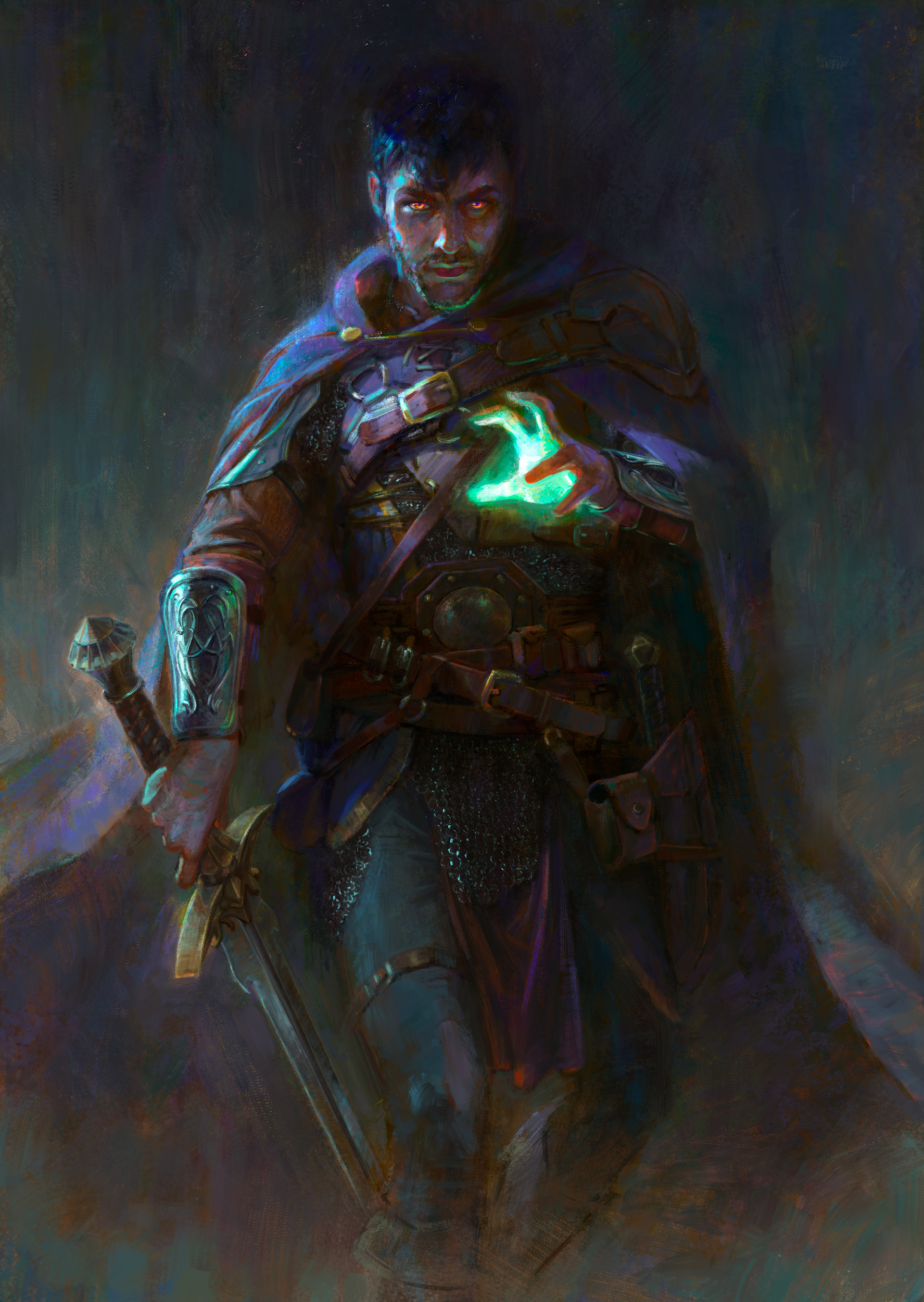
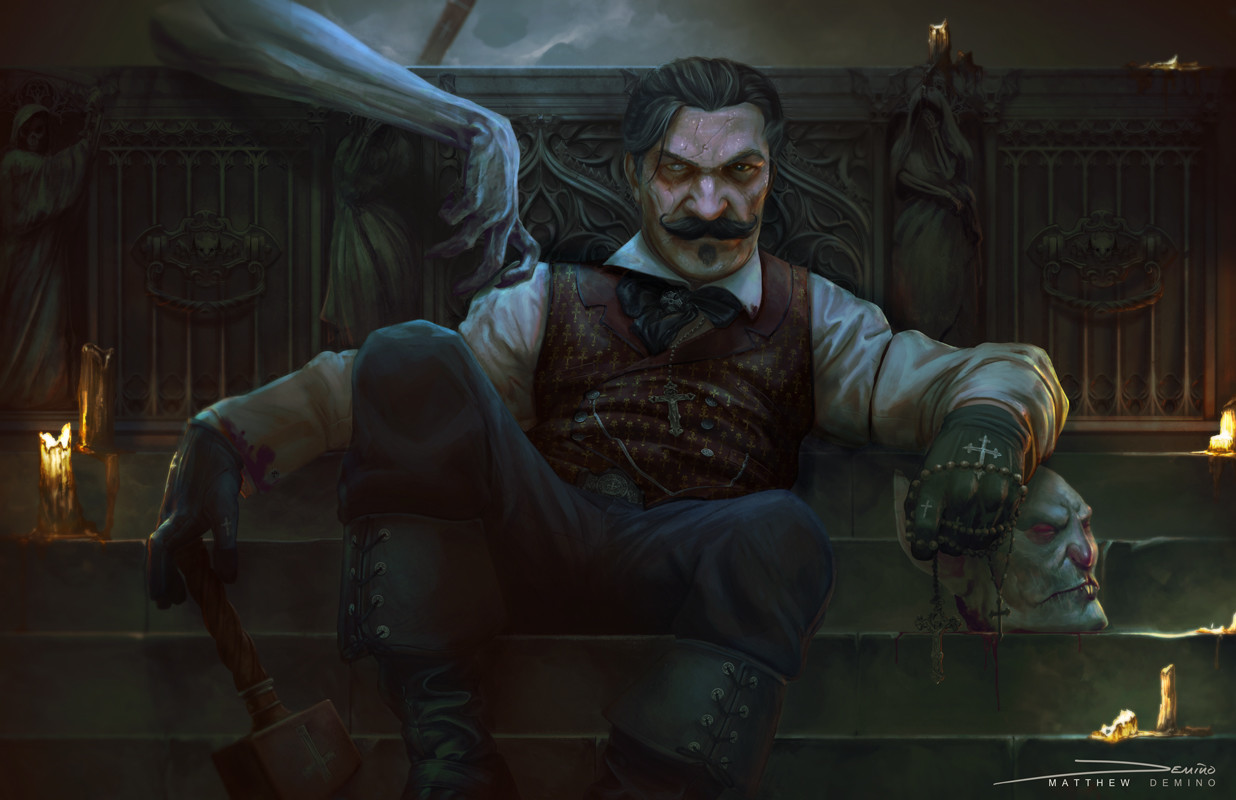
Hunters of heresy, witch craft, necromancy, and other practitioners of evil, purifiers commonly work for religious institutions as inquisitors, exorcists, witch hunters, and vampire hunters. Armed with divine blessings, they cast purifying incantations to purge evil and protect the weak and righteous. Purifiers are known to even hunt down blood hunters, as they are stern and unforgiving towards those who use the dark arts instead of sacred rights to aid them during hunts. Purifiers take any vow they make to purify a creature as law, and once they have a mark, will go to the ends of the earth to cross it out.
.
Spellcasting
Starting at 3rd level, you have learned to cast holy spells. See Spells Rules for the general rules of spellcasting and the Spells Listing for the Purifier spell list.
Spell Slots The Purifier table shows how many spell slots you have to cast your Purifier spells of 1st level and higher. To cast one of these spells, you must expend a slot of the spell’s level or higher. You regain all expended spell slots when you finish a long rest.
For example, if you know the 1st-level spell animal absorb elements and have a 1st-level and a 2nd-level spell slot available, you can cast absorb elements using either slot.
Spells Known of 3rd Level and Higher You know three 1st-level spells of your choice from the Purifier spell list.
The Spells Known column of the Purifier table shows when you learn more Purifier spells of your choice. Each of these spells must be of a level for which you have spell slots. For instance, when you reach 7th level in this class, you can learn one new spell of 1st or 2nd level.
Additionally, when you gain a level in this class, you can choose one of the Purifier spells you know and replace it with another spell from the Mage Hunter spell list, which also must be of a level for which you have spell slots.
Spellcasting Ability Wisdom is your spellcasting ability for your Purifier spells, since your magic draws on your attunement to the arcane. You use your Wisdom whenever a spell refers to your spellcasting ability. In addition, you use your Wisdom modifier when setting the saving throw DC for a Purifier spell you cast and when making an attack roll with one.
Spell Save DC
Spell attack modifier
Purge the Wicked
In addition at 3rd level, your faith grants you many tools to help you hunt those who forsake it and engage in malicious endeavors.
- You gain proficiency with Religion checks, and can double your proficiency bonus for any Religion check related to your favored enemies.
- You gain one additional favored enemy related to the foes of your god or religious order.
- Whenever you deal your Weak Spot damage, you can deal it as fire damage. At 10th level in this class this extends to radiant damage (your choice).
- When you choose to not expend any of your movement on your turn to deal Weak Spot damage, this also extends to spells you cast. Whenever you damage those marked as your prey with a spell attack or they fail a saving throw against a spell you cast, they suffer your Weak Spot damage on top of the spells usual effects. If the spell has multiple targets or has an area effect, the Weak Spot damage only applies to one target which you choose when the spell is cast.
Protect the Pious
Beginning at 7th level, all allies within 30ft of you including yourself, can add your Wisdom modifier to any saving throw they make while they are at or below half their maximum hit points (rounded down). This bonus does not stack with other similar features such as Aura of Courage.
Ashen Repose
At 11th level, when you or an ally within 30ft of you kills a target marked as your prey, you can expend your reaction to roll your Weak Spot dice and grant the ally an amount of temporary hit points equal to the result for 1 minute.
You can do this a number of times equal to your Wisdom modifier every long rest.
Purify
Finally, at 15th level, you can take a sacred vow to purify a creature. When you critically hit your prey, or mutilate one of its attack options, you can invoke the vow, lighting the target ablaze in purifying flame. At the beginning of their next turn, deal your Weak Spot damage to them as fire or radiant damage (your choice). Continue doing this on their following turns, with the amount of dice being rolled reduced by 1 each time, as the flames slowly dissipate. The target or a creature within 5ft of it can use its action to douse the flames.
Once invoked, they suffer vulnerability to fire and radiant damage. If they had a resistance or immunity to fire or radiant damage they instead lose the resistance or immunity. Furthermore, you always know the general direction the creature is in, and how far away they are, as after the flames burn out, a brand marking them for purification is revealed upon their flesh.
You cannot use this feature again until the creature dies, fulfilling the vow.

Ranger
Rangers are more in tune with their environment than other hunters, and once familiar with a place will bend and exploit their surroundings to their benefit. They commonly do this through stealth, out maneuvering their enemies, and then striking from advantageous positions. Bandits, adventurers, guides, and mercenaries, rangers are masters of adaptability.
Lay of the Land
At 3rd level, you are particularly familiar with one type of natural environment and are adept at traveling and surviving in such regions. Choose one type of favored terrain: arctic, coast, desert, forest, grassland, mountain, swamp, city, sea, or the Underdark. When you make an Intelligence or Wisdom check related to your favored terrain, your proficiency bonus is doubled if you are using a skill that you're proficient in.
While in your favored terrain, you gain the following benefits:
- You gain advantage on initiative checks and all attacks against creatures who have not yet taken their turn in combat.
- Difficult terrain doesn't slow your group's travel.
- Your group can't become lost except by magical means.
- Even when you are engaged in another activity while traveling (such as foraging, navigating, or tracking), you remain alert to danger.
- If you are traveling alone, you can move stealthily at a normal pace.
- While tracking other creatures, you also learn their exact number, their sizes, and how long ago they passed through the area.
After traveling for 8 or more hours within a terrain type that isn't your favored terrain, you can switch your favored terrain to the terrain type you are currently traveling in. You can only do this once per long rest.
Camouflage
Also starting at 3rd level, you can spend 1 hour creating camouflage for yourself. You must have access to fresh mud, dirt, plants, soot, and other naturally occurring materials with which to create your camouflage.
Once you are camouflaged in this way, you can try to hide by ducking into foliage, or pressing yourself up against a solid surface, such as a tree that is at least as tall and wide as you are. You gain a +10 bonus to Dexterity (Stealth) checks as long as you remain still or at a slow crawl. Once you move more than 10ft on your turn, or take an action or a Reaction, you must camouflage yourself again to gain this benefit.
.
Adept Explorer
At 7th level, your experience with exploring increases, and you gain the following benefits while in your favored terrain:
- You can take the Hide action as a bonus action.
- You can't be tracked by nonmagical means, unless you choose to leave a trail.
- You can't be surprised.
- You can re roll results you don't like once when rolling on the potions and oils tables.
- While you are hidden, you can add your Wisdom modifier to the damage of your weapon attacks.
Hightened Senses
Beginning at 11th Level, you gain preternatural Senses that help you fight creatures you can't see. When you Attack a creature you can't see, your inability to see it doesn't impose disadvantage on your Attack rolls against it. You are also aware of the location of any Invisible creature within 30 feet of you, provided that the creature isn't hidden from you and you aren't Blinded or Deafened.
Additionally, you can nimbly dodge out of the way of certain area Effects, such as a red dragon's fiery breath or an Ice Storm spell. Whenever you are subjected to an effect that allows you to make a Dexterity saving throw to take only half damage, you instead take no damage if you succeed on the saving throw.
Fruits of the Land
Finally, at 15th level, you can roll on the rare potions and oils table when foraging for potions in your favored terrain.
Rare Potions and Oils
| d6 | Result |
|---|---|
| 1 | Potion of Mind Reading |
| 2 | Potion of Invisibility |
| 3 | Oil of Etherealness |
| 4 | Potion of Heroism |
| 5 | Potion of Speed |
| 6 | Potion of Superior Healing |
Slayer
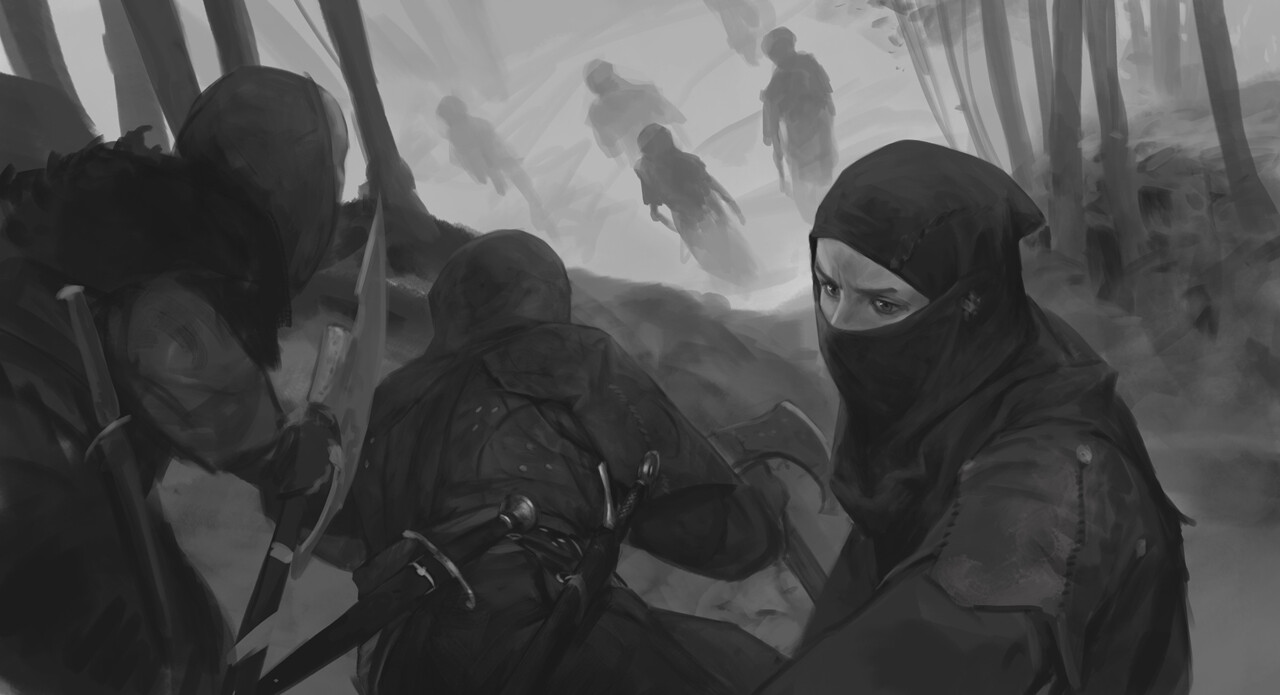
Slayers take pride in slaying the largest of beasts. Some do it for coin, others for trophies. Slayers enjoy grappling and fighting their prey in close combat, and often believe hunters who use other methods are weak and cowardly.
Sharpened Claws
Beginning at 3rd level, you learn how to manipulate your hunting armory further, in new and deadly ways.
- Your unarmed strikes deal an additional 1d4 bludgeoning damage against your prey. Furthermore, if you are not carrying a weapon or wearing a shield and you take the attack Action against those marked as your prey, you can make an additional unarmed strike as part of the Action.
- While you are wielding a one handed melee weapon and no other weapons, you can add your Wisdom modifier to the damage of your attacks with the weapon against those marked as your prey.
- While you are wielding a melee weapon with two hands that lacks the great weapon or pole arm tag, you can use it with greater control. If you are using your Strength modifier for attack and damage rolls with the weapon you can also add half your Dexterity modifier to the attack and damage rolls made with the weapon (rounded up) and vice versa.
- When making an attack with a Great Weapon or Polearm you can expend your bonus action to increase the attacks reach by 5ft. If the attack deals Weak Spot damage, you can re roll any results of 1 on your Weak Spot dice and must use the new result.
- While you are wielding two melee weapons, you gain +1 AC against melee attacks. Also, your offhand weapon packs a hidden punch and you can increase your number of Weak Spot damage dice while using this weapon by 1. This increases to 2 at 10th level in this class.
.
Toughened Hide
Also at 3rd level, when calculating your AC, you can replace your Dexterity modifier with your Strength modifier. Additionally, you can increase your maximum hit points by 3, and by 1 again each time you gain a level in this class.
Rush of the Hunt
At 7th level, you revel in the rush of the hunt. Once per round, when you deal your Weak Spot damage, you can choose to gain half of the amount of damage your Weak Spot damage dealt as temporary hit points for 1 minute. While you have these temporary hit points, you gain advantage on Strength based checks and saving throws, and your carrying capacity (including your maximum load and maximum lift) doubles.
You can use this feature a number of times equal to your Wisdom modifier every short or long rest.
Restrain and Slay
At 11th level, you deal 1 extra Weak Spot damage dice against creatures per condition they are currently afflicted with. For example you would deal 3 extra Weak Spot damage dice when dealing your Weak Spot damage against a creature who is blinded, prone, and grappled.
Stop Hitting Yourself
Finally, at 15th level, when you mutilate or remove a creatures attack option, you can expend you reaction to use it once against a creature within the attack options reach. You can only do this if you are within 5ft of the creature with the attack option, and the attack option must be a touch or weapon attack.
Trapper
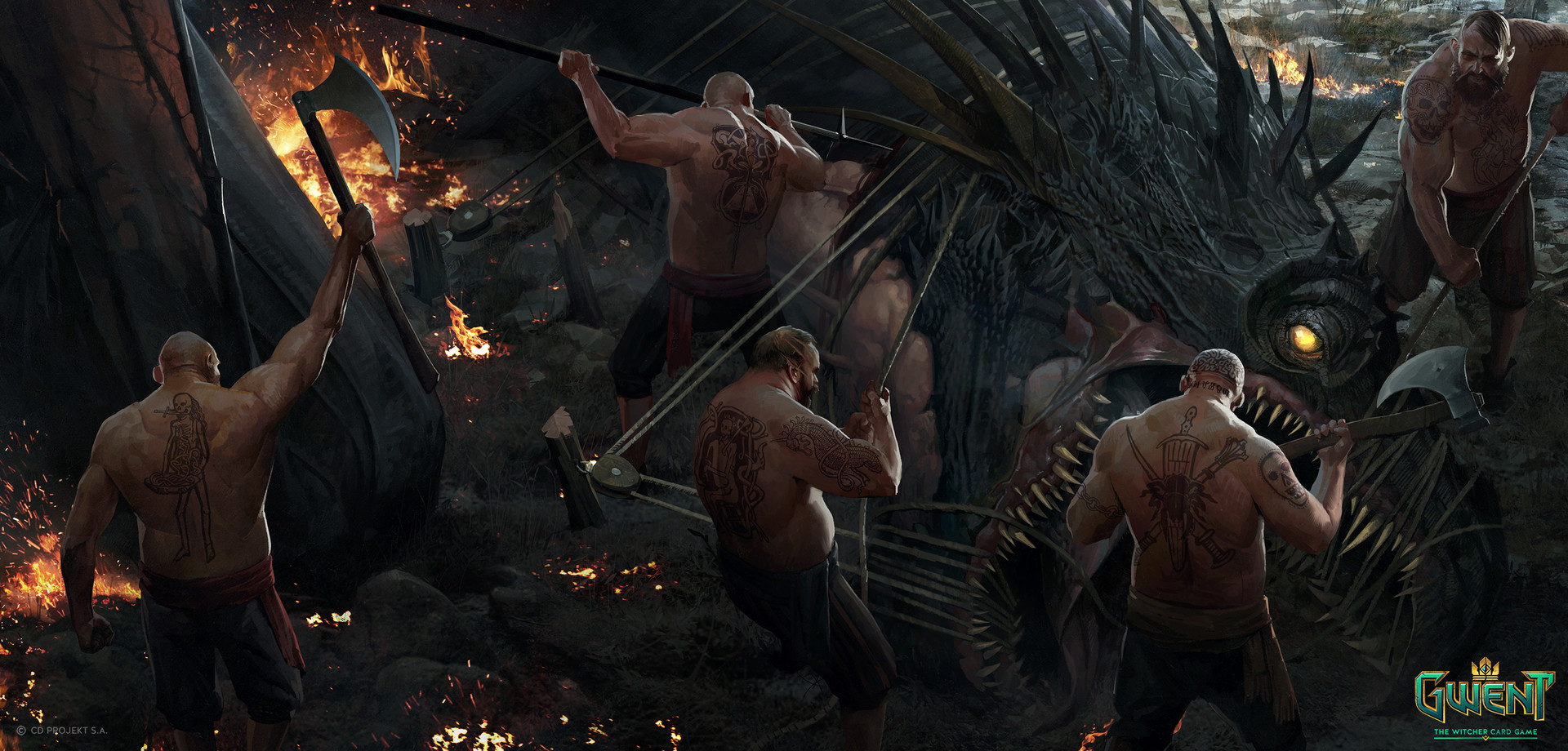
Methodical planners and masters of ambush, trappers prefer taking their time with trapping and slaying their prey. Trappers see other sorts of hunters as brash and dull, and exude great pride when a successful hunt has come to a close without receiving a single scratch on their own hide. Trappers who work for coin are sought after as often for disarming traps as laying them, however if given a the choice a trapper will always choose to do the later.
Improved Traps
At 3rd level, you learn how to make traps earlier than other hunters. You gain the 9th level hunter feature "Traps" at this level. And at 9th level in this class, you instead gain advantage on any checks and saving throws related to traps, such as disarming or escaping them, and learn how to craft better traps.
Additionally, when taking a long rest you can craft an amount of traps equal to your Wisdom modifier instead of just one, and all of your traps deal your Weak Spot damage on top of any other damage they usually do.
Finally, you gain proficiency with Smith's Tools and Thieves' Tools.
Useful Trophies
At 7th level, you can retrieve useful implements from slain prey. Once you have killed a creature, you can collect one of its attack options. Once collected you can incorporate this attack into a trap you craft. When this trap is triggered it simultaneously attacks the creature that triggered it with this attack option. The attack options save DC is equal to that of your traps, and its attack modifier = your proficiency bonus + your Wisdom modifier.
Also at this level, your carrying capacity (including your maximum load and maximum lift) doubles, allowing you to carry more traps and trophies.
Skilled Ambusher
At 11th level, during the first round of combat, you can make an additional weapon attack when using the Attack Action, and you gain advantage on initiative checks if an enemy has set off one of your traps within the last minute.
Master Trapper
Finally, at 15th level, you gain advantage on all attack rolls against creatures who have triggered one of your traps within the current or previous round of combat.
Warden
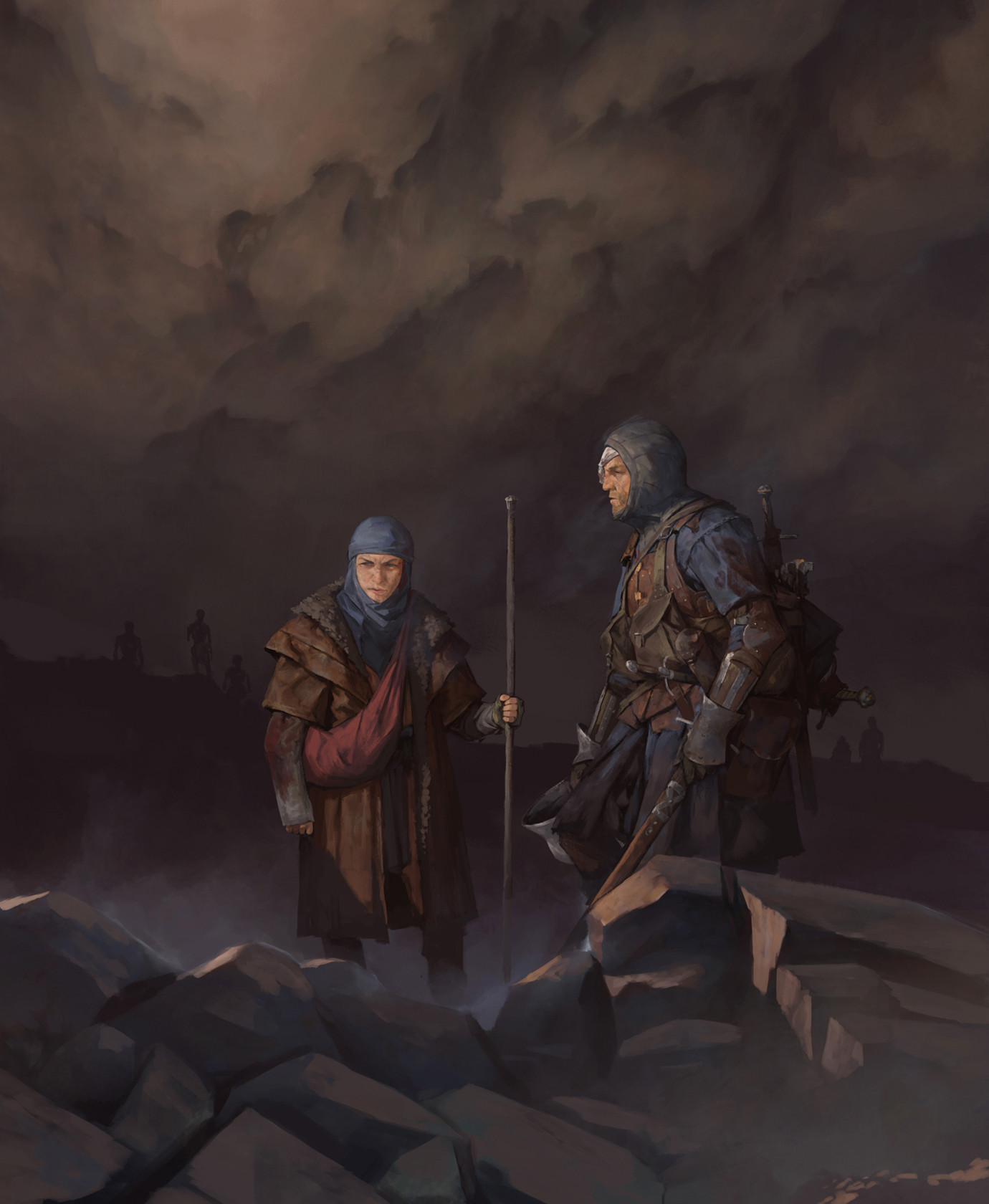
Wardens are staunch defenders who use land based magic and hardened bulwarks to protect their interests with a watchful eye. Slow and methodical, wardens pick at their prey and trespassers with caution and restraint. This allows them to dodge and parry blows that other hunters may recklessly throw themselves into, and ensures they have a long and unwavering watch.
Spellcasting
Starting at 3rd level, you have learned to cast spells, much as those you hunt do. See Spells Rules for the general rules of spellcasting and the Spells Listing for the ranger spell list.
Spell Slots The Warden table shows how many spell slots you have to cast your warden spells of 1st level and higher. To cast one of these spells, you must expend a slot of the spell’s level or higher. You regain all expended spell slots when you finish a long rest.
For example, if you know the 1st-level spell animal friendship and have a 1st-level and a 2nd-level spell slot available, you can cast animal friendship using either slot.
Spells Known of 3rd Level and Higher You know three 1st-level spells of your choice from the ranger spell list.
The Spells Known column of the warden table shows when you learn more warden spells of your choice. Each of these spells must be of a level for which you have spell slots. For instance, when you reach 7th level in this class, you can learn one new spell of 1st or 2nd level.
Additionally, when you gain a level in this class, you can choose one of the warden spells you know and replace it with another spell from the warden spell list, which also must be of a level for which you have spell slots.
Spellcasting Ability Wisdom is your spellcasting ability for your warden spells, since your magic draws on your attunement to nature. You use your Wisdom whenever a spell refers to your spellcasting ability. In addition, you use your Wisdom modifier when setting the saving throw DC for a warden spell you cast and when making an attack roll with one.
Spell Save DC
Spell attack modifier
.
Warden Spellcasting
| Hunter Level | Spells Known | 1st | 2nd | 3rd | 4th |
|---|---|---|---|---|---|
| 3rd | 3 | 2 | — | — | — |
| 4th | 4 | 3 | — | — | — |
| 5th | 4 | 3 | — | — | — |
| 6th | 4 | 3 | — | — | — |
| 7th | 5 | 4 | 2 | — | — |
| 8th | 6 | 4 | 2 | — | — |
| 9th | 6 | 4 | 2 | — | — |
| 10th | 7 | 4 | 3 | — | — |
| 11th | 8 | 4 | 3 | — | — |
| 12th | 8 | 4 | 3 | — | — |
| 13th | 9 | 4 | 3 | 2 | — |
| 14th | 10 | 4 | 3 | 2 | — |
| 15th | 10 | 4 | 3 | 2 | — |
| 16th | 11 | 4 | 3 | 3 | — |
| 17th | 11 | 4 | 3 | 3 | — |
| 18th | 11 | 4 | 3 | 3 | — |
| 19th | 12 | 4 | 3 | 3 | 1 |
| 20th | 13 | 4 | 3 | 3 | 1 |
Strong Bark
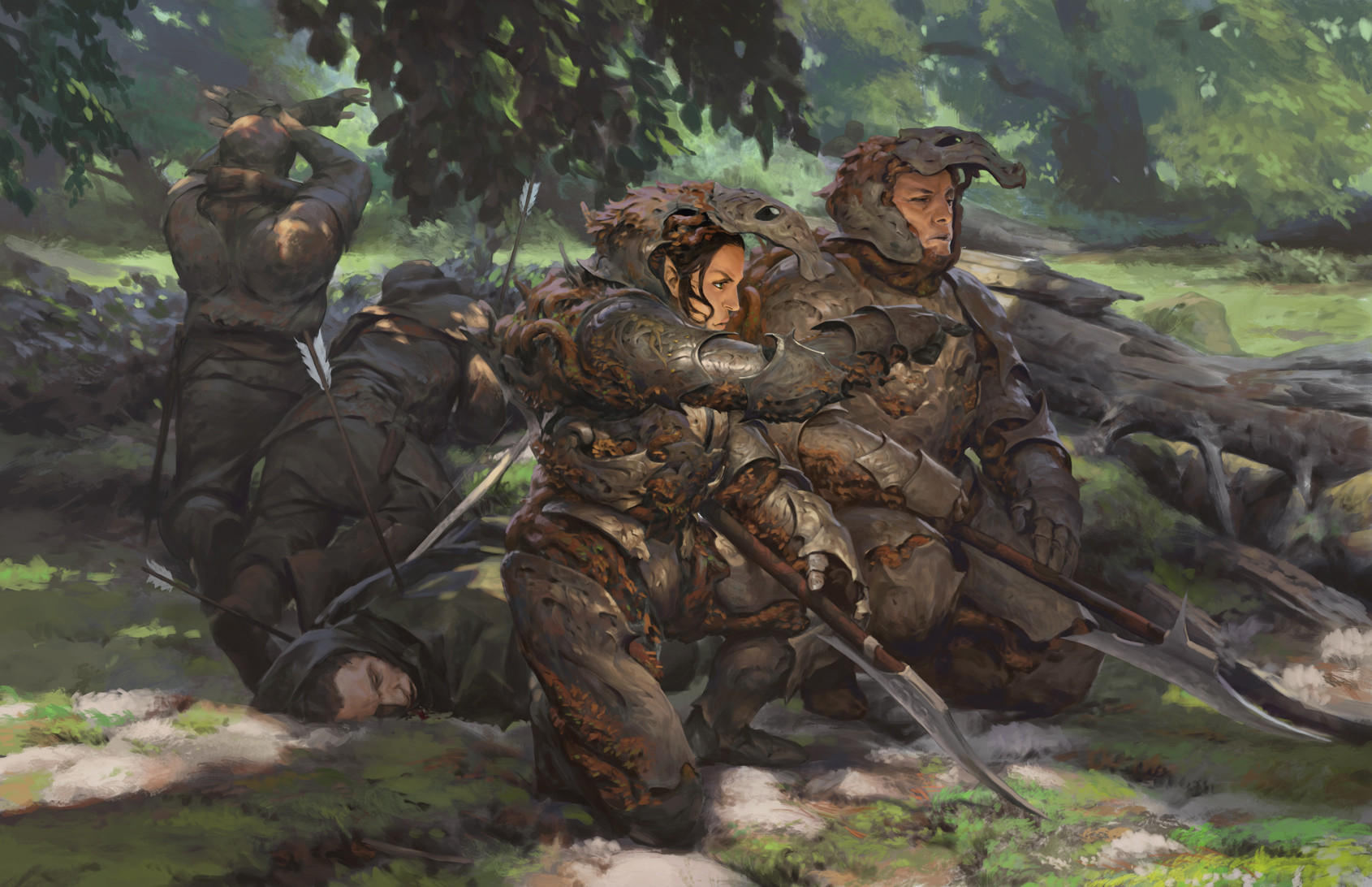
Also at 3rd level, your defensive capabilities improve, allowing to to don living armor intertwined with plate and roots. You gain proficiency with heavy armor, and can spend one minute to perform a ritual, turning a suit of armor within 5ft of you into this living layer of defense. Once the ritual is complete, the armor is bonded to you. Once you have bonded the armor to yourself, you gain the following benefits:
- If it is on the same plane of existence, you can summon that suit of armor as a bonus action on your turn, causing it to instantly sprout and form around you.
- If you choose to not expend any of your movement on your turn, the armor grows thicker around you granting you the benefits of half cover until the beginning of your next turn.
.
Deep Roots
At 7th level, you excel at holding a defensive position, and ensuring your enemies cannot escape your methodical grasp.
- If you choose to not expend any of your movement on your turn, you can brace yourself against oncoming attacks as a bonus action. While you are braced in this way, you gain a +1 to your AC, and advantage on Strength and Constitution saving throws until the beginning of your next turn.
- If you choose to not expend any of your movement on your turn, you can grant yourself advantage on a spell attack you make against a prone creature, or afflict a prone creature with disadvantage on a saving throw against a spell you cast that turn.
- Whenever you disable or remove an enemies attack option, you can also choose to knock them prone, as roots pull them to the ground.
- At the end of your turn, if you have not expended any of your movement, you can roll your Weak Spot dice and gain the result as temporary hit points until the end of your next turn.
You can use this feature a number of times equal to your Wisdom modifier every short or long rest.
Crawling Bulwark
Beginning at 11th level, if you do not expended any movement on your turn, roots sprout and writhe around you, protecting your allies, and harassing your enemies. Allies within 10ft of you gain half cover against ranged attacks, and enemies have their movement speed reduced by 10ft.
Withstand and Repel
Finally, at 15th level, you have learned how to consolidate more layers of defense. Whenever you receive temporary hit points while you already have temporary hit points, instead of being forced to choose one or the other, you can choose to add these temporary hit points to your current temporary hit points. Doing so however weighs you down, and each time you do this, your movement speed is reduced 10ft until your temporary hit points are lost or reduced to 0.
Additionally, as an action you can reduce your temporary hit points to 0, causing them to strike out from you as roots, thorns, or another form you choose. Enemies within 20ft of you must succeed a Dexterity saving throw against your spell save DC or suffer an amount of damage equal the temporary hit points you expended and are pushed back 15ft and knocked prone. This is dealt as piercing, bludgeoning, or slashing damage (your choice) and is treated as magical for the purposes of overcoming resistances and immunities. They take half damage on a successful save.
Mage Hunter Spell List
1st Level
- Absorb Elements
- Alarm (Ritual)
- Beast Bond
- Cure Wounds
- Detect Magic (Ritual)
- Ensnaring Strike
- Fog Cloud
- Hail of Thorns
- Jump
- Longstrider
- Snare
- Zephyr Strike
2nd Level
- Cordon of Arrows
- Darkvision
- Darkness
- Find Traps
- Hold Person
- Invisibility
- Mind Spike
- Mirror Image
- Misty Step
- Lesser Restoration
- Locate Object
- Pass Without Trace
- Protection from Poison
- See Invisibility
- Silence (Ritual)
- Shadow Blade
- Spider Climb
3rd Level
- Blink
- Conjure Barrage
- Flame Arrows
- Glyph of Warding
- Hypnotic Pattern
- Lightning Arrow
- Nondetection
- Protection from Energy
- Sending
- Wind Wall
- Thunder Step
4th Level
- Banishment
- Confusion
- Dimension Door
- Freedom of Movement
- Greater Invisibility
- Locate Creature
- Stoneskin
- Shadow of Moil
Purifier Spell List
1st Level
- Absorb Elements
- Alarm (Ritual)
- Burning Hands
- Cure Wounds
- Detect Evil and good
- Detect Magic (Ritual)
- Detect Poison and Disease (Ritual)
- Ensnaring Strike
- Heroism
- Jump
- Longstrider
- Snare
- Sheild of Faith
- Wrathful Smite
- Zephyr Strike
2nd Level
- Aid
- Branding Smite
- Cordon of Arrows
- Darkvision
- Enhance Ability
- Hold Person
- Lesser Restoration
- Locate Object
- Pass Without Trace
- Prayer of Healing
- Protection from Poison
- See Invisibility
- Silence (Ritual)
- Spiritual Weapon
- Zone of Truth
3rd Level
- Conjure Barrage
- Crusader's Mantle
- Daylight
- Dispel magic
- Fear
- Glyph of Warding
- Magic Circle
- Flame Arrows
- Fireball
- Protection from Energy
- Slow
- Speak with Dead
- Spirit Shroud
- Water Breathing (Ritual)
- Water Walk (Ritual)
4th Level
- Banishment
- Death Ward
- Divination
- Freedom of Movement
- Fire Shield
- Guardian of Faith
- Locate Creature
- Wall of Fire
Warden Spell List
1st Level
- Absorb Elements
- Alarm (Ritual)
- Animal Friendship
- Armor of Agathys
- Beast Bond
- Cure Wounds
- Detect Magic (Ritual)
- Detect Poison and Disease (Ritual)
- Ensnaring Strike
- Heroism
- Goodberry
- Hail of Thorns
- Jump
- Longstrider
- Snare
- Speak with Animals
- Zephyr Strike
2nd Level
- Animal Messenger (Ritual)
- Barkskin
- Beast Sense (Ritual)
- Cordon of Arrows
- Darkvision
- Enhance Ability
- Healing Spirit
- Hold Person
- Lesser Restoration
- Locate Animals or Plants
- Locate Object
- Pass Without Trace
- Protection from Poison
- Spike Growth
3rd Level
- Conjure Animals
- Conjure Barrage
- Daylight
- Flame Arrows
- Glyph of Warding
- Lightning Arrow
- Plant Growth
- Protection from Energy
- Speak with Plants
- Water Breathing (Ritual)
- Water Walk (Ritual)
- Wind Wall
4th Level
- Conjure Woodland Beings
- Freedom of Movement
- Fire Shield
- Grasping Vine
- Guardian of Nature
- Locate Creature
- Stoneskin
Design notes
This is more or less a complete redesign. The only things that I have kept from the PHB ranger is favored enemy, resourceful, extra attack, and fighting styles. There was three core design goals I wanted to incorporate into this re design.
-
A clear sense of theme. This is underlined by the name change from Ranger to Hunter. I wanted the class to be centered around tracking, studying and eliminating prey, and I felt that the name Hunter would reinforce this theme more aptly than ranger. Ranger felt too vague to me, and re branding the class to hunter allowed me to make more interesting decisions subclass wise. For example I find it a bit odd that the Scout is a Rogue subclass and not a Ranger one, and I think re branding the Ranger as the Hunter helped pull it away from treading the same ground as rogues or even druids with the elimination of spellcasting.
-
A play style that reflects their keen and methodical nature. Taking your time to take aim at your target and exploit their weaknesses would be enough to distinguish them from the other classes. Their On the Hunt + Weak Spot features are really what makes the redesign of the class have its identity. Sacrificing your movement and bonus action to bump your damage both at melee and at range. I didn't want this mechanic to feel too similar to the rogues sneak attack. Sacrificing movement to be able to do it, and applying it to all your attacks instead of just one, felt like a good way of achieving this design goal.
-
Fun mobility options. I enjoy mechanics in games that give you small short range dashes, rolls, or teleports, and giving the Hunter more mobility later on as they level to offset their lack of mobility as part of using Weak Spot fits well. This should make Hunters feel more accomplished and reactive in combat, as they see their enemies blows coming towards them, dashing away with their high Wisdom. I would also bring into this point combo potential within the class and plenty of synergy for skilled players. Such as Mage Hunters trying to string together movement combos to give them the most damage with arcane momentum. Combat combos with multiple moving parts are something that I feel is lacking within martial class features in 5e.