Roguish Archetype
Ferryman
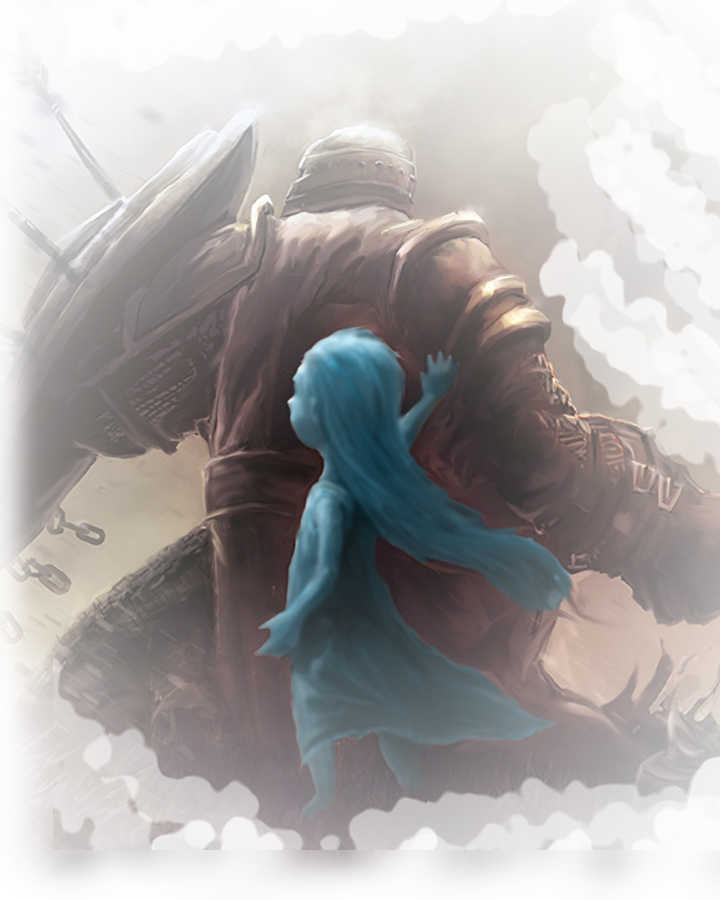
By some twist of fate, whether willing or not, you have found yourself to be a conduit to lost souls. Some of them haunt and torment you to varying degrees. Many simply seek companionship from someone who can actually sense them and 'hear' them. But some few are desperate to complete unfinished business, and are willing to pay - in the form of service, to gain your help in seeing it finished. You are a Ferryman, one who helps send wayward souls on to their afterlife. A guide, of sorts, whose toll is paid with servitude rather than coin.
Spirits seek you out constantly, and generally speaking you are the only one who can sense them - be it visually, audibly, or through any other sensory (or 'extrasensory') input.
Many will follow you for a time and try to mitigate the eternal loneliness of their unlife, but some come seeking your aid. From among those, you can choose to bond to a small number at any given time. In exchange for your help in whatever quests they have, they will aid you in various ways.
Ferryman
| Level | Feature |
|---|---|
| 3 | Spirit Companions, Ghost Strike |
| 9 | Manifest Presence |
| 13 | Ghost Walk |
| 17 | Spirit Sacrifice |
Spirit Companions
Beginning at third level, you can bond to a number of spirits equal to your proficiency bonus. Once you have bonded to the maximum number of spirits, you cannot bond to a new spirit until you fulfill the requests that spirit made of you and it departs for its afterlife.
By bonding with a spirit, you gain certain proficiencies and abilities based upon who the spirit was in life. Roll or work with your DM to choose from the table below to determine each spirit's background.
Each general background could cover a wide array of personalities - for example an artisan might have been an alchemist, a blacksmith, a farmer, a merchant, a mime, a poet, or so many other occupations. And none of those define the entirety of their personality, nor their quest; merely the types of skills and abilities they can provide to you in service.
| d6 | Background | d6 | Background | |
|---|---|---|---|---|
| 1 | Arcanist | 4 | Entertainer | |
| 2 | Artisan | 5 | Lost | |
| 3 | Devoted | 6 | Warrior |
Spell Attack, Spell Save DC. For the purposes of this class, any effects that rely on your spell attack modifier or spell saving throw DC use:
Spell save DC = 8 + your proficiency bonus + your Charisma modifier
Spell attack modifier = your proficiency bonus + your Charisma modifier
Arcanist Spirit
An arcanist was, in their lifetime, someone who was tied to the arcane arts. Typically an artificer, bard, cultist, sorcerer, warlock, or wizard of some sort. Whatever the source, their focus in life was manipulating arcane energy.
At 3rd level you gain proficiency with the Arcana skill (or expertise if you are already proficient) and you can cast one cantrip the spirit knew in its life. Regardless of the class or spell list the cantrip comes from, the spellcasting ability modifier to determine your spell attack modifier, bonus damage, and saving throw DC for this spell is Charisma.
At 6th level or higher you can also cast a single 1st level spell the spirit could cast in its life. At 11th level or higher you can also cast a single 2nd level spell spell the spirit could cast in its life. You can cast these spells once per short or long rest.
Artisan Spirit
An artisan spirit might have been anyone who devoted themselves to crafting, creating, repairing, or improving the world around them. Their focus was in one or more specific sets of skills, or the use of one or more tools.
You gain proficiency and expertise with one set of tools which the spirit was proficient with in its lifetime. Additionally, once per short or long rest you can call upon the spirit for specific guidance in a task related to its profession, and add 1d4 to an appropriate (based on its life experiences) ability check or saving throw.
Devoted Spirit
The typical devoted spirit was a cleric, priest, or paladin... but it could also include former druids, rangers, or other beings who were merely highly devoted, closely tied to one or more deities they revered.
At 3rd level you gain proficiency with the Nature or Religion skill (or expertise if you are already proficient) and you gain a limited healing ability. This functions exactly as the Paladin's Lay on Hands ability, but the total number of hit points is equal to your proficiency bonus x 5. If you already have the lay on hands ability from another class (or another spirit), you simply add these hit points to your total pool.
Once per long rest, you can become a more direct/open conduit for the spirit's faith, and can Channel Divinity. You gain a single channel divinity option which the spirit had in life - if it had none, you gain the ability to Control Undead as below.
Control Undead. As an action, you target one undead creature you can see within 30 feet of you. The target must make a Wisdom saving throw versus your Charisma-based spell save DC. On a failed save, the target must obey your commands for the next 24 hours, or until you use this Channel Divinity option again. An undead whose challenge rating is equal to or greater than your levels in this class is immune to this effect.
Entertainer Spirit
Some members of society have a passion to spark joy within others, to bring peace into chaos - or perhaps a bit of chaos into peace. Jesters, bards, courtesans, even gladiators and trick riders all lived their live to entertain others.
Bonding to an entertainer spirit lends you an air of sophistication and charm. Or, some other similar yet ineffable quality. By talking to a creature for one minute, it must succeed on a Wisdom saving throw against your Charisma-based spell save DC or be charmed by you.
While charmed in this way, the target idolizes you, it speaks glowingly of you to anyone who talks to it, and it hinders anyone who opposes you, although it avoids violence unless it was already inclined to fight on your behalf. This effect ends on a target after 1 hour, if it takes any damage, if you attack it, or if it witnesses you attacking or damaging any of its allies.
If a target succeeds on its saving throw, the target has no hint that you tried to charm it. Once you use this feature, you can’t use it again until you finish a short or long rest.
Lost Spirit
Lost spirits were typically criminals or other less than desirable elements of society when they were alive. They may have had any occupation or initial background, but somehow found themselves cast out of society, living among the shadows or wholly alone.
By bonding to a lost spirit, every target you attack is considered to have an ally of yours adjacent to it and thus qualifies for sneak attack dice (as long as you do not have disadvantage on the attack roll and you have not yet used your sneak attack feature this turn).
You also gain proficiency and expertise in one skill of your choice, or proficiency with a single simple or martial weapon.
Warrior Spirit
Warrior spirits arise from those who practiced the arts of war. Whether their focus was to bring peace through any means required, or to conquer their foes, they studied the martial arts in some fashion or another.
When you bond to this spirit, you gain some of their martial prowess. You gain one fighting style relevant to the spirit's favored tactics in life. You cannot gain a fighting style that you already possess a second time. You also gain proficiency in medium armor and with shields.
There are several easy to use NPC generators, and it is recommended that to save time a DM might use one to randomly create multiple NPCs to be used as spirits, and then pick from among those one who matches the type of spirit selected. A few recommended sites are:
Personal Quests
In addition to gaining benefits from the bond, you also take on certain responsibilities. Each spirit has a personal quest, their 'unfinished business' for which you must provide them aid to complete. You are their physical agent in the world, acting for them where they cannot.
As they will be desirous of completing this quest, they will (usually) provide anything and everything they know and can remember about it. If they notice anything which sparks a memory, or seems relevant to their quest, they will share the new revelations with you.
A spirit's personal quest could be so simple as traveling to a remote location and giving a message to a loved one, or it might be as difficult and open-ended as 'defeating the forces of evil within the Kingdom of Kalamar'. Regardless, it is left to the DM to determine not only what the quest is, but when it has been fulfilled.
Further, if one of your bonded spirits feels you are neglecting its quest, it may choose to withdraw some or all of the aid it provides to you - until it feels you have shown an appropriate effort in resuming that aid. It is again left to the DM to determine when this happens, what benefits are lost, and when/how they are regained.
Once a personal quest has been fulfilled, the spirit departs for its final resting place; typically determined by its beliefs in life. You lose all benefits you had gained from the bond to that spirit, including the Spirit Companions feature, their availability for Ghost Strike and Manifest Presence, and any knowledge they were able to provide to you.
You are then free to bond to another spirit; again determining the type by choosing or rolling on the above table, and working with the DM to flesh out any details required about their background and personal quest.
Occasionally, and purely at the DM's prerogative, you may receive a boon of some sort for completing the quest. It might be a temporary boon or a permanent boon. By 'boon' this is not necessarily referring to the Boons listed in the Dungeon Master's Guide, though they may be used, but rather any benefit the DM feels appropriate.
Ghost Strike
At third level, you can direct one of your bonded spirits to attack your foes as a bonus action. This is an attack with a magical melee weapon that has the finesse and thrown properties, with which you are proficient. It has a normal range of 60 feet and no long range, and on a hit it deals psychic damage equal to the ability modifier you used for the attack roll, plus your sneak attack damage. This does not count as using your sneak attack dice for the turn. This attack leaves no mark on its target.
Manifest Presence
Once you attain ninth level, your bonded spirits can temporarily appear - not just to you but to everyone. Once per short or long rest, you can use an action to call any one of your bonded spirits to manifest. It remains incorporeal, but can affect the world around it.
While a spirit is manifested, you temporarily lose the benefits you gain from it through your spirit companions feature, and it is not available for your Ghost Strike attacks.
Outside of combat, you can give the spirit open-ended instructions and it can function as a companion, servant, or sidekick for the duration.
In combat, the spirit shares your initiative count, but it takes its turn immediately after yours. The only action it takes on its turn is the Dodge action, unless you take a bonus action on your turn to command it to take another action. That action can be one in its stat block or some other action. If you are incapacitated, the spirit can take any action of its choice, not just Dodge.
The spirit manifests for 1 hour, until it is reduced to 0 hit points, until you use this feature to manifest a spirit again, or until you die. If a manifested spirit is reduced to 0 hit points, you lose the benefits of its service in all ways until you have completed a long rest.
Ghost Walk
Once you attain 13th level in this class, you can phase partially into the realm of the dead, becoming like the ghosts you bond to. As a bonus action, you assume a spectral form. While in this form, you have a flying speed equal to half your walking speed, you can hover, and attack rolls have disadvantage against you. You can also move through creatures and objects as if they were difficult terrain, but you take 1d10 force damage if you end your turn inside a creature or an object.
You stay in this form for 1 hour or until you end it as a bonus action. To use this feature again, you must first complete a long rest.
Spirit Sacrifice
If you or one of your living allies would die, one of your bonded spirits might sacrifice itself to prevent the lethal effect and redirect it onto itself. Whatever the triggering effect was simply does not affect its intended target(s) in any way, and instead is fully absorbed by the spirit. The spirit then discorporates and you lose your bond with it (see Personal Quests). It is treated as if you helped it complete its quest, and the spirit will move on to its final afterlife.
Note that the DM determines if any of your bonded spirits would be willing to sacrifice itself for you or any of your allies. While it will move on to its final afterlife, it knows it has no guarantee its unfinished business will ever be taken care of - so much depends upon your actions and relationship with it up to that point.
Bonded Spirit
Medium Apparition, Unaligned
- Armor Class 12 + PB (natural armor)
- Hit Points 4 + 4 times your rogue level (the spirit has a number of Hit Dice [d6s] equal to your rogue level)
- Speed 0 ft., fly 30 ft. (hover)
STR DEX CON INT WIS CHA 10 (+0) 15 (+2) 13 (+1) 10 (+0) 10 (+0) 10 (+0)
- Saving Throws STR, DEX, INT, WIS: [modifier plus PB], CON, CHA: [modifier plus PBx2]
- Damage Resistances bludgeoning, piercing, and slashing from nonmagical attacks, psychic
- Condition Immunities exhausted, incapacitated, poisoned, restrained
- Senses darkvision 60 ft.
- Languages Common plus one language it knew in life
- Aura of Encouragement. (Entertainer Spirit Only) You and each ally who starts their turn within 30 feet of the spirit gain a d6 inspiration die which can be used for one attack roll or saving throw they make before the start of their next turn.
- Aura of Enlightenment. (Artisan Spirit Only) You and each ally who starts their turn within 30 feet of the spirit gain advantage and a d4 guidance die on the first ability check made before the start of their next turn.
- Incorporeal Passage. The spirit can move through other creatures and objects as if they were difficult terrain. If it ends its turn inside an object, it is shunted to the nearest unoccupied space and takes ldl0 force damage for every 5 feet traveled.
- Undead Fortitude. If damage reduces the spirit to 0 hit points, it must make a Constitution saving throw with a DC of 5 + the damage taken, unless the damage is from a critical hit. On a success, the spirit drops to 1 hit point and is no longer manifested.
- Weight of Sorrow. (Lost Spirit Only) Any creature, other than you, that starts its turn within 5 feet of the spirit has its speed reduced by half until the start of that creature's next turn.
Actions
- Multiattack. (Warrior Spirit Only) The spirit makes a number of attacks equal to your rogue level divided by 5 (round down, minimum 1). These can be Deathly Touches or Weapon Attacks.
- Crafting. (Artisan Spirit Only) Each hour the manifested Artisan Spirit spends in crafting an item (or in aiding you or another artisan in crafting) counts as a full day's (8 hours) worth of crafting.
- Deathly Touch. Melee Weapon Attack: your spell attack modifier to hit, reach 5 ft., one creature. Hit: 1d6 + PB psychic damage.
- Spellcasting. (Arcanist or Devoted Spirits only) The spirit casts one of its known or prepared spells using the appropriate casting time for the spell. Regardless of its power in life, it has a number of spell slots equal to a half-caster (paladin or ranger for example) of your rogue level, and uses your Spell Save DC and Spell Attack Modifier as appropriate for each spell.
- Taunt. (Entertainer Spirit Only) The spirit targets a creature within 30' of it that can perceive it. That creature must succeed on a Wisdom saving throw or it must use its movement (if required) and action each round to attack the spirit. It can repeat the saving throw at the end of each of its turns.
- Weapon Attack. (Lost or Warrior Spirits Only) The spirit manifests wielding its preferred weapon of choice from its lifetime. It is proficient with that weapon, and uses your spell attack modifier to hit, and adds your PB to damage.
Credits
Art in Order of Appearance
"Warden" by Matt Forsyth
"Among the Ghosts" by Jason Chan