


Introduction
The gods can be one of the most fascinating forces of the world that drive its action. Their immeasurable power often creates situations where they become central in the events of the material realm, whether they are 'good' or 'evil' in their alignment.
Many players make them a focus in their character backstories, and oftentimes simply selecting the cleric, paladin or warlock classes unavoidably brings celestial matters into the game narrative. This guide contains numerous boons (both from evil and good dieties) that you can use to reward your players with, as well as curses that you can use to showcase an evil deity's threat, and make the celestial involvement of the gods in your world more tangible.
For such a powerful and important force, Gods are very difficult to roleplay in D&D. Other than the fact that these immortal and powerful entities would have minds unimaginable for us, there is also the issue that there simply is rarely an opportunity to roleplay them in the first place. Few campaigns become high level enough to have direct communication with the gods, and until then one has to limit themselves to cryptic visions.
It is often a good idea to portray the values and ethical system of a deity through their mortal counterparts, the churches and cleric NPCs that serve them in the material realm. However, if you would like to introduce NPCs that move beyond that line, this guide can assist you in portraying the gods through their immortal servants in the material realm: the angels. Included are descriptions of 8 celestial NPCs of epic power levels, complete with personality and goal descriptions, plot hooks, statblocks, spells, subclasses, items and boons that you can use in numerous ways. These angels and heralds could be the patrons of warlocks or clerics that receive a holy calling, or they can be representatives of powerful factions in your world, letting you demonstrate their power and goals while you allow your players to make their own decisions about how they will align themselves with them. As the characters approach the 4th tier of play, these heralds and angels themselves could even become their enemies or allies on the battlefield.
Not only can your DM give your Aasimar character a new kind of experience, but you can also use this content as a player to be inspired for your backstory. You could even pick one of these Angels or Heralds to be involved in your story, and ask your DM's approval and their own ideas about what your story could lead to!
Contents
This document is divided into two parts. The first contains a selection of general boons followed by curses, before the guide continues into its second and largest part: the Angels and Heralds that could be the ones who bestow these boons. The plot hooks included are open enough that they can fuel your imagination without constraining you.
The following table uses the page marking of the pdf itself, allowing for easy navigation.
Table of Contents
| Chapter | Page |
|---|---|
| Part I | 3 |
| Supernatural Gifts and Rewards |
3 |
| Curses | 5 |
| Part II | 7 |
| Angels | 7 |
| Tithus, the Complete | 7 |
| Shanti, the Ohm Mind | 10 |
| Livia, the Pulse | 14 |
| Oniera, the Dreamless | 17 |
| Heralds | 20 |
| Yriya, the Soulmistress | 20 |
| The Fraying Mind | 25 |
| Zhalur, the Siphoning Herald | 32 |
| Kalwar, the Violent | 36 |
Design Notes. The boons included in this guide are not supposed to be equal to one another. They vary in strength and function, as do the boons included in the DMG. Since boons are DM fiat, and not accessible to players in any independent ways, you can use and also change them at your discretion.
The statblocks of angels do not have any legendary or lair action, given the fact that they are less likely to be the villains for most campaigns, unlike the heralds, who have higher CRs and richer statblocks. If you have any questions, feel free to reach out to me at /u/Lambros009!


Supernatural Gifts and Rewards
Boons and Blessings are gifts that can be given by gods, demigods or other sufficiently powerful beings of your world as a reward or token of support for a character's deeds. Boons could also be unlocked when a character overcomes a particularly difficult challenge after months of effort, such as deciphering a forbidden eldritch tome or acquiring apocryphal knowledge. They are an underused resource included in the DMG (p. 232) that can be an ideal tool to make high-level play feel extra special and rewarding. They allow players to feel that their power is originating from within themselves rather than a multitude of items they have equipped.
The following boons are provided as extra options to those offered in the DMG. They can vary from mildly powerful to very powerful, so you can use them at your discretion.
Boon of Vigil
You have kept vigil countless times in prayer and meditation, and have devotedly forgone rest when your services were necessary.
You do not gain a level of exhaustion as a result of not sleeping or completing a long rest.
Boon of Potency
When a target succeeds on its saving throw against a spell you cast, you can use this boon to make it fail instead. Once you've used this boon, you can't do so again until you complete a long rest.
Boon of Celestial Strength
A great deed you have done in service of the good of the realm or Mount Celestial has granted you the favor of a powerful Planetar.
As an action, you can call forth this gift in a moment of great need. For 1 minute, your Strength score becomes 27 and your eyes fill with radiant light. You gain 40 temporary hitpoints, gain truesight out to 60 ft., and have advantage on all saving throws.
Once you've used this boon, you can't use it again.
Boon of Arcane Knowledge
You have gained the favor of Mystra, Mistress of Magic. You can unerringly recognize any spell you see being cast, and the level at which it is being cast. Additionally, you can sense the presence of magic within 30 feet of you, and you can use an action to identify its properties as per the identify spell.
Boon of Nullification
You can use your reaction to end the casting of a spell you see being cast within 60 feet of you. Once you've used this boon, you can't do so again until you complete a short rest.
Boon of Limited Magic Immunity
You can't be affected by spells of 3rd level or lower unless you choose to be.

Boon of the Intimidator
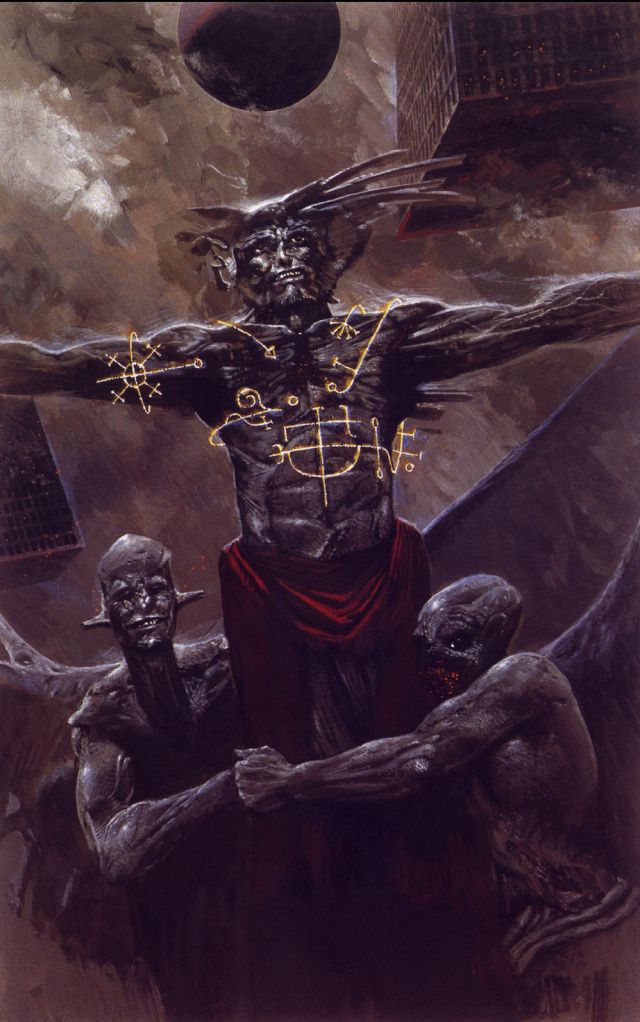
You can use an action to frighten those that try to resist your will. Any creatures of your choice within 60 feet of you must succeed on a DC 20 Charisma saving throw, or become frightened of you for 1 minute. When a creature becomes frightened of you in this way, you can speak a single word as a command for the creature to follow. In its next turn, the creature obeys your word as per the command spell.
Once you've used this boon, you can't use it again until you complete a short rest.
Boon of Punishment
When you take damage, you can use your reaction to cause that blow to hit harder. You reduce your own maximum hitpoint score by the amount of damage you took, but you cause the enemy that damaged you to take twice as much damage. This reduction lasts until you finish a long rest. If your hitpoint maximum is reduced to 0 in this way, you die.
Boon of Devil's Sight
You can see normally in darkness, both magical and nonmagical, out of a distance of 120 feet. Additionally, when a creature causes you to become blinded, you become blinded to everything else but you can still see the creature that blinded you.
Boon of Incomprehensible Arcana
When a creature attempts to counterspell or dispel your magic, it takes psychic damage equal to your level.
Boon of Rage
When you see a close ally of yours die, you can fly into an uncontrollable rage. You make attack rolls with advantage, and have resistance to all damage for 1 minute or until you become incapacitated.
Boon of the Cycle
When you see a close ally of yours die, you can use their fleeting life's essence to bolster those that remain. Each creature of your choice within 120 feet regains hitpoints equal to twice your level.
Boon of the Fiend Horde
You can use an action to cast dominate monster (DC 20) on a fiend that you can see within range. Once you've used this boon, you can't do so again until you complete a long rest.
Boon of Adaptation
After you've taken damage of a specific type, you can use your reaction to gain resistance to that damage type until the end of your next turn.
Boon of Malice
When you damage a creature, you can cause it take an extra 10 damage of the same damage type. If you kill a creature when you do so, you can use the Boon of Malice again. Otherwise you must complete a long rest before you are able to use it again.
Boon of Hate
When you end your turn, any creature of your choice within 5 feet of you that has any hitpoints left takes 5 necrotic damage.
Boon of Envy
When you see a creature within 60 feet of you succeed on a saving throw, you can curse them with envy. They have disadvantage on the next saving throw they make.
Once you've used this boon, you can't do so again until you complete a long rest.

Curses
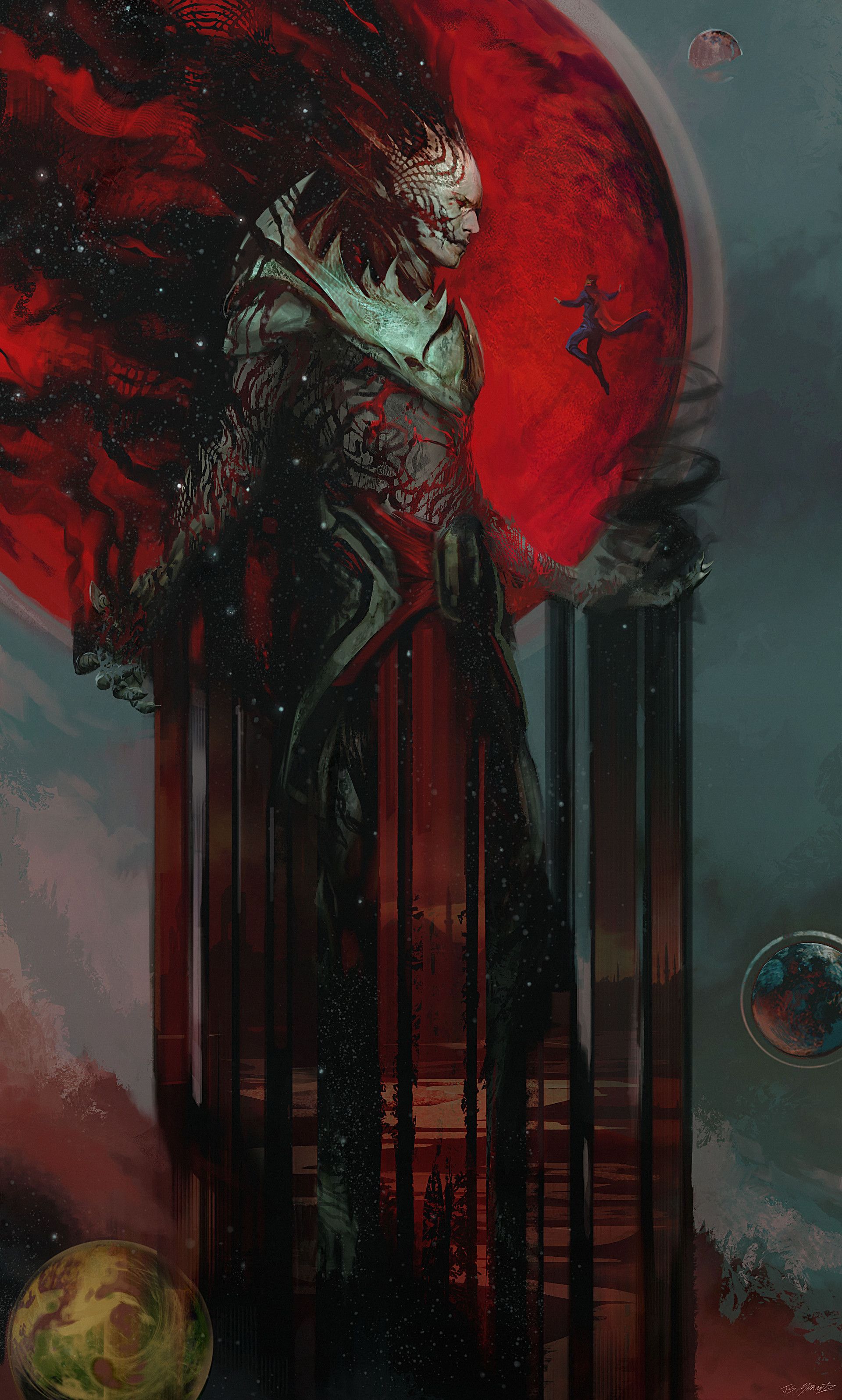
When a character conducts himself in a way that they become an affront to the gods or nature, a spirit or other entity might curse them with its dying breath. The following curses are examples of afflictions and maladies that can impair an immodest adventurer who lets their greed overshadow their morals.
These curses are meant to be storytelling tools, rather than ways of a DM to punish their players. They are meant to be curses that might eventually be lifted off, as a character rethinks their actions and redeems themselves. A player might incorporate one of these curses (or a weaker version of one) into their backstory, as they start adventuring in search of forgiveness (or a devious way to trick the curse). If you are a player, consider what led to you being cursed, how your character deals with their ensuing state, and what they'd be willing to do in order to be free again.
As a DM, you might also incorporate one of these curses into a villain's story. Perhaps the party first crosses paths with the villain as they are trying to find a way to break the curse, willing to do anything in the process so that they can resume their plans. How did the villain become cursed, and what is the solution to breaking their curse? What plans was the villain pursuing before they were set back? And what can the players do about it?
Each curse will feature variants in parentheses when necessary, along with the reasoning behind them. When it comes to curses, you should always adapt them to the player character, so as to ensure playing them is still enjoyable and rewarding.
Remove Curse
The remove curse spell is notorious for trivializing curses in 5th edition. This document assumes that the following curses cannot be removed merely with a casting of remove curse. Perhaps they require specific components with which the spell must be cast, a specific person to cast the spell, or an altogether different solution to breaking the curse, up to the discretion of the DM. A few of these curses might be cast off simply by the cursed character performing a self-sacrificing act, or otherwise genuinely redeeming themselves through extraordinary actions. Do not be afraid to improvise and offer closure to a curse arc when the narrative demands it.
Curse of Near Sight
Your short-sightedness has turned into a physical malady to plague you.
You can only see out to a distance of 30 feet. You are blind beyond this radius.
Variant. You can only see out to a distance of 60 feet. You are blind beyond this radius.
Long ranged casters such as wizards stand to lose much from having a more limited scope. This problem can still be solved through familiars, but a softer version of this curse is included in case the non-combat effects of this curse might prove to be enough for a character.


Curse of Soul-Eating
You feel something gnawing away at your soul, awake and at night, ever since that day. Each time you complete a long rest, you must succeed on a DC 10 Wisdom saving throw, or your maximum hitpoints are reduced by 1. If your hitpoint maximum is reduced to 0 in this way, you die.
This can be adequately pressing for a low level character, without being outright deadly. A solution to the curse, or a way to abate it for a time, should be close for the player to achieve. Until they do, a ticking clock will sound over their head each night, and soon enough the symptoms of the curse will start to show, revealing the somber truth to the cursed creature's companions.
If the characters are higher level, or the character has a high Wisdom save, consider increasing the DC to 12, 13 or 15. If they are above level 9 and not entirely squishy, consider removing the DC entirely, making it an automatic effect.
Make sure to keep in mind that reaching 0 hitpoints is not the greatest pitfall. A wizard with 10 maximum hitpoints less is considerably more likely to die in combat, than live to see out the curse's ultimate end. Make sure to periodically grant access to ways to combat the curse, such as access to greater restoration or similar effects.
Curse of Gluttony
Each time you are presented with a meal, you cannot help overstuffing yourself to the point of exhaustion. You are likely to offend those you dine with, as well those who will hear your demands of more food.
You need to eat 3 times as much as a normal humanoid of your size. Additionally, for 1 hour after every meal your overindulgence makes your body unwieldy. Your speed is reduced by 10 feet.
Curse of Mistrust
Your distrust and doubt towards a loved one lead to you standing by as they perished, betrayed by your inaction and lack of trust. Their spirit made sure you will perish the same way they did, by your own disloyal nature.
You are mistrustful of even the most honest of creatures. You have disadvantage on Wisdom (Insight) checks made to determine whether someone is to be trusted. Additionally, when a spell requires its target to be willing, you are unable to qualify, as your mistrustful nature instinctively rejects the effect.
Curse of Cowardice
You belittled those you deemed to be below you, so their spirits turned you into the image you had of them: a squeamish coward.
Creatures have advantage on Charisma (Intimidation) checks made against you. Intelligent creatures can notice this flaw in you, and are likely to take advantage of it.
Curse of the Bad Dream
Each time you regain consciousness after being knocked out you feel as if reality is a bad dream from which you can never wake up.
When you fall to 0 hitpoints, and magical healing causes you to regain hitpoints, you gain 1 level of exhaustion.
Curse of the Promise
You made a promise and broke it. But life and even unlife will make sure you eventually make up for it.
When you die, you can not be resurrected or brought back to life by any means other than a wish spell. Instead, a few days after your death, you will return to the world as a revenant. This event will happen again and again until you fullfil the promise you gave. Even if it is impossible for you to fullfil it anymore.

Angels
The source of these boons and curses are usually the gods that grant a part of their power to the mortal realm. But the gods face a multitude of issues at each moment, and not all gods can be at every place at once. Some gods may employ angels and other celestials to stand vigil over the mortal realm and be the bastion of good the world needs. As high servants of the gods, some of them may be able to bestow a boon of their god.
Below, you will find information on several angels, along with their values, personality and the goings on they are involved in. These angels may help you flesh out the character and values of a god in your campaign, as they are the perfect middle ground between clerics of the god, who are only mortals, and the gods themselves, who may not have the time to converse with mortal beings every day. Additionally, you can use these angels as the patron of a celestial warlock, or the guide of an Aasimar player in your table.
In the next chapter, you will find the corresponding celestials that may serve an evil god, called Heralds, and other minions in service of evil forces.
Tithus, the Complete
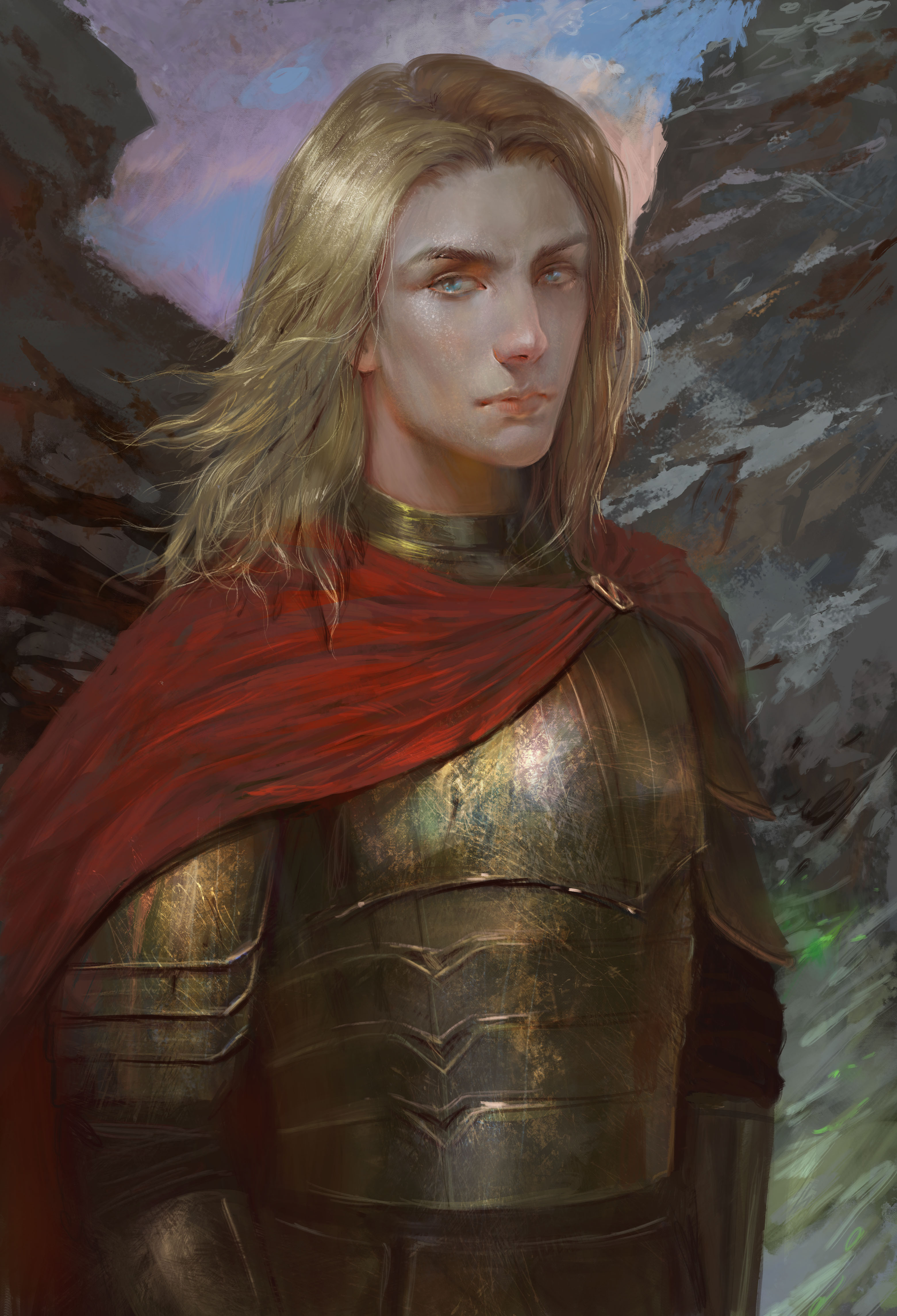
Tithus is the angel presiding over the strive for perfection. He appreciates the limits a mortal is born into and places value in the effort mortals make to overcome them. He has a soft spot for humans, who exemplify the most growth and adaptability for their lifespand, and always seek to better themselves and their societies through ceaseless innovation. He is known for treating with respect the individuals that have succeeded in following his teachings. When they put their own lives and all they've achieved on the line in order to do good, he is moved, and has been known to put his own existence at risk in order to support them.
Tithus the warden of hubris, tasked to guard mortals who would try to overcome their nature by becoming an affront against the gods. All in their pursuit to achieve immortality or power they are not worthy of.
His nemeses include Varys, the Herald of Coveting, and Zhalur, the Siphoning Herald.
When he descends to interact with the mortal realm, he is straightforward in his speech and disapproves of creatures that use words in order to shift the appearance of reality, instead of looking at it in the face and trying to improve it. He only chooses to show himself to creatures that have come close to perfection (level 20 characters), as his perfect appearance might unfairly impact the aspirations of mortal creatures.
Alignment: Lawful Good or Lawful Neutral.
Plot Hooks
These plot hooks include events that would cause Tithus to be concerned or even become involved in them. Tithus could enlist the services of the player characters, if he has reason to, or gently nudge them to the right direction if they both want to solve the same issue. These plot hooks might include references to creatures or forces described later in this document.
The Siphoned City. Zhalur has corrupted Dash NaVaren, the archmage and arcane council to the King of Astevar. At his orders, she has spread distrust and discord over the city, in order to provide distractions from their true goal. The upheaval that has spread in the city has led to the closing of the gates, preventing anyone from coming in or going out of Astevar. Which is the perfect situation for Zhalur to begin his Siphoning (see Zhalur), using NaVaren's body as a conduit.
Ambitious Mage. The player characters have come across an odd item in their journeys that fell into their hands. In truth, this enchanted relic is paramount to Alkasta's plans to achieve lichdom. Without revealing the nature of the item, or their goals, Alkasta will attempt to buy it off the characters by paying a handsome reward. If the players accept, or the amount of the reward makes them wonder the item's use, Tithus could send a messenger to warn the party of the wizard's plans.
If the players refuse to sell the item, Alkasta will attempt to take it by force or cunning.
If the players accept the changeling wizard's reward, and you play Tithus as neutral instead of good, he will send forces to take the item from the players' hands before it falls to Alkasta's grasp, where it will be even harder to retrieve. If Alkasta notices this move, he will try to exploit it in order to turn the players against Tithus. He will not hesitate to lie or deceive them, perhaps claiming that Tithus is not who he claims to be.
Alkasta is a changeling wizard who hides their shapeshifting abilities, appearing as a male catfolk when in their role of Alkasta.
Divine Drain. Tithus has began to feel their powers being drained by an unknown source. Any creature who benefits from Tithus' patronage (celestial warlocks, clerics or paladins) experiences the same effect. What is causing this?
Alternatively, Tithus could be missing entirely, having stopped answering the prayers of his clerics. His followers would be seeking answers and solutions.

Tithus
Large celestial, lawful good or lawful neutral
- Armor Class 19 (natural armor)
- Hit Points 200 (16d10 + 112)
- Speed 40 ft., fly 120 ft.
STR DEX CON INT WIS CHA 25 (+7) 25 (+7) 25 (+7) 19 (+4) 20 (+5) 25 (+7)
- Saving Throws Con+12, Wis+11, Cha+12
- Skills Athletics +17
- Damage Vulnerabilities necrotic
- Damage Resistances radiant; bludgeoning, piercing, and slashing from nonmagical attacks
- Condition Immunities blinded, deafened, charmed, exhaustion, frightened, petrified, poisoned
- Senses truesight 120 ft., passive Perception 21
- Languages all, telepathy 120 ft.
- Challenge 16 (15,000 XP)
Perfect Being. Tithus can add his proficiency modifier to any skill check he makes. He adds double his proficiency modifier to Strength (Athletics) ability checks.
Steadfast Resolution (1/Day). After Tithus receives necrotic damage, he can use his reaction to enter a state of absolute determination against those that would stunt all growth. While he is concentrating on this state (as if concentrating on a spell), he has resistance to all damage, and advantage on all saving throws against the creature that dealt necrotic damage to him, and its allies.
In addition, if he is wearing his amulet of divine protection, he gains 32 temporary hitpoints.
Perfection Itself (3/Day). When Tithus makes an attack roll, ability check or saving throw, he can choose to roll a natural 20.
Angelic Weapons. Tithus' weapon attacks are magical. When Tithus hits with any weapon, the weapon deals an extra 2d8 radiant damage (included in the attack).
Divine Awareness. Tithus knows if he hears a lie.
Magic Resistance. Tithus has advantage on saving throws against spells and other magical effects.
Innate Spellcasting. Tithus' spellcasting ability is Charisma (spell save DC 20). Tithus can innately cast the following spells, requiring no components:
At will: detect evil and good, greater restoration
3/day each: dispel evil and good, flame strike, flesh to stone, freedom of movement
1/day each: commune, divine word, summon celestial (7th-level version)
Actions
Multiattack. Tithus makes two melee attacks.
Greatsword. Melee Weapon Attack: +12, Reach: 5 ft., one target. Hit: 21 (4d6 + 7) slashing damage plus 9 (2d8) radiant damage.
Healing Touch (4/Day). Tithus touches another creature. The target magically regains 30 (6d8 + 3) hit points and is freed from any curse, disease, poison, blindness, or deafness.
Martial Archetype: The Tithan
Tithans are perfectionist fighters who are devout to the ideas that Tithus represents. They believe that prosperity lies in the striving of mortals to improve themselves and reach the most they can in their limited lifespan. They value integrity and wholeness of being, and train their mind and soul as much as their body in order to have a holistic approach to life.
Rounded Mind
When you choose this archetype at 3rd level, you gain proficiency in one skill of your choice. Whenever you complete a long rest, you can change your selection, choosing another skill to gain proficiency in.
Masterful Growth
Starting at 3rd level, whenever you select to gain a feat with an Ability Score Improvement from this class, you can also increase one ability scores of your choice by 1, up to a maximum of 20.
Unstoppable Skill
Also at 3rd level, whenever you make an attack roll or Athletics ability check, and you roll a 1 or 20 on the d20, you gain a Striving Point, representing your ability to learn not only from your triumphant victories but also your failures. This striving point lasts until you complete a long rest.
While you have a Striving Point, you can expend it in order to gain advantage on one attack roll, ability check or saving throw. You must do so before you make the roll. Additionally, if you roll a 1 on the d20 while you have a Striving Point, you can expend it in order to reroll the die. You can only have 1 Striving Point at a time.
Flowing Skill
At 7th level, you have achieved an even greater mastery over your skills both in and out of battle. You can use an action to change the skill that Rounded Mind grants you proficiency in. Once you do so, you must complete a short rest before being able to do so again.
Additionally, when you make an ability check with a skill you are proficient in, you can choose to add double your proficiency modifier to the roll. You can use this ability a number of times equal to your proficiency bonus, and you regain all expended uses when you complete a long rest.
Dauntless
Starting at 10th level, you can expend a Striving Point to recharge your Indomitable feature. Additionally, you can have up to 3 Striving Points at a time, and when you gain a Striving Point, you also gain a number of temporary hitpoints equal to your level.
The Sky is the Limit
At 15th level, when you make an ability check with a skill that you are proficient in, you gain an additional +1 bonus to the roll for each of your ability scores that is 20 or higher.
Additionally, the maximum of all of your ability scores is increased by 2.

Will to Perfection
Starting at 18th level, you have gained the ability to achieve perfection merely through your will. When you make an attack roll, ability check or saving throw, you can expend a Striving point to roll a 20 instead of rolling a die.
Design Notes
This archetype focuses a lot on ability scores and their improvement. It is balanced with the point buy or standard array rules in mind for character creation. If you prefer to let your players roll for stats, consider that a fighter that got very lucky with their rolls will be able benefit from these features considerably more than a character that starts out with average stats, and slowly proceeds with achieving perfection.
This archetype was designed for games that use the optional feats rule. When you gain a feat with this class, consider what feats would grant your character a rounded spirit instead of only martial ability. However, if your DM does not want to give you access to feats, you can use the following Masterful Growth variant included bellow.
Masterful Growth
(3rd-level feature variant; replaces Masterful Growth)
Starting at 3rd level, whenever you gain an Ability Score Improvement from this class, you can increase one ability score of your choice by 2, and one other ability score by 1, or you can increase three ability scores of your choice by 1. As normal, you can't increase an ability score above its maximum when you do so.
Amulet of Divine Protection
Wondrous item, very rare
This amulet bears the symbol of the Complete. Tithus has an innate vulnerability to necrotic damage, the element that stunts all growth and flies in the face of everything he stands for. Instead of weeding that vulnerability out of himself, he chose to keep it, and he crafted this amulet himself, to show that none should mold themselves according to the threats of their adversaries. Instead they should construct themselves and their spirit only according to their values, and their own vision.
When you receive necrotic damage, you can use your reaction to gain a number of temporary hitpoints equal to twice your level. You gain these temporary hitpoints after receiving the damage. Once you've used this ability, you must complete a long rest before you are able to do so again.
Awakened. When you perform a deed worthy enough to bind yourself to the essence of this amulet, it awakens, attuning to you. While you are attuned to this amulet, you gain a +1 bonus to your AC and saving throws. Additionally, while you have temporary hitpoints granted from this amulet, you have resistance to all damage.
You can use this amulet to cast commune and summon celestial at 7th level without expending a spell slot or requiring material components. When you cast a spell in this way, you can't cast it again until you complete a long rest.
Censer of Tithus
Wondrous item, artifact
While holding this censer, and performing a sacred ritual in which the creature states their reason for calling unto him, a worthy being can summon Tithus. If he is willing, Tithus appears within 5 feet of the censer.
Circlet of Perfection
Wondrous item, very rare (requires attunement)
This masterwork circlet is made of untarnishable gold and platinum. When you attune to this circlet, you can choose one ability score. You achieve perfection in that domain. That ability score becomes 20, if it isn't already higher. When you complete a long rest, you can change the ability score you have selected.
Additionally, when you make an ability check using the chosen ability score, you can treat any result of 9 or lower on the d20, as 10.
Censer of Centering (Shanti)
Wondrous item, rare
This object looks like an ordinary, nonmagical censer. If you meditate with this censer for 1 hour, you can gain the benefits of a long rest. Once this ability of the censer is used, it fades from it for 1 year.
Boon of Perfection
When you make an ability check, you can choose to treat the result as if you had rolled 20.
Once you've used this boon, you can't do so again until you complete a short or long rest.
Shanti, the Ohm Mind
Shanti is the angel of wisdom, peace and calm. He values pacifism and the ability to place oneself and one's own interests aside in order to look at the bigger picture. He has been the patron of peace ambassadors and many spiritual leaders of varied cultures. Most of Shanti's devout followers are monks that meditate in an effort to bring themselves at peace with their environment. It is not uncommon for a hermit follower of Shanti to receive a calling that will thrust them back into the civilized world, just as it is not uncommon for an individual to receive guidance that will lead them into one of the many isolated mountain monasteries where Shanti monks practice their way of life.
Shanti's duties are to protect the link between the mortals and the spiritual world, including the gods, but also the elements. Some Shanti monks that reach enlightenment are known to live out their lives as air elementals.
The Fraying Mind opposes Shanti in every way, as does Kalwar the Violent.
Alignment: Lawful good.
Plot Hooks
Peaceless Dreaming. A small village has become infected with a disease that plunges its citizens into unsettling nightmares. No herbal remedy can cure the dreams, or bring peace to the suffering, as the villagers begin to lose track on whether they are in the waking or dreaming world.
Elemental Havoc. Any elemental that is summoned flails helplessly when its time to return to its home plane arrives. Using its primordial language, it begs on deaf ears not to let it go back as it's sucked back into its plane. What is causing trouble in the elemental planes?
Yriya the Keeper has vanished, and her fog of lost souls started expanding into the astral plane as it has been left unattended. Countless of the lost souls she kept in her hoard have landed in the elemental planes, upsetting their balance, and taking over their essence. How can this problem be undone? And most importantly what has caused the vanishing of the cruel soulmistress?
Memories Unclaimed. The player characters find a feral human in the outskirts of a mining installation. He behaves like an animal and cannot speak at all, but to their surprise his vestments bear the symbol of Shanti, the Ohm Mind. What has taken his memories? What was he trying to stop?
Boon of Free Air
You can use an action to become like the wind. For 1 hour, you gain a fly speed of 80 ft. (hover).
Once you've used this boon, you can't do so again until you complete a short or long rest.
Temperate Mind
Your mind is one with itself. You are immune to being frightened. When you see a creature within 60 ft. of you becoming frightened, you can use your reaction to lend their mind your inner peace. The effect on them ends, and they have advantage on Wisdom saving throws until the end of their next turn.
Once you've used this boon, you can't do so again until you complete a short or long rest.

Shanti
Medium celestial, lawful good
- Armor Class 24
- Hit Points 168 (16d8+96)
- Speed 80 ft., fly 80 ft.
STR DEX CON INT WIS CHA 19 (+4) 25 (+7) 22 (+6) 19 (+4) 25 (+7) 21 (+5)
- Saving Throws Dex +12, Con +11, Wis +12, Cha +10
- Skills Acrobatics +12, Insight +12, Perception +17, Persuasion +10, Stealth +12
- Damage Resistances psychic
- Condition Immunities charmed, exhaustion, frightened, poisoned, disease
- Senses truesight 120 ft., blindsight 60 ft., passive Perception 32
- Languages all, telepathy 120 ft.
- Challenge 16 (15,000 XP)
Cleansed. At the start of his turn, Shanti can end any condition of his choice that is affecting him.
Ki Strikes. Shanti's unarmed strikes are magical. When Shanti hits a creature with 2 consecutive attacks, that creature's speed is reduced to 0. Additionally, once per turn, Shanti can force a creature to make a DC 19 Constitution saving throw when he hits it with a melee attack. On a failure, that creature is stunned until the end of Shanti's next turn.
As a Feather. Shanti has a fly speed of 80 ft. If he ends his turn while still aloft, he falls. Shanti is immune to falling damage.
Divine Awareness. Shanti knows if he hears a lie.
Magic Resistance. Shanti has advantage on saving throws against spells and other magical effects.
Innate Spellcasting. Shanti's spellcasting ability is Wisdom (spell save DC 20). Shanti can innately cast the following spells, requiring no components:
At will: calm emotions, detect evil and good, prayer of healing, sanctuary, silence
3/day each: cease*, dispel evil and good, freedom of movement (other creatures only), stop harm*
1/day each: change of ways*, commune, greater restoration
Actions
Multiattack. Shanti makes 4 unarmed strike attacks.
Unarmed Strike. Melee Weapon Attack: +12, Reach: 5 ft., one target. Hit: 12 (1d10 + 7) plus 9 (2d8) radiant damage
Healing Touch (4/Day). Shanti touches another creature. The target magically regains 30 (6d8 + 3) hit points and is freed from any curse, disease, poison, blindness, or deafness.

Peace Domain
Peace clerics are often renowned diplomats, negotiators or ambassadors. They are individuals determined to fight against the tendency of the world to devolve into chaos and war, and strive to maintain the peaceful state of society, so that all humanoid lives may flourish and civilizations progress.
At each indicated cleric level, you add the listed spells to your spells prepared.
Peace domain spells
| Cleric level | Spells |
|---|---|
| 1st | sanctuary, charm person |
| 3rd | aid, calm emotions |
| 5th | cease* (or beacon of hope), tongues |
| 7th | charm monster, Otiluke's resilient sphere |
| 9th | commune, teleportation circle |
Ambassador of Peace
When you choose this domain at 1st level, you learn how to make others see and trust in your peaceful motives. You gain proficiency in the Persuasion skill. Your proficiency bonus is doubled for any ability check you make that uses that skill. Even if a creature would not be willing to do something you attempted to persuade it to do, on a successful persuation check they nevertheless consider you an honorable person and regard you favourably.
Additionally, whenever you are telling the truth, a creature has advantage on any Insight checks it makes to deduce whether you are being truthful.
Pacifist
Starting at 1st level, you gain the following benefits:
When you are not wearing armor, a shield, or carrying a weapon, your AC becomes 13 + your Wisdom modifier if it is not already higher.
Whenever you are surprised, you gain immunity to all damage until the start of a turn on which you are not surprised. Additionally, whenever you are surprised, any damage dealt to a non hostile creature within 30 feet of you is reduced by an amount equal to your level.
You believe so deeply in the good inherent in all creatures and the possibility of always arriving at a non-violent solution to any problem. When an enemy initiates hostilities with you or your allies without being attacked by you and your allies first, you gain immunity to all damage during the first round of combat. Additionally, any damage dealt to a non hostile creature within 30 feet of you during that first round is reduced by an amount equal to your level.
Channel Divinity: Suppress the Violent
Starting at 2nd level, you can use your channel divinity to hinder the perpetrators of violence. When you see an ally within 60 feet of you take damage, you can expend your reaction to use your channel divinity and reduce the amount of damage your ally takes by half.
Additionally, if the attacker is humanoid, that creature becomes marked for 1 minute or until it takes damage. While marked, the creature deals half as much damage as it normally would with its attacks or spells.
Divine Aid
At 6th level, your ability to provide aid to your allies is improved. Whenever you complete a long rest, choose one spell from your list of prepared spells which requires concentration and can only target willing creatures. That spell does not require concentration for you. This benefit can only apply to one spell you have selected at a time.
Peaceful Soul
At 17th level, you have attained a state of complete peace with the world. Your Wisdom ability score and ability score maximum are increased by 2. Additionally, you can enter a special meditation that surrounds you with an aura of peace. At the end of a long rest, you gain the effect of a sanctuary spell that lasts until the start of your next long rest (the spell can end early as normal).
Spells
Below follow some additional spells that are inspired with the Peace Domain in mind. It is left to the discretion of the DM whether these are only available to peace domain clerics, all clerics, or additional classes.
Cease
3rd level, enchantment
- Casting Time: 1 action
- Range: 90 feet
- Components: V, S, M (a blunted miniature sword)
- Duration: Concentration, up to 1 minute
You bellow words of condemnation and reproach at a humanoid within range that you have seen damage a creature during the last minute. The target must succeed on a Charisma saving throw, or be affected by the spell. If the target has reduced any of your allies to 0 hitpoints in the last minute, the target makes the saving throw with disadvantage. The target automatically succeeds on this saving throw if they are immune to being charmed. Until the spell ends, or until the creature takes damage from one of your allies, the target cannot take the attack action or cast a spell that deals damage to a creature.
At Higher Levels. When you cast this spell using a spell slot of 4th level or higher, you can target one additional creature for each slot level above 3rd. The creatures must be within 30 feet of each other when you target them.
Change of Ways
7th level, enchantment
- Casting Time: 1 action
- Range: Touch
- Components: V, S, M (a vial of holy water that the target swallows)
- Duration: Until Dispelled/Special
You touch a humanoid that has been violent or cruel in the past and let out a wave of peace and amity from your heart towards it. The target must succeed on a Charisma saving throw, or let its heart change as a response to the harmonious feelings you let it experience. The target loses any intense feelings bloodthirst from their mind, and they do not seek to revert back to their previous self. Any time they may attempt to damage a creature while doing so with murderous intent, they must succeed on a Charisma saving throw with disadvantage, or they are unable to complete the action.
If the target ever kills a creature while under the effects of this spell, they can repeat the initial Charisma saving throw. On a success, the spell ends.
Stop Harm
2nd level, enchantment
- Casting Time: 1 reaction, when you or a creature within 30 feet of you becomes the target of an attack
- Range: 60 feet
- Components: V
- Duration: Instanteneous
You yell out halting words at the attacker after seeing their intent to enact violence. If you share at least one language with the target, they must succeed on a Wisdom saving throw or they lose their attack. If they succeed on the saving throw, or cannot understand you, they instead make the attack roll with disadvantage.
At Higher Levels. When you cast this spell using a spell slot of 3rd level or higher, you can target one additional creature for each slot level above 2th. The creatures must be within 30 feet of each other when you target them.
Aura of Sanctity
5th level, enchantment
- Casting Time: 1 action
- Range: Self (15-foot radius)
- Components: V, S
- Duration: Concentration, up to 10 minutes.
You let your hate against harm and violence overwhelm you, spilling outwards from you, forming an aura with a radius of 15 feet around you. When you cast this spell, you can designate any number of creatures you can see to be unaffected by it. When an affected creature deals damage to an ally of yours while within the aura, you can use your reaction to condemn its actions. It must succeed on a Wisdom saving throw or take 4d10 psychic damage. On a successful save, the creature takes half as much damage. The target automatically fails the saving throw if the damage it dealt reduced a creature to 0 hitpoints.
At Higher Levels. When you cast this spell using a spell slot of 6th level or higher, the radius of the aura around you increases by 5 feet for every two slot levels above 5th.
Peace Guardians
3rd level, abjuration
- Casting Time: 1 action
- Range: Self (15-foot radius)
- Components: V, S, M (a holy symbol)
- Duration: Concentration, up to 10 minutes
You call forth spirits to protect you. They flit around you to a distance of 15 feet for the duration.
When you cast this spell, you can designate any number of creatures you can see to be unaffected by it. An affected creature's speed is halved in the area, and any time an affected creature deals damage with an attack the amount of damage it deals is reduced by an amount equal to half your level. Creatures affected by the aura cannot deal lethal damage with their attacks. When a creature falls to 0 hitpoints as a result of such an attack, they are unconscious but stabilized.
Livia, the Pulse
Livia is an angel that has viewed little of the material realm. Inside her and through every fiber of her being, pulses the very essence of passion itself. In her natural state one can view the rhythmic shifting of her body, pulsing the same way as a heart does for others. Once a mortal is exposed to it, his or her heart will begin to beat at once in the Livian rhythm, their mind being overtaken by the strength of that gravity well near them. Livia sojourned into the material realm carefully, making sure that she came across as few mortals as possible, at least in direct contact. Her powerful aura would overtake the minds of most mortals if in their presence for too long, reducing them into empty vessels of passion and energy.
So she journeyed through the skies high above, unnoticed. The blessings of creativity and passion she gifted to each civilization spread as a tidal wave making its way through the continents as she passed above them, high in the clouds. Music in the Livian rhythm began to develop, as did painting, acting, and writing all influenced by them. It was a mark of a high artist to work in strokes that were in tune with the Livian rhythm. Audiences would attend performances of artists merely painting or writing in front of them, as they engaged in their art by tapping into the Livian rhythm. And the audience would look to see and feel that rhythm in their brush strokes or calligraphy. Merely watching a man write became as pleasurable as watching him dance. Viewing someone entering the Livian Flow became infectious, spreading the harmony the artist felt to anyone around them.
So strong become this effect the more time passed, that Livia became unable to visit the material realm before long. Even in her short sojourns, her aura had become so potent that no matter the distance, a whole planet could be affected and overtaken by it. And so it was, that in the next centuries civilizations began to wither and stagnate. The creative spirit began dying throughout the continents, and it was replaced with the violence and authoritarianism that spread to take its place.
Heartbroken by this, Livia resorted to a final solution. She constructed a shell around her that would resist the pulses she emitted, and refuse to vibrate with them. She climbed inside and sealed it shut before returning to the material realm. The protective casing around her would dampen the effect she had, enough to only bless the societies below, instead of drive them mad with creative frenzy. And so it was, that for the next millenia, an orb beyond the sight of mortals floated above them, gifting them the creative spirit their societies so needed.
Alignment: Chaotic good
Plot Hooks
An Opening for the Ages. Once civilization begins to advance more and more, and artificers progress from clockwork toys to flying airships, humanoids will begin extending their presence into the skies. What will their reaction be once they find this singular orb floating in the sky, of metal they have never previously witnessed, vibrating in intoxicating frequencies? Will they be able to open it?

The Great Silence. All throughout the world, sound is beginning to fade. At first it was thought to be a curse of voicelessness. But soon, the steps of heavy boots lost their thump, and nature lost her song. As magic was irreversibly changed, so was art and music. What is causing this malady, and what can be done about it? Perhaps Livia, even in her shell, might feel the great silence expanding, and contract the service of heroes willing to find its solution.
Boon of Artistry
Whenever you make a Charisma (Performance) check, you can treat any roll of 19 or lower on the d20 as 20.
Boon of Charm
When you cast a spell or use an effect that causes a creature to become charmed, you can make one target of the spell automatically fail their saving throw. If a creature is normally immune to being charmed, its immunity is cancelled when you use this boon. Once you've used this boon, you can't do so again until you complete a long rest.
Livian Philter
Potion (consumable), uncommon
You regain all uses of bardic inspiration when you drink this potion.
Bard's Philter
Potion (consumable), uncommon
When you drink this potion, you become proficient in your choice of 3 musical instruments for 1 hour. You also add a +5 to ability checks you make to play these instruments.
Instrument of the Bards, Livian Flute
Wondrous item, artifact (requires attunement by a bard)
An instrument of the bards is an exquisite example of its kind, superior to an ordinary instrument in every way. Seven types of these instruments exist, each named after a legendary bard college. A creature that attempts to play the instrument without being attuned to it must succeed on a DC 15 Wisdom saving throw or take 2d4 psychic damage.
You can use an action to play the instrument and cast one of its spells. Once the instrument has been used to cast a spell, it can't be used to cast that spell again until the next dawn. The spells use your spellcasting ability and spell save DC.
You can play the instrument while casting a spell that causes any of its targets to be charmed on a failed saving throw, thereby imposing disadvantage on the save. This effect applies only if the spell has a somatic or a material component.
All instruments of the bards can be used to cast the following spells: fly, invisibility, levitate, and protection from evil and good.
This flute has a number of properties that can be unlocked when a creature becomes worthy of them. When you attune to this flute you can choose to activate a number of its properties for which you meet the prerequisites. This number is equal to your proficiency modifier.
When you complete a long rest, you can attempt to harmonize with the essence of the flute, in order to change its properties that are unlocked to you. Only those with enough mastery over the creative arts can succeed. Make a DC 25 Charisma (Performance) check. On a success, you can change the flute's active properties.
Livian Blessing. No prerequisite
You can use this flute to enter the Livian rhythm while performing. Choose a creature that can hear you. For the next hour, that creature has advantage on all Charisma ability checks, as the Livian rhythm causes their creativity and passion inside them to overflow.
Once you've used this ability of the flute, you must complete a short rest before being able to do so again.
Livian Performance. No prerequisite
When you perform with this flute, you can add double your proficiency modifier to Charisma (Performance) checks you make with it.
Additionally, at 6th level you can enter the Livian rhythm with your performance. If you perform for at least 1 minute, any creatures within 30 feet of you must make a Wisdom saving throw contested with your Charisma (Performance) check. On a failure, a creature becomes charmed by your melody for 1 hour. They consider you to have granted them a great gift by letting them experience the Livian rhythm, and will listen to anything you ask of them. Once you've used this ability of the flute, you can't do again until you complete a short rest.
Heavenly Potency. Prerequisite: 5th level.
You gain a +1 bonus to your spell attack rolls and spell save DC. This bonus increases to +2 when you reach 9th level, and +3 when you reach 17th.
Harmonious Cleansing. Prerequisite: 5th level
You can use this flute to perform music that will harmonize the essence of any creature that hears it. If you spend 1 hour in performance, a creature of your choice within 5 feet of you receives the effects of the greater restoration spell.
Celestial Song. Prerequisite: 6th level.
You can use the Livian flute to perform your countercharm using your bonus action. When you do so, any creatures of your choice within range that are charmed or frightened can end that effect on themselves.
Radiant Strike. Prerequisite: 6th level
When a creature hits with a weapon attack, it can choose to expend one of your bardic inspiration dice if it has one, to fuel its strike with radiant energy. The creature can roll the die to deal extra radiant damage equal to twice the number it rolls.
Blessed Inspiration. Prerequisite: 8th level
When a creature rolls a 1 on a bardic inspiration die you gave it, it can choose to reroll the die.
Divine Whispers. Prerequisite: 10th level
You can immerse yourself in the music of the flute and come into contact with the celestial force behind it. You can cast commune using this flute at will. When you do so you can only contact Livia.
Spellcasting. Prerequisite: 5th, 11th or 15th level
When you select this property, you must choose a number of spells equal to your Charisma modifier from the following list. You are able to cast each of the spells you selected once per day using the flute without expending a spell slot.
At 5th level, the Livian flute can be used to cast hypnotic pattern without requiring any material components.
At 11th level, the Livian flute can be used to cast divine word, mass suggestion and word of recall in the same way.
At 15th level, the Livian flute can be used to cast power word heal and mind blank in the same way.
Livian Shell. Prerequisite: 13th level
When a creature that has a bardic inspiration die from you is hit by an attack, it can use its reaction to expend its die. A shell instantly forms around it, envoloping and protecting it in its hold until the end of its next turn. For the duration, the creature is immune to all damage, including the triggering attack. However, it is incapacitated while within its shell.
Divine Favor. Prerequisite: 20th level
You can perform an hymn in favor of Livia, describing the assistance you seek of her using your lyrics. If you succeed on a DC 40 Charisma (Performance) check, she hears your hymn and is moved by it. She will do what she can to offer her assistance to you, if your motives and methods are in alignment with hers. The DM chooses the nature of the assistance; the effect of any bard or cleric spell would be appropriate.
If Livia intervenes, the flute then loses this property.


College of Livian Rhythm
Bards of the College of Livian Rhythm have attained a connection to the creative spirit inside them that has since faded from the world. By tapping into this ambient creative force, they are able to enter a state of creative frenzy in which they can tirelessly engage in creative work for hours, and leave those in physical proximity spellbound, as they experience a state of the Flow they enter.
Livian Aura
Starting at 3rd level, you are always emitting an aura of potent creativity that surges outwardly from you in a radius of 30 ft., positively affecting others. When you can see a creature inside your Livian Aura make a Charisma ability check, you can choose to affect it with the Livian rhythm and enhance its passion. The creature can make the ability check with advantage.
You can use this feature a number of times equal to your Charisma modifier. You regain all expended uses when you complete a long rest.
Livian Flow
Also starting at 3rd level, you gain proficiency in Charisma (Performance) checks. Additionally, you can add double your proficiency modifier to Charisma (Performance) checks you make when performing music.
Additionally, you can enter the Livian rhythm when you perform. If you perform for at least 1 minute, one creature of your choice within your Livian Aura must make a Wisdom saving throw contested with your Charisma (Performance) check. On a failure, the creature becomes charmed by your melody for 1 hour. They consider you to have granted them a great gift by letting them experience the Livian rhythm, and will listen to anything you ask of them. Once you've used this ability, you can't do again until you complete a short or long rest.
Intuitive Charming
Starting at 6th level, creatures inside your Livian Aura have disadvantage on saving throws made to resist becoming charmed by you or ending charm effects caused by you.
Additionally, when you cast a spell that causes a creature to be charmed, and that creature is inside your Livian Aura, you can cast the spell without requiring any components.
Tireless Flow
At 14th level, you become immune to exhaustion. Any creature that benefits from your song of rest can also reduce its exhaustion level by 1. Also, any creatures that travel with you have advantage on forced march saving throws made to prevent becoming exhausted, as you inspire everyone around you with the Livian rhythm.
Additionally, your Livian Aura expands to a radius of 60 ft. from you.

Oniera, the Dreamless
Oniera is the angel of dreaming and the subconscious. She reveres that which angels do not possess, as celestial creatures such as her are constructed by the gods themselves, without any extraneous traits such as dreaming. Where celestials are constructed to exemplify a virtue or idea, to be the perfect incarnation of it, humans are incomplete but so free. Not only do the parents of a child not know what it will grow up to be, but even the human itself does not fully understand what makes up its character and being.
Oniera reveres that tumultuous nature, and how it is fueled by the subconscious, a trait of mortals that the gods underestimate even though they do not fully comprehend it. Oniera first shared that interest with her sister Yriya, the Soulmistress. While they always shared viewing mortals as something far away, an intresting subject to learn more about, Oniera never shared her sister's desensitized cruetly. Where Yriya cut open and studied the souls of mortals, Oniera only dispassionately viewed from afar, without intervening or changing the mortal's course.
Eventually, the two sisters grew apart, choosing to see less of each other until centuries had passed, and they had ceased to be kin. Each continues her path without care for the other's goals. The largest grief Oniera still carries, however, is still known to her sister. Oniera cannot dream, even though she has tried all possible ways her mind could conjure. Unable to experience her most revered passion, she collects the dreams of mortals in thousands upon thousands of rows of periwinkle bottles, pouring the unpredictable liquid dream into her basin each night before sleep in an attempt to at least experience it through the mortal's eyes. Oniera is especially interested in the dreams her warlocks have of her, which they gift to her with admiration. She is known to be the patron of the directionless, the abandoned, and those who only have their dreams left to themselves. She also protects the vulnerable against nightmares, both real and dreaming.
Alignment: True neutral
Plot Hooks
Nightmarish Visions. A force has started infiltrating the minds of those at sleep, plaguing them with cruel and endless nightmares that always seem to change. It seems to feed on their subconscious imagination, subsisting on their fear as their most terrible nightmares come true. True enough that some creatures begin showing marks on their skin that they had only gotten in their dreams.
An Offer She Can't Refuse. A powerful wizard has taken the effort to visit Oniera in her domain. Pledging his respects towards the celestial, the wizard offers to help her in achieving her immortal goal. He only asks access to the angel's collection of dreams in exchange, and her endless patience as he tries his best to unlock this possibility to her.
Edreus is a Kalashtar wizard that seeks to take advantage of Oniera's longing to dream. He has indeed found a way to make the angel dream, but he intends to lock her in that semi-conscious state so that he can take control of her domain. He knows that soon enough the axiomatic mind of the angel will start to blend the dreaming world with the real one. By controlling her dreams and their intensity, he will be able to control her actions, making her give orders that she would otherwise never give, and take actions she would normally oppose.
This half conscious state will lead to Oniera's consciousness spilling out and infecting the dreams of mortals, subconsciously asking for help and potentially causing the Nightmarish Visions described above.
The player characters could become involved in these matters either through a warlock of Oniera being in the party, or a warlock of hers seeking aid in discovering what is responsible for her patron's uncharacteristic behavior lately. Besides followers of Oniera seeking to cure the Nightmarish Visions, or help their mistress once they learn what has transpired, Oniera's sister Yriya will be outraged at the hubris of a mortal (while also fascinated by it). She might contact the group and make her introductions while she offers her assistance, or asks of their help. This would be a perfect opportunity to let the group become acquainted with Yriya, as they will come to understand her true nature only much later.

Oniera
Large celestial, true neutral
- Armor Class 18 (natural armor)
- Hit Points 200 (16d10 + 112)
- Speed 40 ft., fly 120 ft.
STR DEX CON INT WIS CHA 20 (+5) 25 (+7) 24 (+7) 19 (+4) 25 (+7) 22 (+6)
- Saving Throws Con +12, Wis +12, Cha +11
- Skills Perception +12
- Damage Resistances radiant; bludgeoning, piercing, and slashing from nonmagical attacks
- Condition Immunities charmed, exhaustion, frightened
- Senses truesight 120 ft., passive Perception 22
- Languages all, telepathy 120 ft.
- Challenge 16 (15,000 XP)
Dreamless Slumber. Any humanoid of Oniera's choice that starts its turn within 30 feet of her must succeed on a DC 20 Wisdom saving throw, or fall asleep. The creature wakes if it takes damage, or another creature uses its action to slap it awake. A creature is immune to this effect if it can't be charmed.
Angelic Weapons. Oniera's weapon attacks are magical. When Oniera hits with any weapon, the weapon deals an extra 2d8 radiant damage (included in the attack).
Divine Awareness. Oniera knows if she hears a lie.
Magic Resistance. Oniera has advantage on saving throws against spells and other magical effects.
Innate Spellcasting. Oniera's spellcasting ability is Wisdom (spell save DC 20). Oniera can innately cast the following spells, requiring no components:
At will: detect evil and good, dream, guidance
3/day each: dispel evil and good
1/day each: commune, crown of stars, divine word, etherealness, foresight, maze, mental prison
Actions
Multiattack. Oneira makes two shortsword attacks or two longbow attacks
Shortsword. Melee Weapon Attack: +12, Reach: 5 ft., one target. Hit: 10 (1d6 + 7) slashing plus 9 (2d8) radiant damage
Longbow. Ranged Weapon Attack: +12, Range: 150/600 ft., one target. Hit: 11 (1d8 + 7) slashing plus 9 (2d8) radiant damage
Healing Touch (4/Day). Oniera touches another creature. The target magically regains 30 (6d8 + 3) hit points and is freed from any curse, disease, poison, blindness, or deafness.


Night's Shelter
Wondrous item, rare (requires attunement)
This elegent amulet has a dark gem in its center that protects against nightmares. When you complete a long rest, the amulet has a 25% chance to absorb a nightmare you have during your sleep. Once it does so, it becomes charged and the gem's color turns from transparent to opaque.
While the amulet is opaque, you have resistance to psychic damage and magic can't cause you to fall asleep against your will. Additionally, you can use your action to select a point you can see within 30 feet of you. Any creatures of your choice in a 10 ft. radius of the point you select must make a Wisdom saving throw as you unlease the nightmares stored in the amulet on them. On a failure, the creature falls asleep for 1 minute. At the end of each of its turns while it is asleep in this way, the creature takes 2d6 psychic damage. The effect ends for an affected creature if it takes any damage other than psychic or if someone else uses an action to shake the creature out of its nightmare.
When you use this ability of the amulet, it loses its charge and becomes transparent once the stored nightmare vanishes from within it.
Ethereal Dreaming Censer
Wondrous item, rare
You can use this divinely blessed censer to cast the dream spell. Once you do so, you have to complete a long rest before you can do so again.
Additionally, you can perform an 1 minute ritual using fragrant incense to activate the bonding properties of this censer. Any willing creatures that sleep within 20 feet of the censer while it is burning can enter a shared dream state during their sleep. The creatures are all aware of this, and can converse while asleep. The creatures can also shape the environment of the dream, creating landscapes, objects, and other images. While in this dream state, a creature has immunity to psychic damage.
Onieric Stone
Wondrous item, legendary
This ancient stone tablet is engraved with blessings and knowledge of the Dreamless Angel. Long lost, and probably buried under the rubble of one of the First Cities, the tablet is longed after by many individuals, followers of the Dreamless Angel and not.
While this large stone tablet is placed in hallowed grounds, it can be used to cast the astral projection spell. Once it's used in this way, this magic fades from it, returning again in 100 years.
If this stone is placed still for 7 days in an area that isn't desecrated, the area in a 100-foot radius from the sphere becomes hallowed, as per the hallow spell. Celestials are immune to this effect, and if a creature that is in allegiance with the Dreamless Angel takes its place as the caretaker of the temple and the stone, it can choose at each day one of the hallow additional effects to become active. Additionally, any creatures that are not opposed by the Dreaming Angel have advantage on all saving throws while within the hallowed grounds.
Ambassador's Shield
Armor (shield), rare (requires attunement)
While wearing this shield, you gain a +1 to your AC. This is in addition to the shield's normal AC bonus.
Additionally, while wearing this shield, you are considered to be under the effects of sanctuary for any creature that you have never attacked.
Onieric Shard
Wondrous item, legendary (requires attunement)
This hallowed shard was made by Oniera to give to a champion of hers, long gone from the mortal realm. The shard has since then been lost to the ages. A creature can only attune to this shard if Oniera permits it. If Oniera dies, the crystal loses its properties, but still retains its innate magical power, making it a prized possession to have in any way.
A creature can use this shard to cast commune (with Oniera only), dream, etherealness, foresight, Leomund's tiny hut or hypnotic pattern. Once the shard has been used to cast one of these spells, it can be used to cast that spell again until you complete a long rest.
Additionally, when you and your allies are asleep, you gain immunity to psychic damage, and can't be surprised. If a creature attempts to surprise you while asleep, you have advantage on initiative. When you complete a long rest, you may choose up to 7 creatures you can see that also completed a long rest, and grant them temporary hitpoints equal to your level + double your proficiency modifier.
When a creature dies, you can use a reaction to transfer its soul to this shard, if it is willing. While within this shard, the creature pleasantly dreams. This shard can then be used instead of its body for spells such as raise dead. When the shard is used in this way to create a body for the soul housed inside it, roll 1d20. On 10 or lower, the shard is consumed as the creature returns to life. At the discretion of the DM, this shard might already contain the soul of the ancient champion of Oneira, who enterred the shard when they perished ages ago in battle.
Heralds
Yriya, the Soulmistress
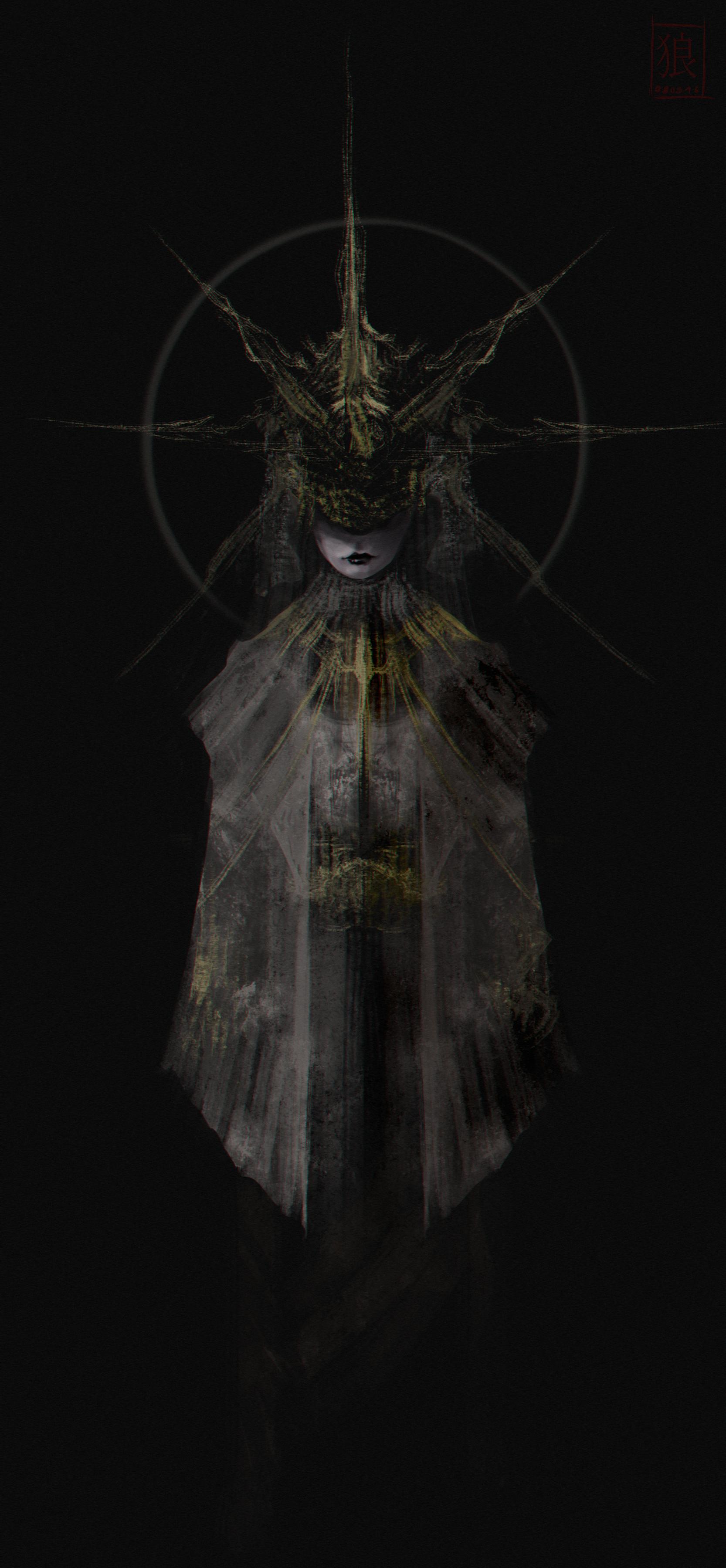
Yriya, also known as the Keeper, is the sister of Oniera, and herald of captured souls. Where other heralds would serve their evil deities by enacting carefully planned schemes towards some far goal, Yriya is much more straightforward. She has no use for the souls she collects other than study and curiosity. She occupies the middle ground between the heralds and angels, and acts on her own agenda. An agenda that can be easily swayed.
Yriya had always been curious about the mortal world from the start. But the subject of her highest interest was not the environment in which mortals live, nor the self-imposed rules under which they collectively survive. She is curious about what lent them their life, and what enables their fragile bodies to live as they do. She is interested in their flesh, but also their souls. She shared her sisters fascination with their subconscious, but where Oniera venerated the dreaming state, she handled the human soul as an artificer would handle a new kind of machine they just discovered. She tore apart their minds and opened up their souls in order to investigate what made them tick, and collected them as prizes in a carnival.
Content to stick to her own business, the other heralds and infernals let her keep building her fog of lost souls, the garden in which she deposited the souls she collected, to wait — often to the point insanity — until their time came to be scrutinized by her. No one knows exactly where the fog of lost souls is, as Yriya has kept it very well hidden. Some theorize that it is in a demiplane of her own supervision, while others theorize it is situated somewhere in the astral plane. Also known as the plane of lost souls, it is an arbitrarily large expanse of fog covered ground, stripped of any other landmarks or structures. Yriya maintains good relations with other extraplanar forces by trading some of the souls she acquires to devils or demons as fuel, in exchange for favors or goods. The balance of these relationships is often tenuous, as her garden of souls is a very appetizing sight to most devils, who are only held back by her power and conniving mind.
Alignment: Chaotic neutral or chaotic evil
Plot Hooks
Soul Harvest. A player character could incorporate the fog of the lost souls into their backstory in a number of ways. They could be a soul that was trapped there, but somehow escaped, or the whole party could begin the adventure on the fog of lost souls after being harvested, having to find a way out. Who would they meet there, and what would they offer them? Other forces such as devils take interest in the garden, and could interact with the PCs, offering infernal deals for their lives. If you want to incorporate the Elemental Havoc plot hook above (see Shanti) you could have the players be souls that were flushed out into random planes after the fog was dispersed and the garden destroyed through some mysterious means. Other than the Elemental planes, souls from the fog could end up in any of the outer planes.
Alternatively, a relative or NPC of interest could be harvested by a warlock of the Soulmistress, drawing the PC's wrath.
Prime Subject. Some trait of one (or more) of the player characters has drawn the attention of the Soulmistress, and she has declared their soul to be wanted by her. Do they have phoenix blood in their veins, or perhaps the lineage of a revered ancient dragon? Whatever their characteristic, their exotic nature has made them targets, as the Soulmistress' hunters are already converging on their location. Their goal not simply to kill them, but capture their soul for their mistress.
Yriya
Large celestial (herald), chaotic evil
- Armor Class 20 (natural armor)
- Hit Points 200 (16d10 + 112)
- Speed 40 ft., fly 120 ft.
STR DEX CON INT WIS CHA 13 (+1) 20 (+5) 25 (+7) 23 (+6) 23 (+6) 25 (+7)
- Saving Throws Str +7, Int +12, Wis +12, Cha +13
- Skills Insight +12, Deception +14, Intimidation +14
- Damage Resistances radiant, necrotic; bludgeoning, piercing, and slashing from nonmagical attacks
- Condition Immunities charmed, exhaustion, frightened
- Senses truesight 120 ft., passive Perception 16
- Languages all, telepathy 120 ft.
- Challenge 20 (25,000 XP)
Magic Resistance. Yriya has advantage on saving throws against spells and other magical effects.
Spellcasting. Yriya is a 17th level spellcaster. Her spellcasting ability is Charisma (spell save DC 21, spell attack +13). She has the following spells prepared.
1st level (4 slots): command, chaos bolt, detect evil and good, shield
2nd level (3 slots): silence, hold person, ray of enfeeblement
3rd level (3 slots): counterspell, dispel magic, magic circle, lightning bolt
4th level (3 slots): phantasmal killer, death ward, banishment
5th level (2 slots): summon celestial, scrying, dominate person
6th level (1 slots): mental prison, soul hunter's haunting*
7th level (1 slots): power word pain, forcecage, divine word
8th level (1 slots): feeblemind, power word stun
9th level (1 slots): power word kill
Cage of the Soulmistress. When a humanoid within 30 feet of Yriya falls to 0 hitpoints, she can use her reaction to siphon its soul into her possession. The creature must succeed on a DC 15 Charisma saving throw or it dies, and its soul is transported to the fog of lost souls.
Actions
Haunting Touch. Melee Weapon Attack: +11, Reach: 5 ft., one target. Hit: 21 (3d10 + 5) necrotic damage. The target is grappled (escape DC 15) as its appearance begins to turn ethereal and a tether forms between it and Yriya. The target must succeed on a DC 21 Wisdom saving throw or be incapacitated until this grapple ends.
Extract Soul. Melee Weapon Attack: +11, Reach: 5 ft., one incapacitated humanoid grappled by Yriya. Hit: 55 (10d10) psychic damage. If this damage reduces the target to 0 hit points, Yriya kills the target by extracting its soul and transferring it to the fog of lost souls.
Legendary Actions
Yriya can take 3 legendary actions, choosing from the options below. Only one legendary option can be used at a time and only at the end of another creature's turn. Yriya regains spent legendary actions at the start of her turn.
Haunting Touch. Yriya makes a haunting touch attack.
Extract Aspects. Yriya opens up the soul of the creature she is grappling with her haunting touch. The creature must succeed on a DC 21 Charisma saving throw, or Yriya gains access to the creature's statistics and its memories. If she does, she uses the memories of the creature to tighten her grasp around its soul. Yriya gains advantage on the next Extract Soul attack she makes against the creature before the end of her next turn.
Cast Spell. Yriya casts a spell of 3rd level or lower. Yriya can spend additional legendary actions when she uses this ability. The spell she casts can be up to 1 level higher for each extra legendary action she consumes. For example, she can use 2 legendary actions to cast a 4th level spell, and 3 legendary actions to cast a 5th level spell.
Lair Actions
On initiative count 20 (losing initiative ties), Yriya can take a lair action to cause one of the following magical effects; Yriya can't use the same effect two rounds in a row:
Fog's Omen. Yriya calls clouds of dense fog to descend in her lair. The whole area becomes heavily obscured for 1 round. Yriya is not affected by the fog.
Call to the Beyond. Yriya calls forth the spirits of creatures imprisoned in her fog of lost souls. These apparitions materialize and attack one creature that Yriya can see within 60 feet of her. The target must succeed on a DC 18 Constitution saving throw, taking 52 (15d6) necrotic damage on a failed save, or half as much damage on a success. The apparitions then disappear.
Absorb Souls. Yriya absorbs some of the souls imprisoned in her garden. She regains 23 (3d10 + 7) hitpoints.
Soulhunters
Soulhunters are the method the Soulmistress employs in order to capture souls for her garden, and pursue her goals on the material plane. These hexblade warlocks are adept, tireless hunters who excell at finding their quarry and capturing its soul for their mistress.
Soul hunter
Medium humanoid, lawful evil
- Armor Class 17 (breastplate, 19 with shield)
- Hit Points 123 (19d8 + 38)
- Speed 30 ft.
STR DEX CON INT WIS CHA 16 (+3) 16 (+3) 14 (+2) 13 (+1) 15 (+2) 19 (+4)
- Saving Throws Wis +6, Cha +8
- Skills Athletics +7, Deception +8, Perception +6, Stealth +7, Survival +6
- Damage Resistances necrotic
- Condition Immunities charmed, exhaustion, frightened
- Senses darkvision 60 ft., passive Perception 16
- Languages Common, Celestial and one other language
- Challenge 11 (7,200 XP)
Soul Quarry. The soul hunter has a creature as its quarry. Its goal is to capture that creature's soul. Any attack roll the soul hunter makes against its quarry is a critical hit on a roll of 19 or 20 on the d20, and if the soul hunter reduces its quarry to 0 hitpoints, it gains 30 temporary hitpoints.
Spellcasting. The warlock is an 11th-level spellcaster. Its spellcasting ability is Charisma (spell save DC 16, +8 to hit with spell attacks). It regains its expended spell slots when it finishes a short or long rest. It knows the following warlock spells:
Cantrips (at will): booming blade, mind sliver, sapping sting
1st-5th level (3 5th-level slots): banishing smite*, bestow curse*, branding smite, dominate person, dream, far step, hold person, ice storm, phantasmal killer
Innate Spellcasting. The warlock's innate spellcasting ability is Charisma. It can innately cast the following spells (spell save DC 16):
At will: alter self, scrying
1/day each: soul hunter's haunting*, commune, invisibility (self only), dimension door, compulsion
Frightful Demise. When the soul hunter reduces a creature to 0 hitpoints, any creatures within 30 feet of the soul hunter and the unconscious creature must succeed on a DC 16 Wisdom saving throw, or become frightened of the soul hunter for 1 minute. An affected creature can repeat the saving throw at the end of each of its turns, ending the effect on itself on a success.
Actions
Multiattack. The soul hunter makes 3 attacks.
Greatsword. Melee Weapon Attack: +8, Reach: 5 ft., one target. Hit: 11 (2d6 + 4) slashing damage
Longsword. Melee Weapon Attack: +8, Reach: 5 ft., one target. Hit: 8 (1d8 + 4) slashing damage
Eldritch Blast. Ranged Spell Attack: +8, Reach: 120 ft., one target. Hit: 9 (1d10 + 4) force damage, and the soul hunter can choose to pull the creature 10 feet towards him.
Capture Soul. The soul hunter uses an an action to capture the soul of a dying creature within 5 feet of it. The creature must be incapacitated and at 0 hitpoints. The creature dies, and its soul is transferred to the fog of lost souls.
Reactions
Armor of Hexes. When the quarry of the soul hunter hits the soul hunter with an attack, the soul hunter can use its reaction to roll 1d6. On a 4 or higher, the attack misses the soul hunter, regardless of its roll.
Soul hunters fight by carefully stalking their prey and assessing its strengths and weaknesses. They pay close attention to any allies that are traveling with the target, and make a point to analyze their fighting style as a whole. They might scry on the party hoping not only to get their location, but also watch them fight in order to deduce what their best method of assault might be. While soul hunters usually prefer to follow straightforward methods of attack, if they realize an ambush might not be effective, they will use their high charisma and deceptive powers to make the group open up their weaknesses. Alter self will allow them to assume a false identity that they can use to manipulate the party.
If the soul hunter arrives at the conclusion that they cannot defeat a threat alone, they will either ask for reinforcements by their patron, or hire mercenary assistants. You can use the veteran, black viper or assassin statblocks in the MM.
Once the time to fight comes, soul hunters can come up with great mobility if they desire. If they know their quarry will be able to kite them, they will use far step or soul hunter's haunting against foes with roguish skills. If the allies of the quarry include martial characters, the soul hunter might attempt to cast dominate person on them, eliminating their threat. If need be, the soul hunter can also fight at range, using phantasmal killer and eldritch blast. They will still need to approach their target when it falls to 0 hitpoints, however, in order to harvest its soul.
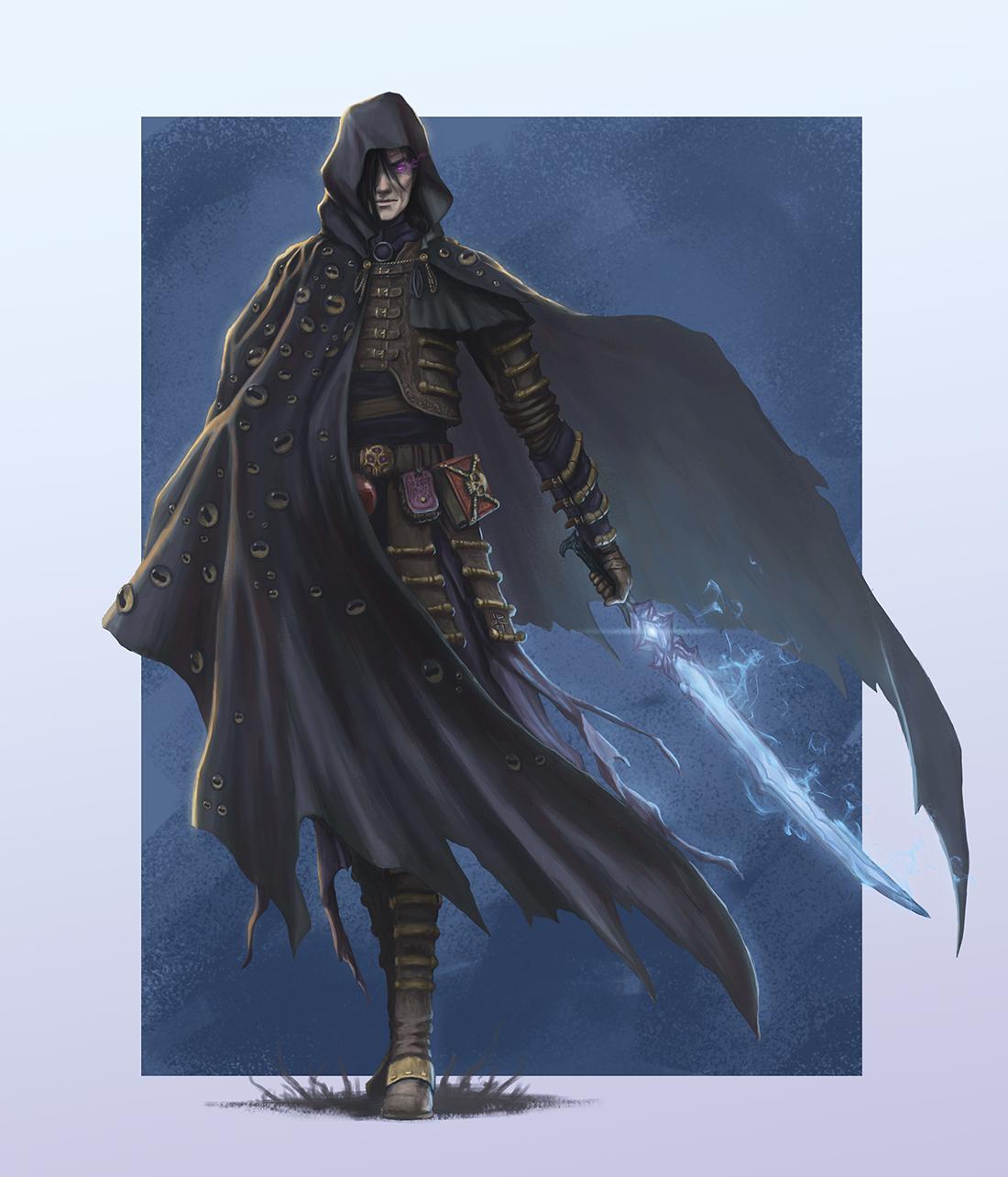
Special Spells. A few spells of the soul hunters have slightly different functions. When the soul hunter casts banishing smite, the target is banished only if its hitpoints are 30 or less (instead of 50), and if they are banished, they appear in the fog of lost souls. If the soul hunter concentrates on the spell for its full duration, the banishment becomes permanent, thus securing the target's soul for Yriya. Additionally, when the soul hunter casts bestow curse on its quarry, it can choose to give it disadvantage on all saving throws it makes against the soul hunter, among the list of the other curses provided.
The spell soul hunter's haunting is detailed in the following chapter, along with items that fit the theme of Yriya and her soul hunters. If you desire a particular soul hunter to be more powerful, you can make sure they possess some of these items. Or have received special boons from their mistress.
DM Notes. Make sure to let your player characters arrive at the knowledge that they are being stalked or attacked by a soul hunter, in order to know the danger they are in. Perhaps a symbol on their dark cloak is recognized by a cleric of the party during the first round of an ambush. If they do suffer a loss, this will make it appear less 'out of the blue', and they will have a definitive target to hate and plan their revenge against, instead of it being a random attack. In either way, they can always attempt to rescue the soul of an ally of theirs that has been locked away in the Soulmistress' garden. This will allow you to open up the campaign to places such as the Astral Sea and all the extraplanar wonders it can possess.
Additionally, if the soul hunter is facing a large party, or a high level one, and you want to keep the encounter a solo one for flavor reasons, you can give the soul hunter legendary actions (detailed below). Also, if the party has a lot of spellcasters, you can add counterspell to the warlock's list of known spells, or wear out the party with a difficult preceding encounter. It might be the soul hunter themselves that arranged it, and if the players extort the truth out of their enemies (if they can speak), they will know that someone is stalking and sabotaging them.
Soul Hunter Loot. Additionally, make sure to reward your players for defeating a soul hunter. They are not easy targets, especially given the fact that they will use their high moblity to escape and fight another day if the battle is going against them. They might possess quite a bit of gold that they mainly use to hire assistance wherever the need may be, and they might also have special and unique items on them. You can let the players find the 1000g mirror needed to cast the scrying spell, which will also add flavor to the threat they were under, as they will know exactly how the soul hunter knew when and how to strike.
Legendary Actions
The soul hunter can take 3 legendary actions, choosing from the options below. Only one legendary option can be used at a time and only at the end of another creature's turn. The soul hunter regains spent legendary actions at the start of its turn.
Attack. The soul hunter makes an attack of its choice.
Move. The soul hunter moves up to its movement speed without provoking attacks of opportunity.
Yriyan Drain (Costs 2 Actions). Each creature of the soul hunter's choice within 30 feet of it must succeed on a DC 16 Wisdom saving throw, or become slowed, as per the slow spell, until the end of their next turn.
Cast Spell (Costs 3 Actions). The soul hunter casts a spell.
Spells
Soul Hunter's Stalking
1st-level divination
- Casting Time: 1 Action
- Range: 60 feet
- Components: V, S
- Duration: Concentration, up to 1 hour
- Classes: Warlock
You target a humanoid within range, which must make a Wisdom saving throw. On a failure, you know the direction of the creature in relation to you for the duration of the spell.
At Higher Levels. When you cast this spell using a spell slot of 3rd or 4th level, the duration is 8 hours. When you use a spell slot of 5th level or higher, the duration is 24 hours. Using a spell slot of 3rd level or higher grants a duration that doesn't require concentration.
Soul Hunter's Haunting
6th-level enchantment
- Casting Time: 1 Action
- Range: 60 feet
- Components: V, S
- Duration: Concentration, up to 1 minute
- Classes: Warlock
You target a humanoid you can see within range and haunt them with the fear that you will never stop coming after their soul. Whenever the creature attempts to move away from you, it must make a Wisdom saving throw. On a failure, the creature takes 4d8 psychic damage and its speed becomes 0 as its terror causes it to freeze in place. On a success, the creature takes half as much damage and isn't otherwise affected. A creature can use its action and end the effect on itself by succeeding on a Wisdom saving throw.
Soul Hunter's Smite
2nd-level enchantment
- Casting Time: 1 bonus action
- Range: Self
- Components: V
- Duration: 1 round
- Classes: Paladin, Warlock
The next time you hit a creature with a weapon attack before this spell ends, the weapon carries with it haunting psychic energy. The attack deals an extra 2d8 psychic damage, and the target must succeed on a Wisdom saving throw, or haunting voices fill its mind until the end of your next turn. In that duration, if the target moves away from you, it takes 2d8 psychic damage and the spell ends.
Soul Siphoning Smite
3rd-level evocation
- Casting Time: 1 bonus action
- Range: Self
- Components: V
- Duration: 1 round
- Classes: Paladin, Warlock
The next time you hit a creature with a weapon attack before this spell ends, the weapon flashes with ghostly power. The attack deals an extra 3d8 force damage. If the attack reduces the creature to 0 hitpoints, you gain 5 temporary hitpoints for each level of the spell.
Items
Minor Soul Siphon
Wondrous item, rare (requires attunement)
This small gem has been imbued with soul siphoning energy. When a creature dies within 30 feet of you, you can use your reaction to gain 1 temporary hitpoint for each hitdie it had.
Major Soul Siphon
Wondrous item, very rare (requires attunement)
This small gem has been imbued with soul siphoning energy. When a creature dies within 30 feet of you, you can use your reaction to gain 2 temporary hitpoints for each hitdie it had.
Additionally, while you have temporary hitpoints from this siphon, you are under the effects of the death ward spell for purposes of power word kill and other similar effects. If the death ward is activated, all temporary hitpoints you have are expended in order to keep you alive.
Yriya's Soul Gem
Wondrous item, legendary (requires attunement)
While holding this gem, you can use a reaction to cast soul cage when a humanoid you can see within 60 feet of you dies. When you do so, you trap its soul within this gem. While the gem holds a soul, it appears as if there is an endless depth in its center, and you gain a +1 to your AC and saving throws while it is on your person.
When a soul is released from this gem, it is transferred to the fog of lost souls. You can perform an 1 minute ritual to release the soul prematurely. While the gem holds a soul, you can't cast soul gem again with it.
Soul Hunter's Blade
Weapon (longsword), very rare (requires attunement by a warlock)
While holding this weapon, you gain a +2 to your attack and damage rolls you make with it, and you gain the benefits of the thirsting blade invocation. When you kill a humanoid with it, its soul is transferred to the fog of lost souls, and the blade gains 1 charge.
This blade can hold a maximum of 10 charges. You can expend a number of its charges to activate one of the following effects:
- You can expend 2 charges to cast soul hunter's stalking at 3rd level.
- You can expend 2 charges to cast soul hunter's smite using this blade.
- You can expend 3 charges to cast soul siphoning smite using this blade.
- You can expend 6 charges to cast soul hunter's haunting.
- When you kill a creature, you can expend 3 charges to use your bonus action and make an additional attack with this blade.

The Fraying Mind
The Fraying Mind used to be a collective of tortured voices, remaining echoes of humans that lived and died in pain and folly. These were humans that were born unable to fit in or belong, and even while they lived peacefully among the rest of their kin, they were in truth banished or self-exiled in spirit. Their souls, being unable to move on, hung on in dark corners of the earth and the dark minds of troubled souls. Noticed by gods that sought to weaponize their maddening effects, they were coalesced into one body of celestial blood, and collectively called the Fraying Mind.
The Fraying Mind has a singular goal. Free of any political machinations, or machiavellian schemes, the Fraying Mind wishes only to turn every thinking creature — and secretly even the gods that gifted it this more powerful form — into a being not unlike itself. Unbalanced and maddened, it wishes to disrupt all culture and form of life that has any logic to its form.
Its followers are short lived, as the Fraying Mind's methods of attack usually involves blunt violence without much rhyme or reason, and usually leads to the sacrifice of its pawns. Even if it weren't for these tactics, the individuals that become the instrument of the Fraying Mind are often already heading towards doom, or have already arrived there. These madmen and maniacs are only ticking time bombs that the Fraying Mind points to an even more random direction until they explode, spreading chaos and trauma. Asylums and madhouses become sources of uncontrollable chaos as the Fraying Mind reaches into the minds of these lunatics, giving them the ability to escape and spread chaos.
There are some individuals, however, who survive the mental onslaught of madness long enough to become prized vessels of the Fraying Mind, and eventually turn into Frayed Minds. When the Fraying Mind, however, comes into contact with mortal minds in person, total obliteration awaits the weak, while transformation awaits the strong.
Plot Hooks
Tool of the Gods. The Fraying Mind was a creation of evil deities that wanted to spread discord and confusion by constructing this entity and letting it loose on the material realm, thus giving them the opportunity to progress their own plans in the background. Soon enough, however, it proved to be impossible to control, turning against its old masters simply because of its nature.
Now, a tenuous alliance has formed even between opposite aligned deities, since the threat of the Fraying Mind needs to be dealt with, for the good of all. Who will stab the other side in its back first?
Old Voices. The Fraying Mind is an entity that a PC could involve in their backstory. Even a person in recovery from the madness it infects would find it a challenge to resist the callings of their old savior, as creeping voices attempt to infiltrate deeper and deeper into the psyche.
Will they be able to resist the calling in the end? What will be the consequences?
Boon of the Frayed Mind
You are immune to being frightened. When a creature attempts to frighten you, visions of what it is to be you flash through its mind. It takes psychic damage equal to your level.
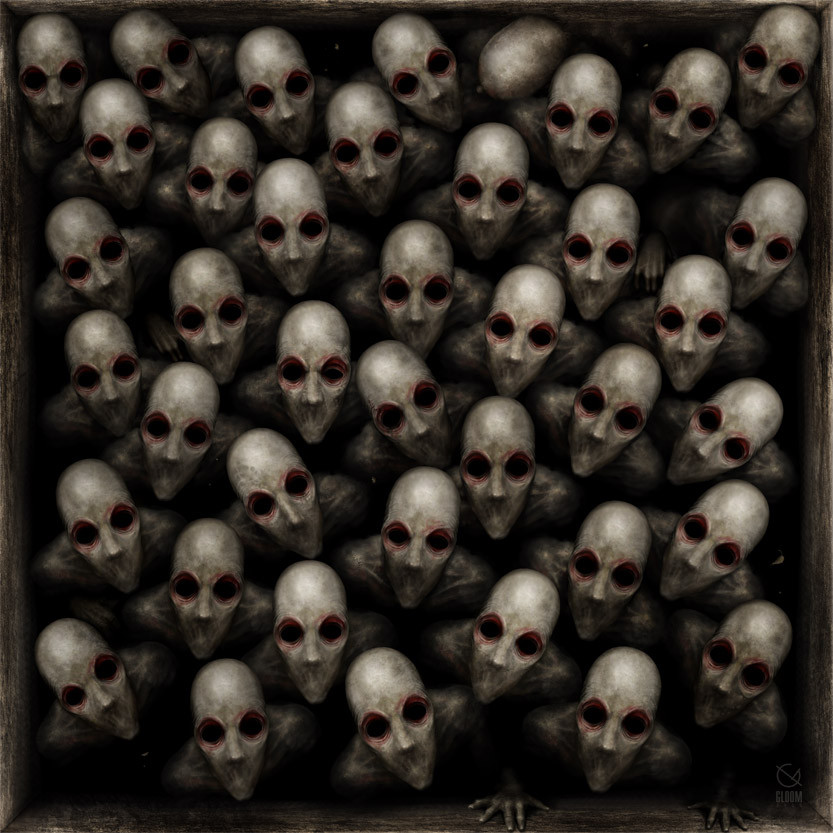
The Fraying Mind
Huge celestial (herald), chaotic evil
- Armor Class 19 (natural armor)
- Hit Points 337 (25d12+175)
- Speed fly 40 ft. (hover)
STR DEX CON INT WIS CHA 24 (+7) 18 (+4) 25 (+7) 21 (+5) 21 (+5) 25 (+7)
- Saving Throws Con +14, Int +12, Wis +12, Cha +14
- Damage Immunities psychic; bludgeoning, piercing, and slashing from nonmagical attacks
- Condition Immunities charmed, exhaustion, frightened, paralyzed
- Senses truesight 120 ft., passive Perception 16
- Languages all, telepathy 120 ft.
- Challenge 23 (50,000 XP)
Aberrant Nature. The Fraying Mind is also recognized as an aberration, for the purposes of any spells or effects.
Magic Resistance. The Fraying Mind has advantage on saving throws against spells and other magical effects.
Innate Spellcasting. The Fraying Mind's innate spellcasting ability is Charisma. It can innately cast the following spells (spell save DC 22, spell attack +14) without requiring any components:
At will: hold monster, hold person (cast as a 5th level spell), scatter, confusion (cast as a 6th level spell), disrupt mind* (cast a 3rd level spell)
3/day each: feeblemind, reality break, maze, mental prison
1/day each: avatar of fright*, psychic scream, maddening darkness, power word stun
Maddening Whispers. Any creature that starts its turn within 30 feet of the Fraying Mind must succeed on a DC 22 Wisdom saving throw, or take 18 (4d8) psychic damage. If a creature rolls a 1 on the d20, it also becomes paralyzed with fear.
Mind Piercer. The Fraying Mind ignores resistance to psychic damage.
Actions
Multiattack. The Fraying Mind makes 2 fraying touch attacks. It can substitute one of these attacks with its Fraying Gaze, or Mind Break if it is available.
Fraying Touch. Melee Weapon Attack: +14, Reach: 5 ft., one target. Hit: 29 (5d8 + 7) psychic damage, and the creature is under the effects of the enemies abound spell until the end of its next turn.
Fraying Gaze. Ranged Spell Attack: +14, Range: 120 ft., one target. Hit: 20 (3d8 + 7) psychic damage, and the creature must succeed on a DC 22 Wisdom saving throw, or be paralyzed until the end of the Fraying Mind's next turn.
Mind Break (Recharge 5-6). The Fraying Mind magically emits psychic energy in a radius of 20 ft. around it. Each creature in that area must succeed on a DC 22 Intelligence saving throw or take 36 (8d8) psychic damage. A creature that fails its saving throw by 5 or more also becomes paralyzed for 1 minute. A creature can repeat the saving throw at the end of each of its turns, ending the effect on itself on a success.
Legendary Actions
The Fraying Mind can take 3 legendary actions, choosing from the options below. Only one legendary option can be used at a time and only at the end of another creature's turn. The Fraying Mind regains spent legendary actions at the start of its turn.
Fraying. The Fraying Mind uses its Fraying Touch or Fraying Gaze attack. If the Fraying Mind uses its Fraying Gaze in this way, it can't use a legendary action to do so again.
Cast Spell (Costs 2 Actions). The Fraying Mind casts one of its at will spells.
Mind Break (Costs 3 Actions). If the Fraying Mind hasn't used its mind break since the start of its last turn, it can recharge and use its Mind Break. Its Mind Break then can't be recharged until the end of its next turn.
Lair Actions
On initiative count 20 (losing initiative ties), the Fraying Mind can take a lair action to cause one of the following magical effects; The Fraying Mind can't use the same effect two rounds in a row:
Crush the Held. The Fraying Mind targets a creature it has paralyzed. That creature must succeed on a DC 20 Wisdom saving throw or fall to 0 hitpoints.
Mire the Mind. The Fraying Mind targes a point within 120 feet of it. The broken souls of the mad begin to apparate from the ground, turning the area in a 30 ft. cube centered on that point into a pit of madness. Any creatures in the cube when it forms, and any that end their turn in it must succeed on a DC 20 Wisdom saving throw, or become paralyzed until the end of their next turn, as they see the hollow eyes of broken souls staring up at them from the ground. The cube lasts until the Fraying Mind uses another lair action.

Spells
Disrupt Mind
2nd-level enchantment
- Casting Time: 1 action
- Range: Touch
- Components: V, S
- Duration: Instantaneous
- Classes: Cleric, Sorcerer, Warlock, Wizard
Make a melee spell attack against a creature within range, as you attempt to assault their mind. On a hit, the creature takes 2d8 psychic damage, and must succeed on a Wisdom saving throw or be paralyzed until the end of its next turn.
At Higher Levels. When you cast this spell using a spell slot of 3rd level or higher, the psychic damage increases by 1d8 for each spell slot above 2nd.
Dominating Fright
3rd-level enchantment
- Casting Time: 1 action
- Range: 60 ft.
- Components: V, S
- Duration: Concentration, up to 1 minute
- Classes: Sorcerer, Warlock, Wizard
You frighten a creature to its core, binding it to your will. A creature you can see within range must succeed on a Wisdom saving throw or become frightened of you for the duration of this spell. The creature can repeat the saving throw at the end of each of its turns, ending the spell on a success. While the creature is frightened of you, you can use your action to give it an one word command. During its turn, the creature must follow the command to the best of its ability, as per the command spell.
Haunting Fright
2nd-level enchantment
- Casting Time: 1 action
- Range: 60 ft.
- Components: V, S, M (a thin silver cord)
- Duration: Concentration, up to 1 minute
- Classes: Sorcerer, Warlock, Wizard
You frighten a creature to its core, binding its mind to yours through a thin silver cord. A creature you can see within range must succeed on a Wisdom saving throw or become frightened of you for the duration of this spell. The creature can repeat the saving throw at the end of each of its turns, ending the spell on a success. While the creature is frightened of you, you know what its location is in relation to you, but you can't tell its exact distance. Additionally, you can use your action to see through its eyes and hear through its ears. While doing so, you are blind to your own senses. Alternatively, you can use a bonus action on your turn to tug on the string, and deal 1d10 psychic damage to the creature.
Avatar of Fright
9th-level enchantment
- Casting Time: 1 action
- Range: Self
- Components: V, S
- Duration: Concentration, up to 1 minute
- Classes: Sorcerer, Warlock, Wizard
You take on the form of absolute and inhuman horror, your face becoming a dark and depthless void for the duration. Any creature of your choice that can see you when it starts its turn must succeed on a Wisdom saving throw or become frightened of you. The creature can repeat the saving throw at the end of each of its turns, ending the effect on itself on a success (but does not become immune to the spell). A frightened creature experiences the following effects:
- When the creature attempts to cast a spell, it must succeed on a Wisdom saving throw against your spell save DC, or the casting of the spell fails as its fingers and lips tremble from fear.
- When the creature attempts to move or make a weapon attack, it must succeed on a Wisdom saving throw against your spell save DC or fall prone as its knees buckle from fright. A creature has to make this save only once during its turn.
- The creature has vulnerability to psychic damage.
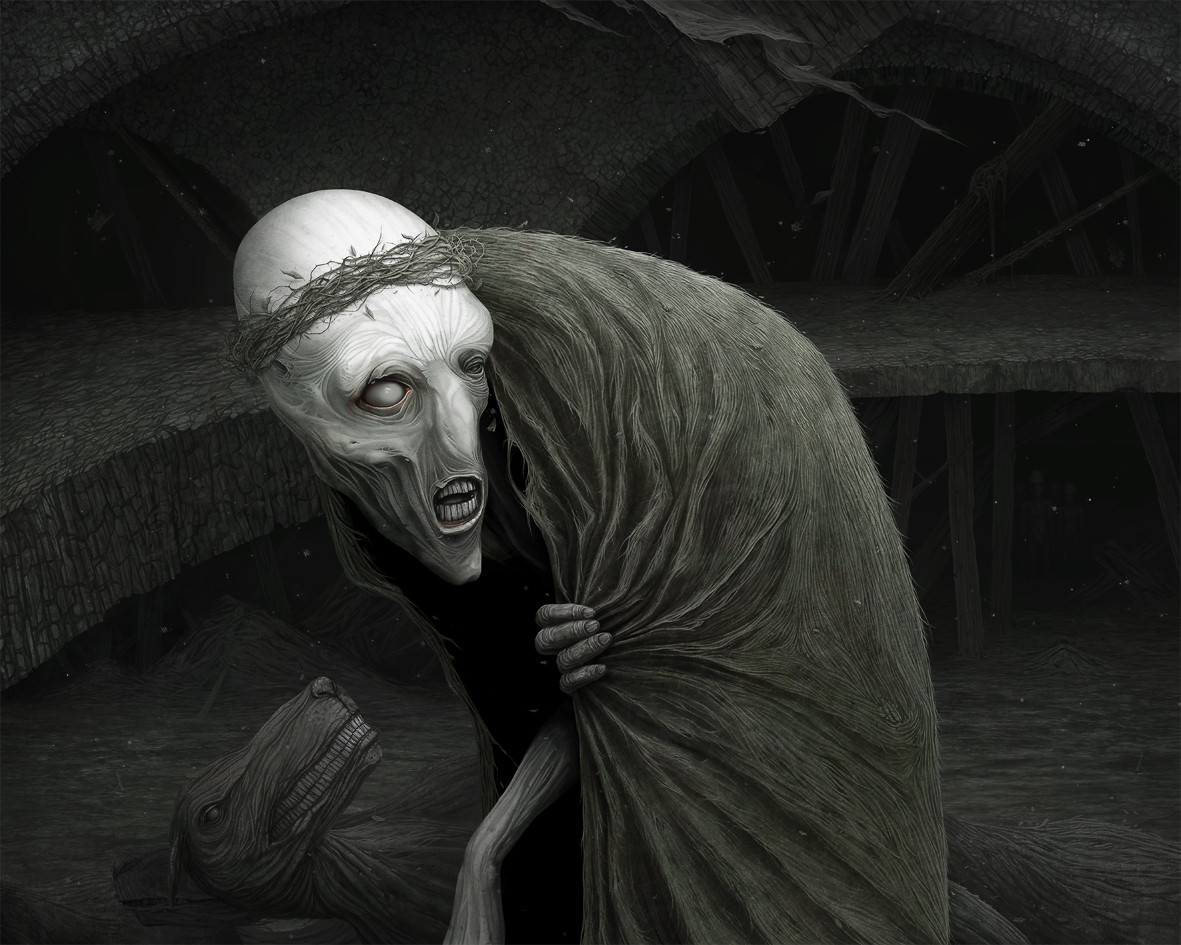
Frayed Mind
Frayed Minds are the mindless subjects and instruments of the Fraying Mind. Some say that there is nothing left in their mind, after madness left only oblivion in the space their soul once occupied. Others, who are closer to the truth, believe that these individuals have merged with the Fraying Mind, becoming one of the many broken souls that gave it existence in the first place.
The more minds that are absorbed into the fold of the Fraying Mind, the more powerful it becomes, and at the same time the decrepit husk of the individual left behind becomes capable of withstanding the insanity of the Fraying Mind, making it a perfect vessel. These frayed minds are capable of producing more of themselves as they spread the insanity of their master. Creatures stout of heart but weak of mind often fall prey to them, as a creature needs to survive long enough in its encounter with the frayed mind in order to contract its insanity.
Frayed Mind
Medium aberration, chaotic evil
- Armor Class 16 (natural armor)
- Hit Points 152 (16d8 + 80)
- Speed 30 ft.
STR DEX CON INT WIS CHA 16 (+3) 18 (+4) 20 (+5) 16 (+3) 14 (+2) 18 (+4)
- Saving Throws Int +7, Wis +6, Cha +8
- Skills Perception +6
- Damage Resistances bludgeoning, piercing, and slashing from nonmagical attacks
- Damage Immunities psychic
- Condition Immunities charmed, exhaustion, frightened, paralyzed
- Senses blindsight 60 ft., passive Perception 16
- Languages understands all but does not speak
- Challenge 12 (8,400 XP)
Magic Resistance. The Frayed Mind has advantage on saving throws against spells and other magical effects.
Innate Spellcasting. The Frayed Mind's innate spellcasting ability is Charisma. It can innately cast the following spells (spell save DC 16, spell attack +8):
3/day each: disrupt mind (cast a 3rd level spell), confusion
1/day each: feeblemind, mental prison, reality break, summon aberration
Fraying Corruption. When a living creature reaches 6 levels of fraying corruption, it falls unconscious due to the amount of mental stress it experiences. 1d4 days later, it turns into a Frayed Mind unless an effect such as greater restoration halts the process or cures it of the corruption levels.
Actions
Multiattack. The Frayed Mind makes two insane touch attacks.
Insane Touch. Melee Weapon Attack: +8, Reach: 5 ft., one target. Hit: 20 (3d10 + 4) psychic damage, and the creature gains one point of fraying corruption.
Mind Break (Recharge 5-6). The Frayed Mind magically emits psychic energy in a 30 ft. cone. Each creature in that area must succeed on a DC 16 Intelligence saving throw or take 22 (4d8 + 4) psychic damage. A creature that fails its saving throw by 5 or more also becomes stunned for 1 minute. A creature can repeat the saving throw at the end of each of its turns, ending the effect on itself on a success.
Items
Amulet of the Fear Within
Wondrous item, very rare (requires attunement)
This necklace holds an absolutely dark gem. Within it, it holds the secrets to fear itself. While you are attuned to this amulet, you are immune to the effects of the frightened condition. However, you can still become frightened. When you do, each creature within 15 feet of you takes an amount of psychic damage equal to your level. Additionally, each creature that starts its turn within 15 feet of you takes 3d8 psychic damage while you are frightened, as you project the fear within outwards.
This amulet holds 3 charges. When a creature takes psychic damage from the powers of this amulet, you can expend 1 charge to force them to make a DC 15 Wisdom saving throw. On a failure, they become frightened of you.
While wearing this amulet, you can use an action to fill yourself with absolute fear of the eternal, becoming frightened for 1 minute. Once you've used this ability of the amulet, you can't do so again until you complete a long rest.
Fearweald
Weapon (greatsword), rarity varies (requires attunement)
You have a +1 bonus to attack and damage rolls you make with this dark blade.
Additionally, you can use a bonus action to cast cause fear using this sword (spell DC 13). After you've used this ability of the sword, you must complete a long rest before being able to do so again.
This blade can evolve as you gain in power and unlock its potential.
Rare. You have a +2 bonus to attack and damage rolls you make with this dark blade.
Additionally, you can use a bonus action to cast cause fear using this sword (spell DC 14). After you've used this ability of the sword, you must complete a long rest before being able to do so again.
When you attack a frightened creature with this blade, you can use your bonus action to make one additional attack against it.
Very Rare. You have a +2 bonus to attack and damage rolls you make with this dark blade.
This blade can hold a maximum of 5 charges. You can expend 1 charge to cast cause fear using a bonus action, or you can expend 3 charges to cast fear (spell save DC 16). Fearweald regains all expended charges each dusk.
When you attack a frightened creature with this blade, you can use your bonus action to make one additional attack against it.
Legendary. You have a +3 bonus to attack and damage rolls you make with this dark blade.
This blade can hold a maximum of 7 charges. You can expend 1 charge to cast cause fear using a bonus action, 3 charges to cast fear, or 4 charges to cast phantasmal killer (spell save DC 17). Fearweald regains all expended charges each dusk.
When you attack a frightened creature with this blade, you can use your bonus action to make one additional attack against it.
Additionally, when Fearweald reaches its Legendary phase, you can select one of the following benefits to be activated.
- You can expend 3 charges to cast suggestion using Fearweald, targetting a creature frightened by you. The creature automatically fails its saving throw. Any spells you cast using Fearweald do not require any components.
- Fearweald regains 1 charge each time a frightened creature within 30 feet of you dies.
- When you hit a creature with Fearweald, you can use a bonus action to expend 4 charges and force the creature to make a DC 17 Wisdom saving throw. On a failure, it takes 6d6 psychic damage and becomes frightened of you for 1 minute. The frightened target can repeat the saving throw at the end of each of its turns, ending the effect on itself on a success.
To the discretion of the DM, you can unlock more than one of the benefits above as you continue to become one with this weapon.
Terror
Weapon (dagger), very rare (requires attunement)
You have +2 bonus to your attack and damage rolls using this black dagger. When you hit a creature with it, you can use this dagger to flood the creature's mind with horrific sensations. The target must succeed on a DC 17 Wisdom saving throw, or become frightened of you and the dagger for 1 minute. The creature can repeat the saving throw at the end of each of its turns, ending the effect on itself on a success. You can use this ability of the dagger twice before you have to complete a long rest to do so again.
When you frighten a creature with this dagger, you can choose to activate one of the following effects:
- You have advantage on attack rolls against the frightened target when you use this dagger. Additionally, you can attempt to use the frightening effects of this dagger even on a creature that is already frightened by it, deepening its fear even more. If the creature fails the saving throw while it is already frightened, it becomes paralyzed as long as it is frightened.
- The frightened creature deals half as much damage as it normally would to you.
Ring of Fear
Ring, rare (requires attunement)
While wearing this ring, you can use an action to cast fear (save DC 15). Once you do so, you can't use the ring to cast the same spell again until you kill a frightened humanoid.
Additionally, you have advantage on saving throws against becoming frightened. When you succeed on such a saving throw, the ring becomes charged with psychic energy for 1 minute. The next time you hit with an attack during that minute, you can imbue it with the psychic energy of the ring, dealing an extra 2d10 psychic damage. Once you've used this ability of the ring, you can't do so again until you complete a long rest.
Fearmonger
Armor (any medium or heavy armor), artifact (requires attunement)
The scales of this black armor are covered in slowly shifting shadows. This armor was made by the scales of an ancient shadow dragon and bears some of its power for those strong enough to wield it. While wearing this armor, you have resistance to necrotic damage, and advantage on Charisma (Intimidation) checks. Additionally, this armor does not cause you to have disadvantage on Dexterity (Stealth) checks.
When you attune to this armor, you can choose up to 3 of its following properties to activate.
Veil of Fear. While wearing this black armor, you gain a number of temporary hitpoints equal to your level whenever a frightened creature within 30 feet of you dies.
Disheartening Resistance. When you take damage from a creature that is frightened of you, you can use your reaction to reduce that damage by an amount equal to your level.
Appalling Aura. Creatures within 30 feet of you have disadvantage on saving throws made to resist becoming frightened.
Armor of the Daunting. You gain a +2 bonus to your AC while a creature is frightened of you.
Frightful Presence. Each creature of your choice that is within 30 feet of you and aware of you must succeed on a DC 17 Wisdom saving throw or become frightened for 1 minute. A creature can repeat the saving throw at the end of each of its turns, ending the effect on itself on a success.
Once you've used this ability of this armor, you must complete a short or long rest before you are able to do so again.
Startling Retribution. When a creature misses you with a melee attack, you can use your reaction to make an attack against it. If you hit, the creature becomes frightened of you.
Once you've used this ability of the armor, you can't do so again until you complete a short or long rest.
Mark of the Fearmonger: Revenge. When a creature within 30 feet of you damages you, you can use your reaction to brand the creature with the mark of the fearmonger, dealing psychic damage to them equal to your level. While the mark is active, you have advantage on attack rolls against the creature. If you hit it with an attack, the mark is expired and you deal an extra amount of psychic damage to the creature equal to your proficiency mofifier.
If not consumed, the mark otherwise expires at the end of your next turn, and you take psychic damage equal to your level. This damage cannot be reduced or prevented in any way.
Mark of the Fearmonger: Weakness. When you cause a creature that has damaged you in the last minute to become frightened of you, you can brand it with the mark of the fearmonger for 1 minute. For the duration, or until the creature is not frightened of you, it deals half damage to you with its attacks if it has 150 hitpoints or less.
Once you've branded a creature with this mark, you can't do so again until you complete a long rest.
Mark of the Fearmonger: Paralysis. You can use an action to brand a creature you can see within 120 feet of you with this mark, making a promise of doom. This creature must not be frightened of you. If you cause it to become frightened of you before the end of your next turn, that creature also becomes paralyzed while frightened of you.
Once you've branded a creature with this mark, you can't do so again until you complete a long rest.
Curse. After you attune to this armor, the clamoring voices of the Fraying Mind begin to appear in your mind. Their ever present whispering alter your psyche, making you unable to sleep. You no longer need to sleep, and do not suffer exhaustion as a result of not sleeping, but you still need to perform light activity as part of a long rest. When you complete a long rest, you must make a DC 15 Wisdom saving throw. On a failure, you don't regain any hitdice from the rest, as the voices crowding your mind were too appalling, and you gain a point of fraying corruption. When you gain a point of fraying corruption, you can unlock one additional benefit of the armor. You can have an additional number of its properties unlocked equal to the corruption points you have. When you unlock all of the armor's properties, you become a Frayed Soul, and lose all sense of yourself as you are plunged into madness and emerge as one of the loyal and mindless instruments of the Fraying Mind.
To the discretion of the DM and the players, the character attuned to this armor can gain short-term or long-term madness effects when they gain a level of corruption, or reach certain thresholds.
Crown of the Fraying Mind
Wondrous item, legendary (requires attunement)
This grotesque crown unsettles any creature that views it with its mere sight. While wearing it, you enter a deranged state whenever you roll initiative.
While in that state, whenever a creature damages you, any creatures of your choice within 10 feet of you take psychic damage equal to half your level (rounded up). This damage ignores resistances.
Additionally, you become immune to the incapacitated condition, as the madness giving your mind momentum refuses to let it shut down. When you fall to 0 hitpoints you continue to make death saving throws as normal, but you do not become incapacitated and can take actions as normal. You cannot gain hitpoints or temporary hitpoints from an effect that you cause while in this state.
If you are in your deranged state, this crown can be used to cast the following spells from it (save DC 17): confusion, disrupt mind, fear, feeblemind, phantasmal killer, mental prison, weird. You can use your own spell save DC when casting these spells if you have one. Once you've used this crown to cast one of these spells, you can't use it again to cast the same spell until you complete a long rest.
Whenever you enter the crown's deranged state, you take psychic damage equal to half your level (rounded up). This damage can't be reduced or prevented in any way. To the discretion of the DM, other incidents apart from rolling initiative are also able to throw you into your deranged state, pushing you out of control. If you try to resist, the DM can ask you to make a Wisdom saving throw (to their discretion). The DC is equal to the save DC of the crown.

Curse. After you attune to this crown, the clamoring voices of the Fraying Mind begin to appear in your mind. Their ever present whispering alter your psyche, making you unable to sleep. You no longer need to sleep, and do not suffer exhaustion as a result of not sleeping, but you still need to perform light activity as part of a long rest. When you complete a long rest, you must make a DC 15 Wisdom saving throw. On a failure, you don't regain any hitdice from the rest, as the voices crowding your mind were too appalling, and you gain a point of fraying corruption. For each point of fraying corruption you have, your spell save DC or the crown's spell save DC increases by 1. When it reaches 23 (or you gain 6 levels of fraying corruption), you become a Frayed Soul, and lose all sense of yourself as you are plunged into madness and emerge as one of the loyal and mindless instruments of the Fraying Mind.
Phantasmal Torment Shard
Wondrous item, legendary (requires attunement)
This jagged shard turns smooth at the touch of a humanoid, and automatically attunes to the creature that touched it. If the creature's attunement slots were full, one other item is unattuned by them at random. While holding this crystal, you can telepathically speak to any creature you can see within 120 feet of you and you have resistance to psychic damage.
You can use a bonus action to channel the tormenting powers of the crystal, and form an aura of mental anguish in a radius of 15 ft. around you. Each creature that starts its turn within the aura must succeed on a DC 17 Intelligence saving throw, or take 5d8 psychic damage. A creature that fails the save by 5 or more, also becomes stunned until the end of their next turn. On a successful saving throw, a creature takes half as much damage. You can use an action to end the effect. If you don't the effect persists even while you're unconscious. While the effect is active, you take 5 psychic damage at the end of each of your turns. This damage can't be reduced or prevented in any way.
Additionally, you can use an action to cast the power word pain and feeblemind spells using this shard. Once you have cast both of these spells, you can't do so again until you recharge the shard by trapping the soul of a humanoid in it. You can do so by using a reaction when a humanoid you can see dies due to psychic damage within 60 feet of you.
While the shard holds a humanoid soul inside it, you can attempt to curse a creature you can see within 60 feet of you, wracking it with horrible nightmares that prevent restful sleep. The creature must succeed on a DC 17 Wisdom saving throw, or be cursed by you. While cursed in this way, whenever the creature attempts to complete a long rest, it must succeed on a DC 17 Wisdom saving throw, or be unable to complete the long rest as terrible nightmares prevent it from sleeping. A creature that doesn't sleep is immune to this curse. A remove curse spell effectively cures the creature of this curse on a successful DC 17 spellcasting ability check. On a failure, further attempts to remove the curse with the same spell by the same creature are unsuccessful.
Curse. A creature can't willingly unattune itself from this shard, and always desires to have the shard in its person, if not in its hand. A remove curse spell ends the attunement to this shard on a successful DC 17 spellcasting ability check. On a failure, further attempts to remove the curse with the same spell by the same creature are unsuccessful.
Additionally, when the attuned creature feels anger towards a target, that anger is accompanied by a desire to crash its mind instead of simply defeating or killing it.
Ring of the Resilient Mind
Ring, rare or very rare
While wearing this ring, you have resistance to being charmed or frightened.
Ring of the Impervious Mind
Ring, rare or very rare (requires attunement)
While attuned to this ring, you are immune to being charmed or frightened.
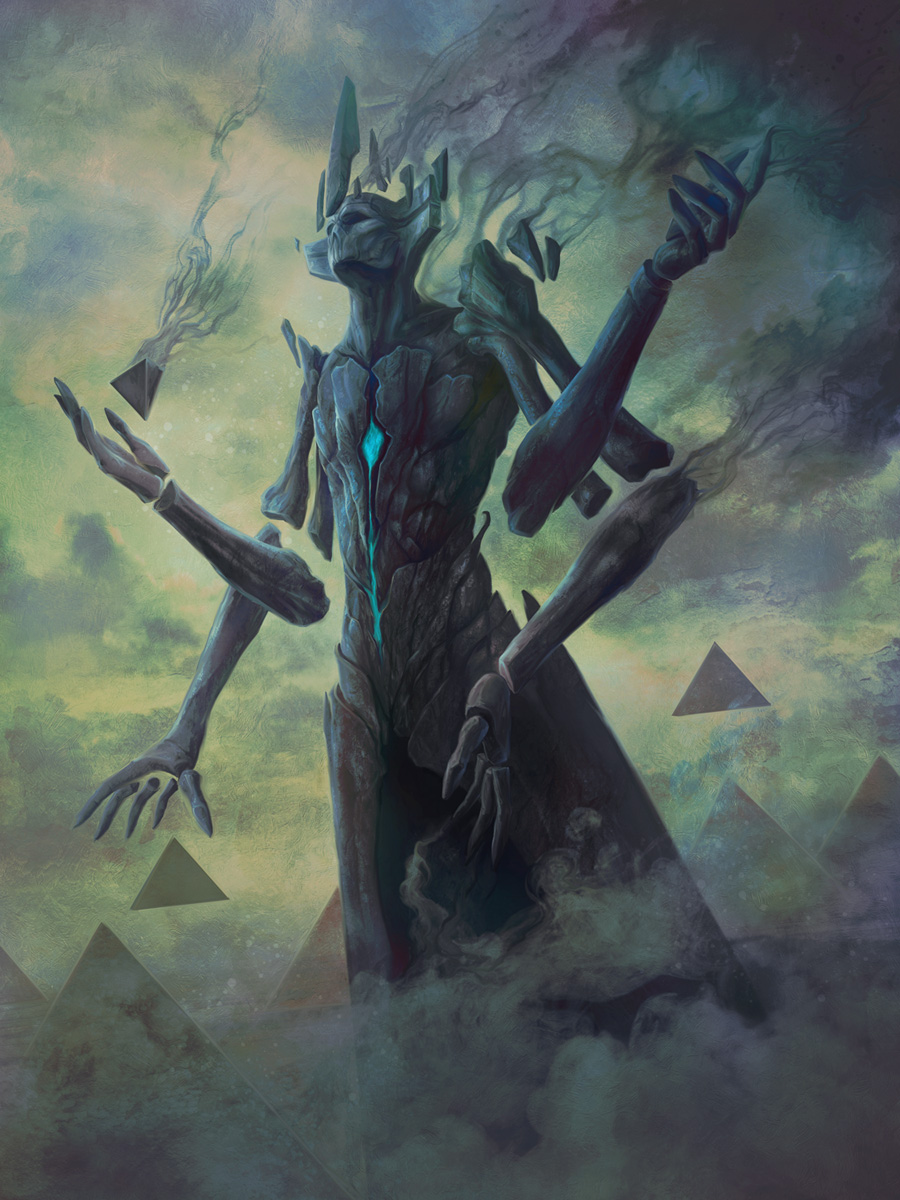
Zhalur, the Siphoning Herald
Zhalur is known as the herald of exploitation and theft. Capable of siphoning off any kind of power, whether that is the life force of humanoids, or the magic essence stored in arcane items, Zhalur steals and consumes any kind of energy he can find. His goals are unknown and always in question. While some theorize that he is merely after power, amassing it quite literally in its raw form so that he can expand his influence and strength, others believe that he is collecting all this raw energy with a very specific plan, and the magnitude of change one can bring using it could be catastrophic.
In truth, Zhalur is not alone. Besides the allies he has bought or attracted to his side, there is another more secret inner circle of beings that like to remain hidden in shadow while they approach ever more close to completing their task. The Orvian Circle, of which Zhalur is only a member, seeks to bring the reclamation of the world by returning the great god Orvussan to the mortal realm, and undoing its chains. This ancient being, abhorrent to all, created the Orvian Circle by rewarding its most loyal followers with celestial blood, tasking them to undo its demise as it unavoidably approached.
Is Zhalur, however, still loyal to it? Or has he been overcome by the wealth of power he has come to taste, siphoning it for the purposes of the Orvian Circle. Are a few thousand years of life as a celestial enough to undo the human nature within? Soon enough he will have to show his true colors when the time comes to proceed with the unimaginable ritual.
Zhalur works by making periodical visits to the material realm, spaced out enough to allow for civilizations to grow again after he has harvested them. He uses his cunning to entice mortals with promises of power — that he does mean, and does fulfill — in order to turn them to his side, and plot the siphoning of their city together. If these protégés prove to be gifted and loyal enough, Zhalur appoints them as governors to what remains of the city, and allows them to rebuild. He offers his protection, support and guidance which allows the city to quickly prosper again in exchange for a steady stream of arcane or living energy. If Zhalur's pronounced influence in the mortal world isn't halted, soon enough the whole world will turn into Zhalur's farm, and all human accomplishment will simply be continuously siphoned by Zhalur for his own purposes.
Plot Hooks
Enticement. Zhalur works by noticing ambitious and capable personalities, offering them support in key moments that will earn him their allegiance. One of these individuals could be a player character. He makes sure to exhibit values that his target also believes in, and to appear as a proponent of peace and goodwill. Give the player a few chances to notice the manipulating nature of this patron if they are observant enough, but also point out its honest aversion to pointless struggle. Zhalur is by nature utilitarian, so there are many issues in which he would support peace and prosperity, since they work in his favor better than war and destruction.

Holds of Zhalur. Sometimes, Zhalur returns to the mortal world to find his territory having expanded, without any doing of his own. The monarchs that rule the various states under his patronage wage war when they feel it is time to expand, conquering more territories to bring under Zhalur's law.
Perhaps a far-off monarch, immortal in his rule under Zhalur, has turned his eye towards the territory of the PCs, perhaps even their hometown. What can they do to fend of the imminent invasion?
Turncoat. Having won the trust and the rewards of the Siphoning Herald, a monarch of one of the various states under Zharul's patronage has been scheming against his tenuous allies. Are his motives puerile and selfish? Does he seek only to expand his own influence and gain sovereignty instead of having to pay his levy to Zhalur? Or has he learned a piece of valuable information that has produced this awakening and shifting of loyalty in him?
How will the player characters become involved in this political turmoil?
Post-Apocalypse. Zhalur has already completed his conquering, and now each corner of the world has become his domain. Who exists to still fight him and his oppressive regimes from the shadows?
Boon of Arcane Power
You gain an additional spell slot of the highest level you can cast (up to a maximum of 5th). You regain this spell slot whenever you complete a long rest.
If you want to make this more powerful, you could have them reset with the short rest. A weaker version would be to give specific spell slots, such as 1st or 2nd level.
Spells
Redirect
7th-level abjuration
- Casting Time: 1 reaction, which you take when you see a spell being cast within range
- Range: 60 ft.
- Components: V, S
- Duration: Instantaneous
- Classes: Bard, Sorcerer, Warlock, Wizard
When you see a spell being cast within range, you can attempt to take control of its casting. The creature must succeed on an Intelligence or Wisdom saving throw (its choice) against your spell save DC, or you can take control and decide what the target of the spell will be. You decide the target of the spell knowing its effects, and if the spell requires concentration, you can choose to concentrate on it instead. If the spell's range is 'self', you can have it affect you instead, but if the spell's range is touch, the target can be within range of either you or the creature that is casting the spell.
If the spell you are attempting to redirect is of a higher level than the spell slot you used to cast this spell, this spell has no effect.
Disruption Field
6th-level abjuration
- Casting Time: 1 action
- Range: Self
- Components: V, S
- Duration: Concentration, up to 1 minute
- Classes: Wizard
You reach out distort the magical properties of the Weave in a 30 ft. radius around you, creating instability in the Weave. For the duration of the spell, any creature of your choice within the affected area has disadvantage on Constitution saving throws made to maintain concentration on a spell. When a creature of your choice within the affected area loses concentration on a spell, or it begins casting a spell and its casting fails (due to effects such as counterspell), it must succeed on an Intelligence saving throw against your spell save DC or take 1d8 force damage for each level of the spell they were casting, or lost concentration on.
Zhalur
Large celestial (herald), lawful evil
- Armor Class 19 (natural armor)
- Hit Points 275 (22d10 + 154)
- Speed 40 ft., fly 120 ft.
STR DEX CON INT WIS CHA 25 (+7) 20 (+5) 25 (+7) 23 (+6) 20 (+5) 25 (+7)
- Saving Throws Int +12, Wis +11, Cha +13
- Skills Insight +12, Deception +14, Intimidation +14
- Damage Resistances force
- Damage Immunitities bludgeoning, piercing, and slashing from nonmagical attacks
- Condition Immunities charmed, exhaustion, frightened
- Senses truesight 120 ft., passive Perception 16
- Languages all, telepathy 120 ft.
- Challenge 22 (25,000 XP)
Magic Evasion. Zhalur has advantage on saving throws against spells and other magical effects. If Zhalur is subjected to an effect that allows him to make a saving throw against a spell or other magical effect to take only half damage, he instead takes no damage if he succeeds on the saving throw, and only half damage if he fails. Zhalur can't use this trait if he's incapacitated.
Arcane Siphon. When Zhalur successfully counterspells or dispels another spell, he regains a spell slot of a level equal to or less than the spell he dispelled, and he gains 20 temporary hitpoints. Zhalur also gains these temporary hitpoints when he succeeds on a saving throw against a spell (after taking damage).
Magic Disruptor. When a creature that is concentrating on a spell begins its turn within 15 feet of Zhalur, it must succeed on a DC 15 Constitution saving throw, or lose concentration on the spell.
Innate Spellcasting. Zhalur's innate spellcasting ability is Charisma (save DC 21; spell attack +13). Zhalur can cast the following spells without requiring any material components.
At will: counterspell, dispel magic
Spellcasting. Zhalur is a 17th level spellcaster. His spellcasting ability is Charisma (spell save DC 21, spell attack +13). He has the following spells prepared.
1st level (4 slots): command, detect evil and good
2nd level (3 slots): silence, hold person, ray of enfeeblement
3rd level (3 slots): fireball, lightning bolt, slow
4th level (3 slots): dimension door, greater invisibility
5th level (2 slots): dominate person, flame strike, scrying
6th level (1 slots): globe of invulnerability, redirect*
7th level (1 slots): forcecage, plane shift
8th level (1 slots): antimagic field, power word stun
9th level (1 slots): meteor swarm, wish
Actions
Multiattack. Zhalur makes two glaive attacks
Glaive. Melee Weapon Attack: +13, Reach: 10 ft., one target. Hit 12 (1d10 + 7) slashing plus 18 (4d8) force damage
Force Bolt. Ranged Spell Attack: +13, Range: 120 ft., one target. Hit 43 (8d8 + 7) force damage, and if the creature is concentrating on a spell, or is affected by one, it must make a DC 21 Wisdom saving throw. On a failure, the creature takes 1d6 force damage for each level of the spell, and Zhalur regains hitpoints equal to half of the damage dealt.
Reactions
Disrupt. When a creature makes a Constitution saving throw to maintain concentration on a spell, Zhalur can use his reaction to grant that creature disadvantage. If the creature fails, Zhalur gains 20 temporary hitpoints as he absorbs the ambient energy being dispersed from the spell.
Legendary Actions
Zhalur can take 3 legendary actions, choosing from the options below. Only one legendary option can be used at a time and only at the end of another creature's turn. Zhalur regains spent legendary actions at the start of its turn.
Glaive Attack. Zhalur makes a glaive attack.
Force Bolt. Zhalur makes a force bolt attack.
Arcanic Siphon (Costs 2 Actions). Zhalur reaches out to siphon the magical energy around him. Any creatures of his choice within 30 feet of him must make a DC 21 Wisdom saving throw. A creature takes 18 (4d8) force damage on a failure, or half as much damage on a success. A creature that failed its saving throw also loses its highest level available spell slot (if any), taking 1d8 force damage for each level of the spell.
Cast Spell (Costs 3 Actions). Zhalur casts a spell of 5th level or lower.
Lair Actions
On initiative count 20 (losing initiative ties), Zhalur can take a lair action to cause one of the following magical effects; Zhalur can't use the same effect two rounds in a row:
Sustaining Siphon. Zhalur causes the area in his whole lair to absorb errant magical energy. When a creature casts a spell in Zhalur's lair, Zhalur gains a number of hitpoints equal to twice the level of the spell cast. This effect lasts until initiative count 20 on the next round.
Arcane Instability Field. Zhalur causes the area in his whole lair to blur with arcane instability. When a creature loses concentration on a spell, or spends a spell slot but fails to cast its spell, it takes 1d6 force damage for each level of the spell. This effect lasts until initiative count 20 on the next round.

Items
Ring of Disruption
Ring, rare (requires attunement)
This gem encrusted ring can hold a maximum of 3 charges. You can expend 1 of its charges to cast counterspell or dispel magic. When you successfully cast counterspell from this ring, the caster of the spell you counterspelled takes 1d6 force damage for each level of the spell they attempted to cast. The ring regains all of its charges each dawn.
Mage's Savior
Ring, rare
While wearing this ring you have resistance to force damage, and you are immune to the effects of the counterspell spell.
Bracers of Disruption
Wondrous item, rare (requires attunement)
These light bracers pulse with energy whenever a creature nearby is concentrating on a spell. While wearing these bracers, you know whether a creature you can see within 30 ft of you is concentrating on a spell.
When a creature you can see within 30 ft. of you makes a Constitution saving throw to maintain concentration on a spell, you can use your reaction to give it disadvantage on the save. If the creature then fails on its saving throw, you gain 5 temporary hitpoints for each level of the spell the creature was concentrating on, as the bracers absorb the spell's energy. After you have gained temporary hitpoints in this way, you can't use the bracers in this way again until you complete a long rest.
Wand of Amplification
Wand, rare (requires attunement by a spellcaster)
This illustrious wand holds a connection to Zhalur's vast stores of power. When you cast a spell, you can choose to channel that power and enhance the spell in a variety of ways. This wand holds a maximum of 10 charges, and regains 1d6 + 4 charges each dawn.
When you cast a spell, you can expend a number of charges in order to activate a number of the following effects. You can only activate up to two effects at the same time.
Potent (2 Charges). The DC of the spell is increased by 2.
Reaching (2 Charges). If a spell has a range of 5 feet or more, its range is increased by 30 feet. If the spell has a range of touch, its range becomes 30 feet.
Vicious (1 Charge). If the spell deals damage, you can add your spellcasting modifier to the damage roll.
Resistant (1 Charge). Any creature that makes a roll to counterspell or dispel your spell does so with disadvantage. Additionally, a creature must make a spellcasting ability check to counterspell or dispel your spell, even if they otherwise wouldn't need to.
Grand Crystal of Power
Wondrous item, legendary (requires attunement by a spellcaster)
This is one of the large crystals that are used by Zhalur to store the arcane energy he siphons in a way that can be used. Up to three spellcasters can be attuned to this crystal at the same time.
The crystal holds a maximum of 20 charges, and regains 1d10 + 5 charges each day. You can expend a number of these charges to activate one of the following effects:
Spell Charge. You can expend up to 5 charges in order to regain an expended spell slot of a level equal to the charges you expended.
Spell Capacity. When you complete a long rest, you can expend up to 10 charges in order to prepare additional spells for the day. The number of these spells is equal to half of the expended charges. You prepare them in the same way that you normally prepare spells, and they remain prepared until you complete a long rest. If you normally learn spells instead of preparing them, you can select an equal number of spells from your spell list. They count as known for you until you complete a long rest.
Mark of Protection. You can use an action while touching this crystal and expend 2 charges in order to gain a mark of protection, which lasts until you complete a long rest. While this mark is on you and you expend the last available spell slot you have, the mark vanishes from your skin and you gain 30 temporary hitpoints.
Magic Resistance. You can use an action while touching this crystal and expend 2 charges. For the next hour, you gain advantage on saving throws against spells and other magical effects.
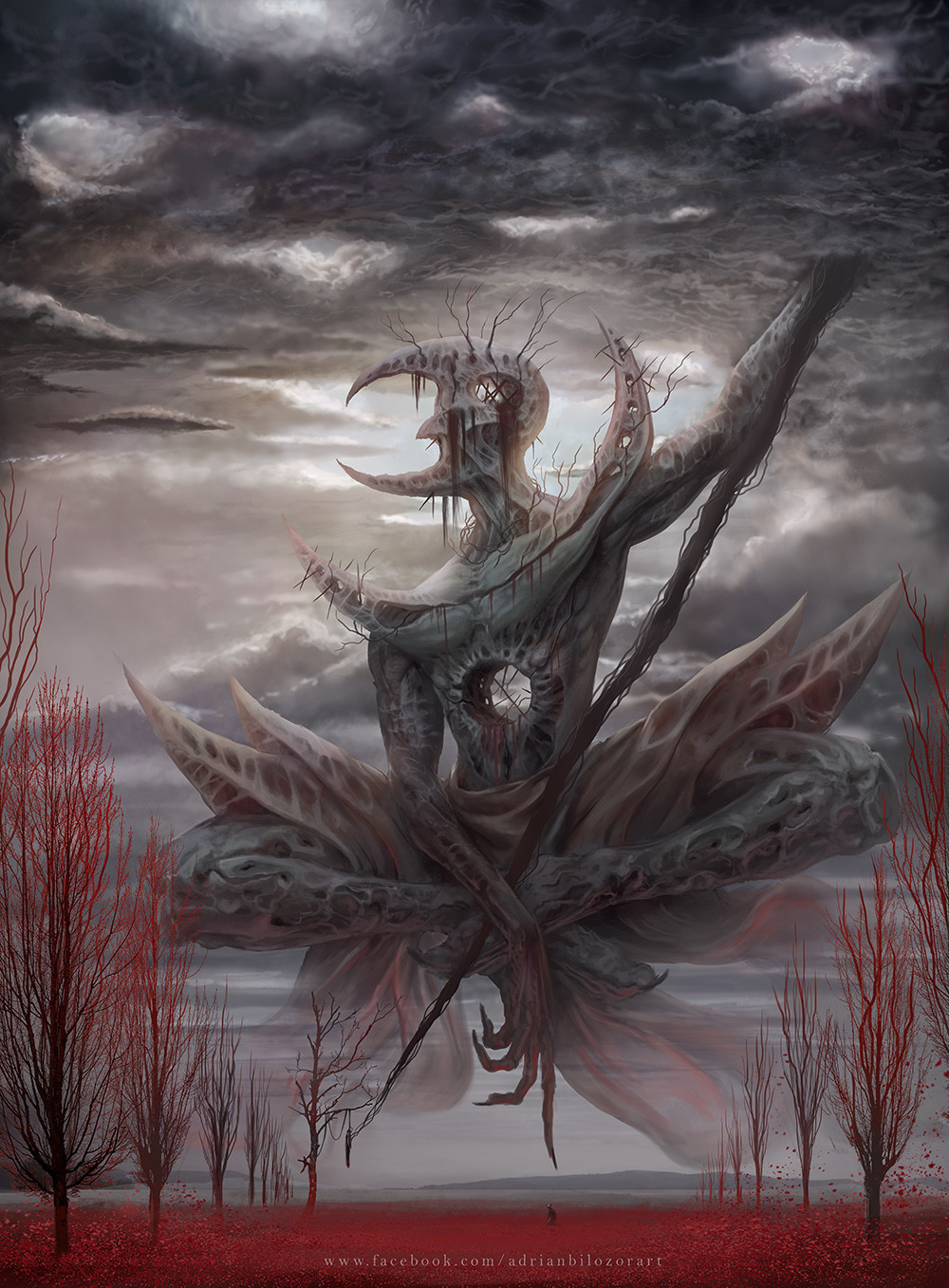
Kalwar, the Violent
Kalwar is the herald of senseless and uncontrollable violence. He plants the seeds for rage to be born in a mortal, and supplies the enraged with endless ferocity to their death. He will even support opposite sides of the same battlefield if individuals capable of wielding his wrath are present, revelling in the frenzied bloodbath that ensues.
His ultimate goal is to reduce the world back to its uncivilized state, where might and violence ruled above all. Kalwar is simple in his machinations, and uses brute force to pursue his goals rather than thinking. He doesn't have followers as much as individuals that he has consumed with the need for violence and rage. Various barbarian tribes are driven to endless pillaging due to his influence. He would reward only the strongest of them by making them his champion, to enforce his will on the world.
Plot Hooks
Infecting Rage. Individuals around the world are starting to exhibit signs of uncontrollable temper, which quickly turns them into ravaging barbarians bereft of any self control or cultured personality they used to possess. How is Kalwar causing this, and how can it be stopped?
Wrathful Patron. Kalwar furthers his goals by noticing defeated individuals that have been stepped on by others, and manipulates that anger into hate and rage. A barbarian in your party could incorporate Kalwar into their backstory by him being the source of their power, having been powerless and defenseless without his patronage.
Boon of the Aggressor
You have advantage on attack rolls against any creatures that have never attacked you.
Boon of Might
Each time you kill a creature, your strength score is increased by 1, to a maximum of 25. This increase lasts until you complete a short or long rest.
Boon of Blood
When you hit a creature that has all of its hitpoints, you can use this boon to declare your intention to end its life, and deal an additional 4d8 damage to it. If the creature is alive after 1 minute, you take 8d8 necrotic damage, which cannot be reduced or prevented in any way. You can't use this boon on an undead or construct creature.
After you have used this boon, you must complete a short rest before doing so again.
Boon of Retaliation
When a creature hits you with a melee weapon attack while within 5 feet of you, you can use your reaction to make a melee weapon attack against it.
If you miss with your attack, you can't use your reaction in this way again until you complete a long rest.
Boon of the Enraged Death
When you are reduced to 0 hitpoints by a creature within your reach, you can make a melee weapon attack against it as a reaction before falling unconscious.
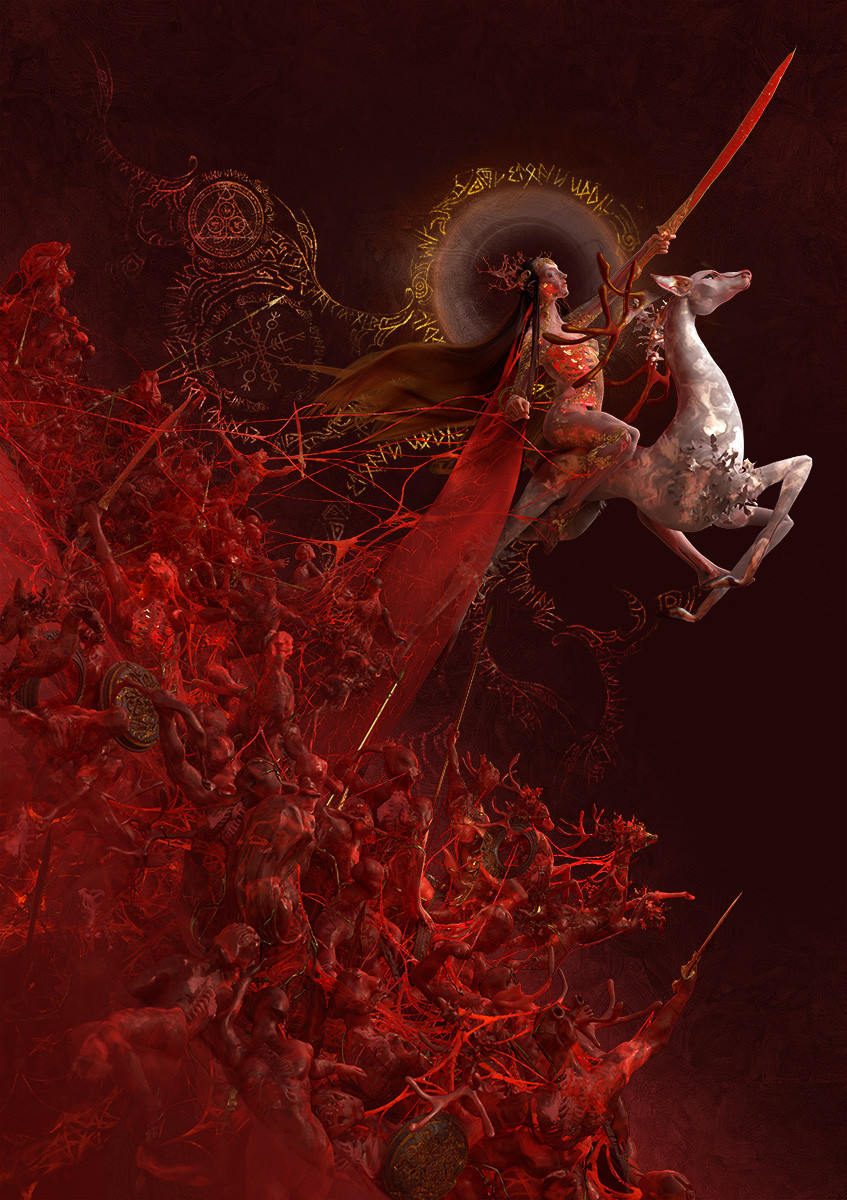
Kalwar
Huge celestial (herald), chaotic evil
- Armor Class 20 (unarmored defense)
- Hit Points 693 (42d12 + 420)
- Speed 90 ft.
STR DEX CON INT WIS CHA 30 (+10) 10 (+0) 30 (+10) 16 (+3) 16 (+3) 20 (+5)
- Saving Throws Dex +8, Wis +11, Cha +13
- Skills Athletics +18
- Damage Immunities bludgeoning, piercing, slashing from nonmagical weapons
- Condition Immunities charmed, exhaustion, frightened
- Senses darkvision 120 ft., passive Perception 15
- Languages all
- Challenge 26 (90,000 XP)
Enraged Instincts. Kalwar has advantage on Strength, Dexterity and Constitution saving throws against effects that he can see. Additionally, Kalwar's jump distance is tripled while he is in initiative (long jump 90, high jump 40), and when Kalwar succeeds on a contested strength check with another creature, that creature takes 10 bludgeoning damage, as his incredible ferocity batters the creature.
Brutal Weapons. Kalwar's weapons attacks are magical. A melee weapon deals four extra dice of its damage when Kalwar hits with it (included in the attack). Additionally, on a critical hit, Kalwar can roll three additional weapon damage dice when determining the extra damage.
Unarmored Defense. Kalwar can add his Constitution modifier to his AC. Additionally, Kalwar reduces any damage he takes from weapon attacks by an amount equal to his Constitution modifier (10).
Enraged Attacks. At the beginning of his turn, Kalwar can choose to gain advantage on all weapon attacks he makes until the end of his turn. However, attack rolls against him have advantage until the start of his next turn. An enraged attack made against a prone creature is a critical hit on a roll of 18-20.
Thorns of Rage. If Kalwar hits with all 4 attacks during his turn, thorns of rage grow on his body. Until the start of his next turn, any creature that touches him or makes a melee weapon attack against him takes 10 piercing damage. If a creature starts its turn grappling or being grappled by Kalwar and his thorns of rage are active, it takes 10 piercing damage.
.
Actions
Multiattack. Kalwar makes 4 greataxe attacks. He can substitute up to 2 of these attacks with a backhand strike each.
Greataxe. Melee Weapon Attack: +18, Reach: 10 ft., one target. Hit 36 (4d12 + 10) slashing damage
Backhand Stike. Melee Weapon Attack: +18, Reach: 10 ft., one target. Hit 28 (4d8 + 10) bludgeoning damage, and if the creature is Large or smaller, it must make a DC 26 Strength saving throw. On a failure, Kalwar can choose to knock it prone or push it 10 feet away from him in a direction of his choice.
Legendary Actions
Kalwar can take 3 legendary actions, choosing from the options below. Only one legendary action can be used at a time and only at the end of another creature's turn. Kalwar regains spent legendary actions at the start of its turn.
Strike. Kalwar makes a greataxe or backhand fist attack.
Berserker's Leap (Costs 2 Actions). Kalwar jumps in the air and lands at a point of his choice within 90 feet. Any creatures within 10 feet of that point must succeed on a DC 26 Dexterity saving throw or take 28 (4d8 + 10) bludgeoning damage and be knocked prone. A creature occupying the space Kalwar lands on is pushed to the nearest unoccupied space.
Sweeping Strike (Costs 3 Actions). Kalwar sweeps his greataxe in a grand motion. Any creatures within 10 feet of him must succeed on a DC 26 Dexterity saving throw, or take 62 (8d12 + 10) slashing damage and be pushed 10 feet away from him.
Lair Actions
On initiative count 20 (losing initiative ties), Kalwar can take a lair action to cause one of the following effects; he can't use the same effect two rounds in a row:
Frightful Roar. Kalwar lets out a frightening roar that shakes the foundations of any structures nearby. Any creatures within 90 feet of him that can hear the roar must succeed on a DC 21 Wisdom saving throw or become frightened of him until initiative count 20 next round. While frightened, a creature is also under the effects of the confusion spell, and any attack Kalwar makes against it is a critical hit on a roll of 18-20.
Violent Execution. Kalwar leaps in the air and brings his greataxe down on a prone creature within his reach. Kalwar makes a greataxe attack. On a hit, if the attack reduces the creature to 30 or fewer hitpoints, it dies.
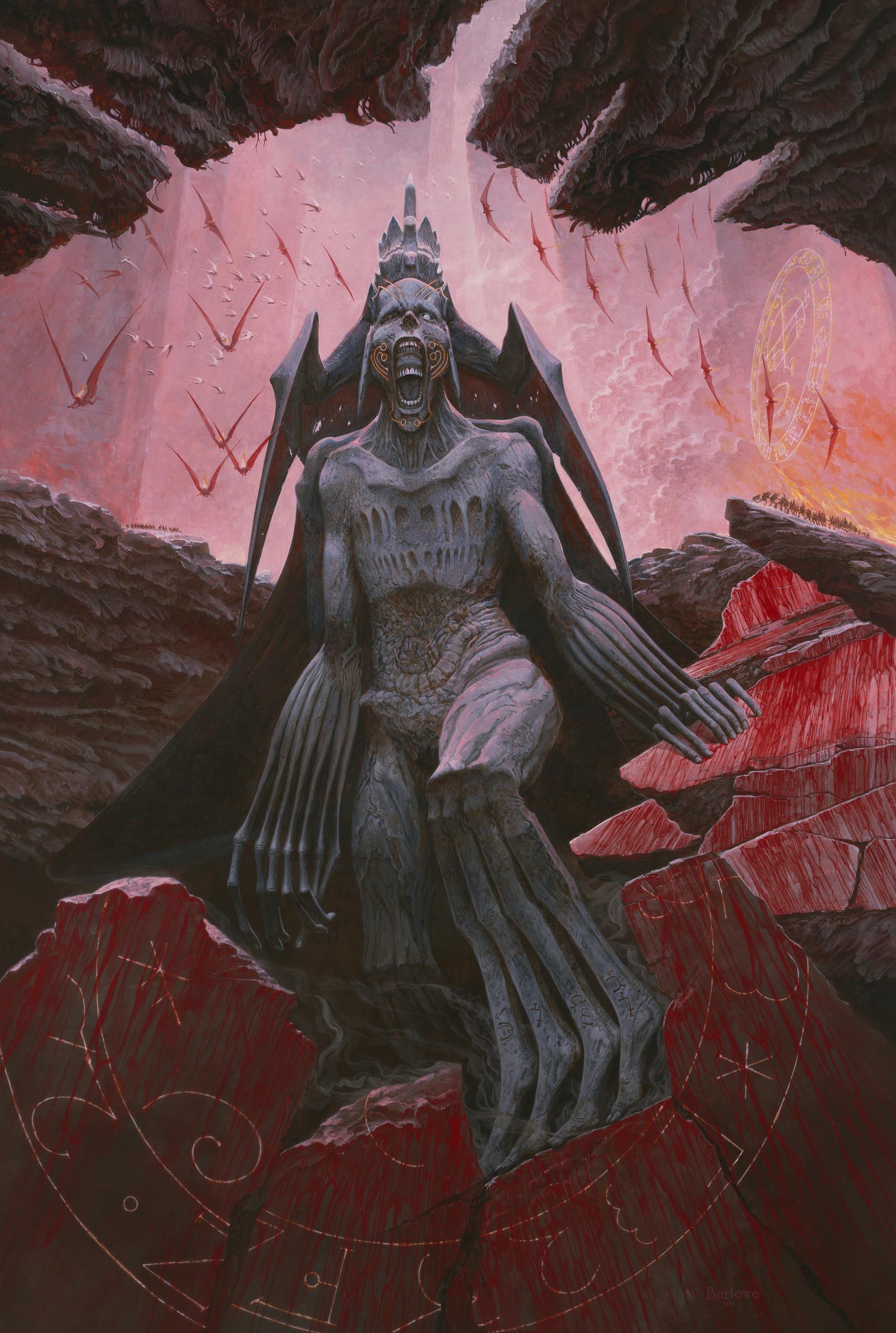
Kalwar's Piercings
No one knows if these three ancient piercings were made by Kalwar himself, or were made in his honor, but they have unique properties that can be used by those who feel the call of Kalwar, whether they know it or not. You can attune to each of these piercings by using an action to attach it on your body. When you do so, you take 1d4 + 3 piercing damage (which can't be reduced or prevented in any way) and your hitpoint maximum is reduced by an equal amount. While you are attuned to this item, these hitpoints can't be restored in any way.
Each piercing has its unique properties detailed below. If you are attuned to all 3 of them, your rage damage bonus is increased by 1, and you gain an additional attunement slot.
Curse. When you attune to one of these piercings, you feel a great power surging through you, promising you that with pain comes great reward. You can't willingly unattune from this piercing. A remove curse spell or similar effect ends your attunement to the piercing if the spellcaster succeeds on a DC 13 spellcasting ability check. On a failure, the same creature cannot end the curse with the same spell.
When you attune to this piercing and whenever you use its synonymous feature, you gain 1 level of Kalwar's corruption. When you attempt to end your rage, you must make a Wisdom saving throw. The DC equals 10 + your Kalwar corruption levels. On a failure, you are unable to end your rage. Instead you are consumed with murderous energy, attacking any creature closest to you until your rage ends. If you are attuned to Endless Rage when that happens, your rage does not end if you have not attacked a hostile creature or been damaged since your last turn.
Kalwar's Piercing: Pained Rage
Wondrous item, rare (requires attunement by a barbarian)
This brass piercing has red divots etched on it in the color of blood. It pulses painfully whenever your violent instincts call to you but you refuse them.
Pained Rage. When you take damage by a creature you can see, you can expend your reaction and use Kalwar's Piercing to fill yourself with rage at the creature's insolence. You take additional piercing damage as the piercing burrows deeper into your skin, equal to half your level (rounded down) + your proficiency bonus. After taking this damage, which can't be reduced in any way, you enter your rage. Additionally, you have advantage on all attack rolls against the creature that damaged you until the end of your next turn.
Kalwar's Piercing: Endless Rage
Wondrous item, very rare (requires attunement by a barbarian)
This obsidian piercing has red divots etched on it in the color of blood. It pulses painfully whenever your violent instincts call to you but you refuse them.

Endless Rage. When your rage would end as a result of not attacking a hostile creature or taking damage since your last turn, you can use your reaction and use this piercing to sustain your rage. You take piercing damage equal to half your level (rounded down) + your proficiency bonus when you do so, as the piercing burrows deeper into your body. This damage can't be reduced in any way.
Alternatively, you can use the power in this piercing to allow yourself to continue fighting when others would undoubtedly perish. When you are reduced to 0 hitpoints while you are in your rage, you can use your reaction to instead fall to 1 hitpoint instead. You can't use this property of the piercing again until you complete a long rest.
Kalwar's Piercing: Terrorizing Rage
Wondrous item, very rare (requires attunement by a barbarian)
This ebonstone piercing has red divots etched on it in the color of blood. It pulses painfully whenever your violent instincts call to you but you refuse them.
Terrorizing Rage. When you enter your rage, you can bite this piercing and scream in an unearthly intensity. You take piercing damage equal to half your level + your proficiency bonus. This damage can't be reduced in any way.
Each creature of your choice within 30 feet of you must make a Wisdom saving throw. The DC equals 8 + your proficiency bonus + your Constitution modifier. On a failed save, if the creature can hear you, it becomes frightened of you until your rage ends. When you make an attack against a creature frightened in this way, your attack scores a critical hit on a roll of 18-20. A frightened creature can repeat the saving throw at the end of each of its turns, ending the effect on itself on a success.
Ferocity
Weapon (greataxe), rare (requires attunement by a barbarian)
You have a +1 bonus to attack and damage rolls you make with this weapon. While you are in your rage, that bonus increases to a +2.
When you make a reckless attack with this greataxe, your reach also increases by 5 feet with it.
However, if your rage ends as a result of not having attacked a hostile creature since your last turn, you take psychic damage equal to your level.
Bottled Fury
Potion, very rare
Barbarians that follow the path of Kalwar recognize this substance as his blood. If you have the rage feature, you can use your bonus action to drink this blood-red liquid, and immediately go into a rage. While in this rage, your rage damage bonus is doubled and when you use your reckless attack feature to make an attack roll with advantage, you can reroll one of the dice once.
When a creature which does not have the rage feature drinks this potion, it must make a DC 15 Wisdom saving throw. On a success, the creature makes all attack rolls with advantage for 1 minute. However all attack rolls against it are also made with advantage. On a failure, the creature is overcome with uncontrollable violence. For the next minute, it attacks the closest creature near it.
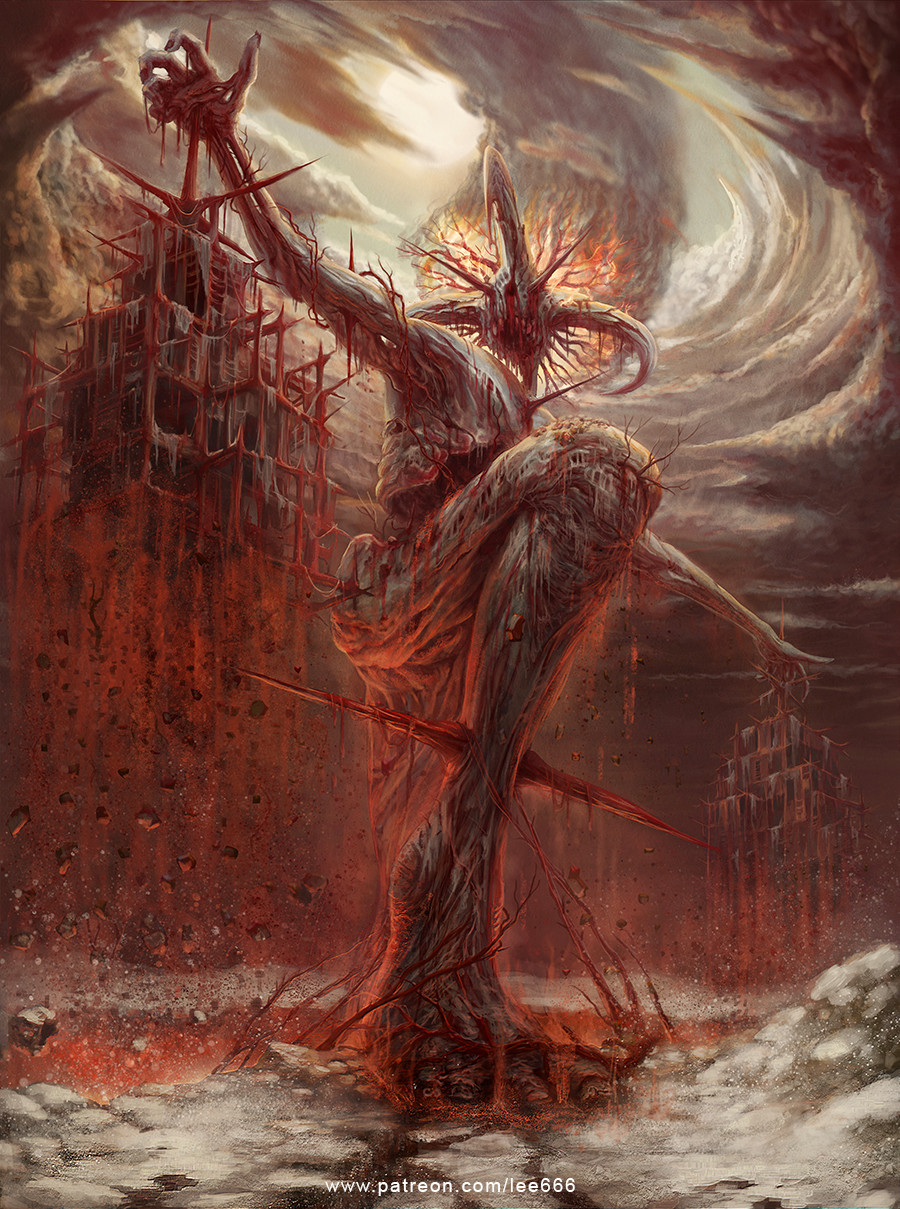
Belt of Sadism
Wondrous item, rare (requires attunement)
This grotesque belt can be used to hang trophies of the creatures you have killed. When you kill a creature and hang a part of its body on this belt, the belt's sadism score increases by 1, up to a maximum of your level. When you hit a creature with a weapon attack while wearing this belt, you can use its sadistic power to deal additional damage equal to its sadism score to the creature. This damage is of the same type as that dealt by the weapon.
You can't use this ability of the belt again until you complete a short or long rest.
Greataxe of the Colossus
Weapon (greataxe), rare (requires attunement by a creature of giant heritage)
This greataxe was made for giant-kin. You must have a strength of 19 or higher to wield this weapon, or you have disadvantage on all attack rolls you make with it.
While wielding this greataxe, you can use an action or bonus action on your turn to activate one of the archaic runes inscibed on its axeblade. When you do so, you gain the effects of the enlarge spell for 1 minute. While enlarged in this way, your weapon attacks deal 1d8 additional damage (instead of 1d4) and you have a reach of 10 feet with this greataxe. You can't activate the same runes again until you complete a long rest.
Additionally, when you take the attack action while you are enlarged, you can use one of your attacks to make a sweeping attack with this greataxe. Any creatures within 5 feet or 10 feet of you (your choice) must succeed on a DC 15 Dexterity saving throw, or take 3d12 + your Strength modifier slashing damage. You can only make this special attack once while you are enlarged.
Slayer's Helm
Wondrous item, rare (requires attunement)
This stark black helmet makes a creature shudder at its sight. This helmet can hold a maximum of 20 charges, and gains 1 charge whenever you kill a creature. You can hear the creature's ethereal but unintelligible scream as its soul is siphoned into the helmet.
When you are forced to make an Intelligence, Wisdom or Charisma saving throw, you can draw upon the voices in the helmet to shield your mind from the oncoming effect. You can expend 5 charges, and gain advantage on the roll.
When the helmet's charges are full and you are in darkness, the eye sockets of the helmet glow red, giving you a darkvision of 60 ft. If you already have darkvision, you can increase its range by 30 ft. Everything you see through the helmet's eyes in darkness is red. When you hit a creature that can see you while you are both in complete darkness, you can expend 5 charges of this helmet to attempt to frighten it. The creature must succeed on a DC 13 Wisdom saving throw, or it becomes frightened of you for 1 minute. The effect ends if the creature can no longer see you, or if it succeeds on the same saving throw at the end of its turn.
Additionally, you can use an action and expend any number of the helmet's charges. You gain an equal number of temporary hitpoints.

Blood Frenzy
Weapon (greataxe), legendary (requires attunement)
This greataxe will begin dripping blood from its blade if there is a living creature within 60 feet of it. If the creature is a fiend, the blood will be pitch black. You have a +3 bonus to attack and damage rolls you make with this weapon. Fiends killed by this greataxe do not returned to their home plane. Instead they die in the material realm.
Blood Frenzy. Once per long rest, you can use this greataxe to attempt to incite a blood frenzy in a creature you can see within 30 feet of you. That creature must succeed on a DC 17 Wisdom saving throw, or become hostile to every creature it can see for 1 minute, attacking the nearest creature to it in its turn. A fiend makes the saving throw with disadvantage. A creature that is immune to being charmed is unaffected, unless it is a fiend.
An affected creature can repeat the saving throw at the end of each of its turns, ending the effect on itself on a success. If the effect's full duration elapses, the creature becomes cursed with Blood Frenzy.
Disseminator of Violence. The first time you affect a creature with blood frenzy, select Strength or Constitution. The first time and each time after that, you can increase your selected ability score by 1, to a maximum of 25.
If you continue to spread Blood Frenzy after your chosen ability score has reached its maximum, Kalwar might notice your work and grant you further boons in reward of your service.
Bloodblessed Armor
Armor (any armor), legendary (requires attunement)
This armor has by now turned blood-red after its many years of service to the herald of Kalwar. When you kill a creature, you can perform an 1 minute ritual in which you coat the armor in the creature's fresh blood. After its completion, the creature cannot be resurrected by any means other than a wish spell, and the Bloodblessed armor gains 1 charge.
For each charge the armor has, it gains a +1 bonus to its AC. The armor can hold up to a maximum of 3 charges.
When you hit a creature with a melee weapon attack, you can expend one of the armor's charges and deal an additional 4d8 necrotic damage to it. If you are wielding Blood Frenzy, you instead deal 8d8 necrotic damage to the target.
Bloodbashing Shield
Armor (shield), legendary (requires attunement)
This shield has by now turned blood-red after its many years of service to the herald of Kalwar. The jagged spikes that come out of it however, remain black as stone. While holding it, you gain a +2 bonus to your AC. This bonus is in addition to the shield's normal bonus to AC.
When you take the attack action, you can use one of your attacks to make a special Shield Bash attack with this shield. You are considered proficient with this attack, which you make using your Strength modifier. You also gain a +2 bonus to attack and damage rolls you make with this shield. However, this Shield Bash does not count as a weapon attack for the purposes of features such as Divine Smite for example.
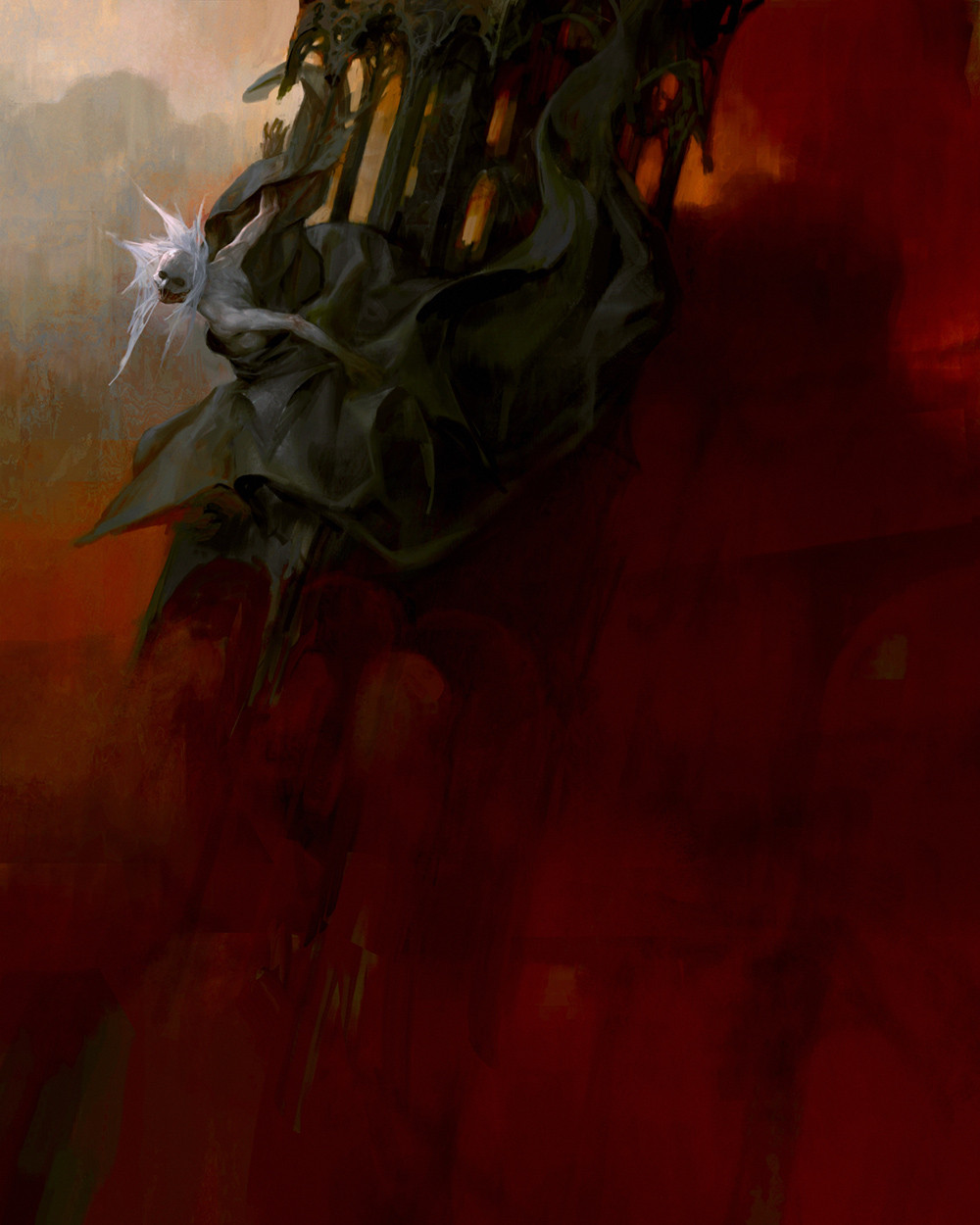
On a hit, the target takes 1d10 + your Strength modifier piercing damage, and it must succeed on a Strength or Dexterity saving throw (its choice), or be restrained by the shield, as its jagged spikes pierce through its body. If a creature is restrained by this shield, you can't use its Shield Bash attack against another creature. When you hit a creature that is already restrained by the shield, you regain hitpoints equal to half of the damage you deal with it.
Heartpiercer
Weapon (javelin), very rare (requires attunement)
This javelin is made of a dark-grained wood. You have a +2 bonus to attack and damage rolls you make with it.
When you score a critical hit with this weapon, the target becomes paralyzed until the end of your next turn as the javelin pierces its heart.
After you've killed a creature, you can use your bonus action to make a thrown weapon attack with heartpiercer if it on your person. On a hit, the target must make a DC 13 Constitution saving throw if it is a humanoid, as the javelin becomes embedded into its body. On a failure, the creature is paralyzed until the end of your next turn, or until the javelin is removed from its body.
Locket of the Martyr's Brother
Wondrous item, rarity varies (requires attunement by a creature deemed worthy by the amulet)
This locket is a monument to self-sacrifice and protecting one's own at any cost. You can see a number of initials etched inside it, not one of them besmirched by the locket's imposing age.
When you find this amulet, it might contain any number of charges, from 1 up to a maximum of 7. You gain a +1 bonus to your death saving throws for each charge of this amulet. This amulet gains a charge whenever its attuned wearer dies in sacrifice.
Its rarity is determined as follows: 1-2 charges (uncommon), 3 charges (rare), 4-5 charges (very rare), 6-7 charges (legendary).
As the sentience of this amulet silently progresses to know its new wearer better, it might unveil more of its power to them if they prove that they are worthy of benefiting from the past's sacrifices. It might lend advice in critical moments of time and death, having soaked the wisdom of the past, and might support its wearer with effects such as temporary hitpoints if they endanger their lives for the good of others.
However, in most moments the voice inside it remains silent, and might not give signs of its existence even once. Inside it live the remnants of the soul of the first martyr's brother, William Iverson. This locket was the only personal effect he had left of his brother, after he had given his life to save them from a deadly fire. He kept it always close, and bonded enough with it by depositing all of his memories of his brother into it that part of his soul still lies there.

Credits
Created by /u/Lambros009. You can reach out to me for any questions you have.
Many thanks to these artists for producing such amazing work, which inspires even more powerfully than it illustrates. I urge you to check them out! A quick copy paste to google will lead you to wonderful places for each of them.
Art By (In order of appearance):
Pelor by thatsanj (cover, pg. 1)
Thoughts Above the Trees by Art Venti (pg. 2)
Paolo Puggioni (pg. 3)
Belial in the New World
by Wayne Barlowe (pg. 4)Dormammu by Jerad Marantz (pg. 5)
Daniel Karlsson (pg. 6)
The Sun King by James Zapata (pg. 7)
Gate to Heaven by Te Hu (pg. 8)
Cleric by Bella Bergolts (pg. 9)
Convocation by Kitt Lapena (pg. 11)
Annatar by Krabat (pg. 12)
Restoring Seraphim by Livia Prima (pg. 14)
Young Kvothe by Camila Vielmond (pg. 16)
In Memoriam by Aw Anqi (pg. 17)
Announcer by Aw Anqi (pg. 18)
Gem by Karina Eibatova (pg. 19)
Darkened Sun by Jiangxhi (pg. 20)
Warlock with Robe of Eyes
by Daylen Coyle (pg. 23)Hostess of the Copper Hill
by Anton Semenov (pg. 25)Oświęcim by Anton Semenov (pg. 26)
Secrets of the Wind by Anton Semenov (pg. 27)
Home by Anton Semenov (pg. 28)
Eclipse by Anton Semenov (pg. 31)
The Shadow King by Jason Engle (pg. 32)
The Keeper of Whispers by Jason Engle (pg. 33)
Crystal Matrix by Giorgio Grecu (pg. 35)
The God of Dispair by Adrian Bilozor (pg. 36)
Queen by Te Hu (pg. 37)
Semjaza Rising by Wayne Barlowe (pg. 38)
Ascend to Death by James Zapata (pg. 39)
The God of Pain by Adrian Bilozor (pg. 40)
Spirit of Pain by Antonio J. Manzanedo (pg. 41)
Wall by Tobias Kwan (pg. 42)
Seek by Te Hu (credits) (pg. 43)