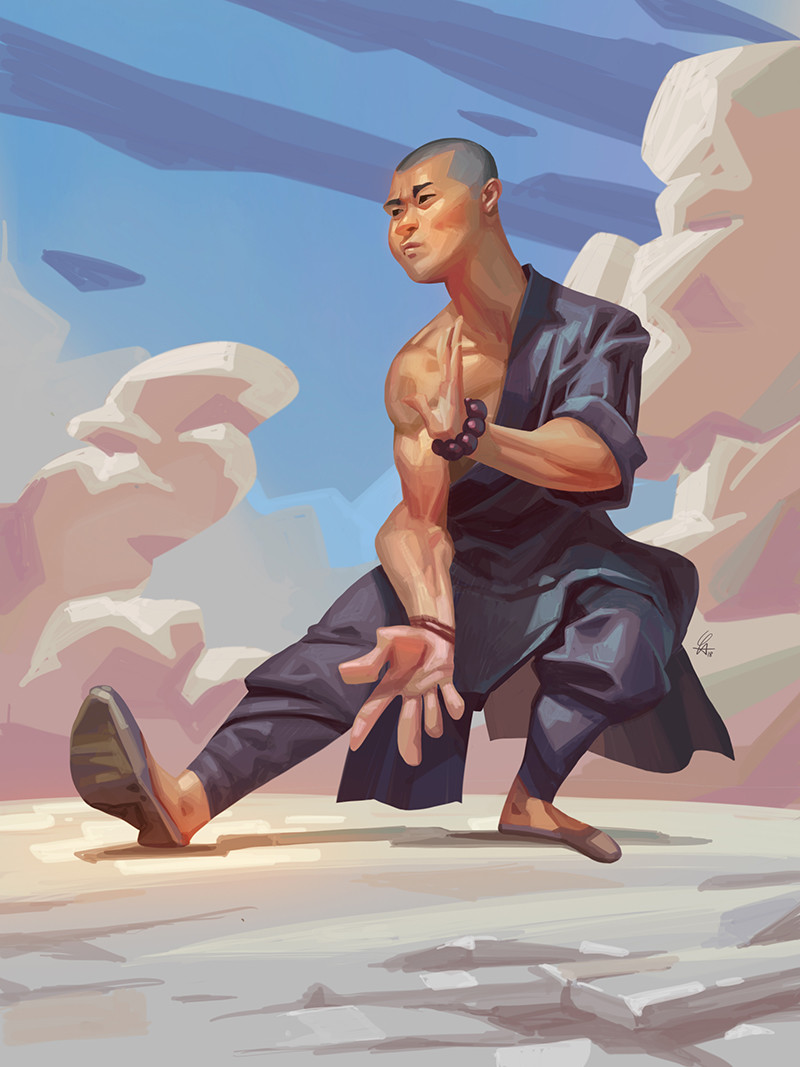
Martial Artist
Her fists a blur as they deflect an incoming storm of arrows, a half elf springs over a barricade and throws herself into the massed ranks of hobgoblins on the other side. She whirls among them, surgically picking them apart with precise strikes, leaving them reeling, gasping for air, until finally she is the last one standing.
A half orc charges through the crowd of people to oppose the village's aspiring tyrant. No sooner do the two meet face to face than the thug is grabbed and thrown bodily to the ground and pounded with a hail of kicks.
Moving with the silence of the night, a black-robed halfling steps into a shadow beneath an arch and emerges from another inky shadow behind the unwary guard. The guard has no time to cry out before a single kick leaves him battered and broken on the floor.
Whatever combat style, martial artists are united in their mastery of combat styles that rely wholly or in part on unarmed techniques, as well as a driving philosophy that points them towards personal growth.
Combat and Philosophy
Martial Artists are separated from common fighters in their study of a particular way of life. Some martial artists place emphasis on the importance of efficiency and minimal effort, leading efficient lives, and fighting with minimal effort. Others place emphasis on power and speed, leading them to strike first and strike hard in every endeavor they undertake. Still others place emphasis on gentleness and kindness, practicing techniques to incapacitate their opponent without hurting them, and similarly undertaking the task of spreading love and compassion, even to one's perceived enemies.
Whatever their way of life, the harmony of one's mind and body allows them access to the mystic energy of ki, granting them uncanny speed and strength in their techniques. As they gain experience, their martial training and mastery of mind and body grants them power over their bodies and the bodies of their foes.
The Magic of Ki
Due to the harmony between a martial artist's philosophy and how they live their lives, as well as their fighting styles in combat, a martial artist can access the mystic energy of ki. This energy is an element of the magic that suffuses the multiverse -- specifically, the element that flows through living bodies. Martial artists harness this power within themselves to enhance their physical capabilities beyond normal limits, or even to manifest overtly magical effects.
This element of magic, while most often referred to as "ki", is also known in other regions as "qì", "prana", "chi", "mana", "manitou", "anima", "pneuma", "hamon", and many other names. Regardless of what it is called, it is accessed through internal unity between one's true intent and actions, and is what sets dedicated practitioners of martial arts apart from someone who simply knows how to punch correctly.
Because ki flows in living beings, it is best channeled through direct contact, hence the widespread usage of unarmed techniques, though some make exquisite study of the usage of weapons.
Training of Martial Arts
Small walled cloisters dot the landscapes of the worlds of D&D, tiny refuges from the flow of everyday life. Monastic orders of some of these cloisters practice their martial arts, in the hope of better understanding of oneself and the nature of the multiverse. Many enter a monastery as children, sent to live when their parents died, or when their families can't support them. Others may join as adults when a debt of kindness is owed, or when in a state of crisis, seeking healing for a stormy mind.
In other places are schools that teach techniques of self defense and how to wield this power. It is often said that with power comes responsibility, and a school that allows its practitioners to win their bar fights would be seen as a dishonorable and lowly job, no matter its demand.
Never settling in one place at all may be wandering masters of martial arts, and when fortune or skill or natural aptitude favors one person over the rest, it is possible that the master may take them as an apprentice to wander with them in their travels and to learn the philosophy and combat style unique to their craft.
On occasion, a martial art is born in isolation. Legends tell of the birth of a martial art after fasting on the top of a mountain for months. But those are not the only circumstances in which a martial arts are founded. A wandering vagabond may have a profound realization in his travels, and fight with a new determination.
Creating a Martial Artist
As you make your Martial Artist character, think about what philosophy drives your character's actions, and where you learned your unarmed techniques. Did you join a monastic order seeking peace after a traumatic event? If you did, did you find harmony again, or are you still looking for your answer? Were you apprenticed to a master? Was he kind to you, or mean-spirited? Where is your master now? Did you join a school for martial arts? Did you join because you were bullied by other members of your village? What was the school's experience like? Or did you perhaps come up with your martial art on your own, without the help of any formal training?
What philosophy do you follow? Does it value self denial, or does it embrace pleasure of any kind? How do you see other creatures? Would you fight for just causes, avoid violence at any cause, or do you see your power as a tool to be leveraged at any opportunity?
Consider why you began adventuring. Did the head of your monastery send you on an important mission, or were you cast out? Was your master killed, or did you leave because of a dispute? Did you graduate from your school of martial arts, or were you expelled? Is there something you hope to accomplish with your training in martial arts?

Martial Artist
| Level | Proficiency Bonus | Martial arts | Features | ki points | Unarmored Movement |
|---|---|---|---|---|---|
| 1st | +2 | 1d4 | Martial Arts, Unarmored defense | — | — |
| 2nd | +2 | 1d4 | Ki, Basic techniques, Unarmored Movement | 2 | +10 ft. |
| 3rd | +2 | 1d4 | Combat philosophy | 3 | +10 ft. |
| 4th | +2 | 1d4 | Ability Score improvement, Breakfalls | 4 | +10 ft. |
| 5th | +3 | 1d6 | Extra Attack, Adept techniques | 5 | +10 ft. |
| 6th | +3 | 1d6 | Ki-empowered strikes, Combat philosophy feature | 6 | +15 ft. |
| 7th | +3 | 1d6 | evasion | 7 | +15 ft. |
| 8th | +3 | 1d6 | Ability Score Improvement | 8 | +15 ft. |
| 9th | +4 | 1d6 | Expert Techniques | 9 | +15 ft. |
| 10th | +4 | 1d6 | Tireless Power | 10 | +20 ft. |
| 11th | +4 | 1d8 | Combat philosophy feature | 11 | +20 ft. |
| 12th | +4 | 1d8 | Ability Score improvement | 12 | +20 ft. |
| 13th | +5 | 1d8 | Practiced Cornerstones | 13 | +20 ft. |
| 14th | +5 | 1d8 | Perfect Alignment | 14 | +25 ft. |
| 15th | +5 | 1d8 | Resolute Beliefs | 15 | +25 ft. |
| 16th | +5 | 1d8 | Ability Score Improvement | 16 | +25 ft. |
| 17th | +6 | 1d10 | Combat philosophy feature | 17 | +25 ft. |
| 18th | +6 | 1d10 | Master Techniques | 18 | +30 ft. |
| 19th | +6 | 1d10 | Ability Score improvement | 19 | +30 ft. |
| 20th | +6 | 1d10 | True Harmony | 20 | +30 ft. |
Quick Build
You can make a martial artist quickly by following these suggestions. First, make Dexterity your highest ability score, followed by wisdom. Second, choose the soldier background.
Class Features
as a martial artist, you gain the following class features.
Hit Points
- Hit Dice: 1d8 per martial artist level
- Hit Points at 1st Level: 8 + your constitution modifier
- Hit Points at Higher Levels: 1d8 (or 5) + your constitution modifier
Proficiencies
- Armor: None
- Weapons: Simple weapons, Shortswords
- Tools: Choose one type of artisan's tools, gaming set, or musical instrument
- Saving Throws: Strength, Dexterity
- Skills: Choose two from Acrobatics, Athletics, History, Insight, Religion, and Stealth.
Equipment
You start with the following equipment, in addition to the equipment granted by your background:
- (a) a shortsword or (b) any simple weapon
- (a) a dungeoneer's pack or (b) an explorer's pack
- 10 darts
Unarmored Defense
Beginning at 1st level, while you are wearing no armor and not wielding a shield, your AC equals 10 + your Dexterity modifier + your Wisdom modifier.
Martial Arts
At 1st level, your practice of martial arts gives you mastery over combat styles that use unarmed strikes and Martial Artist's weapons, which are shortswords and any simple weapon that lacks the two-handed or heavy properties.
You gain the following benefits while you are unarmed or wielding only martial artist's weapons and you aren't wearing armor or wielding a shield.
- You can use dexterity for the attack and damage rolls of your unarmed strikes and martial artist's weapons.
- You can roll a d4 in place of the normal damage of your unarmed strike or martial artist's weapon. This die changes as you gain martial artist levels, as shown in the Martial arts column of the Martial Artist table.
- When you use the Attack action with an unarmed strike or a martial artist's weapon on your turn, you can make one unarmed strike as a bonus action, assuming you haven't already taken a bonus action this turn.
Ki
Starting at 2nd level, your training allows you to access the mystic energy of ki. Your access to this energy is represented by a number of ki points. Your martial artist level determines the number of points you have, as shown in the ki Points column of the Martial Artist table.
You can spend these points to fuel various martial artist features. When you spend a ki point, it is unavailable until the end of your next short or long rest.
Some of your ki features require your target to make a saving throw to resist the feature's effects. The saving throw DC is calculated as follows:
Ki Save DC

Basic Techniques
At 2nd level, your training grants you access to martial techniques to enhance your combat effectiveness. Choose 2 techniques from the following list, and you learn those techniques:
Flurry of Blows
Immediately after you take the Attack action on your turn, you can spend 1 ki point to make two unarmed strikes as a bonus action.
Heavy Blow
Once per turn, you can choose for an attack to be a heavy blow. If the attack hits, you deal additional damage equal to your Martial Arts die. Hit or miss, the next attack made against you before the start of your next turn is made with advantage.
Patient Defense
You can spend 1 ki point to take the dodge action as a bonus action on your turn.
Step of the Wind
You can spend 1 ki point to take the Disengage or Dash actions as a bonus action on your turn, and your jump distance is doubled for the turn.
Throwing Techniques
You can add your wisdom modifier to checks made to shove or grapple. When you choose to shove prone a creature that is grappled by you and succeed, you can choose any unoccupied space within 5 feet, and the grappled creature is moved to that space.
Unarmored Movement
Starting at 2nd level, your speed increases by 10 feet while not wearing armor or wielding a shield. This bonus increases when you reach certain martial artist levels, as shown on the Martial Artist table.
Combat Philosophy
At 3rd level, you commit yourself to a combat philosophy, such as the Way of the Open Hand, or the Way of Shadow. Your choice grants you features at 3rd, 6th, 11th, and 17th level.
Ability Score Improvement
When you reach 4th level, and again at 8th, 12th, 16th, and 19th level, you can increase one ability score of your choice by 2, or two ability scores of your choice by 1. As normal, you can't increase an ability score above 20 using this feature.
Breakfalls
Beginning at 4th level, you can use your reaction when you fall to reduce any falling damage you take by an amount equal to five times your martial artist level.
Extra Attack
Beginning at 5th level, you can attack twice, instead of once, whenever you take the attack action on your turn.
Adept Techniques
At 5th level, your training grants you access to martial techniques to enhance your combat effectiveness. You learn 3 techniques from the following list. If an adept technique allows you to force a target to make a saving throw to resist the feature's effects, you can only use one such technique per attack.
Blinding Strike
When you hit another creature with a melee weapon attack, you can spend 1 ki point to attempt a blinding strike. The target must succeed on a dexterity saving throw or become blinded until the start of your next turn.
Crippling Blow
When you hit with a melee weapon attack, you can choose to spend 1 ki point to try to cripple your opponent. The target must make a strength saving throw. On a failure, the target's speed is reduced to 0 until the end of your next turn.
Deflect Missiles
You can use your reaction to deflect or catch a missile when you are hit by a ranged weapon attack. When you do so, you can reduce the damage by 1d10 + your monk level + your Strength or Dexterity modifier (your choice)
When you take this reaction, you can reduce the damage of a number of these projectiles equal to your proficiency bonus in this way.
Pushing Stance
At the start of each of your turns, you can choose to spend 1 ki point to empower your attacks with more blunt force until the end of that turn. When you hit a creature that is your size or smaller with a melee weapon attack while your attacks are empowered in this way, you can choose to push that creature 5 feet away from you.
Restricting Grip
When a creature you are grappling hits you with an attack, you can use your reaction to halve that attack's damage against you.
Ki-Empowered Strikes
Staring at 6th level, Your unarmed strikes count as magical for the purpose of overcoming resistance to nonmagical attacks and damage.
Evasion
At 7th level, your instinctive agility lets you dodge out of the way of certain area effects, such as a blue dragon's lightning breath or a fireball spell. When you are subjected to an effect that allows you to make a Dexterity saving throw to take only half damage, you instead take no damage if you succeed the saving throw, and only half damage if you fail.
Expert Techniques
At 9th level, your training grants you access to martial techniques to enhance your combat effectiveness. You learn 3 techniques from the following list. If an expert technique allows you to force a target to make a saving throw to resist the feature's effects, you can only use one such technique per attack.
Body Block
If you have a creature grappled, and another creature targets you with an attack, you can spend 1 ki point and your reaction to force that attack to be made with disadvantage. If the attack misses, the attack must be rerolled, targeting the creature you're grappling.
Choke Hold
When you have a creature grappled, you can use your action to attempt a hold that completely immobilizes your target. To do so, make a grapple check against a creature you are already grappling. If you succeed, your target is restrained, and cannot breathe. While your target is restrained in this way, the only action it can take is to make a strength check against your ki save DC, breaking free of your grapple and this hold on a success.
You must use your bonus action on each of your turns to maintain this hold, and your speed becomes 0. This hold also ends if your grapple ends on that target.
Dizzying Strike
You learn to hit in precise locations to disrupt your opponents' balance. When you hit another creature with a melee weapon attack, you can spend 1 ki point to attempt a dizzying strike. The target must succeed a constitution saving throw or become dizzy for one minute. While a creature is dizzy at the start of its turn, it must succeed on a dexterity saving throw or fall prone. The target can use its action shake off these effects, returning to normal.
Jeopardizing Strike
Once per turn when you hit a creature with a melee weapon attack, you can spend 2 ki points to render your opponent more susceptible to all sources of damage. Each time that target takes damage, it takes an additional d4 of damage of the same type. This bonus lasts until the start of your next turn.
Knockout Blow
Once per turn when you hit a creature with a melee weapon attack, you can spend 3 ki points to force your target to make a constitution saving throw. On a failure, your target falls unconscious for one minute. It can repeat this saving throw at the end of each of its turns, and whenever it takes damage, ending the effect on a success.
Sickening Strike
When you hit with a melee weapon attack, you can choose to spend 1 ki point to force your target to make a constitution saving throw. On a failure, the target is poisoned for the next minute. At the start of each of its turns, it can make a constitution saving throw, returning to normal on a success.
Stunning Strike
You learn to hit with jarring force. Once per turn when you hit another creature with a melee weapon attack, you can spend 1 ki point to attempt a stunning strike. The target must succeed a Constitution saving throw or be stunned until the end of your next turn.
Swift Reflexes
You have a number of reactions each round equal to half your proficiency bonus. You must spend 1 ki point to use each reaction beyond the first.
Tireless Power
At level 10, you can push even further beyond the physical limits of your body, damaging it in the process. When you have 0 ki points remaining, you can spend hit dice in place of ki points. To do so, roll one hit die per ki point you spend after you have none remaining. You take the amount rolled as necrotic damage, which cannot be reduced in any way.
Practiced Cornerstones
At 13th level, your repetition of the basic techniques allows you to use them at the highest power. Choose two enhancements from the following list. You can only pick an enhancement if you have the basic technique associated with it.
Deadly Drop
Associated technique: Throwing Techniques
When you successfully shove a creature prone using your Throwing Techniques feature, that creature takes bludgeoning damage equal to 3 times your martial arts die.
Feather Step
Associated technique: Step of the Wind
When you use your Step of the wind technique, it costs no ki. Additionally, you gain the ability to move along vertical surfaces and across liquids without falling during the move.
Patient Step
Associated technique: Patient Defense
When you use your Patient Defense technique, it costs no ki. Additionally, you may move 5 feet as a reaction when a creature misses you with an attack if you have taken the dodge action on your last turn.
Rapid Flurry
Associated technique: Flurry of Blows
When you use your flurry of blows technique, you can make three unarmed strikes, instead of two.
Staggering Blow
Associated technique: Heavy Blow
When you use your heavy blow technique, you can spend 1 ki point empower your Heavy blow to a staggering blow. When you do so, subtract your martial arts die from the attack roll, adding twice the number rolled to the damage of that attack on a hit.


Perfect alignment
At 14th level, all aspects of your body and mind are in perfect unity, granting you proficiency in all saving throws.
Additionally, whenever you make a saving throw and fail, you can spend 1 ki point to reroll it and take the second result.
Resolute Beliefs
At 15th level, your alignment cannot be changed through magical means, and you have advantage on saving throws against being charmed or frightened, as your philosophy holds you steady.
Master Techniques
At 18th level, your experience and mastery of the techniques you've learned have reached their zenith. You learn two techniques from the following list.
Blinding Speed
On your turn, instead of moving, you can choose to teleport a number of feet up to half your speed to a space you can see. In addition, you can spend a number of ki points equal to your wisdom modifier to teleport further. For every ki point you spend, you can travel an additional ten feet.
Chaining Strike Mastery
After you take the attack action on your turn, you can spend a number of ki points up to to your wisdom modifier, and make a number of unarmed strikes equal to the ki points spent.
Empty Body
You can use your action to spend 4 ki points to become invisible for 1 minute. During that time, you also have resistance to all damage but force damage.
Harmonious Motion
You can use your bonus action to spend 3 ki points to gain an additional action on each of your turns. This additional action can only be used to take the dash, dodge, or disengage action.
Perfect Strike
When you hit with a melee weapon attack, you can choose to spend 5 ki points, and deal an extra 6d12 magical bludgeoning damage. The target must then make a Constitution saving throw, being pushed 30 feet away from you and knocked prone on a failure.
Whirlwind strikes
At the start of your turn, you can spend 1 ki point increase the reach of your melee weapon attacks to 15 feet, and their damage type to force.
True Harmony
At 20th level, your training of your mind and conditioning of your body have converged perfectly, allowing limitless amounts of ki magic to flow through you. You may use an action on your turn to gain 1 ki point, up to your maximum number of ki points.
In addition, any technique that costs ki points has its cost reduced by 1 ki point.
Optional Class Features
You gain class features in this document when you reach certain levels in your class. This section offers additional features that you can gain as a Martial Artist. Unlike those features, you don't gain the features here automatically. Consulting with your DM, you decide whether to gain a feature in this section if you meet the level requirement noted in the feature's description. These features can be selected separately from one another; you can use some, all, or none of them.
If you take a feature that replaces another feature, you gain no benefit from the replaced one and don't qualify for anything in the game that requires it.
Unflinching Defense
1st level martial artist feature, which replaces the Unarmored Defense feature
Beginning at 1st level, while you are wearing no armor and not wielding a shield, your AC equals 13 + your Wisdom modifier.
Quickened Healing
4th level martial Artist feature
As an action, you can spend 2 ki points and roll a martial arts die. You regain a number of hit points equal to the number rolled plus your constitution modifier.
Art Credits


Subclass Tweaks
Given that a few subclasses rely in part on the assumption of knowing Flurry of Blows, and that is no longer a guarantee, a few small changes must be made.
Way of the Open Hand
Starting when you choose this Combat Philosophy at 3rd level, you learn the Flurry of Blows Technique, from the Basic Techniques list. If you already know Flurry of Blows, you can instead learn one other technique of your choice from the Basic Technique feature list.
Way of Shadow
Starting when you choose this Combat Philosophy at 3rd level, you learn the Heavy Blow Technique, from the Basic Techniques list. If you already know Heavy Blow, you can instead learn one other technique of your choice from the Basic Techniques feature list.
Way of the Four Elements
Starting when you choose this Combat Philosophy at 3rd level, you learn the Step of the Wind Technique, from the Basic Techniques list. If you already know Step of the Wind, you can instead learn one other technique of your choice from the Basic Techniques feature list.
Way of the Drunken Master
Starting when you choose this Combat Philosophy at 3rd level, you learn the Flurry of Blows Technique, from the Basic Techniques list. If you already know Flurry of Blows, you can instead learn one other technique of your choice from the Basic Technique feature list.
Way of the Kensei
Starting when you choose this Combat Philosophy at 3rd level, you learn the Heavy Blow Technique, from the Basic Techniques list. If you already know Heavy Blow, you can instead learn one other technique of your choice from the Basic Technique feature list.
Way of the Sun Soul
Starting when you choose this Combat Philosophy at 3rd level, you learn the Step of the Wind Technique, from the Basic Techniques list. If you already know Step of the Wind, you can instead learn one other technique of your choice from the Basic Techniques feature list.
Way of Mercy
Starting when you choose this Combat Philosophy at 3rd level, you learn the Flurry of Blows Technique, from the Basic Techniques list. If you already know Flurry of Blows, you can instead learn one other technique of your choice from the Basic Technique feature list.
Way of the Astral Self
Starting when you choose this Combat Philosophy at 3rd level, you learn the Flurry of Blows Technique, from the Basic Techniques list. If you already know Flurry of Blows, you can instead learn one other technique of your choice from the Basic Technique feature list.
