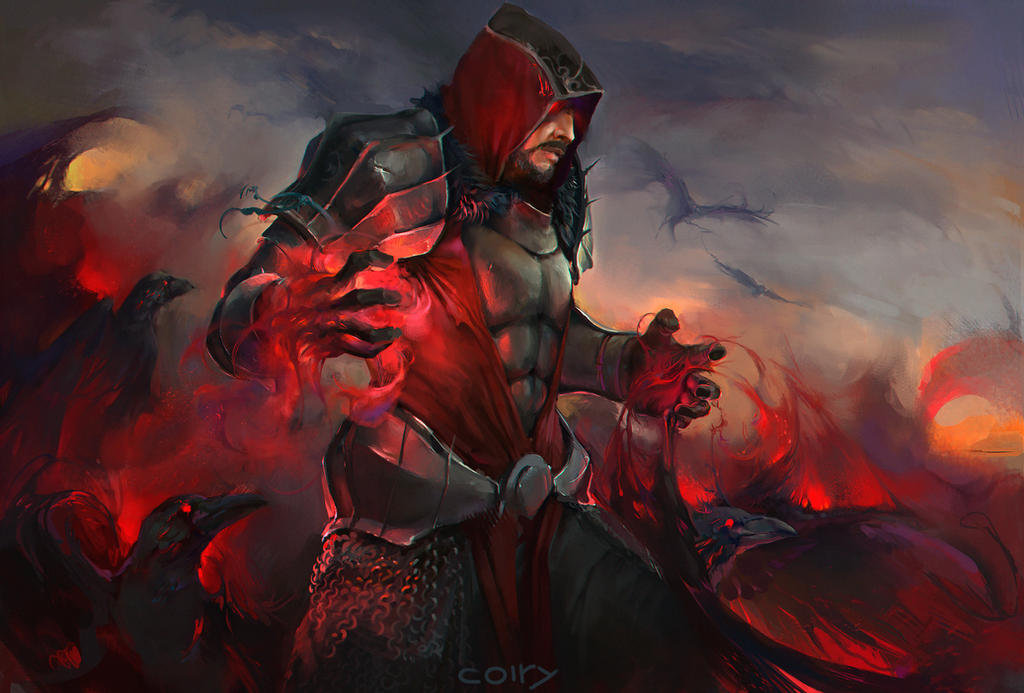

Blood Mage
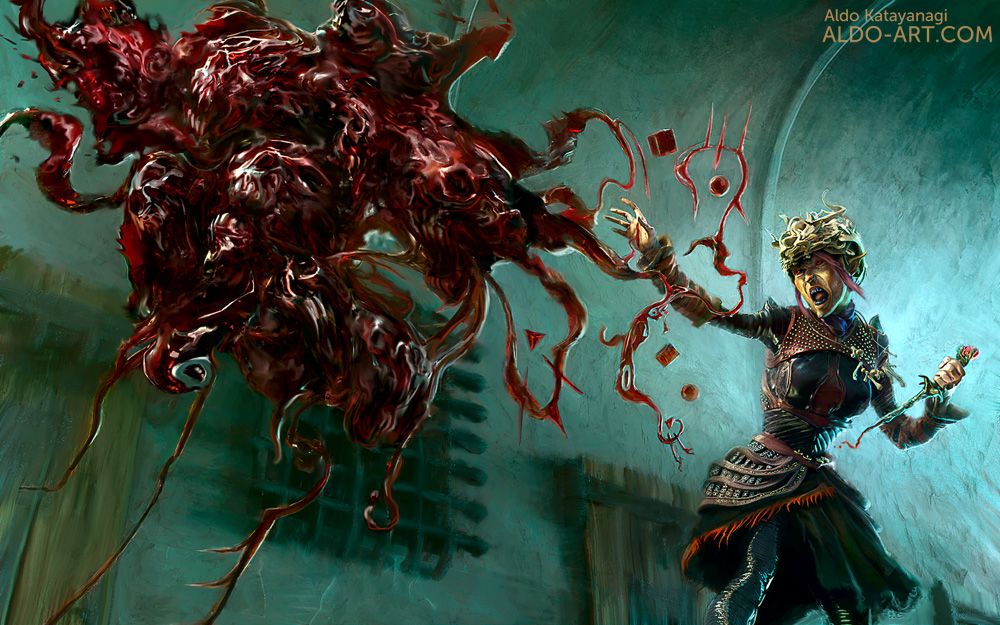
A female human, cloaked in fabric, peers down a corridor teeming with monstrosities, acutely aware that a single creature escaping will lead to countless innocent deaths. With an arm raised, she opens a wound on her palm and pulling blood from it with her knowledge of the weave to shape a wall of strings before her. The monstrosities charge forward into the wall, becoming entrenched in sticky crimson threads, preventing more creatures from charging forward.
A night sky, painted with clouds and stars, sits overhead as rain pours into the city streets before. A young elven man travels through the city alleyways, finding himself before 3 cloaked figures stepping out of the shadows. Each cloaked figure gives a gnarled toothy grin, lucky to find such easy prey to fill their pockets with coin. The elf charges forward, suddenly brandishing a pair of crimson-hued blades, and slitting the throats of the predators, dropping them to the ground before releasing his strange magic, and leaving only two streaks of blood splatter in his wake as he continues onward.
A cleric lies breathless in the center of the room, the ranger and barbarian in the corner of the room, a step away from the afterlife, as ghouls claw at them. The blood mage, standing over the cleric, ponders her options for a moment, and comes to only one conclusion. She gives herself a silent prayer, a sigh, and a faint smile, knowing she is about to sunder her soul for a good cause. The blood mage plunges her memento dagger into her heart, falling to her knees, the cleric's eyes illuminate with new life and fiery vigor, and the ranger and barbarian's wounds instantly wash away. The blood mage falls flatly on the ground still with a faint smile on her face as her soul is sucked away into oblivion.
blood mages utilize the weave that flows through their life and blood, or the blood of others, to manifest epic powers. They are learned scholars of the weave, and they use their knowledge to manipulate blood, as a sort of vessel for the weave. Each blood mage utilizes their power in a myriad of different ways, ranging from offensive, armor-clad warriors, to the most studious of arcane casters.
Art: Yharnam
(Bloodborne) by
Anato Finnstark
Quick Build
You can make a blood
mage quickly by following
these suggestions. First, if you
plan to play use magic or the
witch's curses as your primary
offense, make Intelligence your
highest ability score. If you are going to
be attacking at the front lines as a
knight, make Strength or Dexterity your
highest ability score. Make Constitution your
second highest ability score. Second, choose the
sage background.



The Blood Mage
| Level | Proficiency Bonus | Features |
|---|---|---|
| 1st | +2 | Crimson Soothsaying, Sacrament |
| 2nd | +2 | Lifeline, Sacrament Feature |
| 3rd | +2 | ─ |
| 4th | +2 | Ability Score Improvement |
| 5th | +3 | Adrenalized Degeneration |
| 6th | +3 | Sacrament Feature |
| 7th | +3 | — |
| 8th | +3 | Ability Score Improvement |
| 9th | +4 | Red Exoskeleton |
| 10th | +4 | Sacrament Feature |
| 11th | +4 | — |
| 12th | +4 | Ability Score Improvement |
| 13th | +5 | Iron Admonishment |
| 14th | +5 | Sacrament Feature |
| 15th | +5 | Sanguine Binder |
| 16th | +5 | Ability Score Improvement |
| 17th | +6 | — |
| 18th | +6 | Healing Abdication |
| 19th | +6 | Ability Score Improvement |
| 20th | +6 | Sacrament Feature |
Art: Blood Magic by Steve Argyle
Class Features
As a blood mage, you gain the following class features.
Hit Point
Hit Dice. 1d8 per blood mage level
Hit Points at 1st Level. 8 + your Constitution modifier
Hit Points at Higher Levels. 1d8 (or 5) + your Constitution modifier per blood mage level beyond 1st.
Proficiencies
Armor. Light armor
Weapons. Simple weapons
Saving Throws. Constitution, Intelligence
Skills. Choose two from Acrobatics, Athletics, Arcana, Medicine, Nature
Equipment
You start with the following equipment, in addition to the equipment granted by your background.
- (a) 2 daggers, (c) a simple weapon, or (b) a martial weapon (if proficient)
- (a) a shortbow and 20 arrows or (b) a shield (if proficient)
- (a) leather armor, (c) chain shirt (if proficient), or (b) chain mail (if proficient)
- (a) a dungeoneer's pack or (b) a scholar's pack
- (a) an arcane focus or (b) component pouch

Crimson Soothsaying
Your study of the life essence in all living creatures has given you keen insights that you derive from magic in the blood of humanoids. When you find humanoid blood, you can spend a minute concentrating on the magic of it to derive two of the following about the humanoid:
- Its race
- Its strongest emotion when its blood was shed
- If it was charmed, frightened, or poisoned
- The direction it was traveling when its blood was shed
Sacrament
When a blood mage enters into this study and manipulation of magic, they must choose which path they will follow. Each blood mage, regardless of their path, channels magic and blood, but each sacrament channels their blood into magic in very different ways. Not every path learns to cast magic as quickly as the magus, and none can parallel the battlefield prowess of the knight; each is vastly different from the other, and seldom few invoke their abilities for the same reason as another of their sacrament. Choose Sacrament of the Beckoner, Sacrament of the Knight, Sacrament of the Magus, or Sacrament of the Witch. Your choice grants you features at 1st level and again at 2nd, 6th, 14th, and 20th level.
Lifeline
At 2nd level, your study of arcana has learned you how to tug on the residual weave of recently deceased creatures. When you reduce a creature to 0 hit points, you can use a reaction to cause a crimson mist to erupt from the creature's body and enshroud you. You gain a number of temporary hit points equal to your Constitution modifier (minimum 1). If a creature is reduced to 0 hit points as part of a spell you cast using a spell slot of 1st level or higher, you can use you reaction to impart temporary hit points to up to 6 creatures, instead.
Ability Score Improvement
When you reach 4th Level, and again at 8th, 12th, 16th, and 19th level, you can increase one ability score of your choice by 2, or you can increase two Ability Scores of your choice by 1. As normal, you can’t increase an ability score above 20 using this feature.
Adrenalized Degeneration
At 5th level, if a blood mage feature causes you to lose hit points, you gain that many temporary hit points. While you have these temporary hit points, when you cast a blood mage spell that deals damage, you can use a bonus action to change the damage type to necrotic.
Additionally, necrotic damage you deal with spells of 1st-level or higher do double damage to structures and buildings.
Red Exoskeleton
At 9th level, you have learned to waste not when you rend your flesh for your magics. When a blood mage feature is used and reduces your hit points, you gain a bonus to AC equal to the amount of hit points lost until the beginning of your next turn.
Iron Admonishment
You have performed rites and trials on your own flesh, attempting to control your body further than is natural, and have found success. At 13th level, when you make an attack roll, or an attack roll would hit you, you can expend a hit die as a reaction. Roll the die and add or subtract it to the result and reduce your hit points by an equal amount, potentially causing the attack to hit or miss. If you cause an attack to miss you in this way, you can make an attack as part of the reaction. You can use this feature a number of times equal to your Constitution modifier. You regain all expended uses when you finish a long rest.
Sanguine Binder
Starting at 15th level, you've understood how blood has often functioned as a catalyser for magic, but have begun to unlock its secrets. You can draw a sigil made with the blood of a slain humanoid creature or creature with CR 1 greater as a ritual. The ritual fails if the creature has been dead for longer than 3 days. With 8 hours of work and 1000 gp worth of rare ritual materials, you inscribe a 10-foot radius blood sigil on the ground infused with magic, and inscribed with a unique sigil sequence. After the ritual, the blood used for the sigil turns to magical iron embossed in the surfacer the ritual was performed on, and the sigil becomes a permanent teleportation circle for you.
Additionally, you can cast the spell teleportation circle once per long rest without expending a spell slot. Casting it in this way can only teleport you to a permanent teleportation circle you created with this feature.
Healing Abdication
At 18th level, you understand just how much magic is packed into a single life, and, even more so, a soul, and how much can be done by sacrificing the vessel that carries it. As an action, you can manipulate the weave that runs through your body and life by ripping the weave out of it. Up to 6 allies of your choice regain all their hit points, neutralizes all poisons, cures all diseases, lifts any curses, and replaces damaged or missing organs or body parts, and each creature gain a bonus to AC and saving throws equal to your Intelligence modifier (minimum 1) for 1 minute. The weave that binds your life together is permanently severed, and your soul is ripped to pieces. Your hit points are reduced to 0, you die instantly, and you cannot be brought back to life by any means. Effects like death ward cannot prevent this.

Sacrament of the Beckoner
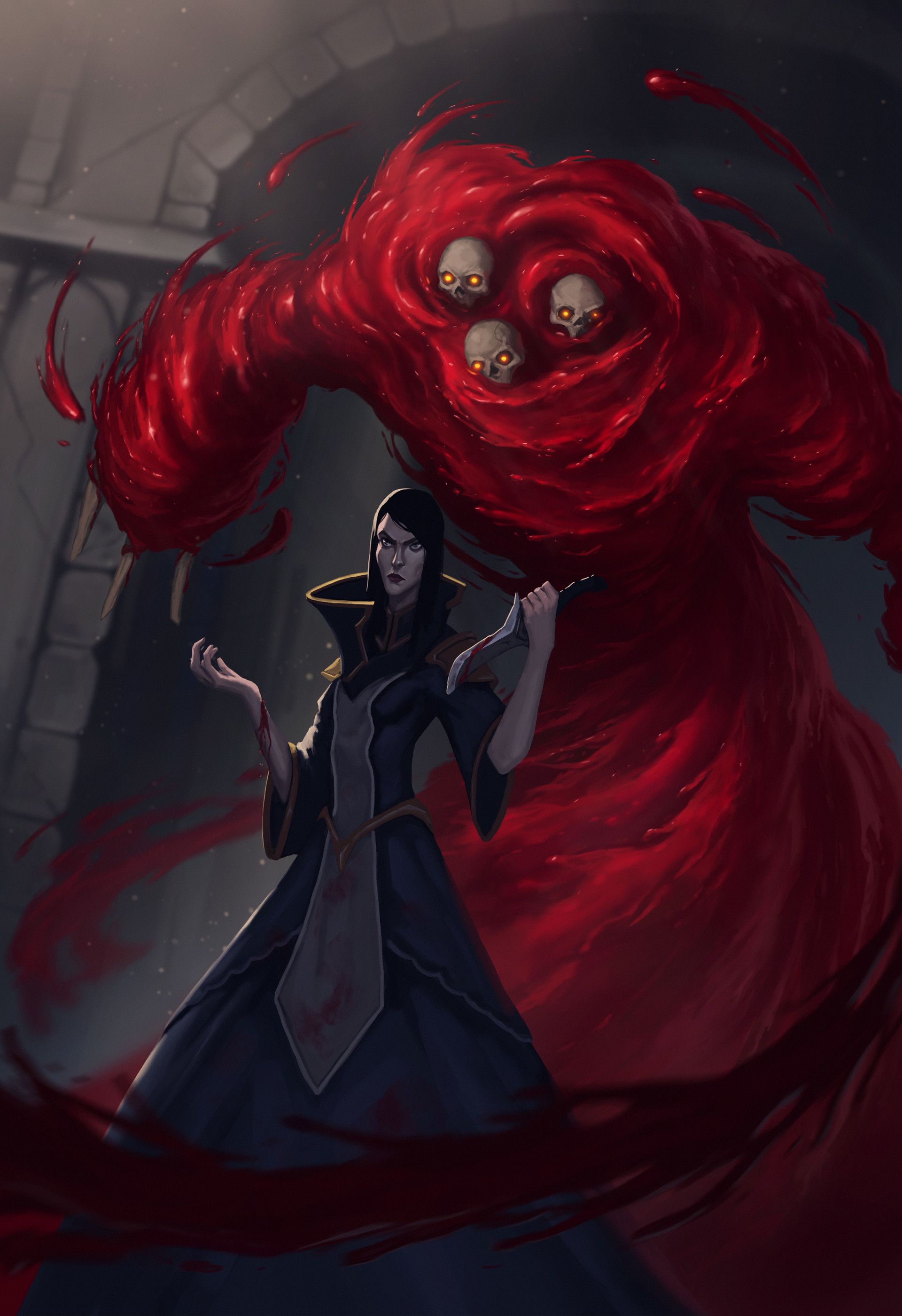
Willing consciousness and quasi-sentience into free blood is what sacrament beckoners are well known for. Some stories about them tell of creates makes of rotting flesh fulfilling their commands, or wispy darkness protecting their person. Their utilization of bodied objects does not disqualify them as mages, however, as they too can cast powerful magics, some leaving their foes desicated and rotting, other leaving smolders in their wake.
Sacrament of the Beckoner Features
| Blood Mage Level | Features |
|---|---|
| 1st | Bonus Proficiencies |
| 2nd | Blood Golem, Infusion, Spellcasting |
| 6th | Magic Golem, Mercurial Bloodform, Reconstructing Golem |
| 14th | Mercurial Bloodform Upgrade, Red Portal |
| 20th | Living Infusion |
Bonus Proficiencies
At 1st level, you understand the intelligence behind those who fear what they do not know or understand, and have thusly made the intelligent decision to guard yourself. You gain proficiency in medium armor.
Blood Golem
At 2nd level, you have learned how to shape and give semi-consciousness you control to unused blood as a golem in the form of your choice.
The golem is friendly to you and your companions and obeys your commands. See this creature's game statistics in the blood golem stat block. You determine the golem's appearance. You might shape it to look like a large dark red humanoid, or into a large crimson beast. It also gains proficiency in three saving throws of your choice (chosen when you gain this feature).
During combat, the golem shares your initiative count, but it takes its turn immediately after yours. The only action it takes on its turn is the dodge action unless you take a bonus action on your turn to command it to take one of the actions in its stat block or to take the Dash, Disengage, Help, or Hide action.
Infusion
At 2nd level, you've learned not only how to manifest a golem made of blood, but also how to infuse it with additional properties. You learn one infusion of your choice. The infusions are detailed at the end of the subclass description. You learn an additional infusion at 6th level, and again at 14th and 20th level.
Additionally, when you gain a level in the blood mage class, you can replace an infusion you know with another infusion you could learn at that level.
Blood Golem
Large construct, neutral
- Armor Class 15 (natural armor)
- Hit Points 2 + your Intelligence modifier + 5 times your blood mage level
- Speed 30ft.
STR DEX CON INT WIS CHA 14 (+2) 12 (+1) 14 (+2) 4 (-3) 10 (+0) 6 (-2)
- Damage Immunities Necrotic, Poison
- Condition Immunities Charmed, Exhausted, Poisoned
- Senses Darkvision 60ft.
- Languages Understands all languages you speak, but cannot talk
- Challenge —
- Proficiency Bonus (PB) equals your bonus
Amorphous. The golem is able to squeeze through spaces as narrow as 1 foot wide.
Immutable Form. The golem is immune to any spell or effect that would alter its form.
Magic Resistance. The golem has advantage on saving throws against spells and other magical effects.
Necrotic Absorption. Whenever the golem is subjected to necrotic damage, it takes no damage and instead gains hit points equal to the damage.
Actions
Rend. Melee Weapon Attack: your spell attack modifier to hit, reach 5ft., one target. Hit 2d6 + PB bludgeoning damage.
Spellcasting
As a scholar of Arcane Magic, you have learned how to prepare spells from your wealth of arcane knowlede.
Preparing and Casting Spells. The Blood Beckoner Spellcasting table shows how many Spell Slots you have to cast your Spells of 1st level and higher. To cast one of these Spells, you must expend a slot of the spell's level or higher. You regain all expended Spell Slots when you finish a Long Rest.
You prepare the list of blood mage Spells that are available for you to cast, choosing from the beckoner spell list. When you do so, choose a number of beckoner Spells equal to your Intelligence modifier + half your blood mage level (minimum of one spell). The Spells must be of a level for which you have Spell Slots.
For example, if you are a 5th-level blood mage, you have four 1st-level and two 2nd-level Spell Slots. With an Intelligence of 16, your list of prepared Spells can include eight Spells of 1st or 2nd level, in any combination. If you prepare the 1st-level spell cure wounds, you can cast it using a 1st-level or 2nd-level slot. Casting the spell doesn't remove it from your list of prepared Spells.
You can also change your list of prepared Spells when you finish a Long Rest. Preparing a new list of blood mage Spells requires time spent in studying: at least 1 minute per Spell Level for each spell on your list.
Spellcasting Ability. Intelligence is your Spellcasting Ability for your blood mage Spells, since you learn your Spells through dedicated study and memorization. You use your Intelligence whenever a spell refers to your Spellcasting Ability. In addition, you use your Intelligence modifier when setting the saving throw DC for a blood mage spell you cast and when Making an Attack roll with one.
Spell Save DC
Spell attack modifier
Spellcasting Focus. You can use an arcane focus (see chapter 5 of the Player's Handbook, "Equipment") as a Spellcasting focus for your blood mage Spells.
Scrament of the Beckoner Spellcasting
| Level | Cantrips | 1st | 2nd | 3rd | 4th | 5th |
|---|---|---|---|---|---|---|
| 2nd | 2 | 2 | — | — | — | |
| 3rd | 2 | 3 | — | — | — | — |
| 4th | 2 | 3 | — | — | — | — |
| 5th | 2 | 4 | 2 | — | — | — |
| 6th | 2 | 4 | 2 | — | — | — |
| 7th | 2 | 4 | 3 | — | — | — |
| 8th | 2 | 4 | 3 | — | — | — |
| 9th | 3 | 4 | 3 | 2 | — | — |
| 10th | 3 | 4 | 3 | 2 | — | — |
| 11th | 3 | 4 | 3 | 3 | — | — |
| 12th | 3 | 4 | 3 | 3 | — | — |
| 13th | 3 | 4 | 3 | 3 | 1 | — |
| 14th | 3 | 4 | 3 | 3 | 1 | — |
| 15th | 3 | 4 | 3 | 3 | 2 | — |
| 16th | 3 | 4 | 3 | 3 | 2 | — |
| 17th | 4 | 4 | 3 | 3 | 3 | 1 |
| 18th | 4 | 4 | 3 | 3 | 3 | 1 |
| 19th | 4 | 4 | 3 | 3 | 3 | 2 |
| 20th | 4 | 4 | 3 | 3 | 3 | 2 |
Magic Golem
At 6th level, the Blood Pet's attacks count as magical for the purpose of overcoming resistances and immunity to nonmagical attacks.
Additionally, you can use your bonus action to change your golem's rend attack damage type to bludgeoning, piercing or slashing damage, and your golem's attacks deal double damage to structures and buildings.
Mercurial Bloodform
At 6th level, as a bonus action, you can reshape your blood golem into three head-sized crimson orbs that hover around your body as a command. While in this form, your golem's rend attack has a range of 45 feet, and using your bonus action to command it to attack allows it to make two attacks. You can return the golem to its original form as a bonus action command.
At 14th level, you golem can be commanded as a bonus action to transform into lancet wings that float around your body. In this form, your blood golem's rend attacks has a reach of 15 feet and can attack twice as part of the attack action. While your golem floats around you in this way, you can hover up to a foot off the ground and you gain a +2 bonus to AC. You can command the golem to reform into any of these form as a bonus action.
Reconstructing Golem
By 6th level, your golem has learned how to repair itself using the blood of creatures it slays. When your blood golem reduces a creature to 0 hit points, you can roll one of it's hit die and it regains hit points equal to the result.
Red Portal
At 14th level, you learn how to use blood as a quick short distance way of transportation, but where time and gold are not the offering, something else must be. As an action, you can expend a spell slot and you or your golem (your choice) takes 1d6 necrotic damage per level of the spell slot expended to create a portal beneath you and your golem. You and your golem swap places, and each creature within 10 feet of where you and your golem appear take 1d10 necrotic damage per level of the spell slot expended. Damage you take this way ignores resistance. You have to be able to see your golem to use this feature.
Living Infusion
At 20th level, you have infused your golem with magic and life essence, changing how you can utilize it. Choose one of the following.
Living Armor. You've gained the ability to fuse with your blood golem, wearing it as armor and adopting its traits while you wear the golem in this way and the golem persists. You gain the following benefits:
- Your AC becomes the same as the golem's.
- Damage that would be dealt to you is dealt to the golem instead. If the golem dies, this effect ends.
- You gain the traits of the golem while fused with it.
- While fused with the golem, you gain the benefits of your mercurial bloodform feature without the need to command the golem.
- You can use your bonus action to make two rend attacks with the golem.
Living Prison. You have infused your golem with magic that turns its internal structure into a demiplane of suspended animation. You can command your golem to absorb a creature. The target must make a Wisdom saving throw. On a failed save, the creature is absorbed into the golem, and it falls into a state of suspended animation. Time ceases to flow for it, and it doesn't grow older. Additionally, it be targeted by divination spells or perceived through scrying sensors created by divination spells. On a success, the creature becomes immune to this effect for 24 hours. The golem can absorb up to 3 creatures this way, and each creature it absorbs increases its size by one category, up to gargantuan. The golem's rend attack deals an additional die of damage and its AC is reduced by 1 for each creature absorbed.
Infusions
If an infusion has a level prerequisite, it means your level in the blood mage class.
Bloodletter
Prerequisite: 7th level
The golem has advantage on attack rolls against creatures that have all their hit points. On a critical hit against a creature that has all its hit points, the golem deals an additional 4d6 necrotic damage.
Blood Bank
Prerequisite: 9th level
Your blood golem can cast the spell life transference once per long rest.
Corpse Factory
Prerequisite: 9th level
During a short or long rest, you can feed a corpse to your golem and create a zombie or skeleton over the course of an hour. The zombie or skeleton created is loyal to you and your commands, and takes the same course of action you command your golem to take. The zombie or skeleton lasts until its hit points are reduce to 0, or 24 hours has elapsed, after which it crumbles to dust.
Costly Rend
Prerequisite: 5th level
Before your golem makes a weapon attack, you can make the attack a costly rend. You can expend a hit die and roll it. You add the result to the attack or damage roll and you lose hit points equal to the result. You can only do so before it is determined to hit or not.
Hematopoietic Body
Prerequisite: 15th level
At the beginning of each of your turns, if your golem has less than half its hit points, it regains hit points equal to your proficiency bonus.
Hexblood Exterior
Your golem's exterior is covered in hexagonal plates made from the iron in its body. Its AC is increased by 2.
Living Hoard
Your golem gains the properties of a bag of holding, except that items stored in the golem do not get ejected if the golem is destroyed. If your golem is destroyed, items stored in the golem cannot be retrieved until you reform your golem.
Scaling Body
Your golem's size is reduced to medium. It can squeeze through spaces as narrow as 6 inches wide.
Septic Strike
When you golem hits a creature, before damage is dealt, you can change the damage type to poison.
Walking Cemetery
You can store dead bodies inside your golem. While stored inside your golem, dead bodies are under the effects of the gentle repose spell.

Beckoner Spell List
Cantrips (0 Level)
Acid Splash
Chill Touch
Dancing Lights
FrostbiteXG
InfestationXG
Light
Mending
Message
Minor Illusion
Prestidigitation
Ray of Frost
Shocking Grasp
Toll the DeadXG
1st Level
Cause FearXG
Comprehend Languages
Detect Magic
Fog Cloud
Ice KnifeXG
Identify
Mage Armor
Protection from Evil and Good
Ray of Sickness
Tenser's Floating Disk
2nd Level
Blindness/Deafness
BloodfliesBM
Continual Flame
Darkness
Darkvision
Nystul's Magic Aura
Ray of Enfeeblement
See Invisibility
Web
XG Xanathar's Guide to Everything
TC Tasha's Cauldron of Everything
BM Blood Mage
3rd Level
Life TransferenceXG
Sleet Storm
Spirit Shroud
Summon ShadowspawnTC
Summon UndeadTC
Tongues
Wall of SandXG
Wall of WaterXG
Water Breathing
Water Walk
Wind Wall
4th Level
Arcane Eye
Blight
Death Ward
Dominate Beast
Find Greater SteedXG
Grasping Vine
Storm SphereXG
Vitriolic SphereXG
Watery SphereXG
5th Level
Cloudkill
Contact Other Plane
Control WindsXG
Dance MacabreXG
Dominate Person
Enervation
Flesh Sculpt
Legend Lore
Negative Energy FloodXG
Steel Wind StrikeXG
Synaptic StaticBM
Teleportation Cirle
Sacrament of the Knight
The sacrament of the knight is centered around training one's mind and body as two halves of a whole. Strengthening their body with magically compacted with more iron, cultivating raiments and weapons from one's own torn flesh, and weaving blade and sorcery as an interchangeable arsenal.
Sacrament knights derive their lessons and teaching from the far traveled learning of groups like vampire warriors and idealogical texts like those created for the Blood of Vol.
Sacrament of the Knight Features
| Blood Mage Level | Feature |
|---|---|
| 1st | Bonus Proficiencies, Iron Body, Iron Shaper |
| 2nd | Fighting Style, Spellcasting |
| 6th | Extra Attack, Spellblood Knight |
| 14th | Crimson Bastion |
| 20th | Extra Attack II, |
Bonus Proficiencies
At 1st level, your studied have taught you the art of arcana, and your sacrament has taught you the art of combat. You gain proficiency in medium armor, heavy armor, shields, and martial weapons.
Iron Body
The blood that runs though your veins is magically augmented to be more dense with iron. Your hit point maximum increases by 2, and it increases by 1 every time you gain a level.
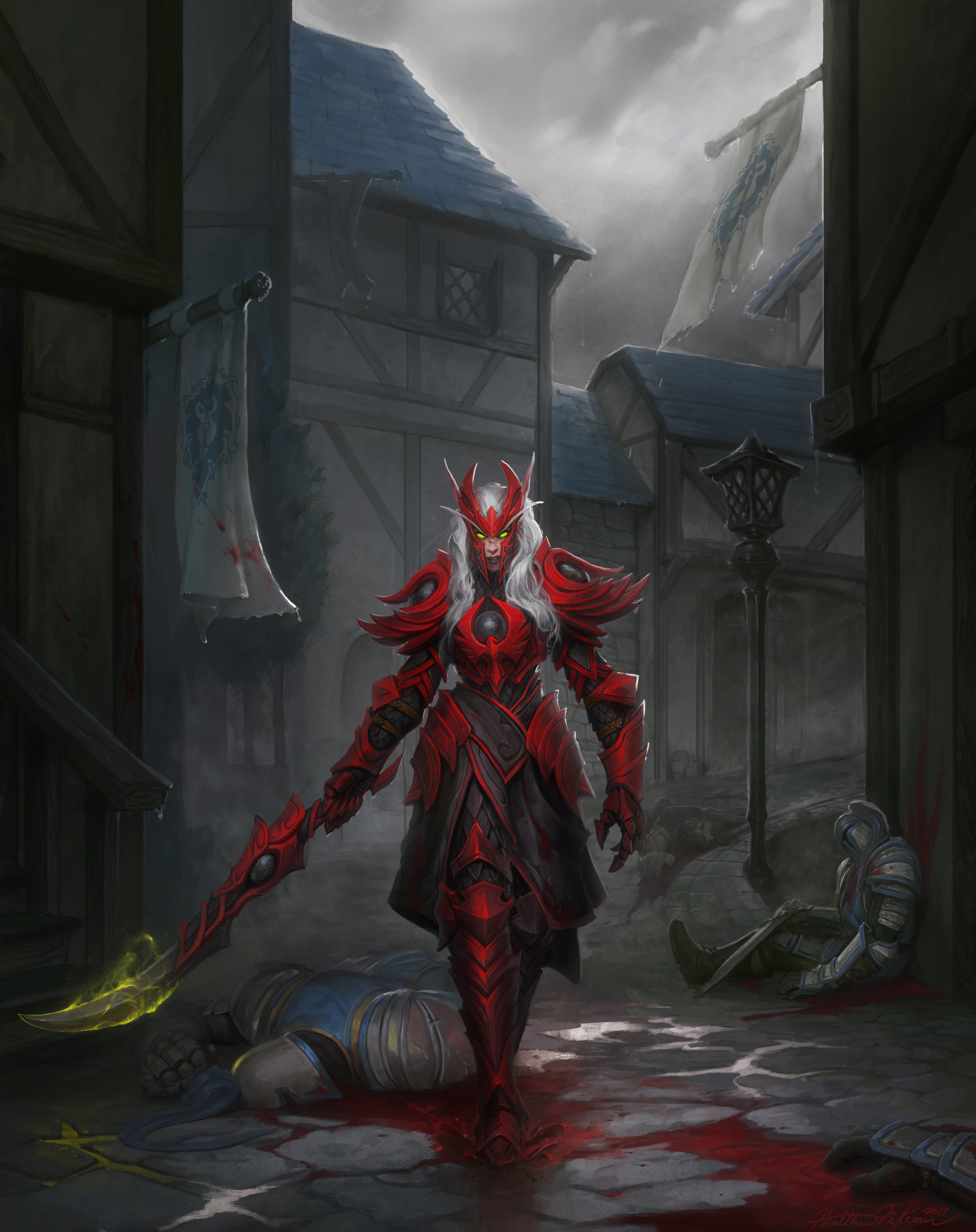
Art: Bloodknight by Matthew McKeown
Iron Shaper
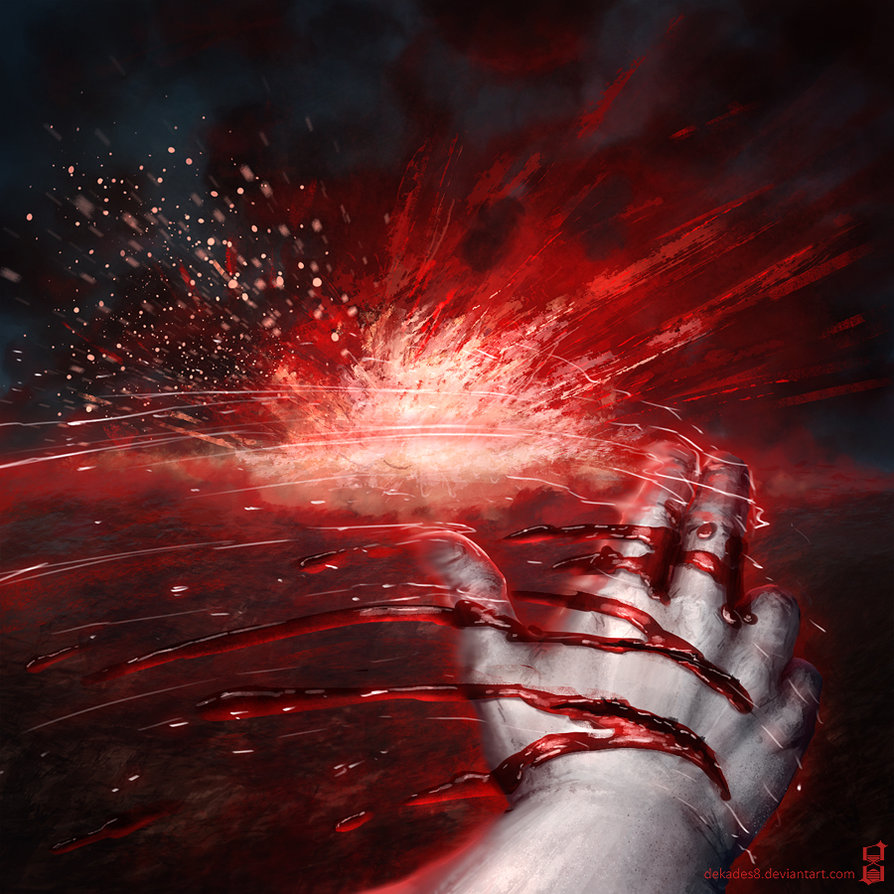
You've learned how to shape the iron in your flowing blood into tools of war. As an action, you can open a wound on your palms and will your blood into shape, creating one or more of the following effects:
- You conjure a bow in your free hands. It has a d8 for the damage die, and it has the two-handed trait with an effective range of 100 feet and a maximum range of 400 feet. The bow can create arrows from your blood or use provided arrows as normally.
- You conjure melee weapons in one or both of your free hands. A melee weapon created this way has a d6 for the damage die, and has the finesse, light, and thrown (20/60) properties. You can use a bonus action on your turn to reconstitute a weapon in a free hand.
- You conjure a shield in a free hand. You gain a +2 bonus to AC while you maintain the shield.
- You wreathe yourself in your blood. Your AC becomes 16 and you gain resistance to necrotic damage. You are treated as wearing metal armor.
When you use this feature to manifest your initial armaments, you expend a hit die and lose hit points equal to your proficiency bonus.
You are proficient in weapons created this way, they are treated as martial weapons, and damage dealt by weapons created this way is necrotic. You can change your armaments as a bonus action.
The blood that makes your armaments retreats into you body if you end this effect as a bonus action, fall unconscious, or die.
Additionally, as you gain levels in this class, armaments created by this feature become stronger. At 5th level, the bonus to AC the shield and armor created this way increases by 1, and weapons created this way have a
+1 bonus to attack and damage rolls. These
bonuses increase by 1 at 11th level
and 17th level.
Fighting Style
At 2nd level, you adopt a particular fighting style as your specialty. Choose one of the following options. You can't choose a fighting style more than once, even if you later get to choose again.
Defense. While you are wearing armor, you gain a +1 bonus to AC.
Dueling. When you are wielding a weapon in one hand and no other weapons, you gain a +2 bonus to the damage rolls with the weapon.
Interception. When a creature you can see hits a target that is within 5 feet of you with an attack, you can use your reaction to reduce the damage the target takes by 1d10 + your proficiency bonus (to a minimum of 0 damage). You must be wielding a shield or a simple or martial weapon to use this reaction.
Mage Knight. You learn two cantrips of your choice from the sacrament of the knight spell list. Intelligence is your spellcasting ability for them. Whenever you gain a level in this class, you can replace one of these cantrips with another cantrip from the blood mage spell list.
Shield Thrasher. Your shield counts as a simple weapon for you, and you are proficient with it. You use your Strength modifier for its attack and damage rolls. Its damage is blugeoning, and its damage die is a d6. It has the heavy property.
Thrown Weapon Fighting. You can draw a weapon that has the thrown property as part of the attack you make with the weapon.
In addition, when you hit with a ranged attack using a thrown weapon, you gain a +2 bonus to the damage roll.
Two-Weapon Fighting. When you engage in two-weapon fighting, you can add your ability modifier to the damage of the second attack.
Unarmed Fighting. Your unarmed strikes can deal bludgeoning damage equal to 1d6 + your Strength modifier. If you strike with two free hands, the d6 becomes a d8.
Additionally, when you successfully start a grapple, you can deal 1d4 bludgeoning damage to the grappled creature. Until the grapple ends, you can also deal this damage to the creature whenever you hit it with a melee attack.
Combat Discipline
2nd-level sacrament of the knight feature, which replaces the Fighting Style feature
You have mastered weapon swings and motions that you can weave together as beautifully as magic incantations. You gain three of the following maneuvers. You gain an additional maneuver at 9th level and 15th level. You can only augment an attack with one maneuver at a time. The saving throw for maneuvers you gain this way is equal to your spellcasting DC.
Disarming Strike. When you hit a creature with a weapon attack, you can augment the attack and the creature must make a Strength saving throw. On a failed save, it drops an object of your choice.
Distracting Strike. When you hit a creature with a weapon attack, you can augment the attack as a bonus action. The next attack against the target by a creature other than you has advantage.
Goading Strike. When you hit a creature with a weapon attack, you can augment the attack and the creature must make a Wisdom saving throw. On a failed save, the target has disadvantage on attack rolls against creatures other than you.
Grappling Strike. When you hit a creature with a weapon attack, you can augment the attack and make a grapple check against the target as a bonus action.
Menacing Attack. When you hit a creature with a weapon attack roll, you can augment the attack as a bonus action and the target must make a Wisdom saving throw. On a failed save, the target is frightened of you until the beginning of your next turn.
Parry. When you hit a creature with a weapon attack roll, you can augment the attack and forgo an attack you would make with your attack action this turn. If you do, the next time you would take damage that is not force or psychic damage, you can make a damage roll with a melee weapon you are holding and reduce the damage you take by the rolled amount.
Pushing Attack. When you hit a creature with a weapon attack, you can augment the attack as a bonus action and the target must make a Strength saving throw. On a failed save, you push the target up to 15 feet away from you in a straight line.
Trip Attack. When you hit a creature that is larger or smaller with a weapon attack, you can augment the attack as a bonus action and the target must make a Strength saving throw. On a failed save, you knock the target prone.
Sacrament of the Knight Spellcasting
| Level | 1st | 2nd | 3rd | 4th | 5th |
|---|---|---|---|---|---|
| 2nd | 2 | — | — | — | |
| 3rd | 3 | — | — | — | — |
| 4th | 3 | — | — | — | — |
| 5th | 4 | 2 | — | — | — |
| 6th | 4 | 2 | — | — | — |
| 7th | 4 | 3 | — | — | — |
| 8th | 4 | 3 | — | — | — |
| 9th | 4 | 3 | 2 | — | — |
| 10th | 4 | 3 | 2 | — | — |
| 11th | 4 | 3 | 3 | — | — |
| 12th | 4 | 3 | 3 | — | — |
| 13th | 4 | 3 | 3 | 1 | — |
| 14th | 4 | 3 | 3 | 1 | — |
| 15th | 4 | 3 | 3 | 2 | — |
| 16th | 4 | 3 | 3 | 2 | — |
| 17th | 4 | 3 | 3 | 3 | 1 |
| 18th | 4 | 3 | 3 | 3 | 1 |
| 19th | 4 | 3 | 3 | 3 | 2 |
| 20th | 4 | 3 | 3 | 3 | 2 |
Spellcasting
When you reach 2nd level, your understanding of the arcane and the weave has allowed you to cast spells, much the same wat that a wizard does.
Preparing and Casting Spells. The Blood Knight Spellcasting table shows how many Spell Slots you have to cast your Spells of 1st level and higher. To cast one of these Spells, you must expend a slot of the spell's level or higher. You regain all expended Spell Slots when you finish a Long Rest.
You prepare the list of blood mage Spells that are available for you to cast, choosing from the knight spell list. When you do so, choose a number of knight Spells equal to your Intelligence modifier + half your blood mage level rounded up (minimum of one spell). The Spells must be of a level for which you have Spell Slots.
For example, if you are a 5th-level blood mage, you have four 1st-level and two 2nd-level Spell Slots. With an Intelligence of 16, your list of prepared Spells can include six Spells of 1st or 2nd level, in any combination. If you prepare the 1st-level spell cure wounds, you can cast it using a 1st-level or 2nd-level slot. Casting the spell doesn't remove it from your list of prepared Spells.
You can also change your list of prepared Spells when you finish a Long Rest. Preparing a new list of blood mage Spells requires time spent in studying: at least 1 minute per Spell Level for each spell on your list.
Spellcasting Ability. Intelligence is your Spellcasting Ability for your blood mage Spells, since you learn your Spells through dedicated study and memorization. You use your Intelligence whenever a spell refers to your Spellcasting Ability. In addition, you use your Intelligence modifier when setting the saving throw DC for a blood mage spell you cast and when Making an Attack roll with one.
Spell Save DC
Spell attack modifier
Spellcasting Focus. You can use an arcane focus (see chapter 5 of the Player's Handbook, "Equipment") as a Spellcasting focus for your blood mage Spells.
Extra Attack
Starting at 6th level, you can attack twice, instead of once, whenever you take the Attack action on your turn.
The number of attacks increase to three when you reach 20th level in this class.
Spellblood Knight
At 6th level, your blood has transcended human norms as your blood has become magic itself. Each blood knight's blood manifests in one of three forms. Choose one of the following.
Crimson Coating. As a bonus action, you can inflict a wound upon yourself to coat your weapon in poisoned blood. Your hit point maximum is reduced by your proficiency bonus, and your weapon attacks deal an additional 1d6 poison damage for 1 minute. After you use this feature, you can't use it again until you finish a short or long rest.
Spellblade Striker. When you cast a cantrip with a casting time of 1 action, you can make a weapon attack as part of the action.
Weave Coating. As an action, you can infuse your weapon with a spell that has a casting time of 1 action and make a weapon attack against a creature within melee range. If the spell is 1st-level or higher, you must expend a spell slot to do this. On a hit, the creature becomes the target of the spell or where the spell is centered, and the target has disadvantage on any saving throw against the spell.
Crimson Bastion
While you are wearing armor created by the Iron-Shaper feature, nonmagical bludgeoning, piercing, and slashing damage you take is reduced by half your proficiency bonus, rounded down.
Additionally, as a reaction when a creature within 10 feet of you is hit by an attack, you can impart your armor made by the Iron-Shaper feature onto that creature. Until the beginning of your next turn, you lose the benefits of the armor and the target gains the benefits of the armor, possibly making the attack miss. You can use this trait a number of times equal to your proficiency bonus.
Sacrament Sovereign
At 20th level, you learn how to form armaments from the crimson ties that bind, allowing feats never before seen. Choose from one of the following options.
Blood Giant. As a bonus action, you can embody the effects of the spell enlarge. The effects last until you end them as a bonus action. While in this large form, you can make a melee weapon attack in a 10-foot line using a melee weapon you're holding. You make a separate attack roll for each creature in the line. You can only use this attack one per turn.
Crimson Corrupter. When you deal damage to a creature with a weapon made with Iron-Shaper, it must make a Constitution saving throw against your spell save DC. On a failed save, the creature is poisoned. A poisoned creature repeats the save at the end of each of its turns. If you would deal damage to a poisoned creature, it takes an additional 4d8 poison damage.
You may change your choice when you finish a long rest.
Knight Spell List
Cantrips (0 Level)
Acid Splash
Blade Ward
Booming BladeTC
Chill Touch
Dancing Lights
Friends
Frostbite
Green-Flame BladeTC
Light
Mending
Message
Mind SliverTC
Minor Illusion
Poison Spray
Prestidigitation
Shocking Grasp
Sword BurstTC
ThunderclapXG
True Strike
1st Level
Absorb ElementsXG
Alarm
Cause FearXG
Color Spray
Comprehend Languages
Detect Magic
Identify
Mage Armor
Protection from Evil and Good
Ray of Sickness
Snare
XG Xanathar's Guide to Everything
TC Tasha's Cauldron of Everything
BM Blood Mage
2nd Level
Blindness/Deafness
BloodfliesBM
Blur
Continual Flame
Darkvision
Enlarge/Reduce
Invisibility
Levitate
Magic Weapon
Mirror Image
Ray of Enfeeblement
Shadow BladeXG
Spider Climb
3rd Level
Counterspell
Dispel Magic
Elemental Weapon
Fear
Flame ArrowsXG
Gaseous Form
Haste
Life TransferenceXG
Sinovial SnapBM
Spirit ShroudTC
ThunderstepXG
Tongues
Wall of SandXG
Wall of WaterXG
Water Breathing
Water Walk
Wind Wall
4th Level
Banishment
Blight
Death Ward
Elemental BaneXG
Find Greater SteedXG
Freedom of Movement
Polymorph
Stoneskin
5th Level
Antilife Shell
Contact Other Plane
Dance MacabreXG
Enervation
Flesh SculptBM
Legend Lore
Negative Energy Flood
Skill EmpowermentXG
Synaptic StaticBM
Telekinesis
Sacrament of the Magus
Sacrament Magi use their very blood, the thing so very infused with magic and the weave, to power their learned abilities. They are nearly unparalleled in their understanding, and nearly as dangerous because they can be just as likely to use their own blood for spellcraft as the life essence of their enemies on the battlefield.
Sacrament masters are able to hone their magic in the red essence others, giving their spells even deadlier affects, or marksmen like accuracy. Not much is known about their order, as most who battle them are seldom seen alive, again.
Sacrament of the Magus Features
| Blood Mage Level | Feature |
|---|---|
| 1st | Spellcasting |
| 2nd | Blood Magic |
| 6th | Bloodleter Casting |
| 14th | Malevolent Leech |
| 20th | Bloodhunt Spellcraft |
Spellcasting
Startin at first level, you have invested yourself in learnig Arcane Magic as a scholar, and you have learned how to prepare spells from your wealth of arcane knowlede.
Cantrips. At 1st level, you know two Cantrips of your choice from the magus spell list. You learn an additional magus Cantrip of your choice at 4th level, and again at 10th level.
Preparing and Casting Spells. The Blood Magus Spellcasting table shows how many Spell Slots you have to cast your Spells of 1st level and higher. To cast one of these Spells, you must expend a slot of the spell's level or higher. You regain all expended Spell Slots when you finish a Long Rest.
You prepare the list of blood mage Spells that are available for you to cast, choosing from the magus spell list. When you do so, choose a number of magus Spells equal to your Intelligence modifier + your blood mage level (minimum of one spell). The Spells must be of a level for which you have Spell Slots.
For example, if you are a 3rd-level blood mage, you have four 1st-level and two 2nd-level Spell Slots. With an Intelligence of 16, your list of prepared Spells can include six Spells of 1st or 2nd level, in any combination. If you prepare the 1st-level spell cure wounds, you can cast it using a 1st-level or 2nd-level slot. Casting the spell doesn't remove it from your list of prepared Spells.
You can also change your list of prepared Spells when you finish a Long Rest. Preparing a new list of blood mage Spells requires time spent in studying: at least 1 minute per Spell Level for each spell on your list.
Spellcasting Ability. Intelligence is your Spellcasting Ability for your blood mage Spells, since you learn your Spells through dedicated study and memorization. You use your Intelligence whenever a spell refers to your Spellcasting Ability. In addition, you use your Intelligence modifier when setting the saving throw DC for a blood mage spell you cast and when Making an Attack roll with one.
Spell Save DC
Spell attack modifier
Ritual Casting. You can cast an blood mage spell as a ritual if that spell has the ritual tag and you have the spell prepared.
Spellcasting Focus. You can use an your blood as a Spellcasting focus for your blood mage Spells.
Sacrament of the Magus Spellcasting
| Level | Cantrips Known | 1st | 2nd | 3rd | 4th | 5th | 6th | 7th | 8th | 9th |
|---|---|---|---|---|---|---|---|---|---|---|
| 1st | 2 | 2 | — | — | — | — | — | — | — | — |
| 2nd | 2 | 3 | — | — | — | — | — | — | — | — |
| 3rd | 2 | 4 | 2 | — | — | — | — | — | — | — |
| 4th | 3 | 4 | 3 | — | — | — | — | — | — | — |
| 5th | 3 | 4 | 3 | 2 | — | — | — | — | — | — |
| 6th | 3 | 4 | 3 | 3 | — | — | — | — | — | — |
| 7th | 3 | 4 | 3 | 3 | 1 | — | — | — | — | — |
| 8th | 3 | 4 | 3 | 3 | 2 | — | — | — | — | — |
| 9th | 3 | 4 | 3 | 3 | 3 | 1 | — | — | — | — |
| 10th | 4 | 4 | 3 | 3 | 3 | 2 | — | — | — | — |
| 11th | 4 | 4 | 3 | 3 | 3 | 2 | 1 | — | — | — |
| 12th | 4 | 4 | 3 | 3 | 3 | 2 | 1 | — | — | — |
| 13th | 4 | 4 | 3 | 3 | 3 | 2 | 1 | 1 | — | — |
| 14th | 4 | 4 | 3 | 3 | 3 | 2 | 1 | 1 | — | — |
| 15th | 4 | 4 | 3 | 3 | 3 | 2 | 1 | 1 | 1 | — |
| 16th | 4 | 4 | 3 | 3 | 3 | 2 | 1 | 1 | 1 | — |
| 17th | 4 | 4 | 3 | 3 | 3 | 2 | 1 | 1 | 1 | 1 |
| 18th | 4 | 4 | 3 | 3 | 3 | 2 | 1 | 1 | 1 | 1 |
| 19th | 4 | 4 | 3 | 3 | 3 | 2 | 2 | 1 | 1 | 1 |
| 20th | 4 | 4 | 3 | 3 | 3 | 2 | 2 | 2 | 1 | 1 |
Blood Magic
Starting at 2nd level, you can use your life force to fuel aracane alterations you make for spells at a moments notice. Knowledge for these arcane alterations is both hard to come by, and hard to invent. You gain two of the following Blood Magic options of your choice, which are detailed below.
You learn another Blood Magic option at 10th and 17th level. When you gain a level in this class, you can replace a Blood Magic option you know with a different one.
You gain 2 blood points. You gain an additional blood point every time you gain a level in this class. When you expend a number of blood points, you lose an equal amount of hit points. You regain any expended blood points when you finish a long rest.
When you cast a spell, you can alter the spell with a Blood Magic option you know. You can alter a spell with only one Blood Magic option at a time, unless the option states otherwise.
Deadly Spell. You can spend 1 blood point to add your Intelligence modifier to the damage roll of the spell. If you would make multiple spell attacks with the spell, add your Intelligence modifier to each damage roll.
Empowered Spell. When you roll damage for the spell, you can spend 1 blood point to reroll a number of the damage dice up to your Intelligence modifier (minimum one). You must use the new rolls.
You can use empowered spell even if you have used a different blood magic option during the casting of the spell.
Extended Spell. When you cast a spell that has a duration of 1 minute or longer, you can expend 1 blood point to double its duration, to a maximum of 24 hours.
Guided Spell. You can expend 1 blood point to gain advantage on all spell attacks you make with the spell.
Heightened Spell. When you cast a spell that forces a creature to make a saving throw to resist its effects, you can expend 3 blood points to give one target of the spell disadvantage on the first saving throw it makes against the spell.
Hemmoraging Spell. When you cast a spell with a duration of 1 minute or longer, you can spend 2 blood points to cause a target creature to hemmorage blood. For the duration of the spell, the target cannot regain hit points.
Reverberating Spell. You can spend 2 blood points when you cast a spell using a spell slot of 1st-level or higher. Until the beginning of your next turn, you may cast a cantrip as a bonus action.
Rider Spell. You can spend a 3 blood points to cast an additional spell as part of the same action. Each spell must have a casting time of 1 action, target only one creature, and must target the same creature. The second spell must use a lower level spell slot, with a maximum level equal to your Intelligence modifier. The lower level spell takes effect after the higher level one. For example, a 1st-level magic missle and a1st-level scorching ray are not eligble with this option, but a 4th-level geas and 3rd-level bestow curse can be cast as part of the same action.
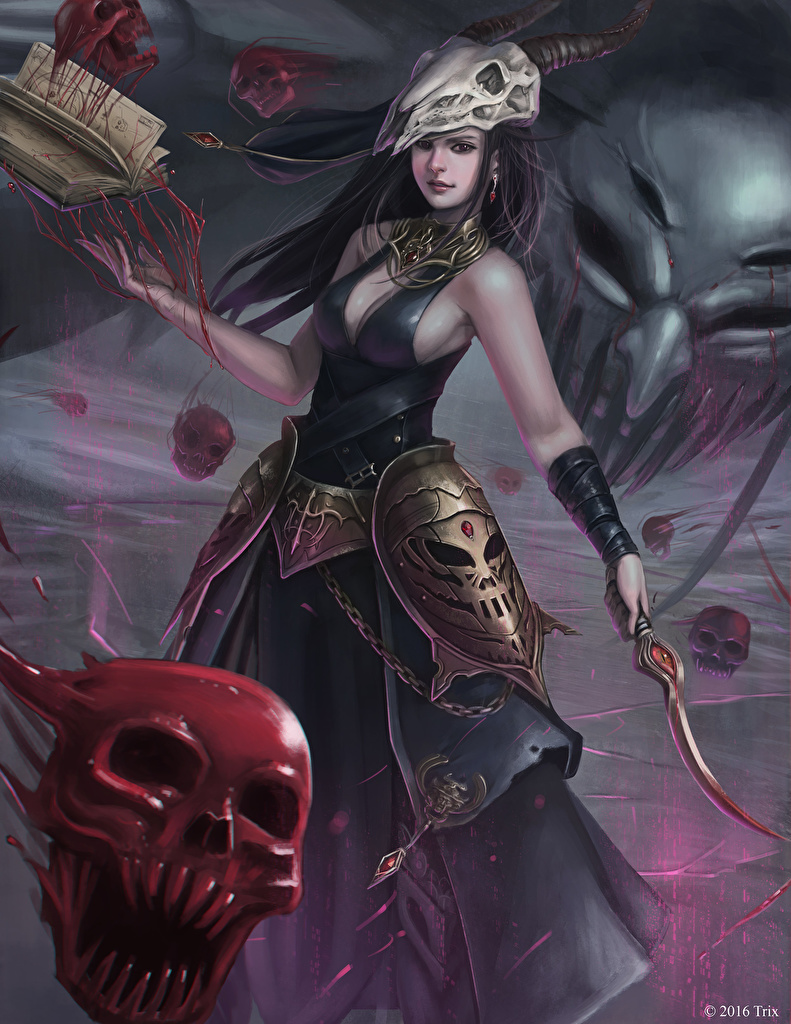

Bloodletter Casting
Starting at 6th level, you have learned how to funnel magic from your lifeforce into powerfull spellcraft, allowing you to exeed the limits of any ordinary user of the weave. When you cast a spell using a spell slot of
1st-level of higher, you can reduce your hit points
by 5 to treat the level of the spell slot expended
as being 1 level higher (maximum 5th-level).
The new level of the spell must be of a level
you could cast normally to use this feature.
You can use this feature a number of times
equal to your proficiency bonus. You regain any
expended uses when you finish a long rest. For
example, if you cast the 1st-level spell witch bolt
at 2nd level using this feature, you still only
expend a 1st level spell slot.
Malevolent Leech
At 14th level, your body begins to emit an aura that occasionally leeches the weave from your enemies, making you stronger. During combat, roll a d20 at the start of each of your turns. On a 20, you regain a 1st-level spell slot and gain a number of temporary hit points equal to your proficiency bonus. On a 1, a creature of your choice within 30 feet of you takes an amount of necrotic damage equal to your proficiency bonus, and until the beginning of your next turn, you can cast cantrips with a casting time of 1 action as a bonus action.
Bloodhunt Spellcraft
At 20th level, you've learned how to use residual
magic to imbue harm and prolong spells. You
gain the following traits:
Miserable Spells. When a creature succeeds
on a saving throw against a spell you cast
with a casting time of 1 action, the creature
takes necrotic damage equal to your
proficiency bonus.
Reiterative Spells. When a creature under
the effects of one of your spells is reduced
to 0 hit points, if the spell requires
concentration, you can use your reaction
to move the spell onto another target
within range. The target makes a saving
throw against the spell, if the spell
requires a saving throw. If the spell
persists, it persists until the creature
succeeds on its saving throw, you
lose concentration, or enough time
has elapsed since the spell's
initial casting to end naturally.
For example, if a creature under the
effects of suggestion dies after 2 hours
have elapsed, you can transfer the spell to
another creature as a reaction, and, if the
creature fails the Wisdom saving throw, the
spell persists for 6 hours, until you lose
concentration, or the creature dies.
Magus Spell List
Cantrips (0 Level)
- Acid Splash
- Blade Ward
- Booming BladeTC
- Chill Touch
- Dancing Lights
- FrostbiteXG
- Green-Flame BladeTC
- Infestation*
- Light
- Mending
- Message
- Mind SliverTC
- Minor Illusion
- Poison Spray
- Prestidigitation
- Ray of Frost
- Shocking Grasp
- Sword BurstTC
- ThunderclapXG
- Toll the DeadXG
- True Strike
1st Level
- Absorb ElementsXG
- Alarm
- Cause FearXG
- Charm Person
- Chromatic Orb
- Color Spray
- Comprehend Languages
- Detect Magic
- Fog Cloud
- Ice KnifeXG
- Identify
- Mage Armor
- Protection from Evil and Good
- Ray of Sickness
- SnareXG
- Tasha's Caustic BrewTC
- Tasha's Hideous Laughter
- Tenser's Floating Disk
2nd Level
- Alter Self
- Blindness/Deafness
- BloodfliesBM
- Blur
- Continual Flame
- Crown of Madness
- Darkness
- Darkvision
- Enlarge/Reduce
- Hold Person
- Invisibility
- Levitate
- Magic Weapon
- Mind SpikeXG
- Mirror Image
- Tasha's Mind WhipTC
- Nystul's Magic Aura
- Ray of Enfeeblement
- Scorching Ray
- See Invisibility
- Shadow BladeXG
- Shatter
- Spider Climb
- Suggestion
- Web
3rd Level
- Bestow Curse
- Counterspell
- Dispel Magic
- Elemental Weapon
- Enemies AboundXG
- Fear
- Flame ArrowsXG
- Gaseous Form
- Glyph of Warding
- Haste
- Hypnotic Pattern
- Intellect FortressTC
- Life Transference*
- Major Image
- Sending
- Sinovial SnapBM
- Sleet Storm
- Speak with Dead
- Spirit ShroudTC
- Summon ShadowspawnTC
- Summon UndeadTC
- Thunder StepXG
- Tongues
- Wall of SandXG
- Wall of WaterXG
- Water Breathing
- Water Walk
- Wind Wall
4th Level
- Arcane Eye
- Banishment
- Blight
- Charm MonsterXG
- Confusion
- Death Ward
- Dominate Beast
- Elemental BaneXG
- Freedom of Movement
- Grasping Vine
- Ice Storm
- Polymorph
- Stoneskin
- Storm SphereXG
- Vitriolic SphereXG
- Watery SphereXG
5th Level
- Antilife Shell
- Cloudkill
- Contact Other Plane
- Contagion
- Control WindsXG
- Dance MacabreXG
- Dominate Person
- EnervationXG
- Far Step*
- Flesh SculptBM
- Geas
- Hold Monster
- ImmolationXG
- Legend Lore
- Negative Energy FloodXG
- Scrying
- Seeming
- Skill EmpowermentXG
- Steel Wind StrikeXG
- Synaptic StaticXG
- Telekinesis
- Teleportation Circle
- Wall of Force
- Wall of LightXG
- Wall of Stone
6th Level
- Arcane Gate
- Create HomunculusXG
- Investiture of FlameXG
- Investiture of IceXG
- Investiture of StoneXG
- Investiture of WindXG
- Mental PrisonXG
- ScatterXG
- Soul CageXG
- Tenser's TransformationXG
7th Level
- Crown of StarsXG
- Dream of the Blue VeilTC
- Power Word PainXG
8th Level
- Maddening DarknessXG
- Mighty FortressXG
9th Level
- Blade of DisasterTC
- InvulnerabilityXG
- Mass PolymorphXG
- Psychic ScreamXG
XG Xanathar's Guide to Everything
TC Tasha's Cauldron of Everything
BM Blood Mage
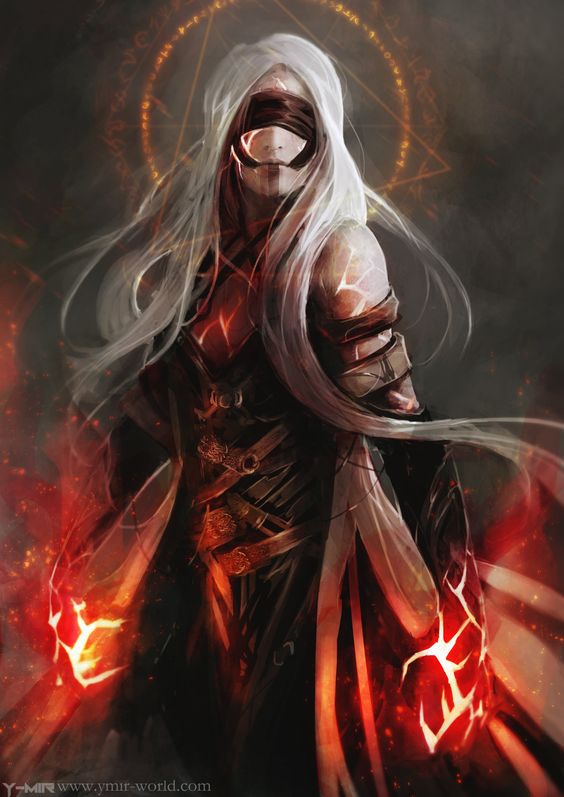

Sacrament of the Witch
Blood Mages of the Witch Sacrament utilize their magics, and their life forces, to curse and hex others. Some of their magics are short lived, where skilled practitioners can extend the half-life of their malisons to minutes, hours, months, and sometimes entire lifetimes. They are not the most skilled fighters or the most versatile of mages, making their study and application much more tactical compared to the other sacraments.
Sacrament of the Witch Features
| Blood Mage Level | Feature |
|---|---|
| 1st | Bonus Proficiencies, Shaman Magic |
| 2nd | Sacramental Vigor, Witch's Curse |
| 6th | Extra Attack, Imprecations, Malevolent Benefactor, Reverberating Malison |
| 14th | Epic Magic, Maledictions, |
| 20th | Eternal Maledictions, Witch's Zenith |
Bonus Proficiencies
At 1st level, you are aware of the dangers the world possess against those who would curse others, as well as the applications of crafting reagents. You gain proficiency in Medicine, medium armor and shields, and herbalism kits or brewer's supplies.
Shaman Magic
Your delve into the vast through research, note
taking, trial, and error has gained you the ability
to cast spells. See Spells Rules for the general
rules of spellcasting.
Preparing and Casting Spells.
The Witch
Spellcasting table shows how many Spell Slots
you have to cast your Spells of 1st level and
higher. To cast one of these Spells, you must
expend a slot of the spell's level or higher. You
regain all expended Spell Slots when you
finish a Short or Long Rest.
You prepare the list of witch Spells that
are available for you to cast, choosing from
the witch spell list. When you do so, choose
a number of witch Spells equal to your
Intelligence modifier + half your blood
mage level rounded up (minimum of one
spell). The Spells must be of a level for
which you have Spell Slots.
For example, if you are a 5th-level blood
mage, you have one 1st-level, one
2nd-level, and one 3rd-level Spell Slot.
With an Intelligence of 16, your list of
prepared Spells can include six 1st,
2nd and 3rd level spells, in any
combination. If you prepare the 1st-level
spell cure wounds, you can cast it using a
1st-level, 2nd-level, or 3rd-level slot.
Casting the spell doesn't remove it from
your list of prepared Spells.
You can also change your list of prepared Spells when you finish a Long Rest. Preparing a new list of blood mage Spells requires time spent in studying: at least 1 minute per Spell Level for each spell on your list.
Spellcasting Ability. Intelligence is your Spellcasting Ability for your blood mage Spells, since you learn your Spells through dedicated study and memorization. You use your Intelligence whenever a spell refers to your Spellcasting Ability. In addition, you use your Intelligence modifier when setting the saving throw DC for a blood mage spell you cast and when Making an Attack roll with one.
Spell Save DC
Spell attack modifier
Spellcasting Focus. You can use an arcane focus (see chapter 5 of the Player's Handbook, "Equipment") as a Spellcasting focus for your blood mage Spells.
Sacrament of the Witch Spellcasting
| Level | 1st | 2nd | 3rd | 4th | 5th |
|---|---|---|---|---|---|
| 1st | 1 | — | — | — | — |
| 2nd | 1 | — | — | — | |
| 3rd | 1 | 1 | — | — | — |
| 4th | 1 | 1 | — | — | — |
| 5th | 1 | 1 | 1 | — | — |
| 6th | 1 | 1 | 1 | — | — |
| 7th | 1 | 1 | 1 | 1 | — |
| 8th | 1 | 1 | 1 | 1 | — |
| 9th | 1 | 1 | 1 | 1 | 1 |
| 10th | 1 | 1 | 1 | 1 | 1 |
| 11th | 1 | 1 | 1 | 1 | 1 |
| 12th | 1 | 1 | 1 | 1 | 1 |
| 13th | 1 | 1 | 1 | 1 | 1 |
| 14th | 1 | 1 | 1 | 1 | 1 |
| 15th | 1 | 1 | 1 | 1 | 1 |
| 16th | 1 | 1 | 1 | 1 | 1 |
| 17th | 1 | 1 | 1 | 1 | 1 |
| 18th | 1 | 1 | 1 | 1 | 1 |
| 19th | 1 | 1 | 1 | 1 | 1 |
| 20th | 1 | 1 | 1 | 1 | 1 |
Sacramental Vigor
At 2nd level, when you finish a short rest, you regain a number of expended hit dice equal to your Constitution modifier up to your maximum, and you regain all expended hit dice when you finish a long rest.
Witch's Curse
As a mage, you have studied both magical theory and anatomy, even delving into the peerless abyss that is magical knowledge, and some cadavers. Such efforts have learned you the way of creating simple curses that acts as hindrance on the battlefield. Continued study will only increase you ability to apply your craft on a larger scale.
Curses. You learn four curses of your choice that you can utilize at the elevation of Cess. The curses are detailed at the end of the subclass description. You can only use one curse per turn, and a creature can only be effected by up to three different curses and each curse affecting a creature must be of different elevations. In order to curse a creature, the target must be within 60 feet of you, able to hear you, and you have to be able to see it. You learn an additional curse of your choice at
Saving Throws. Some of your curses require your target to make a saving throw to resist its effects. The saving throw DC is equal to your spellcasting DC.
Extra Attack
Starting at 6th level, you can attack twice, instead of once, whenever you take the Attack action on your turn.
Imprecations
Blood acts as a catalyser for your curses, enhancing their effects and potency. Starting at 6th level, you can utilize curses at the elevation of Imprecation. To do so, you must expend a hit die, roll it, and reduce your hit points by the result in addition to using your action or bonus action (depending on the curse).
Malevolent Benefactor
Your curses hinder, and their magic aids you. At 6th level, you have learned how to further your curses into brief bouts of assistance for you and your allies. When a creature under the effects of one of your curses is reduced to 0 hit points, you can choose one of the following.
Allay. Up to 6 allies of your choice gain a number of temporary hit points equal to your proficiency bonus + your Intelligence modifier.
Conveyance. You transfer the curse to another creature you can see within 30 feet of you. The curse lasts until the end of the creature's next turn.
Drudge. The creature's spirit rises as a shadow under your control, the statistics for which can be found in the Monster Manual. It has the same Initiative as you but takes its turn immediately after you. It obeys your verbal commands, and its bonus to attack rolls is equal to your spell attack modifier. The shadow lasts for 1 minute, until it is reduced to 0 hit points, the encounter ends, or you fall unconscious or die, whichever occurs first, at which point the spirit departs for the afterlife. You can only control one shadow at a time.
Reverberating Malisons
At 6th level, when you use a curse, you can expend a spell slot of 1st-level or higher. If you do so, you can target an additional creature for each level of the spell slot expended. Each creature makes a separate saving throw, if any.
Epic Magic
At 14th level, you gain a 7th-level spell slot and learn a spell of your choice from the Magus spell list of 7th level or lower. This does not count towards the number of spells you can prepare. You regain this spell slot when you finish a long rest.
Maledictions
At 14th level, you have learned the greatest potency of your curses and how to utilize them, though they require a great deal of will to use. To do so, you must expend a hit die, roll it, and reduce your hit points by the result in addition to using your action or bonus action (depending on the curse). You can utilize curses at the elevation of Malediction a number of times equal to your Proficiency bonus. You regain all expended uses when you finish a long rest.
Eternal Malediction
You've strained and endured hardships. Though them, you have learned to master the application of your curses and how to extend their magics by using your spellcraft as a binder. At 20th level, when a creature fails an initial saving throw against one of your Witch's Curses, you can expend a spell slot of 5th-level or higher. If you do so, the curse persists until the creature succeeds on the saving throw, and is only able to reroll the saving throw once every 30 days.
Witch's Zenith
Your theories of magic have been completely explored, and had founded you at the apex of spellcasting. At 20th level, you gain a 9th-level spell slot and learn a spell of your choice from the Magus spell list of 9th level or lower. This does not count towards the number of spells you can prepare. You regain this spell slot when you finish a long rest.
Curses
The curses are presented in alphabetical order. Imprecations and Maledictions start with the action type to use them.
Atrophy Curse
With a short phrase and a hint of magic, you cause a creature's tendons to shrink, their muscle to wane, and their strength to torpor.
Cess. As a bonus action, you utter a curse at target creature and choose an ability score. Ability checks that use the chosen ability are made at disadvantage until your next turn.
Imprecation. Bonus Action: the target must make a Constitution saving throw. On a failure, the duration is increased to 1 minute and the next saving throw that uses the chosen ability is made at disadvantage. On an initial success, the curse acts as a Cess.
Malediction. Bonus Action: the target must make a Constitution saving throw. On a failure, the duration increases to 1 hour and saving throws that use the chosen ability are made at disadvantage. On an initial success, the curse acts as an Imprecation.
Erring Curse
Your words strike a creature's mind with such effect, that it causes its movements to become sloppy, cautian forgotten, and they move with visible error.
Cess. As a bonus action, you suffuse your words with a hex that cause error in a creature's movements. The target's next ability check, attack roll, or saving throw is made with disadvantage.
Imprecation. Action: the target must make a Dexterity saving throw. On a failed save, duration is increased to 1 minute, the first ability check, attack roll, or saving throw the target makes each turn is with disadvantage, and it falls prone. The creature can repeat the saving throw at the end of each of its turns. On an initial success, the curse acts as a Cess.
Malediction. Action: the target must make a Dexterity saving throw. On a failed save, the duration is increased to 1 minute, attack rolls, ability checks, and saving throws are made at disadvantage, and at the beginning of each of the targets turns or when it tried to move 10 feet in a turn, the target must make a Dexterity saving throw or fall prone. The target repeats the save at the end of each of its turns. On an initial success, the curse acts as an Imprecation.
Hemorrhaging Curse
The malevolent phrase you loose wracks a creature's body.
Cess. As a bonus action, your words cause a target creature to become weak to pain until your next turn. The next time target creature is dealt damage, it takes an additional die of damage.
Imprecation. Bonus Action: the target must make a Constitution saving throw. On a failed save, the duration increases to 1 minute, takes an additional die of damage the next time it would take damage, and had disadvantage on Constitution saving throws. It can repeat the save at the end of each of its turns. On an initial success, the curse acts as a Cess.
Malediction. Action: the target must make a Constitution saving throw. On a failed save, the duration increases to 1 minute. Each time the creature takes damage, it takes an additional die of damage and it had disadvantage on Consitution saving throws. It can repeat this save at the end of each of its turns. On an initial success, the curse acts as an Imprecation.
Lethargy Curse
You enchanted words drain the strength and vigor from a creature's body, making its motions describably apathetic.
Cess. As a bonus action, you utter vile words at a creature and reduces its speed by 10 feet until your next turn.
Imprecation. Bonus Action: the target must make a Wisdom saving throw. On a failed save, for 1 minute the target's movement speed is reduced by half and it can't take reactions. On an initial success, the curse acts as a Cess.
Malediction. Action: the target must make a Wisdom saving throw. On a failed save, the target is under the effects of the spell slow for the duration. At the end of each of its turns, it can repeat the saving throw, ending these effects on a success. On an initial success, the curse acts as an Imprecation.
Poisoned Blood Curse
Your words turn a creature's blood foul, weakening any attempts to spare their mortal coil.
Cess. As a bonus action, you enchant a creature's body so that its blood registers as undeath to spells. If a creature would regain hit points from a spell or item, or instead regains half that amount as temporary hit points until your next turn.
Imprecation. Action: the target must make a Constitution saving throw. On a failed save, the duration increases to 1 minute, and any effect that would cause the creature to regain hit points instead gives it half as many temporary hit points. On an initial success, the curse acts as a Cess.
Malediction. Action: the target must make a Constitution saving throw. On a failed save, the duration increases to 1 minute, any any effect that would cause the creature to regain hit points causes it to take half as much as poison damage instead. On an initial success, the curse acts as a Imprecation.
Psychosis Curse
Your speech assault a mind and excite fear and panic in a creature.
Cess. As a bonus action, you strike caution in the steps of a creature. The target cannot move closer to you until the start of your next turn.
Imprecation. Bonus Action: the target must succeed on a Wisdom saving throw. On a failed save, the duration is increased to 1 minute and the target becomes afraid of you. The target can repeat the saving throw at the end of each of its turns. On an initial success, the curse acts as a Cess.
Malediction. Action: the target must make a Intelligence saving throw. On a failed save, the duration increases to 1 minute and the creature becomes afraid of all creatures it can see and begins talking agitatedly and incoherently, making it incapable of casting spells with verbal components. The creature can repeat the save at the end of each of its turns. On an initial success, the curse acts as an Imprecation.
Scrying Curse
Your magic words bind a creature to your vision.
Cess. As a bonus action, you curse a creature to be bound to your vision. When the creature makes a Dexterity (Stealth) check to hide, you can make a contested Wisdom (Perception) check with advantage. On a success, you know the direction of the creature and it is not hidden to you.
Imprecation. Bonus Action: the target must make a Dexterity saving throw. On a failed save, the target has disadvantage on Dexterity checks for 1 minute. The creature can repeat the saving throw at the end of each of its turns. On an initial success, the curse acts as a Cess.
Malediction. Action: the target must make a Dexterity saving throw. On a failed save, the target has disadvantage on Dexterity checks and saving throws for 1 minute. The target can repeat the save at the end of each of its turns. On an initial success, the curse acts an Imprecation.
Seething Curse
With words that could make a devil blush, you incite rage and adrenaline in a creature.
Cess. As an action, you utter words of a curse at a creature and incite it into a vivacious rage. The target gain resistance to all damage until your next turn and its next attack is aimed at the closest creature it can see. If no creature is within range, it uses all of its movement to move towards the creature, and, if it is still not within range, it uses its action freely.
Imprecation. Action: the target must make a Wisdom saving throw. On a failed save, the duration is increased to 1 minute, and the creature can repeat the saving throw at the end of each of its turn, ending these effects on it on a success. On an initial success, the curse acts as a Cess.
Malediction. Action: the target must make a Wisdom saving throw. On a failed save, the duration increases to 1 minute and is unable to see you and your allies for the duration and uses all its attacks against any creatures closest to it. The creature can repeat the saving throw at the end of each of its turns, end these effects on a success. On an initial success, the curse acts as an Imprecation.
Vexing Curse
You words seed doubt, worldly contemplation, and a void of thoughtless introspection in a creature.
Cess. As a bonus action, you beguile the mind of a creature into hesitating confusion. The target can only use either its action or bonus action on its next turn.
Imprecation. Action: the target must make a Wisdom saving throw. On a failed save, the duration increases to 1 minute and must make a Wisdom save at the start of each of its turn or waste its action doing nothing. The creature can repeat this save at the end of each of its turns. On an initial success, the the curse acts as a Cess.
Malediction. Action: the target must succeed on a Wisdom saving throw. On a failed, the duration increases to 1 minute and is under the effects of the confusion spell for the duration. The creature can repeat the save at the end of each of its turns. On initial success, the curse acts as an Imprecation.
Witch Spell List
Cantrips (0 Level)
Acid Splash
Blade Ward
Chill Touch
Dancing Lights
FrostbiteXG
InfestationXG
Light
Mending
Message
Mind SliverTC
Minor Illusion
Poison Spray
Prestidigitation
Ray of Frost
Shocking Grasp
ThunderclapXG
Toll the DeadXG
True Strike
1st Level
Cause FearXG
Charm Person
Color Spray
Comprehend Languages
Detect Magic
Identify
Mage Armor
Protection from Evil and Good
Ray of Sickness
Tasha's Caustic BrewTC
Tasha's Hideous Laughter
2nd Level
Blindness/Deafness
BloodfliesBM
Continual Flame
Crown of Madness
Darkness
Darkvision
Hold Person
Invisibility
Mind SpikeXG
Mirror Image
Tasha's Mind WhipTC
Nystul's Magic Aura
Ray of Enfeeblement
See Invisibility
Spider Climb
Suggestion
Web
XG Xanathar's Guide to Everything
TC Tasha's Cauldron of Everything
BM Blood Mage
3rd Level
Bestow Curse
Counterspell
Dispel Magic
Fear
Glyph of Warding
Hypnotic Pattern
Major Image
Sinovial SnapBM
Speak with Dead
Spirit ShroudTC
Tongues
Water Breathing
Water Walk
4th Level
Arcane Eye
Banishment
Blight
Charm MonsterXG
Confusion
Death Ward
Elemental BaneXG
Storm SphereXG
Vitriolic SphereXG
Watery SphereXG
5th Level
Antilife Shell
Contact Other Plane
Contagion
Dance MacabreXG
Enervation
Flesh SculptBM
Geas
Hold Monster
Legend Lore
Negative Energy FloodXG
Scrying
Seeming
Synaptic StaticXG
Teleportation Circle
Blood Mage Spells
Bloodflies
2nd-level necromancy
Casting Time: 1 action
Range: 60 feet
Components: V, M (blood of an undead)
Duration: Instantaneous
You choose up to three creature within range. Each creature must make a Constitution saving throw. On a failed save, a creature takes 2d8 necrotic damage and is poisoned for 1 minute. A creature can repeat the saving throw at the start of each of its turns. On a success, a creature takes half as much damage and isn't poisoned.
At Higher Levels. When you cast this spell using a spell slot of 3rd-level or higher, the necrotic damage is increased by 1d8 and you can choose an additional creature for each slot level above 2nd.
Flesh Sculpt
5th-level transmutation
Casting Time: 1 hour
Range: Touch
Components: S, M (a small vial of acid)
Duration: Instantaneous
You touch a willing humanoid creature and begin to change their appearance over the course of an hour. You can change a creature's appearance in the following ways:
- Change any combination of color of the creature's skin, eyes, and hair.
- Change the shape of the creature's eyes.
- Change the length of the creature's hair.
- Change the facial features of the creature like chin, ears, jaw, teeth.
- Change the way in which their hair grows and naturally styles.
Changing a creature's appearance in this way does not regenerate missing limbs or body parts, cannot change how many limbs the creature naturally has, change the height or width of the creature, or the basic bone structure of the creature.
Sinovial Snap
3rd-level necromancy
Casting Time: 1 action
Range: 60 feet
Components: V, S
Duration: Instantaneous
You choose a creature within range. The target takes must make a Constitution saving throw. On a failed save, the creatures takes 3d6 necrotic damage and is paralyzed for 1d4 rounds. The creature can repeat the save at the end of each of its turns. On a success, the target takes half as much damage and is not paralyzed.
At Higher Levels. When you cast this spell using a spell slot of 4th-level or higher, the necrotic damage is increased by 2d6 for each slot level above 3rd.
Rulings
When using Iron Admonishment, you gain a temporary AC from Red Exoskeleton. Because Iron Admonishment is the reason you gain a temporary AC, and thus could cause the attack to miss you, you would get to make an attack if the attack misses you.
When a creature succeeds on a saving throw against a Witch's Curse, the elevation of the curse is reduced by 1 and takes effect at that level. For example, a creature succeeds on a save against an Imprecation, and is now under the effects of the curse at the elevation of Imprecation until it succeeds on the end of turn save or the duration of the imprecation has elapsed.
Changelog
1.0 — MONTH, DAY, 2020
- Class description completed, playtesting begins