Ancestries
The land of Hyrule is filled with a rich diversity of civilized species. From the high mountains, to the dry deserts, to the tropical coasts, the world is peopled with beings of in a wonderous variety of sizes, shapes, colors, creeds, and features.
The culture of Hyrule is mixed bag of diversity, and it is generally common for all the ancestries to mingle and amiably interact with each other.
Below are the playable ancestries, along with descriptions of each's unique traits and abilities.
Gerudo
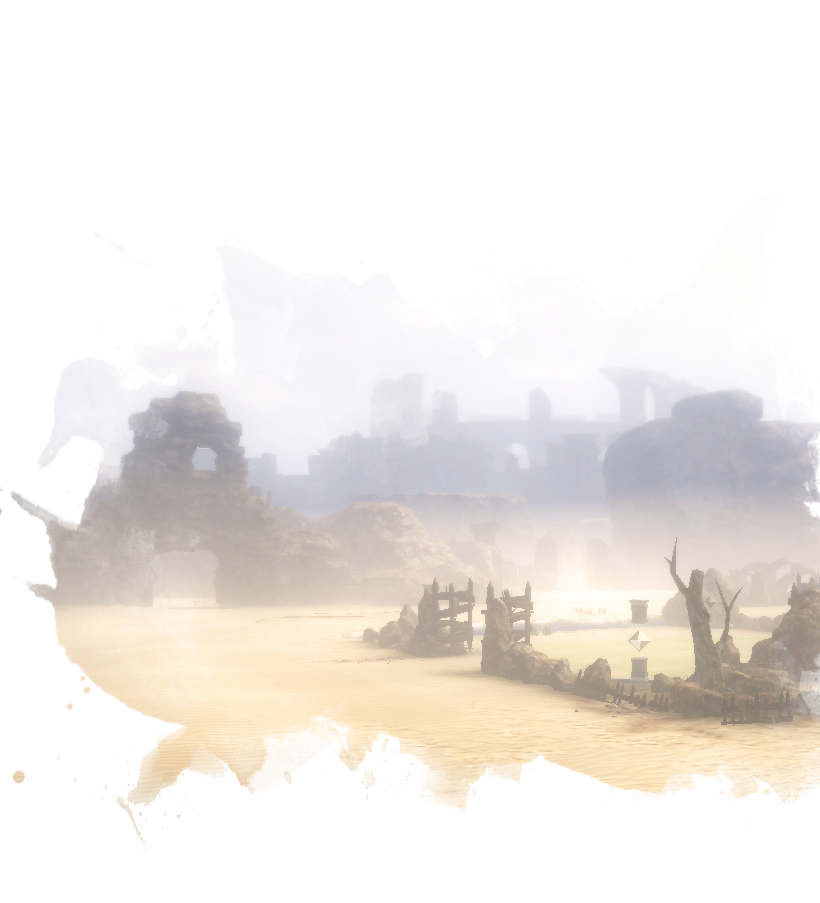
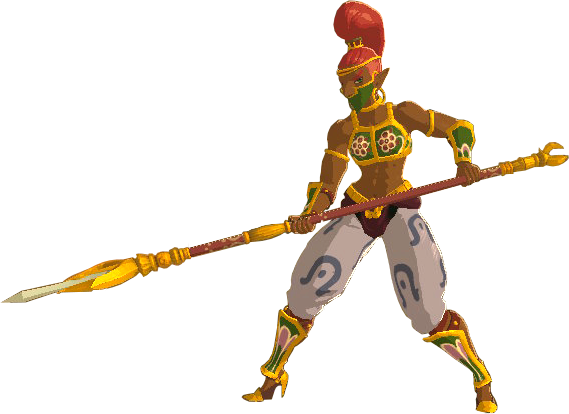
The Gerudo are a desert-dwelling folk. They are warriors by reputation, feared and respected in the countries they inhabit. A rather peculiar aspect of the Gerudo is that they consists entirely of women. Long ago, a lone male was born every 100 years, but one hasn't been born for millennia. Some say it is a punishment from the gods and goddesses for the crimes of a trechrous Gerudo male of a past era.
Gerudo have a skin color that typically ranged from white, to sun-kissed tan, to dark ebony. A few have a rare skin tone of deep olive green. Gerudo generally have green or amber eyes. Their ears vary between round and pointed. They distinctly have a large, sharp, beak-like noses.
Generally, the Gerudo have been shown to be a reclusive lot that does not take well to outsiders on their territory. Even when they are more open to other ancestries, they often show disdain to men. They do not allow males to enter their towns, and sometimes make it illegal to sell men's clothing. Despite this, the Gerudo appreciate talent when they see it and do accept non-Gerudo (and occasionally men) among their ranks if they manage to prove themselves. Being a warrior tribe, they are well apt at combat, and have been shown to use weapons such as glaives, dual scimitar swords, and magic.
Archery and skilled horseback riding are highly regarded in Gerudo society. They also use Sand Seals, animals native to the Gerudo Desert, to get around the desert.
Gerudo Traits
Your Gerudo character has the following ancestral traits.
Ability Score Increase. Your Constitution score increases by 2, and your Strength score increases by 1.
Age. Gerudo mature at the same rate humans do and reach adulthood in their late teens and typically live a little over a century.
Size. Gerudos are typically athletically built and are taller than an average human, with a average height of 6 to 7 feet. Your size is Medium.
Speed. Your base walking speed is 30 feet.
Gender. All Gerudos are female. In the past, a male was born every 100 years. However, a Gerudo male hasn't been born in well over a thousand years.
Arid Born. You double your proficiency bonus on Wisdom (Survival) checks made in arid environments.
Natural Athlete. You have proficiency in the Athletics skill.
Gerudo Toughness. Your hit point maximum increases by 1, and it increases by 1 every time you gain a level.
Desert’s Endurance. You can focus yourself to occasionally shrug off injury. When you take damage, you can use your reaction to roll a d12. Add your Constitution modifier to the number rolled and reduce the damage by that total. After you use this trait, you can’t use it again until you finish a short or long rest. You're also naturally adapted to hot desert climates, as described in Chapter 5 of the Dungeon Master's Guide.
Ability Score Increase. Your Constitution score increases by 2, and your Strength score increases by 1.
Gerudo Combat Training. You are proficient with scimitars, spears, glaives, shortbows and longbows.
Tool Proficiency You gain proficiency with the artisan’s tools of your choice: jeweler's tools or potter's tools.
Languages. You can read, speak, and write Gerudo and Common.
Goron
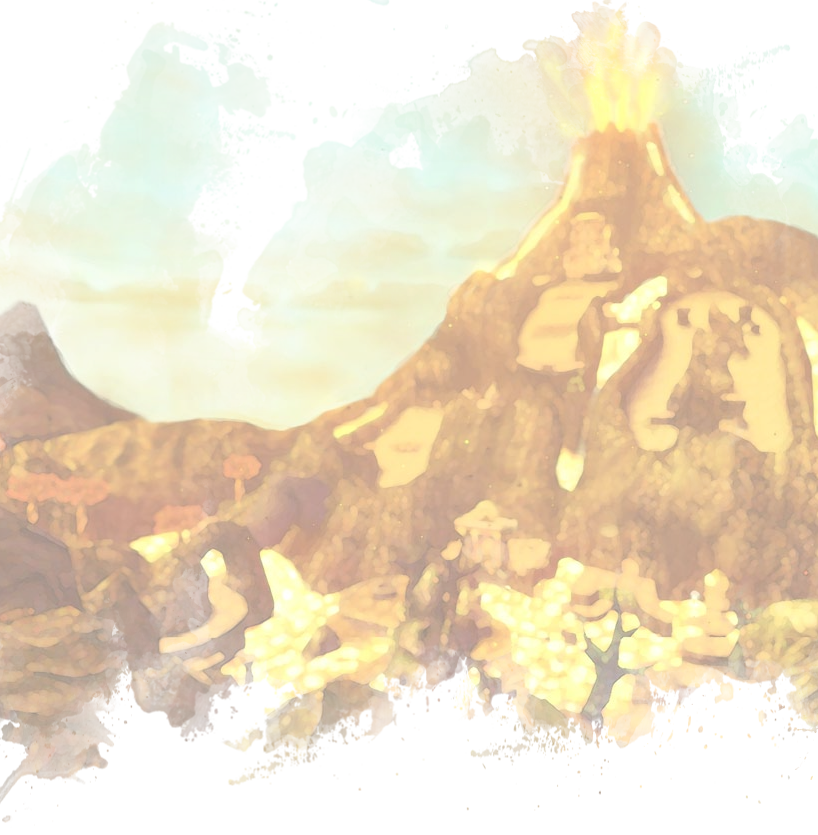
The Gorons are large, mountain-dwelling people, with sizes ranging from medium, large, huge, and even gargantuan. Gorons typically live in or under mountain ranges. Befitting with that of their habitat, their durable, round bodies greatly resemble that of stones and boulders, and nearly all Gorons have a hide of ridged stones on their backs. Combined with their round shape, Gorons can also curl themselves into a ball shape and roll like a boulder. Gorons usually have light ochre or light brown skin, though some have dark brown or almost black skin. They have large eyes that are usually dark blue, purple, or red. They have noticeable lips, which conceal large, square teeth. Another common trait is the Goron symbol tattooed to the sides of their arms. Some Gorons have tribal tattoos on various parts of their bodies.
Gorons possess immense strength which they are proud of. Many tribes of Gorons hold competitions that test each other's physical strength or rolling ability, such as sumo wrestling and rolling racing. While Gorons do have many strengths, they are also not without their weaknesses. Gorons tend to move slowly, for which their ability to roll makes up for. Another weakness is their inability to swim.
Groups of Gorons often live in close-knit communities within their home mountains, often led by a patriarch. Gorons are very close and respectful to others of their own kind, and often refer to each other as "brother."
Gorons are slow to trust outsiders, and may come off as cautious or even aggressive depending on the situation. However, if an outsider can prove his or her worth, usually in a test of strength, skill, intelligence, or courage, the Goron tribe might accept the outsider, and refer to him or her as "brother."
Throughout the land, Gorons are renowned for their smithing skills, crafting masterwork weapons and armor.
Goron Traits
Your Goron character has the following ancestral traits.
Ability Score Increase. Your Strength score increases by 2, your Constitution score increases by 1.
Age. Gorons reach maturity in their mid to late teens, and live less than two centuries, but due to the growing demands of their bodies, usually retire to specially equipped settlements or hermitage halfway into their second century.
Size. Adult Gorons typically stand between 6 and 7 feet tall, and vary wildly in growth as they age, typically retiring from the world once they exceed 8 feet. Adult Gorons weigh between 350 and 800 pounds. It is common for Gorons to have shed much of their mass and/or height in their elder years. Regardless of your position in these ranges, your size is Medium.
Speed. Your base walking speed is 20 feet.
Natural Armor. You have tough skin. When you aren't wearing armor, your AC is 12 + your Dexterity modifier. You can use your natural armor to determine your AC if the armor you wear would leave you with a lower AC. A shield's benefits apply as normal while you use your natural armor.
Darkvision. You can see in dim light within 60 feet of you as if it were bright light, and in darkness as if it were dim light. You can’t discern color in darkness, only shades of gray.
Igneous Upbringing. You have resistance to fire damage.
Rolling Attack. If you move at least 10 feet in a straight line, you can use a bonus action to tuck and roll. While rolling, your movement becomes 40 feet, and you can roll into a target and make an unarmed attack as an action on the same turn. If you hit with this attack, the target takes 1d12 + your Strength modifier in bludgeoning damage. If the target is a creature, it must also succeed on a Strength saving throw or be knocked Prone. The DC is equal to 8 + your Strength modifier + your proficiency bonus. If you knock a creature Prone in this manner, you don't provoke an opportunity attack when you roll out of its reach on the same turn.
On your next turn, you can use a bonus action to keep rolling. If you take damage while rolling, you are moved 5 feet away from the source of the damage and are knocked Prone.
Powerful Build. You count as one size larger when determining your carrying capacity and the weight you can push, drag, or lift.
Stone Gut. Rocks are an integral component of your diet. You must eat 30 pounds of edible rocks daily. You can forage for appropriate rocks with a DC 10 Wisdom (Survival) check per hour in most environments. Additionally, your great density causes you to sink in water, making it impossible for you to swim without significant assistance.
Goron Combat Training. You have proficiency with the war hammer and war pick.
Tool Proficiency You gain proficiency with the artisan’s tools of your choice: mason's tools or smith's tools.
Languages. You can read, speak, and write Goron and Common.

Human
Humans are for the most part identical to Hylians, with the sole exception being their small, rounded ears in contrast to the Hylians' pointed ears.
Humans are not as prevalent as the more prolific, dominating Hylians. Nonetheless, round-eared Humans do still frequently appear across the world.
Human Traits
Your human character has the following ancestral traits.
Ability Score Increase. Your ability scores each increase by 1.
Age. Humans reach adulthood in their late teens and usually live less than a century.
Size. Humans vary widely in height and build, from just under 5 feet to well over 6 feet tall. Regardless of your position in that range, your size is Medium
Speed. Your base walking speed is 30 feet.
Magic Sense. You have an extra sense for detecting the arcane. Using a bonus action, you can sense the presence of magic within 30 feet of you. You cannot pinpoint the location of the source(s) of the magic, magic type(s), or the number of magic sources, only the general presence of magic.
The sense can penetrate most barriers, but it is blocked by 1 foot of stone, 1 inch of common metal, a thin sheet of lead, or 3 feet of wood or dirt.
Skill Versatility. You gain proficiency in two skills, artisan tools, or musical instruments of your choice.
Languages. Humans read, speak, and write the language of their home area (usually Common), plus one other standard language. Humans generally learn the languages of those they deal with, including obscure dialects. Examples include Goron, Zora, and Bokoblin. They are fond of sprinkling their speech with words borrowed from other tongues: Gerudo curses, Zora musical expressions, Goron military phrases, and so on.
Hylian
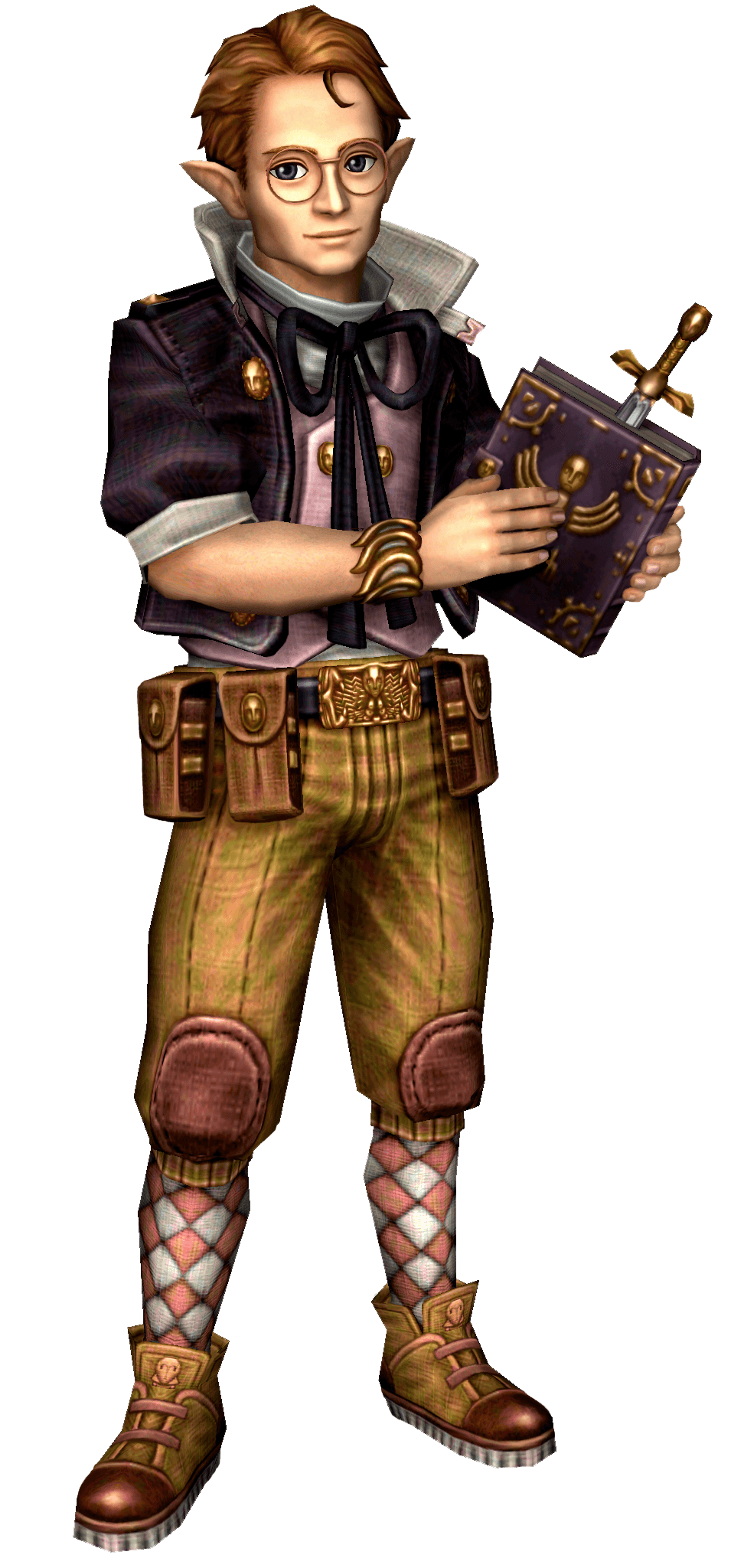
The Hylians are human-like beings descended from the people who lived among the goddess Hylia long prior to the establishment of Hyrule as a kingdom. They are a magic lot with long, pointed ears who have inherited the blood, powers, and abilities of their ancient ancestors. The most famous Hylians are the many heroes and princesses that share the same name as one another, the latter being of blood relation and naming tradition.
Hylians traditionally have long, pointed ears, and generally have blue or blue-grey eyes and light skin, although the ethnicity has a wide degree of variation. The lower classes usually wear casual clothing; Hylian males tend to wear belt leather jerkins, and females wear long gowns in many different colors; Hyrulean symbols are often part of the embroidery in their dresses. Tall buns and braids are common in women, while men of the working class usually wear broad-brimmed hats to protect their skin from the sun and the rain. Some men also wear knee-length leather boots. It has been observed that the higher classes including royalty wear complex and luxurious jewelry including precious metals and gemstones such as gold and rubies.
One of the few known abilities that the Hylian people possess is the use of their long, pointed ears to receive special messages from the gods themselves. This is an ability that continues to get passed unto their children, their children's children and so on.
Hylian Traits
Your Hylian character has the following ancestral traits.
Ability Score Increase. Your Wisdom score increases by 2, and your Intelligence score increases by 1.
Age. Hylians mature at the same rate humans do and reach adulthood in their late teens and typically live less than a century.
Size. Hylians vary widely in height and build, from just under 5 feet to well over 6 feet tall. Regardless of your position in that range, your size is Medium.
Speed. Your base walking speed is 30 feet.
Long Ears. Your large ears afford you a heightened auditory sense, giving you advantage on Perception checks involving hearing.
Voices of the Gods Sometimes, your long Hylian ears can detect the gods whispering to you. Listening to these voices can give you foresight on what lies ahead. Once a day, using an action, you can cast the augury spell without any components and without using a spell slot. The results are given privately to you. Wisdom is your spellcasting ability for the spell.
Courageous. You have advantage on saving throws against being Frightened.
Hylian Combat Training. . You have proficiency with the longsword, shortsword, shortbow, and longbow.
Languages. Hylians read, speak, and write the language of their home area (usually Common), plus one other standard language. Hylians generally learn the languages of those they deal with, and sometimes ancient languages. Examples include Goron, Zora, and Sky Writing
Kokiri
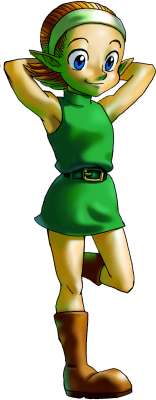
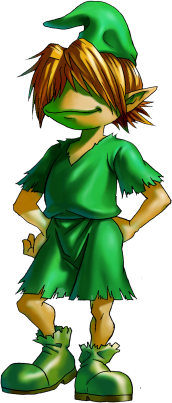
The Kokiri are small beings that inhabit magical forests. The Kokiri are an ageless group that takes the form of children.
When a Kokiri reaches a certain age, the spirit of the Great Deku Tree blesses him or her with a guardian fairy, which watches over the Kokiri. Having a fairy is considered the sign of being a "true Kokiri" within the forest, and many of the Kokiri congratulate young Kokiris after he or she receives one.
The Kokiri dress in green tunics. The females wear headbands, while the males wear floppy green hats. They tend to make homes in hollowed-out trees. Like Hylians, they possess long, pointed ears. All known Kokiri have either blonde or red hair.
Kokiri tend to be a happy, playful lot, and typically retain some of their child-like behavior and innocence (at varying degrees) regardless of how old they are. It is rare for a Kokiri to be jaded, even if they have been around for a few centuries. They would sooner ask a stranger to play a game before they would tell him or her to go away.
Kokiri Traits
Your Kokiri character has the following ancestral traits.
Ability Score Increase. Your Dexterity score increases by 2, and your Wisdom score increases by 1.
Age. Kokiri are fully grown by age 5. From that age on, you no longer physically grow or visually age, instead remaining child-like in appearance.
Kokiri can live forever, barring accidents and misadventures. However, it is said that if a Kokiri strays too far from his or her home forest for too long, he or she will die or become corrupted, turning into a Skull Kid.
Size. Kokiri are typically between 3 and 4 feet tall and weigh between 30 and 60 pounds. Your size is Small.
Speed. Your base walking speed is 25 feet.
Kokiri Nimbleness. You can move through the space of any creature that is of a size larger than yours, and you have advantage when attempting to Tumble through a creature's space.
Fairy Companion. You are bound to a tiny fey called a Kokiri Fairy. The fairy has the stats and abilities listed in the stat block below. The Kokiri Fairy acts independently of you and will obey reasonable commands from you. In combat, it does not roll its own initiative. You choose if it acts immediately before or after your turn. A Kokiri Fairy can’t attack, but it can take other actions as normal.
If the Kokiri Fairy is ever more than 60 feet from you or takes damage, vanishes to the Fairy Realm and stays there until you spend 1 hour praying for its return, after which it reappears within one foot of you.
Fairies emit a glow that comes in a variety of colors. You can choose your fairy's glow color or roll on the Fairy Glow Color Chart below to determine your fairy's glow color.
Instrument Proficiency. You gain proficiency with a wind instrument of your choice: deku pipes, flute, horn, ocarina, panflute, shawm.
Languages. You can speak, read, and write Kokiri and Common.
Fairy Glow Color Chart
| Roll | Color |
|---|---|
| 1 | Pink |
| 2 | Light Orange |
| 3 | Pastel Yellow |
| 4 | Mint Green |
| 5 | Light Blue |
| 6 | Lilac Purple |


Kokiri Fairy
Tiny fey, lawful good
- Armor Class 16
- Hit Points 1 (1d4 - 1)
- Speed 5 ft., fly 60 ft.
STR DEX CON INT WIS CHA 2 (-4) 20 (+5) 8 (-1) 16 (+3) 14 (+2) 13 (+1)
- Senses passive Perception 14
- Languages Kokiri, Common
- Challenge 0 (0 XP)
Glow. The fairy emits dim pastel-colored light for 5 feet.
Target. The fairy grants advantage on ranged attacks made by its bonded Kokiri if the fairy is flying within 5 ft. of the target.
Actions
Heal (recharge 1/day). The fairy casts cure wounds as a 3rd-level spell, if it is able to.
Resuscitate (recharge 4d8 days). The fairy casts revivify on its bonded Kokiri without the need of components. Casting this spell temporarily drains all the Kokiri Fairy's powers. During this time, the fairy cannot glow, fly, target, cast spells, and also automatically fails any skill checks and saving throws. The fairy's powers return in 4d8 days.
Detect the Hidden (recharge 1/day). The fairy automatically succeeds a Wisdom (Perception) check to detect a trap or secret door within 15 feet, provided the hidden trap or door is not hidden by magic.
Korok
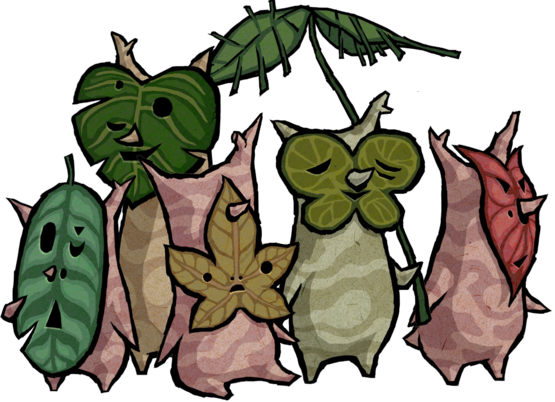
The Koroks are shy, little wooden people whose bodies resemble trees, and whose faces are concealed by leaf masks. The masks they wear take on various shapes and colors based on types of leaves and have holes in them resembling eyes and a mouth, and occasionally a hole for their noses to fit through. Their bodies make a jingling sound whenever they move. Koroks are also able to fly short distances using propeller-like Deku Leaves.
Korok Traits
Your Korok character has the following ancestral traits.
Ability Score Increase. Your Wisdom score increases by 2, and your Charisma score increases by 1.
Age. Koroks are fully grown by age 7 or 8, and can live for four or five centuries.
Size. Koroks vary in height and build, from barely 3 feet to just over 5 feet tall, from skinny to stout. Regardless of your position in that range, your size is Small.
Speed. Your base walking speed is 25 feet.
Children of the Forest. Whenever you make a Wisdom (Nature) check related to the nature of plants or fungi, you are considered proficient in the Nature skill and add double your proficiency bonus to the check, instead of your normal proficiency bonus.
Tree People. You have advantage on Dexterity (Stealth) checks when attempting to hide from non-Koroks among plants and vegetation as long as you remain still and are not talking, moving, or taking actions.
Propeller Leaf. As an action, you can manifest a leafy propeller on a stem that you can grab onto, granting you a flying speed of 10 feet for 1 minute. You must concentrate on maintaining your flight as though concentrating on a spell and must use one of your hands to hold onto the stem. If your concentration is interrupted or if you suffer fire damage, your flight immediately ends, and you begin falling uncontrollably and continue to fall until the fall ends.
The propeller makes an audible buzzing sound that is audible out to 100 feet, and only has enough power to lift you and 30 lbs. of equipment.
Once you use this trait, you cannot use it again until you have completed a short or long rest.
Jangling Gait. You audibly jingle when you move. You have disadvantage on Dexterity (Stealth) checks that rely on moving silently.
Fire Aversion. You are vulnerable to fire damage.
Brew Elixir. With your innate knowledge of plants and minerals, you can create beneficial concoctions during downtime. You can create one healing potion or antitoxin per day. To create either, you must have access to at least 2 types of plants, vegetation, or minerals (a successful DC 10 Wisdom (Survival) check per hour yields these items), you must have access to an herbalism kit or alchemist kit, and you must have a container to hold the elixir.
If you spend at least 2 hours working, you can create a healing potion that restores hit points equaling 1d4 x your proficiency bonus.
If you spend at least 8 hours working, you can create an antitoxin that, when administered, will grant advantage on a saving throws against a poison effect for 1 minute, including advantage on saving throws for ending the Poisoned condition.
Any potions or antitoxins you create expire after 12 hours. These elixirs are easily recognizable by their strong, plant-like odor as well as their dark green, broth-like appearance.
Plant Empathy. You have a natural harmony with plants, and thus can get a vague idea of what they are feeling. You are conveyed feelings from plants such as: needing water, mad about being stepped on, fear about being cut down, uneasiness about herd of herbivores that recently arrived in the area, and similar general emotions. Additionally, you have advantage on any Charisma checks to influence plants.
Tool Proficiency. You gain proficiency with the artisan’s tools of your choice: herbalism kit or alchemist kit.
Languages. You can speak, read, and write Kokiri and Common. Korok voices tend to be high-pitched and nasally.
Rito
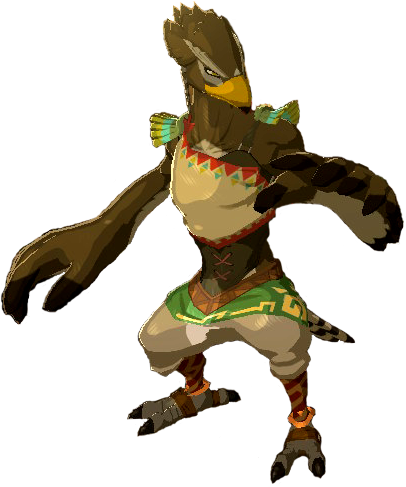
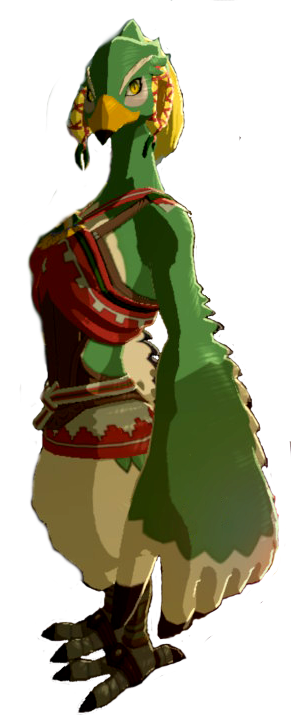
The Rito are bird-like people, primarily avian in appearance, possessing wings, a beak, and talons. Rito have few human features, with features covering their entire body. They have very bird-like faces, and large, feathered, wing-like hands. Their feather colors range, with the most common being green, purple, red, yellow, blue, pink, black, brown, and white. Their eyes are typically red, yellow, blue, or bright green.
Ritos feathers insulate them from harsh, freezing temperatures. Their wings and features also allow them to soar through the skies. A typical Rito cannot ascend while gliding and must make use of updrafts and winds to climb to a higher altitude. It has been known that master flyers have been able to ascend without the help of updrafts.
Rito are very protective of their friends and family and will fight to the end for loved ones.
In combat, Rito are renown to excel in archery, possessing a deadly aim and raining down arrows from above.
Rito Traits
Your Rito character has the following ancestral traits.
Ability Score Increase. Your Charisma score increases by 2, and your Constitution score increases by 1.
Age. Ritos mature at almost the same rate as humans do and reach adulthood in their mid-teens and typically live about two centuries.
Size. Ritos tend to be taller than humans, but they weigh only three quarters as much as a human of comparable proportions. Your size is medium.
Speed. Your base walking speed is 30 feet.
High Life. You're acclimated to high altitude, including elevations above 20,000 feet.
Naturally Insulated. Your feathers provide you protection from icy effects. You have resistance to cold damage, and you have advantage on saving throws related to cold or ice effects (such as a freezard's breath or the ray of frost spell).
Additionally, you're naturally adapted to cold climates, as described in Chapter 5 of the Dungeon Master's Guide.
Glide. If you are in the air, you can use a bonus action to spread your wings and glide. To be able to properly glide, you can’t be wearing medium or heavy armor, you must be able to freely use both of your arms, you cannot have any levels of exhaustion, and you cannot be Grappled, Restrained, or Incapacitated.
You can glide a total number of rounds equal to your Constitution modifier (minimum of 0) + your proficiency bonus. If you are still gliding after that number of rounds, at the beginning of your next turn you gain a level of exhaustion and begin falling uncontrollably. Once you glide the number of total allowed rounds, you must finish a short or long rest before you can use this feature again.
While gliding, you can move yourself in any direction (except up) at a rate up to your base walking speed, and you descend a minimum of 10 feet each round if there is no updraft to maintain your altitude. You can only wield shortbows, longbows, javelins, and weapons with the light property and cannot wield a shield. You have disadvantage on Strength checks and Strength saving throws. Performing any activity that uses your wings or hands (such as somatic components for a spell) while gliding uses movement and altitude equal to 10 feet per each individual activity.

If you take damage while gliding, you must make a Dexterity saving throw to maintain your flight. The DC equals 10 or half the damage you take, whichever number is higher. If you take damage from multiple sources, such as an arrow and a spell attack, you make a separate saving throw for each source of damage. If you fail the saving throw, you begin uncontrollably falling to the ground. While falling, you can repeat the saving throw at the beginning of each of your turns until you regain your flight on a success, or until the fall ends.
You can use the Dash action to rapidly descend downward in a controlled dive. Dashing in this manner allows you to descend at a rate up to three times your base walking speed and does not count against the number of rounds you are able to glide.
Additionally, you can ascend or glide on any natural or magical effects that create significant updrafts of wind, such as strong winds in a storm or the spell gust of wind. The DM may call for additional ability or skill checks to control gliding in these scenarios.
Danger Above. When attacking a target with a ranged attack and you are at least 10 feet higher than the target, you have advantage on your ranged attack, even if the target is Prone. Your target also gains no benefits from cover that isn't total cover.
If you perform this while gliding, you can use 5 feet of movement and use an action to perform a ranged attack.
Rito Combat Training. You are proficient with shortbows, longbows, and javelins.
Instrument Proficiency. You gain proficiency with an instrument of your choice: concertina, dulcimer, and lyre.
Tool Proficiency. You gain proficiency with the artisan’s tools of your choice: cartographer's tools or navigator's tools.
Languages. You can speak, read, and write Zora and Common.
Far-Traveled. You can speak, read, and write two additional standard languages of your choice, or one exotic language of your choice.
Sheikah
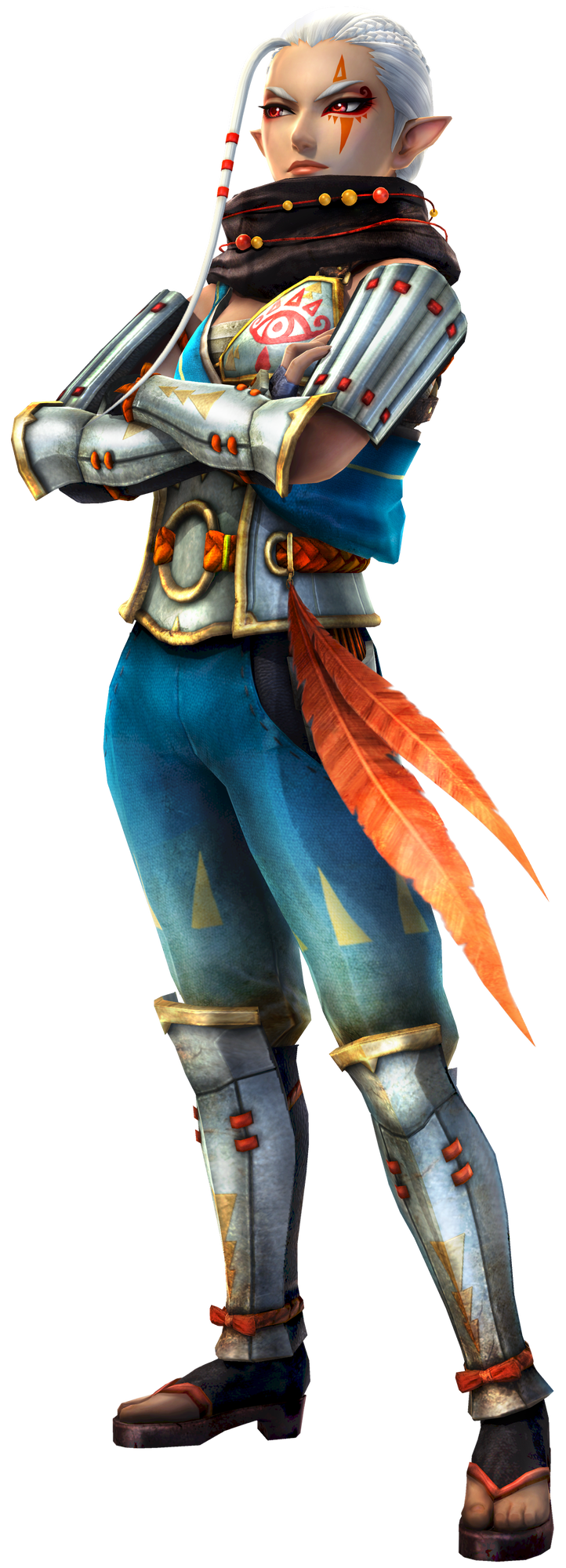
The Sheikah are a humanoid ancestry, bearing great resemblance to Hylians in both appearance and magical capacity. The Sheikah, however, are known for their distinctive red eyes and light-colored hair.
While much about the tribe and their history is shrouded in mystery, one recurring reminder of their connections to various times, places and objects is their symbol, an eye with three pointed lashes atop, two curling on each side, and a tear drop. This symbol can be found on various objects around the land.
The Sheikah were originally chosen by the Goddess Hylia to serve as guardians and have been highly devoted to the Royal Family of Hyrule, protecting the descendants of Hylia's mortal incarnation.
Sheikah Traits
Your Sheikah character has the following ancestral traits.
Ability Score Increase. Your Dexterity score increases by 2, and your Intelligence score increases by 1.
Age. Sheikah age comparably to humans but live somewhat longer than humans. They live no more than two centuries.
Size. Sheikah tend to be roughly the same height, ranging from barely 5 feet to well over 6 feet tall. Your size is Medium.
Fleet of Foot. Your base walking speed increases to 35 feet.
Darkvision. You can see in dim light within 60 feet of you as if it were bright light, and in darkness as if it were dim light. You can’t discern color in darkness, only shades of gray.
Shadow Arts. You have proficiency in Stealth and Arcana skills.
Protection. You know the resistance cantrip and can cast it without material components (somatic and verbal components are still required). Wisdom is your spellcasting ability for the spell.
Additionally, once a day you can cast the shield spell as a bonus action or reaction on a creature other than yourself within 30 feet without using a spell slot with this trait. You regain the ability to do so when you finish a short or long rest. Wisdom is your spellcasting ability for the spell.
Honed Reflexes. You can use your reaction even if you are surprised.
Vanish. You can use an action to teleport up to 30 feet to an unoccupied space that you can see, where you can immediately use Hide as a bonus action. Any gap you pass through must be at least 3 square feet, and you must be able to visibly see the entire space large enough to fit your body. The process creates a visible flash of light and an audible snap sound. You must finish a short or long rest before using this trait again.
Surprise Attack. If you surprise a creature and hit it with an attack on your first turn in combat, the attack deals an extra 2d6 damage to it. You can use this trait only once per combat encounter.

Languages. You can speak, read, and write Sheikah and Common.
Extra Language. You can speak, read, and write one additional language of your choice.
Twili
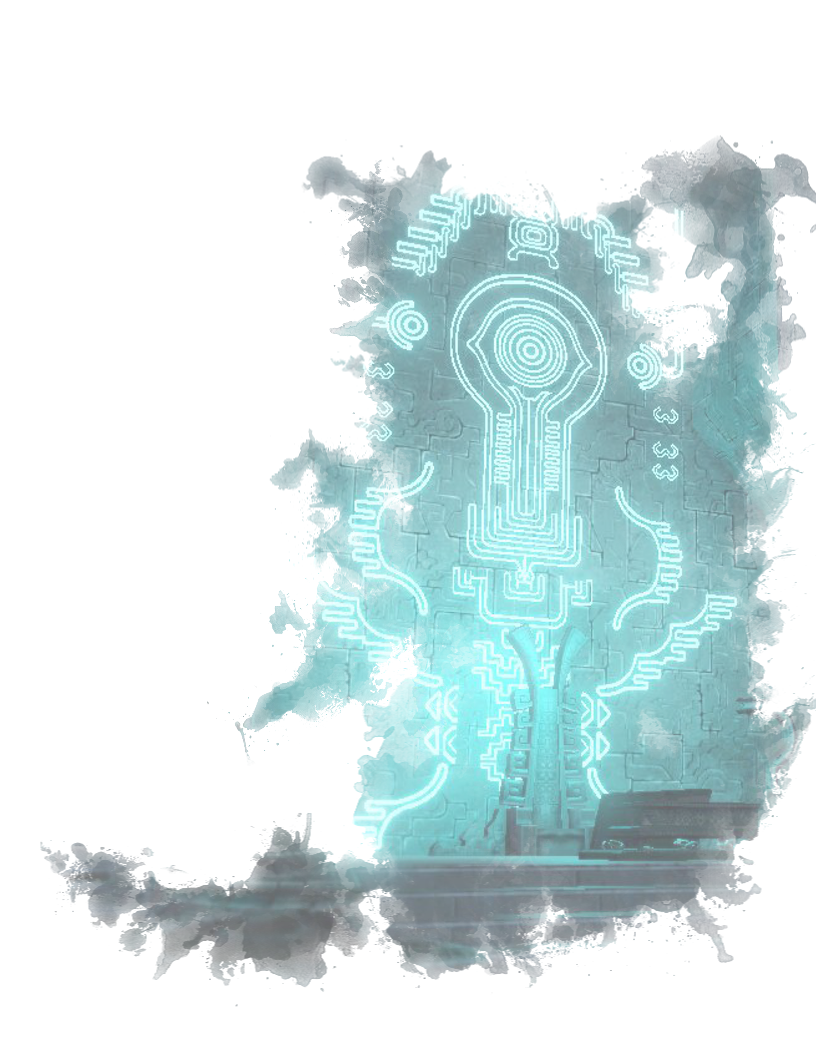
The Twili are shadow beings who inhabit the Twilight Realm. They are descendants of a tribe of sorcerers of unknown ethnicity referred to as Dark Interlopers, who eons ago were condemned to the Twilight Realm by the Golden Goddesses of Hyrule as punishment for their misgoverned attempt to use magic to claim the Triforce. The tribe lived and evolved in the Twilight Realm for centuries in isolation, mere shadows of what they once were, as over time they grew used to their surroundings and came to accept their fate. While some learned to love the beautiful peace that can be found only in Twilight, it drove other inhabitants mad.
The Twili have pale bluish-gray skin covered by areas of thicker, black "second" skin. The black areas range from large blots to thin, patterned lines. These darker areas sometimes protrude outward from the Twili's body, creating a clothing-like appearance resembling flaps, sleeves, and collars. They also have eyes that are normally red, yellow, and orange. They are usually slender and are slightly taller than Hylians in general. Their most noticeable feature is the glowing markings they have on their skin. The marking form geometric patterns and, like fingerprints, no two are the same. The amount of markings varies. Some Twili might only have a small marking on one hand or on a foot. Others might have their entire torso and half their face covered.
The color of the glowing marking also indicates the purity of a Twili's heart. Blues and greens are generally good-hearted Twili. Yellows and oranges are generally neutral and indifferent Twili. Magentas and reds are generally evil Twili.
Twili are natives of the Twilight Realm. Travel between the Twilight Realm and the Light World is not a common occurrence. Inhabitants of Hyrule have heard of the Twili, but few have ever witnessed one. If you play a Twili in the Light World, talk with your DM to discuss the nature of your presence in the Light World. How did you get there? Were you banished from the Twilight Realm? Did you stumble upon a magical gate? What is your purpose in the Light World? How are you getting back to the Twilight Realm?
Twili Traits
Your Twili character has the following ancestral traits.
Ability Score Increase. Your Charisma score increases by 2, and your Intelligence score increases by 1.
Age. Age. Twili reach maturity in their mid-twenties and may live up to three centuries.
Size. Twili statures tend to be slightly taller than that of humans, and their builds less robust. Your size is medium.
Speed. Your base walking speed is 30 feet.
Exceptional Darkvision. Accustomed to the Twilight Realm, where there is rarely any light brighter than a soft glow, you have exceptional vision in dark and dim conditions. You can see in dim light within 120 feet of you as if it were bright light, and in darkness as if it were dim light.
Unlike standard darkvision, you can discern colors using your darkvision.
Magic Rebuff Whenever you make a saving throws against spells and other magical effects, you can roll 1d4 and add that to your total.
Twilight Magic. You know the mage hand cantrip. When you reach 3rd level, you can cast the bane spell as a 2nd-level spell once without material components and without using a spell slot with this trait and regain the ability to do so when you finish a long rest. When you reach 5th level, you can cast the shadow blade spell once without using a spell slot with this trait and regain the ability to do so when you finish a long rest. Intelligence is your spellcasting ability for these spells.
Light Aversion. You are vulnerable to radiant damage.
Additionally, while in sunlight, you have disadvantage on attack rolls, as well as on Wisdom (Perception) checks that rely on sight. If you spend one hour or more exposed to direct sunlight in one day, you gain one level of exhaustion. To recover from this exhaustion, you must spend a full day resting in dim light or total darkness. You may prevent this exhaustion by wearing specially crafted clothing that covers your entire body, including your head (such as a hooded robe).
Languages. You can speak, read, and write Twili and Common. Voices of Twili have a reverberating echo, and their voices sound like they are speaking from inside a cave or large empty chamber.
Extra Language. You can speak, read, and write one additional language of your choice.

Twilight Realm Native Powers
As a being who is indigenous to the Twilight Realm, you gain the following racial traits while in the Twilight Realm.
Twilight Teleport. You can cast misty step a number of times equal to your Intelligence modifier (minimum 1). Additionally, you can also cast dimension door once. You regain the ability to cast these spells when you finish a long rest.
Twilight Lore. Whenever you make an Intelligence (Arcana) check related to Twilight magic, you are considered proficient in the Arcana skill and add double your proficiency bonus to the check, instead of your normal proficiency bonus.
Zora
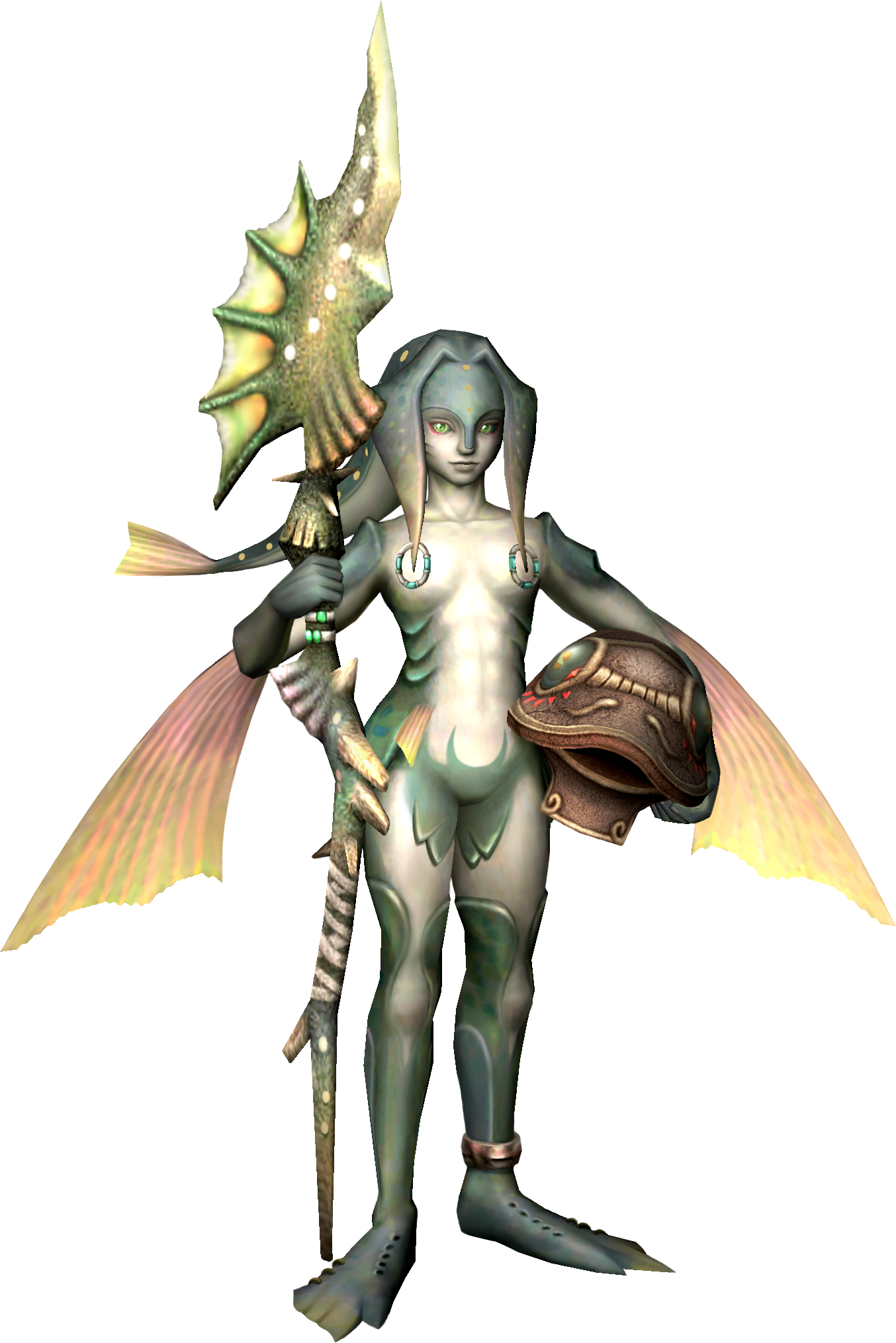
Zoras are an aquatic folk who possess fish and amphibian like traits, including fins, webbed feet and gills, which allow them to swim a\columnbreak
nd thrive underwater. Zoras are normally found in or near large bodies of water, and rarely stray far away from them. Zoras do not solely live in fresh water and can also thrive in salt water. Most individuals (but not all) have fins attached to their limbs and a tail at the back of their head resembling a common aquatic creature, like a dolphin or manta. Zoras also come in various shapes and sizes, with some lacking the head fin and others having a very round body shape. Their skin color has a wide range, varying between white, light teal, light gray, light pink, maroon, brown, blue, dark blue, and green. Their skin texture ranges from scaly like a fish, to smooth like an eel, to rough like a shark.
Zoras are known to have long lifespans, with many Zoras being over fifty years old while still looking young. Zora children age in such a way where, even as young adults, they can still appear to be children before reaching a growth spurt. As Zoras age, they hold themselves to higher standards of speaking as a matter of pride.
Zora Traits
Your Zora character has the following ancestral traits.
Ability Score Increase. Your Constitution score increases by 2, and your Wisdom score increases by 1.
Age. Zoras age much slower than Hylians, reaching maturity around their seventh or eighth decade and living for six or seven centuries.
Size. Zoras stand between 5 and 8 feet tall, with a variety of builds comparable to humans. Your size is Medium.
Speed. Your base walking speed is 30 feet.
Aquatic Upbringing You double your proficiency bonus on Wisdom (Survival) checks made in sea, river, lake, and coastal environments. Additionally, you ignore any drawbacks caused by a deep, underwater environment.
Exceptiopnal Swimmer. You have a swimming speed equal to your base walking speed plus 15 feet.
Fluid Defense. While swimming, if you are targeted by an attack, spell, trap, or similar effects, you can use your reaction to quickly dart out of the way, moving in a straight line of 5 additional feet in a direction of your choice. The triggering attack roll against you has disadvantage if you can see it. If the triggering attack requires a Dexterity saving throws, you have advantage on the saving throw.
Amphibious. You can breathe air and water.
Fighting Fins. You have one sharp fin on each arm that you can make rigid at will, allowing you to make unarmed strikes that deals a 1d4 base slashing damage each on a hit. Additionally, you can detach each fin to use as a thrown weapon with a range of 20/60 that deals 1d4 slashing damage on a hit. Each fin withers away after one round of detachment, becoming unusable. You are proficient with your fins, and they have the light, finesse, and thrown properties.
Alternatively, you can use a reaction to block attacks using your arm fins like bucklers. While using your arm fins in this way, you gain a bonus to your AC equal to the number of arm fins you have to use. After the attack, any arm fins detach and wither away, becoming unusable.
You grow back detached fins after a long or short rest.
Shock Aversion. You are vulnerable to lightning damage.
Water Dependency. Once a day, you must completely flush your skin with water, tripling the amount of water you need daily if you do not have access to a body of water to wade in. Each day you do not, you gain a level of exhaustion as your skin begins to dry out. Additionally, if you have a level of exhaustion gained in this manner, your drying-out skin gives off a foul, pungent odor, giving you disadvantage on Stealth checks related to your stench.
You can remove all exhaustion levels gained this way by submerging yourself in water for an entire short of long rest.
Zora Combat Training. You are proficient with halberds, glaives, and pikes.
Tool Proficiency. You gain proficiency with the artisan’s tools of your choice: cobbler's tools or glassblower's tools.
Instrument Proficiency. You gain proficiency with an instrument of your choice: lute, lyre, or zora guitar.
Languages. You can speak, read, and write Zora and Common.
Credits
Wizards of the Coast
For creating the core rules of this game I enjoy tremendously.
http://company.wizards.com/
http://dnd.wizards.com/
Nintendo
For creating the Legend of Zelda (my favorite video game franchise) and the for all the official art work and models.
https://www.nintendo.com/
http://www.zelda.com/
GM Binder
For creating this official-looking formatting.
https://www.gmbinder.com
Hyrule Total War
For additional images/models.
http://www.moddb.com/mods/hyrule-total-war
D&D Zelda 5e PHB
DA Clark for the inspiration and ideas. I think DA Clark's Reddit name is u/ninjabreadbear https://www.reddit.com/r/DnD/comments/2ookln/dd_5e_legend_of_zelda_campaign_setting/
DA Clark's Players Handbook: https://www.dropbox.com/s/lexzdcugan6m0vu/Zelda%205E%20Player%27s%20Guide.pdf?dl=0
DA Clark's Dungeon Master's Guide: https://www.dropbox.com/s/9mru2aqtdhfj01e/Zelda%205E%20Master%27s%20Guide.pdf?dl=0
\LumancerErrant
Reddit user \LumancerErrant, for additional ideas.
Zelda Wiki
For descriptions, characteristics, and a centralized location for official artwork.
https://zelda.gamepedia.com/Main_Page