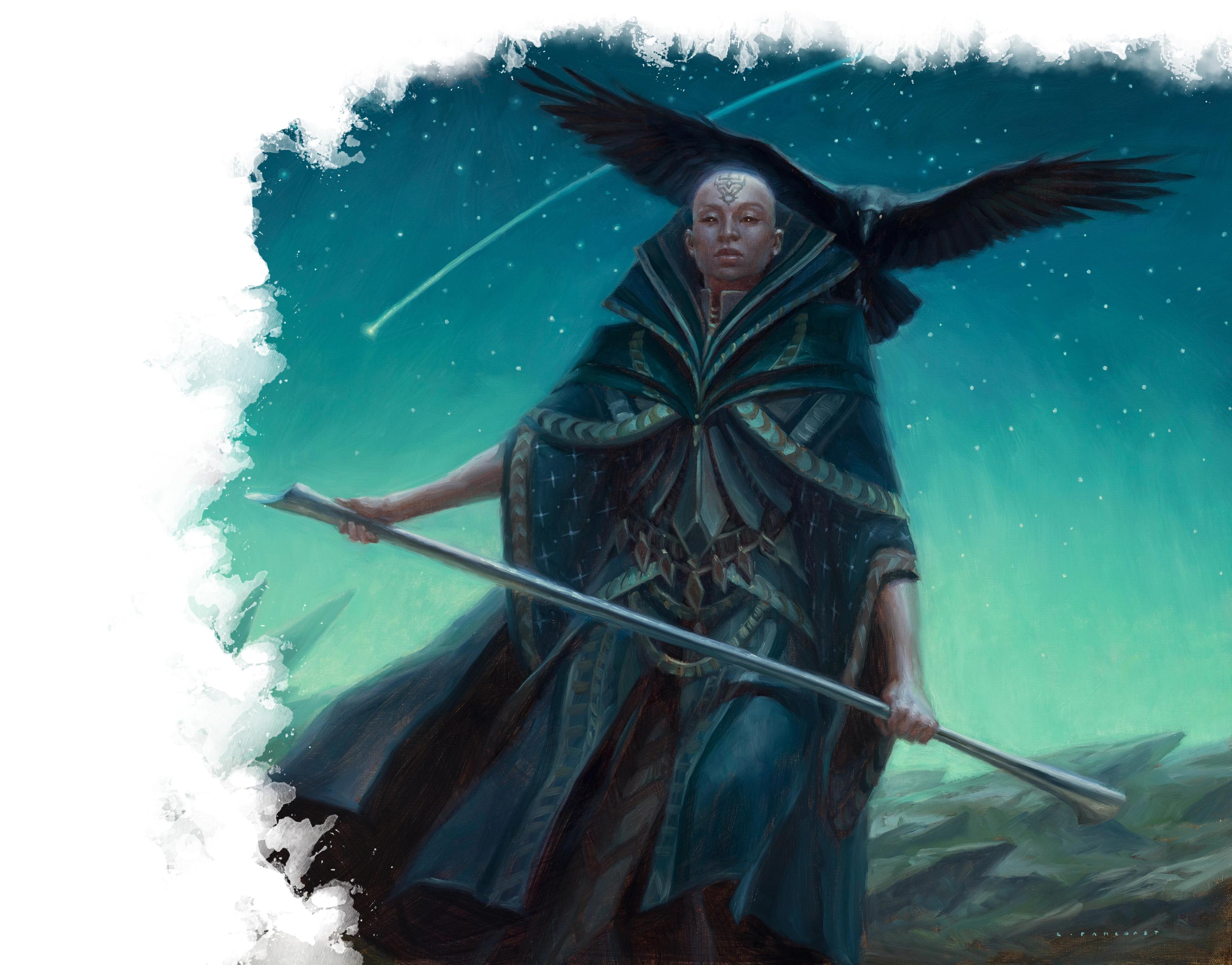
The Monk Nobody Asked For
Her fists a blur as they deflect an incoming hail of arrows, a half-elf springs over a barricade and throws herself into the massed ranks of hobgoblins on the other side. She whirls among them, knocking their blows aside and sending them reeling, until at last she stands alone.
Taking a deep breath, a human covered in tattoos settles into a battle stance. As the first charging orcs reach him, he exhales and a blast of fire roars from his mouth, engulfing his foes.
Moving with the silence of the night, a black-clad halfling steps into a shadow beneath an arch and emerges from another inky shadow on a balcony a stone’s throw away. She slides her blade free of its cloth-wrapped scabbard and peers through the open window at the tyrant prince, so vulnerable in the grip of sleep.
Whatever their discipline, monks are united in their ability to manipulate their inertia through perfect fluid movement, completed with absolute self awareness and control. Peerless speed heightens their reflex, letting them simultaneously make striking displays of combat prowess, all while dodging and deflecting incoming attacks.
Training and Asceticism
Small walled cloisters dot the landscapes of the worlds of D&D, tiny refuges from the flow of ordinary life, where time seems to stand still. The monks who live there seek personal perfection through contemplation and rigorous training. Many entered the monastery as children, sent to live there when their parents died, when food couldn’t be found to support them, or in return for some kindness that the monks had performed for their families.
Some monks live entirely apart from the surrounding population, secluded from anything that might impede their spiritual progress. Others are sworn to isolation, emerging only to serve as spies or assassins at the command of their leader, a noble patron, or some other mortal or divine power.
The majority of monks don’t shun their neighbors, making frequent visits to nearby towns or villages and exchanging their service for food and other goods. As versatile warriors, monks often end up protecting their neighbors from monsters or tyrants.
For a monk, becoming an adventurer means leaving a structured, communal lifestyle to become a wanderer. This can be a harsh transition, and monks don’t undertake it lightly. Those who leave their cloisters take their work seriously, approaching their adventures as personal tests of their physical and spiritual growth. As a rule, monks care little for material wealth and are driven by a desire to accomplish a greater mission than merely slaying monsters and plundering their treasure.
Seeking Nirvana
Monks pursue meditation as part of the path toward liberation, awakening and Nirvana. This path of meditation involves long periods of self reflection, mindfulness, and balancing one's own supernatural focus. Monks train not only their body, but their spirit in order to gain greater control over the flow of their life force. In order to bring about nirvana, their meditative practice focus on unblocking these mystical pathways. Upon doing so, monks can channel this energy into uncanny speed and strength.
As they gain experience, they can enter temporary states of Zen. These states of Zen remove the monk from the material plane, allowing them to accomplish otherwise impossible feats. Meditation, dedication, and Zen brings the monks closer to reaching their perfect self.
Creating a Monk
As you make your monk character, think about your connection to the monastery where you learned your skills and spent your formative years. Were you an orphan or a child left on the monastery’s threshold? Did your parents promise you to the monastery in gratitude for a service performed by the monks? Did you enter this secluded life to hide from a crime you committed? Or did you choose the monastic life for yourself?
Monk Class Table
| Level | Proficiency Bonus | Martial Arts | Unarmored Movement | Features |
|---|---|---|---|---|
| 1st | +2 | 1d4 | - | Unarmored Defense, Martial Arts |
| 2nd | +2 | 1d4 | 10ft | Unarmored Movement, Step of the Wind, Flurry of Blows |
| 3rd | +2 | 1d4 | 10ft | Monastic Tradition, Conditioned Reflex |
| 4th | +2 | 1d4 | 10ft | Ability Score Improvement, Meditative Rest |
| 5th | +3 | 1d6 | 10ft | Extra Attack, Cloistered Studies |
| 6th | +3 | 1d6 | 10ft | Empowered Strikes, Monastic Tradition Feature |
| 7th | +3 | 1d6 | 10ft | Stillness of Mind, Evasion |
| 8th | +3 | 1d6 | 10ft | Ability Score Improvement |
| 9th | +4 | 1d6 | 15ft | Unarmored Movement Improvement, Conditioned Reflex Improvement |
| 10th | +4 | 1d6 | 15ft | Purity of Body, Flurry of Blows Improvement |
| 11th | +4 | 1d8 | 15ft | Monastic Tradition Feature |
| 12th | +4 | 1d8 | 15ft | Ability Score Improvement |
| 13th | +5 | 1d8 | 15ft | Tongue of the Sun and Moon, The Third Eye |
| 14th | +5 | 1d8 | 15ft | Diamond Soul |
| 15th | +5 | 1d8 | 15ft | Timeless Body, Wholeness of Being |
| 16th | +5 | 1d8 | 20ft | Ability Score Improvement |
| 17th | +6 | 1d10 | 20ft | Monastic Tradition Feature |
| 18th | +6 | 1d10 | 20ft | Empty Body |
| 19th | +6 | 1d10 | 20ft | Ability Score Improvement |
| 20th | +6 | 1d10 | 20ft | Perfect Self |
Consider why you left. Did the head of your monastery choose you for a particularly important mission beyond the cloister? Perhaps you were cast out because of some violation of the community’s rules. Did you dread leaving, or were you happy to go? Is there something you hope to accomplish outside the monastery? Are you eager to return to your home?
Class Features
As a Monk, you gain the following class features
Hit Points
- Hit Dice: 1d8 per Monk level
- Hit Points at 1st Level: 8 + your Constitution modifier
- Hit Points at Higher Levels: 1d8 or 5 + your Constitution modifier per monk level after 1st
Proficiencies
- Armor: none
- Weapons: Simple weapons, shortswords
- Tools: Choose one type of artisan’s tools and one musical instrument
- Saving Throws: Strength, Dexterity
- Skills: Choose two from Acrobatics, Athletics, History, Insight, Medicine, Performance, Religion, and Stealth.
Equipment
You start with the following equipment, in addition to the equipment granted by your background:
- (a) a shortsword or (b) any simple weapon
- (a) a dungeoneer’s pack or (b) an explorer’s pack
- 10 darts
Unarmored Defense
Beginning at 1st level, while you are wearing no armor and not wielding a shield, your AC equals 10 + your Dexterity modifier + your Wisdom modifier.
Martial Arts
At 1st level, your practice of martial arts gives you mastery of combat styles that use unarmed strikes and your monk weapons. You gain the following benefits while you are unarmed or wielding only monk weapons and you aren’t wearing armor or wielding a shield:
- You can use Dexterity instead of Strength for the attack and damage rolls of your unarmed strikes and monk weapons.
- You can roll a d4 in place of the normal damage of your unarmed strike or monk weapon. This die changes as you gain monk levels, as shown in the Martial Arts column of the Monk table.
- You can make one unarmed strike as a bonus action on each of your turns.
Monk Weapons
With dedicated training, you can use a variety of weapons as monk weapons. Your monk weapons must meet these criteria:
- The weapon must be a simple or martial weapon.
- You must be proficient with it.
- It must lack the heavy and special properties.
Certain monasteries use specialized forms of the monk weapons. For example, you might use a club that is two lengths of wood connected by a short chain (called a nunchaku) or a sickle with a shorter, straighter blade (called a kama). Whatever name you use for a monk weapon, you can use the game statistics provided for the weapon in the Weapons section.
Unarmored Movement
Starting at 2nd level, your speed increases by 10 feet while you are not wearing armor nor wielding a shield. This bonus increases when you reach certain monk levels, as shown in the Monk table.
At 9th level, you gain the ability to move along vertical surfaces and across liquids on your turn without falling during the move.
Step of the Wind
Starting at 2nd level, you can take the Disengage or Dash action as a bonus action on your turn. Whenever you take one of these actions (either as a bonus action or your main action), your jump distance is doubled for the turn.
Flurry of Blows
Starting at 2nd level, you can make a display of lightning fast strikes. When you make an unarmed strike, you can choose to make one additional unarmed strike as part of that same attack. Once you use this feature, you cannot use it again until you finish a short or long rest.

Conditioned Reflex
Starting at 3rd level, your spiritual and mental training lets you harness an innate energy. Some cultures refer to this energy as axé, prana, pneuma, or qi, and this energy gifts you with a supernatural insight, allowing you to react without thought. You gain new ways to use your reactions while you are not wearing armor or wielding a shield. You can use these reactions a combined number of times equal to your Wisdom modifier (minimum of once). You regain all expended uses at the end of a short or long rest.
Deflect Missiles. You can use a reaction to deflect or catch the missile (ex. a rock, arrow, or dagger) when you are hit by a ranged weapon attack. When you do so, the damage you take from the attack is reduced by 1d10 + your Dexterity modifier.
If you reduce the damage to 0, you can catch the missile if it is small enough for you to hold in one hand and you have at least one hand free. If you catch a missile in this way, you can make a ranged attack with the weapon or piece of ammunition you just caught. You make this attack with proficiency, and the missile counts as a monk weapon for the attack, which has a normal range of 20 feet and a long range of 60 feet.
Patient Defense. Whenever a creature makes a melee attack roll against you, you can use a reaction to impose disadvantage on it. You must use this feature before creature makes the attack roll.
Slow Fall. You can use a reaction when you fall to reduce any falling damage you take by an amount equal to five times your monk level, to a minimum of 0 damage.
Each of these features gain an improvement at 9th level.
Monastic Tradition
When you reach 3rd level, you commit yourself to a monastic tradition. Your tradition grants you features at 3rd level and again at 6th, 11th, and 17th level.
Ability Score Improvement
When you reach 4th level, and again at 8th, 12th, 16th, and 19th level, you can increase one ability score of your choice by 2, or you can increase two ability scores of your choice by 1. As normal, you can’t increase an ability score above 20 using this feature.
Using the optional feats rule, you can forgo taking this feature to take a feat of your choice instead.
Meditative Rest
Starting at 4th level, if you spend at least 15 minutes of a short rest meditating, you can accelerate the healing process. You regain a number of hit points equal to one roll of your martial arts die plus your proficiency bonus. You can do this before or after spending any hit dice.
Extra Attack
Beginning at 5th level, you can attack twice, instead of once, whenever you take the Attack action on your turn.
Cloistered Studies
At 5th level, you've chosen a path and have learned from doing alongside your monastic studies. Choose one of the following skills to become proficient with: Arcana, History, Nature, Performance, or Religion. In addition, whenever you make a check that uses the chosen skill, you can add your Wisdom modifier to the check.
Empowered Strikes
Starting at 6th level, your unarmed strikes count as magical for the purpose of overcoming resistance and immunity to nonmagical attacks and damage.
Stillness of Mind
Starting at 7th level, you can still your mind and body to return to place of self control. You can use your action to end one effect on yourself that is causing you to be charmed or frightened.
Evasion
Starting at 7th level, your instinctive agility lets you dodge out of the way of certain area effects, such as a blue dragon’s lightning breath or a fireball spell. When you are subjected to an effect that allows you to make a Dexterity saving throw to take only half damage, you instead take no damage if you succeed on the saving throw, and only half damage if you fail.
Conditioned Reflex Improvement
Starting at 9th level, your instinctive reflex grows stronger allowing you to perform incredible feats. The following features improve from their 3rd level introduction.
Deflect Missles. When you reduce the damage taken by a missile, you further reduce the damage taken by an amount equal to your monk level.
Patient Defense. If the attacking creature has multiattack, it gains disadvantage on each of its melee attacks against you.
Slow Fall. You can extend the benefit of your slow fall to one willing creature that you are touching.
Purity of Body
When you reach 10th level, you purify your body, just as you've purified your soul. You become immune to disease and poison.
Flurry of Blows Improvement
Starting at 10th level, you gain additional uses of your Flurry of Blows equal to your Dexterity modifier(minimum of one bonus use) instead of just once, and regain all expended uses after finishing a short or long rest. However, you cannot use your Flurry of Blows more than once per unarmed strike.
Tongue of the Sun and Moon
Starting at 13th level, you learn to reach out with your spirit, touching the minds of others such that you understand all spoken language. Moreover, any creature that can understand a language can understand what you say.
The Third Eye
At 13th level, you open your presence to the world, granting you transcendental awareness. You cannot be surprised so long as you are conscious, and you have 2 reactions each round instead of 1.
Diamond Soul
Beginning at 14th level, you gain proficiency in all saving throws.
Timeless Body
At 15th level, you attain a perfect state of Zen which sustains you so that you suffer none of the frailty of old age, and you can’t be aged magically. You can still die of old age, however. In addition, you no longer need food or water.
Wholeness of Being
At 15th level, you fighting form has reached its apex, as you synchronously utilize the entirety of your being. Your Flurry of Blows and Conditioned Reflex features gain additional uses between rests equal to your Constitution modifier(minimum of one bonus use).
Empty Body
Starting at 18th level, through stillness of mind and perfect focus, you ignore the frailties of the world around you for a short time. As a bonus action you can enter an otherworldly state for 1 minute. During this time you have resistance to all damage but force damage.
Once you use this feature you cannot do again until you finish a short or long rest.
Perfect Self
At 20th level, your body, mind, and spirit have reached perfect harmony. Each of your attribute scores increase by 2. Your maximum for all scores is now 22.
Monastic Traditions
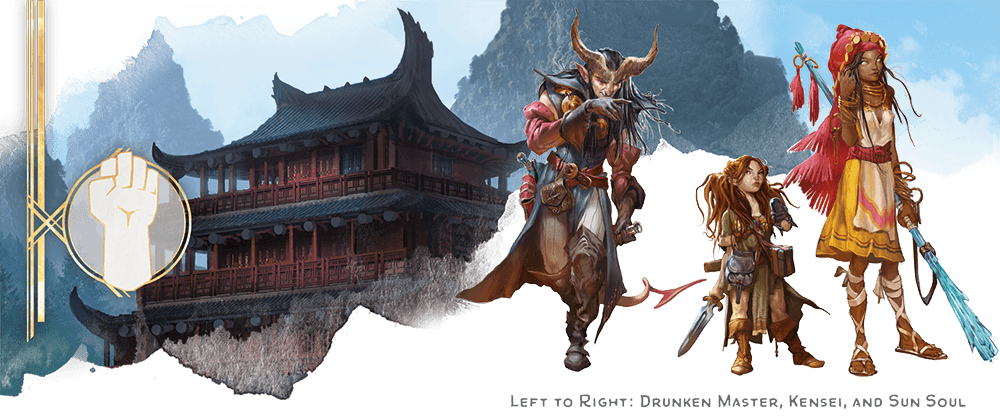
Three traditions of monastic pursuit are common in the monasteries scattered across the multiverse. Most monasteries practice one tradition exclusively, but a few honor the three traditions and instruct each monk according to his or her aptitude and interest. All three traditions rely on the same basic techniques, diverging as the student grows more adept. Thus, a monk need choose a tradition only upon reaching 3rd level.
Way of the Drunken Master
The Way of the Drunken Master teaches its students to move with the jerky, unpredictable movements of a drunkard. A drunken master sways, tottering on unsteady feet, to present what seems like an incompetent combatant who proves frustrating to engage. The drunken master’s erratic stumbles conceal a carefully executed dance of blocks, parries, advances, attacks, and retreats.
A drunken master often enjoys playing the fool to bring gladness to the despondent or to demonstrate humility to the arrogant, but when battle is joined, the drunken master can be a maddening, masterful foe. Your martial arts technique mixes combat training with the precision of a dancer and the antics of a jester.
Bonus Proficiencies
When you choose this tradition at 3rd level, you gain proficiency in the Performance skill if you don’t already have it, and any time you make a Performance skill check when performing physical movement, you can use your Dexterity modifier in place of your Charisma modifier. Additionally, you also gain proficiency with brewer’s supplies if you don’t already have it.
Drunken Technique
At 3rd level, you learn how to twist and turn so quick, it beguiles your opponents. You gain the following benefits:
- You gain one additional use of your Flurry of Blows between rests.
- Whenever you make an unarmed strike against a creature, you don't provoke opportunity attacks from that creature for the rest of the turn, whether you hit or not.
- Whenever you take the Dash or Disengage as an action or bonus action, your walking speed increases by 10 feet until the end of the current turn, and you gain advantage on your next attack made before the start of your next turn.
Tipsy Sway
Starting at 6th level, you can move in sudden, swaying ways. You gain the following benefits.
Leap to Your Feet. When you’re prone, you can stand up by spending 5 feet of movement, rather than half your speed.
Redirect Attack. After you use Patient Defense and the first melee attack targeting you misses, you can cause the attacker to reroll the attack and force them to target a different creature of your choice, other than the attacker, that you can see within 5 feet of you and 5 feet of the attacker. This rerolled attack does not gain disadvantage from your Patient Defense feature.
Drunkard’s Luck
Starting at 11th level, you always seem to get a lucky bounce at the right moment. When you make an ability check, an attack roll, or a saving throw and have disadvantage on the roll, you can cancel the disadvantage for that roll.
You can cancel the disadvantage a number of times equal to you Wisdom modifier (minimum of once), and regain all uses of this feature after finishing a short or long rest.
Intoxicated Frenzy
At 17th level, you gain the ability to make an overwhelming number of attacks against a group of enemies. When you use your Flurry of Blows, you can make up to three additional attacks with it (up to a total of five Flurry of Blows attacks), provided that each Flurry of Blows attack targets a different creature this turn.
Way of the Kensei
Monks of the Way of the Kensei train relentlessly with their weapons, to the point where the weapon becomes an extension of the body. Founded on a mastery of sword fighting, the tradition has expanded to include many different weapons.
A kensei sees a weapon in much the same way a calligrapher or painter regards a pen or brush. Whatever the weapon, the kensei views it as a tool used to express the beauty and precision of the martial arts. That such mastery makes a kensei a peerless warrior is but a side effect of intense devotion, practice, and study.
Path of the Kensei
When you choose this tradition at 3rd level, your special martial arts training leads you to master the use of certain weapons. This path also includes instruction in the deft strokes of calligraphy or painting. You gain the following benefits.
Kensei Weapons. Choose two types of weapons to be your kensei weapons: one melee weapon and one ranged weapon. Each of these weapons can be any simple or martial weapon that lacks the heavy and special properties. For example: the longbow is a valid choice. You gain proficiency with these weapons if you don’t already have it. Weapons of the chosen types are monk weapons for you. Many of this tradition’s features work only with your kensei weapons.
When you reach 6th, 11th, and 17th level in this class, you can choose another type of weapon — either melee or ranged — to be a kensei weapon for you, following the criteria above.
Way of the Brush. You gain proficiency with your choice of calligrapher’s supplies or painter’s supplies.
Agile Parry. You use your kensei weapon to defend yourself if it is a melee weapon. You can use a bonus action to gain +2 AC until the start of your next turn while the kensei weapon is in your hand and you aren’t incapacitated.
Kensei’s Shot. You can use a bonus action on your turn to make your ranged attacks with a kensei weapon more deadly. When you do so, all ranged attacks using a kensei weapon this turn gain an extra 1d4 damage.
Kensei's Technique
When you choose this tradition at 3rd level, you learn techniques fueled by special dice called superiority dice.
Technique. You learn two techniques of your choice, which are detailed under “Techniques” below. Many technique enhance an attack in some way. You can use only one technique per attack.
You learn one additional technique of your choice at 6th, 11th, and 17th level. Each time you learn new technique, you can also replace one technique you know with a different one.
Superiority Dice. You have four superiority dice, which are d8s. A superiority die is expended when you use it. You regain all of your expended superiority dice when you finish a short or long rest.
You gain another superiority die at 6th level and one more at 11th level.
Saving Throws. Some of your technique require your target to make a saving throw to resist the technique’s effects. The saving throw DC is calculated as follows:
Technique save DC = 8 + your proficiency bonus + your Dexterity modifier
One with the Blade
At 6th level, you hone your accuracy, focusing on striking exposed pressure points with your blades as you do with your fists. Your attacks with your kensei weapons count as magical for the purpose of overcoming resistance and immunity to nonmagical attacks and damage.
Improved Technique
At 11th level, you perfect your fighting form. Your superiority dice become d10s instead of d8s.
Unerring Accuracy
At 17th level, your mastery of weapons grants you extraordinary accuracy. If you miss with an attack roll using a kensei weapon on your turn, you can reroll it. You can use this feature only once on each of your turns.
Techniques
- Shikake Strike. You can expend one superiority die on your turn to hit a target that is off its guard, choosing one creature as your target. You have advantage on your next attack roll against that creature this turn made with a kensei weapon. If that attack hits, add the superiority die to the attack’s damage roll.
- Oji Counter. When a creature misses you with a melee attack, you can use a reaction and expend one superiority die to make a melee weapon attack against the creature with a kensei weapon. If you hit, you add the superiority die to the attack’s damage roll.
- Gokaku. When you hit a creature with a melee weapon attack, you can expend one superiority die to attempt to goad the target into attacking you. You add the superiority die to the attack’s damage roll, and the target must make a Wisdom saving throw. On a failed save, the target has disadvantage on all attack rolls against targets other than you until the end of your next turn.
- Pressing Palm. When you hit a creature with an unarmed strike, you can expend one superiority die to attempt to drive the target back. You add the superiority die to the attack’s damage roll, and if the target is Large or smaller, it must make a Strength saving throw. On a failed save, you push the target up to 15 feet away from you.
- Pinning Stroke. When you hit a creature with an attack using a kensei weapon, you can expend one superiority die to attempt to knock the target off balance. You add the superiority die to the attack’s damage roll, and the target must make a Dexterity saving throw. On a failed save, the target's speed becomes 0 until the end their next turn.
- Thrusting Slash. When you make a melee weapon attack on your turn using a kensei weapon, you can expend one superiority die to increase your reach for that attack by 5 feet. If you hit, you add the superiority die to the attack's damage roll.
- Disabling Rend. When you hit a creature with a weapon attack using a kensei weapon, you can expend one superiority die to temporarily impair their ability to fight. You add the superiority die to the attack's damage roll, and on the creature's next turn, it can take an action or a bonus action, but not both.
Way of the Sun Soul
Monks of the Way of the Sun Soul learn to channel their life energy into searing bolts of light. They teach that meditation can unlock the ability to unleash the indomitable light shed by the soul of every living creature.
Radiant Expression
Starting at 3rd level, if you fail a Charisma (Intimidation) or Charisma (Persuasion) check, you can use a reaction to reroll the check, as you tap into the warming radiance of the sun's rays. Once this feature turns a failure into a success, you can’t use it again until you finish a long rest
Radiant Sun Bolt
Starting when you choose this tradition at 3rd level, you can hurl searing bolts of magical radiance.
Whenever you make an unarmed strike, you can choose to covert that attack into a new special attack. This special attack is a ranged spell attack with a range of 30 feet. You are proficient with it, and you add your Dexterity modifier to its attack and damage rolls. Its damage is radiant, and its damage die is a d4. This die changes as you gain monk levels, as shown in the Martial Arts column of the Monk table.
Sun Shield
At 6th level, you gain the ability to surround yourself in restorative radiant flame. As an action, you can cause yourself to be engulfed in radiant flame until the start of your next turn. When you use this action, you can regain hit points equal to twice your monk level. Until the start of your next turn you emit bright light in a 15 foot radius, dim light for another 15 foot radius, and any creature that hits you with an attack takes radiant damage equal to monk level + your Wisdom modifier as the radiant flame lashes out against them. Additionally, during this time, you have advantage on all saving throws, as the might of the sun protects you.
You must finish a long rest before you can use this feature again.
Beacon of Sunlight
At 11th level, you become wreathed in a luminous, magical aura. You shed bright light in a 30-foot radius and dim light for an additional 30 feet. You can extinguish or restore this light as a bonus action.
While the light shines, the range of your Radiant Sun Bolt is increased to 90ft.
When you extinguish the light and have not attacked or dealt damage to a creature on your turn, you can enter a special meditation that surrounds you with an aura of peace. You can choose to gain the effect of a sanctuary spell that lasts until you restore this light again(the spell can end early as normal). The saving throw DC for the spell equals 8 + your Wisdom modifier + your proficiency bonus.
Searing Sunburst
At 17th level, gain the ability to create an orb of light that erupts into a devastating explosion. After you hit a target with your Radiant Sun Bolt, you can cause the bolt to erupt into a sphere of radiant flame for a brief but deadly instant. Each creature in a 20-foot-radius sphere (excluding you) must succeed on a Constitution saving throw (DC of 8 + proficiency bonus + Wisdom modifier) or take 3d6 radiant damage on a failed save, or half as much on a successful one. This is in addition to the attack's normal effects. A creature doesn’t need to make the save if the creature is behind total cover that is opaque. A creature that fails this save by 5 or more is blinded until the start of their next turn.
You can use this feature a number of times equal to your Wisdom modifier (minimum of once), and regain all expended uses after finishing a short or long rest.
Way of the Open Hand
Monks of the Way of the Open Hand are the ultimate masters of martial arts combat, whether armed or unarmed. They learn techniques to exercise control over themselves and their opponents.
Bonus Proficiencies
Starting when you choose this tradition at 3rd level, you've continually trained your body long and hard to fast, strong and flexible. You gain proficiency in either Athletics or Acrobatics.
Additionally, you gain a bonus die with the Athletics and Acrobatics skills. Anytime you make a skill check with either of these skill, add one roll of your martial arts die to the result of the check.
Open Hand Technique
Starting when you choose this tradition at 3rd level, your training in the martial arts allows you greater control over the battlefield. Immediately after you hit a creature with an unarmed strike, you can force that creature to make a Strength saving throw against a DC of 8 + proficiency bonus + Dexterity modifier. On a failure, that creature takes 1d6 bludgeoning damage, and you can apply one of the following effects:
- You push the creature 10 feet away from you.
- You knock the creature prone.
- You grapple the creature.
- The creature cannot take reactions until the start of its next turn.
You can force this saving throw a number of times equal to your Dexterity modifier(minimum of once), and regain all expended uses after finishing a short or long rest.
Stunning Strike
Starting at 6th level, you can heighten your focus, finding the correct sequence of nerve bundle when struck in sequence will momentarily disable an opponent’s body. When you hit another creature with an unarmed strike, you can attempt a stunning strike. The target must succeed on a Constitution saving throw (DC of 8 + proficiency bonus + Wisdom modifier) or be stunned until the end of your next turn. A target that has been stunned by this feature is immune to its effects for the next 24 hours.
You can attempt this stunning strike a number of times equal to your Wisdom modifier (minimum of once), and regain all expended uses after finishing a long rest.
Swift as the Wind
Starting at 11th level, your swift palms strike faster and harder than all others. Once per turn, when you would attack with advantage, you can forgo the advantage to make 2 attacks without advantage instead.
Transitioned Momentum
At 17th level, with a graceful touch, you master the art of turning attacks against you into attacks back at the aggressor. Once between turns when a creature misses you with a melee attack, you can use a reaction to make an unarmed strike against that target. You do so with advantage, and may choose to use your Open Hand Technique with this attack without expending a use.

Way of the Long Death
Monks of the Way of the Long Death are obsessed with the meaning and mechanics of dying. They capture creatures and prepare elaborate experiments to capture, record, and understand the moments of their demise. They then use this knowledge to guide their understanding of martial arts, yielding a deadly fighting style.
Touch of Death
Starting at 3rd level, your study of death allows you to extract vitality from another creature as it nears its demise. Once per turn, when you hit a creature with an unarmed strike who has less than 1/2 its maximum hit points remaining, you can deal 1d8 bonus necrotic damage.
In addition, when you reduce a creature within 5 feet of you to 0 hit points, you gain temporary hit points equal to your Wisdom modifier + your monk level (minimum of 1). These temporary hit points last for up to 1 minute and surround you, appearing as an intangible spirit of the dead, guarding your life.
Touch of Life
At 3rd level, just as you can take life, you can prevent it's passing. You learn the spare the dying cantrip, if you don't already know it. Once between long rests, when you stabilize a creature with this cantrip, you can also heal that creature for 1 hit point.
Hour of Reaping
At 6th level, you gain the ability to unsettle or terrify those around you as an action, for your soul has been touched by the shadow of death. When you take this action, each creature of your choice within 30 feet of you that can see you must make a Wisdom saving throw against a DC of 8 + your proficiency bonus + your Wisdom modifier. On a failure, the creature becomes frightened of you until the end of your next turn. While you have temporary hit points from your Touch of Death feature, creatures within 15 feet of you that can see you gains disadvantage on this saving throw.
Mastery over Death
Beginning at 11th level, you use your familiarity with death to escape its grasp. When you are reduced to 0 hit points, you can have 1 hit point instead.
Once you have sustained life in this way, you cannot do so again until you finish a short or long rest.
The Five Point Palm Strike
Starting at 17th level, you can destructively interfere with the pulse of your victim's heart. When you hit a creature with an unarmed strike, you can start these imperceptible destructive vibrations, which last for a number of days equal to your monk level. The vibrations are harmless unless you use your action to end them. To do so, you and the target must be on the same plane of existence. When you use this action, the creature must make a Constitution saving throw (DC of 8 + your proficiency bonus + your Wisdom modifier). If it fails, it is reduced to 0 hit points. If it succeeds, it takes 10d10 necrotic damage.
You can have only one creature under the effect of this feature at a time. You can choose to end the vibrations harmlessly without using an action. Once you use this feature, you cannot use it again until you finish a short or long rest.
Way of Shadow
Monks of the Way of Shadow follow a tradition that values stealth and subterfuge. These monks might be called ninjas or shadowdancers, and they serve as spies and assassins. Sometimes the members of a ninja monastery are family members, forming a clan sworn to secrecy about their arts and missions. Other monasteries are more like thieves’ guilds, hiring out their services to nobles, rich merchants, or anyone else who can pay their fees. Regardless of their methods, the heads of these monasteries expect the unquestioning obedience of their students.
Shadow Arts
Starting when you choose this tradition at 3rd level, you learn the subtle arts of subterfuge. You gain proficiency in Thieves' Tools or the Disguise Kit and can duplicate the effects of certain spells.
As an action, you can cast Darkness, Darkvision, Pass Without Trace, or Silence, without providing material components. After casting one of these spells in this way, you cannot do so again until you finish a short or long rest. Wisdom is your spellcasting ability for these spells.
Starting at 11th level, you can cast these spells one additional time between rests.
Silent Strike
Starting when you choose this tradition at 3rd level, you know how to strike subtly and exploit a foe’s distraction. Once on your turn, you can deal extra damage to one creature you hit with an attack if you have advantage on the attack roll. The attack must use a monk weapon or an unarmed strike. The extra damage is equivalent to one roll of your martial arts die.
You don’t need advantage on the attack roll if another enemy of the target is within 5 feet of it, that enemy isn’t incapacitated, and you don’t have disadvantage on the attack roll.
Shadow Step
At 6th level, you gain the ability to step from one shadow into another. When you are in dim light or darkness, as a bonus action you can teleport up to 60 feet to an unoccupied space you can see that is also in dim light or darkness. You then have advantage on the first melee attack you make before the end of the turn.
Cloak of Shadows
By 11th level, you have learned to become one with the shadows. When you are in an area of dim light or darkness, you can use your action to become invisible. You remain invisible until you make an attack, cast a spell, or are in an area of bright light. Additionally, your Shadow Arts feature gains the Invisibility spell, but this spell cast can only target yourself.
Opportunist
At 17th level, you can exploit a creature’s momentary distraction when it is hit by an attack. Once between turns when a creature within 5 feet of you is hit by an attack made by a creature other than you, you can use a reaction to make a melee attack against the struck creature.

Way of the Four Elements
You follow a monastic tradition that teaches you to harness the elements of nature. These monks make careful study of a magical energy called ki. This energy is an element of the magic that suffuses the multiverse—specifically, the element that flows through living bodies and all the world around them. When you focus your ki, you can align yourself with the forces of creation and bend the elements to your will, using them as an extension of your body.
Many monks of this tradition tattoo their bodies with representations of their ki powers, commonly imagined as coiling dragons, phoenixes, fish, plants, mountains, cresting waves, or waxing moons.
Initiate of the Way
3rd-level Way of the Four Elements feature
Choose one the following four elements: Earth, Air, Fire, or Water. You gain the minor power related to your choice of element. You can choose another 6th, 11th, and again at 17th level.
- Fire. You learn the control flames cantrip.
- Air. You learn the gust cantrip.
- Earth. You learn the mold earth cantrip.
- Water. You learn the shape water cantrip.
Disciple of the Elements
3rd-level Way of the Four Elements feature
You learn magical disciplines that harness the power of the elements, represented by the mystic energy of ki. You have a number of ki points equal to your Wisdom modifier + your Proficiency bonus (minimum of one). You'll spend ki points to access various discipline features. When you spend a ki point, it is unavailable until you finish a short or long rest. Should your discipline require a saving throw to resist the feature’s effects. The saving throw DC is calculated as follows:
Discipline save DC = 8 + your proficiency bonus + your Wisdom modifier
You gain the following disciplines, which reflects one of the elements. You can choose another 6th, 11th, and again at 17th level.
Fangs of the Fire Snake When you make an unarmed strike on your turn, you can spend 1 ki point to cause tendrils of flame to stretch out from your fists and feet. The unarmed strike is replaced with a lash of flame, the target of this special lash of flame must succeed on a Dexterity saving throw or take fire damage equal to 1d10 + one roll of your Martial Arts die + your Wisdom modifier.
Fist of Unbroken Air You summon a swirling wind and concentrate it around your fist. When you make an unarmed strike on your turn, you can spend 1 ki point to strike out condensed bursts of air which stretch out beyond your normal reach. You increase the reach of this attack by 15ft. Should you hit, you deal 1d6 bonus damage and you can force the target to make a Strength saving throw. On a failure, you can push the target back 15 feet or daze the target, halving its speed until the end of its next turn.
Water Whip When you make an unarmed strike on your turn, you can spend 1 ki point to replace the strike with a whip of water that shoves and pulls a target, potentially unbalancing it. Choose a target that you can see within 15 feet of you to make a Strength saving throw. On a failed save, the target takes bludgeoning or slashing damage equal to one roll of your Martial Arts die + your Wisdom modifier, and you can push it up to 10 feet in any direction of your choosing. On a successful save, the creature takes no damage, and you don’t push it.
Mountain Stance. When you use the Attack action on your turn, you can spend 1 ki point to mold the earth into stone projectiles. All unarmed strikes for that action as well as for the rest of your turn become ranged, with a short range of 30 feet and a long range of 90 feet, and these attacks deal bludgeoning or piercing damage.
Endowment of the Elements
6th-level Way of the Four Elements feature
You gain the boon related to your primary element, chosen one of the following. This showcases your growth, and deepening connection with your element.
Fire. Those capable of manipulating fire also gain what fire can produce, warmth and light. You gain darkvision out to a range of 120 feet, and you do not suffer the ill effects of extreme temperatures.
Air. You can guide and ride the air currents as if you were standing on solid ground. Whenever you Dash, you ignore difficult terrain.
Water. You gain a swimming speed equal to your walking speed. Also, you can channel your restorative healing to aid others with their own restoration. When you use your Meditative Rest feature during a short rest, you can choose up to 1 willing creature to also regain an equivalent amount of hit points.
Earth. Standing firm grants you advantage on checks and saving throws to resit being moved or knocked prone. Additionally, you are able to suss out falsehoods and a creature's motivation based on the micro-movements of their body. You gain advantage on Wisdom(Insight) checks when reading another creature within 30 feet of you who is touching the same ground you are.
Harnessed Energy
6th-level Way of the Four Elements feature
You gain the ability to ground out a portion of lightning, disperse flame, numb the cold, and dampen the shock impact of a bludgeoning strike. You can capture and harness some of this elemental energy used by your foes. When you take fire, cold, lightning, or bludgeoning damage, you can spend 1 ki points and use a reaction to gain resistance to that damage. Additionally, your next unarmed strike made before the end of your next turn gains bonus damage equal to one roll of your martial arts die of the damage type you resisted.
Elemental Discipline
11th-level Way of the Four Elements feature
You learn to harness the magic of the elementals, letting you cast certain spells.
Casting Elemental Spells. Some elemental disciplines allow you to cast spells. See chapter 10 of the Player’s Handbook for the general rules of spellcasting. To cast one of these spells, you use its casting time and other rules, but you don’t need to provide material components for it. When you cast a spell with a discipline, it is cast at the spell’s lowest level. You can spend additional ki points to increase the level of an elemental discipline spell that you cast, provided that the spell has an enhanced effect at a higher level, as ice knife does. The spell’s level increases by 1 for each additional ki point you spend.
The maximum number of ki points you can spend to cast a spell in this way (including its base ki point cost and any additional ki points you spend to increase its level) is determined by your monk level, as shown in the Spells and Ki Points table, unless the Disciple specifies otherwise.
Spells and Ki Points
| Monk Levels | Maximum Ki Points for a Spell |
|---|---|
| 11th–12th | 4 |
| 13th–16th | 5 |
| 17th–20th | 6 |
You learn two of these Disciplines listed below at 11th level. You learn two additional Disciplines of your choice at 17th level.
Curtain of Unyielding Wind. You let out a fierce howl as a mighty wind begins swirling around you. You can spend 2 ki points to cast warding wind.
Cyclone Sweep. You summon a mighty, high pressure, gale force cyclone of wind. As an action and spending 3 ki points, each creature in a 15 foot cube originating from you must succeed on a Strength saving throw or take 3d8 bludgeoning damage and be caught up in the cyclone. Until the end of their next turn, a creature caught up in the cyclone cannot take reactions, has a −2 penalty to AC and Dexterity saving throws. On its turn, it can use either an action or a bonus action, not both. Regardless of the creature's abilities or magic items, it can't make more than one melee or ranged attack during its turn. Any nonmagical object that isn't being worn or carried also takes this damage, and is thrown wildly up to 30 feet from the center of the cyclone. On a successful save, a creature takes half as much damage and suffers no other effects.
Earth Reaches for Sky. Focusing your strength with a deep, rumbling shout, you swing your arms up high, causing an eruption of churned earth and stone that engulfs your foes. You can spend 3 ki points to cast erupting earth.
Eternal Mountain Defense. Your body hardens to stone, nearly impervious to weapons. You can spend 4 ki points to cast stoneskin, targeting yourself.
Earthen Binds. When you hit a target with an unarmed strike and spending 2 ki point, you cause the earth to engulf the target. That target must make a Strength saving throw. On a failed save, the target takes is restrained for up to 1 minute. To break out, the restrained target can use its action or another creature can use it action to make a Strength check against your Discipline save DC. On a success, the target escapes and is no longer restrained.
Freezing Mist. You push a freezing cold front from you in all directions, turning liquids solid and moisture in the air into pins and needles. As an action and spending 2 ki points, each creature in a 10 foot radius from you must succeed on a Dexterity saving throw or take 3d8 cold damage and be knocked prone. The ice that covers the area around you becomes difficult terrain until the start of your next turn. On a successful save, they take half as much damage and are not knocked prone. The cold freezes nonmagical liquids in the area that aren’t being worn or carried. On a successful save, a creature takes half as much damage and is not knocked prone.
Fang of the Frost Wolf. You summon a shard of razor-sharp ice and fling it at your foe. You can spend 1 ki point to cast ice knife.
Fist of Four Thunders. You slam your fists together in front of you, causing a thunderous boom that blows away everything around you. You can spend 1 ki point to cast thunderwave.
Rain of Sparks. With a deep breath you inhale pure energy, drawn from the clouds. You can spend 3 ki points to cast lightning arrow.
Raise the Still Waters. Though water can give way easily, it's density offers great resistance. You can spend 3 ki to cast wall of water.
River of Hungry Flame. You sweep your hands upward, causing a wall of blazing hot fire to leap up from the ground. You can spend 4 ki points to cast wall of fire.
Sweeping Cinders. With a wide sweeping gesture, you summon forth a barrage of hot cinders. As a bonus action and spending 2 ki points, each creature within a 15 foot cone originating from you must succeed on a Dexterity saving throw or take 3d6 fire damage, or half as much damage on a successful one. The fire ignites any flammable objects in the area that aren't being worn or carried.
Sweeping Crosswind. A wall of strong wind rises from the ground, batting away anything in its path. You can spend 3 ki points to cast wind wall.
Avatar of the Elements
17th-level Way of the Four Elements feature
As an ultimate display of your mastery of the elements, you can evoke the power of the elements for some time. As a bonus action, you can enter an avatar state, gaining multiple benefits for 1 minute. This effect ends early if you are knocked unconscious or choose to end it (no action required). Once use active this state, you cannot do so again until you finish a short or long rest.
- You gain a burrow, fly, and swim speed equal to your movement speed.
- You gain a 1 ki discount on any feature that spends ki.
- If you are concentrating on a spell, your concentration cannot be broken by damage.
Way of the Astral Self
A monk who follows the Way of the Astral Self believes their body is an illusion. They've opened their chakras in order to see their true form, their astral self. This astral self has the capacity to be a force of order or disorder, with some monasteries training students to use their power to protect the weak and other instructing aspirants in how to manifest their true selves in service to the mighty. Monks who follow the ways of the Astral Self dedicate time to understanding, knowledge, and unveiling life’s mysteries, bringing light to the secrets of the dark.
Bonus Proficiency
3rd-level Way of the Astral Self feature
You gain the knowledge most extensively held by the universe itself as you open your body, mind, and soul to that which lies just beyond reach. You learn one language of your choice, and you gain proficiency with one of the following skills of your choice: Arcana, History, Investigation, Nature, or Religion.
Astral Self
3rd-level Way of the Astral Self feature
Your openness to the universe allows you to summon a portion of your astral self. As a bonus action, you can summon your astral self, which lasts for the next 10 minutes, and your astral self ends early if you are incapacitated or die. You can summon your astral self twice, and regain all expended uses after finishing a short or long rest.
Additionally, when you summon your astral self, each creature of your choice that you can see within 15 feet of you must succeed on a Dexterity saving throw (DC of 8 + your proficiency bonus + your Wisdom modifier) or take force damage equal to two rolls of your Martial Arts die + your Wisdom modifier.
Arms of the Astral Self. Your astral self summons the arms of your astral self. They appear as spectral arms that hover near your shoulders or surround your arms (your choice). You determine the arms’ appearance. While you have the Arms of the Astral Self active, you gain the following benefits:
- You can use your Wisdom modifier in place of your Strength modifier when making Strength checks and Strength saving throws.
- You can use the spectral arms to make unarmed strikes.
- When you make an unarmed strike with the arms on your turn, your reach for it is 5 feet greater than normal.
- The unarmed strikes you make with the arms can use your Wisdom modifier in place of your Strength or Dexterity modifier for the attack and damage rolls, and their damage type is force.
- When you use this bonus action to summon your astral self, you may immediately make one unarmed strike.
Visage of the Astral Self
6th-level Way of the Astral Self feature
Your astral self grows as your deepen your connection to the universe. When you summon your astral self, you can summon the visage of your astral self for the duration. The spectral visage covers your face like a helmet or mask. You determine its appearance.
While you have the Visage of the Astral Self active, you gain the following benefits.
Astral Sight. You can see normally in darkness, both magical and nonmagical, to a distance of 120 feet.
Wisdom of the Spirit. You have advantage on Wisdom (Insight) and Charisma (Intimidation) checks.
Word of the Spirit. When you speak, you can direct your words to a creature of your choice that you can see within 60 feet of you, making it so only that creature can hear you. Alternatively, you can amplify your voice so that all creatures within 600 feet can hear you.
Body of the Astral Self
11th-level Way of the Astral Self feature
Your astral self grows as your deepen your connection to the universe. When you summon your astral self, you can summon the body of your astral self for the duration. This spectral body covers your physical form like a suit of armor, connecting with the arms and visage. You determine its appearance.
While you have the Body of the Astral Self active, you gain the following benefits.
Armor of the Spirit. You gain a +2 bonus to Armor Class.
Deflect Energy. You can use your Deflect Missiles feature when you are attacked with acid, cold, fire, force, lightning, or thunder damage.
Awakened Astral Self
17th-level Way of the Astral Self feature
Your connection to your astral self is complete, allowing you to traverse the astral boundary, leaving your mortal body behind. You can cast the astral projection spell, without any material components, only targeting yourself. For the duration of this spell cast, all forms of your astral self are considered to be active. Once you do, you cannot do so again until you finish a long rest.
Additionally, whenever all aspects of your astral self are active, you gain two additional benefits:
Astral Barrage. Whenever you use the Extra Attack feature to attack twice, you can instead attack three times if all the attacks are made with your astral arms.
Astral Convergence. You have resistance to force damage.

Way of Mercy
Monks of the Way of Mercy learn to manipulate the life force of others through Qi transference. They are wandering physicians for the poor and downtrodden. However, to those beyond their help, they bring a swift end as an act of mercy.
Those who follow the Way of Mercy might be members of a religious order, administering to the needy and making grim choices rooted in reality rather than idealism. Some might be gentle-voiced healers, beloved by their communities, while others might be masked bringers of macabre mercies.
The walkers of this way usually don robes with deep cowls, and they often conceal their faces with masks, presenting themselves as the faceless bringers of life and death. There concealing mask takes on several forms. Each has an origin based on the sect it represents.
Bonus Proficiencies
3rd-level Way of Mercy feature
You gain proficiency in the Insight and Medicine skills, and you gain proficiency with the herbalism kit.
Transference
3rd-level Way of Mercy feature
You gain a mystical ability to move life force, also known as energy, axé, prana, pneuma, qi, or essence from one being to another. You gain a pool of essence dice, which are d4s. You have a number of dice equal to your Wisdom modifier + your proficiency bonus (minimum of one die). You refill your pool of dice after finishing a long rest.
Hand of Healing
Your mystical touch can mend wounds. As an action, you can touch a creature and restore a number of hit points equal to a roll of your Martial Arts die. You can optionally spend any number of essence dice up to your Wisdom modifier(minimum of one), roll them and add the result to the amount of healing granted by your Hand of Healing.
You can use this action a number of times equal to your Proficiency bonus, and regain all expended uses after finishing a long rest.
Hand of Harm
You use your mystical touch to inflict wounds, and steal a small portion of their life essence. Once per turn, when you hit a creature with an unarmed strike, you can replace the damage of the attack with necrotic damage equal to one roll of your Martial Arts die. When you do, you regain 1 expended essence die.
Alternatively, you can forgo regaining an expended essence die to convert your stored energies into a devastating attack on the creature's life force. You can spend any number of essence dice up to your Wisdom modifier(minimum of one), roll them and add the result to the amount necrotic damage dealt by this attack.
Physician’s Touch
6th-level Way of Mercy feature
You can administer even greater cures with a touch, and if you feel it’s necessary, you can use your knowledge to cause harm.
When you use Hand of Healing on a creature, you can also end one disease or one of the following conditions affecting the creature: blinded, deafened, paralyzed, poisoned, or stunned.
When you use Hand of Harm on a creature and spend essence dice to increase its damage, you can subject that creature to the poisoned condition until the end of your next turn.
Flurry of Healing and Harm
11th-level Way of Mercy feature
You channel a deeper well of life energy. Your essence dice become d8s instead of d4s.
You can now mete out a flurry of comfort and hurt. When you use your Hand of Healing, you can target a second creature as well, and can make one unarmed strike all as part of the same action in any order you choose. You can break up the individual portions of this action using your movement.
Hand of Ultimate Mercy
17th-level Way of Mercy feature
Your mastery of life energy opens the door to the ultimate mercy. As an action, you can touch the corpse of a creature that died, but not of old age, within the past 24 hours. The creature then returns to life, regaining a number of hit points equal to 4d10 + your Wisdom modifier. If the creature died while subject to any of the following conditions, it revives with them removed: blinded, deafened, paralyzed, poisoned, and stunned.
Once you use this feature, you can’t use it again until you finish a long rest.

Way of the Ascendant Dragon
Monks who follow the Way of the Ascendant Dragon revere the power and grandeur of dragons. They alter their own essense to resonate with draconic might, channeling it to augment their prowess in battle, and to bolster their allies.
As a follower of this Monastic Tradition, you decide how you unlocked the power of dragons. The Ascendant Dragon Origin table offers some possibilities.
Ascendant Dragon Origin
| d6 | Origin |
|---|---|
| 1 | You honed your abilities by observing a dragon and underwent a ritual to align your energy with their world altering power. |
| 2 | A dragon personally took an active role in shaping you, molded you, and fused you with its energy. |
| 3 | You studied at a monastery that traces its teachings back centuries or more to a single dragon’s instruction. |
| 4 | You spent long stretches meditating in the region of influence of an ancient dragon’s lair, absorbing its ambient magic. |
| 5 | You found a scroll written in Draconic that contained inspiring new techniques. Upon reading the scroll, the powers of the dragon were transfered to you. |
| 6 | After a dream that featured a five-handed dragonborn you awoke with an altered self, reflecting the breaths of dragons. |
Draconic Manifestation
3rd-level Way of the Ascendant Dragon feature
You gain a draconic aspect as part of your draconic inheritance or training. Your aspect magnifies your presence and enhances your physique. You gain the following benefits:
- If you can’t already, you learn to speak, read, and write Draconic.
- Your body hardens, as if covered by tough dragon scales. You can treat your AC as 13 + your Dexterity modifier so long as you are not wielding a shield.
- The constitution of the dragon's blood flows through you. Your maximum hit points increase by 3, and gain 1 additional maximum hit point each time you gain a level in this class.
- You can manifest retractable claws or talons from your hands or feet(no action required), which can be used to make unarmed strikes. These natural weapons deal 1d6 slashing damage on hit, and increase with your Martial Arts die as listed in the Monk table, but are always 1 die type larger. For example, at 3rd level they are d6 instead of a d4.
Breath of the Dragon
3rd-level Way of the Ascendant Dragon feature
You can evoke destructive waves of energy like the dragons you emulate. When you take the Attack action on your turn, you can replace one of the attacks with an exhalation of draconic energy in either a 15-foot cone or a 30-foot line that is 5 feet wide (your choice). Choose a damage type: acid, cold, fire, lightning, or poison. Each creature in the area must make a Dexterity saving throw against a DC of 8 + your proficiency bonus + your Wisdom modifier, taking damage of the chosen type equal to two rolls of your Martial Arts die on a failure, or half as much damage on a success.
At 11th level, the damage of your breath increases to three rolls of your Martial Arts die.
You can use this feature a number of times equal to your proficiency bonus, and you regain all expended uses when you finish a long rest.
Strength of the Dragon
6th-level Way of the Ascendant Dragon feature
A portion of the ancient dragon's strength has been gifted to you. Whenever you make Strength or Constitution skill check, you can roll 1d4 and add the result to the check. Whenever you make a long jump or high jump, the distance you can jump is doubled.
In addition, you has advantage on skill checks and saving throws to resit being moved or knocked prone against your will.
Aspect of the Wyrm
11th-level Way of the Ascendant Dragon feature
The power of your draconic aspect now radiates from you, protecting your allies from harm and punishing any who raise arms against them. As a bonus action, you can create an aura of draconic power that radiates 30 feet from you for 1 minute. Choose acid, cold, fire, lightning, or poison damage, and for the duration, you gain the following effects:
- You and your allies within your aura gain resistance to the chosen damage type.
- Waves of destructive energy flow out from you and your allies when any of you are attacked. When you or one of your allies in the aura is hit by an attack made by another creature within the aura, the target that was hit can use their reaction to deal an amount of damage of the chosen type equal to one roll of your Martial Arts die to the attacker.
Once you use this bonus action, you can’t use it again until you finish a short or long rest.
Ascendant Aspect
17th-level Way of the Ascendant Dragon feature
Reaching the pinnacle of your draconic aspect, you gain the following benefits:
- You gain blindsight out to 30 feet. Within that range, you can effectively see anything that isn’t behind total cover, even if you’re blinded or in darkness. Moreover, you can see an invisible creature within that range, unless the creature successfully hides from you.
- When you damage a creature with your Breath of the Dragon, the energy clings to the target. At the start of each of the creature’s turns, it takes damage of the type your breath dealt equal to one roll of your Martial Arts die. At the end of its turn, the creature can repeat the save, ending the effect on itself on a success.
- When you activate your Aspect of the Wyrm, draconic fury explodes from you. Choose any number of creatures you can see within your aura. Those creatures each take 4d10 acid, cold, fire, lightning, or poison damage (your choice).
Way of the Ancient Giant
It is no secret that the Giants once roamed and ruled over the Sword Coast. The Way of the Ancient Giant monks are dedicated in their search for the scholastic knowledge that is and was these ancient giants. They've passed along the knowledge they've gained from monastery to monastery, and those that follow the Way of the Ancient Giant learn to use the runic magic of the once formidable giant for their own aid. This magic serves to bolster their resolve, furthering their way's desire to uncover greater mysteries and the power once held by the ancient giants.
Bonus Proficiency
3rd-level Way of the Ancient Giant feature
You gain proficiency with smith's tools, and you learn to speak, read, and write Giant. When you make an Intelligence (Arcana or History), or a Charisma (Persuasion) check related to Giants, you are considered to be proficient even if you are not.
Runic Augmentation
3rd-level Way of the Ancient Giant feature
You scrawl or tattoo runes of power onto your body or equipment that you are carrying. These runes grant you enhanced ability over the battlefield.
You gain a pool of dice representing your ability to command the runic powers of the Giants. You a number of rune dice equal to 1 + your Wisdom modifier(minimum of one die). The size of these dice are d4s and increase with your Martial Arts die, as listed in the Monk table. Once you use a die, it is unavailable until you finish a short or long rest.
You gain the following runes:
Rune Mark. When you hit a target with an unarmed strike, you can spend a rune die to leave a runic mark one the creature. Once within the the next minute, when you attack a creature you have marked this way, you can increase the attack roll by the result of the die roll. You can do this after rolling the d20, but before determining if the attack hit or missed. Then the rune mark fades.
Rune of Protection. As a bonus action, you can press your palm to ground creating a large rune on the floor or ground below you filling a 15 foot square centered on you. You can designate any number of creatures to be protected by the rune. Expend and roll one rune die, each attack made against a protected creature deals less damage equal to the result of the roll. The rune lasts until the end of your next turn.
Frozen Rune. When you make an ability check or saving throw that uses Strength or Constitution and fail, you can use a reaction and expend one rune die. You add the result to the check or save, potentially changing a failure into a success.
Rune of Power. As a bonus action, you can expend a runic die to evoke this rune. You cause the rune to fill a 15 foot square area originating from you. At the start of your next turn, the rune explodes. Creatures of your choice that in the rune's area of effect must succeed on a Dexterity saving throw (DC of 8 + your proficiency bonus + your Wisdom modifier) or take cold, fire, poison, lightning, or thunder damage equal to one roll of your rune die + your Wisdom modifier.

Written in Ancient Runic
6th-level Way of the Ancient Giant feature
Spending 1 minute, you can scribe magical runes onto non-magical objects to create a variety of effects. Each rune you scribe this way can produce 1 such effect. Such effects include:
- A proximity alarm that dings like a bell when a non-designated creature moves within 1 foot of the rune.
- A timed delay release of harmless sparks, odor, a noise no louder than 70 decibels, or similar. This effect ends seconds after release.
- Magical writings that shift and move on the page unless the correct command word is spoken.
- The rune emits a small static hologram no larger than 1 cubic foot directly above the scribed surface.
- The rune creates dim light in a 30 foot radius. This light can be toggled on and off by speaking the command word.
You can have up to 3 of these minor rune effects active at one time. These effects last for up to 24 hours. Repeated use of the same runic feature over the course of 1 week will cause the rune effect to become permanent for up to 1 year and no longer count against your limit. These runes can be ended early through dispels, or should you take an action remove the rune.
Runes of Sovereignty
11th-level Way of the Ancient Giant feature
Through trial, you unlock two new runes to exert control over your foes and the ground you fight on.
Rune of Binding Shackles. You learn to harness a powerful, rune of labor. As an action, you expand the power of the rune, causing it fill a 20 foot square area originating from you for up to 1 minute. You designate any number of creatures that you can see to not be effected by this rune. Any non-designated creature in the area of effect must succeed on a Constitution saving throw (DC of 8 + your proficiency bonus + your Wisdom modifier).
On a failure, the creature suffers -2 to its AC, its speed is halved, it cannot benefit from a fly speed, it suffers disadvantage on attack rolls, and gains no benefits from cover. A non-designated creature must make this save again at the start of its turn or suffer the runes effects until the start of its next turn. This effect immediately ends when the creature leaves the rune's area of effect.
You can dismiss this rune anytime (no action required). Once you invoke the power of this rune, you cannot use it again until you finish a short or long rest.
Rune of Dominance. When you hit a creature with an unarmed strike, you can brand the target with a rune of dominance. The target must make a Wisdom saving throw (DC of 8 + your proficiency bonus + your Wisdom modifier). On a failure the creature is charmed by you for 1 minute. While charmed in this way, the creature has a speed of 0 and is incapacitated, descending into a dreamy stupor. The creature repeats the saving throw at the end of each of its turns, ending the effect on a success.
Once you invoke this rune, you can’t do so again until you finish a short or long rest.
Mastery of Runic Might
17th-level Way of the Ancient Giant feature
When you use a Runic Augmentation feature, roll your rune die twice and take either result.
You can use your Runes of Sovereignty twice between rests between rests instead of once.
Way of the Monte
Those who follow the Way of the Monte understand that life is suffering. They also know that greatest remedy for pain is laughter. They walk the duality of tragedy and comedy in their way of life. They are known for their tricks, illusions, jests, antics, and playing the fool in order to put a smile on the face of others.
These monks are taught that tricks of the mind are dual purposed. A subtle trick can convince someone to avoid danger and better themselves, while the same trick can con a man out of his daily bread. As a result, these monks take an a-moral stance on life. Some lives cannot be helped, so they must choose who can and who cannot be helped.
Bonus Proficiency
3rd-level Way of the Monte feature
Known for their arts, you gain proficiency with one gambling set or musical instrument of your choice, Sleight of Hand, and Performance. You also learn the minor illusion cantrip if you don't already know it.
Projection
3rd-level Way of the Monte feature
You're quick with wits, letting you better defend yourself and aid others. You gain the following two features:
- You can use your Patient Defense targeting any creature making an attack roll within 30 feet of you.
- You can use the Help action as a bonus action. Additionally, when you use the Help action to aid an ally in attacking a creature, the target of that attack can be within 30 feet of you, rather than within 5 feet of you, if the target can see or hear you.
Mind Bending Blow
3rd-level Way of the Monte feature
You can lace your strikes with toxic trickery, causing confusion and disillusion. When you hit a creature with an unarmed strike, you can deal an additional 2d6 psychic damage to that target. This damage increases to 3d6 at 11th level, and 4d6 at 17th level. You can do so only once per round on your turn.
Alternatively, you can forgo this bonus damage to force the creature to make an Intelligence saving throw (DC of 8 + your proficiency bonus + your Wisdom modifier) or become charmed by you until the end of their next turn, as it momentarily forgets your hostilities.
You can use this feature a number of times equal to your Wisdom modifier (minimum of once), and regain all uses when you finish a short or long rest.
Quick Change
6th-level Way of the Monte feature
As an action, you can magically alter your clothing, armor, weapons, and other belongings on your person. The new forms of each belonging can change up to 1/2 their size in any direction, such as a jacket gaining a hood, or pajamas becomes a fitted dress with a tail. You cannot use this feature to transform organic material. Weapons and armor modified in this way only change in appearance, and not in game stats. These changes last for up to 1 hour, or until you end them (no action required).
The changes wrought by this feature do hold up to physical inspection, as the belongings look and feel real. Though, they have a magical aura about them. To discern that you are disguised in this way, a creature can use its action to inspect your appearance and must succeed on an Intelligence (Investigation) check against a DC of 8 + your proficiency bonus + your Wisdom modifier.
Disappearing Act
6th-level Way of the Monte feature
As a bonus action, you can magically disappear, becoming invisible, along with any equipment you are wearing or carrying, until the end of your current turn, or until you take an action.
When you do, you leave behind an Illusionary Clone of yourself. The clone looks like you, acts and moves like you, but does not leave its space. The clone lasts until the end of your next turn before vanishing in a puff of smoke. Physical interaction with the clone reveals it to be false. You can use this feature a number of times equal to your Wisdom modifier (minimum of once), and regain all uses when you finish a short or long rest.
Distortion
11th-level Way of the Monte feature
You gain a supremacy over illusory control. You gain the following improvements:
Feedback. Whenever an Illusionary Clone of yours is hit by an attack, it lashes out against the target that attacked it. The attacking creature must succeed on an Intelligence saving throw (DC of 8 + your proficiency bonus + your Wisdom modifier). On a failure, the creature takes psychic damage equal to one roll of your Martial Arts die + your Wisdom modifier.
Confusion. When you use your Mind Bending Blow and forgo the bonus damage, you can have the creature suffer the behavioral effect of the Confusion spell, rolled at the start of its next turn, in addition to the charm effect.
Multimirrored Fists. When you make an attack using your Flurry of Blows, you can also have all active Illusionary Clones make 1 attack against a creature that is within 5 feet of the clone. These attacks use your unarmed strike attack and damage modifiers, and they deal psychic damage instead of its normal damage type.
Showdown
17th-level Way of the Monte feature
When you use your Disappearing Act, you can remain invisible until the start of your next turn, and you can create up to 3 additional Illusionary Clones of yourself in unoccupied spaces within 30 feet of you that you can see.

Way of the Medium
Spiritually and mentally aware of the forces just beyond sight and sense. Those who follow the Way of the Medium open their mind to the unknown and the great beyond. These monks act as the medium for the latent power that binds and flows through all things. They channel this power to manipulate their enemies and protect their order. Traditionally, the monks of this order have used use their powers to prophesy the future, either by palm reading, tarot, or tea leaves. Their opened mind grants the the most portent an ability to see where sight cannot.
Prediction
3rd-level Way of the Medium feature
Using your preferred form of prophesy, you can spend 10 minutes in divination. After this time, you cast Augury without the need for material components.
Force of Will
3rd-level Way of the Medium feature
You can manipulate the latent power residing in the space between space. You learn the mage hand cantrip if you don't already know it, and the hand is invisible when you cast it.
You can use this force to concuss your foes. As a bonus action, choose a target within 30 feet of you that you can see. The target must succeed on a Strength saving throw (DC of 8 + your proficiency bonus + your Wisdom modifier) or take force damage equal to 2 rolls of your Martial Arts die + your Wisdom modifier and be pushed up to 15 feet in any direction of your choice. Alternatively, you can forgo the damage to push the target and knock it prone.
You can use this bonus action a number of times equal to your Wisdom modifier(minimum of once), and regain all expended uses after finishing a short or long rest.
Guarded Will
6th-level Way of the Medium feature
Opening yourself to what resides beyond lets you dampen the effects of any mental compulsion, as you send the negative energy out into the space between.
You have advantage on saving throws against being charmed or frightened.
Pilfered Thoughts
6th-level Way of the Medium feature
You can exert subtle control over those with less willpower. You can cast Calm Emotion, Detect Thoughts, and Suggestion without verbal components or material components. Wisdom is your spell casting ability for these spells. However, you must still state your suggested course of action aloud when casting Suggestion.
Once you cast one of these spells, you must finish a short or long rest before being able to do so again. Starting at 11th level, you can cast any combination of these spells twice between rests.
Empowered Precognitive Reflex
11th-level Way of the Medium feature
Gaining a deeper understand and attunement to force between space and time grants you one additional use of your your Conditioned Reflex feature between rests, and each feature gains further improvements.
Deflect Missiles. You can use this feature when targeted by any attack roll. It no longer requires the initiating attack to be a weapon attack. In addition, should you reduce the incoming damage to 0, you can choose to deflect the attack at a different target of your choice. You are proficient with this attack and it uses Wisdom for its attack modifier. It has a short range of 30 feet and a long range of 90 feet. The damage of the attack is rolled based on the triggering attack. For example, when attacked with Firebolt, use the cantrip's damage roll as your damage roll for this attack.
Patient Defense. When you use this feature and the attacking creature misses you, you can make one attack targeting that creature as part of this same reaction.
Slow Fall. Whenever you land and take no damage, you can choose to emit a pulse of energy originating from you. Each creature of your choice within 15 feet of you must succeed on a Strength saving throw (DC of 8 + your proficiency bonus + your Wisdom modifier) or take force damage equal to 2 rolls of your Martial Arts die + your Wisdom modifier and be pushed up to 15 feet away from you.
Supremacy of Will
17th-level Way of the Medium feature
You can cast Hold Monster, Scrying, and Telekinesis without the need for material or verbal components. Wisdom is your spell casting ability for these spells. Once you use this feature to cast one of these spells, you cannot do so again until after you finish a short or long rest.