This will be the last of the ones that I reply to. It just takes too much to reply to these on the fly each time, I'm not very fast typing. I would like to say good day to you, you’ve been rather insightful this whole time.
I’m going to start with 7)
You say that calculating DPR is more of an approximation, that endless considerations have to be made. Another way to say this is by saying we can’t know without play testing, which I have already been saying. Then you say that if your brew deals decent damage, you’re in the good. At a base level of running DPR, which you have to do to tell whether it deals decent damage, it does do just decent damage. Additionally, if decent damage is 150% to Drac sorc, then it deals less than that, as I’ve shown below. But then every time I put forward the DPR, which is in the reasonable, “decent damage” range, you give an alternate “but what about this”, “oh, but you have to consider this” (not direct quotes, rather ways of generalising your points). Then you judge it on the “near endless number of assumptions” that you’ve made and (like efficiency against 1 or more enemies, this is a stretch and I’ve never seen someone actually use this as an actual number, more a footnote “just to be clear, this damage is dealt to 2 enemies (or more)” not saying they haven’t ever, just saying I haven’t seen it ever), then you deem that its overpowered. It’s not, each time you say, “what about this”, I will have to also and, show again, that it actually sticks true to the 150%.
It seems the melee level is brought up to level comparable to that of the melee and half caster classes with these GISHs, with some deviations of course. Though the Drac sorc does more damage on average than the other ranged full caster blasters, so keeping the BOD in that 150% range seems to have worked very well in keeping in line with the official Wizards content game wide.
Then 2)This is what I'm talking about when I say you're not even reading my comments properly anymore, I'm really trying be sure here, not just for you, but also for myself, that I'm not overlooking things. "I have broken it down on the most efficient way to use their respective abilites at level 14, 14 Sorcery Points with expenditure of 1 SP to 6 SP per round, even though anything past 3 SP per round is stupid." A quote from my 2nd most recent message (this one being the most recent) at the time of writing this message. The greatest difference was with only two attacks and one quickened cantrip(2SP), this should show right away that the scaling of the SCAG cantrips doesn’t present the problem that you thought it would, but for the sake of surety, I’ve broken it down below.
Then 1)
This technique you used is flawed and yields inaccurate results, also the numbers you presented weren’t actually correct either, further skewing them in favour of the BOD being overpowered, with the correct results, it is actually very balanced in line with the 150% mark you gave. Even though here, you are asking me to consider a “near endless number of assumptions” where “any one of them could drastically affect your results”, I will satisfy this condition as well, if you would be so kind as to read through it. Comparing the monster actions in such a direct way to damage doesn’t yield the correct results. You may bring up another condition, feel free. Like I said at the start, I’m not going to give this anymore thought. Any other conditions you add, to me, are clearly overkill and, I think it’s a waste of both of our times. As you said, “Calculating DPR in general is more of an approximation than a clear-cut science.” To hold a general DPR calculation to as many conditions really is asking me to consider a “near endless number of assumptions” where “any one of them could drastically affect your results”, which as you said first, and we clearly agree on, is ridiculous and unfair. Other conditions that come to mind are, how may actions a monster can take in a round, but then why not consider where the true strength of the monster lies, in the active effects (their actions of all types), or their passive effects (their stats and special traits). But then we might as well keep going, and get more specific as we go, saving throws, bonus actions, reactions, AC, damage resistances, damage and condition immunities, lair actions, legendary actions. Everything that contributes to the stat block, everything that constitutes CR. But then about the environment, what about respective effectiveness as 100%, 50% and 0% for the respective Sorcs, what about finer percentage increments. We could keep going on forever, it hurts my head just thinking about it. And then each one of these can be thrown out the window by the reality that the game can be changed at a moment’s notice by the DM.
You may choose to have the BOD us a spell like haste, but then we descend further into anarchy, as the spells are more effective for the Drac sorc(for a multitude of reasons I’ve listed below), and the “near endless number of assumptions” where “any one of them could drastically affect your results”, tip over that edge we’ve been treading so carelessly and we just keep falling to a bitter end with our fingers fused with the keyboard. Anyways. The two main ones are player B (the BOD representative), 30 damage to one and, Player C (the Drac sorc representative), 40 damage across 2, 20 to each. Though this is actually wrong, the Player C should actually deal 20 damage across 2, 10 to each. So you’ve actually unfairly benefited the BOD sorc here, but like I said that doesn’t change much, when you use the actual numbers, it still sticks close to the 150% mark.So, when I show the numbers below, just keep in mind when I’m using your Player C and the actual Player C. When you applied the 75% modifier, gained for 9/12 monster actions, to the DPR of the Drac sorc, to get the damage you claimed is comparable, there was a mistake made. You said that dealing 43.8 damage spread across 2 targets is the same as dealing 32.85 to one. I fully suspect you had assessed how many monster actions there would be if you did deal 32.85 to one, so I wonder why you decided to include these statistics. But if you assess the Drac sorc effectives by monster actions then you have to do the same to 32.85. 32.85 is just less than half of 66.4, that was your argument, but you can immediately see that it will take double the number of rounds to kill the targets with 32.85 (a little more actually as it is actually less than half) than 66.4. That would give 18 monster actions. Now, if 32.85 yields 18 monster actions, then you can’t claim that dealing 43.8 to 2 targets, yielding 12 monster actions, is the same.
When you walk through how many monster actions there are round by round in the example you gave. You don't get the total monster actions you claimed. They’re all the same.
You get the same in each situation. Walk through it: 120HP per monster, 2 monsters, we take the PC on first initiative so that the round the monster dies they don’t take an action. Player A, 40 damage to one monster per round. Monster 1, 3 rounds to die takes 2 actions in this time. Monster 2 takes 6 rounds to die, as it cannot be targeted for the first 3, it takes 5 actions in this time. 2+5= 7 total monster actions. Player B, 30 damage to one monster per round. Monster 1, 4 rounds to die takes 3 actions in this time. Monster 2 takes 8 rounds to die, as it cannot be targeted for the first 4, it takes 7 actions in this time. 3+7=10 total monster actions. Player C, your Player C, 40 damage across two, 20 to each. Monster 1 and 2 take 6 rounds to die and, take 5 actions each in this time. 5+5=10 total monster actions. So Player A and B don’t do the same like you claimed, and the Player B and C actually do the same. Then this is 100%, so if we follow the level of accuracy you presented and, we apply that modifier to the Drac sorc in the same way you did. Then it stays at 43.8%, 66.4/43.8 = 152%
But like I said this isn’t correct. Just reminding you I considered effectiveness for SP expenditure 1 – 6. When you consider this “multiple enemies effectiveness modifier (MEM for short)” if you will, then we can change a few things. Previously, the greatest difference was at 2 SP per round, with the numbers 66.4 BOD and, 43.8 Drac. But now we can easily change this. Instead of using twin (1SP) + empower spell(1SP) for the Drac sorc, they can just use quicken(2SP) and target the same creature with both spells. Now the MEM cannot be applied and direct comparison must be made.
We can modify this DPR then, (3d10+5)x2= 21.5 x 2= 43. 43x0.973=41.8
66.4/41.8 = 159%, still not high enough to warrant anything changed.Now the greatest difference is at 1 SP expenditure. BOD, 1 on attack replacement with cantrip and Drac on twin spell. NOT at 3 SP, again, I considered this, the difference is smaller. Very quickly here, the BOD 3SP DPR changes from about 84 at 100% (you can see from my numbers further down) to 73.1 when 97.3% chance to hit and 1/3 booming movement instead of 50%, is factored in and, you minus 3d8 booming movement as it has to only be against one target, the DRac sorc comes to 57.9. 73.1/57.9 =126%. Then you consider that the quicken spell for the Drac has to be against one of the two creatures already targeted with twin spell
Let’s gather the numbers for this then, now I am going to use the 1/3 hits of booming movement damage for the BOD sorc, that you gave, instead of the 50% I have been using mostly and do so further below .So, some of these numbers I use for the base damage they are dealing may be slightly different from how they are below when I compare the damage they do at 6th and 14th level. The greater invis, feats and chances to hit are all the same. BOD: 2d10+ ((5+5+2)x2) + 2d8+ (3d8x 1/3) = 11+ 24+ 9+ 4.5 = 48.5, 48.5 x 0.973 = 47.2 Drac 3d10+ 5 +3d10= 21.5 + 16.5 = 38, 30 x 0.973 = 36.9 Now we convert these into some nice round numbers. 47.2/36.9=~ 1.28 = 32/25 (128%) Therefore, the damage dealt is the same as. Player D, deals 32 damage to one target per round. Player E, 25 damage dealt across two, 12.5 to each. Take 128 HP monsters, so that Player D (128HP/32 damage =4) is effectively the same as player B (120HP/30 damage=4) here. Player D, 32 damage to one monster per round. Monster 1, 4 rounds to die takes 3 actions in this time. Monster 2 takes 8 rounds to die, as it cannot be targeted for the first 4, it takes 7 actions in this time. 3+7=10 total monster actions. Player E, 25 damage across two, 12.5 to each. Monster 1 and 2 take 11 rounds to die and, take 10 actions each in this time. 10+10=20 total monster actions. Now by your logic this 10/20, gives a 50% MEM modifier to be applied to Player E (Drac aorc representative), that gives 36.9/2 = 18.45. Or if we use it in the scenario, you are saying, Player F, 12.5 (50% of the 25 dealt by the Player E, in line with how you took the 43.8 and took 75% of it get 32.85) damage to one monster per round. (Monsters still have 128HP) Monster 1, 11 rounds to die takes 10 actions in this time. Monster 2 takes 22 rounds to die, as it cannot be targeted for the first 11, it takes 21 actions in this time. 10+21=31 total monster actions. By your logic, Player E and F have the same effectiveness. Though Player E yields 20 monster actions, Player F yields 31 monster actions. Again, by your logic of applying this modifier in such a direct way, you are saying that dealing 18.45 damage to one target, is the same as dealing 18.45 damage to 2 at the same time.I hope this highlights how inaccurate this way of approximating the conversion you used, between dealing damage to 2 targets and dealing damage to one target is. It’s much more complex than this.
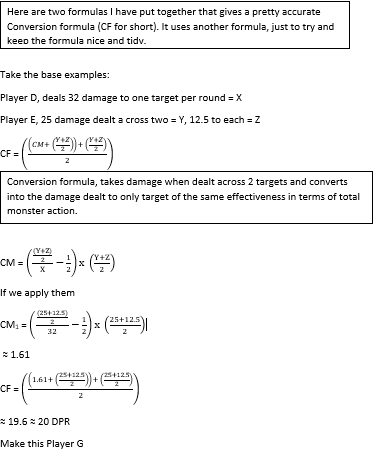 Player G, 20 damage to one monster per round.
(Monsters still have 128HP) Monster 1, 7 rounds to die takes 6 actions in this time. Monster 2 takes 14 rounds to die, as it cannot be targeted for the first 7, it takes 13 actions in this time. 6+13= 19 total monster actions. You change the iniative so the PC goes 2nd, and there you have it, 20 total monster actions.
You may realise that you get the same result with 19 and 21 DPR, that’s 19, 20, and 21, so you clearly take the average. You would not do this with the original DPRs for Players D and E as they are the actual numbers, so you use the actual numbers.
So now we have,
Player G, deals 20 damage to one target per round, on second iniative, a monster takes an action either side of Player G.
Player E, 25 damage dealt across two, 12.5 to each, on first initiative.
Both yield 20 total monster actions. These are the same.
Player G, 20 damage to one monster per round.
(Monsters still have 128HP) Monster 1, 7 rounds to die takes 6 actions in this time. Monster 2 takes 14 rounds to die, as it cannot be targeted for the first 7, it takes 13 actions in this time. 6+13= 19 total monster actions. You change the iniative so the PC goes 2nd, and there you have it, 20 total monster actions.
You may realise that you get the same result with 19 and 21 DPR, that’s 19, 20, and 21, so you clearly take the average. You would not do this with the original DPRs for Players D and E as they are the actual numbers, so you use the actual numbers.
So now we have,
Player G, deals 20 damage to one target per round, on second iniative, a monster takes an action either side of Player G.
Player E, 25 damage dealt across two, 12.5 to each, on first initiative.
Both yield 20 total monster actions. These are the same.
Therefore, if we take that comparison. 32/20 = 160%, which is till close enough to that 150% mark that you set, especially since now it holds up to the masses of scrutiny you have subjected it to, much more than many, if not all of the DPR calculations that many optimisers hold their builds up to.
If we translate this to the actual values, you get BOD – 47.2 DPR to one target Drac sorc – 36.9 DPR across two targets/ Player G – (47.2/160%) = 29.5 DPR to one target 160%, again proven that it doesn’t stray too far from the 150% mark and, that’s also when put under a “near endless number of assumptions” where “any one of them could drastically affect your results”. You may want to say that the iniative order is huge, which I would agree with, but I wouldn’t say as more important than the SP management. Here, BOD(Player D) uses 7 Drac sorc(Player E) uses 11 And Player G (the one target DPR counterpart of the Drac sorc) uses 14. That would lead me to believe that the difference in iniative is bridged as Player G has no SP left (used all 14 at level 14), therefore, further validating the equivalency of Drac sorc and Player G. Just to explore a little more since I have already thought about it, when considering total monster actions and, SP used. As the Monster HP fluctuates up and down, it varies between favouring either Drac or BOD for both, depending on the intervals. Though it never changes too much, never deviating by a max of 10% from the examples we used, ranging from 32 HP monsters up to 896 (as far as I checked at intervals of 128HP when greater than 128HP, i.e. 256HP, 385HP...), so it's not something that should be worried about to much. Though admittedly I was not so attentive when checking these numbers, so it may stray slightly out of 10%, but I don't think so.As total monsters goes down, it favours BOD sorc in both, but we looked at it with 2 monsters, like I said, most of the time there is gonna be way more than that. We can only go one lower, then the stat for the Drac sorc can change quite drastically due to the spell casting investments they've made. But the BOD, the main strat, due to the melee investment of spells known and metmagics, likely won't have a strat that will be more effective than roiding up melee spells and then going in and hitting. Also drawing fire with some excellent manoeuvrability and, controlling enemy movement with booming blade.
As total monsters go up, it favours the Drac sorc in both, but exponentially faster.Then 7) So now circling back before we run some numbers, to the “near endless number of assumptions” you mentioned. I agree, we can’t know without play testing. So, we can either keep going around in circles, or we can keep it at a thresh-hold level of assumptions. Assume there are enemies for a regular encounter (more than 1) (you may disagree, fair enough, I really think that the vast majority of combat is going to have above 3 enemies at least), assume booming blade movement damage hits 50% of the time.
This shows that my homebrew does decent damage, and that I’m in the good. These numbers show that the BOD sorc, sticks in line with the 150% mark and, consistently falls behind the Bladesinger and Pamlock(with no GWM, so you can’t claim its heavily optimised). This damage where the BOD is barely competitive with the GISHs mentioned above, isn’t even sustained, it is burst damage, so, it technically doesn’t even level. This is all whilst the Bladesinger and Pamlock exceed the BOD AC by 4 or 5 (unless the BOD sorc spends another 4 sorcery points, in the scenario with BOM, BOR, quicken and BOW, reducing the sustainability even further). In addition, to the survivability aspect, the Bladesingers receive song of defense, the Pamlcok has a d8, and receives amor of hexes. Then on top of that, the BOD Sorc, respectively, loses out on more of their spellcasting ability power, as its centred so much around the metamagics, which have to be spent on the serious melee power, both in metamagic selection, so they don’t even have as much access to fuelling their spell casting and, in expensiveness, because even if they did have those options, now they have to split it between melee and spellcasting. Where the normal Sorc spends all their Sorcery Points on spellcasting.6&7) The base Lvl6:
This bit ties into your point 6), If it was actually level 6 that you were so worried about then why start with 14 and waste so much of our time? You’ll see here that its actually closer to a 1:1 ratio, 100%, at level 6, which judging by your 150% recommendation, would mean its somewhat unbalanced, on the weaker side. 3 Sorcery Point expenditure per round, so 2 burst rounds, per long rest (VERY VERY POOR SUSTAINABILITY) To me there is just not enough guarantee that there will be a magic weapon at this stage, apart from for the hexblade( adv hexblade yet again) Lvl 6 BOD sorc, with BOM, and quicken, 1d10 longsword,+4 Cha, booming blade, 1d8(+2d8) Lvl 6 Drac sorc, with quicken and twin (elemental affinity). 2d10 firebolt,+4 Cha See at 100% damage and, 55% chance to hit (17AC,+7 to hit), no crazy conditions like efficiency of killing single enemies faster in a large group.Comparatively, at this level:
Lvl 6 Bladesinger,+4 dex, +3 int, 1d8 longsword, See at 100% damage and, 55% chance to hit (17AC, +7 to hit, no crazy conditions like efficiency of killing single enemies faster in a large group.Bladsinger: 100% - 26, 55% - 14.3 Lvl 6 Pamlock, +3 Cha wielding a glaive, Polearm master feat, NO GWM, imporved pact weapon(+1) thirsting blade, hexblade’s curse NOT active. See at 100% damage and, 55% chance to hit (17AC, +7, no crazy conditions like efficiency of killing single enemies faster in a large group. Pamlock: 100% - 25.5, 55% - 14.0 BOD 1SP: 100% 2d10 +8 +1d8(booming) +2d8(50% booming movement)= 28, 55% - 15.4 Drac 1SP: 2d10 firebolt +4(elemental affinity), twin spell 2d10 firebolt = 26, 55% - 14.3 Summary Lvl 6: Lvl 6 3SP (2 rounds) BOD: 100% - 49.5, 55% - 25.6, Drac Sorc: 100% - 41, 55% - 22.6,
Lvl 6 1SP (6 rounds) BOD: 100% - 28, 55% - 15.4 Drac: 100% - 26, 55% - 14.3 Lvl 6 Sustainable BOD 100% - 2d10 +8 = 19, 55% - 10.5, Drac Sorc 100% - 2d10 +4 = 15, 55% - 8.25 Bladsinger: 100% - 26, 55% - 14.3, Pamlock: 100% - 25.5, 50% - 14.0
"Blade of Razing feels like a metamagic tax right now anyways in my opinion, so I wouldn't really miss it... :P"
That's a direct quote from you, to revisit it here, since we already have the level 14 numbers in mind, though I break them down even further below, it's clear your problem with Blade of Marring is ill advised. Why? At level 6, Blade of Razing doesn't come into play, and look a the numbers, they are closer to a 1:1, 100%, than 3:2 150%. So clearly Blade of Marring is needed for a 1SP affordable damage bump. So it seems like quicken spell is the metamagic tax here, not Blade of Razing, which is actually rather needed for the desired 150% mark. Even then, it only comes at lvl 12, after SCAG cantrips have scaled again (lvl11), and benefited the Drac sorc even more.
The base Lvl14: 3 Sorcery Point expenditure per round, so 4 burst rounds, per long rest (VERY POOR SUSTAINABILITY), I won’t walk through all the math, you can check it if you want to. See at 100% damage and, 70% chance to hit (19AC, +12 to hit (+2 magic weapon)), no crazy conditions like efficiency of killing single enemies faster in a large group.
Lvl 14 BOD sorc, with BOM, BOR and quicken, war caster feat, 1d10 longsword,+5 Cha, booming blade, 2d8(+3d8) BOD: 100% - 84, 70% - 58.8 Lvl 14 Drac sorc, with quicken and twin (elemental affinity). 3d10 firebolt,+5 Cha Drac Sorc: 100% - 59.5, 70% - 41.7 100% - 84/59.5 - 141..% 70% - 58.8/41.7 - 141%, each well within the realms of the sweet spot, and exactly the same.Not to mention the fact that these numbers can only be kept up for 4 rounds before falling off drastically. BOD 100% - 2d10 + 24 = 35, 70% - 24.5 (its actual sustainable DPR) Drac Sorc 100% - 3d10+5 = 21.5, 70% 15.1 (162% difference), the largest difference so far, but still not so large as to warrant anything changed in my opinion, especially considering how it behind it falls behind the other GISHS’ at this point, and the fact that the damage isn’t wild either. And these numbers aren’t optimised either, I wouldn’t say any specialist steps have been taken to really push the DPR up, with any, that being the Bladesinger, Pamlock and BOD sorc. To touch on the feeling at the table issue, which I have thought about (and may present an alternative to the temp HP you had a problem with), a fighter with at the same level, longsword 1d8 (+2 weapon), dueling fighting style, +5 Str would do, 3d8 +15 +6 +6 = 100% - 40.5, 70% - 28.35, or a greatsword (+2 weapon), great weapon fighting (increases each d6, 3.5 avg by 0.66..), +5str would do, 6d6 +15+6 = 100% 46, 70% - 32.2, and please try and take this value as is. Don’t then add that the fighter doesn’t have spellcasting, then we’re comparing the entire classes, then we’re making a “near endless number of assumptions” again.
Comparatively at the same level:
Lvl 14 Bladesinger,+4 dex, +4 int, two weapon fighting shortswords(1 is +2), booming blade, war caster See at 100% damage and, 65(55)% chance to hit (19AC, +11to hit(+2 magic weapon), +9 for other shortsword), no crazy conditions like efficiency of killing single enemies faster in a large group. Bladsinger: 100% - 50.25, 65(55)% - 31.9 (Truly sustainable) Lvl 14 Pamlock, +5 Cha wielding a glaive, Polearm master feat, NO GWM, imporved pact weapon and eldritch mind (to replicate war caster), thirsting blade, lifedrinker(still has 2 invocations left over), hexblade’s curse active. See at 100% damage and, 65% chance to hit (19AC, +11to hit(+1 magic weapon), no crazy conditions like efficiency of killing single enemies faster in a large group. Pamlock: 100% - 61.5, 65% - 39.9(Truly sustainable) But just to acknowledge a mindful use of SP, 1SP per round for the same BOD sorc, using it on replacing a cantrip, to give the same ability as the Bladesinger. Note that they don’t use two weapon fighting as it would yield a lower average DPR than simply wielding a longsword two handed. 1SP: This still isn’t sustained though. BOD sorc: 100% - 2d10 +24 + 2d8(booming) + 50%(3d8 booming movement) = 50. 75, 70% - 35.6 Drac 1SP: 3d10 firebolt +4(elemental affinity), twin spell 3d10 firebolt = 38, 70% - 26.6 Summary Lvl 14: Lvl 14 3SP (4 rounds) BOD: 100% - 84, 70% - 58.8, Drac Sorc: 100% - 59.5, 70% - 41.7 (100% - 84/59.5 - 141% , 70% - 58.8/41.7 – 141%) Lvl 14 1SP (14 rounds) BOD sorc: 100% - 50. 75, 70% - 35.6 Drac sorc: 100% - 38, 70% - 26.6 Lvl 14 Sustainable BOD 100% - 2d10 + 24 = 35, 70% - 24.5, Drac Sorc 100% - 3d10+5 = 21.5, 70% - 14.7 Bladsinger: 100% - 50.25, 65(55)% - 31.9, Pamlock: 100% - 61.5, 65% - 39.9 What’s very interesting here is the 100% mark, where the BOD falls even further behind, note that can nearly be achieved by using greater invis, 93%+ accuracy for each of them.You say that the BOD sorc has a specific ability to help trigger booming blade, ok. Again, all the alternatives I gave to having to move still apply. But then you have to alter the numbers I gave, when I quoted those impressive numbers for the BOD sorc, they were with greater invis activating booming blade 50% of the time and Elven accuracy to give a 97.3% chance to hit. If you’re teleporting whilst you invisible the monster can’t see you teleport. For this teleportation to trigger booming blade movement damage, the monster has to see you. So, this chance to hit goes down to 70 % as greater invis has no effect, as per the scenario you gave, +12 to hit. This is a 27% sacrifice in the damage output, in order to land the movement damage on booming blade, and only the remaining 50% of it, it doesn’t add up, as I’ve shown above.
Then you claim you can twin the blade cantrips, I would argue quite rigorously that post tasha’s you can’t, it is a range of self, the effect takes place in a 5ft cube, that’s still a range of self, I think anyone trying to argue otherwise is trying to pull a fast one, the attack isn’t made as part of the casting of the spell(as per the post tasha’s wording, especially when compared to pre tasha’s wording, it really seems like that’s what they were trying to get at), so the part that you twin, isn’t the melee attack, it’s the brandishing of the weapon, so no two attacks, then the last part, I would argue that the target isn’t even a creature, “you brandish a weapon” as part of the casting, the target is an object, so it fails on a number of counts to qualify for twinned spell, not the BOD sorc would necessarily have twinned spell anyway, as they don’t have unlimited options. You may disagree with any one of those points, but I think it would be hard to disagree on all three, and if it fails on one, it fails all together. This ties into 5) nicely, A lot here is mentioned about the fact that when using booming blade isn’t optimal, then they can just use something else. This is again making a “near endless number of assumptions”, which you said we shouldn’t do, but just to entertain the idea as you did, in many of those situations, when booming blade isn’t optimal, the attack action in general probably won’t be either, and so the BOD sorc has becomes much less affective. Taking away the weapon attacks is huge for the BOD power, crippling in fact. If they go into combat, then that compromises the ranged spells and AOE effect spells. If they stay at range, then they can’t use their weapon attacks.When you start to consider the heavy investment into melee that has to be put in, shield and absorb elements spell, haste, mirror image, misty step and far step for some manoeuvrability out of tight spots until level 14. Then the musts, as you included, polymorph, counterspell, fireball/lightning bolt, dimension door.
That’s 9 of the 13 spells the BOD will have at 14th level. Then consider RP and utility spells (they should have at least some). Then consider the other random spells you might want to take. I’m fairly confident the concentration of the BOD would be better spent on haste or far step to enable the power of the melee attacks, the use of polymorph is secondary to those, and the use of fireball and lightning bolt is compromised like I explained above. These spellcasting abilities to trivialise combat become a lot less viable and a lot less apparent. These points you made all seemed to be tied into the point about spell casting being the BOD’s main ability. The same can be said for any GISH, they all get melee abilities, they can all impact with their high-level spells. “If that opportunity doesn't present itself, you simply do your regular caster things and turn the fight around by casting polymorph on your low HP ally, hit the checkpot with a fireball on 6 targets at once, trivialize combat via hypnotic pattern, et cetera. I'd err on the side of caution when it comes to raw melee power outside of spellcasting.” This whole section can be directly applied to both the Bladesinger, and the Hexblade, and the College of Swords, though I know the bard gishs are not as powerful. I’ve added no more raw power than what is given to a bladesinger, or hexblade, or College of Swords infact, as I have and will prove again, the power is in line with the 150% mark you gave. As compared to the closer to 200% mark that each of these official GISHs boast. The raw power is in the classes, Sorcs are better at spiking impacts, whether that be damage, or control etc. than all the rest and, a little weaker in the long run and across the board, I see no reason why that should be different with a GISH sorc either. All the numbers I’ve run suggest that.Take the base spellcasting of each of these main GISH’s full caster classes as balanced (Sorc vs Wiz vs Lock). Then look at the GISHs, they each get abilities that empower their martial prowess in the subclass, respective to the other subclasses within their class. Then you take the price they pay for their melee abilities in line with their spell casting.
You have to look at the spellcasting feature as a package. Warlock – Pact magic, weaker due to spells known, and fewer spell slots, so regens on a short rest for maximum strength almost all of the time + invocations for unlimited casting for some strong utility. Wizard – Standard spell casting + the best breadth and utility, giving a swiss army knife, giving strength across the board. Sorcerer – Standard spell casting, weaker due to spells known + more cantrips + metamagic for flexibility and power within the chosen strength. They all have to invest into spells known, for melee spells. This clearly isn’t so much of a problem for the Bladesinger, but for the BOD and the Hexblade, it hurts.The Hexblade has to invest invocations into becoming more powerful in melee, and their pact boon, where they get the most of their abilites. Though they get lots of invocations, still having a couple to pick excellent options such as mask of many faces and one with the shadows can accomplish a lot for infiltration. At later levels, Visions of distant realms, or shroud of shadows for surveillance, and they get additional invocations frequently as well, getting their first 2 at level 2, before metamagic becomes available, and never spending more than 3 levels before receiving another, so it’s not so drastic. Let’s just acknowledge that the power of the Pact magic feature isn’t effected much here. The power level, which lies in the fact they operate at full capacity all the time due to the short regeneration, the interaction with the spells and the spell slots remains relatively unchanged.
The Bladesinger pays mainly in the subclass area, but that’s because the wizard gets their game and playstyle defining features, in their subclass. As a result, they don’t actually lose out on too much of that spellcasting feature, as the specialist spell feature for most wizards only apply to one school. So that wizard versatility is nearly unaffected. Again, the power level, which lies for a wizard in their breadth and versatility, the interaction with the spells and the spell slots remains relatively unchanged. The BOD sorc, has to give up metamagic options that make their spellcasting flexible and powerful, where a huge amount of the class power comes from. Honestly, 4 metamagics by level 12, BOM,BOR, quicken spell, and I would say BOW for the AC is a must. Where’s twinned spell, or heightened spell, or empowered spell, what about the RP, subtle spell and transmuted spell for a theme. Metamagic is scarce and infrequent. Just two options can get you a long way (7 levels to be precise), but that means missing out on two, is missing out on a lot. Most PCs won’t even reach the point where they get their 5th and 6th options. Just now I gave 4 excellent metamagic options that they miss out on. This greatly effects both utility, breadth, of which they had little of in the first place and, hugely effects the flexibility and power of their spells. Then also the pool they use to fuels these abilities for the sorc, the sorcery points, they are using it on their melee class abilities too, so they’re even more taxed. The power level, which lies in their metamagic, the interaction with the spells and the spell slots is drastically changed, it takes a huge hit, as now its dedicated towards melee. Hell even taking the wrong metamagic options for your sorc theme can be catastrophic in how effective you are (there's a bit more about this down below)Almost everywhere on the internet; whether it be reddit, quora, enworld and further, you can find the debate of Wizards Vs Sorcerers. Most of the time, the wizards win out, but there’s always a load of people that will die on that Sorc hill. Now even amongst all that dispute, there’s one thing that always rings true, and they always agree on. Wizards vs Sorcs is versatility vs power respectively. The Sorc doesn’t have a load of other options, and then their metamagics, where most of their power comes from, tailors to their chosen theme/style that they’ve stuck with. Now this Sorc has specialised in melee, then invested their metamagics into melee, that can’t just “use something else” so easily as you say. That’s a huge overstatement. They do still have their spellcasting but I’ve discussed that above and will continue to do so below.
You brought up Treantmonk in one of the earlier posts so I thought it would be good to have him say exactly what I just said on two separate occasions. https://www.youtube.com/watch?v=CMK8_BK7Kjg https://www.youtube.com/watch?v=CMK8_BK7Kjg -- In this one, he literally talks about a speciality all the time. He really emphasises so much of what I’ve been talking about here. Where the power in the spellcasting is, how expensive and unsustainable it is. To quickly revisit “trivialising combat” with hypnotic pattern of the back of those videos too; BOM, BOD, quicken spell. That’s one metamagic option left. If you want that hypnotic pattern, then you have to take careful spell, so you don’t friendly fire. But then, oooh, to get that hypnotic pattern to land often too, not at the same time as you use careful spell of course, you really want that heightened spell. Now you don’t have enough. To me, it may not seem like it to you, but to me, these other options just fall away so quickly. Honourable mention, they also don’t have twinned spell.There's a lot of repetition in this document. But that's because it all ties in together so much. IMO, from all numbers I've run, in all these conditions, which we both agree is ridiculous to apply to just a general approximation, it is super clear that the BOD is not over powered. That there was little problem with the power level. It sticks true to the 150% (biggest is 162%, but that's actually lower for the reasons listed far above), though I'm a little worried that it should actually be closer to 200% as per the other GISHs, and the fact I truly do, wholeheartedly believe the BOD loses out on the most of it's spellcasting prowess in comparison the offical GISHs.
Really the only things that needed changing were the level 6 feature to not include ability checks and, to incur a cost. As well as, the 14th level feature requiring a cost. I can see a problem, not so much with the extra damage from booming blade, but rather being able to teleport every turn after making weapon attacks as a given ability. At the time of writing this, I think I'll make it so they can replace one of their attacks when they take the attack action. That way they have to use the attack attack action, then lose one of their attacks doing it, limiting their ability to deal damage and then get away, then repeat. What do you think about that? Each of these things were things you pointed out. But the Blade of Marring and, Blade of Razing, yo, they really need to stay, you may disagree, that's completely fair enough it's clear you have quite the mind for this. But I really think we've rung this a dry as it should logically go, anymore conditions and then we're straying into an area of so many presumptions that it will depend entirely on the mind of the player, the players, the DM, the minds of their characters and NPCs, and then how they are interpreted in the moment by the minds of the players and the DMs. That's just too much to consider. I'm done with this now, I am gonna do a second iteration at some point. A user suggested fancy new spells and, they need special consideration of how they will interact with the game. So if you'd like to put any ideas or pointers forward, I'd really greatly appreciate it. Good day to you now.