

Crocodiles
Whereas the oceans are full of dangerous predators that compete for dominance, the rivers is primarily ruled by a scaled terror known as the crocodile. These reptiles tend to be some the largest of their bestial kin, second only to dinosaurs and their relatives.
Crocodiles are fearless predators that devour anything that they can hook their jaws onto. Their most potent weapon is their powerful jaws that clamp onto its prey preventing its escape. Once trapped in its jaws, their prey is often doomed to the crocodile's lethal death roll as the crocodile uses its powerful muscles to cripple and rip the very limbs off of its prey.
Dire Crocodiles
Although most crocodiles tend to relatively large predators under most circumstances, there have been accounts of truly massive behemmoths known as the dire crocodile. It is believed that crocodiles never stop growing throughout their life so it can be estimate that these beasts have lived for centuries.
Crocoddile Tactics
Despite their huge size and sheer strength, crocodiles are ambush predators by nature. They primarily rely on the ability to approach their prey seemingly unnoticed until its too late. Once close enough, it lashes out at its target using its lethal jaws to ensnare its prey as it proceeds to drown its victim in the watery depths.
To prevent its prey from escaping or fighting back, the crocodile uses its death roll to severly cripple its prey. Thanks to the power of its jaws, such a roll is quite capable of dismembering its prey making its prey much easier to eat as crocodiles cannot chew.
Crocodile
Large Beast, Unaligned
- Armor Class 14 (Natural Armor)
- Hit Points 57 (6d10+24)
- Speed 20ft., 40ft. swim
STR DEX CON INT WIS CHA 20 (+5) 10 (+0) 18 (+4) 2(-4) 10 (+0) 5 (-3)
- Skills Athletics +7, Stealth +2, Perception +2
- Senses darkvision 60ft., passive Perception 18
- Challenge 3 (700 xp)
Hold Breath The crocodile can hold its breath for 15 minutes
Sneak Attack The crocodile can deal an additional 7 (2d6) damage against a surprised creature
Ambusher The crocodile has advantage on initiative checks and attacks against a surprised creature.
False Appearance While motionless, the crocodile is indistinguishable from a log
Actions
Bite. Melee Weapon Attack, +7 to hit , 5ft., one target. Hit: 16 (2d10+5) piercing damage. If the target is a Large or smaller creature, it is grappled(escape DC 15). While grappled, crocodile cannot make a bite attack against another target. For the duration of the grapple, it can make another bite attack as a bonus action
Death Roll A creature grappled by the crocodile must succeed a DC 15 Strength saving throw or take 22(4d10) piercing damage and fall prone. Upon failing its saving throw, the creature has disadvantage on attack rolls, ability checks, and saving throws that use Strength or Dexterity until the start of the crocodile's next turn.
Dire Crocodile
Huge Beast, Unaligned
- Armor Class 16 (Natural Armor)
- Hit Points 150 (12d12+72)
- Speed 20ft., 40ft. swim
STR DEX CON INT WIS CHA 25 (+7) 10 (+0) 23 (+6) 2(-4) 10 (+0) 5 (-3)
- Skills Athletics +10, Stealth +6, Perception +3
- Senses passive Perception 13
- Challenge 9 (5000 xp)
Hold Breath The crocodile can hold its breath for 1 hour.
Sneak Attack The crocodile can deal an additional 11 (3d6) damage against a surprised creature
Ambusher The crocodile has advantage on initiative checks and attacks against a surprised creature.
False Appearance While motionless, the crocodile is indistinguishable from a log
Actions
Bite. Melee Weapon Attack, +10 to hit , 10ft., one target. Hit: 27 (3d12+7) piercing damage. If the target is a Large or smaller creature, it is grappled (escape DC 15). While grappled, crocodile cannot make a bite attack against another target. For the duration of the grapple, it can make another bite attack as a bonus action
Death Roll A creature grappled by the crocodile must succeed a DC 18 Strength saving throw or take 33(6d12) piercing damage and fall prone. Upon failing its saving throw, the creature has disadvantage on attack rolls, ability checks, and saving throws that use Strength or Dexterity until the start of the crocodile's next turn.
Giant Snakes
Snakes are easily characterized by their legless scaled bodies that come in a wide variety of colors and patterns. Most their kind tend to be brightly colored signifying their venomous fangs in an attempt to ward off predators.
Despite being limbless, they are extremely agile and are known for their lightning reflexes. When threatened, they can coil up with their head reared to strike at any creature that ventures too close. Often many humanoids underestimate the speed of these snakes an end up as unfortunate victims to its bite.
Dire Snakes
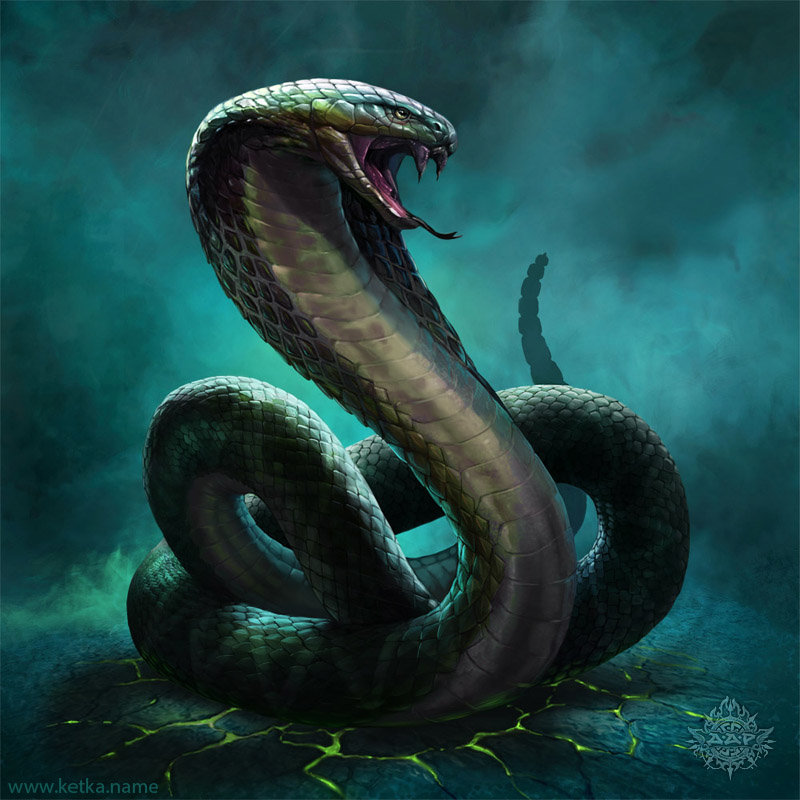
Whereas giant snakes tend to be somewhat larger than most humanoids, some rare variants of snakes have been known to grow nearly 100ft. in length. When they reach this size, they rarely have any natural predators barring giant rocs or other colossal fauna.
Such snakes are often revered by entities such as the yuan-ti. It is believed that such snakes do not occur naturally, but rather are bred to such proportions by yuan-ti rituals. Regardless of whether these claims are true, the presence of a dire snake often is associated with the presence of yuan-ti in the vicinity.
Charmer Snakes
Charmed snakes are probably some of the most beautiful variant of snake. Their beautiful scales are adorned with beautiful patterns unqiue to each snake. However, these patterns also have a hypnotic element about their arrangement causing creatures to become enraptured and enthralled by the snake. This hypnotic skill acts as an offensive and defensive measure that prevents prey from escaping or stunning victims long enough for the snake to easily dispatch its foe or to escape its grasp.
Dreadscale Snakes
Dreadscale snakes are quite similar to charmer snakes in appearance. The primary way to tell them apart is to look at the scale patterns located on the scaly hood around its head . Oftentimes, dreadscale snakes have patterns resembling eyes or toothy maws that generates an overwhelming sense of dread on in creatures that look upon it.
Constrictor Snakes
Although most snakes rely on their poison to subdue their prey, constrictor snakes have learned to use their bodies to immobilize their victims. Creatures caught in its coils are slowly crushed and suffocated. Any attempt to resist is further quelled by a flurry of bites that injects debilitating poison into their prey's bloodstream.
Spitfire Snakes
Spitfire snakes are very skittish by nature as they instantly go on alert at the sight or sound of any disturbance. Once the threat is detected, the snake will begin to flee. However, as it retreats, it will aim to make its attacker has miserable as possible constantly barraging it with a volley of blinding poison. It will continue this hit and run tactics until its prey gives up or ultimately is defeated.
While hunting for prey, it uses this tactic as well, preferring to keep its distance while pelting its victim with blinding acid.
Frostbite Snake
Despite its name, the frostbite snake does not live in arctic regions. Instead is gets its name from its blood-freezing poison in its fangs. This poison has the unique ability to drain the stamina from their prey making its movement very sluggish and lethargic. Such snakes are prized by assassins as their poison is quite useful, especially for particularly agile or strong targets.
Deathscale Snake
The deathscale is easily characterized by its extremely colorful and glowing scales. This snake is probably the most poisonous of its kin as its scales are covered in a film-like mucous that is extremely toxic to the touch. The film also gives its scales the bioluminescent property allowing it to glow in the dark as well as acts somewhat as a dampener against spell effects. Unfortunately, such traits makes this snake quite rare as it is often the target of poachers and trappers seeking to harvest its unique scales.
Sea Snake
Unlike others of its species, the sea snake prefers to live the majority of its life underwater. It tends to live in coastal waters primarily under the cover of reefs where it has numerous alcoves and hiding spots to ambush prey and evade predators; however, they have been known to traverse the open seas to migrate from reef to reef.
Despite being an extremely capable swimmer, these snakes have been known to take shortcuts while traveling the open seas. It is not uncommon for these snakes to sneak aboard ships to hitch an easy ride to a new destination. Most of the times, these snakes prefer to keep to themselves and avoid detection but sometimes their curiosity and the desire to expand their appetite may get the better of them.
Giant Snake Template
Large Beast, Unaligned
- Armor Class 14 (Natural Armor)
- Hit Points 20 (3d10+3)
- Speed 30ft., 30ft. swim, 30ft. climb
STR DEX CON INT WIS CHA 10 (+0) 18 (+4) 13 (+1) 2(-4) 10 (+0) 3 (-5)
- Skills Stealth +6, Perception +2
- Senses blindsight 30ft., passive Perception 12
- Challenge 1 (200 xp)
Reactive The snake can use its reaction to make an opportunity attack or to attack a creature that hits it with a melee attack or attempts to grapple it while within 10ft. of it.
Actions
Bite. Melee Weapon Attack, +3 to hit , 10ft., one target. Hit: 7 (1d4+4) piercing damage. If the target is a creature, it must succeed a DC 11 Constitution saving throw or take 14 (4d6) poison damage and become poisoned until the end of its next turn
Dire Snake Template
Gargantuan Beast, Unaligned
- Armor Class 14 (Natural Armor)
- Hit Points 131 (9d20+36)
- Speed 30ft., 30ft. swim, 30ft. climb
STR DEX CON INT WIS CHA 20 (+5) 18 (+4) 18 (+4) 2(-4) 10 (+0) 3 (-5)
- Skills Athletics +8, Stealth +7, Perception +3
- Senses blindsight 30ft., passive Perception 13
- Challenge 5 (1800 xp)
Reactive The snake can use its reaction to make an opportunity attack or to attack a creature that hits it with a melee attack or attempts to grapple it while within 10ft. of it.
Actions
Bite. Melee Weapon Attack, +8 to hit , 10ft., one target. Hit: 10 (2d4+5) piercing damage. If the target is a creature, it must succeed a DC 16 Constitution saving throw or take 21 (6d6) poison damage and become poisoned until the end of its next turn . On a successful saving throw, it takes half damage and is not poisoned.
Charmer Snake
- Challenge Rating Increases by 1
Hypnotic Gaze If a creature starts its turn within 30ft. of the snake and the two of them can see each other, the snake can force the creature to make a DC 11 Wisdom saving throw or become charmed for one minute. Creature's charmed in this manner have its movement speed reduced to 0 and is incapacitated. At the end of each of its turns, it can repeat its saving throw. Upon a successful saving throw, it is immune to this effect for the 24 hours.
If a dire snake, the DC is 15.
Dreadscale Snake
- Challenge Rating Increases by 1
Frightful Hood If a creature first enters or starts its turn within 30ft. of the snake , the snake can force the creature to make a DC 11 Wisdom saving throw or become frightened for one minute.. At the end of each of its turns, it can repeat its saving throw. Upon a successful saving throw, it is immune to this effect for the 24 hours.
If a dire snake, the DC is 15.
Constrictor Snake
- Challenge Rating Increases by 1
Constrict Creatures grappled by the snake cannot breathe and take 9(2d8) bludgeoning damage at the start of the snake's turn. If the snake is dire, the creature takes 13(2d12) damage instead.
Constrict Melee Weapon Attack, +6 to hit , 10ft., one target. Hit: 9 (1d8+4) bludgeoning damage. If the target is a Medium or smaller creature, it is grappled(escape DC 14). While grappled, the creature is restrained and the snake cannot constrict another target.
Constrict(Dire Snake only) Melee Weapon Attack, +8 to hit , 10ft., one target. Hit: 17 (2d12+4) bludgeoning damage. If the target is a Huge or smaller creature, it is grappled(escape DC 16). While grappled, the creature is restrained and the snake cannot constrict another target.
Spitfire Snake
Spitfire The snake ignore range penalties and bonuses granted to its target by half or three-fourth's cover. It can also use its spit attack as part of its reactive ability.
Acid Spit Melee Weapon Attack, +6 to hit , 15/60ft., one target. Hit: 13 (2d8+4) acid damage. Creatures must succeed a DC 11 Constitution saving throw or become blinded until the end of its next turn. If a dire snake, the DC increases to 15.
Frostbite Snake
Frostbite Poison Creatures poisoned by the snake have its movement speed halved and melee attacks rely on Strength and Dexterity deal half damage.
Bite Melee Weapon Attack, +6 to hit , 10ft., one target. Hit: 7 (1d4+4) piercing damage. If the target is a creature, it must succeed a DC 11 Constitution saving throw or take 7 (2d6) poison damage + 7 (2d6) cold damage and become poisoned for one minute. On a successful saving throw, creatures take half damage and is not poisoned.
Deathscale Snake
- Challenge Rating Increases by 1
Poisonous Skin Creatures that grapple the snake or hit it with a melee attack while within 5ft. of it becomes poisoned until the end of its next turn.
Bioluminescence The snake has advantage on magical saving throws. The snake gives off a bright light in a 10ft. radius. It gives off an dim light an additional 10ft.
Sea Snake
- Swim 30ft. swim
Amphibious The snake can breathe in air and in water
Nimble Swimmer The snake can swim outside a creatures reach without provoking opportunity attack. While underwater, it can use its bonus action to Dash
Giant Turtle
Giant turtles are generally peaceful lumbering titans. They closely resemble tortles in appearance but are quadrupedal in stance and much larger. Most turtles tend to be largely omnivorous; largely eating plants and small animals. They rarely pose a direct threat to humanoids unless they are threatened.
Their most notable feature is their colossal armored shell that protects them from the elements and most conventional forms of attacks. It is able to completely evade the most dangerous of attacks by completely retreating within its shell.
Colossus Turtle
The colossus turtle is the largest of all turtles, as the largest of their kin can reach nearly 50ft. in height. These peaceful giants tend to be very nomadic creatures migrating from location to location in search for ample vegetation.
Some nomadic civilizations have learned to tame these creatures using these creatures as living caravans. Other races have learned to make these titans battle mounts mounting colossal siege engines upon their shells. Thanks to their thick shells, they are able to shrug off volleys of arrows and the general fray of the battlefield.
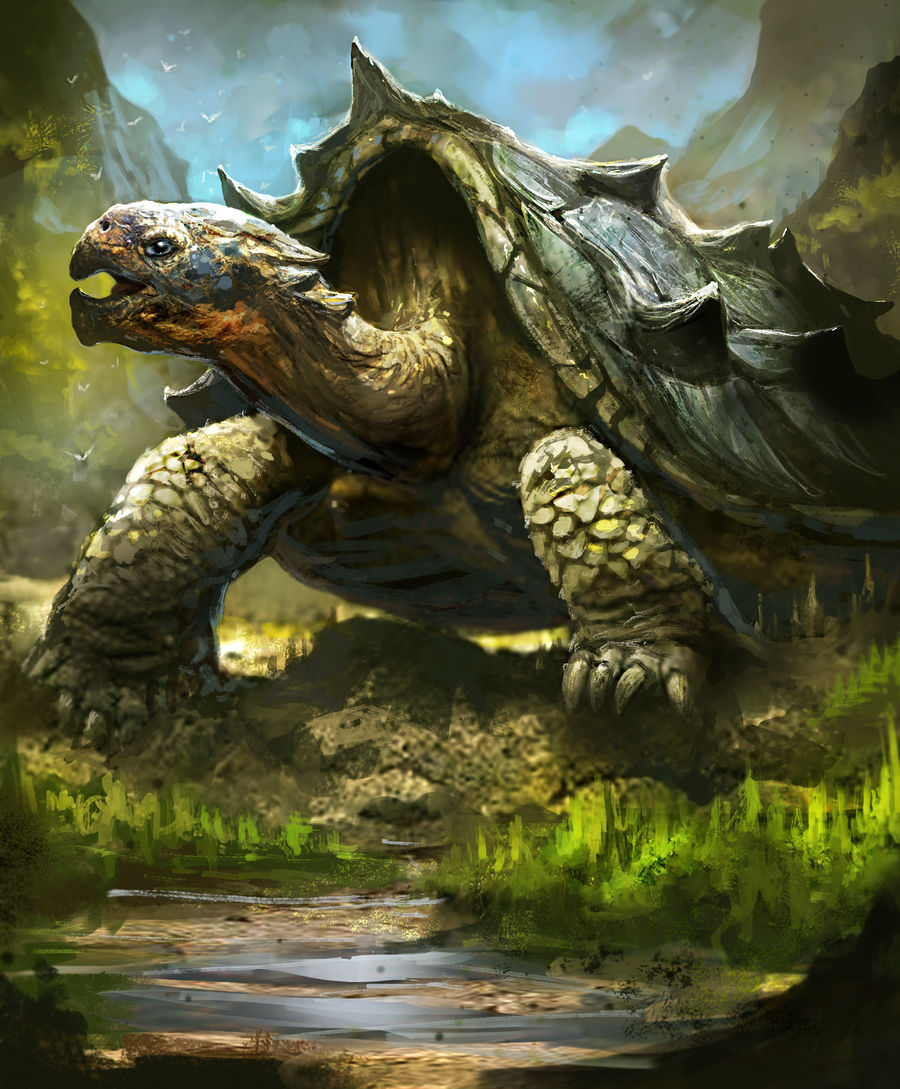
Snapping Turtle
The snapping turtle is probably the most dangerous of all turtles thanks to its powerful, bone-shattering beak. Unlike most other turtles, the snapping turtle is largely carnivorous using its deadly maws to cripple its prey.
Due to its unwieldy size, the snapping turtle prefers to lie in wait for unsuspecting prey. Thanks to its shell, it is able to lurk underwater indistinguishable from an underwater rock or log. Once its prey wanders to close, its beak lunges out in an mere instant to snap at its quarry. Its beak acts effectively as a vice trap that continually crushes the prey in its grasp. Once a snapping turtle latches onto its victim, the only way it tends to release its grip is when the turtle is slain.
Sea Turtle
The sea turtle lives the majority of its life in underwater. The only time it comes ashore is to lay its eggs on the coastal beach. In fact, these turtles tend to make massive migration laying thousands of eggs along the beach. Many druidic tribes and coastal settlements celebrate such migrations safeguarding these breeding grounds and protecting them from poachers or egg thieves.
These turtles are surprisingly resilient capable of enduring the harshest effects of the deep seas and the dangers of underwater predators. Its diet primarily consists of jellyfish and it has developed a natural resistance against its poisons as well as the electrical defenses of many underwater fish.
Desert Turtle
The desert turtle is a completely terrestrial turtle that prefers to live in arid environments such as deserts. It is perfectly adapted to live in such harsh environments thanks to its powerful claws that allow it to easily burrow into the earth. Its shell also acts as an insulator to protect it from extreme heat. It also has the unique ability to absorb and store thermal energy to act as a defense mechanism during the day. When attacked, its turtles shell can become extremely hot scalding its attackers.
Vile Turtle
The vile turtle is quite a disgusting breed of turtle only found in the deepest swamps and at times in sewer systems of cities. Despite its nauseating appearance, these turtles are actually seen as a boon as they primarily feed off of waste, carrion, and decay. Having a healthy population of these turtles actually minimizes the spread of disease in the environment. Their presence also can hint at possible environmental threats such as a plague or rampant undead as such events tend to attract the presence of these turtles.
Deep Turtle
Deep turtles are quite a common site in the Underdark living in large nomadic herds. These herds migrate throughout the Underdark in search for food. In fact, many humanoids using their migration paths as a means to safely traverse the hazardous caverns of the underdark.
These turtles are able to keep communicate to one another using flashes of light from crystal-like structures on their shells to signal food or danger. However, despite always living in large groups, they tend to be very elusive thanks to their uncanny resemblance to many underground crystals within the Underdark.
Giant Turtle
Large Beast, Unaligned
- Armor Class 17 (Natural Armor)
- Hit Points 77 (8d10+32)
- Speed 30ft.
STR DEX CON INT WIS CHA 19 (+4) 10 (+0) 19 (+4) 2(-4) 12 (+1) 5 (-3)
- Saving Throws Constitution +6
- Skills Perception +3
- Senses passive Perception 12
- Challenge 3 (700 xp)
Thick Shell The turtle can reduce bludgeoning, piercing, and slashing damage by 6.
Shell Defense When the turtle is targeted with an attack , it can use its reaction to retreat into its shell. When it uses this feature, it gains the benefit of total cover from all effects outside of the shell.
If it is target with a saving throw, the turtle takes half damage on a failed saving throw and no damage on a successful saving throw.
Actions
Bite. Melee Weapon Attack, +7 to hit , 5ft., one target. Hit: 11 (2d6+4) piercing damage.
Colossus Turtle
Gargantuan Beast, Unaligned
- Armor Class 20 (Natural Armor)
- Hit Points 140 (8d20+56)
- Speed 30ft.
STR DEX CON INT WIS CHA 24 (+7) 10 (+0) 24 (+7) 2(-4) 12 (+1) 5 (-3)
- Saving Throws Strength +10, Constitution +10
- Skills Perception +3
- Senses passive Perception 13
- Challenge 9 (5000 xp)
Thick Shell The turtle can reduce bludgeoning, piercing, and slashing damage by 10.
Siege Monster The turtle can deal double damage to buildings and objects
Shell Defense When the turtle is targeted with an attack , it can use its reaction to retreat into its shell. When it uses this feature, it gains the benefit of total cover from all effects outside of the shell.
If it is target with a saving throw, the turtle takes half damage on a failed saving throw and no damage on a successful saving throw.
Actions
Bite. Melee Weapon Attack, +10 to hit , 10ft., one target. Hit: 21 (3d8+7) piercing damage.
Snapping Turtle
- Movement Speed 30ft. swim
- Challenge Rating Increases by 2
Amphibious The turtle can breathe in air and in water
Spiny Shell When the turtle is grappled or is hit with a melee attack while within 5ft. of it, it takes 5(1d8) piercing damage. If a dire turtle, it takes 9 (2d8) piercing damage.
False Appearance While motionless, the turtle is indistinguishable from an log
Sneak Attack When the turtle deals damage against a surprised creature, it deals an additional 7 (2d6) against surprised creatures
Ambusher The turtle has advantage against surprised creatures. If it takes the Attack action against a surprised creature, it can make an additional bite attack as part of this action.
Vice Jaws Creatures grappled by the turtle takes 14(4d6) piercing damage at the start of each of its turns. If a colossus turtle, it takes 27 (6d8) piercing damage
Actions
Crippling Bite. Melee Weapon Attack, +6 to hit , 5ft., one target. Hit: 18 (4d6+4) piercing damage. If the target is a Medium or smaller creature, it is grappled (escape DC 14)
Crippling Bite. (Colossus Turtle only) Melee Weapon Attack, +10 to hit , 10ft., one target. Hit: 34 (6d8+7) piercing damage. If the target is a Large or smaller creature, it is grappled (escape DC 18)
Sea Turtle
- Movement Speed 10ft., 60ft. swim
- Damage Immunities Poison
- Resistances Lightning
- Condition Immunities Paralyzed, Poisoned
Amphibious The turtle can breathe in air an in water
Nimble Swimmer The turtle can swim outside another creature's reach without provoking opportunity attacks
Desert Turtle
- Damage Resistances Fire
- Movement Speed 30ft. Burrow
- Challenge Rating Increases by 1
Tunneler The turtle can burrow through unworked and non-magical earth. It cannot burrow through solid stone
False Appearance While motionless, the turtle is indistinguishable from an stone
Heated Shell During the day, when the turtle is grappled or is hit with a melee attack while within 5ft. of it, it takes 9(2d8) fire damage. If a dire turtle, it takes 18 (4d8) fire damage.
Vile Turtle
- Resistances Acid; Poison; Necrotic
- Movement Speed 30ft. Burrow
- Challenge Rating Increases by 1
Acidic ShellWhen the turtle is grappled or is hit with a melee attack while within 5ft. of it, it takes 5(1d8) acid damage. If a dire turtle, it takes 9 (2d8) acid damage.
Stench While within 10ft. of the Turtle, creatures other than the Turtle must succeed a DC 14 Constitution saving throw or become poisoned until the end of its next turn. Upon a success, creatures are immune to being poisoned in this manner for the next 24 hours. If a colossal turtle, the DC is 17.
Deep Turtle
- Movement Speed 30ft. Burrow
- Senses Darkvision 60ft.
- Challenge Rating Increases by 1
Tunneler The turtle can burrow through unworked and non-magical earth. It cannot burrow through solid stone
False Appearance While motionless, the turtle is indistinguishable from an stone
Bioluminescence The turtle has advantage on magical saving throws. As a bonus action, the turtle gives off a bright light in a 10ft. radius. It gives off an dim light an additional 10ft. It can dismiss this light at will

Lizard
Lizards are probably the most common of all their reptilian kin. They come in many different sizes and colors and are present in nearly every biome. Thanks to their uncanny ability to climb walls and their nearly unmatched agility, they are able to easily chase down their prey to swallow it whole as well as make a quick escape when in danger. This also makes them prized mounts for many civilizations that have learned to tame them.
Skink
The skink is a rather unique variant of lizards thanks to the peculiar nature of its blood. Skinks are known for their extremely toxic blood which is almost akin to acid which acts as a major deterrent for potential predators. This blood also makes the skink quite resilient to poison and disease and is even able to dampen the effects of necrotic magic. As a result, the skink is able to acquire regenerative abilities allowing it the heal from the harshest of wounds and most debilitating of effects.
Chameleon
The chameleon is known for ability to rapidly camouflage itself against its surroundings. Although it is not able to become completely invisible, the lizard is able to blend into any surroundings causing its foe to temporarily loose track of it. On top of its unique camouflage, it is equipped with a stick tongue that it can use to grasp prey from afar to swallow in one bite.
Dragon Lizard
Despite its frightening appearance, the dragon lizard is actually quite friendly, especially to humanoids. It is not uncommon for them to approach humanoids for food or out of curiosity. If they taking a liking to the individual, they can prove to be useful, albeit somewhat fickle companions. Whenever threatened, dragon lizard attempts to live up to its name by flaring up its frills in an intimidation display scaring off any potential threats.
Whiptail
Whereas the dragon lizard prefers to intimidates predators, the whip tail relies of distraction. When threatened, the whiptail can break off its tail to distract predators while the lizard makes its escape. Despite the somewhat comedic nature of this tactic, the tail can be quite dangerous as it relentless attacks the nearest creature in its reach.
Wavestrider
The wavestrider absolutely loves the water spending all of its time swimming in rivers and lakes. It possesses a rather unique ability that allows it to effortlessly skating across the water at tremendous speeds.
Giant Lizard
Large Beast, Unaligned
- Armor Class 12 (Natural Armor)
- Hit Points 39 (6d10+6)
- Speed 50ft., 50ft. climb
STR DEX CON INT WIS CHA 15 (+2) 12 (+1) 13 (+1) 2(-4) 10 (+0) 5 (-3)
- Skills Perception +3
- Senses passive Perception 12
- Challenge 1 (200 xp)
Spider Climb The lizard can climb difficult surfaces including upside down on ceilings without needing to make an ability check.
Skittish When below half its hitpoint maximum, the lizard can use its bonus action to take the Dash action
Actions
Multiattack The lizard can can make a bite and tail attack
Bite. Melee Weapon Attack, +4 to hit , 5ft., one target. Hit: 7 (1d8+2) piercing damage. Medium or smaller creatures must succeed a DC 14 Strength saving throw or become swallowed. Swallowed creatures are considered blinded and restrained and have total cover against attacks and other effects outside the lizard. Swallowed creatures take 7(2d8) bludgeoning damage + 9 (2d8) acid damage at the start of each of its turns.
Whenever the lizard takes damage by a swallowed creature, it must succeed Constitution saving throw with a DC equal to half the damage dealt by the lizard(minimum 10). On a failed saving throw, the lizard regurgitates all swallowed creatures in a space 5ft. from the lizard prone.
If the lizard dies, the creature can spend up to 10ft of its movement speed to exit prone.
Tail Melee Weapon Attack, +4 to hit , 10ft., one target. Hit: 6 (1d6+2) bludgeoning damage. Creatures must succeed a DC 12 Strength saving throw or be knocked prone.
Dire Lizard
Huge Beast, Unaligned
- Armor Class 15 (Natural Armor)
- Hit Points 126 (12d12+48)
- Speed 50ft., 50ft. climb
STR DEX CON INT WIS CHA 20 (+5) 12 (+1) 18 (+4) 2(-4) 10 (+0) 5 (-3)
- Skills Athletics +7, Acrobatics +3, Perception +2
- Senses passive Perception 12
- Challenge 6 (2300 xp)
Spider Climb The lizard can climb difficult surfaces including upside down on ceilings without needing to make an ability check.
Skittish When below half its hitpoint maximum, the lizard can use its bonus action to take the Dash action
Actions
Multiattack The lizard can can make a bite and tail attack
Bite. Melee Weapon Attack, +8 to hit , 5ft., one target. Hit: 16 (2d10+5) piercing damage. Large or smaller creatures must succeed a DC 14 Strength saving throw or become swallowed. Swallowed creatures are considered blinded and restrained and have total cover against attacks and other effects outside the lizard. Swallowed creatures take 14(3d8) bludgeoning damage + 14 (3d8) acid damage at the start of each of its turns.
Whenever the lizard takes damage by a swallowed creature, it must succeed Constitution saving throw with a DC equal to half the damage dealt by the lizard(minimum 10). On a failed saving throw, the lizard regurgitates all swallowed creatures in a space 5ft. from the lizard prone.
If the lizard dies, the creature can spend up to 20ft of its movement speed to exit prone.
Tail Melee Weapon Attack, +8 to hit , 10ft., one target. Hit: 12 (2d6+5) bludgeoning damage. Creatures must succeed a DC 15 Strength saving throw or be knocked prone.
Skink
- Damage Immunities Acid, Poison
- Damage Resistances Necrotic
- Condition Immunities Poison
- Challenge Rating Increases by 1
Vileblood When the lizard is hit with a melee attack while within 5ft. of it, it takes 5(1d8) acid damage. If a dire lizard, it deals 9 (2d8) acid damage
Rapid Recovery At the start of each of its turns, the lizard can end one of the following effects: blinded, deafened, paralyzed, or stunned.
Regeneration At the start of each of its turns, the lizard can regain 5 hitpoints at the start of each of its turns as long as the lizard has at least 1 hitpoint. If a dire lizard, it regains 10 hitpoints at the start of each of its turns.
Chameleon
- Challenge Rating Increases by 1
False Appearance While motionless, the chameleon is indistinguishable from a tree branch or leaf.
Active Camouflage The lizard can use its bonus action to Hide. The chameleon is able to hide, even if it is not obscured by cover.
Reactive Tongue The chameleon can use its reaction to make an opportunity attack with its sticky tongue. It can use this reaction once at the end of every creatures turn.
Multiattack The chameleon can make a Sticky Tongue attack and a Bite attack
Sticky Tongue A Medium or smaller creature that it can see within 20ft. of it. The target must make a DC 12 Strength saving throw. On a failed saving throw, the creature is becomes swallowed.
Dragon Lizard
Frightful Presence Creatures that first enter or starts its turn within 30ft of the dragon lizard must succeed a DC 11 Wisdom saving throw or become frightened for one minute. It can repeat its saving throw at the end of each of its turns to end the effect. Upon a successful save, it is immune to being frightened in this manner for the next 24 hours. For a dire lizard, the DC is a 15.
Whiptail
Animated Tail(1/day) As a bonus action, the lizard can detach its tail. The tail has 10 hitpoints and an AC of 12. If a dire lizard, it has 25 hitpoints and an AC of 15. These tail has blindsight up to 30ft. and is immune to all conditions. It acts on the lizard's initiative attacking any creature within 10ft. of it before or after the lizard's turn. It can stay in its animated state for up to 1 minute or until it reaches 0 hitpoints. Upon a hit, it deals damage equal to the lizard's tail attack. When the lizard uses this feature, it loses its tail attack as part of its multiattack. The tail can regrow both of its tails after 24 hours.
Wavestrider
- Movement Speed 50ft. swim
Water Walker The spider can move across acid or water as if it were harmless solid ground. (It still takes damage from traversing over acid)
Water Skater While the ant is on water, it can use its bonus action to Dash
Nimble Swimmer The wavestrider lizard can swim outside the reach of a creature without provoking opportunity attack
Giant Frog
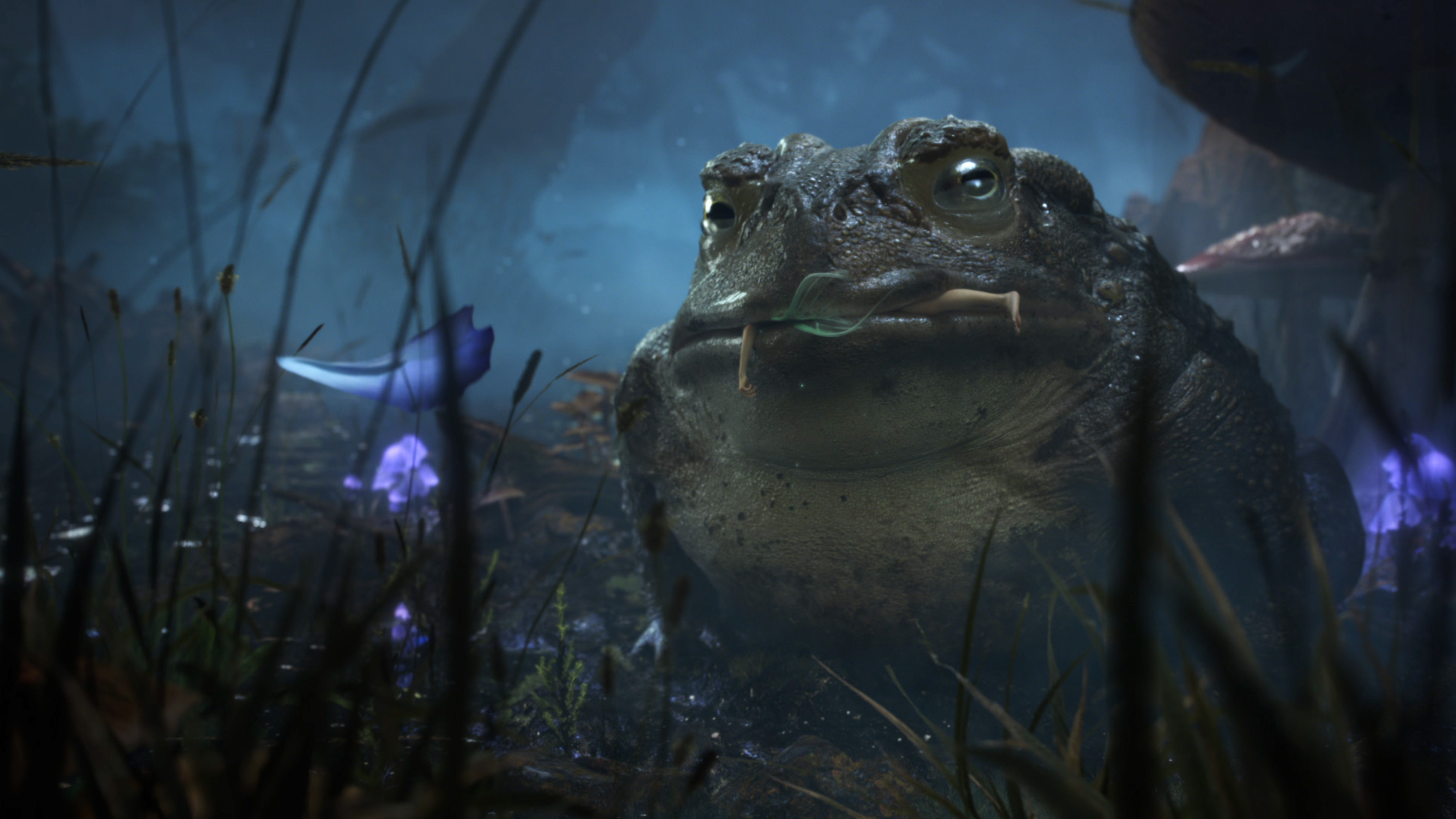
Of all amphibians, frogs and toads are the most common of all amphibians making their homes in lakes, rivers, and streams. They can be easily identified by their squat bulbous body, their bulging eyes, and their powerful hind legs that grant them impressive leaping capabilities. Despite their appearance, they are voracious predators swallowing anything they can fit into their mouth.
They are ambush predators at heart using their sticky tongue to grapple and swallow their prey in the blink of an eye.
Deathwart
Deathwart frogs are the most beautiful of their kind thanks to their vibrant and glistening skin that glows in the dark. Their coloration serves as a stark warning of its extremely poisonous nature for any predator Their skin is able to retain this property thanks to its diet on extremely poisonous plants. Such a diet allows it to excrete an extremely potent toxin on its skin that causes blindness and paralysis from a simple touch.
Stone Toad
Whereas most frog prefer to live in moist and rainy environment, the stone toad thrives in arid biomes. It has developed a natural resilience against hot and dry environments. Its rough skin not only protects it from danger but also grants its natural camouflage allowing it to blend into its surroundings.
Ice Frog
The ice frog makes its home in polar climates completely unaffected by extreme cold. Its skin is somewhat translucent, similar to that of ice allowing it to seamlessly blend into its surroundings.
Screaming Toad
At screaming toad is possibly the most amusing of all frogs thanks to its defense mechanism in the sight of danger. Whenever attacked, the toad lets out an ear-splitting scream. It is hard to accurately describe the toad's scream as it is unique to the individual. Some sounds like a bellowing roar or a high-pitched humanoid scream. Regardless of what it sounds like, its scream can invoke a sense of mortal terror into its foes causing it to flee for its life.
Living near large populations of screaming toads is a nightmare as they tend to use these screams as a method of communication. During mating season, both males and females alike seem to engage in screaming contests with one another to attract a mate. However, such events are seen as a challenge for foolhardy adventurers who compete with one another to see who can endure the screams the longest before fleeing in terror.
Bull Frog
The bullfrog is the epitome of recklessness as its solution to every problem and obstacle is a well-timed headbutt. Thanks to its thick skull and powerful legs, the bullfrog defiantly barrels into attackers as well as its prey. Lakes and rivers with large populations are rife with the sounds of colliding skulls as bullfrogs continually test the mettle of one another in headbutting competitions.
Winged Frog
The winged frog is easily distinguishable thanks to its umbrella-like webbed feet. Its specialized feet allows it to glide through the air allowing it to jump much higher than its other relatives. This webbing also serves as a safety measure for an ill-timed jump acting like a parachute to dampen its fall. Thanks to its new capabilities, the winged frog is often seen picking airborne prey from the skies using a combination of its sticky tongue and its webbed gliders.
Giant Frog Template
Large Beast, Unaligned
- Armor Class 13 (Natural Armor)
- Hit Points 26(3d10+9)
- Speed 30ft., 30ft. climb, 30ft. swim
STR DEX CON INT WIS CHA 16 (+3) 16 (+3) 16 (+3) 2(-4) 10 (+0) 5 (-3)
- Skills Athletics +5, Acrobatics +5, Perception +2, Stealth +7
- Senses passive Perception 12
- Challenge 1 (200 xp)
Spider Climb The giant frog can climb difficult surfaces including upside down on ceilings without needing to make an ability check.
Ambusher The frog has advantge on initiative and advantage on attack rolls against creatures that are surprised
Amphibious The frog can breath in air and in water
Extraordinary Leap The frog can spend an amount of its movement speed to high jump or long jump twice the amount of movement spent.
Actions
Multiattack The frog can make a Sticky Tongue and a bite attack on its turn.
Sticky Tongue A Medium or smaller creature that it can see within 20ft. of it. The target must make a DC 12 Strength saving throw. On a failed saving throw, the creature is becomes swallowed.
Bite. Melee Weapon Attack, +4 to hit , 5ft., one target. Hit: 8 (1d8+3) piercing damage. Small or smaller creatures must succeed a DC 13 Strength saving throw or become swallowed. Swallowed creatures are considered blinded and restrained and have total cover against attacks and other effects outside the frog. Swallowed creatures take 7(2d8) bludgeoning damage + 9 (2d8) acid damage at the start of each of its turns.
Whenever the frog takes damage by a swallowed creature, it must succeed Constitution saving throw with a DC equal to half the damage dealt to the frog(minimum 10). On a failed saving throw, the frog regurgitates all swallowed creatures in a space 5ft. from the frog prone.
If the frog dies, the creature can spend up to 10ft of its movement speed to exit prone.
Deathwart Frog
- Damage Resistances Acid
- Damage Immunities Poison
- Condition Immunities Poisoned
- Challenge Rating Increases by 1.
Bioluminescence The frog has advantage on magical saving throws. The frog gives off a bright light in a 10ft. radius. It gives off an dim light an additional 10ft.
Poisonous Skin Creatures that grapple the frog or hit it with a melee attack while within 5ft. of it must succeed a DC 13 Constitution saving throw or take 7(2d6) poison damage becomes poisoned until the end of its next turn. Creatures poisoned in this manner are blinded and paralyzed. On a successful saving throw, it takes half damage.
Stone Toad
- Armor Class 16
- Senses Darkvision 60ft.
- Damage Resistances Fire
False Appearance While motionless, the toad is indistinguishable from a rock
Spiny Body When the toad is grappled or is hit with a melee attack while within 5ft. of it, it takes 5(1d8) piercing damage.
Stony Camouflage The stone toad has advantage on Dexterity (Stealth) checks while in rocky terrain.
Ice Frog
- Armor Class 13
- Damage Resistances Cold
False Appearance While motionless, the ice frog is indistinguishable from ice
Ice Body The ice frog has advantage on Dexterity (Stealth) checks while in icy or snowy terrain. While these conditions are met, the frog is invisible to creatures that rely on sight to perceive it
Ice Treader The ice frog can move across and climb icy surfaces without needing to make an ability check. Additionally, difficult terrain composed of ice or snow doesn't cost it extra movement.
Screaming Toad
Actions
Screech Creatures other than a screaming toad that can hear the toad while within 30ft. of it must succeed a DC 13 Wisdom saving throw. If the creature fails, it is frightened for one minute.
While frightened in this manner is must spend its turns trying to move as far away from the toad and cannot move willingly towards a space within 30ft. of the toad. It also cannot can't take reactions. For its action, it can use only the Dash action or try to escape from an effect that prevents its from moving. If there's nowhere to move, the creature can use its Dash action.
Upon a successful saving throw, the creature is immune to being frightened by this toad for the next 24 hours.
Bull Frog
Reckless At the start of its turn, the frog can choose to have advantage on its attack rolls, but attacks against it have advantage
Charge If the frog moves at least 20ft. in a straight line and hits a creature within its headbutt on the same turn, it can deal an additional 11 (2d10) damage.
Siege Monster The bullfrog can deal double damage to buildings or objects.
Actions
Headbutt Melee Weapon Attack, +4 to hit , 5ft., one target. Hit: 9 (1d10+3) bludgeoning damage. If the target is a creature, it must succeed a DC 13 Strength saving throw or fall prone.
Winged Frog
Aerodynamic Leap The frog can triple the distance for its extraordinary leap.
Webbed Glide When the frog takes fall damage, it can make a DC 10 Dexterity saving throw. On a successful saving throw, the frog takes no damage; on a failed saving throw it takes half damage. The DC for this save increases by 1 for every 10ft. the frog falls over 60ft.
Giant Salamanders
Whereas frogs are the most common of all amphibians, salamanders tend to be the most popular and beloved of all amphibians. Unlike their leaping cousins, giant salamanders prefer to not hunt humanoids favoring smaller prey instead. Additionally, they are known for the wide array of colorful but unique colorations and patterns. Coupled with their relaxed nature, they have become very popular exotic pets.
However, their most unique properties is their regenerative abilities allowing them to recover from harsh wounds and even severed limbs. This ability seems to be heightened by the presence of water which further accelerates its recovery.
Axolotl
The axolotl is believed and revered as the greatest of all of its kin as it is believed to be nigh immortal as its regenerative abilities are able to bring it back from the clutches of death even when sliced in half or dismembered.
This ability not only idolizes them among many civilizations but also makes them the prime target of poachers and arcanist seeking to harness their regenerative properties.
Fireblood Salamander
The fireblood salamander is often confused as an subspecies of salamanders from the Elemental Plane of fire. This confusion due to its affinity for fire as it enjoys basking in open flames. Although they live primarily near lakes and streams, it is not uncommon that fireblood salamanders will be attracted to nearby campfires.
The salamander gets its unique name takes to its reactive blood that ignites when exposed to the air setting its attackers aflame. When threatened, it can actually begin to heat up its own blood causing its skin to glow making it defense mechanism much more potent.
Elderglow Salamander
The elderglow salamanders are some of the favorite familiar for arcanists. Their brightly colored body is extremely sensitive to magical effects. When exposed to a strong magical presence, the salamander's skin begins to glow a certain color depending on the school of magic.
The tricky thing about these salamander's is figuring out what colors correspond to each magical school as it varies depending on the salamander.
Not only are they quite receptive to magical auras, the salamander has a keen sense of identifying magical creatures changing colors depending on the creature type. Just like with magical schools, the color variations ultimately depend on the individual salamander.
Unfortunately for many spellcasters, these salamanders are extremely rare, residing in the deepest caverns of the Underdark where these salamanders use their innate sensitivity to magic to avoid many dangerous of this environment.
Plague Salamander
Unfortunately for the plague salamander, it is probably the most disliked of all of its kin due to its nauseating smell and oozing body. However, this disdain is largely due to a misunderstanding of its purpose in nature. The plague salamander has a unique resilience against corruption from poison and necrotic magics as it actually prefers to ingest such foul toxins and poisons. This creature is extremely efficient with its consumption of such corruption utilizing its waste as a defense mechanism to deter predators through a foul-smelling poisonous mucous on its skin.
Because of this, they are often drawn to areas of a lot of death and decay, especially during times of plague, famine, or even the magical corruption of the environment. Such environments provide them a surplus of food that can consume at their leisure and it ultimately aids in restoring the region as they consume toxins and poisons otherwise deadly to other creatures. This unfortunately often causes them to be falsely blamed for the source of such corruption and are often viewed as a pest to be hunted and driven out.

Giant Salamander
Medium Beast, Unaligned
- Armor Class 12 (Natural Armor)
- Hit Points 45(6d8+12)
- Speed 30ft., 30ft. swim
STR DEX CON INT WIS CHA 15 (+2) 10 (+0) 15 (+2) 2(-4) 10 (+0) 5 (-3)
- Skills Perception +2
- Senses passive Perception 12
- Challenge 1 (200 xp)
Amphibious The salamander can breath in air and in water
Spider Climb The giant salamander can climb difficult surfaces including upside down on ceilings without needing to make an ability check.
Nimble Swimmer The giant salamander can swim outside a creatures reach without provoking opportunity attack
Regeneration At the start of its turn, it regains 5 hitpoints as long as it has least 1 hitpoint. While in water, the salamander regains 10 hitpoints at the start of each of its turns. If it has any severed limbs, it can regrow them after one hour.
- Rapid Recovery At the start of each of its turns while it has at least 1 hitpoint, the salamander can end one of the following effects: blinded, deafened, paralyzed, or stunned. If in water, it can remove two of these effects at the same time
Actions
Bite. Melee Weapon Attack, +4 to hit , 5ft., one target. Hit: 7 (1d8+2) piercing damage. Small or smaller creatures must succeed a DC 13 Strength saving throw or become swallowed. Swallowed creatures are considered blinded and restrained and have total cover against attacks and other effects outside the salamander. Swallowed creatures take 7(2d8) bludgeoning damage + 9 (2d8) acid damage at the start of each of its turns.
Whenever the salamander takes damage by a swallowed creature, it must succeed Constitution saving throw with a DC equal to half the damage dealt to the salamander (minimum 10). On a failed saving throw, the salamander regurgitates all swallowed creatures in a space 5ft. from the salamander prone.
If the salamander dies, the creature can spend up to 10ft of its movement speed to exit prone.
Axolotl
- Challenge Rating Increases by 1
Delayed Death Upon dropping to 0 hitpoints, the axolotl does not fall unconscious. It still makes death saves as normal.
Mortal Mending Whenever the axolotl takes critical damage, it can treat the hit as a normal hit
Heightened Regeneration At the start of its turn, it regains 10 hitpoints. If it starts its turn in water, it can regain 20 hitpoints at the start of each of its turns. If it has any severed limbs, it can regrow them after one hour.
Fireblood Salamander
- Damage Resistances Acid
Combustion When the salamander is grappled or hit with a melee attack while within 5ft. of it, the attack takes 5(1d8) fire damage and is set aflame. Creatures set aflame take 5 (1d8)fire damage at the start of each of its turns unless it takes an action to put out the flames.
Fireblood When the salamander takes fire damage, it takes no damage and regains hitpoints equal to half the damage dealt.
Illumination The salamander can use its bonus action to give off a bright light in a 10ft. radius. It gives off an dim light an additional 10ft. While active, its fireblood deals 9(2d8) fire damage to attackers. Creatures set aflame during this ability takes 9(2d8) fire damage at the start of each of its turns.
Elderglow Salamander
Bioluminescence The salamander has advantage on magical saving throws. The salamander can use its bonus action to give off a bright light in a 10ft. radius. It can emit a dim light an additional 10ft. It can dismiss this light at will
Magical Recovery It can choose to use its Rapid Recovery ability to end a spell effect on itself. While under the effect of a magical effect, it regenerative abilities are doubled for the duration.
Magic Sense The elderglow salamander can detect the presence of magic within 30ft. of it. Once magic is sensed in this manner, the salamander begins to emit a dim light in a 5ft. radius corresponding to the school of magic. For example, the salamander may begin to glow blue for abjuration magic
Otherworldly Sense The salamander can pinpoint the location of an aberration, celestial, dragon, elemental, fey, fiend, or undead withinn 30ft. of it. Once this creature is sensed in this manner, the salamander emits a dim light in a 5ft. radius corresponding to the creature's type. For example, the salamander may begin to emit a golden glow for a celestial.
Plague Salamander
- Condition Immunities Diseased, Poisoned
Plagued Blood When the salamander is grappled or hit with a melee attack while within 5ft. of it, the attack takes 5(1d8) acid damage and is poisoned until the end of its next turn.
Plague Eater When the plague salamander takes acid, poison, or necrotic damage, it takes no damage. Instead it regains hitpoints equal to half the damage dealt.
Stench If a creature first enters or starts its turn within 10ft. of the salamander, it must succeed a DC 12 Constitution saving throw or become poisoned until the end of its next turn. Upon a success, the creature is immune to being poisoned in this manner for 24 hours.
Tainted Waters While in water, creatures that first enter or starts its turn within 10ft. of the salamander, it takes 5 (1d8) acid damage.
Art Credits
Cover Art: Winona Nelson
Crocodile: Pedro Otelcana
Dire Snake: Maria Trepalina
Giant Turtle: Manthos Lappas
Lizard Riders: Yun Ling
Giant Frog: Angela Rico
Giant Axolotl: Rudy Siswanto
Follow me on GMbinder for future content: Sonixverse Labs