
Monk
Her fists a blur as they deflect an incoming hail of arrows, a half-elf springs over a barricade and throws herself into the massed ranks of hobgoblins on the other side. She whirls among them, knocking their blows aside and sending them reeling, until at last she stands alone.
Taking a deep breath, a human covered in tattoos settles into a battle stance. As the first charging orcs reach him, he exhales and a blast of fire roars from his mouth, engulfing his foes.
Moving with the silence of the night, a black-clad halfling steps into a shadow beneath an arch and emerges from another inky shadow on a balcony a stone’s throw away. She slides her blade free of its cloth-wrapped scabbard and peers through the open window at the tyrant prince, so vulnerable in the grip of sleep.
Whatever their discipline, monks are united in their ability to magically harness the energy that flows in their bodies. Whether channeled as a striking display of combat prowess or a subtler focus of defensive ability and speed, this energy infuses all that a monk does.
The Magic of Ki
Monks make careful study of a magical energy that most monastic traditions call ki. This energy is an element of the magic that suffuses the multiverse—specifically, the element that flows through living bodies. Monks harness this power within themselves to create magical effects and exceed their bodies’ physical capabilities, and some of their special attacks can hinder the flow of ki in their opponents. Using this energy, monks channel uncanny speed and strength into their unarmed strikes. As they gain experience, their martial training and their mastery of ki gives them more power over their bodies and the bodies of their foes.
Training and Asceticism
Small walled cloisters dot the landscapes of the worlds of D&D, tiny refuges from the flow of ordinary life, where time seems to stand still. The monks who live there seek personal perfection through contemplation and rigorous training. Many entered the monastery as children, sent to live there when their parents died, when food couldn’t be found to support them, or in return for some kindness that the monks had performed for their families.
Some monks live entirely apart from the surrounding population, secluded from anything that might impede their spiritual progress. Others are sworn to isolation, emerging only to serve as spies or assassins at the command of their leader, a noble patron, or some other mortal or divine power.


The Monk
| Level | Proficiency Bonus | Features | Martial Arts | Ki Points | Unarmored Movement |
|---|---|---|---|---|---|
| 1 | +2 | Unarmored Defense, Martial Arts | 1d4 | — | — |
| 2 | +2 | Ki, Unarmored Movement | 1d4 | 4 | +10ft |
| 3 | +2 | Deflect Missiles, Ki-Fueled Attack, Monastic Tradition | 1d4 | 5 | +10ft |
| 4 | +2 | Ability Score Improvement, Slow Fall | 1d4 | 6 | +10ft |
| 5 | +3 | Extra Attack, Striking Style | 1d6 | 8 | +10ft |
| 6 | +3 | Ki-Empowered Strikes, Monastic Tradition feature | 1d6 | 9 | +15ft |
| 7 | +3 | Evasion, Stillness of Mind | 1d6 | 10 | +15ft |
| 8 | +3 | Ability Score Improvement | 1d6 | 11 | +15ft |
| 9 | +4 | Unarmored Movement improvement | 1d6 | 12 | +15ft |
| 10 | +4 | Monastic Tradition feature | 1d6 | 13 | +20ft |
| 11 | +4 | Improved Technique | 1d8 | 15 | +20ft |
| 12 | +4 | Ability Score Improvement | 1d8 | 16 | +20ft |
| 13 | +5 | Refined Self | 1d8 | 17 | +20ft |
| 14 | +5 | Diamond Soul | 1d8 | 18 | +25ft |
| 15 | +5 | Tireless Body | 1d8 | 19 | +25ft |
| 16 | +5 | Ability Score Improvement | 1d10 | 20 | +25ft |
| 17 | +6 | Monastic Tradition feature | 1d10 | 22 | +25ft |
| 18 | +6 | Mastery of Ki | 1d10 | 23 | +30ft |
| 19 | +6 | Ability Score Improvement | 1d10 | 24 | +30ft |
| 20 | +6 | Perfect Self | 1d12 | 25 | +30ft |
Class Features
Hit Points
- Hit Dice: 1d8
- Hit Points at 1st Level: 8 + your Constitution modifier
- Hit Points at Higher Levels: 1d8 (or 5) + your Constitution modifier per Monk level after 1st
Proficiencies
- Armor: None
- Weapons: Simple weapons, shortswords
- Tools: Choose one type of artisan's tools or one musical instrument
- Saving Throws: Strength, Dexterity
- Skills: Choose two from Acrobatics, Athletics, History, Insight, Religion, and Stealth
Starting Equipment
You start with the following items, plus anything provided by your background.
- (a) a shortsword or (b) any simple weapon
- (a) a dungeoneer's pack or (b) an explorer's pack
- 10 darts
Martial Arts
Your practice of martial arts gives you mastery of combat styles that use unarmed strikes and monk weapons, which are any melee weapons that lack the heavy property.
You gain the following benefits while you are unarmed or wielding only monk weapons and you aren't wearing armor or wielding a shield.
- You can use Dexterity instead of Strength for the attack and damage rolls of your unarmed strikes and monk weapons.
- You can roll a d4 in place of the normal damage of your unarmed strike or monk weapon. This die changes as you gain monk levels, as shown in the Martial Arts column of the Monk table.
- Once per turn, when you take the Attack action and attack with an unarmed strike or a monk weapon, you can make one additional unarmed strike as part of that action.
Unarmored Defense
Beginning at 1st level, while you are wearing no armor and not wielding a shield, your AC equals 10 + your Wisdom modifier + your Dexterity or Strength modifier (your choice).
Unarmored Movement
Starting at 2nd level, your speed increases by 10 feet while you are not wearing armor or wielding a shield. This bonus movement increases when you reach certain monk levels, as shown in the Monk table.
At 9th level, you gain the ability to move along vertical surfaces and across liquids on your turn without falling during the move.


Ki
Starting at 2nd level, your training allows you to harness the mystic energy of ki. Your access to this energy is represented by a number of ki points. Your monk level determines the number of points you have, as shown in the Ki Points column of the Monk table.
You can spend these points to fuel various ki features. You start knowing three such features: Flurry of Blows, Patient Defense, and Step of the Wind. You learn more ki features as you gain levels in this class.
When you spend a ki point, it is unavailable until you finish a short or long rest, at the end of which you draw all of your expended ki back into yourself. You must spend at least 30 minutes of the rest meditating to regain your ki points.
Some of your ki features require your target to make a saving throw to resist the feature's effects. The saving throw DC is calculated as follows:
Ki save DC = 8 + your proficiency bonus + your Wisdom modifier
- Flurry of Blows. When you would make an additional unarmed strike as a result of your Martial Arts feature, you can instead spend 1 ki point to make two unarmed strikes as a bonus action.
- Step of the Wind. You can spend 1 ki point to take both the Dash and Disengage actions as a bonus action, and your jump distance is doubled for the turn.
- Patient Defense. You can spend 1 ki point to take the Dodge action as a bonus action.
Deflect Missiles
Starting at 3rd level, you can use your reaction to deflect or catch the missile when you are hit by a ranged weapon attack. When you do so, the damage you take from the attack is reduced by 1d10 + your monk level + your Dexterity or Wisdom modifier (your choice).
If you reduce the damage to 0, you can spend 1 ki point to redirect the attack toward another creature. If you do so, choose a creature within 60 feet of yourself that isn’t behind Total Cover. That creature must succeed on a Dexterity saving throw or take damage equal to two rolls of your Martial Arts die. The damage is the same type dealt by the attack.
Monastic Tradition
When you reach 3rd level, you commit yourself to a monastic tradition, chosen from the list of available traditions. Your tradition grants you features at 3rd level and again at 6th, 10th, and 17th level.
Ability Score Improvement
When you reach 4th level, and again at 8th, 12th, 16th, and 19th level, you can increase one ability score of your choice by 2, or you can increase two ability scores of your choice by 1. As normal, you can't increase an ability score above 20 using this feature.
Slow Fall
Beginning at 4th level, you can use your reaction when you fall to reduce any falling damage you take by an amount equal to five times your monk level.
Extra Attack
Beginning at 5th level, you can attack twice, instead of once, whenever you take the Attack action on your turn.
Striking Style
At 5th level, you have learned to use ki to interfere with the flow of ki in an opponent's body. You gain the following abilities. You can use only one strike per attack.
Depriving Strike
When you hit another creature with a melee weapon attack, you can spend 1 ki point to attempt a pinpoint strike to deprive them of their senses. The target must succeed on a Dexterity saving throw. On a failure, they are blinded, deafened, and are unable to speak or perform vocal components of spells until the end of your next turn.
Restricting Strike
When you hit another creature with a melee weapon attack, you can spend 1 ki point to attempt to restrict their movements. The target must succeed on a Strength saving throw or be restrained until the end of your next turn.
Stunning Strike
When you score a critical hit against another creature with a melee weapon attack, you can spend 2 ki point to perform a stunning strike. The target is stunned until the end of your next turn.
Ki-Empowered Strikes
Starting at 6th level, your unarmed strikes count as magical for the purpose of overcoming resistance and immunity to nonmagical attacks and damage.
Evasion
At 7th level, your instinctive agility lets you dodge out of the way of certain area effects, such as a blue dragon's lightning breath or a fireball spell. When you are subjected to an effect that allows you to make a Dexterity saving throw to take only half damage, you instead take no damage if you succeed on the saving throw, and only half damage if you fail.
Improved Technique
At 11th level, your mastery of your most basic of techniques has grown.
- Flurry of Blows. When you use your Flurry of Blows, you can spend 1 additional ki point to make 1 more unarmed strike, for a total of 3 additional unarmed strikes, as a bonus action.
- Step of the Wind. While under the effects of Step of the Wind, your base long jump is up to 25 feet and your base high jump is up to 15 feet, with or without a running start.
- Patient Defense. When you use Patient Defense, if you have not moved on your turn, you can reduce your speed to 0 until the end of the turn instead of expending a ki point.


Refined Self
At 13th level, you have learn to use your ki to further refine yourself. You gain one of the following features of your choice.
Purity of Body
Your mastery of the ki flowing through you makes you immune poison damage and the poisoned condition.
Tranquility of Mind
Your mind is still and undisturbed by the actions of those you fight you. You are immune to the charmed and frightened condition.
Harmony of Purpose
You have become more in tune with the hearts and minds of those around you. Whenever you make a Charisma check, you gain a bonus to the check equal to half your Wisdom modifier (minimum of +1).
Additionally you learn to touch the ki of other minds so that you understand all spoken languages. Moreover, any creature that can understand a language can understand what you say.
Diamond Soul
Beginning at 14th level, your mastery of ki grants you proficiency in all saving throws.
Additionally, whenever you make a saving throw and fail, you can spend 1 ki point to reroll it and take the second result.
Timeless Body
At 15th level, your ki sustains you so that you suffer none of the frailty of old age, and you can't be aged magically. You can still die of old age, however. In addition, you no longer need food or water.
Mastery of Ki
Beginning at 18th level, you have developed your own personal technique using your mastery of your ki. You gain one of the following features of your choice.
Quivering Palm
You gain the ability to set up lethal vibrations in someone's body. When you hit a creature with an unarmed strike, you can spend 5 ki points to start these imperceptible vibrations, which last for a number of days equal to your monk level. The vibrations are harmless unless you use your action to end them. To do so, you and the target must be on the same plane of existence. When you use this action, the creature must make a Constitution saving throw. If it fails, it is reduced to 0 hit points. If it succeeds, it takes 10d10 necrotic damage.
You can have only one creature under the effect of this feature at a time. You can choose to end the vibrations harmlessly without using an action.
Empty Body
You can use your bonus action to spend 6 ki points to become invisible for 1 minute. During that time, you also have resistance to all damage but force damage.
Additionally, you can spend 8 ki points to cast the astral projection spell, without needing material components. When you do so, you can't take any other creatures with you.
Untethered Soul
You gain a flying speed equal to your walking speed.
Additionally, as a bonus action you can spend 4 to cast freedom of movement, targeting only yourself.
Perfect Self
At 20th level, your mastery of your Ki has granted you a bottomless reserve of Ki to draw upon. At the start of each of your turns, you gain 1 temporary Ki point, which lasts until the start of your next turn.
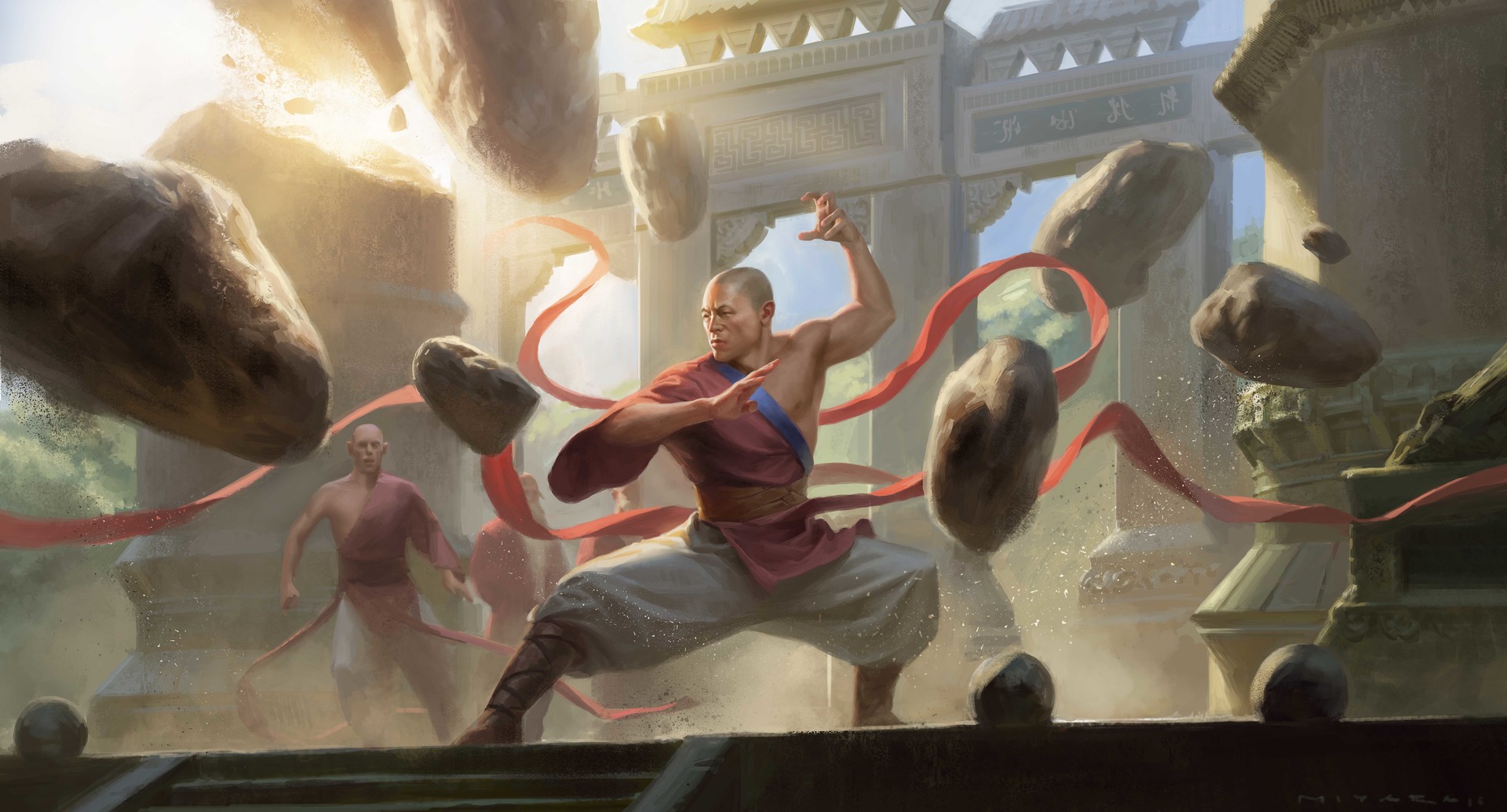

Monastic Tradition
At 3rd level, a monk chooses a monastic tradition, and these options are among those available
Way of the Open Hand
Monks of the Way of the Open Hand are the ultimate masters of martial arts combat, whether armed or unarmed. They learn techniques to push and trip their opponents, manipulate ki to heal damage to their bodies, and empower their strikes with awe inspiring force.
Open Hand Technique
3rd-level Way of the Open Hand feature
You can manipulate your enemy's ki when you harness your own. Whenever you hit a creature with one of the attacks granted by your Flurry of Blows, you can impose one of the following effects on that target:
- It must succeed on a Dexterity saving throw or be knocked prone.
- It must make a Strength saving throw. If it fails, you can push it up to 15 feet away from you.
- It can't take reactions until the end of your next turn.
Wholeness of Body
6th-level Way of the Open Hand feature
You gain the ability to heal yourself. As an action, you can regain hit points equal to three times your monk level. You must finish a long rest before you can use this feature again.
Hand of Wisdom and Action
10th-level Way of the Open Hand feature
You have learned to turn your opponent's strength against them. When a creature hits you with a melee weapon attack, you can use your reaction to reduce the damage dealt by an amount equal to 1d10 + half your monk level.
If you reduce the damage to 0, you can spend 1 ki to reduce the attacker's speed to 0 and either push the attacker 15 feet away from you or knock them prone.
Mountain Collapsing Palm
17th-level Way of the Open Hand feature
You ave learned the penultimate technique of the Way of the Open Hand. When you hit a creature with an unarmed strike, you can spend 6 ki points to use the Mountain Collapsing Palm. The target immediately takes 5d10 bludgeoning damage, is pushed back 30 feet, knocked prone, and must make a Constitution saving throw at disadvantage. On a failed save they are stunned for 1 minute.
The stunned target must make a Constitution saving throw at the end of each of its turns. On a successful save, this stunning effect ends.


Way of the Kensei
Monks of the Way of Kensei train relentlessly with their weapons, to the point that the weapon becomes like an extension of the body. Founded on a mastery of sword fighting, the tradition has expanded to include many different weapons.
A kensei sees a weapon much in the same way a calligrapher or a painter regards a pen or brush. Whatever the weapon, the kensei views it as a tool used to express the beauty and precision of the martial arts. That such mastery makes a kensei a peerless warrior is but a side effect of intense devotion, practice, and study.
Kensei Weapon
3rd-level Way of the Kensei feature
Your special martial arts training leads you to master the use of certain weapons.
Choose one type of weapon to be your kensei weapons. This weapon can be any simple or martial weapon and you gain proficiency with these weapons if you don't already have it. Weapons of the chosen type are monk weapons for you, but if they are a melee weapon with the heavy or special properties you cannot use Dexterity instead of Strength for their attack and damage rolls. Many of this tradition's features work only with your kensei weapons.
When you reach 6th, 11th, and 17th level in this class, you can choose another type of weapon – either melee or ranged – to be a kensei weapon for you, following the criteria above.
Measured Assualt
3rd-level Way of the Kensei feature
When you take the Attack action on your turn, you can choose to focus solely on wielding your kensei weapon and perform a Measured Assault. You gain the following effects, which last until the start of your next turn.
- You gain a +2 bonus to AC while your kensei weapon is in your hand and you aren’t incapacitated.
- Any target you hit with an attack using a kensei weapon takes a extra damage of the weapon’s type equal to your martial arts dice.
- You cannot make attacks using unarmed strikes.
Way of the Brush
3rd-level Way of the Kensei feature
You gain proficiency with your choice of calligrapher's supplies or painter's supplies.
Mystic Weapon
6th-level Way of the Kensei feature
Your attacks with your kensei weapons count as magical for the purpose of overcoming resistance and immunity to nonmagical attacks and damage.
Deft Strike
10th-level Way of the Kensei feature
Once per turn, when you hit a target with a kensei weapon, you can spend ki points, up to a maximum of your Wisdom Modifier, to cause the weapon to deal extra damage to the target equal to one roll of your Martial Arts die, plus an additional roll of your Martial Arts die for each point beyond the first.
Additionally, your attacks with your kensei weapons count as magical for the purpose of overcoming resistance and immunity to nonmagical attacks and damage.
One with the Blade
17th-level Way of the Kensei feature
Your skill with your kensei weapons is without peer and they have become a true extension of yourself. Non-magical kensei weapons you wield gain a +3 bonus to their attack and damage rolls.
When you use your Measured Assault, you can spend 5 ki points to become as one with your kensei weapon. For 1 minute, or until you end your turn without using Measured Assault, the benefits granted by Measured Assault are doubled.

Way of the Sun Soul
Monks of the Way of the Sun Soul learn to channel their own life energy into searing bolts of light. They teach that meditation can unlock the ability to unleash the indomitable light shed by the soul of every living creature.
Radiant Sun Bolt
3rd-level Way of Sun Soul feature
You learn to hurl searing bolts of magical radiance. You gain a new attack option, which you can use in place of an unarmed strike. This special attack is a ranged spell attack with a range of 30 feet. You are proficient with it, and you add your Dexterity or Wisdom modifier to its attack and damage rolls. Its damage is radiant, and its damage die is a d4. This die changes as you gain monk levels, as shown in the Martial Arts column of the Monk table.
Sun Shield
6th-level Way of Sun Soul feature
You become wreathed in a luminous, magical aura. You shed bright light in a 10-foot radius and dim light for an additional 10 feet. You can extinguish or restore the light as a bonus action.
If a creature hits you with a melee attack while this light shines, you can spend 1 ki to use your reaction to force the creature to make a Dexterity saving throw. On a failed save the creature is blinded until the end of your next turn.
Searing Sunburst
10th-level Way of Sun Soul feature
You gain the ability to create an orb of light that erupts into a devastating explosion. As an action, you magically create an orb and hurl it at a point you choose within 150 feet, where it erupts into a sphere of radiant light for a brief but deadly instant.
Each creature in that 20-foot-radius sphere must succeed on a Dexterity saving throw or take 2d6 radiant damage.
You can increase the sphere's damage by spending ki points. Each point you spend, up to a maximum of 3, increases the damage by 2d6.
Soul of Radiance
17th-level Way of Sun Soul feature
Your entire being is filled with the unbridled radiance of your soul. As an action on your turn, you can spend 5 ki to begin charging an immense pool of radiant light, which shines bright light in a 60 feet radius while charging. You release this light at the start of your next turn, unless you choose to use your action and spend an additional 3 ki to continue charging it.
When you release the radiant light, it blasts out in a line 100 feet long and 15 feet wide in a direction you choose. Each creature in the line must make a Dexterity saving throw. A creature takes 5d12 radiant damage, plus an additional 5d12 radiant damage for each turn you chose to continue charging, on a failed save, or half as much damage on a successful one. The light ignites flammable objects in the area that aren’t being worn or carried.
Way of Shadows
Monks of the Way of Shadows follow a tradition that values stealth and subterfuge. These monks might be called ninjas or shadowdancers, and they serve as spies and assassins. Sometimes the members of a ninja monastery are family members, forming a clan sworn to secrecy about their arts and missions. Other monasteries are more like thieves' guilds, hiring out their services to nobles, rich merchants, or anyone else who can pay their fees. Regardless of their methods, the heads of these monasteries expect the unquestioning obedience of their students.
Shadow Arts
3rd-level Way of Shadows feature
You can use your ki to duplicate the effects of certain spells. As an action, you can cast darkness, darkvision, pass without trace, or silence, without providing material components. Once you cast one of these spells using this feature, you cannot do so again until you complete a short or long rest, unless you spend 2 ki to do so.
Additionally, you gain the Minor Illusion cantrip if you don't already know it and you gain darkvision out to a range of 60 feet. If you already have darkvision from your race, its range increases by 30 feet.
Shadow Step
6th-level Way of Shadows feature
You gain the ability to step from one shadow into another. When you are in dim light or darkness, as a bonus action you can teleport up to 60 feet to an unoccupied space you can see that is also in dim light or darkness. You then have advantage on the first melee attack you make before the end of the turn.
Cloak of Shadows
10th-level Way of Shadows feature
You have learned to become one with the shadows. When you are in an area of dim light or darkness, as an action on your turn, or when you use your Step of the Wind, you can become invisible. You remain invisible until you make an attack, cast a spell, or are in an area of bright light.
Shadowborne
17th-level Way of Shadows feature
You have mastered the Way of Shadows, and carry its lessons with you wherever you go. You gain an aura of shadows that turns dim light within 15 feet of you into darkness, and bright light in the same area to dim light. You can extinguish or restore this aura as a bonus action.
Additionally, the first time you hit a creature after using your Shadow Step, you can spend 4 ki points to teleport that creature to a shadow realm until the start of your next turn. While a creature is within this shadow realm, you can make attacks against it as if it were within 5ft of you. The creature can see, and hear only itself and the the shadow realm around it, which takes the appearance of shadowcast version of wherever they were previously.
At the end of your next turn, the target returns to the space it previously occupied, or the nearest unoccupied space.
If a creature dies while within this realm, you can choose for their body to remain within the shadowy realm.
Way of the Four Elements
You follow a monastic tradition that teaches you to harness the destructive power of the weave. When you focus your ki, you can align yourself with the forces of creation and bend the four elements to your will, using them as an extension of your body. Some members of this tradition dedicate themselves to a single element, but others weave the elements together into a storm of magic and natural power.
Spellcasting
3rd-level Way of Four Elements feature
You have learned to augment your martial arts with the ability to cast elemental spells.
Cantrips
You learn two cantrips of your choice from the four elements spells list.
You learn an additional cantrip of your choice at 6th, 11th and 17th level.
Spells Known of 1st Level and Higher
You know two 1st-level four elements spells of your choice, which you must choose from the four elements spell list. At 6th level you learn two 2nd-level spells, 11th two 3rd-level spells, and at 17th two 4th level spells, all of which you must choose from the Four Elements spell list.
To cast these spells you must spend ki points equal to 1 + the level of spell being cast. You can spend additional ki points to cast the spell as a higher level spell. Each additional ki point you spend increases the spell's level by 1, up to a maximum of 9th level. The maximum number of ki points that you can spend on the spell equals 1 + one third your monk level.
Whenever you gain a level in this class, you can replace one of the four elements spells you know with another spell of your choice from the Four Elements list. The new spell must be of the same level as the previous.
Spellcasting Ability
Wisdom is your spellcasting ability for your four elements spells, since you learn your spells understanding of the flow of ki through the elements. You use your Wisdom whenever a spell refers to your spellcasting ability. In addition, you use your Wisdom modifier when setting the saving throw DC for a four elements spells you cast and when making an attack roll with one.
Spell Save DC
Spell attack modifier
Hand of the Elements
3rd-level Way of Four Elements feature
You can weave you magic with your martial arts, strengthening your attacks. You gain the following benefits.
- Four elements spells you cast that require a ranged attack roll do not suffer disadvantage when targeting a creature within 5 feet of you.
- Unarmed strikes you make can use your Wisdom modifier in place of your Strength or Dexterity modifier for the attack and damage rolls, and their damage type can change to match the damage type of any four elements spell you know.
The Motion of Magic
6th-level Way of Four Elements feature
When you take the Attack action on your turn, you can replace one of the attacks with one of your four elements cantrips.
One with the Elements
10th-level Way of Four Elements feature
You are immune to any damage dealt by four elements spells you cast, and you automatically succeed on saving throws against them.
Additionally, you can add your Wisdom modifier (minimum of +1) to the damage roll of four elements spells of 1st level or higher that you cast. The damage bonus applies to one damage roll of a spell, not multiple rolls.
Mastery of Elements
17th-level Way of Four Elements feature
You have mastered the elements at your command. Your four elements spells cost 1 less ki to cast (minimum 1).
When you cast a four elements spell that has a casting time of 1 action, you can spend 2 ki point to change the casting time to 1 bonus action for this casting.

Four Elements Spell List
Cantrips
- Acid Splash
- Druidcraft
- Gust
- Mold earth
- Magic stone
- Produce Flame
- Ray of Frost
- Shapewater
- Shocking Grasp
- Thamuturgy
- Thornwhip
- Thunderclap
1st Level
- Burning Hands
- Chromatic Orb
- Earth Tremor
- Entangle
- Fog Cloud
- Frost Fingers
- Ice Knife
- Searing Smite
- Thunder Wave
- Zephyr Strike
2nd Level
- Aganazzar's Scorcher
- Dust Devil
- Flame Sphere
- Gust of Wind
- Maximillian's Earthen Grasp
- Spike Growth
- Scorching Ray
3rd Level
- Erupting Earth
- Fireball
- Lightningbolt
- Sleet Storm
- Thunder Step
- Tidal Wave
4th Level
- Elemental Bane
- Fire Shield
- Ice Storm
- Storm Sphere
- Wall of Fire
- Watery Sphere
- Vitriolic Sphere
Other Subclasses
Other subclasses can work with this rework as well, though the guarentees on balance can't be as assured. In particular The Way of Mercy will likely be too strong in its current form. The only changes they should need is to move their level 11 to level 10.
Changelog
Main Class
- Martial Arts bonus attack moved into attack action
- Unarmored Defence now offers choice of STR or DEX + WIS for AC
- Unarmored Movement now grants BA dash or disengage,
- Ki gain rate adjusted, now scales up to 25 ki. 2 more at level 2 as well as 1 additional at 5, 11 and 17
- Flurry of blows moved into the attack action
- Step of the Wind now grants BA Dash and Disengage together
- Deflect Missle removed Ki cost to throw back.
- Added Striking Style @ level 5, Which grants a reworked stunning strike and 2 other strikes
- Added Improvement to base Ki Abilities at level 10, moved Purity of Body to 13
- Removed Tongue of the Sun and Moon
- Added new level 13, offering Purity of Body along with 2 other features as a choice
- Reworked level 18, now offers Empty Body along with Quivering Palm and one new feature as a choice
- Reworked Perfect Soul, now grants 1 Temporary ki point at the start of each of your turns.
Subclasses
- Reworked Open Hand Monk level 11 and 18, since old features are now in the base class
- Reworked Sunsoul, nerfed old capstone and made it L6, new capstone
- Kensei Reworked, more weapons focused.
- Reworked Shadow Monk
- Reworked 4 Elements Monk
Art Credit
Cover: Lucas Parolin
Art 1: muyoung
Art 2: Monk, Wizards of the Coast
Art 3: Willian Murrai
Art 4: Jason Engle
Art 5: Francisco Miyara
Art 6: Chase Stone
Art 7: Anakin Lee
Art 8: dCTB
Page Stains By: Jared Ondricek