Potion Crafting System
The following is intended to provide a potion-crafting system that strikes a good balance between "simple" and "flexible." Note that proficiency in alchemist's supplies or herbalism kits, plus 1 hour of actual crafting, is required to craft a potion. Alternatively, the GM might allow proficiency in healer's kits or poisoner's kits to craft particular kinds of potions, or modify some potions' crafting times.
Ingredients for Potions
Every potion requires a minimum of 3–4 ingredients in order to successfully craft it. This is because each ingredient is used to determine one of four particular traits.
The first of these traits, potency, is used to determine which effect(s) can be drawn out from an ingredient used to grant a potion's effects. This trait is only important for the crafting of potions, not for the actual use of the potion.
The second trait, duration, is used to determine how long a potion's effects last once the potion is used.
The third trait, susceptibility, is used to determine the saving throw DC for resisting a potion's effects. This trait is only necessary for potions that are used to harm others, rather than benefit yourself, and as such doesn't require an ingredient if the potion you're making is purely beneficial.
Finally, the effect trait is used to determine what a potion actually does when it's consumed or used to harm another. As will be explained in more detail below, potions only ever use one ingredient to determine their effects—though this doesn't mean a potion can't have multiple effects, if an ingredient with a high potency score is used to to draw out multiple effects from the ingredient used to determine the potion's effect(s).
Keep in mind that each of these traits requires a separate ingredient. For example, if I include a skullfish in my potion's ingredients, I can use it to determine the potion's duration or susceptibility score or effect, not all three. Of course, if I have three skullfish, I could apply one each to determine these traits for my potion, plus nightshade to fulfill my potency requirement!
Potion & Ingredients Traits
Potions are easy to drink, but harder to make. Oddly enough, this is why many individuals devote themselves to the study and brewing of potions as a paid vocation.
When it comes to crafting potions, every potion ends up with two base traits: 1–3 effects and the duration for those effects. Some potions also have a third trait called susceptibility, which measures the strength of effects meant to harm rather than provide benefits. These traits are described in more detail below.
Potency
As mentioned above, potency is the only ingredient trait that's only important when you're crafting a potion. As we'll see in the "Effect" section, some ingredients come with multiple possible effects, often ranging from minor to major effects. Potency is the trait that helps determine which ones actually apply to a potion.
Essentially, the ingredient used for the potency trait draws out one or more effects from the ingredient used for a potion's effect trait. Most ingredients on the Ingredients Characteristics table at the end of this document have a potency score of 1–5. Similarly, ingredients with listed effects have a score next to them, also ranging 1–5. In order to draw out one or more of these effects, the ingredient used for a potion's potency requirement must equal or exceed the score for the effect(s) you wish to draw out.
For example, if I wanted to draw out a black dragon scale's "resistance to acid" and "blindsight 30 ft." effects, I would need my potency ingredient to have a potency score of at least 3, like a griffon claw: 1 for "resistance to acid" plus 2 for "blindsight 30 ft."
Duration
Duration is the simplest potion trait to understand, as it determines how long a potion's effect lasts. Most ingredients have a duration score of 1–5, which determines how long a potion's effects will last if that ingredient is used to grant the potion's duration.
| Duration Score | Duration |
|---|---|
| 1 | 1 minute |
| 2 | 10 minutes |
| 3 | 1 hour |
| 4 | 2 hours |
| 5 | 4 hours |
Susceptibility
Susceptibility is a trait used to measure how difficult it is to resist a harmful potion's effects. Most ingredients have a susceptibility score of 1–5, which determines the saving throw DC for resisting a potion's effects if that ingredient is used to grant the potion's susceptibility score.
A potion with a susceptibility score can be applied to one slashing or piercing weapon or one piece of ammunition, as well as added to food or drink. Unless its ingredients specify otherwise, such a potion always imposes a Constitution saving throw.
| Susceptibility Score | Save DC |
|---|---|
| 1 | 13 |
| 2 | 14 |
| 3 | 15 |
| 4 | 16 |
| 5 | 17 |
Effect
"Too many ingredients spoils the potion. If you try to make yourself super smart and fireproof, you're more likely to find yourself bleeding out of your ears. And that's if you're lucky and don't explode instead, mind you."
Each potion you craft can only use one ingredient to determine its effect(s). As explained in the sections above, some ingredients do have the potential to grant a potion up to 3 effects, but multiple effects can only be drawn out if the ingredient used for your potency requirement has a high enough potency score to equal or exceed the cumulative scores of the effect(s) you're trying to imbue. Examples of this are described above at the end of the "Potency" section and below in the "Let's Make a Potion!" section.
An ingredient's effects can be discerned with a suitable Intelligence skill check, information from an NPC, or from trial-and-error. This can also be achieved by making a Wisdom (Survival) check to carefully taste the ingredient. Doing so also subjects the taster to the ingredient's first effect, so taste wisely!
Note that some ingredients have "cursed" effects that are automatically added to a potion's effects when you add any of their other effects, regardless of whether you want them or not. These "cursed ingredients" are something to be careful of, but are just as useful as any other to an experienced potion brewer.
Ingredient Rarities & Costs
All ingredients have a rarity, as listed on the Ingredients Characteristics table. Costs for ingredients of each rarity are suggested below, though these can be altered at the GM's discretion. For example, perhaps the setting in which you find yourself is having a shortage on eye of newt, or considers a dragon's scale far too rare to ever be found or sold in a shop.
Keep in mind that, in addition to the ingredients used to craft the potion itself, crafting a potion requires basic crafting supplies worth at 15 gp, which are consumed in the crafting of the potion. Such basic crafting supplies can also be found in any standard alchemist's supplies or herbalism kit, and sometimes found in healer's kits or poisoner's kits.
| Ingredient Rarity | Cost |
|---|---|
| Common | 1 gp |
| Uncommon | 10 gp |
| Rare | 100 gp |
| Very Rare | 500 gp |
| Legendary | 1,000 gp |
Special Ingredient Effects
While a number of the effects listed on the Ingredients Characteristics table are straightforward enough that they shouldn't require further explanation, some are a bit more complicated, and are explained on the following table.
| Name | Effect |
|---|---|
| Blindsight | Within the specified range, you can effectively see anything that isn’t behind total cover, even if you’re blinded or in darkness. Moreover, you can see an invisible creature, unless the creature successfully hides from you. |
| CURSE: Glee | You are charmed by any creature you can see or hear for the duration. If a creature attacks you or targets you with a spell, you are no longer charmed by that creature. |
| Devil's Sight | You can see normally in darkness, both magical and nonmagical, to a range of 60 feet. |
| Elemental Resistance | You have resistance to acid, cold, fire, lightning, and poison damage. |
| Invisibility | You become invisible for the duration, or until you attack or cast a spell. Anything you wear or carry is invisible with you. |
| Keen Sight | You have advantage on Wisdom (Perception) checks that rely on sight. |
| Light Sensitivity | You have disadvantage on attack rolls and ability checks while in bright light. |
| Magic Resistance | You have advantage on saving throws against spells and other magical effects. |
| Sense Magic | You can sense the presence of magic within 120 feet of you, similar to the effects of the detect magic spell. |
Let's Make a Potion!
Now that we've explained all the mechanics of what's involved in crafting a potion, let's go through the motions of a couple examples to make sure we understand how all of it comes together to result in the potion of our dreams. To reiterate, all ingredients mentioned are on the next page on the Ingredients Characteristics table.
Suppose I'm planning to sneak into a cultist's house in order to gather some information and want to avoid being seen while I do. I look through my available ingredients and notice that the third possible effect for western nirnroot is "invisibility." Since that effect has a score of 2, I add my trusty hemlock to my brew, since that has a potency score of 2, thus equaling out the invisibility effect cost. Finally, I want to be able to take my time, so I add a drider silk that has a duration score of 3 so that my potion will have a 1-hour duration when I use it. I expend 15 gp worth of basic crafting supplies via my proficiency in herbalism kits and do 1 hour of crafting and voila! I have a potion that will grant me 1 hour of invisibilty for my reconnaissance mission. In total, I used western nirnroot for my potion's effect (choosing to draw out the third effect), hemlock for that effect's potency requirement, and drider silk for my potion's duration.
In another instance, I determine that a corrupt local politician is funding the cult and needs to be hospitalized as a distraction. I pull out another batch of western nirnroot, this time deciding to draw out its first and second effects: "2d6 poison damage (1)" and "disadvantage on Constitution saving throws (2)." I need a combined potency score of 3 to draw out both of those effects at once, so I add a griffon claw. I don't need this to last long for my distraction to work, so this time I use skullfish for my duration so the effect lasts 10 minutes. Finally, since this potion is causing harmful effects, I need to add an ingredient for susceptibility this time to determine the save DC, so I add a second batch of western nirnroot to my brew, using it to give my poison effect DC 13. I use 15 gp of basic crafting supplies from a poisoner's kit that I also have proficiency in this time, and end up with a potion that lasts 10 minutes after being poured and deals 2d6 poison damage and gives disadvantage on Constitution saving throws after an initial failed DC 13 Constitution save. In total, I used one western nirnroot for my potion's effect (choosing to draw out the first and second effects), a griffon claw for those effects' combined potency requirement, a second western nirnroot for my potion's susceptibility score, and a skullfish for my potion's duration.
Design Credits
- Created by Reddit user /u/livingstone_library
- This document was created using GM Binder
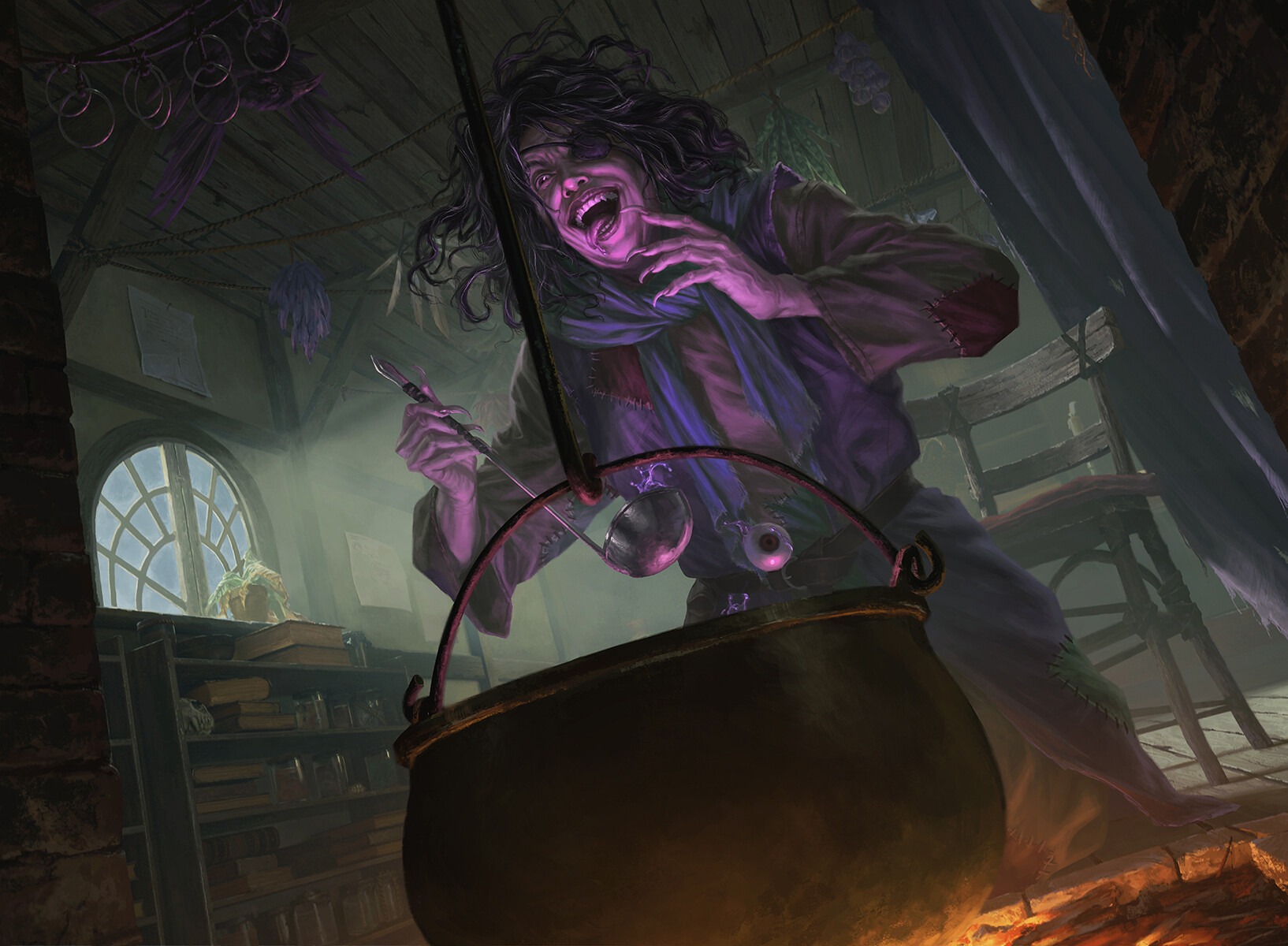
- Cover Art: "Odious Witch" by Lie Setiawan
Special Thanks
- We'd like to especially thank our "Hero" tier Patreon supporters: Harrison Miller, Ryan Willey, and Charlie!
"Potion Crafting System" is unofficial Fan Content permitted under the Fan Content Policy. Not approved/endorsed by Wizards. Portions of the materials used are property of Wizards of the Coast. ©Wizards of the Coast LLC.
Ingredients Characteristics
| Name | Rarity | Potency | Duration | Susceptibility | Effect #1 | Effect #2 | Effect #3 |
|---|---|---|---|---|---|---|---|
| Angelica | Common | — | — | — | Resistance to Poison Damage (2) | — | — |
| Black Dragon's Scale | Very Rare | 4 | 4 | 3 | Resistance to Acid (1) | Immunity to Acid Damage (2) | Blindsight 30 Ft. (2) |
| Blue Dragon's Scale | Very Rare | 4 | 4 | 3 | Resistance to Lightning (1) | Immunity to Lightning Damage (2) | Blindsight 30 Ft. (2) |
| Chuul Claw | Rare | 2 | 2 | 2 | Sense Magic (3) | — | — |
| Comfrey | Common | 1 | — | — | 2d4 Healing (2) | — | — |
| Drider Silk | Rare | 2 | 3 | 3 | — | — | — |
| Eastern Nirnroot | Uncommon | 1 | 1 | 1 | 2d6 Poison Damage (1) | Disadvantage on Constitution Saving Throws (2) | Magic Resistance (2) |
| Eye of Newt | Common | — | 1 | 1 | — | — | — |
| Fey Stone | Rare | 3 | 3 | 3 | CURSE: Glee (0) | Light Sensitivity (1) | — |
| Green Dragon's Scale | Very Rare | 4 | 4 | 3 | Resistance to Poison Damage (1) | Immunity to Poison Damage (2) | Blindsight 30 Ft. (2) |
| Griffon Claw | Uncommon | 3 | 1 | 1 | — | — | — |
| Harpy Eggshell | Uncommon | 2 | 1 | 2 | — | — | — |
| Hawk's Eye | Common | — | — | 1 | Keen Sight (4) | — | — |
| Hemlock | Common | 2 | — | — | 1d4 Poison Damage (4) | — | — |
| Lemure Meat | Uncommon | 0 | 2 | 1 | Darkvision 120 Ft. (1) | Devil's Sight (1) | — |
| Mimic Slime | Uncommon | 1 | 1 | 3 | Resistance to Acid Damage (3) | — | — |
| Mugwort | Common | — | — | — | Resistance to Psychic (4) | — | — |
| Nightshade | Common | 1 | — | — | 1d6 Poison Damage (2) | — | — |
| Powdered Jade | Rare | 1 | 3 | 3 | Resistance to Poison Damage (1) | — | — |
| Red Dragon's Scale | Very Rare | 4 | 4 | 3 | Resistance to Fire Damage (1) | Immunity to Fire Damage (2) | Blindsight 30 Ft. (2) |
| Sage | Common | — | 1 | — | — | — | — |
| Scale of Tiamat | Legendary | 5 | 5 | 5 | Elemental Resistance (5) | — | — |
| Sea Salt | Common | 1 | 1 | — | — | — | — |
| Skullfish | Uncommon | — | 2 | 1 | 2d6 Necrotic Damage (1) | — | — |
| Tyrannosaur Fang | Rare | 5 | 1 | 1 | — | — | — |
| Western Nirnroot | Uncommon | 1 | 1 | 1 | 2d6 Poison Damage (1) | Disadvantage on Constitution Saving Throws (2) | Invisibility (2) |
| White Dragon's Scale | Very Rare | 4 | 4 | 3 | Resistance to Cold Damage (1) | Immunity to Cold Damage (2) | Blindsight 30 Ft. (2) |
Bonus Content
- Want even more potion ingredients? Visit our Patreon at patreon.com/livingstonelibrary to check out 25 more ingredients with a variety of new characteristics and effects!