 Updated for Dungeons & Dragons 5th Edition!
The Reverse Dungeon

Table Of Contents
| Topic | Page |
|---|---|
| Introduction | 1 |
| Playing 'Reverse Dungeon' | 1 |
| Plot Synopsis | 2 |
| Consequences | 2 |
| How to Run the Reverse Dungeon | 3 |
| - DM Preparation | 3 |
| - Player Preparation | 3 |
| Summary of The Dungeon | 4 |
| Chamber Design | 4 |
Introduction
Welcome to The Reverse Dungeon! This is the adventure where everything is backwards! Instead of playing bold adventurers who journey into monsters’ lairs to wipe them out and loot their stuff, the players take the role of the monsters, determined to stop pesky heroes from invading their homes. Instead of being “the good guys,” the players get the chance to be “the bad guys”.
This module is also unusual in that it’s not one adventure but a sequence of three, unfolding like a reverse campaign. Players do not necessarily keep the same monster characters throughout; in fact, they can switch to different characters between each scenario, and sometimes in the middle of a given scenario (a monster’s life is often nasty, brutish, and short).
Roles
In this adventure, roles are reversed so the person who might usually be the Dungeon Master (DM) will be controlling the adventurers. The people who might usually be players will be controlling the monsters. This document will call this latter group the DMs, although you may choose to split up DM-ing responsibilities differently based on the skills of your group.
The original Reverse Dungeon was written in a far off time (the year 2000) by John D Rateliff & Bruce R Cordell, for Advanced Dungeons & Dragons. This is an unfaithful reproduction, for fun.
Playing 'Reverse Dungeon'
The Reverse Dungeon is unlike other adventure modules and thus requires everyone (the DMs & Player) to read the module ahead of time at least as carefully as they might for a standard adventure. Because of this, the player will be familiar with some aspects of the dungeon ahead of time and know roughly what to expect, although won't know the exact nature of the traps, ambushes, and other nasty surprises await the adventurers.
[Red text is WIP] This document is set up in three sections: Goblintown, The Vault Level, and Lichland. Generally speaking, each section corresponds to a physical level of the entire dungeon (see the “Reverse Dungeon Cross Section Map”). Additionally each section assumes the PCs play monsters associated with the level in question. Each section contains several separate scenarios orchestrated by the DM that involve the invasion of adventurers or rival monsters into the PC monsters’ dungeon territory When all the scenarios of a section are played out, for good or ill (see “Consequences,” below), the players move on to the next section.
Although each section allows the PCs to pick a new monster to go with the new section, the DM should allow players to hold onto their monster characters if they want to, although this requires the DM to “beef up” lesser monsters to stand up to more dangerous threats presented, especially for goblin PCs. Allowing goblins to pick up and use some of the artifacts presented in The Vault Level is one way of evening the playing field. Another way is to allow each PC to control a small goblin troupe of 5 or 6 lower-HD goblins.
Each of the three sections contains a subsection entitled “Scenarios.” Refer to these sections to find out how NPC adventurers and rival monsters intend to threaten the PC monsters in each dungeon. Besides providing several scenario outlines, each “Scenarios” section also provides complete NPC statistics. Note that threats aimed at one level that are not eradicated by the PC monsters may have to be dealt with in the next level, by the next set of PC monsters, if the DM desires.
Note: This campaign intentionally has more of a 'player vs DM' design than most others. Make sure everyone is on the same page about what this means and don't take it too far. Play fair, and keep any tricks on the table.
Plot Synopsis
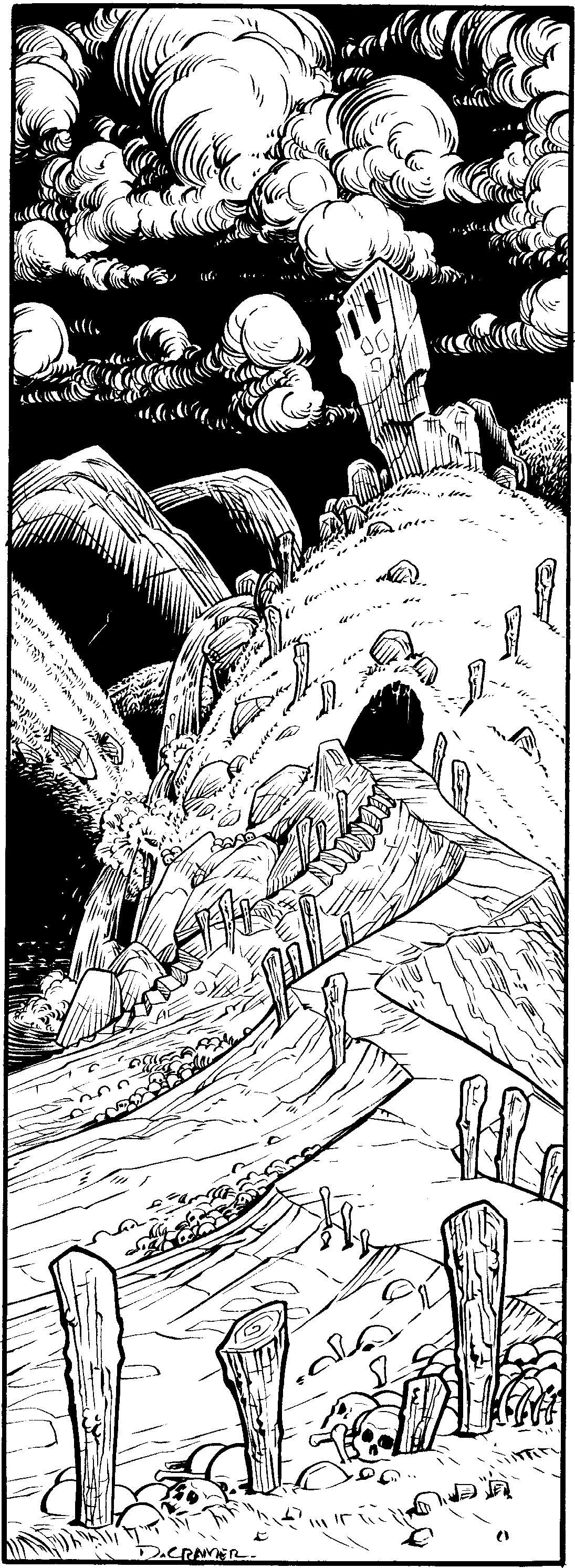
The short campaign of the Reverse Dungeon focuses on the dungeon complex below a large hill. Natural geological processes formed a series of limestone caverns hundreds of thousands of years in the past. An ancient culture subsequently expanded the caverns through mining. These mines later served as home for several demihuman races, until the hill and caverns were claimed by an evil wizard named Blazeth some 600 years ago. Blazeth expanded the mines and caverns into a true dungeon complex, and he capped the hillock with the traditional wizard’s tower. Today, the tower stands in ruins, various monsters have reinhabited the upper levels, and most outsiders assume that Blazeth is long gone. This assumption is false.
Blazeth, now transformed by his festering evil magics, resides in the fourth level of the dungeon. The wizard allows the monsters to inhabit the upper levels of the dungeon, since he has no use for those areas and finds the monsters a convenient cover. In fact, the current generation of monsters are not even aware of what the lower level holds (though they may suspect something powerful).
As the campaign starts, the monsters have led an entirely autonomous existence. However, frequent raids into nearby human civilizations have drawn unwanted attention, and a party of adventurers are about to begin to invading the dungeon. The monsters have the opportunity to defend their lair and bring this threat to an end.
Dungeon chambers
Level 1 - The Warrens
Level 2 - Desecrated Shrine
A religious order set up a shrine
Level 3 - The Vault
Unfortunate captured adventurers
Level 4 - Blazeth's Lair
The final chamber is the lowest level of Blazeth’s dungeon. Here, Blazeth and his monster servants plot evil and attempt to bind demons to their service. If Blazeth is killed, the dungeon falls, with the monsters destroyed or scattered.
How to Run the Reverse Dungeon
The adventure has one Player, who controls three adventurers. Opposing them are the monstrous forces of four Dungeon Masters.
Four Dungeon Masters!?
Yes. Each Dungeon Master is responsible for one chamber of this four-chamber dungeon, and one monster in each chamber. When the adventurers are in a chamber, the appropriate Dungeon Master will narrate the action, make rulings, and control the rest of the monsters if there are more than four.
Goals
The goal of the adventurers is to either kill all the monsters in a chamber, or find the chamber's exit. The goal of the monsters is to stop the adventurers from doing this.
The adventurers also have a side goal
Finding loot! Each chamber has some gold and one special item. The adventurers can spend gold between each chamber in the DM's shop.
Surviving monsters
If a monster survives, it will be available for the DM of the next chamber to add to their roster.
The End
In the final chamber, the adventurers will face an ultimate challenge and hopefully emerge victorious.
DM Preparation
First, the four Dungeon Masters need to decide which order their chambers will be played in. Then read the Chamber Design section on the following page, and create a chamber to challenge the adventurers. They may wish to have a theme for the chamber and choose monsters to fit that theme, or just pick the foulest creatures they can find. Assign the biggest monsters in a chamber to the other Dungeon Masters to control.
Shop
Between each chamber is a shop, for the adventurers to buy & sell items, rest and level up before tackling the next chamber. The shop might be a bare-bones bodega, a fancy emporium, or anything the DM can imagine. Adventurers cannot be harmed in shops. Shops stock standard adventuring gear, weapons, armor and any magic items the DM is feeling generous enough to provide. They can sell cursed items as long as the item is identified first. Shops buy items at face value.
Player Preparation
The player needs to prepare character sheets for three third-level adventurers. To save time, they may wish to also prepare sheets for when these adventurers level up to levels 4, 5 and 6.
Adventurer deaths
Decide in advance as a group how you will treat adventurer deaths. One suggestion: dead adventurers can be revived or a new equal-level adventurer recruited from a shop for 500gp. If the whole party dies the campaign is over and the monsters win.
Summary of The Dungeon
| Description | PC Level | Adjusted XP | Reward |
|---|---|---|---|
| Shop 1 | 3 | - | - |
| Chamber 1 | 3 | 3,000xp | Common magic item |
| Shop 2 | 4 | - | - |
| Chamber 2 | 4 | 7,000xp | Uncommon weapon |
| Shop 3 | 5 | - | - |
| Chamber 3 | 5 | 11,000xp | Rare armor |
| Shop 4 | 6 | - | - |
| Chamber 4 | 6 | 15,000xp | Rare magic item |
Chamber Design
Architecture & Terrain
Chambers can contain any layout of chambers, doors, windows, platforms, gates, ramps, rocks, water, barrels etc. as complex or simple as the DM wants.
- Maximum chamber size is 20x20 5ft squares.
- Minimum corridor size is 5ft wide.
- The entrance to the chamber must be a safe area out of sight of monsters.
- Aside from traps & falling, chamber elements cannot cause damage e.g. no lava, no mounted balistas).
- Chamber design cannot block the adventurers from progressing (e.g. hiding a monster in an inaccessible room, or putting the exit 30ft up a wall).
- Maximum fall damage is 2d6.
- Each chamber must contain a Reward and 500gp worth of other treasure, in a guarded but accessible location.
- Maximum of 500 square feet of difficult terrain (e.g. 20 x 5ft squares).
- Maximum of 5,000 cubic feet of water (e.g. a canal 10ft deep, 10ft wide and 50ft long).
- Once an adventurer is through the exit they cannot be harmed and are free to go on their way to the next chamber.
- After going through an exit, adventures cannot cast spells, use abilities or make attacks which affect the monsters until they reach the next chamber.
Map-making Tools & Resources
Monsters
The monsters populating the chamber must have an Adjusted XP equal or less than the number in the table above. Adjusted XP is the total XP of the monsters, multiplied by the modifier below:
| 2 monsters: | 3-6 monsters: | 7-10 monsters: |
|---|---|---|
| ×1.5 | ×2.0 | ×2.5 |
Monsters do not need to be hostile to the adventurers; maybe they will try to hinder them in a different way, although combat is always a possibility. Monster CR cannot be higher than player level. To check the XP for monsters, DMs can use Kobold Plus.
Traps
- Traps cost 50xp; maximum of three traps in a chamber.
- Monsters can also trigger traps.
- PCs can spot a trap with a DC 18 Perception check.
- Trap designs:
- Trap 1: Poison darts, 2d4 poison damage & poisoned until end of next turn, Con save to avoid.
- Trap 2: Explosives, 2d6 fire damage, Dex save to avoid.
- Trap 3: Falling Portcullis, blocks a passageway, Str save to catch.
- Trap 4: Shunt trap, shoves the target 5ft to the side, Dex save to avoid.
- Trap 5: Pit trap, 1d6 bludgeoning damage from falling, Dex save to avoid, takes 15ft of movement to climb out.
- The saving throw DC to avoid a trap is 10 + the PC's level (i.e. if the PC is at third level, the DC is 13).
- Triggers for traps:
- A pressure plate, Investigation check to disarm.
- A 5ft tripwire in a doorway or between two objects, Sleight of Hand check to disarm.
- The catch of a door or chest, Survival check to disarm.
- A magical symbol, Arcana check to disarm.
- The skill check DC to disarm a trap is 12 + the PC's level (i.e. if the PC is at third level, the DC is 15).
- Failing the attempt to disarm by 5 or more triggers the trap.
Example Adjusted XP calculation
Say the DMs are preparing for Chamber 2. They see the maximum Adjusted XP is 2000xp. They include a Thug (100xp), two Imps (200xp each) and a Giant Boar (450xp) for a total of 950xp.
This is 4 monsters, so the total is multiplied by x2.0 to get the Adjusted XP: 1900xp.
This leaves 100xp remaining, to buy 2 traps. In the previous chamber, a Goblin survived so they can be added for free.
Chamber maps
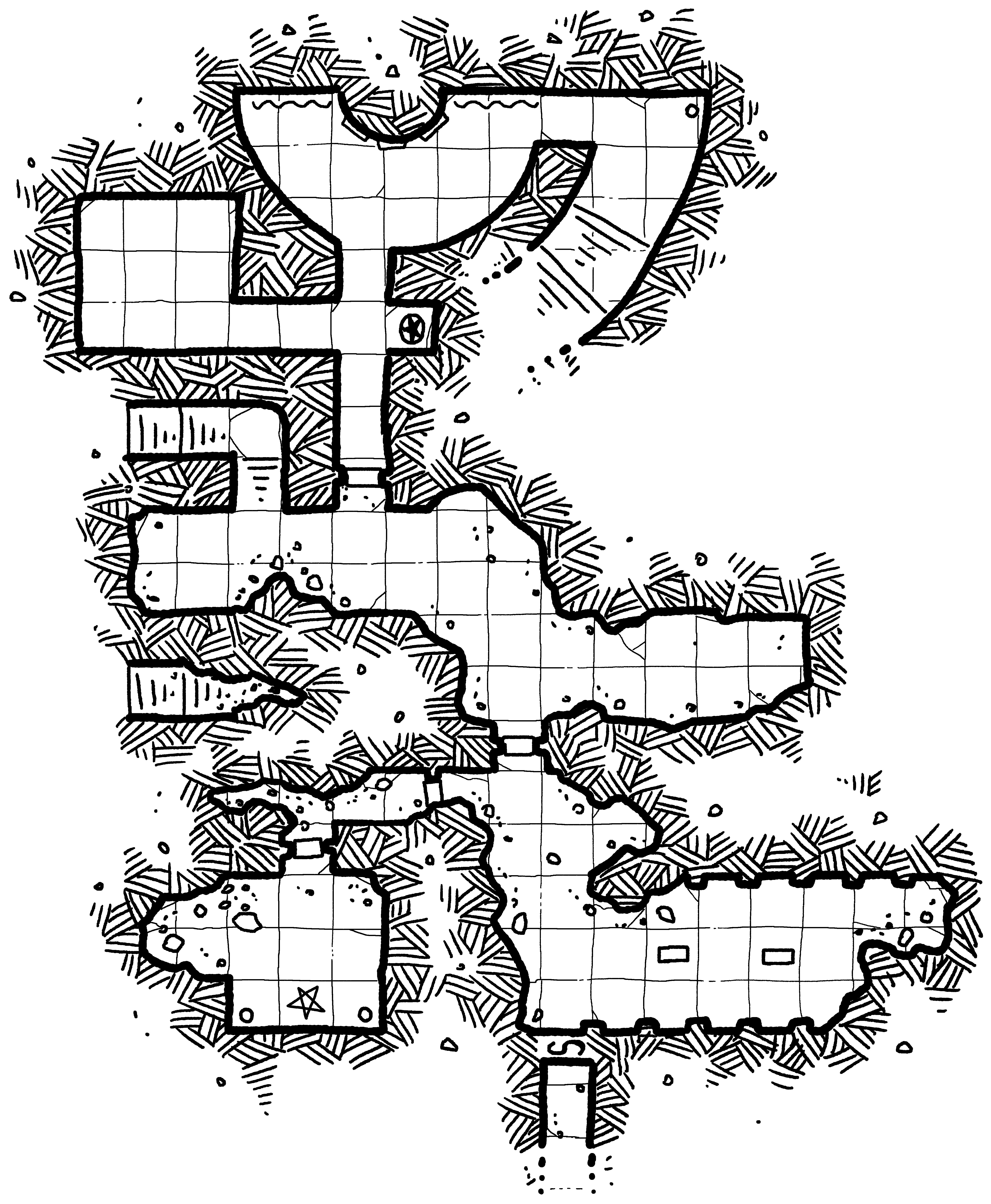
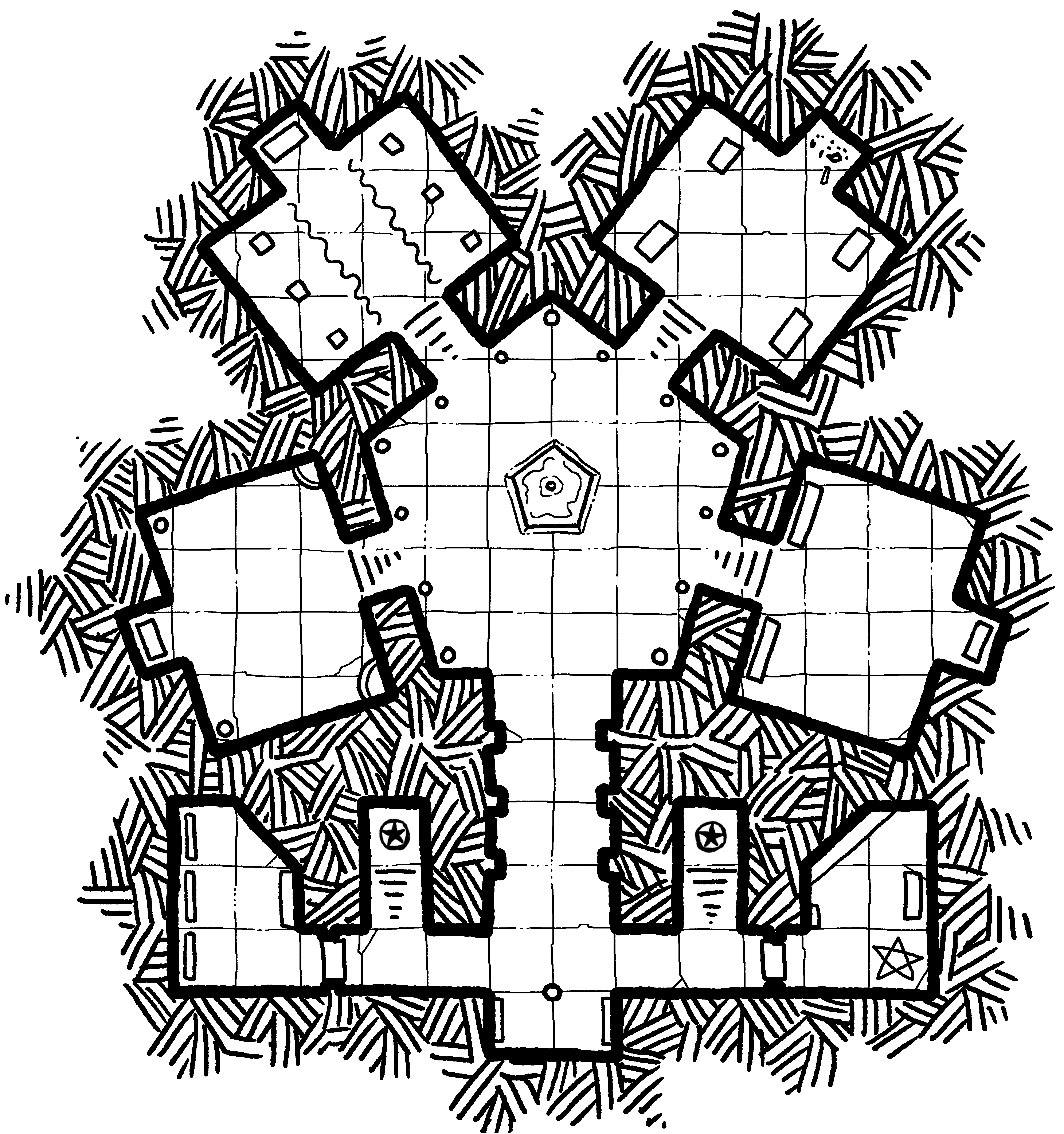
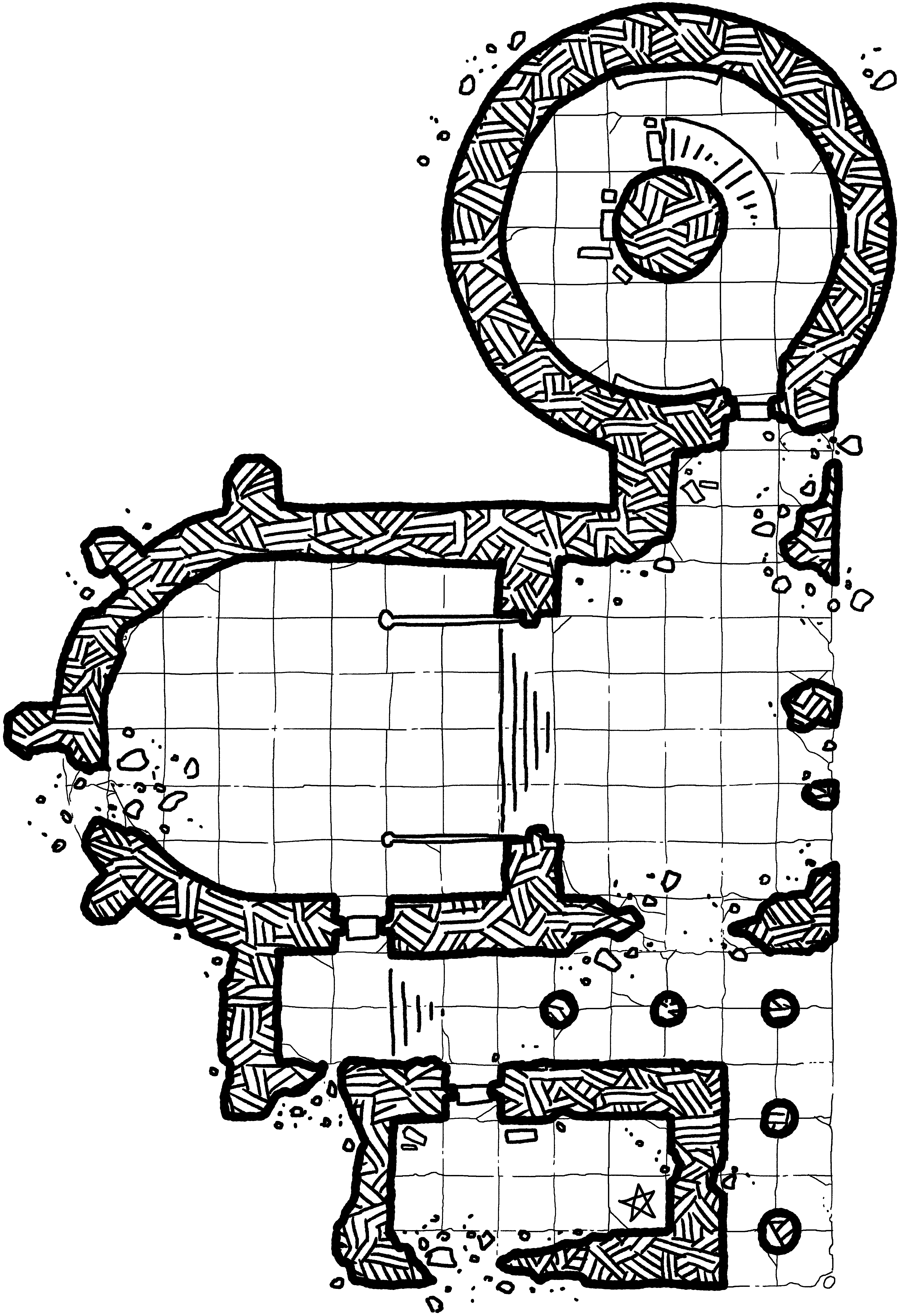
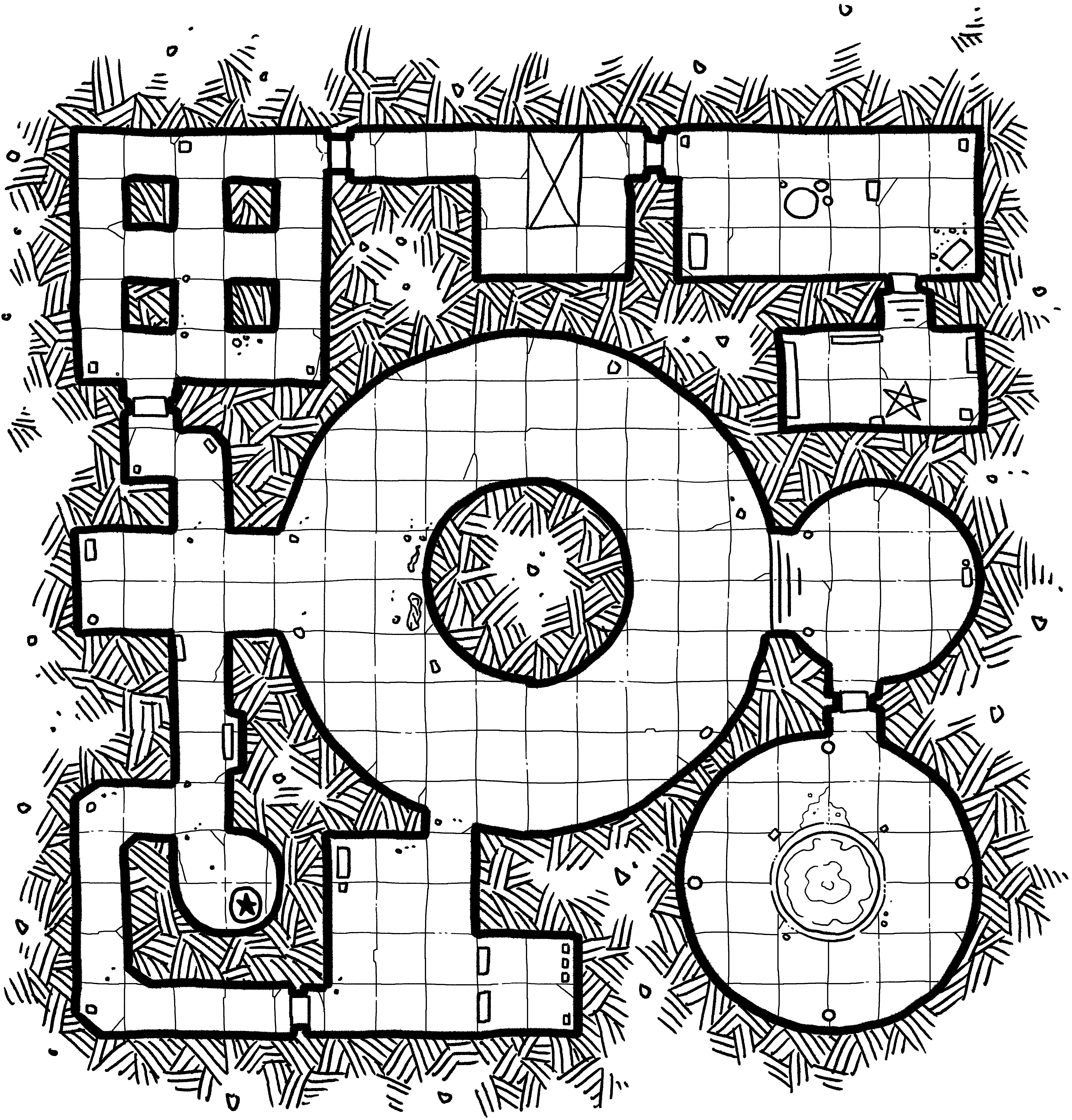
If DMs do not want to create their own chamber maps, they can use the ones below. The adventurers start at the star symbol.
Level 1 - The Warrens
Level 3 - The Vault
Level 2 - Desecrated Monastery
Level 4 - Blazeth's Lair
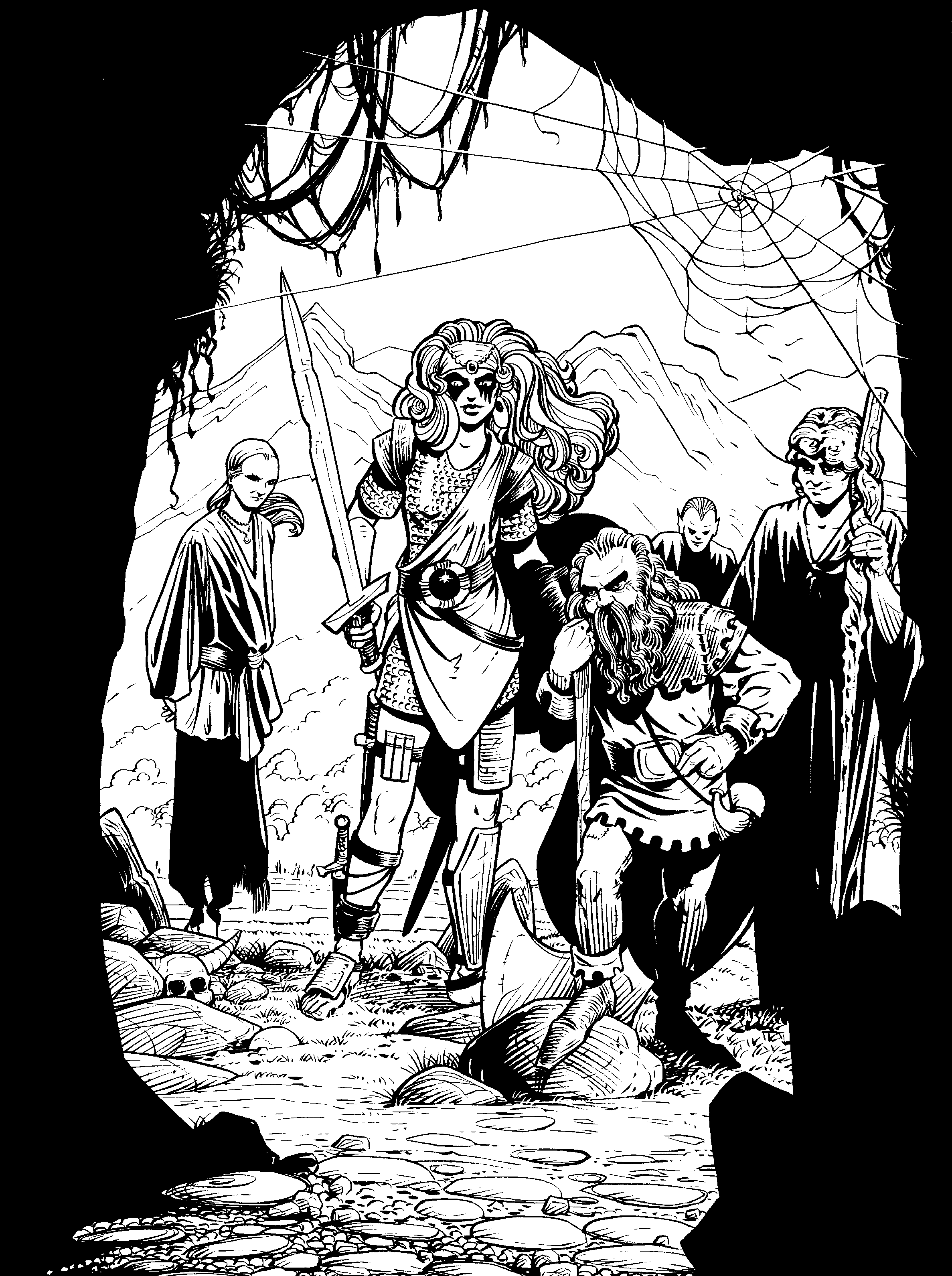
Welcome to The Reverse Dungeon! This is the adventure where everything is backwards!
Instead of playing bold adventurers who journey into monsters’ lairs to wipe them out and loot their stuff, the players take the role of the monsters, determined to stop pesky heroes
from invading their homes.
Enter the Reverse Dungeon, and find out
what it feels like to be on the receiving
end of a hero's blade!
Version History:
- Draft 0.1 - 17th Dec 2021