
to the
Arkoça Archipelago
Part 0
Summary of Content
Part I
Races of the Islands

The Islands are as diverse as they are numerous, abundant in different societies, cultures, and creeds. This compendium lists just some of the most common races seen throughout the archipelago, though it is by no means an exhaustive list.
Humans
Like in much of the Greater World, humans are abundant in numbers, and diverse in creed. Seeing themselves as the ‘default’ race, especially on the larger islands. Humans tend to be generalists, ranging from farmers to fishermen, from priests to pirates.
Improvise, Adapt, and Overcome
When a human puts their mind to a task, there is nothing that can stop them. Due to their relatively short lifespans, humans are consumed by an intense desire to leave a unique mark on the world that will live on far past their own demise.
When combined with their natural talents, this drive allows humans to rival the arcane ability of elvish mages, the martial prowess of orcish warriors, and the craft of dwarven artisans. There is nothing that can hold a dedicated human back from becoming the best there is in their chosen area of mastery.
A Broad Spectrum
With their penchant for migration and conquest, humans are more physically diverse than other common races. There is no typical human. An individual can stand from 5 feet to a little over 6 feet tall and weigh from 125 to 250 pounds. Human skin shades range from nearly black to very pale, and hair colors from black to blond (curly, kinky, or straight); males might sport facial hair that is sparse or thick. A lot of humans have a dash of nonhuman blood, revealing hints of elf, orc, or other lineages. Humans reach adulthood in their late teens and rarely live even a single century.
Human Names
Humans names, like their other traits, depend on where they live and work. Humans are known for borrowing names from other cultures and races that they work and live closely with.
Human Traits
Ability Score Increase: Your ability scores each increase by 1. Alternatively, you can increase 2 ability scores by 1, and choose one feat.
Age: Humans reach adulthood in their late teens and live less than a century.
Languages: You can speak, read, and write Common and one extra language of your choice. Humans typically learn the languages of other peoples they deal with, including obscure dialects. They are fond of sprinkling their speech with words borrowed from other tongues: Orc curses, Elvish musical expressions, Dwarvish military phrases, and so on.
Size: Humans vary widely in height and build, from barely 5 feet to well over 6 feet tall. Regardless of your position in that range, your size is Medium.
Sea Elves
Description
With their piercing turquoise eyes, as blueish tinted skin, it is hard to mistake a sea elf. These wonderers of the high seas live a nomadic lifestyle, most of them living their entire life on large village boats, touching land only to trade. Most village boats are home to just a dozen or so families, but in the open sea there are some rafts formed of many hundreds of these vessels, forming great floating cities, hubs of trade and commerce. The sea elves did not always live this way, but were forced out of their island homes during the great calamity. Some sought asylum in the Isles of Fyshgard to the far north, but many remained sailing the seas of the home land.
Language
The sea elves are thought to be the originators of the Aquan language. In the same family as Sylvan and Undercommon, Aquan is derived from a dialect of old Elvish adapted to be spoken underwater. It combines clicks and whistles with common speech. Aquan soon became a lingua franca amongst aquatic races, such as Trirons and Tortles.
Religion and Culture
Sea elves are worshipers of the sea gods. Deities commonly worshipped include Korrian - the patron of sailors, and Loukeyus (known to them by his Aquan name of Lorokai) - god of the ocean's bounty. Each village ship will often have its own minor patron deity along with a more prominent overarching guardian.
Spending their whole life on the open seas, many Sea Elves feel claustrophobic on dry land when the horizon is not in sight. The Sea Elves are primarily merchants and fishermen, but are also known to be fierce worriers - pirates who raid their caravans seldom live to tell the tale. There is still much bad blood held between the sea elves and their terrestrial counterparts, due to the betrayal that lost them their original island homes.
Nomads of the High Seas
The sea Elves of Arkoça are organised into many fleets of village ships which act as sovreign states on the high seas. Many of the larger fleets are headed by great capitals consisting of many hundreds of village ships rafted together. These floating cities are hubs of trade in Arkoça, serving for many as neutral ground in political disputes.
Sea Elf Names
Male Names: Arvastan, Balthonlis, Barishlin, Deranthil, Ervastath, Kerithlan, Perilastanor, Poldanlin.
Female Names: Avashtana, Bihalisha, Deirastane, Firiashe, Iridansa, Tiliashanna, Xiphalia, Yrashiae.
Clan Names: Anterome (Brightwave), Danlianthol (Silverpearl), Garinlastil (Scarletleaf), Gyrashiil (Joy-bringer), Iandaal (Brightwhisper), Ieriantol (Kinwatcher).

Sea Elf Traits
Ability score increases: +2 dex, +1 con
Size: medium
Speed: 30ft walking, 30ft. swimming
Sea Elf Training: You have proficiency with the spear, trident, light crossbow, and net. You also have proficiency with sea vehicles
Child of the Sea: You have advantage on Nature (Int) checks which relate to aquatic life. You can hold you breathe for a number of minutes equal to 15 + 15 times your constitution modifier, if your modifier is negative, you can hold your breath for 15 minutes.
Fey ancestry: you have advantage on saving throws against being charmed, and magic cannot put you to sleep.
Trance: Elves don't need to sleep. Instead, they meditate deeply, remaining semiconscious, for 4 hours a day.
Languages: you can speak, read, and write Common and Aquan
Halflings

Description
Halflings can be found all across the Arkoça archipelago, often working as cooks or stewards on the fleets of trade ships connecting the islands. Halflings themselves are thought to be native to the archipelago, and while it is not uncommon to hear songs of their homelands, the exact location of their island home is not known to many, being one of the few places which has remained in the hands of its native inhabitants over the course of the 12 great wars following the Calamity.
Halfling Traits
Halflings use the same stats and subraces as can be found in the PHB.
Reef Tritons
Description
Unlike their northern counterparts, the Southern Tritons (also known as reef tritons) do not occupy great depths, preferring to build settlements in warm tropical reefs. They are the guardians and custodians of the reefs. Legend has it that when these Tritons reach a certain age, they do not necessarily die, but simply themselves fade into the reef, being slowly replaced with coral. It is for this reason that the Southern Sea Tritons guard their reefs so fiercely.
Religion
Gods commonly associated with these Tritons are Galenya, Iechdwr, and Loukeyus. Unlike the Tritons of the depths who hold Berithion in reverence, their Southern cousins hold him in contempt, many considering him a demon. It is thought that the reefs protect these tritons from ever passing on to Berithion’s realm.
Triton Traits
Age: Tritons reach maturity around age 15 and can live up to 200 years.
Size: Tritons are slightly shorter than humans, averaging about 5 feet tall. Your size is Medium.
Speed: You have a walking and swimming speed of 30 feet.
Amphibious: You can breathe both air and water.
Triton Training: You are proficient with tridents, as well as in Animal Handling and Nature.
A Marine Symbiosis: living so long in the warm shallow seas, algae have grown on your skin and in your hair. So long as you are exposed to sunlight and can keep your skin moist, you can, when taking a short or long rest use one additional hit die to recover hitpoints without expense. You can use this feature even if you has no remaining hit die. the sea for a full hour.
Custodians of the Reef: You are proficient in Nature and Animal Handling.
Languages: You can speak, read, and write Aquan and Common.
Tabaxi

Description
Hailing from strange and distant lands to the South, wandering tabaxi are catlike humanoids driven by curiosity to collect interesting artifacts, gather tales and stories, and lay eyes on all the world's wonders. Ultimate travelers, the inquisitive tabaxi rarely stay in one place for long. Their innate nature pushes them to leave no secrets uncovered, no treasures or legends lost.
Their appearance varies greatly in terms of build, fur colour, and patterning. There are few truly 'Tabaxi' settlements in the archipelago, but in any large settlement you'll be sure to find one of their many trading posts.
Tabaxi Traits
Ability Score Increase: Your Dexterity score increases by 2, and your Charisma score increases by 1.
Age: Tabaxi have lifespans equivalent to humans.
Size: Tabaxi are taller on average than humans and relatively slender. Your size is Medium.
Speed: Your base walking speed is 30 feet.
Darkvision: You have a cat's keen senses, especially in the dark. You can see in dim light within 60 feet of you as if it were bright light, and in darkness as if it were dim light. You can't discern colour in darkness, only shades of grey.
Feline Agility: Your reflexes and agility allow you to move with a burst of speed. When you move on your tum in combat, you can double your speed until the end of the turn. Once you use this trait, you can't use it again until you move 0 feet on one of your turns.
Cat's Claws: Because of your claws, you have a climbing speed of 20 feet. In addition, your claws are natural weapons, which you can use to make unarmed strikes. If you hit with them, you deal slashing damage equal to 1d4 + your Strength modifier, instead of the bludgeoning damage normal for an unarmed strike.
Cat's Talent: You have proficiency in the Perception and Stealth skills.
Languages: You can speak, read, and write Common and one other language of your choice.
Goliath
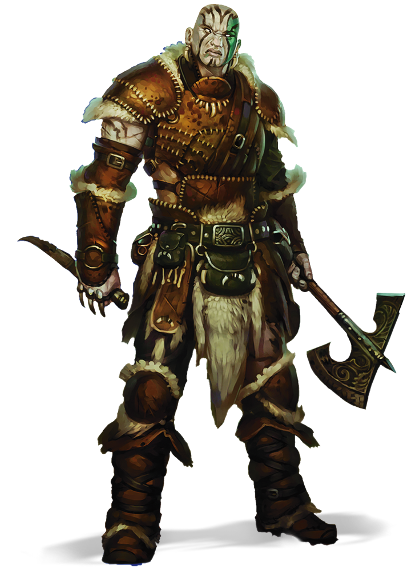
Description
Along with Halflings, Goliaths are the other great race known to be native to the Arkoça archipelago. Again, the location of their homeland is a secret that has been kept for 2 000 years, and held up against the 12 great wars. Goliaths are valued for their skills as smiths and seamen, most being strong enough to bringdown a mainsail in a storm singlehandedly.
Goliath Traits
Age: Goliaths have lifespans comparable to humans. They enter adulthood in their late teens and usually live less than a century.
Size: Goliaths are between 7 and 8 feet tall and weigh between 280 and 340 pounds. Your size is Medium.
Speed: Your base walking speed is 35 feet.
Natural Athlete: You have proficiency in the Athletics skill.
Stone's Endurance: You can focus yourself to occasionally shrug off injury. When you take damage, you can use your reaction to roll a d12. Add your Constitution modifier to the number rolled, and reduce the damage by that total. After you use this trait, you can’t use it again until you finish a short or long rest.
Powerful Build: You count as one size larger when determining your carrying capacity and the weight you can push, drag, or lift.
Mountain Born: You have resistance to cold damage. You’re also acclimated to high altitude, including elevations above 20,000 feet.
Languages: You can speak, read, and write Common and Giant.
Tortle
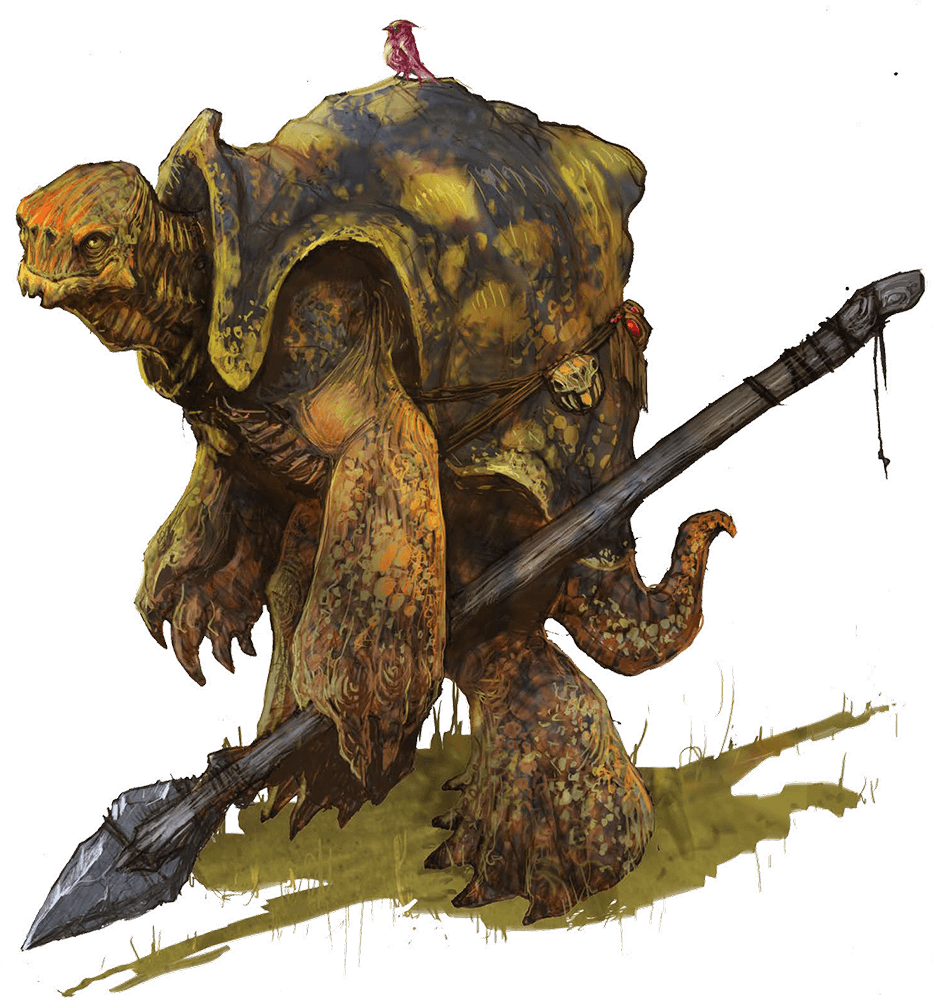
Description
What many tortles consider a simple life, others might call a life of adventure. Tortles are born near sandy coastlines, but as soon as they're able to walk on two legs, they become nomad survivalists eager to explore the wilderness, experience its many wonders, put their skills to the test, and make new acquaintances.
Tortle Traits
Age: Tortles reach maturity at the age of 50 and can live for thousands of years.
Size: Tortle adults stand 5 to 6 feet tall and average 450 pounds. Their shells account for roughly one-third of their weight. Your size is Medium.
Speed: Your base walking speed is 25ft, and swimming speed is 35ft.
Hold Breath: You can hold your breath for up to 1 hour at a time.
Natural Armor: Due to your shell and the shape of your body, you are ill-suited to wearing armor. Your shell provides ample protection, however; it gives you a base AC of 17 (your Dexterity modifier doesn't affect this number). You gain no benefit from wearing armor, but if you are using a shield, you can apply the shield's bonus as normal.
Shell Defense: You can withdraw into your shell as an action. Until you emerge, you gain a +4 bonus to AC, and you have advantage on Strength and Constitution saving throws. While in your shell, you are prone, your speed is 0 and can't increase, you have disadvantage on Dexterity saving throws, you can't take reactions, and the only action you can take is a bonus action to emerge from your shell.
Survival Instinct: You gain proficiency in the Survival skill. Tortles have finely honed survival instincts.
Languages: You can speak, read, and write Common and Aquan.

Lizardfolk
Description
Little is known about these reptilian humanoids, but they are abundant on the isles of Arkoça. Some believe they appear when a lizard feasts on the aberrant spice before laying her eggs. But no one, not even the lizardfolk themselves, knows for certain. They are as diverse in for as the lizards that birthed them, with no two individuals looking quite alike.
A Race of Orphans
Lizardfolk emerge into the world hatching from nests burried in the sand or in the hollow of a tree. When they are born they take the same form simple lizards, though are already sentient. Lizardfolk rarely have humanoid siblings, hatching mostly from nests of unaware lizards. Lizardfolk often form families based on bond as opposed to blood. Though, if a lizardfolk does wish to start a family of their own, it's rare for their offspring to grow to be sentient like their parents.
Lizardfolk Names
Since Lizardfolk never know their parents, they tend to choose their own names when the time arises. These often come from the cultures they come into the most contact with, and can end up being rather unusual combinations.
Lizardfolk Traits
Ability Score Improvements: Your dexterity increases by 2, and your constitution increases by 1.
Age: Lizardfolk live a lifetime comparable to humans.
Size: Lizardfolk can range in size from just undet 5ft. to well over 6ft. tall. Your size is medium.
Speed: Your base walking speed is 30ft.
Saurian Tongue: You can communicate with non-humanoid lizards, the extent to which you can communicate depends on how closely related you are to the species.
Languages: You can speak read and write common and one other language of your choice.
Heritage
Choose one of the following heritages which best describes the type of lizard you are descended from. You will gain the following traits based on your heritage.
Arboreal
Sticky pads: You can climb on difficult surfaces (including upside down on ceilings) without needing to make an ability check, at a speed of 20ft, or 25ft. on normal surfaces.
Camouflage: By spending one minute actively observing your surroundings you can gain advantage on Stealth checks made to hide. You retain this ability until your surroundings change.
Fossorial
Burrower: You can burrow through up to 5ft of sand, earth, mud, or ice. You cannot burrow through solid rock.
Darkvision: You can see in dim light within 60 feet of you as if it were bright light, and in darkness as if it were dim light. You can't discern colour in darkness, only shades of grey.
Tremorsense: You can detect the pinpoint location of vibrations within a 15ft. range of your location, provided the source of the vibrations is in contact with the same ground or substance.
Predatory
Hunter's senses: You have advantage on perception checks which rely on smell.
Tenacious Hunter: You have advantage on opportunity attacks against any creature you have targeted with a melee attack since your last turn.
Feeding Frenzy: When you successfully make a bite attack against another creature, you can use a bonus action to consume some of that creature's flesh. That creature takes additional damage equal to your proficiency bonus, and you gain temporary hit points equal to twice that amount.
Once you use this feature you cannot use it again until completing a short or long rest.
Aquatic
Natural Swimmer: You have a swim speed of 35ft. You also ignore difficult terrain caused by non-magical water.
Marine adaptation: You can hold your breathe for 1 hour. You ignore drawbacks of deep underwater environments.
PART II
Gods, Demons, and
other Deities

The gods
Since time immemorial the gods have been worshiped and revered by mortals. The gods themselves are non- corporeal entities without gender nor age nor name, but mortals have a tendency to categorise the natural world into discrete units they themselves can understand. As such, interpretations of the pantheon are as varied and diverse as the cultures which hold them.
The numbers 6 and 12 are considered with great reverence almost universally across Ta'aria. As such the gods are often grouped into 6 elemental families. The gods of sky, sea, forest, fire, stone, and steel. Each family is represented by a matriarch or patriarch who is the patron of the whole domain, and their 12 children each of whom represents an aspect of that domain.
Which gods are deemed worthy of such status depends greatly from culture to culture, but this book aims to detail the most common in Arkoca.
One man's god is another man's demon
It is important to note that while some cultures may revere an entity as a god, others may hold that very same entity in contempt, and regard them as a demon. Some cultures - especially those governed by humans - make this distinction between the gods of the overworld and the underworld. The divine beings of the Sea, Sky, and Forest representing the gods of the overworld, and those of Stone, Fire, and Steel representing the demons of the underworld.
This being said, few mortal societies are truly innocent of making deals with demons...
The Gods of The Sea
The gods of the seas are as unpredictable and tumultuous as the oceans themselves. Patrons of most mortals, the sea gods can act like petulant children, quick to jealousy and rage. This being said, they are generally well intentioned, and it is by their grace that much of mortal society can go on.
Mora - The Oceanic Queen
Domain: tempest Alignment: CG
Mora (Aquan: Brena Morrea) is the embodiment of the Ocean itself. She is the mother of the pantheon of Sea Deities. She is most often worshiped through one of her aspects, her 12 children and unnumerable grandchildren.
Enys - Mother of Islands
Domain: life Alignment: CG
Enys is the goddess of childbirth, of islands, and of keeping their secrecy. She is worshiped by most island- dwellers, though often as the embodiment of those islands themselves.
Korrian - The Messenger
Domain: knowledge Alignment: NG
The messenger, god of currents and tides. His symbol is a sail fish. Worshipped by sailors seeking favourable winds and fast journeys. Also a patron of athletes
Lorokai - God of the Ocean's Bounty
Domain: knowledge Alignment: CG
Patron of fishermen and feasting, Lorokai is the embodiment of the ocean's bounty. Oft depicted as a great white whale, Lorokai assures that the shoals of fish around the islands stay ever in abundance.
Nix - The Shapeshifter
Domain: trickery Alignment: CE
Patron of charlatans and swindlers, Nix is the god of trickery and deception. Often depicted as a cuttlefish or octopus with the ability to take many forms.
Euglena - The Green Goddess
Domain: Life Alignment: NG
Goddess of all things green in the ocean, Euglena (aquan: Eulana), is considered the goddess of the harvest across Arkoca. She represents the wildness of nature and its ability to both give and take, as she is also the matron of poisons.
Berithion
Domain: Death Alignment: LN
Tywod
Domain: Twilight Alignment: N