Table of Contents.
| Creature | Page Number |
|---|---|
| Avians | 3 |
| Avian Variants | 5 |
| Birdflock | 6 |
| Stridefeather | 7 |
| Terror Bird | 7 |
| Penguins | 9 |
| Dire Goose | 11 |
| Dire Swan | 11 |
| Eagles | 13 |
| Eagle Variants | 16 |
| Owl Variants | 20 |
| Bats | 21 |
| Bat Variants | 23 |
| Sharks | 24 |
| Shark Variants | 27 |
| Dire Octopus | 28 |
| Octopus Variants | 30 |
| Whales | 31 |
| Harlequin Whale | 32 |
| Tusktooth Whale | 32 |
| Killer Whale | 33 |
| Titan Whale | 33 |
| Dreadnought Whale | 34 |
| Cloudjumper Whale | 35 |
| Seals | 36 |
| Lion Seal | 37 |
| Hunter Seal | 37 |
| Tusklord Seal | 38 |
| Behemoth Seal | 38 |
| Fish | 39 |
| Bloodfish Swarm | 40 |
| Beholder Fish | 40 |
| Devil Fish | 40 |
| Macefish | 43 |
| Swordfish | 44 |
| Tidefish | 44 |
| Dire Catfish | 45 |
| Windfish | 45 |
| Dragonfish | 46 |
| Eels | 47 |
| Eel Variants | 49 |
| Manta | 50 |
Table of Contents
| Creature | Page Number |
|---|---|
| Stormtide Manta | 51 |
| Cloud Manta | 52 |
| Emperor Manta | 53 |
| Crabs | 54 |
| Crab Variants | 57 |
| Jellyfish | 58 |
| Jellyfish Variants | 61 |
| Dire Starfish | 62 |
| Reef Walker | 64 |
Avian Beasts
The Material Plane is home to a wide variety of airborne beasts that take many shapes and sizes, each sporting beautiful plumage full of colorful feathers. Nearly every biome imaginable on the Material Plane is home to various species of airborne beasts, even unusual locations such as the subterranean caverns of the Underdark.
Avians
Avians are the most common of all airborne beasts. They are easily recognizable due to their often beautiful feathers and their melodic calls and screeches. Most avians are rather small, as many are able to fit into the hand of most humanoids. However, some species of avians have grown to colossal proportions in comparison to their small relatives. These birds find a lot of utility in many societies as they can be used as a means of airborne transportation and even aerial warfare.
Avian Types
As there are thousands of species of avians in the Material Plane, it can be quite hard to effectively categorize these creatures concisely. However, many scholars have agreed that these birds could be divided into several broad categories based on their unique features.
Brushbeaks
The first kind of avians are known as brushbeaks. These birds tend to reside in forests and jungles, wherein they are able to make nests in dense undergrowth or from the safety of tree boughs. In comparison to the rest of their kind, these birds tend to be somewhat drab in their coloration, as their feathers are primarily used to blend into the surrounding plant life to avoid detection from predators.
Their life on the ground and in trees has also resulted in numerous natural adaptations to help them better fit into their environment. Many species of these birds have especially sharp claws that allow them to easily latch onto tree trucks. Also, their beaks tend to be especially thick and pointed, allowing them to easily crack tough nuts and even drill holes into trees.
Unfortunately, this also causes them to become quite a nuisance as they are commonly known to damage property as they are searching for materials or a location to make their nest.
Charmfeathers
Charmfeathers are typically what comes to mind when one thinks of beautiful birds. These avians possess vibrant and multicolored feathers that at times seem to glimmer and sparkle in sunlight.
An interesting fact about charmfeather avians is that both genders possess extraordinary plumage. In most cases, for the rest of their kind, such colorful plumage typically are exclusive to a particular gender of that species. However, this is not the case for charmfeathers, although their color patterns seem to differ depending on its sex.
These avians use their feathers primarily to attract mates and challenge rivals in dazzling midair dances. However, these features are also used as a defense mechanism against predators. Charmfeather avians are able to use their plumage to temporarily distract and confuse their enemies. Such as distraction typically provides the avians the opportunity to make their escape before their attackers can recover its senses.
Songjays
Songjays are a broad category of avians that typically includes crows, jays, mockingbirds, and parrots. These birds can be quite amusing thanks to their unique ability to mimic voices.
Songjays have a keen memory that allows them to remember sounds and even phrases that it has overheard. They often use their mimicry to duplicate the mating calls of other birds to confuse them and to steal their food.
On top of its talent for mimicry, these birds have also developed the ability to project their voices through short range ventriloquism. This ability has proven to be quite useful for these birds, as they are able to confuse and even drive off predators through misdirection.
Songwings
Songwings are a unique breed of avians that are easily identified by their rapidly flapping wings. Their high speed wings grant them superior agility in comparison to the rest of their kind. These wings also grant them the ability to quickly recover their balance in midair if they are knocked from the sky.
However, their most notable trait is the noise that their buzzing wings tend to make. Depending on its species, songwings are able to generate beautiful melodies from its wings. In fact, many scholars believe these birds use these noises as a secondary method of communication. Many humanoids also seem to find these sounds quite soothing and create gardens to attract these birds to fill the ambient neighborhood with their harmonic buzzing.
Swiftwing
Swiftwing avians are one of the fastest type of avians and typically includes various species such as swallows, pigeons, and doves. Whereas songwings specialize in nimbleness, swiftwings focus primarily on speed. As a result, they are able to travel vast distances in a short manner of time and have been known to enter a skydive in order to gain an additional boost of speed to escape predators.
Seafeather
Seafeather avians typically include all manner of waterfowl such as ducks, gulls, and pelicans. These birds have specially evolved feathers that allow them to swim with surprising speed and enables them to return to the air with little difficulty. These feathers also contain oils that prevent the feathers from becoming waterlogged, enables them to stay afloat, and even helps them slip away from the grasp of predators.

Avian
tiny beast, unaligned
- Armor Class 13(Natural Armor)
- Hit Points 1 (1d4-1)
- Speed 5ft., 40ft. fly
STR DEX CON INT WIS CHA 3(-4) 15 (+2) 8(-1) 8 (-1) 12 (+1) 17 (+3)
- Skills Perception +3, Persuasion +5, Deception +5
- Senses passive Perception 13
- Challenge 0(10 XP)
- Proficiency Bonus +2
Actions
Beak. Melee Weapon Attck, +4 to hit:, 5ft., , one target. Hit 1 piercing damage.
Dire avian
Large beast, unaligned
- Armor Class 13(Natural Armor)
- Hit Points 26 (4d10+4)
- Speed 5ft., 60ft. fly
STR DEX CON INT WIS CHA 13(+1) 17 (+3) 13(+1) 8 (-1) 14 (+2) 17 (+3)
- Skills Perception +4, Persuasion +5, Deception +5
- Senses passive Perception 14
- Proficiency Bonus +2
- Challenge 1(200 XP)
Actions
Multiattack The dire avian can make one attack with its beak and one with its talons
Beak. Melee Weapon Attack, +5 to hit:, 5ft., , one target. Hit 8(1d8+3) slashing damage.
Talon Melee Weapon Attack, +5 to hit:, 5ft., , one target. Hit 8(2d4+3) slashing damage.
Wing Attack Melee Weapon Attack, +5 to hit:, 10ft., , all targets in range. Hit 8(2d4+3) bludgeoning damage. Upon a hit, if the target is a Medium or smaller creature, it is knocked prone.
Brushbeak
Plant Camouflage The brushbeak has advantage on Dexterity(Stealth) checks while obscured by ample plant cover. While these conditions are met, it can use its bonus action to hide.
Siege Monster The brushbeak can deal double damage to buildings and objects
Spider Climb The brushbeak can climb difficult surfaces, including upside down on ceilings without needing an ability check.
Charmfeather
Dazzling Feather Creatures that can see the charmfeather must succeed a DC 13 Wisdom saving throw. On a failed saving throw, that creature is charmed by the charmfeather until the end of its next turn. Upon a successful saving throw, creatures are immune to being charmed in this manner for the enxt 24 hours.
Songjay
- Languages Can speak and understand Common and Auran
Speech Mimic The songjay can only speak by using its mimicry trait
Mimicry The songjay can mimic any sounds it has heard, including voices. A creature that hears the sounds can tell their imitations with a successful DC 13 Wisdom (Insight) check against the songjay's Charisma(Deception) check.
Actions
Ventriloquism The songjay can cause its voice to sound as if it originated from a spot within 30ft. of it. A creature that hears the sounds it makes can determine if this is a trick with a successful Wisdom (Insight) check opposed by your Charisma (Deception) check.
Songwing
Buzzing Flight As long as the songwing is not incapacitated or its movement speed is not equal to 0, it's flight is considered to be hovering
Evasion If the songwing is subjected to an effect that allows it to make a Dexterity saving throw, it instead takes no damage if it succeeds on the saving throw, and only half damage if it fails.
Flyby The songwing can fly outside the reach of a creature without provoking opportunity attack
Reactions
Airborne Agility If a hostile creature moves within 5ft. of the songwing, it can use its reaction to fly up half its movement speed without provoking opportunity attack
Swiftwing
- Challenge Rating Increases by 1
Evasion If the swiftwing is subjected to an effect that allows it to make a Dexterity saving throw, it instead takes no damage if it succeeds on the saving throw, and only half damage if it fails.
Flyby The swiftwing can fly outside the reach of a creature without provoking opportunity attack
Skydive(Dire Bird only) If the swiftwing dives at least 30ft. and makes a beak attack on the same turn, it can deal an additional 11(3d6) damage on its turn.
Bonus Actions
Nimble Flight The swiftwing can use its bonus action to Dash while airborne
Seafeather
- Movement Speed 30ft. swim
- Challenge Rating Increases by 1
Hold Breath The seafeather can hold its breath for up to 15 minutes.
Slippery Feather The seafeather has advantage on Dexterity ability checks and saving throws to escape being grappled or restrained
Skydive(Dire Bird only) If the seafeather dives at least 30ft. and makes a beak attack on the same turn, it can deal an additional 11(3d6) damage on its turn.
Bonus Actions
Nimble Swimmer While the seafeather is underwater, it can use its bonus action to Dash while airborne
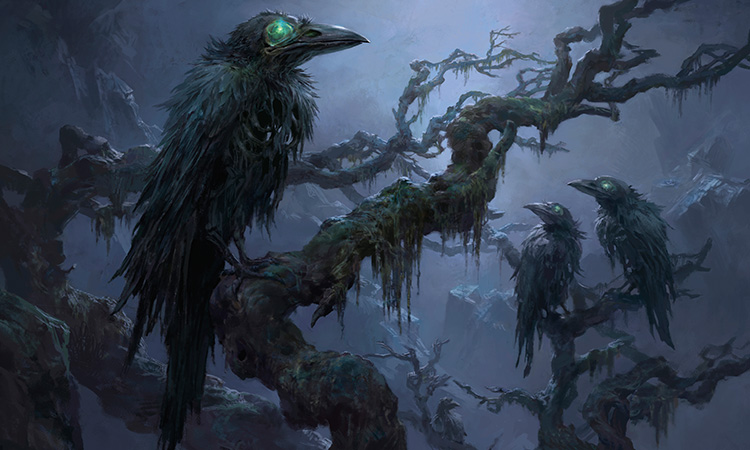
Bird Flock Template
Huge swarm of tiny beasts, unaligned
- Armor Class 13(Natural Armor)
- Hit Points 55 (10d12-10)
- Speed 5ft., 40ft. fly
STR DEX CON INT WIS CHA 16(+3) 14 (+2) 8(-1) 3 (-4) 12 (+1) 16 (+3)
- Skills Perception +4, Deception +6, Persuasion +6, Intimidation +6
- Senses passive Perception 14
- Damage Resistances bludgeoning; piercing; slashing
- Condition Immunties charmed, exhausted, frightened, grappled, paralyzed, petrified, prone, restrained, stunned
- Proficiency Bonus +3
- Challenge 5(1800 XP)
Avian Cacaphony Any creature that is not a bird that starts its turn within 30ft. of the bird flock and can hear it must succeed a DC 14 Wisdom saving throw or it is considered deafened until the end of its next turn.
Flock The Bird Flock can occupy another creature's space and vice versa, and the swarm can move through any opening large enough for a Tiny bird. The swarm cannot regain hitpoints or gain temporary hitpoints.
Flock Tactics The bird flock can enter another creatures space without expending additional movement speed. A creature that first enters or starts its turn with the swarm's space takes 10( 4d4 )piercing damage and must treat the area as difficult terrain.
Swarming Beaks The bird flock has advantage on attack rolls against a creature within its space.
Reactive The bird flock can take a reaction at the end of every creature's turn.
Actions
Multiattack The bird flock can make two beak attacks on its turn. If it has less than half its hitpoint maximum, it only makes one beak attack.
Beak. Melee Weapon Attack, +6 to hit:*, 5ft., , all targets in its space. Hit 13(4d4+3) piercing damage.

Stridefeather
Although most birds have the capacity of flight, there are numerous species of flightless birds. However, despite this apparent handicap, these birds more than make up for this deficiency thanks to their incredible size and speed.
Stridefeathers typically include a number of species such as axebeaks, cassowaries, emus, flamingos, and ostriches. Each of these birds are known for their proportionally long legs and surprising speed. These birds tend to travel together in large nomadic flocks that graze in open grasslands or dense jungles in search of food. In fact, it is not uncommon for these birds to be found near large herbivorous herds for safety from predators.
Because of their astounding speed, many societies tame and breed these birds to use as mounts. Under most circumstances, these birds have very little utility as beast of burden due to their general lack of strength in comparison to other animals, but more than make up for that with their unmatched speed and agility.
Stridefeather Tactics
Although many stridefeathers are considered to be omnivorous, they are rarely a direct threat to humanoids, as they primarily feed on small animals. At the first sign of danger, the primary instinct for these birds is to flee, using their long legs to get a head start on a predator.
However, if cornered or unable to escape, these birds are able to put their powerful legs to good use with a well-timed kick that has proven to be quite lethal, even to fully grown humanoids.
Terror Bird
The terror bird is the largest of all flightless birds. The terror bird roams across forests and plains in small packs in search of their next meal. Despite being pack hunters, the terror bird prefers to only hunt creatures smaller than it. These birds seem to have a particular appetite for humanoids, as many tend to be very slow and seemingly defenseless to these carnivorous birds.
Once they have their prey in their sights, they will relentlessly hunt down that creature, using its keen eyesight to decipher even the most well camouflaged of prey. Thanks to their superior speed, they are able to outrun even the fastest of prey. Once they catch up to their quarry, they immobilize their prey using powerful kicks while using their scissor-like beak to cleave into the flesh of their quarry.
Terror Bird Tactics
Terror birds prefer to hunt smaller prey in packs of about 5(2d4). These birds are unnaturally stealthy for their large size, and can often sneak up to its prey and overwhelm it with a sudden burst of speed. The terror bird prefers to use a short dash to overtake its prey, but is capable of sprinting for long distances to chase down its food.
Its primary tactic is to cripple its prey using it powerful kicks, knocking it prone midstride. Then it proceeds to follow up, using its powerful bone-crushing beak to tear into its vulnerable prey.
Despite being pack hunters, terror birds are quite selfish and refuse to share. As a result, they tend to target multiple victims at a time, so each pack member has its own share to avoid infighting. Although they are quite competitive with one another, they are quick to come to the defense of each another when a creature attempts to steal their prey or attacks an injured pack member. Once antagonized, the entire pack will gang up on that creature in a flurry of kicks and pecks.
Stridefeather
Medium Beast, unaligned
- Armor Class 14(Natural Armor)
- Hit Points 17 (3d8+3)
- Speed 60ft.
STR DEX CON INT WIS CHA 14(+2) 18 (+4) 12(+1) 2 (-4) 15 (+2) 10 (+0)
- Skills Athletics +4, Acrobatics +6, Perception +4
- Senses passive Perception 14
- Proficiency Bonus +2
- Challenge 1/2(100 XP)
Skittish The stridefeather has advantage on initiative checks. Upon rolling initiative, it can move up to half its movement speed as part of that action without provoking attacks of opportunity..
Actions
Kick Melee Weapon Attack, +6 to hit:, 5ft., , one target. Hit 11(2d6+4) piercing damage. If the target is a creature, it must succeed a DC 12 Strength saving throw or be knocked prone
Bonus Actions
Sprinter The stridefeather can use its bonus action to take the Dash action.
Terror Bird
Large Beast, unaligned
- Armor Class 13(Natural Armor)
- Hit Points 51 (6d10+18)
- Speed 60ft.
STR DEX CON INT WIS CHA 16(+3) 16 (+3) 16(+3) 2 (-4) 15 (+2) 10 (+0)
- Skills Athletics +5, Acrobatics +5, Stealth +5, Perception +6
- Senses passive Perception 16
- Proficiency Bonus +2
- Challenge 3(700 XP)
Predatory Instincts The terror bird has advantage on initiative checks.
Ambush Hunter The Terror bird has advantage on attacks against creatures that are surprised or have not taken a turn in combat yet.
Keen Sight The Terror Bird has advantage on Wisdom(Perception) checks that rely on sight
Pack Tactics The Terror Bird has advantage on attack rolls against a creature if at least one of the terror bird's allies is within 5ft. of the creature and the ally isn't incapacitated
Actions
Multiattack The terror bird can make a bite and two kick attacks
Bite. Melee Weapon Attack, +5 to hit:, 5ft., , one target. Hit 16(2d12+3) piercing damage.
Kick Melee Weapon Attack, +5 to hit:, 5ft., , one target. Hit 14(2d10+3) piercing damage. If the target is a creature, it must succeed a DC 13 Strength saving throw or be pushed back 10ft. and knocked prone
Bonus Actions
Sprinter The Terror Bird can use its bonus action to take the Dash action.

Penguins
Penguins are another species of flightless bird that typically resides in the arctic regions of the Material Plane. However, despite their affinity for the cold, penguins have been known to make their homes in more temperate environments.
Penguins make up for their lack of flight with their underwater agility, which gives them the ability to seemingly fly while underwater. Penguins have also developed a unique form of transportation while in frigid climates. By using their bellies, penguins are able to slide at high speeds across the snow and ice to reach their destination.
Penguins are also very social creatures, living in massive flocks that have been known to number in the hundreds or thousands, taking up miles of coastline. They not only flock together for safety from predators such as bears or seals, but also use their massive flocks to conserve body heat, allowing them to stay warm, even through the harshest of blizzards.
Dire Penguins
Although most penguins are very peaceful creatures by nature, dire penguins can be quite territorial. Dire penguins can almost always found in the midst of flocks of normal penguins.
These behemoths can reach nearly 10 to 15 feet tall dwarfing even the largest of their relatives. These titans seem to act as guardians, protecting their smaller kin by chasing off any potential predators. At the first sight of danger, squads of dire penguins meet the threat head-on, using their sheer size to knock their opponents off-balance from an icy dash.
Because of their surprising tenacity, many societies living in these regions have learned to tame these creatures, using them as mounts as well as guardians to protect penguin farms.
Penguin
small Beast, unaligned
- Armor Class 12(Natural Armor)
- Hit Points 11 (2d6+4)
- Speed 20ft., 40ft. swim
STR DEX CON INT WIS CHA 7(-2) 14 (+2) 14(+2) 2 (-4) 10 (+0) 10 (+0)
- Skills Perception +4
- Senses passive Perception 12
- Damage Resistances Cold
- Proficiency Bonus +2
- Challenge 1/4(50 XP)
Frost Down The penguin has advantage on saving throws against effects that deal cold damage. Upon succeeding this saving throw, the penguin takes no damage instead.
Ice Walk The penguin can move across and climb icy surfaces without needing to make an ability check and difficult terrain composed of ice or snow doesn't cost it extra movement.
Ice Glide While on icy or snowy surfaces, the penguin's walking speed is doubled and it can take the Dash action as a bonus action.
Nimble Swimmer The penguin can swim outside the reach of an enemy creature without provoking opportunity attack
Actions
Bite. Melee Weapon Attack, +4 to hit:, 5ft., , one target. Hit 4(1d4+2) piercing damage.
Dire Penguin
Large Beast, unaligned
- Armor Class 12(Natural Armor)
- Hit Points 57 (6d10+24)
- Speed 30ft., 60ft. swim
STR DEX CON INT WIS CHA 17(+3) 14 (+2) 19(+4) 2 (-4) 10 (+2) 10 (+0)
- Skills Perception +4
- Senses passive Perception 12
- Damage Resistances Cold
- Proficiency Bonus +2
- Challenge 2(450 XP)
Frost Down The penguin has advantage on saving throws against effects that deal cold damage. Upon succeeding this saving throw, the penguin takes no damage instead.
Ice Walk The penguin can move across and climb icy surfaces without needing to make an ability check and difficult terrain composed of ice or snow doesn't cost it extra movement.
Ice Glide While on icy or snowy surfaces, the penguin's walking speed is doubled and it can take the Dash action as a bonus action.
Nimble Swimmer The penguin can swim outside the reach of an enemy creature without provoking opportunity attack
Dive Attack If the dire penguin is in water and swims at least 30ft. in a straight line and makes a beak attack on the same turn, it deals an additional 11(3d6) piercing damage.
Charge If the Dire Penguin moves at least 30ft. in a straight line and makes a bite attack on the same turn, it deals an additional 11(3d6) piercing damage.
Actions
Bite. Melee Weapon Attack, +5 to hit:, 5ft., , one target. Hit 10(2d6+3) piercing damage.
Dire Goose
Don't let the somewhat comical appearance and gait of the dire goose fool you. Dire geese are malevolent beasts that will become extremely violent at a whim or whenever it does not get its way. Dire geese populate the coasts of lakes and rivers in large flocks that often migrate from spot to spot. Although their diet primarily consists of small aquatic prey, their interactions with humans has caused them to prefer food from civilization instead. In fact, to the misfortune of a town's population, some dire geese have shifted their entire migration patterns to visit cities they prefer instead of lakes or rivers.
Dire Goose Tactics
When near populated regions, dire geese are quite a nuisance (and a dangerous one at that). Whenever they see a humanoid, they coyly approach the individual with the expectation of free food. When food is not offered, they begin to threaten the individual with a series of hisses and grumbling honks. However, giving them food only makes the problem worse, as once one goose is given food, others in the vicinity flock to that individual expecting a share as well.
If food is completely refused or the individual attempts to drive them off, the geese erupts into a murderous rage of honks and hisses, proceeding to charge and bite the individual with its bill. To make things worse, when one goose erupts into a violent fury, the others follow suit . Quickly, a single angry goose can transform into a mob of furious water fowl.
Once angered, these geese are near impossible to put down. Their sheer fury seems to give them an unnatural vigor as they seek to violently correct any offense towards them. Because of this, one must be extremely tactful and clever to remove dire geese from a populated area.
Emperor Swans
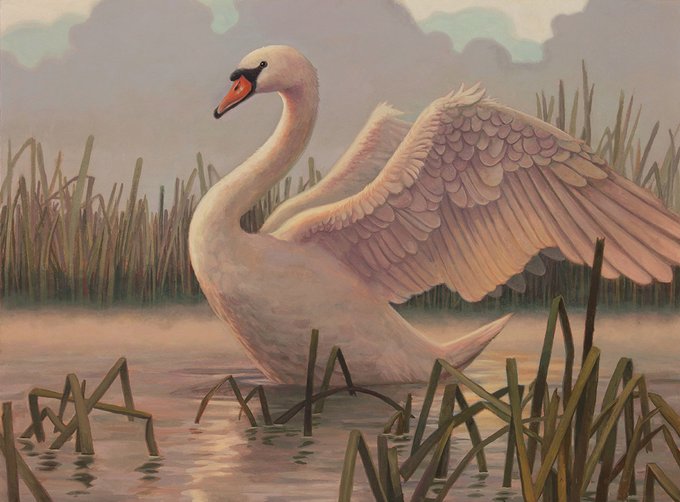
Another problematic water fowl is the emperor swan. Despite the alluring beauty and majesty, the emperor swan is an extremely aggressive and somewhat narcissistic creature.
These swans primarily use their magnificent feathers to invoke an aura of fear and wonder in creatures around it. In fact, it is not uncommon that these swans are followed by an entourage of normal waterfowl and even dire geese.
Emperor Swan Tactics
Just like their relatives, these swans seem to have a special preference for human food and seems to act as if it were their divine right and entitlement to have it. If one refuses to give it food (or in some cases, if it is not given food quick enough) it will erupt into a honking tantrum.
When it erupts into such a rage, waterfowl in the vicinity instantly come to its aid, harassing anyone within reach. Although emperor swan employs similar tactics to that of the dire goose, they can considerably more dangerous as they are able to invoke a sense of fear and hesitation into anyone that gazes into their beady eyes.
Dire Goose
Large Beast, chaotic evil
- Armor Class 12(Natural Armor)
- Hit Points 23 (3d10+6)
- Speed 20ft., 60ft. fly, 40ft. swim
STR DEX CON INT WIS CHA 16(+3) 14 (+2) 14(+2) 2 (-4) 10 (+0) 10 (+0)
- Skills Acrobatics +5, Perception +2, Intimidation +4
- Condition Immunities Charmed, Frightened
- Senses passive Perception 12
- Proficiency Bonus +2
- Challenge 2(450 XP)
Charge If the goose uses 20ft. of its walking speed to move in a straight line towards a target and hits it with a bite attack on the same turn, the target takes an additional 9(2d8) bludgeoning damage.
Gang Boost The dire goose can deal a critical hit on a 18-20 if at least one of the dire goose's allies is within 5 feet of the creature and the ally isn't incapacitated.
Hold Breath The dire goose can hold its breath up to 10 minutes
Pack Tactics The dire goose has advantage on attack rolls against a creature if at least one of the Dire Goose's allies is within 5ft. of the creature and the ally isn't incapacitated
Relentless If the dire goose drops to 0 hitpoints, it can make a DC 10 Constitution saving throw or regain 1 hitpoint at the start of its next turn. On a successful save, the DC for this ability increases by 5 for each consecutive successful save. This ability resets after a short or long rest.
Actions
Bite. Melee Weapon Attack, +5 to hit:, 5ft., , one target. Hit 8(1d8+3) bludgeoning damage.
Wing Melee Weapon Attack, +5 to hit:, 5ft., , all targets in range. Hit 6(1d6+3) bludgeoning damage. If the goose is on the ground, it can fly up to 30ft. as part of this action.
Honk All creatures other than another goose with a 30ft. of the dire goose that can hear it must succeed a DC 12 Wisdom saving throw or become frightened until the end of its next turn.
Upon succeeding its saving throw, the creature is immune to being frightened in this manner for the next 24 hours.
Bonus Actions
Aggressive The dire goose can use its bonus action to move up to its full movement speed against a hostile creature.
Emperor Swan
Large Beast, lawful evil
- Armor Class 12(Natural Armor)
- Hit Points 45 (6d10+12)
- Speed 20ft., 60ft. fly, 40ft. swim
STR DEX CON INT WIS CHA 16(+3) 14 (+2) 14(+2) 2 (-4) 10 (+0) 20 (+5)
- Skills Acrobatics +5, Perception +2
- Condition Immunities Charmed, Frightened
- Senses passive Perception 12
- Proficiency Bonus +2
- Challenge 3(700 XP)
Charge If the emperor swan uses 20ft. of its walking speed to move in a straight line towards a target and hits it with a bite attack on the same turn, the target takes an additional 14(4d6) bludgeoning damage.
Gang Boost The emperor swan can deal a critical hit on a 18-20 if at least one of the emperor swan's allies is within 5 feet of the creature and the ally isn't incapacitated.
Hold Breath The emperor swan can hold its breath up to 10 minutes
Swan's Arrogance Creatures within 30ft. of the emperor swan must succeed a DC 15 Wisdom saving throw it becomes both charmed and frightened by the emperor swan. This duration of this effect lasts for one minute and that creature can repeat its saving throw at the end of each of its turns, ending the effect on a success. Upon ending this effect, creatures are immune to this feature from this swan for the next 24 hours.
Fury If the emperor swan takes the Attack action while it is below half its hitpoint maximum, it can make an additional bite attack against that creature.
Relentless If the emperor swan drops to 0 hitpoints, it can make a DC 10 Constitution saving throw or regain 1 hitpoint at the start of its next turn. On a successful save, the DC for this ability increases by 5 for each consecutive successful save. This ability resets after a short or long rest.
Actions
Bite. Melee Weapon Attack, +5 to hit:, 5ft., , one target. Hit 10(2d6+3) bludgeoning damage.
Wing Melee Weapon Attack, +5 to hit:, 5ft., , all targets in range. Hit 8(1d8+3) bludgeoning damage. If the emperor swane is on the ground, it can fly up to 30ft. as part of this action.
Bonus Actions
Aggressive The emperor swan can use its bonus action to move up to its full movement speed against a hostile creature.
Eagles
Eagles are probably the most common airborne predator in most regions on the Material Plane. Eagles are quite capable hunters, equipped with sharp talons and a razor sharp beak.
However, their most potent weapon is their speed, wherein they can dive from incredible heights to swoop down on their prey, often killing it in one blow. If their prey survives its initial strike, eagles tends to carry their prey to high altitudes and then drop it, letting gravity finish the job.
They come in many colors and sizes ranging from the kite to the mighty skylord which resembles a smaller cousin of the roc. Regardless of what form these birds take, eagles are almost always recognizable due to their beautiful and majestic plumage that gives them a somewhat noble and regal appearance. As a result, eagles are typically well respected among societies who use them as political symbols, military mounts, and even spies.
Osprey
The osprey is a sea-loving variant of the eagle that has adapted specifically to hunt underwater prey. Its feathers are coated with a unique lining that allows it to dive into the water with ease, allowing it to pursue and capture prey hidden underneath the waves. Unlike most birds, it is quite a capable swimmer and is able to remain underwater for short periods of times.
Dusk Eagle
Although most eagles primarily hunt during the day, the dusk eagle has adapted to hunt specifically at night. They can be identified by their black feathers that seem to merge with the shadows when under the cover of night, which allows it to swoop down onto unsuspecting prey.
Mithril Eagle
This beautiful eagle is easily recognizable thanks to its glittering feathers that seem to give off a metallic sheen. These feathers have the unique ability to shrug off the harshest of blows and even reflect magical effects. Unfortunately, these traits have made these eagles the target of poachers, causing their numbers to dwindle significantly.
Hunter Eagle
Eagles by their very nature tend to be solitary hunters. However, this is not the case for the hunter eagle. These predatory birds patrol in small flocks of 5(2d4) members. Thanks to their keen vision and incredible speed, they are able to coordinate the dive attacks to effectively corner and capture their prey.
Because of this coordination, these eagles are highly sought after rangers, druids, and other humanoids who wish to implement their airborne superiority and natural coordination to create truly unstoppable sky mounts.
Carrion Eagles
Carrion eagles typically include a wide variety of predatory birds such as vultures and condors.
In comparison to the rest of their kind, carrion eagles are not very aggressive, as their primary source of food mainly consists of carrion. These notorious scavengers are able to pick up the slightest scent of decay from nearly a mile away and depending on how large the corpse is, they have been known to create flocks of hundreds of birds seeking food.
Although these birds typically wait for when a creature dies, they have been known to follow after a dying creature and at times land the killing strike if these scavengers begins to grow impatient.
Their keen sense of smell for the dead also makes them particularly useful, especially for many orders dedicated to locating and eradicating any sources of undead. These birds have the unique ability to pinpoint the presence of any undead. Due to their heightened immune system, they also have the ability to resist many of the harshest effects from necromantic magic.
Kite Template
small Beast, unaligned
- Armor Class 13(Natural Armor)
- Hit Points 11 (3d4+3)
- Speed 10ft., 60ft. fly
STR DEX CON INT WIS CHA 6(-2) 16 (+3) 12(+1) 2 (-4) 14 (+2) 6 (-2)
- Skills Acrobatics +5, Perception +6
- Senses passive Perception 16
- Proficiency Bonus +2
- Challenge 1/2(100 XP)
Eagle Eye The kite is able to perceive fine details up to 1 mile away as if it were only 100ft. away from it.
Keen Sight The kite has advantage on Wisdom(Perception) checks that rely on sight
Flyby The kite can fly outside a creature's reach without provoking opportunity attack
Actions
Talons Melee Weapon Attack, +5 to hit:, 5ft., one target. Hit 6(1d4+3) piercing damage.
If the creature is Tiny, it is grappled and restrained (escape DC 10). While grappled in this manner, the kite cannot talon attack against another creature.
For the duration of this grapple, the kite can use its bonus action to make a beak attack against that creature.
Dire Eagle Template
Large Beast, unaligned
- Armor Class 13(Natural Armor)
- Hit Points 26 (4d10+4)
- Speed 10ft., 60ft. fly
STR DEX CON INT WIS CHA 16(+3) 16 (+3) 12(+1) 8 (-4) 14 (+2) 6 (-2)
- Skills Acrobatics +5, Perception +6
- Senses passive Perception 16
- Proficiency Bonus +2
- Challenge 2(450 XP)
Eagle Eye The eagle is is able to perceive fine details up to 1 mile away as if it were only 100ft. away from it.
Keen Sight The eagle has advantage on Wisdom(Perception) checks that rely on sight
Flyby The eagle can fly outside a creature's reach without provoking opportunity attack
Skydive If the eagle is flying and dives at least 30ft. toward a target and then hits it with a beak attack, the attack deals an additional 8 (3d4) piercing damage.
Actions
Talons Melee Weapon Attack, +5 to hit:, 5ft., one target. Hit 11(2d6+3) piercing damage.
If the creature is Medium or smaller, it is grappled and restrained (escape DC 13). While grappled in this manner, the eagle cannot talon attack against another creature.
For the duration of this grapple, the eagle can use its bonus action to make a beak attack against that creature.
Bonus Actions
Beak Melee Weapon Attack, +5 to hit:, 5ft. , one grappled target. Hit 8(2d4+3) piercing damage.

Skylord Template
Huge beast, unaligned
- Armor Class 13 (Natural Armor)
- Hit Points 76(8d12+24)
- Speed 20ft.. 120ft. fly
STR DEX CON INT WIS CHA 21(+5) 16 (+3) 17 (+3) 8(-1) 14 (+2) 9 (-1)
- Saving Throws Dexterity +7
- Skills Acrobatics +7, Perception +8
- Senses passive Perception 18
- Proficiency Bonus +3
- Challenge 7(2900 XP)
Eagle Eye The skylord is able to the fine details of an object up to 1 mile away as if it were only 100ft. away from it.
Flyby The skylord doesn't provoke opportunity attack when flying outside an enemies reach
Keen Senses The skylord advantage on Wisdom (Perception) checks relying on sight
Skydive If the skylord is flying and dives at least 60ft towards a target and then hits it with a claw attack, the attack deals an extra 21 (6d6) damage to the target.
Actions
Multiattack The skylord can make two talon attacks
Talons. Melee Weapon Attack, +8 to hit:, 5ft. , one target. Hit 16(3d6+5) slashing damage. upon a hit, if the target is a Large or smaller creature, it is grappled (escape DC 16).
Until this grapple ends, the target is restrained, and the Skylord can't use its talons on another target. It can grapple two creatures in this manner at a time.
Wing Attack Melee Weapon Attack, +8 to hit: 10ft., all creatures in range. Hit 18(2d12+5) bludgeoning damage. Upon a hit, Large and smaller creatures are pushed back 10ft. and fall prone.
The Skylord can fly up to half its movement speed as part of this action.
Bonus Actions
Beak. Melee Weapon Attack, +8 to hit:, 5ft. , one grappled target. Hit 19(3d8+5) piercing damage.
Osprey
- Movement 30ft. swim
Hold Breath The osprey can hold its breath up to 10 minutes..
Nimble Swimmer The osprey can swim outside the reach of a creature without provoking opportunity attack
Dusk Eagle
- Senses Darkvision 120ft.
Gloom Sight The dusk eagle's vision is not obscured by magical darkness
Nocturnal Hunter The dusk eagle has advantage on initiative checks at night or in darkness
Shadow Wings The dusk eagle can use its bonus action to Hide while in dim light or darkness. While in darkness, the moon eagle is invisible to creatures that rely on darkvision to see it..
Mithril Eagle
- Challenge increases by 1
Spell Turning The eagle has advantage on saving throws against any spell that targets only the eagle (not an area). If the eagle's saving throw succeeds, the spell has no effect on the eagle and instead targets the caster.
Mithril Feathers Whenever the eagle takes damage from a critical hit, it takes normal damage instead.
Snow Eagle
- Damage Resistances Cold
Snow Camouflage The eagle has advantage on Dexterity(Stealth) checks it makes in snowy or icy terrain. While these conditions are met, it can use its bonus action to Hide.
Snow Sight The eagle's vision is not obscured by fog, snowfall, or similar effects caused by snow or ice
Hunter Eagle
Brutal Talons The eagle can deal a critical hit on a 19-20. When the eagle deals a critical hit, it can triple the damage die.
Pack Tactics The eagle has advantage on attack rolls against a creature if at least one of the terror bird's allies is within 5ft. of the creature and the ally isn't incapacitated
Bonus Actions
Agile Flight While airbonre, the eagle can use its bonus action to take the Dash action.
Carrion Eagle
- Condition Immunities Poisoned
- Damage Resistance Necrotic
- Damage Immunities Poison
Carrion Eater When the eagle takes the attack action against an Undead creature, it can make an additional bite attack as part of that action
Carrion Sense The eagle knows the direction of a corpse or undead within 1 mile of it.
Necrotic Resilience The eagle cannot have its hitpoint maximum reduced by any means
Reaction
Scavenger Whenever a creature drops to 0 hitpoints while within 30ft. of the tomb ant, it can use its reaction to move up to that creature and make a single bite attack. Upon a hit, that creature is instantly killed.
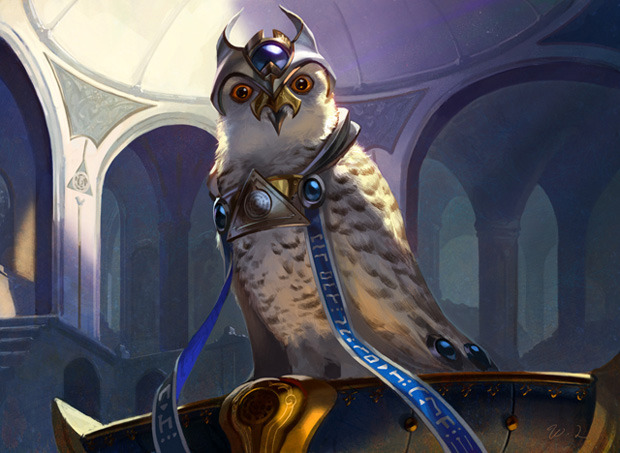
Owls
Whereas eagles dominate the skies during the day, the owl is the ruler of the night. Although the owl lacks the speed of an eagle, it more than compensates for this disparity thanks to its reputation as an ambush hunter. These nocturnal predators specialize in taking their prey by surprise, using their keen hearing to hear the slightest noise. The owl's feathers have specifically evolved to fly silently, causing its prey to not realize the threat until too late.
Much like eagles, owls are quite revered by many humanoid societies and are often used as political figures or mounts of war.
Snow Owls
The snow owl is known for its white plumage that allows it to blend into the surrounding snow or ice. Furthermore, these feathers are able to generate a slight illusory effect that allows them to seemingly vanish into oncoming snowfall.
Because of this, the snow owl is perfectly adapted to hunt in the harshest of blizzards, taking advantage of any prey unfortunate to find itself stranded in the storm.
Devil Owl
The devil owl is a very intimidating beast thanks to its feathery tufts on its head that resemble that of a fiendish horn. However, the true source of its frightening appearance is its wings.
When these owls fully spread their wings, its feathers have patterns that resemble terrifying eyes or terrible maws. The owl uses these markings primarily to scare away rivals or threats seeking to steal its kill.
Twilight Owl
The twilight owl is the ideal nocturnal predator. Its eyes have been perfectly adapted to see in any form of darkness, while is plumage perfectly merges into the shadows. As a result, the unfortunate victims of this predator never know what hit them until it's too late.
Rock Owl
The rock owl is a curious breed, as it prefers to live in a subterranean tunnel carved out by its powerful legs. Much like their other kin, they are patient ambush hunters. In fact, rock owls have been known to sit motionless for hours, nearly indistinguishable from a rock before they swoop in on unsuspecting prey.
Aether Owl
Aether owls are the rarest of all of their kind. These owls are quite unique due to their ability to see magical effects and even see through various magical illusions and invisibility spells.
Their true origins of their abilities is a matter of intense debate, as some scholars believe that these creatures were the result of magical experimentation while others seem to suggest that these owls are merely the result of planar evolution due to exposure to an otherworldly realm such as the Feywild.
Regardless of the origin of their abilities, they owls makes for extremely popular familiars for arcanists. Interestingly enough, despite their rarity, these owls are often viewed as the stereotypical familiar for most spellcasters in many regions of the Material Plane, particularly for wizards.
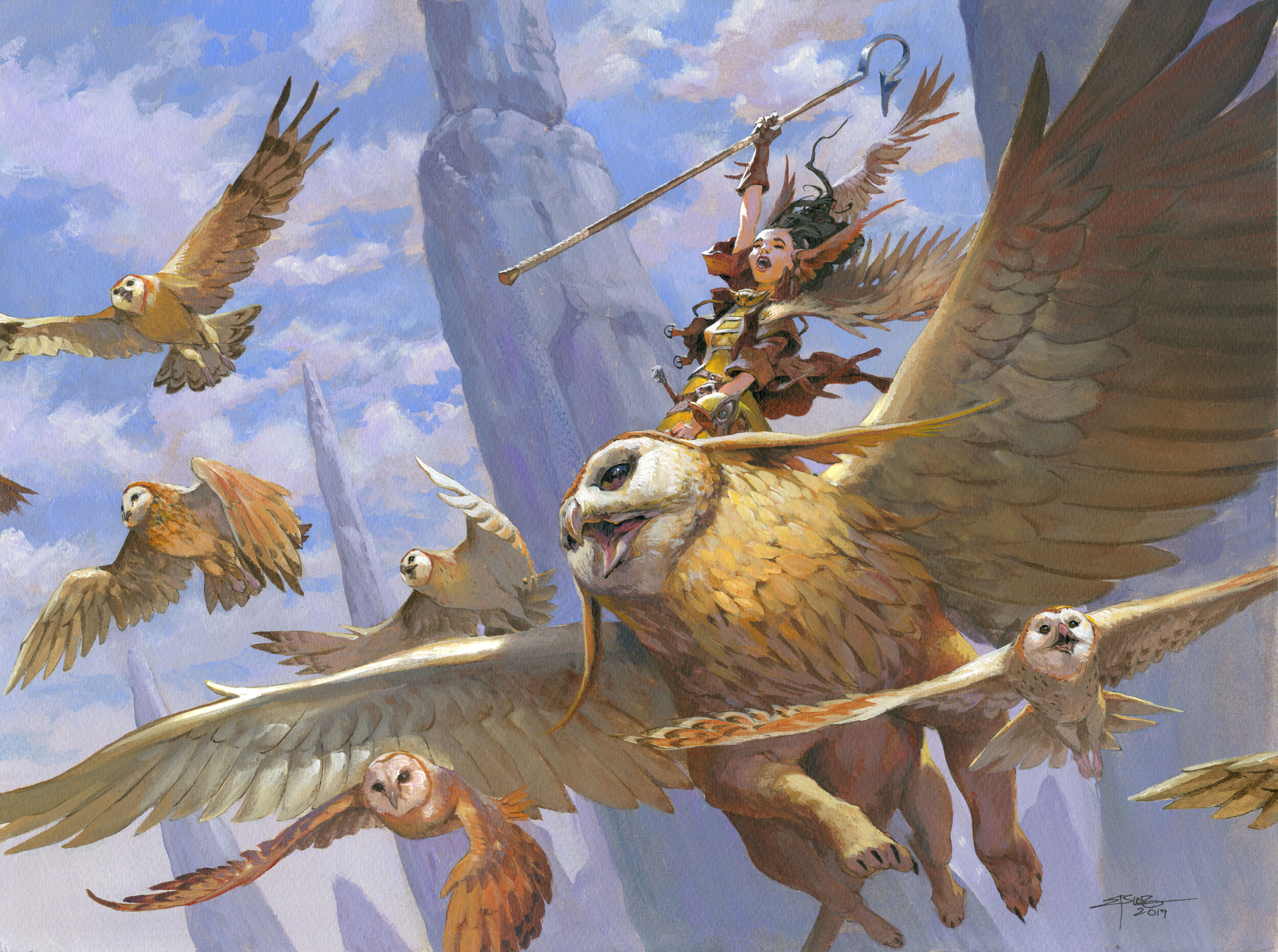
Owl Template
small Beast, unaligned
- Armor Class 13(Natural Armor)
- Hit Points 11 (3d4+3)
- Speed 10ft., 60ft. fly
STR DEX CON INT WIS CHA 6(-2) 16 (+3) 12(+1) 2 (-4) 14 (+2) 6 (-2)
- Skills Acrobatics +5, Stealth +7, Perception +6
- Senses darkvision 120ft., passive Perception 16
- Proficiency Bonus +2
- Challenge 1/2(100 XP)
Ambusher The owl has advantage on initiatve checks. It also has advantage on attacks against creatures that are surprised or have not taken a turn in combat yet.
Flyby The owl can fly outside a creature's reach without provoking opportunity attack
Keen Sight and hearing The owl has advantage on Wisdom(Perception) checks that rely on hearing and sight
Night Vision The owl does not suffer disadvantage on Wisdom(Perception) checks due to low light.
Actions
Talons Melee Weapon Attack, +5 to hit:, 5ft., , one target. Hit 6(1d4+3) piercing damage. If the creature is Tiny, it is grappled and restrained (escape DC 10). While grappled in this manner, the owl cannot talon attack against another creature.
Dire Owl Template
large Beast, unaligned
- Armor Class 13(Natural Armor)
- Hit Points 20 (3d10+3)
- Speed 10ft., 60ft. fly
STR DEX CON INT WIS CHA 16(+3) 16 (+3) 12(+1) 2 (-4) 14 (+2) 6 (-2)
- Skills Acrobatics +5, Stealth +7, Perception +6
- Senses darkvision 120ft., passive Perception 16
- Proficiency Bonus +2
- Challenge 1/2(100 XP)
Ambusher The owl has advantage on initiatve checks. It also has advantage on attacks against creatures that are surprised or have not taken a turn in combat yet.
Flyby The owl can fly outside a creature's reach without provoking opportunity attack
Keen Sight and hearing The owl has advantage on Wisdom(Perception) checks that rely on hearing and sight
Night Vision The owl does not suffer disadvantage on Wisdom(Perception) checks due to low light.
Sneak Attack When the owl makes an attack against a creature that is surprised or has not taken a turn yet in combat, it can deal an additional 7(2d6) damage.
Skydive If the owl is flying and dives at least 30ft. toward a target and then hits it with a talon attack, the attack deals an additional 5 (2d4) piercing damage.
Actions
Talons Melee Weapon Attack, +5 to hit:, 5ft., , one target. Hit 12(2d8+3) piercing damage.
If the creature is Medium or smaller, it is grappled and restrained (escape DC 12). While grappled in this manner, the owl cannot talon attack against another creature.
Bonus Actions
Beak Melee Weapon Attack, +5 to hit:, 5ft., , one grappled target. Hit 8(2d4+3) piercing damage.

Ancient Owl
Huge Beast, unaligned
- Armor Class 13 (Natural Armor)
- Hit Points 76(8d12+24)
- Speed 20ft., 90ft. fly
STR DEX CON INT WIS CHA 21(+5) 16 (+3) 17 (+3) 8(-1) 15 (+2) 9 (-1)
- Saving Throws Dexterity +6, Constitution +5
- Skills Acrobatics +6, Perception +8
- Senses passive Perception 18
- Proficiency Bonus +3
- Challenge 7(2900 XP)
Ambusher The owl has advantage on initiatve checks. It also has advantage on attacks against creatures that are surprised or have not taken a turn in combat yet.
Flyby The owl can fly outside a creature's reach without provoking opportunity attack
Keen Sight and hearing The owl has advantage on Wisdom(Perception) checks that rely on hearing and sight
Night Vision The owl does not suffer disadvantage on Wisdom(Perception) checks due to low light.
Sneak Attack When the owl makes an attack against a creature that is surprised or has not taken a turn yet in combat, it can deal an additional 11(3d6) damage.
Skydive If the owl is flying and dives at least 40ft. toward a target and then hits it with a talon attack, the attack deals an additional 14 (4d6) piercing damage.
Actions
Multiattack The owl can make two attacks with its claws.
Talons. Melee Weapon Attack, +8 to hit:, 5ft. , one target. Hit 19(3d8+5) piercing damage and the target is a Large or smaller creature, it is grappled (escape DC 16).
Until this grapple ends, the target is restrained, and the owl can't use its talons on another target. It can grapple two creatures in this manner at a time.
Wing Attack Melee Weapon Attack, +8 to hit: 10ft., all creatures in range. Hit 16(2d10+5) bludgeoning damage. Upon a hit, Large and smaller creatures are pushed back 10ft. and knocked prone.
The owl can fly up to half its movement speed as part of this action.
Bonus Actions
Beak. Melee Weapon Attack, +8 to hit:, 5ft. , one grappled target. Hit 19(3d8+5) piercing damage.
Snow Owl
- Damage Resistances Cold
- Challenge increases by 1
Snow Camouflage The owl has advantage on Dexterity(Stealth) checks it makes in snowy or icy terrain. While these conditions are met, it can use its bonus action to Hide.
Snow Sight The owl's vision is not obscured by fog, snowfall, or similar effects caused by snow or ice
Snow Cloak The owl counts as invisible to creatures that rely on sight to see it provided there is ample snowfall
Devil Owl
- Skills Intimidation +4
- Challenge increases by 1
Frightening Gaze Creatures that first enter or start its turn within 30ft. of the owl and can see it must succeed a DC Wisdom saving throw or become frightened until the start of its next turn. The DC for this ability is equal to 8 + the Owl's Constitution modifier + its proficiency bonus. Upon a successful saving throw, creatures are immune to being frightened in this manner for 24 hours.
Twilight Owl
Gloom Sight The twilight owl's vision is not obscured by magical darkness
Shadow Wings The owl has advantage can use its bonus action to Hide while in dim light or darkness. While in darkness, the twilight owl is invisible to creatures with darkvision
Rock Owl
- Movement Speed 30ft., 30ft. burrow
Stony Camouflage The owl has advantage on Dexterity(Stealth) checks it makes in rocky terrain. While these conditions are met, it can use its bonus action to Hide.
False Appearance While motionless, the rock owl is indistinguishable from a rock.
Aether Owl
- Challenge increases by 1
Arcane Sight The owl is able to see a creature or object hidden by illusions or invisibility. Additionally, the owl is unaffected by magical abilities that invoke disadvantage on attacks based on sight.
Magic Sight The owl can detect the presence of magical effects or items within 120ft. of it. Additionally, it can determine the school of magic.
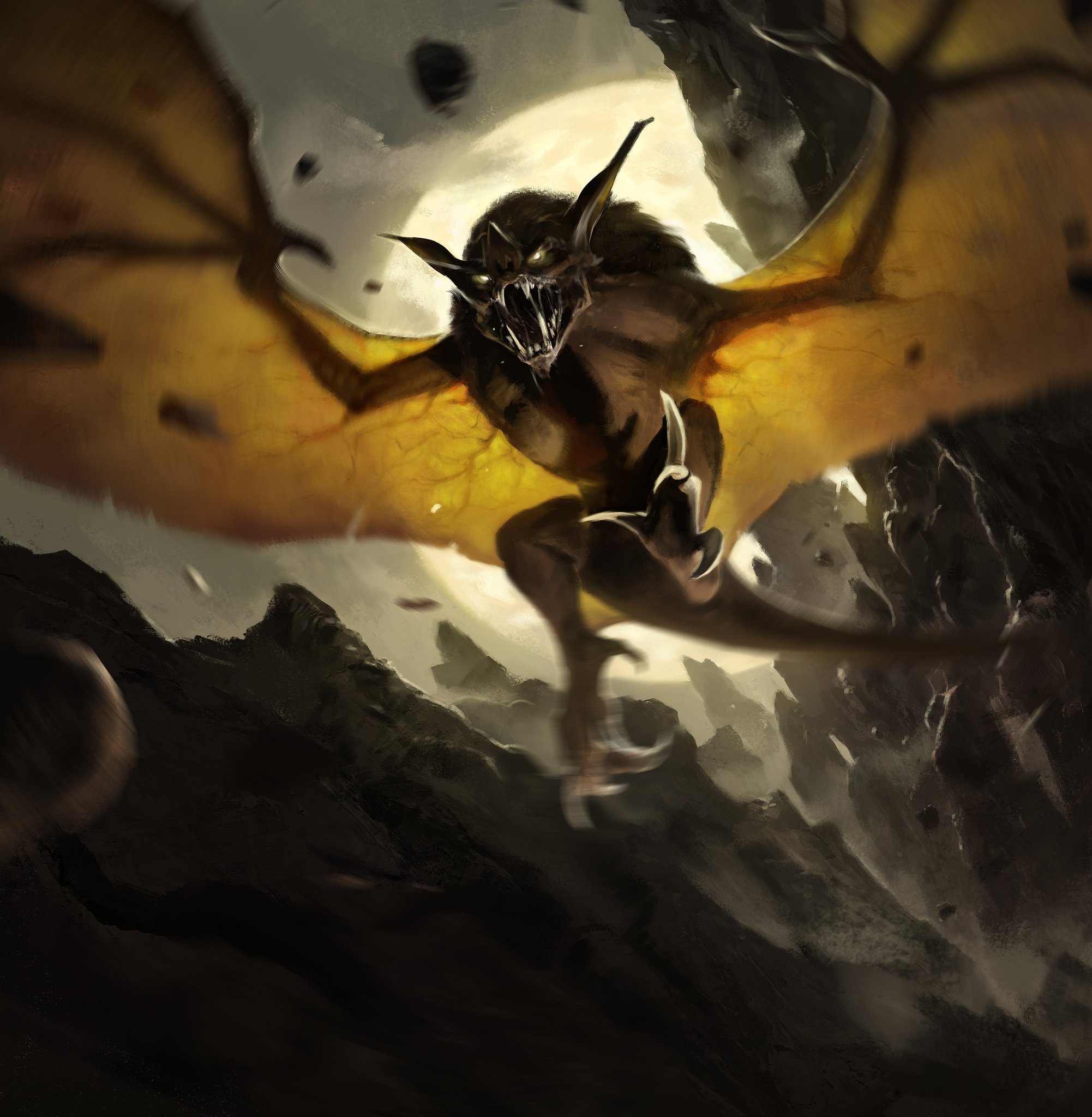
Bats
Out of all airborne beasts, bats are the most peculiar for they are neither bird nor reptile, but instead mammalian in origin. Bats prefer to live in dark subterranean environments such as the Underdark or to come out at night.
Because of these tendencies, they actually do not rely on sight to see their surroundings, instead they mainly use their keen hearing to perceive their surroundings through echolocation.
Most bats are relatively harmless, but their giant kin are popular choices for battle mounts due to their versatility in any environment. Additionally, large swarms of bats often can prove to be equally dangerous, as they will ceaselessly barrage their opponents with bites when threatened or placed under some magical command.
Vampiric Bats
Vampiric bats are one of the few bats that are actively aggressive to humanoids, for their diet primarily relies on blood for sustenance. As a result, these bats can typically be found flying out in large swarms hunting down and swarming any living being they come across, sucking it dry of blood. Thankfully, such feeding frenzies are predictable, as they tend to occur monthly before their retreat back to their caverns to hibernate and rest until the next feast.
However, their desire for blood and keen senses make them very useful servants to entities such as vampires. While under the control of magic, they become much more dangerous as they are no longer bound by their natural instincts.
Plague Bats
Plagues bats are primarily scavengers that feast on anything they can get their little jaws on. Their innate resistance to various poisons and toxins allow them to be able to endure any negative effects of their diet. However, this makes them a carrier for many vile diseases. When threatened, these bats will attempt to bite their foes, which then inflicts it with terrible diseases.
Thankfully, getting bitten by a plague bat tends to only happen when one threatens them, but they are numerous accounts where these bats have been controlled via magic to spread death and ruin to surrounding communities.
Umber Bats
Umber bats originate from the darkest reaches of the Underdark. They have adapted to seemingly vanish under the cover of darkness, allowing them to evade detection from many creatures that call the Underdark home. Their ability to seemingly vanish into the shadow makes them prized mounts, allowing their riders to sneak behind enemy lines practically unseen.
River Bats
River bats are the largest species of bats. Unlike the rest of their kin, they can be commonly found during the day as well as night. They also tend to be largely omnivorous, as they tend to feed on fruit and small fish. Thanks to their powerful and webbed wings, they are able to nimbly dive beneath the surface of the water to swim after prey before taking to the skies to finish their meal.
Giant Bat Template
Large Beast, unaligned
- Armor Class 13(Natural Armor)
- Hit Points 33 (6d10)
- Speed 10ft., 10ft. climb, 60ft. fly
STR DEX CON INT WIS CHA 15(+2) 16 (+3) 11(+0) 2 (-4) 17 (+3) 6 (-2)
- Skills Acrobatics +5, Perception +7
- Senses blindsight 60ft., passive Perception 17
- Proficiency Bonus +2
- Challenge 1(200 XP)
Keen hearing The bat has advantage on Wisdom(Perception) checks that rely on hearing
Echolocation The bat can't use its blindsight while deafened
Spider Climb The bat can climb difficult surface without having to make an ability check
Actions
Bite Melee Weapon Attack, +5 to hit:, 5ft., one target. Hit 8(2d4+3) piercing damage.
Bat Swarm Template
Large swarm of tiny beasts, unaligned
- Armor Class 13(Natural Armor)
- Hit Points 33 (6d10)
- Speed 10ft., 10ft. climb, 60ft. fly
STR DEX CON INT WIS CHA 5(-2) 16 (+3) 11(+0) 2 (-4) 17 (+3) 6 (-2)
- Skills Acrobatics +5, Perception +7
- Senses blindsight 60ft., passive Perception 17
- Damage Resistances bludgeoning; piercing; slashing
- Condition Immunties charmed, frightened, grappled, paralyzed, petrified, prone, restrained, stunned
- Proficiency Bonus +2
- Challenge 3(700 XP)
Keen hearing The bat swarm has advantage on Wisdom(Perception) checks that rely on hearing
Echolocation The bat swarm can't use its blindsight while deafened
Spider Climb The bat swarm can climb difficult surface without having to make an ability check
Swarm The bat swarm can occupy another creature's space and vice versa, and the swarm can move through any opening large enough for a Tiny bat. The swarm cannot regain hitpoints or gain temporary hitpoints
Swarm Tactics The bat swarm can enter another creatures space without penalty to its movement. A creature that first enters or starts its turn with the swarm's space takes 5( 2d4 )piercing damage and must treat the area as difficult terrain.
Swarming Bites The bat swarm has advantage on attack rolls against a creature within its space
Actions
Multiattack The bat can make two bite attacks. If it has less than half its hitpoint maximum, it makes one bite attack
Bite Melee Weapon Attacks, +5 to hit:, 5ft., , 5ft.. Hit 8(2d4+3) piercing damage.
Vampiric Bats
- Damage Resistances Poison; Necrotic
- Challenge increases by 1
Poison Resistance The vampiric bat has advantage on saving throws against being poisoned and disease
Blood Sense The vampiric bats know the direction of a creature below half its hitpoint maximum within 1 mile of it. This feature fails if the target does not have blood
Blood Frenzy When the vampiric bat takes the Attack action against a creature below half its hitpoint, it can make one additional bite attack as part of that action.
Blood Drinker The vampire bat regains hitpoints equal to half the number dealt from its bite attack.
Plague Bats
- Damage Resistances Necrotic
- Damage Immunities Poison
- Condition Immunities Poisoned, Diseased
- Challenge increases by 1
Plague Bringer Creatures poisoned by the plague bat cannot regain hitpoints for the duration of the poison. This effect can be ended by Lesser Restoration or greater magic. On a successful save, creatures are immune to being poisoned in this manner for 24 hours.
Plague Fang When the plague bat bites a creature, the target must succeed a DC 12 saving throw or take an additional 7(2d6) poison damage and become poisoned until the end of its next turn. On a success, that creature takes half damage and is not poisoned.
Umber Bats
- Skills Stealth +7
Shadow Wings The bat has advantage can use its bonus action to Hide while in dim light or darkness. While in darkness, the umber bat is invisible to creatures with darkvision
River Bats
- Movement Speed 30ft.
Hold Breath The bat can hold its breath for up to 15 minutes.
Nimble Swimmer While underwater, the bat does not provoke opportunity from swimming outside a creature's reach
Slippery Fur The bat has advantage on Strength and Dexterity ability checks and saving throws against effects that would grapple or restrain it.
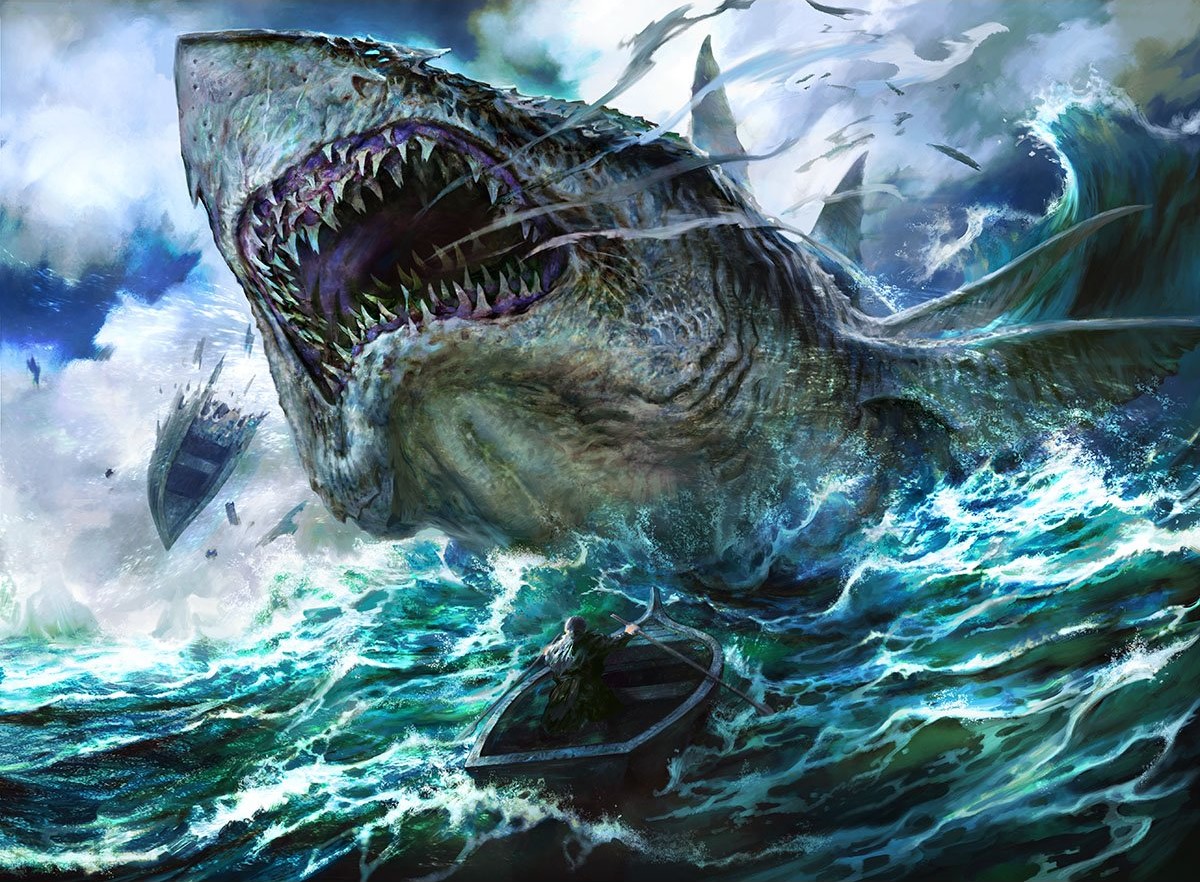
Sharks
Sharks are one of the most recognizable predators of the open seas thanks to their foreboding dorsal fins and fearsome jaws filled with razor sharp teeth. Of all the aquatic predators that pose a threat to humanoids, sharks are probably the most common. Their appearance also seems to vary depending on the region of the ocean they are encountered.
Sharks are known to make their home in a wide variety of environments ranging from coral reefs, to the open seas, while some even have adapted to live upstream in lakes and rivers.
Regardless of their environment, all sharks possess a keen sense of smell, particularly for the scent of blood. As a result, sharks are able to track wounded prey over long distances. The scent of blood is also known to drive them into a feeding frenzy, which as earned them their fearsome reputation.
However, the rarest and deadliest of all sharks would be the megalodon. This colossal predator seems to have no fear, feasting upon any creature that it sets its sight on. There are numerous accounts wherein this monster has sunken vessels with its colossal jaws feasting upon any sinking survivors.
A megalodon can easily be identified due to their enormous size, as they are known to grow to the size of a small galleon. Their bodies are often marked with numerous scars and wounds that hint of numerous conflicts that the beast may have had with other sharks or aquatic predators.
Shark Tactics
Sharks are known for their keen sense of smell, particularly for the scent of blood. Although sharks rarely have a preference when hunting for prey, upon discovering the scent of blood, they tend to focus their attacks on a wounded creature.
This bloodlust also may attract other sharks within the vicinity. When this occurs, the sharks will often all attack the same target, but will begin to fight over the corpse once the prey is slain. The only exception to this case is the legion shark, which relies on cooperative tactics from its other kin. However, this inherent bloodlust does not seem to hamper its survival instincts, for a shark will attempt to retreat if its prey is too much to handle.
Sharks are typically the prized mounts of merrow and sahuagin which use these creatures are mounts and guardians of their underwater settlements. The bravest and most powerful of sahuagin civilizations have even tamed the great megalodons using them as beasts of war carrying their nautical war machines or equipped with battle armor.
Coralfang Shark
The heavily armored shark prefers to patrol the shallow waters of coral reefs near many coastlines. Their thick shell provides them ample protection from larger predators, as well as serves a countermeasure against the stings of a good deal of prey that hide within the safety of the reef.
Due to its close vicinity to many beaches and coastlines, coralfang sharks are a common threat to many humanoids, as they tend to target humanoids if there is no ample food in the area.
Hammerhead Shark
The brutish hammerhead shark prefers to hunt in the open seas away from coral reef. While in open waters, the hammerhead shark is able to embrace its reckless hunting style, which typically involves slamming its large, armored head into its foes to temporarily disorient them.
Thanks to its reinforced skull, the hammerhead shark is surprisingly resilient and is able to endure the harshest of wounds from much larger predators.
Legion Shark
Most sharks are considered to be solitary predators. However, the legion shark is quite the except as they travel in small schools of 7(2d6) members. These sharks prefer to roam the open seas, wherein they can pursue colossal schools of fish or titanic prey such as dragonfish or whales.
They are known for the surprisingly strategic tactics as they use their large size and numbers to corral large schools of fish into a death trap, while using their superior speed and agility to tackle larger, much dangerous prey.
However, their predatory coordination is not nearly as refined as those from killer whales or dolphins, as these whales are able to quickly cause these sharks to disband out of fear and confusion.
Deep Shark
Deep sharks are a unique species of shark that makes its home in the rather unusual biomes found at the very bottom of the sea. These sharks have evolved several modifications to live and hunt in these light-forsaken depths.
These sharks have enhanced eyesight that allows them to pierce through the thickest shrouds of darkness. They also have developed bioluminescence that they can use to lure unsuspecting prey to their hungry jaws.
Frostbite Shark
Frostbite sharks are a rare species that find themselves completely at in the frozen waters of the arctic reaches of the Material Plane. Instead of prominent dorsal fins like the rest of their kind, these sharks have developed bony protrusions that seem to resemble jagged ices fragments.
These protrusions enable them to blend to their surroundings, disguising themselves as ice floes. Once their unsuspecting prey, typically penguins, seals, and small whales, passes by, they will latch onto their quarry with their freezing fangs which seems to drain the energy from their target preventing its escape.
Windfang Shark
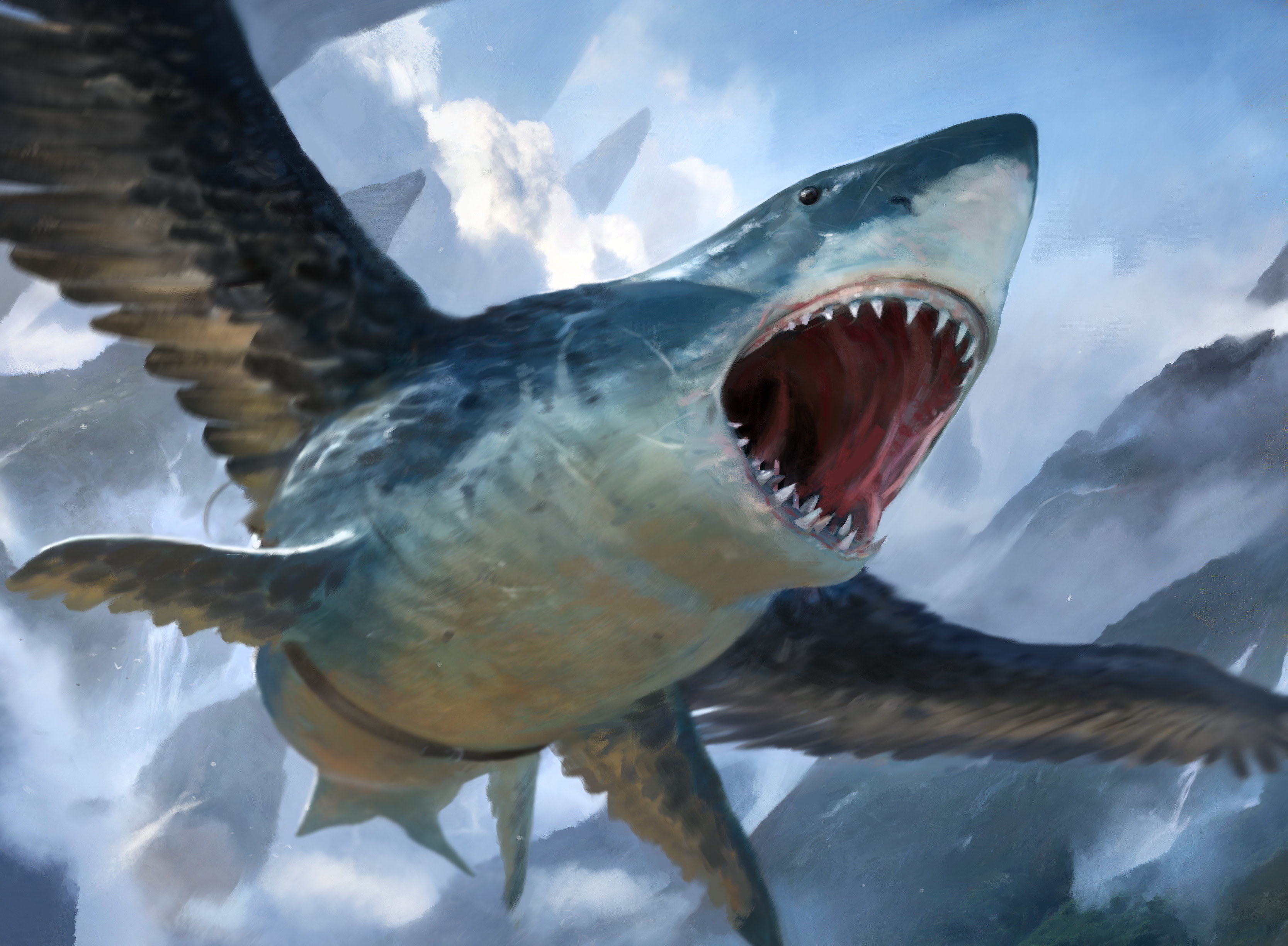
The windfang shark is probably the most bizarre of all species of shark. These sharks acquired the ability for flight, allowing them to leap out of the ocean to catch airborne prey and even at times snatch humanoids off of ships.
Despite their ability to fly, these sharks still spend the majority of their time underwater, as they can only stay in the air for a few minutes before having to dive beneath the waves to regain its breath.
Shark Template
large beast, unaligned
- Armor Class 11(Natural Armor)
- Hit Points 45 (6d10+12)
- Speed swim 40ft.
STR DEX CON INT WIS CHA 18(+4) 13 (+1) 15 (+2) 1 (-5) 15 (+2) 4 (-3)
- Skills Athletics +6, Perception +6
- Senses blindsight 30ft., darkvision 120ft., passive Perception 16
- Proficiency Bonus +2
- Challenge 3(700 XP)
Blood Sense The shark knows the direction of a creature below half its hitpoint maximum within 1 mile of it. This feature fails if the creature does not have blood.
Keen Senses The shark has advantage on Wisdom(Perception) checks that rely on sight or smell
Blood Frenzy When it takes the Attack action against a creature below half its hitpoint maximum, it can make an additional bite attack as part of that action.
Waterbreathing The shark can breathe only underwater
Actions
Bite. Melee Weapon Attacks, +6 to hit:, 5ft., , one target. Hit 22(4d8+4) piercing damage.
Bonus Actions
Aggressive The shark can move up to its movement speed toward a hostile creature that it can see as a bonus action
Megalodon Template
Huge beast, unaligned
- Armor Class 15(Natural Armor)
- Hit Points 138 (12d12+60)
- Speed swim 50ft.
STR DEX CON INT WIS CHA 23(+6) 13 (+1) 21 (+5) 1 (-5) 15 (+2) 4 (-3)
- Saving Throws Strength +10, Constitution +9
- Skills Athletics +10, Perception +6
- Senses blindsight 30ft., darkvision 120ft., passive Perception 16
- Proficiency Bonus +4
- Challenge 10(5900 XP)
Blood Sense The megalodon knows the direction of a creature below half its hitpoint maximum within 1 mile of it. This feature fails if the creature does not have blood.
Keen Senses The shark has advantage on Wisdom(Perception) checks that rely on sight or smell
Blood Frenzy When it takes the Attack action against a creature below half its hitpoint maximum, it can make an additional bite attack as part of that action.
Waterbreathing The shark can breathe only underwater
Siege Monster The shark deals doubles damage to buildings and structures
Actions
Bite. Melee Weapon Attack, +10 to hit:, 5ft., , one target. Hit 34(8d6+6) piercing damage.
If the target is a Large or smaller creature, it is grappled (escape DC 18). Until this grapple ends, the target is restrained and the megalodon can't bite another target.
If a creature is grappled in this manner, it can use its bonus action to make an additional bite attack against that creature.
Bonus Actions
Aggressive The megalodon an move up to its movement speed toward a hostile creature that it can see as a bonus action
Coralfang Shark
- Skills Stealth +5
- Armor Class Increases by 3
Coral Camouflage The coralfang shark has advantage on Dexterity(Stealth) checks it makes in underwater terrain provided there is ample cover. While these conditions are met, it can use its bonus action to Hide.
Spined Shell A creature that grapples or hits the coralfang shark with a melee attack while within 5ft. of it takes 5(1d8) piercing damage
Hammerhead Shark
Traits
Stunning Dive If the hammerhead shark moves at least 20ft. straight towards a target and then hits it with a bite attack on the same turn, the target takes an extra 7(2d6) piercing damage. If the target is a creature, it must succeed a Constitution saving throw or be stunned until the end of its next turn.
The DC for this ability is equal to 8 + the Shark's Strength modifier + its proficiency bonus.
Reckless At the start of its turns, the hammerhead shark can choose to grant itself advantage on attack rolls until the start of its next turn. For the duration of this effect, attacks against it have advantage.
Relentless If the hammerhead shark takes damage that would reduce it to 0 hitpoints, it can make a DC 10 Constitution saving throw to regain 1 hitpoint. Upon a success, the DC increases by 5. This DC can reset after it takes a short or long rest
Legion Shark
Pack Tactics The legion shark has advantage on an attack roll against a creature that has at least one of the shark's allies is within 5ft. of the creature and the ally is not incapacitated.
Deep shark
Traits
Bioluminescence The deep shark has advantage on magical saving throws. It can uses its bonus action to emit or dismiss a bright light in a 10ft radius and a dim light an additional 10ft.
Shadow Stalker The deep shark has advantage on Dexterity(Stealth) checks it makes in dim light or darkness. While in darkness, it is invisible to creatures with darkvision. While these conditions are met it can use its bonus action to Hide.
Shadow Hunter The shark has advantage on initiative checks and attack rolls while in dim light or darkness
Frostbite shark
- Damage Resistances Cold
- Challenge Rating Increases by 1
False Appearance While the shark remains motionless, it is indistinguishable from a floating piece of ice.
Frostbite Creatures hit by the shark's attack take an addititonal 7(2d6) cold damage and has its movement speed reduced by 10ft. upon a hit.
Windfang shark
- Movement Speed 30ft. fly
FlybyThe shark can fly outside a creature's reach without provoking opportunity attack
Skydive If the windfang shark flies at least 20ft. straight towards a target and then hits it with a bite attack on the same turn, the target takes an extra 7(2d6) piercing damage.
Octopus
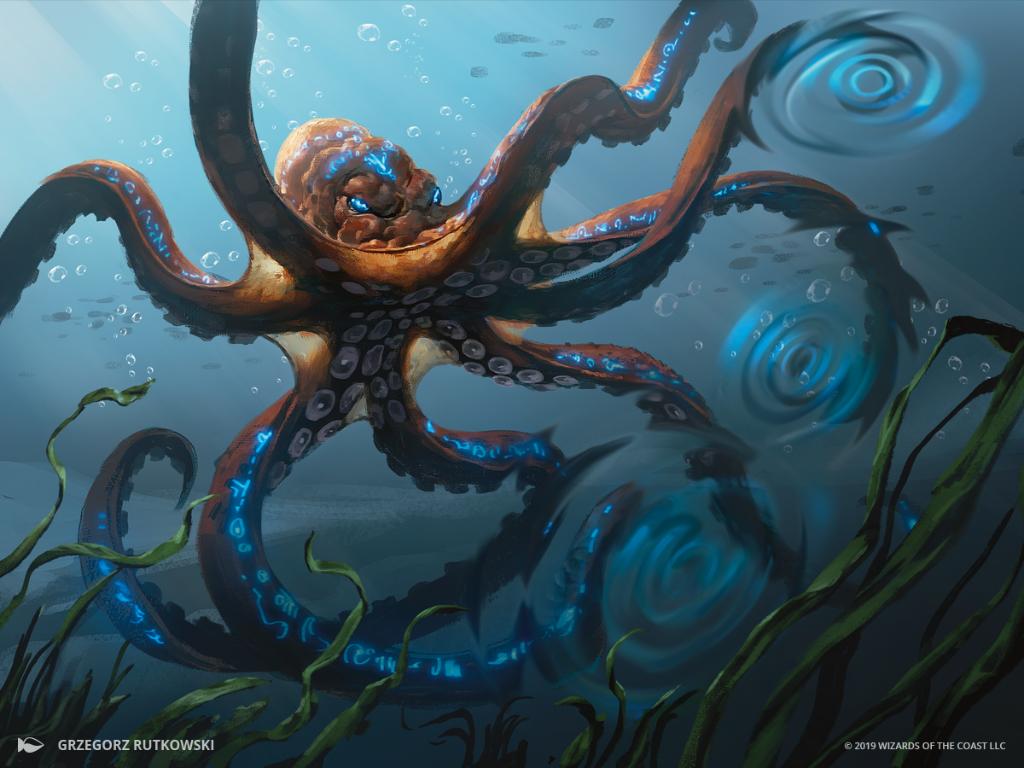
The giant octopus is a rather clever aquatic predator. It possesses a strange physiology, consisting of a bulbous head with a writhing mass of tentacles. These tentacles are lined with suction cups that latch onto its prey, preventing it from easily escape.
Once s prey is captured, the octopus begins to feast on that creature, using its bone crushing beak to snap its prey in two. Despite its large size, the octopus the uncanny ability to squeeze into much smaller spaces, allowing it to pursue prey hiding underneath coral.
Octopus Tactics
The octopus is an ambush predator at heart, using its elusiveness and intellect to help it quickly capture its prey. Using its ability to camouflage in nearly any underwater environment as well as its very limber form, the octopus always tries to position itself in an ideal location for an ambush. Once it catches a creature by surprise, it uses its numerous tentacles to latch onto its foes, bringing it in to the deadly beak.
There are numerous instances where a giant octopus has attacked terrestrial prey. Many common accounts reveal that an octopus climbed onboard of a vessel and dragged off an unsuspecting victim. Thankfully, these accounts are rare, but some believe that such encounters may have not simply been out of predatory instinct.
Instead, some theorize that giant octopus actually revere and primitively worship krakens and similar entities, and such encounters may have been under the influence of a kraken. However, such beliefs have not been confirmed and are purely speculation, probably in an attempt to explain the unusual intelligence that the octopus possesses.
Nautilus
The nautilus octopus is a unique type of octopus that possess a thick shell that can take a variety of shapes as some can resemble a conch while others take the form of a spiral shell. However, unlike other shelled aquatic creatures, the nautilus is unable to full retreat into its shell.
Despite this limitation, this shell is still more than enough to deter attackers due to the various thorny protrusions on its body. The nautilus octopus also possess highly evolved tentacles filled with teeth-like barbs that prevents creatures from easily escaping its grasp.
Shadowtide
The shadowtide octopus is a nocturnal hunter that completely relies on stealth to capture its prey. Its ink has the special ability to blot out any source of light, even from magical sources.
Because of the unique traits that their ink possesses, shadowtide octopus ink is an extremely valuable commodity, as it can be uses as an alchemical ingredient for all manner of arcane and alchemical devices.
Siren
As its name suggests, the siren octopus is not for its lethal beauty. Instead of relying on sound, the siren primarily targets the vision of its prey, for its body is lined with numerous bioluminescent glands that give off an otherworldly light.
This glow also has a slightly hypnotic property that can cause a creature to enter an enthralled stupor that causes it to absent-mindedly approach the octopus. While in this state, the octopus is able to bind its helpless prey with little difficulty. Once its quarry is in its grasp, that creatures is as good as dead, for there is little chance that it can escape its grasping tentacles before its large beak makes short work of that creature.
Deathsting
The brightly-colored skin of the deathsting octopus serves as a dire warning for any predator of this octopus's extremely potent poison. The suction cups on their tentacles are lined with small barbs that are lined with toxic venom glands. Once they have ensnared a creature in their grasp, creature are able to deploy these barbs to inject their deadly venom into their quarry's bloodstream.
These octopi are also able to inject some of these toxic compounds into their ink clouds as a means of self-defense. This poisonous ink is able to temporarily cause a creature's respiratory system to malfunction, making it impossible to breathe.
Jungle
The jungle octopus is a rather rare breed of octopus that is actually completely amphibious, unlike its relatives. Also in contrast to the rest of its kin, the jungle octopus is largely a terrestrial organism that prefers to live in lush jungles. However, despite its affinity for land, it still prefers to maintain a close vicinity to rivers, streams, and lakes.
Its appearance is perfectly suited for its lush jungle home as its body is able to easily blend into its surroundings, disguising itself as tree roots and vines. Thanks to this natural camouflage, it is able to lie in wait patiently to snatch up small prey such as birds and monkeys.
Dire Octopus Template
Large beast, unaligned
- Armor Class 14(Natural Armor)
- Hit Points 52 (8d10+8)
- Speed 10ft., 10ft. climb, swim 60ft.
STR DEX CON INT WIS CHA 18(+4) 18 (+4) 13 (+1) 8 (-1) 10 (+0) 4 (-3)
- Saving Throws Str +6, Dex +6
- Skills Athletics +6, Acrobatics +6, Stealth +6, Sleight of Hand +6, Perception +2
- Senses blindsight 30ft., darkvision 60ft., passive Perception 12
- Proficiency Bonus +2
- Challenge 4(1100 XP)
Hold Breath While out of water, the octopus can hold its breath for one hour
Malleable Form The octopus can move through any space large for a creature one size smaller than it without squeezing
Suction Cups Creature's grappled by the octopus have disadvantage on its ability checks and saving throws to escape the grapple
Underwater Camouflage The octopus has advantage on Dexterity(Stealth) checks made while underwater
Waterbreathing The octopus can breathe only underwater
Actions
Multiattack The octopus can make four tentacle attack actions on its turn.
Tentacle. Melee Weapon Attack, +6 to hit:, 15ft., one target. Hit 8(1d6+4) bludgeoning damage. If the target is a Large or smaller creature, it is grappled(escape DC 14).
Until this grapple ends, the target is restrained and the octopus can't use its tentacles on another target. The octopus can grapple up to 4 creatures in this manner at a time
Ink Cloud(Recharge 5-6) A 20ft. radius cloud of ink extends all around the octopus if it is underwater. The area is heavily obscured for one minute although a significant current can disperse the ink.
After releasing the ink, the octopus can use the Dash action as part of this feature. This movement does not provoke opportunity attacks
Bonus Actions
Reel The octopus can use its bonus action to pull a grappled creature 15ft. towards it.
Beak Melee Weapon Attacks, +6 to hit:, 5ft., , one grappled target. Hit 18(4d6+4) piercing damage.
Nautilus
- Armor Class 17(Natural Armor)
Spined Shell A creature that hits the nautilus with a melee attack or grapples it while within 5ft. of it takes 5(1d8) piercing damage
Barbed Tentacles Creatures grappled by the Nautilus take 5(2d4) piercing damage at the start of each of its turns
Shadowtide
- Darkvision 120ft.
GLoom Sight The shadowtide octopus's vision is not obscured by magica darkness.
Shadow Stalker The shadow tide octopus has advantage on Dexterity(Stealth) checks it makes in dim light or darkness. While in darkness, it is invisible to creatures with darkvision. While these conditions are met it can use its bonus action to Hide.
Umbral Ink When the Shadowtide Octopus uses its Ink Cloud ability, that area becomes magical darkness and creatures fully within this area are blinded. No light, magical or otherwise can illuminate this area.
Shadow Hunter The octopus has advantage on intiative checks and attack rolls while in dim light or darkness
Siren Octopus
Hypnotic Presence When a creature that can see the octopus starts its turn within 30 feet of the octopus, the octopus can force it to make a DC 11 Wisdom saving throw if the octopus isn't incapacitated and can see the creature.
On a failed save, the creature is charmed. While charmed in this way, a creature is considered incapacitated and must use its movement to approach the octopus in a safe manner. While the affected creature is within 5 feet of the octopus, its movement speed is 0for the duration.
It can repeat its saving throw to end the effect on a success at the end of each of its turns or whenever it takes any damage.
Upon ending this effect, the creature is immune to being charmed in this manner for 24 hours.
Bioluminescence The Siren Octopus has advantage on magical saving throws. It can uses its bonus action to emit a bright light in a 10ft radius and a dim light an additional 10ft. It can dismiss this light as a free action
Death Sting Octopus
- Damage Resistances Poison.
Poison Resistance Has advantage on saving throws against being poisoned
Actions
Sting All creatures grappled by the Octopus must succeed a DC 11 Constitution save or take 4d6 poison damage and become poisoned for one minute. It can repeat it saving throw at the end of each of its turns to end the effect. On a successful saving throw, creatures take half damage and are otherwise unaffected.
Noxious Ink When the Death Sting Octopus uses its Ink Cloud ability, creature that first enter or start its turn within the cloud must succeed a DC 11 Constitution saving throw or be poisoned until the end of its next turn. While poisoned in its manner, its spends it is unable to take an action or reactions as it spends its turn wretching.
Jungle
Amphibious (Replaces Water Breathing) The jungle octopus can breathe in air and in water
False Appearance While motionless, the jungle octopus is indistinguishable from a moss covered stone
Plant Camouflage The jungle octopus has advantage on Dexterity(Stealth) checks when obscured by ample plant life. While these conditions are met, the octopus can use its bonus action to Hide.
Actions
Poison Gas(Replaces Ink Cloud) A 20ft. radius cloud of poison extends all around the octopus. The area is obscured for one minute although a significant current can disperse the poison.
Creatures that first enter or starts its turns in this cloud are considered blinded, poisoned, and its vision is heavily obscured until the end of its next turn.
After releasing the cloud, the octopus can use the Dash action as part of this feature. This movement does not provoke opportunity attacks
Whales
Whales are the largest of all aquatic beasts. Despite their fish-like appearance, they are actually closely related to terrestrial mammals. Much like other large aquatic beasts such as leviathans, they must hold their breath while underwater, resurfacing using a blowhole located on the top of their heads. Whales are known to be very social animals, living in large pods which provide protection and support to raise young.
Harlequin Whale
Like many other aquatic beasts, whales come in many shapes and sizes. One of the smallest whale species are harlequin whales. They are colorful whales are known for their extremely friendly personalities. It is not uncommon for these whales to approach humanoids out of curiosity and attempt to play harmless pranks or games with them, hence coining the name harlequin whale.
They also have even been known to aid individuals stranded amidst the waves from shipwrecks or pulled out by the tidal current. As a result , they are typically a welcome presence along any coast as their pods tend to drive out larger, more dangerous aquatic predators. Despite being smaller than most aquatic threats, harlequin whales use their agility and coordinated tactics to harry their opponent until it flees.
Tusktooth Whale
Another species of whale, typically found in cold climates, is the tusktooth whale. As its name suggests, these whales tend to have one or two spears like tusks protruding from its jaws that it uses to defends itself or challenge rivals.
Unlike their smaller kin, the tusktooth whale tends to be a bit temperamental, becoming aggressive if humanoids encroach on its territory for too long. When provoked, these whales will ram into its opponent with its lance-like tusks that are capable of shearing a humanoid in half or splintering the hull of a vessel.
Killer Whale
The killer whale resembles the harlequin whale in many ways, from its appearance to their behavior. However, these whale are in reality very sinister predators. These whales use their disarming appearance to its advantage, often playing with its prey to lead it astray while the rest of its pods moves in for the kill.
There are accounts where these whale will playfully leap out of the water as if to do tricks near a vessel but will intentionally become more reckless using their bodies to capsize the vessel.
There is no limit to what killer whale will attempt to hunt, using their superior coordination, intellect, and communication skills through echolocation to hunt down their prey.
Titan Whales
Titan whales are believed to be the largest of all kinds of whales. Most titan whale are large enough to rival the size of a mid-sized galleon, but the largest and most ancient of their kind have been known to dwarf all but the largest of battleships.
Despite their immense size, titan whale are peaceful giants that primarily feed on microscopic creatures known as plankton. Their colossal maws are lined with hair-like teeth known as baleen which allows them to filter large amounts of these creatures in a single gulp.
Dreadnought Whales
The dreadnought whale is the carnivorous counterpart to the Titan whale, although they tend to be slightly smaller than their peaceful cousins. In contrast to the docile titan, dreadnoughts are vicious hunters, that hunt in small groups of 3(1d4). Although they hunt any prey smaller than them, they have a special appetite for humanoids, often breaching the water to capsize larger vessels to acquire the tasty morsels within its hull.
Because of this, these whales tend to be very rare and only found in remote expanses of the ocean as many coastal settlements constantly monitor the seas for these predators, hunting them down the instant they are discovered.
Cloudjumper Whale
One of the most awe-inspiring phenomena on the Material Plane is to get an opportunity to view a cloudjumpers whale soaring over the horizon. Although these whales are truly enormous, rivaling that of the dreadnought and titan whale, these creatures are surprising light for their size.
The source of their lightweight build is due to their extremely buoyant blubber that allows them to harness the slightest breeze to become airborne. As they float above the clouds, they can use their powerful fins to navigate through the high altitude airstreams with little difficulty.
Harlequin Whale
Large Beast, unaligned
- Armor Class 12(Natural Armor)
- Hit Points 26 (4d10+4)
- Speed 60ft. swim
STR DEX CON INT WIS CHA 15(+2) 14 (+2) 13 (+1) 9 (-1) 17 (+3) 12 (+1)
- Skills Athletics +4, Acrobatics +4, Performance +5, Deception +5, Perception +7
- Senses blindsight 120ft., darkvision 120ft., passive Perception 17
- Challenge 1(200 XP)
Agile Swimmer The harlequin whale can swim outside a creature's reach without provoking opportunity attack
Echolocation The harlequin whale can't use blindsight while deafened
Hold Breath The harlequin whale can hold its breath for 90 minutes
Keen Senses The harlequin whale has advantage on Wisdom (Perception) checks relying on hearing or sight
Pack Tactics The harlequin whale has advantage on an attack roll against a creature if at least one of the harlequin whale's allies is within 5ft. of the creature and the ally is not incapacitated.
Actions
Bite Melee Weapon Attacks, +4 to hit:, 5ft., , one target. Hit 9(2d6+2) piercing damage.
Tusktooth Whale
Huge Beast, unaligned
- Armor Class 10(Natural Armor)
- Hit Points 76 (8d12+24)
- Speed 40ft. swim
STR DEX CON INT WIS CHA 19(+4) 10 (+0) 16 (+3) 7 (-2) 17 (+3) 12 (+1)
- Skills Athletics +6, Perception +5
- Senses darkvision 60ft., passive Perception 15
- Damage Resistances Cold
- Proficiency Bonus +2
- Challenge 3(700 XP)
Blubber The tusktooth whale has advantage on saving throws against effects that deal cold damage. If the tusktooth whale succeeds on a saving throw that deal cold damage it takes no damage instead.
Hold Breath The tusktooth whale can hold its breath for 90 minutes
Echolocation The tusktooth whale can't use blindsight while deafened
Keen Senses The tusktooth whale has advantage on Wisdom (Perception) checks relying on hearing or sight
Siege Monster The tusktooth whale can deal double damage to buildings and objects
Dive Attack If the tusktooth whale moves at least 20ft. straight towards a target and then hits it with a bite attack on the same turn, the target takes an extra 13(2d12) piercing damage
Actions
Gore Melee Weapon Attack, +6 to hit:, 10ft., , one target. Hit 17(2d12+4) piercing damage.
Killer Whale
Huge Beast, unaligned
- Armor Class 12(Natural Armor)
- Hit Points 68 (8d12+16)
- Speed 50ft. swim
STR DEX CON INT WIS CHA 19(+4) 14 (+2) 14 (+2) 8 (-1) 17 (+3) 12 (+1)
- Skills Athletics +6, Acrobatics +4, Performance +5, Deception +5, Perception +7
- Senses blindsight 120ft., darkvision 120ft., passive Perception 17
- Damage Resistances Cold
- Challenge 4(1100 XP)
Blubber The killer whale has advantage on saving throws against effects that deal cold damage. Upon succeeding this saving throw, the killer whale takes no damage instead.
Hold Breath The killer whale can hold its breath for 90 minutes
Echolocation The killer whale can't use blindsight while deafened
Keen Senses The killer whale has advantage on Wisdom (Perception) checks relying on hearing or sight
Pack Tactics The killer whale has advantage on an attack roll against a creature if at least one of the killer whale's allies is within 5ft. of the creature and the ally is not incapacitated.
Siege Monster The killer whale deals double damage to buildings and structures
Stunning Dive If the killer whale swims at least 30ft. straight towards a target and then hits it with a bite attack on the same turn, the target must succeed a DC 14 saving throw or become stunned until the end of its next turn.
Actions
Bite Melee Weapon Attack, +6 to hit:, 5ft., , one target. Hit 15(2d10+4) piercing damage.
Titan Whale
Gargantuan Beast, unaligned
- Armor Class 15(Natural Armor)
- Hit Points 224 (16d20+96)
- Speed 40ft. swim
STR DEX CON INT WIS CHA 25(+7) 9 (-1) 23 (+6) 4 (-1) 17 (+3) 7(-2)
- Saving Throws Strength +11, Constitution +10
- Skills Athletics +11, Perception +7
- Senses darkvision 60ft., passive Perception 19
- Proficiency Bonus +4
- Challenge 10(5900 XP)
Hold Breath The titan whale can hold its breath for 90 minutes
Echolocation The titan whale can't use blindsight while deafened
Siege Monster The titan whale can deal double damage to buildings and objects
Titanic Frame The titan whale has advantage on Strength and Constitution saving throws
Bioluminesence The titan wale has advantage on magical saving throws. It can uses its bonus action to emit a bright light in a 10ft radius and a dim light an additional 10ft. It can dismiss this light as a free action.
Actions
Tail Melee Weapon Attack, +10 to hit:, 20ft., , one target. Hit 31 (4d12+7) bludgeoning damage. If the target is a creature, it must succeed a DC 19 Constitutions saving throw or become stunned until the end of its next turn.

Dreadnought Whale
Gargantuan Beast, unaligned
- Armor Class 15(Natural Armor)
- Hit Points 198 (12d20+72)
- Speed 50ft. swim
STR DEX CON INT WIS CHA 26(+8) 8 (-1) 22 (+6) 3 (-4) 12 (+1) 5(-3)
- Saving Throws Strength +12, Constitution +10
- Skills Athletics +12, Perception +5
- Senses blindsight 120ft., darkvision 120ft., passive Perception 17
- Proficiency Bonus +4
- Challenge 11(7200 XP)
Endurance When the dreadnought whale fails a Constitution saving throw that deals damage, it takes half damage. On a successful saving throw, it takes no damage.
Hold Breath The dreadnought whale can hold its breath for 90 minutes
Echolocation The dreadnought whale can't use blindsight while deafened
Keen Senses The dreadnought whale has advantage on Wisdom (Perception) checks relying on hearing or sight
Siege Monster The dreadnought whale deals double damage to buildings and structures
Titanic Frame The dreadnought whale has advantage on Strength and Constitution saving throws
Actions
Multiattack The whale can make two attack actions: one with its bite and one with its tail. It cannot make both attacks against the same creature on the same turn.
Bite Melee Weapon Attack, +11 to hit:, 10ft., , one target. Hit 30(4d10+8) piercing damage.
If the target is Large or smaller, it must succeed a DC 19 Strength saving throw or be swallowed by the whale.
A swallowed creature is restrained and blinded and has total cover against attacks and other effects outside the whale and takes 18(4d8) acid damage + 18(4d8) bludgeoning damage at the start of each of the whale's turns.
If the whale takes damage, it must succeed a Constitution saving throw with a DC equal to half the damage dealt by the swallowed creature (minimum 10). On a failed saving throw, the whale regurgitates all swallowed creatures which fall prone in a space within 10ft. of the whale.
If the whale dies, a swallowed creature can escape from the corpse by using 20ft. of movement exiting prone.
Tail Melee Weapon Attacks, +11 to hit:, 10ft., , one target. Hit 32 (4d12+8) bludgeoning damage.
If the target is a creature, it must succeed a DC 20 Constitution saving throw or become stunned until the end of its next turn.
Sonic Burst(Recharge 5-6) Creatures within a 120ft. cone must succeed a DC 18 Constitution saving throw or become stunned until the end of its next turn.

Cloudjumper Whale
Gargantuan Beast, unaligned
- Armor Class 15(Natural Armor)
- Hit Points 165 (10d20+60)
- Speed 40ft. swim, 40ft. fly (hover)
STR DEX CON INT WIS CHA 25(+7) 9 (-1) 23 (+6) 4 (-1) 17 (+3) 7(-2)
- Saving Throws Strength +11, Constitution +10
- Skills Athletics +11, Stealth +3, Perception +7
- Senses darkvision 60ft., passive Perception 19
- Proficiency Bonus +4
- Challenge 9(5000 XP)
Cloudy Camouflage While obscured by ample cloud cover, the cloudjumper whale has advantage on Dexterity(Stealth) checks
Cloud Treader The cloudjumper whale can fly through strong winds without having to expend any additional movement or make ability checks to stay aloft.
Echolocation The cloudjumper whale can't use blindsight while deafened
Hold Breath The cloudjumper whale can hold its breath for 90 minutes
Siege Monster The cloudjumper whale can deal double damage to buildings and objects
Titanic Frame The cloudjumper whale has advantage on Strength and Constitution saving throws
Actions
Tail Melee Weapon Attack, +10 to hit:, 20ft., , one target. Hit 31 (4d12+7) bludgeoning damage. If the target is a creature, it must succeed a DC 19 Constitutions saving throw or become stunned until the end of its next turn.
Sonic Roar(Recharge 5-6) Creatures within a 120ft. cone must succeed a DC 20 Strength saving throw or be pushed back 60ft. and fall prone.
Seals
Seals are another species of mammals that spend the majority of their time in the water. Although most creatures under this category can include sea lions and walruses, creatures such as the manatee are loosely related to these animals and can also be considered under this category.
Lion Seal
The lion seal is probably the most common type of seal. Although they typically can be found in frigid arctic oceans, they have been known to venture to more temperate climates.
Lion seals are generally quite sociable animals that live in large groups that can consist of up to 50 members at a time. These pods tend to spend the majority of their times swimming in unison to find underwater prey such as small fish and clams. When they are not hunting, they tend to lounge and sunbathe on the beach.
Out of all kinds of seals, the lion seal is the friendliest. In fact, it is not uncommon for these seals to curiously approach humanoids near their hunting grounds. In some cases, they have been known to even play water games with their bipedal companions.
Interestingly enough, many aquatic and coastal civilizations have learned to tame these creatures. Domesticated lion seals are known for their devotion and loyalty, at times matching that of domesticated canines.
However, despite their friendly demeanor, they can be quite fierce fighters, particularly when defending their young.
Hunter Seal
Despite their appearance, hunter seals are known to be particularly vicious predators. Although their diet largely consists of fish, penguins, and smaller seals, hunter seals have been known to take their chances to hunt more exotic and dangerous prey such as humanoids.
Unlike all other species of seals, hunter seals are solitary by nature. Although this puts them at a considerable disadvantage against larger predators, these seals are known for their surprising ferocity, enabling them to fight creatures much larger than them.
Tusklord Seal
The tusklord is one of the largest of all seals. They can be easily identified by the saber like tusks that can grow to nearly a foot in length. Despite their seemingly bulbous and clumsy looking forms, tusklord seals are surprisingly capable swimmers.
Thanks to their large size, tusklord seals have very few natural predators such as whales and bears. However, bringing down one of these seals can prove to be quite the challenge, even for these predators. Thanks to their enormous size and tremendous weight, they are able to inflict severe bodily harm to their attackers, especially if they possess a significant weight advantage against their opponent.
Another reason why these seals are incredibly dangerous is that they seem to have gang mentality when one of their members are threatened. If one is not carefully, they can end up being pursued by a stampede of grumpy tusklords.
Behemoth Seal
The behemoth seal is the largest of all seals. These titanic creatures can grow to incredible sizes, easily dwarfing the smallest of whales. Just like the smaller tusklord, the behemoth seal is incredibly temperamental and will become increasingly aggressive when it senses the presence of humanoids or other predators.
In addition to their surprisingly sharp teeth, the greatest weapon of the behemoth seal is its sheer size. In combat, this seal literally throws its weight around, crushing anything that gets too close to them.

Lion Seal
Medium Beast, Unaligned
- Armor Class 12 (Natural Armor)
- Hit Points 21 (3d8+6)
- Speed 20ft., 40ft. swim
STR DEX CON INT WIS CHA 17 (+3) 15 (+2) 15 (+2) 3(-4) 12 (+1) 8 (-4)
- Skills Athletics +5, Acrobatics +4 Perception +3
- Damage Resistances Cold
- Senses passive Perception 13
- Proficiency Bonus +2
- Challenge 1/2 (100 xp)
Blubber The lion seal has advantage on saving throws against effects that deal cold damage. If the lion seal succeeds on a saving throw that deal cold damage it takes no damage instead.
Dive Attack If the lion seal swims at least 20ft. in a straight line and makes a bite attack on the same turn, it can deal an additional 7(2d6) damage.
Nimble Swimmer The lion seal can swim outside the reach of a creature without provoking opportunity attack.
Pack Tactics The lion seal has advantage on attack rolls if at least one of the lion seal's allies are within 5ft. of an ally
Aquatic Whiskers While underwater, the lion seal has a tremorsense and blindsense up to 30ft.
Slick Body The seal has advantage on Strength and Dexterity ability checks and saving throws against being grappled or restrained.
Actions
Bite. Melee Weapon Attack, +5 to hit , 5ft., one target. Hit: 7 (1d6+3) piercing damage.
Bonus Actions
Agile Swimmer While swimming, the lion seal can use its bonus action to Dash
Hunter Seal
Large Beast, Unaligned
- Armor Class 12 (Natural Armor)
- Hit Points 45 (6d10+12)
- Speed 10ft., 40ft. swim
STR DEX CON INT WIS CHA 17 (+3) 15 (+2) 15 (+2) 3(-4) 12 (+1) 8 (-4)
- Skills Athletics +5, Acrobatics +4 Perception +3
- Damage Resistances Cold
- Senses passive Perception 13
- Proficiency Bonus +2
- Challenge 2 (450 xp)
Blubber The hunter seal has advantage on saving throws against effects that deal cold damage. If the hunter seal succeeds on a saving throw that deal cold damage it takes no damage instead.
Nimble Swimmer The hunter seal can swim outside the reach of a creature without provoking opportunity attack.
Dive Attack If the hunter seal swims at least 20ft. in a straight line and makes a bite attack on the same turn, it can deal an additional 9(2d8) damage.
Feral When the hunter seal has at least two hostile creature's within 5ft. of it, it has advantage on its attacks
Natural Camouflage The hunter seal has advantage on Dexterity(Stealth) checks while in icy or snowy terrain. While in these conditions, it can use its bonus action to Hide.
Predator Instinct The hunter seal has advantage on initiative checks. If it makes an attack against a creature that is surprised has not acted yet in combat, it can make an additional bite attack as part of that action.
Slick Body The hunter seal has advantage on ability checks and saving throws against being grappled or restrained.
Actions
Bite. Melee Weapon Attack, +5 to hit , 5ft., one target. Hit: 12 (2d8+3) piercing damage.
Bonus Actions
Agile Swimmer While swimming, the hunter seal can use its bonus action to Dash
Tusklord Seal
Large Beast, Unaligned
- Armor Class 9(Natural Armor)
- Hit Points 84 (8d10+40)
- Speed 20ft., 40ft. swim
STR DEX CON INT WIS CHA 19 (+4) 9 (-1) 19 (+4) 3(-4) 12 (+1) 8 (-4)
- Saving Throws Str +6, Con +6
- Skills Athletics +6, Perception +3
- Damage Resistances Cold
- Senses darkvision 60ft., passive Perception 13
- Proficiency Bonus +2
- Challenge 4 (1100 xp)
Blubber The tusklord seal has advantage on saving throws against effects that deal cold damage. If the tusklord seal succeeds on a saving throw that deal cold damage it takes no damage instead.
Endurance When the tusklord seal fails a Constitution saving throw that deals damage, it takes half damage. Upon a successful saving throw, the tusklord seal takes no damage instead.
Hold Breath The tusklord seal can hold its breath for 30 minutes.
Reckless The the start of its turn, the tusklord seal can choose to grant itself advantage on attack rolls until the start of its turn. For the duration of this effect, attacks against it have advantage.
Actions
Bite. Melee Weapon Attack, +6 to hit , 5ft., one target. Hit: 15 (2d10+4) piercing damage.
Body Flop Melee Weapon Attack, +6 to hit , 5ft., one target. Hit: 15 (2d10+4) bludgeoning damage. If the target is Medium or smaller it must succeed a DC 14 Strength saving throw or be knocked prone. Small and smaller creatures have disadvantage on this saving throw and take an additional 11(2d10) damage.
Bonus Actions
Aggressive The tusklord can use its bonus action to move up to half its movement speed towards a hostile creature that it can see within range
Behemoth Seal
Gargantuan Beast, Unaligned
- Armor Class 15 (Natural Armor)
- Hit Points 140 (8d20+56)
- Speed 20ft., 40ft. swim
STR DEX CON INT WIS CHA 24 (+7) 6 (-2) 24 (+7) 3(-4) 12 (+1) 8 (-4)
- Saving Throws Str +11, Con +11
- Skills Athletics +11, Perception +5
- Damage Resistances Cold
- Senses darkvision 60ft., passive Perception 15
- Proficiency Bonus +4
- Challenge 10 (5900 xp)
Blubber The behemoth seal has advantage on saving throws against effects that deal cold damage. If the behemoth seal succeeds on a saving throw that deal cold damage it takes no damage instead.
Dense Body The behemoth seal has advantage on saving throws against effects that would knock it prone or forcibly move it
Endurance When the behemoth seal fails a Constitution saving throw that deals damage, it takes half damage. Upon a successful saving throw, the behemoth seal takes no damage instead.
Hold Breath The behemoth seal can hold its breath for 30 minutes.
Reckless The the start of its turn, the behemoth seal can choose to grant itself advantage on attack rolls until the start of its turn. For the duration of this effect, attacks against it have advantage.
Siege Monster The behemoth seal can deal double damage to buildings and objects
Actions
Bite. Melee Weapon Attack, +11 to hit , 5ft., one target. Hit: 29 (4d10+7) piercing damage.
Body Flop Melee Weapon Attack, +11 to hit , 5ft., one target. Hit: 29 (4d10+7) bludgeoning damage. If the target is Huge or smaller it must succeed a DC 19 Strength saving throw or be knocked prone. Large and smaller creatures have disadvantage on this saving throw and take an additional 11(2d10) damage.
Fish
Of all aquatic beasts, fish tend to be the most common. They come in nearly an infinite variety of shapes, sizes, and colors. Many serve as a staple food for many civilizations, while others can pose a dire threat for anyone attempting to traverse the coastal reefs or the wide open seas.
Bloodfish
Bloodfish are small but vicious carnivores that have been known to live in bodies of freshwater and saltwater. By itself, the bloodfish is a relatively minor inconvenience. However, it is rare one will ever encounter a bloodfish by itself, for they hunt in large schools. Aided by their acute senses, bloodfish are able to detect the location of living creatures within one mile of them. When they enter their feeding frenzy, their schools transform into a storm of tiny maws, devouring their prey alive.
Bloodfish Tactics
Bloodfish are pack predators that rely on numbers to overwhelm their prey. Oftentimes, the schools engulf their prey in the midst of their school while they barrage it with a flurry of bites. Once engulfed by a bloodfish swarm, there is often little hope of survival for that creature.
Thankfully, bloodfish are not the brightest of creatures and see to have a sense of tunnel vision when they enter into their blood frenzy. Many times, they can be diverted away by the scent of fresh blood or raw meat; however, this could prove rather difficult if they have already begun to feast on a target.
Due to their acute sense of smell and ravenous appetite, these swarms are frequently tamed by sahuagin and merrow who uses them to patrol their underwater strongholds. Large bloodfish swarms are typically the ominous herald of an oncoming sahuagin or merrow raid or invasion, as they release these tiny monsters in large numbers to thin out enemy forces in an underwater assault.
Beholder Fish
The beholder fish is a bizarre predator that lurks in the deepest depths of the ocean. It gains its name due to its somewhat uncanny appearance to a beholder thanks to its array of bioluminescent stalks. However, the only thing they have in common with beholders is their somewhat similar appearance.
Instead of eyestalks, the beholder fish has a bioluminescent organ that glows with a hypnotic light to draw prey towards its toothy maw. Most specimens tend to have one or two of these appendages, but the largest of these creatures have been reported to have up to five. This appendage also seems to have a somewhat magical property, as it can slightly dampen magical effects around the beholder fish.
This special ability causes this creature to be quite valuable for hunters. However, to acquire such a prize would come at great expense, for one would have to traverse to the deepest depths of the sea and face this monstrous fish.
Beholder fish Tactics
The beholder fish is a patient predator that relies on its bioluminescent stalks to draw prey to it. In fact, the beholder fish prefers not have to swim at all to acquire its prey, instead leading it come to it.
Once close enough, the beholder snatches its prey with its ghastly cage-like jaw that prevents its prey escape. Sometimes the beholder fish's tactics work a bit too well, attracting larger predators to it. When it encounters a foe too large or much more powerful than it, it uses its appendage to temporarily blind its opponent so that it can promptly flee.
Devilfish
Devilfish are commonly referred to as the wolves of the sea. Despite their name, these creatures are not fiendish in origin, although their appearance can be quite intimidating as their jaws are lined with rows.
These large predatory fish tend to travel in small schools of about 11(2d10) members. Devil fish are very agile swimmers, allowing them to shoot through the water like an arrow. In fact, this ability to swim at these speeds actually tends to be quite lethal as they launch themselves at their prey, piercing into them with their razor sharp teeth. They have even been known to launch themselves out of the water to attack humanoids traveling on small boats.
Devilfish Tactics
As pack predators, devil fish are most efficient when hunting in schools. Using their underwater agility, they often take turns launching themselves at their prey, using their momentum to piercing even the thickest of hides. Since they typically target much larger prey, they use their nimbleness to quickly escape the reach of their quarry before it can retaliate.
Monsterfish
Whereas the largest sharks tend to dominate the open seas, the monster fish is the apex predator of coral reefs and in some rare instances rivers and lakes. These massive fish are covered in this thick plated armor that is seemingly impervious to conventional weapons and natural attacks.
Their armored shell also gives this creature the uncanny ability to blend into its surroundings, making it indistinguishable from coral or underwater rocks. However, its most potent feature is its crushing jaws capable of cleaving prey at times, smaller vessels in two.
Monsterfish Tactics
Despite its large size, the monsterfish prefers to be an ambush predator, as it is quite a slow swimmer. Instead, it prefers to burrow itself into the soft silt at the bottom of the ocean and wait for unsuspecting prey swimming out in short bursts to quickly devour its prey before proceeding to return to its hiding spot. Thanks to its natural defenses, the monsterfish has hardly any natural enemies outside another one of its kin.
Because of their lack of natural predators, monsterfish are often prone to attempt to hunt new kinds of prey. As a result, they are often known to attack vessels, regardless of its size, using its powerful jaws to tear into its hull.
Bloodfish Swarm
Large Swarm of tiny beasts, unaligned
- Armor Class 13(Natural Armor)
- Hit Points 39 (6d10+6)
- Speed 40ft. swim
STR DEX CON INT WIS CHA 16(+3) 16 (+3) 12 (+1) 1 (-5) 15 (+2) 3 (-4)
- Skills Perception +7
- Damage Resistances Bludgeoning, Piercing, Slashing
- Condition Immunities Charmed, Frightened, Grappled, Paralyzed, Petrified, Prone, Restrained, Stunned
- Senses darkvision 120ft., passive Perception 17
- Proficiency Bonus +2
- Challenge 4(1100 XP)
Blood Frenzy When the bloodfish swarm takes the Attack action against a creature below half its hitpoint maximum, it can make an additional bite attack as part of that action
Blood Sense The bloodfish swarm knows the direction of a creature below half its hitpoint maximum within 1 mile of it.
Swarm The bloodfish swarm can occupy another creature space and vice versa. It can move through any opening large enough for a tiny creature. The swarm can't regain hitpoints or gain temporary hitpoints
Swarm Tactics The bloodfish swarm can enter another creatures space expending additional movement speed. A creature that first enters or starts its turn with the swarm's space takes 10 (4d4) piercing damage and must treat the area as difficult terrain
Swarming Bites The bloodfish swarm has advantage on attack rolls against creatures within its space.
Waterbreathing The bloodfish swarm can only breathe underwater
Blood Sense The bloodfish swarm knows the direction of a creature below half its hitpoint maximum within 1 mile of it.
Actions
Multiattack The bloodfish swarm can make two frenzy of bites attacks. If it is below half of its hitpoint maximum, it can only make one attack
Frenzy of Bites Melee Weapon Attack, +5 to hit:, 5ft. , all targets in range. Hit 14(4d4+4) piercing damage.
Bonus Actions
Aggressive The bloodfish swarm can use its bonus action to move up to its movement speed towards a hostile creature it can see.
Beholder Fish
Large Beast, unaligned
- Armor Class 14(Natural Armor)
- Hit Points 84 (10d10+40)
- Speed 30ft. swim
STR DEX CON INT WIS CHA 19(+4) 10 (+0) 18 (+4) 3 (-5) 10 (+0) 17 (+3)
- Skills Perception +2
- Senses blindsight 120ft., darkvision 120ft., passive Perception 12
- Proficiency Bonus +2
- Challenge 4(1100 XP)
Hypnotic Array When a creature that can see the beholder fish's array starts its turn within 30 feet of the beholder fish, the beholder fish can force the creature to make a DC 14 Wisdom saving throw if the beholder fish isn't incapacitated.
On a failed save, the creature is charmed. While charmed in this way, a creature is incapacitated and must use all of its movement speed to approach the beholder fish in a safe manner. While an affected creature is within 5 feet of the beholder fish, its movement speed is reduced to 0 .
That creature can repeat its save to end the effect on a success at the end of each of its turns or if it takes any damage. Upon ending this effect, creatures are immune to being charmed in this manner by this beholder fish for the next 24 hours.
Bioluminesence The beholder fish has advantage on magical saving throws. It can uses its bonus action to emit or dismiss a bright light in a 10ft radius and a dim light an additional 10ft.
Waterbreathing The beholder fish can only breathe underwater
Actions
Bite Melee Weapon Attack +6 to hit:, 5ft., , one target. Hit 17(2d12+4) piercing damage. If the creature is a Medium or smaller creature, it is grappled and restrained(DC 14).
Until this grapple ends, the beholder fish cannot make a bite attack against another creature but can use its bonus action to make another bite attack against that creature.
Stunning Flash(Recharge 5-6) Creatures with a 30ft. radius of the Beholder Fish that can see it must succeed a DC 14 Constitution saving throw become stunned and blinded until the end of its next turn.
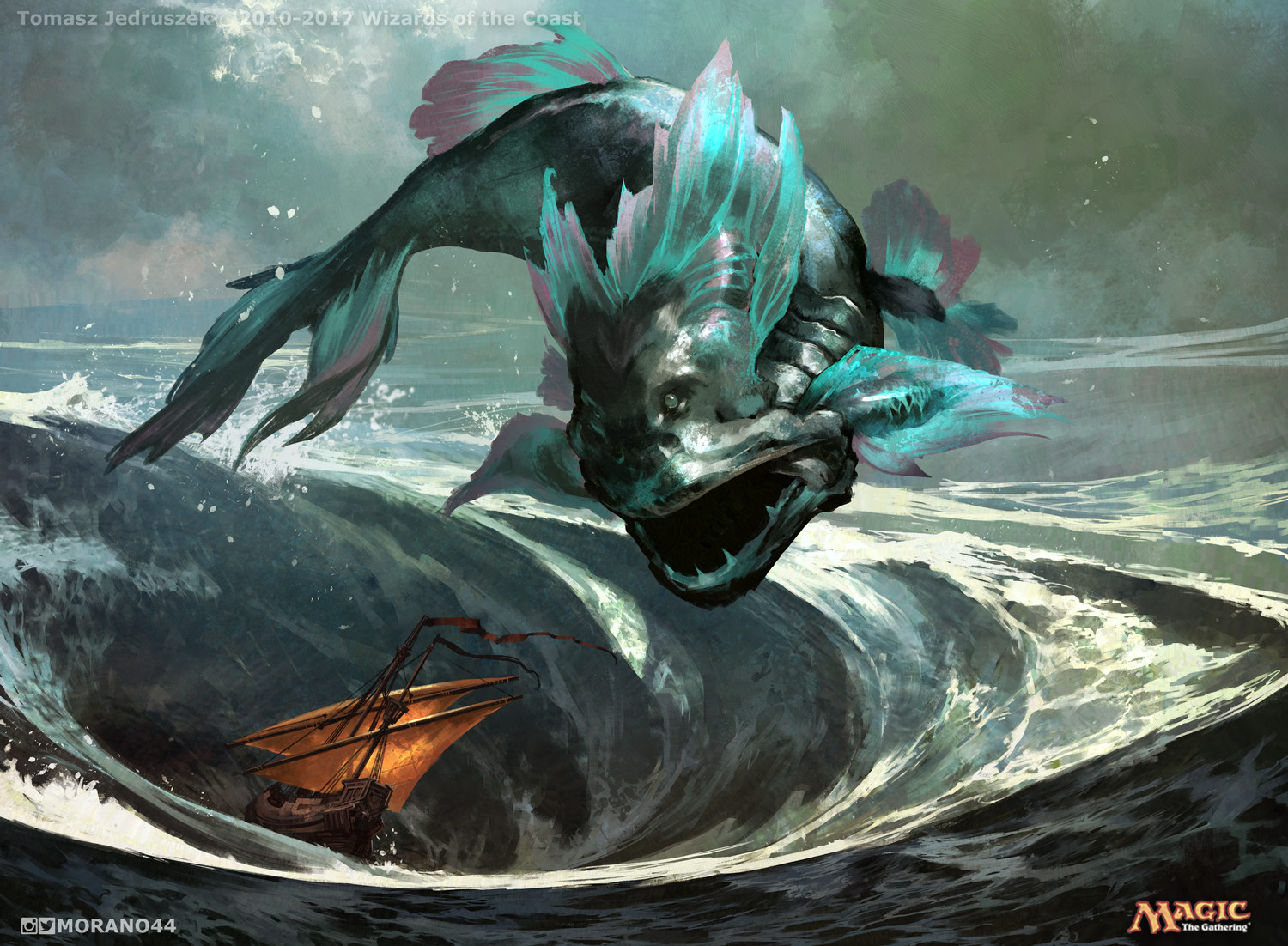
Devilfish
Medium Beast, unaligned
- Armor Class 15(Natural Armor)
- Hit Points 33 (6d8+6)
- Speed 40ft. swim
STR DEX CON INT WIS CHA 14(+2) 18 (+4) 12 (+1) 1 (-5) 10 (+0) 3 (-4)
- Skills Perception +2, Athletics +4, Acrobatics +6
- Senses darkvision 120ft., passive Perception 12
- Proficiency Bonus +2
- Challenge 2(450 XP)
Waterbreathing The devilfish can only breathe underwater
Pack Tactics The devilfish has advantage on an attack roll against a creature if at least one of the devilfish's allies is within 5 ft. of the creature and the ally isn't incapacitated.
Agile Swimmer The devilfish can swim outside the reach of an enemy without provoking opportunity attack
Aggressive The devilfish can use its bonus action to move up to its movement speed towards a hostile creature it can see.
Dive Attack If the devilfish moves least 20 feet straight toward a target and then hits it with a bite attack on the same turn, the target takes an extra 11 (2d10) piercing damage.
Actions
Bite Melee Weapon Attack, +6 to hit:, 5ft., one target. Hit 10(1d10+4) piercing damage.
Monsterfish
Huge Beast, unaligned
- Armor Class 17(Natural Armor)
- Hit Points 125 (10d12+60)
- Speed 30ft. swim, burrow 30ft.
STR DEX CON INT WIS CHA 20(+5) 9 (-1) 22 (+6) 1 (-5) 10 (+0) 6 (-2)
- Saving Throws Constitution +10, Strength +9
- Skills Perception +4, Athletics +9, Stealth +3
- Senses darkvision 120ft., passive Perception 14
- Proficiency Bonus +4
- Challenge 9(5000 XP)
Crushing Jaws When the monsterfish makes a bite attack against a creature, that creature must succeed a DC 17 Constitution saving throw or have its movement speed halved until the end of its next turn.
False Appearance While the monsterfish remains motionless, it is
Siege Monster The monsterfish can deal double damage to buildings and objects indistinguishable from an underwater rock.
Thick Armor The monsterfish has advantage on saving throws against being stunned.
Waterbreathing The monsterfish can only breathe underwater
Actions
Bite Melee Weapon Attack, +9 to hit:, 5ft., one target. Hit 25(3d12+5) piercing damage. If the target is a Medium or smaller creature it is grappled(escape DC 17). Until this grapple ends, the target is restrained and the monsterfish cannot bite another target. While grappling a creature in this manner, it can use its bonus action to make another bite attack against the target.
Macefish
Macefish have a somewhat comical appearance, with their slightly bloated bodies covered with prickly spines. When threatened, they have the unique ability to inflate their bodies and elongate their body spines to make themselves hard to swallow. The spines on its body are quite poisonous and can be lethal to most humanoids. When inflated, these spines are even more potent, as the macefish pumps more venom from its glands into the spines as a last line of defense.
Macefish Tactics
These fish are quite peaceful and do not directly pose a threat to humanoids. However, because they like to congregate in large numbers near reefs, they can transform the reef into a deadly minefield to swim through. Swimmers have to be careful not to bump into these fish while traversing through large schools of macefish for a simple touch can prove to be quite lethal. One should also be careful not to aggravate or frighten these fish while swimming through them, because if they inflate, they become much harder to avoid and their spines are much more potent.
Many water-welling civilizations keep these creatures as a deterrent to trespassers, using unique magics to communicate with these fish for safe passage to safely pass through their schools.
Swordfish
Swordfish are some of the fastest of all fish. They are easily recognizable due to their sharp lance-like beak. They use their elongated beak as a means of self-defense and for battling rivals in fights somewhat reminiscent of jousting knights. They are often found in large schools in the open ocean, following colossal schools of smaller fish that they can prey on.
Swordfish Tactics
Swordfish are not aggressive by nature and will oftentimes flee at the sight of danger. However, if forced to, it is quite capable of defending itself, using its superior speed to propel itself at its opponents with its deadly lance-like beak.
Tidefin
Tidefins are the most common of all fish and are typically found in the open expanse of the ocean instead of crowded reefs. These fish are particularly known for their enormous schools that consists of thousands of fish at a time.
Due to their sheer abundance, these type of fish are a staple for the diets of many aquatic predators as well as many coastal societies.
Tidefin Tactics
Despite their relatively large form, tidefins are docile fish that will flee at the first sign of danger. Thanks to their strong muscles, they are able to swim at extreme speeds to escape predators, while their slick scales allow them to escape from the jaws of predators.
Dire Catfish
Dire catfish are incredibly large scavengers that primarily dwell at the bottom of many freshwater lakes and streams. Dire catfish get their name due to their somewhat goofy appearance, wherein they possess several pairs of cat-like whiskers that it uses to sense its surroundings.
Catfish are also known for their extremely filthy lifestyle, as they tend to wallow in mud and other waste at the bottom of riverbeds. As a result, they are covered in a nauseating film that deters predators as well as allows them to slip from the grasp of their enemies.
Dire Catfish Tactics
Normal catfish are known to devour anything that can fit in their mouth. This behavior is definitely the case for the dire catfish, as it spends most of its time roaming lakes and streams to consume anything in its path. Unfortunately, this can cause them to be quite dangerous, as they will attempt to swallow humanoids or small boats if the opportunity presents itself.
When it is not feeding, it prefers to bury itself under mud and silt to mask is presence from any potential predators such as crocodiles.
Dragonfish
The dragonfish is the largest of all fish, dwarfing all but the largest vessels. It is also often the source of many myths and legends behind sea monsters. Many sailors tell terrible stories of a colossal fish whose very presence churns the ocean in its wake, threatening to sink their ship. However, despite the foreboding tales about this creature, the dragonfish is not aggressive, and it's rather curious, often too much for its own good.
The dragonfish seems to show a particular interest for sea-faring vessels, often swimming around it and at times playfully bumping into to it. Often times, its presence is frequently mistaken for malevolence, and this creature is unfortunately often fired upon by vessels at first sight. Because of this, their numbers have seemingly dwindled due to being hunted, or simply they have learned of the dangers of approaching vessels.
Dragonfish Tactics
Dragonfish are peaceful creatures by nature and if attacked, it will prefer to flee. However, its large size makes it very dangerous if angered as it is capable of swallowing creatures whole in a single bite and a single swipe from its tail can cause significant damage to a vessel.
However, in the case that it is not driven off, it has been known to accompany vessels for days on their voyage. The presence of the dragon inadvertently deters other aquatic threats thanks to their huge size.
Additionally, the wake of such a colossal beast actually seems to aid vessels in storms as large waves seems to disrupted by the path of this creature, providing safe passage for a vessel. It is unclear whether these benefits are the intentions of the dragonfish or merely coinciding with its presence, but these creatures can be seen as a hidden boon to those who tolerate its presence.
Macefish
Small Beast, unaligned
- Armor Class 14 (Natural Armor)
- Hit Points 17 (3d6+6)
- Speed 30ft. swim
STR DEX CON INT WIS CHA 4(-2) 9 (-1) 15 (+2) 1 (-5) 10 (+0) 14 (+2)
- Skills Perception +2, Intimidation +4
- Damage Resistances Poison
- Senses darkvision 60ft., passive Perception 12
- Proficiency Bonus +2
- Challenge 1/4(50 XP)
Poison Resilience The macefish has advantage on saving throws against being poisoned
Waterbreathing The macefish can only breathe underwater
Toxic Spines If a creatures hits it with a melee attack or touches it while within 5ft. of the macefish takes 3(1d4) piercing damage and must succeed a DC 12 Constitution saving throw or take 7 (2d6) poison damage and become poisoned until the end of its next turn.
On a successful saving throw, creatures take half damage and are not poisoned
Actions
Inflate As an action, the macefish increases to one size larger for one minute. While in this state, its toxic spines deals 5(2d4) piercing damage and the poison damage dealt increase to 14(4d6). While in this state, its movement speed is reduced to 0. The macefish can deflate itself as a bonus action.
Dire Macefish
Large Beast, unaligned
- Armor Class 16 (Natural Armor)
- Hit Points 57 (6d10+24)
- Speed 30ft. swim
STR DEX CON INT WIS CHA 14(+2) 9 (-1) 19 (+4) 1 (-5) 10 (+0) 14 (+2)
- Skills Perception +2, Intimidation +4
- Damage Resistances Poison
- Senses darkvision 60ft., passive Perception 12
- Proficiency Bonus +2
- Challenge 2(450 XP)
Poison Resilience The macefish has advantage on saving throws against being poisoned
Waterbreathing The macefish can only breathe underwater
Toxic Spines If a creatures hits it with a melee attack or touches it while within 5ft. of the macefish takes 3 (1d4) piercing damage and must succeed a DC 14 Constitution saving throw or take 14(4d6) poison damage and become poisoned until the end of its next turn.
On a successful saving throw, creatures take half damage and is not poisoned
Actions
Inflate As an action, the macefish increases to one size larger for one minute. While in this state, its toxic spines deals 5(2d4) piercing damage and the poison damage dealt increases to 21(6d6). While in this state, its movement speed is reduced to 0. The macefish can deflate itself as a bonus action.

Swordfish
large Beast, unaligned
- Armor Class 13 (Natural Armor)
- Hit Points 52 (8d10+8)
- Speed 60ft. swim
STR DEX CON INT WIS CHA 17(+3) 16 (+3) 13 (+1) 1 (-5) 10 (+0) 2 (-5)
- Skills Athletics +5, Acrobatics +5, Perception +2
- Senses passive Perception 12
- Proficiency Bonus +2
- Challenge 2(450 XP)
Waterbreathing The swordfish can only breathe underwater
Dive Attack If the swordfish moves least 30 feet straight toward a target and then hits it with a bite attack on the same turn, the target takes an extra 18 (3d12) piercing damage..
Actions
Gore Melee Weapon Attack, +5 to hit:, 10ft., one target. Hit 9(1d12+3) piercing damage.
Bonus Actions
Fast Swimmer while underwater, the swordfish can take the Dash action as a bonus action
Tidefin
Medium Beast, unaligned
- Armor Class 13 (Natural Armor)
- Hit Points 17 (3d8+3)
- Speed 50ft. swim
STR DEX CON INT WIS CHA 12(+1) 16 (+3) 13 (+1) 1 (-5) 10 (+0) 2 (-5)
- Skills Acrobatics +5
- Senses passive Perception 12
- Proficiency Bonus +2
- Challenge 1/4(50 XP)
Slick Scale The tidefin has advantage on Strength and Dexterity checks against being grappled and restrained.
Waterbreathing The tidefish can only breathe underwater
Actions
Bite Melee Weapon Attack, +5 to hit:, 5ft., one target. Hit 7(1d6+3) piercing damage.
Bonus Actions
Fast Swimmer While underwater, the tidefish can take the Dash action as a bonus action
Dire Catfish
large Beast, unaligned
- Armor Class 14 (Natural Armor)
- Hit Points 84 (8d10+40)
- Speed 30ft. swim
STR DEX CON INT WIS CHA 17(+3) 8 (-1) 20 (+5) 1 (-5) 10 (+0) 2 (-5)
- Skills Athletics +6, Stealth +5, Perception +3
- Senses darkvision 60ft., passive Perception 13
- Proficiency Bonus +3
- Challenge 5(1800 XP)
False Appearance While motionless, the dire catfish is indistinguishable from underwater debris
Slick Body The catfish has advantage on Strength and Dexterity ability checks and saving throws to escape being grappled or restrained
Stench While underwater, creatures other than the catfish that first enters or start its turn within 10ft. of the catfish must succeed a DC 16 Constitution saving throw or become poisoned until the end of its next turn. On a successful saving throw, creatures are immune to being poisoned in this way for the next 24 hours.
Waterbreathing The dire catfish can only breathe underwater
Actions
Bite Melee Weapon Attack, +6 to hit , 5ft., one target. Hit: 10 (2d6+3) bludgeoning damage. Medium or smaller creatures must succeed a DC 14 Strength saving throw or become swallowed.
Swallowed creatures are considered blinded and restrained and have total cover against attacks and other effects outside the dire catfish. Swallowed creatures take 17(3d8) bludgeoning damage + 17 (3d8) acid damage at the start of each of its turns.
Whenever the catfish takes damage by a swallowed creature, it must succeed Constitution saving throw with a DC equal to half the damage dealt to the catfish(minimum 10). On a failed saving throw, the catfish regurgitates all swallowed creatures in a space 5ft. from the catfish and is considered prone.
If the catfish dies, the creature can spend up to 10ft of its movement speed to exit prone.
Windfish
large Beast, unaligned
- Armor Class 14 (Natural Armor)
- Hit Points 22 (4d8+4)
- Speed 40ft. fly, 40ft. swim
STR DEX CON INT WIS CHA 11(+0) 17 (+3) 13 (+1) 1 (-5) 10 (+0) 2 (-5)
- Skills Acrobatics +7, Perception +2
- Senses darkvision 60ft., passive Perception 12
- Proficiency Bonus +2
- Challenge 1(200 XP)
Dive Attack While airborne or underwater, when the windfish moves least 20 feet straight toward a target and then hits it with a bite attack on the same turn, the target takes an extra 5 (2d4) damage.
Evasion While underwater or airborne, whenever the windfish fails a Dexterity saving throw against an effect that deals damage, it takes half damage. On a successful saving throw, it takes no damage.
Flyby The windfish can fly and swim outside the reach of a creature without provoking opportunity attack
Hold Breath The windfish can hold its breath up to 5 minutes.
Waterbreathing The windfish can only breathe underwater
Actions
Bite Melee Weapon Attack +6 to hit:, 5ft., one target. Hit 7(1d4+4) piercing damage.
Bonus Actions
Agile while underwater or airborne, the windfish can take the Dash action as a bonus action
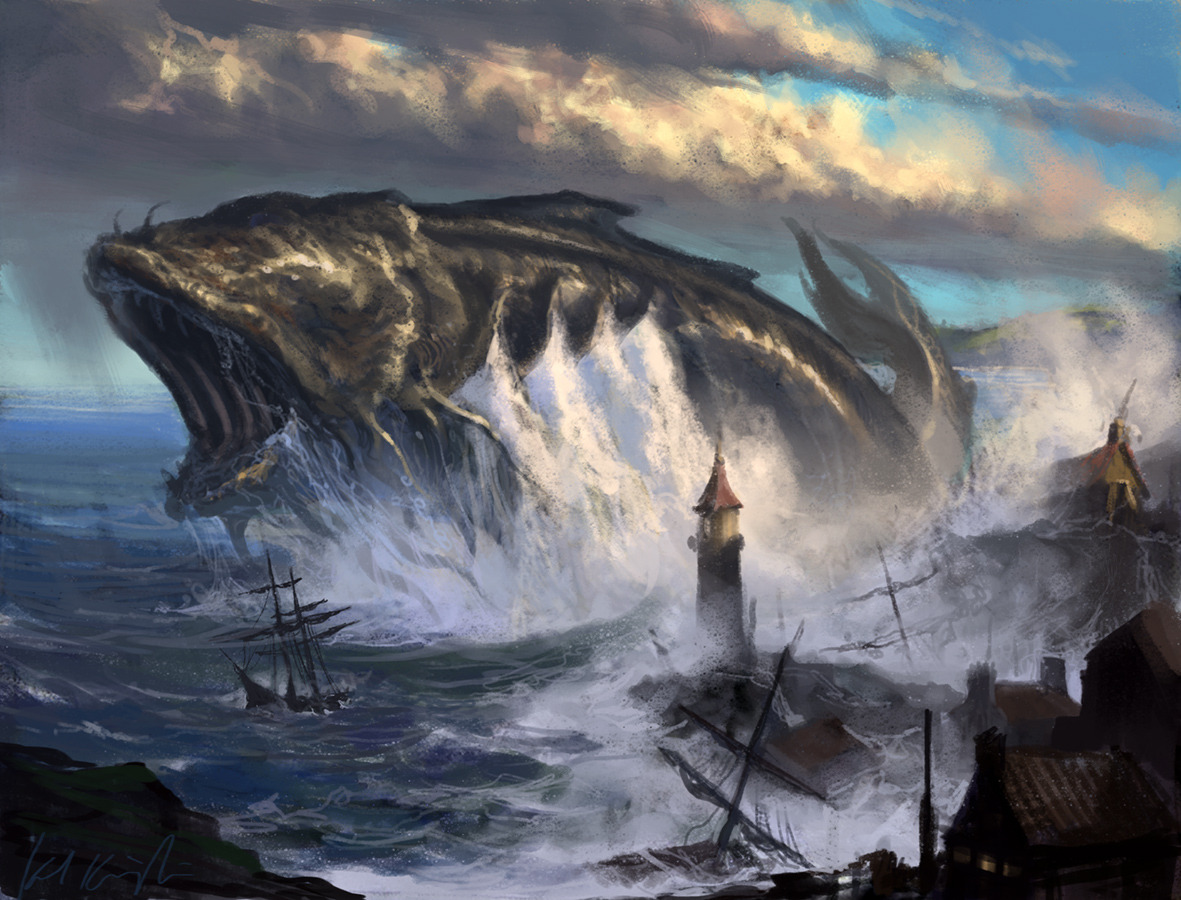
Dragonfish
Gargantuan Beast, unaligned
- Armor Class 12 (Natural Armor)
- Hit Points 155 (10d20+50)
- Speed 40ft. swim
STR DEX CON INT WIS CHA 20(+5) 15 (+2) 21 (+5) 2 (-4) 10 (+0) 4 (-3)
- Saving throws Strength +8, Constitution +8
- Skills Athletics +8, Perception +3
- Senses passive Perception 13
- Proficiency Bonus +3
- Challenge 8(3900 XP)
Endurance When the dragonfish fails a Constitution saving throw that deals damage, it takes half damage. On a successful saving throw, it takes no damage.
Siege Monster The dragonfish deals double damage to buildings and objects
Titanic Frame The dragonfish has advantage on Strength and Constitution saving throws
Titanic Wake While underwater, the dragonfish can generate difficult terrain for creatures other than itself within 30ft. of it as long as the dragonfish's movement speed is not 0 and it is not incapacitated. This effect does not hinder the movement of the dragonfish.
Waterbreathing The dragonfish can only breathe underwater
Actions
Multiattack The dragonfish can make a bite attack and a tail attack. It cannot make both attacks against the same target.
Bite Melee Weapon Attack, +8 to hit:, 5ft., one target. Hit 19(3d8+5) bludgeoning damage. If the target is Large or smaller creature, it must succeed a DC 16 Strength saving throw or be swallowed whole.
A swallowed creature has full cover against attacks and other effects outside the dragonfish and it takes 17(3d8) acid + 17(3d8) bludgeoning damage at the start of the dragonfish's turn.
If the dragonfish takes damage from a swallowed creature, it must succeed a Constitution saving throw equal to half the damage dealt(minimum 10). On a failed save, it regurgitates all swallowed creatures which fall prone in a space within 10ft. of the dragonfish.
If the dragonfish dies, a swallowed creature can escape the corpse by using 20ft. of its movement, exiting prone.
Tail Melee Weapon Attacks, +8 to hit:, 20ft., one target. Hit 22(3d10+5) bludgeoning damage. Creatures hit by this attack must succeed a DC 16 Strength saving throw or be pushed back 10ft. and knocked prone.

Eels
Eels are often confused for being a species of snake, despite the fact that they are actually considered to be a species of fish. This is probably due to the fact that they share some of the behaviors that snakes possess, such as their preternatural speed to lash out at their foes, as well as their ability to bind and constrict prey to prevent its escape.
Eels by nature are ambush hunters, relying on stealth to surprises and quickly immobilize and suffocate its prey. Once bound, the eels can rip into its prey at its own leisure using its sharp teeth. Whenever faced with danger, its body is lined with a thin layer of slime that allows it to easily slip free to make an escape.
Lightning Eel
The lightning eel is an extremely dangerous species of eel that can generate its own natural source of electrical energy. Its body is lined with special organs that emit a powerful shock to any creature that touches it. In fact, the eel is immune to electrical shock, instead it has the ability to store and redirect it at its opponent.
Hunter Eel
Although most eels are solitary hunters, hunter eels prefer strength in numbers. Using their keen sense of smell and superior speed, they are able to quickly chase down their prey. While hunting, they typically prefer to have one member of their pack immobilize their prey while the others rip it to shreds.
Swamp Eels
Swamp eels prefer to live in lakes, swamps, and rivers instead of the ocean. They have built a natural tolerance to poisonous and acid environments. They actually prefer to cloak themselves in muck and mire to ambush their prey. Their filthy lifestyle actually grants them several defensive advantages, such as their poisonous skin and sickening aura of stench.
Leech Eel
Leech eels are a parasitic predator that drains the blood from its victims. It has an uncanny sense of smell to track the slightest scent of blood. Once the scent is acquired, the leech eel relentlessly hunts down its prey, latching on to it with it multiple rows of teeth sucking the blood from its quarry with each bite.
Dragon Eel
The dragon eel is the largest of its kin, causing many sailors to mistake it for an aquatic dragon. These colossal beasts have been known to sink entire vessels, wrapping its colossal around the vessel, dragging it to its doom in the water depths. However, despite its large size, the dragon eel is often a staple food for other apex predators in the ocean such as aquatic dragons, krakens, predatory whales, and leviathans.
Giant Eel Template
Large beast, unaligned
- Armor Class 13(Natural Armor)
- Hit Points 51 (6d10+18)
- Speed 5ft., 30ft. swim
STR DEX CON INT WIS CHA 17(+3) 17 (+3) 16(+3) 2 (-4) 12(+1) 3 (-4)
- Skills Perception +3
- Senses darkvision 60ft., passive Perception 14
- Proficiency Bonus +2
- Challenge 2(450 XP)
Ambusher The eel has advantage on initiative checks and it also has attack rolls against creatures that are surprised or have not taken an action yet.
Slippery Body The eel has advantage on Strength and Dexterity checks and saving throws to escape being grappled or restrained.
Suffocation Creatures grappled by the dire eel cannot breathe and take 6(1d10) bludgeoning damage at the start of each of its turns.
Reactive The giant eel can make a reaction at the end of every creature's turn
Waterbreathing The eel can only breathe underwater
Actions
Bite Melee Weapon Attack +5 to hit:, 10ft., one target. Hit: 10(2d6+3 piercing damage)
Constrict Melee Weapon Attack +5 to hit:, 10ft., one target. Hit: 9(1d10+3 bludgeoning damage) and the if the target is a Medium or smaller creature, it is grappled. Until this grapple ends, that creature is restrained and the eel cannot constrict another target. The eel can make another bite attack against a creature that is grappled.
Dragon Eel Template
Gargantuan beast, unaligned
- Armor Class 13(Natural Armor)
- Hit Points 198 (12d20+72)
- Speed 10ft., 40ft. swim
STR DEX CON INT WIS CHA 22(+6) 17 (+3) 22(+6) 2 (-4) 12(+1) 3 (-4)
- Saving throws Str +10, Dex +7, Con+10
- Skills Perception +5, Stealth +7
- Senses darkvision 60ft., passive Perception 15
- Profiency Bonus +4
- Challenge 9(5000 XP)
Ambusher The dragon eel has advantage on initiative checks and it also has attack rolls against creatures that are surprised or have not taken an action yet.
Slippery Body The dragon eel has advantage on Strength and Dexterity checks and saving throws to escape being grappled or restrained.
Suffocation Creatures grappled by the dragon eel cannot breathe and takes 11(2d10) bludgeoning damage at the start of each of its turns.
Reactive The dragon eel can make a reaction at the end of every creature's turn
Waterbreathing The dragon eel can only breathe underwater
Actions
Bite Melee Weapon Attack +10 to hit:, 20ft., one target. Hit: 34(8d6+6 piercing damage.
Constrict Melee Weapon Attack +10 to hit:, 20ft., one target. Hit: 28(4d10+6 bludgeoning damage) and the if the target is a Large or smaller creature, it is grappled. Until this grapple ends, that creature is restrained and the eel cannot constrict another target. The eel can make another bite attack against a creature that is grappled as a bonus action.
Lightning Eel
- Condition Immunities Paralyzed
- Challenge increases by 2.
Discharge When the eel takes lightning damage, it takes no damage. Creatures within 10ft. of the eel must succeed a DC 13 Constitution saving throw (the DC is 17 for the dragon eel) or become paralyzed until the end of its next turn.
If the target is underwater, it has disadvantage on its saving throw
Charged Body Creatures that hit the eel with a melee attack or grapples it while within 5ft. of the eel takes 9(2d8) lightning damage
Charged Suffocation Creatures grappled by the eel take lightning damage instead of bludgeoning damage
Actions
Bite Melee Weapon Attack +5 to hit:, 10ft., one target. Hit: 10(2d6+3 piercing damage +5(1d8) lightning damage.
Volt Surge(Recharge 5-6) Creatures within a 10ft. radius of the lightning eel must succeed a DC 13 Constitution saving throw (or DC 17 for dragon eel)
On a failed saving throw, creatures in range take 18(4d8) lightning damage on a failed saving throw and are paralyzed until the end of its next turn. While underwater, creatures have disadvantage on this saving throw.
The damage increases to 36 (8d8) for a lightning dragon eel.
On a successful saving throw, creatures take half damage and are not paralyzed
Hunter Eel
- Challenge increases by 1.
Pack Tactics The hunter eel has advantage on attack rolls against a creature that is within 5ft. of one the the eel's allies that is not incapacitated.
Keen Senses The hunter eel has advantage on Wisdom(Perception) checks relying on smell.
Bonus Actions
Aggressive The hunter eel can use its bonus action to move up to its movement speed towards a hostile creature it can see.
Swamp Eel
- Damage Resistances Acid
- Damage Immunties Poison
- Condition Immunities Poisoned
- Challenge increases by 1.
False Appearance The swamp eel is indistinguishable to a mound of mud while it is motionless.
Poisonous Body Creatures that hit the eel with a melee attack or grapples it while within 5ft. of the eel takes 5 (1d8) acid damage.
Poison Fang Creature hit by the eel's bite attack are poisoned until the end of its next turn.
Stench Any creature other than the swamp eel within 5 feet of it must make a DC 12 Constitution saving throw or be poisoned until the end of its next turn. The DC is 18 for a dragon eel.
On a successful save, creatures are immune to being poisoned in this manner for the next 24 hours
Leech Eel
- Challenge increases by 1.
Blood Sense The leech eel can pinpoint the location of a creature below half its hitpoint maximum within 1 mile of it. That creature must have blood for this ability to work
Blood Frenzy When the leech eel make a bite attack against a creature below its hitpoint maximum, it make an additional bite attack as part of its action.
Blood Drinker When the leech eel hits a creature with its bite attack, it regains a number of hitpoints equal to half the damage dealt.
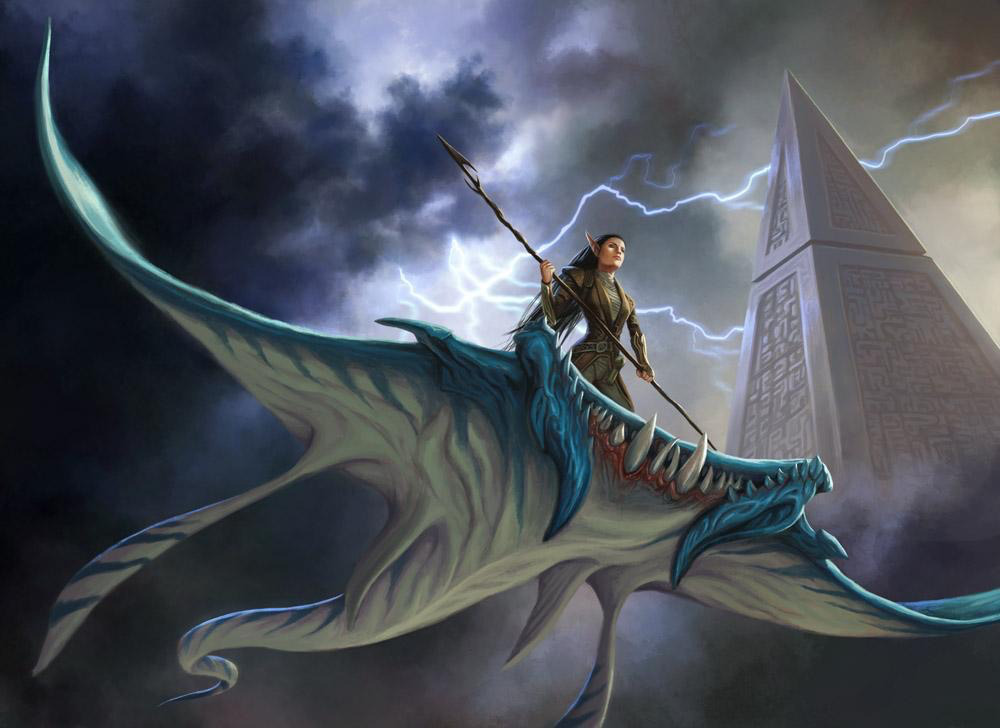
Mantas
Mantas are a rather strange breed of fish sporting winglike fins and a wiry barbed tail. Mantas seem to emulate the motion of flying as they effortlessly glide through coral reefs and the open seas in large schools or flocks. When they are not swimming, they choose to rest on the seafloor, wherein they can blend in with their surroundings to avoid predators. Their natural majesty makes them respected by many aquatic and coastal civilizations. In fact, several settlements have begun to tame these creatures as mounts or to farm them as a source of food.
Stormtide Manta
The stormtide manta is a rare but easily recognizable variant of manta. Its body is covered with bioluminescent patterns that are believed to be individually unique. It is believed that the stormtide manta primarily resides in the deepest depths of the sea, only coming up to the surface during a storm. Because of this, sailors often associate their appearance as an omen for a terrible storm.
Despite their beautiful appearance, stormtide mantas can be quite dangerous. Although they are not aggressive, they do have numerous defenses that can prove to be quite lethal.
Their primary weapon is their barbed stinger-like tail that is coated with a paralyzing venom. Additionally, their bodies can generate lethal charges of electricity that can shock predators. However, their unique ability to absorb and redirect lightning. This trait is believed to be responsible for why these creatures are attracted to storms.
Cloud Mantas
Cloud mantas are the most popular of all kinds of mantas thanks to their very friendly demeanor. At times, these creatures can be too friendly, as small flocks have been known to swarm individuals they like when they want attention.
Another reason for their popularity is their ability to leap out of the water to fly for short periods of times to catch small airborne prey. As a result, cloud mantas are common mounts in aquatic and coastal cities. However, cloud mantas rarely travel too far from the ocean as they must return to the sea, for they can only breathe underwater and must hold their breath while airborne.
Emperor Manta
The colossal emperor manta is a true sight to behold. Oftentimes, the first sign of the appearance of emperor mantas is that the surrounding water begins to glow with an otherworldly light, as these glow from their bioluminescent bodies causes them to illuminate the surrounding sea. However, the most peculiar ability of these creatures are their ability to seemingly turn invisible while underwater, as their scales seems to perfectly mimic the surrounding ocean.
In general, these creatures are very peaceful, but will use their colossal fins and whip-like tail to repel any creature foolish enough to attack it.
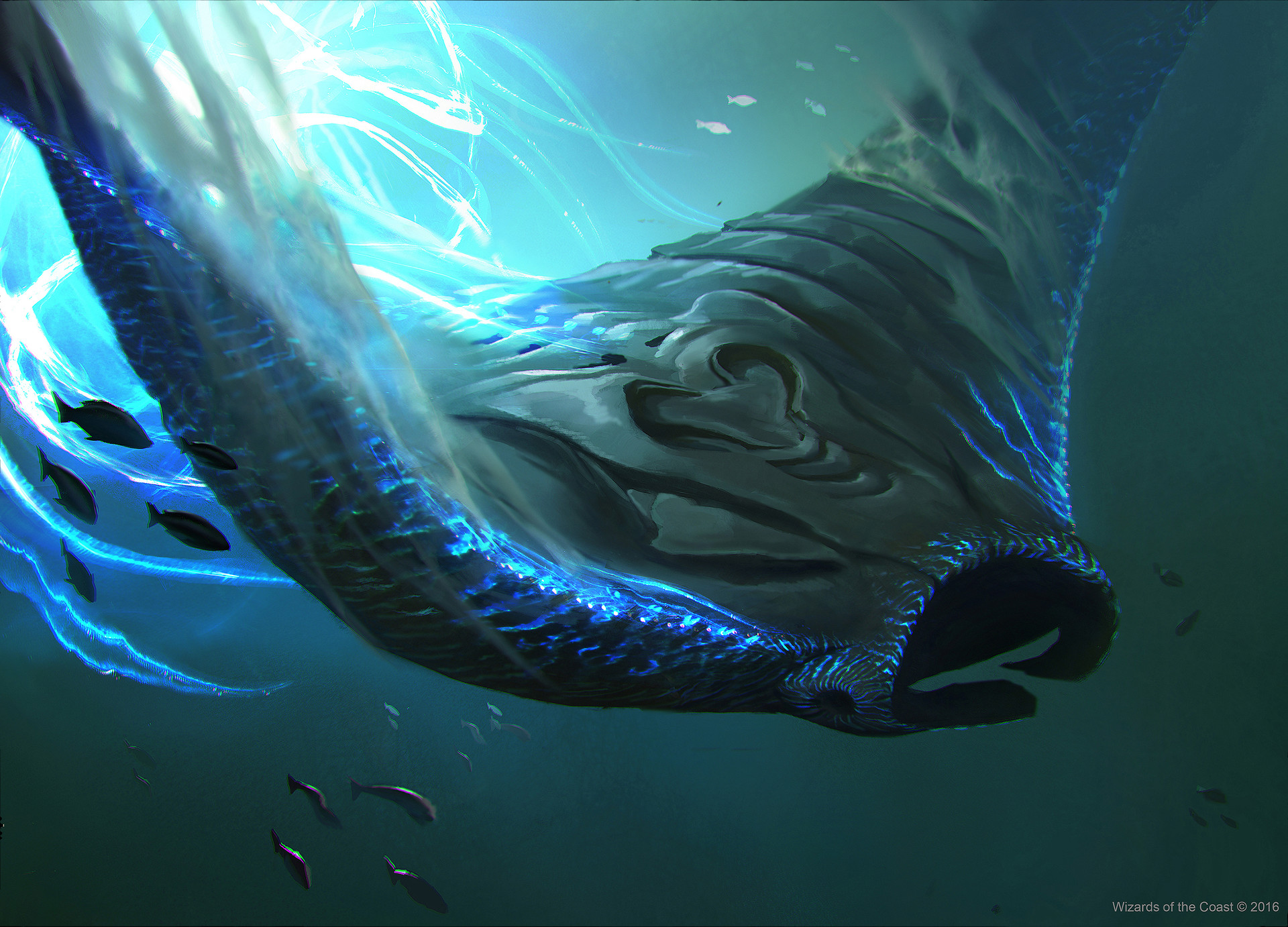
Stormtide Manta
large Beast, unaligned
- Armor Class 12 (Natural Armor)
- Hit Points 58 (8d10+16)
- Speed 40ft. swim, 20ft. burrow
STR DEX CON INT WIS CHA 15(+2) 15 (+2) 15 (+2) 1 (-5) 10 (+0) 4 (-3)
- Skills Perception +2, Acrobatics +4
- Damage Resistances Poison
- Condition Immunities Paralyzed
- Senses blindsight 120ft., passive Perception 12
- Proficiency Bonus +2
- Challenge 3(700 XP)
Bioluminesence The stormtide manta has advantage on magical saving throws. It can uses its bonus action to emit or dismiss a bright light in a 10ft radius and a dim light an additional 10ft.
Charged Skin When a creature grapples or hits the stormtide manta with a melee weapon attack, it takes 5(1d8) lightning damage
Discharge When the stormtide manta takes lightning damage, it takes no damage and can force all creatures within a 10ft. radius to make a Constitution saving throw.
On a failed saving throw, creatures take lightning damage equal to the amount of lightning damage dealt and take half damage on a successful save.
If creatures are underwater, they have disadvantage on this saving throw.
False Appearance While the stormtide manta remains motionless, it is indistinguishable from the sea floor
Poison Resilience The stormtide manta has advantage on saving throws against being poisoned
Waterbreathing The manta can only breathe underwater
Actions
Sting Melee Weapon Attack +4 to hit:, 10ft., one target. Hit 6(1d6+2) piercing damage. Creatures hit by this attack must succeed a DC 12 Constitution saving throw or take 14(4d6 poison) damage and poisoned until the end of its next turn.. While poisoned in this manner, creatures are paralyzed.
On a successful saving throw, creatures take half damage and are not poisoned.

Cloud Manta
large Beast, unaligned
- Armor Class 13 (Natural Armor)
- Hit Points 30 (4d10+8)
- Speed 40ft. swim, 40ft. fly
STR DEX CON INT WIS CHA 15(+2) 17 (+3) 15 (+2) 1 (-5) 10 (+0) 4 (-3)
- Skills Perception +2, Acrobatics +7
- Senses blindsight 120ft., passive Perception 12
- Proficiency Bonus +2
- Challenge 2(450 XP)
False Appearance While the cloud manta remains motionless, it is indistinguishable from the sea floor
Flyby The cloud manta can fly out of the reach of an creature without provoking opportunity attack
Hold Breath The cloud manta can hold its breath up to one hour.
Nimble Swimmer The cloud manta can swim out of the reach of an creature without provoking opportunity attack
Waterbreathing The cloud manta can only breathe underwater
Actions
Multiattack The Cloud Manta can make a bite attack and a tail attack. It cannot target the same creature with both attacks
Bite Melee Weapon Attack, +4 to hit:, 5ft., one target. Hit 7(1d8+2) piercing damage.
Tail Melee Weapon Attack, +4 to hit:, 5ft., one target. Hit 6(1d6+2) slashing damage.
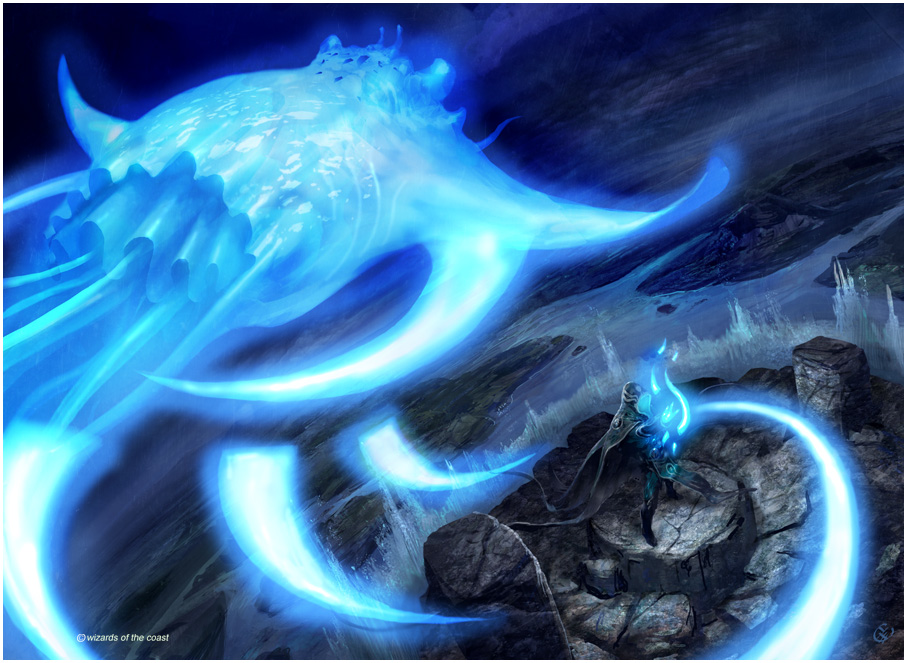
Emperor Manta
Gargantuan Beast, unaligned
- Armor Class 12 (Natural Armor)
- Hit Points 124 (8d20+40)
- Speed 60ft. swim
STR DEX CON INT WIS CHA 20(+5) 15 (+2) 20 (+5) 1 (-5) 10 (+0) 4 (-3)
- Skills Perception +3, Athletics +5
- Senses blindsight 120ft., passive Perception 12
- Proficiency Bonus +3
- Challenge 5(1800 XP)
Bioluminesence The emperor manta has advantage on magical saving throws. It can uses its bonus action to emit or dismiss a bright light in a 10ft radius and a dim light an additional 10ft.
False Appearance While the emperor manta remains motionless, it is indistinguishable from the sea floor
Siege Monster The emperor manta deals double damage to buildings and objects
Waterbreathing The emperor manta can only breathe underwater
Actions
Tail Melee Weapon Attack, +8 to hit:, 20ft., one target. Hit 25(3d12+5) slashing damage. Creatures hit by this attack must succeed a DC 16 Constitution saving throw or become stunned until the end of its next turn
Wing Melee Weapon Attack, +8 to hit:, 10ft., all targets in range. Hit 22(3d10+5) bludgeoning damage. If the target is a Huge or smaller creature, it is pushed back 10ft. and knocked prone.
The manta can swim up to half its movement speed without provoking opportunity attacks as part of this action.
Bonus Actions
Water Cloak While underwater, the emperor manta can use its bonus action to turn invisible until its attacks or until its Concentration ends, as if concentrating on a spell.
Crabs
At first glance, crabs can sometimes be confused for water-dwelling insects. Although loosely related, crabs are distinctly different in physiology from their land-dwelling kin. Although they have many species, most crabs share the same common traits of large pincers to grasp prey and a squat, thick exoskeleton that protects it from harm.
Crabs tend to be scavengers and bottom feeders, eating pretty much anything that can get their claws on. Crabs tend to keep to themselves, largely ignoring humanoids, but are known to be somewhat territorial when their space is intruded upon.
Individually they can pose a decent threat thanks to the sharp pincers; however, antagonizing crabs can quickly prove deadly as they are very social creatures.
Nomad Crabs
Nomad crabs to carry beautiful shells upon their back, often abandoned, or at times stolen from other sea dwelling creatures. These shells serve as an extra layer of defense for these crab, as well as shelter for when it sleeps.
These crabs keep their mobile homes with them, either until they outgrow them or find another shell that it likes better. In regions where shells are scarce, nomad crabs have been known to engage non-lethal duels over shells.
In fact, these shells play a central role in the nomad crab's life. They get their unique name for their migratory treks they take along beaches and the ocean floor. From various account from druids and other custodians of the seas, it is believed that these crabs embark on these migrations in search for the perfect shell, traveling in large groups in their quest.
It has been reported that the largest of these migrations can include hundreds of crabs. As a result, many coastal cities and settlements actually have festivals or holidays scheduled around the arrival of a migrating troupe of nomad crabs passing through their region.
Ice Crab
Ice crabs primarily live in regions of snow and ice. Their shells are perfectly adapted for their frigid environment, as their shells seems to simulate the appearance of ice, making it nearly indistinguishable from their surroundings. Ice crabs also seem to sport a rather unique appearance, as their claws and appendages are actually covered in a thick layer of hair, giving them a fur-like appearance.
Swamp Crabs
Swamp crabs prefer to make their homes in swamps and at times sewers beneath cities rather than the ocean. Due to their time living in such filthy environments, they have gained a natural tolerance to poisons and acidic toxins. The presence of swamp crabs can be easily recognized thanks to its sickening stench that they give off to deter predators.
Spiny Crabs
Spiny crabs probably have the most terrifying appearance of all crabs. These creatures seem to resemble large aquatic spiders thanks to their elongated appendages, allowing them to traverse difficult terrain with ease. Their body is also covered with hundreds of spikes to discourage all but the most foolhardy of predators.
Hulk Crab
Hulk crabs are notorious for their oversized and extremely armored pincers that almost see to resemble muscular arms. Thanks to the size of these pincers, these crabs can perform impressive feats of strength.
In fact, these crabs seem to make a sport of proving its strength against its other kin, engaging in pincer matches with its rivals or attempting to break objects that it deems to be difficult to tear down. Unfortunately, this makes these crabs quite the culprit for vandalism and property damage.
Their brazen nature also makes them rather difficult to deal with, as they are prone to throw objects and boulders at anyone who trespasses their territory or threatens them.
Divine Crabs
Interactions between crabs is already a somewhat strange phenomenon in general. However, the concept of divine crabs makes it even more perplexing. Divine crabs are the largest of all crabs, reaching to size rivaling that of a medium-sized vessel.
As suggested in their names, divine crabs seem to give off a god-like presence to their lesser kin. Any crab that beholds the presence of a divine crab becomes enthralled by their new overlord. As a result, the presence of the divine crab is always preceded by an unnatural amount of crabs of all sizes in the region.
Once enthralled, these crabs are forever under its control unless the divine crab dies or another rival divine crab challenges its authority. Such an encounter usually results in a legendary battle (at least for the crabs) as both titans and their minions battle for dominance as the loser gains control of whatever crabs are left.
The sheer amount of crabs following in the wakes of these titans makes its mere presence a major inconvenience for nearby settlements. Handling such an encounter requires a lot of careful thought and tact, for an angered divine crab usually means a legion of angry crabs following its every command.
How this effect is occurs is not completely understood, some believe it could be an innate magical effect, while others believe it is a natural phenomenon. Thankfully, such encounters are rare as divine crabs only seem to come from the deepest parts of the ocean every couple of decades and at times, even entire centuries
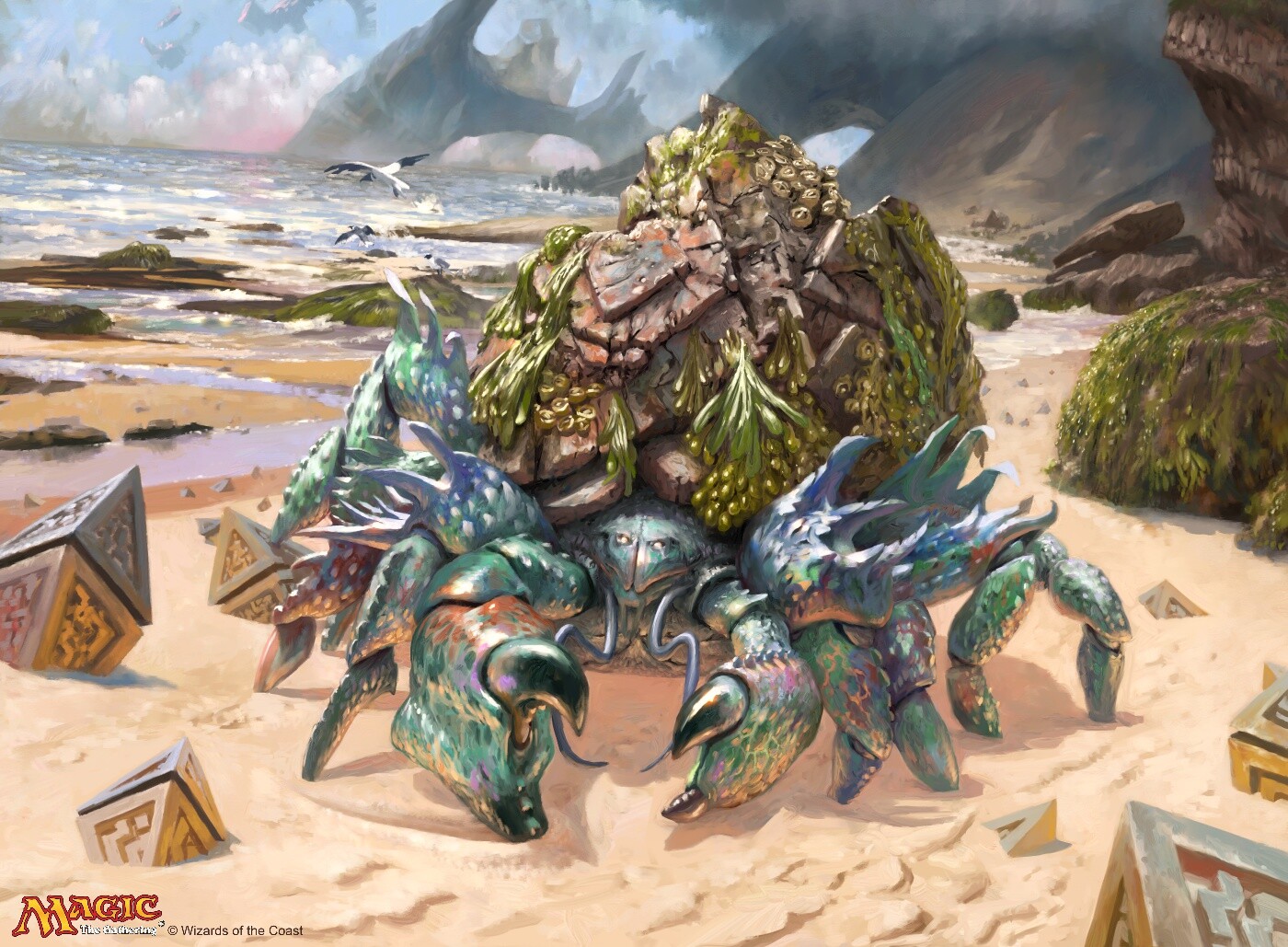
Giant Crab Template
medium beast, unaligned
- Armor Class 14(Natural Armor)
- Hit Points 20 (3d8+6)
- Speed 30ft., 30ft. swim, 30ft. burrow, 30ft. climb
STR DEX CON INT WIS CHA 16(+3) 8 (-1) 14(+2) 1 (-5) 9 (-1) 3 (-4)
- Skills Athletics +5, Perception +1, Stealth +3
- Senses blindsight 30ft., passive Perception 11
- Proficiency Bonus +2
- Challenge 1(200 XP)
Amphibious The crab breathe in air and in water
False Appearance While motionless, the crab is indistinguishable from a rock or piece of coral
Powerful Build The crab counts as one size larger for the purposes of carrying, pushing, shoving, lifting, or grappling.
Spider Climb The crab can climb difficult surfaces, including upside down on ceilings, without needing to make an ability check.
Thick Exoskeleton Whenever the crab takes bludgeoning piercing, or slashing damage, the crab can reduce the damage taken by 5.
Actions
Multiattack The giant crab can make two attacks with its claws
Claw. Melee Weapon Attack, +5 to hit:, 5ft., one target. Hit 7(1d6+3) bludgeoning damage and if the the target is a Medium or smaller creature, it is grappled(escape DC 13).
The crab has two claws, each of which can grapple only one target. While grappling a creature in this manner, it cannot make a pincer attack against another target but can use its bonus action to make an additional pincer attack against a grappled creature
Stone Ranged Weapon Attack, +5 to hit:, 30/60ft., one target. Hit 12(2d8+3) bludgeoning damage . Creatures hit by this attack must succeed a DC 13 Strength saving throw or be knocked prone
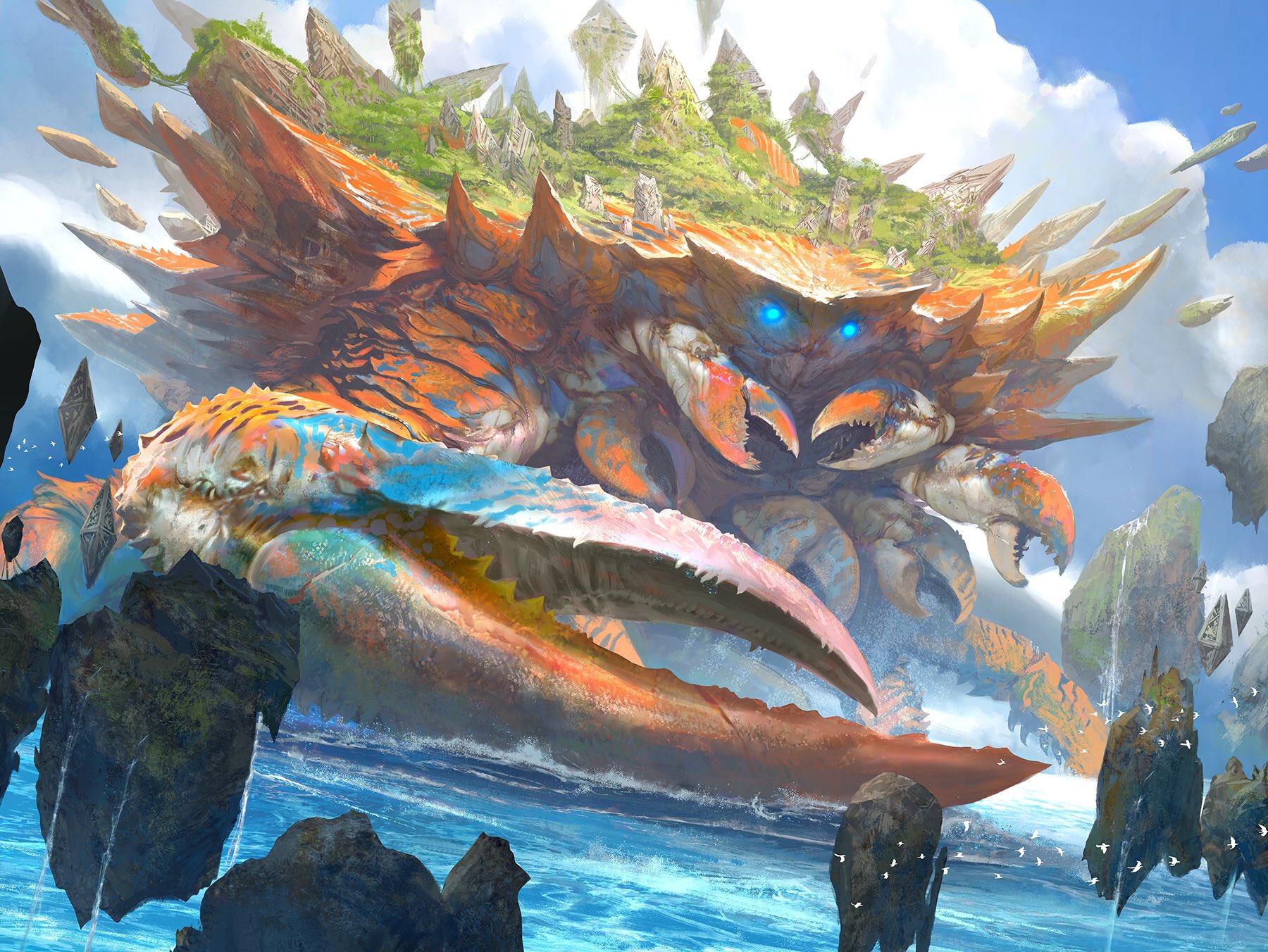
Divine Crab Template
Huge beast, unaligned
- Armor Class 16(Natural Armor)
- Hit Points 120 (12d12+48)
- Speed 30ft., 30ft. swim, 30ft. burrow, 30ft. climb
STR DEX CON INT WIS CHA 21(+5) 8 (-1) 19(+4) 1 (-5) 9 (-1) 13 (+1)
- Saving throws Strength +9, Constitution +9
- Skills Athletics +9, Perception +3, Stealth +7
- Senses blindsight 60ft., passive Perception 13
- Proficiency Bonus +4
- Challenge 10(5900 XP)
Amphibious The crab breathe in air and in water
False Appearance While motionless, the crab is indistinguishable from a rock or piece of coral
False Deity Any crab that is aware of it within 120ft. must succeed a DC 12 Wisdom saving throw or become charmed by the Divine Crab at the start of its turn or when it first enters this radius.
On a failed saving throw, the crabs treat the divine crab as its ally and obeys its commands without question(no action required).
Other divine crabs are immune to this effect. This effect ends if the divine crab releases a crab from its influence or if the divine crab dies.
Upon a successful save, the crab is immune to this effect for the next 24 hours.
Powerful Build The crab counts as one size larger for the purposes of carrying, pushing, shoving, lifting, or grappling.
Siege Monster The crab deals double damage to buildings and objects
Spider Climb The crab can climb difficult surfaces, including upside down on ceilings, without needing to make an ability check.
Thick Exoskeleton Whenever the crab takes bludgeoning piercing, or slashing damage, the crab can reduce the damage taken by 10.
Actions
Multiattack The divine crab can make two attacks with its claws
Pincer. Melee Weapon Attacks, +9 to hit:, 5ft., , one target. Hit 27(4d10+5) bludgeoning damage and if the the target is a Large or smaller creature, it is grappled and restrained (escape DC 16).
The crab has two claws, each of which can grapple only one target. While grappling a creature in this manner, it cannot make a pincer attack against another target but can use its bonus action to make an additional pincer attack against a grappled creature
Boulder Ranged Weapon Attack, +9 to hit:, 60/120ft., , one target. Hit 57(8d12+5) bludgeoning damage . Upon a hit, creatures must succeed a DC 17 Strength saving throw or be knocked prone.
Nomad Crab
- Challenge increases by 1
Armored Shell When the Nomad crab succeeds a Constitution or Dexterity saving throw against an effect that causes it to take no damage, it takes no damage instead. Upon a failed saving throw, the crab takes half damage instead.
Reactions
Shell Defense As a reaction, the crab can add +5 to its armor class against the next attack roll made against it. If the attack still hits, the crab gains resistance to that damage.
Ice Crab
- Damage Resistances Cold
Ice Treader The crab can move across and climb icy surfaces without needing to make an ability check. Additionally, difficult terrain composed of ice or snow doesn't cost it extra movement.
Snow Camouflage The crab has advantage on Dexterity (Stealth) checks it makes in any terrain with ample obscuring snow or ice. While these conditions are met, it can use its bonus action to Hide
Swamp Crab
- Damage Resistances Acid
- Damage Immunities Poison
- Challenge increases by 1
Stench Any creature other than the swamp crab within 5 feet of it must make a DC 12 Constitution saving throw or be poisoned until the end of its next turn. On a successful save, creatures are immune to being poisoned in this manner for the next 24 hours
Spiny Crab
- Challenge increases by 1
Elongated Legs The spiny crab can travel through the space of a creature one sizer or smaller than it without expending an additional movement speed. It can also end its turn in another creature's space
Elongated Claws The crab's melee attack have an increased reach by 5ft.
Looming Form The spiny crab has advantage on attack rolls against creature's one size smaller than it. Additionally, creatures one size smaller than it has disadvantage on attack rolls against it.
Spined Body Creatures that hit the spiny crab with a melee attack or grapples it while within 5ft. of it take 5(1d8) piercing damage
Hulk Crab
- Challenge increases by 1
Powerful Build The hulk crab counts as one size larger for the purpose of pushing, shoving, carrying, and grappling
Siege Monster The hulk crab deals double damage to buildings and objects
Superior Strength The hulk crab has advantage on Strength checks and saving throws
Vice Grip Creatures grappled by the crab are restrained and have disadvantage on saving throws to escape
Jellyfish
Jellyfish are some of the most beautiful but deadly creatures in the entire ocean. These creatures have a somewhat simple appearance due to their translucent disc-like body and a string-like array of tendrils. Despite its seemingly harmless appearance, jellyfish are quite deadly thanks to their extremely venomous tendrils. Even the smallest jellyfish has the capability of killing a fully grown humanoid.
Although these creatures aren't malevolent hunters as they tend to prefer to eat smaller prey, they float into areas where humanoids often swim, oftentimes in large numbers wherein many humanoids meet their doom from an accidental touch.
Because of their potent tendrils, many underwater civilizations tame them to guard strongholds, preventing entry to unwanted intruders. Others farm them to utilize their toxins into lethal weapons.
Frostblood Jellyfish
The frostblood jellyfish prefers to live in frigid waters, but have been known to make their home anywhere. As their name suggests, creatures unfortunate enough to be poisoned by these creature can have their blood transformed into a numbing frost that drains its stamina.
Vampiric Jellyfish
Vampiric jellyfish are probably the most dangerous of all jellyfish. As their name suggests, vampiric jellyfish prefer to feast on the blood of living creatures. Their tendrils are lined with tiny barbs that inject poison that amplifies blood loss in a creature. This poison prevents a creature from healing itself, actually reversing its effects to inflict more damage on its prey instead.
Because of their appetite for blood, they intentionally float towards large groups of creatures in hope of ensnaring an unfortunate victim.
Glass Jellyfish
Glass jellyfish are probably responsible for the most humanoid deaths to aquatic creatures. The primary reason is for their unique ability to seemingly become invisible underwater. Their bodies are completely transparent, making them nearly impossible to see. Because of this ability, many unfortunate victims never even are aware they were slain by the glass jellyfish as they wandered into its tendrils.
Ghost Jellyfish
Ghost jellyfish are the most beautiful of all jellyfish. Their natural bioluminescence gives them an ethereal, otherworldly appearance. Encountering a ghost jellyfish swarm is one of the most beautiful encounters on the open seas as the ocean transforms into a starscape illuminated by hundreds of ghost jellyfish.
However, this beauty also has a lethal twist as it has a somewhat hypnotic presence to it. Although these jellyfish use these lights to attract fish, humanoids that get too close to the ocean's surface during an encounter can be transfixed by the light, causing them to jump overboard into the writhing tendrils of these jellyfish.
Lightning Jellyfish
These jellyfish have falsely been rumored to cause massive storms at sea. This myth came about as large swarms of these jellyfish seem to always be present during a storm. However, these jellyfish actually are attracted to the electrical energy generated by the lightning generated by these storms.
This is probably due to their unique ability to absorb lightning energy as a source of food and energy. This ability makes them a bit more dangerous than most jellyfish, as they tend to discharge excess electricity to their surroundings.
Floating Jellyfish
Floating jellyfish are the rarest and most beautiful of all jellyfish. These jellyfish are nearly identical to their aquatic relatives, except for the fact that they have developed special air sacs in their disc-like bodies that are able to harness the slightest breeze to give them the ability to float.
Floating jellyfish also utilize similar hunting tactics as other jellyfish, as they tend to cluster in large groups. Such clusters are able to create an impossible tangle of stinging tendrils that will ensnare and incapacitate all manner of prey ranging from insect, birds, and at times even larger prey such as humanoids and beasts.

Jellyfish Template
Tiny beast, unaligned
- Armor Class 12(Natural Armor)
- Hit Points 5 (2d4)
- Speed 20ft. swim
STR DEX CON INT WIS CHA 1(-5) 15 (+2) 10(+0) 1 (-5) 9(-1) 11 (+0)
- Skills Perception +1
- Senses blindsight 30ft., passive Perception 11
- Proficiency Bonus +2
- Challenge 1/2(200 XP)
Waterbreathing Can breathe underwater
Water Dependency The jellyfish takes 5(1d8) acid damage every minute it goes without exposure to water.
Tendrils Creatures that first enter or start its turn within 5ft. of the Jellyfish must succeed a DC 10 Constitution saving throw or take 7(2d6) poison damage become poisoned until the end of its next turn.
On a successful save, creatures take half damage and are not poisoned.
Giant Jellyfish Template
large beast, unaligned
- Armor Class 12(Natural Armor)
- Hit Points 23 (3d10+6)
- Speed 20ft. swim
STR DEX CON INT WIS CHA 16(+3) 15 (+2) 15(+2) 1 (-5) 9(-1) 11(+0)
- Skills Perception +1
- Senses blindsight 30ft., passive Perception 11
- Proficiency Bonus +2
- Challenge 2(450 XP)
Waterbreathing Can breathe underwater
Water Dependency The jellyfish takes 5(1d8) acid damage every minute it goes without exposure to water.
Tendrils Creatures that first enter or start its turn within 10ft. of the Giant Jellyfish must succeed a DC 10 Constitution saving throw or take 14(4d6) poison damage become poisoned until the end of its next turn.
On a successful save, creatures take half damage and are not poisoned.
Actions
Tendrils Melee Weapon Attack, +5 to hit:, 10ft., one target. Hit: If the target is a creature that is Medium or smaller, that creature is grappled (escape DC 13). Until the grapple ends, the target is considered restrained

Colossal Jellyfish Template
Gargauntuan beast, unaligned
- Armor Class 12(Natural Armor)
- Hit Points 155 (10d20+50)
- Speed 30ft. swim
STR DEX CON INT WIS CHA 21(+5) 15 (+2) 20(+5) 1 (-5) 9(-1) 16 (+3)
- Skills Perception +3
- Senses blindsight 120ft., passive Perception 12
- Proficiency Bonus +3
- Challenge 6(2300 XP)
Tendrils Creatures that first enter or start its turn within 20ft. of the Colossal Jellyfish must succeed a DC 18 Constitution saving throw or take 21(6d6) poison damage become poisoned until the end of its next turn. On a successful save, creatures take half damage and are not poisoned.
Waterbreathing The jellyfish can only breathe underwater
Water Dependency The jellyfish takes 5(1d8) acid damage every minute it goes without exposure to water.
Actions
Tendrils +8 to hit:, 20ft., all creatures in range. Hit: If the target is a creature that is Huge or smaller, that creature is considered grappled(escape DC 17). Until the grapple ends, the target is restrained.
Frostblood Jellyfish
- Damage Resistances Cold
- Challenge increases by 1.
Frostblood Poison Creatures poisoned by the Jellyfish take 9(2d8) cold damage at the start of each of its turns and have its movement speed halved for the duration of this effect.
Vampiric Jellyfish
- Damage Resistances Poison, Necrotic
- Challenge increases by 1.
Deathblood Poison The jellyfish deals necrotic damage instead of poison damage.
Additionally, creatures poisoned by the Jellyfish cannot regain hitpoints for the duration of this effect.
Whenever that creature recovers hitpoints, it takes necrotic damage equal to the amount healed instead.
Reactions
Life Drain When creature takes damage from the jellyfish's tendrils, it can recover a number of hit points equal to half the necrotic damage dealt to that creature
Glass Jellyfish
- Challenge increases by 1.
Clear Body While underwater, the jellyfish is considered to be invisible
Bonus Actions
Aquatic Camouflage The glass jellyfish can use its bonus action to Hide.
Ghost Jellyfish
- Challenge increases by 2.
Bioluminescence The jellyfish has advantage on saving throws against spell effects. The jellyfish emits bright light in a 10ft. radius and dim light an additional 10ft.
Hypnotic Presence Each creature within 30ft. of the jellyfish that can see it must succeed a DC 12 Wisdom saving throw (DC 14 for colossal jellyfish) or become charmed by the Jellyfish.
Creatures charmed in this manner are incapacitated and must all of its movement speed to move as close as it can towards the jellyfish.
If it is already within 5ft. of the jellyfish, it movement speed is reduced to 0.
Creatures can repeat their saving throw at the end of each of its turns to end it upon a successful save. Upon ending this effect, that creature is immune to being charmed in this manner for the next 24 hours.
Narcotic Toxins Creatures poisoned by the ghost jellyfish cannot repeat their saving throw against the effects of charm as a result of taking damage.
Lightning Jellyfish
- Condition Immunities Paralyzed
- Challenge increases by 1.
Discharge When the jellyfish takes lightning damage, it takes no damage. Creatures within 10ft. of the Jellyfish must succeed a Constitution saving throw or become paralyzed until the end of its next turn pm a failed saving throw.
Paralytic Poison Creatures poisoned by the jellyfish are paralyzed for the duration of the effect.

Dire Starfish
Dire starfish are colossal variants of the starfish. At first glance, these aquatic invertebrates are easily mistakes for star-shaped coral due to their largely dormant behavior. However, in reality, starfish are actually voracious predators that devour mollusks and clams in the vicinity. As a matter of fact, starfish are often viewed as a pest for many coastal settlements do to their insatiable appetite.
If a normal starfish infestation was bad, the presence of dire variants is much worse. If dire starfish populations are not controlled, they can easily devour an entire coral reef within a matter of weeks.
Dire Starfish Tactics
However, dealing with these creatures is no easy task. Fighting a dire starfish can be an extremely risky endeavor. Despite their slow and lumbering forms, these creatures are extremely strong and are able to shatter the bones of a humanoid they catch in their grasp. To make matters worse, they are notoriously hard to kill due to their heightened regeneration. They have even been known to come back to life after being dismembered.
If one manages to fully kill a starfish, they still must be wary of its remains for if left to grow long enough, it will spawn numerous clones of the original.
Reefbreaker Starfish
Few individuals have come face to face with the colossal monstrosity known as the reefbreaker starfish. These creatures resemble normal starfish but can possess dozens of thick pseudopods spanning up to 30 ft. in width. A single reefbreaker starfish is able to completely devour a medium-sized reef within a matter of days if left unchecked.
Due to their massive appetites, these starfish tend to be quite nomadic, often traveling hundreds of miles across the sea floor in search of food. Due to the vast expanse of the ocean and their relatively slowly gait, the reefbreaker starfish has learned to expanded it diet.
In fact, it is not uncommon to find a reefbreaker starfish near underwater shipwrecks, where these beasts begin to devour the ship's watery remains as well as any corals and other aquatic life that makes its home in these ruins.
Reefbreaker Starfish Tactics
Although these lumbering titans can be quite slow, they are known to be quite aggressive whenever their meals are interrupted. Most hostile encounters with reefbreaker starfish has been when individuals stumbled across one of these starfish while exploring a shipwreck or ancient reef.
Although these starfish prefer to eat coral and mollusks, they will not hesitate to devour their attackers by engulfing them in a crushing embrace while ripping them apart with their toothy maw contained in the center of their body.
Dire Starfish
Large beast, unaligned
- Armor Class 8(Natural Armor)
- Hit Points 57 (6d10+24)
- Speed 10ft., 10ft. swim, 10ft. climb
STR DEX CON INT WIS CHA 18(+4) 6 (-2) 18(+4) 1 (-5) 8 (-1) 10 (+0)
- Saving Throws Str +6, Con +6
- Skills Athletics +6, Perception +1, Stealth +3
- Senses blindsight 30ft., passive Perception 11
- Proficiency Bonus +2
- Challenge 4(1100 XP)
Coral Camouflage The starfish has advantage on Dexterity(Stealth) checks while obscured by ample coral terrain.
Post Mortem Clones When the starfish dies, if its remains are not destroyed, it will regrow into 3(1d4) fully grown dire starfish after 1 week.
Powerful Build The starfish counts as one size larger for the purposes of carrying, pushing, shoving, lifting, or grappling.
Spider Climb The starfish can climb difficult surfaces, including upside down on ceilings, without needing to make an ability check.
Spined Body If a creature grapples or hits the starfish with a melee weapon attack while within 5ft. of it, that creature takes 5(1d8) piercing damage.
Regeneration At the start of each of its turns, the starfish can recover 10 hitpoints.
Regenerative Fortitude When the dire starfish drops to 0 hitpoints, it can make a Constitution saving throw with a DC equal to half the damage dealt(minimum 10). On a successful saving throw, the starfish regains 1 hitpoint instead.
Waterbreathing The dire starfish can only breathe underwater
Actions
Crushing Embrace. Melee Weapon Attack, +6 to hit:, 5ft., , one target. Hit 18(4d6+4) bludgeoning damage. Upon a hit, a creature the starfish's size or smaller is considered grappled and restrained.
The starfish can only grapple one creature at a time in this manner and cannot target another creature with its crushing embrace for the duration of this grapple.
Bonus Actions
Ventral Maw Melee Weapon Attack, +6 to hit:, 5ft., , one grappled target. Hit 14(4d4+4) piercing damage.
Reefbreaker Starfish
Huge beast, unaligned
- Armor Class 14(Natural Armor)
- Hit Points 150 (12d12+72)
- Speed 20ft., 20ft. swim, 20ft. climb
STR DEX CON INT WIS CHA 23(+6) 6 (-2) 23(+6) 1 (-5) 8 (-1) 10 (+0)
- Saving Throws Str +10, Con +10
- Skills Athletics +10, Perception +3, Stealth +6
- Senses blindsight 60ft., passive Perception 13
- Proficiency Bonus +4
- Challenge 12(8400 XP)
Coral Camouflage The reefbreaker starfish has advantage on Dexterity(Stealth) checks while obscured by ample coral terrain.
Post Mortem Clones When the starfish dies, if its remains are not destroyed, it will regrow into 3(1d4) fully grown reefbreaker starfish after 1 week.
Powerful Build The reefbreaker starfish counts as one size larger for the purposes of carrying, pushing, shoving, lifting, or grappling.
Siege Monster The reefbreaker starfish can deal double damage to buildings and objects
Spider Climb The reefbreaker starfish can climb difficult surfaces, including upside down on ceilings, without needing to make an ability check.
Spined Body If a creature grapples or hits the reefbreaker starfish with a melee weapon attack while within 5ft. of it, that creature takes 9(2d8) piercing damage.
Regeneration At the start of each of its turns, the reefbreaker starfish can recover 30 hitpoints.
Regenerative Fortitude When the reefbreaker starfish drops to 0 hitpoints, it can make a Constitution saving throw with a DC equal to half the damage dealt(minimum 10). On a successful saving throw, the starfish regains 1 hitpoint instead.
Waterbreathing The reefbreaker starfish can only breathe underwater
Actions
Crushing Embrace. Melee Weapon Attack, +10 to hit:, 10ft., , one target. Hit 32(4d12+6) bludgeoning damage. Upon a hit, a creature the starfish's size or smaller is considered grappled and restrained.
The starfish can only grapple one creature at a time in this manner and cannot target another creature with its crushing embrace for the duration of this grapple.
Bonus Actions
Ventral Maw Melee Weapon Attack, +10 to hit:, 5ft., , one grappled target. Hit 28(4d10+6) piercing damage.

Reef Crawler
One of the largest organisms in all the Material Plane is ironically a collection of some of the smallest creatures on earth known, a coral. These microscopic creatures are able to form beautiful colonies that line the underwater shoals of many coastlines within the realm.
Depending on the region, coral can take many sizes, shapes, and colors. Coral reefs serve a variety of roles in their ecosystem as they are a staple source of food for many animals and humanoids as well provides suitable environments for these creatures to dwell.
However, when it reaches a certain size or age, many scholars believe these colonial organisms are able to create a very primitive consciousness that gives portions of the reef a form a sentience to create a reef crawler.
Reef crawlers come in many shapes and sizes, but often resemble large multi-legged chunks or coral or rock.
Reef Crawler Tactics
Whenever reef crawlers are created, they seem to act as protectors of their respective reef. Many scholars have come to believe that these creatures are created as a self-defense mechanism when the reef is threatened. As a result, these reef crawlers regularly patrol reefs to chase off malevolent predators such as dire starfish.
Despite their rather unwieldy appearance and gait, these creatures are incredibly strong and dense, allowing them to flatten nearly anything in their path. They also are able to alter their physiology to create poisonous coral growths that can paralyze a creature from a single touch.
Reef Titan
Reef titan are the largest of all sentient coral. These creatures are believed to possess the largest nexus of sentience with a reef colony. Although most sentient reefs tend to only possess one reef titan, some coral megastructures have been known to have dozens of reef titans across their entire colonial network.
Due to their heightened consciousness, many experts believe that reef titans possess some level or hierarchy over reef crawlers and are able to command them to fulfill the needs of the entire coral colony.
Reef Titan Tactics.
Because of this relationship, many druid orders and ranger conclaves often attempt to tame these creatures as a means to fully connect with the aquatic ecosystem. Societies who manage to tame these beasts acquire an extremely useful ally, as these lumbering hulks are nearly unstoppable due to their sheer size and bulk. Not to mention, those who control these creatures are able to command a small army of reef crawlers that will defend the reef to the very end.
Reef Crawler
Large beast, unaligned
- Armor Class 16(Natural Armor)
- Hit Points 85 (10d10+50)
- Speed 20ft., 20ft. swim, 20ft. climb
STR DEX CON INT WIS CHA 20(+5) 6 (-2) 20(+5) 1 (-5) 8 (-1) 10 (+0)
- Skills Perception +2
- Senses blindsight 60ft., passive Perception 13
- Proficiency Bonus +3
- Challenge 7(2900 XP)
Air Poisoning For every hour the reef crawler spends outside of water, it gains one level of exhaustion
Amphibious The reef crawler can breathe in air and in water
Dense Body The reef crawler has advantage on Strength and Constitution saving throws.
False Appearance While motionless, the reef crawler is indistinguishable from coral
Siege Monster The reef crawler can deal double damage to buildings and objects
Spider Climb The reef crawler can climb difficult surfaces, including upside down on ceilings, without needing to make an ability check.
Jagged Body If a creature grapples or hits the reef crawler with a melee weapon attack while within 5ft. of it, that creature takes 5(1d8) piercing damage.
Photosynthesis While in sunlight, the reef crawler regains 10 hitpoints as long as it has at least 1 hitpoint and and is underwater.
Actions
Multiattack The reef crawler can make a reef bash and a stinging anemone strike.
Reef Bash. Melee Weapon Attack, +8 to hit:, 5ft., , one target. Hit 16(2d6+5) bludgeoning damage + 7(2d6) slashing damage. Creatures hit by this attack must succeed a DC 16 Strength saving throw or be knocked prone.
Stinging Anemones Melee Weapon Attack, +8 to hit:, 5ft., , one target. Hit 10(2d4+5) bludgeoning damage. Upon a hit, creatures must succeed a DC 16 Constitution saving throw and become poisoned until the end of its next turn.
Creatures poisoned in this manner are considered paralyzed.
Reef Titan
Large beast, unaligned
- Armor Class 18(Natural Armor)
- Hit Points 350 (20d20+140)
- Speed 30ft., 30ft. swim, 30ft. climb
STR DEX CON INT WIS CHA 25(+7) 6 (-2) 25(+7) 1 (-5) 8 (-1) 10 (+0)
- Saving Throws Str +13, Con +13
- Skills Perception +5
- Senses blindsight 60ft., passive Perception 15
- Proficiency Bonus +6
- Challenge 20(25000 XP)
Air Poisoning For every hour the reef crawler spends outside of water, the reef titan gains one level of exhaustion
Amphibious The reef titan can breathe in air and in water
Dense Body The reef titan has advantage on Strength and Constitution saving throws.
False Appearance While motionless, the reef titan is indistinguishable from coral
Siege Monster The reef titan can deal double damage to buildings and objects
Spider Climb The reef titan can climb difficult surfaces, including upside down on ceilings, without needing to make an ability check.
Jagged Body If a creature grapples or hits the reef titan with a melee weapon attack while within 5ft. of it, that creature takes 9(2d8) piercing damage.
Photosynthesis While in sunlight, the reef titan regains 30 hitpoints as long as it has at least 1 hitpoint and is underwater.
Actions
Multiattack The reef titan can make a reef bash and a stinging anemone strike.
Reef Bash. Melee Weapon Attack, +13 to hit:, 10ft. , one target. Hit 40(3d12+7) bludgeoning damage + 20(3d12) slashing damage. Creatures hit by this attack must succeed a DC 16 Strength saving throw or be knocked prone.
Stinging Anemones Melee Weapon Attack, +8 to hit:, 5ft., , one target. Hit 25(3d10+7) bludgeoning damage. Upon a hit, creatures must succeed a DC 21 Constitution saving throw and become poisoned until the end of its next turn.
Creatures poisoned in this manner are considered paralyzed for the duration.
Art Credits
Cover Art Alayna Danner
Dire Parrot: Sam Rowan
Bird Flock Tianhua X
Terror Bird Paul Bonner
Emperor Swan Allen Douglas
Skylord Sidharth Chaturvedi
Dire Owl: Kev Walker
Dire Owl 2: Jesper Ejsing
Ancient Owl: Suzanne Helmingh
Megalodon: Mathias Kollros
Siren Octopus: Grzegorz Rutkowski
Harlequin Whale Lie Setiawan
Titan WhaleSveltin Velinov
Dreadnought Whale: John Kuo
Cloudjumper Whale: Cliff Childs
MonsterfishTomasz Jedruszek
DragonfishKarl Kopinski
Dragon Eel Anna Podedworna
Cloud Manta: Dan Scott
Stormtide Manta: Jason Kang
Cloud Manta 2: Mitchell Malloy
Emperor Manta: Johann Bodinn
Nomad Crab: Simon Dominic Brewer
Divine Crab Kekai Kotaki
Floating Jellyfish Simon Dominic Brewer
Dire Starfish: Nils Hamm
Reef Crawler: Johann Grenier
Watercolor Stains: u/blckthorn
A special Thanks to my Patrons
Mythic Patrons
Marcella V.
Legendary Patrons
Sven V
Steven K.
Epic Patrons
Vincent
Captain Blackwood
Jacob S.
Razi R.
Tallon M.
Douglas B.
John B.
Nathan S.
Sexydoughboy
Cyptossarian
Andrew W.
Glenn S.
Andrew C.
Justin R.
Eradan9s

About Me!
If you are interested in staying up to date on my upcoming content, be sure to follow me on GMBinder, my Discord server, or on my Instagram to receive regular updates on future compendiums
If you wish to view my previous works or support me, be sure to check out my Patreon and Ko Fi where you can download these compendiums for free!