
The Wild Card
A tabaxi walks up to an alley in the shady part of town and sees a few enforcers from the local thieves guild beating up an old man, interrogating him on where his money is. As the tabaxi walks further in, the enforcers turn to face them, brandishing clubs and malicious intent. Unphased, the tabaxi pulls out a deck of cards. As the ruffians rush towards them, they throw out two cards into the air. The first burst into a fan of flames in front of the thieves while the other punctures the closest one and shatters into ice. As the smoke disappears, two cards dart towards the enforcers, striking with surprising force and knocking them out. The old man hearing the silence, looks up only to see the two enforcers unconscious and an ace of spades on the floor between them.
A genasi stumbles back after the lich unleashed a powerful spell. His friends have been bested and his magic has been depleted from the long fight. With the genasi on hhis last legs, lich taunts him, telling him to draw his last card. His demeanor quickly turns from defeated to confident as he uses the remaining cards in his hand to unleash fate upon the lich, obliterating it.
An old half elf stands in the middle of the road shuffling cards with a grin on her face. Bandits circle her like wolves stalking their prey. The bandits tell her she is outnumbered. She gives a chuckle as a grin forms on her face. She draws an old looking card that brims with light as she summons a knight whose stories surpass time, causing the bandits to flee in terror.
Considered as eccentric entertainers or even charlatans by arcane and religious scholars, Wild Cards do not have the best reputation with those coming from what most consider as higher learning. But Wild Cards take pride in their practice and will never miss a chance to share their knowledge or apply their skills. Whether it be in halls full of scholars or in back alleys for a bit of coin, when it comes to changing destiny, Wild Cards consider themselves experts in the field.
Belief in the Method
Wild Cards use cards and their knowledge and ability to calculate and interpret signs and symbols as a way to channel what they believe to be luck and fate guiding them. The cards and their deck are a show of how they are willing to let destiny decide what comes next. Though they will often alter the outcomes at times with the help of their additional knowledge and research. Even then their predictions can be random at best. In the end and no matter what the result a Wild Card will always standby their cards and the luck it brings them.
Heart of the Cards
Each Wild Card has a respect for their deck and the magic it brings. Almost treating it as its own being, Wild Cards typically spend a lot of time and energy into making new cards for their deck. Although the deck might not always be in their favor, they know that whatever fate brings, they will be ready.
Creating a Wild Card
When creating a Wild Card it's important to think about what lead you to this line of study. Was it genuine curiousity, the search for fame and fortune, or some strong belief that there is a way to predict or change one's destiny? Are you trying to stop some incoming portent of ill will. Remember to discuss with your DM about your backstory and how it fits in with the setting.
Quick Build
You can make a Wild Card quickly following these suggestions. Make Charisma your highest ability score, followed by Dexterity or Constitution. Then, choose the entertainer background.
Class Features
Hit Points
- Hit Dice: 1d8 per Wild Card level
- Hit Points at 1st Level: 8 + your Constitution modifier
- Hit Points at Higher Levels: (1d8 or 5) + your Constitution modifier per Wild Card level after 1st
Proficiencies
- Armor: Light Armor
- Weapons: Simple weapons
- Tools: Calligrapher's tools, Gaming set
- Saving Throws: Wisdom, Charisma
- Skills: Choose two from Arcana, Deception, Intimidation, Nature, Perception, Performance, Persuasion, and Religion
Equipment
You start with the following equipment, in addition to the equipment granted by your background:
- (a) a dagger
- (a) Deck of Destiny
- (a) a scholar's pack or (b) an explorer's pack
- (a) Calligrapher's tools or (b) Gaming set
Deck of Destiny
As a Wild Card you hold and build a Deck of Destiny that acts as your arcane focus and is the source of your arcane and destiny bound abilities. You build and add cards to your deck as you grow in level.
The Wild Card
| Level | Proficiency Bonus |
Features | Cantrips Known | Destiny Points | Spell Limit | Fortune Cards |
|---|---|---|---|---|---|---|
| 1st | +2 | Deck of Destiny, Virtues of Fate | 3 | 4 | 1st | - |
| 2nd | +2 | Fortune Cards | 3 | 6 | 1st | 2 |
| 3rd | +2 | Archetype Feature | 3 | 14 | 2nd | 2 |
| 4th | +2 | Ability Score Improvement | 4 | 17 | 2nd | 2 |
| 5th | +3 | ─ | 4 | 27 | 3rd | 3 |
| 6th | +3 | Archetype Feature | 4 | 32 | 3rd | 3 |
| 7th | +3 | ─ | 4 | 38 | 4th | 4 |
| 8th | +3 | Ability Score Improvement | 4 | 44 | 4th | 4 |
| 9th | +4 | - | 4 | 57 | 5th | 5 |
| 10th | +4 | Virtue of Fate | 5 | 64 | 5th | 5 |
| 11th | +4 | Signature Card (6th level) | 5 | 64 | 5th | 5 |
| 12th | +4 | Ability Score Improvement | 5 | 66 | 5th | 6 |
| 13th | +5 | Signature Card (7th level) | 5 | 66 | 5th | 6 |
| 14th | +5 | Archetype Feature | 5 | 68 | 5th | 6 |
| 15th | +5 | Signature Card (8th level) | 5 | 68 | 5th | 7 |
| 16th | +5 | Ability Score Improvement | 5 | 70 | 5th | 7 |
| 17th | +6 | Signature Card (9th level), Virtue of Fate | 5 | 70 | 5th | 7 |
| 18th | +6 | Archetype Feature | 5 | 72 | 5th | 8 |
| 19th | +6 | Ability Score Improvement | 5 | 72 | 5th | 8 |
| 20th | +6 | Fatebreaker | 5 | 75 | 5th | 8 |
If you are separated from your deck, you can use a bonus action to return it to yourself for as long as magic can be cast in the area where you and your deck are. You are also always aware of the general location of each and every card in your deck but the cards can never be more than 100 ft from your Deck of Destiny. If they do move further than 100 ft away, they teleport back to your deck.
Cantrips You learn 3 cantrips at first level from the Wild Card's spell list and can be cast without needing a spell card that represents it. You learn additional Wild Card cantrips of your choice at higher levels, as shown in the Cantrips Known column of the Wild Card table.
Deck Building. Your Deck of Destiny is made up of a mix of your known spells, signature cards, and fortune cards.
You add a number of cards from the list of wild card spells that are available for you to cast, choosing from the wild card spell list. When you do so, choose a number of wild card spells equal to your Charisma modifier + your wild card level (minimum of one spell). The spells must be of a level for which you have spell slots.
You can your deck when you finish a long rest. Making a new deck of wild card spells requires time spent organizing and creating cards: at least 1 minute per spell level for each spell on your list.
Using the Deck of Destiny To use a card, you must have the card in hand. You can have up to 10 cards in hand. When you roll for initiative, you shuffle all of the cards you had in your hand and draw a number of cards equal to your proficiency bonus.
At anytime during your turn, you can draw one card from your deck for free (no action required). If you end your turn with more cards than your hand size, you must discard cards of your choice until your the number of cards in your hand equals your hand size.
Outside of combat, you can spend 1 minute going through your deck to add any cards to your hand from your deck and cast them as normal.
Discard Pile Unless otherwise specified, once you use a spell card or fortune card is sent to the discard pile after use. Cards sent to the discard pile remain there until you take a short or long rest.
If you run out of cards in your Deck of Destiny, you can use your action to shuffle your discard pile and return it to your Deck of Destiny.
Exhaust Pile Some abilities will refer to your exhaust pile like signature cards. Cards sent to the exhaust pile cannot be used or shuffled into your deck until you finish a long rest or an ability specifies otherwise.
Cardcasting The Wild Card table shows how many destiny points you have to cast your spells of 1st-level and higher. To cast one of these Wild Card spells, you must have the spell card in hand and expend the amount of destiny points indicated in the table below. You regain all expended destiny points when you finish a long rest.
For example, as a 3rd level Wild Card, you can cast the spell burning hands at 2nd-level by spending 3 destiny points.
| Spell Level | Point Cost |
|---|---|
| 1st | 2 |
| 2nd | 3 |
| 3rd | 5 |
| 4th | 6 |
| 5th | 7 |
Spell Limit Your Wild Card level limits the potency of spells that you can cast. This is reflected in the Spell Limit column of the Wild Card Table. For example, as a 5th level Wild Card, you are limited to casting spells of 3rd-level or lower.
Spell Casting Ability Charisma is your Spellcasting ability for your Wild Card Spells, since you need the confidence and bravado to back up your foretellings and make them believeable. You use your Charisma whenever a spell refers to your Cardcasting ability. In addition, you use your Charisma modifier when setting the saving throw DC for a Wild Card spell you cast and when making an Attack roll with one.
Spell Save DC = 8 + proficiency bonus + Charisma
Spell Attack Modifier = Proficiency bonus + Charisma
Ritual Casting You can cast a Wild Card spell as a ritual if that spell has the ritual tag and you have the spell in your hand.
Spellcasting Focus You can use your Deck of Destiny as a spellcasting focus for your wild card spells.
Virtues of Fate
Each Wild Card has their own ideals that come with their power. At 1st level, choose two of the following virtues.
- Change. As a bonus action, you can either take 2 necrotic damage, spend a destiny point, or discard a card to draw from your deck. This damage ignores resistance and immunity.
- Creativity. Whenever you cast a spell that deals acid, cold, fire, lightning, necrotic, poison, radiant, or thunder damage damage, you can spend 1 destiny point to change the spell's damage to a type.
- Determination. Whenever you would fail a concentration save, you can spend a destiny point to reroll. You must use the new roll.
- Hope. Once per turn, when you heal a friendly creature, you can spend a destiny point to draw a card.
- Knowledge. As a bonus action, you can spend a destiny point to look at the top 3 cards on the top of your deck. Put any number of them on the bottom of your deck and the rest on top in any order.
- Redemption. As a bonus action, you can spend a destiny point to put a card of your choice from the discard pile into your hand.
- Ruin. Once per turn, when you reduce a hostile creature to 0 hit points, you can spend a destiny point to draw a card.
- Trickery. Whenever you cast a spell that requires a saving throw, you can substitute another spell of equal or higher level after the creature has rolled by spending a number of destiny points equal to the difference in level between the two spells. The spell that gets substituted returns to your hand while the new spell is discarded.
You gain another one at 9th and 17th level. Whenever you gain a level in this class, you may replace one of virtues with a different option available to you.
Fortune Cards
Part of your magic isn't just having luck, but also to create your own. You gain the use of special cards known as fortune cards that give you unique powers.
At 2nd level, you gain two fortune cards of your choice. Your card options are detailed at the end of the class description. When you gain certain Wild Card levels, you gain additional cards of your choice, as shown in the Fortune Cards column of the Wild Card table.
Additionally, when you gain a level in this class, you can choose one of the fortune cards you know and replace it with another fortune card that you could learn at that level.
If a fortune card has prerequisites, you must meet them to learn it. You can add the card at the same time that you meet its prerequisites. A level prerequisite refers to your level in this class.
Deck Archetype
Starting at 3rd level you begin to specialize in one of many various archetypes to aid your strategy. These archetypes aid you in managing your deck and discovering what lies in the future. You gain additional features from your chosen Study at 6th, 9th, and 18th level.
Ability Score Improvement
When you reach 4th level, and again at 8th, 12th, 16th, and 19th level, you can increase one ability score of your choice by 2, or you can increase two ability scores of your choice by 1. As normal, you can't increase an ability score above 20 using this feature.
Signature Card
At 11t level, you gain access to a signature card that reflects your experience. Choose a 6th-level spell card to add to your deck. You can cast this signature card without expending destiny points. After casting it, it is exhausted.
Each time you gain a level in this class, you can replace one of your signature cards with another spell of your choice.
As you gain levels in this class, you manifest more powerful signature cards, as indicated in the Wild Card table: one 7th-level signature card at 13th level, one 8th-level signature card at 15th level, and finally, one 9th-level signature card at 17th level.
Your signature card don't count against your total number of Spells Known. If you select a spell of 5th-level or lower to upcast as a signature card, it must also be one of your Spells Known in order to cast it with your Cardcasting feature.
You can apply fortune cards to your signature card as you would for any spell, expending the usual destiny points.
Destiny Weaver
When you reach 20th level, destiny bends to your whim. Once per long rest, you can use your action to shuffle in as many of the cards from your exhaust pile into your deck.
Additionally, there is no limit to the size of your deck or how many copies of a spell or fortune card you can have.
Card Shark
These Wild Cards are known for their fast pace in and out of combat. Their sometimes reckless behavior leads to more aggressive strategies by rushing down your opponent and leaving them nowhere to run.
Walk the Walk
When you choose this archetype at 3rd level, you gain proficiency in a Charisma skill of your choice. Your proficiency bonus is doubled for any ability check you make that uses this proficiency.
Wheeling And Dealing
Starting at 3rd level, you are sling spells as they appear. If you cast a spell that you drew this turn, you can throw the card at a target within 60 ft of you as part of the same action. If the spell you cast deals damage, the target takes 1d4+1 damage of the same type. If the spell does multiple damage types, you can choose which of the damage type the card deals. If the spell does not deal damage, the card deals force damage.
Additionally, whenever you play a card that you drew this turn, you may draw a card.
Top Decking and Wrecking
At 6th level, you are able to chain smaller cards in rapid succession. If you use your action to cast a spell that is of a level equal to or lower than half your proficiency (rounded down), you can cast another spell of equal level or lower as part of the same action. You can choose to draw from Wheeling and Dealing before casting the second spell.
You can use this feature a number of times equal to your proficiency bonus, and you regain all expended uses when you finish a long rest. While you have no uses available, you can spend 2 destiny points to use this feature again.
Aggressive Necessities
Also at 6th level, choose one evocation spell from the any spell list that is of a level you can cast. It counts as a wild card spell, but it doesn’t count against the number of wild card spells you know.
You can choose another spell at 14th and 18th levels, following the same rules.
Combo Cards
Starting at 14th level, your pace is even faster which leads to even more action. Whenever you reduce a creature to 0 hit points with a spell of 1st level or higher or a card you've thrown, you can throw a card. The maximum amount of cards you can throw in a turn as part of this ability is equal to half your proficiency bonus (rounded down).
Additionally, you can choose to draw two cards as part of Wheeling and Dealing instead of one.
Signature Card: Burst Finisher
At 18th level, your skill with cards is unmatched and your lethality with them even more so. You gain access to the Burst Finisher signature card. You can exhaust this card (no action required) to throw a number of cards equal to the number of cards you have drawn this turn.
Diviner
Through the use of tarot cards or similar styles of cards, Diviners are able to peer through fate and portent what is yet to pass. Each card has its meaning and purpose in the deck. And when each are understood as a whole, great power can be achieved.
Uncanny Intuition
When you choose this archetype at 3rd level, you gain proficiency in a Wisdom skill of your choice. Your proficiency bonus is doubled for any ability check you make that uses this proficiency.
Prophecy
At 3rd level, you can see aspects of fate others cannot begin to comprehend. Choose one of the following prophecies. Each of the prophecies have a condition that needs to be met and a prophecy number:
- Perfect Unity After you build you Deck of Destiny, shuffle a number of unity cards into your deck equal to your proficiency bonus. Once you have 2 or more unity cards in your hand, the prophecy is fulfilled. Your prophecy counter is equal to the number of unity cards in your hand.
- Primal Chaos: After you at least 2 spells of different damage types, the prophecy is fulfilled. Your prophecy counter is equal to the number of different spells you've cast that deal different damage types.
- The End Times: If you have no cards left in your deck, the prophecy is fulfilled. Your prophecy counter is your proficiency bonus or twice the number of turns you have started (whichever is higher).
If you fulfill the prophecy, you can use your action to unleash fate on a target of your choice. They must make a Charisma saving throw or take force damage equal to the number in your discard pile x your prophecy counter on a failed save or half as much on a successful one.
Vision Cards
At 6th level you've made a breakthrough when it comes to your cards and their correlation to fate. You can add a number of vision cards equal to your Charisma modifier into your deck. You use a bonus action to cast and deliver a small prophecy to a target within 30ft of you and in line of sight. To determine which Vision comes up on the card you roll a d4 as part of your action and the meaning of the results are listed in the table below:
| d4 | Vision |
|---|---|
| 1st | Saving Throws |
| 2nd | Ability Checks |
| 3rd | Attack Rolls |
| 4th | Your Choice |
If your target is an ally, they add a d4 on the next roll based on the vision that you rolled. But if your target is hostile, they subtract a d4 on that next roll. Once the Vision card is used, it is discarded. The effect of Vision only lasts until the start of your next turn. If they did not make a roll according to the Fate you read out, nothing happens.
If the ally you gave a d4 to succeeds in its saving, ability check, or attack roll an enemy you subtracted a d4 from fails its saving, ability check, or attack roll while under the effects of Vision you gain a Destiny point and can draw a card. You cannot gain more Destiny Points than what is shown on the class table for your level.
Universal Truth
Starting at 14th level, your visions become clearer and more powerful as a result. If your prophecy counter is 3 or more when you unleash fate, choose one of the following effects:
- You can target a number of creatures equal to your Charisma modifier instead.
- The target automatically fails its saving throw
- You gain a number of destiny points equal to double your prophecy counter.
Signature Card: Revelation
At 18th level, you have reached a new understanding of your powers, allowing you to unleash it upon those who work against your visions. You gain access to the Revelation signature card. Whenever you unleash fate as part of your prophecy, you gain exhaust this card to double its damage against all affected targets.
Storyteller
Wild Cards who align with this archetype are known for their stories of great heroes and dastardly villains. Through the power of cards, their stories are brought to life as summoned creatures, ready to fight again.
Knowledge of the Ancients
When you choose this archetype at 3rd level, you gain proficiency in an Intelligence skill of your choice. Your proficiency bonus is doubled for any ability check you make that uses this proficiency.
Creatures of Legend
Starting at 3rd level, whenever you cast a spell that summons a creature under your control, you can make one of the creatures legendary and grant it one of the following ways to enhance it:
- Exalted Guardian: While you and your legendary creature are within a number of feet of each other equal to 5 x your proficiency bonus, it can protect you. Whenever you take damage, it can use its reaction to magically take any damage instead of you until the start of its next turn. This feature doesn’t transfer any other effects that might accompany the damage, and this damage can’t be reduced in any way.
- Fabled Hunter: Your legendary creature has advantage on an attack roll against a creature if at least one of your allies is within 5 feet of the creature and the ally isn't incapacitated.
- Stalwart Behemoth: Your legendary creature's size increased by one and can grapple or shove as a bonus action.
Enhanced Bond
At 6th level, you have learned how to channel more of your power into your summons, allowing them to live up to tales of their exploits. You can concentrate on two spells at a time as long as one of them has summoned your legendary creature and the other targets it. If your concentration on one spell is broken due to damage, you lose concentration on the other as well.
Additionally, any spell you cast that has a range of self and be cast as if your legendary creature had cast it.
Bonded Spells
Also at 6th level, choose one spell from the any spell list that is of a level you can cast. It must be able to either summon a creature or only target a friendly creature. It counts as a wild card spell, but it doesn’t count against the number of wild card spells you know.
You can choose another spell at 14th and 18th levels, following the same rules.
Conjured Actions
Starting at 14th level, your summons improve even further, allowing them to mimic the power of actual legendary creatures. Your legendary creature has one special reaction it can take each round at the end of another creature's turn. This reaction can be used to perform one of the following effects:
- It makes an attack against a creature in range.
- It can move up to its movement speed without provoking attacks of opportunity.
Signature Card: Mythic Summon
At 18th level, you are able to summon grand heroes and villains from old stories in their true form. You gain access to the Mythic Summon signature card. While you have a legendary creature summoned, you can exhaust this card as an action to replace it with a mythic summon. Your legendary creature is replaced with a creature of a CR equal to or lower than your level. It is considered a legendary creature for your class features and any spells you have cast on the legendary creature it replaced transfers to the mythic summon.
The mythic summon lasts for 1 minute before turning back into the legendary creature it replaced.



Wild Card Spell List
Cantrips (0 Level)
- Acid Splash
- Chill Touch
- Control Flames
- Dancing Lights
- Fire Bolt
- Friends
- Frostbite
- Guidance
- Gust
- Light
- Message
- Mind Sliver
- Minor Illusion
- Prestidigitation
- Thunderclap
- Toll the Dead
- Sapping Sting
- Shape Water
- Spare the Dying
- Sword Burst
- Vicious Mockery
- Word of Radiance
1st Level
- Absorb Elements
- Armor of Agathys
- Bane
- Bless
- Burning Hands
- Catapult
- Cause Fear
- Ceremony
- Chaos Bolt
- Charm Person
- Chromatic Orb
- Color Spray
- Command
- Comprehend Languages
- Cure Wounds
- Detect Magic
- Detect Poison and Disease
- Disguise Self
- Dissonant Whispers
- Distort Value
- Divine Favor
- Earth Tremor
- Entangle
- Expeditious Retreat
- Faerie Fire
- Feather Fall
- Fog Cloud
- Gift of Alacrity
- Grease
- Heroism
- Hideous Laughter
- Ice Knife
- Identify
- Inflict Wounds
- Mage Armor
- Magic Missile
- Sanctuary
- Silvery Barbs
- Sleep
2nd Level
- Aid
- Arcane Lock
- Arcanist's Magic Aura
- Augury
- Blindness/Deafness
- Borrowed Knowledge
- Calm Emotions
- Crown of Madness
- Darkness
- Detect Thoughts
- Enthrall
- Find Traps
- Fortune's Favor
- Healing Spirit
- Heat Metal
- Hold Person
- Lesser Restoration
- Locate Object
- Mirror Image
- Misty Step
- Phantasmal Force
- Ray of Enfeeblement
- Rope Trick
- See Invisibility
- Shatter
- Silence
- Suggestion
- Summon Beast
- Vortex Warp
3rd Level
- Bestow Curse
- Blink
- Clairvoyance
- Counterspell
- Create Food and Water
- Daylight
- Dispel Magic
- Fear
- Glyph of Warding
- Haste
- Hypnotic Pattern
- Lightning Bolt
- Magic Circle
- Melf's Minute Meteors
- Remove Curse
- Sending
- Slow
- Spirit Guardians
- Summon Fey
- Summon Shadowspawn
- Summon Undead
- Tongues
- Tidal Wave
4th Level
- Arcane Eye
- Banishment
- Blight
- Charm Monster
- Confusion
- Control Water
- Dimension Door
- Divination
- Dominate Beast
- Guardian of Faith
- Hallucinatory Terrain
- Locate Creature
- Phantasmal Killer
- Polymorph
- Resilient Sphere
- Sickening Radiance
- Summon Aberration
- Summon Construct
- Summon Elemental
5th Level
- Arcane Hand
- Conjure Volley
- Contagion
- Control Winds
- Dawn
- Dominate Person
- Dream
- Geas
- Hold Monster
- Insect Plague
- Legend Lore
- Mass Cure Wounds
- Mislead
- Modify Memory
- Scrying
- Seeming
- Summon Celestial
- Summon Draconic Spirit
- Wall of Force
6th Level
- Circle of Death
- Contingency
- Eyebite
- Find the Path
- Globe of Invulnerability
- Harm
- Mass Suggestion
- Mental Prison
- Soul Cage
- Summon Fiend
- True Seeing
7th Level
- Crown of Stars
- Force Cage
- Magnificent Mansion
- Mirage Arcane
- Plane Shift
- Power Word Pain
- Prismatic Spray
- Project Image
- Symbol
8th Level
- Anti Magic Field
- Control Weather
- Dark Star
- Demiplane
- Feeblemind
- Illusory Dragon
- Power Word Stun
9th Level
- Astral Projection
- Blade of Disaster
- Foresight
- Gate
- Imprisonment
- Ravenous Void
- Time Stop
- Time Ravage
Fortune Cards
Below are the fortune cards available to wild cards. When you gain a wild card level, you can choose one fortune card you know and replace it with another card of your choice.
In order to use a fortune card, it must be in your hand. Some cards can be used with a specific kind of action like a bonus action and some are attached to spells as part of casting a spell.
Fortune Card.
Prerequisite: Xth level.
Description
Ace in the Hole.
Prerequisite: Card Thrower.
Once per turn, when you hit a creature with a spell card you've thrown, you can expend destiny point as if you had casted the card to deal extra force damage. This extra damage is equal to 1d8 plus another 1d8 per level of the spell card. Additionally, you can knock the creature up to 10 ft back.
Card Thrower.
You can use your cards as weapons. Your use your Charisma modifier to the attack and damage rolls of your cards and they deal 1d6 force damage on a hit. When you do so, discard a card from your hand and draw a card.
When you reach 5th, 11th, and 17th level, you can make an additional card attack whenever you use the attack action to throw cards.
Cheat Death.
When you would be hit by an attack, you can exhaust this card and spend 2 fortune points to turn that attack into a miss. If the attack was a critical hit, it is turned into a normal hit instead.
Cycle of Life.
As a bonus action, you can spend 2 destiny points to place a number of cards from your hand into the discard pile and draw a number of cards equal to the number discarded.
Fresh Start.
You can use this card as a bonus action to discard your hand and draw cards equal to your proficiency bonus.
Trap Card.
When you cast a spell card with a casting time of 1 action, you can attack this card to it and whisper a foretelling into the cards. The cards then float 5ft off the ground and become invisible instead of its normal effects. The foretelling you whisper becomes the trigger or condition that activates the spell at which point the cards return to this plane and perform the spell's effects as determined by you and its rules. If you are targeting one creature or area, it must be within range of where you left the cards. Once triggered, the fortune card and the spell card are discarded.
The trap card takes effect immediately after the foretelling is met for the first time, whether or not you want it to, and then trap ends. The trap lasts for a minute and if it is not triggered, Trap Card is discarded and the spell returns to your hand. Once a creature triggers your trap card, it is exhausted.
Foreseen Change.
You can use a bonus action to spend 1 destiny point to discard one card in your hand and exchange it for another specific card in your deck.
Future Shift.
As a bonus action, you can spend 3 destiny points to draw 2 cards.
If this card gets discarded, exhaust this card and draw 2 cards. You can spend 1 destiny point to discard it instead of exhausting it.
Heart of the Cards.
You can use a bonus action to spend 2 destiny points and draw a specific card from your deck.
Moment of Power.
Prerequisite: 5th level.
When you or a creature within 60 ft of you uses an ability or casts a spell that effects an area, you can use your reaction to double the radius of the spell. If you attach this to a spell you cast, you do not need to use a reaction.
Once you use this fortune card, it is exhausted. You can spend 3 destiny points to discard it instead of exhausting it.
Moment of Weakness.
Prerequisite: 5th level.
When you or a creature within 60 ft of you uses an ability or casts a spell that effects an area, you can use your reaction to force the creature to make a charisma saving throw or the area of the ability or spell is halved. A creature can willingly fail this saving throw. If you attach this to a spell you cast, you do not need to use a reaction.
Once you successfully use this fortune card, it is exhausted. You can spend 3 destiny points to discard it instead of exhausting it.
Plot Armor.
You can exhaust this card to cast Mage Armor without expending destiny points. When cast in this way, the spell lasts until your next long rest.
Additionally, you can spend 2 destiny points when you cast Mage Armor to use your Charisma modifier in place of your Dexterity modifier when determining your AC for this spell.
Plot Twist.
Prerequisite: 12th level.
As a reaction to a creature you can see within 60 ft of you casting a spell, you can spend destiny points equal to the level of the spell to make a Charisma saving throw with a DC equal to the save DC of the spell. On a success, you can change the target of the spell to another creature or space within the spell's range. If there are no other available targets, the spell fizzles and the spell is wasted. After you successfully use this card, it is exhausted.
Power of Friendship.
Prerequisite: 7th level.
Whenever a creature you have summoned is reduced to 0 hit points or you would lose concentration on a spell that summons a creature, you can use your reaction an spend destiny points equal to the spell's level to resummon it in the same space.
Shifting Tides.
Prerequisite: 5th level.
When you or a creature within 60 ft of you uses an ability or casts a spell that effects a radius, cylinder, or cube, you can use your reaction to force the creature to make a charisma saving throw or the area of the ability or spell is moved by 15 feet. A creature can willingly fail this saving throw. If you attach this to a spell you cast, you do not need to use a reaction.
Once you successfully use this fortune card, it is exhausted. You can spend 3 destiny points to discard it instead of exhausting it.
Sudden Opportunity.
As a bonus action, you can spend 2 destiny points and make a spell attack roll against a creature within 60 ft of you, If it hits, the target can't take Reactions until the start of its next turn and, if it is concentration on a spell, uses your spell save DC instead of the normal DC to maintain concentration.
Winds of Change
When a creature misses you with a weapon attack, you can use your reaction to force it to repeat the attack against a different creature of your choice within range.
Once you successfully use this fortune card, it is exhausted. You can spend 1 destiny points to discard it instead of exhausting it.
Art
Credits
A big thank you to the artists whose work I used in this class. In order of appearance, they are:
"Twisted Fate" by Sixmorevodka.
"Cleric N Demon" by ekoputeh.
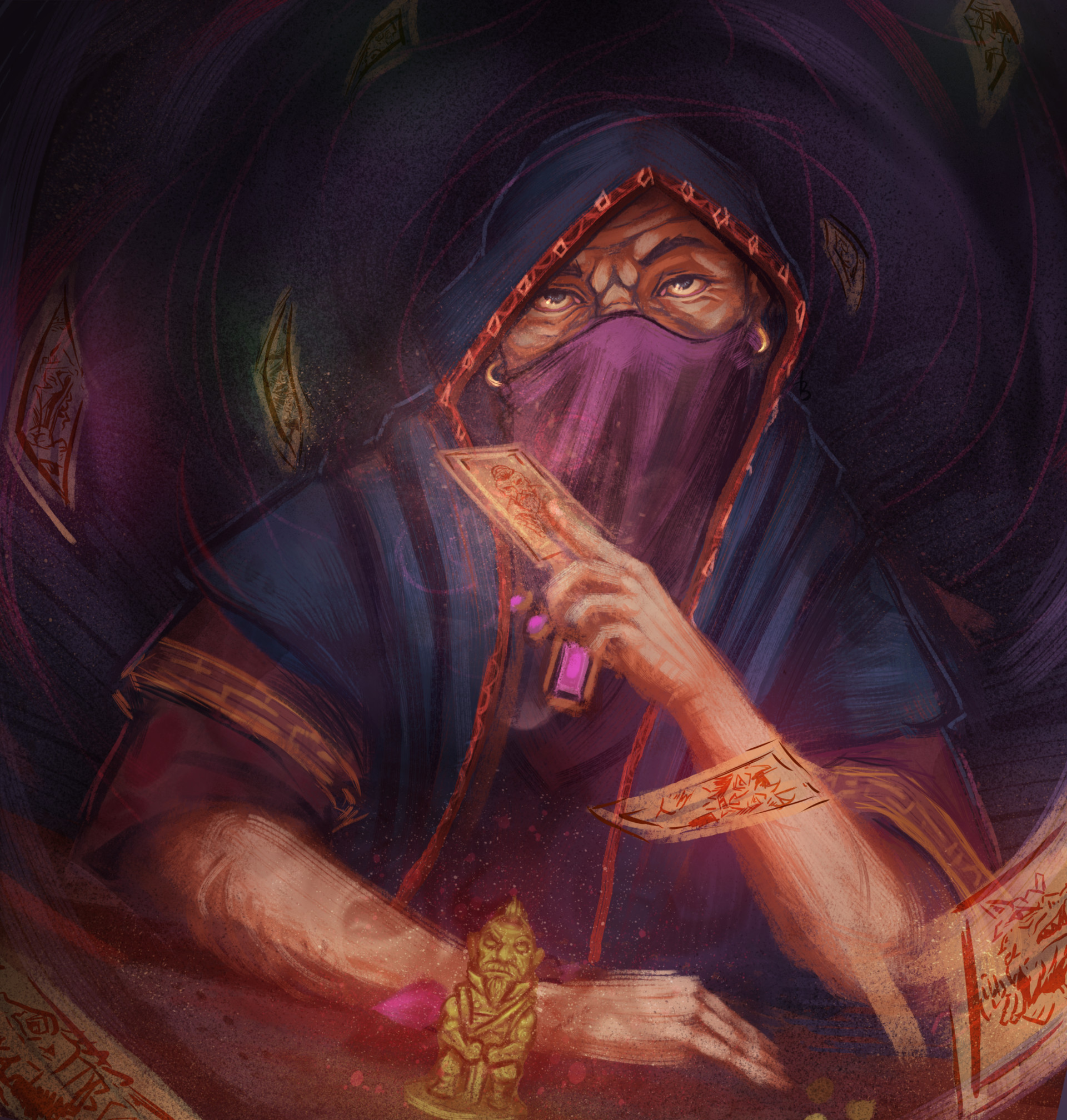
"Hand of Fate - The Deal of the Millennia" by Alexandra Bisson.
The Wild Card is unofficial Fan Content permitted under the Fan Content Policy. Not approved/endorsed by Wizards. Portions of the materials used are property of Wizards of the Coast. ©Wizards of the Coast LLC.
This homebrew was created by terebrine, and the 1.0 version was formatted using the GM Binder digital toolset.