Table of Contents
| Creatures. | Page Number |
|---|---|
| Awakened Plants | 3 |
| Awakened Tree | 6 |
| Awaken Mushroom | 11 |
| Forest Effects | 15 |
| Carnivorous Plants | 16 |
| Mantrap | 17 |
| Skytrap | 18 |
| Death Lotus | 19 |
| Devourer Plant | 20 |
| Dewstalk | 21 |
| Deathvine | 22 |
| Tumbleweed | 23 |
| Maw Lotus | 24 |
| Shambler | 27 |
| Hydra Bloom | 31 |
| Floral Elementals | 34 |
| Vegepygmy | 40 |
| Woads | 45 |
| Spriggan | 51 |
| Myconids | 57 |
| Treants | 71 |
| Bloomplague | 85 |
| Sporebloom | 88 |
| Blight | 91 |
Awakened Plants
There are only very few regions on the Material Plane wherein some form of plant life is not present. These lifeforms come in many varieties, often adapting to the conditions of the biome that they dwell.
Sometimes due to their vicinity to magical ley lines or the influence of druidic magics, these otherwise inert plants gain a life of their own. Depending on the origin of this magic, these plants acquire a personality of their own or are under the control of another force, whether for good or evil.
Awakened Shrubs.
Awakened shrubs make up the majority of all kinds of awakened plants. This classification is rather broad, as it encompasses all forms of underbrush and smaller flora.
Briarthorns
Briarthorns are known for their prickly leaves that are almost as sharp as knives. These leaves are typically used to deter herbivorous animals from making a meal out of them.
When awakened, it turns out these plants tend to have a personality as prickly as their appearance, as they tend to be quite territorial. Additionally, their newfound sentience has taught them a few new tricks, such as firing a storm of blade-like leaves at anyone who upsets them.
Rivervine
Rivervines are aquatic plants that often take the appearance of seaweed or kelp. When awakened, these plants can prove to be quite dangerous since they tend to live in large groups and will work together to entangle and drown their attackers.
Daliah
Daliahs are one of the most beautiful of all plants and come in dozens of variations. They all share the same base characteristics, as they tend to sport a unique array of flowers that emit a slightly hypnotic pollen. Such an arrangement is unique to each plant, as some sport a specific arrangement, coloration, or number of flowers.
Blighted
Blighted shrubs are typically awakened differently than most of its other kin. These plants gain sentience due to the influence of necromantic magic or parasitic spores. As a result, these plants tend to seek out other plants to drain their life force to sustain them. However, if desperate enough, they have been known to come after beasts and humanoids.
Winterbloom
Winterblooms are a rather unique breed of plants that only appear in the coldest of environments. Since flora in such environments tend to be quite scarce, most herbivorous creatures tend to be attracted to them. These plants use this to their advantage to acquire sustenance, as it absorbs the body heat of the unsuspecting creature to make up for the general lack of nutrients and sunlight in such a cold climate.
Nightleaf
Nightleafs are plants that have adapted to living in the Underdark where there is not any sunlight. These plants sport a beautiful array of bioluminescent leaves which protect it from aberrant magics in the Underdark as well as guides pollinators to its branches.
When awakened, these plants seem to hate any form of sunlight, immediately fleeing at the presence of it. Despite this innate fear, there is no evidence that sunlight seem to harm the plant as seen in other creatures, outside possible mental trauma, if plants even suffer from that.
Sunbloom
Sunblooms are one of the dazzling of all plants thanks to its scintillating leaves. As their name suggests, they resemble miniature suns with their gleaming branches and, unlike other plants, they have a natural immunity to fire. Many believe that these plants were brought from the Upper Planes as a gift of the gods, or possibly the work of a mischievous adventurer who smuggled their seeds from their native planes.
Amberwoods
Amberwoods are easily recognizable thanks to their glistening appearance as if they're coated with wax. This film is actually a layer of viscous amber. This amber is highly prized for its many uses.
This sap is quite popular to make very potent ales and desserts. These deserts are known to be extremely sweet or sour, but have been known to be extremely acidic if too much is consumed. This sap also is particularly useful as a fire retardant.
Cactus
Cacti are the hardiest of all plants, living in the harshest and most arid of environments. Their leaves are perfectly adapted for retaining moisture and as well as repelling the heat. They also have a unique ability to regrow from the most lethal of wounds and even dismemberment.
Despite their thorny appearance, awakened cacti are actually the most amiable of all plants and often provide aid to the stranded in the desert. Unfortunately, despite their best intentions, they have a hard time understanding personal space.
Duskbloom
The duskbloom is probably the most peculiar of all plants. Whereas most plants require light for sustenance, the duskbloom takes it to a whole new degree. The leaves of these plants have the unique ability to completely siphon light from its surroundings.
When awakened, these plants can prove to be quite the nuisance as they tend to migrate towards large sources of light, such as large towns or cities

Awakened Shrub Template
small plant, unaligned
- Armor Class 9(Natural Armor)
- Hit Points 11 (3d6)
- Speed 20ft., 20ft. climb
STR DEX CON INT WIS CHA 13(+1) 8 (-1) 11(+0) 10 (+0) 10 (+0) 6 (-2)
- Skills Athletics +3, Perception +2
- Damage Resistances Piercing, bludgeoning
- Damage ImmunitiesPsychic
- Senses tremorsense 60ft., passive Perception 12
- Condition Immunities Charmed, Blinded, Deafened, Frightened, Stunned, Paralyzed
- Proficiency Bonus +2
- Challenge 1/8(25 XP)
False Appearance While motionless, the shrub is indistinguishable from a normal shrub
Spider Climb The shrub can climb difficult surfaces without needing to make an ability check
Rooted Defense The shrub has advantage on saving throws and ability checks against be pushed, shoved, or knocked prone.
Flammable Whenever the shrub takes fire damage, it catches aflame. While aflame, it takes 5 (1d8) fire damage at the start of each of its turns for one minute. It must use its action to put out the flames. However, while in this state, its attacks deal an additional 5 (1d8) fire damage for the duration..
Photosynthesis
While in sunlight, the shrub gains the following benefits:
- Regeneration It can regain 5 hitpoints at the start of each of its turns while it has at least 1 hitpoint and hasn't taken fire damage on its turn.
- Rapid Recovery At the start of each of its turns, it can end one of the following conditions: poisoned.
Special Effects
Some shrub variants that rely on a saving throw for its Primary DC or Melee DC
- Primary DC The Primary DC for a shrub is 10
- Melee DC The Melee DC for a shrub is 11
Actions
Rake Melee Weapon Attack, +3 to hit:, 5ft., , one target. Hit 4(1d4+1) slashing damage.
Awakened Bush Template
large plant, unaligned
- Armor Class 9(Natural Armor)
- Hit Points 34 (4d10+12)
- Speed 20ft., 20ft. climb
STR DEX CON INT WIS CHA 18(+4) 8 (-1) 16(+3) 10 (+0) 10 (+0) 6 (-2)
- Skills Athletics +6, Perception +2
- Damage Resistances Piercing, bludgeoning
- Damage Immunities Psychic
- Senses tremorsense 60ft., passive Perception 12
- Condition Immunities Charmed, Blinded, Deafened, Frightened, Stunned, Paralyzed
- Proficiency Bonus +2
- Challenge 1/2(100 XP)
False Appearance While motionless, the bush is indistinguishable from a normal bush
Spider Climb The bush can climb difficult surfaces without needing to make an ability check
Rooted Defense The bush has advantage on saving throws and ability checks against be pushed, shoved, or knocked prone.
Flammable Whenever the bush takes fire damage, it catches aflame. While aflame, it takes 5 (1d8) fire damage at the start of each of its turns for one minute. It must use its action to put out the flames. However, while in this state, its attacks deal an additional 5 (1d8) fire damage for the duration..
Photosynthesis
While in sunlight, the bush gains the following benefits:
- Regeneration It can regain 5 hitpoints at the start of each of its turns while it has at least 1 hitpoint and hasn't taken fire damage on its turn.
- Rapid Recovery At the start of each of its turns, it can end one of the following conditions: poisoned.
Special Effects
Some bush variants that rely on a saving throw for its Primary DC or Melee DC
- Primary DC The Primary DC for a bush is 13
- Melee DC The Melee DC for a bush is 14
Actions
Rake Melee Weapon Attack, +5 to hit:, 5ft., , one target. Hit 9(2d4+4) slashing damage.
Briarthorn
Thorns Creatures that grapple or make a melee attack against the shrub while within 5ft. of the shrub takes 3(1d4) piercing damage.
Actions
Razor Leaf(Recharge 5-6): Bush Only Creatures within a 10ft. radius must succeed a DC 13 saving throw or take 10 (4d4) slashing damage. On a successful saving throw, it takes half damage.
Rivervine
- Movement Speed 20ft. swim
Amphibious The shrub can breathe in air and in water
Actions
Vine Melee Weapon Attack, +3 to hit:, 10ft., , one target. Hit 4(1d4+1) bludgeoning damage. If the target is a Small or smaller creature, it is grappled(escape DC 10).
Vine (Bush Only) Melee Weapon Attack, +6 to hit:, 10ft., , one target. Hit 9(2d4+4) bludgeoning damage. If the target is a Medium or smaller creature, it is grappled(escape DC 14).
Daliah
Aromatic Pollen Creatures other than the shrub that first enter or start its turn within 5ft. of the shrub must succeed a Constitution saving throw equal to the plant's primary DC.
On a failed saving throw, creatures are considered poisoned. Creatures poisoned in this manner are considered to be charmed by the plant. It can repeat its saving throw at the end of each of its turns. Upon a success, creatures are immune to being poisoned in this manner for the next 24 hours.
Blighted
- Damage Resistances Poison, Necrotic
Blighted Resilience The shrub has advantage on saving throws against being poisoned or diseased.
Withered Form When a creature grapples or hits the shrub with a melee attack while within 5ft. of it, that creature takes 4(1d6) necrotic damage and the shrub regains a number of hitpoints equal to the necrotic damage dealt
Winterbloom
- Damage Immunities Cold
Cold Aura Creatures that first enters or start its turn within 5ft. of the shrub, takes 4(1d6) cold.
Nightleaf
Night Bloom The shrub gains the benefit of photosynthesis while in dim light, darkness, or at night instead of daylight.
Sun Turning When it starts its turn or first enters sunlight, the nightleaf must use its action to Dash as far away from the source of light as it can. It can safely navigate any hazardous terrain. If it cannot escape, it takes the Dodge action for the duration.
Bioluminesence The shrub has advantage on saving throws against spells and magical effects. It gives off dim light in a 5ft. radius.
Sunbloom
- Damage Resistances Radiant
- Damage Immunities Fire
Frost Susceptibility The shrub or bush takes cold damage, it loses its heated body, photosynthesis, and illumination ability until the end of its next turn.
Heated Body Creatures that grapple or make a melee attack against the shrub while within 5ft. of the shrub takes 5(1d8) fire damage. It only gains these benefits while its Photosynthesis effect is active
Illuminate The shrub gives off bright light in a 10ft. radius and dim light an additional 10ft.
Amberwood
- Damage Resistances Acid, fire
Sticky Form Creatures that grapple the shrub, hits it with a melee weapon attack while within 5ft. of hit, or is hit by the shrub's melee attacks are grappled by the shrub (escape DC is equal to the plant's primary DC). Ability checks made to escape this grapple have disadvantage.
Fireproof Film The amberwood cannot be set aflame and does not lose the benefits of photosynthesis when it takes fire damage
Acidic Amber Creatures grappled by the shrub takes 3(1d4) acid damage at the start of each of its turns.
Cactus
- Damage Resistances Fire
Heatproof The cactus cannot be set aflame. Upon succeeding a saving throw against an effect that deals fire damage, the cactus takes no damage. It can still benefit from photosynthesis even if it takes fire damage.
Spiked Body A creature that touches the cactus takes 4(1d6) piercing damage.
Self Propagation The cactus can still regain hitpoints from it photosynthesis feature even if it starts its turn with 0 hitpoints. It can still die as normal upon failing all of its death saving throws.
Duskbloom
Light Drain Upon taking radiant damage, the duskbloom takes no damage but regains a number of hitpoints equal to the radiant damage dealt.
Dusk Leaf The duskbloom emits nonmagical darkness is a 10ft. radius around it. Dim light extends an additional 19ft. around it. This darkness extinguishes non-magical and magical sources of light.
Awakened Tree
Awakened trees are some of the largest of all kinds of awakened plants. These entities are a bit rarer than their small kin, as they require much more magical energy to animate their forms.
However, once awakened, or in some cases tames, awakened trees are incredibly useful creatures. They can serve as plants of burden and are extremely versatile battle creatures. Thanks to their hardy forms as well as their attunement to many druidic magics, they serve as the ideal troop transport, easily bypassing enemy lines and able to move many troops at a time over long distances.
Because some of these trees share similar traits to smaller varieties of awakened plants, this section while only highlight species that haven't been previously mentioned.
Timbersteel
As their name suggests, timbersteel trees are known for their incredibly durable bark. In fact, this bark is much harder than steel and is used as armor for many druidic tribes. However, despite its strengths, it still has one weakness wherein it quite flammable and requires additional modifications for optimal use.
Razor Willows
Razor willows are known for their tendril-like leaves that drape from its branches. These leaves are razor sharp and primarily serve as a defense against herbivores. Unwary travelers can easily end up heavily wounded by these creatures, as it is easy to become entangle and lacerated by its leaves.
Lotuswood
Lotus woods seem to resemble colossal flowers with thick wooden stems. Just like their smaller flower counterparts, they are known for their aromatic pollen that actually as many medicinal properties from just inhaling its spores.
Sirenwood
Sirenwood often resemble dead trees, due to their pale, twisted bark and scarce variety of trees. However, these plants are very much alive and the hollow nature of their anatomy can generate a rather interesting effect. When the slightest wind blows across the tree, it can create an eerie howling cacophony that is known to drive a creature mad in fear. However, the sound of the scream sounds different depending on the unique structure of each tree. However, when in a forest of sirenwoods, this cacophony becomes nearly unbearable.
Whisperglade
Whisperglade trees are the most bizarre of all trees. Their origins are not entirely understood, but some believe they are the result of magical experimentation on trees, while others believe they are an aberrant species of flora native to the underdark.
These trees seem to feed off of the psychic energy of living beings around them. As horrific as this sounds, this effect seems to be relatively harmless and actually serves as a boon to nearby creatures. Since these trees seem to reside in magically volatile environments such as the Underdark, their ability to siphon psychic energy actually dampens harmful psionic magics to nearby creatures.
However, this psionic aura can generate some unintended consequences, as its psychic attunement also occasionally causes one to see hallucination or hear the thoughts of nearby creatures. Additionally, if the tree is harmed in any way, it can redirect this psychic energy in a painful blast against its attacker.
Describing their appearance is quite problematic, as their coloration tends to change the longer you look at it. To make things even more peculiar, it seems that the appearance of the tree seems to be unique to each individual observer, as accounts from multiple observers looking at the same tree seem to describe vastly different appearances.

Awakened Tree
Huge plant, unaligned
- Armor Class 16(Natural Armor)
- Hit Points 63 (6d12+30)
- Speed 20ft., 20ft. climb
STR DEX CON INT WIS CHA 19(+4) 6 (-2) 20(+5) 10 (+0) 10 (+0) 7 (-2)
- Skills Athletics +7, Perception +3
- Damage Resistances Piercing, bludgeoning damage
- Damage Immunities Psychic
- Senses tremorsense 60ft., passive Perception 13
- Condition Immunities Blinded, Charmed, Deafened, Frightened, Stunned, Paralyzed
- Proficiency Bonus +2
- Challenge 4(1100 XP)
False Appearance While motionless, the tree is indistinguishable from a normal tree
Spider Climb The tree can climb difficult surfaces without needing to make an ability check
Rooted Defense The tree has advantage on saving throws and ability checks against be pushed, shoved, or knocked prone.
Siege Monster The tree deals double damage to buildings and objects
Flammable Whenever the tree takes fire damage, it catches aflame. While aflame, it takes 5 (1d8) fire damage at the start of each of its turns for one minute. It must use its action to put out the flames. However, while in this state, its attacks deal an additional 5 (1d8) fire damage for the duration.
Photosynthesis
While in sunlight, the tree gains the following benefits:
- Regeneration It can regain 10 hitpoints at the start of each of its turns while it has at least 1 hitpoint and hasn't taken fire or necrotic damage on its turn.
- Rapid Recovery At the start of each of its turns, it can end one of the following conditions: poisoned.
Special Effects
Some tree variants that rely on a saving throw for its Primary DC or Melee DC
- Primary DC The Primary DC for a tree is 16
- Melee DC The Melee DC for a tree is 15
Actions
Multiattack The tree can make two Entangling Root Attacks. It can substitute a Root Attack for a Fling.
Raking Limbs Melee Weapon Attack, +6 to hit:, 10ft., , all targets within range. Hit 14(4d4+4) slashing damage.
Entangling Roots Melee Weapon Attack, +6 to hit:, 10ft., , one target. Hit 14(2d6+4) bludgeoning damage. If the target is a creature, it is grappled and restrained(escape DC 14). A creature must use its action to break free from the root. The creature can also choose to attack the root to escape. The roots have an AC of 16, 15 hitpoints, resistances to bludgeoning, piercing, or slashing damage, and is immune to all conditions. Destroying the root does not deal any damage to the tree.
Fling One Large or smaller object held or creature grappled by the tree is thrown up to 30 feet in a random direction and knocked prone. If a thrown target strikes a solid surface, the target takes 4 (1d6) bludgeoning damage for every 10 feet it was thrown. If the target is thrown at another creature, that creature must succeed on a DC 14 Dexterity saving throw or take the same damage and be knocked prone.

Elder Tree
Gargantuan plant, unaligned
- Armor Class 17(Natural Armor)
- Hit Points 210(12d20+84)
- Speed 30ft., 30ft. climb
STR DEX CON INT WIS CHA 24(+7) 6 (-2) 25(+7) 10 (+0) 10 (+0) 7 (-2)
- Skills Athletics +11, Perception +4
- Damage Resistances Piercing, bludgeoning damage
- Damage Immunities Psychic damage
- Senses tremorsense 60ft., passive Perception 12
- Condition Immunities Blinded, Charmed, Deafened, Frightened, Stunned, Paralyzed
- Proficiency Bonus +4
- Challenge 12(8400 XP)
False Appearance While motionless, the tree is indistinguishable from a normal tree
Barkskin The tree can reduce bludgeoning, piercing, and slashing damage by 5.
Spider Climb The tree can climb difficult surfaces without needing to make an ability check
Rooted Defense The tree has advantage on saving throws and ability checks against be pushed, shoved, or knocked prone.
Siege Monster The tree deals double damage to buildings and objects
Flammable Whenever the tree takes fire damage, it catches aflame. While aflame, it takes 5 (1d8) fire damage at the start of each of its turns for one minute. It must use its action to put out the flames. However, while in this state, its attacks deal an additional 5 (1d8) fire damage for the duration.
Photosynthesis
While in sunlight, the tree gains the following benefits:
- Regeneration It can regain 20 hitpoints at the start of each of its turns while it has at least 1 hitpoint and hasn't taken fire or necrotic damage on its turn.
- Rapid Recovery At the start of each of its turns, it can end one of the following conditions: poisoned.
Special Effects
Some tree variants that rely on a saving throw for its Primary DC or Melee DC
- Primary DC The Primary DC for a tree is 19
- Melee DC The Melee DC for a tree is 19
Actions
Multiattack The tree can make two Entangling Root Attacks. It can substitute a Root Attack for a Fling.
Raking Limbs Melee Weapon Attack, +11 to hit:, 20ft., , all targets within range. Hit 35(8d6+7) slashing damage.
Entangling Roots Melee Weapon Attack, +11 to hit:, 20ft., , one target. Hit 14(4d6+7) bludgeoning damage. If the target is a creature, it is grappled and restrained(escape DC 19). A creature must use its action to break free from the root. The creature can also choose to attack the root to escape. THe roots has an AC of 18, 30 hitpoints, resistances to bludgeoning and piercing damage, and is immune psychic damage and to all conditions. Destroying the root does not deal any damage to the tree.
Fling One Huge or smaller object held or creature grappled by the tree is thrown up to 60 feet in a random direction and knocked prone. If a thrown target strikes a solid surface, the target takes 4 (1d6) bludgeoning damage for every 10 feet it was thrown. If the target is thrown at another creature, that creature must succeed on a DC 19 Dexterity saving throw or take the same damage and be knocked prone.
Timbersteel
- Damage Resistances Acid, Poison
- Challenge Rating Increases by 1
Timbersteel Bark The tree can reduce damage taken by 5.
Resilient Form The tree has advantage on saving throws against being poisoned or diseased.
Razor Willow
- Challenge Rating Increases by 1
Willow Snares Creatures that first enter or starts its turn within 10ft. of the willow must succeed a Strength save of 14 or become grappled and restrained by the willow. Creatures grappled in this manner take 5(2d4) slashing damage at the start of each of its turns.
Lotus Wood
Aromatic Pollen Creatures that first enter or start its turn within 10ft. of the tree have advantage on saving throws against being blinded, deafened, exhausted, paralyzed, or poisoned. If an elder tree, the radius is 20ft.
Sirenwood
- Challenge Rating Increases by 1
Howling Wood Creatures that first enters or starts its turn within 30ft. of the tree that can hear it must succeed a DC 15 Wisdom saving throw or become frightened until the end of its next turn. If an elder tree, the DC is 19.
If another sirenwood is within 30ft., creatures have disadvantage on the saving throw.
Upon a successful saving throw, creatures are immune to being frightened in this manner for 24 hours.
Nightleaf
- Challenge Rating Increases by 1
Night Bloom The tree gains the benefit of photosynthesis while in dim light, darkness, or at night instead of daylight.
Bioluminescence The tree has advantage on saving throws against spells and magical effects. It gives off dim light in a 10ft. radius. If an elder tree, the radius is 20ft.
Sunbloom
- Damage Resistances Radiant
- Damage Immunities Fire
- Challenge Rating Increase by 1
Frost Susceptibility When the tree takes cold damage, it loses its heated body, photosynthesis, and illumination ability until the end of its next turn.
Flaming Aura Creatures that first enter within 10ft. of the tree, takes 5(1d8) fire damage
Heated Body Creatures that grapple or hit the tree with a melee weapon attack while within 5ft. of the tree takes 9(2d8) fire damage. It only gains these benefits while its Photosynthesis effect is active
Illuminate The tree gives off bright light in a 30ft. radius and dim light an additional 30ft. This light counts as sunlight
Cactus
- Damage Resistances Fire
- Challenge Rating Increases by 1.
Heatproof The cactus cannot be set aflame. Upon succeeding a saving throw against an effect that deals fire damage, the cactus takes no damage. It can still benefit from photosynthesis even if it takes fire damage.
Spiked Body A creature that touches the cactus takes 7(2d6) piercing damage.
Self Propagation While in sunlight, the cactus can still regain hitpoints from it photosynthesis feature even if it starts its turn with 0 hitpoints. It can still die as normal upon failing all of its saving throws.
Amberwood
- Damage Resistances Acid, fire
- Challenge Rating Increases by 1
Sticky Form Creatures that grapple the tree or hits it with a melee weapon attack while within 5ft. is grappled by the tree (uses the tree's Melee DC). Ability checks made to escape this grapple have disadvantage.
Fireproof Film The amberwood is not set aflame and does not lose the benefits of photosynthesis when it takes fire damage
Acidic Amber Creatures grappled by the tree take 5(2d4) acid damage at the start of each of its turns.
Blighted
- Damage Resistances Poison, Necrotic
Blighted Resilience The tree has advantage on saving throws against being poisoned or diseased.
Witherblight Creatures hit by its attacks must succeed a Constitution saving throw against the tree's Primary DC or become blighted for one minute . Blighted creatures take an additional 1d8 necrotic damage when it takes damage and cannot regain hitpoints. Creatures can repeat it saving throw at the end of each of its turns to end the effect upon a successful save
Winterbloom
- Damage Immunities Cold
- Challenge Rating Increases by 1
Cold Aura Creatures that first enters or start its turn within 10ft. of the tree, takes 5(1d8) cold.
Freezing Chill Creatures within range of its cold aura have their movement speed reduced by 10ft.
Whisper Glade
- Challenge Rating Increases by 1
Psychic Wood When a creature deals damage to the tree while within 30ft. of it, it takes 5(1d8) psychic damage.
Psychosynthesis Whenever a creature that is not an undead or construct is within 30ft. of the tree, it can benefit from the effects of photosynthesis. If an elder tree, the range increases to 60ft.
Psychic Sensitivity The tree can pinpoint the presence of a creature that is not an undead or construct within 1 mile of it. However, it cannot determine the identity of the creature.
Psychic Muddling Creatures that starts its turn or first enters within 30ft. of the tree have disadvantage on saving throws to maintain concentration.
Duskbloom
- Challenge Rating Increases by 1
Light Drain Upon taking radiant damage, the duskbloom takes no damage but regains a number of hitpoints equal to the radiant damage dealt.
Dusk Leaf The duskbloom emits nonmagical darkness is a 20ft. radius around it. Dim light extends an additional 20ft. around it. This darkness extinguishes non-magical and magical sources of light.
Dusk Eater he tree gains the benefit of photosynthesis while in darkness.
Awakened Mushroom
Whereas trees tend to be the staple form of plant life on the surface of the Material Plane, fungi dominate the sunless realm of the Underdark. Instead of relying on sunlight, mushrooms tend to gather nutrients from nearly anything, such as decomposing matter or even from other living creatures as a parasite.
Mushrooms are much different from their surface dwelling kin. Although they do not possess the regenerative abilities of their kin, they also do not share many of the weaknesses of other plants and have more tools at their disposal to defend themselves.
Their primary means of defense and reproduction are microscopic spores that it can use to infect other creatures, as well spread its offspring over long distances.
Despite their differences, mushrooms can be awakened in the same manner as other plants and often serve similar functions as their surface dwelling counterparts.
Blightspore
Blight spores are probably the first thing to come to mind when regarding sentient mushrooms. Their main form of sustenance tends to come from other plants, but occasionally, especially when awakened, it devours living creatures. Its spores are especially designed to decompose its prey by preventing any regenerative abilities a creature may possess and making it extremely susceptible to the mushroom's attacks.
Thankfully, most of the time, these mushrooms are content to being scavengers but have been known to search for and pursue living creatures if other forms of food is lacking.
Mirespore
Mirespores are known for the psychedelic spores. Exposure to such spores begins to warp the mind of its victim, causing them to see hallucinations of their own making. Unfortunately, this ability makes them the prime target as their spores are used for ingredients in many ales, medicines, and pleasure drugs.
When awakened, mirespore mushrooms tend to be quite friendly creatures, although they tend to be pranksters. They favorite tactic is to use distract their victim with psychedelic spores while they proceed to steal their belongings, typically anything shiny. However, in the end, these mushrooms typically don't harm any creature unless threatened and will often return belongings once they grow bored with it.
Host Spore
The hostspore mushroom is the most parasitic of all of its kin. Creatures infected with its vampiric spores that ties the essence of its victim with the life force of the mushroom.
If a creature dies while infected with these spores, it serves as the perfect breeding ground for the mushroom to spawn its offspring, typically within an hour of the creature's death.
Spellspore
Spellspore mushrooms are the rarest and most sought after mushroom on the material plane. These mushrooms can only be found in the deepest and most remote portions of the Underdark. Because of their magically volatile environment, its spores actually emit a slight anti-magic aura to protect it from such effects.
If inhaled by a creature, it can temporarily disrupt the ability for a creature to tap into the magical aether around it, hindering its ability to cast spells.
For many centuries, it was believed that these spores were primarily used a defense, but further studies from observing awakened variants seem to suggest that these fungi actually feed on magical energy as they tend to flock towards sources of magic.
The origin of their awakening is rather unclear, as spells and rituals that often creates such sentience has no effect on these fungi. It is theorized that with enough consumption of magic, a mushroom can eventually generate a spark of sentience.
Frostspore
Despite its name, frost spores are only found in regions of extreme heat such as volcanoes, elemental hotspots, and even the Elemental Plane of Fire. These mushroom crave warm has extreme heat has the capability of mending its wounds.
As a result, these mushrooms tend to attack any nearby source of heat, whether it be a living creature or even elementals. They tend to surround themselves in a cloud of misty spore, which sap the very body heat from any creature that wanders too close.
However, their appetite for heat leaves them extremely vulnerable to any form of cold.
Umberspore
The most common of all mushrooms are the umberspore. These mushrooms are often the primary sources of light in the Underdark living in large patches lighting up the ground or even the ceiling with various hues of otherworldly light.
When awakened, they are generally the most peaceful of all mushrooms, preferring to keep to themselves. However, when threatened, their spores have been known to cause blindness.
Ragespore
As their name suggests, ragespore mushrooms are able to incite a furious rage within creature's they infect with their spores. While infected, the mushroom is actually in fully control of that creature, causing it to harm other creatures and eliminate anything that would compromise the mushroom's safety.
Although this tends to be a defense mechanism, sentient ragespores have proven to be quite calculating with their spores. They use their abilities to take control of nearby creatures, inciting it into a violent rampage to attack any nearby creature.
The mushroom often does not care who the victor is as long as one creature dies. Once its work is complete, the mushroom can move in to feast on the remains at its leisure, since its host did all the hard work for it already.

Awakened Mushroom
small plant, unaligned
- Armor Class 11(Natural Armor)
- Hit Points 20 (3d6+9)
- Speed 20ft.
STR DEX CON INT WIS CHA 14(+2) 6 (-2) 16(+3) 10 (+0) 10 (+0) 7 (-2)
- Skills Athletics +4, Perception +2
- Damage Immunities Poison, Necrotic, Psychic
- Senses tremorsense 60ft., passive Perception 12
- Condition Immunities Blinded, Charmed, Deafened, Frightened, Stunned, Paralyzed
- Proficiency Bonus +2
- Challenge 1/2(100 XP)
False Appearance While motionless, the mushroom is indistinguishable from a normal mushroom
Stench Creature that first enter or start its turn within 5ft. of the mushroom must succeed a DC 13 Constitution saving throw or become poisoned until the start of its next turn.
Spore Puff Whenever the mushroom is grappled or hit with a melee attack by a creature within 5ft. of it, that creature must succeed a DC 13 Constitution saving throw or be poisoned until the end of its next turn.
Death Plume Upon dropping to 0 hitpoints, creatures within 10ft. of it must succeed a DC 13 Constitution saving throw or take 5(1d8) necrotic damage + 5(1d8) poison damage. On a successful saving throw, it takes half damage.
Actions
Spore Slam Melee Weapon Attack, +4 to hit:, 5ft., , one target. Hit 5(1d4+2) bludgeoning damage. Creatures must succeed a DC 13 Constitution saving throw or become poisoned until the end of its next turn.

Awakened Mushroom
Huge plant, unaligned
- Armor Class 13(Natural Armor)
- Hit Points 63 (6d12+30)
- Speed 20ft.
STR DEX CON INT WIS CHA 19(+4) 6 (-2) 20(+5) 10 (+0) 10 (+0) 7 (-2)
- Skills Athletics +8, Perception +2
- Damage Immunities Poison, Necrotic, Psychic
- Senses tremorsense 60ft., passive Perception 12
- Condition Immunities Blinded, Charmed, Deafened, Frightened, Stunned, Paralyzed
- Proficiency Bonus +2
- Challenge 4(1100 XP)
False Appearance While motionless, the mushroom is indistinguishable from a normal mushroom
Stench Creature that first enter or start its turn within 20ft. of the mushroom must succeed a DC 15 Constitution saving throw or become poisoned until the start of its next turn.
Siege Monster The mushroom deals double damage to buildings and objects
Spore Puff Whenever the mushroom is grappled or hit with a melee attack by a creature within 10ft. of it, that creature must succeed a Constitution saving throw or be poisoned until the end of its next turn.
Death Plume Upon dropping to 0 hitpoints, creatures within 10ft. of it must succeed a DC 15 Constitution saving throw or take 9(2d8) necrotic damage + 9(2d8) poison damage. On a successful saving throw, it takes half damage.
Actions
Multiattack The mushroom can make two club attacks
Spore Club Melee Weapon Attack, +6 to hit:, 10ft., , all targets within range. Hit 11(1d12+4) bludgeoning damage. Creatures must succeed a DC 15 Constitution saving throw or become poisoned until the end of its next turn.
Spore Plume(Recharge 5-6) Creatures within a 30ft. radius other than the mushroom must succeed a DC 15 Constitution saving throw or take 9(2d8) necrotic damage + 9(2d8) poison damage and become poisoned for one minute. Creatures poisoned in this manner can succeed its saving throw at the end of each of its turns.
Blightspore
Blightspore Creatures poisoned by the mushroom cannot regain hitpoints for the duration. Whenever creatures recover hitpoints, it takes necrotic damage instead. Whenever creatures take necrotic damage, it takes maximum damage instead of roll.
Mirespore
Mire Spore Creatures poisoned by this mushroom are subjected to psychadelic hallucinations. For the duration of this effect, creatures have a movement speed of 0 and have is considered incapacitated.
Hostspore
Spore Spawn If a creature poisoned by the mushroom is reduced to 0 hitpoints, it is killed. After 1 hour, that creatures returns to life as an awakened mushroom.
Reactions
Symbiotic Spore Whenever the mushroom takes damage, it can use its reaction to split the damage between it and one creature that is poisoned by the mushroom while within 30ft. of it. The mushroom takes half damage and the creature takes necrotic damage equal to the other half of damage dealt.
Spellspore
- Challenge Rating Increases by 1
Spellspore Creatures poisoned by this mushroom cannot cast or concentrate on spells for the duration of this effect.
Anti-magic Spores The mushroom creates a antimagic field in a 10ft. radius around it. If a giant mushroom, the radius increases to 20ft.
Frostspore
Cold Susceptibility Whenever the mushroom takes cold damage, it movement speed is halved until the end of its next turn.
Frostspore Creatures that first enter, start its turn within 10ft. of the mushroom, or is poisoned by the mushroom, it takes 9(2d8) cold damage.
Flame Heal When the mushroom takes fire damage, it takes no damage and is healed a number of hitpoints equal to half the damage dealt.
Umber Spore
Illumination The mushroom can give off bright light in a 10ft radius and dim light an additional 10ft.
Umber Spore Creatures poisoned by the mushroom are blinded for the duration.
Ragespore
Rage Spore Creatures poisoned are considered charmed by the mushroom and its allies.
On that creature's turn, it is under the full control the mushroom obeying its every command with it actions, or bonus action.
Forest Effects
By their very nature, plants tend to have a drastic impact on their environment around. This is more so the case with many of the various forms of plants seen on the Material Plane. You can choose to roll a d20 to determine the effect of the respective tree or mushroom forest. You can choose to roll randomly or select as many appropriate effects to simulate the forest you wish to build.
| d10 | Effect | Description |
|---|---|---|
| 1 | Blightwood | Whenever you take a short or long rest, you can only recover half the amount of hitpoints gained. |
| 2 | Wildwood | Each time a creature casts a spell of 1st level or higher, it must roll on the Wild Surge table to determine a magical effect.. |
| 3 | Spellwood | Whenever a creature casts a spell, it must succeed a DC 10 Charisma saving throw. On a failed saving throw, the spell effect fails but the spell slot is still expended. Creatures in this area has advantage on saving throws against spell effects. |
| 4 | Mistwood | Creatures in the forest can only see up to 10ft. without their vision obscured by pollen, spores, or a similar effect. |
| 5 | Banewood | Whenever creature take a short or long rest, it must succeed a DC 10 saving throw of the DM's choice. On a failed saving throw, that creatures ability score decreases by 1. Upon dropping to 0 is a certain ability score, the creature dies. |
| 6 | Deadwood | Whenever a creature is reduced to 0 hitpoints while in the forest, it is instantly is killed and its corpse is transformed into an awakened plant or mushroom within the next hour. |
| 7 | Direwood | Beasts born within this forest increase by one size larger. If it has a dire or giant variant, it transforms into that form instead. |
| 8 | Moonwood | Creatures within this forest that are shapechagners or have the ability to change its shape must succeed a DC 10 Charisma saving throw. On a failed saving throw, it is unable to transform or use such effect for the next 24 hours while in these woods wasting a use of that ability. |
| 9 | Godwood | The woods takes on the traits of one creature type from the following list: Aberration, Celestial, Dragon, Elemental, Fey or Fiend. Creatures of the select type have advantage on saving throws while in this area and creatures have disadvantage on saving throws to resist their spells and effects. |
| 10 | Tanglewood | Travel within this forest counts as difficult terrain. Additionally, Wisdom (Perception) checks relying on sight has disadvantage. Vision beyond 60ft. is shrouded by dense plant life. |
| 11 | Howling Woods | Creatures that take a long rest within the forest must succeed a DC 10 Wisdom saving throw. On a failed saving throw, it is unable to gain the benefits of a long rest due to restless sleep. |
| 12 | Duskwood | The surrounding forest is shrouded in non-magical darkness |
| 13 | Whispering Woods | Creatures can hear a small fragment of another creature's thoughts (no longer than 5 words) as long as that creature is within that same forest and within 1 mile of those creatures. The creature has no clue of the thought's owner nor its location |
| 14 | Rosewood | Whenever creature take a short or long rest, it roll its hit die with advantage. Additionally, it can end one status effect upon itself. |
| 15 | Cinderwood | For every hour a creature spends within this forest, it must succeed a DC 10 Constitution saving throw or take 5(1d8) fire damage and suffer one level of exhaustion. Creatures are immune to this effect if it is resistant to fire damage. |
| 16 | Frostwood | For every hour a creature spends within this forest, it must succeed a DC 10 Constitution saving throw or take 5(1d8) cold damage and suffer one level of exhaustion. Creatures are immune to this effect if it is resistant to fire damage. |
| 17 | Ghostwood | The forest is full of haunting sounds and shapes just at the edge of ones senses. These illusions are amplifications of animals and sounds of the forest. |
| 18 | Sunwood | The forest is shrouded with sunlight, even if the sun is completely obscured from view by the foliage |
| 19 | Mazewood | The forest seems to be continually shifting and any physical evidence of tracks disappear after 10 minutes. Wisdom(Survival) checks are made with disadvantage |
| 20 | Frenzywood | At the end of each short or long rest while in the forest, creature must succeed a DC 10 Wisdom saving throw. On a failed saving throw, it suffers from an effect on the Short-Term Madness table. |
Mantrap
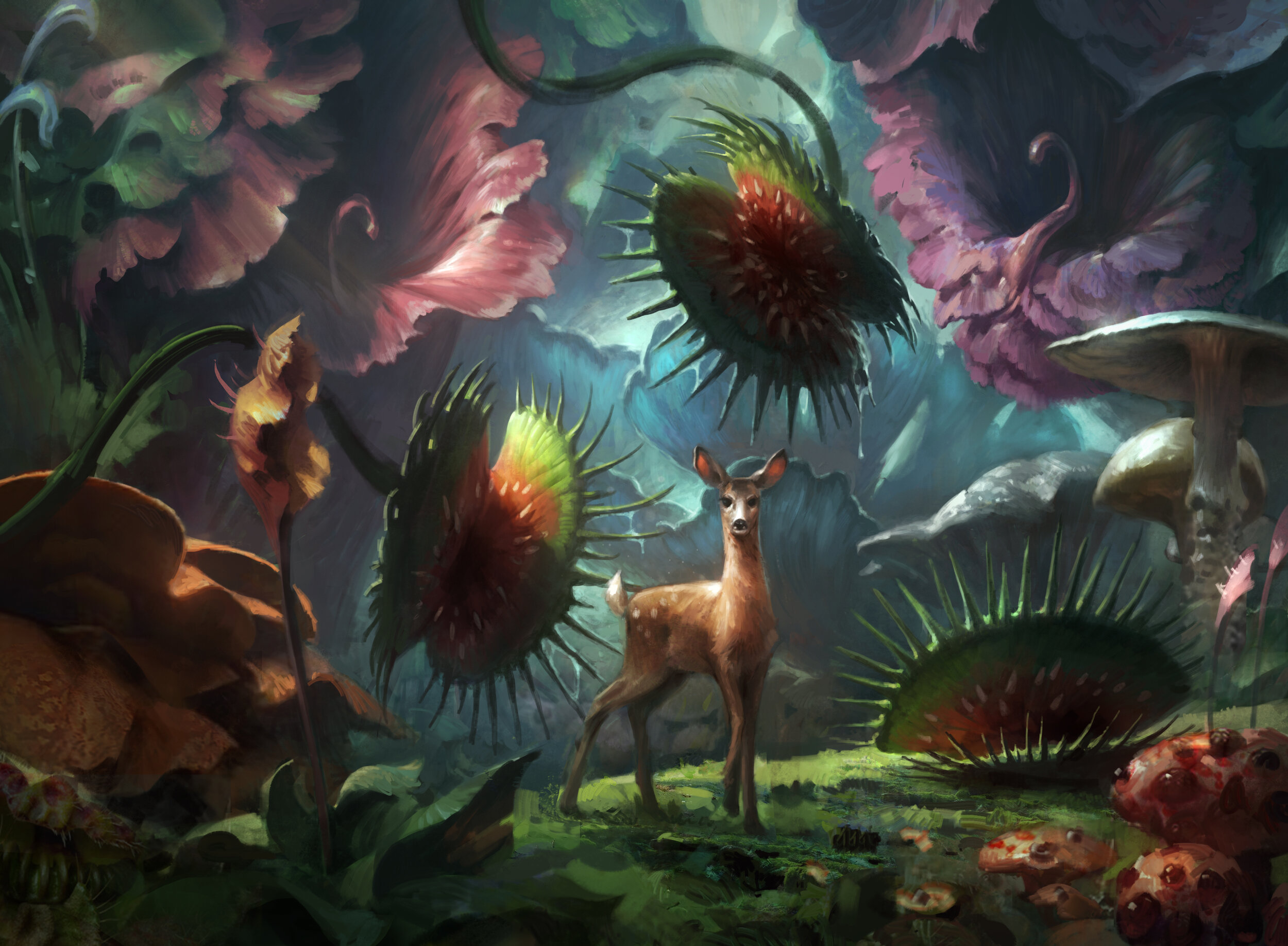
The mantrap is probably the most recognizable and notorious of all carnivorous plants. These plants take a number of different forms depending on their biome, whether it is a beautiful flower, a lanky palm tree, or even the bushy fir tree in arctic environments.
Despite have the ability to move under its own volition, the mantrap prefers to stay stationary unless absolutely necessary (such as moving to a more ideal hunting spot).
Instead, it utilizes an intoxicating aroma that causes a creature to approach it. Once in range, the mantrap unfurls its flower-like head, revealing a jagged maw full of spines that cage its victim within its jaw. Once trapped, the plant begin to secrete corrosive acids that are capable of completely dissolving a creature in a couple of minutes.
Due to the potential dangers of retaliation from large prey such as humanoids and beasts, the mantrap seems to be quite selective on which prey it with latch out to. It seems to be able to recognize if creatures are too large for its maw and will not attack if there are multiple creatures nearby, as it cannot defend itself while feeding. Hence, mantraps tend to live in small clusters to help defend one another while feeding.
Death Frond
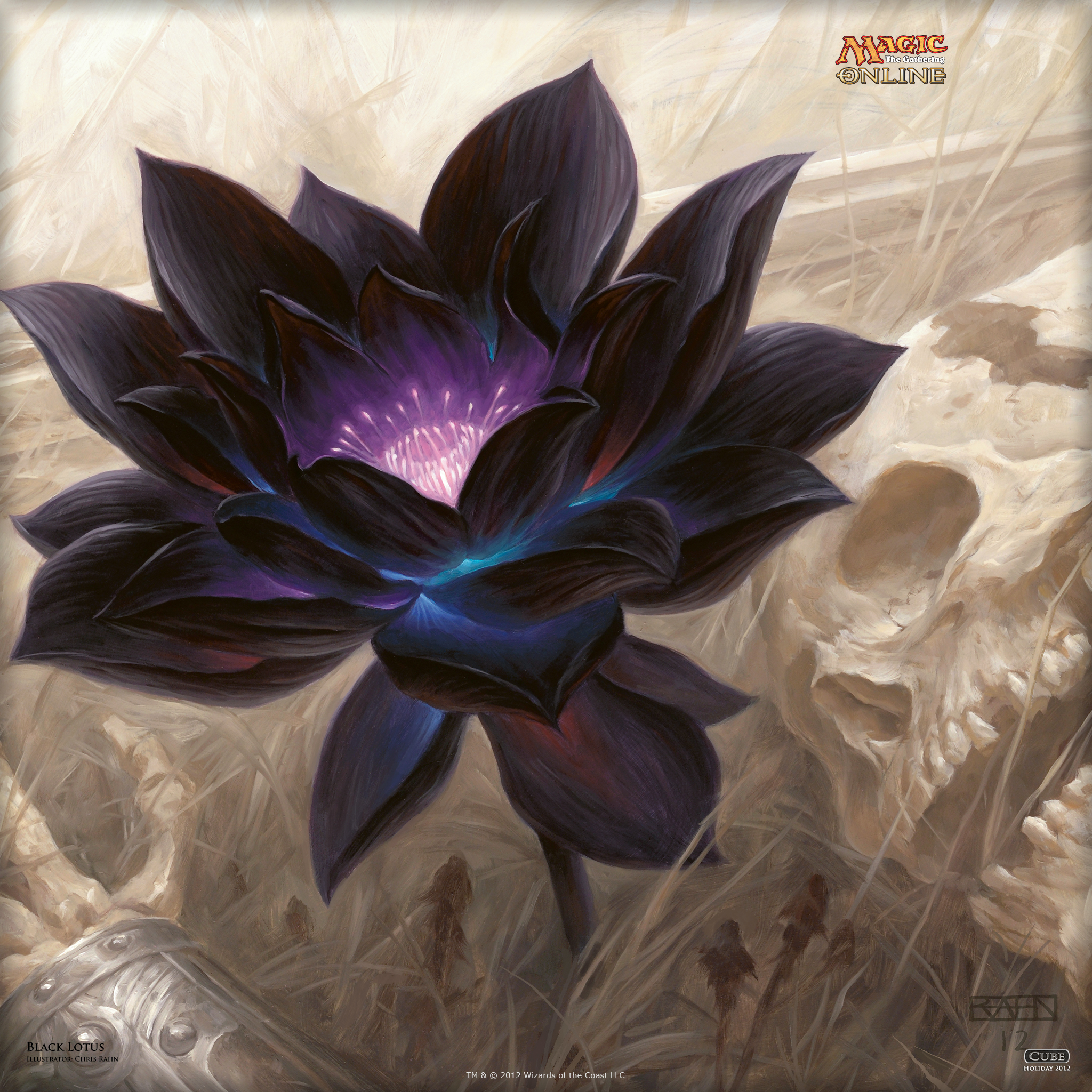
The death frond is probably the most elusive, as it takes the form of some of the most beautiful of flowers. The reason this plant can be so elusive is due to the fact that it is a much more passive hunter than its other kin, as it hardly moves at all whenever it preys on a creature.
The death frond uses its aromatic pollen to lure creatures close enough for it to infect it with a puff of pollen filled of noxious spores that causes creatures to fall unconscious. Once incapacitated, the frond extends one of its roots a tether to latch into that creature, draining its life force leaving behind a withered husk.
Devourer Plant
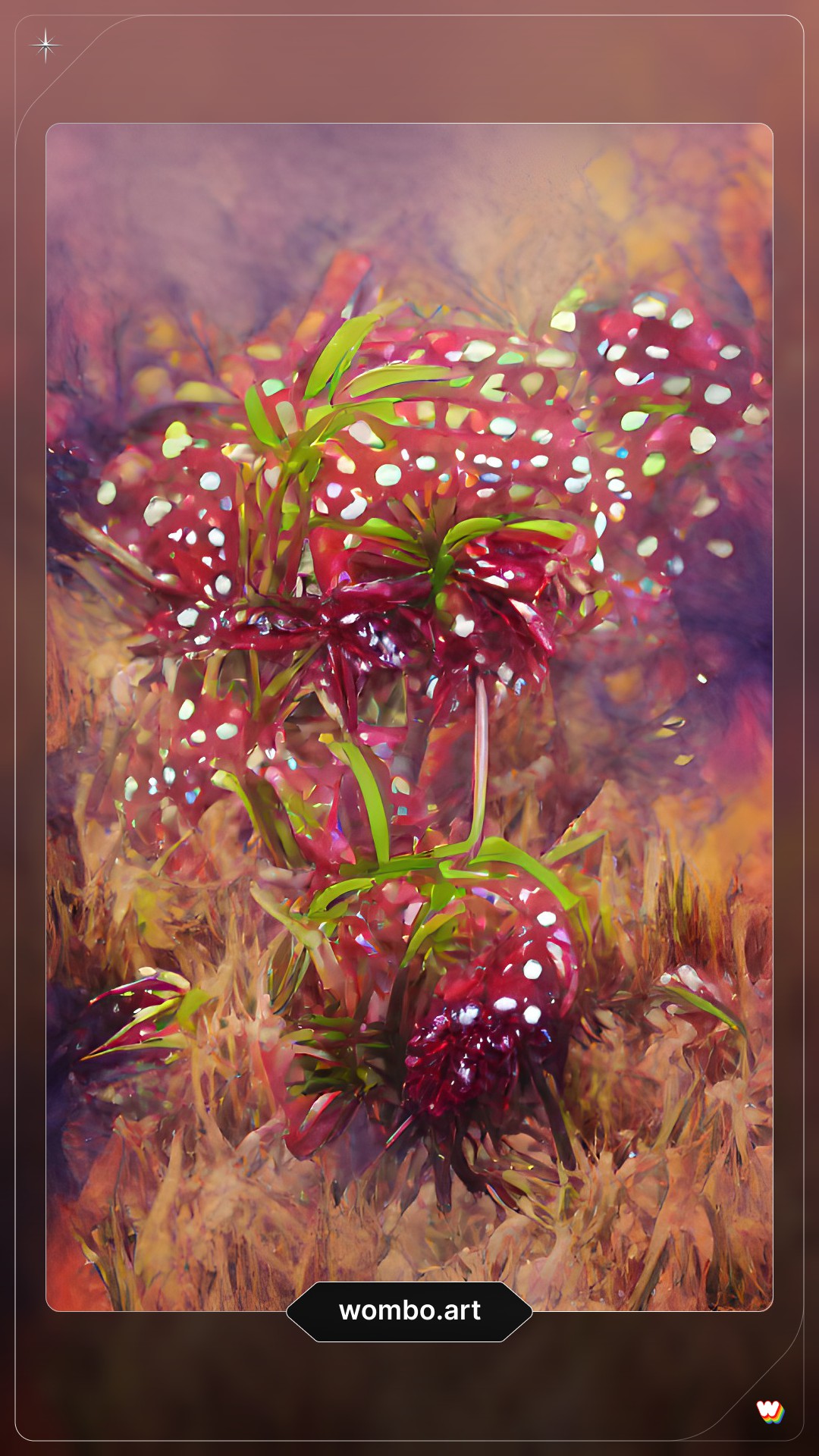
The devourer plant is one of the largest species of carnivorous plants. Although they come in many forms or varieties, many share a central locus of pitcher-like bulbs wherein they can entrap their prey. Depending on their type, they can emit a pleasant (or foul) aroma to attract various kinds of prey.
Such an aroma from this plant is quite unique, as it is tailored for a specific kind of creature that this plant prefers to consume. For example, a foul smelling odor may be used to attract undead while sweet smells may be used to attract beasts.
Its primary method of grabbing prey, its vast array of vines to grab its victims and to drop them into its digestion bulbs. Creatures trapped within its bulb are essentially drowned in digestive acids that siphons the creature's life essence, transferring it to its own vitality instead.
Unlike its relatives, the devourer is prone to be much more nomadic, traveling long distances towards large populations of its favored prey.
Dewstalk
Dewstalks are one of the most unique of all carnivorous plants. Its form is lines with rows of glistening spines similar to that of raindrops. However, the glistening orbs are actually a sweet smelling secretion that draws unsuspecting prey towards the plant. Once a creature gets too close to the dewstalk, it wraps around the creature like a gigantic tentacle. While constricting a creature, this secretion acts as an adhesive preventing a creature from escaping its grasp, while simultaneously liquefies and drains the life force from its prey.
Unlike the mantrap, the dewstalk is much more liberal in which prey it targets, using its multiple tendrils to latch out to anything that wanders too close.
Deathvines
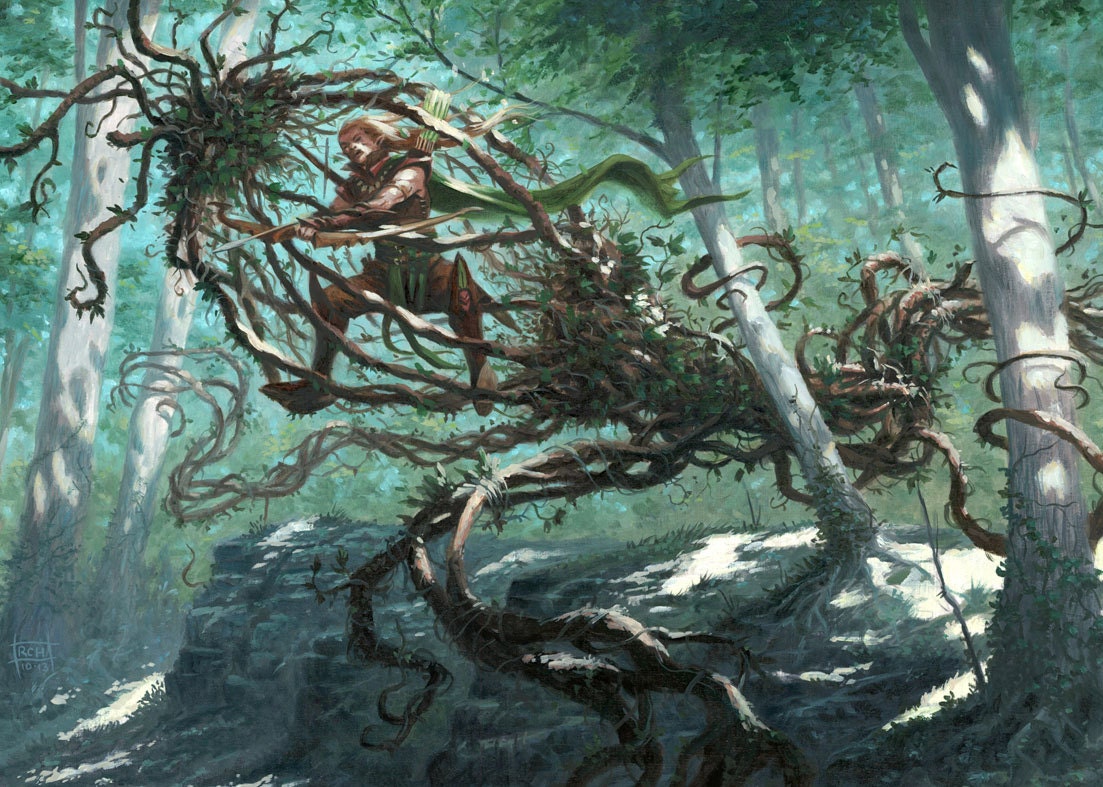
Deathvines are very hard to identify, as they tend to resemble a tangle mass of vines or roots. These plants are not a single entity, but instead are a symbiotic colony of small vine-like plants. These vines are active hunters, slowly writhing through the undergrowth after its prey.
When attacking, the vine latches onto the form of its victim, preventing its escape. These vines are incredibly strong, capable of breaking bones and suffocating its victims. In addition to crushing its prey, the death vine implants small tendril like roots into the victim's body, allowing it to drain its prey's vitality.
However, these roots also serve as a protective countermeasure while the plant is in the somewhat vulnerable state. Whenever the vine is harmed, it can redirect some of its pain to its ensnared victim, hastening that creature's demise.
Tumbleweed
Tumbleweeds are a rather peculiar species of carnivorous plants, typically found in arid regions with wide open fields. These plants resemble tangled masses of dried leaves and tend to migrate in large droves of 10 (4d4) members at a time. They become especially become active during sandstorms, serve as a boon to their mobility. However, they have been known to form massive swarms of hundreds during massive dust storms, known as haboobs.
Despite their fluffy forms, these plants are ravenous hunters, using the wind as a means of locomotion, enabling them to travel long distances with ease. Their appearance makes them rather unassuming as they drift aimlessly near their prey. Creatures usually do not recognize the threat they pose until these seem to be followed by a small entourage of tumbleweed.
When tumbleweeds attack, they ram into their prey, using their surprising razor sharp leaves to hook into the flesh of their prey. They rely on numbers to clump onto their prey, slowly shredding its flesh, leaving a bloody mess in the end.
Thankfully, their buoyant forms also serve as their primary weakness, as they are easily prone to being pushed away from the slightest shove. However, they tend to make up for this weakness by their sheer numbers as for every tumbleweed pushed away, two more seem to be ready to take its place. .
Mantrap
Large plant, unaligned
- Armor Class 13(Natural Armor)
- Hit Points 51 (6d10+18)
- Speed 5ft., climb
STR DEX CON INT WIS CHA 18(+4) 16 (+3) 16(+3) 1 (-5) 10 (+0) 2 (-4)
- Skills Stealth +7, Perception +6
- Damage Immunities psychic
- Senses blindsight 60ft., tremorsense 60ft., passive Perception 12
- Condition Immunities Charmed, Blinded, Deafened, Frightened, Stunned, Paralyzed
- Proficiency Bonus +2
- Challenge 2(450 XP)
False Appearance While motionless, the mantrap is indistinguishable from a plant
Attractive Aroma Creatures that first enter or starts its turns within 60ft. of the mantrap must succeed a DC 13 Constitution saving throw or be poisoned on a failed saving throw.
Poisoned creatures are considered to be charmed, incapacitated, and is forced to use all its movement to get as close to the mantrap as possible. An affected target can repeat the saving throw at the end of each of its turns, ending the effect on itself on a success.
Upon a successful saving throw, creatures are immune to being poisoned in this manner for the next 24 hours.
Rooted Defense The mantrap has advantage on saving throws and ability checks against be pushed, shoved, or knocked prone.
Flammable Whenever the mantrap takes fire damage, it catches aflame. While aflame, it takes 5 (1d8) fire damage at the start of each of its turns for one minute. It must use its action to put out the flames. However, while in this state, its attacks deal an additional 5 (1d8) fire damage for the duration.
Reactive The mantrap can take a reaction at the end of each of every creature's turn.
Photosynthesis
While in sunlight, the mantrap gains the following benefits:
- Regeneration It can regain 10 hitpoints at the start of each of its turns while it has at least 1 hitpoint and hasn't taken fire damage on its turn.
- Rapid Recovery At the start of each of its turns, it can end one of the following conditions: poisoned.
Actions
Engulf Melee Weapon Attack, +6 to hit:, 10ft., , one Medium or smaller creature. Hit 17(2d12+4) piercing damage. Upon a hit, the target is trapped in its jaws.
While trapped, that creature is blinded, restrained, and has total cover from attacks and other effects outside the mantrap. While trapped in this manner, thgat creature takes 14(4d6) acid damage at the start of each of its turns.
If the mantrap dies, the creature is no longer restrained. For the duration of engulf, the mantrap can only trap one creature at a time and cannot make another engulf attack against another creature during the duration.
Reactions
Reactive Jaws Whenever a creature first enters within 10ft. of the mantrap, it can use its reaction to make a Engulf attack against that creature.

Skytrap
Gargantuan plant, unaligned
- Armor Class 13(Natural Armor)
- Hit Points 279 (18d20+90)
- Speed 20ft., 20ft.climb
STR DEX CON INT WIS CHA 28(+9) 16 (+3) 21(+5) 1 (-5) 10 (+0) 2 (-4)
- Skills Stealth +9, Perception +6
- Damage Immunities psychic
- Senses blindsight 120ft., tremorsense 120ft., passive Perception 15
- Condition Immunities Charmed, Blinded, Deafened, Frightened, Stunned, Paralyzed
- Proficiency Bonus +6
- Challenge 19(22000 XP)
False Appearance While motionless, the skytrap is indistinguishable from a plant
Attractive Aroma Creatures that first enter or starts its turns within 60ft. of the mantrap must succeed a DC 19 Constitution saving throw or be poisoned on a failed saving throw.
Poisoned creatures are considered to be charmed, incapacitated, and is forced to use all its movement to get as close to the skytrap as possible. An affected target can repeat the saving throw at the end of each of its turns, ending the effect on itself on a success.
Upon a successful saving throw, creatures are immune to being poisoned in this manner for the next 24 hours.
Rooted Defense The skytrap has advantage on saving throws and ability checks against be pushed, shoved, or knocked prone.
Flammable Whenever the skytrap takes fire damage, it catches aflame. While aflame, it takes 5 (1d8) fire damage at the start of each of its turns for one minute. It must use its action to put out the flames. However, while in this state, its attacks deal an additional 5 (1d8) fire damage for the duration.
Reactive The skytrap can take a reaction at the end of each of every creature's turn.
Photosynthesis
While in sunlight, the skytrap gains the following benefits:
- Regeneration It can regain 30 hitpoints at the start of each of its turns while it has at least 1 hitpoint and hasn't taken fire damage on its turn.
- Rapid Recovery At the start of each of its turns, it can end one of the following conditions: poisoned.
Actions
Multiattack The skytrap can make one attack with its Engulf and two with its Ensnaring Vines. It can replace an Ensnaring Strike for a Fling Attack
Engulf Melee Weapon Attack, +12 to hit:, 20ft., , one Huge or smaller creature. Hit 44(5d12+9) piercing damage. Upon a hit, the target is trapped in its jaws.
While trapped, that creature is blinded, restrained, and has total cover from attacks and other effects outside the skytrap. While trapped in this manner, that creature takes 42(12d6) acid damage at the start of each of its turns.
Ensnaring Vines Melee Weapon Attack, +12 to hit:, 30ft., , one target, Hit 20 (4d6+6) piercing damage. Upon a hit, the target is grappled and restrained (escape DC 20).
Fling One Huge or smaller object held or creature grappled by the skytrap is thrown up to 60 feet in a random direction and knocked prone. If a thrown target strikes a solid surface, the target takes 3 (1d6) bludgeoning damage for every 10 feet it was thrown. If the target is thrown at another creature, that creature must succeed on a DC 20 Dexterity saving throw or take the same damage and be knocked prone.
Bonus Action
Snapping Jaw The skytrap can use its reaction to make an Engulf attack against a creature grappled by it
Reactions
Reactive Jaws Whenever a creature first enters within 30ft. of the skytrap, it can use its reaction to make a Engulf attack against that creature.
<
Death Lotus
Large plant, unaligned
- Armor Class 12(Natural Armor)
- Hit Points 45 (6d10+12)
- Speed 5ft., 5ft. climb
STR DEX CON INT WIS CHA 13(+1) 14 (+2) 14(+2) 1 (-5) 10 (+0) 2 (-4)
- Skills Stealth +6, Perception +4
- Senses blindsight 60ft., tremorsense 60ft., passive Perception 14
- Condition Immunities Charmed, Blinded, Deafened, Frightened, Stunned, Paralyzed
- Proficiency Bonus +2
- Challenge 2(450 XP)
False Appearance While motionless, the frond is indistinguishable from a plant
Attractive Aroma Creatures that first enter or starts its turns within 60ft. of the frond must succeed a DC 12 Constitution saving throw or be poisoned on a failed saving throw.
Poisoned creatures are considered to be charmed, incapacitated, and is forced to use all its movement to get as close to the frond as possible. An affected target can repeat the saving throw at the end of each of its turns, ending the effect on itself on a success.
Upon a successful saving throw, creatures are immune to being poisoned in this manner for the next 24 hours.
Life Drain Creatures grappled by the death frond takes 14(4d6) necrotic damage at the start of its turns. The death frond regains a number of hits points equal to the amount of necrotic damage dealt and that creature has its hitpoint maximum reduced by that amount.
Rooted Defense The frond has advantage on saving throws and ability checks against be pushed, shoved, or knocked prone.
Flammable Whenever the frond takes fire damage, it catches aflame. While aflame, it takes 5 (1d8) fire damage at the start of each of its turns for one minute. It must use its action to put out the flames. However, while in this state, its attacks deal an additional 5 (1d8) fire damage for the duration.
Life Tether When the frond takes damage while grappling a creature, it takes half the damage, transferring the damage to one of its grappled creatures.
Photosynthesis
While in sunlight, the frond gains the following benefits:
- Regeneration It can regain 10 hitpoints at the start of each of its turns while it has at least 1 hitpoint and hasn't taken fire or necrotic damage on its turn.
- Rapid Recovery At the start of each of its turns, it can end one of the following conditions: poisoned.
Actions
Verdant Bloom A creature within 10ft. must succeed a DC 12 Constitution saving throw or fall unconscious up to 1 hour on a failed saving throw. It can repeat its saving throw at the end of each of its turn to end the effect.
Vampiric Roots Melee Weapon Attack, +4 to hit:, 10ft., , incapacitated creatures in range. Hit 25 (4d10+3) piercing damage. Upon a hit, if the target becomes grappled and restrained (escape DC 12).

<
Devourer Plant
Huge plant, unaligned
- Armor Class 12(Natural Armor)
- Hit Points 63 (6d12+24)
- Speed 5ft., 5ft. climb
STR DEX CON INT WIS CHA 17(+3) 8 (-1) 18(+4) 1 (-5) 10 (+0) 2 (-4)
- Skills Stealth +3, Perception +2
- Senses blindsight 60ft., tremorsense 60ft., passive Perception 12
- Condition Immunities Charmed, Blinded, Deafened, Frightened, Stunned, Paralyzed
- Damage Immunities Psychic
- Proficiency Bonus +2
- Challenge 2(450 XP)
False Appearance While motionless, the Devourer Plant is indistinguishable from a plant
Attractive Aroma Creatures that first enter or starts its turns within 60ft. of the plant must succeed a DC 14 Constitution saving throw or be poisoned on a failed saving throw.
Poisoned creatures are considered to be charmed, incapacitated, and is forced to use all its movement to get as close to the plant as possible. An affected target can repeat the saving throw at the end of each of its turns, ending the effect on itself on a success.
Upon a successful saving throw, creatures are immune to being poisoned in this manner for the next 24 hours.
Rooted Defense The plant has advantage on saving throws and ability checks against be pushed, shoved, or knocked prone.
Flammable Whenever the plant takes fire damage, it catches aflame. While aflame, it takes 5 (1d8) fire damage at the start of each of its turns for one minute. It must use its action to put out the flames. However, while in this state, its attacks deal an additional 5 (1d8) fire damage for the duration.
Reactive The plant can take a reaction at the end of every creature's turn.
Photosynthesis
While in sunlight, the plant gains the following benefits:
- Regeneration It can regain 10 hitpoints at the start of each of its turns while it has at least 1 hitpoint and hasn't taken fire or necrotic damage on its turn.
- Rapid Recovery At the start of each of its turns, it can end one of the following conditions: poisoned.
Actions
Multiattack The devourer plant can make two grasping vine attacks.
Grasping Vine A Large or smaller creature within 20ft. of the plant must succeed a DC 13 Strength saving throw or grappled, restrained, and pulled 20ft. towards the plant. As a bonus action, the devourer plant use its bonus action to devour a creature.
Bonus Actions
Devour One grappled creature becomes devoured by the plant. While devoured, that creature is blinded, restrained, cannot breathe or speak, and has total cover from attacks and other effects outside the plant.
At the start of each of its turns, it takes 14(2d6) acid damage + 14(2d6) necrotic damage at the start of each of its turns. The plant regains a number of hitpoints equal to the necrotic damage dealt. Creatures reduced to 0 hitpoints while devoured are killed.
If the plant dies, the creature is no longer restrained and must spend 20ft. of movement to exit 5ft. from the plant to exit prone.
Reactions
Reactive Vines Whenever a creature first enters within 20ft. of the plant, it can use its reaction to make a Grasping vine attack against that creature.

Dewstalk
Large plant, unaligned
- Armor Class 14(Natural Armor)
- Hit Points 39 (6d10+6)
- Speed 5ft., 5ft.climb
STR DEX CON INT WIS CHA 17(+3) 17 (+3) 12(+1) 1 (-5) 10 (+0) 2 (-4)
- Damage Immunities Acid, Psychic
- Damage Resistances Fire
- Skills Stealth +7, Perception +4
- Senses tremorsense 60ft., blindsight 60ft., passive Perception 12
- Condition Immunities Charmed, Blinded, Deafened, Frightened, Stunned, Paralyzed
- Challenge 2(450 XP)
False Appearance While motionless, the Dewstalk is indistinguishable from a plant
Attractive Aroma Creatures that first enter or starts its turns within 10ft. of the plant must succeed a DC 13 Constitution saving throw or be charmed. A charmed creature is forced to use all its movement and cannot take actions or bonus actions on its turns to get as close to the dewstalk as possible. An affected target can repeat the saving throw at the end of each of its turns, ending the effect on itself on a success. Upon a successful saving throw, creatures are immune to being charmed in this manner for the next 24 hours.
Rooted Defense The dewstalk has advantage on saving throws and ability checks against be pushed, shoved, or knocked prone.
Sticky Adhesive The dewstalk adheres to anything that touches. A Medium or smaller creature is adhered to the Dewstalk is also grappled and restrained by it (escape DC 13).
Draining Sap While grappled to the dewstalk, creatures take 7(2d6) acid damage + 7(2d6) necrotic damage. The dewstalk regains hitpoints equal to the necrotic damage dealt.
Fire Proof Sap The dewstalk cannot be set aflame and upon succeeding a saving throw against an effect that deals fire damage, it takes no damage instead.
Reactive The dewstalk can take a reaction on ever creature's turn. This reaction can only be used to make an sticky vine attack of its choice against a creature that provokes opportunity attack or first enters within 10ft. of the dewstalk.
Photosynthesis
While in sunlight, the dewstalk gains the following benefits:
- Regeneration It can regain 10 hitpoints at the start of each of its turns while it has at least 1 hitpoint and hasn't taken necrotic damage on its turn.
- Rapid Recovery At the start of each of its turns, it can end one of the following conditions: poisoned.
Actions
Sticky Vine Melee Weapon Attac, +5 to hit:, 10ft., , one Medium or smaller creature in range. Hit 17 (2d10+3) bludgeoning damage. Upon a hit, creatures are considered grappled and restrained.
Death Vine
Large plant, unaligned
- Armor Class 13(Natural Armor)
- Hit Points 85 (10d10+30)
- Speed 5ft., 5ft. climb
STR DEX CON INT WIS CHA 18(+4) 15 (+2) 16(+3) 1 (-5) 10 (+0) 1 (-5)
- Damage Resistances Bludgeoning, Piercing
- Skills Athletics +7, Stealth +8, Perception +3
- Senses tremorsense 60ft., blindsight 60ft., passive Perception 13
- Condition Immunities Charmed, Blinded, Deafened, Frightened, Stunned, Paralyzed, Prone
- Proficiency Bonus +3
- Challenge 7(2900 XP)
False Appearance While motionless, the deathvine is indistinguishable from a normal plant
Flammable When the vine takes fire damage, it catches aflame. While aflame, it takes 5 (1d8) fire damage at the start of each of its turns for one minute. It must use its action to put out the flames. However, while in this state, its attacks deal an additional 5 (1d8) fire damage for the duration.
Shambling Form The deathvine can move through another creature's space without penalties to its movement. Creatures that first enters or starts its turn within the vine's space must treat it as difficult terrain. It has advantage on attack rolls against creatures within its space.
Life Drain For the duration of this grapple creatures must succeed a DC 14 Constitution saving throw at the start of each of its turns. Upon a failed saving throw, the creature take 21 (6d6) necrotic damage at the start of each of its turns and the vine recovers a number of hitpoints equal to the amount of necrotic damage dealt. On a successful saving throw, the creature takes half damage and the vine does not recover hitpoints.
The vine regains hitpoints equal to the necrotic damage dealt. The vine can only constrict one creature at a time
Regeneration The vine can regain 5 hitpoints at the start of each of its turns while it has at least 1 hitpoint and hasn't taken fire or necrotic damage on its turn. If in sunlight, it regains 10 hitpoints,and can end the poisoned condition at the start of its turns.
Damage Transfer While grappling a creature, the vine takes only half the damage dealt to it(rounded down) and the other half takes the other half.
Spider Climb The vine can climb difficult surfaces without needing an ability check
Actions
Constrict Melee Weapon Attack, +6 to hit:, 20ft., , one Large or smaller creature. Hit 10 (2d6+4) bludgeoning damage. Upon a hit, creatures are considered grappled and restrained (escape DC 14).
While grappled in this manner, creatures are blinded, cannot speak, cannot breathe, and has total cover from any effects outside of the vine.

Tumbleweed
small plant, unaligned
- Armor Class 13(Natural Armor)
- Hit Points 27 (6d6+6)
- Speed 30ft.
STR DEX CON INT WIS CHA 1(-4) 20 (+5) 13(+1) 1 (-5) 11 (+0) 10 (+0)
- Damage Resistances Bludgeoning, Piercing
- Skills Acrobatics +9, Perception +2
- Senses blindsight 60ft., passive Perception 12
- Condition Immunities Charmed, Blinded, Deafened, Frightened, Stunned, Paralyzed, Prone
- Proficiency Bonus +2
- Challenge 1(200 XP)
Bounce The tumbleweed can spend any amount of its movement speed to vertically jump by that amount.
Charge If the tumbleweed moves at least 20ft. in as straight line, it deals an addition 5(2d4) piercing damage. Creatures hit by an attack using this feature must succeed a DC 15 Strength saving throw or fall prone.
False Appearance While motionless, the tumbleweed is indistinguishable from normal tumbleweed
Flammable When the tumbleweed takes fire damage, it catches aflame. While aflame, it takes 5 (1d8) fire damage at the start of each of its turns for one minute. It must use its action to put out the flames. However, while in this state, its attacks deal an additional 5 (1d8) fire damage for the duration.
Pack Tactics The tumbleweed has advantage on attack rolls against a creature if at least one of the tumbleweed's allies is within 5 feet of the creature and the ally isn't incapacitated.
Razor Brambles Creatures grappled by the tumbleweed take 3(1d4) slashing damage at the start of each of its turns.
Slowfall Whenever the tumbleweed takes damage, it can make a DC 10 Dexterity saving throw. On a failed saving throw, it takes half damage and none on a success. The DC increases by 10 for every 10ft. above 60ft.
Actions
Tackle Melee Weapon Attacks +7 to hit:, 5ft., , one creature. Hit 8 (1d4+5) slashing damage. Upon a hit, creatures are considered grappled (escape DC 8). For the duration of this grapple, the tumbleweed cannot make an attack against another creature
Maw Lotus
Advanced Specimen
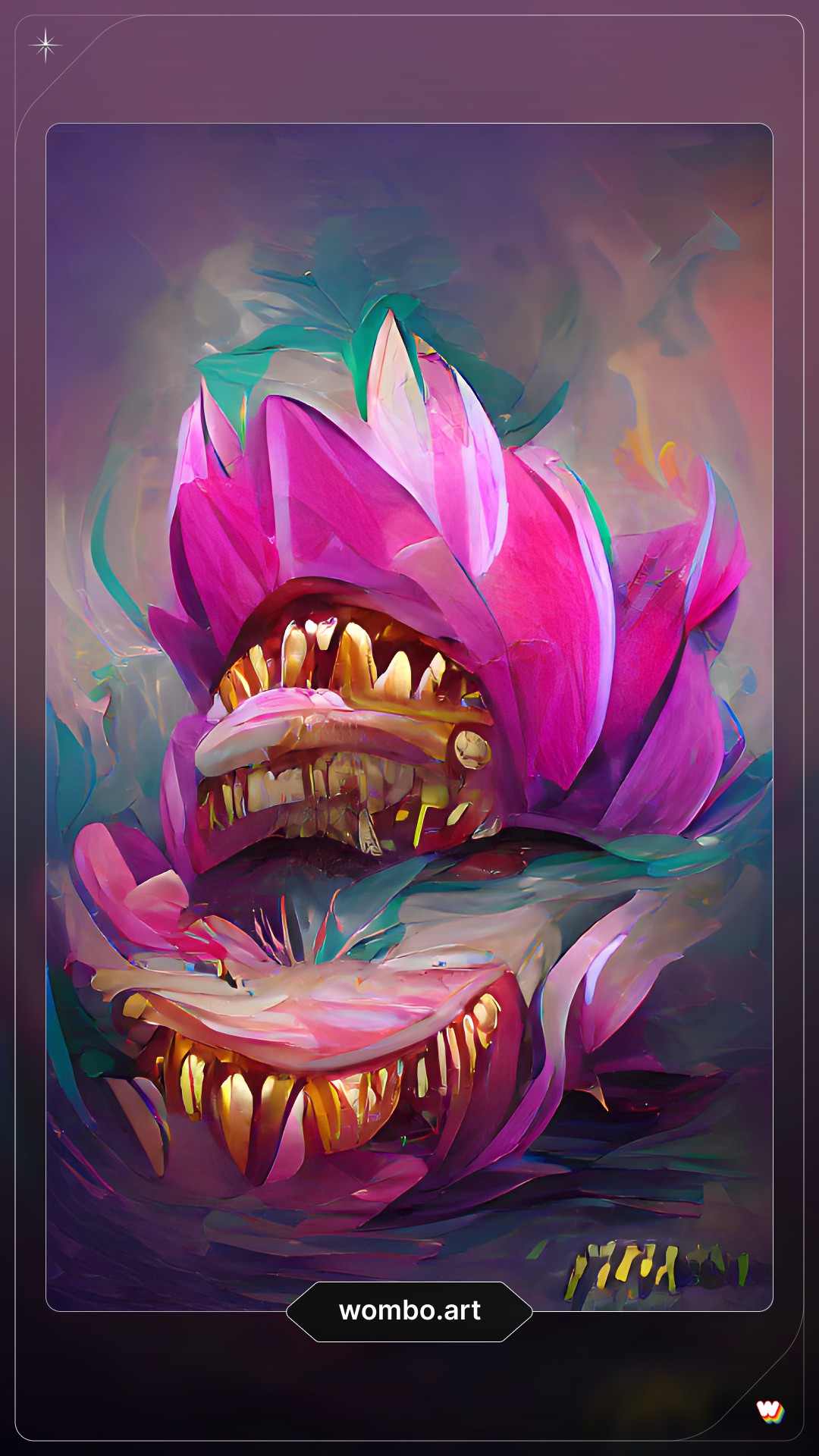
It is believed that the maw lotus is an advanced evolution of the conventional carnivorous plant. These creatures are much more mobile and intelligent than their other kin. The maw lotus can be identified by a central bulb that often takes the form of a single colossal maw or multiple smaller maws surrounded by a writhing mass of tentacles.
Toxic Pollen
Despite its intimidating maw, the lotus's greatest weapon and defense is the perpetual cloud of toxic pollen around it. The poison from its pollen is one of the most potent in all the Material Plane and is capable of debilitating any creature, even those that conventionally cannot be poisoned, such as undead or even constructs.
It is believed that the potency of this toxin can be correlated to the rapid evolving nature of this poison. The longer a creature is poisoned by the lotus, the more debilitating effects it begins to suffer, often leading to an extremely painful death.
As a result, this makes the maw lotus extremely valuable as many adventurers and mercenaries take on extremely dangerous contracts to retrieve maw lotus poison, often leading to their demise.
Valued Tame
One of the significant advantages that the maw lotus in comparison to the rest of its carnivorous kin is its heightened intelligence (at least in comparison to other plants). Although their intelligence is not much greater than the average beast, they are highly valued as they prove to be quite reliable guardian plant's while tamed.
Although most sentient plants can be tamed, their very limited intelligence makes them very hard to use. However, the maw lotus has the ability to understand basic commands and shows extreme loyalty to its tamer. Interestingly enough, creatures that it shows affection too also seems to gain immunity an immunity to its debilitating pollen. Despite these benefits, taming a maw lotus is an extremely long and dangerous process, especially if its tamer is not a plant.
Battle Plant
Tamed lotus maws are much more dangerous than their wild counterparts. In the wild, maw lotuses tend to be solitary, but when tamed as a group, maw lotuses are frighteningly effective. Many sentient plants such as vegepygmy's and blights train these creatures as battle mounts, guardians, and even troop transports. They provide the necessary muscle and sheer power for these entities, while suppressing their enemies with clouds of toxin that only affect its foes.
Maw Lotus Tactics
Maw lotuses are extremely aggressive, brazenly attacking creature their size or smaller. Because they are constantly expending energy as they tend to be much more mobile than their other relatives, they are nearly always hunting or searching for food.
However, thanks to its appearance as natural foliage, it is able to easily get within reach of its prey before deploying a cloud of toxic pollen. Because the maw lotus prefers not to chase down its prey, it tends to use its pollen spray first to incapacitate its prey. If it can target multiple prey at a time, it will do so, as it prefers to eat as much as it can in a single meal so that it does not have to constantly hunt.
In the rare chance that it is overwhelmed or exposed to fire, the lotus will use its poison to deter attackers long enough to make its escape.
Maw Lotus
large plant, unaligned
- Armor Class 15(Natural Armor)
- Hit Points 84 (8d10+40)
- Speed 30ft., 30ft. climb
STR DEX CON INT WIS CHA 19(+4) 11 (+0) 20(+5) 6 (-2) 10 (+0) 2 (-4)
- Damage Resistances Bludgeoning, Piercing
- Damage Immunities Poison, Psychic
- Skills Perception +3
- Senses blindsight 60ft., passive Perception 13
- Condition Immunities Charmed, Blinded, Deafened, Frightened, Stunned, Paralyzed, Poisoned, Prone
- Proficiency Bonus +3
- Challenge 7 (2900 XP)
False Appearance While motionless, the lotus is indistinguishable from normal tropical plant
Flammable When the lotus takes fire damage, it catches aflame. While aflame, it takes 5 (1d8) fire damage at the start of each of its turns for one minute. It must use its action to put out the flames. However, while in this state, its attacks deal an additional 5 (1d8) fire damage for the duration.
Spider Climb The lotus can climb difficult surfaces without needing to make an ability check
Pollen Marked When the lotus take the Attack action against a creature poisoned by it, it can make an additional bite attack against that creature and it can make these attacks with advantage.
Potent Toxins The lotus's poison is extremely potent can ignore any resistances or immunities a creature may have against poison or the poisoned condition
Debilitating Pollen Creatures of the lotus's choice that is not another maw lotus that first enter or starts its turn within 10ft. of the lotus must succeed a DC 16 Constitution saving throw.
On a failed saving throw, creatures are poisoned for one minute and must roll a d20 on the Lotus Poison table to determine an additional effect.
Creatures can repeat its saving throw at the end of each of its turns to end the effect. Upon each failure, you can roll of the lotus poison table to determine the additional effect of the poisoned condition, rerolling duplicate effects.
Photosynthesis
While in sunlight, the maw lotus gains the following benefits:
- Regeneration It can regain 10 hitpoints at the start of each of its turns while it has at least 1 hitpoint and hasn't taken fire or necrotic damage on its turn.
- Rapid Recovery At the start of each of its turns, it can end one of the following conditions: poisoned.
Actions
Multiattack The lotus can make a bite attack and two vine attacks
Bite Melee Weapon Attack, +7 to hit:, 5ft., , one creature. Hit 19 (6d4+4) piercing damage.
Vine Melee Weapon Attack, +7 to hit:, 10ft., , one creature. Hit 7 (1d4+4) bludgeoning damage. If the target is a Medium or smaller creature, it is grappled (escape DC 15) and pulled 10ft. towards the lotus
Pollen Spray(Recharge 5-6) Creatures of the lotus's choice that is not another maw lotus in a 30ft. cone must succeed a DC 16 Constitution saving throw or become poisoned for one minute and suffer an effect from the Lotus Poison table. At the end of each of its turns, it can make a saving throw to end the effect. Upon a failure, the poison's duration resets and the creature suffers an additional lotus poison effect by rolling a d20.
Bonus Actions
Hungering Maw The lotus can use its bonus action to make an additional bite attack against a grappled creature or a creature with 0 hitpoints.
Lotus Poison Options
| 1d20 | Poison Option | Effects |
|---|---|---|
| 1-2 | No effect | Poisoned creatures do not suffer any additional effects. |
| 3 | Nighteye Poison | Poisoned creatures are blinded for the duration |
| 4 | Bloodfire Poison | Poisoned creatures take 7(2d6) poison damage at the start of each of its turns. |
| 5 | Bloodwither Poison | Poisoned creatures cannot recover hitpoints. If the creature is reduced to 0 hitpoints while poisoned, it is killed. |
| 6 | Terrorbloom Poison | Poisoned creatures are considered frightened for the duration. The source of fear for that creature is anything that the creature can see or hear. |
| 7 | Mutemaw Poison | Poisoned creatures cannot breathe or speak for the duration |
| 8 | Cripple Poison | Poisoned creatures have its movement speed halved for the duration. |
| 9 | Frenzy Poison | While poisoned, creatures must make an attack against the nearest creature within range of it that is not the maw lotus. If there is no suitable target, the creature takes 7(2d6) psychic damage and wastes its turns |
| 10 | Lethargy | Poisoned creatures deal half damage on Strength and Dexterity based damage rolls. |
Lotus Poison Options
| 1d20 | Poison Option | Effects |
|---|---|---|
| 11 | Spellbane Poison | Poisoned creatures cannot maintain concentration nor cast spells |
| 12 | Limblock Poison | Poisoned creature are paralyzed for the duration. |
| 13 | Dreamcast Poison | Poisoned creatures are unconscious for the duration. |
| 14 | Fleshrot Poison | Poison creatures suffer vulnerability to all damage for the duration |
| 15 | Doomlock Poison | Poisoned creatures have disadvantage on all saving throws for the duration. |
| 16 | Baneplague Poison | If the poisoned creature is touched by or touches another creature other than the maw lotus, its target must succeed a DC 15 Constitution saving throw or become poisoned by the Maw Lotus. Creatures poisoned in this manner must roll a d20 to determine its initial effect. |
| 17 | Vertigo Poison | Whenever poisoned creatures take damage or spends any movement speed, ,it must succeed a DC 15 Wisdom saving throw or fall prone. |
| 18 | Muddling Poison | Poisoned creatures are considered stunned for the duration |
| 19-20 | Dual Effects | Upon rolling a 20, you can roll the DC20 twice to add two effects to a poisoned creature. You must ignore and reroll duplicates or additional 20s. |
Shambler
Shamblers are often confused to be a form of blights due to their large and somewhat humanoid form. However, these entities tend to be much large colonial masses of sentient plants or fungi. This feature is the primary factor that separates a shambler from a species of blight.
Another signature feature of a shambler is its ability to absorb various forms of energy. Some scholars believe that such absorption is actually what grants these entities their colonial sentience.
Their primary tactics are to grasp its prey with its tendril like arms and then proceeds to engulf its victim within its colossal body where its constricting vines crushes its prey to death.
Corpseflower
As its name suggests, corpseflower shamblers are covered with the bloated decomposing body and jagged skeletons of its prey protruding from its body. Although the shambler prefers to scavenge corpses, it has been known to attack living creatures on numerous occasions.
Corpse Collector
Interestingly enough, the shambler gain no nutrients from the skin or bones of its prey, only feasting on its blood. The shambler's vine latch into an engulfed creature, linking its life force to that of its prey. Whenever the shambler receives harm, it can redirect its pain to its quarry. Once its prey is slain, the body of its victim slowly begins to protrude from the rest of the shambler's form, causing its appearance to resemble an abomination of flesh and vines. Because of this, corpseflower shamblers are often accompanied by a sickening stench.
Primordial Shambler
Primordial shamblers are a rather unique breed of shamblers. Whereas most shamblers prefer to hunt creatures with flesh and blood, the primordial shamblers favored prey are elementals.
Elemental Evolution
It is believed these shambler have undergone extensive evolutionary adaptation due to exposure to elemental magic due to exposure to volatile regions such as the planar rifts between the Material Plane and Elemental Plane.
As a result, these shamblers have learned to feed off of certain elemental energies to heal its wounds. They also have evolved to act as a parasite that uses elementals as their host. Whereas most shamblers simply engulf their prey, primordial shamblers can wrap its form around and take control of elementals feeding off its life essence.
Elemental Consumption
While in this state, elemental loses all control of its body and is fully under the shambler's control. Once a shambler acquires an elemental host, it rarely detaches unless it comes across a more powerful or more favorable host. While in this state, it uses its elemental form to slay and consume stronger elementals, gaining sustenance for each elemental it destroys.
Golem Alternative
This unique ability makes shamblers quite desirable to tame by many druids and other natural casters, as they are able to utilize the strengths of both creatures without many of the detrimental side effects often associated with dealing elementals using other arcane methods.
Husk
Husk shamblers are probably the most frightening and disturbing of all shamblers. It seems to behave very similarly to the primordial shambler, but seems to infect any creature with flesh and blood. It seems to not display a particular preference for which type of creature it possesses, but it seems to show a general disdain for constructs or elementals, completely avoiding these creatures entirely.
Hungering Host
Like their other kin, they are driven by their insatiable hunger. Like the primordial cousin, the shambler will attempt to keep its host alive while under its control, only allowing harm to come to it if the shambler's own life is threatened. It will use its new form as well its capabilities to seek out new sources of food or possibly new, more powerful hosts.
Druidic Extermination
Their ability to take the possession of the body of any creature makes them extremely dangerous. In fact, numerous druidic circles and ranger conclaves have dedicated themselves to attempting to hunt these creatures to extinction due to the threat they can pose once they find a host. Thankfully, because of such efforts, they tend to be extremely rare.
Spellflower
These shamblers tend to be less aggressive than the rest of their kin, since their primary source of food is magical energy. These plants tend to reside in magical volatile biomes where they can passively feed off the ambient magical energy, using it to heal itself as well as defend itself.
Whenever it detects the presence of a creature with magical potential, it will attempt to drain that creature dry of its innate magic. Although the sheer strength of this creature can prove to be lethal, most encounters tend to be nonlethal, as it tends to leave once it has absorbed its fill of that creature's magic.
Many spellflower shamblers are often tamed by druidic settlements as a specific counter to enemy spellcasters.
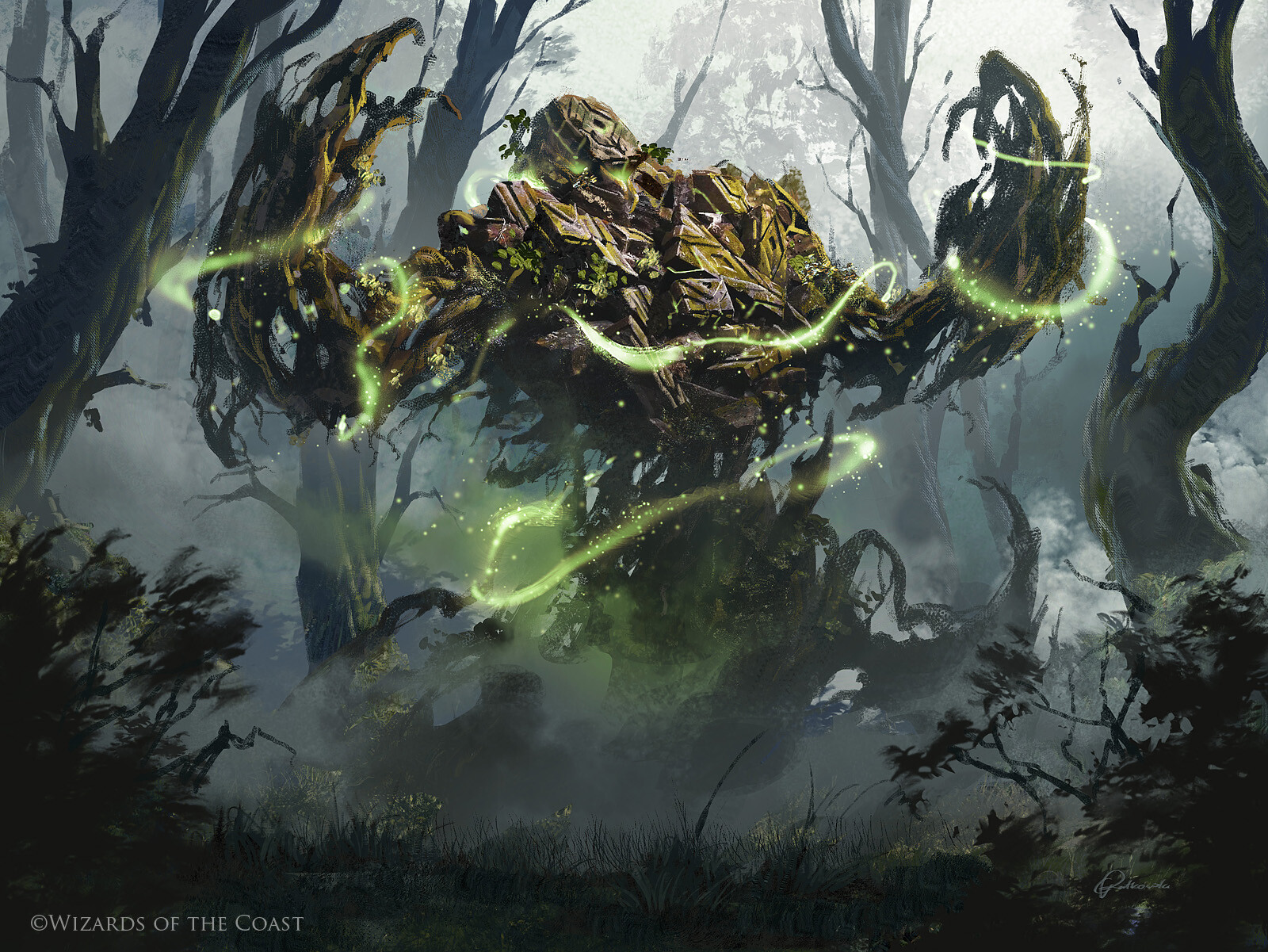
Shambler
Large Plant, unaligned
- Armor Class 14 (Natural Armor)
- Hit Points 126 (12d10+60)
- Speed 20ft., 20ft. swim, 20ft. climb, 20ft. burrow
STR DEX CON INT WIS CHA 18 (+4) 8 (-1) 20 (+5) 5 (-3) 10 (+0) 5 (-3)
- Saving Throws Strength +7, Constitution +8
- Skills Stealth +5, Perception +3,
- Damage Resistances bludgeoning, piercing, and slashing, necrotic
- Damage Immunities poison, psychic
- Condition Immunities blinded, deafened, exhausted, paralyzed, poisoned
- Senses blindsight 60ft., tremorsense 60ft., passive Perception 13
- Proficiency Bonus +3
- Challenge 7 (2900 xp)
False Appearance While motionless, the shambler is indistinguishable from normal underbrush
Spider Climb The shambler can climb difficult surfaces without having to make an ability check
Siege Monster The shambler deals double damage to buildings and objects
Regeneration At the start of each of its turns, the shambler regains 10 hitpoints.
Constriction At the start of each of its turns, engulfed creatures take 14 (3d8) bludgeoning damage
Actions
Multiattack. The shambler can make two slam attacks.
Slam Melee Weapon Attack: +7 to hit, 10ft., one target. Hit 13 (2d8+4) bludgeoning damage. If the creature is a Large or smaller creature, it is grappled (escape DC 15).
Bonus Actions
Engulf. As a bonus action, the shambler can engulf a Large or smaller creature grappled by it. The engulfed the target is blinded, restrained, and unable to breathe. If the mound moves, the engulfed target moves with it. The mound can have only one Large creature or four Small or Medium creatures engulfed at a time.
When the shambler takes damage from an engulfed creature, it must succeed a Constitution saving throw with a DC equal to half the damage dealt(minimum 10). On a failed saving throw, the shambler ejects that creature to a space 5ft from it. prone.
If the shambler dies while engulfing a creature, that creature can spend 10ft. of movement to exit from the shambler prone.
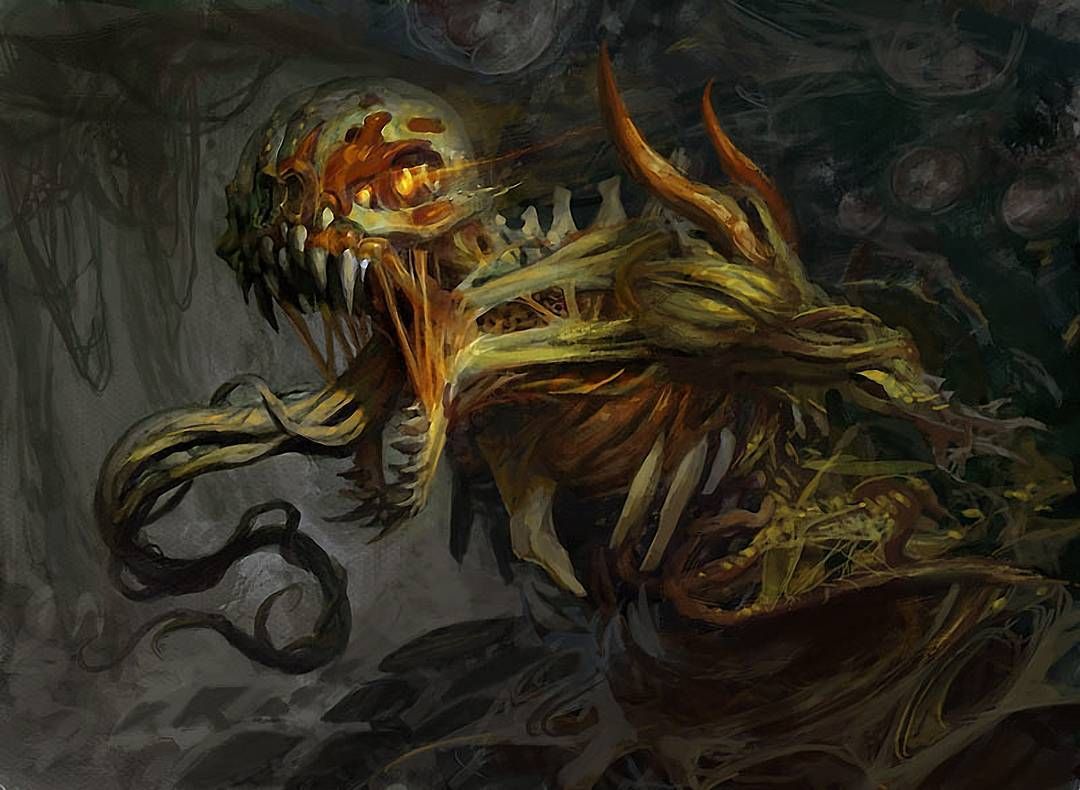
Corpseflower
- Challenge Rating Increases by 2
Necrotic Constriction (Replaces Constriction) At the start of each of its turns, engulfed creatures take 14 (3d8) necrotic damage. On a failed saving throw, creatures shambler can regain hitpoints equal to half the damage dealt.
Damage Transfer Upon taking damage, the shambler can redirect half the damage taken to one creature grappled by the shambler
Stench Creature that first enter of starts its turn within 10ft. of the shambler must succeed a DC 14 Constitution saving throw. On a failed save, creatures are poisoned until the end of its next turn. While poisoned, creatures cannot take action or reactions as its spends its turn wretching. Upon a successful saving throw, creatures are immune to this effect for the next 24 hours.
Bonus Action
Necrotic Absorption As a bonus action, the shambler can engulf a coprse within 10ft. of it. That corpse is consumed and absorbed into the shambler. The shambler regains 14 (3d8) hitpoints as part of this action.
Primordial
- Challenge Rating Increases by 1
Elemental Absorption When the shambler takes cold, fire, lightning, it takes no damage. Instead, it regains a number of hitpoints equal to half the damage dealt.
Elemental Attunement Until the end of its next turn, its attacks deal an additional 5(1d8) elemental damage equal to the damage type taken. Additionally for the duration of this feature, creatures that hit the shambler with an melee weapon attack or grapples it while within 5ft. dealing 9(2d8) elemental damage equal to the amount of damage dealt.
Actions
Elemental Host (Replaces Engulf) As an action, a Large or smaller elemental within 10ft. of the shambler must succeed a DC 16 Constitution saving throw with disadvantage. On a failed saving throw shambler shares the same space as the elemental. While merged, both creatures count as a single creature for the purposes of targeting it with an attack, spell, or saving throw.
The elemental is incapacitated and loses control of its body. The shambler controls its body but doesnt deprive the elemental of its awareness. It uses the possessed target's statistics but doesn't gain acccess to the target's knowledge. While in this state, the elemental cannot be charmed or frightened. Whenever the the shambler takes damage or an effect, it can redirect all the damage taken or effects to its elemental host instead.
This host lasts until the elemental drops to 0 hitpoints, or if it ends the effect as a bonus action. When the merge ends, the shambler reappears in an unoccupied space within 5ft. of the body.
Upon ending this feature or a successful saving throw, the Elemental is immune to this feature for the next 24 hours.

Husk
- Challenge Rating Increases by 2
Symbiosis An engulfed creature can still benefit from the Husk's movement speed and Regeneration. If its host's form has these same features, they both can benefit from the higher of the two.
Actions
Symbiotic Host (Replaces Engulf) As an action, a Large or smaller creature that is not a construct or elemental within 10ft. of the shambler must succeed a DC 16 Constitution saving throw with disadvantage. On a failed saving throw shambler shares the same space as the creature. While merged, both creatures count as a single creature for the purposes of targeting it with an attack, spell, or saving throw.
The creature is incapacitated and loses control of its body. The shambler controls its body but doesnt deprive the creature of its awareness. It uses the possessed target's statistics but doesn't gain acccess to the target's knowledge. Whenever the the shambler takes damage, it can redirect all the damage taken to its host instead.
This host lasts until the creature drops to 0 hitpoints, or if it ends the effect as a bonus action. When the merge ends, the shambler reappears in an unoccupied space within 5ft. of the body.
Upon ending this feature or a successful saving throw, the creature is immune to this feature for the next 24 hours.
Spellflower
- Challenge Rating Increases by 2
Magical Attacks The shambler's attacks count as magical for the purpose of overcoming resistance
Magic Sense The shambler can detect and pinpoint the presence of magic within 1 mile of it.
Spell Resistance The shambler has resistance to damage from spell effects.
Spell Absorption The shambler has advantage on saving throws against spells and magical effects. Upon a successful saving throw, the shambler takes no damage and the next time it makes a slam attack before the end of its next turn, it deals an additional 1d8 force damage for every spell level above 1st
Spell Fury When the shambler takes the Attack action against a creature under a spell effect or concentrating on a spell effect, the shambler has advantage on attack rolls.
Hydra Bloom
The hydra bloom is the largest and the deadliest of carnivorous plants. Just like its other relative, its appearance often varies depending on the region, but many share the same characteristics of four flowery maws, similar to that of a mantrap. Its body seems to resembles a tangled, bulbous mass of leaves, petal, or vines, while its dozens of writhing vines propels it through the forest with surprising speed and agility.
Fearless Hunter
Because of its immense size, strength, and durability, the hydra bloom is an intrepid hunter brazenly taking on anything that comes across its path. Few creatures are able to withstand its devastating barrage of bites and noxious poisons. As fearsome as these creatures are, they tend to be very territorial and solitary by nature often clashing to the death with their other kin. As a result, they tend to be quite rare and it is practically unheard of that two wild hydra blooms are found within 100 miles of each other.
Sentient Blooms
As its name suggests, the hydra bloom possess the unique ability to regenerate stalks that it loses in battle. However, each stalk actually serves as an aspect of the hydra bloom's consciousness. Whenever a head is cut off, it begins to act as if it has a mind of its own aiding its body in battle. These are often known as bloom mites.
Extended Consciousness.
Although hydra blooms seem to only have 4 stalks on its body at a time, it is believed that they can possess up to 20 bloom mites at a time. Oftentimes, the other mites serve as extensions of its senses allowing to find prey nearby, distract attackers or protect the hydra bloom from harm. If the mites are not patrolling for its central body, these reside in special compartments located within its central bulb.
Unique Bloom
Each bloom is unique as it can generate a special kind of pollen to debilitate its prey. Current research seems to suggest that these blooms can come in 8 variations often changing color depending on its type.
Bloom Locus
Whenever its central body is severely wounded, the heads can merge back onto the primary body. However, if these blooms die while disconnected, it cannot merge back with the main body.
Any time its body loses all of its heads, the hydra bloom instantly becomes inert and is unable to move. While in this state, the hydra bloom is extremely vulnerable and can only recover if one of the blooms merges back within its form.
However, if the hydra bloom dies while at least one of the blooms are still alive, the bloom mite can fully regrow within a week. Only one of the bloom mites can fully grow in this manner at a time and the others simple serve as additional bloomstalks for its new body.
Memory Blooms
Because of this regeneration, hydra blooms tend to at least keep one bloom mite hidden and secure while it goes hunting so that it can fully regrow if it ever dies. Therefore, adventurers must be extremely thorough while hunting hydra blooms lest it returns. Since each mite shares an aspect of the hydra bloom's consciousness, it is known to have extremely long memories and often holds grudges against creatures that slew its previous forms.
Legacy Blooms
Because of their status within their ecosystem and their nigh immortal nature, they are often viewed as a symbol of power by many forest-dwelling civilizations. In fact the most powerful of these civilization have tamed these creatures as battle mounts. High ranking nobility often pass down bloom mites to each family member almost as an heirloom carrying that hydra bloom's memory across generations. As a result, these creatures have often forged powerful bonds with loyalty to its masters that has lasted over numerous lifetimes.
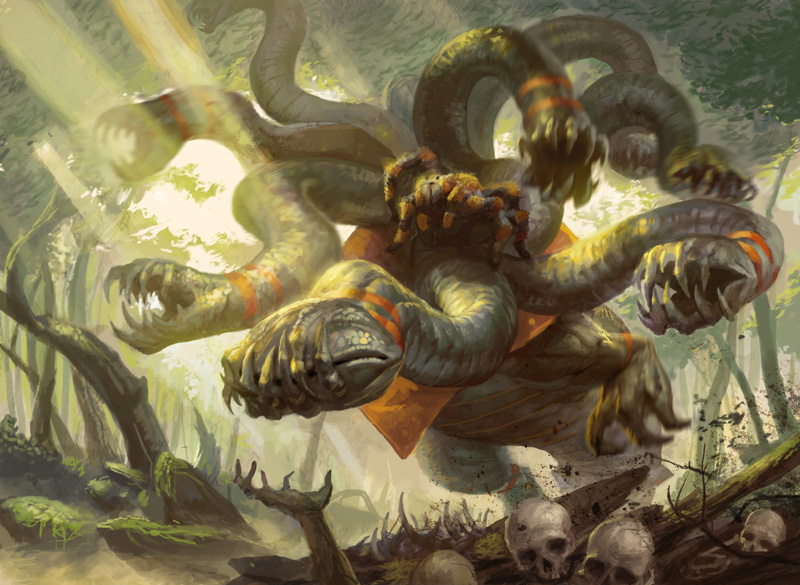
Hydra Bloom
Huge Plant, unaligned
- Armor Class 18 (Natural Armor)
- Hit Points 175 (14d12+84)
- Speed 30ft., 30ft. climb
STR DEX CON INT WIS CHA 20 (+5) 14 (+2) 22 (+6) 10 (+0) 20 (+5) 2 (-4)
- Saving Throws Strength +9, Constitution +10, Wisdom +9
- Skills Perception +10
- Damage Resistances bludgeoning, piercing
- Senses tremorsense 60ft., blindsight 60ft., passive Perception 20
- Condition Immunities Blinded, Deafened, Stunned, Paralyzed, Poisoned
- Proficiency Bonus +5
- Challenge 13 (10000 xp)
Bloomless If the hydra bloom loses all of its heads (while bloom mites are still under its control), it can only use its Action to Dash, Dodge, or Disengage. The hydra bloom is unable to die unless all the bloom mites under its control all destroyed.
False Appearance While motionless, the hydra bloom is indistinguishable from a tropical plant
Rooted Defense The Hydra Bloom has advantage on saving throws and ability checks against be pushed, shoved, or knocked prone.
Flammable Whenever the plant takes fire damage, it catches aflame. While aflame, it takes 5 (1d8) fire damage at the start of each of its turns for one minute. It must use its action to put out the flames. However, while in this state, its attacks deal an additional 5 (1d8) fire damage for the duration.
Multiple Blooms The hydra bloom has four bloomstalks. While it has more than one head, the hydra has advantage on saving throws against being charmed, deafened, frightened, stunned, and knocked unconscious.
Whenever the hydra bloom takes 30 or more damage in a single turn, one of its heads dies. However, if all its heads die, the hydra does not die.
At the end of its turn, its severed head returns to life as a Bloom Mite that is under the Hydra Bloom's Control.
The Hydra Bloom can only have up to 4 bloomstalks at a time but can have up to 20 bloom mites it can have under its control.
Regeneration The bloom can regain 20 hitpoints at the start of each of its turns while it has at least 1 bloom mite under is control and hasn't taken fire or necrotic damage on its turn. If in sunlight, it regains 30 hitpoints.
Regenerate Heads(Recharge 5-6) At the start of its turn, the hydra bloom can regain 3(1d4) heads. It cannot possess any more than 4 heads at time. When it uses this feature, it can change its existing blooms to one of its choice
Spider Climb The hydra bloom can climb difficult surfaces without having to make an ability check
Actions
Multiattack. The hydra bloom can make four bite or pollen puff attacks on its turn.
Bite Melee Weapon Attack: +10 to hit, 20ft., one target. Hit 18 (2d12+5) piercing damage.
Pollen Puff Consult the hydra bloom table to determine the effect
Reactions
Reactive Stalks The hydra bloom can take a reaction on each creature's turns. This reaction can only be used to make an bite attack of its choice against a creature that provokes opportunity attack or first enters within 20ft. of the hydra bloom.
Legendary Actions (up to 3/ turn)
Bloomstalk Strike(1 action) The hydra bloom can make a bite or pollen puff.
Floran Stride(1 action) The hydra bloom can move up to 30ft. to a location of its choice. This movement does not provoke opportunity attack
Merge Blooms (2 actions) The hydra bloom can merge with a bloom mite within 20ft. of it. It regains 30 hitpoints as part of this action
Rapid Recovery(3 action) The hydra bloom can end one status or spell effect on itself
Bloomstalk Options
| d8 | Bloomstalk Option | Effects |
|---|---|---|
| 1 | Witherbloom | Creatures must succeed a DC 19 Constitution saving throw or take 19(5d6) necrotic damage on a failed saving throw. It hitpoint maximum is reduced by this amount as well. Creatures that fail this saving throw cannot regain hitpoints until the end of its next turn. On a successful saving throw, it takes half damage and is unaffected. |
| 2 | Stenchbloom | Creatures must succeed a DC 19 Constitution saving throw or take 19(5d6) poison damage on a failed saving throw. Upon a failed saving, throw creatures are poisoned until the end of its next turn. While poisoned in this manner, creatures cannot take actions or reactions as it spends its turn coughing and wretching hitpoints. On a successful saving throw, it takes half damage and is unaffected. |
| 3 | Terrorbloom | Creatures must succeed a DC 19 Constitution saving throw or take 19(5d6) poison damage on a failed saving throw. Upon a failed saving, throw creatures are poisoned until the end of its next turn. While poisoned in this manner, creatures are considered frightened. All creatures that the target can see counts as its source of fear. On a successful saving throw, it takes half damage and is unaffected. |
| 4 | Spellbloom | Creatures must succeed a DC 19 Constitution saving throw or take 19(5d6) poison damage on a failed saving throw. If the target is under a spell effect or concentrating on a spell, it has disadvantage on its saving throw. Upon a failed saving, throw creatures are poisoned until the end of its next turn. While poisoned in this manner, creatures cannot cast or concentrate on spells. On a successful saving throw, it takes half damage and is unaffected. |
Bloomstalk Options
| d8 | Bloomstalk Option | Effects |
|---|---|---|
| 5 | Nightbloom | Creatures must succeed a DC 19 Constitution saving throw or take 19(5d6) poison damage on a failed saving throw. Upon a failed saving, throw creatures are poisoned until the end of its next turn. While poisoned in this manner, creatures are considered blinded. On a successful saving throw, it takes half damage and is unaffected. |
| 6 | Deathbloom | Creatures must succeed a DC 19 Constitution saving throw or take 19(5d6) necrotic damage on a failed saving throw. Upon a failed saving, throw creatures are poisoned until the end of its next turn. While poisoned in this manner, creatures deal half damage on a Strength and Dexterity-based attacks. On a successful saving throw, it takes half damage and is unaffected. |
| 7 | Hypnobloom | Creatures must succeed a DC 19 Constitution saving throw or take 19(5d6) poison damage on a failed saving throw. Upon a failed saving, throw creatures are poisoned until the end of its next turn. While poisoned in this manner, creatures are charmed. While charmed, it is considered incapacitated and its movement speed is 0. On a successful saving throw, it takes half damage and is unaffected. |
| 8 | Ragebloom | Creatures must succeed a DC 19 Constitution saving throw or take 19(5d6) poison damage on a failed saving throw. Upon a failed saving, throw creatures are poisoned until the end of its next turn. While poisoned in this manner, creatures must use its action to attack the nearest creature within range of it that is not the hydra bloom. On a successful saving throw, it takes half damage and is unaffected. |
Floral Elementals
In many circumstances, an extreme abundance or concentration of nature magic can have unintended consequences. One of these side effects can result in the creation of Flora Elementals. Because of this, they are typically found deep in the heart of overgrown jungles or corrupted bogs of the blight.
These entities are quite similar to their primordial counterparts as they typically behave according to the element that they represent. In fact, the appearance of these entities can be a omen for a potential magical outbreak such as the blight as these entities, depending on their type, serve as a natural defense (or instigator) for such events.
Floral Elemental Tactics
In combat, these elementals share many tactics as their primordial kin. They possess an instinctual need to spread their respective form of life, whether it be engulfing everything in overgrown forests, assimilation through fungal spores, or corrupting the living with the blight. Because of their elemental aspect, they are often bound as servants to druids and powerful awakened plants.
Anima Elemental
Anima Elementals are created by high concentrations of nature magic created by overgrown and ancient forests. These entities are revered by many druidic circles and awakened plants who believe these elementals actually are the spirits of the forest given physical form. They come in a variety of form, as some appear as masses of floating vines and leaves while others seem to be made of moss-covered stones bound together by green nature magic.
As their name suggests, these elementals give off an aura of life giving magic that is able to fully heal the wounds of creatures within range. They have the unique ability to harness sunlight to convert it into a concentrating beam of radiance that annihilates any creature within range.
Blight Elemental
Blight elementals are the twisted counterpart to the anima elemental. These entities are created when a forest is corrupted by the ravenous Blight. The very presence of these entities is known to cause nearby plants to instantly wither and die.
These elementals only have one goal in mind, which is to corrupt any living creature with the Blight. Whenever these entities slay a creature, that creature is tainted with its magic causing it to rise again as a Blighted creature in less than a hour.
Spore Elemental
Despite their name, spore elementals are not truly considered to be elementals. although their appearance and origins are quite similar to many elementals, spore elementals are actually a collection of spores that have acquired heightened sentience due to an large concentration of nature magic.
Spore elementals resemble a whirling cloud of noxious spores that poisons any creature that gets too close to it. Thanks to their gaseous form, they are incredibly Thanks to their newly awakened state and heightened, spore elementals are prized minions by many myconids. In fact, myconid fungal gardens are used to attract these entities who fiercely guard these guardians from any intruders.
Leaf Elemental
Just life the spore elemental, the leaf elemental is commonly mistaken for a elemental when in reality, it is actually a symbiotic host of plants. Just like the spore counterparts, they are typically creatures when dying leaves are exposed to a nexus of nature magic. This magic grants them sentience and a physcial form that resembles a swirling mass of leaves that possesses a vaguely humanoid shape.
Thanks to their leafy form, they can prove to be troublesome opponents as they are able to easily blend into their surrounding posing as pile of leaves in the undergrowth. They have even been known to flock into tree giving it the false appearance of a tree bough full of leaves.
Although most leaf elementals tend to be much smaller than other types of floral elementals, they have been known to merge into a truly colossal form. Thankfully, such a event tends to be quite rare and requires an large amount of magic to fully link the consciences of so many plants into one entity.

Anima Elemental
Large Elemental, unaligned
- Armor Class 12 (Natural Armor)
- Hit Points 102 (12d10+36)
- Speed 40ft., 40ft. climb
STR DEX CON INT WIS CHA 17 (+3) 15 (+2) 16 (+3) 6 (-2) 10 (+0) 17 (+3)
- Saving Throws Con +6
- Skills Perception +3
- Damage Resistances Poison, Necrotic
- Condition Immunities Exhaustion, unconscious
- Senses blindsight 60ft.
- Languages Druidic
- Proficiency Bonus +3
- Challenge 8(3900 xp)
Aura of Life Creatures of the anima elemental's choice within 30ft. of it can regain 10 hitpoints at the start of each of its turns. The anima elemental only emits this aura while it is not incapacitated
False Appearance While motionless, the Anima Elemental is indistinguishable from a large plant
Forest Treader The anima elemental can move through non-magical difficult terrain created by nonmagical plants
Photosynthesis At the start of each of its turns, the anima elemental regains 10 hitpoints. If it starts its turn in sunlight, it regains 20 hitpoints instead.
It cannot benefit from this feature if it takes fire or necrotic damage on its turn.
Spider Climb The anima elemental can climb difficult surfaces without needing to make an ability check
Sun Absorption When the anima elemental takes radiant damage, it takes no damage. Instead, it regains a number of hitpoints equal to the radiant damage dealt.
Actions
Multiattack. The anima elemental can make two attacks with its Anima Vine. It can substitute any number of these attacks for an Anima Blast
Anima Vine. Melee Weapon Attack: +8 to hit, 10ft., one target. Hit: 17 (4d6+4) bludgeoning damage. Upon a hit, the target is grappled and restrained by the Anima Vine (escape DC 15)
Anima Bolt. Ranged Weapon Attack: +8 to hit, 120ft., one target. Hit: 13 (2d8+4) poison damage. If this attack is made in sunlight, it deals an additional 9(2d8) radiant damage.
Anima Beam (Recharge 5-6) Creatures in a 60ft. long and 5ft. wide line must succeed a DC Dexterity saving throw or take 14 (3d8) poison damage + 14(3d8) radiant damage. On a successful saving throw, it takes half damage.
If the anima elemental uses this attack while in sunlight, this attack has 23 (5d8) poison damage + 23 (5d8) radiant damage
Bonus Actions
Plant Stride As a bonus action, the anima elemental can enter a Huge or larger plant and emerge 5ft. from another Huge or larger plant within 60ft. of its original location
Reactions
Tree Stride If the anima elemental is within 5ft. of a Huge or smaller plant, it can use its reaction to merge into that plant whenever it is targeted with an attack or saving throw. This reaction occurs before the triggering effect and grants the anima elemental total cover as it takes no damage. This effect only applies to the trigger attack or effect.
Blight Elemental
Large Elemental, unaligned
- Armor Class 12 (Natural Armor)
- Hit Points 102 (12d10+36)
- Speed 40ft., 40ft. climb
STR DEX CON INT WIS CHA 17 (+3) 15 (+2) 16 (+3) 6 (-2) 10 (+0) 17 (+3)
- Saving Throws Con +7
- Skills Perception +4
- Damage Immunties Necrotic, Poison
- Condition Immunities Poisoned, Exhaustion, unconscious
- Senses blindsight 60ft.
- Languages Druidic
- Proficiency Bonus +4
- Challenge 9(5000 xp)
Blighted Corruption Creatures killed by the blight elemental returns to life as a Blighted creature after 1 hour.
False Appearance While motionless, the blight elemental is indistinguishable from a large plant
Blighted Hunger When the blight elemental takes the Attack action against a beast, plant, or humanoid, it can make an addition blighted touch attack.
Photosynthesis At the start of each of its turns, the blight elemental regains 20 hitpoints.
It cannot benefit from this feature if it takes fire damage on its turn.
Spider Climb The blight elemental can climb difficult surfaces without needing to make an ability check
Withering Aura Creatures 10ft. of the Blight Elemental takes 1d8 necrotic damage.
Actions
Multiattack. The blight elemental can make two attacks with its Blighted Vine. It can substitute any number of these attacks for an Blight Blast
Blight Vine. Melee Weapon Attack: +7 to hit, 10ft., one target. Hit: 17 (2d8+4) bludgeoning damage + 9(2d8) necrotic damage. Upon a hit, the blight elemental regains a number of hitpoints equal to half the necrotic damage dealt.
Blight Blast. Ranged Weapon Attack: +7 to hit, 120ft., one target. Hit: 18 (4d6+4) necrotic damage. Upon a hit, the target cannot regain hitpoints until the end of its next turn
Blight Pulse(Recharge 5-6) Creatures in a 30ft. radius around the blight elemental must succeed a DC 15 Constitution saving throw. On a failed saving throw, creatures take 36 (8d8) necrotic damage and half as much on a successful saving throw.
Plants have disadvantage on this saving throw.
Bonus Actions
Plant Stride As a bonus action, the blight elemental can enter a Huge or larger plant and emerge 5ft. from another Huge or larger plant within 60ft. of its original location
Reactions
Tree Stride If the blight elemental is within 5ft. of a Huge or smaller plant, it can use its reaction to merge into that plant whenever it is targeted with an attack or saving throw. This reaction occurs before the triggering effect and grants the woad total cover as it takes no damage. This effect only applies to the trigger attack or effect.
Spore Elemental
Large Plant, unaligned
- Armor Class 15 (Natural Armor)
- Hit Points 126 (12d10+60)
- Speed 40ft., 40ft fly(hover)
STR DEX CON INT WIS CHA 7 (-2) 20 (+5) 21 (+5) 6 (-2) 10 (+0) 17 (+3)
- Saving Throws Dex +9, Con +9
- Skills Perception +4
- Damage Resistances Bludgeoning, Piercing, and Slashing damage from magical attacks
- Damage Immunties Bludgeoning, Piercing, and Slashing damage from nonmagical attacks, Necrotic, Poison
- Condition Immunities Poisoned, Exhaustion, unconscious
- Senses blindsight 60ft.
- Languages Druidic
- Proficiency Bonus +3
- Challenge 10(5900 xp)
Gaseous Form The spore elemental can move through a space that is 1 inch wide without squeezing. The spore elemental can enter a hostile creature's space and stops there. The first time it enters a creature's space on its turn, that creature must make a DC 17 Constitution saving throw or become poisoned until the end of its next turn.
Stench Creatures that first enters or starts its turn within 10ft. of the spore elemental must succeed a DC 17 Constitution saving throw or become poisoned until the end of its next turn.
Spore Burst When the spore elemental is reduced to 0 hitpoints, creatures must succeed a DC 17 Constitution saving throw or take 4d6 poison damage. On a successful saving throw, creatures take half damage.
Toxic Spore The spore elemental can ignore resistance and immunity to poison damage and being poisoned. Creatures with immunity to being poisoned have advantage on the saving throw instead.
Actions
Multiattack. The spore elemental can make two attacks with its Spore Touch. It can substitute any number of these attacks for a Spore Bomb
Spore Touch Melee Weapon Attack: +8 to hit, 10ft., one target. Hit: 19 (4d6+5) poison damage
Spore Bomb Creatures in a 10ft. radius around a spot the Spore Elemental can see within 60ft. must succeed a DC 17 Constitution saving throw. On a failed saving throw, creatures take 14 (4d6) poison damage and are poisoned until the end of its next turn. On a successful saving throw, it takes half damage and is not poisoned.
Spore Cloud(Recharge 5-6) Creatures in a 30ft. radius around the spore elemental must succeed a DC 17 Constitution saving throw. On a failed saving throw, creatures take 27 (8d6) poison damage and are poisoned until the end of its next turn. Creatures poisoned in this manner are considered incapacitated until the end of its next turn.
On a successful saving throw, creatures take half as much on a successful saving throw.
Bonus Actions
Fungal Stride As a bonus action, the spore elemental can enter a Huge or larger plant and emerge 5ft. from another Huge or larger fungi within 60ft. of its original location
Reactions
Fungal Merge If the spore elemental is within 5ft. of a Huge or smaller fungi, it can use its reaction to merge into that fungi whenever it is targeted with an attack or saving throw. This reaction occurs before the triggering effect and grants the woad total cover as it takes no damage. This effect only applies to the trigger attack or effect.

Leaf Elemental
Large Plant, unaligned
- Armor Class 15 (Natural Armor)
- Hit Points 45 (6d10+12)
- Speed 40ft., 40ft. fly(hover)
STR DEX CON INT WIS CHA 10(+0) 20 (+5) 15 (+2) 6 (-2) 10 (+0) 17 (+3)
- Saving Throws Dex +7
- Skills Perception +3
- Damage Resistances Bludgeoning, Piercing, and Slashing damage
- Condition Immunities Charmed, Frightened, Grappled, Paralyzed, Prone, Petrified Exhaustion, stunned, unconscious
- Senses blindsight 60ft.
- Languages Druidic
- Proficiency Bonus +2
- Challenge 3(700 xp)
False Appearance While motionless, the leaf elemental is indistinguishable from a pile of leaves or foliage on a tree.
Flamable Whenever the leaf elemental takes fire damage, it catches aflame. While aflame, it takes 5 (1d8) fire damage at the start of each of its turns for one minute. It can use its action to put out the flames. However, while in this state, its attacks deal an additional 5 (1d8) fire damage for the duration.
Swarm The leaf elemental can occupy another creature's space and vice versa, and it can move through the spce large enough for a tiny creature. The leaf elemental can't regain hitpoints or gain temporary hitpoints
Swarm Tactics The leaf elementals has advantage on attack rolls against within the Elemental's space.
Swirling Leaves Creatures in the leaf elemental's space are considered blinded and take 5 (2d4) piercing damage at the start of each of its turns.
Actions
Multiattack. The leaf elemental can make two attacks with its Leafy Slam. If it starts its turn below half its hitpoint maximum, it can only make one leafy slam
Leafy Slam Melee Weapon Attack: +7 to hit, 5ft., one target, Hit: 15 (4d4+5) slashing damage
Leaf Storm(Recharge 5-6) Creatures in a 30ft. cone centered from the leaf elemental must succeed a DC 15 Dexterity saving throw. On a failed saving throw, creatures take 20(8d4) slashing damage and are blinded until the end of its next turn. On a successful saving throw, it takes half damage.
Bonus Actions
Floral Stealth The leaf elemental can use its bonus action to take the Hide action as long as it is lightly obscured by ample plant life.
Greater Leaf Elemental
Gargantuan Plant, unaligned
- Armor Class 15 (Natural Armor)
- Hit Points 300 (24d20+48)
- Speed 40ft., 40ft. fly(hover)
STR DEX CON INT WIS CHA 20(+5) 20 (+5) 15 (+2) 6 (-2) 10 (+0) 17 (+3)
- Saving Throws Dex +10
- Skills Perception +5
- Damage Resistances Bludgeoning, Piercing, and Slashing damage
- Condition Immunities Charmed, Frightened, Grappled, Paralyzed, Prone, Petrified Exhaustion, stunned, unconscious
- Senses blindsight 60ft.
- Languages Druidic
- Proficiency Bonus +5
- Challenge 15(13000 xp)
False Appearance While motionless, the leaf elemental is indistinguishable from a pile of leaves or foliage on a tree.
Flamable Whenever the leaf elemental takes fire damage, it catches aflame. While aflame, it takes 5 (1d8) fire damage at the start of each of its turns for one minute. It can use its action to put out the flames. However, while in this state, its attacks deal an additional 5 (1d8) fire damage for the duration.
Swarm The leaf elemental can occupy another creature's space and vice versa, and it can move through the spce large enough for a tiny creature. The leaf elemental can't regain hitpoints or gain temporary hitpoints
Swarm Tactics the leaf elemental's has advantage on attack rolls against within the Elemental's space
Swirling Leaves Creatures in the leaf elemental's space are considered blinded and take 17 (5d4) piercing damage at the start of each of its turns.
Actions
Multiattack. The leaf elemental can make two attacks with its Leafy Slam. If it starts its turn below half its hitpoint maximum, it can only make one leafy slam
Leafy Slam Melee Weapon Attack: +10 to hit, 5ft., all targets in range Hit: 30 (10d4+5) slashing damage
Leaf Storm(Recharge 5-6) Creatures (other than the leaf elemental) in a 300ft. tall and 60ft. radius column centered on the leaf elemental must succeed a DC 18 Dexterity saving throw. On a failed saving throw, creatures take 50(20d4) slashing damage and are blinded until the end of its next turn. On a successful saving throw, it takes half damage.
Bonus Actions
Floral Stealth The leaf elemental can use its bonus action to take the Hide action as long as it is lightly obscured by ample plant life.

Vegepygmy
Of all sapient forms of plant life, the vegepygmy is the smallest and most numerous. As with most species of plants, vegepygmies come in numerous varieties and temperaments. However, their intelligence is not to be underestimated as they more than make up for their diminutive stature by making use of their superior regeneration capable of fully healing them from the brink of death, their expert knowledge of the forest as well as their superior numbers.
Clever Hunters
Regardless of their temperament, vegepygmies make full use of their small size. Despite their diminutive stature, they are able to cover a lot of ground thanks to their ability to merge and reappear into nearby foliage. This allows them to be the perfect ambush hunters as they can continually harry their foes using grass-like darts to launch at their foes before fleeing deeper into the undergrowth. Thanks to their heightened regeneration, they can prove to be problematic to kill, as they can fully heal from all but the deadliest of wounds in a matter of seconds.
Fungal Hatred
Although vegepygmies have varying degrees of relations with one another, they all do share a common hatred for sentient fungi that seeming has existed for all of recorded history. Vegepygmies, as well as most other forms of sapient plants, thrive on the expansion of the forest and floral assimilation. However, myconids and other fungi are also driven by a similar motive, which often places them at odds with one another. Under most circumstances, this conflict serves as a check and balance to keep each force in check; however, it is often the responsibility of many druidic tribes to ensure this balance is not swayed lest one force gets out of control.
Blighted
An unfortunate side effect of this conflict is the emergence of the blighted. The blighted can be best as a mutation that affects many sentient plants as a resistance against parasitic fungal swarms. Although the host managed to resist its effects, it warps the body and mind of the individual. As a resulted, the blighted are driven by a desire to consume both plant and fungal life.
Kelp
Kelp vegepygmy's are one of the more dangerous breeds of vegepygmy. Unlike their other kin, they tend to reside primarily in the water, only staging terrestrial expeditions if food is scarce. They primarily reside in the tangled underwater forests of kelp, using these colossal plants as a means of camouflage and entangling their prey.
Their favored tactic is to form groups of 10 (4d4) to engage their enemy from a far, flinging grass-like darts laced with a suffocating poison before merging into the kelp to reappear at another location.
Flytrap
The flytrap vegepygmy is notorious for its oversized maw and equally oversized appetites. These little monsters rampage through the forest in small mobs of about 10(4d4) individuals in search of their prey. Such mobs are often led by a single chieftain, which drives them into a feeding frenzy.
Thankfully the vegepygmies never appear in groups any larger than these since they tend to be quite territorials towards other vegepygmies and often enter turf wars with their own kind and other breeds of vegepygmies.
Sunbloom
Sunblooms are some of the friendliest of all vegepygmies, especially towards other plants. They have the unique ability to absorb sunlight and emit it, to throw glowing spores. They tend to be very outgoing, wanting to spread their inner sunlight to other plants.
As a result, they are typically seen in a large community consisting of other types of vegepygmies as well other sentient plants. Sometimes these vegepygmies have taken this friendliness a bit too far, often spurring crusades of vegepygmies into the Underdark to spread their light to its myconid denizens, resulting in a long-lasting hatred between vegepygmies and myconids.
Mandroga
The mandroga is the rarest and most elusive of all vegepygmies. One of the primary reasons for this, mandrogas are extremely shy and spend most of their time hiding underground with the only sign of their presence is a small tuft of foliage that absorbs sunlight. Despite their reclusive nature, they enjoy the company of other mandrogas often hiding together in hidden grottoes.
However, when disturbed they enter into a wild frenzy as they burst from the ground to scream. This "screaming" seems actually only audible to creatures poisoned by darts generated on their body. Once one is disturbed, all the nearby mandrogas burst from the ground and enter into a violent fury, viciously attacking the source of their disturbance. If angered, it's best to leave the mandroga's territory as they will not follow, preferring not to leave their home.
Dandelion
Dandelions are notorious for their mischievous antics. They are easily recognizable by their fluffy bodies and their airborne mobility. These plants always gravitate to anything that sparks their interest. As a result, they typically play numerous pranks on unsuspecting humanoids, such as stealing their stuff and particularly trying to make them sneezing by blowing pollen in their face. Now that I think about it, they have a weird, a fascination with sneezes.
Despite their friendly attitude, they are rarely found amongst other vegepygmies. It turns out that most other vegepygmies do not like them because the dandelions seem to possess a superiority complex over their other kin thanks to their ability to fly. Based on numerous vegepygmy sources, this superiority complex seems to involve taunting and practical pranks, all revolving around the inability of their kin to fly.
Twig
Twig vegepygmies are the most common and widespread of all their kin. They are much hardier than their relatives and are capable of enduring most conventional forms of weaponry. They are also distinguished artisans amongst their kin, making incredible structures, contraptions, and weapons forged of sticks and leaves.
Lotus
Lotus vegepymies are the most beautiful of all their relatives. Their flower-like appearance is quite interesting as each individual seems to have its own unique design with varying number, shapes, and colors of their pebbles. They are often accompanied by an entourage of other vegepygmies who seem to revere them as some sort of royalty.
When threatened, they prefer not to fight themselves, instead they command their allies to fight in their stand. But if pressured enough, they will use their hypnotic pollen to incapacitate their enemy long enough for help to arrive or for them to make an escape.
Blighted
Blighted vegepygmies are despised by all of their kin. It is believed that blighted vegepygmies are the result of deviant mutations from those infected by blights and other fungal creatures. However, these mutations seemed to warp the mind of these creatures as well as their bodies, resulting in an insatiable hunger for plants and fungi alike.
However, this ravenous hunger did not warp their intelligence, as they are still just a cunning as their other kin. Under most circumstances, blighted vegepygmies will not attack humanoids unless threatened or if their territory is encroached. In fact, blighted vegepygmies tend to be more prone to work with humanoids, since often times they share a common enemy. Such deals usually enables the humanoids to deal with any problems associated with sentient plants, while the blighted can satisfy their ravenous hunger for sentient plants.
Vegepygmy Warrior
Small Plant, any alignment
- Armor Class 13 (Natural Armor)
- Hit Points 9 (2d6+2)
- Speed 30ft., 30ft. climb
STR DEX CON INT WIS CHA 7 (-2) 14 (+2) 13 (+1) 11 (+0) 11 (+0) 12 (+1)
- Skills Perception +2, Stealth +6
- Condition Immunities Blinded, Deafened
- Damage Resistances Psychic
- Senses tremorsense 30ft., blindsight 60ft.
- Languages Druidic, Vegepygmy
- Proficiency Bonus +2
- Challenge 1/4(50 xp)
Flammable Whenever the vegepygmy takes fire damage, it catches aflame. While aflame, it takes 5 (1d8) fire damage at the start of each of its turns for one minute. It can use its action to put out the flames. However, while in this state, its attacks deal an additional 5 (1d8) fire damage for the duration.
Plant Camouflage The vegepygmy has advantage on Dexterity (Stealth) checks it makes in any terrain with ample obscuring plant life. It can use its bonus action to Hide while these conditions are met.
Regeneration > Regeneration The vegepygmy regains 5 hitpoints at the start of its turn as long as has 1 hitpoint and it has not taken fire or necrotic damage on its previous turn. If it starts its turn in sunlight, it regains 10 hitpoints.
Actions
Vine Spear Melee Weapon Attack: +4 to hit, 10ft., one target. Hit: 6 (1d6+2) piercing damage. If the target is a creature, it must succeed a DC 11 Constitution saving throw or become poisoned until the end of its next turn.
Dart Ranged Weapon Attack: +4 to hit, 30/120ft., one target. Hit: 5 (1d4+2) piercing damage. If the target is a creature, it must succeed a DC 11 Constitution saving throw. On a failed saving throw, it takes 7 (2d6) poison and becomes poisoned until the end of its next turn. On a successful saving throw, it takes half damage and is not poisoned.
Bonus Actions
Plant Stride As a bonus action, the vegepygmy can enter a Medium or larger plant and emerge 5ft. from another Medium or larger plant within 60ft. of its original location
Vegepygmy Chieftain
Small Plant, any alignment
- Armor Class 16 (Natural Armor)
- Hit Points 45 (6d6+24)
- Speed 30ft., 30ft. climb
STR DEX CON INT WIS CHA 16 (+3) 14 (+2) 18 (+4) 16 (+3) 11 (+0) 17 (+3)
- Skills Perception +2, Stealth +6
- Condition Immunities Blinded, Deafened
- Senses tremorsense 30ft., blindsight 60ft.
- Languages Druidic, Vegepygmy
- Challenge 3(700 xp) Proficiency Bonus +2
Flammable Whenever the vegepygmy takes fire damage, it catches aflame. While aflame, it takes 5 (1d8) fire damage at the start of each of its turns for one minute. It can use its action to put out the flames. However, while in this state, its attacks deal an additional 5 (1d8) fire damage for the duration.
Plant Camouflage The vegepygmy has advantage on Dexterity (Stealth) checks it makes in any terrain with ample obscuring plant life. It can use its bonus action to Hide while these conditions are met.
Regeneration The vegepygmy regains 10 hitpoints at the start of its turn as long as has 1 hitpoint and it has not taken fire or necrotic damage on its previous turn. If it starts its turn in sunlight, it regains 20 hitpoints.
Actions
Multiattack The vegepygmy makes two vine spear attacks.
Vine Spear Melee Weapon Attack: +5 to hit, 10ft., one target. Hit: 7 (1d6+3) piercing damage.
Dart Ranged Weapon Attack: +5 to hit, 30/120ft., one target. Hit: 5 (1d4+2) piercing damage + 7(2d6) poison damage. If the target is a creature, it must succeed a DC 14 Constitution saving throw. On a failed saving throw, it takes becomes poisoned until the end of its next turn.
Pollen Cloud(Recharge 5-6) Creatures that are not plants in a 10ft. radius of the vegepygmy must succeed a DC 14 Constitution saving throw. On a failed saving throw, creatures take 14(4d6) poison damage and are poisoned until the end of its next turn. On a successful saving throw, creatures take half damage and are not poisoned.
Bonus Actions
Plant Stride As a bonus action, the vegepygmy can enter a Medium or larger plant and emerge 5ft. from another Medium or larger plant within 60ft. of its original location
Kelp
- Movement Speed 30ft. swim
- Damage Resistances Acid, Cold
Amphibious The vegepygmy can breathe in air and in water
Aquatic Regeneration If the vegepygmy starts its turn in water, it regains 10 hitpoints and can end one of the following effects on itself: poisoned or stunned. While in water, it can still benefit from these features even if it doesn't meet the other requirements of its regeneration feature. If a chieftain, it regains 20 hitpoints
Drowning Poison Creatures poisoned by the vegepygmy are unable to breathe , speak, and is considered suffocating
Kelp Spear When the vegepygmy hits a creature with a melee weapon attack, that creature is grappled and Restrained. The escape DC is equal to the vegepygmy's Secondary DC
Mantrap
Devourer When the vegepygmy makes an attack against a beast or humanoid, it can make one additional bite attack
Actions
Bite (Replaces Spear) Melee Weapon Attack: +4 to hit, 5ft., one target. Hit: 8 (1d10+2) piercing damage.
Frenzy Spore(Replaces Spore Cloud) Plants within a 10ft. radius of the vegepygmy have advantage on attack rolls until the end of its next turn. When it takes the attack action, it can make an additional bite attack as a bonus action.
Reactions
Rampage When the vegepygmy deals a critical hit or reduces a creature to 0 hitpoints, it can use its reaction to move up to half its movement speed to make a bite attack against a creature within range.
Sunbloom
- Damage Resistances Radiant
Radiant Pollen The vegepygmy gives off bright light in a 5ft. radius and dim light and additional 5ft. This light counts as sunlight
Sun Empowerment When the vegepygmy starts its turn in sunlight, the vegepygmy has advantage on attack rolls and saving throws
Sun Poison Creatures poisoned by the vegepygmy are considered to be blinded.
Mandroga
- Movement Speed 30ft. burrow
False Appearance While motionless, the vegepygmy is indistinguishable from a small plant
Sneak Attack When vegepygmy has advantage against surprised creatures. When it makes an attack against a surprised creature, it deals an additional 7 (2d6) damage. It can only benefit from this trait once on each of its turns.
Terror Poison Creatures poisoned by the vegepygmy is considered to be frightened and deafened for the duration
Dandelion
- Movement Speed 30ft. fly(hover)
Flyby The vegepygmy can fly outside the reach of another creature without provoking opportunity attack
Windborne While exposed to a moderate wind (at least 10 miles per hour), the vegepygmy's movement speed increases by 10ft. For every 5 miles per hour above 10, the vegepygmy's movement speed increases by an additional 5ft.
Slow Fall Whenever the vegepygmy takes fall damage, it can make a DC 10 Dexterity saving throw. Upon a successful saving throw, it takes no damage and upon a failure, it takes half damage. For ever 10ft. above 60ft. that the vegepygmy falls, the DC for this ability increases by 1.
Reactions
Floating Defense Whenever the vegepygmy is hit with a melee attack, it can use its reaction to move up to half its movement speed out of the range of the attack causing the attack to miss. This movement does not provoke opportunity attack
Twig
- Armor Class increases by 3
- Resistances Bludgeoning, Piercing
Spiked Body Whenever the creatures grapples or hits the vegepygmy with a melee attack, it takes 4(1d6) piercing damage.
Actions
Bark Club (replaces vine spear) Melee Weapon Attack: +4 to hit, 5ft., one target. Hit: 6 (1d6+2) bludgeoning damage + 4(1d6) piercing damage.
Needle Twig(replaces dart) Ranged Weapon Attack: +4 to hit, 30/120ft., one target. Hit: 7 (1d8+2) piercing damage.
Spiny Transformation(1/short rest) As a bonus action, the vegepygmy increases by one size for 1 minute. For the duration of this ability, it gains the following benefits
- Its reach increases by 5ft and it attacks deal an additional 4(1d6) piercing damage
- Its spiked body feature deals 7(2d6) damage instead
- It can make one additional Needle Twig or Bark Club attack on its turn.
Lotus
Aromatic Spores Creatures that are not plants that first enter or starts its turn within 10ft. of the vegepygmy must succeed a DC 12 Constitution saving throw or become poisoned until the end of its next turn.
*Pleasant Aroma Creatures poisoned by the vegepygmy are considered charmed it
Narcotic Poison Creatures poisoned by the vegepygmy cannot repeat its saving throw as a result of taking damage.
Blighted
- Condtition Immunities Poisoned
- Damage Immunities Necrotic, Poison
Floral Bane Whenever the vegepygmy takes the Attack action against a creature plant, it can make an additional tendril attack.
Witherblight Creatures poisoned by the vegepygmy takes 5(1d8) necrotic damage at the start of each of its turns and cannot regain any hitpoints.

Woad
Woads are the much larger and more dangerous relatives of the vegepygmy. Woads as a whole tend to be fiercely protective of their Woodland homes, which often places them at odds with many humanoid civilizations, wherein interactions between both species are wary at best.
Woad Society
Woad civilizations are just as diverse as that of humanoids, with a wide array of rather unique customs and agendas. In general, they tend to be rather untrustworthy of humanoids but have been known to forge alliances with local druidic communities, working together to protect their home.
Woad Tactics
Just like their smaller relatives, woads have the unique ability to merge and reappear in nearby plant life. This makes them extremely hard to fight or track, as they will prefer to slowly wear down their opponent using a series of ambush tactics.
Ancient Rivalry
Regardless of their location, woads share a disdain for sentient fungi such as myconids and blights, resulting in numerous conflicts. To fully understand this ancient rivalry, it is best not to view it as a centuries long conflict. Instead, it is more appropriate to view both sides as opposing forces of nature. At their very core, both woads and blights seek to spread their form of life, whether it be through vibrant forests or spore filled fields of fungi. Whenever these two front collide encroach the domain it results in a powerful conflict capable of warping entire ecosystems.
Woad Titan
The most ancient of all woads can transform into a woad titan. Because of their somewhat similar size and appearance, they are confused to be treants. However, the primary thing that sets woad titans apart is their inability to assume the appearance of a normal tree.
These colossal entities are the largest and most powerful of their kin. However, their colossal size and strength is not their only advantage. Due to the intertwined life force of most plants, a single woad titan is capable of transporting legions of vegepymies and woads to their aid thanks to their plant stride ability.
Needle Woads
Needle woads are one of the more common of all of their kin. They are easily recognizable thanks to their bark-like skin covered with an array of thorny vines.
Much like twig vegepygmy, needle woads are capable of creating feats of engineering creating massive wooden fortresses. They are created elaborate wooden contraptions to defend their homes and to entrap intruders.
Wicker Woads
Whereas many woads make their homes in dense forests, wicker woads find themselves at home in open plains of tall grasses. Their appearance resembles a slightly humanoid form composed of writhing masses of grass. In fact, their appearance is often confused with that of an animated scarecrow.
In general, wicker woads tend to be much more nomadic than their other kin. Because of this, wicker woads rarely have much interaction with humanoids. However, they can prove to be quite a threat to those living on the frontier, as wicker woads have been known to come together to attack farmers or settlements that seem to expanding into the open plains where they live.
Since they are especially adapted to vanishing into the tall grass, the first resort to combat these creatures is to use fire to force them out of hiding. However, fire sends them into a berserk fury as they immediately seek to destroy the source of the flame.
Vine Woads
Vine woads are probably the second most common of all woads and are found primarily in very tropical environments. Vine woads are avid gardeners, even more than their other kin, growing extensive gardens of sentient carnivorous plants to decorate and guard their grottoes. To feed their pets, vine woads often travel in small hunting parties of 7(2d6) members, searching for suitable prey.
Vine woads are typically quite amicable towards other sentient plants, often coming to their aid when they are threatened. They show a special affinity for vegepygmies, almost looking after them as if they were children.
Moss Woads
Although they can be found in nearly any biome, moss woads are the most reclusive of all species of woad. They spend the majority of their times underground or in subterranean caverns. They have the unique ability to climb and even to camouflage into stone.
Because of the vicinity of their habitat near the Underdark, they often have numerous skirmishes with the myconid and other sentient fungi. Because of their perpetual hatred of these creatures, they will regularly attempt to guide or even escort creatures through the Underdark to prevent them from falling victim to their fungal enemies.
Cinderbloom
Cinderbloom woads live in regions of the Material Plane touched by incursions from the Elemental Plane of Fire. Living in such environments has imbued the body of the woad with the fire from the Elemental Plane. Cinderbloom woads are frequently at odds with their other kin, as they are still driven by their inner drive to expand the forest.
However, their exposure to the elemental plane has warped their view of nature as one closer aligned to the elemental plane of fire. As a result, cinderblooms regularly burn down entire forests in order to grow trees native to the elemental plane of fire. Because of this, woad and druidic civilizations alike often stand vigil against the expansion of these entities.
Winterbloom
Winterblooms are easily identified by their frost-coated barkskin that has developed after centuries of adaptation to live in such climates. The sole desire of winterblooms is to spread vegetation to frigid wastelands. However, they are extremely protective of their winter grottoes and will violently refuse the entry of humanoids in their realm.
The only one can acquire sanctuary in such areas is from a test of worth, wherein they may demand a task or gift from an outsider. Such demands can vary from eliminating a nearby threat or acquiring a rare plant seed to add to their grottoes.
Skulltrap Woads
Skulltrap woads are the most dangerous and terrifying of all woads. Their bodies resemble humanoid flytraps, and they patrol forests in parties of 5(2d4) to search for their next prey. Although they will devour nearly anything with flesh, they particularly enjoy eating beasts and humanoids, especially devouring their heads.
It is unclear why they particularly enjoy eating the heads of their victims, some accounts seem to suggest it is a delicacy for these woads while other claim that brains have nutritional benefits for them. Regardless of the reason, it is best to avoid fighting skulltrap woads if possible.
However, despite their brutal practices, they are quite friendly to other sentient plants and often aid vegepygmies and other woads in protecting their settlement or joining them in battle against outsiders or myconids.
Blighted Woads
Blighted woads are the unfortunate result of the centuries long conflict between fungi and plants. These woads favor neither their other kin nor fungi, as their warped minds and physiology drives them to consume all other plants.
Naturally, this hunger causes them to be the mortal enemies of both fungi and plants, causing these rivals to put aside their differences to fight them. To even the odds, blighted woads have been known to employ the aid of humanoids and other entities who goals would benefit from the removal of nearby sentient plants or fungi.
Throughout history, such alliances have been resulted in both good and evil as in some cases, the spread of woads and fungi have been controlled thanks to the assistance of the blighted while in other cases, entire ecosystems have been ravaged by their presence.

Woad Template
Medium Plant, any alignment
- Armor Class 14 (Natural Armor)
- Hit Points 45 (6d8+12)
- Speed 30ft.
STR DEX CON INT WIS CHA 17 (+3) 14 (+2) 15 (+2) 9 (-1) 13 (+1) 13 (+1)
- Skills Perception +3, Stealth +6
- Condition Immunities Blinded, Deafened
- Senses blindsight 60ft., tremorsense 30ft.
- Languages can understand Common but cannot speak it, Druidic
- Proficiency Bonus +2
- Challenge 3 (700 xp)
Flammable Whenever the woad takes fire damage, it catches aflame. While aflame, it takes 5 (1d8) fire damage at the start of each of its turns for one minute. It can use its action to put out the flames. However, while in this state, its attacks deal an additional 5 (1d8) fire damage for the duration.
Plant Camouflage The woad has advantage on Dexterity (Stealth) checks it makes in any terrain with ample obscuring plant life. It can use its bonus action to Hide while these conditions are met.
Regeneration The woad regains 5 hitpoints at the start of its turn as long as has 1 hitpoint and it has not taken fire or necrotic damage on its previous turn. If it starts its turn in sunlight, it regains 10 hitpoints.
Special Effects
Some woad variants that rely on a saving throw for its Primary DC or Melee DC
- Primary DC The Primary DC for a woad is 12
- Melee DC The Melee DC for a woad is 13
Actions
Multiattack. The woad can make two claw attacks
Claw Melee Weapon Attack: +5 to hit, 5ft, one target. Hit: 7 (1d6+3) piercing damage
Bonus Actions
Plant Stride As a bonus action, the woad can enter a Large or larger plant and emerge 5ft. from another Large or larger plant within 60ft. of its original location
Reactions
Tree Merge If the woad is within 5ft. of a Large or smaller plant, it can use its reaction to merge into that plant whenever it is targeted with an attack or saving throw. This reaction occurs before the triggering effect and grants the woad total cover as it takes no damage. This effect only applies to the trigger attack or effect.

Woad titan template
Huge Plant, any alignment
- Armor Class 15 (Natural Armor)
- Hit Points 113 (9d12+54)
- Speed 30ft.
STR DEX CON INT WIS CHA 22 (+6) 9 (-1) 22 (+6) 9 (-1) 13 (+1) 13 (+1)
- Skills Perception +4, Stealth +8
- Condition Immunities Blinded, Deafened
- Senses blindsight 60ft., tremorsense 30ft.
- Languages can understand Common but cannot speak it, Druidic
- Proficiency Bonus +3
- Challenge 8 (3900 xp)
Flammable Whenever the woad titan takes fire damage, it catches aflame. While aflame, it takes 5 (1d8) fire damage at the start of each of its turns for one minute. It can use its action to put out the flames. However, while in this state, its attacks deal an additional 5 (1d8) fire damage for the duration.
Plant Camouflage The woad titan has advantage on Dexterity (Stealth) checks it makes in any terrain with ample obscuring plant life. It can use its bonus action to Hide while these conditions are met.
Regeneration The woad titan regains 10 hitpoints at the start of its turn as long as has 1 hitpoint and it has not taken fire or necrotic damage on its previous turn. If it starts its turn in sunlight, it regains 20 hitpoints.
Siege Monster The woad titan deals double damage to buildings and objects
Special Effects
Some woad titan variants that rely on a saving throw for its Primary DC or Melee DC
- Primary DC The Primary DC for a woad titan is 17
- Melee DC The Melee DC for a woad titan is 17
Actions
Multiattack. The woad titan can make two spiked slam attacks
Spiked Slam Melee Weapon Attack: +9 to hit, 10ft, one target. Hit: 13 (2d6+6) bludgeoning damage + 7(2d6) piercing damage.
Brambled Boulder Melee Weapon Attack: +9 to hit, 60/240ft, one target. Hit: 20 (4d6+6) bludgeoning damage + 14(4d6) piercing damage. Creatures must succeed a DC 17 Strength saving throw or be knocked prone.
Reactions
Tree Merge If the woad is within 5ft. of a Gargantuan or smaller plant, it can use its reaction to merge into that plant whenever it is targeted with an attack or saving throw. This reaction occurs before the triggering effect and grants the woad total cover as it takes no damage. This effect only applies to the trigger attack or effect.
Needle
- Challenge Rating Increases by 1
Sharpshooter The woads ranged weapon attacks ignore range penalties and the benefit of half or three-fourth's cover.
Spiked Body If a creature grapples or hits the woad with a melee attack while within 5ft. of it takes 4(1d6) piercing damage.
Actions
Needle Spike Ranged Weapon Attack: +5 to hit, 120ft, one target. Hit: 7 (1d8+3) piercing damage.
Impaling Spike(Titan only) Melee Weapon Attack: +9 to hit, 480ft, one target. Hit: 20 (8d6+6) piercing damage + 14(4d6) piercing damage. Creatures must succeed a DC 17 Strength saving throw or be knocked prone and restrained. While restained in this manner, the creature must use its action to succeed a DC 17 Strength saving throw to pry itself from the gigantic spike.
Wicker
- Damage Resistances Bludgeoning, Piercing
- Challenge Rating Increases by 1
Blazing Fury When the woad takes fire damage, it has advantage on attack rolls and can make an additional claw attack when it takes the attack until the end of its next turn.
Smoking Chaff While the woad is ablaze, it emits a cloud of smoke in a 10ft. radius around it obscuring the sight of creatures within 10ft. of it.
Creatures that first enter or start within range of this cloud must succeed a Constitution saving throw equal to the Woad's Primary DC until the end of its next turn.
Black Smoke Creatures poisoned by the woad are considered incapacitated and cannot speak, breathe, and is considered to be suffocating
Floral Merge WHile obscured in ample plant camouflage, the woad counts as invisible to creature that rely on vision to perceive it.
Bonus Actions
Grass Glide As a bonus action, the woad can teleport to another spot it can see within 60ft. Its final destination must be covered in ample plant life.
Vine
- Movement 30ft. climb
Elongated Limbs The woad's melee weapon attack have an increased reach of 5ft.
Spider Climb The woad can climb difficult surfaces without needing to make an ability check
Constriction Creatures grappled by the woad takes 9(2d8) bludgeoning damage at the start of each of its turns, cannot speak, breathe, and is considered to be suffocated.
Vine Body The woad can move through a space of at least 1 inch without squeezing
Vine Grasp When the woad hits a creature with a melee weapon attack, it is considered grappled and restrained. The escape DC is equal to the Woad's Melee DC.
Moss
- Movement Speed 30ft. climb, 30ft. burrow
Spider Climb The woad can climb difficult surfaces without having to make an ability check.
Siege Monster The woad can deal double damage to buildings and objects
False Appearance While motionless, the woad can is indistinguishable from a moss covered stone.
Bonus Actions
Earth Glide As a bonus action, the woad can burrow through non-magical unworked stone or earth.
Cinderbloom
- Damage Immunities Fire
- Challenge Rating Increases by 1
Cinder Touched Its weapon attacks deal an additional 5(1d8) fire damage.
Blazing Body When the creature grapples or hits the woad with a melee weapon attack, it takes 5(1d8) fire damage.
Illumination The woad gives off a bright light in a 5ft. radius. It gives off dim light an additional 10ft.
Winterbloom
- Damage Immunities Cold
- Challenge Rating Increases by 1
Frost Touched Its weapon attacks deal an additional 5(1d8) cold damage.
Winterbloom Whenever the woad takes fire damage, it does not catch aflame. Until the end of its next turn, it becomes shrouded in a mist that obscures sight within a 10ft. radius around the woad until the end of its next turn. If a woad titan, the radius is 20ft.
Frozen Body When the creature grapples or hits the woad with a melee weapon attack, it takes 5(1d8) cold damage.
Snow Stride The woad can move across and climb icy surfaces without needing to make an ability check. Additionally, difficult terrain composed of ice or snow doesn't cost it extra movement.
Skulltrap
- Challenge Rating Increases by 1
Ravenous Hunger If the woad makes an attack against a beast or humanoid, it can make an additional bite attack as part of its action.
Pack Tactics The woad has advantage on attack rolls against a creature that is within 5ft. of one of the woad's allies
Brutal Strikes The woad deals a critical hit on a19-20. Upon dealing a critical hit, it can triple the damage die.
Actions
Multiattack The woad can make a bite and two claw attacks.
Bite Melee Weapon Attack: +5 to hit, 5ft, one target. Hit: 9 (1d10+3) piercing damage. Creatures reduced to 0 hitpoints by this attack are killed as it bites the creature's head off.
Bite(Titan only) Melee Weapon Attack: +9 to hit, 5ft, one target. Hit: 28 (4d10+6) piercing damage. Creatures reduced to 0 hitpoints by this attack are killed as it bites the creature's head off.
Blighted
- Condtition Immunities Poisoned
- Damage Immunities Necrotic, Poison
Floral Bane Whenever the woad takes the Attack action against a creature plant, it can make an additional tendril attack.
Witherblight When the blighted damaes a creature, it can deal an additional 5 (1d8) necrotic damage. Upon a hit, the target cannot regain hitpoints until the end of its next turn and the woad regains a number of hitpoints equal to the necrotic damage dealt.

Spriggan
Spriggans are one of the most powerful of all sapient plants, only second to the treant. Due to their similar appearance, spriggans are often confused for woads. However, the distinguishing factor between woads and spriggans is their innate ability to take the form of a living plant, as well as their ability to command plants around them.
Spriggan Origins
It is not entirely clear how spriggans are created, but many sources seem to agree that spriggans at least used to be a woad at some point in its life. Whereas some woads tend to transform into a woad titan give enough time, others seem to transform into a spriggan.
Mysterious Origins
The most common theory is that has woads grow, some develop a deeper attunement to the interconnected life force that most plant's possess granting them the ability to control it at will, somewhat akin to the development of certain forms of sorcery in humanoids. Others seem to believe it involves an extremely secretive ritual that only the most capable of woads seem to be able to endure.
Forest Skirmishers
Like all sapient plants, spriggans have the ability to quickly traverse the forest using the interconnected life force between plants. However, thanks to their innate magical ability, they are able to use this ability in a greater capacity than their other kin. Despite being much more powerful than their relatives, spriggans still rely primarily on the element of surprise, preferring to attack or cast spells from a distance before merging into a tree to reappear elsewhere.
In combat, spriggans always keep a close vicinity to a tree or other large plant, so they can make a quick escape. If desperate enough, they are able to temporarily merge their form to a tree in order to evade attacks.
Aluraine
The aluraine is the most devious and elusive of all spriggans. It surrounds itself with a hypnotic but potent aroma of pollen that is able to take control of all but the strongest of minds. This poison has a wide array of effects, causing the spriggan to seemingly appear as any beast or humanoid of its victim's choice to mask its true identity. Once poisoned, the creature becomes enthralled by the spriggan obeying it every command through a telepathic link enabled by its pollen.
Aluraines thrive off of chaos they unleash upon their opponents. They prefer to attack from a distance, letting their spells and poison do the work for them, causing their enemies to attack one another, fall into traps, or even get mauled by enthralled beasts. If their foes manages to see through all of their ruses, they are content with fleeing until another window of opportunity presents itself.
Kelp Spriggans
These type of spriggans are often mistaken for kelpies. Thanks to their immense power, they are viewed as gods to many kelp vegepygmies forming massive syndicate and cults that dominate coastal rivers or beaches.
Kelp spriggan civilizations are quite interesting as a group of about 9 (2d8) will rule multiple vegepygmy societies as a joint pantheon, commanding the vegepygmies to carry out their will.
As a result, these spriggans can prove to be a bane or boon to nearby humanoid settlements. Some chose to aid their humanoid neighbors with fish or navigating the waters, while others use their power for piracy and exploitation or even act as servants for even more powerful entities such as krakens.
Cinderwood
When exposed to the rampant magics of the elemental plane of fire, some woads are imbued with a more potent burst of elemental magic, resulting in a cinderwood spriggan. These spriggans have only one goal in mind, which is either to return to the Elemental Plane of fire or to make an equivalent home on the Material Plane.
These spriggans often cultivate quite a following of cinderwood woads as well as many fire elementals as they would also benefit from their home of never-ending flames.
Rimewood
Like winterbloom woads, rimewood spriggans are fierce guardians of the frozen grottoes. Although rimewoods tend to be extremely distrustful of humanoids; they have been known to forge alliances with other arctic creatures such as yetis to help protect their frozen sanctuaries. However, once one acquires the trust of these creatures, they can prove to be quite capable guides and loyal allies.
Blightwood
Blightwood spriggans are twisted mutations of spriggans negatively warped by exposure to fungal spores during their conflict with myconids. Although they acquired a resistance to these spores, its effects left their bodies and minds twisted and warped. They are drive by a desire to consume any form of plant or fungal life.
Although they do not directly pose a threat to humanoids as their primary goal is to wipe out and assimilate any other form of plant life, they are often at odds with many druidic civilizations as they often corrupt their nearby ecosystem.
Shadowgleam
Shadowgleam spriggans are the rarest and most unique of all spriggans as they have the unique ability to shift forms depending on the time of day. During the day, the bark of these spriggans transforms into a radiant gold while sporting leaves with an array of hues from gold, red, orange, and even pink. While in this form, they are able to emit sunlight stored within its leaves and is able to absorb radiant energy to empower its attacks.
At night, their bark begins to black and their leaves revert to hues of blue, purple, gray, and even black. While in this state, the spriggan seems to act as a light sink, siphoning the smallest mote of light into its form, capable of snuffing out even the most brilliant of lights. Any source of light absorbed in this manner is able to heal the spriggan from the harshest of wounds.
Their affinity for light and darkness is very evident in their society, as nearly every aspect of their life is tied to this connection between light and darkness. Other species (even including other spriggans) of sentient plants regard these spriggans with a high degree of reverence. As a result, it is very easy for shadowgleams to hold considerable authority among sentient plants, bringing together numerous species together under one banner.
Spriggan Template
Medium Plant, any alignment
- Armor Class 16 (Natural Armor)
- Hit Points 85 (10d10+30)
- Speed 30ft., 30ft. climb
STR DEX CON INT WIS CHA 18 (+4) 17 (+3) 16 (+3) 15 (+2) 18 (+4) 18 (+4)
- Damage Resistances Bludgeoning, Piercing
- Damage Immunities Psychic
- Skills Stealth +9, Nature +8, Perception +7, Survival +10
- Condition Immunities Blinded, Deafened, Paralyzed
- Senses blindsight 60ft., tremorsense 30ft.
- Languages can understand Common but cannot speak it, Druidic
- Proficiency Bonus +3
- Challenge 8 (3900 xp)
Flammable Whenever the spriggan takes fire damage, it catches aflame. While aflame, it takes 5 (1d8) fire damage at the start of each of its turns for one minute. It can use its action to put out the flames. However, while in this state, its attacks deal an additional 5 (1d8) fire damage for the duration.
Plant Camouflage The spriggan has advantage on Dexterity (Stealth) checks it makes in any terrain with ample obscuring plant life. It can use its bonus action to Hide while these conditions are met.
Regeneration The spriggan regains 10 hitpoints at the start of its turn as long as has 1 hitpoint and it has not taken fire or necrotic damage on its previous turn. If it starts its turn in sunlight, it regains 20 hitpoints.
Forest Guardian The spriggan has advantage on initiative checks while in forest terrain. While in the forest, it can make ranged attacks or cast a spell while hidden without revealing its location.
Magical Attacks The spriggan's attacks count as magical for the purpose of overcoming resistances and immunities.
False Appearance While motionless, the spriggan is indistinguishable from as small tree
Spellcasting
The spriggan is a 10th level spellcaster. its spellcasting ability is Wisdom(spell save DC 15, +7 to hit with spell attacks). The spriggan has the following spells prepared.
Cantrips(At Will) Druidcraft, Mold Earth, Commune with Nature, Speak with Plants
1st Level(4/long rest) Cure Wounds, Entangle, Hail of Thorns
2nd level(3/long rest) Spike Growth, Lesser Restoration, Locate Animals and Plants, Web
3rd level(3/long rest) Plant Growth
4th level(2/long rest) Grasping Vine, Guardian of Nature, Hallucinatory Terrain
5th level(2/long rest) Awaken, Greater Restoration, Wrath of Nature
Actions
Multiattack. The spriggan can make one spell attack and one splinterstaff attacks. It can a splinterstaff attack for a tetherbow.
Splinterstaff Melee Weapon Attack: +7 to hit, 10ft, one target. Hit: 13 (2d8+4 bludgeonning) + 5(2d4) piercing damage. Creatures other than the spriggan within 5ft. of the target takes 5(2d4) piercing damage.
Tetherbow Ranged Weapon Attack: +7 to hit, 150/600ft, one target. Hit: 13 (2d8+4 piercing). Upon a hit, the target must succeed a DC 15 Strength saving throw or become restrained until the end of its next turn.
Life Drain (Recharge 5-6) One creature within 60ft. of the spriggan must succeed a DC 15 Constitution saving throw. On a failed saving throw, creatures take 54(12d8) necrotic damage and the spriggan can recover a number of hitpoints equal to half the damage dealt.
Upon a successful saving throw, creatures take half damage and are the spriggan does not regain any hitpoints.
Bonus Actions
Plant Stride As a bonus action, the spriggan can enter a Large or larger plant and emerge 5ft. from another Large or larger plant within 60ft. of its original location
Reactions
Tree Merge If the spriggan is within 5ft. of a Large or smaller plant, it can use its reaction to merge into that plant whenever it is targeted with an attack or saving throw. This reaction occurs before the triggering effect and grants the spriggan total cover as it takes no damage. This effect only applies to the trigger attack or effect.
Aluraine
- Challenge Rating Increases by 1
Hallucinatory Aroma The aluraine can resemble the appearance of a beast or humanoid of its choice. A creatures must succeed a DC 15 Wisdom (Perception) check to decipher its true nature. Creatures that are immune to being poisoned can discern its true identity
Binding Aroma As long as the aluraine is within 300ft. and on the same plane of existence of a creature poisoned by it, it can telepathically communicate with that creature.
Aluraine Toxin Creatures poisoned by that Aluraine are charmed by it for the duration of the poison. The charmed target obeys the aluraine's verbal and telepathic commands for the duration of the poisoned condition
Narcotic Toxin Creatures cannot repeat their saving throw against being charmed by the Aluraine
Aluraine Spells
Cantrips(At Will) Friends, Minor Illusion
1st Level Charm Person
2nd Level Suggestion, Phantasmal Force
3rd Level Hypnotic Pattern
4th Level Phantasmal Killer, Dominate Beast
5th Level Spells Dominate Beast, Geas
Actions
Poisonbow (Replace tetherbow) Ranged Weapon Attack: +7 to hit, 150/600ft, one target. Hit: 13 (2d8+4 piercing). Upon a hit, the target must succeed a DC 15 Constitution saving throw or become poisoned until the end of its next turn.
Kelp
- Resistances Acid, Cold
- Movement Speed 30ft. swim
Amphibious The spriggan can breathe in air and in water
Aquatic Regeneration If the spriggan starts its turn in water, it regains 20 hitpoints and can end one of the following effects on itself: poisoned or stunned. While in water, it can still benefit from these features even if it doesn't meet the other requirements of its regeneration feature.
False Appearance While motionless, the spriggan is indistinguishable from normal seaweed
Kelpie Spells
Cantrips(At Will) Acid Splash, Shape Water
1st Level Tasha's Casutic Brew, Create and Destroy Water
2nd Level Suggestion, Phantasmal Force
3rd Level Water Walk, Tidal Wave
4th Level Vitreolic Sphere, Wall of Water, Watery Sphere
5th Level Spells Maelstrom
Actions
Vinestaff(Replace Splinterstaff) Melee Weapon Attack: +7 to hit, 10ft, one target. Hit: 13 (2d8+4 bludgeonning). Upon a hit, a Large or smaller target is pulled 10ft. towards the spriggan
Cinderwood
- Immunities Fire
- Challenge Rating Increases by 1
Heated Body Creatures that grapple or hit the spriggan with a melee attack while within 5ft. of it takes 9 (2d8) fire damage.
Inner Fire The cinderwood cannot benefit from photosynthesis if it takes cold damage on its previous turn.
Illumination The spriggan gives off bright light in a 10ft. radius and dim light an additional 10ft.
Cinderwood Spells
Cantrips(At Will) Create Bonfire, Produce Flame
1st Level Burning Hands
2nd Level Scorching Ray
3rd Level Fireball, Stinking Cloud
4th Level Wall of Fire
5th Level Spells Immolation
Actions
Cinderstaff (Replaces Splinterstaff) Melee Weapon Attack: +7 to hit, 10ft, one target. Hit: 13 (2d8+4 bludgeonning) + 9(2d8) fire damage. Creatures other than the spriggan within 5ft. of the target takes 9(2d8) fire damage.
Cinderbow (replaces Tetherbow) Ranged Weapon Attack: +7 to hit, 150/600ft, one target. Hit: 13 (2d8+4 piercing) + 7(2d8) fire damage.. Creatures hit with the attack are set aflame for one minute. Ignited creatures takes 9 (2d8) fire damage at the start of each of its turns unless it takes an action to put out the flames.
Rimewood
- Immunities Cold
- Challenge Rating Increases by 1
Rimewood Whenever the spriggan takes fire damage, it does not catch aflame. Until the end of its next turn, it becomes shrouded in a mist that obscures sight within a 10ft. radius around the spriggan until the end of its next turn.
Snow Stride The spriggan can move across and climb icy surfaces without needing to make an ability check. Additionally, difficult terrain composed of ice or snow doesn't cost it extra movement.
Rimewood Spells
1st Level Armor of Agathys, Ice Knife
3rd Level Sleet Storm
4th Level Ice Storm
5th Level Spells Cone of Cold
Actions
Rimestaff(replaces Splinterstaff) Melee Weapon Attack: +7 to hit, 10ft, one target. Hit: 13 (2d8+4 bludgeoning) + 9(2d8) cold damage. Upon a hit, a creature's movement speed is reduced by 10ft.
Rimebow(replaces Tetherbow) Ranged Weapon Attack: +7 to hit, 150/600ft, one target. Hit: 13 (2d8+4 piercing) + 9(2d8) cold damage. Upon a hit, a creature's movement speed is reduced by 10ft.
Blightwood
- Immunities Poison, Necrotic
- Condition Immunities Poisoned
- Challenge Rating Increases by 1
Blight Bloom Creatures reduced to 0 hitpoints by the spriggan are killed. Additionally, plants have disadvantage on saving throws against the spriggan
Vampiric Blight The spriggan regains a number of hitpoints equal to half the necrotic damage dealt from its weapon attacks
Actions
Blightstaff(replaces Splinterstaff) Melee Weapon Attack: +7 to hit, 10ft, one target. Hit: 13 (2d8+4 bludgeoning) + 9(2d8) necrotic damage. Upon a hit, the target cannot regain hitpoints.
Blightbow(replaces Tetherbow) Ranged Weapon Attack: +7 to hit, 150/600ft, one target. Hit: 13 (2d8+4 piercing) + 9(2d8) necrotic damage. Upon a hit, the target cannot regain hitpoints.
Blightwood Spells
1st Level Inflict Wounds
3rd Level Vampiric Touch
4th Level Blight
Shadowgleam
- Challenge Rating Increases by 1
Sun Shift While during the day or when the spriggan starts its turn in sunlight, it transforms into its sunwood form
Night Shift While during the night or when the spriggan starts its turn in darkness, it transforms into its nightwood Form.
Spells
Cantrips(At Will) Dancing Lights, Light
1st Level Color Spray, Faerie Fire
2nd Level Darkness, Pass without a Trace
3rd Level Daylight
4th Level Shadow of Moil
5th Level Spells Dawn
Sunwood Form
While in this form, the spriggan has the following traits:
- As a bonus action, it can emit bright light 10ft. radius and dim light an additional 10ft. This light counts as sunlight and lasts for 1 hour and can be dismissed as a bonus action. It cannot use this feature again until it takes a short rest.
- Upon taking radiant damage, it takes no damage. Until the end of its next turn, it deals an additional 5(1d8) radiant damage on each of its damage rolls
Nightwood Form
While in this form, the spriggan has the following traits:
- As a bonus action, it can emit magical darkness 10ft. radius and dim light an additional 10ft. This light lasts for 1 hour and can be dismissed as a bonus action. It cannot use this feature again until it takes a short rest.
- Whenever it takes radiant damage, it takes no damage but recovers a number of hitpoints equal to the damage dealt instead
- While in this state, it regains 20 hitpoints at the start of its turns while in darkness. It is still subject to the other limitations of regeneration.

Myconids
The most common of all sentient fungi are myconids. Myconids take many sizes and forms, ranging from the diminutive mite to the lumbering myconid behemoth. What sets myconids apart from other sentient plants and even other sentient fungi is their composition.
Although many myconids assume a humanoid form, the essence is actually composed of a collection of spores that contains its consciousness. Its body is essentially a shell made of organic matter that gives it form. Myconids are able to decompose nearly any form of organic matter transforming it into a suitable body.
If its body dies, the spores escape from the empty husk to find a new host. While in this state, myconids are extremely vulnerable and will die if their spores are harmed or if they cannot find a new host within a short period of time.
Spore Mind
Myconids do not speak in the same way as most sentient creatures on the Material Plane. Instead, they communicate with one another via spores. Although most of myconid spores are stored within its body, they tend to leave a seemingly invisible cloud of wandering spores that can be used to transmit to other fungi. This network creates a hive-like structure of communication between myconids to send alerts of nearby food or imminent danger.
Assimilating Spores
Not only do their spores act as a means of communication, it also serves as a means of defense and reproduction. In combat, myconids use their spores to debilitate their foes by infecting their body tissue with their spores. Depending on the type of myconid, such attacks can inflict various effects. If a creature dies, while infected with these spores, the spores within that creature's body begins to blossom gaining sentience of its own converting its organic matter into a suitable body. Within an hour, a new myconid is born in its place. Although this myconid develops a unique personality, it does retain some traits or quirks of the original.
Floran Rivalry
The innate drive of myconids to assimilate organic matter into fungi often places them at odds with other societies within the Underdark. However, myconids have made numerous attempts to expand their reach from the Underdark. Their arrival in the surface has placed them at odds with another opposing force, sentient plants. Myconids have been bitter rivals with sentient plants such as vegepygmies, woads, spriggans, and treants for centuries.
Scholars believe the source of this rivalry is best understood as two opposing forces of nature that seeks to assimilate and spread its form of life. Interestingly enough, man druidic circles do not intervene with this conflict as they serve as a natural checks and balance preventing one side from getting out of control. Only until one side gains the upper hand will intervention be required, as that will result in devastation of entire ecosystems.
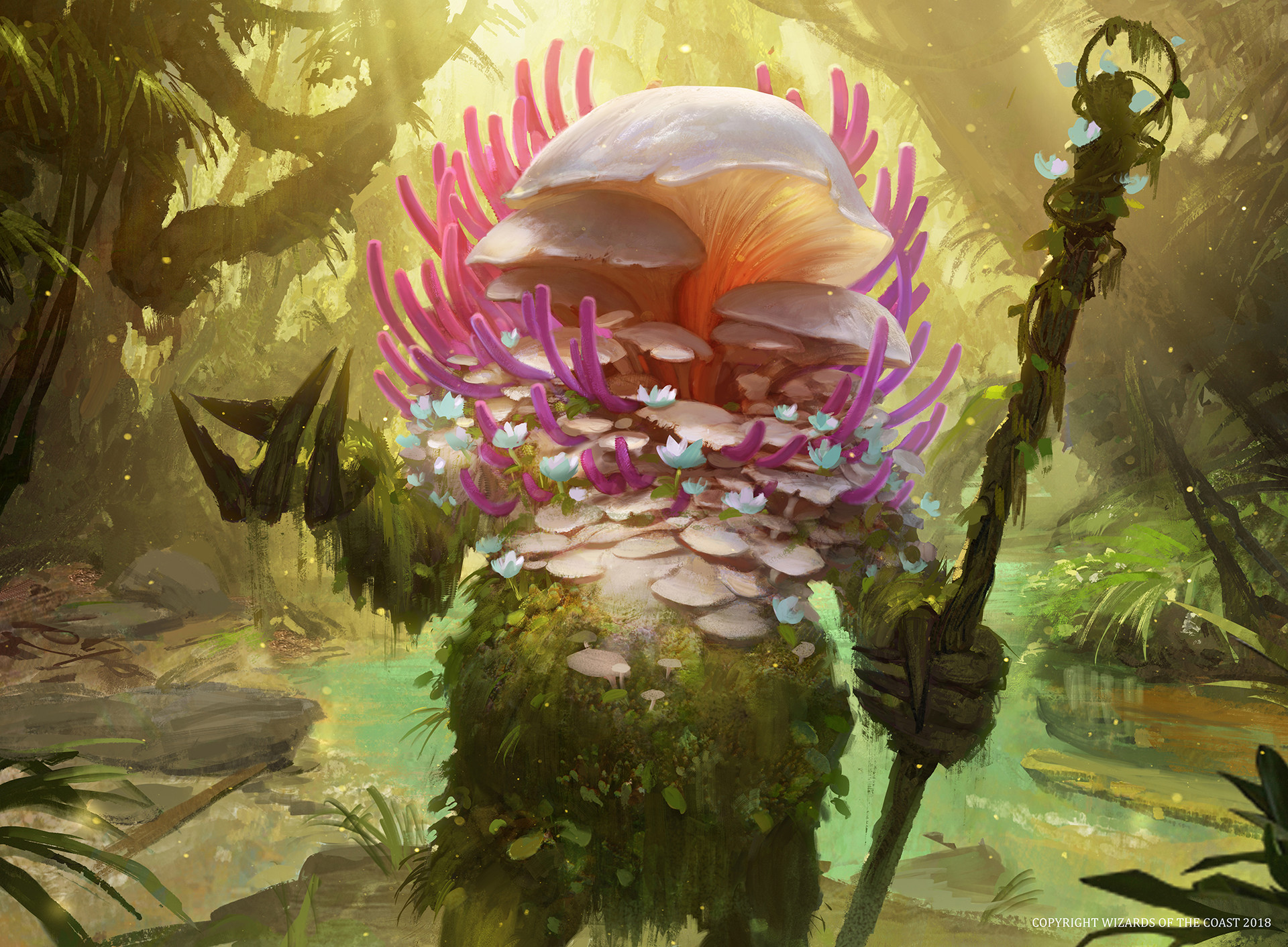
Myconid Mites
Myconid mites are the smallest and most numerous of all sapient fungi. Myconid mites can be found in nearly any location within the Underdark. Due to their friendly nature and knowledge of the Underdark, they are often a welcome sight to many humanoids who often trade various good, preferably some form of organic matter that they convert into new mites, in exchange for navigation through the Underdark.
Curious Nomads
In general, they are extremely curious and nomadic fungi. They tend to travel in large groups of up to 20 (10d4) members to traverse the deepest and darkest reaches of the Underdark.
Occasionally, mites make a trek to the surface world to experience the sun. Such a journey is actually believed to be a tradition celebrated by all myconid mites, as they will embark on entire pilgrimages to the surface world consisting of hundreds or even thousands of them at a time.
Fungal Gardeners
When they are not traveling, mites love to tend to their fungal gardens, wherein they grow normal and awakened fungi. These gardens are maintained by masses of various organic matter they find from their journeys. Occasionally, if they reside closer enough to the surface, they are known to trek into sewers and even cemeteries to acquire more organic matter for their gardens.
Myconid Tactics
Despite their generally peaceful attitude, myconids can prove to be troublesome enemies. Myconids typically do not become aggressive unless they are provoked; however, they have been known to go on the offensive at the command of larger myconids.
Due to their small, size, myconids prefers to fight in their favored terrain wherein they have advantage. Such terrain would typically include fungal forests or their fungal gardens. Just like their floral counterparts, myconids have the ability to merge into nearby fungi and reappear in another fungi elsewhere. Such tactics enable them to employ hit-and-run tactics, keeping their enemy constant on edge.
Thanks to their link to the spore mind, they are able to call for aid to nearby myconids. Typically, if ambushed or overwhelmed, they will telegraph their position to reinforcements while evading the grasp of their enemy using their fungal stride.
The final advantage that they possess in their fungal gardens is that they can quickly find a new host body with ease if their primary body is destroyed. Thanks to the fungal mists that typically accompany their fungal gardens, their vulnerable spore form is able to easily slip away so that it can find a new body to rise from.

Myconid Mite Template
Small Plant, any alignment
- Armor Class 13 (Natural Armor)
- Hit Points 13 (2d6+6)
- Speed 30ft., 30ft. climb
STR DEX CON INT WIS CHA 14 (+2) 10 (+0) 16 (+3) 10 (+0) 13 (+1) 10 (+0)
- Skills Perception +3, Stealth +4
- Condition Immunities Blinded, Charmed, Deafened, Paralyzed, Poisoned
- Damage Immunities Necrotic, Poison
- Senses blindsight 60ft., passive Perception 13
- Lanuages Telepathy 30ft.
- Proficiency Bonus: +2
- Challenge 1/4(50 xp)
Spore Mind The myconid mite can communicate with another myconid within 240ft. of it. Myconid Mites in this range can sense the pain of another.
Symbiotic Mind The myconid mite has advantage on attack rolls, ability checks, and saving throws, while within 30ft. of another creature with symbiotic mind.
Spore Burst Upon dropping to 0 hitpoints, creatures within 10ft. of it must succeed a DC 12 Constitution saving throw or take 5(1d8) necrotic damage + 5(1d8) poison damage. On a successful saving throw, it takes half damage.
Fungal Camouflage The myconid mite has advantage on Dexterity (Stealth) checks it makes in any terrain with ample obscuring fungus. It can use its bonus action to Hide while these conditions are met.
Spore Cloud Creatures that first enter or starts its turn within 5ft. of the myconid mite must succeed a DC 13 Constitution saving throw or become poisoned until the end of its next turn. Upon a successful saving throw, creatures cannot be poisoned in this manner for the next 24 hours.
Spore Spawn If a creature poisoned by the mite is reduced to 0 hitpoints, it is killed. After 1 hour, that creatures returns to life as an myconid mite. This feature does not work against constructs or undead.
Actions
Fungal Mace Melee Weapon Attack: +4 to hit, 10ft., one target. Hit: 7 (1d6+2) bludgeoning damage + 4(1d6) poison damage.
Spore Wand Once creature within 30ft. of the myconid mite must succeed a DC 12 Constitution saving throw or take 7(2d6) poison damage Upon a successful saving throw, creatures take half damage.
Bonus Actions
Fungal Stride As a bonus action, the myconid mite can enter a Medium or larger fungus and emerge 5ft. from another Medium or larger fungus within 60ft. of its original location

Myconid Walker
Myconid walkers are much larger forms of myconids. As mites are typically the first stage of life for myconids, walkers are usually born once a mite become powerful enough to assimilate and control a much larger body.
Fungal Guardians
Whereas mites tend to be more nomadic, walkers are typically more prone to build settlements and cities with the fungal forests of the Underdark. These cities are quite alien in comparison to that of most societies in the Material Plane, as their cities often resemble a large amalgamation of mushrooms or lichen. Thanks to their innate ability to merge into fungi, navigating such cities is nigh impossible for most other creatures.
In addition to building myconid settlements, walkers also tend to be very protective of mites and other sentient fungi. They frequently accompany mites on their various pilgrimages as well as tend to the fungal garden.
Agents of Assimilation
Unlike their smaller kin, walkers tend to be much more dangerous as they seek to expand their civilization and fungal forests beyond the Underdark. They regularly organize in large raid parties of 11(2d10) members, which actively hunts for any living creature. The purpose of these raids are to find suitable hosts to create more walkers as well as to refill their barrows filled of organic matter to feed their fungal gardens as well as to maintain a store auxiliary hosts for when their settlements fall under attack.
Walker Tactics
Much like their smaller kin, walkers are at their strongest while in fungal forests or gardens, employing hit-and-run tactics. However, depending on the location of their target, they may not have the luxury fighting in such a location.
To make up for this, tend to choose their targets carefully, oftentimes watching them for hours to identify any strengths or weaknesses. Communicating via spore mind, they are able to silently coordinate attacks prioritizing the most dangerous attackers, such as individuals who can cast spells (primarily fire) as their fungal form and toxic spores are able to weaken most forms of conventional weaponry.
For much larger raids, they tend to bring larger awakened fungi or even myconid behemoths along to serve as additional strength as well as quick transport via their fungal stride ability.
Myconid Walker Template
Medium Plant, any alignment
- Armor Class 15 (Natural Armor)
- Hit Points 51 (6d8+24)
- Speed 30ft.
STR DEX CON INT WIS CHA 17 (+3) 13 (+1) 18 (+4) 11 (+0) 13 (+1) 12 (+1)
- Skills Perception +3, Stealth +5
- Condition Immunities Blinded, Charmed, Deafened, Paralyzed, Poisoned
- Damage Resistances Bludgeoning, Piercing, and Slashing damage
- Damage Immunities Necrotic, Psychic, Poison
- Senses blindsight 60ft, passive Perception +3
- Lanuages Telepathy 60ft.
- Proficiency Bonus: +2
- Challenge 4(1100 xp)
Spore Soul When the walker is in its spore form, it can't take any actions, speak, or manipulate objects. It is weightless, has a flying speed of 20ft., can hover, and enter a hostile creature's space. In addition, if air can pass through a space, the spore can do so without squeezing and it cannot pass through water. It has advantage on Strength, Dexterity, and Constitution saving throws, is immune to all conditions, and is immune to to bludgeoning, necrotic, piercing, poison, and slashing damage.
Fungal Resurrection When the myconid walker drops to 0 hitpoints, the life-giving spores of the walker escapes from its body instead of falling unconscious provided it hasn't taken fire damage on its previous turn. If it cannot escape, it is destroyed.
While in is in its spore form, it has 1 hitpoint, it can't revert to its physical form and it must be able to infect a medium corpse within 1 hour or become destroyed.
After spending 1 hour assimilating into a new corpse, it returns as a fully healed myconid walker.
Spore Mind The myconid walker can communicate with another myconid within 240ft. of it. Myconids in this range can sense the pain of another.
Symbiotic Mind The myconid walker has advantage on attack rolls, ability checks, and saving throws, while within 30ft. of another creature with symbiotic mind.
Spore Burst Upon dropping to 0 hitpoints, creatures within 10ft. of it must succeed a DC 12 Constitution saving throw or take 9(2d8) necrotic damage + 9(2d8) poison damage. On a successful saving throw, it takes half damage.
Spore Cloud Creatures that first enter or starts its turn within 10ft. of the myconid walker must succeed a DC 14 Constitution saving throw or become poisoned until the end of its next turn. Upon a successful saving throw, creatures cannot be poisoned in this manner for the next 24 hours.
Fungal Camouflage The myconid walker has advantage on Dexterity (Stealth) checks it makes in any terrain with ample obscuring fungus. It can use its bonus action to Hide while these conditions are met.
Spore Spawn If a creature poisoned by the walker is reduced to 0 hitpoints, it is killed. After 1 hour, that creatures returns to life as an myconid walker. This feature does not work against constructs or undead.
Actions
Multiattack The myconid walker can make two fungal strike. It can substitute any number of fungal strikes for a spore wand.
Fungal Strike Melee Weapon Attack: +5 to hit, 5ft., one target. Hit: 7 (1d8+2) bludgeoning damage + 5(1d8) poison damage.
Spore Wand One creature within 60ft. of the myconid walker must succeed a DC 14 Constitution saving throw or take 9(2d8) poison damage + 9 (2d8) necrotic damage. Upon a successful saving throw, creatures take half damage.
Bonus Actions
Fungal Stride As a bonus action, the myconid walker can enter a Medium or larger fungus and emerge 5ft. from another Large or larger fungus within 60ft. of its original location
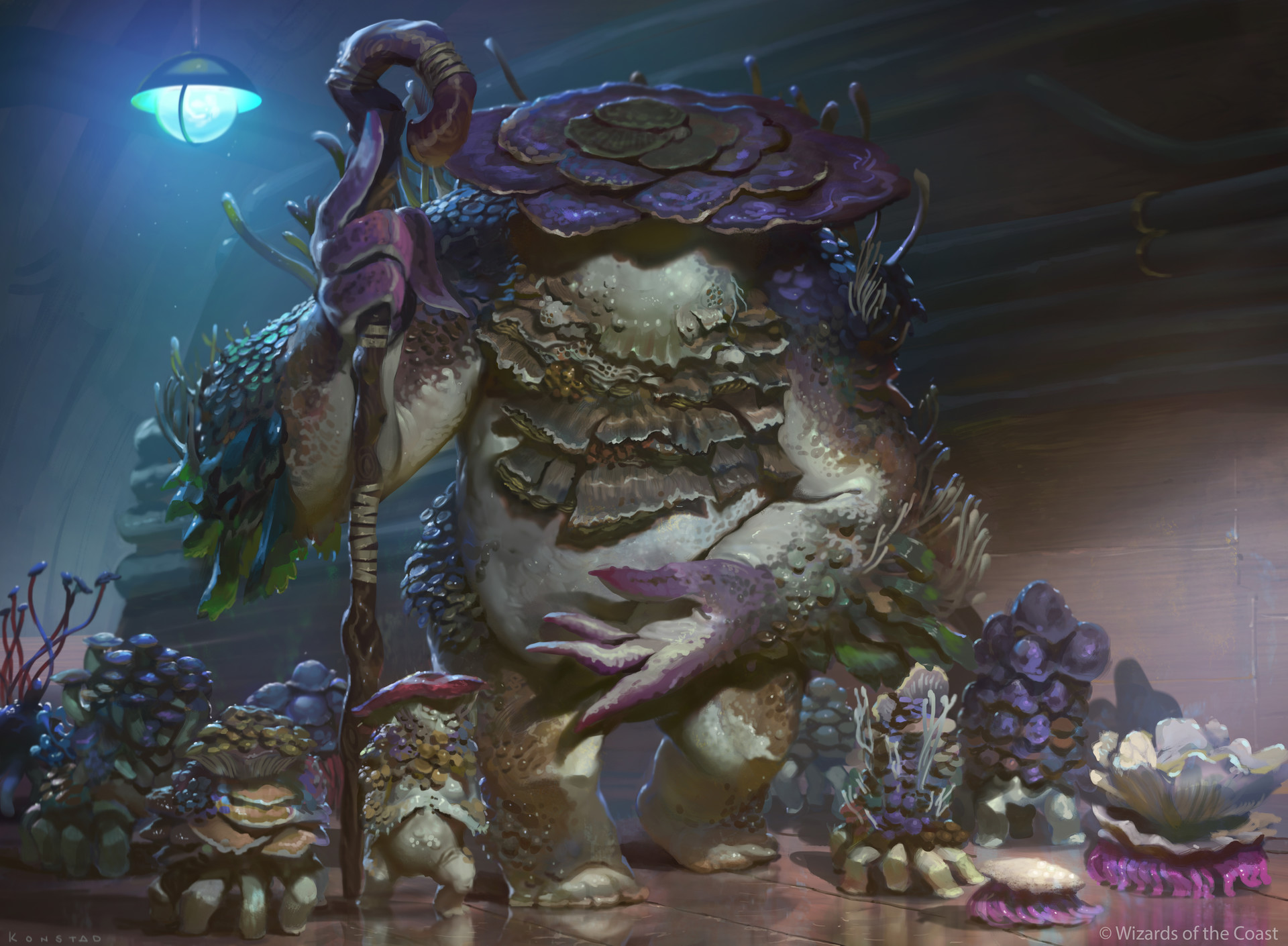
Myconid Behemoth
Myconid behemoths are the final stage of the traditional life cycle of most myconids. Behemoths are created where a myconid's essence is powerful enough to control and manipulate a large amount of organic matter to grow into a towering colossus.
Mobile Sanctuary
Thanks to the innate ability that allows myconids to merge into nearby fungi, myconid behemoths are able to serve as temporary homes from many myconid mites, walkers, and in even some cases sovereigns. This is especially the case for the more nomadic groups that traverse the very dangerous terrain of the Underdark. Because of their size, few creatures would dare attack a behemoth.
Rare Ascension
Because of their immense size, behemoths are often quite rare since they require a lot of organic matter to assimilate in a new form. If a behemoth's form is destroyed, it is much more likely that the behemoth will split is essence to form multiple walkers unless it can find a large enough host to possess.
Sovereign Guardians
Despite their immense power and size, behemoths typically hold a lower social station than sovereign's in myconid society. Many tend to be the staunch protectors of their sovereigns as well as for myconid archspores. Over serve as commanders or generals, leading myconids on massive raiding parties or coordinating the defense against attackers.
Behemoth Tactics
In combat, behemoths are living siege engines capable of breaking down the strongest defenses and cutting a path through enemy lines. They also inadvertently serve as a troop transport, capable of serving as a nexus where troops can retreat or reinforce by using its body with their Fungal Stride.
Because of this, one should be extremely wary when fighting a behemoth, especially a solitary one. More often than not, small portals will begin opening on its form to bring through squads of mites, walkers, and at times even sovereigns.
Myconid Behemmoth Template
Huge Plant, any alignment
- Armor Class 15 (Natural Armor)
- Hit Points 125 (10d12+60)
- Speed 30ft.
STR DEX CON INT WIS CHA 22 (+6) 8 (-1) 23 (+6) 11 (+0) 13 (+1) 12 (+1)
- Saving Throws Constitution +10
- Skills Perception +5
- Condition Immunities Blinded, Charmed, Deafened, Paralyzed, Poisoned
- Damage Resistances Bludgeoning, Piercing, and Slashing damage
- Damage Immunities Necrotic, Psychic, Poison
- Senses blindsight 60ft.
- Lanuages Telepathy 120ft.
- Proficiency Bonus: +4
- Challenge 11(7200 xp)
Spore Soul When the behemmoth is in its spore form, it can't take any actions, speak, or manipulate objects. It is weightless, has a flying speed of 20ft., can hover, and enter a hostile creature's space. In addition, if air can pass through a space, the spore can do so without squeezing and it cannot pass through water. It has advantage on Strength, Dexterity, and Constitution saving throws, is immune to all conditions, and is immune to to bludgeoning, necrotic, piercing, poison, and slashing damage.
Fungal Resurrection When the myconid behemmoth drops to 0 hitpoints, the life-giving spores of the behemmoth escapes from its body instead of falling unconscious provided it hasn't taken fire damage on its previous turn. If it cannot escape, it is destroyed.
While in is in its spore form, it has 1 hitpoint, it can't revert to its physical form and it must be able to infect a Huge corpse within 1 hour or become destroyed. Alternatively, it can infect 4 Medium corpses to turn into 4 walkers
After spending 1 hour assimilating into a new corpse, it returns as a fully healed myconid behemmoth or 4 myconid walkers.
Siege Monster The myconid behemmoth deals double damage to buildings and objects
Symbiotic Mind The myconid behemmoth has advantage on attack rolls, ability checks, and saving throws, while within 30ft. of another creature with symbiotic mind.
Spore Burst Upon dropping to 0 hitpoints, creatures within 10ft. of it must succeed a DC 19 Constitution saving throw or take 18(4d8) necrotic damage + 14(4d8) poison damage. On a successful saving throw, it takes half damage.
Fungal Camouflage The myconid behemmoth has advantage on Dexterity (Stealth) checks it makes in any terrain with ample obscuring fungus. It can use its bonus action to Hide while these conditions are met.
Spore Spawn. If a creature poisoned by the behemmoth is reduced to 0 hitpoints, it is killed. After 1 hour, that creatures returns to life as an myconid walker. This feature does not work against constructs or undead.
Spore Cloud Creatures that first enter or starts its turn within 20ft. of the myconid behemmoth must succeed a DC 18 Constitution saving throw or become poisoned until the end of its next turn. Upon a successful saving throw, creatures cannot be poisoned in this manner for the next 24 hours.
Spore Mind The myconid behemmoth can communicate with another myconid within 240ft. of it. Myconids in this range can sense the pain of another.
Mushroom Portal The behemmoth counts as a fungi for the Fungus Stride feature.
Actions
Multiattack The myconid behemmoth can make two fungal strike. It can substitute any number of fungal strikes for a spore blast
Fungal Strike Melee Weapon Attack: +10 to hit, 10ft., one target. Hit: 24 (4d8+6) bludgeoning damage + 18(4d8) poison damage.
Spore Blast Once creature within 240ft. of the myconid Behemmoth must succeed a DC 19 Constitution saving throw or take 18(4d8) poison damage + 18 (4d8) necrotic damage . Upon a successful saving throw, creatures take half damage.
Spore Burst(Recharge 5-6) Creatures within a 30ft. radius around a spot within 120ft. of the behemmoth can see must succeed a DC 18 Constitution saving throw. On a failed saving throw, it takes 18 (4d8) poison damage + 18 (4d8) necrotic damage and becomes poisoned for one minute. At the end of each of its turns, it can repeat its saving throw to end the effects on a successful saving throw. On a successful saving throw, creatures take half damage and are not poisoned.
Myconid Variants
Just like their normal and awakened relatives, myconids can come in many varieties. These variants typically can be identified by the different effects their spores can induce on their victims.
Mirespore
Mirespores are easily recognizable by their sweet-smelling aroma of their spores. Despite their pleasing scent, mirespores have very dangerous, mind-altering capabilities. Creatures infected by these spores suffer from hallucinations and imaginary noises. Based on accounts, these hallucinations vary from individual, as they tend to take the form of that creature's greatest fears or desires.
More powerful myconids such as sovereigns and archspores are able to control these spores to a greater degree, using them to take control of their victims minds or spread mass hysteria and chaos amongst their enemies.
Spellspores
Spellspore are the rarest of all myconids and are found in the deepest parts of the Underdark. Their spores have unique antimagic properties capable of blocking an infected creature's connection to magic. These spores are also strong enough to generate an antimagic field in a close vicinity around the myconid. This spore cloud provides the myconid ample protection from the magical, volatile environment often associated with the deepest reaches of the Underdark.
However, interestingly enough, the antimagic properties generated by these spores seems to have no bearing on the myconid's own spellcasting abilities. Scholars believe that myconids do not channel magic in the same way that most other creature do, as their spores are actually believed to be the source of its magic. Essentially, these spores act somewhat like a battery, absorbing nearby arcane energy to power their own spell effects.
Hostspore
Of all myconids, the host spore is the most dangerous and frightening, as they have the ability to take the control of the body and mind of living creatures. The spores of these myconids tend to have a higher degree of sentience than their other kin. Once it infects a creature, it is able to make take over that creature's body, forging a temporary link between the myconid and its new host.
While under the myconid's control, the creature has no control over its body and mind ; but is still fully aware of its actions. For the duration of its effects, the myconid has full access to that creature's abilities and thoughts. Thanks to this symbiotic link, whenever the myconid is harmed, it is able to transfer some of its pain to that of its host.
Frostspore
Ironically, frostspore myconids can only be found in areas of extreme heat, such as volcanoes, underground magma lakes, or near planar incursions with the Elemental Plane of Fire. The fungi primarily feed off of warmth, siphoning it from its surroundings.
If their environment does not suit their needs, they will often resort to living creatures as they are drawn to their body heat. Unfortunately, their craving for heat also makes them extremely susceptible to cold as it greatly saps their vitality, making them extremely sluggish.
Blightspore
Blightspores are typically what comes to mind when one thinks of a myconid. Although myconids share a general hatred towards plants, blightspores absolutely despise their floral counterparts. Although most myconids do not have a preference for what type of creature they assimilate, blightspore specifically aim to target plants during their raids.
Their spores are perfectly adapted for combating plants, as their spores are able to completely nullify and even reverse any form of regeneration or healing magic. Because of its nature, plants are extremely susceptible to becoming infected with their spores.
Umberspore
Although most myconids occasionally make a yearly trek to the surface to experience the sun, umber spores absolutely despise the presence of any light, especially sunlight.
Unlike most creatures which are hindered by the light, umberspores enter into a violent frenzy. Although most umberspores tend to be less aggressive than their other kin, they are one of the most common fungal perpetrator of attacks against humanoids. This is primarily due to the fact that humanoids tend to rely on light while traversing the Underdark as they stumble across a group of umberspore myconids.
Halospore
Halospores are one of the few myconids that naturally live on the surface of the Material Plane. Their spores have the unique ability to absorb and emit sunlight. As a result, one can find these myconids basking in sunlight, absorbing its energy.
Halospores are also responsible for the myconid pilgrimages to the surface, as they regularly trek to the Underdark to give their kin a taste of sunlight through their spores.
Despite their peaceful motives, halospores often find themselves in conflict with many surface dwelling creature, particularly other plants. As they try to establish a home on the surface, converting nearby forests into fungi gardens, they often end up in large skirmished with nearby awakened plants or even druidic circles. Such skirmishes often deteriorate into large-scale conflicts, as their other myconid relatives will often rise from the Underdark to aid their sun-loving kin.
Mirespore
Mire Spore Creatures poisoned by the myconid are subjected to psychadelic hallucinations. For the duration of being poisoned, creatures have a movement speed of 0 are considered incapacitated.
Spellspore
- Challenge Rating Increases by 1
Spellspore Creatures poisoned by the myconid cannot cast or concentrate on spells for the duration of this effect.
Anti-magic Spores The myconid's spore cloud counts as an antimagic field
(This effect does not hinder the myconid's own spellcasting abilities or effects.)
Frostspore
Cold Susceptibility Whenever the mushroom takes cold damage, it movement speed is halved until the end of its next turn. Cold damage can hinder its fungal resurrection ability
Flame Heal When the myconid takes fire damage, it takes no damage healing for the amount of damage dealt instead. Fire does not effect fungal resurrection.
Frostspore Creatures poisoned by the myconid takes 7(2d6) cold damage at the start of each of its turns.
Blightspore
Blightspore Creatures poisoned by the myconid cannot regain hitpoints for the duration. Whenever creatures recover hitpoints, it takes necrotic damage equal to the amount healed instead. Whenever poisoned creatures take necrotic damage, it takes maximum damage instead of roll.
Floral Bane Plants have disadvantage on saving throws against its poison effects.
Host Spore
- Challenge Rating Increases by 1
Actions
Possession Spore While poisoned by the myconid, creatures are controlled by the myconid as its spores takes over that creature's body and mind. For the duration, that creature is under the complete control of the myconid.
Whenever the myconid takes takes damage, it takes half damage and splits the damage taken between its host. That creature takes that damage as necrotic damage.
Creatures can repeat its saving throw at the end of each of its turns ending the effect on a success. This effect can be removed if the myconid dies, the creatures succeeds its saving throw, or if lesser restoration or a similar or greater effect is applied to that creature.
The myconid can only possess one creature at a time in this manner.
Umber Spore
Shadow Spore The myconid's spore cloud ability counts as magical darkness and extinguishes any form of nonmagical or magical light. This cloud emits dim light an additional distance equal to the spore clouds radius.
Sun Fury Whenever the myconid takes radiant damage or extinguishes any form of light, it takes no damage. Until the end of its next turn, the myconid has advantage on attack rolls, can make an additional Fungal Mace or Spore Wand attack on its turn, and can use its bonus action to Dash.
Halo Spore
Halo Spore The myconid's spore cloud ability gives off bright light in its radius. This light counts as daylight. This cloud emits dim light an additional distance equal to the spore clouds radius.
Revealing Light Creatures that first enter or starts its turn within range of its spore cloud, cannot benefit from half or three-fourth's cover or invisibility.
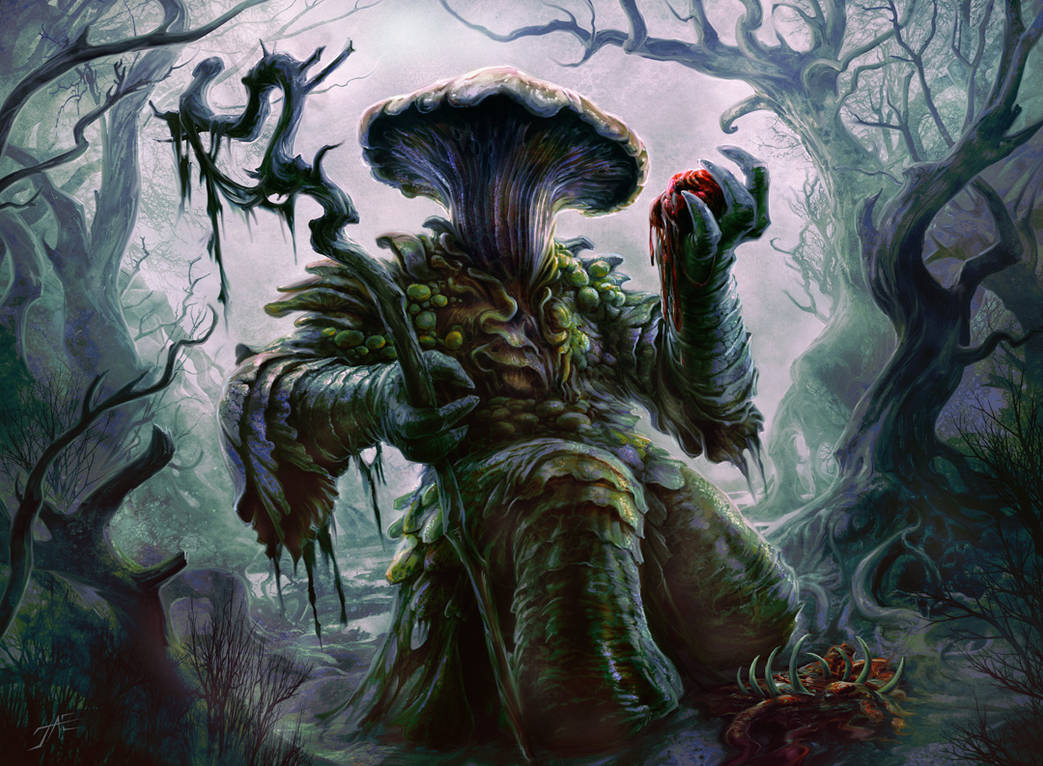
Myconid Sovereign
Sovereigns are extremely special and highly valued amongst the myconid spore minds. Sovereigns are individuals who show a special affinity to replicate magical effects using their spores.
Sporemind Entitlement
Because of their special abilities, they are held with much regard in myconid society. They not only command considerable authority amongst their kin, they also gain priority upon preserving their physical forms.
Favored Offspring
Sovereigns also seem to show partial favor towards thralls created by its own spores when it infects a slain creature. Although these walkers do not retain any of the sovereign's magical ability, the sovereign often acts as a guide or tutor for these individuals in hope that they will one day become powerful enough to develop their magical ability.
Sovereign Barrows
Their status also entitles them to entire fungal gardens or barrows dedicated to them. Since sovereigns regularly have entire legions of walkers and mites under its authority, any bodies acquired under an assimilation raid are brought to its barrow.
These barrows not only serve as a source of potential host bodies for itself, it also uses it as a reward for loyalty, as its most trusted subjects will be gifted a share of hosts within this barrow as a guaranteed rebirth if it ever falls in battle.
Sovereign Tactics
Under most circumstances, myconid mites and walkers are not as afraid of dying as most creatures on the Material Plane. Many of them view death as a chance at rebirth as it assumes a new host. If by some circumstance, it is not able to acquire a new form before death, many still take comfort in the fact that as aspect of its essence resides in another form created from a prior assimilation.
However, this is not entirely the case for sovereigns, as they are paranoid of dying. This is the reason for why they acquire and hoard so much organic matter, so they have a guaranteed chance at rebirth. Unless forced to leave (usually by command of an archspore), they rarely leave their seat of power within myconid society, sending their minions to do their bidding.
If forced to fight, they are extremely dangerous as they are always accompanied by 5(2d6) walkers and 7(2d6) mites. The sovereign will concentrate its most powerful attacks on the most dangerous opponents from a distance. Meanwhile, the majority of its minions will focus on harrying and distracting other opponents while the rest stay back protecting the sovereign by weakening them from a distance.
Myconid Sovereign Template
Medium Plant, any alignment
- Armor Class 15 (Natural Armor)
- Hit Points 85 (10d8+40)
- Speed 30ft.
STR DEX CON INT WIS CHA 17 (+3) 13 (+1) 18 (+4) 16 (+3) 17 (+3) 17 (+3)
- Skills Perception +3, Stealth +5
- Condition Immunities Blinded, Charmed, Deafened, Paralyzed, Poisoned
- Damage Resistances Bludgeoning, Piercing, and Slashing damage
- Damage Immunities Necrotic, Psychic, Poison
- Senses blindsight 60ft.
- Languages telepathy 120ft.
- Proficiency Bonus: +3
- Challenge 7(2900 xp)
Spore Soul When the sovereign is in its spore form, it can't take any actions, speak, or manipulate objects. It is weightless, has a flying speed of 20ft., can hover, and enter a hostile creature's space. In addition, if air can pass through a space, the spore can do so without squeezing and it cannot pass through water. It has advantage on Strength, Dexterity, and Constitution saving throws, is immune to all conditions, and is immune to to bludgeoning, necrotic, piercing, poison, and slashing damage.
Fungal Resurrection When the myconid sovereign drops to 0 hitpoints, the life-giving spores of the sovereign escapes from its body instead of falling unconscious provided it hasn't taken fire damage on its previous turn. If it cannot escape, it is destroyed.
While in is in its spore form, it has 1 hitpoint, it can't revert to its physical form and it must be able to infect a medium corpse within 1 hour or become destroyed.
After spending 1 hour assimilating into a new corpse, it returns as a fully healed myconid sovereign.
Fungal Stride As a bonus action, the myconid sovereign can enter a Large or larger fungus and emerge 5ft. from another Large or larger fungus within 60ft. of its original location
Spore Mind The myconid sovereign can communicate with another myconid within 240ft. of it. Other creatures with spore mind in this range can sense the pain of another.
Symbiotic Mind The myconid sovereign has advantage on attack rolls, ability checks, and saving throws, while within 30ft. of another creature with symbiotic mind.
Spore Burst Upon dropping to 0 hitpoints, creatures within 10ft. of it must succeed a DC 15 Constitution saving throw or take 14(3d8) necrotic damage + 14(3d8) poison damage. On a successful saving throw, it takes half damage.
Fungal Camouflage The myconid sovereign has advantage on Dexterity (Stealth) checks it makes in any terrain with ample obscuring fungus. It can use its bonus action to Hide while these conditions are met.
Spore Cloud Creatures that first enter or starts its turn within 10ft. of the myconid sovereign must succeed a DC 15 Constitution saving throw or become poisoned until the end of its next turn. Upon a successful saving throw, creatures cannot be poisoned in this manner for the next 24 hours.
Spore Spawn If a creature poisoned by the sovereign is reduced to 0 hitpoints, it is killed. After 1 hour, that creatures returns to life as an myconid walker. This feature does not work against constructs or undead.
Spellcasting
The sovereign is a 10th level spellcaster. its spellcasting ability is Constitution(spell save DC 15, +7 to hit with spell attacks). The sovereign has the following spells prepared.
Cantrips(At Will) Druidcraft, Toll the Dead
1st Level(4/long rest) Bane, Fog Cloud, Inflict Wounds, Sleep
2nd level(3/long rest) Ray of Enfeeblement
3rd level(3/long rest) Stinking Cloud, Vampiric Touch
4th level(2/long rest) Blight
5th level(2/long rest) Cloudkill, Contagion, Enervation
Actions
Multiattack The myconid sovereign can cast one spell and make two fungal strikes. It can substitute any number of fungal strikes for a spore wand.
Fungal Strike Strike Melee Weapon Attack: +6 to hit, 5ft., one target. Hit: 12 (2d8+3) bludgeoning damage + 9(2d8) poison damage.
Spore Wand Once creature within 120ft. of the myconid sovereign must succeed a DC 15 Constitution saving throw or take 9 (2d8) poison damage + 9 (2d8) necrotic damage. Upon a successful saving throw, creatures take half damage.
Spore Burst (Recharge 5-6) Creatures in a 20ft. radius of a spot within 120ft. of the myconid sovereign that it can see must succeed a DC 15 Constitution saving throw. On a failed saving throw, it takes 14 (3d8) poison damage + 14(3d8) necrotic damage At the end of each of its turns, it can repeat its saving throw to end the effects. Upon a successful saving throw, creatures take half damage and are not poisoned
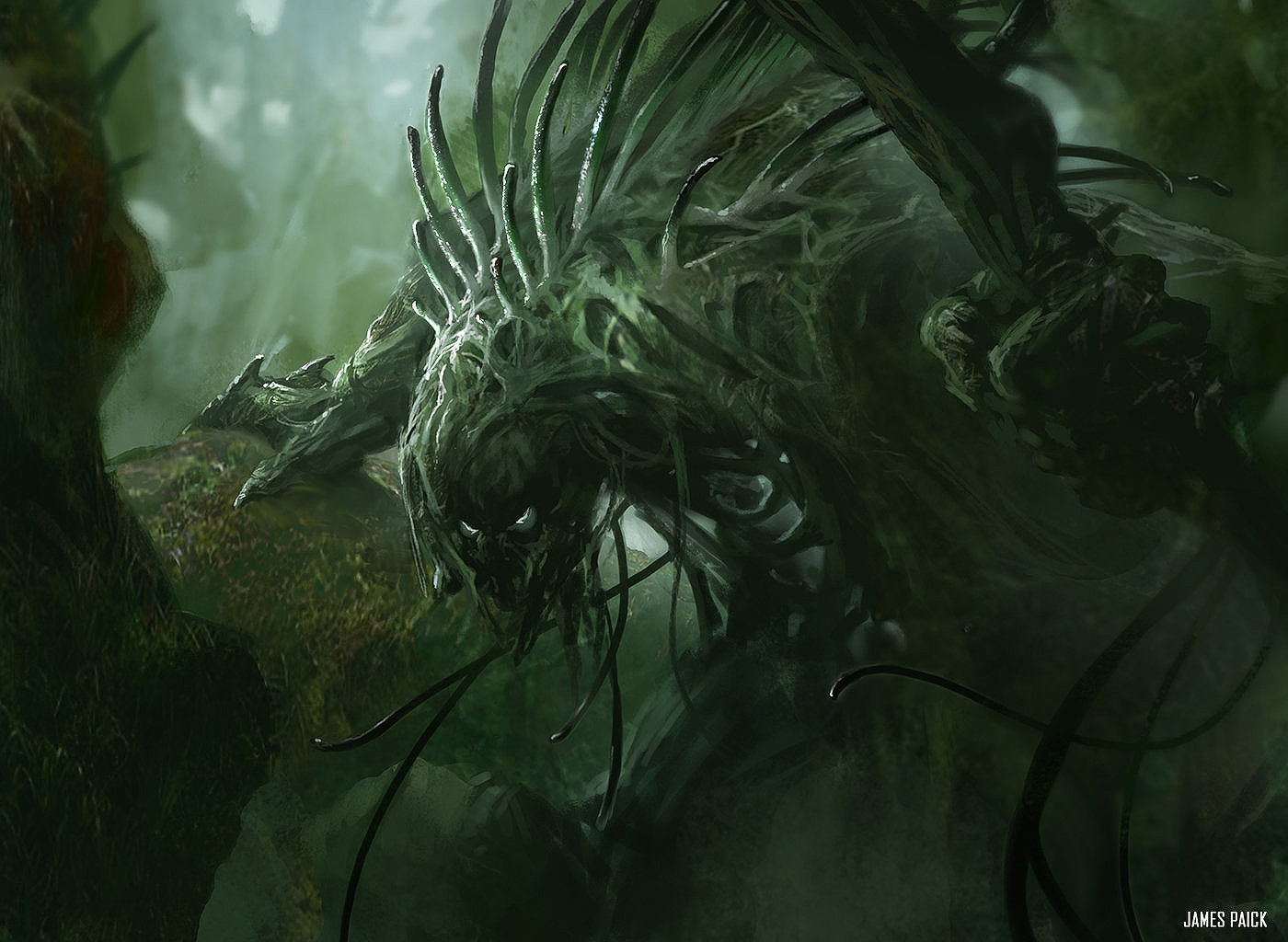
Myconid Archspore
Archspores are the rarest and most powerful of all myconids. Archspores originate from sovereign that have lived for centuries or even millennia. Oftentimes, an entire myconid settlement is founded by a single archspore. Just like sovereigns, archspores have colossal barrows dedicated to them for when they fall in battle.
Myconid Gods
Archspores are the representation of divine ascension for their society. Become an archspore is the ultimate goal of any myconid sovereign. The influence of an archspore is immense, as hundreds or, in some cases, thousands of myconids have flocked under its banner.
Interestingly enough, archspores rarely display any form of rivalry or violence between one another. Instead, they combine their powers to commanding their subjects to spread their fungal civilization. Such alliances are nearly always followed by a Sporetide wherein they sweep through the Underdark or even travel to the surface world, assimilating anything in its path. Thankfully, such incursions are rare and were only hindered by massive druidic coalitions or the opposing tide of nature from sentient plants.
Immortal Hosts
Unlike their sovereign counterparts, most archspores no longer fear death, as few creatures are capable of challenging its power. The primary reason for this is that although myconids can prove to be hard to kill without the use of fire, archspores are especially so due to their ability to transfer their life force to another body.
As long as the archspore, it can connect to the Spore Mind, it can transfer its essence to the form of a walker or sovereign if its physical body happens to be destroyed. This transfer is fatal to its host, as the archspore cannibalizes the spores of its host, taking the new body as its own.
Archspore Tactics
Just like sovereigns, archspores prefer not to leave their seat of power and are always accompanied by an entourage of myconid behemoths, walkers, and sovereigns. Those who seek to fight an archspore must manage to fight or sneak their way into the heart of myconid settlements.
However, to fully defeat it, one must separate it far enough from the spore mind, as it will simply transfer its essence to a new form. Once this happens, it will either escape using its new form to blend in among its subjects, or it returns with reinforcements.
Myconid Archspore
Large Plant, any alignment
- Armor Class 17 (Natural Armor)
- Hit Points 230 (20d10+120)
- Speed 30ft., 30ft. climb
STR DEX CON INT WIS CHA 17 (+3) 13 (+1) 23 (+6) 22 (+6) 22 (+6) 22 (+6)
- Saving Throws Con +12, Int +12, Wis +12
- Skills Perception +12, Nature +18, Stealth +7,
- Condition Immunities Blinded, Charmed, Deafened, Paralyzed, Poisoned
- Damage Resistances Bludgeoning, Piercing, Slashing
- Damage Immunities Necrotic, Psychic, Poison
- Senses blindsight 60ft., passive Perception 22
- Languages telepathy 120ft.
- Proficiency Bonus: +6
- Challenge 21(33000 xp)
Spore Soul When the archspore is in its spore form, it can't take any actions, speak, or manipulate objects. It is weightless, has a flying speed of 20ft., can hover, and enter a hostile creature's space. In addition, if air can pass through a space, the spore can do so without squeezing and it cannot pass through water. It has advantage on Strength, Dexterity, and Constitution saving throws, is immune to all conditions, and is immune to to bludgeoning, necrotic, piercing, poison, and slashing damage.
Fungal Resurrection When the myconid sovereign drops to 0 hitpoints, the life-giving spores of the sovereign escapes from its body instead of falling unconscious provided it hasn't taken fire damage on its previous turn. If it cannot escape, it is destroyed. While in is in its spore form, it has 1 hitpoint, it can't revert to its physical form and it must be able to infect a Large corpse within 1 hour or become destroyed. After spending 1 hour assimilating into a new corpse, it returns as a fully healed myconid sovereign.
Spore Mind The archspore can communicate with another creature with sporemind within 240ft. of it. Other creatures with spore mind in this range can sense the pain of another.
Fungal Camouflage The archspore has advantage on Dexterity (Stealth) checks it makes in any terrain with ample obscuring fungus. It can use its bonus action to Hide while these conditions are met.
Spore Spawn If a creature poisoned by the archspore is reduced to 0 hitpoints, it is killed. After 1 hour, that creatures returns to life as an myconid walker. This feature does not work against constructs or undead.
Spore Cloud Creatures that first enter or starts its turn within 20ft. of the myconid archspore must succeed a DC 20 Constitution saving throw or become poisoned until the end of its next turn. Upon a successful saving throw, creatures cannot be poisoned in this manner for the next 24 hours.
Legendary Resistances (3/day) Upon failing a saving throw, the archspore can choose to succeed.
Upon using this feature, the archspore can cast a spell of 5th level or lower.
Actions
Multiattack The myconid archspore can make one spell or Spore Burst(if available) and two fungal strikes. It can substitute any number of fungal strikes for a spore wand.
Fungal Strike Melee Weapon Attack: +8 to hit, 5ft., one target. Hit: 17 (3d8+3) bludgeoning damage + 14(3d8) poison damage.
Spore Wand Once creature within 120ft. of the myconid archspore must succeed a DC 20 Constitution saving throw or take 14 (3d8) poison damage + 14 (3d8) necrotic damage. Upon a successful saving throw, creatures take half damage.
Spore Burst (Recharge 5-6) All creatures with a 30ft radius around a spot within 120ft. of the archspore that it can see must succeed a DC 20 Constitution saving throw. On a failed saving throw, it takes 27 (6d8) poison damage + 27 (6d8) necrotic damage and becomes poisoned for one minute. At the end of each of its turns, it can repeat its saving throw to end the effects. Upon a successful saving throw, creatures take half damage and are not poisoned
Sovereign Resurrection (1/long rest) If the archspore is hit by an attack that would reduce it to 0 hitpoints, it can choose to not take damage as it transfers its essence to another myconid walker or sovereign within 60ft. of it. Upon using this feature, the archspores original body as well as the myconid host dies and the archspore takes over the new body retaining its original statistics except that its current hitponts is equal to that of its new body. Using this feature does not recover any expended spells or legendary resistances.
Bonus ACtions
Fungal Stride As a bonus action, the archspore can enter a Huge or larger fungus and emerge 5ft. from another Huge or larger fungus within 60ft. of its original location
Create walker The archspore can cause one corpse it can see within 30ft. of it to turn into a Myconid walker. This walker acts on initiative count 20 losing an ties.
Legendary Actions (3/turn)
Fungal Merge(1 action) The archspore can use its Fungal Stride
Create walker(1 action) The archspore can use its create walker feature
Spore Plume(2 action) The archspore can force one creature it can see to make a DC 20 Constitution saving throw. On a failed saving throw, that creature is poisoned until the end of its next turn.
Rapid Recovery (3 action) The archspore can end one condition or spell effect of its choice on itself
Cast Spell(2 actions) The archspore can cast a spell of 5th level or lower.
Archspore Spell Template
Spellcasting
The archspore is a 20th level spellcaster. its spellcasting ability is Constitution(spell save DC 20, +12 to hit with spell attacks). The archspore has the following spells prepared.
Cantrips(At Will) Druidcraft, Toll the Dead
1st Level(4/long rest) Bane, Fog Cloud, Inflict Wounds, Sleep
2nd level(3/long rest) Ray of Enfeeblement
3rd level(3/long rest) Stinking Cloud, Vampiric Touch
4th level(2/long rest) Blight
5th level(2/long rest) Cloudkill, Contagion, Enervation
6th level(2/long rest) Circle of Death, Eyebite, Harm
7th level(1/long rest) Tether Essence, Power Word Pain
8th level(1/long rest) Abi-dalzim's Horrid Wilting, Feeblemind
9th level(1/long rest) Time Ravage
Mirespore variant Spells
The Mirespore variant has the following additional spells
Cantrips(At Will) Mind Sliver, Message
1st Level(4/long rest) Charm Person
2nd level(3/long rest) Crown of Madness, Mind Spike, Phantasmal Force, Suggestion
3rd level(3/long rest) Hypnotic Pattern, Fear
4th level(2/long rest) Phantasmal Killer
5th level(2/long rest) Dominate Person, Geas
7th level(1/long rest) Tether Essence
8th level(1/long rest) Dominate Monster
Frostspore Variant Spells
Spellcasting
The frostpore variant has the following additional spells
Cantrips(At Will) Ray of Frost, Frostibte
1st Level(4/long rest) Frost Fingers
3rd level(3/long rest) Slow
5th level(2/long rest) Cone of Cold
Spellspore Variant Spells
Spellcasting
The spellpore variant has the following additional spells
At will Detect Magic
3rd level(3/long rest) Counterspell, Dispel Magic
8th level(1/long rest) Antimagic Field
Umberspore Spellcasting
Spellcasting
The umberspore variant has the following additional spells
2nd Level(3/long rest) Darkness
8th level(1/long rest) Maddening Darkness
Halospore Variant Spells
The Halospore variant has the following additional spells
Cantrips(at will) Light, Dancing Lights
1st Level(4/long rest) Color Spray, Faerie Fire, Guiding Bolt
3rd Level(3/long rest) Daylight
5th Level(3/long rest) Dawn
6th level(2/long rest) Sunbeam
8th level(1/long rest) Sunburst

Treants
The largest and most powerful of all sapient plants are treants. Despite their similar appearance and physiology, they are much different from their other kin. Whereas most spriggans and woads are essentially evolved awakened plants, treants are far more ancient and are probably closer to an aspect of nature itself rather than a single entity.
Soul of the Forest
One of the defining characteristics of a treant is its innate connection to the forest. It is believed its life force is actually tied to that of the forest. This connection grants it the ability to project its essence into surrounding trees, allowing it to assume the form and consciousness. Although most treants maintain this connection with the forest of their birth; some embark on expeditions to find a new forest to call its homes. Such journeys are often viewed as an opportunity of self-discovery as it learns its purpose in the world.
Forest Shepherds
These titans are commonly known as tree shepherds, as they are known to be stalwart guardians of their forests realms. Although a particular forest may be protected by one or treants, the largest of forests have been known to protected by entire conclaves or orders of treants. There is very little that goes on in a forest that at least one treant is not aware of.
Druidic Patrons
A treant is extremely devoted to its forest realm and will do anything for its subjects, for better or worse. Many druidic conclave work with, or in some cases were founded by, by treants. These powerful entities teach humanoids how to tap into and communicate with the will of nature around them.
Nature's Zeal
However, some have proven to be more zealous in their resolve to nature. These treants have led vengeful campaigns against those that threaten their forest homes. These treants wield the power of the forest with brutal efficiency, burying entire towns under an unstoppable tide of root and vines.
Others act as warlords that believe that they are the very will of nature and seek to expand their forest realms, recruiting or even conquering treants of other forest realms. Such crusades often threaten the balance of nature, as their goals are to topple civilization or to cleanse the world of the myconid threat.
Treant Tactics
Fighting a treant in its forest home, is a terrible idea, even for the most experienced of adventurers. Not only must one contend with its immense size, strength, and ability to animate the surrounding forest, treants have numerous allies to come to its aid, whether it be awakened plants or even druidic humanoids. However, what makes them extremely dangerous is their ability to project their essence to surrounding trees, giving them similar forms to itself, quickly turning a battle into the treant's favor.
Because the treant acquires the majority of its power in its forest home, it rarely travels beyond its forest home. To make up for this disadvantage, a vengeful treant that ventures beyond its forest home is often accompanied by a troop of awakened plants such as woads, spriggans, druids, or even other treants.
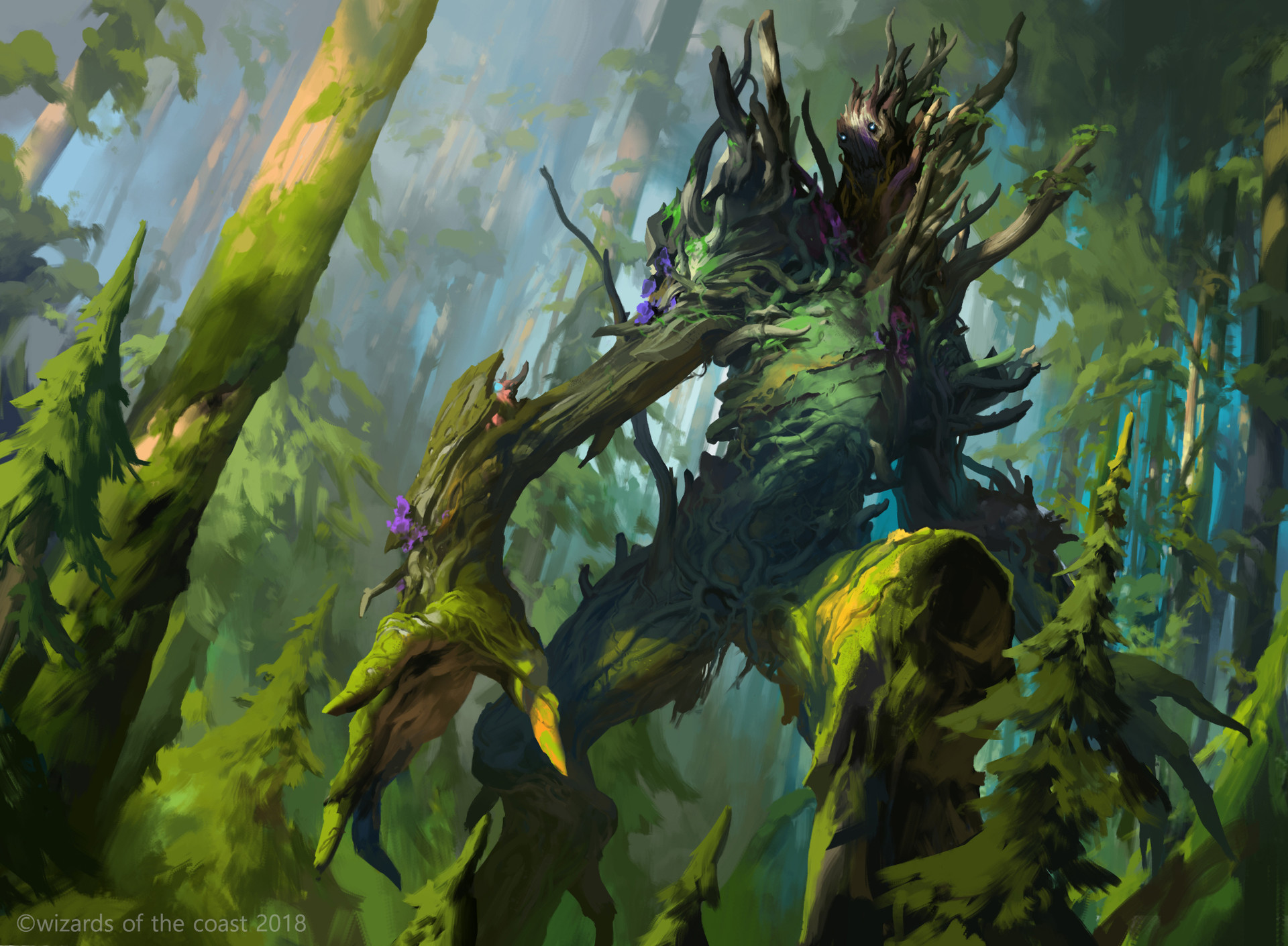
Treant Sapling Template
Large Plant, varies
- Armor Class 17 (Natural Armor)
- Hit Points 63(6d10+30)
- Speed 30ft.
STR DEX CON INT WIS CHA 18 (+4) 8 (-1) 21 (+5) 12 (+1) 16 (+3) 12 (+1)
- Saving Throws Strength +6. Constitution +7
- Skills Athletics +6, Stealth +3, Nature +3, Perception +5
- Damage Resistances bludgeoning, piercing, slashing
- Damage Immunities psychic
- Condition Immunities blinded, deafened, exhausted, paralyzed, stunned
- Senses tremorsense 60ft, blindsight 60ft., passive Perception 15
- Languages Common, Druidic
- Proficiency Bonus +2
- Challenge 4 (1100 xp)
False Appearance While motionless, the treant is indistinguishable from a normal tree
Siege Monster The treant deals double damage to buildings and objects
Rooted Defense The treant has advantage on saving throws against being knocked prone or pushed.
Flammable Whenever the treant takes fire damage, it catches aflame. While aflame, it takes 5 (1d8) fire damage at the start of each of its turns for one minute. It must use its action to put out the flames. However, while in this state, its attacks deal an additional 5 (1d8) fire damage for the duration.
Regeneration The treant regains 10 hitpoints at the start of its turn as long as has 1 hitpoint and it has not taken fire or necrotic damage on its previous turn. If it starts its turn in sunlight, it regains 20 hitpoints.
Magical Attacks The treant's attacks count as magical for the purpose of overcoming resistances and immunities.
Actions
Multiattack. The treant can make two club attacks. It can replace any one of its club attacks for a Grasping Tendril
Tree Club. Melee Weapon Attack: +6 to hit, 10ft., one target. Hit 11 (1d12+4) bludgeoning damage. If the target is a creature, it must succeed a DC 15 Strength saving throw or be knocked prone.
Boulder. Ranged Weapon Attack: +6 to hit, 60/240ft., one target. Hit 17 (2d12+4) bludgeoning damage. If the target is a creature, it must succeed a DC 15 Strength saving throw or be knocked prone and is restrained. It must use its action to escape from being restrained
Grasping Tendrils Melee Weapon Attack: +6 to hit, 10ft., one target. Hit 11 (2d6+4) bludgeoning damage. If the target is a creature, it is grappled and restrained (escape DC 15).
Treant Template
Huge Plant, varies
- Armor Class 19 (Natural Armor)
- Hit Points 261(18d12+144)
- Speed 30ft.
STR DEX CON INT WIS CHA 23 (+6) 8 (-1) 26 (+8) 17 (+3) 21 (+5) 17 (+3)
- Saving Throws Str+12. Con +14
- Skills Athletics +12, Stealth +11, Nature +9, Perception +11
- Damage Resistances bludgeoning, piercing, slashing
- Damage Immunities psychic
- Condition Immunities blinded, deafened, exhausted, paralyzed, stunned
- Senses tremorsense 60ft, blindsight 60ft., passive Perception 21
- Languages Common, Druidic
- Proficiency Bonus +6
- Challenge 20 (25000 xp)
False Appearance While motionless, the treant is indistinguishable from a normal tree
Siege Monster The treant deals double damage to buildings and objects
Rooted Defense The treant has advantage on saving throws against being knocked prone or pushed.
Flammable Whenever the treant takes fire damage, it catches aflame. While aflame, it takes 5 (1d8) fire damage at the start of each of its turns for one minute. It must use its action to put out the flames. However, while in this state, its attacks deal an additional 5 (1d8) fire damage for the duration.
Regeneration The treant regains 20 hitpoints at the start of its turn as long as has 1 hitpoint and it has not taken fire or necrotic damage on its previous turn. If it starts its turn in sunlight, it regains 30 hitpoints.
Legendary Resistances(3/day) Upon failing a saving throw, the treant can choose to succeed. Upon using this feature, the treant can regain 30 hitpoints.
Magical Attacks The treant's attacks count as magical for the purpose of overcoming resistances and immunities.
Special Effects
Some treant variants that rely on a saving throw for its Primary DC or Melee DC
- Primary DC The Primary DC for a treant is 22
- Melee DC The Melee DC for a shrub is 20
Actions
Multiattack. The treant can make two club attacks. It can replace any one of its club attacks for a Grasping Tendril
Tree Club. Melee Weapon Attack: +12 to hit, 15ft., one target. Hit 25 (3d12+6) bludgeoning damage. If the target is a creature, it must succeed a DC 18 Strength saving throw or be knocked prone.
Boulder. Ranged Weapon Attack: +12 to hit, 120/480ft., one target. Hit 45 (6d12+6) bludgeoning damage. If the target is a creature, it must succeed a DC 18 Strength saving throw or be knocked prone and is restrained. It must use its action to escape from being restrained
Grasping Tendrils Melee Weapon Attack: +12 to hit, 30ft., one target. Hit 21 (3d6+6) bludgeoning damage. If the target is a creature, it is grappled and restrained(escape DC 20).
Legendary Actions (3/turn)
Binding Roots (1 Action) A creature within 60ft. of the treant must succeed a DC 20 Strength saving throw or become restrained. Restrained creatures must use its action to escape the root. The root can also be attacked. It possesses 20 hitpoints and has an AC of 19. It shares the same resistances as the treant but is immune to all conditions. Upon dropping to 0 hitpoints, the root is destroyed but does not deal any damage to treant itself.
Fling(2 Actions) One Large or smaller object or creature grappled by the treant is thrown up to 60ft in a direction of its choice and knocked prone. If a throw target strikes a solid surface, the target takes 1d6 bludgeoning damage for every 10ft. thrown. If the target is thrown at a creature, that creature must succeed a DC 20 Dexterity saving throw or take the same damage and be knocked prone.
Leaf Storm( 2 actions) Creatures within 15ft. of the treant are enveloped in a cloud of swirling leaves. Creatures that first enter or starts its turn in this space takes 10 (4d4) slashing damage and are considered blinded until the end of that creatures next turn.
Resilience (3 actions) The treant can choose to end one status condition or spell effect on itself.
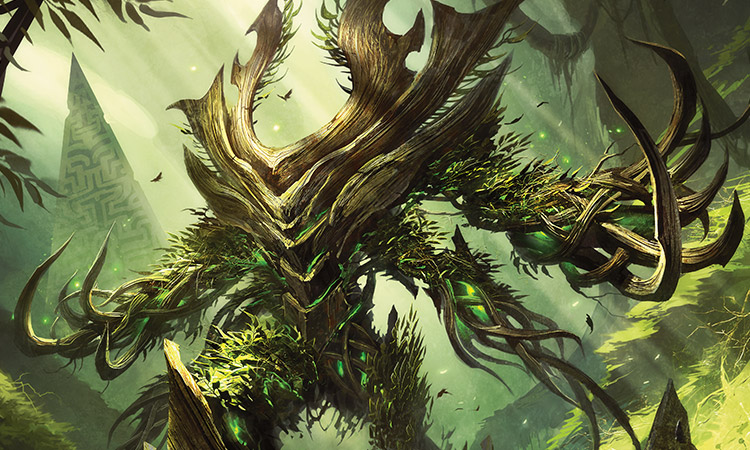
Mythic Actions
Soul of the Forest(1/day) When the treant starts its turn below half its hitpoint maximum, it body begins to glow a luminous green as it transfers its essence to two nearby trees that are not awakened.
Each of these tree transform into similar likenesses of the treant using its statistics except that its hitpoint maximum is equal to half the treant's maximum hitpoints. These new forms act on their own initiative.
The treant cannot truly die as long as one of these trees has at least 1 hitpoint. These surviving trees remain animated in this manner for up to 1 day or until it dies. The treant assumes its original form if possible but will inhabit the body of one of its additional forms if its original body is destroyed.
While its Mythic trait is active, the treant recovers all of its legendary resistances and legendary actions and are shared between all of its forms. The treant can also benefit from these new features
Linked Essence While within 30ft. of at least one of its forms, the treant has advantage on attack rolls and saving throws.
Reactions
Life Tether(1 legendary action) The next damage roll against the treant takes can be split between it and one of its other forms as long as it is within 30ft. of the treant.
Lair actions
On initiative count 20 ( losing initiative ties), the treant takes a lair action to cause one of the following effects; the treant can't use the same effect two rounds in a row.
The treant can use its lair actions as long as it is within the forest of its birth or the forest that it claims as its domain.
- Tangled Vines Grasping roots and vines erupts in a 20ft. radius centered on a point on the ground that the treant can see within 120ft. of it. Creatures of the treant's choice within the are must treat the area difficult terrain and each creature must succeed a DC 20 Strength saving throw or become restrained by the roots and vines. The vines wilt away when the treant dies or uses another lair action
- Briar Patch The treant creates a briar patch appears in a 60ft. cube centered on a point on the ground that the treant can see within 120ft. of it. When it appears, creatures of the treant's choice that starts its turn in this area must succeed a DC 20 Dexterity saving throw or take 14 (4d4) piercing damage and is pushed 5ft. out of its space.
Each time a creatures of the treant's choice starts its turn or first enters within this area, it must succeed a DC 19 Dexterity or take 10(4d4) piercing damage. On a successful saving throw, the creature takes half damage.
For every 10ft. a creature willingly moves through this space, it must make the repeat this saving throw taking full damage on a failed saving throw and half on a success.
These briars sink back into the ground when the treant dies or when it uses another lair action
- Root Tide Creatures of the treant's choice within in a 60ft. radius of the treant must succeed a DC 20 Strength saving throw or be pushed back 30ft. and knocked prone. This area counts as difficult terrain to all creatures of the treant's choice until the treant dies or uses another lair actions.
Amberwood
- Challenge Rating Increases by 1
- Damage Immunities Acid
Sticky Sap Creatures that touch the tree takes 9 (2d8) acid damage and become grappled and restrained to the treant (escape DC 22).
Adhesive Creatures have disadvantage on ability checks and saving throws to escape the treant's grapple
Flammable Sap If the treant is set aflame, creatures grappled to the tree are set aflame as well.
Actions
Amber Toss(Replaces Boulder) The treant's boulder attack deals acid damage instead. Creatures hit by the boulder must succeed a Strength saving throw equal to the treant's Primary DC. On a failed saving throw, the target is encased in a globule of amber.
Encased creatures are considered restrained, cannot breathe or speak, and have total cover inside the amber. The amber capsule has 20 hitpoints, an AC of 15 , resistant to bludgeoning, piercing, and slashing damage, and is immune to acid, poison, psychic damage as well as all conditions.
While encased, creatures take 9(2d8) acid damage at the start of each of its turns. Creatures reduced to 0 hitpoints in this manner are killed and are turned to solid amber.
Bonus Actions
Amber Encapsulation One creature grappled and restrained by the treant must succeed a Strength saving throw equal the treant's Primary DC or become encapsulated in capsule of amber located on the treant's body.
Refer to amber toss to determine the effects of Amber Encapsulation
Legendary Action
Amber Collection (1 actions) The treant can attach an encapsulated creature to its body.
Amber Petrification(3 actions) One creature within 30ft. that the treant can see must succeed a DC 22 Strength saving throw or become encapsulated in capsule of amber.
Refer to amber toss to determine the effects of Amber Encapsulation.
Amberwood
One can often detect the presence of an amberwood treant long before they see it due to an extremely sweet aroma originating from it. This aroma is generated by viscous sap that oozes from the treant's body. Despite its sweet scent, large amounts of the sap can prove to be extremely acidic, capable of corroding the skin of most creatures.
Amber Traders
Despite these detrimental effects, this does not stop traders and revelers from making deals with the treant to acquire this sap to make exotic ales, desserts, and even drugs. It also has been manufactured for utilitarian purposes such as glues and even as means of capturing individuals. Their raw sap is also quite valuable in its crystallized form, as it is believed to have medicinal as well as even slight arcane properties.
Crystallized Trophies
Unfortunately, some are not content with the quantities of amber sold by the treants and attempt to hunt them to harvest the sap. However, such hunts tend to go awry as many underestimate the power of a treant leading to an untimely death. Such treants proudly store or even wear the corpses of their assailants encased in an amber tomb.
Multiple Professions
Due to the demand of their natural commodities, many treants use this demand as a means to embark on other economic ventures. Some amberwoods are nomadic merchants traveling to neighboring cities bordering their forest realm, while others act as smiths crafting specialty armors, tools, and weapons made of crystallized amber. There is even one account, where an amberwood treant was a very successful bounty hunter, storing their quarry in amber capsules that it stored on its form.
Ashwood
Ash Fumes Whenever the treant takes fire damage, it takes no damage (however, the treant is still set aflame). Instead emits a noxious cloud in a 30ft. radius around it 30ft. around that lasts until the end of the treant's next turn.
Creatures that are not a plant that first enters or starts its turn within this cloud are considered blinded, has its vision obscured, and must succeed Constitution saving throw equal to the treant's Primary DC. On a failed saving throw, that creature becomes poisoned until the end of its next turn
Creatures poisoned in this manner cannot breathe, speak, or take an actions or reactions as it spend its turn choking on the fumes.
Blazing Fury Whenever the treant takes fire damage, it gains resistance to all damage and can make an additional tree club or grasping tendril attack as part of its action until the end of its next turn.
Pyrosynthesis(Replaces Photosynthesis) The treant regains 20 hitpoints at the start of its turn. If it takes necrotic damage, this trait doesn't function at the start of the treant's next turn. If the treant starts its turn 0 hitpoints, it doesn't regenerate. If it starts its turn in sunlight or takes fire damage on its previous turn, it regains 30 hitpoints at the start of each of its next turn.
Torchwood Upon taking fire damage, the treant gives off a bright light in a 20ft. radius and dim light and additional 20ft until the end of its next turn.
Actions
Ash Fumes(Torchwood Form only: Recharge 5-6) The ashwood treants unleashed a blast of cinders and smoke upon its foes. Creatures in a 120ft. cone originating from the treant must succeed a Constitution saving throw with a DC equal the treant's Primary DC.
On a failed saving throw, creatures a number of d8s equal to the treant's proficiency bonus as both fire damage and poison damage. That creature is also considered poisoned until the end of its next turn.
Creatures poisoned in this manner cannot breathe, speak, and is considered to be incapacitated as it spends its turn choking on the fumes.
Ashwood
At first glance, ashwood treants are nearly indistinguishable from other species of treants. The only trait that sets them apart, is that their bark tends to have a somewhat darker or slightly ashy appearance.
Ashwood Body
The coloration alludes to the strange fireproof properties of the treant's body. When exposed to flame, the treant emits a noxious cloud similar to that of ash. This ash cloud is extremely toxic to most creatures, making it impossible for to see or breathe.
This ability is extremely dangerous because the smallest flame is capable of triggering this effect. To make matters worse, despite its innate immunity to damage by fire, the fumes given off by this wood are extremely flammable. As a result, the treant's form will still be ablaze. However, this blaze seems to have no effect upon the treant.
Blazing Fury
Although most treants despise fire, the presence of fire sends the ashwood into a terrible frenzy. Although fire is the often one of the best counters when fighting a treant, using fire against an ashwood treant often spells certain doom. When hit with fire, the treant transforms into a terrible avatar of vengeance cloaked in a shroud of flame and ash.
Unfortunately, it only takes the smallest of flames to send the treant into this fury.
Wildfire Warden
One of the most tragic things to treant are wildfires that destroy entire swathes of forests, their forest home. This is especially the case for ashwood treants. Many ashwoods view themselves as the wardens of these graveyards. They dutifully watch over these regions, ensuring that life can one day abundantly return.
Mysterious Origins
Because of their connection to such catastrophes, many believe that ashwood treants are formed when a treant survives a wildfire that destroyed its forest. Other scholars theorized that ashwood treants are simply an adaptation that treants have undergone to resist the common threat to their home, especially considering incursion from the elemental plane of fire.
Blightwood
- Condition Immunities Poisoned
- Damage Immunities Poison, Necrotic
Blighted Hunger Whenever the treant takes the Attack action against a plant, beast, or humanoid, it can make an additional bite attack as part its action
Blight Sense The treant knows the general location of any beast, humanoid, or plant within 1 mile of it.
Witherblight Creatures hit by the treant's attacks must succeed a Constitution saving throw equal to the treant's primary DC. On a failed saving throw, that creature becomes blighted for one minute . Whenever blighted creatures takes damage it takes an additional 1d8 necrotic damage. It also cannot regain hitpoints for the duration of the effect.
Actions
Multiattack The treant can substitute one tree club attack for a bite attack.
Bite.(Replaces Tree Club) Upon a hit, if the target is a one size smaller than the treant, that creature is swallowed.
Swallowed creatures are blinded, restrained, cannot breathe or speak, and has total cover against attacks and other effects outside the treant. At the start of each of the treant's turns, swallowed creatures takes piercing damage equal to a number of d6s equal to the treant's proficiency bonus.
If the treant takes damage from a creature inside of it, the creature can force the treant to make a Constitution saving throw (minimum of 10). On a failed saving throw, all swallowed creatures can climb its way out of the treant and fall prone in a space within 5ft. of the treant.
If the treant dies, a swallowed creature is no longer restrained by it and can exit from the corpse by using 20ft. of movement.
Reactions
Devour The treant can make a bite attack against a creature has 0 hitpoints within its reach
Legendary Action
Bite(3 actions) The treant can make a bite attack against a creature within range
Blightwood
All throughout recorded history, there have been numerous accounts of the seemingly eternal struggle between sentient plants and fungi, as both sides attempt to overwhelm and assimilate the other. Forever, an unfortunate side effect of this conflict was the creation of the blighted, a twisted form of plants formed by an errant mutation to resist the assimilating spores of fungi.
This mutation leaves its victim with a twisted, insatiable hunger to consume both plants and fungi alike. Although this mutation takes different forms depending on the plant, it is most to pronounce in the blightwood treant. This mutation has twisted and warped its mind as it constantly must sate its appetite.
Insatiable Hunger
However, this hunger however has driven this consumes any creature outside of just plants and fungi. The treant's connection to nature gives it the ability to pinpoint the location of any living creature within one mile of it, allowing it to hunt with little difficulty. Although the treant seems to devour its prey whole, it is believed that what it truly values is the blood of the creature. Upon each victim it devours, it is able to siphon the life force of its prey to gives it renewed vitality.
Twisted Maw
This drive has caused the treant to take a form much different from its other kin as it develops a terrible, consuming maw of jagged thorns and bark. It devours creatures whole, shredding it within its twisted body.
Devious Cunning
Do not let their eternal need to consume fool you for a lack of intelligence. Of all sentient plants, treants tend to be the most intelligent and calculated, and this definitely the case for the blightwood. Knowing that both myconids and other sentient plants have been known to band together to fight them, the blightwood treants have been known to forge alliance with factions in opposition to these entities. In fact, blightwoods have even come to the aid of settlements besieged by a vengeful treant.
Many times, blightwoods often offer their services in times of war to a faction that they deem would be advantageous. Such a conflict frequently provides an ample supply of food as well as serves a means to gauge potential means. If the opportunity presents itself, the blightwoods will not hesitate to turn on their allies to consume them. However, such actions tend to be extremely calculated, for blightwoods prefer not to make more enemies than it can handle.
Cactus
- Damage Resistance Fire
- Challenge Rating Increases by 1
Endurance When the treant is forced to make a Constitution saving throw against an effect that deals damage, it takes half damage on a failed saving throw and none of a success.
Flameproof The treant is immune to being set aflame.
Sand Treader The treant can travel across non-magical difficult terrain caused by sand or rocky terrain without expending additional movement.
Thorny Blows Each of the treant's attacks, deal an additional damage die as piercing damage.
Thorny Body Creatures that grapple or hit the treant with a melee attack while within 5ft. of it takes 5 (2d4) piercing damage.
Actions
Needle Spray Creatures in a 20ft. radius around the treant must succeed a Dexterity saving throw to the treant's Primary DC. On a failed saving throw, creatures in range take piercing damage equal to a number of d8s equal to twice the treant's proficiency bonus. On a successful saving throw, creatures take half damage.
Kelpwood
- Damage Resistance Acid
- Movement Speed 30ft. swim
Aquatic Regeneration (Replaces Regeneration) The treant regains 20 hitpoints at the start of its turn. If it takes fire or necrotic damage, this trait doesn't function at the start of the treant's next turn. The treant starts its turn within 0 hitpoints and doesn't regenerate. If it starts its turn in sunlight or underwater, it regains 30 hitpoints at the start of each of its turns.
Amphibious When the treant can breathe in air and in water
Underwater Camouflage While underwater, the treant can use its bonus action to Hide while only lightly obscured.
Cactus Treants
Unlike most of other kinds of treants, Cactus treants are not specifically bound to a particular forest due to the biomes in which they are typically found, such as deserts and wastelands. Instead, cactus treants instead choose to forge this connection with any plant they happen to come across in their bleak domains.
Nomadic Protectors
In general, cactus treants tend to be quite nomadic, often traveling hundreds of miles within a matter of weeks. Despite their intimidating and thorny appearance, they are arguably one of the friendliest kinds of treants often aiding stranded and lost travelers leading them to sanctuary. They even have been known to nurse stranded individuals back to health in the oases that they protect. In fact, some oasis communities are actually led by the local cactus treant that resides there.
Desert Shepherds
These treants are extremely protective of any plants or animals that manage to survive in the harsh desert climates. It is not uncommon for one to find cactus treants traveling with an entourage of various animals or awakened plants. However, despite their friendly demeanor, they are terrifying opponents to those who seek to do harm to their charges or their oasis sanctuaries.
Kelp Treants
Kelp treants are the aquatic wardens of the magnificent kelp and coral gardens and forests that line the ocean floor. These treants come in a variety of form resembling towering colossi made of ribbon-like kelp while others resemble walking coral reefs.
Defenders of the Waves
Just like their terrestrial kin, these treants possess a special connection with their underwater forests and seek to protect it from those that would seek to harm it. In general, these treants tend to be somewhat suspicious of surface dwellers and can be quite territorial. In fact, they have been known to sink vessels that intrude upon their lands. Many scholars believe that many accounts of shipwrecks are not because of an accidental collision with a reef, but was the doing of one of these treant's instead.
Underwater Rulers
In some cases, kelp treants have forged a close bond with many aquatic races such as merfolk, sahuagin, and other aquatic races, allowing them to build powerful communities and nations that extend across entire coastlines. Coastal settlements must be sure to maintain peaceful relations with such entities, unless these treants unleash the wrath of their underwater forests upon their enemies.
Cinderwood
- Immunities Fire
- Challenge Rating Increases by 1
Heated Body Creatures that grapple or hit the treant with a melee attack while within 5ft. of it takes 5 (1d8) fire damage.
Inner Fire The treant cannot benefit from photosynthesis if it takes cold damage on its previous turn. Additional, whenever its fire damage is halved until the end of its next turn.
Illumination The treant gives off bright light in a 30ft. radius and dim light an additional 30ft.
Flame Touched The treant deals an additional 5(1d8) fire damage on each of its weapon attacks.
Blazing Demise the treant is reduced to 0 hitpoints while its torchwood feature is still active, creatures within a 30ft. radius of the tree must succeed a Dexterity saving throw equal to treant's Primary DC or take fire damage equal to a number of d8s equal to the treant's proficiency bonus. On a successful saving throw, creature take half damage.
Burning Presence Creatures that first enter or starts its turn within 30ft. of the treant takes 5(1d8) fire damage at the start of each of its turns.
Legendary Actions
Cinderblaze(2 actions) Creatures within a 20ft. radius around a spot within 60ft. that the treant can see must succeed a Constitution saving throw equal to the treant's Primary DC. On a failed saving throw, that creature is setaflame for one minute. Ablaze creatures take 5(1d8) fire damage at the start of each of its turns and can use its action to get rid of the flames.
Cinderwood
Cinderwood treants are created from prolonged exposure to the elemental plane of fire. The exposure to the raw elemental magic from this realm begins to warp the mind of treant.
Elemental Acclimation
Cinderwood treants often consume their home flame in elemental flame, transforming it into an environment closer to that of the elemental plane of fire. These actions are not simple mindless destruction, for from these flames grows special flora native to the Plane of Fire.
Elemental Alliance
As the cinderwood treant spreads its fires of change, elemental entities are often drawn to such regions, as it reminds them of their home on the Material Plane. Because of their ability to create biomes suitable to that of the Plane of Fire, many elementals align themselves with the agenda's of cinderwood treants.
Druidic Scourge
Because of their elemental corruption, cinderwood treants are frequently at odds when many druidic conclaves. As a result, many druid circles have dedicated their orders to push back against the influence of cinderwood treants. Conversely, these treants have launched blazing campaigns against these druids to annihilate their enemies with all-consuming fire.
Elemental Sanctuary
However, this is not the case for all cinderwood treants, as some have chosen to embrace their purpose providing sanctuary for rampant elementals stranded on the Material Plane. These treants regularly search out for rogue elementals and provide them safety in their blazing forests while searching for a way to return to the Elemental Plane of Fire.
Recognizing their ultimate goal, some humanoids have aligned themselves with these treants aiding them in their quest to keeping elementals in check and returning them to the Plane of Fire. Such alliances have resulted in various druid circles such as the Circle of Wildfire.
Shadowgleam
Umbrasynthesis (Replaces Photosynthesis) The treant regains 20 hitpoints at the start of its turn. If it takes fire or necrotic damage, this trait doesn't function at the start of the treant's next turn. The treant starts its turn within 0 hitpoints and doesn't regenerate. If it starts its turn in sunlight or darkness, it regains 30 hitpoints at the start of each of its turns.
Sun Shift When the treant starts its turn in bright light or daylight, it transforms into its Sunwood form
Night Shift When the treant starts its turn in bright light or daylight, it transforms into its Nightwood form
Radiant Empowerment(Sunwood Only) When the treant takes radiant damage, it takes no damage as its body begin to radiate this excess radiant energy. Until the end of its next turn, each of its attacks deal an additional 9(2d8) radiant damage.
Radiant Absorption(Nightwood Only) When the treant takes radiant damage, it takes no damage absorbing it into its form. Instead it regains a number of hitpoints equal to the amount of damage it would have taken
Actions
Solar Beam(Sunwood Form only: Recharge 5-6) Creatures within a 10ft. wide and 120ft. long line must succeed a Constitution saving throw with its Primary DC. On a failed saving throw, creatures take radiant damage equal to twice the the treant's proficiency bonus and are blinded until the end of its next turn.
Shadow Beam(Nightwoood Form only: Recharge 5-6) Creatures within a 10ft. wide and 120ft. long line must succeed a Constitution saving throw equal to the treant's Primary DC. On a failed saving throw, creatures takes necrotic damage equal to twice the the treant's proficiency bonus. The affected area become obscured in magical darkness until the end of the treant's next turn.
Legendary Actions
Sun Glade (Sunwood only: 3 actions) The treant create a radiant of beam of sunlight in a 30ft. wide and 60ft. tall column around a spot that it can see within 60ft. Creatures that first enters or starts its turn within this area must succeed Constitution saving throw equal to the treant's Primary DC or become blinded until the end of its next turn.
Shade Grotto (Nightwood only: 3 actions) The treant create shadowy mist in a in a 60ft. cube around a spot that it can see within 60ft. This area counts a magical darkness for creatures. This effect lasts until the end of the treant's next turn.
Shadowgleam Treants
Although most plants share a special connection to the sun, shadowgleam treants display a special affinity and appreciate for both day and night.
Dual Forms
Shadowgleam treants have the unique ability to transition their form depending on the presence of light or darkness. This duality provides numerous benefits, such as the ability to benefit from photosynthesis regardless of the time of day.
Sunwood Form
In the presence of light, the treant's body begins to acquire a golden hue while its leaves begin to turn a bright orange, gold, red, or pink. While in this form, it is able to absorb any form of radiant energy emitting it like a beacon of sunlight. While in this form, it is capable to redirect radiant magic to further empower its attacks. It is also capable of channeling this energy into a ray of blinding brilliance.
Nightwood Form
The treant's nightwood form acts as a siphon, draining all light from its surroundings into its form. When targeted with concentrated bursts of radiant energy, the treant is able to absorb this magic to mend some of its wounds. Its body is also capable of draining its surrounding of any form of light energy, leaving a vacuous void of darkness in its wake.
Floran Icon
Thanks to their attunement to light and darkness, they are both idolized and feared by their floral counterparts. Shadowgleam treants are prone to bring together all kinds of sentient plants under one banner, regardless of their kind or any pre-existing rivalries.
Luminous Devotion
Their devotion to light and darkness makes shadowgleam treants more prone to be avid followers of many divine entities, particularly those whose domain tends to reside around light and darkness. This devotion can result in extreme zealotry amongst the treant and its followers as it seeks to bring itself and its subjects closer to divine ascension.
Leshen
- Challenge Rating Increases by 2
Spellcasting
The treant is a 12th level spellcaster. its spellcasting ability is Wisdom(spell save DC 18, +10 to hit with spell attacks). The treant has the following spells prepared.
Cantrips(At Will) Druidcraft, Mold Earth, Commune with Nature, Speak with Plants
1st Level(4/long rest) Cure Wounds, Entangle, Find Familiar, Hail of Thorns
2nd level(3/long rest) Flock of Familiars, Spike Growth, Lesser Restoration, Locate Animals and Plants, Summon Beast, Web
3rd level(3/long rest) Plant Growth, Conjure Animals
4th level(2/long rest) Dominate Beast, Grasping Vine, Guardian of Nature, Hallucinatory Terrain, Polymorph
5th level(2/long rest) Awaken, Greater Restoration, Mass Cure Wounds, Wrath of Nature
6th level(2/long rest) Wall of Thorns
Actions
Multiattack The treant can cast a spell and can make two tree club attacks. It can substitute any one of its club attacks for a vine strike.
Alternatively, it can cast a spell and make a boulder attack
Legendary Actions
Spell (3 actions) The treant can cast a spell of its choice
Mythic Traits
Linked Casting When it enter its Soul of the Forest State, each form shares the same pool of spell slots but each can independently concentrate on three spells as a time. The treant does not recover any expended spell slots from entering into this state.
Leshens
Leshens are the most powerful and possibly the most ancient of all treants. Although most treants are fundamentally linked to the surrounding forest, their bond pales in comparison to that of the leshen treant. Leshens are able to command powerful druidic magics and are even able to call upon the aid of any beasts that live within their realm.
Druidic Guardians
It is believed by some scholars that leshens were the first practitioners of certain forms of druidic magics, as they have developed a deep bond with both animals and plants of their respective realms. Despite their large size, leshens are known to be quite elusive, as they are capable of assuming the form of a beast.
Forest Shepherds
The influence of a leshen as their realm often contains larger populations of awakened plants and animals within its domain. These creatures serve as the eyes and ears of the leshen's realms as well as protects the region from any trespassers or assailants.
Druidic Mastery
Because of their innate connection to natural magics, they often advise or even serve as patrons for entire druid circles. It is believed that the most powerful of leshens actually are a part of a group that spans across the Material plane through multiple druid conclave to preserve the balance of nature.
Treant Sages
Because of their heightened attunement to nature, leshens frequently act as advisors to other treants, especially younger treants that have ventured out on their own to search for a forest to call their own. Some train up other treants to take their place in their forest homes so that they embark on a quest to lead other treants.
Although many leshens are born with their natural abilities, treants are believed to be able to ascend into a leshen when their connection with nature becomes strong enough.
Rimewood
- Immunities Cold
- Challenge Rating Increases by 1
Rimewood Whenever the treant takes fire damage, it does not catch aflame. Until the end of its next turn, it becomes shrouded in a mist that obscures sight within a 30ft. radius around the treant until the end of its next turn.
For the duration of this effect, any fire damage within this area is halved by the cloud of mist
Ice Walk The treant can move across and climb icy surfaces without needing to make an ability check. Additionally, difficult terrain composed of ice or snow doesn't cost it extra movement.
Cold Aura Creatures that first enter or starts its turn within 30ft. of the treant takes 5(1d8) cold damage at the start of each of its turns.
Rime Touched The treant deals an additional 5(1d8) cold damage on each of its weapon attacks.
Legendary Actions
Strength Sap(3 actions) Creatures within 30ft. of the treant must succeed a Constitution saving throw equal to the treant's Primary DC.
On a failed saving throw, creatures have their movement speed halved for the duration until the end of its next turn.
Rimewood
Rimewoods are the most reclusive of all treants preferring to stay deep within their frozen grottoes. Unlike their other kin, rimewoods will rarely ever travel beyond their frozen grotto. Instead, young treants stay will stay in the forest of their birth, as largest forests in many polar regions tend to be quite rare.
Expansive Hinterland
Because these arctic forests are maintained by multiple rimewood treants, what once was a small grove of tree within a frozen wilderness can transform into a frozen and tangled wilds. Such forests are sanctuaries for other awakened plants that reside in such frozen regions. Much like their other kin, they are very untrustworthy of humanoids that enter within their forests, and they must perform extensive acts of trust to gain refuge from them.
Despite their suspicion of humanoids, they have been known to form alliances with yetis and other wintry denizens, providing sanctuary and protection for one another. They have even been known to forge alliances with white dragons, as their frozen sanctuaries attracts ample prey for the dragon and the dragon's presence seems to dissuade humanoids.
Draconic Alliance
An essential component to such a surprising relationship is probably due to the fact of their mutually beneficial goals. The treants and its allies would rarely fear the dragon's wrath, as they would hardly satisfy the dragon's appetite. In fact, the presence of such a dragon is often welcomed, for it would typically would discourage any humanoid presence.
Similarly, the treants desire to spread their wintry forests would attract more powerful and suitable prey, such as mammoths and remorhazes. Additionally, thanks to the rather territorial nature of the treant, its lair would be protected from any unwanted intruders by the treant's watchful eyes.
Rimewood Armor
Rimewood treants have many similarities to other variants of treant's; however, their bark is coated is always coated with a layer of permafrost. It is said that one can gauge how old a rimewood treant is based on how thickness of this permafrost layer. This permafrost not only acts as a layer of armor, but also can counteract the effects of fire. When exposed to an open flame, this layer of frost emits a damp mist around the treant which temporarily dampens the effects of fire.
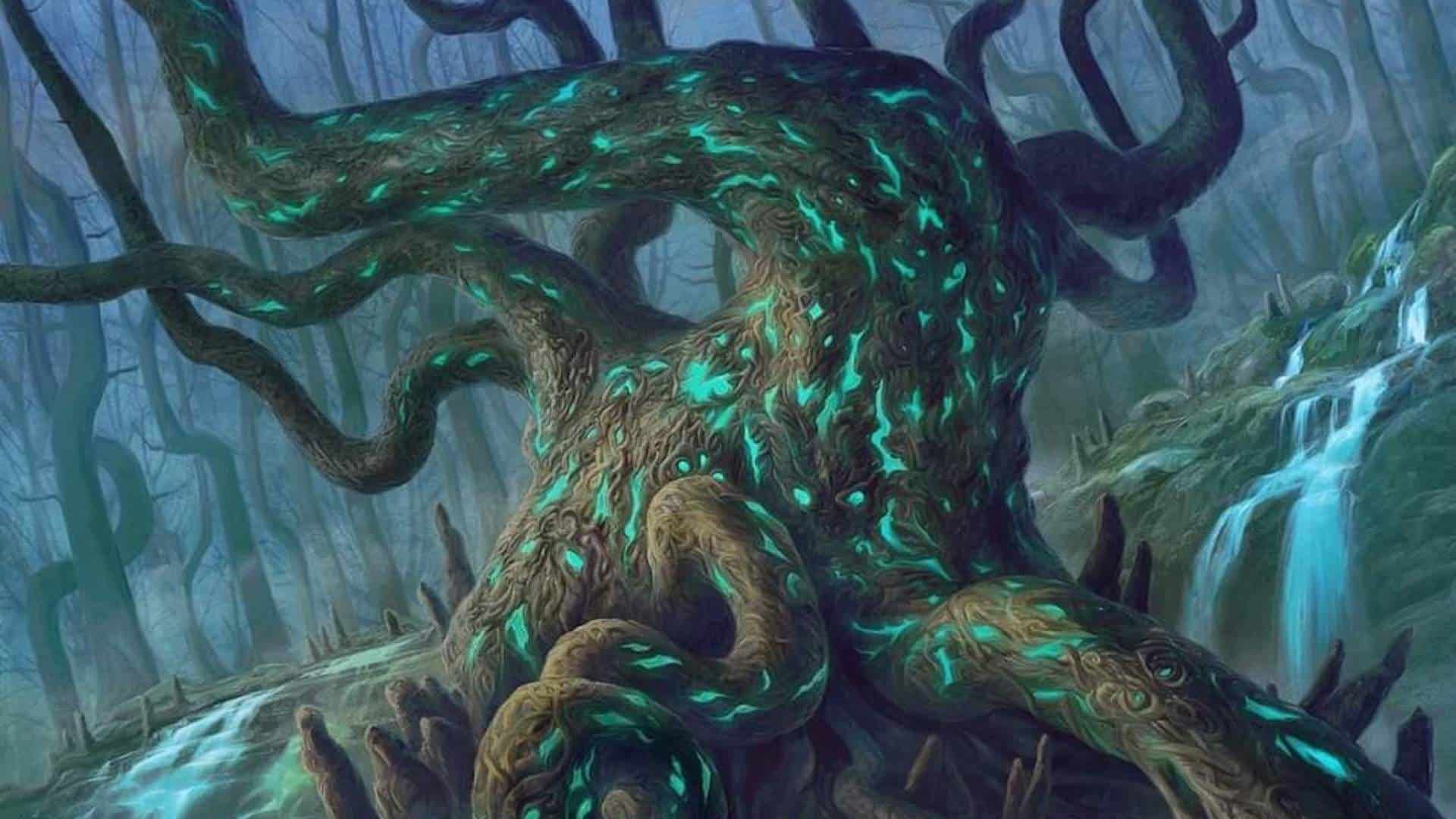
Runic Treant
- Challenge Rating Increases by 2
Magic Sense The treant can pinpoint the location of a spell or magical effect within 1 mile of it. It can also determine the school of the magical effect.
It can also determine if a creature it can see is a spellcaster or not
Magical Resistance The treant has advantage on saving throws against spells and magical effects.
Spell Negation If the treant is hit with a spell attack, it can roll a d6. Upon roll a 5 or a 6, the spell has no effect on the treant and it can activate its runic protection feature.
Runic Protection
Upon succeeding a saving throw against a spell effect or activating its spell negation ability, it it gains the benefits of one of the following effects depending on the school of magic.
The treant can only benefit from one feature on its turn at a time.
- Abjuration The treant gains resistance to one damage type of its choice until the end of its next turn.
- Conjuration The treant is able to conjure a magical avatar of its self that appears in an unoccupied space within 60ft. of it. Whenever the treant takes the Attack action, its avatar can take the Attack action as well against a creature within its range as well. Upon making this attack, the avatar disappears.
(Attacks or saving throws forced by conjured creatures do not activate this feature)
- Divination The treant's gains advantage on all attack rolls and saving throws until the end of its next turn.
- Evocation The treant's next attack deals additional force damage equal to a number of d8s equal to the spell level cast (minimum 1) until the end of its next turn.
- Enchantment The treant can reflect the spell effect back on the original caster.
- Illusion Attacks against the treant has disadvantage until the end of its next turn.
- Necromancy The treant recovers a number of hitpoints equal to a number of d8s equal to the spell level cast (minimum 1).
- Transmutation The treant's movement speed is doubled until the end of its next turn. For the duration of this ability, it can benefit from a climbing, burrowing, or flying speed
Legendary Actions
Siphon Magic(1 action) The treant can force a creature that it can see within 120ft. that is concentrating or under the effect of a spell to make a Charisma saving throw equal to the treant's Primary DC.
On a failed saving throw, the treant can end the spell effect and the target cannot concentrate or cast spells until the end of its next turn.

Runic Treants
Runic treants are the rarest of all species of treants. Many scholars theorize that runic treants have quite peculiar origins in comparison to most other kinds of treants. Runic treants are believed to acquire sentience in forest exposed to magically volatile environments, such as a biome near a zone of Wild Magic or a nexus of eldritch ley lines that converge at various points throughout the Material Plane.
Arcane Sensitivity
As a result, runic treants are extremely sensitive to various forms of magic. This sensitivity often manifests itself through its bark and leaves that pulse with eldritch energy, often changing color if in the vicinity of a particular school of magic. However, this arcane attunement is harnessed in a much different manner than for other magically sensitive treants such as leshens.
Spell Negation
Despite their magical origins, most runic treants do not seem to poss the ability to innate cast spells like the leshen. Instead, it has the ability to absorb arcane energy, converting it into various effects that depend on the school of magic.
Arcane Guardians
In comparison to their relatives, runic treants tend to be much more nomadic. Instead of solely residing and protecting their respective homes, runic treants see themselves as guardians of the very essence of magic itself. Many not only seek to preserve the natural balance of magic, but also seek to further understand the arcane.
They are naturally drawn to concentrations of great magical power and embark on vast treks to investigate the source. Their deep knowledge and connection to the arcane often brings them into the circle of many spellcasters, from all sources, whether arcane, divine, or druidic.

The Bloomplague
One of the constants of life, within nature, is that it desires to grow and spread. Often, many druidic tribes understand this basic principle and seek to encourage and safeguard this process. However, their duty also requires them to keep this growth in check. For if this balance is disrupted, the results can be widespread and devastating.
Verdant Growth
Most of the time, nature itself serves as its own checks and balances; for example, abundant herbivores are countered by a predator population. This is also the case on the grand scale of things. One of the primary forces in nature on the Material Plane are plants. Nearly every corner of the realm has some form of plant life. The spread of plant life would theoretically overtake most of the realm if it were not for the presence of fungal creatures such as myconids.
Fungal Counter
Fungi serve as a direct counter to the growth of plants, as it breaks down and assimilates plants for their own sustenance. Although the most fungi reside in the subterranean Underdark, fungal forests have often ventured to the surface, often in regions where plant life seems to have grown rampant.
It is for this reason why there is a chronic rivalry between sentient plants and fungi. It is more than a simple feud, as each side represents a rival force of nature.
Bloomplague
One of the most devastating side effects from unchecked plant life is the bloomplague. The bloomplague is best understood as a parasitic plant that resides in the corpse of a living being, giving it seemingly reanimated life. Bloomplague seeds are extremely rare, for they were believed to have been extinct. It was believed to have been destroyed by ancient druids who sough to prevent an outbreak, whether by natural causes or by intention by entities such as vengeful or overzealous treants, spriggans, or even other druids who were disgruntled by civilization.
Dormant Seeds
However, the bloomplague is near impossible to eliminate due to the seed's ability to remain dormant for centuries, only germinating within the corpse of a living creature. Scholars believe that this germination occurs only if there is enough ambient natural magic in its surroundings. They believe that such an environment will ensure that a bloomplague is able to spread rapidly and successfully. Without it, it risks germinating too soon and could be completely destroyed if it doesn't find enough hosts.
Verdant Hosts
Once a bloomplague begins, it is nigh impossible to stop. For each host controlled by the bloomplague has one thing in mind; to spread its seeds to other creatures. Infected hosts resemble their normal form except its body seems to consist of overgrown ivy, moss, or vines, and has a vibrant green light emitting from its eyes and mouth.
The bloom-plagued are extremely dangerous because they take on the physical might and even intellect of their host. They are even capable of replicating the abilities and spells of powerful creatures and couples it with the regenerative endurance of plants.
Floran Assimilation
Each creature slain by a bloomplagued returns to life as one with an hour as the seed rapidly germinates within its body. Kill a bloomplague is extremely risk without precautions for upon its destruction, it bursts into a shower of miniscule seeds that latches itself inside a living host. From there, the seed can lies dormant for weeks or even years, waiting for the instant that creature die to give it new life as a bloomplagued. One of the definitive counters to its spread is to kill it with fire. Open flame will instantly kill the germinating seeds, preventing it from spreading to a new host or infecting a living creature.
Template Notes
This feature provides additional features to add to a bloomplagued creature. It retains all of its stats, proficiencies, or any other feature it had in life.
If there are similar traits, they do not stack, instead the bloomplague benefits only from the best of the two (for example Regeneration or Heated Body).
This template cannot be applied to constructs, elements, plants, or undead
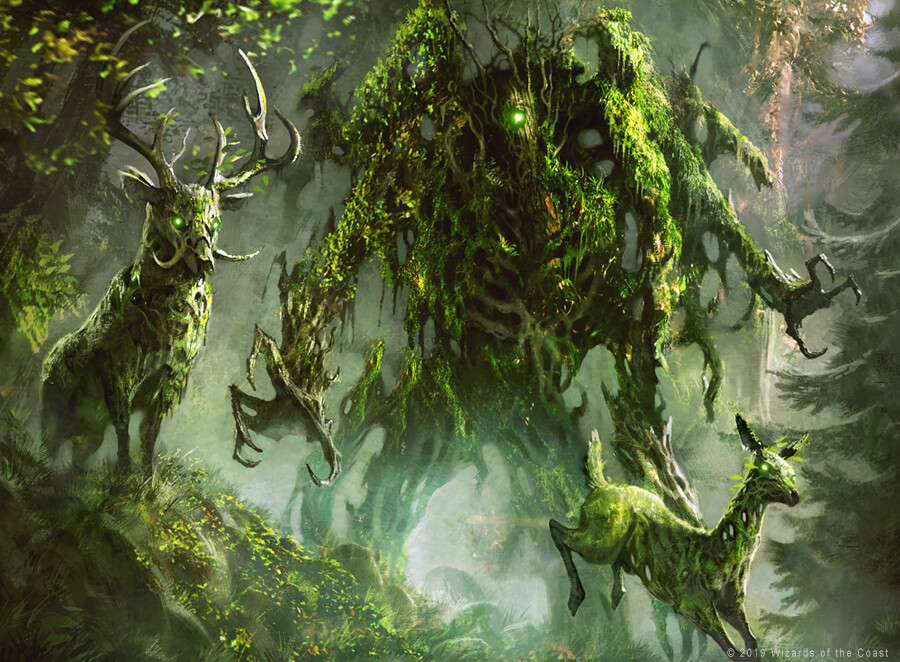
Bloomplague Template
- Damage Immunities Psychic
- Condition Immunities Blinded, Charmed, Frightened, Exhausted, Paralyzed, Stunned, Unconscious
- Senses blindsight 60ft., tremorsense 60ft.
- Languages Languages it knew in life
- Challenge Increases by 1.
Assimilating Bloom Creatures reduced to 0 hitpoints by the bloomplague, it is killed. After 1 hour, the corpse comes back to life as a bloomplagued. Bloomplagued creatures count as a plant.
This feature does not work on constructs, elementals, plants, or undead. This feature fails if the corpse is burned or it returned to life
False Appearance While motionless, the bloomplague is indistinguishable from a plant
Photosynthesis The bloomplague regains 5 hit points at the start of its turn. If it takes fire, or necrotic damage, this trait doesn't function at the start of the bloomplague's next turn. The bloomplague can continue to regenerate even if it has 0 hitpoints. However, it can die normally from failed death saving throws.
If it starts its turn in sunlight, it regains 10 hitpoints at the start of each of its turns instead.
Plant Camouflage While obscured by ample plant life, the bloomplague has advantage on Dexterity(Stealth) checks. While these conditions are met, it can use its bonus action to Hide. While hidden, it is indistinguishable from normal plant life to creatures that rely on sight to see it.
Thorny Body If a creature grapples or hits the bloomplague with a melee attack, it takes 4(1d6) piercing damage.
Vine Limbs The creatures melee weapons attack has a reach increased by 5 ft.
Seed Flare When the bloomplagued dies, creatures within 10ft. of it must succeed a Constitution saving throw equal to 8 + its proficiency bonus + its Constitution modifier. On a failed save, creatures are infected with a bloomplague seed. It does not benefit from this feature if it took fire damage on its final blow.
Regional Effects
A region affects by a bloomplague infestation warps its environment creating the following effects.
- 1. The affected areas are difficult to traverse due to rampant overgrowth. This terrain counts as difficult terrain from magical plants. Vision is obscured up to 15ft. by the abundant overgrowth.
- 2. Creatures that are reduced to 0 hitpoints while in this region are instantly killed and return to life as a bloom-plagued
- 3. Spells such as Commune with Nature gives false information that would align with the goals of the bloom-plagued

Bloom-plagued Lion
Large plant, unaligned
- Armor Class 12 (Natural Armor)
- Hit Points 26 (4d10+4)
- Speed 50ft.
STR DEX CON INT WIS CHA 17 (+3) 15 (+2) 13 (+1) 3 (-4) 12 (+1) 8 (-1)
- Skills Perception +3, Stealth +6
- Damage Immunities Psychic
- Condition Immunities Blinded,Charmed,Frightened, Exhausted, Paralyzed, Stunned, Unconscious
- Senses blindsight 60ft., tremorsense 60ft., passuve Perception 12
- Proficiency Bonus +2
- Challenge 2 (450 xp)
Assimilating Bloom Creatures reduced to 0 hitpoints by the bloomplague, it is killed. After 1 hour, the corpse comes back to life as a bloomplagued. Bloomplagued creatures count as a plant.
False Appearance While motionless, the bloom-plagued lion is indistinguishable from a normal plant
Keen Smell The bloom plagued lion has advantage on Wisdom (Perception) checks that rely on smell
Pack Tactics The lion has advantage on an attack roll against a c reature if at least one of the lion's allies is within 5ft. of the creature and the ally isn't incapacitated.
Photosynthesis The bloomplagued lion regains 5 hit points at the start of its turn. If it takes fire, or necrotic damage, this trait doesn't function at the start of the bloomplagued lion's next turn.
If it starts its turn in sunlight, it regains 10 hitpoints at the start of each of its turns instead.
The bloomplague can continue to regenerate even if it has 0 hitpoints. However, it can die normally from failed death saving throws.
Plant Camouflage While obscured by ample plant life, the bloomplagued lion has advantage on Dexterity(Stealth) checks. While these conditions are met, it can use its bonus action to Hide.
Pounce If the lion moves at least 20ft. straight toward a creature on the same turn, that target must succeed on a DC 13 Strength saving throw or be knocked prone. If the target is prone, the lion can make one bite attack against it as a bonus action
Running Leap With a 10ft. running start, the lion can long jump up to 25ft.
Seed Flare When the bloomplagued dies, creatures within 10ft. of it must succeed a DC 11 Constitution saving throw. On a failed save, creatures are infected with a bloomplague seed.
Thorned Body If a creature grapples or hits the bloomplague with a melee attack, it takes 4(1d6) piercing damage.
Actions
Bite. Melee Weapon Attack: +5 to hit, reach 10ft., one target. Hit 8(1d8+3) piercing damage.
Claw. Melee Weapon Attack: +5 to hit, reach 10ft., one target. Hit 7(1d6+3) slashing damage.

The Sporebloom
As plants are one of the driving forces of nature on the surface of the Material Plane, fungi has the primary influence in the subterranean caverns of the Underdark. Just like its floral counterpart, fungi can be extremely beneficial to the subterranean ecosystem; but can also result in mass devastation if left unchecked as it consumes and assimilates any organic matter it encounters.
Floran Rivalry
Due to its innate drive to grow and spread, fungi often crosses paths with plants. These encounters have driven the millennia old rivalry between plants and fungi, as both side seeks to consume and control the realm of the other. Interestingly enough, the conflicts preserves the natural balance between both species, keeping the overall balance of nature in check. However, if one side gains the upper hand, it can have dire consequences.
Sporebloom
One of these consequences is the sporebloom. Similarly to the bloomplague, the sporebloom only occurs with rampant fungal overgrowth. However, it differs from its floral counterpart due to the process of its creation.
Whereas the bloomplague can lie dormant for decades or even centuries, many believe that the sporebloom is an errant mutation amongst fungal spores that only occurs during extreme periods of fungal expansions.
Others believe that the sporebloom is created by myconid rituals that can only be completed with enough natural ambient magic that is only generated from the life force of nearby fungi. It is believed that myconids weaponize sporeblooms to begin the assimilation campaign against the denizens of the Underdark and ultimately surface world
Parasitic Spores
Regardless of its origins, the sporebloom results in a horrific outbreak, consuming everything it comes across. The rampant spore takes the form of corpses of living creatures, altering its form with fungal growths protruding from its body. These creatures are surrounded with a cloud of toxic fungi that not only poisons the individual, but also infects it with dormant spores that transformed into a sporebloom monstrosity only an hour after death.
Spore Essence
The most frightened aspect of the sporebloom is that the majority of its essence resides in a gaseous form made of spores. These spores enable it to take control of its host's body and is able to replicate that creature's abilities. To make things worse, its ability to create these effects are due to its rapidly evolving spores. Due to the physiology of these spores, it grants these abilities additional potency, as its infectious form allows its host's attacks to overcome some weaknesses it may have in life.
Fungal Resurrection
The final advantage that its spores provides is its ability to seemingly become immortal. Once its body is destroyed, it can simply assume its gaseous form, infecting any nearby corpse. Therefore, during a sporebloom outbreak, it is highly recommended to destroy the sporebloomed with fire as well as any potential dead in the vicinity.
Template Notes
This feature provides additional features to add to a bloomplagued creature. It retains all of its stats, proficiencies, or any other feature it had in life.
If there are similar traits, they do not stack, instead the bloomplague benefits only from the best of the two (for example Regeneration or Heated Body)
This template does not apply to constructs, elementals, or undead
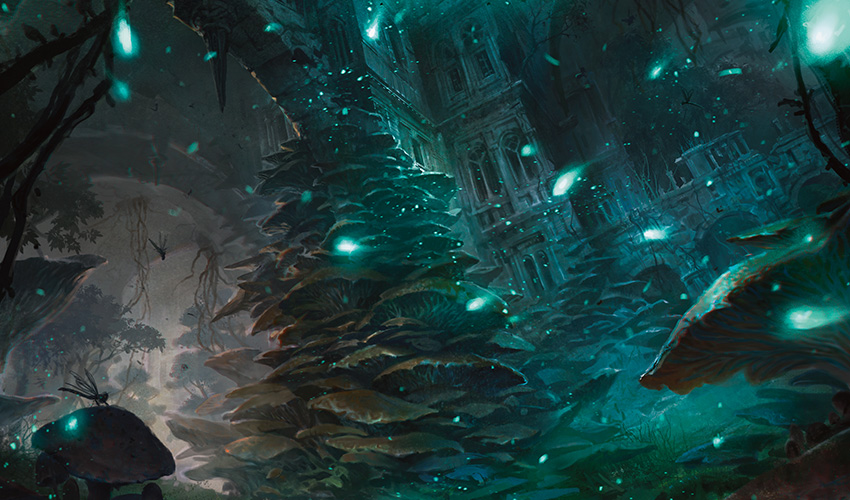
Sporebloom Template
- Damage Immunities Poison, Necrotic
- Condition Immunities Blinded, Charmed, Frightened, Exhausted, Paralyzed, Poisoned Stunned, Unconscious
- Senses blindsight 60ft., tremorsense 60ft.
- Languages Languages it knew in life , telepathy 60ft.
- Challenge Increases by 1.
Assimilating Bloom Creatures reduced to 0 hitpoints by the sporebloom or its poison are killed. After 1 hour, the corpse comes back to life as a sporebloom. Sporeblooms count as a plant. It counts as a fungi for the purposes of fungal stride.
Fungal Camouflage While obscured by ample fungal life, the sporebloom has advantage on Dexterity(Stealth) checks. While these conditions are met, it can use its bonus action to Hide.
Fungal Resurrection When the sporebloom drops to 0 hitpoints, the life-giving spores of the sporebloom escapes from its body instead of falling unconscious provided it hasn't taken fire damage on its previous turn. If it cannot escape, it is destroyed.
While in is in its spore form, it has 1 hitpoint, it can't revert to its physical form and it must be able to infect a corpse within 1 hour or become destroyed.
After spending 1 hour assimilating into a new corpse, it returns as a fully healed sporebloomed
Spore Cloud Creatures that first enter or starts its turn within 10ft. of the sporebloom must succeed a Constitution saving throw with a DC equal to 8 + its proficiency bonus + its Constitution modifier.
On a failed saving throw, creatures are poisoned for one minute. Poisoned creatures can repeat its saving throw at the end of each of its turns to end the effect.
Spore Soul When the sporebloom is in its spore form, it can't take any actions, speak, or manipulate objects. It is weightless, has a flying speed of 20ft., can hover, and enter a hostile creature's space. In addition, if air can pass through a space, the spore can do so without squeezing and it cannot pass through water. It has advantage on Strength, Dexterity, and Constitution saving throws, is immune to all conditions, and is immune to to bludgeoning, necrotic, piercing, poison, and slashing damage.
Spore-touched Creatures damage by the sporebloom must succeed a Constitution saving throw equal to 8 + the sporebloom's proficiency bonus + the sporebloom's Constitution bonus.
Toxic Spores When the sporebloom deals poison damage, it can ignore resistance and immunity to poison damage and the poisoned condition. Creatures with immunity to being poisoned have can make their saving throw with advantage instead.
Regional Effects
A region affects by a sporebloom outbreak twists its environment creating the following effects.
- 1. The affected areas are covered in a dense spore fog obscuring vision up to 10ft. Fungal overgrowth is rampant replacing any form on natural plant life.
- 2. Creatures that are reduced to 0 hitpoints while in this region are instantly killed and return to life as a sporebloom
- 3. After each long rest, creatures must succeed a DC 10 Constitution saving throw. On a failed saving throw, creatures gain 1 level of exhaustion.

Giant Sporebloom Spider
Large plant, unaligned
- Armor Class 14 (Natural Armor)
- Hit Points 26 (4d10+4)
- Speed 30ft., 30ft. climb
STR DEX CON INT WIS CHA 14 (+2) 16 (+3) 12 (+1) 2 (-4) 11 (+0) 4 (-3)
- Skills Stealth +7
- Damage Immunities Necrotic, Poison, Psychic
- Condition Immunities Blinded, Charmed, Frightened, Exhausted, Paralyzed, Poisoned Stunned, Unconscious
- Senses blindsight 60ft., tremorsense 60ft., passive Perception 12
- Challenge 2 (450 xp)
Assimilating Bloom Creatures reduced to 0 hitpoints by the sporebloom or its poison are killed. After 1 hour, the corpse comes back to life as a sporebloom. Sporeblooms count as a plant. It counts as a fungi for the purposes of fungal stride.
False Appearance While motionless, the sporebloom spider is indistinguishable from a normal mushroom
Fungal Camouflage While obscured by ample fungal life, the sporebloom has advantage on Dexterity(Stealth) checks. While these conditions are met, it can use its bonus action to Hide.
Fungal Resurrection When the sporebloom drops to 0 hitpoints, the life-giving spores of the sporebloom escapes from its body instead of falling unconscious provided it hasn't taken fire damage on its previous turn. If it cannot escape, it is destroyed.
While in is in its spore form, it has 1 hitpoint, it can't revert to its physical form and it must be able to infect a medium corpse within 1 hour or become destroyed.
After spending 1 hour assimilating into a new corpse, it returns as a fully healed sporebloomed
Spore Cloud Creatures that first enter or starts its turn within 10ft. of the sporebloom spider must succeed a DC 11 Constitution saving throw. On a failed saving throw, creatures are poisoned for one minute. Poisoned creatures can repeat its saving throw at the end of each of its turns to end the effect.
Spore Soul When the spider is in its spore form, it can't take any actions, speak, or manipulate objects. It is weightless, has a flying speed of 20ft., can hover, and enter a hostile creature's space. In addition, if air can pass through a space, the spore can do so without squeezing and it cannot pass through water. It has advantage on Strength, Dexterity, and Constitution saving throws, is immune to all conditions, and is immune to to bludgeoning, necrotic, piercing, poison, and slashing damage.
Toxic Spores When the sporebloom spider deals poison damage, it can ignore resistance and immunity to poison damage and the poisoned condition. Creatures with immunity to being poisoned have can make their saving throw with advantage instead.
Web Sense While in contact with a web, the spider knows the exact location of any other creature in contact with the web
Web Walker The spider ignores movement restrictions caused by webbing.
Actions
Bite. Melee Weapon Attack: +5 to hit, reach 5ft., one target. Hit 8(1d8+3) piercing damage, and the target must make a DC 11 Constitution saving throw, taking 9 (2d8) poison damage on a failed save, or half as much damage on a successful one. If the poison damage reduces the target to 0 hit points, the target is stable but poisoned for 1 hour, even after regaining hit points, and is paralyzed while poisoned in this way.
Web(Recharge 5-6) Ranged Weapon Attack: +5 to hit, range 30/60ft., one creature. Hit he target is restrained by webbing. As an action, the restrained target can make a DC 12 Strength check, bursting the webbing on a success. The webbing can also be attacked and destroyed (AC 10; hp 5; vulnerability to fire damage; immunity to bludgeoning, poison, and psychic damage).
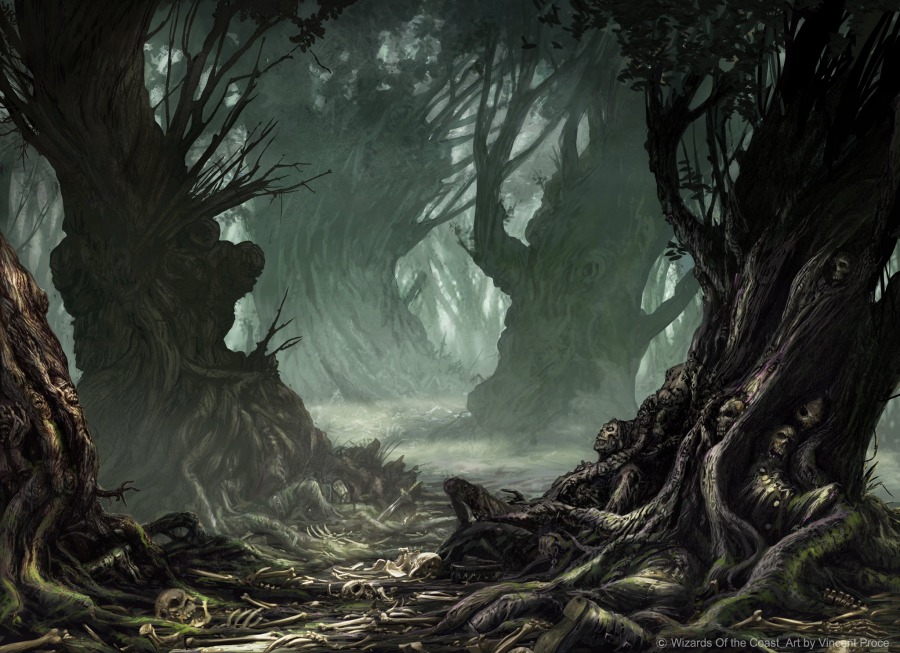
The Blighted
Unlike the bloomplague and sporebloom, the blighted is not the direct result of an imbalance of nature due to overgrowth. Instead, it is a twisted corruption of one of the natural checks and balances of nature, the eternal feud between plants and fungi.
Many scholars believe that the Blighted are created from creatures that successfully resist infections from the bloomplague or sporebloom. However, this resistance didn't necessarily kill the seed or the spore, but rather altered it. This mutation begins to slowly take over the body of its hosts, twisting its mind to grow and consume.
Insatiable Hunger
In its attempts to satisfy its hunger, the blighted shows no discrimination towards plants or fungi alike. The blighted are attracted to the vibrant presence of life, so they are naturally drawn to large forests or even cities. For this same reason, they are terribly averse to attacking constructs, elementals, or undead since they will not satisfy its appetite.
Witherblight
Because the blighted were created directly from plants and fungi, they are natural resilient and adept to combating their effects. Its primary weapons include a strange corruption known as witherblight.
For the duration of its infection, the witherblight causes its victim's wounds to fester and reverse any form of healing that creature may possess.
The witherblight slowly corrupts organic matter as the mutated seeds and spores begin to take hold on its target. If not treated right away, the witherblight slowly drains the individual of its vitality, leaving an empty husk upon its death.
Once its host dies, the dormant spore inside the creature has enough energy to reanimate its form as a blighted.
Blighted Appearance
Like its precursors, the blighted take the form of its dormant host and can spread upon infecting other corpses. Their forms resemble that of when their host was alive; however, it bodies seems to consist of blackened bark and vines as its interior seems to glow with a sickly green energy.
Blighted Empowermenet
Because of its origins, it is able to replicate some regenerative effects of plants while also acquiring some innate resistances of its fungal relatives.
In addition to these modifications, the blighted is equally capable of mimicking the physical, magical, and mental prowess of its host in life. However, its new form become further enhanced thanks to the necrotic corruption of its host's form thanks to its mutations. This adaptation mimics a lot of the abilities seen in its fungal counterpart; however, it proves to be much more potent in comparison.
As a result, the blighted tends to be much harder to combat and destroy compared to its alternative. However, as seen in the previous two plagues, the spread of the blighted can be best halted through the careful use of fire.
Blighted Template
This feature provides additional features to add to a blighted creature. It retains all of its stats, proficiencies, or any other feature it had in life.
If there are similar traits, they do not stack, instead the bloomplague benefits only from the best of the two (for example Regeneration or Heated Body)
This template does not apply to constructs, elementals, plants, or undead

Blighted Template
- Damage Immunities Necrotic, Poison, Psychic
- Condition Immunities Blinded, Charmed, Frightened, Exhausted, Paralyzed, Poisoned, Stunned, Unconscious
- Senses blindsight 60ft., tremorsense 60ft.
- Languages Languages it knew in life
- Challenge Increases by 1.
Blighted Corruption Creatures reduced to 0 hitpoints by the blighted, it is killed. After 1 hour, the corpse comes back to life as a blighted. Blighted creatures count as a plant.
This feature does not effect undead, constructs, or elementals
Blight Touched Creatures that take damage from the blighted cannot regain hitpoints until the end of its next turn. If the blighted deals bludgeoning, piercing or slashing damage, it can replace the damage type as necrotic instead.
Blighted Immunity The blighted is immune to being infected by the bloomplague or sporebloom.
Photosynthesis The blighted regains 5 hit points at the start of its turn. If it takes fire damage, this trait doesn't function at the start of the blighted's next turn. The blighted can continue to regenerate even if it has 0 hitpoints. However, it can die normally from failed death saving throws.
If it starts its turn in sunlight, it regains 10 hitpoints at the start of each of its turns instead.
Withered Corruption If a creature does not succeed its saving throw against Witherblight before its duration ends, its effects become permanent. After every 24 hours, that creature's hitpoint maximum reduces by 5(1d8).
If this reduces a creature to 0 hitpoints, it instantly dies. After one hour, the corpse returns as a blighted.
This effect can be reversed by using Greater Restoration or similar magics.
Witherblight When the blighted deals necrotic damage, it can ignore resistance and immunity to necrotic damage.
Life Drain When the blighted deals necrotic damage, it can recover hitpoints equal to half the damage dealt.
Regional Effects
A region affects by a blighted infestation warps its environment creating the following effects.
- 1. The affected areas are difficult to traverse due thick and twisted undergrowth. This area counts as difficult terrain.
- 2. This region corrupts any body of water that causes creatures to regurgitate it within minutes.
- 3. Creatures that are reduced to 0 hitpoints while in this region are instantly killed and return to life as a blighted after 1 hour unless the corpse is burned.
- 4. Creatures that take a short or long rest in this region cannot regain hitpoints

Blighted Young Red Dragon.
Large plant, unaligned
- Armor Class 18 (Natural Armor)
- Hit Points 178 (17d10+85)
- Speed 40ft., 80ft. fly, 40ft. climb
STR DEX CON INT WIS CHA 23 (+6) 10 (+0) 21 (+5) 14 (+2) 11 (+0) 19 (+4)
- Saving Throws Dexterity +4, Constitution +9, Wisdom +4, Charisma +8
- Skills Perception +8, Stealth +4
- Damage Immunities Necrotic, Poison, Psychic, Fire
- Condition Immunities Blinded, Charmed, Frightened, Exhausted, Paralyzed, Poisoned Stunned, Unconscious
- Senses blindsight 60ft., tremorsense 60ft., darkvision 120ft., passive Perception 18
- Languages Common, Draconic
- Challenge 12 (8400 xp)
Blighted Corruption Creatures reduced to 0 hitpoints by the blighted, it is killed. After 1 hour, the corpse comes back to life as a blighted. Blighted creatures count as a plant.
This feature does not effect undead, constructs, or elementals
Blighted Immunity The blighted is immune to being infected by the bloomplague or sporebloom.
Blight Touched Creature's damage by the dragon cannot regain hitpoints until the end of its next turn.
Photosynthesis The blighted dragon regains 5 hit points at the start of its turn. If it takes fire damage, this trait doesn't function at the start of the blighted's next turn. The blighted can continue to regenerate even if it has 0 hitpoints. However, it can die normally from failed death saving throws.
If it starts its turn in sunlight, it regains 10 hitpoints at the start of each of its turns instead.
Witherblight Creatures that take damage from the blighted attacks must succeed a DC 17 Constitution saving throw or become blighted for one minute.
Whenever blighted creatures cannot recover hitpoints and whenever it takes damage, takes an additional 5(1d8) necrotic damage.
Withered Corruption If a creature does not succeed its saving throw against Witherblight before its duration ends, its effects become permanent. After every 24 hours, that creature's hitpoint maximum reduces by 5(1d8).
If this reduces a creature to 0 hitpoints, it instantly dies. After one hour, the corpse returns as a blighted.
This effect can be reversed by using Greater Restoration or similar magics.
Life Drain When the blighted dragon deals necrotic damage, it can recover hitpoints equal to half the damage dealt.
Actions
Multiattack The dragon makes three attacks: one with its bite and two with its claws.
Bite. Melee Weapon Attack: +10 to hit, reach 10ft., one target. Hit 17(2d10+6) necrotic damage + 4(1d6) fire damage.
Claw Melee Weapon Attack: +10 to hit, reach 5ft., one target. Hit 13(2d6+6) necrotic damage.
Fire Breath (Recharge 5-6) The dragon exhales fire in a 30-foot cone. Each creature in that area must make a DC 17 Dexterity saving throw, taking 56 (16d6) fire damage on a failed save, or half as much damage on a successful one.