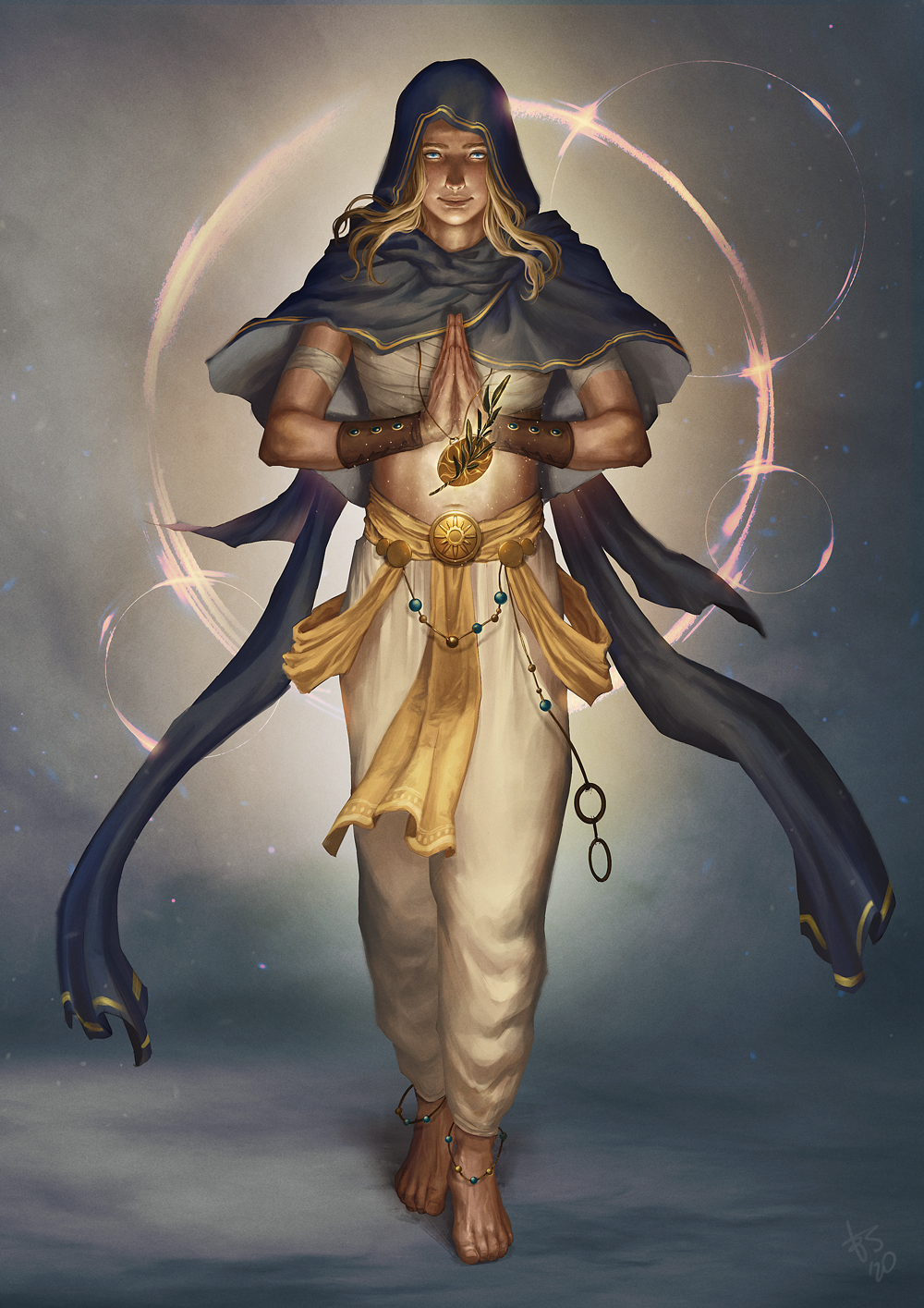

Way of the Devout
Monks of the Way of the Devout have combined their monastic teachings with their devotion to the gods. Imbued with divine magic from their continued service, Way of the Devout Monks can come in all types from all walks of life as they combine the mystical power of Ki and their divine magic in order to better service their Deity's wishes.
Way of the Devout Spellcasting
| Monk Level | Cantrips Known | 1st | 2nd | 3rd | 4th |
|---|---|---|---|---|---|
| 3rd | 2 | 2 | — | — | — |
| 4th | 2 | 3 | — | — | — |
| 5th | 2 | 3 | — | — | — |
| 6th | 2 | 3 | — | — | — |
| 7th | 2 | 4 | 2 | — | — |
| 8th | 2 | 4 | 2 | — | — |
| 9th | 2 | 4 | 2 | — | — |
| 10th | 3 | 4 | 3 | — | — |
| 11th | 3 | 4 | 3 | — | — |
| 12th | 3 | 4 | 3 | — | — |
| 13th | 3 | 4 | 3 | 2 | — |
| 14th | 3 | 4 | 3 | 2 | — |
| 15th | 3 | 4 | 3 | 2 | — |
| 16th | 3 | 4 | 3 | 3 | — |
| 17th | 3 | 4 | 3 | 3 | — |
| 18th | 3 | 4 | 3 | 3 | — |
| 19th | 3 | 4 | 3 | 3 | 1 |
| 20th | 3 | 4 | 3 | 3 | 1 |
Spellcasting
When you reach 3rd level, you augment your martial arts and Ki with the ability to cast spells.
Cantrips
You learn two cantrips of your choice from the cleric spell list. You learn an additional cleric cantrip of your choice at 10th level.
Spell Slots
The Devout Monk Spellcasting table shows how many spell slots you have to cast your cleric spells of 1st level and higher. To cast one of these spells, you must expend a slot of the spell's level or higher. You regain all expended spell slots when you finish a long rest.
You prepare the list of cleric spells that are available for you to cast, choosing from the cleric spell list. When you do so, choose a number of cleric spells equal to your Wisdom modifier + 1/2 your monk level (minimum of one spell rounded up). The spells must be of a level for which you have spell slots.
For example, if you are a 8th-level monk, you have four 1st-level and two 2nd-level spell slots. With a Wisdom of 16, your list of prepared spells can include seven spells of 1st or 2nd level, in any combination. If you prepare the 1st-level spell Cure Wounds, you can cast it using a 1st-level or 2nd-level slot. Casting the spell doesn't remove it from your list of prepared spells.
You can change your list of prepared spells when you finish a long rest. Preparing a new list of cleric spells requires time spent in prayer and meditation: at least 1 minute per spell level for each spell on your list.
Spellcasting Ability
Wisdom is your spellcasting ability for your cleric spells. The power of your spells comes from your devotion to your deity. You use your Wisdom whenever a cleric spell refers to your spellcasting ability. In addition, you use your Wisdom modifier when setting the saving throw DC for a cleric spell you cast and when making an attack roll with one.
Spell save DC = 8 + your proficiency bonus + your Wisdom modifier
Spell attack modifier = your proficiency bonus + your Wisdom modifier
Ritual Casting
You can cast a cleric spell as a ritual if that spell has the ritual tag and you have the spell prepared.
Spellcasting Focus
You can use a holy symbol as a spellcasting focus for your cleric spells.
Channel Divinity
At 3rd level, you gain the ability to channel divine energy directly from your deity, using that energy to fuel magical effects. You start with two such effects: Turn Undead and an effect determined by your domain. Some domains grant you additional effects as you advance in levels, as noted in the domain description.
When you use your Channel Divinity, you choose which effect to create. You must then finish a short or long rest to use your Channel Divinity again.
Some Channel Divinity effects require saving throws. When you use such an effect from this class, the DC equals your monk spell save DC.
Beginning at 6th level, you can use your Channel Divinity twice between rests, and beginning at 17th level, you can use it three times between rests. When you finish a short or long rest, you regain your expended uses.
Channel Divinity: Turn Undead
As an action, you present your holy symbol and speak a prayer censuring the undead. Each undead that can see or hear you within 30 feet of you must make a Wisdom saving throw. If the creature fails its saving throw, it is turned for 1 minute or until it takes any damage.
A turned creature must spend its turns trying to move as far away from you as it can, and it can't willingly move to a space within 30 feet of you. It also can't take reactions. For its action, it can use only the Dash action or try to escape from an effect that prevents it from moving. If there's nowhere to move, the creature can use the Dodge action.
Devout Domain
At 3rd level, you choose a domain shaped by your choice of Deity and the gifts they grant you. Choose one of the Cleric Domains and you gain the Channel Divinity Option granted to you at 2nd Level. Your monk class levels count as cleric levels for any class level requirements needed for your Channel Divinities. You also gain access to the expanded spell list of your chosen domain, however the levels you gain these spells are altered to match your casting level in this class. 3rd for 1st level, 7th for 2nd, 13th for 3rd, and 19th for 4th. You do not gain access to the 5th level spells provided by this list.
Additionally, you gain proficiency in Religion. If you already proficient in Religion, you may pick another skill and gain proficiency in that skill instead, the skill must one of the following History, Insight, Medicine, or Persuasion. You also qualify for any magic items that require attunement by a Cleric.
Flurry of Spells
At 6th Level, when you take the attack action, you can forgo one of your attacks and cast one of your Cantrips with a casting time of 1 action in its place. You can spend number of ki points to replace that Cantrip used by this feature with any spell you have prepared up to a max of 4th level and has a casting time of one action without expending a spell slot. The Ki points spent is equal to 1 + the spells level. You can replace a cantrip using this feature a number of times equal to your proficiency bonus per long rest.
Hands of the Divine
At 11th level, your Ki has been imbued with divine magic. Once per turn you can imbue an unarmed strike or monk weapon with divine magic, it deals additional radiant damage equal to one roll of your martial arts die. You gain the Spare the Dying Cantrip, if you already possess this Cantrip you may select another Cantrip from the Cleric spell list instead. You can use spend 2 ki points to cast the Lesser Restoration spell without expending a spell slot. You can also spend 5 Ki points to cast the Greater Restoration spell without expending the material components, you can only use Greater Restoration in this way once per long rest.
Divine Rapture
At 17th level, as an action, you can cast the Heal and Harm spells once each per long rest. You can spend 5 Ki points to cast the Raise Dead spell without expending the material components. You can only cast Raise Dead in this way again after 1d4 Long Rests.