Undead Familiars
Necromancers can learn a variation of the find familiar spell at first level. This variation lets the necromancer summon an undead familiar in addition to their thralls. They can choose the Flying Skull, Creeping Claw, Hollow Spider, Skeletal Mage, Spectral Raven, or Wisp as their familiar choices.
Flying Skull
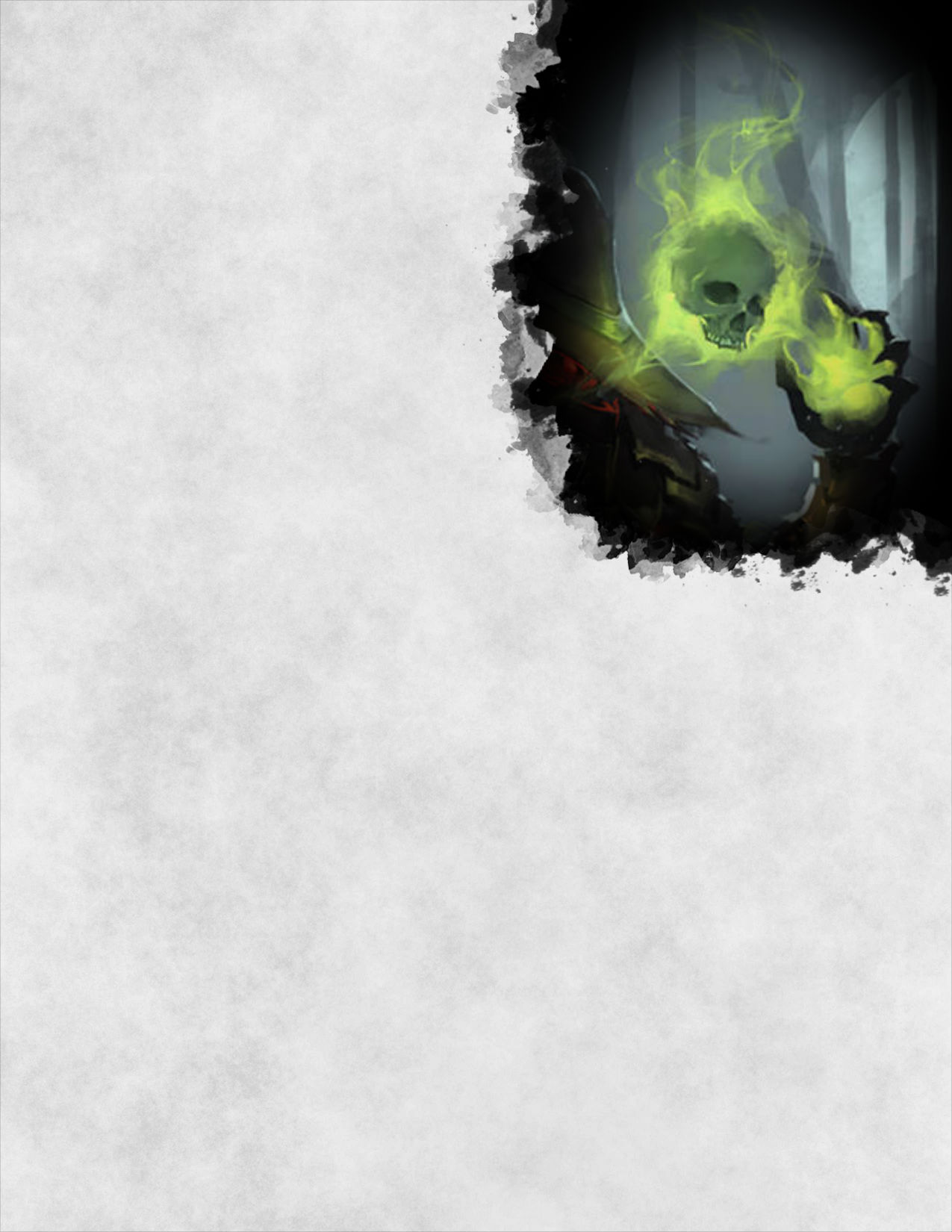
Created from the remains of dead wizards, flying skulls and flameskulls are commonly found perusing a lich's lair or the grounds of a necromancer cult. Though usually green, their flames can actually shine in any color. Like flameskulls, flying skulls keep themselves afloat by sheer anger alone.
Pyromaniacs. Flying skulls know only fire-related spells. In the dark, they'll provide a much needed source of light and can circumvent resistance against non-magical weapon attacks.
Flying Skull
Tiny undead, chaotic evil
- Armor Class 13
- Hit Points 18 (4d6+4)
- Speed 0 ft., fly 40 ft. (hover)
STR DEX CON INT WIS CHA 2 (-4) 15 (+2) 13 (+1) 16 (+3) 13 (+1) 12 (+1)
- Skills Perception +4
- Damage Resistances fire, necrotic, piercing
- Damage Immunities poison
- Condition Immunities charmed, frightened, paralyzed, poisoned, prone
- Senses darkvision 60 ft., passive Perception 14
- Languages Common and Abyssal
- Challenge 1/4
Undead Familiar. A familiar in this creature's form assumes the nature of undead.
As a familiar, it can still ignite flammable objects with fire bolt, but without dealing damage.
Illumination. With the fire within itself, the flying skull sheds either dim light in a 15-foot radius, or bright light in a 15-foot radius and dim light for an additional 15 feet. It can switch between the options or disable it as an action.
Rejuvenation. If the flying skull is destroyed, it regains all its hit points in 1 hour unless holy water is sprinkled on its remains or a dispel magic or remove curse spell is cast on them.
Spellcasting. The flying skull's innate spellcasting ability is Charisma (spell save DC 12). It can innately cast the following spells, requiring no material components:
- Cantrip (at will): mage hand, control flames, fire bolt
Actions
Fire Bolt. Ranged Spell Attack: +4 to hit, range 120ft., one target. Hit: 6 (1d10) fire damage. A flammable object hit by this spell ignites if it isn’t being worn or carried.

Creeping Claw
Left to its own devices long enough, a crawling claw can learn to leap, becoming a creeping claw. Thus, they are known to get into surprisingly difficult places and for being a nuisance in general.
Creeping Claw
Tiny undead, chaotic evil
- Armor Class 13
- Hit Points 18 (5d4+5)
- Speed 20 ft., climb 20 ft.
STR DEX CON INT WIS CHA 12 (+1) 16 (+3) 13 (+1) 6 (-2) 10 (0) 4 (-3)
- Damage Immunities poison
- Condition Immunities charmed, exhaustion, frightened, poisoned
- Skills Athletics +4, Stealth +6
- Senses blindsight 30 ft. (blind beyond this radius), passive Perception 10
- Languages understands Common and Abyssal but cannot speak
- Challenge 1/4
Undead Familiar. A familiar in this creature's form assumes the nature of undead. As a familiar, it can still use the grab action.
Leaping. At the cost of 10 feet of its movement, the claw can jump up to 10 feet without needing to make an ability check.
Tight Grab. If a medium-sized creature grappled by the claw has a limb, the claw will seize one, imposing disadvantage on attack rolls until released. The claw can't drag its grappled target, and the target can still move freely. While attached to the target, the claw travels with it should it move or teleport, maintaining the grapple.
Actions
Claw. Melee Weapon Attack: +3 to hit, reach 5 ft., one creature. Hit: 4 (1d6) bludgeoning or slashing damage (claw's choice).
Grab. Melee Weapon Attack: +3 to hit, reach 5 ft., one creature. On hit, the target is grappled. This attack has disadvantage if the target is medium-sized, unless it has limb to latch on to, or if the target is huge-sized or larger. The claw may jump as part of this attack.
Hollow Spider
This larger-than-normal spider is empty on the inside... literally. It is hollow as it is sneaky and creepy. Hollow spiders tend to be found deep in catacombs where no living insects can survive.
Hollow Spider
Tiny undead beast, unaligned
- Armor Class 13
- Hit Points 23 (5d6+5)
- Speed 25 ft., climb 25 ft.
STR DEX CON INT WIS CHA 7 (-2) 16 (+3) 13 (+1) 6 (-2) 13 (+1) 12 (+1)
- Skills Stealth +6
- Damage Immunities poison
- Condition Immunities exhaustion, frightened, poisoned
- Senses blindsight 5 ft., darkvision 60 ft., passive Perception 11
- Challenge 1/4
Undead Familiar. A familiar in this creature's form assumes the nature of undead.
Spider Climb. The spider can climb difficult surfaces, including upside down on ceilings, without needing to make an ability check.
Web Sense. While in contact with a web, the spider knows the exact location of any other creature in contact with the same web.
Web Walker. The spider ignores movement restrictions caused by webbing.
Actions
Bite. Melee Weapon Attack: +4 to hit, reach 5 ft., one creature. Hit: 4 (1d6) Piercing damage plus 4 (1d6) Poison damage.
Skeletal Mage
A mage-turned skeleton... or perhaps a skeleton-turned mage?
As a familiar, it is rather intelligent compared to most others. The skeletal mage will use its message and mending cantrips tactfully, without needing your command or approval.
Skeletal Mage
Small undead, neutral evil
- Armor Class 13
- Hit Points 18 (5d6)
- Speed 25 ft.
STR DEX CON INT WIS CHA 8 (-1) 12 (+1) 11 (+0) 12 (+1) 13 (+1) 16 (+3)
- Skills Arcana +3
- Damage Immunities poison
- Condition Immunities exhaustion, poisoned
- Senses darkvision 120 Ft, passive Perception 11
- Languages those known in life
- Challenge 1/4
Undead Familiar. A familiar in this creature's form assumes the nature of undead.
Spellcasting. The skeletal mage's innate spellcasting ability is Intelligence (spell save DC 12). It can innately cast the following spells, requiring no material components:
- Cantrip (at will): eldritch blast, message, mending
Actions
Claw. Melee Weapon Attack: +3 to hit, reach 5 ft., one creature. Hit: 3 (1d4) slashing damage.
Eldritch Blast. Ranged Spell Attack: +4 to hit, range 120 ft., one creature. Hit: 6 (1d10) force damage.
Spectral Raven
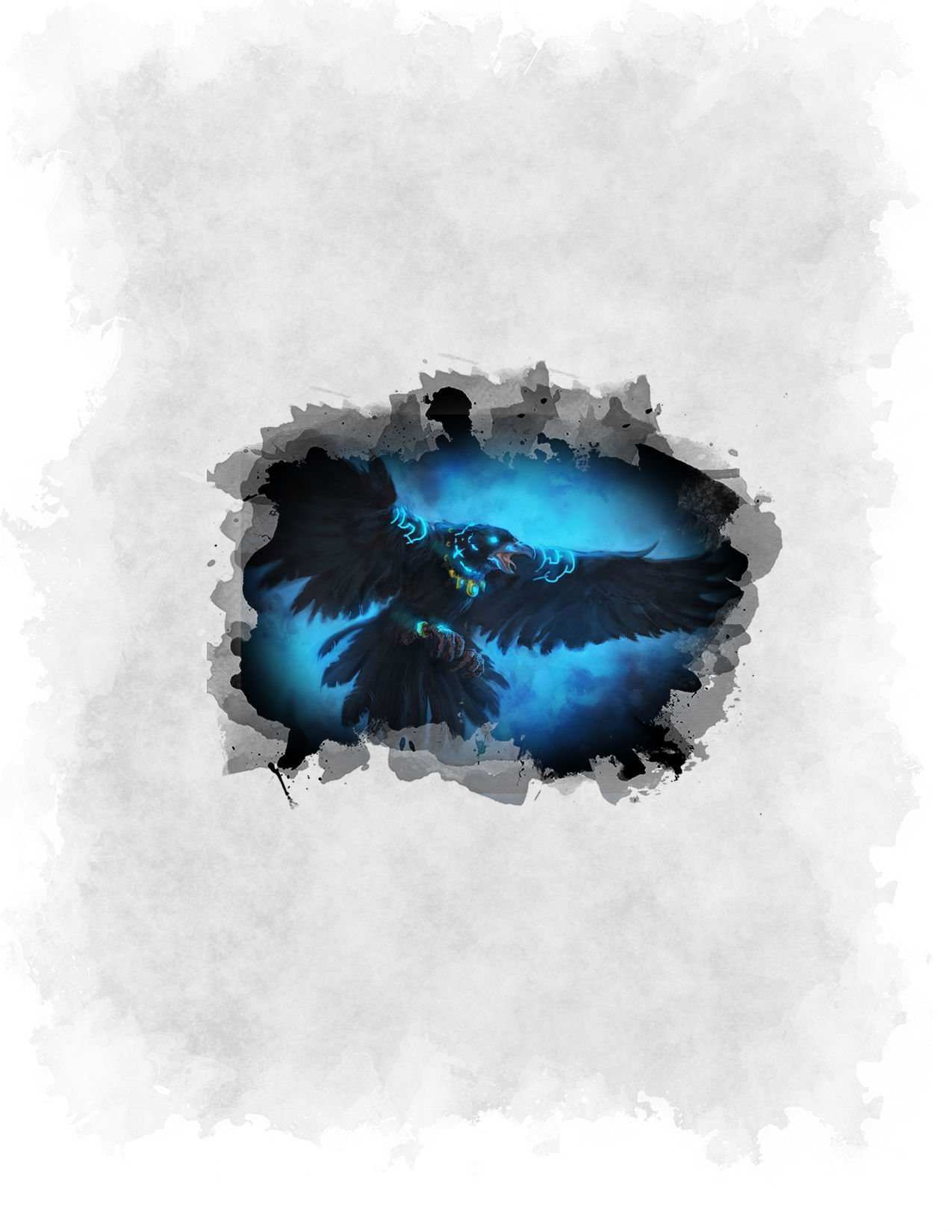
Whether you are in the Material or Ethereal Plane, a spectral raven will find a way to perch on your shoulder. Its keen senses work in both planes, making them well suited to keep watch and scout. Without Mimicry, this stat block may still apply should you choose a different spectral bird of prey.
Spectral Raven
Tiny undead, unaligned
- Armor Class 13
- Hit Points 13 (5d4)
- Speed 10 ft., fly 50 ft.
STR DEX CON INT WIS CHA 3 (-4) 14 (+2) 10 (+0) 4 (-3) 14 (+2) 7 (-2)
- Damage Immunities poison
- Condition Immunities charmed, exhaustion, frightened, poisoned
- Skills Perception +5
- Senses darkvision 120 ft., passive Perception 15
- Languages -
- Challenge 1/4
Undead Familiar. A familiar in this creature's form assumes the nature of undead.
Ethereal Sight. The raven can see 60 ft. into the Ethereal Plane when it is on the Material Plane, and vice versa.
Flyby. The raven doesn't provoke opportunity attacks when it flies out of an enemy's reach.
Mimicry. The raven can mimic simple sounds it ha s heard, such as a person whispering, a baby crying, or an animal chittering. A creature that hears the sounds can tell they are imitations with a successful DC 10 Wisdom (Insight) check.
Keen Hearing and Sight. The raven has advantage on Wisdom (Perception) checks that rely on hearing or sight.
Actions
Talons. Melee Weapon Attack: +3 to hit, reach 5 ft., one creature. Hit: 4 (1d6) piercing damage.
Ethereal Shift. The raven enters the Ethereal Plane from the Material Plane, or vice versa. It can't affect, be affected, or be seen by anything on the other plane.

Wisp
Unlike will-o'-wisps, regular wisps are simply souls of those who've perished too early and are not inherently evil. When it dies, it heals nearby creatures before reverting back into a normal soul. It is then free to linger or rest in peace.
Wisp
Tiny undead, any alignment
- Armor Class 13
- Hit Points 13 (5d4)
- Speed 0 ft., fly 40 ft. (hover)
STR DEX CON INT WIS CHA 1 (-5) 18 (+4) 10 (+0) 13 (+1) 15 (+2) 14 (+2)
- Damage Resistances acid, cold, fire, necrotic, thunder; Bludgeoning, piercing, and slashing from nonmagical attacks
- Damage Immunities lightning, poison
- Condition Immunities exhaustion, grappled, paralyzed, poisoned, prone, restrained, unconscious
- Senses darkvision 120 Ft, passive Perception 12
- Languages those known in life
- Challenge 1/4
Undead Familiar. A familiar in this creature's form assumes the nature of undead.
Clemency. When the wisp dies, it reverts into a normal soul and all non-construct creatures within 20 feet restore 2d6 hit points.
Ephemeral. The wisp can’t wear or carry anything.
Incorporeal Movement. The wisp can move through other creatures and objects as if they were difficult terrain. It takes 5 (1d10) force damage if it ends its turn inside an object.
Variable Illumination. The wisp sheds bright light in a 5- to 20-foot radius and dim light for an additional number of feet equal to the chosen radius. The wisp can alter the radius as a bonus action.
Actions
Shock. Melee Spell Attack: +3 to hit, reach 5 ft., one creature. Hit: 4 (1d6) lightning damage.
Invisibility. The wisp and its light magically become invisible until it attacks or uses its Effuse, or until its concentration ends (as if concentrating on a spell).
Effuse. The wisp dies, reducing its own hit points to 0.