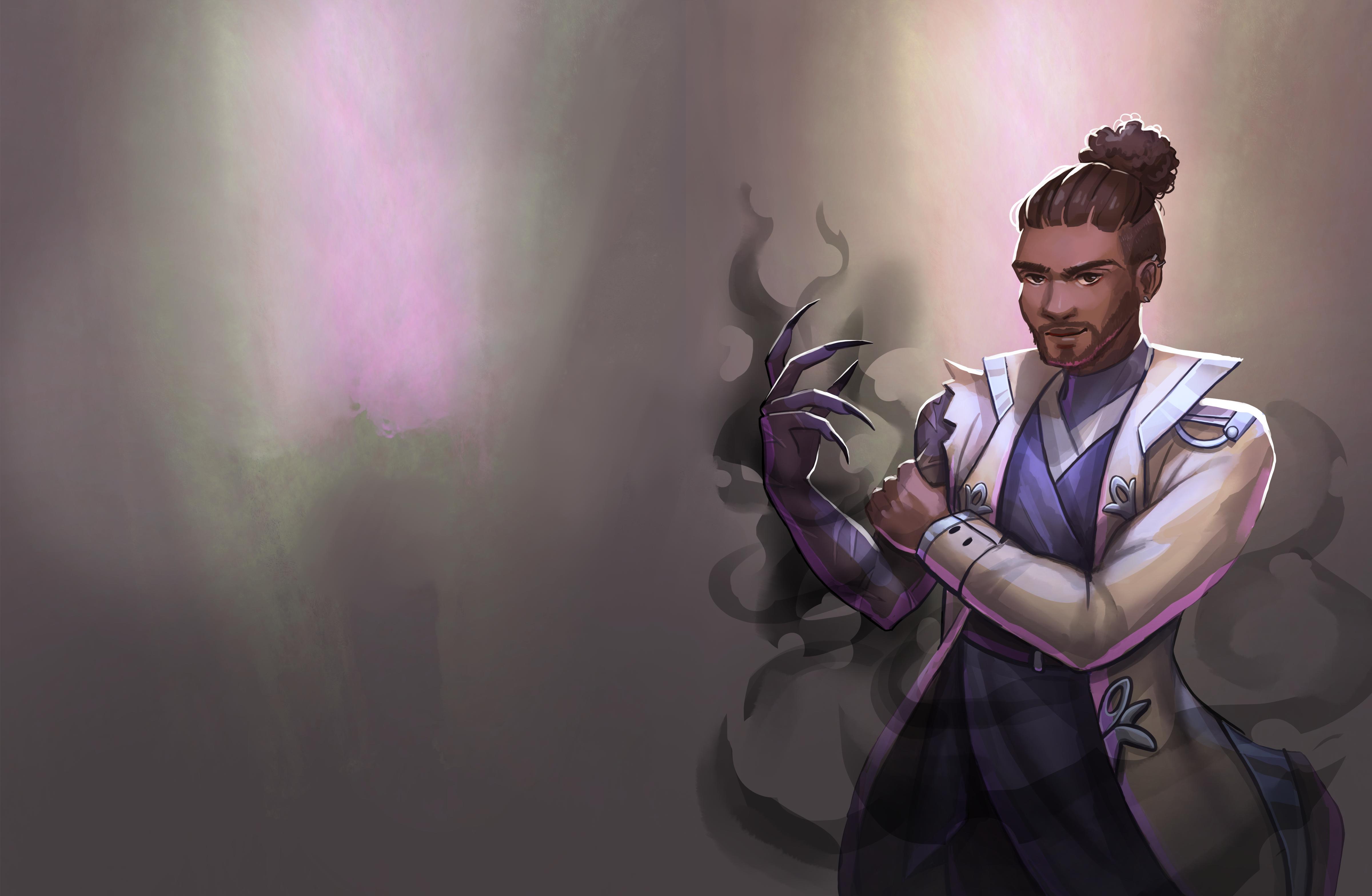


A kanala uses his symbiotic creature to
activate the locus energy form
activate the locus energy form
Kanala
When two individual forces become one, a kanala is born. Kanalas utilize powerful gifts given to them by a creature, object, or intangible force that has become incorporated into their very bodies and souls. Their relationships with these sources of power can be simple in most cases or turbulent at the best of times. You can find everything you need to play as one of these amalgamated warriors in the next several pages.
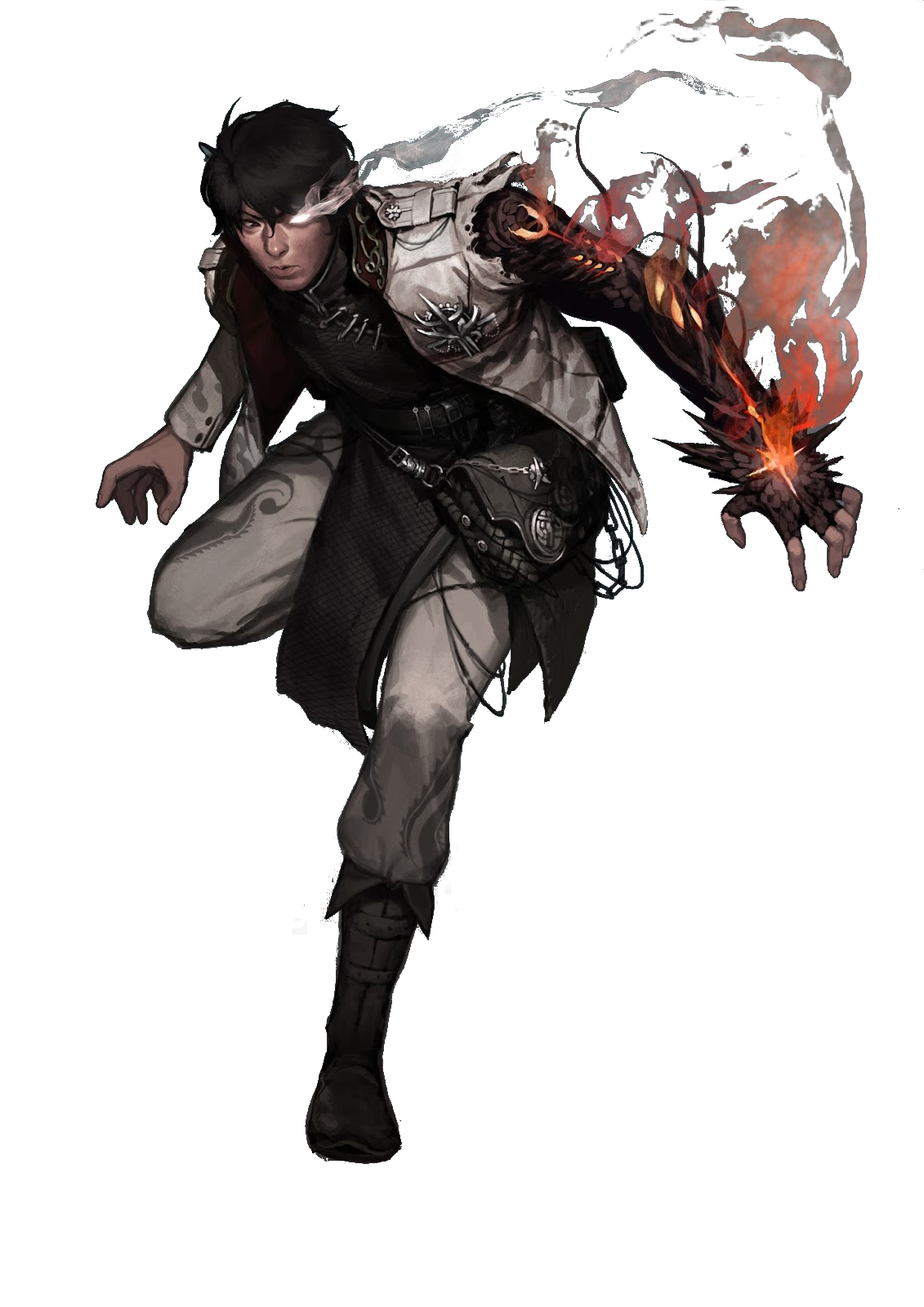
A kanala will materialize something called a locus when they externalize and manipulate their inner power. When this happens, one or two of their extremities, typically their arms, take on a unique appearance. When using a locus form, a kanala might cause their hand to stretch away from their body, change their forearm into a pure element like ice, or transform their entire arm into a blade. These are all loci. A kanala's versatility relies on their locus, and it's hard to find a character with more tricks up their sleeve than a kanala.
Kanalas in Pagrodin
Though they are uncommon in the rest of the multiverse, kanalas can be easily found in Pagrodin. Some of the odd relics found after the fires in Chaparral can make humanoids into kanalas. In Apparat, the Alchemy Guild has learned how to create fairly stable kanalas using only a serum. The Stony Throes are rumored to have a number of wandering spirits waiting for a soul to latch onto, forming a kanala as a result. It's also a known fact that rare creatures in the Nevergood Forest can become symbiotic if they find the right person. Even a handful of inventors scattered around the Erlauntza desert can make advanced prostheses for aspirant kanalas.
Creating a Kanala
I personally became a kanala after accidentally fusing with an interdimensional being during my multiversal hops. It's a good thing Rayna was already looking for a corporeal form, because this roommate situation would've been a lot more awkward otherwise.–W
To create a kanala, start by thinking about the source of their gift. Then, consult the following subsections, which give you hit points, proficiencies, and starting equipment. Then look at the Kanala table to see which features you get at each level. The descriptions of those features appear in the "Class Features" section.
Quick Build
You can make a kanala quickly by following these suggestio-ns. First, make Dexterity your highest ability score, followed by Intelligence. (Some kanalas choose to make Strength higher than Dexterity, and more use Charisma or Wisdom in place of Intelligence.) Second, choose the seeker background. Third, choose Kanala Prosthesis as your Gift Source.
The Kanala
| Level | Proficiency Bonus |
Features | Spells Known |
Spell Slots |
Slot Level |
Locus Forms Known |
|---|---|---|---|---|---|---|
| 1st | +2 | Gift Source, Pact Magic | 2 | 1 | 1st | — |
| 2nd | +2 | Locus Forms | 2 | 1 | 1st | 3 |
| 3rd | +2 | Empowered Bond | 3 | 2 | 1st | 3 |
| 4th | +2 | Ability Score Improvement | 3 | 2 | 1st | 4 |
| 5th | +3 | Extra Attack | 4 | 2 | 2nd | 4 |
| 6th | +3 | Empowered Bond Feature | 4 | 2 | 2nd | 4 |
| 7th | +3 | Gift of Protection | 5 | 2 | 2nd | 5 |
| 8th | +3 | Ability Score Improvement | 5 | 2 | 2nd | 5 |
| 9th | +4 | — | 6 | 2 | 3rd | 5 |
| 10th | +4 | Empowered Bond Feature | 6 | 2 | 3rd | 6 |
| 11th | +4 | Extraordinary Attack | 7 | 2 | 3rd | 6 |
| 12th | +4 | Ability Score Improvement | 7 | 2 | 3rd | 6 |
| 13th | +5 | — | 8 | 2 | 4th | 6 |
| 14th | +5 | Shared Physique | 8 | 2 | 4th | 7 |
| 15th | +5 | Empowered Bond Feature | 9 | 2 | 4th | 7 |
| 16th | +5 | Ability Score Improvement | 9 | 2 | 4th | 7 |
| 17th | +6 | — | 10 | 2 | 5th | 7 |
| 18th | +6 | Empowered Bond Feature | 10 | 2 | 5th | 8 |
| 19th | +6 | Ability Score Improvement | 11 | 2 | 5th | 8 |
| 20th | +6 | Locus Combatant | 11 | 2 | 5th | 8 |
Hit Points
- Hit Dice: 1d10 per kanala level
- Hit Points at 1st Level: 10 + your Constitution modifier
- Hit Points at Higher Levels: 1d10 (or 6) + your Constitution modifier per kanala level after 1st
Proficiencies
- Armor: Light armor, medium armor, shields
- Weapons: Simple weapons, martial weapons
- Tools: None
- Saving Throws: Constitution, Charisma
- Skills: Choose two from Arcana, Athletics, History, Insight, Intimidation, Religion, and Sleight of Hand
Starting Equipment
You start with the following equipment, in addition to the equipment granted by your background:
- a martial melee weapon of your choice
- a sling and a pouch containing 20 sling bullets
- (a) studded leather armor, (b) scale mail, or (c) 40 gp
- a component pouch and an explorer’s pack
If you forgo this starting equipment, as well as the items offered by your background, you start with 5d4 × 10 gp to buy your equipment.
Multiclassing and the Kanala
If your group uses the optional rule on multiclassing, here's what you need to know if you choose kanala as one of your classes.
Ability Score Minimum. As a multiclass character, you must have a Strength or Dexterity score of at least 13 to take a level in this class, or to take a level in another class if you are already a kanala.
Proficiencies Gained. If kanala isn't your initial class, here are the proficiencies you gain when you take your first level as a kanala: light armor, medium armor, shields, simple weapons, and martial weapons.
Pact Magic. Add half of your levels (rounded up) in the kanala class to the appropriate levels from other classes (i.e., the warlock class) to determine your total level for Pact Magic, then use that level's row on the Warlock table to determine your available spell slots.
Class Features
As a kanala, you gain the following class features, which are summarized in the Kanala table.
Gift Source
1st-level kanala feature
The source of your power determines your early capabilities as well as the spellcasting ability for your Pact Magic feature. Choose your gift source from the choices below.
Conjoined Soul
Spellcasting Ability: Charisma
The soul of another entity, perhaps the ghost of an ancient hero or the vengeful spirit of a long-dead culture, has become entwined with your own. The knowledge of your second soul carries over to you, allowing you gain proficiency in one skill, one tool, and one language of your choice. When you finish a long rest, you can replace each of these proficiencies with another one of the same type.
Kanala Prosthesis
Spellcasting Ability: Intelligence
As a bonus action, you can send out a magic pulse from your prosthesis to detect any creatures that can see you. Creatures you are already aware of aren't detected. You learn the size of each detected creature, as well as roughly which direction it is in. Additionally, any invisible creatures and objects within 20 feet of you become visible until the start of your next turn.
You can use this gift a number of times equal to your proficiency bonus, and you regain all expended uses when you finish a long rest.
Latent Energy
Spellcasting Ability: Wisdom
The gift of latent energy is represented by a connection to a unique hidden force from within or without yourself that may whisper to you when all else is quiet. With it, your Armor Class equals 10 + your Dexterity modifier + your Wisdom modifier while you are wearing no armor and not wielding a shield, but you lose any armor proficiencies you gained from taking a level in this class.
Relic of Power
Spellcasting Ability: Intelligence
A strange artifact has chosen, or been forced, to select you as the heir to its power. At 1st level, you gain the Locus Forms feature, but you only know one locus form. At 2nd level, you learn two more to reach a total of three locus forms known.
As an action, you can give a small fragment of the artifact to a willing creature within 5 feet of you, choosing a locus form you know when you do. Until you retrieve the fragment or spend an hour invoking its return to the artifact, the creature can use the chosen locus form, but you cannot. The form still uses your spellcasting ability modifier as normal.
Symbiotic Creature
Spellcasting Ability: Wisdom
You share your body with a creature that affords you fantastic powers in exchange for food. You can allow it to consume the edible remains of a Medium or smaller creature within your reach over the course of 1 minute. The first time this occurs after you complete a long rest, you regain a number of hit points equal to 1d4 + your kanala level.
Transformative Serum
Spellcasting Ability: Charisma
An experimental elixir has altered the makeup of your body, allowing you to gain great strength temporarily. As a bonus action, you gain advantage on Strength checks and Strength saving throws for the next minute.
You can use this gift a number of times equal to your proficiency bonus, and you regain all expended uses when you finish a long rest.
Pact Magic
1st-level kanala feature
You can use your gift to cast spells. However, your magic does not appear in the same way as that of wizards or sorcerers; instead, casting a spell causes your locus to coalesce or alter its appearance as the magic physically flows out from it.
Locus Required
Your magical effects are produced through your locus. You must have an empty hand when you cast any spell with this Pact Magic feature (meaning the spell has an "S" component when you cast it).
After you gain the Locus Forms feature at 2nd level, you can also use any active locus form to fulfill this requirement.
Spell Slots
The kanala table shows how many spell slots you have. The table also shows the level of those slots; all of your spell slots are the same level. To cast one of your kanala spells of 1st level or higher, you must expend a spell slot. You regain any expended spell slots when you finish a short or long rest.
For example, when you are 5th level, you have two 2nd-level spell slots. To cast the 1st-level spell color spray, you must spend one of those slots, and you cast it as a 2nd-level spell.
Spells Known of 1st Level and Higher
At 1st level, you know two 1st-level spells of your choice from the kanala spell list. The Spells Known column of the Kanala table shows when you learn more kanala spells of your choice of 1st level and higher. A spell you choose must be of a level no higher than what’s shown in the table's Slot Level column for your level. When you reach 7th level, for example, you learn a new kanala spell, which can be 1st or 2nd level.
Additionally, when you gain a level in this class, you can choose one of the kanala spells you know and replace it with another spell from the kanala spell list, which also must be of a level for which you have spell slots.
Spellcasting Ability
Your Gift Source determined your spellcasting ability for your kanala spells. You use that ability whenever a kanala feature or spell refers to your spellcasting ability. In addition, you use its modifier when setting the saving throw DC for a kanala spell you cast and when making an attack roll with one.
Spell save DC = 8 + your proficiency bonus + your spellcasting ability modifier
Spell attack modifier = your proficiency bonus + your spellcasting ability modifier
Kanala Spells from Other Sources
When choosing spells to add to the kanala spell list from other sources, there are a few things to keep in mind. Most importantly, every spell on the kanala spell list has a range of either Self or Touch. Most of these spells focus on applying benefits or detriments to a single creature. The last few are spells with areas of effect that deal elemental damage or apply a condition.
Replacing Bond Spells. When replacing one or more of an Empowered Bond's bond spells, any replacement spell can work as long as its relevance is justified.
Kanala Spell List
Here's the list of spells you consult when you learn a kanala spell. The list is organized by spell level, not character level.
Blank spaces are included for you to add some additional spells (see "Kanala Spells from Other Sources").
1st Level
- Color spray
- Comprehend languages
- Cure wounds
- Detect evil and good
- Detect magic
- Detect poison and disease
- Disguise self
- Expeditious retreat
- Inflict wounds
- Jump
- Longstrider
- Mage armor
- Shield
- Thunderwave
- _______________
- _______________
- _______________
- _______________
2nd Level
- Alter self
- Barkskin
- Blur
- Darkvision
- Enhance ability
- Flame blade
- Invisibility
- Lesser restoration
- Magic weapon
- Mirror image
- Misty step
- Pass without trace
- Protection from poison
- See invisibility
- Spider climb
- _______________
- _______________
- _______________
- _______________
3rd Level
- Bestow curse
- Blink
- Fear
- Protection from energy
- Remove curse
- Revivify
- Tongues
- Vampiric touch
- _______________
- _______________
- _______________
4th Level
- Death ward
- Fire shield
- Freedom of movement
- Stone shape
- Stoneskin
- _______________
- _______________
- _______________
5th Level
- Cone of cold
- Greater restoration
- Mislead
- Raise dead
- _______________
- _______________
- _______________

Kanala with a
Kanala Prosthesis
Kanala Prosthesis
Locus Forms
2nd-level kanala feature
Your locus is more than an extension of your gift: it is a tool for solving the countless obstacles you face as an adventurer.
You know three locus forms of your choice. Your options are detailed in the "Locus Forms" section at the end of the class description, where you will also find the general rules of locus form activation. When you gain certain kanala levels, you gain additional forms of your choice, as shown in the Locus Forms Known column of the Kanala table.
Additionally, when you gain a level in this class, you can choose one of the forms you know and replace it with another form that you could learn at that level.
Empowered Bond
3rd-level kanala feature
Your relationship with your gift has matured to the point where you gain specialized benefits from it. Choose from the Bond of the Collector, the Bond of the Host, the Bond of the Lionheart, the Bond of the Savant, or the Bond of the Vessel, each detailed at the end of the main class description. Your bond grants you features at 3rd level and again at 6th, 10th, 15th, and 18th level.
Bond Spells
Each bond has a list of associated spells. You learn these add-itional spells at the levels specified in the bond description if you don't already know them. These spells don't count against the number of kanala spells you know.
If you gain a bond spell that doesn't appear on the kanala spell list, the spell is nonetheless a kanala spell for you.
You can cast each of your bond spells once at their lowest level without expending a spell slot or material components. Once you cast a bond spell this way, you can't do so again until you finish a long rest; however, you can still expend a spell slot to cast the spell normally.
Ability Score Improvement
4th-level kanala feature
When you reach your 4th level and again at 8th, 12th, 16th, and 19th level, you can increase one ability score of your choice by 2, or you can increase two ability scores of your choice by 1. As normal, you can’t increase an ability score above 20 using this feature.
Extra Attack
5th-level kanala feature
You can attack twice, instead of once, when you take the Attack action on your turn.
Gift of Protection
7th-level kanala feature
Your gift fortifies your mind and helps you withstand the elements. While you are not incapacitated, acid, cold, fire, lightning, necrotic, poison, psychic, radiant, and thunder damage that you take is reduced by 3.
Extraordinary Attack
11th-level kanala feature
The cognitive strength required to control your gift helps you keep your focus during battle and swiftly defeat your foes. You can now attack thrice, instead of twice, when you take the Attack action on your turn.
When you make your third attack as part of the Attack action, you must add your spellcasting ability modifier, inst-ead of Strength or Dexterity, to the attack and damage rolls.
Foolproof Fail-Safe
6th-level Bond of the Collector feature
You've learned how to magnify the defensive ability of your locus for when you inevitably get into trouble. When you take damage, you can use your reaction to reduce all incoming damage to 0 for that single instance. If you take damage from multiple sources at once, such as a spike trap and a fireball contained in a glyph of warding, you must choose one source from among them to have its damage reduced.
Once you use this feature, you can't do so again until you finish a long rest. At 15th level, you can use this feature twice between long rests.
Combat Preparation
10th-level Bond of the Collector feature
By using your Always Prepared feature, you can now conjure magical bombs. As an action, you can throw a conjured bomb up to 60 feet, causing it to detonate on impact.
Each bomb has its own gp value and detonation effect, as shown in the Magical Bombs table. You can only have one magical bomb conjured at a time.
Magical Bombs
| Bomb | Value | Detonation Effect |
|---|---|---|
| Black Dragon |
30 gp |
Each creature in a 10-foot-radius sphere centered on the detonation point must make a Dexterity saving throw against your spell save DC, taking 8d8 acid damage on a failed save or half as much on a success. |
| Myst |
10 gp |
Nonmagical flames in a 30-foot-radius sphere centered on the detonation point are extinguished, and the area becomes heavily obscured for the next 10 minutes or until a wind of moderate or greater speed disperses the mist. |
| Tie-Down |
20 gp |
A 20-foot-radius, 90-foot-high cylinder of space centered on the detonation point becomes magically-charged. The ground within this zone is difficult terrain, and the flying speed (if any) of creatures there is reduced to 10 feet. The zone returns to normal after 1 minute. |
Trivial Pursuit
15th-level Bond of the Collector feature
As an action, you can try to exhaust a creature that you can see within 20 feet of you, either with your gift or your nonstop blathering. That creature must succeed on a Constitution saving throw against your spell save DC or suffer three levels of exhaustion. This feature can't cause a creature to die of exhaustion, however.
At the end of each of its turns, the creature's exhaustion level is reduced by 1 if it is conscious and not within 20 feet of you. This reduction can occur up to three times per use of this feature, or until the creature returns to the exhaustion level it had beforehand.
Once you use this feature, you can't do so again until you finish a long rest.
Peerless Preparation
18th-level Bond of the Collector feature
Though you still might not entirely understand your gift, it nevertheless comes in handy. You can now use your bonus action to conjure items with your Always Prepared feature, and your gp limit is doubled for it.
A collector sizes up
the Spike with their
relic of power.
the Spike with their
relic of power.
Bond of the Host
Some gifts reveal their true nature only after building up a bit of trust. They may have their own nefarious goals and moti-vations. Even if they aren't sentient, they pose a danger to the kanala and everyone around them. Hosts must be vigilant to keep the destructive impulses of their gift in check, lest they be consumed by them entirely.
Bond Spells
3rd-level Bond of the Host feature
You gain bond spells at the kanala levels listed. You can cast each of your bond spells once at their lowest level without expending a spell slot or material components. Once you do, you can't do so again until you finish a long rest.
An asterisk designates a spell found in chapter 2.
Bond of the Host Spells
| Kanala Level | Spell |
|---|---|
| 3rd | false life, inflict wounds |
| 5th | blindness/deafness, sudden death* |
| 9th | bestow curse, vampiric touch |
| 13th | blight, cruel facade* |
| 17th | contagion, wave of rust* |
Necrotic Adept
3rd-level Bond of the Host feature
Your locus deals necrotic damage in a way that goes beyond withering. As a result, spells you cast and locus forms you activate ignore resistance to necrotic damage. In addition, when you roll damage for a spell you cast or locus form you activated that deals necrotic damage, you can treat any 1 on a damage die as a 2.
One With Death
3rd-level Bond of the Host feature
Your gift is slowing killing you, whether you know it or not. This process is stalled by bringing death to others, and your gift is more than willing to help with that. Anytime a kanala spell you cast deals necrotic damage, you can choose one affected creature and deal extra necrotic damage to it equal to your spellcasting ability modifier. Additionally, you gain resistance to necrotic damage.
Improved Bond Spells
6th-level Bond of the Host feature
Whenever you cast one of your bond spells, you can cast it as if you had expended a spell slot of one level higher than the spell slots provided by your Pact Magic feature, up to a maximum of 5th level. You can do so whether or not you expended a spell slot to cast the spell.
Necrotic Expert
10th-level Bond of the Host feature
The benefits of the Necrotic Adept feature now apply to any weapon attacks you make, locus forms you activate, features you use, and spells you cast that deal necrotic damage.
Invasive Rot
15th-level Bond of the Host feature
You can use your action to make a ranged spell attack against up to five creatures that you can see within 60 feet of you. On a hit, your gift begins to destroy the target from the inside, dealing 2d12 necrotic damage and leaving it tainted. On each of your subsequent turns, you can use a bonus action to deal 1d8 necrotic damage to each tainted creature automatically.
At the end of each of a tainted creature's turns, it can make a Constitution saving throw against your spell save DC. On a success, it is no longer tainted. Once you use this feature, you can't use it again until you finish a long rest.
Necrotic Master
18th-level Bond of the Host feature
Once per turn when you deal necrotic damage to a creature, you can regain hit points equal to half the amount of necrotic damage the creature takes. This feature can only restore you to up to half of your hit point maximum.
Bond of the Lionheart
The Bond of the Lionheart is a relationship that spurs one to action. Kanalas with this bond carry one of two specific moti-vations: a duty to help others or a desire to conquer them. Regardless, lionhearts share a confidence that people can't ignore. If they live long enough to make a name for thems-elves, these kanalas become heroes and villains of legend.
Bond Spells
3rd-level Bond of the Lionheart feature
You gain bond spells at the kanala levels listed. You can cast each of your bond spells once at their lowest level without expending a spell slot or material components. Once you do, you can't do so again until you finish a long rest.
Bond of the Lionheart Spells
| Kanala Level | Spell |
|---|---|
| 3rd | command, heroism |
| 5th | find steed, hold person |
| 9th | fly, haste |
| 13th | banishment, compulsion |
| 17th | geas, hold monster |
Improved Locus Weapon
3rd-level Bond of the Lionheart feature
You gain the locus weapon form if you don't already know it. At the end of your turn after creating a locus weapon, you can choose to keep it in your grasp instead of having it disappear. If you do, you gain a +2 bonus to AC while the weapon is in your grasp and you aren't wielding a shield. The bonus lasts until you use your reaction or until the start of your next turn, when the locus weapon retracts back into your locus and disappears as normal.
If you already know the locus weapon form, you gain another locus form that you meet the prerequisites for. The form you gain from this feature doesn't count against the number of locus forms you know.
Offensive Action
6th-level Bond of the Lionheart feature
You always find a way to strike. If you take an action other than the Attack action, you can make one weapon attack as a bonus action. You can activate the locus weapon form before making this attack as part of the same bonus action.
You can use this feature a number of times equal to your spellcasting ability modifier (minimum of once). You regain all expended uses when you finish a long rest.
Lion's Courage
10th-level Bond of the Lionheart feature
The gift you hold makes you feel completely invincible. You are immune to being frightened, and when another creature attempts to frighten you, you instead regain 2d6 hit points as the mere thought of its futile attempt emboldens you.
Power Overwhelming
15th-level Bond of the Lionheart feature
You can use your bonus action to enter an empowered state and conduct the energy of your inner power all around you. When you do, each creature you choose within 5 feet of you must succeed on a Strength saving throw against your spell save DC or be pushed 5 away from you and knocked prone.
You remain in this state for 1 minute. During that time, your weapon attacks score a critical hit on a roll of 17–20.
After you use this feature, you must finish a long rest before you can use it again. At 18th level, you can use it twice between long rests.
Pride of the Willful
18th-level Bond of the Lionheart feature
You channel the ferocity of an apex predator with every strike. Your weapon attacks now score a critical hit on a roll of 19 or 20, and when you score a critical hit on a creature, it becomes frightened of you until the end of its next turn.
Bond of the Savant
For some kanalas, the close-combat abilities of a locus come second to its other uses, such as prying into the minds of other creatures. These savants tend to be book-smart, caut-ious, and always ready with a clever contingency plan.
Bond Spells
3rd-level Bond of the Savant feature
You gain bond spells at the kanala levels listed. You can cast each of your bond spells once at their lowest level without expending a spell slot or material components. Once you do, you can't do so again until you finish a long rest.
Bond of the Savant Spells
| Kanala Level | Spells |
|---|---|
| 3rd | find familiar, floating disk |
| 5th | calm emotions, detect thoughts |
| 9th | counterspell, dispel magic |
| 13th | arcane eye, confusion |
| 17th | modify memory, telepathic bond |

Lionheart with
Latent Energy
Latent Energy
Ritual Casting
3rd-level Bond of the Savant feature
You can cast a kanala spell that you know as a ritual if that spell has the ritual tag.
Magical Aptitude
3rd-level Bond of the Savant feature
You gain a single 1st-level spell slot to use as you see fit. You can expend it to cast any spell of its level or lower from any spell list, and you regain it after finishing a long rest.
Casting a spell this way does not mean you know that spell. Your locus actually produces a magical effect that imitates the spell you wished to cast, even if you already know it.
The spell slot's level increases as you gain more levels in the kanala class: it becomes 2nd-level at 6th level, 3rd-level at 10th level, 4th-level at 15th level, and 5th-level at 18th level.

Savant with
Conjoined Soul
Conjoined Soul
Expertise
6th-level Bond of the Savant feature
Choose two of your skill proficiencies. Your proficiency bonus is doubled for any ability check you make that uses either of the chosen proficiencies. If you choose the proficiency provided by your Conjoined Soul Gift Source, the expertise moves to the new proficiency when you replace it.
At 10th level, you can choose another two of your skill proficiencies to gain this benefit.
Warding Gift
10th-level Bond of the Savant feature
Your gift allows the world's magic to fill and pass through you, creating a natural warding effect. As long as you aren't incapacitated, you have resistance to damage from spells.
Interplanar Escape
15th-level Bond of the Savant feature
At any time during your or another creature's turn, you can use your reaction to slip into a demiplane of your own creation, which borders the plane that you vanish from.
While on your demiplane, you can see and hear the plane you originated from, but you can't see anything there more than 120 feet away. You can affect creatures on the plane that you originated from with attacks, spells, and most other interactions, but you can only be affected by other creatures on your demiplane. Creatures that aren't there can't perceive you or interact with you, unless they have the ability to do so.
You remain in your demiplane until the beginning of your second turn after using this feature. At that time, you return to an unoccupied space of your choice that you can see within 60 feet of the space you vanished from.
After you use this feature, you have to wait until you finish a long rest before you can use it again.
Boundless Ability
18th-level Bond of the Savant feature
The deeper understanding of the multiverse that your gift provides has granted you incredible mental capabilities. Your spellcasting ability score increases by 2, and your maximum for that score is now 22.
Bond of the Vessel
Vessels are kanalas that view themselves and their gift as one complete entity. Their self-assuredness and determined nature make them truly cherish competition for its own sake. In general, they'll accept even minor reasons to let loose. If you fight one, just remember that a vessel is never truly alone.
Bond Spells
3rd-level Bond of the Vessel feature
You gain bond spells at the kanala levels listed. You can cast each of your bond spells once at their lowest level without expending a spell slot or material components. Once you do, you can't do so again until you finish a long rest.
Bond of the Vessel Spells
| Kanala Level | Spell |
|---|---|
| 3rd | jump, longstrider |
| 5th | enhance ability, warding bond |
| 9th | fly, haste |
| 13th | death ward, stoneskin |
| 17th | mass cure wounds, passwall |
First In, Last Out
3rd-level Bond of the Vessel feature
Your inner power stands ready to jolt your muscles into swift action, whether you are conscious or not. You can now add your spellcasting ability modifier to the result of any death saving throw, Strength check, or Dexterity check you make.
This feature does not allow you to add your spellcasting ability modifier to any saving throws that aren't death saving throws.
Part of Me
6th-level Bond of the Vessel feature
You gain an ability that helps deceive your enemies and protect your allies. As an action, your gift absorbs up to 3 willing or unconscious creatures of your choice within 10 feet of you along with any equipment they have.
While absorbed, each creature shares your senses and is immune to all damage. They can speak, but their voice is only heard by you and any other absorbed creatures. The only action that absorbed creatures can take is to exit your gift.
After one hour, all creatures are forced to exit. You can also force any absorbed creatures to exit as an action. If you fall unconscious or die, the absorbed creatures exit immediately. When a creature exits your gift, it enters the nearest unoccu-pied space with all of its equipment intact.
Once you use this feature, you can't do so again until you finish a long rest.
Tenacity
10th-level Bond of the Vessel feature
You can choose one ability when you finish a short or long rest. You gain proficiency in that ability's saving throws until you choose a different one with this feature.
From the Brink
15th-level Bond of the Vessel feature
When you are reduced to 0 hit points but not killed outright, you can instead drop to 1 hit point and gain a number of temporary hit points equal to your Constitution score times 5. Your gift envelops you like a second skin, leaving few open-ings for a finishing blow. While these temporary hit points persist, you can use your action to remove any number of them and deal half that much necrotic damage to a creature that you can see within 20 feet of you.
Once you use this feature, you can’t use it again until you finish a long rest.
Persistent Concentration
18th-level Bond of the Vessel feature
You can't lose your concentration on a spell as a result of taking damage if you are the spell's only target.
Locus Forms
Each form description begins with a block of information, including the form’s name, prerequisites, activation time, range, somatic requirement, and duration. The rest of the entry describes the form’s effect.
Prerequisites. If a locus form has prerequisites, you must meet them to learn it. You can learn the form at the same time that you meet its prerequisites. A level prerequisite refers to your level in this class.
Activation Time. Many locus forms require a single bonus action to activate, but some forms require an action, a reaction, or other specific circumstances to activate.
Range. The target of a locus form must be within the form’s range. Some forms have ranges expressed in feet. Other forms can target only a creature or object that you touch. Other forms, such as the bolster form, affect only you. These forms have a range of self.
Somatic Requirement. Each locus form requires one or two of your hands to be empty in order to be activated. While a form is active, the hand(s) that you used to activate it can't be used for anything outside the scope of that form's effects. This includes activating another locus form, making unarmed strikes, or wielding a weapon or shield with that same hand.
Duration. A locus form's duration is the length of time that it can persist before deactivating on its own. Duration can be expressed in rounds or minutes, but many forms are instant- aneous: the form harms or alters a creature or an object in a way that only requires it to be active for an instant. Some forms specify that their effects last until the forms are deact- ivated. You can deactivate one of your active locus forms at any time on your turn (no action required). If you become incapacitated or die, your active forms deactivate instantly.
Saving Throws. Some of your locus forms require your target to make a saving throw to resist the form’s effects. The saving throw DC is equal to your spell save DC for this class.
Appendage
- Activation Time: 1 action
- Range: 30 feet
- Somatic Requirement: One hand
- Duration: Instantaneous
An appendage extends straight out from your locus to a point that you can see within range. The appendage can manipula-te an object, open an unlocked door or container, stow or retrieve an item from an open container, or pour the contents out of a vial before it is retracted.
The appendage can fit through a space as narrow as 1 inch wide. It cannot attack, activate magical items, or carry more than 10 pounds.
Bolster
Prerequisite: 10th level
- Activation Time: 1 bonus action
- Range: Self
- Somatic Requirement: One hand
- Duration: Instantaneous
Your locus spreads along your skin and quickly scabs over your cuts and scrapes. You gain a number of temporary hit points equal to 1d8 + your spellcasting ability modifier.
Dissociation
Prerequisite: Wisdom 13 or higher
- Activation Time: 1 action
- Range: 200 feet
- Somatic Requirement: Two hands
- Duration: 1 minute
You focus your hearing in order to listen to a specific sound, including verbal speech, that is originating from a point with-in range. In order to so, you must either be able to faintly hear the sound you wish to focus on or see the sound's sou-rce. While focusing, you can hear the sound clearly and even discern its source if you are familiar with it.
You can also choose to focus on a point that you can see within range and hear sounds as if you were standing in the chosen spot. While focusing this way, you are deaf to the sounds in your immediate vicinity.
Elevent
Prerequisite: 7th level, locus energy form
- Activation Time: 1 action
- Range: Self (15-foot cone)
- Somatic Requirement: One hand, which must be the same hand you used to activate the locus energy form this turn
- Duration: Instantaneous
You instantly release your stored energy in a cone in front of you, deactivating the locus energy form and forcing each cre-ature within range to succeed on a Dexterity saving throw or take 3d6 damage of the chosen type. This damage increases to 4d6 when you reach your 11th level in this class.
Flare
- Activation Time: 1 bonus action
- Range: 60 feet
- Somatic Requirement: One hand
- Duration: Until deactivated
Your locus begins to shed bright light in a 20-foot radius and dim light for an additional 20 feet. When you activate this form, or as a bonus action while it is active, you can send the light to a spot that you can see within range. You can recall the light back to your hand by using a bonus action, but it is automatically recalled when it exceeds the form's range.
Guise
Prerequisite: 7th level, Charisma 13 or higher
- Activation Time: 1 action
- Range: Self
- Somatic Requirement: One hand
- Duration: 1 minute
For the duration, you have advantage on all Charisma checks directed at one creature of your choice. When the form deact-ivates, the creature must make a Wisdom saving throw. If it succeeds, it realizes that you used magic to change its mood and becomes hostile toward you. A creature prone to violence might attack you. Another creature might seek retribution in other ways (at the GM’s discretion), depending on the nature of your interaction with it.
Your Gift Externalized: The Locus
Your locus is the purposeful externalization of your gift. Normally, it will only appear when you cast a spell or activate a locus form. However, some gift sources (like a magical prosthesis) are always visible, meaning that the locus forms are the exchangeable/temporary tools/weapons that are used/produced by those gifts.
Some loci look very similar to limbs while others bear no resemblance. A conjoined soul's locus may simply add a magical sheen to a kanala's body whereas a symbiotic creature might sprout a tentacle. The relic of power could grow over the arm being used while latent energy forms whatever is needed out of light and shadow. Transformative serums may allow a kanala to turn their extremities into light shows as the magical prosthesis is having its upgrades exchanged. It's your locus, so the specifics are up to you.
Hasten
Prerequisite: 4th level
- Activation Time: 1 bonus action
- Range: Self
- Somatic Requirement: One hand
- Duration: Instantaneous
This form increases your speed by 20 feet and doubles your jump distance until the end of your turn.
Hook
- Activation Time: 1 bonus action
- Range: 30 feet
- Somatic Requirement: One hand
- Duration: Until deactivated
Your locus attaches to a solid surface you can see within range, such as a wall or ceiling. While attached this way, the locus has the same properties as a rope. You can lengthen or shorten your locus by using your movement, allowing you to pull yourself to the attachment point and suspend yourself.
You can also use your locus to swing if you have enough room to do so and you aren't carrying weight in excess of your carrying capacity. If you would be forced to move more than 30 feet away from the attachment point, such as by the thunderwave spell, the form deactivates immediately.
Implement
Prerequisite: 4th level
- Activation Time: 1 bonus action
- Range: Self
- Somatic Requirement: Two hands
- Duration: Until deactivated
Your locus morphs into various handheld implements. You can use these implements to perform an action that would normally require a specific tool or set of tools. You can add half your proficiency bonus to any ability check you make while using these implements as long as the ability check doesn’t already include your proficiency bonus.
Introspect
Prerequisite: 4th level, Intelligence 13 or higher
- Activation Time: 1 action
- Range: Touch
- Somatic Requirement: Two hands
- Duration: Instantaneous
You touch a creature that has a speed of 0, is incapacitated, or is willing. You then force it to remember a subject that you choose, such as its boss, a treasure, or last night's dinner. One of its relevant memories, no longer than 6 seconds, then surfaces in the creature's mind as well as your own. If the memory includes speech, it is limited to 15 words or less.
The memory's detail and level of accuracy both depend on the creature's Intelligence and sanity. For example, using this form on a pet might allow you to visualize the owner, but their speech would be heard as unintelligible gibberish if the pet does not comprehend their language.
Repeated use of this form on the same creature makes subsequent memories more obscured than the last, with them becoming incomprehensible after three such uses. This effect is reset after 24 hours of not being affected by the form.
Leash
- Activation Time: 1 bonus action
- Range: 20 feet
- Somatic Requirement: One hand
- Duration: 1 minute
While this form is active, the target of any grapple attempt you make can be a creature within the form's range, but you must still obey the other restrictions of grappling. This means that unless you have another way to grapple, you must still use one attack from your Attack action to attempt a grapple. The hand that you use to grapple a creature this way must be the same hand that you used to activate this form.
If you target a creature that is not within arm's reach, a sizable leash reaches out to it. If you succeed in grappling the creature, the leash connects it to your arm while you are more than an arm's length away from it.
While grappling a creature this way, you can use your movement to move either the creature or yourself. Your speed is not halved when doing so. For example, with a speed of 30 feet, you could grapple a creature that is 20 feet away from you, move it 15 feet closer, then walk 15 feet away from it.
Creatures can attack the leash (AC 11 + your proficiency bonus), but all damage it takes is taken by you instead. The grapple ends if the target is ever outside of the form's range.
Locus Energy
- Activation Time: 1 bonus action
- Range: Self
- Somatic Requirement: One hand, which can be shared with another form that has a duration of "until deactivated"
- Duration: 1 round
You begin stockpiling energy of one the following damage types of your choice: acid, cold, fire, lightning, necrotic, or thunder. While this form is active, your weapon attacks deal an extra 1d4 damage of the chosen type on a hit.
If the weapon is a locus weapon, all bludgeoning, piercing, and slashing damage that it deals becomes damage of the chosen type until this form is deactivated.
The form deactivates at the beginning of your next turn unless you use your bonus action to keep it active.
Locus Weapon
- Activation Time: Special, see description
- Range: Self
- Somatic Requirement: One or two hands
- Duration: Instantaneous
When you take the Attack action on your turn, you can acti-vate this form and create a locus weapon in your empty hand. You can choose the form that this melee weapon takes each time you create it (see chapter 2 for some additional weapon options). You are proficient with it and can't be disarmed of it while you wield it. If you plan to engage in two-weapon fighting, you can create two locus weapons at once, assuming you have two empty hands to work with.
If you can make multiple attacks as part of the Attack action, you can freely change the form of your locus weapon or create a new one before each attack. At the end of your turn, all of your locus weapons retract back into your locus and disappear.
Your locus can assimilate a magic melee weapon and turn it into a locus weapon by accommodating the weapon over the course of 1 hour, which can be done during a short rest. The weapon must be within your grasp during this time. After 1 hour, the weapon melds with your locus and becomes a locus weapon for you, allowing you to choose it whenever you create a locus weapon. You can’t affect an artifact weapon in this way. If the weapon is sentient, you must gain its consent before accommodating it. Sentient locus weapons share your senses and converse telepathically with you. Accommodating a weapon this way does not automatically attune you to it.
You can have up to three accommodated weapons. If you attempt to accommodate a fourth magic weapon, you must reconstitute one of the other three. That weapon appears at your feet and ceases to be one of your locus weapons. If you die, your accommodated weapons reconstitute immediately.
Mend
- Activation Time: 1 action
- Range: Touch
- Somatic Requirement: Two hands
- Duration: Instantaneous
This form repairs one break or tear in an object you touch, such as a cracked window pane or a warped pan. As long as the break or tear is no larger than 1 foot in any dimension, you mend it, leaving no trace of the former damage.
This form can physically repair a magic item or construct, but the form can’t restore magic to such an object. It can also heal constructs in the same manner as the mending spell.
Metamorphosis
Prerequisite: 14th level
- Activation Time: 1 bonus action
- Range: Self
- Somatic Requirement: One hand
- Duration: Instantaneous
You gain the ability to cast the polymorph spell this turn, targeting yourself. If the spell is cast this way, you do not need to provide material components. You must still use your action and expend a spell slot to cast the spell, as normal.
You retain your Intelligence, Wisdom, and Charisma scores once you transform. You also retain all of your skill and saving throw proficiencies, in addition to gaining those of the chosen creature. If the creature has the same proficiency as you and the bonus in its stat block is higher than yours, use the creature’s bonus instead of yours.
Additionally, your transformation does not limit your ability to use your instantaneous locus forms.
Negate
Prerequisite: 14th level
- Activation Time: 1 reaction, which you take when you fail a saving throw
- Range: Self
- Somatic Requirement: One hand
- Duration: Instantaneous
Your locus tries to counteract the magical or physical force that is overwhelming you. You gain a bonus to the triggering saving throw equal to your spellcasting ability modifier.
Practice
- Activation Time: 1 action
- Range: Self
- Somatic Requirement: One hand
- Duration: Until deactivated
You change a minor aspect of your body. Choose one of the following effects each time you activate this form:
- Your locus takes on the visage of a creature you are familiar with, becoming akin to a hand puppet.
- You groom yourself without moving a finger. For example, you could smooth your hair or adjust your undergarments.
- You alter the appearance of your eyes, teeth, or both.
- Your locus layers thinly over your skin, allowing you to form scars, tattoos, or other markings on your body.
- You begin to emit a familiar scent of your choice.
Prolong
Prerequisite: 4th level
- Activation Time: Special, see description
- Range: Self
- Somatic Requirement: One hand
- Duration: Until the end of your next short or long rest
When you cast a spell of 5th-level or lower that has a duration of 1 minute or longer, you can activate this form as part of the casting process. If you do, the spell persists until this form is deactivated instead of until it reaches its maximum duration.
This form immediately deactivates if the spell ends early. If the spell must be maintained with concentration, the Const-itution saving throws you make to keep your concentration are made with disadvantage.
Retaliate
Prerequisite: 10th level
- Activation Time: 1 reaction, which you take when you are hit by an attack from a creature
- Range: 20 feet
- Somatic Requirement: One hand
- Duration: Instantaneous
Your locus seeks out the creature that harmed you, punishing the offender even if you can't see them yourself. The creature instantly takes necrotic damage equal to 1d10 + your spellca-sting ability modifier as long as it is within the form's range.
Ruse
Prerequisite: 14th level, Intelligence 13 or higher
- Activation Time: 1 reaction, which you take when a creature within 120 feet of you notices you for the first time
- Range: 120 feet
- Somatic Requirement: One hand
- Duration: 10 minutes
You quickly attempt to fool the creature's vision, making it think as though your existence was just a trick of the light.
The creature must make an Intelligence saving throw. If it fails, you and your held equipment are considered to be invisible to that creature for as long as this form is active. The form deactivates early if the target is ever outside of the form's range or if you harm it in any way.
Splitter
Prerequisite: 7th level, locus weapon form
- Activation Time: 1 bonus action
- Range: Self
- Somatic Requirement: Two hands
- Duration: Instantaneous
You create a special locus weapon with the finesse and two-handed properties. It deals 1d4 slashing damage on a hit and counts as magical for the purpose of overcoming resistance and immunity to nonmagical attacks and damage. As with all other locus weapons, it disappears at the end of your turn.
Each time you attack with this locus weapon, you can target up to two creatures that are both within 5 feet of you. You make a separate attack roll for each target.
Track
Prerequisite: 4th level
- Activation Time: 1 reaction, which you take when a creature that you can see attempts to move behind cover, burrow underground, turn invisible, or enter the ethereal plane
- Range: 90 feet
- Somatic Requirement: One hand
- Duration: 10 minutes
You send a tiny part of your locus to a creature that is attempting to break line of sight with you. Make a ranged spell attack against the target. On a hit, the creature takes 1d4 necrotic damage, and you know its location as long as it remains within range. While this form is active, you can use your bonus action to instantly deal 1d4 necrotic damage to the creature again. The form deactivates early if the creature dies or is ever outside of the form's range.
Alternatively, you can use your action to touch a willing creature and apply the tracking effect of this form to it without making an attack or dealing damage.
Trip
- Activation Time: 1 reaction, which you take when a creature that you can see moves out of your reach
- Range: Touch
- Somatic Requirement: Two hands
- Duration: Instantaneous
Your locus grasps at the creature's limbs, forcing it to make a Strength saving throw. If it fails, the creature takes 1d12 necrotic damage and is knocked prone.
Weave
Prerequisite: 7th level
- Activation Time: 1 bonus action
- Range: Self
- Somatic Requirement: One hand
- Duration: Instantaneous
Until the end of your turn, you can move through the space of any creature, regardless of its size, without treating occupied spaces as difficult terrain. Additionally, your movement does not provoke opportunity attacks for the rest of the turn.
As normal, you can't willingly end your turn in another creature's space.
Don't Worry, I'm
An Open Book!
The kanala Walker, perhaps the most brilliant mind to grace the world of Furminolv, has finally returned home after a jaunt of otherworldly sightseeing. Unfortunately, hundreds of years have passed there since he left. Now, he makes the effort to document the strange new wonders of his home country, Pagrodin, all while poking fun at what didn't make the cut.
Scribbled into this small book are rules options for adventures in this half-underground setting, new subclasses for all types of characters, unique races with accompanying feats, and the fan favorite kanala class. There's even more to find inside, so go take a look!
Walker fully expects this to be read, so his notes frequently mention you, the eventual reader. He thinks he's funny. Don't think too hard about it.
This product was formatted in We Write Code's GM Binder software. The content is best enjoyed with other foundational texts.
Produced by Andrew Nichols-Melton.