Content
All the official Dungeons and Dragon 5th Edition books are permitted in this campaign.



.
All the official Dungeons and Dragon 5th Edition books are permitted in this campaign.
The whole of Unearthed Arcana from Wizards of the Coast or https://www.dandwiki.com are subject to review. Per player request, content is re-evaluated, re-balanced and included in this campaign supplement.
The following third party player options are allowed:
List of ban or rework feats, spells, objects.
Feats.
Spells.
Class Features.
If an gap that was found (Survival Campain) will be discuss later.


You can roll your character core attributes using the 4d6 method 4d6 x6 times +1 rerolling the 1, in the presence of the DM. After you roll your attributes you can choose between them or either the point buy method or the standard array method.
Inspiration Points are earned by the whole party. The party per session can store points up to the number of players in the group. The party must agree when and how to spend the Inspiration Points.
The party may also earn one or more additional Inspiration Points at the end of a session with:
The party can spend an Inspiration Point at any time to:
Any PC who wants to make a rollplay/speech need make a call for it to have 3 min to rollplay without any interruption unless the PC make a question to get a response. Any another player can have the same time to continue or argue a finish to the conversation.
In combat any PC have 120 sec to make any combat interaction, any discussion of combat rules that can delay actions will be verified at the end of the battle, in the meantime the DM have the last word in that 120 sec.
The Death Saves going to be rolled Secret, when any PC are down you gain a point of Exhaustion, when you are struck down but are not killed outright, you can draw on what's left of your will and vitality to keep going. As a Reaction when you reach 0 HP, you can expend and roll one hit die, regaining that much HP plus your Con bonus. When you do so, you gain a point of Exhaustion, and you must roll a Constitution saving throw against a DC equal to the damage you took. If you fail, you must roll 1d10 on one of Lingering tables depending on which damage type brought you to 0. If the effect had more than one damage type, combine the tables and roll a bigger die.

In this campain we will use the Healing variant rule (DMG p. 267) Characters don't regain hit points at the end of a long rest. Instead, a character can spend Hit Dice to heal at the end of a long rest, just as with a short rest.
Starting in LV3 all will have the fixed value, later on each time you gain a level, you gain 1 additional Hit Die. Roll that Hit Die, add your Constitution modifier to the roll (minimum of 3, re-roll 1 & 2) to your hit point maximum.
Lingering
Massive Damage
The Rime of the Frostmaiden campaign brings important changes to damage types. The campaign introduces new type of damage - frost damage - that is inherently different from cold damage. Failing a CON save check vs the spellcast DC or weather DC [called later Frost Checks (FC)] get the Frost condition .
Spells and effects that cause frost damage cover a creature in growing layer of frost that can become just as impenetrable as permafrost. Effects and abilities that grant resistance to cold damage do not affect frost damage.
Resistance to cold damage only affects spells and attacks that cause cold damage. It doesn't provide protection against prolonged exposure to cold or extreme cold weather. There is one exception, however - immunity to cold damage also grants immunity to cold and extreme cold weather. For example, Frost Giants do not suffer the effect of cold and extreme cold weather.
Variant Encumbrance Rule.
Fear and Stress. add a Skill at 0
Sidekicks. LV Half rounded up of the PC.
Loyalty. Encountered or Hired NPC or Sidekick have them.
Flanking. Remove Advantage and add +2 (+4 if are four PC) to the Attack roll, ranged attacks also add, if the creature is already flanked.


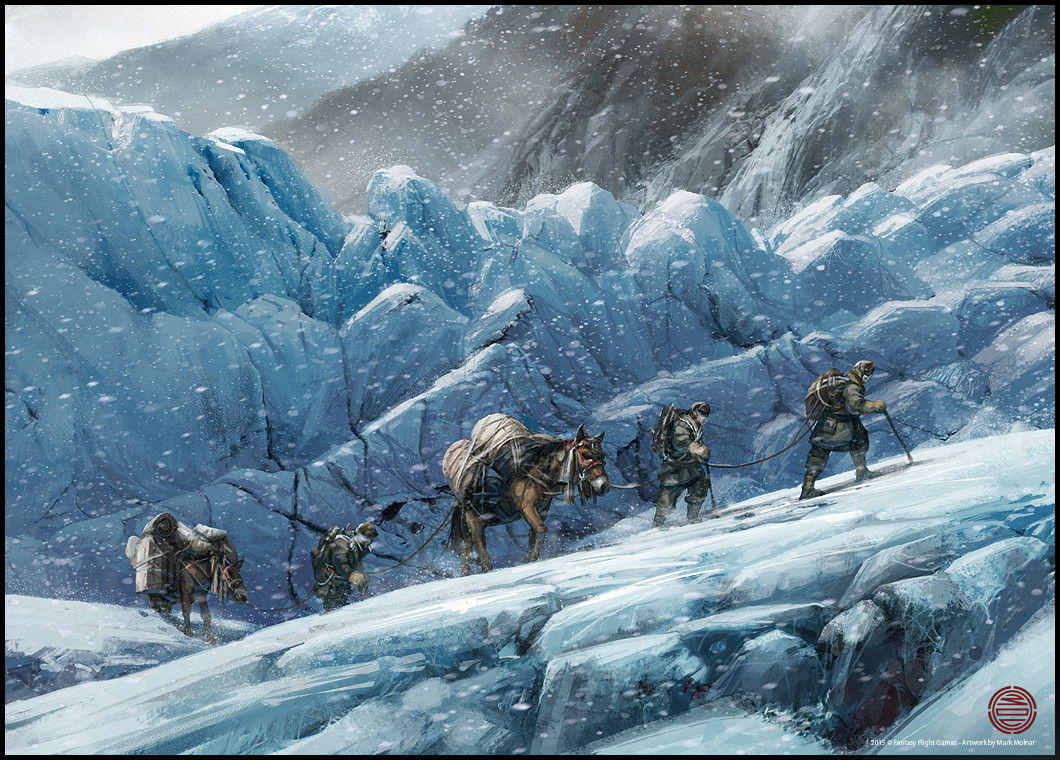
During Auril's everlasting winter, the average temperature in Icewind Dale is −49 degrees Fahrenheit (−45 degrees Celsius). Wind chill can lower these temperatures by as much as -80 degrees. A creature exposed to the cold must succeed on a DC Constitution saving throw at midnight and in the end of each hour in a blizzard storm or immersed in frigid water every 3 min or gain one level of exhaustion. In the following table you will determine the temperature and its corresponding saving throw.
| Conditions | Temperature | DC Frost Check |
|---|---|---|
| Cold | 0°C | DC 10 |
| Frigid Cold | -20°C | DC 15 |
| Severe Cold | -40°C | DC 20 |
| Extreme Cold | -60°C | DC 25 |
| Deathly Cold | -80°C | DC 30 |
Frost Check (FC). If they fail, they gain one level of exhaustion. If a player fails by more than ten, they gain two levels of exhaustion. In the Rime there are a wide variety of cold temperatures. The DC increases by 5 for each 20 degree drop from 0 to -80 degrees. Temperatures may vary depending on altitude, exposure and weather.
Characters who are exposed to extreme cold without being prepared can experience both hypothermia and frostbite. If a character fails multiple consecutive Constitution saving throws against Frost Spells and cold or extreme cold weather, he suffers the Frostbitten condition and suffers the following:
The Extended duration of the Cold has penetrated deep into your bones.
The Frostbitten or Hypothermia condition is removed by at the end of a full day's rest in conditions that provide immunity to cold weather and a warm source of fire.

Any PC can spend a short rest (1hrs minimun) to make a improvised shelter for one person or pitch a tent to get a well rest condition (long rest effect) a PC without completing the necessary time of sleep can't get the well rest condition (if the race need 8hrs or Trance). A shelter + and any heat source + food + needed time of rest, reduce 1 level of exhaustion.
Pitch a tent without any measure of defense or exposed can allure hunger creatures to a midnight snack. The DM rolls a d4 on the table below to decide what campsite properties are found.
| Camp properties | D4 |
|---|---|
| Defendable | 1 |
| Hidden | 2 |
| Comfortable | 3 |
| Exposed | 4 |


Skill: Strength (Athletics).
You can use wooden spikes or large boulders to barricade your campsite or dig a ditch and build ramparts. A successful DC 15 Strength (Athletics) check adds the Defendable property to your campsite if it doesn't already have it. The DM may increase the DC of the check due to terrain or climate complications.
Skill: Dexterity (Stealth).
You can gather and use natural materials like rocks or foliage to hide your campsite. A successful DC 15 Dexterity (Stealth) check adds the Hidden property to your campsite if it doesn't have it. The DM may increase the DC of the check due to terrain or climate complications.
Skill: Dexterity (sleight of hand).
You can set a number of small traps like caltrops, slings, and small pits around your camp. The DC to find these traps with an Intelligence (Investigation) or Wisdom (Perception) check, as well as the DC for any saving throw made to resist their effects is equal to the result of your Dexterity (sleight of hand) check adds the Confortable property to your campsite if it doesn't have it.
These traps do 2d4 damage if triggered and enough noise for guards to hear them, or sleeping creatures to attempt Constitution saving throws to be alarmed and awakened.
Skill: proficient Wisdom (Medicine) and a Comfortable camp.
You go around camp, making sure that the wounds and condition of up to six creatures other than yourself have taken all precautions against extreme weather. For each ally, spend a use of healer's kit and make a check against DC 15.
At the end of the long rest, every tended creature that removed level of Exhaustion during its long rest and still has more levels of Exhaustion, removes an additional level of Exhaustion.

Tool proficiencies are a useful way to highlight a character's background and talents. At the game table, though, the use of tools sometimes overlaps with the use of skills, and it can be unclear how to use them together in certain situations. XGE p78. Any skill checks that need to be made, may also add the proficency to the roll with the required tool. Must be proficient in the tool to add the bonus using the Hammunds Crafting table.
Some races are known for some kind of works, their bloodlines let them be better than others in some extent with the right tool.
Some other races have their own additions or proficiency, any race are subject to review per player request, content is re-evaluated, re-balanced and included in this campaign supplement. Working together can down the time needed in craft or foraging and stack bonuses with diferent races.
What is better for making a Quarterstaff, Carpenter’s tools or Woodcarver’s Tools? The decision lies with the DM, but it should be noted neither the tools nor the proficiency brings with it any structural requirements if they exist. A Smith will still need a forge to properly apply their craft.
| Tool's | Ability Score |
|---|---|
| Alchemist’s Supplies | Intelligence |
| Brewer’s Supplies | Wisdom |
| Calligrapher’s Supplies | Dextrity |
| Carpenter’s Tools | Strength |
| Cartographer’s Tools | Intelligence |
| Cobbler’s Tools | Dexterity |
| Cook’s Utensils | Wisdom |
| Glassblower’s Tools | Constitution |
| Jeweler’s Tools | Intelligence |
| Leatherworker’s | Dexterity |
| Mason’s Tools | Strength |
| Painter’s Tools | Charisma |
| Potter’s Tools | Dexterity |
| Smith’s Tools | Strength |
| Tinker’s Tools | Dexterity |
| Weaver’s Tools | Dexterity |
| Woodcarver’s Tools | Dexterity |

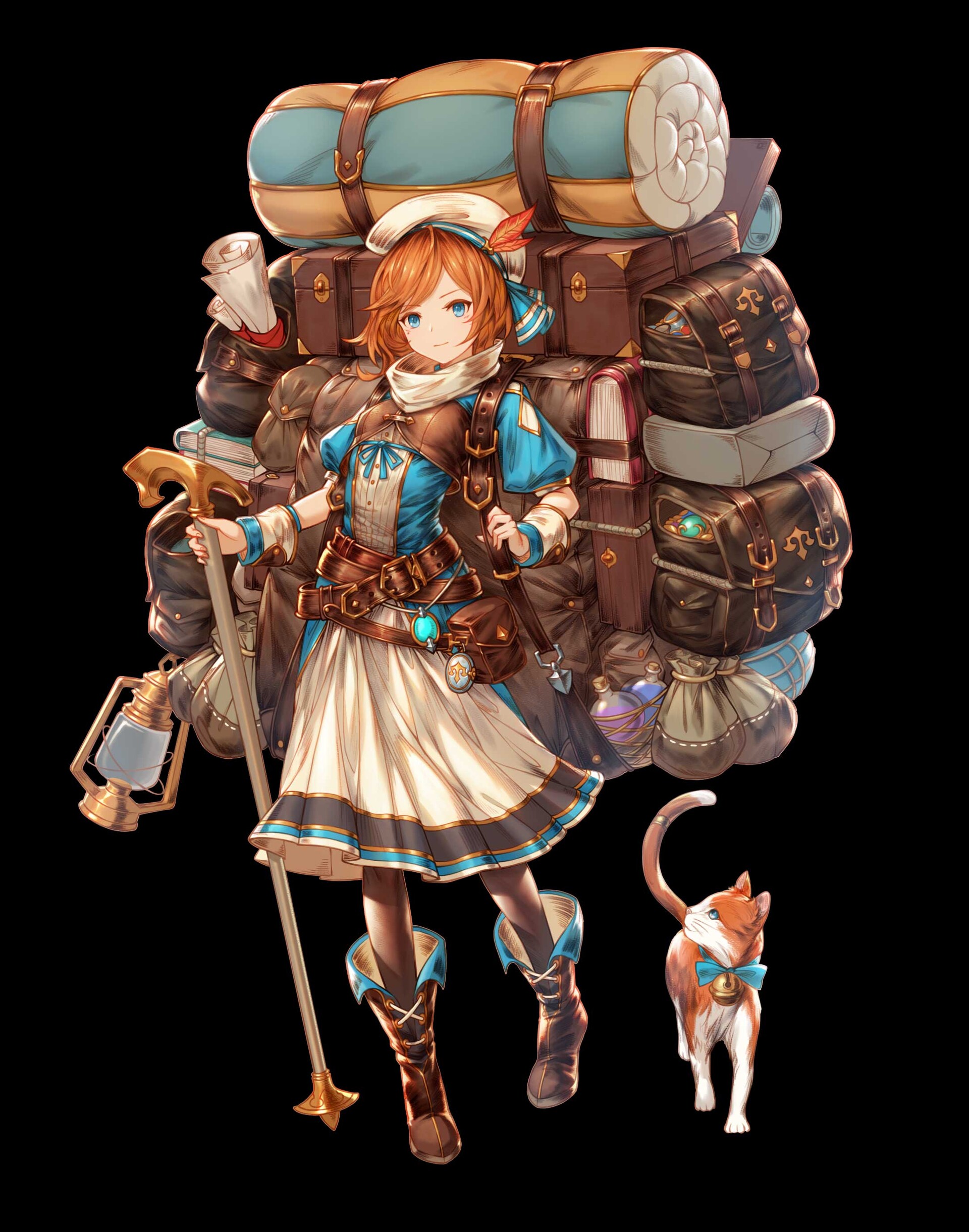
The Winter Survival Gear table provides costs for cold weather clothing, crampons, and snowshoes, which can be added to the list of things that characters can buy in Ten-Towns.
| Item | Price | Weight | Frost Check (FC) |
|---|---|---|---|
| Furred Coat | 10 gp | 8 lbs | +5 |
| Hide Gambeson | 8 gp | 12 lbs | +5 |
| Rawhide Cloak | 6 gp | 3 lbs | +2 |
| Crampons | 2 gp | 1/4 lbs | - |
| Snowshoes | 2 gp | 4 lbs | - |
| Snow Goggles | 5 gp | 1/4 lbs | - |
Furred Coat.
Thick set of arctic explorer's clothing including a two layered elk hide coat with a furred cloak, set of woolen stockings, a scarf and a hat, and ordinary thick boots. While not wet, these clothes provide +5 to FC rolls. You can wear light armor under the coat but not medium or heavy armor.
Hide Gambeson.
This underlay is made of rawhide medium armor stripped of most of its worn out outer layers. This allows to reuse what is left as a makeshift coat and put another set of medium armor on top of it. While not wet, these clothes provide +5 to FC rolls.
Rawhide Cloak.
A heavy rawhide cloak from a bear or a thunderbeast been worn provide partial coverage of the body against FC rolls, it can provide +2.
Crampons.
A crampon is a metal plate with spikes that is strapped to the sole of a boot. A creature wearing crampons can't fall prone while moving across slippery ice. (fighting exeption)
Snowshoes.
Snowshoes reduce the likelihood of their wearer getting stuck in the deep snow. Wearer can move at normal speed through snowy difficult terrain.
Snow Goggles.
Allows the wearer to roll without disadvantage on sight, tracking, and navigation checks inside of storms.

| Item | Capacity | Price | Weight | Frost Check (FC) |
|---|---|---|---|---|
| Insulated tent (2) | 1 Large or 2 Medium | 40 gp | 35 lbs | +10 |
| Insulated tent (6) | 3 Large or 6 Medium | 250 gp | 70 lbs | +10 |
| Coal rocks (5 uses) | - | 3 gp | 15 lbs | - |
Insulated Tent. This tent protects creatures inside of it against the elements. While inside of the tent, the creatures has +10 FC roll.
Sack of coal rocks. Black coal rocks mined in the region between Mirabar and the Evermoors is sold in rough burlap sacks. Rocks of coal burn twice longer than dry wood and are far more compact than carrying stacks of wood or relying on foraging before camping especially during the arctic winter. A single sack contains enough to maintain 5 campfires.
| Vehicles | Cost | Weight | Speed | Crew | Passengers | Carry Capacity | Pull | AC | HP | Damage Threshold |
|---|---|---|---|---|---|---|---|---|---|---|
| Dogsled (Medium) | 20 gp | 30 lbs. | - | 1 | - | 300 lbs. | - | 12 | 50 | 5 |
| Dogsled (Large) | 50 gp | 50 lbs. | - | 1 | 3 | 500 lbs. | - | 13 | 55 | 8 |
| Sled Dog (Medium) | 50 gp | - | 4 miles/hrs | - | - | 180 lbs. | 900 lbs. | 13 | 11 | - |
| Axe Beak (Large) | 75 gp | - | 5 miles/hrs | 1 | - | 420 lbs. | 2.1 tons. | 11 | 19 | - |
| Reindeer (Large) | 75/100 gp | - | 5 miles/hrs | 1 | - | 480 lbs. | 2.4 tons. | 10 | 13 | - |
Sled Dog. Sled dogs served as a primary means of communication and transportation in harsh arctic weather conditions.
Sled dogs must take a short rest after pulling a sled for 1 hour; otherwise, they gain one level of exhaustion.
Axe Beak. An axe beak is a tall flightless bird with strong legs and a heavy, wedge-shaped beak. An axe beak's splayed toes allow it to run across snow, and it can carry as much weight as a mule.
Reindeer. Are a larger variety of deer. They have arching antlers, thick coats, long snouts, and wide hooves. Their coat is brown or grey. Reindeer are crucial to the survival of the northern tribes of the Hordelands.
One out of every six has glow-in-the-dark antlers that emit dim light in a 10-foot radius.
.
When your sack an ancient temple or clear a crumbling dungeon they expect to find some loot. But an often overlooked feature of these older dungeons is spoilage and decay.
We will base time on the Calendar of Harptos
| Type | Workweek |
|---|---|
| Dairy | 1 |
| Meat | 1/2 |
| Drinks (Non-Alcoholic) | 3 |
| Condiment | 9 |
| Type | Durability | Price % |
|---|---|---|
| Loot & Crafts | 100 % | -10 |
| Loot & Crafts | 75 % | -30 |
| Loot & Crafts | 50 % | -60 |
| Loot & Crafts | 25 % | -90 |
| D20 | Effect |
|---|---|
| 1-5 | Nauseating |
| 6-8 | Side Effects |
| 9-12 | Weakened |
| 13-19 | Normal |
| 20 | Better with Age |
| Type | Durability | Price % |
|---|---|---|
| Meal Cooked | +1 (FC) | 1 hrs |
| Hot Soups | +2 (FC) | 1/2 hrs |
| Hard Drinks [Con Save] | +2 (FC) | 1-1/2 hrs |

You can move through a nonhostile creature’s space. In contrast, you can move through a hostile creature’s space only if the creature is at least two sizes larger or smaller than you, As an Action contest check [STR or DEX] if is one size large, smaller or same. Remember that another creature’s space is difficult terrain for you. Whether a creature is a friend or an enemy, you can’t willingly end your move in its space, if is a friendly creature can enter and leave if have movement left.
If you fall into a deep body of water is difficult terrain and you carry weight in excess of 5 times your Strength score, every foot of movement costs 1 extra foot.
If you carry weight in excess of 10 times your Strength score, up to your maximum carrying capacity your speed is 0 and need make STR check to stay afloat.

Long Live
the Queen of
Cold and Frost.
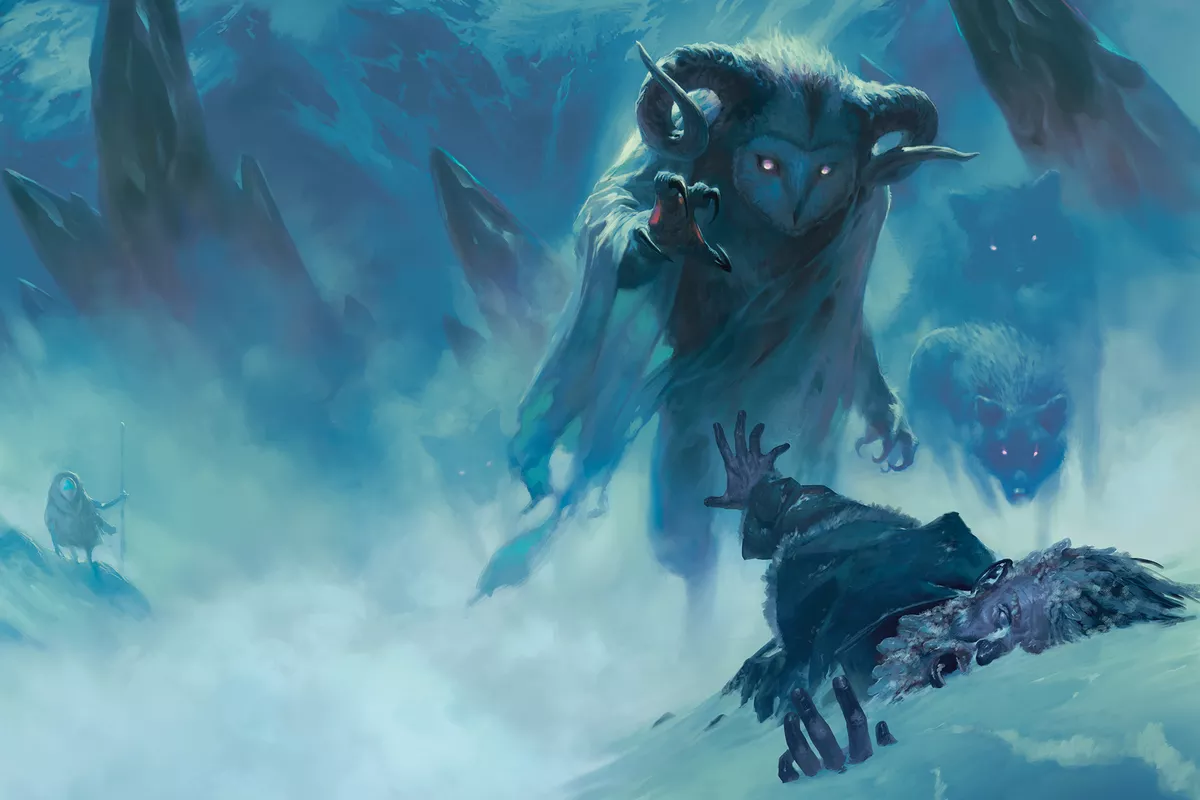
Icewind Dale has become trapped in a perpetual winter. Ferocious blizzards make the mountain pass through the Spine of the World exceedingly treacherous, and this land has not felt the warmth of the sun in over two years.
In fact, the sun no longer appears above the mountains, not even in what should be the height of summer. In this frozen tundra, darkness and bitter cold reign as king and queen.
Most dale residents blame Auril the Frostmaiden, the god of winter's wrath. The shimmering aurora that weaves across the sky each night is said to be her doing--a potent spell that keeps the sun at bay.
This campaign is maintained by Lord AO for personal use with his group. Feedback and suggestions are greatly appreciated.